STAY UP TO DATE
The Grey Blog


FEATURED ARTICLES

Virtual cards in Egypt for online payments
Grey, EverTry, Card-Y, Fyatu, and AstroPay: Here is how virtual cards work for online payments in Egypt and your top options.

Adeolu Titus Adekunle
•
6 min read
It is one thing to have the funds for online payments; it is another thing to have the means to complete the payment without getting frustrated. Managing international payments in Egypt can be quite a hassle. If you’ve tried paying for an international subscription, a work tool, online shopping, or an online course from Egypt, perhaps you can relate to the struggle. Local Egyptian bank cards are often restricted from international transactions, offer poor exchange rates, or aren’t supported by global platforms.
Virtual cards exist mostly to solve these problems, and they have become one of the most efficient options for anyone who shops online, pays for subscriptions, or needs a reliable way to spend in foreign currency without the limitations of a standard local bank card.
This article explains how virtual cards work, who they are for, and the main options available to people in Egypt right now.
What is a virtual card, and how does it work?
A virtual card is a digital payment card that works just like a traditional debit or credit card, except it exists only electronically. Instead of receiving a plastic card, you get the card details instantly on your phone or computer, including the card number, expiration date, and CVV security code.
Because virtual cards are issued digitally, they are typically available within minutes, unlike physical cards that must be printed and delivered.
Most virtual cards operate as prepaid or debit cards, meaning you spend funds you already have. In many cases, the card is connected to a multi-currency account, so payments are deducted directly from your balance in currencies such as USD, GBP, or EUR. This eliminates the need to manually top up the card before each purchase.
For example, Grey virtual cards are linked directly to your foreign currency balance, allowing you to pay online or in apps without transferring funds to the card first.
In practice, using a virtual card is no different from using a physical one. You simply enter the card details at checkout when making online payments, subscriptions, or international purchases. Many virtual cards can also be added to Apple Pay or Google Pay, enabling secure contactless payments with your phone wherever mobile wallets are supported.
Also read: Managing USD income as a remote worker in Egypt
What to look for when choosing
Not all virtual cards work the same way. The best option for you will depend on how you plan to use it, which currencies you deal with most often, and how frequently you make international payments. Before choosing a provider, it’s worth looking closely at a few key factors.
Currency support. Many virtual cards are designed primarily for USD payments, but international platforms often charge in other currencies such as EUR or GBP. If you regularly use services based in Europe or the UK, a card that supports multiple currencies can help you avoid additional conversion fees. Choosing a provider with a multi-currency account allows you to hold and spend different currencies more efficiently.
Funding options. Different platforms allow you to add funds in different ways. Some accept local bank transfers, others allow crypto deposits such as USDT, and some link directly to a multi-currency account balance, like Grey. Before signing up, check that the funding method available actually works for your situation and location.
Platform compatibility. Not every virtual card works equally well across all international platforms. Some services, particularly advertising platforms or large marketplaces, may reject certain cards depending on the issuing network or region. If you plan to use your card for a specific purpose, such as paying for Google Ads or cloud hosting, it’s worth confirming that the card is widely accepted on those platforms.
Fees and exchange rates. Virtual card costs can vary significantly between providers. Some charge a card creation fee, others add transaction fees, and most apply a small markup on currency conversions. A card that appears free at first glance may become more expensive if the exchange rate spread is high. Always look at the total cost of using the card, not just the upfront fee.
Security and regulation. Security should always be a priority when choosing a financial platform. Look for providers that follow proper identity verification processes and operate with licensed financial partners. Features such as two-factor authentication, transaction alerts, spending limits, and the ability to instantly freeze your card add an important layer of protection.
Contactless payments. Some virtual cards can be added to mobile wallets like Apple Pay or Google Pay, allowing you to make contactless payments with your phone. This can be particularly useful when travelling or making in-store purchases abroad. If this feature matters to you, make sure the card supports mobile wallet integration in your region.
Taking a few minutes to compare these factors can help you choose a virtual card that fits your spending habits and avoids unnecessary fees or payment issues later.
The top virtual cards in Egypt for online payments
While cards issued by local banks work well for domestic spending, they are not always reliable for international payments. Here is a list of the top virtual cards in Egypt for online payments.
Grey
Grey offers virtual cards linked to a multi-currency account that supports USD, EUR, and GBP. You can create multiple cards for various uses to properly plan your finances. One card can be for online shopping while another could be for subscriptions and or online course. Grey cards are globally accepted and works with the full range of international platforms
You can receive international payments into your Grey USD, GBP, or EUR account or fund your account in EGP and convert to USD to spend on your cards directly.
Fees: Grey virtual USD cards cost a one-time creation fee of $4, plus a minimum of $1 to fund the card, totalling $5 to get started. There are no monthly maintenance fees.
EverTry
EverTry offers a solution for international payment restrictions in Egypt through their virtual dollar card platform. It allows Egyptian users to pay for global services that often decline local bank cards. It supports funding in local currency and USDT, making it accessible to users who are comfortable with crypto. The card works across a wide range of international platforms, including Netflix, Spotify, AWS, DigitalOcean, Namecheap, Facebook Ads, and Google Ads.
Fees: Card creation typically costs $2.5, with no monthly maintenance fees.
Card-Y
Card-Y is a fintech platform that offers multi-currency global accounts with a linked virtual card, designed for Egyptian freelancers and remote workers. It offers USD and EUR account details for receiving international payments, with a free virtual card included that draws from those account balances. It also issues local Egyptian bank cards to subscribers.
Fees: Card-Y offers virtual Mastercard issuance for a $20 USD fee, which is valid for one year and does not add to the card balance. The service features a $1 monthly maintenance fee, a 1% USD transaction fee ($1 min/$5 max), and a 1.5% foreign currency conversion fee.
Fyatu
Fyatu provides instant virtual Mastercards with support for multiple currencies, aimed at users who need to make global payments and manage international subscriptions. Onboarding is digital, and card issuance is immediate. It is a straightforward option for users whose primary need is an international spending card rather than a full suite of banking features.
Fees: Fyatu virtual card costs include a 1.5% fee for card usage (for either withdrawal or payments), with card replacement fees of $5 for World cards and $10 for Platinum cards. A $1.00 fee applies to declined transactions. Funding methods vary, with fees such as 3% for MTN MoMo and various percentages for online wallets like PayPal (3.5% + $0.30).
AstroPay
AstroPay is a globally recognised digital wallet and virtual card platform, available in over 150 countries, including Egypt. It has been around since 2009 and has a particularly strong footprint in emerging markets across Africa, Latin America, and Asia. The platform supports more than 50 currencies, issues virtual prepaid cards instantly, and does not require a traditional bank account to sign up.
For Egyptian users, AstroPay works as a prepaid spending tool. You load funds onto your wallet using a local payment method, then use the virtual card for international purchases on platforms that accept Visa or Mastercard. Card details are issued instantly through the app, and the platform supports one-time or multi-use cards depending on the denomination.
However, bank withdrawals from AstroPay can attract fees of up to 6% depending on the institution. There is a margin of 1% to 3% on exchange rate.
Fees: No card purchase or maintenance fee. No annual fee. Transaction fees of 2–5% depending on the payment method used. FX markup of approximately 1–3% on non-native currency transactions. Withdrawals to a bank account: up to 6%.
Comparison of the top virtual cards in Egypt
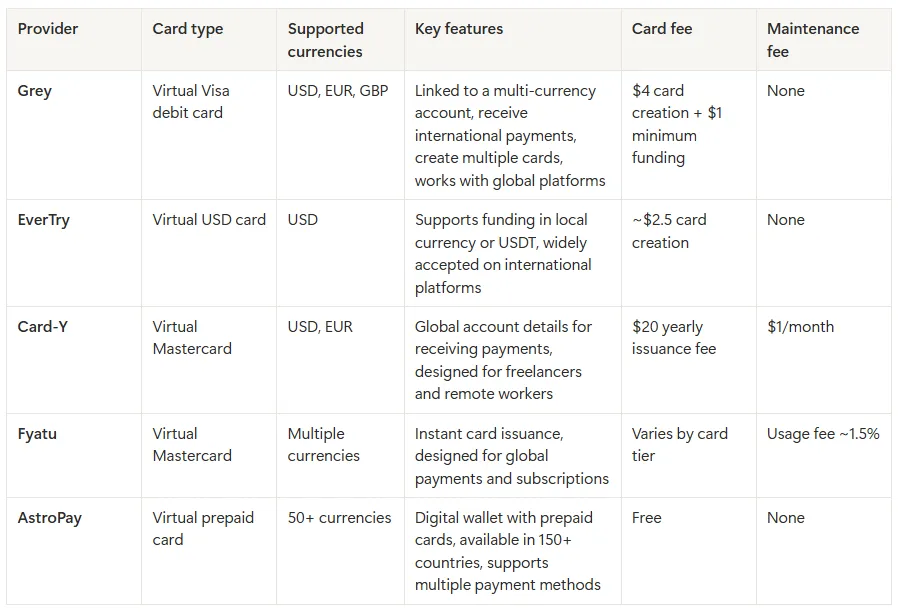
Before exploring each option in detail, the table below summarises some of the key differences between the most popular virtual cards available to users in Egypt, including supported currencies, card type, and typical fees.
Quick recommendations
If you’re not sure which virtual card to choose, here’s a quick guide based on common use cases in Egypt.
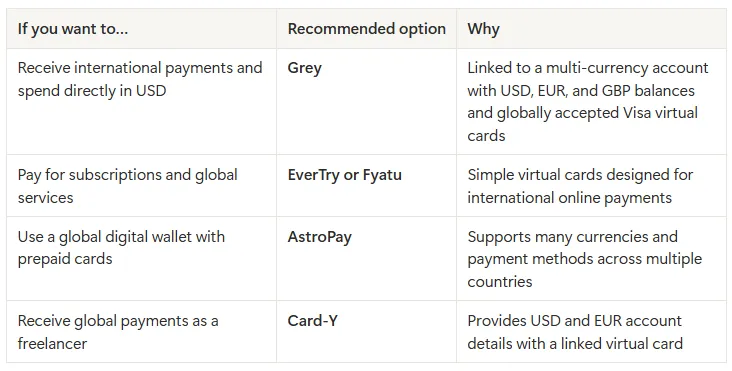
For most freelancers, remote workers, and online entrepreneurs in Egypt, a virtual card linked to a multi-currency account is often the most practical option. It allows you to receive money from abroad, hold foreign currencies, and pay for global services without converting funds every time you make a transaction.
Also read: Grey card vs other virtual cards: What you should know
Make international payments with Grey
The advent of virtual cards has brought significant flexibility to managing international payments. Grey gives Egyptians a virtual card linked to your multi-currency account. This allows you to receive international payments and spend internationally from the same platform. Whether you are paying for software subscriptions, running digital ads, shopping on international platforms, or managing online tools for your work, Grey's virtual card is accepted globally and straightforward to set up.
Ready to get your virtual card? Sign up on Grey and download the app to create your virtual USD card in minutes.
ALL ARTICLES

UAE Golden Visa: Eligibility and how to apply
See who qualifies for the UAE Golden Visa and how to apply. Routes, thresholds and steps, checked against official sources. Start planning your move.
Tunde Aladeloba
•
October 15, 2026
•
6 min read
The UAE Golden Visa offers long-term residency to investors, entrepreneurs, skilled professionals and individuals with exceptional talent who want to live and build their future in the United Arab Emirates. Depending on the eligibility category, the visa is typically valid for five or ten years and can be renewed.
Unlike standard residency permits, the UAE Golden Visa allows eligible holders to live, work and study in the country without requiring a national sponsor. It also offers greater flexibility for individuals seeking long-term stability, career opportunities and business growth in the UAE.
Eligibility depends on factors such as professional qualifications, salary, investment value, business ownership or recognised achievements. Applicants must meet the specific requirements for their chosen category and provide supporting documents.
The application process generally involves identifying the appropriate eligibility route, gathering the required documents and submitting an application through the relevant UAE government authority or approved channel.
Understanding the eligibility criteria, documentation requirements and application process can help prospective applicants make informed decisions before applying for the UAE Golden Visa.
What is the UAE Golden Visa?
The UAE Golden Visa is a long-term residence permit introduced by the United Arab Emirates to attract investors, entrepreneurs, skilled professionals, scientists and individuals with exceptional talents. It allows eligible foreign nationals to live in the country and pursue career, business or educational opportunities without needing a traditional national sponsor.
The visa is generally issued for five or ten years, depending on the applicant’s eligibility category and the applicable requirements. It is renewable, provided the holder continues to meet the relevant conditions. The validity period offers greater stability for individuals and families planning to establish long-term roots in the UAE.
One of the key benefits of the UAE Golden Visa is self-sponsored residency. Unlike many standard employment-based residence permits, holders do not need an employer or UAE national to sponsor their residency. This provides greater independence when changing jobs, managing businesses or exploring professional opportunities.
For eligible applicants, the UAE Golden Visa offers more than extended residency. It provides flexibility to build a career, invest, study and plan for the future in one of the Middle East’s leading business and lifestyle destinations, subject to applicable laws and visa conditions.
Who Is Eligible for the UAE Golden Visa?
Your eligibility for the UAE Golden Visa depends on your professional achievements, investments, qualifications or exceptional abilities, with specific requirements for each applicant category.
Investors
Investors may qualify through eligible public investments or real estate investments that meet the UAE’s financial and regulatory requirements. Applicants must provide supporting documents to demonstrate that their investments satisfy the applicable criteria.
Entrepreneurs
Entrepreneurs may qualify through business ownership, approved projects or demonstrated entrepreneurial achievements, depending on the relevant eligibility category. Applicants must meet the applicable conditions and provide evidence of their business activities or project qualifications.
Skilled professionals
Skilled professionals may be eligible based on their occupation, educational qualifications, employment status, salary and other requirements. Eligibility depends on the applicant’s professional category and the relevant government regulations.
Students and graduates
Outstanding students and graduates may qualify based on academic performance, examination results and recognised institutional criteria. Specific requirements apply depending on their educational background and the relevant eligibility pathway.
Exceptional talent
Individuals with exceptional abilities in fields such as science, technology, arts, culture and sports may qualify through relevant approvals. Applicants may need to demonstrate recognised achievements, specialised expertise or professional distinction, depending on their field.
Investment routes and thresholds
The UAE Golden Visa offers long-term residency to eligible investors through property ownership and qualifying capital investments. The minimum investment threshold for these routes is generally AED 2 million, subject to the applicable eligibility criteria and documentation requirements.
Property investment
The property investment route requires real estate with a combined value of at least AED 2 million. Multiple properties may be combined to meet the threshold. Certain off-plan and mortgaged properties may qualify, depending on the emirate and applicable conditions.
Capital and public investments
Investors may qualify by investing at least AED 2 million in an eligible UAE investment fund or qualifying business. An approved bank deposit may also meet the requirements, subject to the relevant regulations and supporting documentation.
The 23 Lakh Rumour
Online claims about a UAE Golden Visa costing approximately ₹23 lakh, or AED 100,000, have caused confusion. This amount should not be mistaken for the standard investment threshold for the Golden Visa. Any offer promising residency at a significantly lower cost should be verified through official UAE government channels before payment.
Also read: How UAE freelancers save on currency exchange with Grey
How to apply for the UAE Golden Visa
Step-by-Step application process
1. Check your eligibility and apply
Choose the appropriate Golden Visa category and submit your application or nomination request through the relevant authority. Upload supporting documents, such as your property title deed, investment evidence or salary certificate, as required.
2. Obtain an entry permit if required
If you are applying from outside the UAE, check whether you need an entry permit to complete the residency process. Eligible applicants may use a six-month multiple-entry permit, subject to approval and applicable rules.
3. Complete your medical fitness test
Once in the UAE, complete the required medical fitness examination at an authorised centre. This typically includes a blood test and chest X-ray.
4. Submit your final application
Provide the remaining documents, including your medical fitness results and proof of health insurance, where required. Pay the applicable fees and wait for the authorities to process your application.
5. Complete biometrics and receive your Emirates ID
Attend your biometrics appointment if required. Once your application is approved, your Emirates ID and Golden Residency will be processed.
Where to apply
You can submit your UAE Golden Visa application online through the relevant government portal or get assistance in person at an authorised service centre.
- ICP: The Federal Authority for Identity, Citizenship, Customs and Port Security handles applications across Abu Dhabi, Sharjah, Ajman, Umm Al Quwain, Ras Al Khaimah and Fujairah.
- GDRFA Dubai: If your application is connected to Dubai, use the General Directorate of Residency and Foreigners Affairs.
- Amer and authorised typing centres: Visit an approved centre in the UAE for help preparing and submitting your application.
Required documents
Prepare the following documents before applying. Additional requirements depend on your eligibility category.
- Valid passport: A clear copy of your passport. Six months' validity is commonly recommended.
- Current visa or status documents: Provide your existing UAE residence visa, visit visa or cancellation documents, as applicable.
- Medical fitness certificate: Submit the certificate issued by an authorised UAE medical centre when required.
- Health insurance: Provide valid UAE health insurance or any alternative documentation permitted for your category.
- Passport photograph: Prepare a recent digital photograph that meets the UAE authorities' specifications, typically with a white background.
Read also: How to open a virtual bank account as a freelancer in the UAE
Money and banking in the UAE
The UAE dirham (AED) is the country’s official currency and is pegged to the US dollar. Understanding money and banking in the UAE helps you manage everyday expenses, receive your salary and plan your finances. Opening a local bank account typically requires identification, residency documents and other information, depending on the bank.
If you manage money across countries, a multi-currency account makes it easier to handle international finances. Grey offers a convenient way to manage multiple currencies, giving you greater flexibility when receiving, holding and moving money across borders.
When you need to send money from the UAE to Nigeria, Grey provides a practical solution for cross-border transfers. Its multicurrency services help simplify international money management, whether you are supporting family, handling personal expenses or managing business payments. With Grey, you can streamline your international finances and make cross-border money transfers more convenient.
Frequently asked questions about the UAE Golden Visa
Who qualifies for the UAE Golden Visa?
Eligible applicants include real estate investors, entrepreneurs, skilled professionals, exceptional talents and outstanding students. Each category has specific financial, academic or professional requirements. Applicants must meet the relevant criteria and provide supporting documents to qualify for long-term UAE residency.
How long is the UAE Golden Visa valid?
The UAE Golden Visa is generally valid for five or ten years, depending on your eligibility category. It can be renewed if you continue to meet the applicable requirements. This long-term residency offers greater stability for professionals, investors and families planning to live in the UAE.
How much do you need to invest?
The minimum investment threshold for qualifying property and capital investment routes is generally AED 2 million. Skilled professionals may qualify through a separate route, subject to salary, qualification and employment requirements, including a monthly salary threshold of AED 30,000 for eligible categories.
Can your family join you?
Yes. Golden Visa holders can sponsor eligible family members, including their spouse and children, subject to applicable requirements. They may also sponsor domestic workers under the relevant rules. This allows families to enjoy greater stability while living together in the UAE.
How do you apply for the UAE Golden Visa?
Applications can be submitted through the relevant government authority, including ICP or GDRFA Dubai, depending on your emirate and category. Prepare your supporting documents, submit the application, complete required medical checks and biometrics, and pay applicable fees.
How can you move money to the UAE?
You can transfer funds to the UAE through international bank transfers or authorised money transfer providers. A local UAE bank account can help manage incoming funds and everyday expenses. Keep supporting documents for larger transfers and comply with applicable banking and anti-money laundering requirements.
Portugal D7 visa: How to apply for the passive income visa
Find out if you qualify for the D7 visa Portugal offers passive income earners. Income thresholds, documents and timings explained. Apply with confidence.
Tunde Aladeloba
•
October 11, 2026
•
6 min read
Portugal has become an attractive option for people who want to build a life in Europe without relying on a local job offer. For retirees, property owners and others with regular passive income, the Portugal D7 visa offers a way to apply for residency while continuing to support yourself from income earned outside the country.
The Portugal D7 visa is a residency route for non-EU nationals with a stable passive income, such as pensions, rental income or dividends. You must show income at least equal to the Portuguese minimum wage, plus proof of accommodation.
But having enough income is only one part of the application. You also need to understand the documentation, accommodation requirements, application process and what happens after your visa is approved. If you are considering Portugal as your next home, knowing what the D7 visa requires before you apply can help you avoid delays, prepare the right documents and decide whether this residency route fits your circumstances.
Also read: Portugal transfer limits from US banks: Rules explained
What is the D7 visa?
The Portugal D7 visa is a residency visa for non-EU nationals with stable passive income who want to live in Portugal.
Who Can Apply?
The D7 visa is designed for non-EU nationals who can support themselves through regular passive income. Applicants must demonstrate sufficient financial means and provide accommodation evidence, making it suitable for people planning to relocate rather than simply visit Portugal.
Retirees
Retirees are among the most common D7 applicants because pensions can qualify as passive income. Someone receiving a regular pension from another country may use that income to demonstrate financial stability while moving to Portugal for retirement.
Remote-Income Earners
The D7 can also appeal to people earning a regular income from sources outside Portugal. This may include rental properties, investments or other recurring income streams. However, remote workers whose income comes from active employment or freelancing should check whether another Portuguese visa is more appropriate.
The Passive-Income Requirement
The D7 is based on demonstrating reliable financial resources rather than securing a Portuguese job. Applicants generally need to show recurring income, such as pensions, rental income or dividends, alongside sufficient savings to support their stay and meet the visa requirements.
What are the D7 visa requirements for Portugal?
Understanding the Portugal D7 visa requirements gives you a clearer picture of what to prepare before submitting your application, from proving your finances to securing accommodation and meeting the health and character requirements.
- Income: Financial stability is central to the D7 application. You need to demonstrate sufficient regular income or financial resources to support your life in Portugal. For 2026, Portugal’s minimum wage is €920 per month, giving a €11,040 annual reference amount for a single applicant.
- Accommodation: Before applying, arrange a suitable place to live in Portugal. This could be a rental property or a home you own. Your documents should provide evidence of your intended address and show that you have somewhere to live during your stay.
- Health insurance: Appropriate health insurance is another part of the application. Your policy should cover necessary medical expenses, including urgent treatment and potential repatriation. Once you become a resident, different healthcare requirements may apply depending on your circumstances.
- Clean record: Your application also needs to demonstrate good character. This usually means providing a criminal record certificate from your country of nationality or the relevant country of residence, with the required authentication. Portuguese authorities will also check your Portuguese criminal record.
For highly qualified professionals moving to Portugal for work, the EU Blue Card route provides another residency option. The route is designed for skilled workers with an eligible employment offer and comes with specific requirements
Also read: Real budgeting tips for nomads living in Lisbon
How to apply for the Portugal D7 visa
If you are applying for the Portugal D7 visa, following the process in the right order helps you prepare your documents, avoid unnecessary delays and know what to expect at each stage.
1. Gather your documents
Start by preparing proof of income or financial resources, accommodation in Portugal, valid health insurance, a criminal record certificate, your passport and any other supporting documents required. You may also need to have certain documents authenticated or translated before submitting your application.
2. Submit your visa application
Next, submit your D7 visa application through the Portuguese consulate or visa application centre responsible for your country of residence. You will provide your documents, complete the application process and attend an appointment or interview if requested.
3. Travel to Portugal
Once your residence visa is approved, you can travel to Portugal within the validity period shown on your visa. This gives you permission to enter Portugal and complete the next stage of your residency application.
4. Apply for your residence permit
After arriving in Portugal, you will attend your appointment with AIMA and submit the documents required for your residence permit. Once your application is approved, you will receive your Portuguese residence card, allowing you to live in Portugal legally.
Residency, taxes and the path to citizenship
Once you have your D7 residence permit, the focus shifts from getting approved to maintaining your residency and planning for the years ahead. That means understanding renewal dates, how much time you need to spend in Portugal, the route to citizenship and how becoming a tax resident could affect your income.
Renewal timeline
Your D7 journey begins with a two-year residence card, followed by a three-year renewal, provided you continue meeting the residency requirements and maintaining your ties to Portugal. You should also plan around the minimum-stay requirement, especially if you work remotely or are registering as self-employed abroad while living in Portugal.
Minimum stay
A D7 residence permit is intended for people who genuinely live in Portugal, so your travel plans matter. You generally need to spend at least six consecutive months or eight non-consecutive months in Portugal each year. If your work takes you abroad frequently, factor these limits into your plans before choosing this residency route.
Citizenship route
After five years of legal residency, D7 holders may become eligible to apply for Portuguese citizenship, subject to the applicable requirements, including an A2-level Portuguese language test. For someone building a long-term life in Portugal, this can turn the D7 from a temporary relocation decision into a potential pathway towards permanent belonging.
How moving to Portugal can affect your tax residency
Getting a D7 residence permit does not automatically mean every tax obligation is the same; your tax residency depends on your circumstances and time spent in Portugal.
Portugal generally considers factors such as spending more than 183 days in the country or having a home there that indicate an intention to maintain it as your habitual residence. Once you become a tax resident, Portuguese IRS rules can apply to your income, including foreign-source income, subject to applicable exemptions, credits and tax treaties.
Proving income and moving money when preparing for life in Portugal
As you prepare your Portugal D7 Visa application, Grey can help you manage the money side of your move. Its multi-currency account lets you hold and manage different currencies, while giving you access to a euro account for receiving, holding and spending euros once you start settling into Portugal.
You will still need to prove that you have stable funds or a regular income to support yourself. Your bank statements and financial documents should clearly show where your money comes from and that you can cover your living costs. Having a euro account can also make everyday payments in Portugal more straightforward.
Whether you are moving money from the UK to Portugal or the US to Portugal, Grey gives you a way to move funds across currencies without having to juggle multiple accounts. You can convert your money to euros when needed and use your euro balance for expenses such as rent, bills and everyday spending.
Frequently asked questions about Portugal D7 visa
What is the D7 visa?
The D7 visa is a Portuguese residence visa for non-EU citizens who have a stable income or sufficient financial resources. It is commonly associated with passive income, including pensions, investments and rental income, and allows eligible applicants to live in Portugal with their families.
How much income do I need?
The minimum income requirement is linked to Portugal’s minimum wage and currently starts at €920 per month for the main applicant. You need additional funds for dependents. You should also be prepared to demonstrate that your income or savings can support your planned life in Portugal.
Can I work on a D7?
Yes. Although your initial D7 application is based on demonstrating sufficient income or financial resources, holding Portuguese residency allows you to work legally in Portugal. This means you can take up employment, become self-employed or develop a business after your residency has been granted.
How long does it take?
The initial D7 visa process can take around 60 days once your application is submitted, although processing times vary by consulate and individual circumstances. After receiving the visa, you travel to Portugal and complete the required steps to obtain your residence permit.
Does it lead to citizenship?
The D7 can provide a route towards Portuguese citizenship. Under the rules applicable to your application, you may become eligible after meeting the required period of legal residence and other conditions, including Portuguese language requirements. Check the current nationality rules before relying on a specific timeline.
How do I move money to Portugal?
You can transfer money internationally into your Portuguese bank account to support your move and everyday expenses. Grey can also help you move money across currencies, including transfers from the UK or US to Portugal, while its multi-currency account gives you access to a euro balance.
EU Blue Card: How to qualify and apply
See who qualifies for the EU Blue Card and how to apply. Degree and salary thresholds, plus the German route, explained. Start your application today.
Tunde Aladeloba
•
October 11, 2026
•
6 min read
Moving to Europe for work can feel complicated when you are trying to understand which visa, residence permit and eligibility requirements apply to you. The EU Blue Card offers a route for highly qualified non-EU nationals who have the skills and qualifications European employers need.
To qualify for an EU Blue Card, you generally need a recognised university degree or equivalent professional qualification, a qualifying employment contract or job offer, and a salary that meets the required threshold in the EU country where you plan to work. Requirements can vary between countries, so checking the rules for your destination matters before you apply.
The EU Blue Card combines the right to live and work in a participating EU country with a pathway to greater mobility within the EU. Understanding the eligibility criteria, salary requirements and application process can help you decide whether it is the right route for your move.
Also read: Expat living in Germany: Banking, visas and costs
What is the EU Blue Card?
The EU Blue Card is a work and residence permit for highly qualified non-EU nationals who have a qualifying job offer in a participating European Union country. It is designed to attract skilled professionals from outside the EU by giving them the right to live and work in the country where they are employed, provided they meet the required qualifications, salary and employment conditions.
The “highly qualified” requirement generally means you need higher education qualifications, such as a recognised university degree, or qualifying professional skills recognised under the rules of the country where you apply. You also need a binding job offer or employment contract that meets the required salary threshold. Because these thresholds and application requirements vary by country, your eligibility can depend on where you plan to work.
Most EU countries participate in the EU Blue Card scheme, including Germany, France, the Netherlands, Spain and Italy. Denmark and Ireland do not participate, so you need to consider the specific immigration route available in your chosen destination before applying.
Who qualifies for the EU Blue Card?
You may qualify for the EU Blue Card if you are a highly qualified non-EU national with a qualifying job offer in a participating EU country. You generally need higher professional qualifications, a work contract or binding job offer lasting at least six months, and a salary that meets your destination country’s threshold.
A university degree is the most common way to meet the qualification requirement, typically through a recognised higher education programme of at least three years. However, some countries also recognise relevant professional experience as an alternative, particularly for certain occupations such as IT. Your job must also match the qualifications or professional skills you are using to qualify for the card.
There is no single euro salary figure for the whole EU. Under the current rules, each participating country sets its own threshold, generally between 1 and 1.6 times its average gross annual salary. For example, Germany’s 2026 threshold is €50,700, with a lower €45,934.20 threshold for shortage occupations and certain recent graduates.
The Blue Card in Germany
Germany is the largest issuer of EU Blue Cards in Europe, making it an important destination for highly qualified professionals looking to work in the EU. In 2024, Germany issued 56,252 Blue Cards, representing 72% of all cards issued across the EU.
For 2026, the standard salary threshold in Germany is €50,700 gross per year. A lower threshold of €45,934.20 applies to shortage occupations, provided the Federal Employment Agency approves the employment. Recent graduates can also qualify at the lower threshold, while certain IT specialists may qualify without a university degree if they have the required professional experience.
Germany’s shortage occupations include academic STEM professionals, doctors, veterinarians, dentists, pharmacists, nurses and midwives, teachers and educators, as well as certain managers in manufacturing, logistics, ICT and professional services. This means that when searching for German companies that sponsor work visas, your occupation and the salary offered can directly affect your EU Blue Card eligibility.
How to apply for the EU Blue Card step by step
Once you have confirmed that you qualify, the EU Blue Card application usually follows a straightforward sequence, although the exact process depends on the country where you will work.
- Secure a qualifying job: Get a signed employment contract or binding job offer that meets the required salary threshold and runs for at least six months.
- Prepare your documents: Gather your valid passport, employment contract, CV, degree certificates, proof of qualifications and health insurance. Your destination country may require foreign documents to be translated, legalised or accompanied by a statement of comparability.
- Apply for the required visa: If you need an entry visa, submit your application through the relevant embassy or consulate in your country of residence, including your supporting documents and biometrics.
- Enter your destination country: Once your visa is approved, travel to the country where you will work and complete any required address registration or other local formalities.
- Apply for your Blue Card: Depending on the country and your circumstances, you may apply before travelling or after arrival. The immigration authority reviews your application and, once approved, issues your biometric EU Blue Card residence permit.
Also read: How to open US, UK and Euro bank accounts in Germany
EU Blue Card benefits and path to permanent residence
The EU Blue Card offers more than permission to work, giving you options for family reunification, mobility across participating EU countries and eventually permanent residence.
Family reunification
Your EU Blue Card can make it easier to bring eligible family members to join you in your destination country. Spouses and dependent children may qualify for residence permits, with specific rights depending on national rules. In many cases, family members can also access employment without needing a separate work permit, helping your household settle more easily.
EU mobility
After legally living in an EU country with an EU Blue Card, you can gain greater mobility within participating EU countries. After 12 months of legal residence in your first member state, you may be able to move to another participating country for highly qualified employment, although you must apply for a new Blue Card under that country’s rules.
Path to permanent residence
The EU Blue Card can also contribute towards long-term residence, although the timeline depends on your circumstances and national rules. Under EU rules, Blue Card holders can generally qualify for EU long-term resident status after five years of continuous legal residence, with periods spent in other participating EU countries potentially counting towards the requirement.
Getting paid in euros and sending money home
Once you start working in Germany, your salary will typically be paid into a German or European bank account in euros. If you regularly move money across borders, opening a euro account can give you a place to receive and hold your earnings before deciding when to convert or transfer them, rather than exchanging everything as soon as you are paid.
Grey can help you manage this money through a multi-currency account where you can receive and hold supported currencies, manage international payments and convert funds when needed. This means your euros can remain available while you decide whether to spend them, convert them or send them elsewhere.
When you are ready to move your money, you can use supported payment routes to send money from Germany or send money to India, depending on the currencies and transfer routes available to you. Whether you are supporting your family, paying expenses abroad or moving your own savings, keeping your money in the currency you receive can give you more control over when you transfer.
Frequently asked questions
What is the EU Blue Card?
The EU Blue Card is a work and residence permit for highly qualified non-EU citizens who want to live and work in participating EU countries. It provides a legal route to employment for professionals who meet the required education, salary and job conditions in their chosen destination.
Who is eligible?
You may qualify as a non-EU professional with a recognised higher education qualification and a qualifying employment contract or binding job offer. In certain cases, particularly for IT professionals, relevant professional experience can replace a traditional degree, depending on the country’s rules.
What salary do I need?
Your salary must meet the threshold set by the country where you will work. Under EU rules, the threshold generally falls between 1.0 and 1.6 times the national average gross annual salary, with lower thresholds potentially applying to shortage occupations and other qualifying groups.
Which countries offer it?
The EU Blue Card is available in 25 EU member states. Denmark and Ireland do not participate in the EU Blue Card scheme, so professionals planning to work there need to explore their separate national work and residence routes instead.
Can my family join me?
Yes. Your eligible family members can generally join you through family reunification procedures, and EU Blue Card rules provide favourable conditions for accompanying family members. Spouses may also have access to employment, although the exact application process and requirements depend on the country where you live.
How do I send money?
Once you are working in Europe, you can send money home through your bank or an international payment platform such as Grey. Grey lets you receive and hold supported currencies in a multi-currency account, manage international payments and choose when to convert your money, giving you greater control over exchange rates and transfers.
.jpg)
Going Abroad? Here’s your international travel checklist
Use this international travel checklist to sort documents, health, packing, phone and money before you fly, so nothing is forgotten. Read on.
Priscila Marotti
•
September 10, 2026
•
6 min read
International trips come with a longer to-do list than most of us realise.
There are the obvious things, like checking your passport and packing your clothes. Then there are the things you might only remember at the last minute: travel insurance, an adapter, mobile data, copies of your documents or a card that works in another country.
So, instead of trying to keep all of that in your head, use this international travel checklist to work through it before you leave.
It covers your travel documents, health and insurance, packing, phone and connectivity, and money, so you can check each one off as you prepare.
What travel documents do you need for an international trip?
Your passport is the obvious one, but there may be several other documents you need before you can travel.
Start by checking the entry requirements for your destination based on your nationality. Some countries allow visa-free visits, while others require a visa or electronic travel authorisation before arrival. Your passport may also need to remain valid for a certain period beyond your travel dates.
Do this early rather than assuming you can sort everything a few days before your flight. Depending on the destination, getting the right visa or travel authorisation can take time.
Before you travel, check that you have:
- A valid passport
- The visa or travel authorisation required for your destination
- Flight confirmations and your itinerary
- Accommodation confirmations
- Proof of onward or return travel, if required
- Any additional documents requested at immigration
- Digital or paper copies of important documents
It’s a good idea to keep copies of your passport, visa and other important documents somewhere separate from the originals. Having digital copies you can access from another device can also be useful if your phone or physical documents are lost.
If your journey includes a connection in another country, check its transit requirements too. Depending on your nationality and itinerary, you may need additional documentation even if you’re only changing planes.
What health and insurance preparations should you make?
Nobody wants to spend the weeks before a holiday thinking about getting sick. Still, a little preparation here can make a big difference if something does happen while you’re away.
Check the health requirements and recommendations for your destination well before departure. Depending on where you’re travelling, you may need certain vaccinations or proof of vaccination to enter.
The World Health Organization provides travel health information, but you should also check official guidance for your destination and speak to a healthcare professional if you have questions about vaccinations or medication.
Add these to your checklist:
- Check vaccination requirements and recommendations
- Arrange travel insurance
- Pack enough prescription medication for your trip
- Keep medication in its original packaging where possible
- Bring copies of prescriptions or supporting medical documents if needed
- Check whether your medication is restricted at your destination
- Save your travel insurer’s emergency contact details
Travel insurance is also worth arranging before you leave. Policies vary, so check what yours actually covers, particularly medical treatment, cancellations, delays and lost belongings.
If you take prescription medication, don’t assume you can simply buy more when you arrive. Rules around medication vary between countries, and some medicines that are commonly available at home may be controlled elsewhere.
What should you pack for international travel?
Packing depends heavily on where you’re going and what you’ll be doing there, but there are a few essentials that belong on almost every travel checklist for international travel.
Start with what you’ll genuinely use rather than trying to prepare for every possible scenario. Check the weather forecast shortly before you pack and think about your plans for each day. A beach holiday, work trip and week of hiking obviously call for very different suitcases.
For the basics, check off:
- Clothes appropriate for the weather and your plans
- Comfortable shoes
- Toiletries
- Prescription medication
- Phone and other devices
- Chargers and cables
- A travel adapter for your destination
- Headphones
- Reusable water bottle, if useful for your trip
- Any destination-specific essentials
Your carry-on deserves its own mini checklist. Keep anything difficult or expensive to replace with you rather than putting it in checked luggage.
That includes:
- Passport and travel documents
- Wallet and cards
- Phone
- Medication
- Valuables
- Chargers
- A change of clothes and basic toiletries
If your checked bag is delayed, having the essentials with you can make the first day of your trip considerably easier.
And check your airline’s baggage rules before packing. Cabin bag dimensions, weight allowances and restrictions can vary between airlines and ticket types.
How can you stay connected while travelling abroad?
Working out how you’ll get online is much easier before you arrive than after you land and discover your usual mobile plan charges a small fortune for roaming. International roaming is one option, and for short trips it may be convenient. But depending on your mobile provider and destination, it can be expensive.
A local SIM is another option. You can usually buy one at the airport, a mobile shop or convenience store after arrival, although you may need to show identification and physically swap your existing SIM.
If your phone supports it, an eSIM gives you another option. It’s digital, so there’s no physical SIM to insert or remove. You can buy a data plan for your destination and set it up on your phone, sometimes before you even leave home.
Before travelling, check:
- Your mobile provider’s international roaming rates
- If your phone is unlocked
- Which phones support eSIM
- How much data you expect to use
- Coverage at your destination
- That your eSIM or roaming plan is ready before arrival
If you’re an iPhone user, you can also check how to activate an eSIM on iPhone before your trip. It’s worth downloading anything important while you still have reliable Wi-Fi too. Save your boarding passes, accommodation details, maps and transport information offline where possible.
That way, you’re not completely dependent on finding airport Wi-Fi the moment you arrive.
How should you manage money when travelling abroad?
Money deserves a little more planning than simply checking that there’s enough in your bank account.
Before travelling, think about what currency you’ll need, how you’ll pay for everyday purchases and what you’ll do if your main payment method doesn’t work.
Start with:
- Check the local currency at your destination
- Find out how widely cards are accepted
- Check your card’s foreign transaction and currency conversion fees
- Make sure your card can be used internationally
- Have a backup payment method
- Keep a small amount of local cash if useful
- Check ATM fees and withdrawal limits
- Avoid keeping all your cards and cash in the same place
Having a card that works abroad can make everyday spending easier, particularly if you’re travelling between countries or paying in different currencies.
It can also be useful to hold multiple currencies rather than converting money every time you need to make a payment. With Grey, you can hold supported currencies in your account and use your Grey Card for international payments.
Before paying, always check which currency you’re being charged in. Some shops, hotels and ATMs may offer to convert the transaction into your home currency. The rate offered may differ from the rate your card provider would use, so check the amount and conversion before accepting it.
Your card can also be useful before the trip itself. From booking activities to paying on international sites, having an international payment method gives you more flexibility when arranging things in advance.
It’s still sensible to travel with a backup. Keep another card or some emergency cash somewhere separate from your main wallet so one lost wallet doesn’t leave you without access to money.
Your international travel checklist before you leave
A few days before your trip, do one final run-through.
- Passport is valid and packed
- Visa or travel authorisation is approved
- Flights and accommodation are confirmed
- Important documents are saved offline
- Travel insurance is active
- Medication is packed
- Clothes and essentials are ready
- Travel adapter and chargers are packed
- Roaming, SIM or eSIM is sorted
- Offline maps and important information are downloaded
- Your main card works internationally
- You have a backup way to access money
- You have any local cash you want to carry
You don’t need to prepare for every possible thing that could happen while you’re away. The aim is simply to take care of the things you can sort in advance, so you’re not trying to solve them from an airport terminal or hotel lobby.
Frequently asked questions about preparing for international travel
What should be on an international travel checklist?
Your international travel checklist should cover your passport and other travel documents, visas, health requirements, travel insurance, medication, clothing, chargers and adapters, phone connectivity and how you’ll access and spend money abroad.
You can also add destination-specific items based on the weather, activities you have planned and local entry requirements.
What documents do I need for international travel?
At a minimum, you’ll need a valid passport. Depending on your nationality and destination, you may also need a visa or travel authorisation, proof of accommodation, a return or onward ticket and other supporting documents.
Always check the official entry requirements for your destination before travelling.
Should I get travel insurance for an international trip?
Travel insurance can help cover unexpected costs related to medical treatment, cancellations, delays, lost luggage and other problems, depending on your policy.
Read the terms carefully before buying so you know exactly what is and isn’t covered.
How do I get mobile data abroad?
You can use international roaming from your existing mobile provider, buy a physical SIM at your destination or use an eSIM if your phone supports one.
Compare the cost, data allowance and coverage of each option before choosing.
What is the best way to spend money abroad?
The best option depends on your destination and how you prefer to pay. A card that supports international payments can be useful for everyday purchases, while a small amount of local cash can help in places where cards aren’t accepted.
It’s also a good idea to have a backup payment method and check any currency conversion or international transaction fees before travelling.
How early should I prepare for an international trip?
Start checking passport validity, visa requirements and vaccinations as soon as you know where you’re travelling, as some applications and health preparations can take weeks or longer. Packing, connectivity and spending arrangements can usually be handled closer to departure, but sorting them a few days in advance gives you time to fix any problems.
With the practical details taken care of, there’s one less thing competing for your attention when your trip begins.
Get a Grey virtual card before you travel and have a way to pay when you’re abroad.

14 Canadian companies that sponsor work visas in 2026
Hoping to work in Canada? Here are Canadian companies known to sponsor work visas in 2026, how the LMIA works, and how to apply. Start your search today.
Tunde Aladeloba
•
August 18, 2026
•
6 min read
A Canadian job offer can be the first real step towards working and living in Canada, but not every employer is prepared to hire someone who needs immigration support. Knowing which companies regularly recruit international workers can save you time and help you focus your applications on employers with a realistic pathway to sponsorship.
Large employers and organisations across technology, healthcare, construction, agriculture, manufacturing and hospitality hire foreign workers frequently, especially for roles they struggle to fill locally. Depending on the position, an employer may need a Labour Market Impact Assessment (LMIA) before you can apply for a work permit. Other jobs can qualify through different immigration programmes without an LMIA. This guide highlights Canadian employers worth checking, what types of workers they hire and what to look for before applying.
Also read: How to register as self-employed in the UK and US
How Canadian work visa sponsorship works
A Canadian job offer does not automatically give you the right to work in Canada. For many employer-specific work permits, the process starts with an employer deciding that it needs to hire someone from outside Canada. In most cases, the employer must obtain a Labour Market Impact Assessment (LMIA), which confirms that there is a genuine need for a foreign worker and that suitable Canadians or permanent residents were not available.
The employer handles the LMIA process where one is required and, once approved, gives you the positive LMIA, job offer and employment contract needed for your work permit application. You then apply to Immigration, Refugees and Citizenship Canada (IRCC) and must meet the requirements for the permit and the job.
Not every job needs an LMIA. Some positions qualify for an exemption under Canada's International Mobility Program or another specific pathway, where the employer submits an offer through the Employer Portal instead.
Express Entry is a separate route to permanent residence for skilled workers. A job offer can still matter for eligibility in some programmes, although Canada removed CRS points for job offers from 25 March 2025
Which Canadian companies sponsor work visas?
The companies below operate in sectors where Canada regularly recruits international talent. However, sponsorship is not automatic: whether a company can support your work permit depends on the specific vacancy, location, employer requirements and immigration programme. Always check the individual job posting and the employer’s current hiring policy before applying.
Technology
- Google Canada: Software development, artificial intelligence and data science roles can attract international candidates, particularly where specialised technical skills are required.
- Amazon Canada: Opportunities span cloud computing, software engineering, logistics technology and systems architecture across its Canadian operations.
- Microsoft Canada: Technical roles in software, cloud services, research and enterprise technology can appeal to experienced international professionals.
Healthcare
- Alberta Health Services: A major healthcare employer recruiting internationally for roles including registered nurses, physicians and other healthcare professionals.
- Ontario Health: Supports Ontario’s healthcare system, with opportunities across nursing, clinical and specialised healthcare positions.
- Vancouver Coastal Health: Offers roles across hospitals, community care and allied health services in British Columbia.
Trades and construction
- PCL Construction: Large infrastructure and building projects create opportunities for experienced construction professionals, supervisors and project managers.
- EllisDon: Employs workers across construction, infrastructure and specialised trades on major Canadian projects.
- Magna International: Automotive manufacturing creates demand for skilled technicians, mechanics, engineers and production specialists.
Agriculture
- Cargill Canada: Its food and agricultural operations create opportunities across processing, production, maintenance and agricultural supply chains.
- Maple Leaf Foods: Food production facilities recruit for manufacturing, processing, maintenance and operations roles.
- Highline Produce: Agricultural operations provide opportunities in farming, food production and seasonal agricultural work.
Hospitality
- Fairmont Hotels & Resorts: International applicants may find opportunities across culinary, hotel operations, management and guest services.
- Marriott Canada: Hotel properties recruit across hospitality management, food service, housekeeping and guest-facing positions.
- Holiday Inn Express: Individual Canadian properties may recruit internationally for hospitality and operational roles where local labour shortages exist.
Also read: How to send Canadian dollars (CAD) to Canada with Grey
Which industries in Canada are most likely to sponsor foreign workers?
Canada’s strongest sponsorship opportunities tend to appear in industries where employers struggle to find enough qualified workers locally. The exact route still depends on the job, employer and immigration programme, but these sectors are worth watching closely when searching for sponsored roles.
Healthcare
Canada’s ageing population continues to increase demand for healthcare workers, creating opportunities for international professionals.
Qualifying roles include:
- Registered nurses
- Physicians
- Home care aides
- Medical laboratory technicians
Technology
Canada’s growing digital economy has increased demand for specialised technical skills, particularly in areas where employers face talent shortages.
Qualifying roles include:
- Software engineers
- Data scientists
- Cybersecurity analysts
- Cloud architects
Trades and construction
Housing, infrastructure and commercial development continue to create demand for skilled tradespeople across Canada.
Qualifying roles include:
- Industrial electricians
- Structural welders
- Commercial carpenters
- Heavy machinery mechanics
Agriculture
Farms and food-processing businesses can struggle to recruit locally, particularly for seasonal work and positions in rural areas.
Qualifying roles include:
- Agricultural mechanics
- Food processing workers
- Farm supervisors
- Harvesting workers
Hospitality
Hotels, restaurants and tourism businesses often experience high staff turnover, particularly in busy tourism destinations.
Qualifying roles include:
- Executive chefs
- Restaurant supervisors
- Hotel operations managers
How to apply for a Canadian job with visa sponsorship
- Finding listings: Search Canada’s Job Bank for employers hiring temporary foreign workers and look specifically for roles where international candidates are considered. An LMIA is not guaranteed simply because a company appears on a sponsorship list.
- Fix your CV: Keep your CV clear and tailored to the Canadian job description. Highlight relevant experience, qualifications, licences and measurable achievements, and make sure your claims match the role you are applying for.
- Get the offer: Once selected, the employer handles the LMIA where required. After receiving a positive LMIA, you should receive the LMIA number, job offer and employment contract needed for your work permit application.
- Prepare documents: Expect to provide your résumé, work references, proof of experience, qualifications, identification and other documents from your personalised IRCC checklist. Regulated jobs may also require licences or certifications.
- Apply and wait: Submit your work permit application to IRCC after receiving the required employer documents. Processing times vary; June 2026 LMIA averages ranged from 9 days for the Global Talent Stream to 79 days for high-wage applications.
How to get paid in Canadian dollars and send money home
Most Canadian employers pay salaries through payroll, with your wages deposited directly into a Canadian bank account in CAD. For example, if your monthly salary is CAD 5,000, that money arrives in your account as Canadian dollars, ready for rent, bills and everyday spending.
A multi-currency account such as Grey can be useful when you need to move some of your money into another currency. Grey lets you hold and convert supported currencies from one account, so you can move CAD into USD, EUR or another supported currency when needed. You can convert currencies at mid-market rates with Grey.
For Nigerians working in Canada, the process can be much simpler when it is time to send money home. You can use Grey to send money to Canada at competitive prices, rather than converting your Canadian dollars into another currency first and then converting again into naira. This can help avoid unnecessary conversion costs.
Frequently asked questions
What is an LMIA?
A Labour Market Impact Assessment (LMIA) is a government assessment that helps determine whether hiring a foreign worker will positively affect Canada’s labour market. A positive LMIA confirms that no Canadian worker was available and the employer needs foreign talent.
Do I need a job offer first?
For most employer-specific work permits, yes. If your position requires an LMIA, you need a Canadian employer, job offer and positive LMIA before applying for the work permit. Some LMIA-exempt routes work differently and require an employment contract and offer number instead.
Which companies sponsor foreign workers?
Canadian employers in healthcare, technology, construction, agriculture and hospitality commonly recruit internationally where skills are difficult to find locally. Companies such as Google Canada, Amazon Canada, Alberta Health Services and PCL Construction are worth researching, but sponsorship depends on the specific vacancy.
How long does the process take?
There is no single timeline because LMIA and work-permit processing are separate stages. In June 2026, average LMIA processing ranged from 9 business days for Global Talent Stream applications to 79 days for high-wage applications. Work-permit processing then depends on IRCC.
Can I bring my family?
Your spouse or partner and eligible dependent children may be able to apply alongside you, depending on their circumstances and your work permit. Family members have separate eligibility requirements, and some may qualify for an open work permit.
How do I send money home from Canada?
Once you are earning in Canada, Grey can help you manage supported currencies and send money internationally. For Nigeria, you can convert supported funds into NGN and send naira directly to a Nigerian bank account through Grey

How to open a bank account in India as a non-resident
Can a foreigner open a bank account in India? See the account types, documents, and rules for non-residents, NRIs, and OCIs. Compare your options today.
Olayoyin Olorunmota
•
August 10, 2026
•
6 min read
India’s banking system has a structured framework for non-residents, built around three specific account types: NRE, NRO, and FCNR. Each serves a different purpose, holds currency differently, and comes with different tax and repatriation rules.
For those who can’t easily open a resident Indian account, whether tourists, short-stay visitors, or freelancers earning internationally, understanding how freelancers in India receive international payments without a local account is often a more practical starting point.
This guide covers who qualifies for which account, what documents you need, how to open one from overseas, and what to do if the Indian banking system isn’t accessible to your specific situation.
Can a foreigner open a bank account in India?
Yes, but the type of account you can open depends on your status.
India’s banking rules, governed by the Foreign Exchange Management Act (FEMA) and administered by the Reserve Bank of India (RBI), draw a clear line between residents and non-residents. Your residency status determines which accounts are available to you, what currency they hold, and how freely you can move money in and out.
Non-Resident Indians (NRIs) are Indian citizens who live outside India for more than 182 days in a financial year. They can open NRE, NRO, and FCNR accounts.
Overseas Citizens of India (OCIs) hold a special status that gives them most of the banking rights of NRIs. OCIs can open NRE, NRO, and in some cases FCNR accounts at most major Indian banks.
Foreign nationals of non-Indian origin face more restrictions. They generally cannot open NRE accounts, which are reserved for those of Indian origin. They can typically open NRO accounts if they have legitimate India-sourced income, or resident accounts if they are living in India on a long-term visa (employment, student, business).
If you are not an NRI or OCI, you typically need a work visa or business visa to open a resident account. Tourists and short-stay visitors have a specific, limited option covered in the section below.
One critical compliance point: under India’s FEMA regulations, once you become an NRI you are not permitted to keep an ordinary resident savings account. It must be converted to an NRO account or closed.
Types of Indian bank accounts for non-residents: NRE, NRO, and FCNR
India’s RBI has established three types of non-resident deposit accounts. Each serves a different function. Understanding the difference before you apply saves significant paperwork and avoids compliance mistakes later.
| Feature | NRE account | NRO account | FCNR(B) account |
|---|---|---|---|
| Full name |
Non-Resident External | Non-Resident Ordinary | Foreign Currency Non-Resident (Bank) |
| Currency held |
Indian rupee (INR) | Indian rupee (INR) | Foreign currency (USD, GBP, EUR, others) |
| Who can open it | NRIs and OCIs (generally not foreign nationals without Indian origin) | NRIs, OCIs, and foreign nationals with India-sourced income | NRIs (limited access for non-Indian-origin foreigners) |
| Funded by | Foreign earnings remitted to India | India-sourced income (rent, dividends, pension) and foreign remittances | Foreign earnings; deposited in the original foreign currency |
| Repatriation | Fully and freely repatriable (principal and interest) | Up to USD 1 million per financial year (with Forms 15CA/15CB) | Fully repatriable |
| Interest tax in India |
Tax-free in India | Taxable; TDS applies | Tax-free in India for eligible account holders |
| Exchange rate risk |
Yes (converted to INR on deposit) | Yes (held in INR) | No (held in foreign currency) |
| Joint account with resident Indian | Allowed on "former or survivor" basis | Allowed | Allowed on "former or survivor" basis |
| Best for | Parking foreign savings in India; repatriating freely | Managing rent, dividends, or Indian pension | Avoiding rupee depreciation risk on large foreign currency savings |
NRE accounts are ideal for repatriable foreign savings. NRO accounts are for India-sourced income. FCNR accounts are for holding dollar savings with no foreign exchange risk. Most NRIs end up with a combination: an NRE and NRO pair (very common), and an FCNR deposit if they want currency protection.
One common mistake worth naming explicitly: income earned in India, such as rent, dividends, or pension, cannot be credited to an NRE account. This is a frequent error. Such income must go into an NRO account.
What documents do you need to open a bank account in India?
The document requirements vary by account type and your specific status, but the core requirements are consistent across major Indian banks.
For NRIs and OCIs opening NRE or NRO accounts:
- Valid passport (Indian passport for NRIs; foreign passport for OCIs)
- OCI card or PIO card (for OCIs and Persons of Indian Origin)
- Proof of NRI or OCI status
- Proof of overseas address: a utility bill, bank statement, or official document from your country of residence, typically dated within 90 days
- Passport-size photographs (two to four, depending on the bank)
- PAN card or Form 60 (PAN is required for most account operations and is strongly recommended)
- Visa copy (where applicable)
For foreign nationals opening NRO accounts:
- Valid passport
- Valid visa (tourist, employment, or business, depending on circumstances)
- FRRO registration certificate, where required (foreigners staying more than 14 days on certain visa types must register with the Foreigners Regional Registration Office)
- Proof of Indian address or overseas address
- PAN card (required for transactions above INR 50,000)
Practical notes on documentation:
Indian banks are thorough in their KYC (Know Your Customer) requirements. Bring originals and multiple self-attested photocopies of every document. Incomplete submissions are the primary reason account applications are delayed or rejected. Some banks accept applications and documents by post or courier for NRIs opening accounts from abroad; others require either an in-person visit to an Indian branch or an in-person visit to an overseas representative office of the bank.
How to open an Indian bank account from overseas: step by step
Many major Indian banks allow NRIs and OCIs to begin the account opening process from abroad, though the extent to which the full process can be completed remotely varies by bank.
- Choose your account type. Decide whether you need an NRE, NRO, or FCNR account based on the nature of your India-related income and whether you need full repatriation. For most NRIs starting out, an NRE account is the first account to open, with an NRO account added if you have India-sourced income.
- Choose your bank. Major Indian banks with strong NRI services include State Bank of India (SBI), HDFC Bank, ICICI Bank, and Axis Bank. HDFC and ICICI are frequently cited for their digital onboarding capabilities and NRI-dedicated customer service teams. SBI has the broadest branch network globally through its overseas offices.
- Gather your documents. Compile passport, visa or OCI card, overseas address proof, PAN card, and photographs. Have originals ready, and prepare multiple self-attested photocopies.
- Begin the application. ICICI and HDFC both offer online application forms for NRI accounts that can be started from outside India. You will typically fill in personal and financial details, upload document scans, and then submit physical originals by courier to the bank’s NRI processing centre.
- Complete KYC verification. Some banks accept in-person verification at their overseas representative offices or partner banks. Others require a visit to an Indian branch, which many NRIs complete during a trip to India. NRI accounts typically take 1 to 3 weeks to open once the full documentation is submitted.
- Fund the account. For NRE accounts, fund by remitting foreign currency from your overseas bank account. The bank converts the amount to INR at the prevailing rate. For NRO accounts, fund via foreign remittance or by crediting India-sourced income.
- Set up UPI and internet banking. Once the account is active, link it to UPI for local payments in India. The RBI now allows NRIs from select countries to use UPI with international SIM cards, which is useful for payments during visits to India.
Can a tourist or visitor open a bank account in India?
Yes, but with significant restrictions.
Foreign tourists during their short visit to India can open a Non-Resident (Ordinary) Rupee (NRO) account at any bank dealing in foreign exchange. Such an account is valid for a maximum period of six months.
Funds remitted from outside India through banking channels, or obtained by the sale of foreign exchange brought by the tourist to India, can be credited to this account. Tourists can freely make local payments through the NRO account, with all payments to residents exceeding INR 50,000 required to be made by cheque, pay order, or demand draft.
Banks can convert the balance in the account into foreign currency for payment to the account holder at the time of departure from India, provided the account has been maintained for no more than six months and has not been credited with any local funds other than interest. If the account runs beyond six months, repatriation requires an application to the RBI’s Foreign Exchange Department.
For most tourists and short-stay visitors, this level of complexity outweighs the benefit of a temporary Indian bank account. Practical alternatives for tourists include carrying foreign currency cash, using an international debit card, or maintaining a multi-currency account that allows local spending in INR without needing a local bank relationship.
Can US citizens, NRIs, and OCIs open bank accounts in India?
US citizens
A US citizen can open a bank account in India, but the process depends on their India-related status and residency. A US citizen who qualifies as an NRI (Indian citizenship, living outside India) opens an NRE or NRO account as an NRI. A US citizen who is an OCI holder opens accounts on OCI terms. A US citizen with no Indian origin who lives in India on a long-term visa can open a resident account.
US citizens face an additional layer: FATCA (Foreign Account Tax Compliance Act) reporting requirements. Indian banks are required to collect FATCA declarations from US citizens and report account details to the US Internal Revenue Service. This doesn’t prevent account opening, but it means US citizens should be prepared for additional compliance paperwork and should consult a US tax advisor familiar with foreign account reporting requirements (FBAR and Form 8938) before opening accounts.
NRIs
NRIs have the most straightforward path: NRE and NRO accounts are specifically designed for them. Most major Indian banks have dedicated NRI banking divisions. The primary compliance obligation is ensuring that the correct account type is used for the correct income type, and that resident accounts are converted to NRO accounts if an Indian resident becomes an NRI.
OCIs
OCIs can open all types of accounts available to NRIs, including NRE, NRO, and, in most cases, FCNR accounts. OCI holders returning to live in India convert their NRI accounts to resident accounts on repatriation, and reconvert when they leave again.
One important OCI note from RBI guidance: an OCI who becomes resident in India must redesignate or convert their NRE, NRO, or FCNR accounts to resident account types as applicable.
What if you cannot open a resident account? Use a multi-currency account
Not everyone who needs to receive, hold, or spend money connected to India can easily open an Indian bank account. Tourists on short visits, foreign nationals without Indian origin, freelancers receiving payments from Indian or international clients, and non-residents who want to avoid the documentation complexity of NRE/NRO accounts all face practical barriers.
For these situations, a multi-currency account provides a working alternative that doesn’t require Indian residency, Indian documentation, or FEMA compliance overhead.
Grey provides USD, EUR, and GBP accounts with local banking details, allowing users to receive international payments without needing an Indian bank account at all. For freelancers based in India receiving USD from US clients, the ability to provide a US ACH routing number and account number to clients means payments arrive as domestic US transfers, without international wire fees or SWIFT deductions. For a full breakdown of how this works, see our guide on safe ways to receive international payments in India.
For non-residents who need foreign currency accounts with local banking details in USD, EUR, or GBP, rather than Indian rupee accounts, you can open a multi-currency account that provides those details without requiring Indian residency. You hold balances in foreign currency, convert when you choose at a rate shown before confirmation, and withdraw to your preferred bank account.
Grey’s deposit fee via ACH, SEPA, or Faster Payments is 0.8%, capped at $10/€10/£10. Currency conversion is charged at 1%, capped at $6. There are no monthly maintenance fees. For a guide to opening US, UK, and euro accounts that work for India-based users, see our article on opening US, UK, and euro accounts in India.
Frequently asked questions
What is the minimum balance required for an NRE or NRO account in India?
Minimum balance requirements vary by bank and account type. At SBI, the minimum average monthly balance for an NRE savings account is typically INR 3,000 for non-metro branches and INR 10,000 for metro and urban branches. HDFC and ICICI Bank generally require higher minimum balances for NRI accounts, ranging from INR 10,000 to INR 25,000, depending on account type and branch location. Always confirm current minimum balance requirements directly with the bank before opening, as these figures change.
What is the difference between an NRE and an NRO account?
An NRE account holds rupees funded by foreign earnings remitted to India, is fully and freely repatriable, and earns tax-free interest in India. An NRO account holds rupees and is primarily for managing income earned within India, such as rent, dividends, or pension. NRO interest is taxable, and TDS applies. Repatriation from an NRO account is permitted up to USD 1 million per financial year with documentation (Forms 15CA and 15CB). Most NRIs hold both an NRE account for foreign savings and an NRO account for Indian income.
Can I open an Indian bank account remotely without visiting India?
Partially. Several major Indian banks, including HDFC and ICICI, allow NRIs and OCIs to begin the application process online from outside India. However, full KYC completion often requires either submitting physical documents by courier to the bank’s NRI processing centre, in-person verification at an overseas bank representative office, or a visit to an Indian branch during a trip to India. A fully digital, non-in-person account opening that is accepted across all Indian banks is not consistently available for non-residents as of 2026.
Can a foreign company open a bank account in India?
Yes, but through a different regulatory framework. Foreign companies operating in India, whether as a branch, liaison office, or subsidiary, can open current accounts with Indian banks subject to RBI approval and FEMA compliance. The documentation requirements are more extensive than for individual accounts and typically involve corporate registration documents, board resolutions, and, in some cases, RBI or FIPB approval, depending on the nature of the business activity.
Can an Indian resident open a foreign bank account?
Yes, under the Liberalised Remittance Scheme (LRS). Indian residents can remit up to USD 250,000 per financial year outside India for permitted purposes, including opening and maintaining foreign bank accounts, investments, education, and travel. Amounts above USD 7 lakh in a financial year attract Tax Collected at Source (TCS) of 20% on the excess, which can be claimed as a credit against tax liability. For a detailed breakdown of how LRS works, see the RBI’s official LRS guidelines at rbi.org.in.
Do I need a PAN card to open a bank account in India as a non-resident?
A PAN card is not mandatory to open an account, but is strongly recommended and practically necessary for most account operations. Transactions above INR 50,000 typically require a PAN. Interest earned on NRO accounts is subject to TDS, and filing for treaty benefits or refunds requires a PAN. NRIs and OCIs can apply for a PAN card by submitting Form 49A along with a passport, overseas address proof, and a photograph. Applications can be submitted online through the Income Tax Department portal at incometax.gov.in or through authorised PAN service centres.
Can I open an NRI account if I hold dual citizenship?
India does not permit dual citizenship. The OCI (Overseas Citizen of India) status is the closest equivalent for those who have taken foreign citizenship. OCI holders can open NRE and NRO accounts on the same terms as NRIs. Persons who have renounced Indian citizenship but hold OCI status retain full NRI banking access. If you are a Person of Indian Origin (PIO) without OCI status, most banks still allow NRO account opening, and some extend NRE account access as well: confirm with your specific bank before applying.
Compare your options and open a multi-currency account with Grey today at grey.co/foreign-accounts.

51 companies in the United States that sponsor H-1B work visas in 2026
Want to work in the US? Here are 51 companies that sponsor H-1B work visas in 2026, how the H-1B works, and how to apply. Start your search today.
Adeolu Titus Adekunle
•
August 6, 2026
•
6 min read
The American Dream still represents a unique opportunity for many skilled professionals across the world to build a better life for themselves and their families with grit and talent. Stricter visa restrictions over the last few years have made this dream less realistic, but still very much possible with the right information.
The H-1B is a US work visa that lets employers hire foreign professionals in speciality occupations. Many large technology, consulting and finance firms sponsor thousands of H-1B petitions each year, including Amazon, Google, Microsoft and the major consulting groups. You need a qualifying job offer from a sponsoring employer to apply.
For Nigerian professionals and other international workers, the H-1B route is the most widely used pathway to working in the United States. Getting there requires a job offer from a company willing to file a petition on your behalf. This guide explains how the process works, which companies are the most active sponsors, and what to expect once you are earning in USD.
How the H-1B visa works
The H-1B visa is a non-immigrant work visa that allows U.S. employers to temporarily hire foreign professionals in “speciality occupations” that require highly specialised knowledge and at least a bachelor's degree. Common examples include software engineering, data science, financial analysis, medicine, engineering, and accounting.
How the process works:
- You receive a job offer from a US employer
- The employer submits a Labour Condition Application (LCA) to the Department of Labor and confirms that they will pay you at least the prevailing wage for the role.
- The employer submits an H-1B petition to the US Citizenship and Immigration Services (USCIS) for you.
- If selected and approved, you attend a visa interview at a US embassy or consulate before travelling to the United States.
The H-1B lottery
Congress sets a cap of 65,000 new regular H-1B visas every fiscal year. There is an additional 20,000 slots for people with a US master's degree or higher. Because the demand for H-1B visas is much higher than this number, USCIS run this annual lottery. Applications for the following fiscal year (which begins October 1) are typically submitted in March, with the lottery conducted electronically. Only selected petitions proceed to adjudication.
Cap-exempt employers
Some employers are exempt from the annual H-1B cap. These include:
- Universities
- Non-profit research organisations
- Government research institutions
These employers can sponsor H-1B workers year-round without entering the lottery.
How long does the process take?
The lottery process usually takes about 7 to 12 months, from registration in March to approval and resuming work in October. The process can take longer if the USCIS requires additional review or evidence.
51 US companies that sponsor H-1B visas
The companies below are among the largest H-1B sponsors based on publicly available data from the US Department of Labour’s Labour Condition Application (LCA). Sponsorship levels vary by role, hiring needs, and year, so always check the company's careers page before applying.
Technology
| Company | Common sponsored roles |
|---|---|
| Amazon | Software engineers, product managers, data scientists |
| Software engineers, data scientists, UX researchers | |
| Microsoft | Software engineers, cloud architects, data scientists |
| Meta (Facebook) | Software engineers, ML engineers, product managers |
| Apple | Software engineers, hardware engineers |
| Salesforce | Software engineers, solution architects |
| Intel | Hardware engineers, software engineers, chip designers |
| Nvidia | AI researchers, hardware engineers, software engineers |
| Adobe | Software engineers, data scientists, product managers |
| Oracle | Software engineers, cloud consultants, database engineers |
Consulting and IT services
| Company | Common sponsored roles |
|---|---|
| Accenture | Technology consultants, software engineers, data analysts |
| Infosys | Software engineers, business analysts, consultants |
| Tata Consultancy Services (TCS) | Software engineers, project managers, business analysts |
| Cognizant | Developers, analysts, QA engineers |
| Wipro | Software engineers, data analysts, consultants |
| HCL Technologies | Developers, systems engineers, consultants |
| Capgemini | Technology consultants, developers, cloud engineers |
| Deloitte | Technology consultants, auditors, data analysts |
| PwC | Technology consultants, auditors, advisers |
| KPMG | Auditors, tax specialists, technology consultants |
| EY | Auditors, advisory professionals, technology consultants |
| McKinsey | Management consultants, data analysts |
| BCG | Management consultants, data scientists |
Finance and banking
| Company | Common sponsored roles |
|---|---|
| JPMorgan Chase | Technology specialists, financial analysts, risk managers |
| Goldman Sachs | Technology engineers, quantitative analysts, financial analysts |
| Citibank | Technology specialists, financial analysts, risk managers |
| Bank of America | Technology engineers, data analysts, compliance |
| Morgan Stanley | Technology engineers, quantitative analysts |
| Wells Fargo | Technology specialists, financial analysts |
| Bloomberg LP | Software engineers, data engineers, financial analysts |
| Fidelity | Software engineers, data analysts, financial analysts |
| BlackRock | Technology engineers, quantitative analysts |
| Charles Schwab | Software engineers, data analysts |
Healthcare and pharmaceuticals
| Company | Common sponsored roles |
|---|---|
| Johnson and Johnson | Research scientists, clinical specialists, engineers |
| Pfizer | Research scientists, clinical scientists, regulatory affairs |
| Merck | Scientists, engineers, regulatory specialists |
| Abbott Laboratories | Engineers, scientists, regulatory affairs |
| Medtronic | Medical device engineers, software engineers |
| Mayo Clinic | Physicians, researchers, clinical scientists |
Engineering, automotive and aerospace
| Company | Common sponsored roles |
|---|---|
| Tesla | Software engineers, mechanical engineers, AI researchers |
| General Electric | Engineers, data scientists, project managers |
| Boeing | Aerospace engineers, software engineers, systems engineers |
| Lockheed Martin | Aerospace engineers, systems engineers |
| Raytheon | Systems engineers, software engineers |
E-commerce and digital platforms
| Company | Common sponsored roles |
|---|---|
| Uber | Software engineers, data scientists, product managers |
| Airbnb | Software engineers, data scientists, product designers |
| Stripe | Software engineers, financial engineers |
| Palantir | Software engineers, data engineers, deployment strategists |
| Zoom | Software engineers, product managers |
| Software engineers, data scientists, product managers |
This list is based on publicly available LCA disclosure data. Sponsorship availability changes each year. Always check the company's careers page and confirm their current sponsorship policy before applying.
Industries and roles most likely to be sponsored
Getting a sponsored job is easier in some sectors than others because those sectors require specialised skills or face shortages of professionals. Here are the industries and roles that are more likely to get sponsored:
- Technology: Software engineering, data science, machine learning, and cloud architecture account for the majority of all H-1B petitions. US companies in every sector, not just tech firms, hire internationally for these roles.
- Consulting: Large management consulting and IT services firms file large numbers of H-1B petitions annually. Indian IT services companies, including TCS, Infosys, Cognizant, and Wipro, have historically been the top filers by volume.
- Finance: Quantitative analysts, risk managers, financial engineers, and technology specialists at banks and asset management firms are regularly sponsored.
- Healthcare: Doctors, nurses with specialist qualifications, and research scientists at hospitals and pharmaceutical companies can access sponsorship. Healthcare roles often have additional state-specific licensing requirements.
- Engineering: Aerospace, mechanical, and electrical engineers at companies with government contracts are frequently sponsored, though security clearance requirements can restrict eligibility for non-US nationals in some roles.
How to find and land a sponsored H-1B role
If you're looking for a sponsored H-1B role, here’s how to go about it:
Step 1: Research employers that already sponsor H-1B visas
The US Department of Labor keeps Labor Condition Application data. It is a database where you can search for companies that regularly sponsor international workers. You can search by employer, job title, salary, and location to see recent H-1B activity.
Step 2: Target companies hiring your skills
Search LinkedIn, Indeed, company careers pages, and industry job boards. Many employers clearly state whether they provide H-1B sponsorship or visa support.
Step 3: Tailor your application to the US style
US resumes (CVs) are usually one or two pages. They don’t include photos, dates of birth, or marital status. Focus on measurable achievements and relevant technical skills. Make it clear you are eligible and interested in visa sponsorship. Mentioning it briefly in a cover letter is fine.
Step 4: Apply in Q4 the year before you want to start
If you plan to start work on 1 October, you should begin applying several months before the March H-1B registration period. Early applications give employers enough time to complete the sponsorship process.
Step 5: Receive the job offer
Once you are hired, the employer prepares and files the Labour Condition Application and H-1B petition with USCIS. Your role is to provide documents, including your degree certificates, transcripts, and employment history.
Step 6: Attend your visa interview
If USCIS approves your petition, schedule a visa interview at the US embassy or consulate in your country. Bring all requested documents and be prepared to discuss your employer, role, qualifications, and work experience.
Getting paid in USD and sending money home
US salaries are paid in USD, usually every two weeks. The payment is made directly by bank transfer to your US bank account. So, you need to set up your bank account as soon as you touch down.
Opening a US bank account
Opening a bank account is one of the first things you'll need to do after arriving in the US. Most banks require:
- Your passport
- Your visa
- Proof of address
- A Social Security Number (SSN)
If you haven't received your SSN yet, some banks may allow you to open an account using your passport and immigration documents, or an Individual Taxpayer Identification Number (ITIN). Many employers also help international employees set up their bank accounts during onboarding.
Sending money home
Once you are earning in USD, you will likely want to send money to family in Nigeria or elsewhere. Standard bank wire transfers from US banks are expensive. International wire fees cost about $25 to $50 per transfer. The money goes through one or more banks that charge a handling fee. And then when the money lands in your loved one’s account, there are conversion margins of 1%-3%. So, if you send $1,000 to your loved ones, they might end up receiving less than $950 in their local currency while you rack up extra fees.
Using a multi-currency account is a better idea. You can manage USD, EUR, and GBP in one place, send money internationally at lower fees, and convert at disclosed rates.
Whether you're relocating to the US or already working there, Grey helps you manage your USD, send money home, and make international transfers at transparent exchange rates. Open a USD account with Grey to manage your US income. You can then send money between Nigeria and the US at transparent rates with fees shown before you confirm. If your family sends money to you, you can also receive it via Grey. You can receive and send money from the US to many other countries through the same account.
Moving to the US for work? Send money home with Grey at low fees and transparent rates, all while managing multiple currencies in one place.
Frequently asked questions about the H-1B visa sponsor
Which companies sponsor the most H-1B visas?
Based on publicly available LCA disclosure data, the companies that have historically filed the most H-1B petitions include Amazon, Google, Microsoft, Infosys, TCS, Cognizant, Meta, Accenture, and Apple. IT services companies and large technology firms dominate the top of the list by petition volume each year.
Do I need a job offer before I can apply for an H-1B?
Yes. The H-1B is an employer-sponsored visa. You cannot apply independently. You need a job offer from a US employer willing to file an H-1B petition on your behalf. The employer, not the individual, initiates the process.
What is the H-1B cap?
Congress sets an annual cap of 65,000 H-1B visas, plus 20,000 additional visas for applicants with a US master's degree or higher. Because demand typically exceeds supply, USCIS conducts an annual electronic lottery in March. Only selected petitions proceed to adjudication. Cap-exempt employers, including universities and non-profit research organisations, can file outside the lottery at any time.
Can I bring my family on an H-4 visa?
Yes. Spouses and dependent children under 21 can accompany an H-1B holder on an H-4 visa. H-4 spouses of certain H-1B holders who are pursuing permanent residency are eligible to apply for work authorisation (H-4 EAD), though this has been subject to policy changes over the years. Confirm current H-4 EAD eligibility with an immigration lawyer.
How long is an H-1B valid?
An initial H-1B petition is approved for up to three years, with one extension possible for a further three years, for a total of six years. Further extensions beyond six years are available if a permanent residency (green card) application has been filed and is pending.
How do I send money home from the US?
Grey allows you to send money from the US to Nigeria and many other countries at transparent rates. The amount your recipient will receive in their local currency is shown before you confirm the transfer. Transfers are initiated from your Grey USD balance after receiving your salary.

What is a transit visa and do you need one?
A transit visa lets you pass through a country on the way to another. Learn what it is, when you need one and how to apply. Plan your trip with Grey.
Tunde Aladeloba
•
August 5, 2026
•
6 min read
A transit visa is a short-term permit that lets you pass through a country on the way to your final destination. It is needed when your route requires you to enter that country's territory or, in some cases, simply change planes there. Whether you need one depends on your nationality, the airport, and how long you stop.
It can be the difference between a smooth connection and an unexpected travel disruption, especially when a journey involves a long layover, airport change or entry into the country.
Understanding how transit visas work helps you plan better, avoid last-minute surprises and keep your journey moving. From quick connections lasting a few hours to short stays of several days, knowing the requirements can make international travel far easier.
Also read: How to avoid international roaming charges
What is a transit visa?
A transit visa is a short-term travel permission that allows you to pass through a country while travelling to another destination. It is mainly used when you have a connecting flight, need to change airports or must enter a country briefly before continuing your journey.
Unlike a tourist visa, which allows you to visit a country for holidays, sightseeing or leisure activities, a transit visa is only for passing through. It does not usually allow you to explore the country, work or stay for an extended period.
The validity of a transit visa depends on the country issuing it and your travel route. Some are valid for only a few hours during an airport connection, while others may allow stays of several days before you continue to your final destination.
Airport transit visa vs transit visa: What is the difference?
The main difference between an airport transit visa and a transit visa is whether you need to pass through immigration during your connection. An airport transit visa allows you to remain inside the international transit area of an airport without officially entering the country. It is commonly required when changing flights in certain countries, even if you do not leave the airport.
A transit visa, on the other hand, allows you to enter the country temporarily before continuing your journey. You may need one if you have to collect and recheck luggage, change airports, leave the airport during a long layover or stay overnight outside the transit area.
For example, a passenger connecting through France without leaving the airport may need an airport transit visa, while someone travelling between two airports in the same country may require a transit visa.
Factors that determine if you need a transit visa
Find out if your journey requires a transit visa based on your passport, route, connection time and travel plans.
Passport nationality
Your citizenship plays a major role in visa requirements. Some nationalities can transit freely, while others need approval before connecting through certain countries.
Transit rules
Each country has different immigration policies for connecting passengers. Always check the official government website for the latest transit visa requirements before travelling.
Airside or landside
Staying inside the airport transit area may not require a visa, but passing through immigration, collecting baggage or leaving the airport often changes the requirements.
Layover length
Short airport connections may qualify for visa-free transit, while longer stops or overnight stays can require additional permission depending on the country and route.
Also read: What is a redress number? TSA redress explained for frequent travellers
Which countries require a transit visa?
Many countries require transit visas, depending on your nationality, travel route, and airport of connection. Popular examples include the United States, which requires a C-1 transit visa for certain travellers, and Canada, which may require a transit visa for eligible passengers connecting through the country.
Other destinations such as the United Kingdom, Australia and New Zealand have specific transit visa rules, even for travellers who remain inside the airport. In Europe, countries like Germany, France and Switzerland apply Schengen airport transit requirements for certain nationalities. Meanwhile, countries such as China and Japan offer visa-free transit options for eligible travellers who meet conditions, including holding confirmed tickets to a third destination.
Steps to apply for a transit visa
Check requirements
Visit the official embassy or immigration website to confirm whether you need a transit visa, eligibility rules, required documents and application procedures for your travel route.
Complete application
Fill out the transit visa application form accurately with your personal details, passport information, travel plans and connection details to avoid unnecessary delays.
Prepare documents
Provide essential documents such as your valid passport, onward flight tickets, visa for your final destination, travel itinerary, accommodation details and supporting financial evidence.
Submit application
Submit your completed application through the embassy, consulate, online portal or approved visa centre, depending on the transit country’s official application process and requirements.
Pay fees
Pay the required transit visa application fee using the accepted payment method. Fees vary by country, nationality and processing service used during your application.
Track approval
Processing times vary by country and application. Monitor your application status, respond to requests quickly and ensure approval before travelling to avoid connection issues.
How long is a transit visa valid?
A transit visa is designed for short stays, with validity periods usually ranging from a few hours to several days, depending on the country and your travel circumstances. Some countries issue visas that allow a single entry, while others may provide multiple-entry options for travellers making repeated connections.
For example, the United States C-1 transit visa allows eligible travellers to pass through the country, while Canada’s transit visa can cover short connections for qualifying passengers. In Europe, Schengen airport transit visas issued by countries such as Germany and France are typically limited to airport transfers for specific nationalities.
For tight connections, booking flights on a single ticket can reduce complications. If delays occur, you need to change terminals or pass through immigration. Having the correct transit visa ensures you can continue your journey without unnecessary disruption.
Frequently asked questions
Do I need a transit visa if I do not leave the airport?
Usually, travellers who remain inside the airport’s international transit area do not need a transit visa. However, requirements depend on your nationality and route. Countries such as the United States and Canada have stricter rules, and some passengers may need transit approval even without leaving the airport.
How long can I stay on a transit visa?
The validity of a transit visa depends on the country issuing it and the purpose of your connection. Most transit visas allow short stays, usually ranging from 24 hours to several days. Some countries may offer longer periods, but they are generally limited to completing your onward journey.
Is a transit visa the same as a layover?
No, a layover and a transit visa are not the same thing. A layover refers to the waiting period between connecting flights, while a transit visa is a legal document that allows you to pass through a country during your journey.
How much does a transit visa cost?
Transit visa fees vary depending on the country, your nationality and the type of application required. Some countries offer free transit options for eligible travellers, while others charge fees ranging from a small processing fee to around $100 or more.
Can I be refused boarding without one?
Yes, airlines can refuse boarding if you do not have the required transit visa or travel documents. Carriers check passenger requirements before departure because they may face penalties, fines or responsibility for returning passengers who cannot enter or transit through another country.
Where do I check if I need one?
The safest way to confirm transit visa requirements is to check official government immigration websites, embassy pages, or trusted travel resources like the IATA Travel Centre. Always verify requirements before departure, as rules can change based on nationality, route and travel conditions.
As you move through different countries, having access to your money makes travelling easier. Beyond visa requirements, you may need to pay for meals, transport, shopping or other travel expenses during your journey. With the Grey virtual card, you can make payments while abroad wherever Visa is accepted, giving you more flexibility on the go. Open an account or download the app before you travel.

25 companies in Saudi Arabia that sponsor work visas in 2026
Looking to work in Saudi Arabia? Here are 25 companies known to sponsor work visas in 2026, plus how to apply and get paid. Start your search today.
Tunde Aladeloba
•
August 5, 2026
•
6 min read
Saudi Arabia remains one of the world's largest destinations for skilled foreign workers, offering opportunities across industries such as oil and gas, healthcare, construction, engineering, finance and technology. Many of the country's leading employers sponsor work visas, making it easier for qualified professionals to relocate by handling the employment visa, work permit and residency permit (iqama) process. For many expatriates, this sponsorship removes much of the administrative burden of moving abroad.
Another major advantage of working in Saudi Arabia is its attractive financial environment. Foreign nationals living and working in the Kingdom benefit from 0% personal income tax, allowing employees to keep more of their earnings than in many other countries. Combined with competitive salaries, employer-provided accommodation or housing allowances, healthcare benefits and annual flight tickets, Saudi Arabia continues to attract professionals from around the world.
Many large employers in Saudi Arabia sponsor work visas for foreign professionals, especially in oil and gas, healthcare, construction and technology. Sponsorship means the employer arranges your work permit and residency (iqama). Well-known sponsors include Aramco, SABIC, and major hospital groups, alongside multinational firms with Saudi offices.
In this guide, you'll discover 25 companies in Saudi Arabia that sponsor work visas in 2026, covering some of the country's biggest employers and fastest-growing organisations. Whether you're seeking opportunities in energy, healthcare, technology or infrastructure, these companies regularly recruit international talent and provide visa sponsorship to eligible candidates.
How work visa sponsorship works in Saudi Arabia
Getting a job in Saudi Arabia is often simpler than many people expect because your employer takes care of most of the immigration process. Once you're hired, the company applies for your work visa, obtains the necessary approvals and helps you receive your iqama, which is your official residency permit. Think of the iqama as your legal ID card in Saudi Arabia, it allows you to live, work, open a bank account, rent accommodation and access essential services.
Saudi Arabia operates under a sponsorship model known as the kafala system. In simple terms, your employer acts as your sponsor while you're employed. They are responsible for processing your work permit, maintaining your employment records and ensuring your residency status remains valid. Over the past few years, labour reforms have given many foreign workers greater flexibility to change jobs or leave the country under certain conditions.
The good news is that once your sponsorship is in place, settling into life in Saudi Arabia becomes much easier. Instead of navigating complex paperwork on your own, your employer guides you through each step, allowing you to focus on starting your new role and building your career in one of the Middle East's fastest-growing economies.
Also read: How to receive British pounds in Saudi Arabia
25 companies in Saudi Arabia that sponsor work visas
Saudi Arabia has several companies offering work visa sponsorship for foreign professionals. Find below a list of 25 employers and choose the one that suits you best.
Energy
- Aramco: Sponsors skilled international professionals, hiring engineers, geologists, data scientists and sustainability experts to support major energy production, innovation and infrastructure projects.
- SABIC: Recruits global talent, including chemical engineers, polymer researchers and supply chain professionals, to drive manufacturing excellence and advanced materials development.
- ACWA Power: Offers visa sponsorship for renewable energy specialists, project managers, financial analysts and solar professionals supporting clean energy projects across Saudi Arabia.
- Saudi Electricity Company (SEC): Employs foreign electrical engineers, grid specialists, safety inspectors and digital transformation experts to modernise the Kingdom's power infrastructure.
- LUBEREF: Hires international refining operators, chemical laboratory technicians and industrial safety professionals to support lubricant production and refinery operations.
Healthcare
- Dr. Sulaiman Al Habib Medical Group: Sponsors experienced physicians, registered nurses, healthcare administrators and specialists delivering world-class medical care across multiple hospitals.
- Mouwasat Healthcare: Recruits foreign clinical pharmacists, laboratory technicians and emergency healthcare professionals to strengthen patient care in its expanding medical facilities.
- Dallah Healthcare: Offers work visa sponsorship for surgical specialists, patient care coordinators and medical billing professionals supporting modern healthcare delivery across Saudi Arabia.
- King Faisal Specialist Hospital: Employs international biomedical researchers, oncology nurses and healthcare technology specialists working within one of Saudi Arabia's leading specialist hospitals.
- Saudi German Health: Hires multinational medical consultants, physical therapists and healthcare managers committed to delivering high-quality patient care across its hospital network.
Construction
- Roshn: Recruits international civil engineers, urban planners and residential development managers to support ambitious housing and community development projects throughout Saudi Arabia.
- Diriyah Company: Sponsors heritage architects, infrastructure engineers and sustainability professionals helping transform one of Saudi Arabia's most significant cultural and tourism destinations.
- Red Sea Global: Employs foreign architects, marine engineers and hospitality construction specialists developing luxury tourism destinations with strong environmental sustainability standards.
- Saudi Binladin Group: Hires experienced structural engineers, equipment operators and construction supervisors for major commercial, infrastructure and public sector development projects.
- El Seif Engineering Contracting: Recruits international quantity surveyors, commercial managers and high-rise construction specialists delivering complex engineering and building projects across the Kingdom.
Tech
- STC (Saudi Telecom Company): Sponsors cybersecurity specialists, cloud engineers, network architects and technology professionals driving Saudi Arabia's expanding digital transformation initiatives.
- Mobily: Employs foreign data analysts, telecommunications technicians and mobile application developers supporting innovative digital communication services and customer experiences.
- Zain KSA: Recruits international network engineers, digital marketing professionals and platform developers to expand next-generation telecommunications services across Saudi Arabia.
- Elm: Offers visa sponsorship for software developers, artificial intelligence researchers and digital platform architects building secure government technology solutions.
- Jahez: Hires logistics software engineers, product managers and data scientists improving food delivery technology and digital commerce platforms throughout the Kingdom.
Finance
- Saudi National Bank (SNB): Recruits international investment bankers, risk analysts and wealth management professionals supporting one of Saudi Arabia's largest financial institutions.
- Al Rajhi Bank: Sponsors fintech developers, Islamic finance specialists and retail banking managers delivering innovative banking solutions to millions of customers nationwide.
- Riyad Bank: Employs foreign compliance officers, digital banking specialists and commercial portfolio managers supporting business growth and financial innovation across Saudi Arabia.
- Alinma Bank: Recruits Sharia-compliant financial advisors, cybersecurity professionals and credit analysts to strengthen modern Islamic banking services and secure digital operations.
- Saudi Tadawul Group: Hires international stock market analysts, clearing operations experts and financial market professionals supporting Saudi Arabia's rapidly growing capital markets.
Industries most likely to sponsor work visas in Saudi Arabia
Saudi Arabia continues to attract foreign professionals through major development projects and growing industries. The sectors below have some of the highest demand for international talent, especially for specialised roles that require global experience and technical expertise.
| Industry | Shortage roles and opportunities |
|---|---|
| Healthcare | Saudi Arabia has a growing demand for international medical professionals. Roles with strong visa sponsorship opportunities include specialised doctors, oncologists, biomedical researchers, registered nurses and healthcare specialists. |
| Technology | The Kingdom’s digital transformation is increasing demand for global technology experts. High-demand roles include cybersecurity architects, artificial intelligence developers, cloud engineers, software specialists and data analysts. |
| Construction and infrastructure | Large-scale projects under Saudi Arabia’s development plans require experienced professionals. Opportunities include mega-project managers, civil engineers, heritage architects, marine engineers and quantity surveyors. |
| Energy and renewables | Beyond traditional oil and gas, Saudi Arabia is investing heavily in clean energy and sustainability. Employers seek hydrogen energy experts, grid connection engineers, renewable energy specialists and project technicians. |
| Hospitality and tourism | The expansion of luxury tourism destinations is creating opportunities for international hospitality talent. In-demand roles include resort directors, entertainment planners, tourism consultants and hospitality managers. |
How to apply for a sponsored role in Saudi Arabia
Getting a sponsored job in Saudi Arabia involves finding suitable employers, presenting your experience effectively and completing the required visa and residency steps. The process is straightforward when you understand each stage.
Finding job listings
Search for sponsored roles through platforms like LinkedIn, Bayt, GulfTalent and company career pages where Saudi employers regularly advertise international opportunities.
Tailoring your CV
Highlight your professional experience, technical skills, major projects, industry certifications and achievements that demonstrate your value to Saudi employers seeking global talent.
Understanding the offer-to-iqama process
After accepting a job offer, complete medical checks, visa approvals and employer requirements before travelling to Saudi Arabia and receiving your iqama residency permit.
Preparing required documents
Prepare essential documents, including a valid passport, authenticated degree certificates, background checks, medical reports and other paperwork required for successful visa processing.
Also read: How to receive international freelance payments in Saudi Arabia
How workers receive salaries in Saudi Arabia and send money abroad
Most employees in Saudi Arabia receive their salaries directly into a local bank account opened after obtaining their iqama (residency permit). Employers typically process monthly payments through the Saudi banking system, allowing workers to manage daily expenses, pay bills and access essential financial services.
For Nigerians working in Saudi Arabia, sending money home is an important part of managing income abroad. Instead of relying only on traditional remittance options, workers can use Grey to move money more conveniently by depositing Saudi Riyals from their Saudi bank account into their Grey wallet through a standard bank transfer or card.
After funding their Grey wallet, users can easily convert their Saudi Riyals (SAR) into US dollars (USD) within the app and send the money directly to a Nigerian bank account. By opening a Grey account or downloading the app, Nigerians working in Saudi Arabia can manage international transfers more simply and efficiently.
Frequently asked questions
Which companies sponsor work visas in Saudi Arabia?
Major Saudi employers such as Aramco, STC, Al Habib Medical Group and other leading companies sponsor work visas for qualified foreign professionals. Sponsorship opportunities are common across energy, healthcare, technology, construction and other industries where international skills are in demand.
What is an iqama?
An iqama is the official residency identity card issued to foreign workers living in Saudi Arabia. It confirms your legal status, allows access to essential services and is required for activities such as opening a bank account, renting accommodation and completing everyday transactions.
Do I need a job offer first?
Yes, you usually need a confirmed job offer from a Saudi employer before starting the work visa process. The employer acts as your sponsor, handling the required approvals, paperwork and residency procedures needed for you to legally work in Saudi Arabia.
How long does sponsorship take?
The timeline varies depending on the employer, documentation and approvals required. In many cases, the work visa sponsorship process can take several weeks, including document verification, medical checks, visa processing and preparation before travelling to Saudi Arabia.
Can I bring my family?
Yes, eligible foreign professionals can sponsor residency visas for immediate family members, depending on requirements such as salary level, employment status and government regulations. Many skilled workers relocate with their families after securing stable employment and completing the required residency process.
How do I send money home from Saudi Arabia?
Workers can send money home through banks, remittance services or digital platforms like Grey. With Grey, users can deposit Saudi Riyals from their local bank account, convert funds within the app and send money directly to a Nigerian bank account.

31 companies in Spain that sponsor work visas in 2026
Hoping to work in Spain? Here are 31 companies known to sponsor work visas in 2026, plus how the permit works and how to apply. Start your search today.
Tunde Aladeloba
•
August 4, 2026
•
6 min read
Spain has become one of Europe's most attractive destinations for skilled professionals, offering a relaxed lifestyle, thriving cities and growing opportunities across technology, engineering, tourism and finance. From Barcelona's fast-moving startup scene to Madrid's multinational headquarters, thousands of international workers relocate every year to build their careers while enjoying life in one of the continent's most vibrant countries.
To work in Spain as a non-EU national, you usually need an employer to sponsor a work permit, or you qualify under the highly qualified professional route. Sponsors are common in technology, tourism, engineering and multinational corporations with Spanish offices. You generally need a job offer before applying.
This guide highlights 31 companies in Spain that will sponsor work visas in 2026, the industries with the strongest demand, how sponsorship works and practical tips for securing your first job offer, helping you move from searching online to starting your new career in Spain.
Also read: Living in Spain as an expat: Complete banking and finance guide
How work visa sponsorship works in Spain
There are two main ways most non-EU professionals move to Spain for work. The first is the standard work permit, where a Spanish employer offers you a job and agrees to sponsor your application. The employer applies for authorisation before you relocate, proving the role cannot easily be filled locally where required. Once approved, you apply for your visa and can travel to Spain to begin work. This route is common across sectors such as hospitality, construction, logistics and many skilled occupations.
The second option is the Highly Qualified Professional (HQP) route, designed for experienced professionals taking specialist or senior roles. It's typically used by multinational companies, technology firms, and engineering businesses that hire highly skilled international talent. In both cases, the employer leads the process by preparing the paperwork, submitting the application to the relevant authorities and ensuring immigration requirements are met, making your job offer the foundation of your work visa application.
31 companies in Spain that sponsor work visas
The companies below regularly hire international talent across technology, engineering, finance and professional services. Sponsorship availability depends on the role, your qualifications and whether the position meets Spain's immigration requirements.
Also read: Expat banking 101: Opening an account before relocation
Industries most likely to sponsor work visas in Spain
Companies in these sectors face ongoing skills shortages, making them more likely to recruit qualified international professionals through Spain's work visa sponsorship routes.
How to apply for a sponsored role in Spain
Following the right application process improves your chances of securing sponsorship and moving through Spain's work visa process smoothly.
- Find recognised opportunities: Search company career pages, LinkedIn, InfoJobs and international job boards for employers actively hiring foreign professionals or advertising roles that mention visa sponsorship.
- Tailor your CV: Adapt it to Spanish expectations by keeping it concise and highlighting measurable achievements, relevant technical skills, and language abilities that match the specific position.
- Secure a job offer: Once selected, your employer prepares the employment offer and begins the work permit or Highly Qualified Professional application before you apply for your visa.
- Prepare your documents: Have your passport, educational certificates, employment contract, professional licences and any required translations ready to avoid delays during the sponsorship and visa application process.
Sending money home from Spain
Working in Spain means your salary will usually be paid in euros, and managing those earnings shouldn't be complicated. Grey's multi-currency account makes it easier to receive your salary with local EUR account details, so you can access and manage your money without the usual cross-border banking friction. Whether you're employed by a multinational or a fast-growing startup, you can keep your salary in euros until you're ready to use it.
Sending money back to Nigeria is just as simple. Once your salary reaches your Grey account, you can convert your euros and send the money directly to a Nigerian bank account at competitive exchange rates, all within the app. There's no need to move your money through multiple services. Simply download the Grey app or open an account, receive your salary in euros and send money home whenever you need to.
Frequently asked questions
Which companies sponsor work visas in Spain?
Many Spanish employers sponsor work visas, particularly in technology, engineering, finance and consulting. Companies such as Glovo, Cabify, TravelPerk, Revolut, Siemens Gamesa, Airbus, Banco Santander, Accenture Spain and Deloitte Spain regularly recruit international professionals when qualified local talent is unavailable for specialist positions.
Do I need a job offer first?
Yes. In most cases, you must have a confirmed job offer before applying for a Spanish work visa. Your employer starts the sponsorship process by submitting the required paperwork to the immigration authorities. Without an employment contract from a sponsoring company, you generally cannot begin the application process.
What is the HQP route?
The Highly Qualified Professional (HQP) route is a fast-track immigration pathway for experienced professionals, managers and specialists hired into skilled positions. It's commonly used by multinational companies and technology firms, offering a quicker application process than the standard work permit, provided salary and eligibility requirements are met.
How long does the permit take?
Processing times depend on the application type, but the Highly Qualified Professional route is usually much faster than a standard work permit. Once a complete application has been submitted, the Spanish authorities often issue a decision within 20 working days, although additional checks can occasionally extend the timeline.
Can I bring my family?
Yes. Most sponsored workers can include their spouse or registered partner and dependent children in their immigration plans. Depending on your circumstances, certain dependent relatives may also qualify. Family members receive residence permits linked to your status and can usually live with you throughout your employment in Spain.
How do I send money home from Spain?
If you're earning in euros, a multi-currency account can simplify international transfers. With Grey, you can receive your salary in euros, convert it within the app and send money directly to a Nigerian bank account at competitive exchange rates, making it easier to support family from Spain.