
Dubai attracts people from all over the world with its career opportunities, international lifestyle and tax advantages. For Nigerians considering a move, the possibility of earning in a stronger currency can be particularly appealing. But how much of that salary will actually be left after paying for everyday life?
The cost of living in Dubai varies considerably depending on where you live, how you get around and your family size. Rent is usually the biggest expense, followed by groceries, transport, utilities and, for families, schooling.
A single person might spend AED 5,000 to AED 10,000 per month, including rent, while a family of four could need AED 15,000 to AED 30,000 or more. These are planning estimates rather than fixed costs, and your actual budget will depend heavily on your housing choices and lifestyle.
Here's a closer look at what you can expect to spend each month, from finding an apartment to managing your money and sending some of your earnings back home.
Average monthly cost of living in Dubai
There's no single answer to how much you need to live in Dubai. You could share an apartment, take the metro to work and keep your monthly spending fairly modest. Or you could rent your own place in Dubai Marina, drive everywhere and enjoy the city's restaurant scene. Naturally, those two lifestyles come with very different price tags.
To help you work out where your budget might fall, here's a look at typical monthly expenses for a single person and a family of four.
These are approximate monthly costs converted from AED to USD. Actual expenses vary depending on location, lifestyle and household needs.
For a rough USD comparison, AED 1,000 is approximately $272, based on the UAE dirham's longstanding peg to the US dollar. This is a general conversion guide, not a live exchange rate.
What does this mean for your salary?
If you're moving to Dubai for a job paying AED 8,000 per month, renting a private apartment in an expensive neighbourhood could leave very little room for savings. Sharing accommodation or living farther from the city centre might make that salary more comfortable.
Someone earning AED 15,000 could have greater flexibility, although the amount left over will still depend on rent, lifestyle and financial responsibilities.
For families, the calculation becomes more complicated. School fees, larger homes and additional healthcare costs can quickly change what initially looks like a generous salary.
It's also important to consider the expenses involved in relocating. You may need money for a rental deposit, agency fees, furniture, transport and setting up utilities before receiving your first salary.
The official Dubai government portal provides information about residency, housing and everyday services that can help you prepare.
If you're considering staying in the UAE long term, you may also want to read about the UAE Golden Visa and the residency options available to eligible professionals and investors.
Rent and housing in Dubai
Housing will probably take the largest share of your monthly budget. The difference between renting a studio in an older residential neighbourhood and a waterfront apartment in Dubai Marina can amount to thousands of dirhams every month.
Dubai's rental market offers everything from shared rooms and compact studios to large villas in gated communities. Your choice will depend on your salary, workplace location, family needs and how much you're prepared to spend commuting.
How much is rent in Dubai?
Rent is likely to take up the biggest share of your monthly budget in Dubai, and prices can vary significantly between neighbourhoods. To give you a better idea of what to expect, here's a comparison of typical monthly rents for studios, one-bedroom and three-bedroom apartments in three popular areas, with prices in USD.
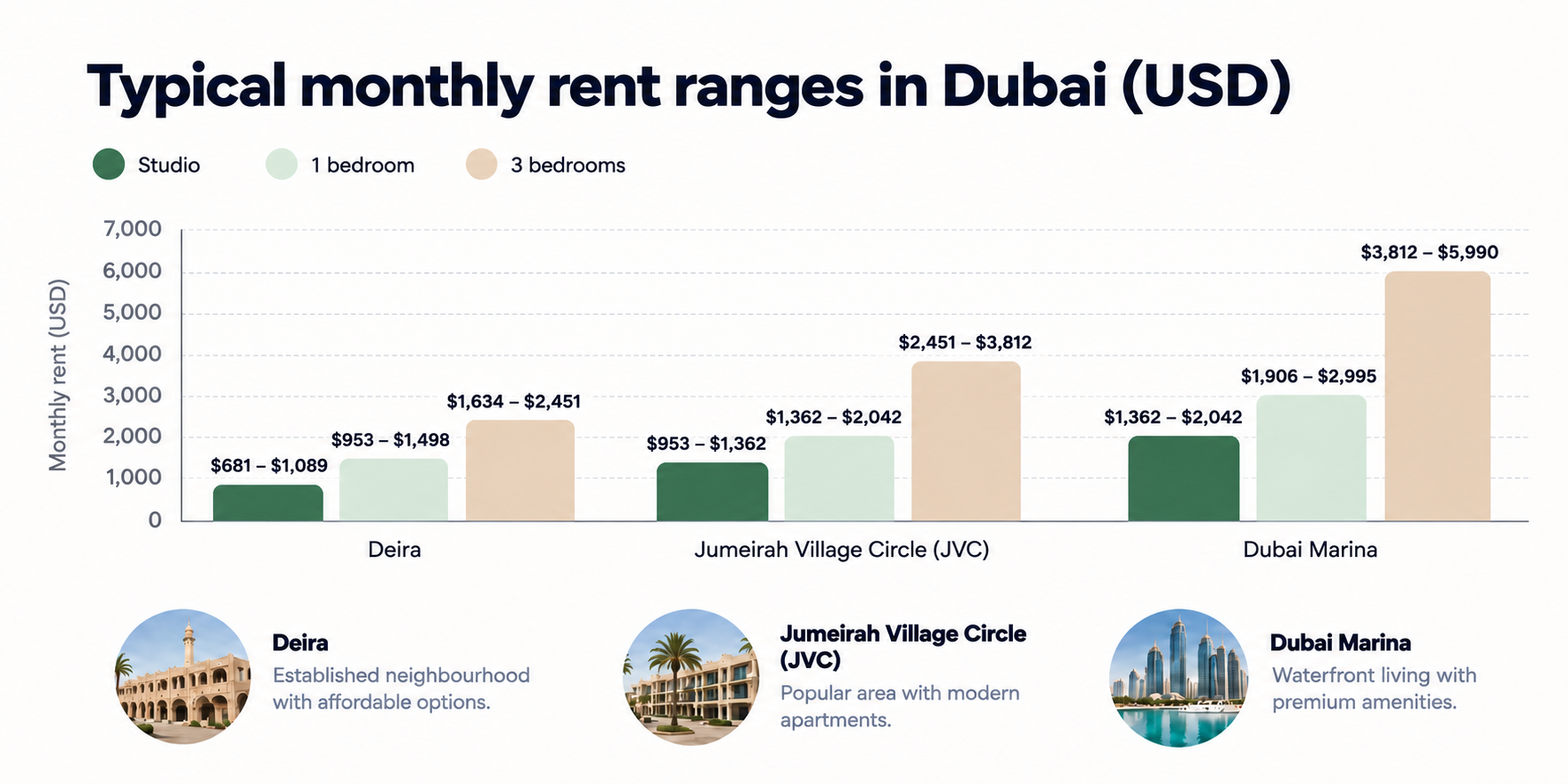
These are general costs for one person and may vary depending on your lifestyle and location.
Deira is one of Dubai's older, more established neighbourhoods. It offers access to shops, public transport and a variety of relatively affordable housing options. For newcomers working in central or older commercial districts, it can be a practical starting point.
Jumeirah Village Circle, commonly called JVC, attracts residents looking for newer apartments at prices that may be lower than those in premium waterfront locations. However, commuting can be less convenient without a car, depending on your building and workplace.
Dubai Marina offers a very different experience, with waterfront restaurants, modern residential towers and access to beaches and entertainment. That lifestyle comes with higher housing costs.
Renting alone or sharing accommodation
For someone moving to Dubai on a modest salary, shared accommodation can make a significant difference.
Instead of paying AED 5,000 for an entire apartment, you might rent a private room in a shared flat for considerably less. Prices depend on the neighbourhood, room size and facilities.
Before agreeing to share, check that the arrangement complies with local housing and occupancy regulations. You should also confirm exactly which bills are included in the rent.
Another detail worth knowing is that rent in Dubai is often advertised annually, even though people discuss their budgets monthly.
Landlords may request payment through one or several cheques rather than twelve equal monthly payments. That means you could need a substantial amount of money upfront, even if your monthly salary comfortably covers the annual rent.
You should also budget for a security deposit, possible agency fees, Ejari registration and utility connection charges.
For this reason, it's worth having enough savings to cover your first few months before relocating.
Bills, food and transport: everyday life expenses in Dubai
Beyond rent, your regular expenses will include electricity, water, internet, groceries and transport. These costs are easier to control than housing, but small lifestyle choices can still make a noticeable difference to your monthly budget.
For example, cooking most meals at home and using public transport could save you hundreds of dirhams compared with ordering food frequently and relying on taxis.
Utilities, internet and mobile plans
Dubai's climate makes air conditioning essential for much of the year, which means electricity bills can rise considerably during the hotter months.
Electricity and water services are provided by the Dubai Electricity and Water Authority (DEWA). The amount you pay depends on your consumption, property size and applicable housing charges.
Here's a rough guide to common monthly expenses:
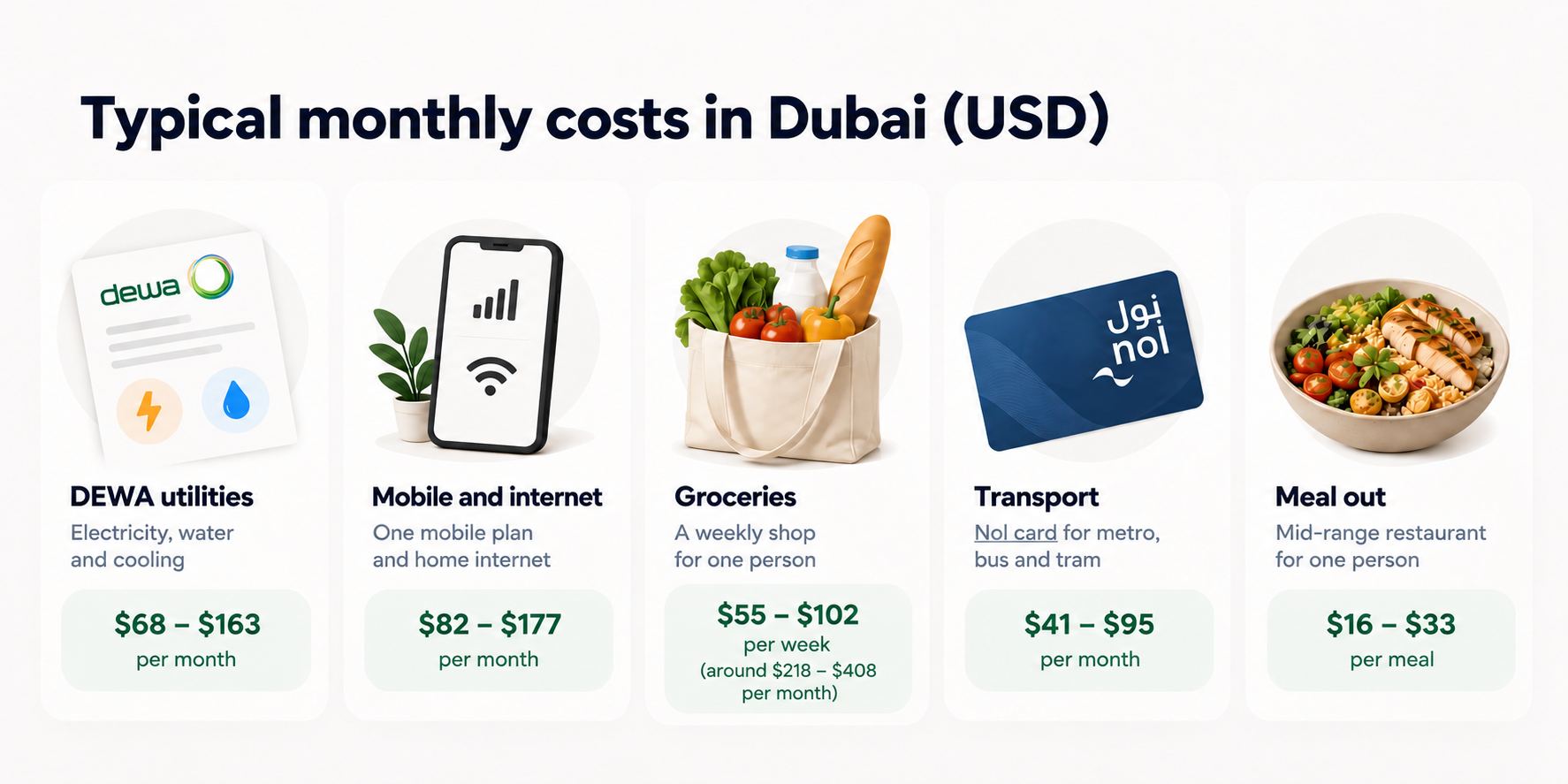
These are general costs for one person and may vary depending on your lifestyle and location.
When comparing apartments, ask whether the building uses a separate district cooling system. Some properties have additional cooling charges that aren't included in the regular DEWA bill.
Groceries in Dubai typically cost around $250 to $450 per month for one person, depending on shopping habits and food preferences. Supermarkets such as Carrefour and Lulu offer affordable everyday essentials, while imported products, including some Nigerian ingredients, can be more expensive. Eating out varies considerably, with simple meals costing around $10 to $15 and mid-range restaurants charging $20 to $40 per person.
Beyond food, entertainment expenses depend on your lifestyle, with cinema trips, beach clubs and other paid activities adding to your monthly budget. Dubai also has plenty of free options, including public beaches, parks and community events. Cooking at home, comparing supermarket prices and choosing affordable activities can help keep your spending under control.
Getting around Dubai
Transport is another important consideration when calculating the living cost in UAE Dubai, particularly if your workplace is far from your accommodation.
Dubai has a public transport network that includes the metro, buses and trams. You can pay for journeys using a Nol card, with fares depending on the zones travelled and ticket type.
If you use public transport for a regular commute, budgeting approximately AED 150 to AED 350 per month is a reasonable starting point, although longer journeys and additional connections may cost more.
Taxis are convenient, especially during the hotter months, but using them daily can increase your transport expenses considerably.
Owning a car introduces additional costs, including fuel, insurance, registration, parking, maintenance and possible financing payments.
For someone living alone, choosing accommodation near a metro station could reduce the need for a car. Families, particularly those living farther from public transport routes, may find driving more practical.
If you regularly make purchases in foreign currencies, it's also worth understanding how to avoid foreign transaction fees when using your card for online purchases, travel or international subscriptions.
Schooling and healthcare in Dubai
If you're moving with children, schooling and healthcare deserve their own place in your budget. These expenses can be substantial, and they aren't always covered by the benefits offered in an employment contract.
How much do schools cost in Dubai?
Dubai has a large private education sector, with schools offering British, American, Indian, International Baccalaureate and other curricula.
Fees vary significantly depending on the school, curriculum, facilities and year group.
For budgeting purposes, annual tuition might fall into the following broad ranges:
These ranges are indicative rather than official school fee quotations. Some schools charge outside these bands.
For a family with two children, school fees could become the second-largest household expense after rent.
It's also important to remember that tuition isn't the only cost. Uniforms, books, transport, school meals, extracurricular activities and registration fees may be charged separately.
Before accepting a job offer, check whether your employer provides an education allowance. Some companies offer benefits that cover part of their employees' children's school fees.
If you're comparing schools, look at the total annual cost rather than tuition alone. You should also consider the school's location, as a long daily journey could increase transport costs and affect your family's routine.
Healthcare and health insurance
Health insurance is an essential part of living in Dubai.
Employers are generally responsible for arranging mandatory health insurance for their employees in Dubai. However, the level of coverage can vary, and dependants may need separate arrangements.
Before relocating, ask your employer what the insurance policy includes, particularly regarding hospital visits, specialist consultations, prescription medicines and maternity care.
For families, it's worth checking whether your spouse and children are covered and whether there are additional premiums or out-of-pocket expenses.
Private healthcare can be expensive without suitable insurance. Even with coverage, you may still need to pay consultation fees, deductibles or co-payments.
If you take regular medication or have specific healthcare needs, check whether your prescriptions and preferred healthcare providers are included in the insurance network.
Other costs to consider before moving
Monthly budgets are useful, but they don't capture every expense involved in relocating.
You may need to pay for document attestation, medical tests, residency processing, flights and temporary accommodation. Depending on your employment arrangement, some of these costs may be covered by your employer.
Setting up your home can also require a substantial initial investment, especially if you're renting an unfurnished apartment.
For Nigerians moving to Dubai, keeping some money available in both AED and NGN can be useful during the transition. You may still have financial responsibilities in Nigeria while paying for your new life in the UAE.
It's worth building an initial relocation budget separately from your regular monthly expenses so you don't underestimate how much money you'll need before settling in.
Managing money and sending it home from Dubai
Moving to Dubai can change how you earn, spend and save money, particularly if you continue supporting family members in Nigeria or working with clients in other countries.
You might receive your salary in AED, pay international subscriptions in USD, save in another currency and send money home regularly.
Keeping track of those transactions matters because exchange rates and transfer fees can affect how much money you actually have available.
Managing money across different currencies
If you earn in AED but have expenses in USD, GBP or EUR, converting money every time you need to make an international payment can become costly.
One way to organise your finances is to separate the money you need for everyday expenses from the money you intend to save or use internationally.
For example, you could keep enough AED in your local bank account for rent, groceries and transport while managing eligible foreign-currency payments through a separate account.
Grey offers multi-currency accounts that can help eligible users hold and send multiple currencies, including USD, GBP and EUR.
This can be useful if you work with international clients, receive payments from abroad or regularly manage expenses in different currencies.
However, Grey's available services, funding methods and transfer routes depend on your country of residence and account eligibility. You should confirm which features are supported for UAE residents before relying on them.
Sending money from Dubai to Nigeria
If you're supporting family members back home, remittances may be one of your most important monthly expenses.
Imagine you earn AED 12,000 per month and plan to send the equivalent of AED 1,500 to Nigeria.
That transfer should be included in your budget alongside rent, groceries and transport. Otherwise, you might overestimate how much money you can spend or save.
When comparing international transfer services, look beyond the advertised transfer fee.
The exchange rate matters just as much. A service might charge a small upfront fee but offer a less favourable exchange rate, reducing the amount your recipient receives.
It's also worth checking the expected delivery time, supported payout methods and any transfer limits.
Grey provides information about options to send money from the UAE, including its UAE-to-Nigeria money transfer route.
Before initiating a transfer, check the current availability, applicable fees and payout options for your account.
Building a realistic budget in Dubai
Once you understand your regular expenses, you can start deciding how much of your salary to allocate to spending, savings and financial responsibilities abroad.
For example, someone earning AED 12,000 (approximately $3,300)per month might organise their budget as follows:
This is an illustrative budget, not a recommendation that everyone should follow the same percentages.
Someone sharing accommodation might be able to save more. A person with children, a car or higher rent could have considerably less money available after paying their bills.
The important thing is to calculate your budget using the amount you actually receive, including any applicable deductions, and account for financial commitments in both countries.
You should also leave room for unexpected expenses. Medical costs, travel, family emergencies and annual payments can affect your finances even when your regular monthly spending seems predictable.
Dubai offers plenty of opportunities to earn and build an international career, but the amount you can save depends on how your income compares with your actual living expenses.
Before accepting a job offer, compare the salary with realistic housing costs, transport options, employer benefits and any financial responsibilities you have back home.
That will give you a much clearer picture of the lifestyle you can afford.
Manage money in Dubai with Grey and organise your international finances with access to eligible multi-currency account services.
Frequently asked questions about the cost of living in Dubai
How much does it cost to live in Dubai per month?
A single person might need approximately AED 5,000 to AED 10,000 per month, including rent, while a family of four could spend AED 15,000 to AED 30,000 or more. The actual amount depends on accommodation, transport, schooling and lifestyle choices. Sharing accommodation and using public transport can help reduce expenses.
How much is rent in Dubai?
Rent varies considerably by neighbourhood and property size. A studio apartment might cost AED 2,500 to AED 7,500 per month, while a one-bedroom apartment could range from AED 3,500 to AED 11,000 in the areas covered in this guide. Larger family homes can cost considerably more. These are illustrative monthly equivalents, and actual rental prices change over time.
Is Dubai tax-free?
Dubai does not generally impose personal income tax on employment salaries, which is one reason it attracts international workers. However, that doesn't mean everything is tax-free. The UAE applies a 5% VAT to many goods and services, and other taxes or charges can apply depending on the activity. Personal tax obligations in another country may also depend on your tax residency and circumstances.
How much does a family need to live comfortably in Dubai?
A family of four might budget AED 15,000 to AED 30,000 or more per month for a reasonably comfortable lifestyle. Housing, school fees and transport are usually among the largest expenses. Families with employer-provided accommodation, education allowances or health insurance may need less income to cover their regular expenses.
Is Dubai expensive compared with Nigeria?
Dubai is generally more expensive than many Nigerian cities when comparing rent, schooling and everyday expenses in nominal terms. However, salaries, purchasing power and available benefits can also differ considerably. If you're relocating from Nigeria, compare your expected Dubai salary with your projected monthly expenses rather than looking at prices alone.
How do I send money home from Dubai?
You can send money from Dubai through banks and authorised international money transfer providers that support transfers to your destination country. Before choosing a provider, compare exchange rates, fees, delivery times and payout options. If you're sending money to Nigeria, check that the service supports your preferred recipient bank or payment method and the currency you want your recipient to receive.