STAY UP TO DATE
The Grey Blog


FEATURED ARTICLES
Virtual cards in Egypt for online payments
Grey, EverTry, Card-Y, Fyatu, and AstroPay: Here is how virtual cards work for online payments in Egypt and your top options.

Adeolu Titus Adekunle
•
6 min read
It is one thing to have the funds for online payments; it is another thing to have the means to complete the payment without getting frustrated. Managing international payments in Egypt can be quite a hassle. If you’ve tried paying for an international subscription, a work tool, online shopping, or an online course from Egypt, perhaps you can relate to the struggle. Local Egyptian bank cards are often restricted from international transactions, offer poor exchange rates, or aren’t supported by global platforms.
Virtual cards exist mostly to solve these problems, and they have become one of the most efficient options for anyone who shops online, pays for subscriptions, or needs a reliable way to spend in foreign currency without the limitations of a standard local bank card.
This article explains how virtual cards work, who they are for, and the main options available to people in Egypt right now.
What is a virtual card, and how does it work?
A virtual card is a digital payment card that works just like a traditional debit or credit card, except it exists only electronically. Instead of receiving a plastic card, you get the card details instantly on your phone or computer, including the card number, expiration date, and CVV security code.
Because virtual cards are issued digitally, they are typically available within minutes, unlike physical cards that must be printed and delivered.
Most virtual cards operate as prepaid or debit cards, meaning you spend funds you already have. In many cases, the card is connected to a multi-currency account, so payments are deducted directly from your balance in currencies such as USD, GBP, or EUR. This eliminates the need to manually top up the card before each purchase.
For example, Grey virtual cards are linked directly to your foreign currency balance, allowing you to pay online or in apps without transferring funds to the card first.
In practice, using a virtual card is no different from using a physical one. You simply enter the card details at checkout when making online payments, subscriptions, or international purchases. Many virtual cards can also be added to Apple Pay or Google Pay, enabling secure contactless payments with your phone wherever mobile wallets are supported.
Also read: Managing USD income as a remote worker in Egypt
What to look for when choosing
Not all virtual cards work the same way. The best option for you will depend on how you plan to use it, which currencies you deal with most often, and how frequently you make international payments. Before choosing a provider, it’s worth looking closely at a few key factors.
Currency support. Many virtual cards are designed primarily for USD payments, but international platforms often charge in other currencies such as EUR or GBP. If you regularly use services based in Europe or the UK, a card that supports multiple currencies can help you avoid additional conversion fees. Choosing a provider with a multi-currency account allows you to hold and spend different currencies more efficiently.
Funding options. Different platforms allow you to add funds in different ways. Some accept local bank transfers, others allow crypto deposits such as USDT, and some link directly to a multi-currency account balance, like Grey. Before signing up, check that the funding method available actually works for your situation and location.
Platform compatibility. Not every virtual card works equally well across all international platforms. Some services, particularly advertising platforms or large marketplaces, may reject certain cards depending on the issuing network or region. If you plan to use your card for a specific purpose, such as paying for Google Ads or cloud hosting, it’s worth confirming that the card is widely accepted on those platforms.
Fees and exchange rates. Virtual card costs can vary significantly between providers. Some charge a card creation fee, others add transaction fees, and most apply a small markup on currency conversions. A card that appears free at first glance may become more expensive if the exchange rate spread is high. Always look at the total cost of using the card, not just the upfront fee.
Security and regulation. Security should always be a priority when choosing a financial platform. Look for providers that follow proper identity verification processes and operate with licensed financial partners. Features such as two-factor authentication, transaction alerts, spending limits, and the ability to instantly freeze your card add an important layer of protection.
Contactless payments. Some virtual cards can be added to mobile wallets like Apple Pay or Google Pay, allowing you to make contactless payments with your phone. This can be particularly useful when travelling or making in-store purchases abroad. If this feature matters to you, make sure the card supports mobile wallet integration in your region.
Taking a few minutes to compare these factors can help you choose a virtual card that fits your spending habits and avoids unnecessary fees or payment issues later.
The top virtual cards in Egypt for online payments
While cards issued by local banks work well for domestic spending, they are not always reliable for international payments. Here is a list of the top virtual cards in Egypt for online payments.
Grey
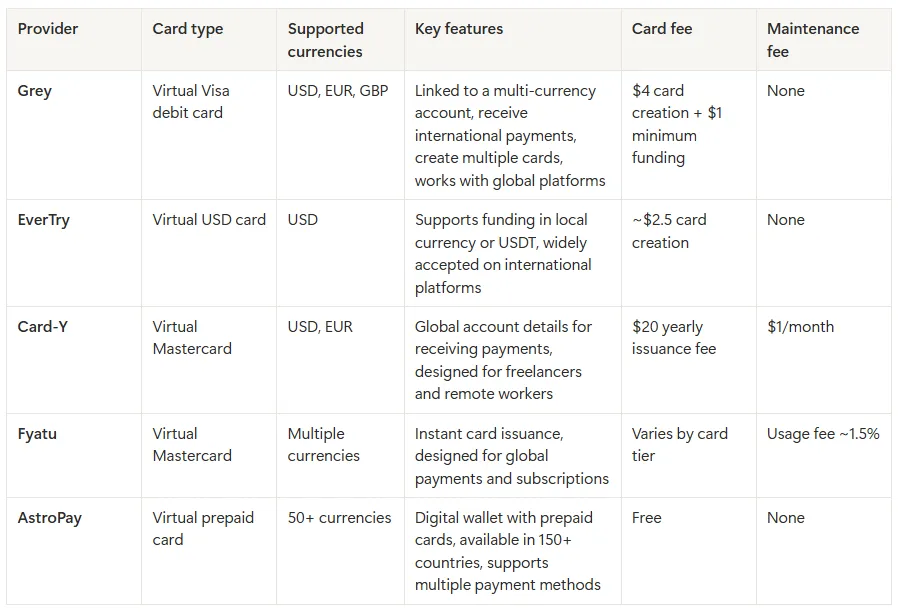
Grey offers virtual cards linked to a multi-currency account that supports USD, EUR, and GBP. You can create multiple cards for various uses to properly plan your finances. One card can be for online shopping while another could be for subscriptions and or online course. Grey cards are globally accepted and works with the full range of international platforms
You can receive international payments into your Grey USD, GBP, or EUR account or fund your account in EGP and convert to USD to spend on your cards directly.
Fees: Grey virtual USD cards cost a one-time creation fee of $4, plus a minimum of $1 to fund the card, totalling $5 to get started. There are no monthly maintenance fees.
EverTry
EverTry offers a solution for international payment restrictions in Egypt through their virtual dollar card platform. It allows Egyptian users to pay for global services that often decline local bank cards. It supports funding in local currency and USDT, making it accessible to users who are comfortable with crypto. The card works across a wide range of international platforms, including Netflix, Spotify, AWS, DigitalOcean, Namecheap, Facebook Ads, and Google Ads.
Fees: Card creation typically costs $2.5, with no monthly maintenance fees.
Card-Y
Card-Y is a fintech platform that offers multi-currency global accounts with a linked virtual card, designed for Egyptian freelancers and remote workers. It offers USD and EUR account details for receiving international payments, with a free virtual card included that draws from those account balances. It also issues local Egyptian bank cards to subscribers.
Fees: Card-Y offers virtual Mastercard issuance for a $20 USD fee, which is valid for one year and does not add to the card balance. The service features a $1 monthly maintenance fee, a 1% USD transaction fee ($1 min/$5 max), and a 1.5% foreign currency conversion fee.
Fyatu
Fyatu provides instant virtual Mastercards with support for multiple currencies, aimed at users who need to make global payments and manage international subscriptions. Onboarding is digital, and card issuance is immediate. It is a straightforward option for users whose primary need is an international spending card rather than a full suite of banking features.
Fees: Fyatu virtual card costs include a 1.5% fee for card usage (for either withdrawal or payments), with card replacement fees of $5 for World cards and $10 for Platinum cards. A $1.00 fee applies to declined transactions. Funding methods vary, with fees such as 3% for MTN MoMo and various percentages for online wallets like PayPal (3.5% + $0.30).
AstroPay
AstroPay is a globally recognised digital wallet and virtual card platform, available in over 150 countries, including Egypt. It has been around since 2009 and has a particularly strong footprint in emerging markets across Africa, Latin America, and Asia. The platform supports more than 50 currencies, issues virtual prepaid cards instantly, and does not require a traditional bank account to sign up.
For Egyptian users, AstroPay works as a prepaid spending tool. You load funds onto your wallet using a local payment method, then use the virtual card for international purchases on platforms that accept Visa or Mastercard. Card details are issued instantly through the app, and the platform supports one-time or multi-use cards depending on the denomination.
However, bank withdrawals from AstroPay can attract fees of up to 6% depending on the institution. There is a margin of 1% to 3% on exchange rate.
Fees: No card purchase or maintenance fee. No annual fee. Transaction fees of 2–5% depending on the payment method used. FX markup of approximately 1–3% on non-native currency transactions. Withdrawals to a bank account: up to 6%.
Comparison of the top virtual cards in Egypt
Before exploring each option in detail, the table below summarises some of the key differences between the most popular virtual cards available to users in Egypt, including supported currencies, card type, and typical fees.
Quick recommendations
If you’re not sure which virtual card to choose, here’s a quick guide based on common use cases in Egypt.
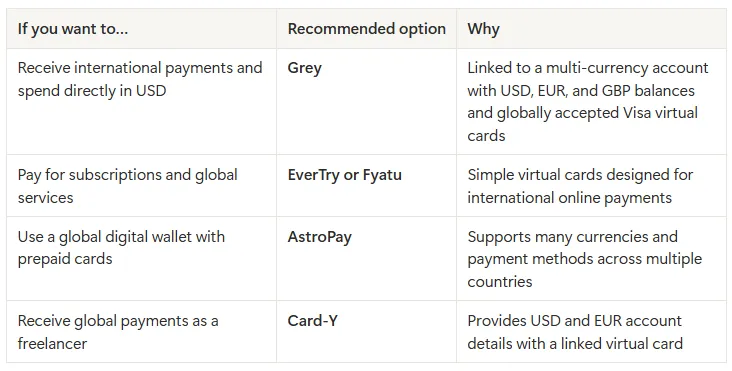
For most freelancers, remote workers, and online entrepreneurs in Egypt, a virtual card linked to a multi-currency account is often the most practical option. It allows you to receive money from abroad, hold foreign currencies, and pay for global services without converting funds every time you make a transaction.
Also read: Grey card vs other virtual cards: What you should know
Make international payments with Grey
The advent of virtual cards has brought significant flexibility to managing international payments. Grey gives Egyptians a virtual card linked to your multi-currency account. This allows you to receive international payments and spend internationally from the same platform. Whether you are paying for software subscriptions, running digital ads, shopping on international platforms, or managing online tools for your work, Grey's virtual card is accepted globally and straightforward to set up.
Ready to get your virtual card? Sign up on Grey and download the app to create your virtual USD card in minutes.
ALL ARTICLES

How to find accommodation as a digital nomad: Short-term and long-term
Finding accommodation as a digital nomad takes strategy. From short-term rentals to co-living spaces, here is how to find housing abroad on any budget. Plan now.
Olayoyin Olorunmota
•
September 30, 2026
•
6 min read
Finding accommodation as a digital nomad is a skill in itself. Unlike a holiday, where you book something nice for a week and call it done, nomadic living involves a constant cycle of research, short-term stays, longer-term negotiations, and the occasional bad Wi-Fi situation you didn't see coming.
The good news is that the infrastructure for nomadic accommodation has improved significantly in recent years. More landlords understand what nomads need. More co-living spaces have opened in major nomad cities. And the playbook for finding good, affordable housing on the road is well established, even if it's not always well documented.
This guide covers the full range of accommodation options available to digital nomads, from short-term platforms to local rental markets, along with practical tips for finding housing quickly in a new city and managing cross-border payments when you do. For a broader introduction to the lifestyle itself, see our digital nomad lifestyle guide.
Short-term accommodation options for digital nomads
Short-term stays, typically under one month, are where most nomads start when arriving in a new location. They're more expensive per night than long-term rentals but are usually more flexible, have no lease requirements, and are often furnished and include utilities.
Airbnb and Vrbo
Airbnb and Vrbo are the most familiar options. Both offer furnished apartments, private rooms, and entire properties for nightly, weekly, or monthly bookings. Airbnb has a monthly discount feature built into the pricing: hosts can set a percentage off for bookings of 28 days or more, and many do. Make sure to contact the host directly to negotiate a monthly rate, even if the discount isn’t advertised.
Pros: wide selection, clear guest reviews, flexible booking terms, and host communication before arrival.
Cons: higher cost than local rentals, Wi-Fi quality varies significantly, and some hosts are optimised for tourists rather than working professionals.
Booking.com monthly stays
Booking.com has expanded significantly into the long-stay market and often surfaces options that don’t appear on Airbnb, particularly serviced apartments and aparthotels. Filter for “apartments” and select monthly stays for better pricing.
Pros: broad inventory, often includes properties not listed elsewhere, good cancellation policy options.
Cons: varies by property; some listings have minimum requirements for monthly pricing.
Hostels with private rooms
In budget destinations across Southeast Asia, Latin America, and Eastern Europe, hostels with private rooms offer a surprisingly good option for short stays. Private rooms in hostels are often significantly cheaper than equivalent Airbnb listings, include shared common areas and sometimes coworking spaces, and come with a built-in social environment.
Pros: cost-effective, social, often include breakfast and utilities.
Cons: thin walls, shared bathrooms in some cases, variable Wi-Fi, and not suitable for long client calls in shared spaces.
Hotel long-stay deals
Many hotels, particularly business hotels and aparthotels, offer significantly reduced monthly rates for extended stays that are never listed on their standard booking pages. These are negotiated directly by calling the hotel and asking for long-stay or corporate rates.
Pros: Hotel amenities, cleaning service, reliable infrastructure.
Cons: Typically more expensive than private rentals, even with long-stay discounts, and less "home-like.”
Cost comparison by accommodation type and region
Figures are estimates based on Nomad List city data and market research. Costs vary significantly by city, neighbourhood, and season.
Long-term accommodation options for digital nomads
Once you’ve settled on staying somewhere for two months or more, the economics shift. The short-stay premium no longer makes sense, and the right approach is to find accommodation the way a local would.
Local rental market
In most cities, the cheapest furnished apartments are found through local channels rather than international platforms. This typically means Facebook groups (search for "[city name] expats", "[city name] apartments for rent", or "[city name] digital nomads"), local property listing sites, and WhatsApp groups that circulate among the expat and nomad community in that city.
The trade-off: finding a place this way takes more time and requires being either in the city already or trusting photos and video tours remotely. The upside is that a furnished apartment found through local channels can cost 30 to 50% less than the equivalent on Airbnb for the same city and quality level.
Furnished apartment agencies
Many cities have local agencies that specifically handle furnished apartments for short- to medium-term rentals. These agencies often cater to business travellers and relocating professionals, which means their inventory is typically furnished to a reasonable standard and includes utilities. A quick search for “furnished apartments [city name]” plus the local language equivalent often surfaces these.
House-sitting through TrustedHousesitters
TrustedHousesitters matches homeowners who need their home and pets looked after with nomads and travellers willing to house-sit for free accommodation. If you're comfortable with pets and flexible on location, this is a legitimate way to live rent-free in exchange for daily pet care and property oversight.
It requires advance planning: good house-sitting opportunities in desirable locations fill quickly, and building a strong TrustedHousesitters profile with reviews takes time. But for nomads who want to significantly reduce accommodation costs in high-cost countries, it’s a genuine option.
Sublets
Locals who are travelling temporarily often sublet their furnished apartments at rates closer to local market prices than tourist prices. These can be found through the same Facebook groups and WhatsApp networks as local rentals. Sublets are typically informal arrangements, so due diligence on the space and the landlord’s willingness to let is important.
How do digital nomads find housing abroad?
The most common mistake first-time nomads make is trying to solve the accommodation problem entirely from home, before arriving. Booking three months of Airbnb before you’ve spent a single week in a place is expensive and inflexible. The approach experienced nomads use is different.
Book one to two weeks of short-term accommodation first
Arrive at your destination with a comfortable, central place already sorted for the first week or two. This gives you time to explore neighbourhoods, join local nomad and expat groups, and get a feel for where you actually want to be before committing to something longer.
Join the Facebook and WhatsApp groups for that city
Search for “[city] expats”, “[city] digital nomads", and “[city] apartments for rent” on Facebook. Request access. Post asking what you’re looking for. Many of the best long-term finds come through these groups within 48 hours of posting.
Ask on Nomad List
Nomad List’s community forum and chat are organised by city and are among the most useful real-time sources for what's available, which areas are best for working, and what pitfalls to avoid in any given place.
Talk to other nomads already there
The nomad community is generally generous with practical information. If you’re staying in a hostel or co-living space during your first week, ask other residents where they found their accommodation. Recommendations from people currently living in the city are more reliable than anything you’ll find through a search engine.
Be ready to move quickly on local listings
Good furnished apartments at local prices go fast, particularly in popular nomad cities like Chiang Mai, Medellín, Lisbon, and Tbilisi. If you find something good, don’t spend days deliberating.
Co-living spaces for digital nomads: are they worth it?
Co-living spaces are purpose-built or adapted residential properties that offer private or semi-private rooms with shared common areas, Wi-Fi, and often a built-in community of other remote workers and nomads. They sit somewhere between a high-end hostel and a furnished apartment in terms of experience and price.
What co-living typically includes:
- Private furnished room with reliable, fast internet
- Shared kitchen, living areas, and sometimes coworking desks
- Utilities and cleaning are included in the price
- Community events, networking opportunities, and social programming
- Often: rooftop access, gym, pool, or other amenities, depending on the property
Is it worth it?
Co-living is worth it in two situations. First, when you’re new to a city, you want a built-in social environment to meet people quickly without putting in weeks of social effort. Second, when the all-inclusive price is genuinely competitive with furnished apartments, once you factor in utilities, internet, and cleaning. In some cities, it is, in others, it’s significantly more expensive per month than an equivalent local rental.
The experience varies considerably between properties. Read reviews specifically about the internet speed, noise levels, and the current community atmosphere (which changes as residents cycle in and out). A co-living space with a dead atmosphere or patchy Wi-Fi solves neither the social nor the work problem.
Tips for finding and securing nomad housing
- Test the Wi-Fi before committing: Ask the host or property for the broadband speed, or run a speed test during a video call or in-person visit before signing anything. Minimum functional speed for most remote work is 25 Mbps download and 10 Mbps upload; 50 Mbps or more is comfortable for video calls.
- Use a VPN to search local listing sites: Some regional property platforms show different results or prices based on your detected location. Searching with a local VPN node can surface listings that don’t appear when searching from abroad.
- Always have a backup option: Before checking out of your current place, have your next accommodation confirmed and paid. Moving cities without a fallback creates unnecessary stress.
- Read reviews for noise level, not just overall score: A 4.8-rated apartment can still be on a main road above a bar. Look specifically for reviews mentioning noise, street sounds, and sleep quality.
- Ask for a monthly discount, even if one isn’t listed: Hosts and landlords generally prefer a reliable occupant for a month to the uncertainty of nightly bookings. A direct message asking for a monthly rate almost always gets a response, even if the answer is no.
- Confirm check-in flexibility before booking: Many nomads arrive on late flights or unconventional schedules. Clarify check-in times before booking, particularly for entire-apartment listings where a lockbox or key exchange must be arranged.
- Arrive with one month’s rent in local cash if possible: Many local landlords in emerging market countries prefer or require cash deposits. Having local currency ready, rather than relying on finding an ATM on arrival, simplifies the move-in process.
How to manage payments and deposits as a digital nomad
The financial side of finding accommodation abroad creates its own set of complications. Deposits are often due in advance, in local currency. Monthly rent may need to be transferred internationally. And paying through your home bank can mean losing 3 to 5% on every conversion.
For deposits sent ahead of arrival, the cleaner approach is a multi-currency account that lets you convert at a fair rate and send internationally at low cost. Grey lets you send money abroad with Grey at a conversion fee of 1%, capped at $6, with the rate shown before you confirm. For nomads regularly moving money between countries, this is significantly cheaper than bank wire transfers that typically carry a $25 to $50 sending fee plus a 2 to 4% conversion spread.
For ongoing rent payments in foreign currencies, opening a multi-currency account for nomads lets you hold USD, EUR, and GBP balances, pay from whichever currency is most cost-effective for the transaction, and avoid converting back and forth on every monthly payment.
The practical workflow: hold income in the currency you earn it in, convert only what you need for the current month’s expenses, and use a Grey virtual card for USD-denominated online subscriptions and tools you’re paying for, regardless of where you’re living.
Open a multi-currency account with Grey today to begin.
Frequently asked questions about finding accommodation as a digital nomad
How much should a digital nomad budget for accommodation?
It depends significantly on the destination. In Southeast Asia (Chiang Mai, Bali, Ho Chi Minh City), comfortable furnished apartments run $400 to $800 per month. In Southern Europe (Lisbon, Barcelona, Athens), expect $900 to $1,800 for a similar standard. In Latin America (Medellín, Mexico City, Buenos Aires), the range is $500 to $1,200. Co-living and Airbnb add a premium of 20 to 50% above the local rental market rate for equivalent quality. A general planning range for most nomad-friendly destinations is $600 to $1,500 per month for accommodation, with high-cost-of-living cities (Western Europe, Japan, US) falling above that range.
Is it safe to rent from local landlords as a digital nomad?
Generally, yes, with reasonable precautions. Request a video call to see the apartment in real time before paying any deposit. Pay the deposit using a method that leaves a record (bank transfer or a traceable payment method), rather than in cash, if possible. Confirm the landlord’s identity and verify the address on maps before arrival. In cities with established nomad communities, Facebook groups and WhatsApp recommendations for specific landlords are useful vetting tools: others have rented from the same person and can confirm their experience.
Can I get a lease as a digital nomad without a fixed address?
Formal leases typically require proof of income and sometimes a local guarantor, which many nomads can’t provide. In practice, most nomad accommodation is arranged informally: a written agreement, a WhatsApp exchange, or a platform booking confirmation rather than a legally binding lease. This is the norm in the nomad market, and most landlords catering to nomads expect it. For any significant deposit, having a written agreement (even via email or WhatsApp) that specifies the amount, the return conditions, and the rental period is worth the effort.
What is the best app for finding digital nomad accommodation?
No single app covers everything. For short stays, Airbnb and Booking.com are the most practical starting points. For co-living, Selina and Outsite have their own booking platforms. For local rentals, the most effective tool is Facebook Groups combined with Nomad List’s city-specific community chats. Many experienced nomads use Airbnb for the first week in a new city and then transition to a local rental found through Facebook or community recommendations.
How do digital nomads handle deposits in a foreign country?
Most deposits for nomad accommodation are paid by bank transfer, local cash, or through a platform (for Airbnb bookings, Airbnb holds the payment). For local rentals requiring a direct bank transfer in foreign currency, a multi-currency account with a competitive conversion rate is the most cost-effective method: converting at a bank’s standard rate typically costs 3 to 5% of the deposit amount, whereas a platform like Grey charges 1%, capped at $6, on conversion. Keep a record of every deposit paid, the agreed return conditions, and the landlord’s contact details.
Do I need travel insurance if I am renting accommodation long-term?
Travel insurance needs change when you’re a long-term renter rather than a short-stay tourist. Standard travel insurance often excludes stays beyond 30 to 90 days or has reduced coverage for long-term accommodation. Nomad-specific insurance products (such as SafetyWing or World Nomads) are designed for extended travel and cover medical emergencies, trip interruption, and sometimes personal belongings. For long-term rentals, contents insurance for your possessions in the rental property is worth investigating separately, as landlord insurance typically doesn’t cover tenants’ belongings.
.jpg)
11 best coworking spaces in Bali
11 best coworking spaces in Bali for digital nomads ranked by location, speed, price, and vibe. Find your workspace in Bali today. Compare now.
Tunde Aladeloba
•
September 27, 2026
•
6 min read
Working from Bali sounds great until you actually need somewhere reliable to take a video call, finish a deadline, or spend a full day getting work done. A beach café might be great for an hour, but it is not always practical when you need fast Wi-Fi, a comfortable desk, and a quiet place to focus.
With more than 50 coworking spaces across Bali, you have plenty of options. Canggu, Ubud, Seminyak, and Sanur all have spaces designed for remote workers, freelancers, entrepreneurs, and digital nomads. Prices can range from around IDR 50,000 per day for a basic hot desk to IDR 2,500,000 per month for a dedicated desk at a premium space.
For most digital nomads, Canggu and Ubud are the first places to look because they have some of the island’s largest remote-working communities. But the right coworking space in Bali depends on where you are staying, how long you plan to work, and whether you need meeting rooms, community events, or simply a quiet desk and reliable internet.
This guide covers 11 coworking spaces worth considering, so you can find one that fits your workday and your Bali plans. For visa options, see our list of visa-free countries for digital nomads.
What should you check before choosing a coworking space in Bali?
The first coworking space you find may look great in photos, but your priorities become clearer once you are sitting there trying to finish a deadline. A beautiful view means little when the Wi-Fi drops during a client call or your desk is too noisy to concentrate.
Check the internet
For regular video calls, aim for at least 50 Mbps and ask whether the space has a backup connection in case the main network goes down. Anything below 30 Mbps will frustrate you if you have to screen-share and upload large files. Test at the time of day you'll actually be working, not at 6 am when the space is empty and the bandwidth is uncontested.
Air conditioning
Open-air spaces look beautiful on Instagram, but working in 32 °C heat with 80% humidity can be miserable for laptop-intensive work. If you run hot, choose an air-conditioned space. Your laptop’s fan will thank you, too. Overheating laptops throttle their processors, which makes everything slower.
Time zone compatibility
Bali is GMT+8. If your clients are in New York (GMT-5), your overlap is 7 am to 11 am Bali time. If they're in London (GMT+0/+1), the overlap is 3 pm to 8pm Bali time. Check that the coworking space opens early enough (or stays open late enough) for your schedule. Some spaces don’t open until 8 am or 9 am, which cuts into your US overlap window.
Think about where you are staying
A 30-minute commute can become frustrating when you are working every day. Canggu works well if you want a social beach scene, while Ubud suits a quieter, nature-based environment.
Compare the actual price
Check whether you are paying daily or monthly and what comes with the membership. Some spaces include coffee, meeting rooms, or events, while others charge separately.
Look beyond the desk
Meeting rooms, phone booths, printers, comfortable seating, and reliable power can make a big difference. Community events matter too if you want to meet other founders, freelancers, and remote workers.
These factors also matter when exploring the best cities in Indonesia for digital nomads, because where you stay can shape both your workday and your experience outside work.
The 11 best coworking spaces in Bali
Whether you’re spending a few weeks in Bali or making the island your new base, you’ll find coworking spaces to suit different ways of working. From quiet spaces where you can focus to lively hubs where you can meet other remote workers, here are 11 places to consider for your next workday.
Outpost
-compressed.jpg)
Location: Ubud and Canggu
Daily rate: Around IDR 225,000 USD(15–16)
Monthly rate: Around IDR 2,935,000 USD(195–210)
Internet: Up to 200 Mbps with load-balanced connections
Best for: Remote professionals who need reliable Wi-Fi, quiet spaces and access to more than one location. The phone booths are the key differentiator. If you're on Zoom 3 hours a day, Outpost handles that better than any open-air space in Bali. The downside? It feels like a nice office, not like Bali. That's either a feature or a bug, depending on what you're here for.
Bali
Location: Legian/Kuta, Dewi Sri
Daily rate: Around IDR 150,000 ($10)
Monthly rate: Around IDR 2,000,000 ($133) for a hot desk pass
Internet: Around 30–60 Mbps
Best for: Expats and digital nomads who want a convenient live-and-work setup.
Tribal Bali
-compressed.jpg)
Location: Canggu, Pererenan
Daily rate: Free entry, with an expected café spend of around IDR 100,000
Monthly rate: No monthly membership
Internet: Around 100 Mbps fibre
Best for: Social digital nomads, creatives and people who enjoy meeting others while they work.
Livit Hub
.png)
Location: Sanur
Daily rate: Around IDR 275,000 ($18)
Monthly rate: Around IDR 4,875,000 ($325) for unlimited access
Internet: Up to 150 Mbps backup fibre
Best for: Startup teams, developers and remote professionals who want a professional workspace.
Workmates Canggu
Location: Canggu
Daily rate: No fixed coworking fee; café spending applies
Monthly rate: Not available
Internet: Around 50–70 Mbps
Best for: Digital nomads who prefer a relaxed café atmosphere over a conventional coworking office.
Kumpul
Location: Multiple locations, including Denpasar and Kuta
Daily rate: Around IDR 200,000 ($13)
Monthly rate: Around IDR 2,500,000 ($165)
Internet: Around 50 Mbps
Best for: Entrepreneurs who want to build connections with local businesses and founders.
The Office Bali
Location: Seminyak
Daily rate: Available on request
Monthly rate: From around IDR 3,500,000 ($230), depending on the desk
Internet: Around 100 Mbps dedicated fibre
Best for: Corporate professionals, consultants and independent professionals who prefer a structured office.
BWork Bali
.png)
Location: Canggu, Berawa
Daily rate: Around IDR 150,000–200,000 (10–13)
Monthly rate: Around IDR 2,300,000 ($150)
Internet: Around 150 Mbps dual fibre
Best for: Developers, content creators and remote professionals who need a quieter place to focus.
Dojo Bali
.png)
Location: Canggu, Echo Beach
Daily rate: N/A — permanently closed
Monthly rate: N/A — permanently closed
Best for: Understanding the history of Bali's digital nomad community.
Hubud
Location: Ubud, Monkey Forest
Daily rate: N/A — permanently closed
Monthly rate: N/A — permanently closed
Best for: Exploring the history and evolution of coworking in Bali.
Komunitas Co
Location: Ubud
Daily rate: Not available as a standard coworking rate
Monthly rate: Not available
Best for: Travellers interested in local creative communities and cultural experiences.
Best coworking spaces in Ubud for focused work
If you need a quiet place to work in Ubud, these three coworking spaces offer a mix of peaceful surroundings, reliable workspaces and meeting facilities.
Outpost Ubud (Penestanan & Nyuh Kunin)
Atmosphere: A tropical workspace with open-air areas, greenery, ravine views and a jungle pool.
Typical clientele: Remote executives, tech founders and long-term expats.
Distance: Around 7 minutes by scooter from central Ubud.
Meeting rooms: Yes, with private booths, conference rooms and whiteboards**.**
Ubud Co-Working
Atmosphere: A peaceful workspace overlooking green rice fields, designed for focused work.
Typical clientele: Writers, software engineers and digital nomads.
Distance: Around 6 minutes northeast of central Ubud.
Meeting rooms: Yes, including private rooms and dedicated meeting spaces.
The Hidden Space Ubud Cafe
Atmosphere: A quiet, plant-filled café with a garden setting away from the busy centre.
Typical clientele: Creative freelancers, slow-travelling nomads, and professionals.
Distance: Around 13 minutes by scooter from central Ubud.
Meeting rooms: Yes, with space for small workshops and private events.
How much does Coworking in Bali cost?
Your coworking budget depends largely on how long you plan to work from Bali. If you’re only staying for a few days, a day pass usually costs IDR 50,000–200,000.
A weekly pass can give you better value. For a longer stay, expect to pay around IDR 1,000,000–3,000,000 (56–167) a month for a hot desk. Dedicated desks cost more and often include extras such as storage and meeting-room access.
Before choosing a space, check the payment options. Some places offer better rates when you pay in cash, so keeping some IDR with you can help. You can keep your larger travel budget in your [Grey account](https://app.grey.co/auth/register?) and use your multi-currency card when you need to pay by card.
If you’re planning a longer stay, our budgeting tips for nomads in Bali can help you plan your daily spending too.
For data on the go, grab a travel eSIM instead of buying a local SIM at the airport (where you'll overpay by 30-50% compared to ordering one online before you arrive). And if you're earning in USD while living in Bali, hold your dollars in a Grey account and convert to rupiah only when you need local currency. The rupiah fluctuates against the dollar, so converting in smaller amounts as needed often gets you a better average rate than converting a lump sum on arrival.
ATM fees can add up quickly, especially when you’re withdrawing regularly. A Grey card can help you manage your spending abroad by letting you pay by card without foreign transaction fees and withdraw cash at a fair exchange rate, depending on the ATM and applicable charges.
If you’re planning to work and spend more time in Indonesia, having a simple way to manage your money can make everyday payments easier. You can open a Grey account for Indonesia and manage your international spending from one place.
Frequently asked questions
What is the best area in Bali for digital nomads?
Canggu is popular with digital nomads because you’ll find plenty of coworking spaces, cafés, accommodation and a large remote-work community. Ubud is a better fit if you prefer a quieter environment surrounded by nature. Your choice ultimately depends on whether you prioritise social connections, convenience or a slower pace.
How fast is the internet at Bali coworking spaces?
Internet speeds vary between spaces, but many established coworking spaces offer reliable fibre connections suitable for video calls, cloud-based work and large file transfers. Some advertise speeds of 100 Mbps or more. Before choosing a space, check whether it has backup internet if reliable connectivity is essential to your work.
How much does a day pass cost at a Bali coworking space?
A day pass typically costs between IDR 50,000 and IDR 200,000, depending on the location and facilities. Some cafés and coworking spaces offer free entry with a minimum spend, while premium spaces charge more for access to meeting rooms, private areas, pools and other facilities.
Can I legally work remotely in Bali?
You need to check Indonesia’s current visa and immigration rules before working remotely from Bali. The rules depend on your nationality, visa type and the nature of your work. If you’re earning from overseas clients or an employer, confirm that your planned activities are permitted under the visa you intend to use.
Which is better for digital nomads: Canggu or Ubud?
Canggu may suit you if you want a lively digital nomad community, more coworking options and easy access to cafés and social activities. Ubud offers a quieter setting with more greenery and a slower pace. Neither is universally better; the right choice depends on how you prefer to work and live.
Do Bali coworking spaces offer accommodation?
Some coworking spaces in Bali are connected to coliving properties, so you can combine your accommodation and workspace in one place. Others only provide workspace access. If you want both, look specifically for coworking and coliving packages, and check whether accommodation, workspace access and other amenities are included.

11 best countries for digital nomads without a visa requirement
The best countries for digital nomads with no visa requirement. Work remotely without applying for a visa. Ranked by ease and lifestyle. Read now.
Priscila Marotti
•
September 17, 2026
•
6 min read
More than 60 countries now offer dedicated digital nomad visas, each with its own income threshold, application form, and processing timeline. But a growing number of remote workers skip that process entirely. They land on a tourist visa, find a cafe with decent Wi-Fi, and start working.
Many countries allow visitors to stay for 30 to 90 days without a visa, which is long enough for short-term remote work. However, working remotely for a foreign employer on a tourist visa is a legal grey area in most countries. Destinations like Georgia, Albania, and Serbia are popular because they offer long-stay options and rarely enforce remote-work restrictions.
This guide covers 11 digital nomad visa-free countries where a formal permit is not required. Each entry explains how long you can stay, whether remote work is explicitly permitted or quietly tolerated, what the destination actually costs and feels like, and how to manage money across borders while you are there.
Can you work remotely without a visa?
The honest answer is that most countries have not written rules for this situation, so remote workers exist in a gap between what is technically legal and what is practically enforced. A tourist visa permits leisure, not employment. But "employment" in most immigration law means working for a local employer or earning from a local source. A remote worker paid by a company in London, depositing into a US bank account, and not competing with any local worker, does not fit that definition cleanly.
A handful of countries have addressed this directly. Georgia explicitly permits remote work during its one-year visa-free stay. Albania and Serbia allow long tourist entries and have shown no interest in policing what visitors do on their laptops. At the other end, several Schengen states, including Germany and the Netherlands, technically classify any work activity on a tourist entry as a violation, though enforcement against remote workers typing in cafes is effectively zero.
The countries you can work remotely without a visa are not breaking the law in any dramatic sense. They are operating in a space that immigration systems have not caught up with. If you plan to stay beyond 90 days, consult a local immigration lawyer. And for countries that have formalised remote work permits, see the full guide to digital nomad visa countries or compare the cheapest digital nomad visas worldwide.
Best visa-free countries for digital nomads
These 11 destinations are visa-free countries for remote workers who want to land and start working without an application, proof of income, or a wait. Ordered by maximum visa-free stay, then overall quality of life for someone earning in foreign currency.
1. Georgia
Stay: Up to 1 year, no visa required for 94 nationalities.
Georgia is the closest thing to a free pass in the digital nomad world. One year, no application, no income proof, no questions asked at the border. The government has actively courted remote workers since 2020, and Tbilisi now has a co-working density that rivals Lisbon. A one-bedroom apartment in the centre of Tbilisi rents for $350 to $500 per month. A full meal at a local restaurant costs $3 to $6. The internet averages 40-60 Mbps in the capital, with faster speeds in newer buildings. The catch is winter: Tbilisi gets cold (down to minus 5 Celsius in January), and heating infrastructure in older apartments is unreliable. If you prefer warmth, Batumi on the Black Sea coast is milder but quieter.
2. Albania
Stay: 1 year for US, EU, and several other nationalities. Others can apply for a Unique Stay Visa (annual income threshold of $9,800).
Albania offers the same one-year entry as Georgia, but in a Mediterranean climate. Tirana has a cafe culture built for laptop work, with strong espresso and fast Wi-Fi in most central spots. The Albanian Riviera (Saranda, Ksamil, Himara) has a coastline that draws comparisons to Croatia and Greece at roughly a third of the cost. A comfortable month runs $700 to $1,100. The internet is 30 to 50 Mbps in Tirana, slower on the coast. What most guides skip: Albania uses the lek, and ATM withdrawal fees from foreign cards can be steep. Carrying a multi-currency account that avoids double conversion saves real money here.
3. Mexico
Stay: Up to 180 days on a tourist permit, but duration is at the immigration officer's discretion.
Mexico is the most popular nomad destination in the Americas, and the one most likely to surprise you at the border. Immigration officers have been issuing shorter stays since 2023, sometimes as little as 14 days, without giving a reason. If you receive the full 180 days, it is one of the longest tourist entries in the region. Mexico City has world-class internet (50 to 100 Mbps), a massive nomad community centred around Roma and Condesa, and monthly costs of $1,200 to $1,800. Merida is quieter, cheaper ($900 to $1,300), and brutally hot from April to September. The food alone justifies the trip, but bring documentation of onward travel and sufficient funds to show at immigration.
4. Colombia
Stay: 90 days on arrival, extendable to 180 days at a local Migracion Colombia office.
Medellin has been a top-tier nomad hub for years because the combination of cost, climate, and community is hard to beat. The city sits at 1,500 meters and holds a steady 22 to 28 degrees Celsius year-round. The internet is 30 to 60 Mbps, co-working spaces are abundant in El Poblado and Laureles, and a comfortable month costs $900 to $1,500. Colombia also offers a formal digital nomad visa, but the 90-day tourist entry with a 90-day extension is simpler for short stays. One thing to know: Colombia charges an exit tax (approximately $38) that is usually included in your flight fare but occasionally shows up as a surprise at the airport.
5. Montenegro
Stay: 90 days for most nationalities. Digital nomad visa available (can apply in-country).
Montenegro is a coastal country in the Balkans on a budget. The Bay of Kotor looks like the Norwegian fjords crossed with the Amalfi Coast, and a month there costs $1,000 to $1,600, roughly half what you would pay in Croatia or southern Italy. Internet speeds run 20 to 50 Mbps, adequate but not exceptional. The country is small enough to drive end to end in four hours, so weekend trips to the Durmitor mountains or across the border into Dubrovnik are easy. The biggest variable is seasonality: summer is busy and prices spike; winter is quiet and some coastal businesses close entirely. If you apply for the digital nomad visa while in-country, you can extend well beyond 90 days.
6. Serbia
Stay: 90 days for most nationalities. Not in the Schengen Zone.
Serbia is the strategic pick for nomads working through Europe. Because it sits outside the Schengen Zone, your 90 days in Serbia do not count toward the Schengen 90/180 limit. That means you can spend three months in Serbia, then three months in Schengen countries, and repeat the cycle without visa complications. Belgrade has fast internet (50 to 100 Mbps), a nightlife scene that runs until dawn, and monthly costs of $800 to $1,300. The co-working scene is smaller than Lisbon or Tbilisi, but growing. Serbian cuisine is heavy, meat-forward, and very cheap: a full meal with a drink costs $5 to $8 at a neighbourhood restaurant.
7. Malaysia
Stay: 90 days for most nationalities.
Malaysia ranks first in several global digital nomad indices for a reason: fast internet (averaging 100 Mbps), modern infrastructure, low costs, and food that rivals any destination in Southeast Asia. Kuala Lumpur is a genuinely cosmopolitan city where $800 to $1,400 per month covers a comfortable life, including a gym membership and regular eating out. Penang is smaller, cheaper, and has what many consider the best street food in the world. Malaysia also offers the DE Rantau digital nomad visa with just a $24,000 annual income requirement, one of the lowest thresholds globally, for those wanting to stay beyond 90 days. English is widely spoken, which removes the language barrier that complicates daily life in much of Southeast Asia.
8. Indonesia
Stay: 30-day visa on arrival, extendable once for an additional 30 days (60 total).
Bali remains the single most recognisable digital nomad destination in the world, and the infrastructure reflects it. Canggu and Ubud have co-working spaces on nearly every block, nomad-friendly cafes that expect you to stay for hours, and a well-established community. Monthly costs run $900 to $1,500. Internet speeds average 25 to 50 Mbps, which is fine for calls and standard work, but users can struggle with large file uploads. The 60-day limit is firm: Indonesian immigration has tightened enforcement, and overstaying triggers fines and potential entry bans. The B211A social visa (available through an agent for roughly $300) can extend your stay to 180 days, but it requires a sponsor.
9. Thailand
Stay: 30 to 60 days visa-free, depending on nationality and entry point.
Chiang Mai is where the modern digital nomad movement arguably began, and the city still delivers: internet speeds of 50 to 100 Mbps, monthly costs ranging from $700 to $1,200, and a density of co-working spaces, gyms, and communities built specifically for remote workers. Bangkok is larger, louder, and marginally more expensive but offers better transport and more variety. Thailand has a Long-Term Resident visa for those earning over $80,000 per year, but the tourist entry is where most nomads start. Immigration has been cracking down on repeated visa runs (leaving and immediately re-entering to reset the clock), so if you plan to stay long-term, the LTR or an education visa is safer than serial border hops.
10. Vietnam
Stay: 90 days on a tourist visa (e-visa). No digital nomad visa exists.
Vietnam is the most affordable destination on this list and one of the most rewarding if you adapt to the pace. Da Nang is the nomad pick: beachfront, reliable internet (30 to 50 Mbps), a growing co-working scene, and monthly costs of $600 to $1,000. Ho Chi Minh City is chaotic, exhilarating, and slightly more expensive. Vietnam has no digital nomad visa and no legal framework for remote work on tourist entry, so you operate entirely in the grey zone. Visa run agencies handle border crossings for $30 to $50, and the process is routine. The risk is that immigration periodically tightens renewal policies without warning, as happened in 2021 when visa extensions stopped for months.
11. Portugal
Stay: 90 days within any 180-day period (Schengen Zone).
Portugal is the most expensive destination on this list, but also the most polished. Lisbon and Porto have fast internet (100+ Mbps), walkable neighbourhoods built for cafe work, and a deeply established nomad and expat community. Monthly costs range from $1,500 to $2,500, driven largely by rent, which has climbed sharply since 2022. The critical detail: your 90 days are shared across all 27 Schengen countries. A week in Barcelona, a long weekend in Amsterdam, and two months in Lisbon all draw from the same 90-day pool. Portugal also offers the D8 digital nomad visa (€3,480 monthly income requirement) for stays beyond 90 days, making it one of the few countries on this list with a clear legal path to upgrade.
Countries where you can stay the longest without a visa
If you are looking for the best countries for nomads with no visa paperwork and the option to stay in one place for as long as possible, this is the shortlist. Georgia and Albania appear in the main list above. The three below did not make the top 11 but are worth knowing about for long-haul stays where extensions are routine and enforcement is relaxed.
| Country | Maximum Stay | Conditions |
|---|---|---|
| Georgia |
1 year | 94 nationalities. No application, no income proof. |
| Albania |
1 year | US, EU, and others. Unique Stay Visa available for shorter visa-free nationalities. |
| Kosovo | 90 days, easy to extend | Extensions are routine and inexpensive. Very low cost of living ($500-$800/month). Limited but improving internet. |
| Kyrgyzstan | 60 days, easy to extend | Extensions processed locally with minimal paperwork. Bishkek is affordable ($400 to $700/month) and increasingly popular with Central Asia-curious nomads. |
| Paraguay | 90 days, low enforcement | Overstays are rarely enforced. Asuncion is very affordable but has a thin nomad community and limited co-working infrastructure. |
What to check before you go
Entry rules change faster than articles can keep up with. Before committing to a destination, work through each of these.
- Entry conditions for your specific passport. Do not assume your nationality gets the same treatment as others. A US passport and a South African passport are subject to very different entry terms in Thailand. Use the IATA Travel Centre or your government's travel advisory for the latest.
- Tax residency triggers. Spending more than 183 days in a single country within a calendar year typically makes you a tax resident there, which can mean owing tax on your worldwide income. Some countries count partial days; others count only overnight stays. The threshold matters more than most nomads realise.
- Health insurance. Some countries (Thailand, Indonesia) ask for proof at the border. Even where they do not, your home health policy almost certainly excludes long-term overseas stays. Nomad-specific insurance, such as SafetyWing or World Nomads, fills this gap.
- Banking and card access. Foreign transaction fees, ATM withdrawal limits, and your bank's fraud detection algorithms all vary by country. A card that works perfectly in Lisbon might get frozen after your first withdrawal in Tbilisi because the bank flags the location as unusual. Test before you rely on it.
- Internet speed at your actual accommodation. National averages are misleading. A country with an average of 100 Mbps might have only 5 Mbps in the specific apartment you booked. Ask for a speed test screenshot before signing a lease. For a deeper look at financial planning around international moves, see how to choose tax-friendly destinations.
Managing money as a visa-free digital nomad
The financial friction of country-hopping is more expensive than most nomads expect. Thai ATMs charge 220 baht ($6 to $7) per withdrawal on top of whatever your home bank charges. A merchant in Bali offers to charge your card "in your home currency," and the dynamic conversion markup is 3-5%. Your UK bank freezes your card after a transaction in Belgrade because the fraud algorithm has never seen Serbia before. You pay rent in Georgian lari but get paid in US dollars, and every conversion eats 1.5 to 3%, depending on who does it.
These are not edge cases. They are the daily reality of earning in one currency and spending in another across multiple countries.
A multi-currency account cuts through most of this. With Grey, you hold USD, GBP, and EUR in one account, spend from your balance with a virtual card, and avoid the double-conversion trap where your dollars convert to your home currency and then back to the local one. There is no fumbling with local bank accounts that require a residence permit to open, and no risk of your primary bank shutting you out for "suspicious" overseas activity. For more on managing finances while working abroad, see financial tips for digital nomads.
Frequently Asked Questions
Can I use co-working spaces on a tourist visa?
Yes. Co-working spaces are private businesses and do not check immigration status. They sell desk access, not work permits. The legal question is whether your country of entry permits you to perform work on a tourist visa, not whether a co-working space will let you in. In practice, co-working spaces in every country on this list welcome tourists and nomads without documentation beyond a passport for signup.
What is a visa run, and is it risky?
A visa run means leaving a country before your tourist visa expires and immediately re-entering to start a new entry period. It is common in Vietnam, Thailand, and Indonesia. Agencies in all three countries offer day-trip border crossings for $30 to $80. The risk is that immigration officers notice the pattern and deny your re-entry. Thailand and Indonesia have both increased scrutiny on repeated visa runs since 2023. If you plan to stay longer than two consecutive tourist entries, applying for a longer-term visa is safer.
Do I need travel insurance or health insurance?
Both Thailand and Indonesia may ask for proof of health insurance at the border, though enforcement is inconsistent. Beyond entry requirements, your home country's health insurance almost certainly does not cover you for more than 30 to 90 days abroad. Nomad-specific policies like SafetyWing, World Nomads, or Genki start at $40 to $80 per month and cover medical emergencies, evacuation, and sometimes lost equipment. Carry proof of coverage regardless of whether the destination requires it.
Can I open a local bank account as a tourist?
In most countries on this list, no. Local banks typically require a residence permit, a local tax number, or proof of address to open an account. Georgia and Mexico are partial exceptions: some banks accept tourists with passports, but the process is inconsistent and branch-dependent. This is the core reason multi-currency accounts matter for nomads: they function across borders without requiring local residency.
What happens to my tax status if I work from multiple countries in one year?
If you spend fewer than 183 days in any single country, you are unlikely to trigger tax residency in that country. However, you may still owe tax in your home country on worldwide income, even while abroad. The US taxes citizens regardless of where they live. The UK uses a Statutory Residence Test that considers days spent, ties to the UK, and work patterns. Other countries have their own rules. Working from three different countries in one year does not erase your tax obligations in any of them. Consult a tax professional who specialises in international or expat taxation.
Which countries are cracking down on digital nomads?
Thailand, Indonesia, and Mexico have all tightened enforcement since 2023. Thailand has increased scrutiny of repeated visa runs and occasionally arrests nomads who work publicly without a work permit. Indonesian immigration raised fines for overstays and is more likely to deny extensions than in previous years. Mexico has reduced the default tourist visa duration from 180 days to as little as 14 days at the officer's discretion, primarily targeting repeat visitors without proof of onward travel. None of these amounts to a blanket crackdown, but the days of unlimited casual stays are narrowing.
Open a Grey account before your first flight and hold USD, GBP, and EUR in one place. Spend in local currency wherever you land. See Grey for digital nomads.
Disclaimer: This article is for informational purposes only and does not constitute legal, tax, or immigration advice. Entry conditions, visa rules, and tax obligations change frequently. Verify current requirements with official government sources or a qualified professional before making travel or financial decisions. Grey is not a bank. Grey is a licensed financial services provider offering multi-currency accounts.
.jpg)
Digital Nomad Tax: What you owe and how to manage it
Digital nomad tax explained: what you owe, how to avoid double taxation, and which countries have the most favourable tax rules for nomads. Read now.
Tunde Aladeloba
•
September 10, 2026
•
6 min read
Moving from one country to another can make your lifestyle more flexible on one hand. On the other hand, it can make your tax situation harder to understand. Spending several months in a country may affect where you are considered a tax resident, while your citizenship and the source of your income can create additional obligations.
For many digital nomads, the 183-day rule is an important starting point, but it is not a universal rule. Some countries use different tests to determine tax residency, and factors such as your home, family, economic ties and immigration status can also matter. This means you should not assume that spending fewer than 183 days in one country automatically means you have no local tax obligations.
Your citizenship can matter too. US citizens, for example, can remain subject to US tax rules on worldwide income even while living abroad. Understanding What You Owe and How to Manage It starts with knowing your tax residency, checking the rules in the countries where you live and work, and keeping clear records of your income and time spent in each location.
Digital nomads typically owe tax in the country where they are tax resident, which is determined by where they spend the most time (usually more than 183 days per year). Some countries also tax citizens on worldwide income regardless of where they live, such as the United States. Tax obligations depend on your citizenship, residency, and where your income originates.
How does tax residency work for digital nomads?
Tax residency basically means the country that considers you a resident for tax purposes. For digital nomads, the 183-day rule is often a useful starting point. If you spend more than 183 days in a country, you may become a tax resident there, although each country has its own rules.
There are two main systems to understand:
- Residence-based taxation: Most countries use this system. Your tax obligations are linked mainly to where you live. If you move to another country and properly end your tax residency, you may no longer owe tax there on your worldwide income.
- Citizenship-based taxation: The US and Eritrea use this approach. Your citizenship can mean you still have tax obligations even when you live and earn money in another country.
Things can become more complicated if two countries consider you a tax resident at the same time. When a tax treaty exists between them, special rules can help decide which country treats you as a resident. These rules may look at where you have a permanent home, where your closest personal and economic ties are, or where you normally live.
For nomads moving between countries, knowing how to manage tax as abroad starts with understanding where you are a tax resident and what that country expects from you. Keeping records of your income, business expenses and the countries where you spend time can make filing easier and help you avoid missing tax obligations.
If you are unsure where you are resident for tax purposes, speak with a qualified tax adviser who understands cross-border work.
How do Digital nomads pay tax?
Digital nomads usually have three broad options for managing their tax obligations. Which one fits depends on your citizenship, where you spend most of your time and whether you have formally established (or ended) tax residency.
Approach 1: Keep your home-country residency
You remain a tax resident in your home country and continue filing and paying taxes there.
- Benefit: You maintain a clear tax position and can usually keep access to local healthcare and social security benefits.
- Trade-off: You may miss opportunities to reduce your tax bill by becoming resident in a lower-tax country.
Approach 2: Establish tax residency in a new country
You formally move your tax residency to another country, potentially through a digital nomad visa or long-term residence programme.
- Benefit: You have a clearer legal position and may qualify for favourable tax rules available to residents.
- Trade-off: The process can involve tedious paperwork, fees and strict requirements about how long you must stay in the country.
Approach 3: Move between countries without establishing residency
Some digital nomads try to stay in each country for less than 183 days and assume this means they do not owe tax anywhere.
- Risk: This can leave you exposed to tax claims from multiple countries, back taxes, penalties or problems with immigration and banking.
The safest approach is to understand where you are a tax resident, follow the relevant filing rules and keep records of where you live and earn your income. If you are searching for practical guidance on staying organised, see our guide on managing taxes as a freelancer abroad.
Double taxation: how to avoid paying tax twice
Double taxation happens when two countries claim the right to tax the same income. For digital nomads, this can happen when one country considers you a tax resident while another also taxes income earned while you were living or working there.
To reduce this risk, many countries have Double Taxation Treaties (DTTs). These agreements set out which country has the main right to tax certain types of income and can provide ways to reduce or avoid paying tax twice.
The rules vary between countries, but many tax treaties are based on the OECD Model Tax Convention, which provides a common framework for deciding how countries should divide taxing rights.
If you are working remotely across borders, check whether your home country has a tax treaty with the countries where you live or work. Your government’s official tax website will usually provide information about active treaties and the rules that apply.
Keeping clear records of where you live, how long you stay and where your income comes from can also make it easier to prove your tax position if a country asks questions. When the rules are unclear, getting advice from a tax professional who understands international taxation can help you avoid costly mistakes.
The best countries for digital nomads by tax treatment
Choosing tax-efficient destinations can help digital nomads reduce their tax burden, particularly when earning income from overseas clients or businesses located abroad.
The right fit depends on your residency status, visa type, income sources, and local rules. Always verify details from up-to-date official sources.
Also read: Tax basics every digital nomad needs to know about earning abroad
How to keep your finances in order as a digital nomad
Moving between countries can make everyday money management more complicated, especially when you earn in different currencies and your tax position changes depending on where you spend time.
Track your income and currencies
Keep a record of every payment you receive, including who paid you, how much you received and the currency. This gives you a clear picture of your earnings and makes tax reporting easier.
Keep a record of where you are
Save evidence of your travel dates, including entry and exit stamps, boarding passes and booking confirmations. These records can help establish how many days you spent in each country.
Separate business and personal money
Keep business income and personal spending separate where possible. It makes your finances easier to manage and gives you clearer records when preparing your tax return.
Set money aside for tax
Put aside a fixed percentage of every payment you receive, regardless of where you think you will eventually pay tax. This helps prevent an unexpected tax bill from disrupting your finances.
Use a multi-currency account
A multi-currency account can make it easier to manage income when you work across borders. Grey provides eligible users with foreign currency accounts, including USD accounts, allowing you to receive and hold supported currencies without converting everything immediately. This can be particularly useful for digital nomads who receive income from clients in different countries and need a simple way to manage their money while moving between countries.
Frequently asked questions
Do digital nomads have to pay tax?
Yes. Being a digital nomad does not automatically exempt you from tax. Your obligations depend on factors such as your tax residency, citizenship, where you work and where your income comes from. Some countries offer special tax rules for nomads, but you still need to follow the applicable filing requirements.
What happens if a digital nomad pays no tax?
Paying no tax does not necessarily mean you have broken the law, as some countries do not tax certain foreign income. However, deliberately failing to report taxable income can lead to penalties, interest, back taxes or legal problems. Your tax position should be based on the rules that apply to you.
Which country is the best for digital nomads to avoid tax legally?
There is no single best country for every digital nomad. Countries such as the UAE and Panama can offer favourable treatment of certain income, but eligibility and residency requirements differ. The right choice depends on your income, citizenship, business structure, intended length of stay and personal circumstances.
Do US citizens pay tax abroad?
Yes. US citizens generally remain subject to US federal income tax rules on worldwide income even when they live abroad. However, exclusions, credits and tax treaties may reduce or prevent double taxation in some situations. US citizens living overseas must still understand their reporting obligations and file when required.
How many days can I spend in a country before paying tax?
There is no universal number of days that automatically determines whether you owe tax. The 183-day threshold is commonly used, but countries can apply different tests based on your home, economic ties and other circumstances. Spending fewer than 183 days somewhere does not always mean you have no tax obligations.
Can I be a tax resident in no country?
It is possible to have no clear tax residency for a period, but simply moving between countries does not guarantee this. Countries can use different residency tests, and your home country may continue to consider you resident. Citizenship can also create tax obligations, particularly for US citizens.

Cost of living in Jakarta: A complete guide for expats and nomads
What does it cost to live in Jakarta? See a real monthly budget for rent, food, and transport for expats and nomads. Plan your move and budget today.
Olayoyin Olorunmota
•
August 10, 2026
•
6 min read
Jakarta is one of Southeast Asia’s most underrated destinations for expats and digital nomads. The city has world-class infrastructure, a fast-growing remote work scene, reliable connectivity, and a cost of living that stretches a USD or EUR income further than most regional alternatives. For context, Singapore costs three times as much.
If you’re considering living in Jakarta as a remote worker, freelancer, or relocating professional, this guide gives you the real numbers, the actual monthly figures that expats and nomads report in 2026, broken down by category, district, and lifestyle. For those earning internationally and spending locally, Grey for digital nomads is worth exploring before you arrive.
How much does it cost to live in Jakarta?
A comfortable single expat life in Jakarta typically costs USD 1,000 to USD 1,500 per month. Budget-conscious digital nomads can live on USD 600 to USD 900 monthly, particularly if they avoid Western restaurants and expat-grade apartments.
In rupiah terms, a single professional can live well on IDR 30-50 million per month. At the premium end, a luxury-standard life with an SCBD apartment, frequent fine dining, and a car costs IDR 80 million or more (approximately USD 4,400) per month for a single person.
For couples without children, double the mid-range single budget and subtract some shared fixed costs. For families with children in international schools, the budget changes entirely: a typical expat family of four in Jakarta spends USD 7,400 to USD 11,400 per month all-in, with housing and international school fees absorbing around 68% of that total.
Here’s a monthly budget breakdown for a single person at three lifestyle tiers:
| Category | Budget (IDR / USD) | Mid-range (IDR / USD) | Comfortable (IDR / USD) |
|---|---|---|---|
| Rent (1-bedroom) | IDR 4–5M / USD 220–280 | IDR 8–12M / USD 450–670 | IDR 15–20M / USD 835–1,110 |
| Food (eating out + groceries) | IDR 2–3M / USD 110–170 | IDR 4–6M / USD 220–330 | IDR 8–12M / USD 445–670 |
| Transport | IDR 500K–1M / USD 28–56 | IDR 1–2M / USD 56–110 | IDR 3–5M / USD 165–280 |
| Utilities (electricity, water, internet) | IDR 500K–1M / USD 28–56 | IDR 1–1.5M / USD 56–85 | IDR 2–3M / USD 110–165 |
| Entertainment and lifestyle | IDR 500K–1M / USD 28–56 | IDR 2–3M / USD 110–165 | IDR 5–8M / USD 280–445 |
| Monthly total (excluding rent) | IDR 3.5–6M / USD 194–333 | IDR 8–12.5M / USD 445–695 | IDR 18–28M / USD 1,000–1,555 |
| Monthly total (including rent) | IDR 7.5–11M / USD 417–610 | IDR 16–24.5M / USD 890–1,360 | IDR 33–48M / USD 1,835–2,665 |
Figures are estimates, so always verify current rates before making financial decisions.
Rent and housing costs in Jakarta
Rent is the biggest variable in any Jakarta budget, and the rent prices usually vary by district. The same monthly budget that gets you a kos (a furnished room in a shared house, the most budget-friendly option in Jakarta) in an outer district can buy you a comfortable studio in a mid-range apartment building in South Jakarta.
A one-bedroom apartment in the city centre typically costs between IDR 8 million and IDR 15 million (approximately USD 445 to USD 835) per month. Larger apartments with two or three bedrooms in central areas range from IDR 18 million to IDR 35 million (USD 1,000 to USD 1,945) per month. Outside the centre, a one-bedroom may cost IDR 4 million to IDR 8 million (USD 220 to USD 445) per month, while a family house ranges from IDR 12 million to IDR 20 million (USD 670 to USD 1,110).
Here’s how rents break down by district:
| District | Type | Monthly rent (IDR) |
Monthly rent (USD approx.) |
Best for |
|---|---|---|---|---|
| SCBD / Sudirman | 1-bedroom apartment | IDR 11–17M | USD 610–945 | Corporate professionals, walkable lifestyle |
| SCBD / Sudirman | 2-bedroom apartment | IDR 20–35M | USD 1,110–1,945 | Couples, small families |
| Kemang | 1-bedroom apartment | IDR 8–14M | USD 445–780 | Young expats, creative professionals |
| Kemang | House with garden | IDR 20–35M | USD 1,110–1,945 | Families, larger space |
| Pondok Indah | House or large apartment | IDR 20–40M | USD 1,110–2,220 | Families near international schools |
| Central Jakarta | 1-bedroom apartment | IDR 4–15M | USD 220–835 | Budget to mid-range, central access |
| East / North Jakarta | Kos or studio | IDR 1.5–4M | USD 85–220 | Budget nomads, local experience |
Jakarta landlords commonly require 12 months’ rent paid upfront, which is the most important practical consideration when budgeting for a move. Your first month’s outlay will be significantly higher than the ongoing monthly cost. Factor this into your arrival budget.
One important note: service charges in Jakarta apartments are typically quoted separately from rent, running IDR 15,000 to IDR 25,000 per square metre per month, and can add IDR 750,000 to IDR 1.5 million to a standard studio’s effective monthly cost.
Food, groceries, and eating out
Food is where Jakarta genuinely impresses. Local food is cheap and widely available, often costing just USD 2 to USD 12 per meal at restaurants and street stalls. A meal at a warung (a local Indonesian street food stall) costs IDR 15,000 to IDR 40,000 (under USD 2.50). Nasi goreng, mie goreng, soto, and bakso are staples available on almost every street corner.
Moving up the price range, a mid-range local restaurant meal with a drink runs IDR 50,000 to IDR 150,000 (USD 3 to USD 8). A meal at a Western-style café or casual international restaurant in South Jakarta runs IDR 150,000 to IDR 350,000 (USD 8 to USD 20). Fine dining at international restaurants in SCBD or Kemang is comparable to mid-range European pricing.
Monthly grocery estimates for a single person:
- Local market and supermarket basics: IDR 500,000 to IDR 1 million (USD 28 to USD 56)
- Mid-range supermarket (Ranch Market, Kemchicks, Grand Lucky): IDR 1.5 to IDR 3 million (USD 85 to USD 165)
- Imported goods and premium supermarkets: IDR 3 to IDR 6 million (USD 165 to USD 335)
The biggest food budget driver in Jakarta is whether you default to Western dining. A month of eating primarily local food, supplemented by occasional Western meals, costs IDR 2 to IDR 4 million (USD 110 to USD 220). A month of primarily Western restaurants in SCBD or Kemang can easily reach IDR 8 to IDR 12 million (USD 445 to USD 670).
Transport, utilities, and other monthly costs
Transport
Jakarta traffic is the city’s most cited downside. Ride-hailing apps like Grab and Gojek make transportation affordable and are the primary mode of getting around for most expats and nomads. A Grab or Gojek car ride of 5 to 10 kilometres costs IDR 30,000 to IDR 70,000 (USD 1.65 to USD 3.90). Monthly ride-hailing spend for regular users runs IDR 1 to IDR 3 million (USD 56 to USD 165).
TransJakarta, the city’s bus rapid transit system, offers a flat fare of IDR 3,500 (under USD 0.20) per journey, making it the cheapest transport option. The MRT Jakarta (Mass Rapid Transit) covers the main Lebak Bulus to Bundaran HI corridor and costs IDR 4,000 to IDR 14,000 per trip, depending on distance.
Some expats and nomads rent a motorbike for IDR 500,000 to IDR 1 million (USD 28 to USD 56) per month for flexible, traffic-beating mobility. Car rental or car ownership adds significantly to the budget and is generally only practical for families or those outside the MRT corridor.
Utilities
Electricity is Jakarta’s most variable utility. Electricity for a unit running two or three air-conditioners continuously costs IDR 2.5 to IDR 4 million per month. A studio with one air-conditioner used moderately typically costs IDR 500,000 to IDR 1.2 million. PLN’s progressive tariffs apply, so heavy users pay proportionally more.
Water bills are typically IDR 100,000 to IDR 300,000 monthly. Internet via home fibre (IndiHome, Biznet, or MyRepublic) runs IDR 250,000 to IDR 600,000 (USD 14 to USD 33) for 20 to 100 Mbps. Mobile data is very cheap: IDR 50,000 to IDR 100,000 per month covers a generous data allowance on providers like Telkomsel or XL Axiata.
Salary vs cost: Can you live comfortably in Jakarta?
The gap between local salaries and expat or nomad income in Jakarta is significant, which is why the city works well for those earning in USD or EUR.
The average monthly salary in Jakarta for local workers varies significantly by industry and seniority. Entry-level formal employment in finance or tech typically starts at IDR 7 to IDR 10 million (USD 390 to USD 556) after tax. Mid-career professionals in corporate roles earn IDR 15 to IDR 30 million (USD 835 to USD 1,670). Senior positions and expatriate packages are substantially higher.
For digital nomads and remote workers earning USD or EUR income, the exchange rate works in their favour. A monthly income of USD 2,000 converts to approximately IDR 36 million, which places a single person comfortably in the mid-to-comfortable lifestyle tier, with money left for savings, travel, and lifestyle spending.
At USD 3,000 per month, a single nomad in Jakarta can afford a well-located apartment in South Jakarta, eat and drink freely, maintain full health insurance, and travel regionally, while saving meaningfully. This level of financial flexibility is difficult to achieve in Singapore, Hong Kong, London, or New York on the same income.
The caveat: Jakarta becomes expensive when expats attempt to replicate a fully Western lifestyle without compromise. Imported groceries by default, Western restaurants by habit, a car and driver stuck in traffic: these choices push the monthly budget into territory where Jakarta’s affordability advantage narrows significantly.
Is Jakarta a good base for digital nomads?
Jakarta has developed meaningfully as a nomad base over the past three years. The city now has a credible coworking infrastructure, fast internet, and a growing international community.
Connectivity: Fibre internet speeds in modern apartments and coworking spaces are reliable. 4G and 5G mobile coverage in central Jakarta is excellent. For video calls and remote work tools, connectivity is not a practical concern in most expat neighbourhoods.
Coworking: CoHive, WeWork, and GoWork have multiple locations across South Jakarta. Day passes run IDR 75,000 to IDR 150,000 (USD 4 to USD 8). Monthly memberships at a fixed desk start at approximately IDR 1.5 to IDR 3 million (USD 85 to USD 165).
Visa: Most nationalities receive a 30-day visa on arrival, extendable once for another 30 days. A social visit visa (B211A) allows stays of up to 60 days and can be extended. Indonesia’s digital nomad visa, introduced in 2023, was designed for remote workers but has had a complicated implementation history. Check current requirements directly with the Indonesian consulate or embassy before planning a long stay. Working without the correct visa carries real risk.
Lifestyle: South Jakarta, in particular, Kemang, Cipete, and Senopati, offers a genuinely international lifestyle: world-class restaurants, independent coffee shops, music venues, and a social scene that makes the city easy to settle into. For a broader context, see our guide on Indonesia for remote workers: tips, connectivity, and community.
Managing money as an expat or nomad in Jakarta with Grey
The practical challenge for expats and nomads in Jakarta is the USD to Indonesian rupiah conversion. The mid-market USD/IDR rate averages approximately IDR 18,000 per dollar over the past 30 days, but the rate your bank or currency exchange offers will be lower. Most traditional banks apply a 2 to 4% margin on the mid-market rate. A bureau de change at a Jakarta airport or mall applies even more.
On USD 3,000 per month converted to IDR at a 3% bank margin, that’s approximately IDR 1.6 million (USD 90) lost every month purely to conversion costs, before spending a single rupiah.
Grey lets you hold USD and convert to rupiah at a transparent rate shown before you confirm, with a conversion fee of 1% capped at $6. On a $3,000 monthly conversion, the fee is $6 at the maximum, compared to $90 at a 3% bank spread. Annually, that’s a difference of over $1,000 staying in your account rather than disappearing to conversion costs.
For digital nomads receiving USD or EUR income from clients abroad, Grey also provides local banking details (USD routing number, EUR IBAN, GBP sort code) so clients can pay via standard domestic transfers. Funds land in your Grey balance without SWIFT wire deductions, you convert what you need to IDR, and the remainder stays in USD or EUR, earning no unnecessary conversion losses.
Grey’s virtual USD card is accepted internationally and can be used at Jakarta’s international merchants and online platforms. It works on most major international services, including AWS, Adobe, and Google Workspace. For a full guide to how nomads across Indonesia manage multi-currency income, see how digital nomads in Indonesia manage USD, EUR, and IDR.
Open a Grey account, hold USD, and spend in rupiah in Jakarta today at grey.co/foreign-accounts.
Frequently asked questions about the cost of living in Jakarta
How much does a couple need to live comfortably in Jakarta?
A couple sharing a one-bedroom or two-bedroom apartment in South Jakarta can live comfortably on IDR 30 to IDR 45 million (approximately USD 1,670 to USD 2,500) per month. This covers a well-located apartment, regular dining out at both local and mid-range Western restaurants, utilities, transport, and leisure. Couples with children should budget significantly more, particularly if international school fees apply.
What are the cheapest areas to live in Jakarta?
East Jakarta and North Jakarta offer the most affordable rents, with studios and one-bedroom apartments available from IDR 1.5 to IDR 4 million (USD 85 to USD 220) per month. These areas have a more local character and are further from the main expat and coworking hubs of South Jakarta. For a balance of affordability and access, Central Jakarta apartments from IDR 4 to IDR 8 million (USD 220 to USD 445) are worth considering.
Is Jakarta safe for expats and digital nomads?
Jakarta is generally safe for expats and nomads in the main residential and commercial areas. Standard urban precautions apply: be aware of your surroundings, avoid displaying expensive items, and use registered transport apps rather than hailing taxis on the street. Petty theft is the primary concern in crowded areas. South Jakarta neighbourhoods like Kemang and Cipete, popular with the expat community, have a strong sense of community and are considered among the safest areas in the city.
How much does a one-bedroom apartment in Jakarta cost?
A one-bedroom apartment in the city centre typically costs IDR 8 to IDR 15 million (USD 445 to USD 835) per month. Outside the centre, a one-bedroom apartment costs IDR 4 to IDR 8 million (USD 220 to USD 445) per month. Premium apartments in SCBD or Sudirman with full facilities can exceed IDR 20 million (USD 1,110) for a one-bedroom. Many Jakarta landlords require 12 months’ rent paid upfront at lease signing.
What is the USD to Indonesian rupiah rate in 2026?
The mid-market USD to IDR rate averages approximately IDR 18,000 per dollar as of August 2026, with the 30-day range running between IDR 17,900 and IDR 18,164. The rupiah has weakened against the dollar over the past 12 months, which benefits expats and nomads earning in USD. Always check the current mid-market rate on XE.com or a similar source before making large conversions, as the rate offered by banks and bureaux de change includes a margin above the mid-market rate.
Is Jakarta expensive compared to other Asian cities?
Jakarta sits comfortably as the cheapest of Asia’s major expat hubs on a like-for-like basis, a clear tier below Singapore and Hong Kong, and roughly on par with Bangkok and Kuala Lumpur once rent is factored in. For nomads earning in USD or EUR, Jakarta offers the purchasing power of a major Asian city at a fraction of the cost of comparable regional hubs. The caveat is that Western-lifestyle choices, imported groceries, frequent international dining, and premium serviced apartments can push costs significantly higher than the headline indices suggest.

How to get travel insurance as a digital nomad
Standard travel insurance does not cover long-term remote work. Here is what digital nomads actually need and how to get properly covered. Read now.
Adeolu Titus Adekunle
•
June 30, 2026
•
6 min read
If you get hurt while hiking in Indonesia or surfing in Portugal, you might have to pay for your treatment out-of-pocket with a standard travel insurance policy. Hiking, surfing, or riding a scooter, which are very common in nomad hubs, are often categorised as high-risk activities. Standard policies will deny medical evacuation or hospital bills if an accident occurs while participating in these activities. Also, most standard travel insurance policies do not cover remote work abroad or stays longer than 90 days.
It is apparent that digital nomads cannot rely on standard travel insurance policies, as they need either a long-term travel insurance plan or an international health insurance policy with comprehensive cover. The right choice depends on how long you travel, whether you need medical cover only or broader protection, and which countries you visit.
So, you cannot just book a one-way flight, pack a bag, and tell yourself you would sort out insurance later. Standard travel insurance was built for two-week vacations, not for a life lived across several countries a year. This guide explains which types of insurance actually fit the digital nomad lifestyle, what to check before you buy, and how to compare the main providers.
What type of insurance does a digital nomad actually need?
Three types of digital nomad insurance exist, each serving a meaningfully different purpose.
Long-term travel insurance
These policies extend the duration limitations of standard travel insurance, typically covering trips of up to 12 months. They cover emergency medical expenses, hospitalisation, trip cancellation, baggage loss, and travel delays, but usually do not cover routine medical care, dental, or preventive health. They are designed for people in long-term travel mode rather than settled abroad in one location. SafetyWing Nomad Insurance and World Nomads Explorer both fall into this category.
Best for: nomads who move frequently across multiple countries and want combined medical and travel cover in one policy. Less suited for those settling in one country for a year, where the travel disruption cover becomes less relevant, and the lack of routine care cover becomes more noticeable.
International health insurance
These policies provide comprehensive medical cover designed for people living abroad long-term. They include routine doctor visits, specialist referrals, preventive care, mental health support, and, in many cases, dental and maternity care. The medical limits are higher than those of travel insurance, and they function like a home-country health plan, just applicable globally. Genki Native and Cigna Global both fall into this category.
Best for: nomads staying in one or a few countries for an extended period who want comprehensive medical coverage rather than emergency-only protection. The monthly premiums are higher than travel insurance, but the cover is closer to what residents expect from health insurance.
Nomad-specific plans
A newer category of products specifically designed for digital nomads, combining elements of travel insurance and international health insurance at accessible price points. SafetyWing, Genki, and Heymondo all build their products around the nomad use case. These plans accept applications from anywhere in the world, allow purchase after you have already left home, and are structured as rolling subscriptions rather than fixed-term policies.
Best for: most digital nomads, particularly those who want flexibility to start, pause, or change plans without the commitment of an annual policy.
Also read: Getting health insurance and saving in foreign currencies
What your digital nomad insurance should cover
Before comparing providers, confirm a prospective policy covers these categories:
- Emergency medical treatment and hospitalisation: Should include doctor visits, hospital stays, emergency surgery, and diagnostics. Verify the per-incident and annual maximum. A medical limit below $100,000 is low for serious conditions in expensive healthcare markets.
- Medical evacuation: Covers transport to the nearest appropriate medical facility or repatriation home if local care is inadequate. Verify the evacuation limit is at least $100,000. Remote or adventure destinations make this particularly important.
- Trip cancellation and interruption. Reimburses non-refundable costs if you need to cut a trip short due to covered reasons. Less relevant for perpetual nomads than for those doing defined trips.
- Baggage and personal belongings. Covers loss, theft, or damage to luggage and personal effects. The important detail here is the per-item limit. Many policies cover total luggage loss up to $2,000 to $3,000 but cap individual items at $500 to $1,000. A laptop worth $1,500 may only be covered up to $500. Read the per-item limit before assuming your equipment is covered.
- Electronics cover. Some nomad-specific plans offer dedicated electronics cover for laptops, cameras, and tablets. This is distinct from the general baggage limit and typically offers higher per-item limits. Verify whether it requires separate purchase.
- Personal liability. Covers legal costs and compensation if you are held liable for accidental damage to property or injury to a third party.
- Adventure sports. If your version of nomad life includes skiing, surfing, scuba diving, or similar activities, confirm these are covered. Many standard plans exclude adventure sports. World Nomads is specifically built for adventure-active travellers.
Pay close attention to the per-item equipment limit. A policy might say it covers $3,000 in baggage. But it may only pay $500 for a stolen laptop because that is the per-item maximum
How to buy travel insurance as a digital nomad
- Decide which category fits your situation: long-term travel insurance, international health insurance, or a nomad-specific plan, based on how long you are travelling and whether you need routine care covered, not just emergencies.
- Check which countries the plan actually covers: Some policies exclude or limit coverage in the US, and some are not accepted for specific visa applications, which matters if you plan to apply for a long-stay visa in a country that requires proof of insurance.
- Verify the medical evacuation limit is at least $100,000: Lower limits exist but leave you exposed if you need evacuation from a remote location.
- Check the equipment cover per-item limit, not just the total cap: A policy advertising $5,000 in equipment cover is not useful if it pays out a maximum of $500 per item and your laptop is worth more than that.
- Check the policy date rules: Confirm if you can buy coverage after you have already left home. Several nomad-specific insurers allow this, which matters if you are reading this while already abroad without cover.
- Pay with a card that does not add foreign transaction fees: Paying a monthly insurance premium in a foreign currency every month adds up if your card charges a percentage on every international transaction; a virtual card built for spending abroad avoids that cost entirely.
Also read: How to find lasting travel insurance for long-term remote work
Best digital nomad insurance plans in 2026
These are not ranked, since the right plan depends on your travel pattern and risk tolerance more than on a single best option. Pricing below is based on published rates from each provider and independent reviews, but insurance pricing varies by age, region, and plan tier, so treat these as a starting point and confirm the exact quote for your situation before buying.
SafetyWing Nomad Insurance
SafetyWing is a subscription-style option that bills every four weeks rather than monthly and is generally positioned as the most affordable entry point to nomad-specific cover. It is travel medical insurance rather than full international health insurance, meaning it covers emergencies well but offers limited routine or preventive care. It suits a nomad who wants a low-cost, flexible safety net and is comfortable paying out of pocket for routine healthcare.
World Nomads
This is built around adventure travel, with policies covering a wide range of activities, such as skiing, diving, and trekking, that many other insurers exclude or charge extra for. Pricing varies significantly by destination, age, and trip length rather than following a flat subscription model, and it tends to cost more than SafetyWing or Genki for equivalent medical limits. It suits a nomad whose travel regularly includes higher-risk activities, less a nomad who mainly wants baseline medical cover.
Genki
Genki is a holistic international health insurance rather than travel medical insurance. Their policy covers routine outpatient visits and preventive care that travel-style policies typically exclude. It is accepted as proof of insurance for several long-stay visa applications in Europe, which travel-style nomad insurance generally is not. It suits a nomad settling in one region for an extended period, particularly where visa requirements call for proper health insurance rather than travel insurance.
Cigna Global
This travel insurance is closer to traditional international health insurance, aimed at expats and remote workers who want comprehensive, customisable coverage rather than a lightweight nomad-specific plan. It tends to involve a more thorough underwriting process and higher cost than the nomad-specific options above, and suits someone prioritising comprehensive long-term coverage over flexibility and low monthly cost.
Each of these four options has its perks and suitability. Here is how to decide between these options.
- If you are bouncing between countries indefinitely with no fixed plan, a nomad-specific plan like SafetyWing or Genki tends to fit better.
- If you are settling in one place for visa purposes, international health insurance is more likely to be accepted as proof of coverage.
- If your travel involves real adventure activities, World Nomads' activity coverage is built for that better than others.
Paying for insurance and other expenses abroad
Whichever plan you choose, you will likely be billed monthly or every few weeks in USD or EUR, which means your card provider's foreign transaction fee policy matters more than it might at first appear. A 2 to 3% fee on every recurring insurance payment adds up over a year of travel, on top of whatever that same card charges you for everyday spending abroad.
A Grey virtual debit card avoids this by letting you hold and spend directly in the currency the charge is billed in, rather than converting through your home card on every transaction. The same logic applies beyond insurance: accommodation booked in EUR, a coworking membership billed in GBP, or a subscription tool billed in USD all pose similar problems when paying with a card tied to a different home currency.
If you frequently receive or spend in more than one currency, it is worth setting up a multi-currency account before you need it rather than after a string of conversion fees on your statement.
Frequently asked questions
Can digital nomads get travel insurance?
Yes, but standard travel insurance is usually the wrong product. Most digital nomads instead choose either a long-term travel insurance plan, an international health insurance policy, or a nomad-specific plan from a provider like SafetyWing, World Nomads, or Genki, all of which are built to accommodate travel longer than the 30 to 90 day cap on typical holiday insurance.
Does travel insurance cover you if you work remotely?
It depends on the policy. Standard travel insurance often excludes any activity resembling work, since it assumes the traveller is on holiday. Nomad-specific insurance plans are explicitly designed for people working while travelling and do not carry this exclusion, which is one of the main reasons they exist as a separate category from standard travel insurance.
What is the best insurance for digital nomads?
There is no single best option; the right plan depends on how you travel. Someone moving between countries indefinitely with no fixed plan is often better served by a nomad-specific plan like SafetyWing or Genki. Someone settling in one country for a long-stay visa often needs international health insurance instead, since some visa applications require proof of health insurance specifically rather than travel insurance. Someone whose trips involve adventure sports may find World Nomads' activity coverage worth the higher price.
How much does digital nomad insurance cost?
Costs vary widely by provider, age, and plan type. Nomad-specific travel medical plans tend to be the most affordable monthly option, while international health insurance plans cost more but cover routine and preventive care that travel medical plans exclude. Age is typically the biggest factor within any single provider's pricing, with costs rising noticeably in older age brackets. Always check a live quote for your specific age and travel plans rather than relying on an advertised starting price, since headline rates usually apply to the youngest age bracket only.
Does SafetyWing cover pre-existing conditions?
Generally, no. Like most travel medical insurance, SafetyWing's plans are designed to cover new, unexpected health issues that arise after the policy starts, not conditions you already had. This keeps premiums lower but means anyone with an ongoing health condition should check the specific terms carefully, or consider an international health insurance plan instead, where pre-existing condition coverage is sometimes available depending on disclosure and underwriting.
Can I buy travel insurance after I have already left home?
With several nomad-specific providers, yes. Unlike many traditional travel insurance policies that require purchase before departure, providers built for nomads often allow you to sign up while already abroad. Coverage typically does not begin immediately in these cases; expect a short waiting period, sometimes 24 to 72 hours, before the policy becomes active, so this is not a same-day fix if you need cover urgently.
Ready to manage your travels without foreign transaction fees eating into your budget? Open a Grey account and pay for your insurance, accommodation, and daily expenses abroad without foreign transaction fees.
Georgia digital nomad visa: Everything you need to know
Most nationalities can work remotely in Georgia for up to 365 days without a visa. Full guide to the Remoteli programme, costs and requirements. Start now.
Adeolu Titus Adekunle
•
June 30, 2026
•
6 min read
Georgia has become one of the easiest countries in the world for digital nomads to live and work remotely. Even though Portugal, Thailand, and Bali are more popular, Georgia offers low living costs, reliable internet, a simple immigration process, and less rowdiness. Tbilisi, the capital, has developed into a major remote work hub with coworking spaces, international cafes, growing startup activity, and a large expat and freelancer community.
Georgia allows most nationalities to stay for up to 365 days without a visa, making it one of the easiest countries in the world for remote workers. The "Remotely from Georgia" (Remoteli) programme, launched in 2020, was created to formalise this for digital nomads, but it has largely been superseded by Georgia's standard visa-free regime and is now considered nearly obsolete. For most remote workers, the visa-free stay alone is sufficient.
This guide covers everything you need to know about living in Georgia as a digital nomad, including visa rules, taxes, cost of living, internet quality, banking, healthcare, best cities to live in, and how to manage international payments while working remotely from Georgia.
Can you work remotely in Georgia without a visa?
For the vast majority of digital nomads, yes. Georgia offers one of the most generous visa-free entry policies in the world. Citizens of more than 90 countries, including the United States, the United Kingdom, EU member states, Canada, Australia, and several African nations, can enter Georgia and stay for up to 365 days without applying for a visa in advance.
While Georgia does not currently offer a standalone "digital nomad visa" as Portugal or Spain do, its standard visa-free entry effectively serves the same purpose for most nationalities. This visa-free stay allows digital nomads to live in Georgia for up to 12 months, work remotely for foreign employers or clients, travel freely within the country, and access local services. It, however, doesn’t permit you to work for a Georgian employer or earn a local income from within Georgia.
Georgia recently passed amendments in June 2025 introducing mandatory work permits for foreign nationals starting 1 March 2026. This law targets foreign nationals working in Georgia or for Georgian business registrations. Remote workers earning income entirely from abroad, without entering into Georgian employment or local business registration, are generally expected to fall outside this requirement, though the distinction is still being clarified as implementation proceeds. If your situation involves any local Georgian income or employment, verify the current requirements before relying solely on the visa-free stay.
For a wider comparison of options, see our full list of 50 countries offering digital nomad visas.
What is the Georgia Remoteli programme?
The "Remotely from Georgia" programme, often referred to as Remoteli, was launched by the Georgian government in 2020 during the COVID-19 pandemic, when international travel and tourism were heavily disrupted. At the time, it served as a structured pathway for remote workers to enter and reside in Georgia legally while standard tourism was restricted.
The honest, current picture is that the programme has been largely phased out in practice. The return of Georgia's standard one-year visa-free entry for most nationalities has made the programme unnecessary for most remote workers. The official government information about the programme has not been consistently updated, and some online application portals associated with it have been reported as unreliable or non-functional. Georgia's official e-visa website no longer prominently lists the programme as an active offering.
In practice, this means most digital nomads researching "Georgia digital nomad visa" do not need to apply for anything at all if their passport qualifies for the standard visa-free stay. Travelling to Georgia, finding accommodation, and beginning remote work is sufficient for most nationalities for up to 365 days.
The formal route still matters for nationalities not on Georgia's visa-free list, or for remote workers and freelancers who specifically want a more structured immigration document for purposes such as a longer pathway to residency, tax registration, or nationalities requiring more than the standard tourist entry. For these cases, the relevant formal route is the D2 Immigration Visa for freelance and entrepreneurial activity, which is separate from the original COVID-era Remoteli programme and remains an active, processed visa category.
D2 Immigration Visa: requirements for those who need a formal visa
For remote workers who are not eligible for Georgia's visa-free entry, or who want formal documented status from the outset, the D2 Immigration Visa (Freelancer and Entrepreneurial Activity) is the relevant Georgian visa category. Confirm current requirements directly with the Georgian Ministry of Foreign Affairs or the Georgian consulate in your country before applying, as terms are subject to change.
- Income or savings: A minimum monthly income equivalent to roughly five times the current national subsistence minimum, which is approximately GEL 1,250 (around $480), or sufficient savings to cover your expenses for the duration of stay
- Remote work status: Proof of remote employment, freelance contracts, or entrepreneurial activity for clients or a business based outside Georgia
- Valid passport: Valid for at least three months beyond the intended departure date
- Health insurance: A policy covering the duration of the stay in Georgia
- Clean criminal record: A background check from the applicant's home country
- Accommodation proof: A rental agreement or hotel reservation confirming where the applicant will stay
- Travel itinerary: Flight booking details confirming entry to Georgia
Acceptable documentation for the income or savings requirement typically includes three to six months of bank statements, employment contracts, freelance agreements, or tax returns. Any documents not already in Georgian or English should be officially translated.
Also read: How to receive USD payments on Etsy as a seller in Georgia
How to apply for the D2 visa: step-by-step
- Confirm whether you actually need a visa: Check your nationality against Georgia's current visa-free list before applying for anything. Most nomads from major Western countries, as well as many African and Asian countries, do not need to apply for a visa at all.
- Gather your documents: You need your passport, proof of remote income or savings, health insurance certificate, criminal background check, proof of accommodation, and travel itinerary.
- Apply through the online visa portal or the relevant Georgian consulate: Applications for the D2 visa are submitted online through the official Georgian government visa portal or, in some cases, through a consulate, depending on your location and circumstances.
- Pay the consular fee: The standard consular fee for a long-term immigration visa is approximately $20, though this can vary slightly by consulate.
- Wait for processing: Processing typically takes 10 to 30 business days, depending on application volume, documentation completeness, and submission method. Apply well in advance of your intended travel date.
- Travel to Georgia and register: Once approved, travel to Georgia within the visa's validity window. If you intend to stay long-term, registering your residential address and exploring residency or tax registration options is the practical next step.
Costs, duration, tax and why Georgia is worth considering
- Costs: The D2 visa carries a standard consular fee of approximately $20. There is no fee for the standard visa-free stay available to most nationalities.
- Duration: Both the visa-free stay and the D2 visa permit a stay of up to one year. The permit is generally cancelled if the holder is absent from Georgia for 183 or more days within a 12-month period.
- Tax position: Holding a Georgian visa, whether visa-free entry or the D2 visa, does not automatically make you a Georgian tax resident. Most digital nomads remain taxed only in their home country unless they meet Georgia's tax residency criteria, which is primarily based on staying in Georgia for 183 or more days within a 12-month period.
- Cost of living in Tbilisi: Georgia's affordability is one of its strongest draws. A comfortable monthly budget in Tbilisi, covering a one-bedroom apartment in a central neighbourhood, food from local markets and restaurants, coworking membership, and local transport, typically runs $800 to $1,200. Many nomads report living comfortably for closer to $1,000 to $1,500 per month, including occasional travel within the country.
- Banking: Georgia offers exceptionally accessible banking for foreigners, with English-speaking staff at major banks, modern digital banking platforms, and relatively straightforward account opening. Most digital nomads report being able to open a local account in a single visit that takes 30 to 60 minutes, though requirements vary by bank.
Managing your international income while based in Georgia is more straightforward with a multi-currency account that holds your earnings in their original currency before converting to lari. Open a multi-currency account before you move, and your clients can pay you in USD, GBP, or EUR as a domestic transfer in their own country, with no correspondent bank deductions on the way to you.
Open a Grey account before you move to Georgia. Hold USD, GBP and EUR in one place and spend locally from day one. Pair it with a Grey virtual debit card for everyday spending in Tbilisi and beyond.
Frequently asked questions
Do I need a visa to work remotely in Georgia?
For citizens of more than 90 countries, including the US, UK, EU member states, Canada, and Australia, no. Georgia's standard visa-free entry allows a stay of up to 365 days, during which remote work for foreign employers or clients is permitted. If your nationality is not on the visa-free list, the D2 Immigration Visa (Freelancer and Entrepreneurial Activity) is the relevant formal route. Always verify your specific nationality's status against Georgia's current official visa-free list before travelling.
What is the Remoteli programme?
Remoteli, officially "Remotely from Georgia," was a programme launched in 2020 during the COVID-19 pandemic to give remote workers a formal pathway to enter and reside in Georgia while standard tourism was disrupted. The programme has largely been phased out and is considered close to obsolete, as Georgia's standard one-year visa-free entry for most nationalities now serves the same practical purpose without requiring a separate application. The current formal visa route for those who need one is the D2 Immigration Visa.
How much does it cost to live in Tbilisi as a digital nomad?
A comfortable monthly budget in Tbilisi runs $800 to $1,200, covering a one-bedroom apartment in a central area, food, coworking membership, and local transport. This is significantly below most European capitals and even below many other popular nomad destinations in Southeast Asia and Latin America.
Do I pay tax in Georgia on foreign income?
In most cases, no, provided you do not trigger Georgian tax residency, which generally requires staying 183 or more days within a 12-month period. Holding a visa or staying visa-free does not automatically make you a tax resident. For those who do register as tax residents and set up as an Individual Entrepreneur with Small Business Status, Georgia offers a flat 1% tax rate on turnover up to approximately $165,000 annually. This is a complex area; consult a tax adviser familiar with Georgian and your home country's tax rules before making decisions.
Can I open a Georgian bank account as a remote worker?
Yes. Foreigners in Georgia can easily open local bank accounts, with English-speaking staff and digital-first processes at major banks. Most nomads report being able to open an account in a single 30- to 60-minute visit, though specific document requirements vary by bank. Some banks also offer remote account opening via a power-of-attorney service for an additional fee.
Can I bring my family to Georgia on a visa-free stay or the D2 visa?
Family members travelling with the primary applicant generally need to meet the same visa-free or visa requirements as the primary applicant, based on their own nationality. For the D2 visa specifically, confirm with the Georgian consulate whether dependants can be included on the same application or require separate applications, as requirements can vary.

Bali digital nomad visa: Can you actually work legally?
Can you work legally in Bali? A straight answer on Indonesia's nomad visa, Social Visa and your real options as a remote worker. Start now.
Adeolu Titus Adekunle
•
June 30, 2026
•
6 min read
Bali has been one of the world's most popular destinations for remote workers for years. The combination of affordable living, established coworking infrastructure, warm climate, and English-friendly environment has made it a default destination for nomads. The visa situation, however, has always been more complicated than the destination's reputation suggests.
Bali does not have its own visa system. Indonesia launched a Digital Nomad Visa (E33G) in 2023, but uptake has been limited. Most remote workers in Bali use a tourist visa or Social Visa, neither of which officially permits remote work. The E33G visa is the only route that explicitly allows working remotely for foreign employers.
This article covers the four realistic visa options for working remotely in Bali, states clearly what each one permits and does not permit, and explains the only route that provides explicit legal authorisation for remote work. The goal is to give you accurate information so you can make an informed decision rather than a comfortable one.
For a broader comparison of destinations a full list of 50 countries offering digital nomad visas.
Does Bali have a digital nomad visa?
Bali is a province of Indonesia, not an independent country. Indonesia's national visa system applies to Bali, Lombok, Java, and every other island. There is no Bali-specific visa.
Indonesia introduced the E33G Remote Worker Visa, its formal digital nomad visa, in 2024. The E33G is a KITAS (Kartu Izin Tinggal Terbatas), a temporary stay permit, classified under the E33G visa category for remote workers employed by companies outside Indonesia.
The E33G is the only visa in Indonesia's system that explicitly authorises remote work for a foreign employer while residing in Indonesia. All other commonly used visas, including the tourist Visa on Arrival, the Social or Cultural Visa (B211A), and standard business visas, do not explicitly authorise remote work.
In practice, large numbers of foreigners have worked remotely in Bali on tourist visas and Social Visas for years. This was widely tolerated. The enforcement landscape changed significantly in 2025 and 2026. Bali immigration formed a dedicated enforcement task force, and deportations increased substantially, with immigration officers monitoring social media, coworking-space activity, and LinkedIn profiles as evidence for enforcement. The "open secret" that tourist visas were fine for remote work is no longer accurate to describe current conditions.
Your four visa options for working remotely in Bali
| Visa | Remote work legally permitted | Duration | Approximate cost | Difficulty |
|---|---|---|---|---|
| Tourist Visa on Arrival (VoA) | No | 30 days, extendable once to 60 days | $35 per entry | Low |
| Social/Cultural Visa (B211A) | No | Up to 60 days, extendable to 180 days total | $50 to $100 for visa; agent fees for sponsor | Medium |
| KITAS (Temporary Stay Permit) | Depends on type; general KITAS for employment requires Indonesian employer | 1 to 2 years | $500 to $2,000+ depending on type | High |
| E33G Remote Worker Visa | Yes, explicitly | 12 months, non-extendable | IDR 7,000,000 (~$430 USD) official fee; $600 to $1,000 with agent and KITAS processing | Medium |
Tourist Visa on Arrival (VoA)
Available to citizens of most countries on arrival at major Indonesian airports and seaports. Valid for 30 days, extendable once for a further 30 days at an immigration office. No advance application required.
The VoA does not permit remote work for a foreign employer. It is a leisure and short-stay visa. Many remote workers use it anyway. Enforcement risk has increased in 2026, with immigration specifically targeting foreigners working on tourist visas.
Social/Cultural Visa (B211A)
Requires an Indonesian sponsor, a cultural institution, language school, or individual, to provide a letter of sponsorship. The B211A allows stays of up to 60 days, extendable multiple times to a maximum of 180 days total. It does not explicitly permit remote work.
B211A enforcement increased in 2025 and 2026, with deportations specifically citing remote workers on social visas. The B211A remains popular among nomads on longer Bali stays, but it carries a higher enforcement risk than before.
KITAS (Temporary Stay Permit)
The general KITAS is a residency permit for people with legitimate reasons to live in Indonesia long-term, including employment with an Indonesian company, marriage to an Indonesian citizen, or investment. An employment KITAS requires an Indonesian employer and work permit, which is not relevant for remote workers employed abroad.
The E33G is technically classified as a KITAS variant, specifically the E33G Remote Worker KITAS. This is the relevant version for digital nomads.
E33G Remote Worker Visa
The only visa in Indonesia's system that explicitly authorises remote work for a foreign employer while residing in Indonesia. Introduced in 2024, it is valid for 12 months, allows multiple entries, and does not require an Indonesian sponsor.
Indonesia E33G digital nomad visa: requirements
Confirm the current requirements from Indonesia's Directorate General of Immigration at imigrasi.go.id before applying, as they are subject to change.
- Employment type: You must be employed by a company registered outside Indonesia. The E33G is designed for remote employees, not freelancers. Freelancers with clients outside Indonesia sit in a grey area; consult a licensed Indonesian immigration agent before applying if your income is freelance-based.
- Minimum annual income: $60,000 per year, or the equivalent in foreign currency, from a foreign employer or clients
- Bank account balance: Minimum $2,000 USD in a bank account for three consecutive months prior to application
- Passport validity: At least 18 months of remaining validity and three blank pages.
- Employment contract: A valid employment contract with a non-Indonesian company confirming a remote work arrangement.
- Health insurance: Valid health insurance covering Indonesia
- Criminal record: Clean background check
- Restricted nationalities: Citizens of certain countries are not eligible; verify the current exclusion list on the official Indonesian immigration website
The E33G does not permit any income-generating work for Indonesian companies or clients. Even consulting for a local business, accepting payment from an Indonesian entity, or providing services to someone who pays you from Indonesia violates the visa terms.
How to apply for the E33G visa: step by step
- Confirm eligibility. Verify your income meets the $60,000 annual threshold, your employer is registered outside Indonesia, and your nationality is not on the restricted list. If you are self-employed or freelance, consult an immigration agent before proceeding.
- Gather your documents. Passport (all pages), employment contract confirming remote work with a non-Indonesian company, three to six months of bank statements demonstrating consistent income above the threshold, health insurance certificate covering Indonesia, and a criminal background check from your home country.
- Choose your application route. Applications can be submitted at an Indonesian embassy or consulate in your home country. Some applicants use licensed Indonesian immigration agents who handle the KITAS processing on arrival. The official fee at the consulate is IDR 7,000,000, approximately $430 USD. Total costs, including KITAS card processing and agent fees, typically run from $600 to $1,000.
- Submit the application and pay the fee. Fees are non-refundable regardless of outcome as of May 2025 enforcement changes.
- Wait for processing. Processing typically takes 7 to 14 working days. Your application may be approved or may require additional documents.
- Enter Indonesia and activate the permit. Enter through an approved port of entry. The E33G sticker is placed in your passport. Complete KITAS card processing at the immigration office in your area of residence in Indonesia, typically within 14 days of arrival. Note: you must enter Indonesia within 90 days of the visa issuance date, or the visa will become void.
See the must-haves for digital nomads before your move.
Costs, practical realities and managing money in Bali
- Visa cost: IDR 7,000,000 (~$430 USD) official fee, plus an additional $200 to $600 for agent and KITAS card processing. Total first-year cost: $600 to $1,000 depending on how you apply.
- Cost of living in Bali: Monthly costs vary significantly by lifestyle and area. A realistic mid-range budget covers $400 to $700 for a one-bedroom villa, $200 to $400 for food (a mix of local warungs and occasional restaurants), $100 to $200 for a coworking membership, and $50 to $100 for transport. A comfortable monthly budget runs $1,000 to $2,000, considerably less than most Western cities.
- Tax position: Staying in Indonesia for more than 183 days in a calendar year triggers Indonesian tax residency under domestic law, which makes worldwide income potentially taxable in Indonesia. Foreign-sourced income remitted to Indonesia may also be subject to tax depending on the bilateral tax treaty between Indonesia and your home country. Many E33G holders plan their annual stay to remain below 183 days in a given calendar year to reduce this exposure. The interaction between home country tax obligations and Indonesian tax residency is complex. Consult a cross-border tax adviser before making long-term plans.
- Internet: Bali's internet infrastructure is adequate for most remote work in major nomad hubs including Canggu, Seminyak, Ubud, and Sanur. Coworking spaces reliably offer 50 to 100 Mbps. Residential connections are more variable. Most nomads use a combination of home internet and coworking access.
- Managing USD earnings while spending in IDR: Most digital nomads in Bali earn in USD, GBP, or EUR and spend in Indonesian rupiah. Converting at Bali's money changers produces reasonable rates, but doing large conversions repeatedly adds up. Grey provides multi-currency accounts where you can hold USD or EUR income and use a Grey virtual debit card for daily expenses, avoiding the 2% to 3% foreign transaction fee that standard debit cards add to every IDR charge.
Open a Grey account before you head to Bali. Hold USD, GBP and EUR in one place and spend in IDR locally.
Frequently asked questions
Can I work remotely in Bali on a tourist visa?
Legally, no. The Tourist Visa on Arrival does not authorise remote work for a foreign employer. Enforcement of this rule increased significantly in 2025 and 2026, with Bali immigration conducting active operations in popular nomad areas, including Canggu and Seminyak, and using social media monitoring and LinkedIn activity as evidence of enforcement. The risk of working on a tourist visa in Bali is meaningfully higher in 2026 than it was in the past.
What is the Indonesia E33G digital nomad visa?
The E33G Remote Worker Visa is a temporary stay permit (KITAS) launched by Indonesia in 2024. It is the only visa in Indonesia's system that explicitly authorises remote work for a foreign employer while residing in Indonesia. It is valid for 12 months, allows multiple entries, and requires a minimum annual income of $60,000 from non-Indonesian sources. It does not permit work for Indonesian companies or clients.
How much does it cost to live in Bali as a digital nomad?
A comfortable mid-range monthly budget runs $1,000 to $2,000 depending on accommodation choice, lifestyle, and how much you eat out at tourist-priced restaurants versus local warungs. Accommodation is the largest variable: a basic room in a guesthouse costs $300 to $500 per month, while a private villa with pool access in Canggu or Seminyak costs $700 to $2,000 depending on size and season.
Do I pay tax in Indonesia if I work remotely in Bali?
Staying in Indonesia for more than 183 days in a calendar year triggers Indonesian tax residency, which makes worldwide income potentially subject to Indonesian tax. Foreign-sourced income that is not remitted to Indonesia is generally not taxed under most circumstances, but the rules depend on the specific bilateral tax treaty between Indonesia and your home country. Consult a qualified tax professional before planning an extended stay.
How long can I stay in Bali as a digital nomad?
For a Tourist Visa on Arrival, the maximum stay is 60 days (a 30-day initial visa plus one 30-day extension). On a B211A Social Visa, up to 180 days total across extensions. On the E33G Remote Worker Visa, 12 months with multiple entries. After 12 months on the E33G visa, the visa is non-extendable, and the holder must leave Indonesia and reapply from outside Indonesia.
Can I get internet fast enough to work remotely in Bali?
Yes, in the major nomad hubs. Coworking spaces in Canggu, Seminyak, Ubud, and Sanur consistently offer 50-100 Mbps connections with backup options. Residential internet is more variable, and older properties in less-developed areas may have slower or less reliable connections. For work requiring stable video calls and cloud uploads, coworking is the most reliable option. Mobile data from Telkomsel or XL Axiata provides a usable backup connection.

10 best countries for digital nomads: Cost, visa and banking
The 10 best countries for digital nomads ranked by cost, visa, internet speed, and banking. Find your next base and manage your money with Grey. Start now.
Adeolu Titus Adekunle
•
June 30, 2026
•
6 min read
The best countries for digital nomads combine affordable living costs, reliable internet, a clear visa pathway, and easy access to banking. The current top options span Europe, Southeast Asia, and Latin America. This guide ranks 11 countries across all four factors so you can find the right base for how you work and what you earn.
Choosing where to base yourself as a digital nomad is a financial decision as much as a lifestyle one. The difference between living in Lisbon and living in Tbilisi on the same income can be $1,000 to $1,500 per month. The difference between having a clear legal right to work remotely and operating in a grey area can be the difference between a productive year abroad and an unexpected deportation.
This guide ranks 11 countries across the factors that actually matter for working remotely: monthly cost of living, internet reliability, visa clarity, and banking access.
Here is a full list of 50 countries offering digital nomad visas.
How we ranked these countries
We considered four factors in selecting these countries.
- Monthly cost of living: Covers a realistic solo nomad budget, including accommodation (one-bedroom in a central neighbourhood), food (mix of local and international), coworking membership, local transport, and utilities. Health insurance and international flights are excluded because these are consistent across destinations.
- Internet reliability reflects average fixed-line and mobile internet speeds in major nomad hubs, based on aggregated data from Speedtest and Nomad List. A country can have excellent average speeds that mask poor reliability in specific areas; the ratings below reflect the experience in the most commonly used nomad cities.
- Visa situation: This considers how clearly and legally a nomad can work remotely in the country: visa-free stay duration, availability of a dedicated digital nomad or remote-work visa, and the complexity of maintaining legal status beyond the initial visa-free period.
- Banking access: This covers ATM availability, ease of accessing local currency, whether international cards work reliably, and how straightforward it is to open a local bank account if needed.
The 11 best countries for digital nomads
Country comparison at a glance
| Country | Monthly cost (USD) | Internet | Visa situation | Banking access |
|---|---|---|---|---|
| Germany | $2,200 to $3,000 | Excellent | Freelance visa available (commonly used by digital nomads) | Very good |
| Portugal | $2,000 to $2,500 | Excellent | Freelancer/nomad visa available | Very good |
| Spain | $2,200 to $2,800 | Excellent | Digital nomad visa available | Very good |
| Georgia | $800 to $1,200 | Good | Visa-free 365 days; Remoteli programme | Good |
| Thailand | $1,000 to $1,500 | Good | Destination Thailand Visa available | Good |
| Mexico | $1,200 to $1,800 | Good | Temporary resident visa; no dedicated nomad visa | Good |
| Colombia | $1,000 to $1,500 | Good | Visa-free 90 to 180 days; digital nomad visa available | Moderate |
| Indonesia (Bali) | $1,000 to $1,800 | Variable | E33G remote worker visa available; low uptake | Moderate |
| Costa Rica | $1,500 to $2,200 | Good | Digital nomad visa available | Good |
| Malaysia | $1,200 to $1,800 | Very good | DE Rantau pass available | Very good |
1. Germany
Germany is one of Europe’s strongest destinations for remote professionals who prioritise infrastructure, economic stability, and long-term residency options. Cities like Berlin, Munich, and Hamburg have large international communities, reliable public transport, and mature coworking ecosystems. Berlin, in particular, has become a major hub for freelancers, startups, designers, developers, and creative professionals from around the world.
Learn more about Germany’s digital nomad visa.
- Monthly cost: $2,200 to $3,500 for a comfortable lifestyle depending on the city. Berlin is generally cheaper than Munich or Frankfurt. Smaller cities can be significantly more affordable.
- Internet: Germany offers reliable high-speed internet in major cities, with strong coworking infrastructure and widespread mobile coverage. Most cafés, apartments, and coworking spaces support stable remote work setups.
- Visa situation: Germany offers a Freelancer Visa (Freiberufler) suitable for self-employed professionals working with international clients. No strict income requirement, but it should be enough to support you during your stay without relying on German social welfare.
- Banking: Germany has a highly developed banking system with widespread card acceptance and reliable digital banking. Opening a local account usually requires proof of address and residence registration (Anmeldung). Online banks like N26 are popular among expats and freelancers.
- Best for: Freelancers, tech workers, creatives, and remote professionals looking for strong infrastructure, long-term stability, and access to one of Europe’s largest economies.
2. Portugal
Portugal consistently ranks among the most popular digital nomad destinations in Europe, and for good reasons. Lisbon and Porto both offer excellent internet infrastructure, a large and established English-speaking expat community, and a cost of living that remains below most Western European capitals.
- Monthly cost: $2,000 to $2,500 for a comfortable lifestyle in Lisbon; Porto and smaller cities could be $1,500 to $2,000
- Internet: Connectivity is excellent with average download speeds above 100 Mbps in major cities. Coworking spaces are well-distributed and reliable.
- Visa situation: Portugal offers a Digital Nomad Visa for non-EU nationals earning more than four times the Portuguese minimum wage (approximately €3,680/$3,850 USD per month as of 2026). EU citizens can live and work freely without a visa.
- Banking: ATMs are widely available. International cards work reliably. Opening a local Portuguese bank account requires a NIF (tax identification number), obtainable for non-residents, and a local address.
- Best for: European-timezone remote workers who want a high-quality urban environment with good infrastructure and an active nomad community
3. Spain
Spain introduced a Digital Nomad Visa in January 2023, providing a legal pathway for non-EU remote workers to live in the country for up to five years. See our full guide to the Spain digital nomad visa.
- Monthly cost: $2,200 to $2,800 in Madrid or Barcelona; the Canary Islands, Valencia, and Málaga run $1,600 to $2,200
- Internet: Excellent. Spain has one of the highest fibre penetration rates in Europe.
- Visa situation: The Digital Nomad Visa requires a minimum monthly income of €2,849 (approximately $3,050), which is 200% of Spain's minimum wage. The DNV is valid for one year and renewable up to five years.
- Banking: Excellent ATM coverage. Local bank accounts require a NIE (foreigner identification number). International cards work well across the country.
- Best for: Non-EU remote workers who want legal status, an excellent quality of life, and access to the broader European travel zone
4. Georgia
Georgia is the most underrated digital nomad destination in this list. Tbilisi offers remarkably low living costs by European standards, a genuine and growing nomad community, and a visa situation that is among the most permissive in the world. The Remoteli programme provides a formal framework, though many nomads simply enter visa-free. See our Georgia Remoteli programme guide for details.
- Monthly cost: $800 to $1,200 in Tbilisi for a comfortable lifestyle including accommodation, food, and coworking
- Internet: Good and improving. Major coworking spaces offer reliable high-speed connections. Some residential areas still have limited fibre availability.
- Visa situation: Citizens of over 95 countries can stay visa-free in Georgia for up to 365 days. Georgia is not in the Schengen Area and does not count against Schengen limits. For the “Remotely from Georgia” programme, you must earn a minimum of $2,000 per month.
- Banking: ATMs are widely available in Tbilisi. International cards accepted in most places. Local bank accounts are relatively easy to open with a passport; some banks accept non-residents without residency documentation.
- Best for: Cost-conscious nomads who want a genuine city experience at a fraction of European prices, and who value long visa-free stays
5. Thailand
Thailand has hosted digital nomads longer than the concept had a name. Chiang Mai in particular has been a nomad hub for over a decade, with a mature coworking ecosystem, very low costs, and excellent food. Thailand introduced the Destination Thailand Visa (DTV) in 2024 to provide a formal long-stay option. See our Thailand DTX visa guide.
- Monthly cost: $1,000 to $1,500 in Chiang Mai; Bangkok runs $1,400 to $2,000
- Internet: Good in major cities and nomad hubs. Coworking spaces offer reliable connections. Residential internet can be variable.
- Visa situation: Most nationalities receive 30 to 60 days of visa-free entry. The DTV provides five-year multi-entry validity with 180-day stays. The income requirement is around $80,000 per year.
- Banking: ATMs are widely available. Foreign card withdrawal fees are high (typically 220 THB per withdrawal). Opening a local Thai bank account requires a long-stay visa and can be complex.
- Best for: Nomads in the Asia-Pacific timezone, those prioritising cost efficiency and quality of life, and long-term Southeast Asia basing
6. Mexico
Mexico offers proximity to US clients, a large and established nomad community particularly in Mexico City, Oaxaca, and Mérida, and a cost of living that goes significantly further than the US. There is no dedicated digital nomad visa, but the Temporary Resident Visa provides a legal long-stay pathway. See our Mexico Temporary Resident Visa guide.
- Monthly cost: $1,200 to $1,800 in Mexico City; Oaxaca and Mérida run $900 to $1,400
- Internet: Good in major cities. Fibre is available in urban centres. Rural areas have variable coverage.
- Visa situation: US and most Western passport holders receive 180 days visa-free on arrival. The Temporary Resident Visa requires proof of income (approximately $2,600 per month from foreign sources) and is valid for one to four years.
- Banking: International cards are widely accepted in cities. ATM availability is good. Opening a local bank account requires a Temporal or Permanente residency card.
- Best for: US and Canadian nomads wanting minimal time zone friction with their clients, a large English-speaking expat community, and a rich cultural environment at reasonable cost
7. Colombia
Colombia has become one of Latin America's most popular nomad destinations, led by Medellín, which offers a year-round spring climate, a vibrant expat community, fast fibre internet in the El Poblado and Laureles neighbourhoods, and a cost of living well below most comparable cities.
- Monthly cost: $1,000 to $1,500 in Medellín; Bogotá runs slightly higher at $1,300 to $1,900
- Internet: Good in major cities. Fibre speeds in modern apartment buildings are reliable. Some older buildings have slower connections.
- Visa situation: Most Western passport holders receive 90 days visa-free, extendable to 180 days in a calendar year. Colombia's digital nomad visa allows stays of up to two years with proof of foreign income of at least three times Colombia's minimum wage (approximately $1,100 to $1,400 per month as at 2026). Here is how to apply for a Colombian digital nomad visa.
- Banking: ATMs are widely available. International cards accepted in cities, less so in smaller towns. Opening a local Colombian bank account as a foreigner has become easier for long-term visa holders.
- Best for: Budget-conscious nomads in the Americas’ timezone who want an urban environment with a strong nomad community and improving infrastructure
8. Indonesia (Bali)
Bali has been synonymous with digital nomad culture for a decade, and the ecosystem of coworking spaces, accommodation options, and nomad-friendly services is among the most developed in Southeast Asia. The visa situation is the most complex on this list. See our full guide to Bali digital nomad visa options.
- Monthly cost: $1,000 to $1,800 in Canggu or Seminyak; Ubud runs $800 to $1,400
- Internet: Variable. Coworking spaces in Canggu and Seminyak offer reliable 50-100 Mbps speeds. Residential connections are inconsistent.
- Visa situation: Tourist Visa on Arrival (30 days, extendable to 60) and Social Visa (up to 180 days) do not legally permit remote work. The E33G Remote Worker Visa ($60,000/year minimum income requirement) explicitly authorises remote work but has limited consulate availability and low uptake. Enforcement of work requirements for tourist visas increased significantly in 2025 and 2026.
- Banking: ATMs widely available. Foreign card fees of IDR 50,000 per withdrawal apply. Local bank accounts are difficult for short-stay visitors.
- Best for: Experienced nomads comfortable with Bali's infrastructure, who either qualify for and obtain the E33G visa or are making a considered, informed decision about their visa status
9. Costa Rica
Costa Rica offers political stability, a well-developed tourism infrastructure, reliable internet in major centres, and a biodiversity-rich environment that gives nomads genuine outdoor access during downtime. The digital nomad visa provides a legal pathway for remote workers. See our Costa Rica digital nomad visa guide.
- Monthly cost: $1,500 to $2,200 in San José; beach towns like Tamarindo run $1,800 to $2,600
- Internet: Good in San José and major towns. Rural and coastal areas are improving but remain variable.
- Visa situation: Most Western passport holders receive 90 days visa-free. The digital nomad visa requires a minimum monthly income of $3,000 for the individual ($4,000 for a family) and provides a two-year residency.
- Banking: ATMs widely available. International cards accepted in most places. Local bank accounts require legal residency and considerable documentation.
- Best for: North America-timezone nomads who want natural environment access, political stability, and a well-trodden expat infrastructure
10. Malaysia
Malaysia offers the strongest combination of urban quality, infrastructure, and affordability on this list. Kuala Lumpur has genuine world-class amenities at Southeast Asian prices, reliable high-speed internet, and an English-friendly environment. The DE Rantau pass is one of the most structured nomad programmes in Asia. See our DE Rantau Pass guide for Malaysia.
- Monthly cost: $1,200 to $1,800 in Kuala Lumpur; $900 to $1,400 in Penang.
- Internet: Network coverage is very good. KL has excellent fibre coverage with speeds consistently above 100 Mbps in most residential and commercial areas.
- Visa situation: Most nationalities receive 90 days visa-free. The DE Rantau pass requires a minimum income of $24,000/year for tech professionals and $60,000/year for non-tech professionals, and is valid for 12 months, renewable once.
- Banking: Excellent ATM coverage. International cards accepted almost everywhere. Opening a local Malaysian bank account requires a long-stay visa and can be done with straightforward documentation.
- Best for: Asia-timezone nomads who want urban quality and infrastructure at mid-range costs, with a strong English-speaking environment
Cheapest countries for digital nomads
For nomads prioritising budget, three countries on this list are significantly lower than the others.
Georgia is the cheapest option by a meaningful margin. A comfortable monthly budget in Tbilisi including a one-bedroom apartment in a central neighbourhood ($400 to $600), food ($200 to $350 mixing local and international), coworking membership ($80 to $150), and local transport ($30 to $60) comes to $800 to $1,200 per month. The 365-day visa-free stay removes the need for visa applications or renewals.
Thailand (Chiang Mai) is consistently one of the most affordable bases in Southeast Asia. Monthly costs in Chiang Mai break down approximately as follows: accommodation ($350 to $600), food ($200 to $400, a mix of Thai street food and occasional restaurants), coworking ($60 to $120), and transport ($50 to $100). Total: $1,000-$1,500 per month. The DTV now provides a legal long-stay option.
Colombia (Medellín) offers European-quality infrastructure, a large nomad community, and a monthly budget of $1,000 to $1,500. A one-bedroom apartment in El Poblado or Laureles runs $500 to $800. Local food is excellent and inexpensive; eating out at local restaurants averages $3 to $7 per meal.
For context, the equivalent budget in Lisbon or Tallinn buys a materially lower standard of accommodation and significantly less discretionary spending.
Also read: A day in the life of a digital nomad
How to manage your money across multiple countries
Moving between countries means moving between currencies, and the friction of converting money adds up quickly. Withdrawing local currency from ATMs on a foreign card costs $3 to $8 in fees per withdrawal. Paying with a standard debit card for a local purchase triggers a 1.5% to 3% foreign transaction fee. Converting client income in USD to Thai baht, Mexican pesos, and Georgian lari at different points costs a percentage each time.
The most practical financial setup for nomads moving across multiple countries is to hold income in the original foreign currency, spend in the local currency from a card that does not charge foreign transaction fees, and convert only when the balance in a given currency exceeds what you need.
Grey offers multi-currency accounts in USD, GBP, and EUR, with real foreign bank details. US clients pay via ACH to a real US routing number. UK clients pay via Faster Payments to a real UK sort code. European clients pay via SEPA. The income arrives in full, without correspondent bank deductions. Grey’s Visa card links to your foreign currency balances and is accepted wherever Visa is accepted, with no foreign transaction fee charged by Grey for purchases in the card's native currency.
When you arrive in Thailand, you withdraw THB from your baht balance if you have converted, or from your USD balance at the disclosed rate. When you move to Georgia, you spend in GEL based on the GEL equivalent of your USD income. When you invoice a UK client from Malaysia, the GBP arrives in your Grey GBP balance, and you convert to MYR when the rate suits you.
Open a Grey account before your next move. Hold USD, GBP and EUR in one place and spend locally in any country without fees.
Explore Grey for digital nomads for the full picture of how the account works across countries.
Frequently asked questions
Which country is easiest for digital nomads?
Georgia is the easiest in practical terms. Citizens of most countries receive a 365-day visa-free stay with no application, no income requirement, and no paperwork. Internet and infrastructure are adequate in Tbilisi, costs are among the lowest on this list, and there is no formal enforcement of working remotely on a tourist visa. Portugal and Spain both offer accessible dedicated nomad visas for those seeking legal clarity, but the income and documentation requirements add complexity.
Which country has the best digital nomad visa?
The Malaysia DE Rantau pass offers the best balance of accessibility (online application, no embassy visit required), duration (12 months, renewable once to 24 months), and income threshold ($24,000/year for tech professionals). Estonia's nomad visa provides access to the Schengen Area, which is valuable for travel flexibility. Portugal's D8 visa offers the longest potential duration (up to five years, renewable) for those who qualify.
Is it cheaper to live abroad as a digital nomad?
For most US and Western European residents, yes. The cheapest options on this list (Georgia, Chiang Mai, Medellín) offer comfortable living at $800 to $1,500 per month. A comparable lifestyle in New York, London, or Amsterdam costs $3,500 to $6,000 per month. Even mid-range nomad destinations like Malaysia and Mexico cost $1,200 to $1,800 per month, meaningfully below most major Western cities.
Can digital nomads live anywhere in the world?
Legally, no. Working remotely while on a tourist visa is technically not permitted in most countries, though enforcement varies significantly. Countries with dedicated digital nomad or remote work visas provide a clear legal framework. Countries without them leave nomads in a grey area where the practice is common but not formally authorised. Enforcement has increased in high-profile nomad destinations including Bali and Thailand since 2025.
What is the cost of living in Portugal for a digital nomad?
A realistic monthly budget in Lisbon runs $2,000 to $2,500 for a one-bedroom apartment in a central neighbourhood, food, coworking membership, local transport, and utilities. Porto runs $1,700 to $2,200 for an equivalent lifestyle. Smaller cities and the Alentejo region are cheaper, typically $1,400 to $1,800 for a comparable standard of living.
11 top countries with digital nomad visas
A practical guide to the 11 best digital nomad visas in 2026. Requirements, costs, and how long you can stay. Find the right one for you.
Adeolu Titus Adekunle
•
June 30, 2026
•
6 min read
With more countries now recognising the importance of digital nomads to the local economy and tourism, many have introduced a Visa category to attract more digital nomads. A digital nomad visa lets remote workers live legally in a foreign country while earning income from clients or employers elsewhere. More than 50 countries now offer them, with income requirements ranging from $1,500 to $3,500 per month.
But not all digital nomad visas are equally attractive. Some require very high monthly income thresholds that exclude many freelancers. Others come with complicated tax obligations, expensive healthcare requirements, or difficult renewal processes. A country may look attractive on Instagram but become frustrating in practice if internet reliability is poor, banking is difficult, or the cost of living is higher than expected.
This guide covers 11 of the best countries offering digital nomad visas in 2026, including visa requirements, minimum income thresholds, costs, taxes, internet quality, banking access, and what daily life is actually like for remote workers living there.
What is a digital nomad visa and who qualifies?
A digital nomad visa is a specific immigration category created for remote workers, distinct from both a standard tourist visa and a traditional work permit. A tourist visa generally does not authorise any income-generating activity, even remote work for a foreign employer, while a traditional work permit ties you to local employment with a company based in that country. A digital nomad visa sits between the two: it explicitly authorises you to live in the country while earning income from sources outside it.
The eligibility requirements share a common pattern across most countries that offer one. You must demonstrate remote income, either as an employee of a company based outside the country or as a freelancer with clients based abroad. Most programmes set a minimum monthly or annual income threshold, ranging from roughly $1,500 to $3,500 per month depending on the country's cost of living. Valid health insurance covering your stay is almost universally required. A clean criminal record is standard. Some programmes also require proof of accommodation before or shortly after arrival.
The visas vary considerably in duration, from six months to multiple years, and in whether they offer a pathway toward permanent residency. Understanding these differences before choosing where to apply saves significant time and cost.
11 countries with digital nomad visas
In no specific order, here are 11 countries with great digital nomad visas and the peculiarity of each option.
1. Portugal
Visa name: D8 Digital Nomad Visa
Minimum monthly income: Approximately €3,680/$3,850 (four times the Portuguese minimum wage)
Application cost: Approximately €90 to €180 depending on consulate
Maximum stay: One year initially, renewable up to five years, with a pathway to permanent residency
Standout benefit: Long-term residency pathway within the EU and Schengen Area access
Banking/financial note: Opening a Portuguese bank account requires a NIF (tax identification number), obtainable as a non-resident before arrival
2. Spain
Visa name: Digital Nomad Visa
Minimum monthly income: Approximately €2,849/$3,050 (200% of Spain's minimum wage)
Application cost: Approximately €75 to €100 plus consular fees
Maximum stay: One year initially, renewable up to five years total
Standout benefit: Access to the broader Schengen Area and a clear five-year residency runway
Banking/financial note: A NIE (foreigner identification number) is required for local bank accounts
3. Germany
Visa name: Freiberufler (Freelance) Visa
Minimum monthly income: No fixed minimum, but applicants typically show €750 to €1,000 per month in client income or contracts
Application cost: €75 consular fee, plus €100 for Chamber of Commerce business plan review if applicable
Maximum stay: Up to three years initially, renewable, with a path to permanent residency after five years
Standout benefit: No fixed income threshold and the ability to work in recognised liberal professions such as design, writing, and consulting
Banking/financial note: A German bank account is not required for the initial visa application but is advisable once relocated. See our full Germany digital nomad visa guide for the complete application process.
4. Costa Rica
Visa name: Rentista/Digital Nomad Visa
Minimum monthly income: $3,000 for an individual, $4,000 for a family
Application cost: Approximately $100 to $200 depending on processing route
Maximum stay: One year, renewable for an additional year
Standout benefit: Tax exemption on foreign-sourced income and import tax exemptions on personal equipment such as laptops
Banking/financial note: Local bank accounts require legal residency status and considerable documentation
5. Thailand
Visa name: Destination Thailand Visa (DTV)
Minimum monthly income: No fixed monthly threshold, but applicants must show 500,000 THB (approximately $14,000) in available funds
Application cost: 10,000 THB (approximately $280)
Maximum stay: Five-year multi-entry validity, with 180-day stays per entry
Standout benefit: Long multi-entry validity without needing to reapply annually
Banking/financial note: Opening a local Thai bank account requires a long-stay visa and can involve a lengthy in-branch process
6. Estonia
Visa name: Digital Nomad Visa
Minimum monthly income: €4,500
Application cost: Approximately €80 to €100 depending on nationality
Maximum stay: Up to one year, non-renewable within Estonia
Standout benefit: World's first digital nomad visa, with full Schengen Area access during the stay
Banking/financial note: A local Estonian bank account requires residency status. See our full Estonia digital nomad visa guide for the complete process.
7. Malaysia
Visa name: DE Rantau Nomad Pass
Minimum monthly income: $2,000/month (tech and digital professionals); $5,000/month equivalent (non-tech professionals)
Application cost: Approximately RM 1,000 (around $252) for the principal applicant
Maximum stay: 12 months, renewable once for a total of 24 months
Standout benefit: No Malaysian tax on foreign-sourced income, and a fully online application process
Banking/financial note: Opening a local bank account requires the DE Rantau pass and is relatively straightforward once the pass is issued. See our Malaysia DE Rantau guide for full details.
8. Greece
Visa name: Digital Nomad Visa
Minimum monthly income: €3,500 after taxes (with an additional 20% for a spouse and 15% per child)
Application cost: €75 consular fee
Maximum stay: One year, renewable for an additional two years via residence permit
Standout benefit: A 50% income tax reduction for the first seven years for those who become Greek tax residents.
Banking/financial note: A Greek tax number (AFM) is needed for most financial activity, including opening a bank account.
9. Georgia
Visa name: Standard visa-free entry (effectively functioning as a digital nomad visa for most nationalities); D2 visa for those requiring formal status.
Minimum monthly income: Approximately $2,000 or $24,000 in savings (for the D2 visa route).
Application cost: Free for visa-free entry; approximately $20 for the D2 visa.
Maximum stay: Up to 365 days.
Standout benefit: No visa application required at all for most nationalities, and one of the lowest costs of living among nomad destinations.
Banking/financial note: Georgia is notably accessible for foreigners opening local bank accounts, often completed in a single visit. See our full Georgia Remoteli programme guide for the complete picture.
10. Indonesia (Bali)
Visa name: E33G Remote Worker Visa
Minimum monthly income: $60,000 per year minimum
Application cost: IDR 7,000,000 (approximately $430), plus agent fees typically bringing the total to $600 to $1,000
Maximum stay: 12 months, non-extendable
Standout benefit: The only Indonesian visa category that explicitly authorises remote work for a foreign employer
Banking/financial note: Foreign card withdrawal fees apply at most ATMs; local accounts are difficult to access for short-stay visitors. See our Bali digital nomad visa guide for the full picture, including why most nomads still use tourist or social visas in practice.
11. Mexico
Visa name: Temporary Resident Visa (no dedicated digital nomad category, but functions as the standard nomad pathway)
Minimum monthly income: Approximately $2,600 per month from foreign sources, or savings equivalent
Application cost: Approximately $50 to $60 for the visa, plus residency card fees on arrival
Maximum stay: One to four years depending on the specific permit issued
Standout benefit: 180 days visa-free for most Western passport holders before any visa is even needed, and close time-zone alignment with US clients
Banking/financial note: Local bank accounts require a Temporal or Permanente residency card. See our Mexico Temporary Resident Visa guide for full requirements.
How to manage your money as a digital nomad
Every digital nomad visa helps digital nomads come into the country, settle down, and work with international clients. One thing the visa doesn’t quite solve is how you manage your finances as a digital nomad in a new country. It is important to plan for how your income gets to you and how you spend it once you arrive a new country, because this is where most new nomads lose money without realising it.
Like most digital nomads, you might earn in USD, GBP, or EUR but have to spend in a different local currency. If that income is sent via international wire to a local bank account, it must go through one or more correspondent banks. Each of these banks will deduct a handling fee. Then your local receiving bank converts the USD, EUR, or GBP at their own conversion rate, often 1% to 3% below the mid-market rate. Most of the time, you cannot even be sure how much you are receiving at the end of the day. Then, when you spend locally using a standard foreign debit card, a foreign transaction fee of 1.5% to 3% applies to every single purchase.
The more cost-effective approach is to receive your income into a foreign-currency account, hold it there, and convert only when you need local currency, at a rate you can see before confirming. Grey offers multi-currency accounts in USD, GBP, and EUR, with real foreign bank details. A US client pays via ACH to a real US routing number. A UK client pays via Faster Payments to a real UK sort code. A European client or employer pays via SEPA. The full amount arrives without correspondent bank deductions.
For spending, the Grey virtual debit card connects directly to your foreign currency balances and is accepted wherever Visa is supported internationally, without adding a foreign transaction fee on top for purchases in the card’s native currency. Whether you are in Lisbon, Tbilisi, or Bangkok, the same account and card travel with you.
Explore Grey for digital nomads and see what an ordinary day managing money on the road actually looks like in a day in the life of a digital nomad.
How to choose the right digital nomad visa
The right visa for you depends more on four practical factors than on the country's reputation or scenery.
- Income level. If your monthly income sits between $1,500 and $2,500, Georgia (visa-free or D2), Malaysia's tech-tier DE Rantau, and Mexico's Temporary Resident Visa are accessible. If your income is above $3,000 per month, Portugal, Spain, Estonia, Greece, and Costa Rica all open up.
- Preferred region. Portugal, Spain, Germany, Estonia, and Greece keep you within or near the Schengen Area, enabling easy regional travel. Malaysia, Thailand, and Indonesia suit Asia-Pacific time zones. Costa Rica, Mexico, and Georgia each offer distinct regional advantages depending on which clients you serve.
- Tax implications. Georgia's 1% flat rate for registered Individual Entrepreneurs and Malaysia's exemption on foreign-sourced income are among the most favourable. Greece offers a meaningful tax reduction for new residents. Portugal and Spain have more standard tax exposure once you become a tax resident, which typically happens after 183 days.
- Length of stay needed. For a short-term trial of nomad life, Georgia's visa-free entry or Thailand's DTV with its flexible multi-entry structure requires the least commitment. For those planning multi-year relocation, Portugal's five-year renewable pathway and Germany's freelance permit, which counts toward permanent residency, are the strongest options.
Frequently asked questions
Can I work remotely on a tourist visa?
In most countries, this exists in a legal grey area. Tourist visas are generally designed for leisure travel and do not explicitly authorise income-generating work, even for a foreign employer. Some countries tolerate this in practice; others, including Indonesia, have significantly increased enforcement in recent years. A dedicated digital nomad visa removes this ambiguity entirely and is the safer route for any extended stay.
How much income do I need for a digital nomad visa?
Thresholds vary from roughly $1,500 to $3,500 per month depending on the country and its cost of living. Lower-cost destinations like Georgia, Malaysia, and Mexico set lower or more flexible thresholds. Higher-cost European destinations like Spain, Portugal, and Greece require higher monthly income to reflect local living costs.
Do digital nomad visas lead to residency?
Some do, some do not. Portugal's D8 visa and Germany's Freiberufler permit both count toward permanent residency after a defined period. Estonia's and Indonesia's nomad visas are explicitly non-renewable within the country and do not lead toward residency. Confirm the specific residency pathway, or lack of one, before choosing a country if long-term settlement is your goal.
Which country has the easiest digital nomad visa to get?
Georgia is the most accessible in practical terms. Most nationalities require no visa application at all for a stay of up to 365 days. For those seeking a formal visa with minimal complexity, Germany's Freiberufler visa has no fixed minimum income threshold, making it more accessible to those with variable or lower freelance income than in countries with strict income floors.
Do I pay tax on a digital nomad visa?
This depends heavily on how long you stay and the specific country's tax residency rules. Most countries trigger tax residency after 183 days within a 12-month period. Below that threshold, most nomads remain taxed only in their home country. Above it, the destination country's tax rules apply, which vary significantly: Georgia and Malaysia offer notably favourable structures for foreign income, while Portugal and Spain apply more standard tax rates once residency is triggered. Always verify your specific position with a cross-border tax adviser.