


What is a W-2 form? How to read yours
What is a W-2 form? Learn what each box reports and how it differs from a 1099. Grey helps you get paid in USD from anywhere. Open an account today.
Tunde Aladeloba
•
October 27, 2026
•
2 min read



From cash and M-Pesa to mobile wallets and PAPSS, see how money really moves across Africa, and send it across borders for less with Grey. Send.

Tunde Aladeloba
•
10 min read
In Douala’s busy markets, a supplier’s next order depends on getting paid for the last one. Not long ago, a trader sending money across a border might have relied on a travelling relative, a trusted intermediary or a bank transfer that took days to clear. Today, digital payment services are changing that reality, allowing money to move across borders in seconds along supported payment routes.
The significance goes beyond speed. When a trader can pay a supplier on time, stock arrives sooner. When a freelancer receives an international payment and can access the money locally, distance becomes less of a barrier to earning a living. These are everyday transactions, but together they are changing how people work, trade and do business across Africa.
Grey is part of this shift, connecting international transfers with local financial systems, including mobile money in supported markets such as Cameroon. For users, the value is practical: paying a collaborator, restocking a shop or supporting family abroad without having to navigate the process alone.
Africa’s money-moving story has travelled from cash carried on buses to transfers initiated on a phone. Yet the digital economy presents an interesting contrast: information can cross the world almost instantly, but moving money still involves national borders, different currencies, regulations and financial networks. The next chapter is not simply about making payments faster. It is about making cross-border transactions work as naturally as the trade, work and family relationships that already connect the continent.
Money has always moved across Africa, but the systems for moving it have rarely been simple.
For much of the continent's history, formal banking was concentrated in major cities and commercial centres. Large parts of the population operated outside the formal financial system, relying heavily on cash and informal networks to earn, save and transfer money.
Then there is the question of currency. Africa is home to more than 40 currencies, each operating within different monetary systems and financial regulations. Moving money between two African countries can involve currency conversion, intermediary banks and additional transaction fees. For example, Cameroon uses the Central African CFA franc (XAF), Côte d’Ivoire uses the West African CFA franc (XOF), while Rwanda uses the Rwandan franc (RWF). To make cross-border transactions easier, Grey has expanded into these markets, supporting regional currencies such as XAF and XOF and enabling users to move money across borders.
That fragmentation has had consequences for ordinary people as well as businesses. A family might have relatives living in another country. A trader might buy stock from across the border. Someone working in a city might earn their income hundreds of kilometres away from where their family lives.
As Africans moved across borders for work, trade and family, money had to follow. A trader in Lagos paying a supplier in Accra, for instance, could face currency conversion, intermediary banks and transfer fees before the money reached its destination. Historically, people relied on travelling relatives, traders and informal agents to bridge this gap.
Digital payments have changed how money moves, but sending money across African borders can still be costly and complicated. Grey helps simplify this process by enabling users to hold and exchange multiple currencies and make international transfers without relying on the traditional chain of intermediaries for every transaction. The goal is to make moving money across borders more accessible, convenient and transparent.
The arrival of mobile money changed the African financial landscape.
Mobile money has transformed financial access across Africa, and Kenya’s M-Pesa is one of its most successful examples. Launched in 2007, it allows people to send, receive and store money using their phones, with local agents providing cash-in and cash-out services. By March 2022, M-Pesa had reached 52.4 million customers across its African markets, processing more than 19 billion transactions that year. Its growth shows how mobile technology, agent networks and everyday payment services can bring financial services to people beyond traditional bank branches.
But sending money within Kenya is different from paying someone in another country. A freelancer in Nairobi paying a supplier in London or supporting family in Lagos needs a way to convert shillings and deliver the money to a foreign bank account. Grey lets users in Kenya fund their accounts through M-Pesa or a bank transfer and send money internationally. This includes Kenyan shillings to British pounds, euros to 30 European countries through SEPA, and Nigerian naira. SEPA, or the Single Euro Payments Area, is a payment network that standardises euro bank transfers across participating countries. Grey shows the exchange rate and fee before users confirm the transfer.
At the same time, infrastructure such as the Pan-African Payment and Settlement System (PAPSS), is being developed to make payments between African countries easier and reduce some of the dependence on international intermediary currencies.
The result is a financial system that looks increasingly different from the one that existed just two decades ago.
There is no single African way of sending money.
In Nigeria, instant bank transfers have become part of everyday life. The country’s fintech industry has also created a large network of digital payment services and agent banking, making it possible to move between bank accounts, wallets and cash.
Kenya’s story is more closely associated with mobile money. M-Pesa became deeply embedded in everyday transactions, from sending money to family to paying businesses.
In Rwanda, services such as MTN MoMo allow people to send money, pay bills and make purchases using their phones. The country’s 2024 FinScope survey found that 86% of Rwandans had used mobile money, showing how widely these services have been adopted. For international transfers, Grey supports sending money to Rwanda, making it easier to move funds across borders.
Ghana has also embraced mobile money, with approximately 73 million registered accounts by the end of 2024. Its payment infrastructure allows users to transfer funds across different mobile money providers and bank accounts. Grey also supports transfers to Ghana, connecting international payments with local receiving methods.
In South Africa, where bank transfers are already part of everyday life, the next step is to make it easier to move money out of the country. Grey enables users to send and receive money internationally without relying solely on traditional banking channels.
A person sending money from Nigeria may be using a bank account. The recipient in Cameroon may be using MTN MoMo. Someone in Kenya may expect the money to arrive through M-Pesa.
For the payment to work smoothly, all those systems have to communicate.
The differences are not accidental.
Each country has developed its payment ecosystem around its own regulations, infrastructure, economy and consumer behaviour.
Kenya’s mobile-money success was helped by an environment in which telecommunications companies could play a major role in financial services. Other markets have placed greater emphasis on commercial banks and licensed fintech companies.
Infrastructure also shapes behaviour. Where bank branches and formal financial services are easily accessible, consumers have more options. Where banking access is limited, mobile money agents can become a practical alternative.
Currency conditions matter too.
In countries experiencing significant currency volatility, people may look for ways to hold or receive money in stronger foreign currencies. For businesses operating across borders, access to foreign-currency accounts and efficient conversion can become particularly important.
This is why there cannot be a single solution for the entire continent. A payment product has to fit the market it enters, and increasingly, it also has to connect that market to others.
Behind all this infrastructure are very ordinary transactions.
A parent sends money to a child studying in another city. Someone working in construction sends part of their wages home. A trader pays a supplier. A family member abroad sends money to relatives. A small business receives payment from a customer in another country.
The amounts may vary enormously, but the importance of the transaction does not necessarily depend on its size. For someone running a market stall, a delayed payment can mean missing the chance to buy stock. For a family, it can mean waiting for money needed for food, transport or school fees. This is why the development of digital payments has been so significant. It is not simply making financial transactions faster. It is changing how people organise their economic lives across distance.
The next challenge is connecting all these systems.
Cameroon provides a useful example. Mobile-money services such as MTN MoMo and Orange Money have become important parts of the country's financial ecosystem. International remittance services can increasingly connect people outside Cameroon with recipients using these local wallets.
That creates a very different experience from the traditional bank wire. A recipient does not necessarily need a conventional bank account. Money can be deposited directly into the mobile wallet already used for everyday transactions. Grey is part of this emerging cross-border infrastructure, enabling supported users to send money to Cameroon via local payment networks, including MTN and Orange mobile money wallets.
One of the biggest challenges when moving money across Africa is that cross-border payments can be more complicated than they should be. A Nigerian business paying a supplier in Cameroon, for example, may face currency conversion requirements, intermediary banks, additional fees and delays, depending on the banks and payment route involved.
The Pan-African Payment and Settlement System (PAPSS), developed by Afreximbank in collaboration with the African Union, was created to address this problem. It connects participating banks and payment systems, allowing payments between African countries to be processed in local currencies without always routing them through third-party currencies such as the US dollar. PAPSS is expanding its network of participating countries and financial institutions to make cross-border payments easier and support trade under the African Continental Free Trade Area (AfCFTA). The goal is to make it easier for African businesses to buy and sell across borders without the cost and complexity of traditional international payment routes.
The significance of these developments goes beyond remittances. If money can move more easily between African countries, businesses can trade more easily. Freelancers can work for clients in other markets. Families can support relatives across borders. Traders can buy stock without relying on someone to physically carry cash. Africa’s payments story began with people finding ways to move money when formal systems could not do so easily.
It moved from cash carried by people, to money sent through mobile phones, to digital wallets and increasingly connected payment networks. The next stage is not simply about making transfers faster. It is about making the continent’s different financial systems work together.
And when that happens, sending money across Africa may finally become less about crossing borders, and more about simply moving money where it is needed.
What is a W-2 form? Learn what each box reports and how it differs from a 1099. Grey helps you get paid in USD from anywhere. Open an account today.
Tunde Aladeloba
•
October 27, 2026
•
2 min read
Tax season can be confusing, especially when you are trying to figure out how much you earned and how much tax you paid. Your W-2 form helps you understand both. What is a W-2? It is a US tax form your employer sends you each year. It shows your total earnings and the taxes taken out of your pay. You need it to file your income tax return.
Your employer generally sends your W-2 by January 31 for the previous year. The form has different boxes showing your wages, taxes, and other details about your pay.
If you work as an employee, you will usually receive a W-2. Independent contractors generally receive a 1099 instead. Knowing what a W-2 means and how to read yours can help you file your taxes correctly. Let’s look at what the boxes on your form mean.
A W-2 form shows how much you earned from your job during the year and how much tax your employer took out of your pay. You need it to file your US income tax return and report your earnings correctly.
Your employer prepares and sends you the form. If you worked for multiple employers during the year, each one should give you a separate W-2. Check your name, wages, and tax details when it arrives to make sure everything is correct.
The deadline for employers to send W-2 forms is generally January 31 each year. The form covers the previous tax year, so your W-2 received in January 2027 will usually report your 2026 earnings.
A W-2 reports what you earned and the taxes withheld. A W-4, on the other hand, helps your employer determine how much federal income tax to withhold from your paycheck. Understanding the difference between the two forms can help you manage your tax paperwork and avoid confusion when filing your return.
Your W-2 form contains several boxes that show your earnings and the taxes taken from your paycheck. Knowing what each box means helps you check your details before filing your tax return.
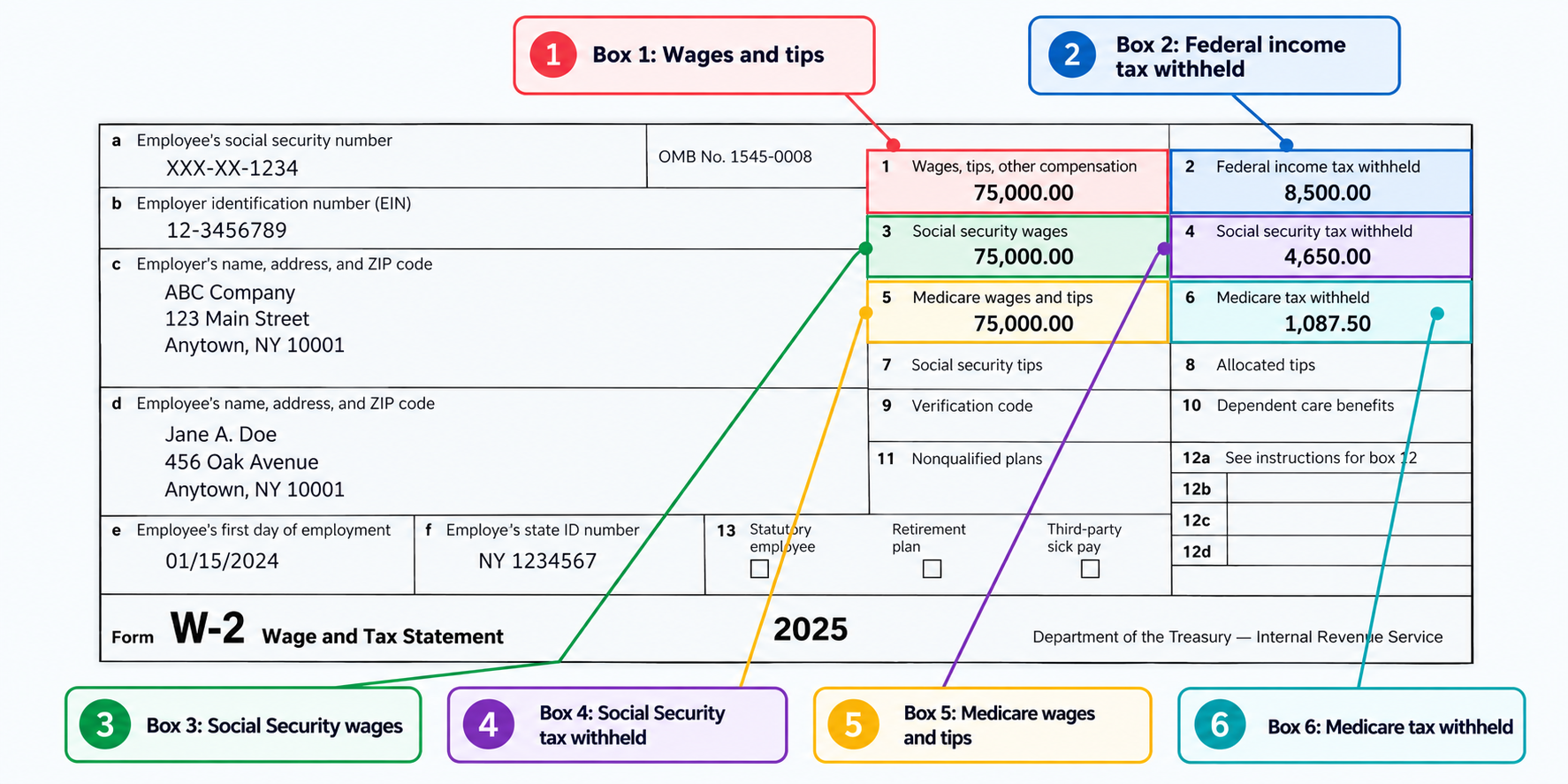
These boxes help you understand your reported income and tax payments. Compare the figures with your pay records, and contact your employer if you notice any errors. Correct information helps you file your tax return accurately.
The main difference between a W-2 and a 1099-NEC is your work status and how you pay taxes. A W-2 is for employees, while a 1099-NEC is generally used to report payments to independent contractors. Understanding the difference between 1099 and W-2 can help you know which form applies to your work.
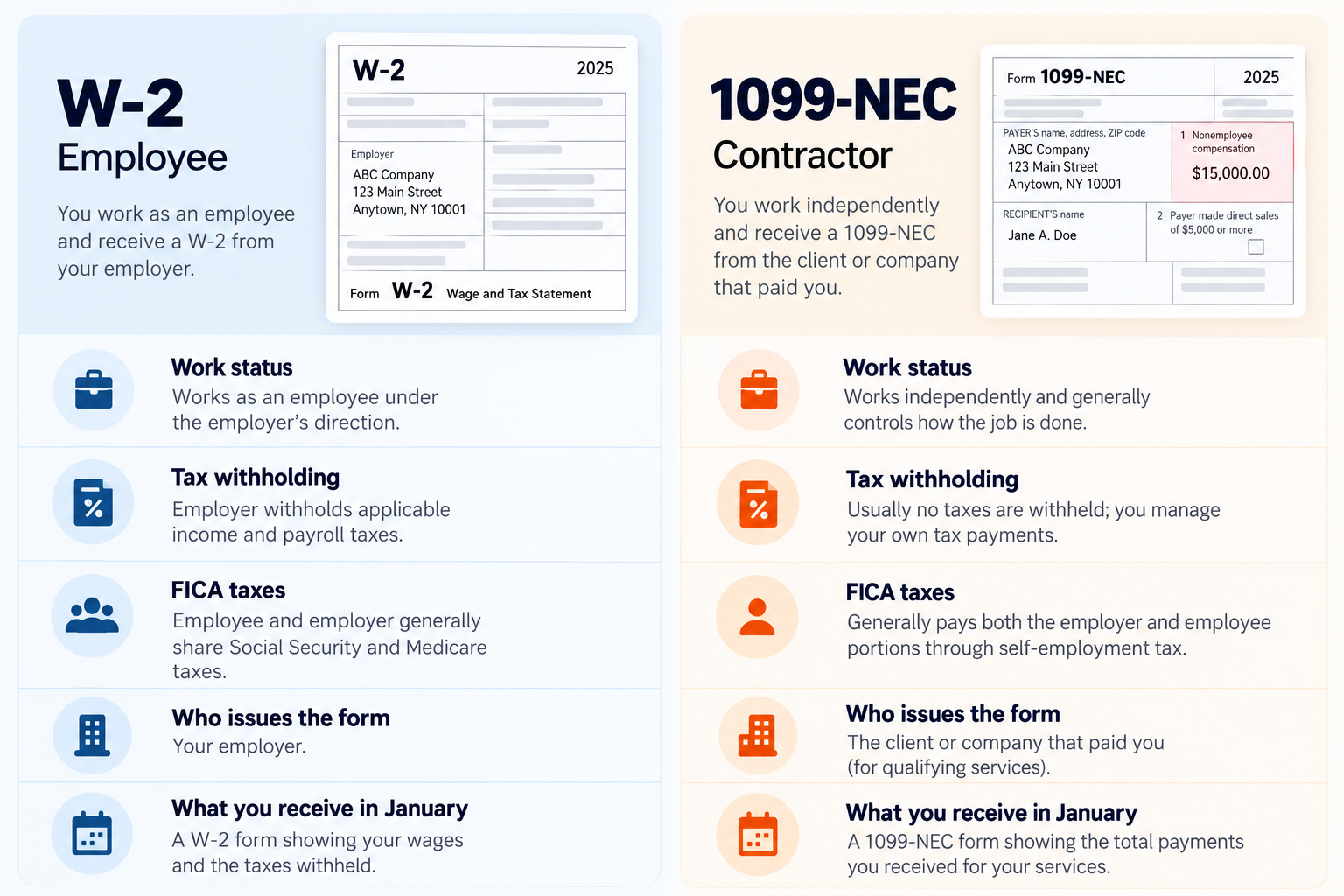
Your classification affects how you handle taxes and other work responsibilities. If you are unsure whether you are an employee or an independent contractor, look at the nature of your working relationship, not just the form you receive.
If your W-2 has the wrong income, tax details, or Social Security number, or you have not received it, do not ignore the problem. You need the correct information to file your tax return.
Contact your employer first: Explain what is wrong or ask when your missing W-2 will arrive. If your original form has an error, your employer can issue a corrected form called Form W-2c. Check the updated details before filing your taxes.
Contact the IRS if the problem continues: If your W-2 is still missing or has not been corrected by the end of February, call the IRS at 800-829-1040 for help. The IRS can contact your employer and explain your next steps.
What if the deadline is near: If you cannot get your W-2 in time to file, the IRS may direct you to use Form 4852, which serves as a substitute. Use your pay records to estimate your wages and taxes accurately. If you already filed using incorrect figures, you may need to submit an amended tax return.
Getting paid by a US employer or client should not be difficult just because you live in another country. You still need a reliable way to receive your money, manage it in dollars, and use it where you live. This is where getting paid across borders becomes important, especially for freelancers, remote workers, and businesses working with international clients.
Grey helps you receive international payments through a foreign currency account. With a Grey USD account, you can share your account details with eligible US employers or clients to get paid from the US without relying on a traditional US bank account. You can then keep your money in dollars or convert it to your local currency when you need it.
To get started, you can open a USD account with Grey, complete identity verification, and check the available receiving options and fees for your location. This makes it easier to manage your international earnings from one place.
A W-2 form is an official US tax document that shows how much you earned from your employer during the year and how much tax was withheld from your pay. You use it to report your earnings and taxes when filing your annual income tax return.
Employers generally must send your W-2 by January 31 each year for the previous tax year. You may receive it by mail or through your employer’s online payroll portal. If it has not arrived by early February, contact your employer to confirm when it will be available.
Box 1 shows wages subject to federal income tax, while Box 2 shows federal income tax withheld. Boxes 3 and 4 cover Social Security wages and tax, while Boxes 5 and 6 show Medicare wages and tax withheld.
W-2 employees generally have income and payroll taxes withheld by their employers. 1099 contractors usually receive payments without tax withholding and must manage their own tax payments, including self-employment taxes when applicable.
Contact your employer’s payroll department as soon as possible and explain the error. Ask them to issue a corrected form called Form W-2c. Check the corrected details carefully and use accurate information when filing your tax return.
Contact your employer first to request your missing form. If it has not arrived by the end of February, call the IRS at 800-829-1040 for assistance. Keep your pay stubs handy to help estimate your earnings and taxes if needed.
See how much a Europe trip costs from five regions, with a country-by-country daily budget, flights, rail and a range for each. Compare.
Olayoyin Olorunmota
•
October 27, 2026
•
2 min read
Planning a Europe trip involves a lot of variables: which countries, which season, how you’ll move between cities, and where you’re flying from. Get those details right, and you can see a lot of Europe for a reasonable amount. Get them wrong, and costs escalate quickly without any obvious single cause.
This guide breaks down what a trip to Europe costs in 2026, starting with five major departure regions, then going country by country to provide daily spending figures that determine your on-the-ground budget.
A two-week Europe trip in 2026 costs roughly $1,800 to $3,500 per person on a budget, $3,500 to $7,000 mid-range, and $8,000 plus for luxury travel. These figures include international return flights from the US, accommodation, food, local transport, and activities.
The single biggest variable after flights is your route. Daily costs range from $70 to $90 in Eastern Europe, $120 to $180 in Western Europe, and $180 to $280 in Switzerland and Iceland. A two-week itinerary through Portugal and the Czech Republic costs meaningfully less than the same length of time in France and Switzerland, even with identical spending habits.
Two other variables that matter: season and booking lead time. Summer (June to August) is the most expensive period for both flights and accommodation across Europe. Shoulder seasons (April to June and September to October) offer a strong balance of good weather and lower prices. Winter travel outside the Christmas period can reduce costs significantly.
The Europe trip budget framework that most experienced travellers use: calculate your flights as a fixed one-off cost, then multiply your daily spending estimate by the number of travel days, and add a 10 to 15% buffer for unexpected costs. The daily estimate depends almost entirely on which countries you visit, covered in the country-by-country section below.
Flights from the US are the single largest fixed cost for most American travellers visiting Europe, and the range is wide depending on departure city, destination, airline, and timing.
From New York (JFK), round-trip fares to London or Paris typically run $600 to $900 on full-service airlines if you book two to three months ahead. In summer, prices can spike to $1,200 or more for direct flights. From Los Angeles (LAX), expect to pay $750 to $1,200 for a round trip in economy to major hubs like Amsterdam, Frankfurt, or Madrid. Chicago usually falls in the $650 to $950 range for nonstop routes.
Budget airlines including Norse Atlantic, PLAY, and French Bee offer transatlantic fares from $150 to $380 one-way. These carry-on-only fares require flexibility on dates and destination, but can substantially reduce the flight portion of your budget.
Two-week Europe trip total from the USA (per person):
Canadian travellers face similar transatlantic flight dynamics to US travellers, with some route-specific differences. Direct flights operate from Toronto (YYZ), Vancouver (YVR), and Montreal (YUL) to major European hubs.
Round-trip fares from the East Coast of North America to Europe average $700 to $1,000 for economy class, with West Coast departures running $900 to $1,300. Canadian departure cities generally sit within this range, with Montreal often competitive on Air France and Air Transat routes to Paris and beyond.
Two-week Europe trip total from Canada (per person):
Travelling within Europe to other European destinations has a completely different cost structure. Budget airlines (Ryanair, easyJet, Wizz Air, Vueling) and an extensive rail network make intra-European travel significantly cheaper than transatlantic flights.
Budget airline fares between European cities often start at £20-£80 one-way when booked in advance, though baggage fees can add £30-£50. Intercity rail within a single country runs €20 to €80 for most journeys, with high-speed international routes (London to Paris, Paris to Amsterdam, Madrid to Barcelona) typically costing €50 to €150 when booked ahead.
A multi-country Eurail Pass offers unlimited travel in 33 European countries, with a 15-day continuous pass starting from approximately €441 for adults. This is cost-effective for intensive rail travel but not always necessary for planned itineraries where point-to-point tickets booked in advance are often cheaper.
Two-week Europe trip total from within Europe (per person):
African travellers to Europe typically fly through major connecting hubs including Istanbul (Turkish Airlines), Addis Ababa (Ethiopian Airlines), Doha (Qatar Airways), Dubai (Emirates), and Amsterdam (KLM). Direct flights exist from a small number of African cities to European destinations, but the majority involve at least one connection.
Roundtrip fares from major African cities, including Lagos, Nairobi, Accra, and Johannesburg, to European destinations typically range from $400 to $1,100, depending on origin, destination, and season. Ethiopian Airlines and Turkish Airlines consistently offer competitive fares on African-to-European routes.
Schengen visa requirements apply for most African passport holders, with consulate fees currently at €80 per application. Factor this into the total trip cost.
Two-week Europe trip total from Africa (per person):
South American travellers face some of the longest transatlantic routes outside of Asia-Pacific. Direct flights operate from São Paulo (GRU), Buenos Aires (EZE), Bogotá (BOG), Lima (LIM), and a handful of other cities to European hubs, primarily Lisbon, Madrid, and Paris.
Lisbon and Madrid are typically the cheapest entry points for South American travellers due to direct routes from multiple South American cities. TAP Air Portugal and Iberia are the primary carriers on these corridors.
Roundtrip economy fares from South America to Europe generally run $700 to $1,400, with São Paulo to Lisbon or Madrid often the most competitively priced at $700 to $1,000 when booked two to three months ahead. Buenos Aires and Lima routes run slightly higher.
Two-week Europe trip total from South America (per person):
Your route determines your daily spending more than almost any other factor. Here is a verified country-by-country comparison for the five most commonly visited European destinations, plus two value alternatives.
Switzerland can cost €230 to €280 per day, while Portugal is €85 to €115 per day, which is significantly cheaper than most of Western Europe.
For a detailed breakdown of one of the most popular European destinations, see our guide on how much a trip to Italy costs.
What your route means in practice: A 14-day trip splitting time between Czech Republic and Portugal, using the mid-range figures above, costs approximately $1,820 to $2,940 in on-the-ground spending, not including flights. The same two weeks split between France and Switzerland costs approximately $2,870 to $4,690 on the ground. That’s a difference of over $1,000 to $1,700 purely from country selection, before a single additional decision is made.
Once you have a total figure, how you access and spend money in Europe makes a measurable difference to what you actually spend.
Hold euros before you go: Most of Western Europe uses the euro. Converting your spending money before departure, or holding euros in a multi-currency account, means you can see and confirm the rate you're getting, rather than accepting whatever the airport kiosk or hotel desk offers. Grey lets you hold euros and more in one account and spend directly from that balance.
Use one virtual Mastercard across borders: A Grey virtual card works at any merchant or ATM that accepts Visa across all 27 EU countries and beyond. There’s no need to carry multiple cards or exchange cash at each border. Cross-border card transactions on a USD card incur a 2% fee plus $0.50; spending from a euro balance avoids this for euro-zone countries.
Get a travel eSIM for Europe: Roaming charges on your home plan can add unexpected costs to a multi-country trip. A travel eSIM lets you add a European data plan before you leave, avoid roaming fees entirely, and switch between local networks across the continent. Buy a travel eSIM for Europe through the Grey app and cover your data needs without a separate SIM card or roaming charges.
For sending money from the US to cover European expenses, see our “send money from the US to Europe” page for current rates and fee information.
A two-week Europe trip in 2026 costs roughly $1,800 to $3,500 per person on a budget, $3,500 to $7,000 mid-range, and $8,000 plus luxury, including flights from the US. The range is wide because Eastern European countries cost roughly half as much per day as Western European ones. Your route shapes the total almost as much as your flights.
Central and Eastern Europe offers the best budget value, with Czechia, Hungary, and Poland providing realistic daily costs from about $45 to $65. Portugal is the best value in Western-adjacent Europe, with prices ranging from $55 to $80 per day on a budget. Switzerland and Scandinavia are consistently the most expensive, with Switzerland running $150 or more even for budget travellers.
Plan $45 to $65 per day in Eastern Europe (Czech Republic, Hungary, Poland), $80 to $130 in Southern Europe (Portugal, Greece, Croatia), and $120 to $200 in Western Europe (France, Italy, Germany). Switzerland is a category of its own at $150 to $300 per day for most travellers. These figures cover accommodation, food, local transport, and entry fees, but not international flights.
It depends on the route and how far ahead you book. Budget airlines frequently offer fares between European cities for £20 to £80 one-way when booked weeks in advance, which beats most rail options on cost. However, rail is often faster city-centre to city-centre once airport travel time is included, and a Eurail Pass becomes cost-effective for intensive multi-country itineraries. For short, planned routes, point-to-point rail tickets booked two to three months ahead are often the best value; for spontaneous travel, budget airlines win on price.
The cheapest months to fly to Europe from the US are typically January, February, and November, when round-trip fares from hubs like JFK can drop to $550-$700. The shoulder seasons of May and September offer a good balance of lower prices and favourable weather compared to the peak summer period in July and August.
Touring Europe? Hold euros with Grey, use one virtual card across borders, and grab a travel eSIM for your trip.

Sell gift cards for cash through exchanges, kiosks or peer marketplaces, and see the rates each pays. Avoid the common scams. Compare your options.
Tunde Aladeloba
•
October 26, 2026
•
2 min read
If you have a gift card you'll never use, selling it can help you turn that unused balance into cash. Whether you received an unwanted gift card, have leftover shopping credit, or simply need money for something else, there are several ways to sell gift cards in the US. Online gift card exchanges offer convenience, physical kiosks provide quick in-person transactions, and peer-to-peer marketplaces let you negotiate directly with buyers.
The amount you receive depends on the retailer, card balance, demand, and selling method. Some gift cards sell closer to their face value than others, so comparing offers before accepting one can help you get a better deal. Payout times also vary, ranging from immediate payment at some kiosks to several business days for online transactions.
Before choosing where to sell, check the platform's fees, payment options, and verification requirements. Be cautious with private buyers who ask for your card number or PIN before payment, as gift card scams can leave you with nothing.
This guide explains how to sell gift cards safely, compare payout options, and choose the method that best fits your needs.
Typical payouts for selling gift cards range from 60% to 93% of the card’s face value, depending on the retailer, platform, and selling method. Understanding how digital gift cards work can help you choose the right selling method and protect your balance.
Gift card trading apps typically offer around 70% to 85% of your card’s value. You submit your card details, receive an offer, and get paid after verification. Check the app’s fees, supported retailers, and payout methods before accepting an offer.
Specialised websites such as GiftCash may offer payouts of approximately 75% to 93% for eligible cards. Rates depend on demand, brand, and balance. Compare the final offer with other platforms, as the highest advertised rate may not apply to your card.
P2P marketplaces let you negotiate directly with buyers, with typical returns of 60% to 85% after fees. You may secure a better price, but fraud risks are higher. Use trusted platforms and never share your card's redemption code before payment is secured. If you also need to purchase or keep track of gift cards, buy and manage gift cards with Grey to explore your options.
The rate you receive depends on the gift card brand, how many buyers want it, and how easily the card can be resold. Amazon, Apple, and Steam gift cards often have strong demand, while cards for less popular or region-specific retailers may sell for less.
A card's resale value is not the same as its face value. If your gift card is worth $100 and a buyer offers 80%, you will receive $80 before any additional fees.
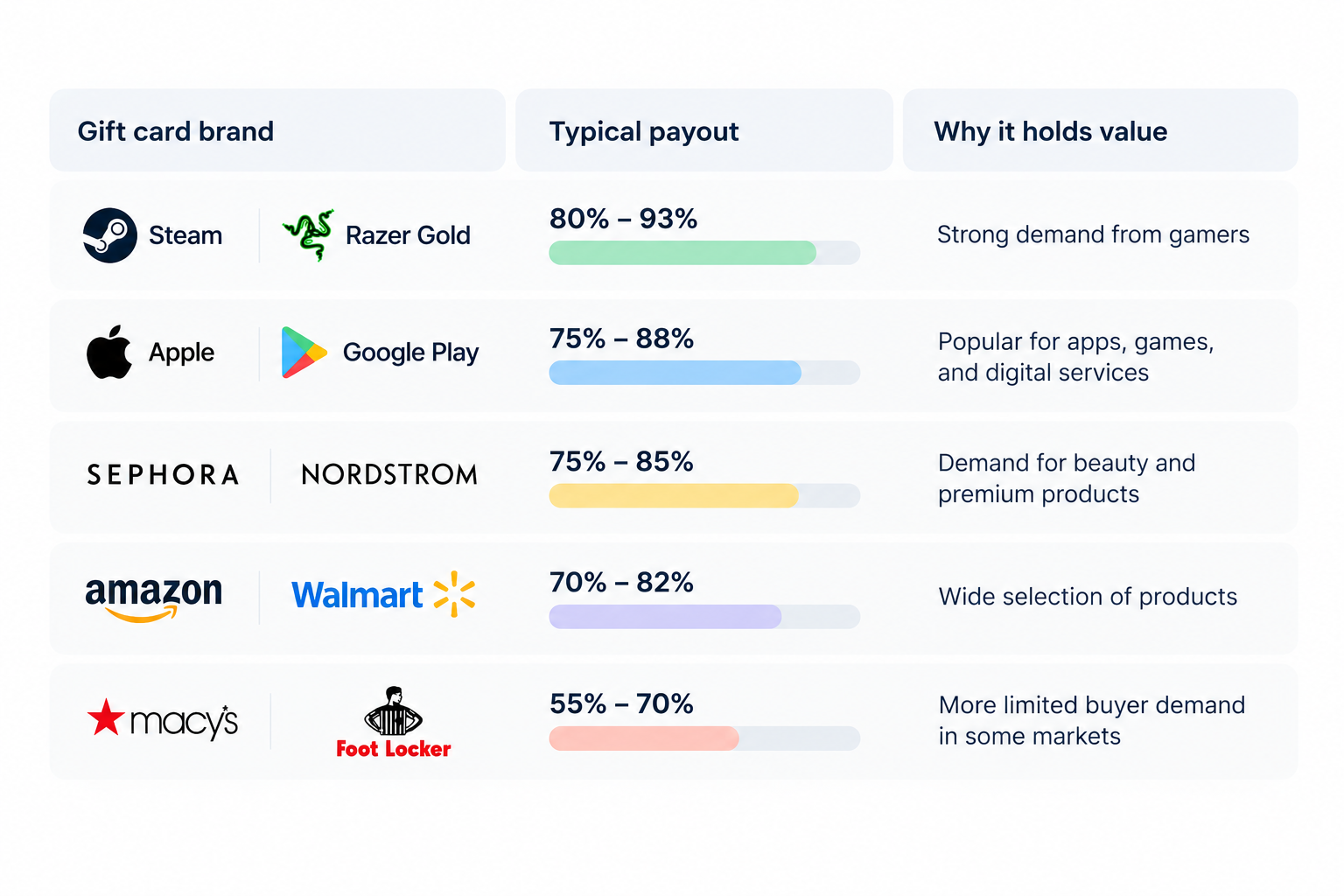
Follow these steps to turn an unused gift card into cash while reducing the risk of delays, rejected submissions, or scams.
1. Check your balance: Visit the retailer's official website to confirm the remaining balance and make sure the card has been activated.
2. Confirm the card details: Check the brand, issuing country, currency, denomination, and whether you have a physical card or digital code.
3. Keep your proof of purchase: Save the original receipt, activation slip, or purchase confirmation email. Some buyers require proof to verify the card's origin.
4. Compare offers: Check the current payout rate on reputable trading platforms and compare the final amount you will receive after fees.
5. Submit your card: Create an account, select the correct card category, and upload clear images or enter the digital code through the platform's official submission process.
6. Wait for verification: The buyer checks the card's validity and balance. Track your transaction and respond to requests for additional information.
7. Receive your payout: Once approved and marked as paid, withdraw the money using an available payment method. Keep your transaction receipt for your records.
Important: Never share your gift card code with an unverified buyer or send it through public comments or unofficial messages.
Selling gift cards for cash can be convenient, but a careless transaction can leave you with an empty balance and no payment. Knowing the warning signs can help you protect your money.
1. Check for drained cards: Confirm your gift card balance on the retailer's official website before trading. Submit it promptly through a trusted platform, as anyone who obtains the code may redeem the balance first.
2. Avoid fake buyers: Be cautious of social media traders promising unusually high rates or instant payments. Use reputable platforms with clear verification procedures and buyer protection where available.
3. Watch for overpayment scams: Never refund an alleged excess payment based on a screenshot or an unverified check. Confirm that funds have actually cleared before releasing your card.
4. Keep your PIN secret: Never share your redemption code, PIN, or photos showing the complete card details with an unverified buyer. Once someone redeems the balance, recovering your money may be difficult.
Always verify the buyer, confirm payment independently, and keep transaction records.
Selling gift cards through US platforms can be useful, but receiving your money while living abroad requires the right payment method. You may not need a US bank account if the platform supports international payouts or allows you to withdraw through an eligible financial service. Before selling, confirm the available payout currencies, withdrawal methods, and account requirements.
If you live in Nigeria, for example, you may want to receive USD and convert it to naira when you need local spending money. Grey supports cross-border transfers, and you can explore how to send money from the US to Nigeria to understand the available transfer options. Check the applicable fees, exchange rate, and delivery time before moving your funds.
You can also open a USD account with Grey to explore options for receiving and managing dollars, subject to eligibility and availability. Keeping funds in USD before converting them may help you choose when to exchange, but always compare the total costs and withdrawal options first.
The best place to sell gift cards depends on your preferred currency, payout speed, and the card you own. Platforms such as Cardtonic, GiftCardsToNaira, GiftCash, and Gameflip offer different options. Compare their rates, fees, supported brands, and payment methods before choosing where to sell.
The amount you receive depends on the card’s brand, value, demand, and resale platform. Some gift cards may sell for 60% to 93% of their face value, but rates vary. Check current offers before selling so you understand how much you will receive.
You may be able to sell a partially used gift card, depending on the platform’s rules. The marketplace must support the card and allow its remaining balance to be verified. Check the requirements first, and disclose the exact balance to avoid disputes with the buyer.
Gift card payout times depend on the platform, verification process, and payment method. Some services process approved transactions quickly, while others may take several hours or longer. Before selling, check the estimated processing time and confirm whether additional identity or card verification is required.
Selling gift cards you legitimately own is generally legal, but the rules depend on your location, the card issuer’s terms, and the transaction. Avoid selling cards obtained through fraud or using platforms that facilitate illegal activity. Check local regulations and the marketplace’s terms before completing a sale.
To sell a US gift card while living abroad, choose a reputable platform that accepts your card brand and country of residence. Check its exchange rate, fees, verification requirements, and payout options. Confirm that you can withdraw the proceeds in your preferred currency before submitting your card details.

See how much a trip to Thailand costs from five regions, with flights, stays and daily spend, plus a budget range for each. Compare.
Olayoyin Olorunmota
•
October 25, 2026
•
2 min read
My friend who took a trip to Thailand last year says it cost her about $30 a day, so you multiply by seven, get $210, and start looking at flights. The first fare you find is $980 return. Her $ 30-a-day rate was accurate, but it left out the flight, the island ferry, and the fee her bank charged on every card payment. Planning a week in Thailand is mostly a matter of separating the low daily costs from the costs that arrive before you land, which are not.
This guide covers what a week in Thailand costs from five starting points, including the island transfers and payment fees that most budgets leave out.
A week in Thailand costs about $1,000 to $2,800 per person once flights, accommodation, food, and local transport are included, and the cost of the trip depends more on your departure city than on anything you do after you arrive. Thailand is a value destination on the ground: a street meal costs roughly $2 to $4, and a shared guesthouse room costs about $20 to $35 per person per night. The return flight, at $600 to $1,400 from most regions, is what makes the total large.
The figures in this guide assume seven nights, two people sharing a room, and two spending levels. Budget means guesthouses or simple hotels at about $20 to $35 per person per night, plus $25 to $40 a day for food, local transport, and entry fees. Mid-range means three- and four-star hotels at about $50 to $90 per person per night, plus $50 to $80 a day. On the ground, that comes to roughly $315 to $525 for a budget week and $700 to $1,190 for a mid-range one, before flights and island transfers.
After the flight, three things move the total: the season, which islands you visit, and how you pay. Prices peak from November to February, when the weather is dry and cool, and fall in the rainy season from roughly May to October.
| Starting point | Return flight | Estimated total, seven nights |
|---|---|---|
| United States | $700 to $1,300 | $1,015 to $2,490 |
| Canada and Mexico | $800 to $1,400 | $1,115 to $2,590 |
| Europe | €500 to €900 | €780 to €1,930 |
| Africa | $600 to $1,200 | $915 to $2,390 |
| South America | $1,300 to $2,200 | $1,615 to $3,390 |
Each total ranges from the cheapest flight at a budget level to the most expensive at a mid-range level. Totals exclude island transfers and visa fees, which are covered below.
Return flights from the United States to Bangkok typically cost $700 to $1,300. Most itineraries connect through East Asia, the Gulf, or Europe; journeys take 20 hours or more, and fares tend to be low in the rainy season, from May to October, and high around Christmas and New Year.
On the ground, a budget week costs about $140 to $245 for accommodation and $175 to $280 for daily spending, while a mid-range week costs $350 to $630 for accommodation and $350 to $560 for daily spending. That puts the total at roughly $1,015 to $2,490 per person before island transfers. The flight is the highest single cost for most travellers, which is why the trip to Thailand cost from the United States varies so much with the month you book.
Card fees add to the total. Many US bank cards charge a foreign transaction fee of around 3% on each baht purchase, which comes to about $30 on $1,000 of card spending, and Thai ATMs charge a separate flat fee on every foreign card withdrawal, covered in the payment section below.
This section covers Canada and Mexico, since the United States has its own section above. Return flights to Bangkok typically cost $800 to $1,400 in US dollars. Canadian travellers usually connect through East Asian hubs, with Vancouver offering the shortest routes, while travellers from Mexico typically connect through the United States, Europe, or East Asia.
Ground costs are the same as in the US section, which puts the total at roughly $1,115 to $2,590 per person before island transfers. Because these figures are in US dollars, the amount you pay in Canadian dollars or Mexican pesos depends on the exchange rate on the day you book and on the days you spend. Many Canadian credit cards also charge a foreign currency fee of around 2.5% on each baht purchase, so check yours before you fly.

Return flights from Europe to Bangkok cost about €500 to €900. Nonstop flights run from several European capitals, and one-stop itineraries through Doha, Dubai, or Istanbul are often cheaper.
Ground costs in euros range from €280 to €460 for a budget week and €610 to €1,030 for a mid-range week, for a total of roughly €780 to €1,930 per person before island transfers. Travellers from the eurozone still convert euros to baht on every card payment and cash withdrawal, and the fee for doing so varies by bank, so check your card's foreign-currency charge before you travel.
Return flights from Africa to Bangkok typically cost $600 to $1,200. Ethiopian Airlines flies from Addis Ababa to Bangkok, and other itineraries connect through Doha, Dubai, or Istanbul.
Entry rules depend on your passport. South African citizens have been able to enter visa-free for a short stay, while Nigerian citizens need a tourist visa, which costs about 2,000 baht (roughly $55) for a single entry at the time of writing and is applied for online or at a Thai embassy before travel. With the same ground costs as the other sections, the total comes to roughly $915 to $2,390 per person before island transfers and any visa fee.
Return flights from South America to Bangkok typically cost $1,300 to $2,200, which makes this the most expensive starting point. Nearly every itinerary connects in Europe, the Gulf, or the United States, and journeys often take 24 hours or more. Citizens of Brazil, Argentina, and Chile can enter Thailand visa-free for short stays, so there’s no visa fee to pay.
With ground costs of $315 to $525 for a budget week and $700 to $1,190 at mid-range, the total is roughly $1,615 to $3,390 per person before island transfers. Travellers paying in Brazilian reais, Argentine pesos, or Chilean pesos face a currency conversion on every purchase, so the exchange rate affects the total more here than for travellers who already hold dollars.
The table below shows what a week costs once the flight is set aside. Island transfers are the item most budgets leave out, and they depend on how far you travel and how quickly you want to get there.
| Cost item (per person, seven nights) | Budget | Mid-range | What moves the number |
|---|---|---|---|
| Accommodation | $140 to $245 | $350 to $630 | Island and month; Phuket, Koh Samui, and Koh Phi Phi cost most from November to February |
| Food and drink | $105 to $175 | $210 to $350 | Street stalls and food courts cost far less than beachfront restaurants |
| Local transport and entry fees | $70 to $105 | $140 to $210 | Metro and shared taxis cost less than private cars and tours |
| Island and city transfers, about three journeys | $30 to $90 | $90 to $250 | Buses, trains, and shared ferries versus domestic flights and speedboats |
| Total before flights | $345 to $615 | $790 to $1,440 |
A ferry from Phuket to Koh Phi Phi, or the combined bus-and-ferry ticket from Surat Thani to Koh Samui, typically costs $9 to $25 per journey, and a domestic flight from Bangkok to Phuket or Chiang Mai typically costs $40 to $100 one way when booked early. The Tourism Authority of Thailand lists entry and transport information for each region.
Travellers who earn or save in more than one currency can hold multiple currencies before they leave, so the exchange rate is fixed when they convert instead of at each purchase.
Thailand uses cash for small purchases such as street food, markets, and local transport, and cards for hotels, tours, and flights. That split shapes what paying costs. Thai ATMs charge a flat fee of about 220 baht (roughly $6 to $7) on every foreign card withdrawal at most banks, on top of whatever your own bank charges, so withdrawing $300 once costs far less in fees than withdrawing $100 three times. When an ATM or card terminal offers to convert the amount to dollars, decline and pay in baht, because the rate it applies is set by the operator and is usually worse than your card's. Most US bank cards also add a foreign transaction fee of around 3%, and carrier roaming passes typically cost about $10 per day, or $70 for a week.
Several options reduce these costs. Travel credit cards with no foreign transaction fee remove the 3% charge, and multi-currency accounts such as Wise and Revolut also support international spending. Their fees vary by plan and country, so compare them before you choose.
Grey is another option, with different trade-offs. You can spend on a virtual card created in the app for $5, with no monthly fee. A virtual card keeps your main bank card out of hotel and tour-booking systems, and you can freeze the virtual card if its details are ever exposed. The card is denominated in US dollars, so every baht purchase is a cross-border card transaction with a 2% fee plus $0.50. Against a 3% bank fee, that makes the card cheaper above $50 and more expensive below it: a $200 tour costs $4.50 in fees against $6, while a $5 street meal costs $0.60 against $0.15. Use the card for hotels, tours, and flights, and pay for street food in cash.
You fund the account by ACH deposit, which costs 0.8% (minimum $2, maximum $10), or by converting from another balance at 1% (capped at $6), and the exchange rate is shown before you confirm. If you also need to pay a tour operator or host by bank transfer, you can move money before you travel and settle the booking in advance. For data, you can buy a travel eSIM for Thailand in the app and install it before you fly. Travel eSIMs are typically data-only, so calls and texts to your US number still need your carrier's plan or Wi-Fi calling, and the price per gigabyte is worth comparing with your carrier's roaming pass.
A week in Thailand costs about $1,000 to $2,800 per person for most travellers flying from North America, Europe, or Africa, covering flights, accommodation, food, and local transport. The return flight is usually the highest single cost, at roughly $600 to $1,400 depending on where you start, while a week on the ground costs about $315 to $525 at a budget level and $700 to $1,190 at mid-range. Island transfers, visa fees where they apply, and card or ATM fees add to the total.
Thailand is inexpensive on the ground compared with the United States and Western Europe. A street meal costs roughly $2 to $4, a shared guesthouse room about $20 to $35 per person per night, and an island ferry about $9 to $25. Prices rise in Phuket, Koh Samui, and Koh Phi Phi during the November to February peak, and the long-haul flight remains the highest cost for most travellers.
Plan for about $25 to $40 a day at a budget level or $50 to $80 a day at mid-range, plus accommodation. Those figures cover street food and local restaurants, metro and shared taxi rides, and temple or park entry fees. They don't cover island transfers, organised tours, or nights out, which you should budget separately.
Prices are lowest in the rainy season, roughly May to October, when flights and hotels cost less and the Andaman coast around Phuket and Krabi sees rougher seas. Gulf islands such as Koh Samui are generally drier between January and August, which makes them a better choice in the middle of the year. Peak prices apply from November to February, with the steepest rates around Christmas and New Year.
Citizens of the United States, Canada, most European countries, Brazil, Argentina, and Chile can enter without a visa for a short stay, currently up to 60 days, though the allowed period has been under review. All arrivals complete the Thailand Digital Arrival Card online shortly before they travel, and a tourist entry fee has been proposed more than once, so check the current rules before you book. Other nationalities, including Nigerian citizens, need a tourist visa, which cost about 2,000 baht at the time of writing.
Yes, for small purchases. Street food stalls, markets, local buses, and many small shops take cash only, while hotels, malls, and larger restaurants accept cards. Withdraw cash in fewer, larger amounts, because Thai ATMs charge a flat fee of about 220 baht on each foreign card withdrawal regardless of the amount, and decline any offer to convert the withdrawal to your home currency.
Off to Thailand? Create a Grey virtual card and add a travel eSIM before you fly.

See how much a trip to Greece costs from five regions, with flights, hotels, ferries and a budget range for each traveller. Compare.
Olayoyin Olorunmota
•
October 25, 2026
•
2 min read
Let’s say you found a return flight from Greece for $890 and started planning a week-long vacation around it. Then you check hotels on Santorini and one night costs more than you expected to spend for three nights. You quickly realise that the flight is usually the easiest part of trips to Greece to price; hotels, ferries, and how many islands you visit are where the budget moves.
A one-week trip to Greece from the United States costs roughly $1,200 to $1,900 per person on a budget, $2,000 to $3,000 mid-range, and $5,000 or more for luxury stays. Flights, island ferries, and July and August hotel rates drive most of the difference.
A week in Greece breaks into three cost layers: getting there, sleeping, and moving around once you arrive. Return flights from the United States typically cost $700 to $1,300. On the ground, a budget traveller spends about €450 to €800 for seven nights and a mid-range traveller spends €900 to €1,500, both assuming two people share a room. Dollar totals in this article use an assumed rate of $1.10 to the euro, so adjust them if the rate has moved by the time you book.
Three choices affect a trip to Greece more than any others.
The first is season, because July and August are when rooms cost the most, and Greece also charges a higher nightly climate fee from April to October than from November to March.
The second is which island you pick: a mid-range room that costs about €130 a night on Naxos can cost €250 to €350 on Santorini in August.
The third is how many ferry hops you add, since each leg costs €35 to €108 depending on the route and vessel.

Return flights from the United States cost about $700 to $1,300. Direct flights from several East Coast cities to Athens take roughly nine to ten hours, and fares sit at the top of that range in July and August. Once you land, a 3-star hotel room in Athens typically costs €70 to €140 a night, and meals run €20 to €35 a day for budget travellers or €45 to €70 for mid-range travellers who eat two sit-down meals daily. An Acropolis ticket is €30, and a flat-rate taxi from Athens airport to the city centre costs €43 during the day and €60 at night, so an Athens-only week stays near the bottom of each range.
That puts a budget trip from the USA at roughly $1,200 to $1,900 per person and a mid-range trip at $2,000 to $3,000 per person, including one island ferry trip. Because you pay for flights in dollars and for almost everything else in euros, the exchange rate and any card fees apply to nearly every purchase after you land, which is why the payment section below is worth reading before you travel.
This section covers Canada, Mexico, and the rest of North America; US travellers should use the section above. Return flights from these origins cost about $800 to $1,400. The ground costs are the same as for any other origin: budget travellers spend €450 to €800 per week, and mid-range travellers spend €900 to €1,500 per week. That makes a budget trip about $1,300 to $2,000 per person and a mid-range trip about $2,000 to $3,100.
Currency adds a step for Canadian and Mexican travellers. Fares may be quoted in Canadian dollars or pesos, while hotels and ferries are priced in euros, and the totals here are in US dollars and euros. Check the day’s rate between your own currency and the euro before treating any total as final, because a three per cent swing on a $2,500 trip is $75.
Flights from elsewhere in Europe are the cheapest in this guide, at roughly €150 to €400 return, because most European capitals have direct routes to Athens and several islands. Ground costs stay the same: €450 to €800 for a budget week and €900 to €1,500 for a mid-range week. Totals come to about €600 to €1,200 for a budget trip and €1,050 to €1,900 for a mid-range trip, shown in euros because that is how most European travellers budget.
Travellers from the eurozone don’t convert any currency in Greece, so their only extra cost is card fees if the account isn’t in euros. Travellers from the UK, Switzerland, and Poland pay a conversion fee on every purchase, which makes the card or account you choose a bigger part of the total.

Return flights from Africa to Athens cost about $500 to $1,100, and most itineraries connect through a hub such as Istanbul, Cairo, or Addis Ababa, so fares vary with the route. Citizens of most African countries, including Nigeria, Ghana, Kenya, Egypt, and Morocco, need a Schengen visa for Greece. The application fee is €90 for adults, and applicants usually also pay a visa centre service charge and need travel insurance with at least €30,000 in medical cover. Add those costs to your total.
Excluding the visa, a budget trip from Africa comes to roughly $1,000 to $2,000 per person and a mid-range trip to $1,700 to $2,800. Many travellers from Africa pay for flights and hotels in dollars or euros, so how you hold foreign currency before you leave matters as much as the fare.
Return flights from South America to Athens cost about $1,100 to $1,900 and usually include one connection in Europe, which makes this the most expensive origin in the guide. Citizens of Brazil, Argentina, Chile, Colombia, and Peru can enter Greece without a visa for up to 90 days in any 180-day period, while citizens of some other countries in the region need one, so check with the Greek embassy before you book.
A budget trip comes to roughly $1,600 to $2,400 per person, and a mid-range trip to $2,300 to $3,600 per person. With a long-haul fare as the largest line item, the biggest savings usually come from the flight date, so compare fares across several weeks before you fix your hotel dates.
This table lists the line items behind the totals above. Prices are per person unless a row says per room, and ferry prices vary with vessel type, season, and how far ahead you book.
| Item | Typical cost | Notes |
|---|---|---|
| Return flight from the USA | $700–$1,300 | Top of the range in July and August |
| Hostel bed | €20–€40 per night | Around €20 in Athens, around €40 on Mykonos and Santorini |
| Budget guesthouse | €25–€50 per room per night | Outside peak season on most islands |
| 3-star hotel | €70–€140 per room per night | Higher on the islands in July and August |
| 4-star boutique hotel | €140–€250 per room per night | Family suites fall in this range |
| Caldera-view luxury villa | €400–€900+ per night | Santorini and Mykonos in peak season |
| Climate crisis resilience fee, April to October | €2–€15 per room per night | €2 for 1 to 2-star, €5 for 3-star, €10 for 4-star, €15 for 5-star; paid at the hotel |
| Climate crisis resilience fee, November to March | €0.50–€4 per room per night | Same star categories at lower rates |
| Meals | €20–€35 per day (budget), €45–€70 (mid-range), €80–€120 (comfortable) | Taverna dinners average €18–€35 per person |
| Ferry, Piraeus to Santorini (conventional) | €40–€60 | About eight hours |
| Ferry, Piraeus to Santorini (high-speed) | €60–€90 | About 4.5 hours |
| Ferry, Piraeus to Mykonos (conventional) | €35–€45 | About five hours |
| Acropolis ticket | €30 | Per person |
| Boat excursion | About €100 | Day trips from the islands |
| Taxi, Athens airport to centre | €43 daytime, €60 at night | Fixed rate |
Ferry times and prices change by season and operator, so check the official Greek tourism site for island information and confirm fares with the ferry operator before you book. If you already know your hotel and ferry costs, you can hold euros before you leave, which locks in the exchange rate for the part of your budget you can price today.
Once the budget is set, the next cost is paying for it. Three charges matter most: your bank's foreign transaction fee, the ATM operator’s withdrawal fee, and dynamic currency conversion, which happens when a Greek card terminal or ATM offers to charge you in dollars instead of euros. Decline that offer, because the conversion is usually done at a less favourable rate than your card network’s.
Grey is one way to handle this. You can hold euros in a Grey account, convert dollars to euros at a 1% cap of $6. You can also spend USD on a virtual card that costs $5 to create and has no monthly fee. As a worked example, converting $1,320 (about €1,200, a mid-range week on the ground) costs $6 in conversion fees instead of $13.20, because of the cap. The exchange rate itself includes a margin over the mid-market rate, and Grey shows it before you confirm. You can also buy a travel eSIM for Greece in the app so you have data when you land, and send money from the US to Greece if you need to pay a host or a booking deposit in advance. A fee-free travel card from your own bank may cost less on a given trip, so compare each option’s foreign transaction fee, conversion rate, and monthly fee before you choose.
A one-week trip to Greece from the United States costs roughly $1,200 to $1,900 per person on a budget and $2,000 to $3,000 per person in the mid-range, including flights of $700 to $1,300. Ground costs alone run about €450 to €800 for a budget week and €900 to €1,500 for a mid-range week, with hotels and ferries causing most of the variation.
It depends on where you go. Daily costs run from about €55 to €210 per person on the mainland and €80 to €420 on the islands, depending on travel style. Santorini and Mykonos cost the most, and a traditional taverna dinner averages €18 to €35 per person, including house wine.
Ferry fares run €35 to €50 per leg on conventional ferries and €70 to €108 on high-speed catamarans, so three to four legs cost roughly €100 to €430. Athens to Santorini costs €40 to €60 on a conventional ferry (about eight hours) and €60 to €90 on a high-speed ferry (about 4.5 hours). The best departure times can sell out on the busiest summer routes, so book early.
November to March is the cheapest period for the nightly climate fee, which falls to €0.50 to €4 per room, compared with €2 to €15 from April to October. Room rates are also lower outside July and August, when a mid-range room that costs about €130 on Naxos can reach €250 to €350 on Santorini. Some island ferry routes run less often in winter, so check timetables before you plan an island trip.
US, Canadian, and many South American passport holders can visit Greece for up to 90 days in any 180-day period without a visa. Citizens of most African countries need a Schengen visa, with an application fee of €90 for adults. The EU’s ETIAS travel authorisation, a short online application for visa-exempt visitors, has been scheduled to start in the last quarter of 2026, so check the official ETIAS website for the start date and fee before you book.
Pay in euros. When a card terminal or ATM offers to charge you in dollars, known as dynamic currency conversion, decline it, because the conversion is usually done at a less favourable rate than your card network’s. Check your own card’s foreign transaction fee and ATM charges before you leave, since those are the two fees that apply to most purchases.
Heading to Greece? Hold euros with Grey, spend on a virtual card, and add a travel eSIM before you fly.

USDT and USDC differ on issuer, reserves, audits, network support and where each is accepted. See all 11 differences. Compare before you choose.
Tunde Aladeloba
•
October 25, 2026
•
2 min read
The rise of stablecoins has made it possible to hold and transfer digital dollars without relying on traditional bank transfers for every transaction. Two of the most widely used options are USDT (Tether) and USDC (USD Coin). Although both aim to maintain a value of $1 per token, they differ in several important ways that can affect how you use them.
Understanding USDT vs USDC starts with knowing who issues each stablecoin. Tether issues USDT, while Circle issues USDC. Both use reserves to support their dollar pegs, but their reserve disclosures, reporting practices, regulatory approaches, blockchain availability, and adoption differ.
USDT generally has a larger circulating supply and broad trading support, making it popular across crypto markets. USDC is known for its regular reserve attestations and emphasis on transparency and regulatory compliance.
These differences matter if you want to trade crypto, transfer money internationally, or hold digital dollars. This guide compares 11 major differences to help you understand how each stablecoin works and which may suit your needs.
The main differences between USDT and USDC are their issuer, reserve transparency, and adoption across crypto markets. USDT is issued by Tether, while USDC is issued by Circle. Both aim to maintain a value of $1 per token, but they differ in how they disclose their reserves, approach regulatory compliance, and support trading and transfers across blockchain networks.
USDT is widely used for crypto trading because of its large circulating supply and broad exchange support. USDC emphasises reserve transparency, with backing primarily in cash and short-term US Treasury securities.
Neither stablecoin is risk-free. Their value can temporarily move away from $1, and their availability, transaction costs, and protections depend on the platform and blockchain you use.
Circle publishes monthly third-party reserve assurances, while Tether also publishes independent reserve attestations. These are attestations, not full independent audits of all reserve holdings.
When comparing USDT vs USDC, one of the biggest differences is how each stablecoin backs its dollar peg. USDC, issued by Circle, is backed by cash and short-term US Treasury securities held in its reserve structure. USDT, issued by Tether, once held significant amounts of commercial paper but has since shifted its reserves toward US Treasury bills and other assets.
Both issuers publish independent attestations to provide information about their reserves and liabilities. However, an attestation reflects the position at a specific point in time. It does not guarantee continuous backing, immediate access to every reserve asset, or protection against legal and liquidity problems during a sudden market sell-off.
Why does this matter to you? If you hold stablecoins to preserve dollar value or plan to convert them into cash, reserve quality and redemption access are important considerations. Before cashing out, learn how USDC to USD conversion works so you understand the process and what to consider when turning your stablecoins into dollars.
When comparing USDT vs USDC, transparency and regulation can help you understand how each stablecoin manages its reserves and reports financial information. However, it is important to distinguish between an attestation and a full audit.
An attestation checks whether reported assets and liabilities match at a specific point in time. A full audit examines financial records, transactions, internal controls, and other relevant information over a defined period. Both provide useful information, but neither automatically guarantees that a stablecoin will maintain its dollar peg under every market condition.
Circle, the issuer of USDC, operates within applicable US regulatory frameworks, including state money transmission requirements. Tether is registered with FinCEN as a Money Services Business (MSB). However, MSB registration is not the same as federal approval or insurance of a stablecoin's reserves.
If you use stablecoins for international payments, consider their transparency, regulatory status, and availability across your preferred platforms. Understanding how USDC compares with other stablecoins for global transactions can help you weigh these factors before choosing a suitable option.
When comparing USDT vs USDC, the blockchain you choose can make a big difference in how much you pay to send money. Both stablecoins operate across multiple networks, but their availability varies. USDT is widely used on Tron and Ethereum, while USDC is available on Ethereum, Solana, Base, and other supported blockchains.
Transaction fees depend mainly on the network, its congestion, and the type of transaction, rather than the stablecoin itself. For example, sending USDC on Ethereum can cost several dollars during busy periods, while transferring USDC on Solana typically costs a fraction of a cent. Base can also offer low-cost transfers. Tron is a popular option for USDT transfers, often with different fees depending on your wallet and available network resources.
Ethereum fees fluctuate with demand, while Solana's standard transaction fees are generally very low.
What should you choose? If you are sending USDC, compare Solana, Base, and Ethereum before confirming your transaction. Check the estimated fee displayed in your wallet or exchange, and make sure the recipient supports the same network. Also account for any withdrawal or service fees charged by your platform, as these are separate from blockchain fees.
Also read: USDC on Solana compared with Ethereum
To turn stablecoins into money you can spend through a bank account, you need a platform that converts cryptocurrency into traditional currency. One option is to use a crypto exchange such as Coinbase or Kraken, where supported. You can deposit USDT or USDC, sell your tokens for USD or another available currency, and withdraw the funds to a linked bank account.
Another option is to use an off-ramp service. Circle Mint, for example, supports eligible institutional customers converting USDC into USD. Access depends on your location and account eligibility.
Once your funds are converted, a multi-currency account can help you manage your dollars and international payments. [Grey](https://app.grey.co/auth/register?) supports sending and receiving USDC and offers multi-currency financial services for eligible users. Depending on your account and location, this can help you manage USD alongside cross-border transactions without converting everything immediately into your local currency. Before transferring funds, check supported networks, conversion rates, fees, and withdrawal options to understand the full cost of moving your money.
USDC may appeal to users who prioritize reserve transparency and regular reporting, while USDT benefits from broad market adoption and liquidity. However, neither stablecoin is risk-free. Both depend on their issuers, reserve management, redemption arrangements, and market conditions. Compare their disclosures and consider your intended use before choosing either option.
USDT generally has broader adoption across global cryptocurrency exchanges and trading pairs, particularly in markets where stablecoins support everyday crypto trading. USDC is also widely supported and has strong adoption among institutions and payment platforms. Acceptance varies by exchange, wallet, blockchain network, and country, so check compatibility before transferring funds.
Yes, you can swap USDT for USDC through supported cryptocurrency exchanges and decentralized trading platforms. You typically deposit USDT, select USDC as the asset you want to receive, and confirm the transaction. Check the exchange rate, trading fees, network costs, and withdrawal options before completing your swap.
Yes, both USDT and USDC can temporarily trade above or below $1. These deviations may occur during market volatility, liquidity shortages, or concerns about an issuer's reserves. Although both aim to maintain their dollar pegs, neither guarantees a constant market price. Check current market prices before buying or selling.
Neither USDT nor USDC always has lower transfer fees. Costs depend mainly on the blockchain network, network congestion, and any exchange or wallet charges. For example, transfers on Solana or Base can be inexpensive, while Ethereum fees may rise during busy periods. Compare the estimated total cost before sending.
You can convert USDT or USDC into cash by selling it through a supported cryptocurrency exchange and withdrawing the proceeds to your bank account. Alternatively, eligible services may offer stablecoin conversion and payment options. Check your country's availability, supported networks, exchange rates, withdrawal fees, and identity verification requirements before proceeding.
Need an employer identification number lookup? Here are five free ways to verify a company EIN, plus how to find your own if it is lost. Check it now.
Tunde Aladeloba
•
October 25, 2026
•
2 min read
An Employer Identification Number (EIN) is a nine-digit number the IRS assigns to businesses for tax reporting and identification. If you work with a new supplier, verify a company’s tax details, or prepare business documents, you may need to confirm that its EIN is valid.
However, finding a company’s EIN is not always straightforward. The IRS does not provide a public database where anyone can search for any business’s EIN. Your options depend on the type of company and your reason for checking its details.
Fortunately, there are several free methods you can use. You can request a signed Form W-9 directly from the business, search SEC EDGAR filings for publicly traded companies, or use the IRS Tax Exempt Organization Search to find eligible nonprofits. If you file information returns, the IRS TIN Matching service may also help you verify taxpayer identification details.
This guide explains how to complete an employer identification number lookup using these methods, what information you can access, and when each option is appropriate.
No, you can't look up every company's Employer Identification Number (EIN) through a single public database. The IRS does not provide a public search tool that reveals the EIN of every registered business. This restriction helps protect business tax information from unauthorised access and misuse.
However, some EINs are publicly available. For example, you can find tax identification details in certain public company filings on SEC EDGAR or search for eligible nonprofits through the IRS Tax Exempt Organization Search.
Who can verify a company's EIN depends on the situation. Business owners can confirm their EIN through IRS notices and tax records. Banks, employers, and other authorised organisations may verify taxpayer identification details when permitted and necessary for their responsibilities. Businesses can also request a completed Form W-9 from vendors or contractors to confirm the information provided for tax reporting.
If you need to verify an EIN, start by asking the company directly or checking the relevant public records. The appropriate method depends on the company's status and your reason for verification.
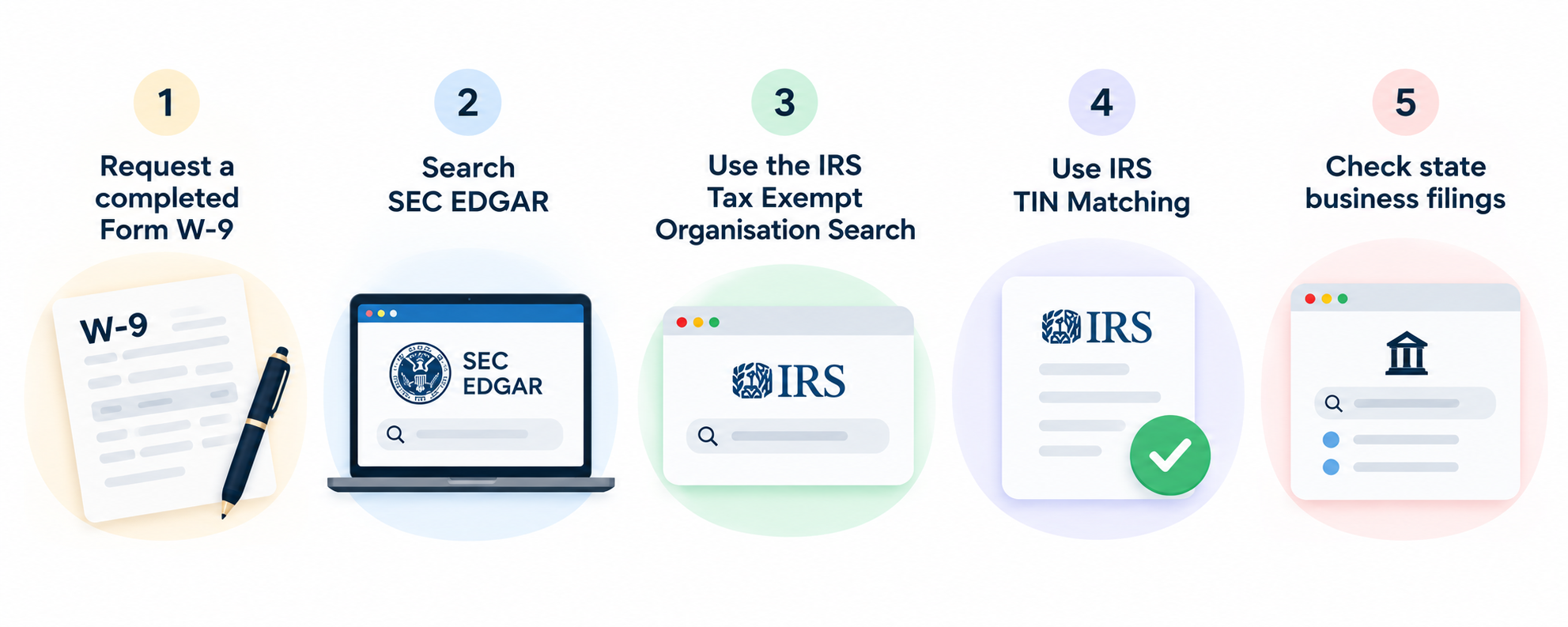
Ask the company to provide a signed Form W-9 containing its legal business name and taxpayer identification number. This is one of the simplest ways to obtain an EIN for vendor payments and tax reporting. Compare the details with your business records before proceeding.
Publicly traded companies may disclose their EINs in regulatory filings. Visit SEC EDGAR and search for the company's name. Review relevant filings, such as annual reports, for available tax identification details. Not every filing includes an EIN.
If the company is a nonprofit, use the IRS Tax Exempt Organisation Search to find eligible organisations and review their publicly available tax records. This tool is not designed to look up every for-profit business.
Businesses authorised to use IRS TIN Matching can check taxpayer identification information against IRS records for eligible payees when filing information returns. This service is restricted to qualifying payers and cannot be used for unrestricted public searches.
Visit the relevant state's official business registry to search for the company's registration details. Some filings may include federal tax identification information, but many do not. Start with the state's official government website, as access and available records vary by state.
Also read: How to complete a W-8BEN form as a non-US resident
If you have misplaced your Employer Identification Number (EIN), you do not need to apply for a new one immediately. There are several ways to recover your existing number, depending on the records you have and whether you have previously used it for business activities.
1. Check your CP 575 confirmation letter. When the IRS assigns your EIN, it sends a confirmation notice called CP 575. Check your business files, emails, or saved documents for this letter, which contains your EIN.
2. Review previous tax returns. Look at your federal business tax returns and other tax documents. Your EIN is typically listed near the top of the relevant forms.
3. Contact your bank. If you used your EIN when opening a business account, your bank may have it on file. Contact your bank and ask how to retrieve your business tax identification details. If you are still setting up your finances, learn how to open a business bank account to understand the documents you may need.
4. Call the IRS. Contact the IRS Business and Specialty Tax Line at 800-829-4933, Monday through Friday, 7 a.m. to 7 p.m. local time. After verifying your identity and authorisation, an IRS representative can help you recover your EIN.
Paying an overseas contractor involves more than sending money. You also need the right tax documents and a reliable way to deliver their payment. For foreign individuals working outside the US, request Form W-8BEN when applicable to document their foreign status for US tax purposes. Foreign entities may need Form W-8BEN-E instead.
Once you have verified the contractor's details and confirmed the appropriate tax documentation, you can arrange payment. For example, if your LLC hires a developer in the Philippines, you can use Grey to send money from the US to the Philippines and pay them through a supported transfer method.
If you also hire US-based independent contractors, understanding what a 1099 employee is can help you distinguish contractors from employees and understand your reporting responsibilities. The term “1099 employee” is informal; independent contractors are generally not classified as employees for tax reporting.
For businesses managing multiple international payments, you can open a Grey Business account to explore tools for paying vendors and contractors across borders.
Yes, you can find some company EINs for free through public records. Try SEC EDGAR for publicly traded companies or the IRS Tax Exempt Organisation Search for eligible nonprofits. However, there is no single public IRS database that lists every company's EIN.
If you are an eligible payer filing information returns, you can use the IRS TIN Matching service to check taxpayer identification details. Business owners who have lost their EIN can contact the IRS Business and Specialty Tax Line for assistance after verifying their identity.
Sometimes. Public company filings, nonprofit tax records, and certain business documents may disclose an EIN. Search official sources such as SEC EDGAR or the IRS Tax Exempt Organisation Search. If the number is not publicly available, ask the company directly for a completed Form W-9.
Check your IRS CP 575 confirmation letter, previous business tax returns, or bank records. If you cannot locate your number, contact the IRS Business and Specialty Tax Line at 800-829-4933. After verifying your identity and authorisation, an IRS representative can help you recover it.
An EIN is not universally public information. Some businesses disclose it in public filings, while other companies' EINs may not be readily available. Although you can access certain tax identification details through official records, the IRS does not provide unrestricted public access to every business's EIN.
Yes, an FEIN (Federal Employer Identification Number) generally refers to the same nine-digit federal tax identification number as an EIN. Businesses use this number for tax reporting, banking, hiring employees, and other official purposes. The term FEIN simply emphasises that the identification number is federal rather than state-issued.

Compare the best business bank accounts in the US on fees, minimums and tools. All 11 ranked with the trade-offs named. Open the right one today.
Tunde Aladeloba
•
October 23, 2026
•
2 min read
Choosing the right business account in the US can make a real difference in how you manage your company’s money, from receiving customer payments to paying suppliers and tracking everyday expenses. However, with so many banks and financial platforms offering different account types, fees and features, knowing which one fits your business can be difficult.
The best business bank accounts pair low or waivable monthly fees with strong online banking, cards and integrations. The right one depends on your size, transaction volume and whether you handle international payments. Compare fees, minimums and features side by side before opening one.
For example, a freelancer receiving occasional payments may prioritise low fees and simple digital banking, while a growing company may need higher transaction limits, cash deposit options and tools for managing payroll. If you work with international clients or suppliers, access to cross-border payments and multiple currencies may also influence your decision.
This guide compares 11 business bank accounts available in the US, highlighting their fees, minimum balance requirements, key features and suitability to help you choose an account that works for your business.
Also read: Best business bank accounts for an LLC
Choosing a business bank account starts with understanding how your business earns, spends and manages money. The right account should support your daily operations without adding unnecessary costs or making payments difficult to track.
Fees and charges: Compare monthly maintenance fees, transaction limits, cash deposit charges, wire transfer costs and ATM fees. An account advertised as free may still charge for certain services.
Minimum balance requirements: Check the opening deposit and ongoing balance requirements. If your cash flow fluctuates, choose an account with no minimum balance or an achievable fee waiver.
Banking tools: Look for reliable online banking, mobile cheque deposits, debit cards, accounting software integrations and payment processing. Growing businesses may also benefit from payroll support and cash management tools.
Access and eligibility: Confirm that your business structure qualifies, whether you can apply online and which documents you need. Some providers require a US address, while others have additional residency restrictions.
If you receive international payments, compare foreign exchange rates, supported currencies and transfer fees before deciding. Your account should fit your current needs while leaving room for your business to grow.
The following comparison ranks 11 business banking options by monthly fees, key features, limitations and suitability, helping you identify the right fit for your company's size, cash flow and banking needs.
| Rank | Bank / Platform | Monthly Fees and waivers | Core pros | Core cons | Best for |
|---|---|---|---|---|---|
| 1 | Chase Business Complete Banking | $15; waivable with qualifying balances or activity | Card processing, extensive branch network, credit card options | Wire fees, cash deposit limits, no interest | Storefronts needing branch access |
| 2 | Mercury | $0 standard tier; paid plans available | Digital tools, wire transfers, API integrations | No physical cash handling, premium features cost extra | Tech startups and online businesses |
| 3 | Bluevine | $0 Standard plan; paid tiers available | Interest potential, sub-accounts, accounting integrations | Conditions for earning interest, wire fees | Online businesses prioritising interest |
| 4 | U.S. Bank Business Essentials | $0 monthly fee | Branch access, no ongoing maintenance fee | Transaction limits, credit approval requirements | Small retailers |
| 5 | Bank of America Business Advantage | $16; waivable with qualifying balance | Rewards programme, national network, credit integration | Balance requirements, potential extra fees | Established businesses |
| 6 | American Express Business Checking | $0 monthly fee | Interest potential, Membership Rewards, support | No cash deposits, limited branch access | Existing Amex customers |
| 7 | Relay | $0 basic plan; Pro costs extra | Multiple sub-accounts, team access, bill management | Some tools require paid plan, ATM fees | Growing teams and agencies |
| 8 | Novo | $0 monthly fee | Invoicing tools, ATM fee refunds, online dashboard | No built-in interest, limited user controls | Freelancers and sole proprietors |
| 9 | Wells Fargo Navigate Business Checking | Tiered fees; waivers may apply | Branch network, cash handling, lending services | Fees and service costs vary | Cash-heavy businesses |
| 10 | Found | $0 base tier; paid Plus plan | Tax tracking, receipt capture, invoicing | Limited international features, fewer team tools | Sole proprietors and independent contractors |
| 11 | Rho | $0 platform fee; service eligibility applies | Corporate cards, expense controls, accounts payable | US business eligibility restrictions, credit criteria | Established companies managing expenses |
When choosing a business bank account for your LLC, consider how you receive payments, manage expenses, and access your money. Traditional banks and online providers offer different benefits, so the right choice depends on how your business operates.
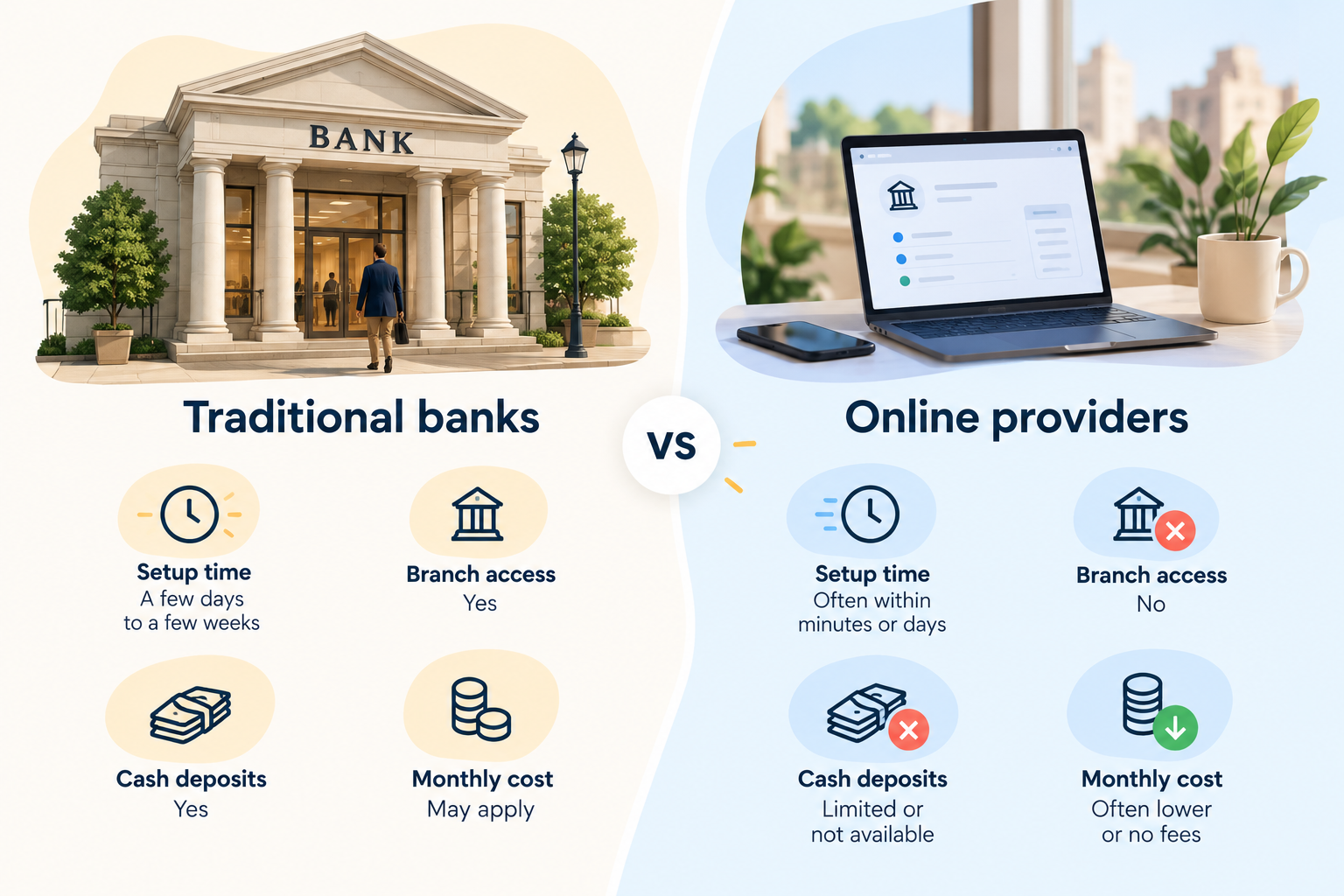
Traditional banks such as Chase, Bank of America, and U.S. Bank give you access to physical branches. You can deposit cash, speak with bank staff, and explore business loans or other financial services. However, some accounts charge monthly maintenance fees unless you meet specific requirements.
Online providers such as Bluevine, Mercury, Relay, and Grey let you manage your finances digitally. While Bluevine, Mercury, and Relay offer business banking tools, Grey supports cross-border payments, making it useful for businesses that send or receive money internationally. Online providers may offer lower fees, faster account setup, and convenient payment management. However, cash deposits and in-person support may be limited.
Before you decide, compare monthly fees, transaction limits, deposit options, and eligibility requirements. If you need branch access, a traditional bank may suit you better. If you value convenience and digital payments, an online provider may be the better fit.
Also read: Can non-residents open a US bank account online in 2026?
Opening an LLC in the US can help you establish your business, but what happens when your customers, suppliers, or team are in different countries? You need a simple way to move money across borders without disrupting your day-to-day operations.
That is where Grey comes in. With Grey, you can send and receive money from the US to support international business transactions, whether you are collecting payments from clients or paying partners overseas. Instead of relying on your traditional business bank account for every cross-border transaction, you can add a dedicated payment solution to your setup.
To get started, open a Grey Business account and explore the options available for your business.
The best business bank account depends on your LLC’s needs. Chase and Bank of America offer branch access, while Bluevine, Mercury, and Relay provide digital banking tools. Compare fees, transaction limits, payment options, and eligibility requirements to find an account that suits your business.
Online providers such as Bluevine, Mercury, and Relay offer business accounts with no monthly maintenance fees on certain plans. However, other charges may apply for specific transactions or services. Compare each provider’s fee schedule and account requirements before making your decision.
Yes, many banks and online providers let you apply for a business bank account online. You will typically need your LLC formation documents, identification, and business details. Approval times and requirements vary by provider, so check the application process before applying.
Many banks require an Employer Identification Number (EIN) to open an LLC business account. Some single-member LLCs may qualify to use other tax identification details, depending on the bank’s policies. Check the provider’s requirements and obtain an EIN from the IRS if needed.
If your LLC works with overseas clients or suppliers, look for accounts that support international transfers and multiple currencies. Grey can complement your business banking setup by helping you send and receive money from the US. Compare transfer fees, exchange rates, supported currencies, and eligibility before choosing a provider.
Online business accounts can offer strong security features, including encryption, multi-factor authentication, and transaction monitoring. However, protections vary by provider. Check whether deposits are held at an FDIC-insured bank, understand applicable coverage limits, and review the provider’s security policies before opening an account.

Italy's currency is the euro (EUR, €). See the notes and coins, when you still need cash, and how to pay in Italy without extra fees. Plan your trip today.
Tunde Aladeloba
•
October 23, 2026
•
2 min read
The currency of Italy is the euro, identified by the code EUR and the symbol €. If you are planning a trip to Rome, shopping in Milan or sending money to someone in Italy, understanding the local currency can help you manage your money and avoid unnecessary charges.
Imagine arriving in Italy, ready to explore its historic streets, enjoy a meal at a local restaurant or pay for your hotel. You will need euros for everyday purchases, whether you are paying by card or carrying cash. Euro banknotes come in different denominations, while coins are available in cents and euros. Although cards are widely accepted, having some cash can be useful for smaller purchases and places that prefer cash payments.
Currency exchange fees, ATM charges and your bank's foreign transaction fees can increase your spending without you noticing if you always have to convert. If you need to send money to Italy, exchange rates and transfer fees affect how much your recipient receives. This guide explains the Italy currency, its symbol and code, and practical ways to spend and transfer money while keeping costs down.
Italy uses the euro (€) as its official currency. Whether you are visiting Rome, shopping in Milan or paying for accommodation in Venice, you will use euros for everyday transactions. The currency is shared by many European countries, making travel and payments across participating nations more convenient.
The euro’s official currency code is EUR, while its symbol is €. You will see the symbol before prices in many Italian shops, restaurants and online stores. One euro is divided into 100 cents. Euro banknotes are available in different denominations, alongside coins ranging from one cent to two euros, which you can use for smaller purchases.
The European Central Bank (ECB), working with the national central banks of eurozone countries, is responsible for monetary policy and maintaining price stability across the euro area. It helps manage the euro’s value by setting key interest rates and using other monetary policy tools.
Italy is a member of the eurozone, the group of European Union countries that use the euro as their official currency. This means you can generally use the same currency when travelling between Italy and other eurozone destinations, although your bank may still charge fees for certain transactions.
When you visit Italy, you will use euro banknotes and coins for everyday purchases, from buying coffee to paying for meals and transport. Euro banknotes come in denominations of €5, €10, €20, €50, €100 and €200. Although the €500 note is no longer issued, existing notes remain valid. Banknotes share common designs across the eurozone, featuring architectural styles from different periods in European history.
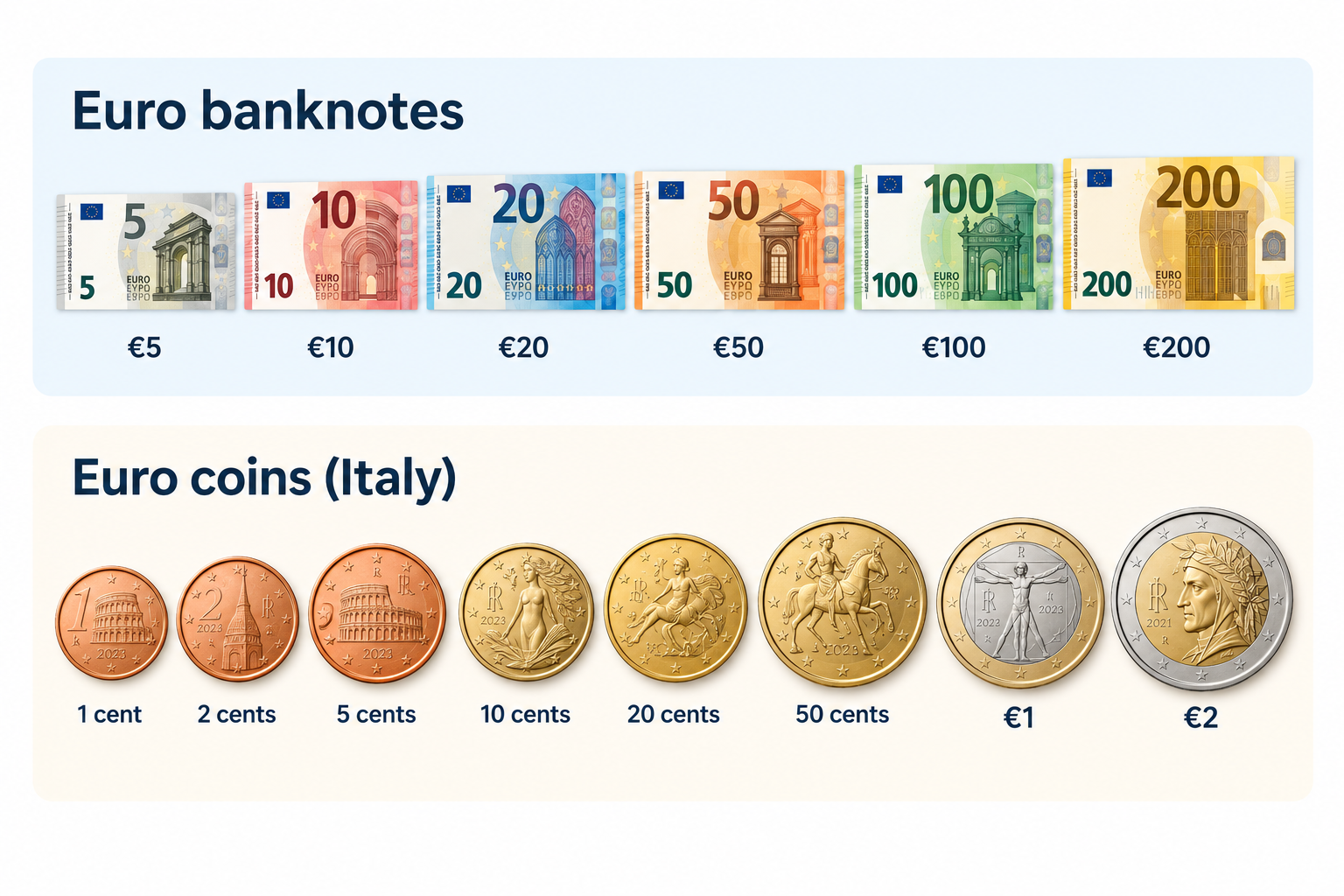
Euro coins come in eight denominations: 1, 2, 5, 10, 20 and 50 cents, plus €1 and €2. Each coin has a common European side and a national side featuring designs selected by its issuing country. All euro coins can be used across the euro area.
Italy’s national coin designs reflect its rich artistic and cultural heritage. The €1 coin features Leonardo da Vinci’s Vitruvian Man, his famous drawing illustrating the proportions of the human body. Other denominations showcase Italian landmarks and masterpieces, including Dante Alighieri, the Colosseum and Sandro Botticelli’s Birth of Venus. These designs celebrate Italy’s contribution to European art and history. The European Central Bank oversees euro banknotes and contributes to maintaining confidence in the currency across participating countries.
When travelling around Italy, you can pay by card at most hotels, restaurants, supermarkets and shops in major cities, where Visa and Mastercard are widely accepted. However, keeping some euros in your wallet can help when shopping at local markets, making small purchases or visiting places where card payments are unavailable. Before travelling, check your bank’s foreign transaction fees so you know how much you could spend on charges.
You are not expected to tip everywhere in Italy, as tipping is not compulsory, but you can leave a small amount or around 5–10% when you receive particularly good service. Check your bill for any service charge before deciding what to leave.
To manage your spending digitally, you can use a Grey virtual card for eligible purchases in euros, including online bookings and payments at merchants that accept Visa. Depending on your card setup, you may also be able to add it to Apple Pay or Google Pay for contactless payments. Check applicable fees and currency conversion rates before spending.
Before travelling to Italy, decide how you will access euros for meals, transport, shopping and accommodation while keeping exchange costs low. You can exchange money before departure, withdraw euros from ATMs in Italy or use a payment card that supports euro spending.
ATMs operated by established banks are convenient for withdrawing cash, but check your bank’s withdrawal charges and any fee displayed by the ATM before confirming. Exchange bureaux are another option, although you should compare exchange rates and commissions to avoid paying more than necessary.
To avoid unnecessary conversion costs, choose euros rather than your home currency whenever an ATM or card terminal offers dynamic currency conversion. This allows your card provider to handle the conversion instead of accepting the machine’s potentially unfavourable rate. You should also check whether your bank charges foreign transaction fees.
A Grey virtual card offers another way to pay for eligible purchases in euros. Check Grey’s card fees and exchange rates, and compare them with your bank’s charges to find a cost-effective way to spend while travelling.
Also read: Italy digital nomad visa: Requirements, costs and process
Whether you are supporting a family in Italy, paying tuition fees or covering accommodation and other expenses, you need a reliable way to send money in euros without losing track of exchange rates and transfer costs. Grey makes cross-border transfers easier by allowing eligible users to send money from Nigeria to European bank accounts in EUR. You can fund your Grey account, review the available exchange rate and fees, and transfer euros directly to your recipient’s bank account.
Grey is also a multi-currency platform, allowing you to hold and convert supported currencies to manage international payments in one place. This can be useful when you earn in one currency but need to pay expenses in euros. Before confirming a transfer, check the live exchange rate, applicable fees and the final amount your recipient will receive.
Italy uses the euro (€) as its official currency, not the Italian lira. The lira was replaced by the euro in 1999 for accounting purposes, with euro banknotes and coins entering circulation in 2002. Today, you need euros to pay for everyday purchases, transport, meals and accommodation in Italy.
The euro symbol is €, and its official three-letter currency code is EUR. You will see these used on Italian price tags, restaurant menus, receipts and online bookings. One euro is divided into 100 cents. When exchanging money or sending payments to Italy, use EUR to identify the currency correctly.
US dollars are not generally accepted for everyday purchases in Italy because the euro is the official currency. You should exchange dollars for euros or withdraw euros from an ATM. Some tourist businesses may accept other currencies, but their exchange rates may be unfavourable. Paying in euros usually makes costs easier to compare.
Cards are widely accepted in Italian cities, hotels, restaurants and shops, making them convenient for everyday spending. However, carrying some euros is useful for markets, small purchases and places that do not accept cards. Check your bank's foreign transaction fees and choose euros rather than your home currency when prompted at payment terminals.
The amount depends on your travel plans, accommodation and spending habits. For many travellers, carrying around €50–€100 for initial expenses and small purchases is a reasonable starting point, while using a card for larger payments. You can withdraw additional euros as needed, but check ATM charges and your bank's withdrawal limits first.
You can send money to Italy through a bank transfer or an international money transfer service. Compare exchange rates, transfer fees and delivery times before choosing. Grey supports eligible cross-border transfers and multi-currency services, allowing users to send money in euros to supported destinations. Check availability, fees and recipient requirements before confirming your transfer.
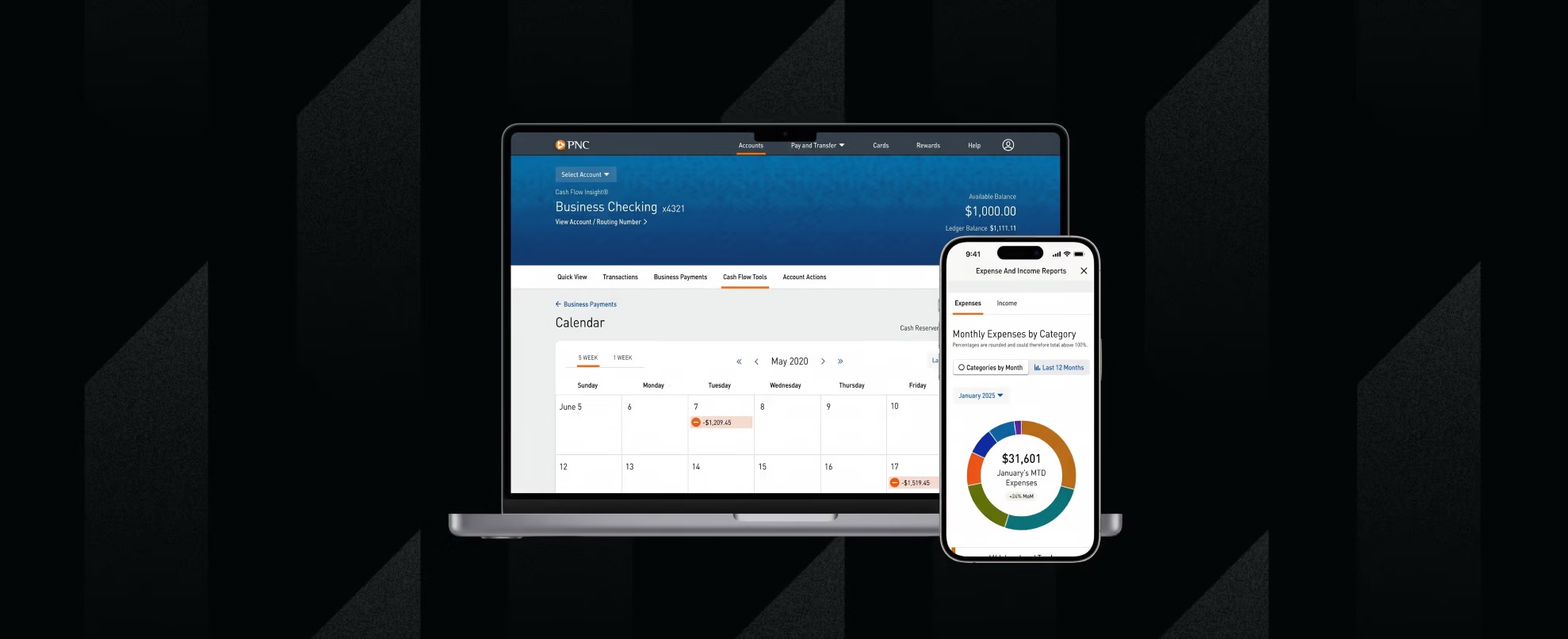
The PNC Bank business account explained: checking tiers, monthly fees and how to open one. Grey adds the cross-border layer on top. Compare your options.
Tunde Aladeloba
•
October 23, 2026
•
2 min read
Choosing the right business bank account can make it easier to manage daily expenses, receive customer payments and keep your business finances organised. However, monthly maintenance fees, transaction limits and minimum balance requirements can affect how much you pay for banking services. If you are considering a PNC Bank business account, understanding these costs and features can help you decide whether it suits your business needs.
PNC offers several business checking accounts designed for businesses with different transaction volumes and banking needs. Each account comes with its own fee structure, transaction allowances and requirements for waiving monthly maintenance fees. Depending on the account you choose, maintaining a qualifying balance may help you avoid these charges.
Opening an account is also relatively straightforward, with options to apply online or visit a branch. You will generally need your employer identification number (EIN), business formation documents and valid identification. This guide covers PNC business account fees, key features, eligibility requirements and how to open an account, helping you understand what to expect before applying.
Also read: Best business bank accounts for an LLC
PNC offers several business checking options designed for different transaction volumes, cash handling needs and business sizes. Choosing the right tier depends on your monthly activity, available balance and financial management needs.
Business Checking: Best for freelancers, sole proprietors and micro-businesses with fewer transactions. Its $500 balance waiver threshold can help eligible account holders avoid the monthly maintenance fee.
Business Checking Plus: Suits local retailers, storefronts and growing businesses that handle more payments. It accommodates up to 500 monthly items and $10,000 in cash deposits before additional charges may apply.
Treasury Enterprise: Designed for businesses managing multiple entities or accounts. It allows up to four linked accounts to qualify toward a combined $30,000 balance requirement.
Analysis: Best suited to large enterprises with substantial cash flows. Earnings Credits can help offset eligible account service charges, making it worth considering for businesses with complex treasury management needs.
| Account tier | Monthly fee / waiver minimum |
Free transactions | Free cash deposits | Ideal for |
|---|---|---|---|---|
| Business Checking | $12 / $500 balance | 150/month | $5,000/month | Freelancers, side hustles and startups |
| Business Checking Plus | $22 / $5,000 balance | 500/month | $10,000/month | Growing businesses and local retailers |
| Treasury Enterprise Plan | $50 / $30,000 combined balance | Unlimited across linked accounts | $50,000/month | Established mid-sized businesses |
| Analysis Business Checking | Variable / Earnings Credit | Custom | Custom | Large enterprises with complex cash flows |
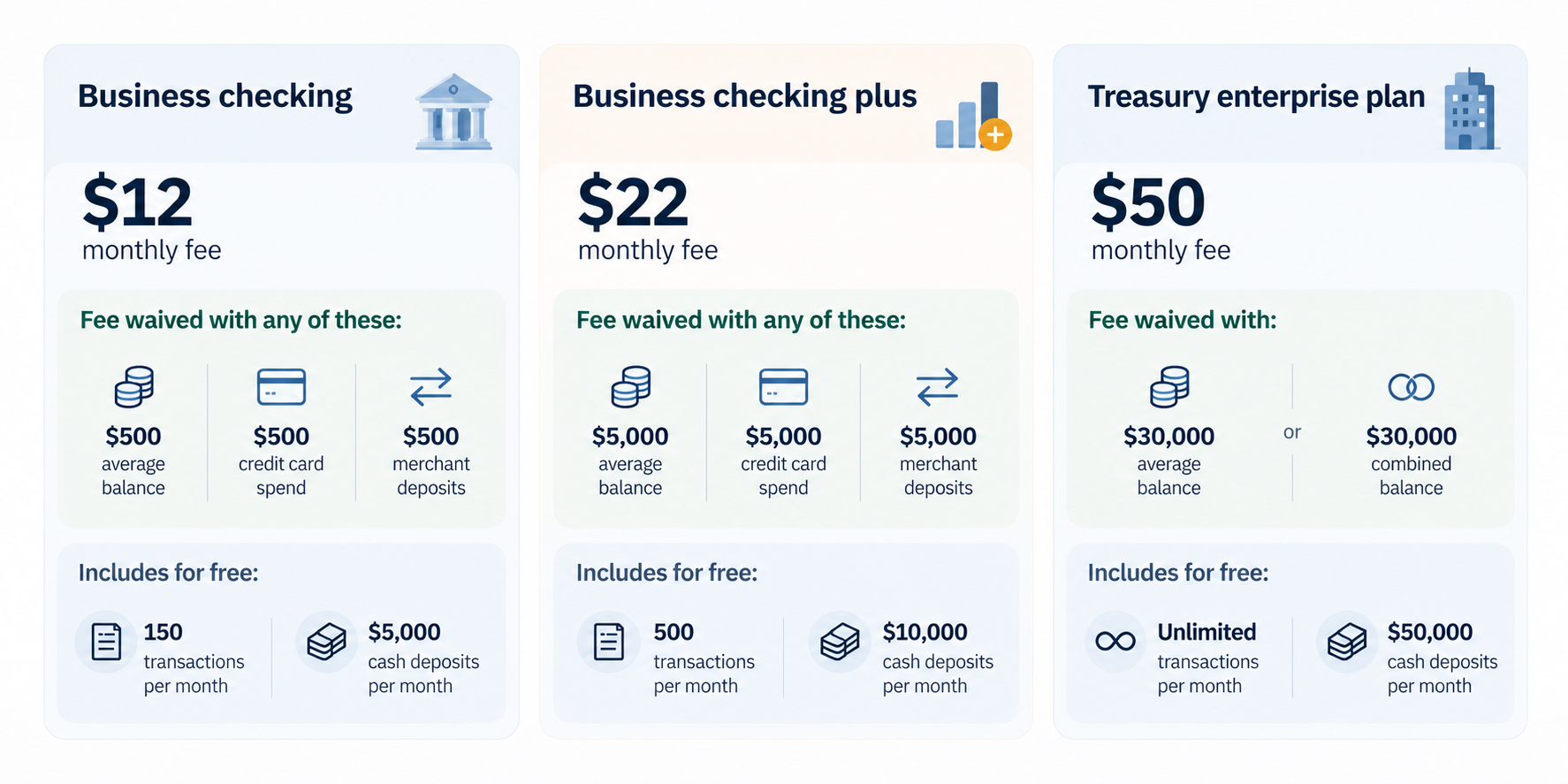
How to avoid the fee:
How to avoid extra charges:
How to avoid the fee:
How to avoid extra charges:
How to avoid the fee:
How to avoid extra charges:
PNC provides digital banking, business debit cards, payment processing and cash management tools to help businesses handle everyday transactions, monitor cash flow and manage finances more efficiently.
Digital tools: PNC Business Online Banking and mobile deposit capabilities help business owners check balances, review transactions, deposit eligible checks and manage accounts without visiting a branch.
Cards: Eligible account holders can access PNC Bank Visa Business Debit cards for convenient business purchases. The Purchase Payback® programme may offer cash-back rewards on qualifying purchases from participating merchants, subject to applicable terms.
Integrations: Businesses with more complex financial needs can use PINACLE®, PNC's treasury management platform, to access cash management services and tools that support cash-flow forecasting, payment management and account visibility.
Payment processing: PNC Merchant Services helps businesses accept customer payments and manage transactions. When used alongside available cash-flow tracking tools, these services can make it easier to monitor incoming payments, reconcile transactions and manage accounts receivable.
Together, these features give businesses tools to manage routine banking, track incoming funds and oversee payments. Availability, eligibility and fees may vary by account type and service, so review PNC's current terms before enrolling.
Also read: How to open a business bank account
While a PNC business account can help you manage everyday banking in the US, businesses working with international clients, suppliers or remote teams may need additional options for cross-border payments. This is where Grey can complement your banking setup.
With a Grey Business account, eligible businesses can send and receive money from the US, making it easier to manage international payments when working with American clients, paying overseas suppliers or serving customers across borders.
Grey adds a multi-currency layer to your financial operations, helping you handle international transactions alongside your regular business banking. Before choosing a service, review supported currencies, transfer fees, exchange rates and account eligibility to understand the costs involved.
PNC offers several business checking options, including Business Checking, Business Checking Plus, Treasury Enterprise Plan and Analysis Business Checking. Each serves different needs, from freelancers and small businesses to larger companies managing substantial cash flows. The right account depends on your transaction volume, cash deposits and treasury management requirements.
Monthly maintenance fees vary by account tier. Business Checking costs $12, Business Checking Plus costs $22, and Treasury Enterprise Plan costs $50, based on the fee schedule outlined above. Analysis Business Checking has variable fees. Eligible accounts may qualify for waivers by meeting balance or other requirements. Transaction and cash deposit limits may also trigger additional charges.
Yes, PNC allows eligible customers to apply for certain business checking accounts online. You can also visit a branch to complete the application. Availability may depend on your business structure, location and eligibility. Before applying, review the account requirements and prepare the necessary identification and business documents to help avoid delays.
PNC generally requires your business Tax Identification Number (TIN), or Social Security number for eligible sole proprietors, business registration documents and proof of authority to operate the business. You will also need identification. Online applicants need a valid email address. Requirements vary by business structure.
PNC Business Checking has a $100 minimum opening deposit. This differs from the $500 average monthly balance that can waive its $12 maintenance fee. Other account tiers have different waiver requirements. You may avoid monthly fees through qualifying linked credit card purchases or merchant deposits, depending on the account.
You can use PNC international wire transfers to send money overseas or receive payments from abroad, although transfer fees and currency conversion costs may apply. For additional cross-border flexibility, eligible businesses can use a Grey Business account to send and receive money from the US. Compare fees and supported currencies before choosing a service.
Find the current US passport cost for a new book, card, renewal or expedited service. Every fee is checked at source. Get your travel money sorted.
Tunde Aladeloba
•
October 22, 2026
•
2 min read
How much you'll need to pay for a US passport depends on your age, the type of passport you need and how quickly you want it processed. Whether you are applying for your first passport, renewing an expired document or replacing a lost one, understanding the fees helps you prepare your budget and avoid unexpected expenses.
A US passport has two main charges: an application fee and an execution fee. A new adult passport book costs more than a renewal, and expedited service adds an extra fee. A passport card is cheaper than a book
Your total cost may also depend on whether you apply in person, request faster processing or need additional services, such as overnight delivery. Children have different application fees and requirements from adults, while passport cards and books serve different travel purposes.
This guide breaks down US passport fees, renewal costs, expedited processing charges and the differences between passport books and cards, helping you understand what you may need to pay before applying.
The cost of a US passport depends on whether you are applying for the first time or renewing an existing passport. A first-time adult passport book costs $165, while an adult renewal costs $130. These fees cover the standard passport book application and do not include optional expedited processing or delivery services.
First-time adult applicants must pay two separate fees:
Together, these fees bring the total cost of a first-time adult passport book to $165. Adult renewals generally cost less because eligible applicants can apply by mail or online without paying the separate execution fee. Before applying, confirm the current fees and payment methods on the official US Department of State website.
The cost of a first-time US passport depends on your age and whether you apply for a passport book, a passport card or both. Applicants must pay an application fee to the US Department of State and a separate $35 execution fee to an authorised acceptance facility.
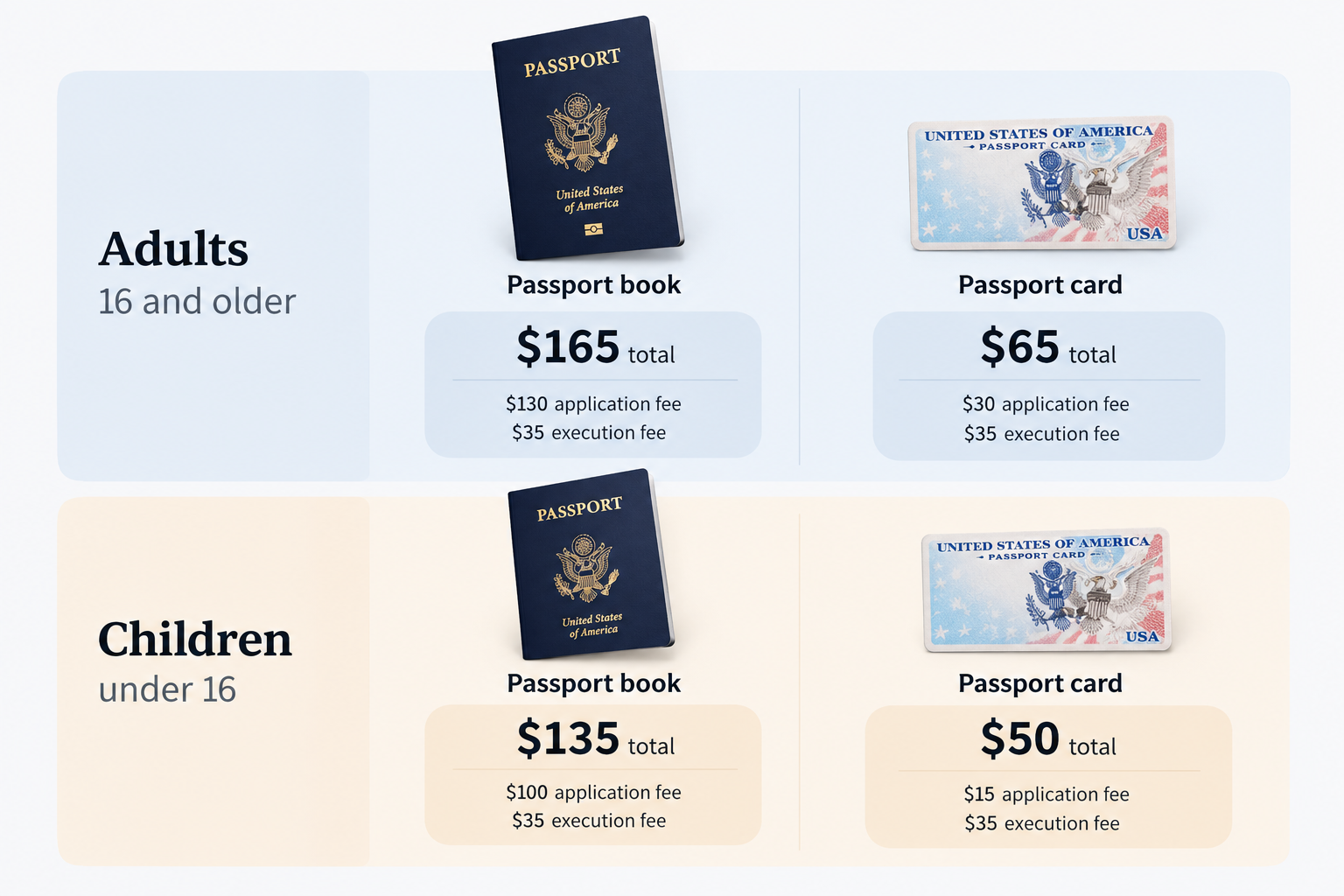
Adults aged 16 and older:
Children under 16:
A passport book allows international travel by air, land and sea, while a passport card is limited to eligible land and sea crossings, primarily between the United States, Canada, Mexico, Bermuda and Caribbean countries. It cannot be used for international air travel. Check the official US Department of State website for current fees, eligibility requirements and application instructions.
Renewing a US passport generally costs less than applying for a first passport because eligible adult applicants do not pay the separate execution fee. An adult passport renewal costs $130 for a passport book or $30 for a passport card. These fees cover standard processing, while expedited service and optional delivery services may cost extra.
You can renew your US passport by mail if your most recent passport is undamaged, was issued within the last 15 years, and you were at least 16 years old when it was issued. Your passport must also display your current legal name, or you must provide official documentation confirming your name change.
If you are a Canadian citizen, the renewal process and fees are different. Check the requirements for renewing a Canadian passport to understand eligibility, application methods and current charges before submitting your documents. Always verify the latest fees through the relevant government website.
If you need your US passport sooner than the standard processing time allows, you can pay extra for expedited service. The additional fee is $60, which is added to your regular passport application cost. This option may be useful if you have an upcoming trip and cannot wait for routine processing, but you should still check the current processing estimates before applying.
You can also pay $21.36 for 1–2 day delivery of your completed passport book to your home address. This fee covers faster delivery after your passport has been issued; it does not guarantee that your application will be processed within one or two days.
Remember to budget for passport photographs if you do not take an acceptable photo yourself. A local retail store or post office may charge around $15 for passport photos, although prices vary by location. Before submitting your application, review the latest fees on the US Department of State website to confirm the amounts and available services.
Spending abroad can cost more than expected when card charges and unfavourable exchange rates add up. Before travelling, check whether your credit card charges foreign transaction fees, which typically range from 1% to 3% per purchase. A card with 0% foreign transaction fees can help you keep more of your travel budget.
If you are travelling from the US to the UK, you may also need to move money across borders before your trip. Grey makes it easier to send money from the US to the United Kingdom, so you can organise your funds before departure. Check the applicable transfer fees and exchange rate to understand the total cost.
Once you arrive, Grey’s virtual card for spending abroad offers another payment option for eligible purchases. Check its fees and supported currencies before using it to understand how to avoid foreign transaction fees where applicable.
When paying at shops or restaurants, choose to pay in the local currency rather than your home currency. This helps you avoid dynamic currency conversion, which may come with an unfavourable exchange rate.
A first-time adult US passport book costs $165, including the $130 application fee and $35 acceptance fee. If you apply for a passport card instead, the total is $65. Your final cost may increase if you choose expedited processing or faster delivery. Check official passport fees.
Renewing an eligible adult US passport costs $130 for a passport book or $30 for a passport card. You do not pay the separate $35 acceptance fee when renewing by mail or online. Expedited processing and optional delivery services cost extra. Check your eligibility before submitting your renewal application.
A first-time adult US passport card costs $65, including the $30 application fee and $35 acceptance fee. Eligible adult renewals cost $30. The card supports qualifying land and sea travel to destinations such as Canada, Mexico, Bermuda and the Caribbean, but it cannot be used for international air travel.
Expedited US passport processing costs an additional $60 per application. This fee is added to your standard passport charges for faster processing, currently estimated at two to three weeks. Optional one-to-three-day delivery of an issued passport book costs extra. Check current processing times before paying, as mailing time is separate.
Yes, if you qualify for online renewal. Eligible applicants can pay using a credit or debit card through the official government renewal portal. First-time applicants generally need to apply in person and pay using the accepted methods. Avoid unofficial websites that charge additional fees or claim to process applications on the government’s behalf.
To reduce travel costs, choose a payment card with 0% foreign transaction fees and check its terms before travelling. At payment terminals, select the local currency to avoid potentially unfavourable dynamic currency conversion rates. If you use Grey’s virtual card, review its applicable fees and supported currencies before making international purchases. Compare transfer charges and exchange rates before sending money abroad.

Convert your Airtel SIM to an eSIM by SMS or in the Airtel Thanks app, with no store visit. See the steps and timings. Start the switch today.
Tunde Aladeloba
•
October 22, 2026
•
2 min read
Switching to an Airtel eSIM lets you use your mobile number without inserting a physical SIM card into your phone. Instead, your device stores the SIM profile digitally, making it easier to activate your line on a compatible smartphone and manage your mobile connection.
If you want to convert your existing Airtel SIM to an eSIM, you'll typically need to send a text message, confirm your request and scann a QR code sent to your email address. The exact steps and eligibility requirements may vary depending on your country and Airtel’s current eSIM service.
Before you begin, check that your phone supports eSIM technology and that your Airtel line qualifies for conversion. You should also have access to the email address linked to your request and a reliable internet connection to download your eSIM profile. This guide explains the steps to follow and what to know before switching.
Before converting your Airtel SIM to an eSIM, make sure you have a compatible smartphone, an active Airtel number and access to a registered email address. These are essential for completing the conversion and receiving the eSIM activation details.
1. An eSIM-compatible smartphone
Your phone must support eSIM technology. Common eSIM-capable devices include the iPhone XS, XS Max and newer models, selected Samsung Galaxy S20 and newer models, Google Pixel 4 and newer models, and certain newer Motorola devices. However, compatibility varies by model, region and carrier, so confirm that your specific handset supports eSIM.
2. A registered email address
You need a working email address to receive the eSIM QR code and activation instructions from Airtel. Check that you can access your inbox before starting the process.
3. An active Airtel number
Keep your existing Airtel SIM active so you can send the conversion request and confirm it when prompted. You may also need your phone to receive verification messages during activation.
Check Airtel’s local requirements before beginning, as procedures differ by country.
Convert your Airtel SIM to an eSIM by texting Airtel, confirming your request, waiting for activation and scanning the emailed QR code.
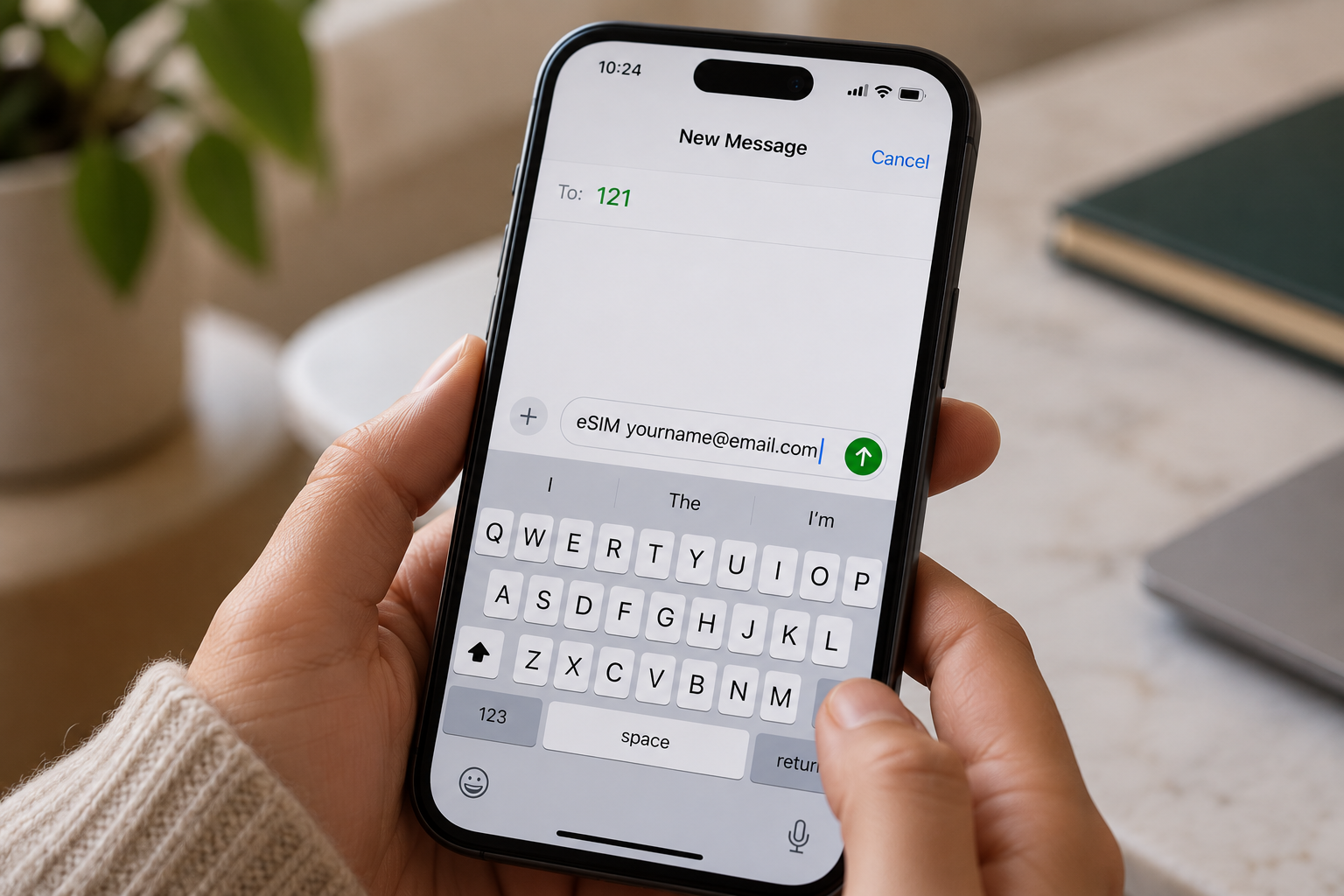
You can convert your physical Airtel SIM to an eSIM through the Airtel Thanks app without visiting a store, provided your number and device are eligible. The steps below apply to Airtel India; menu options may vary by app version.
To activate your Airtel eSIM, scan the QR code provided by Airtel using your phone’s mobile network settings. Keep your phone connected to Wi-Fi during setup, as the eSIM profile needs an internet connection to download.
If you’re moving to a new iPhone, follow this guide to transfer an eSIM from one iPhone to another.
After the eSIM activates, your physical Airtel SIM for that number is deactivated. You can remove it from your phone. If activation fails, contact Airtel before deleting any installed eSIM profile
Your Airtel eSIM may fail to activate because of a problem with your identity verification, phone compatibility, registered email address or activation timing. Identifying the specific issue helps you determine the right fix without unnecessarily repeating the conversion process.
If you need mobile connectivity while travelling, Grey lets you top up airtime and buy eSIMs. You can also manage cross-border expenses by using Grey to send money from the US to India or send money from the UK to India, helping you handle payments while staying connected abroad
An Airtel eSIM usually activates within two hours after you download and enable the eSIM profile on your compatible phone. During processing, your physical SIM may continue working. Keep your device connected to Wi-Fi and follow Airtel’s instructions to complete activation. Timings may vary by country and request.
No, converting your existing Airtel physical SIM to an eSIM generally keeps your current mobile number. The process replaces the physical SIM with a digital profile linked to the same line. You can continue using your number for calls, messages and mobile data once activation is complete.
Yes, eligible Airtel prepaid customers can convert their physical SIM to an eSIM in supported markets. However, the process differs by country. Airtel India provides an app-based conversion process, while Airtel Nigeria directs customers to a service centre for assistance. Confirm your line’s eligibility before starting.
Once your Airtel eSIM activates successfully, the physical SIM linked to that number becomes inactive. You can remove it from your phone because the eSIM now provides your mobile connection. Keep the physical SIM in place until activation is confirmed to avoid losing service during the transition.
Yes, you can generally switch your Airtel eSIM back to a physical SIM by requesting a SIM replacement. In India and Nigeria, Airtel directs customers to a service centre or showroom for assistance. Bring the required identification and complete any verification steps before using the replacement SIM.
The cost depends on your country and Airtel’s current policy. Airtel Nigeria currently states that eSIM activation has no charge, while other SIM replacement services or markets may have different fees. Before converting, check with your local Airtel provider whether activation, replacement or related services incur additional costs.



