STAY UP TO DATE
The Grey Blog


FEATURED ARTICLES

Virtual cards in Egypt for online payments
Grey, EverTry, Card-Y, Fyatu, and AstroPay: Here is how virtual cards work for online payments in Egypt and your top options.

Adeolu Titus Adekunle
•
6 min read
It is one thing to have the funds for online payments; it is another thing to have the means to complete the payment without getting frustrated. Managing international payments in Egypt can be quite a hassle. If you’ve tried paying for an international subscription, a work tool, online shopping, or an online course from Egypt, perhaps you can relate to the struggle. Local Egyptian bank cards are often restricted from international transactions, offer poor exchange rates, or aren’t supported by global platforms.
Virtual cards exist mostly to solve these problems, and they have become one of the most efficient options for anyone who shops online, pays for subscriptions, or needs a reliable way to spend in foreign currency without the limitations of a standard local bank card.
This article explains how virtual cards work, who they are for, and the main options available to people in Egypt right now.
What is a virtual card, and how does it work?
A virtual card is a digital payment card that works just like a traditional debit or credit card, except it exists only electronically. Instead of receiving a plastic card, you get the card details instantly on your phone or computer, including the card number, expiration date, and CVV security code.
Because virtual cards are issued digitally, they are typically available within minutes, unlike physical cards that must be printed and delivered.
Most virtual cards operate as prepaid or debit cards, meaning you spend funds you already have. In many cases, the card is connected to a multi-currency account, so payments are deducted directly from your balance in currencies such as USD, GBP, or EUR. This eliminates the need to manually top up the card before each purchase.
For example, Grey virtual cards are linked directly to your foreign currency balance, allowing you to pay online or in apps without transferring funds to the card first.
In practice, using a virtual card is no different from using a physical one. You simply enter the card details at checkout when making online payments, subscriptions, or international purchases. Many virtual cards can also be added to Apple Pay or Google Pay, enabling secure contactless payments with your phone wherever mobile wallets are supported.
Also read: Managing USD income as a remote worker in Egypt
What to look for when choosing
Not all virtual cards work the same way. The best option for you will depend on how you plan to use it, which currencies you deal with most often, and how frequently you make international payments. Before choosing a provider, it’s worth looking closely at a few key factors.
Currency support. Many virtual cards are designed primarily for USD payments, but international platforms often charge in other currencies such as EUR or GBP. If you regularly use services based in Europe or the UK, a card that supports multiple currencies can help you avoid additional conversion fees. Choosing a provider with a multi-currency account allows you to hold and spend different currencies more efficiently.
Funding options. Different platforms allow you to add funds in different ways. Some accept local bank transfers, others allow crypto deposits such as USDT, and some link directly to a multi-currency account balance, like Grey. Before signing up, check that the funding method available actually works for your situation and location.
Platform compatibility. Not every virtual card works equally well across all international platforms. Some services, particularly advertising platforms or large marketplaces, may reject certain cards depending on the issuing network or region. If you plan to use your card for a specific purpose, such as paying for Google Ads or cloud hosting, it’s worth confirming that the card is widely accepted on those platforms.
Fees and exchange rates. Virtual card costs can vary significantly between providers. Some charge a card creation fee, others add transaction fees, and most apply a small markup on currency conversions. A card that appears free at first glance may become more expensive if the exchange rate spread is high. Always look at the total cost of using the card, not just the upfront fee.
Security and regulation. Security should always be a priority when choosing a financial platform. Look for providers that follow proper identity verification processes and operate with licensed financial partners. Features such as two-factor authentication, transaction alerts, spending limits, and the ability to instantly freeze your card add an important layer of protection.
Contactless payments. Some virtual cards can be added to mobile wallets like Apple Pay or Google Pay, allowing you to make contactless payments with your phone. This can be particularly useful when travelling or making in-store purchases abroad. If this feature matters to you, make sure the card supports mobile wallet integration in your region.
Taking a few minutes to compare these factors can help you choose a virtual card that fits your spending habits and avoids unnecessary fees or payment issues later.
The top virtual cards in Egypt for online payments
While cards issued by local banks work well for domestic spending, they are not always reliable for international payments. Here is a list of the top virtual cards in Egypt for online payments.
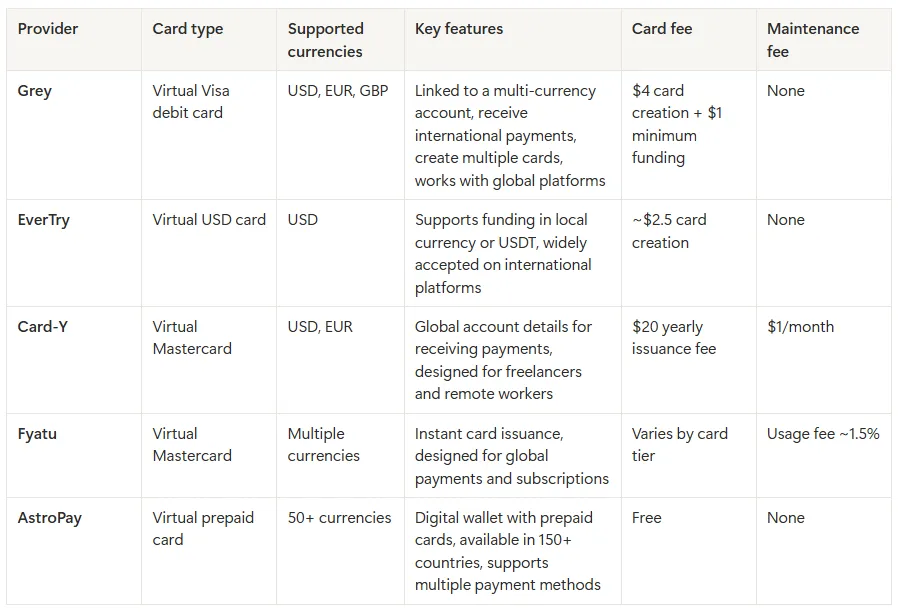
Grey
Grey offers virtual cards linked to a multi-currency account that supports USD, EUR, and GBP. You can create multiple cards for various uses to properly plan your finances. One card can be for online shopping while another could be for subscriptions and or online course. Grey cards are globally accepted and works with the full range of international platforms
You can receive international payments into your Grey USD, GBP, or EUR account or fund your account in EGP and convert to USD to spend on your cards directly.
Fees: Grey virtual USD cards cost a one-time creation fee of $4, plus a minimum of $1 to fund the card, totalling $5 to get started. There are no monthly maintenance fees.
EverTry
EverTry offers a solution for international payment restrictions in Egypt through their virtual dollar card platform. It allows Egyptian users to pay for global services that often decline local bank cards. It supports funding in local currency and USDT, making it accessible to users who are comfortable with crypto. The card works across a wide range of international platforms, including Netflix, Spotify, AWS, DigitalOcean, Namecheap, Facebook Ads, and Google Ads.
Fees: Card creation typically costs $2.5, with no monthly maintenance fees.
Card-Y
Card-Y is a fintech platform that offers multi-currency global accounts with a linked virtual card, designed for Egyptian freelancers and remote workers. It offers USD and EUR account details for receiving international payments, with a free virtual card included that draws from those account balances. It also issues local Egyptian bank cards to subscribers.
Fees: Card-Y offers virtual Mastercard issuance for a $20 USD fee, which is valid for one year and does not add to the card balance. The service features a $1 monthly maintenance fee, a 1% USD transaction fee ($1 min/$5 max), and a 1.5% foreign currency conversion fee.
Fyatu
Fyatu provides instant virtual Mastercards with support for multiple currencies, aimed at users who need to make global payments and manage international subscriptions. Onboarding is digital, and card issuance is immediate. It is a straightforward option for users whose primary need is an international spending card rather than a full suite of banking features.
Fees: Fyatu virtual card costs include a 1.5% fee for card usage (for either withdrawal or payments), with card replacement fees of $5 for World cards and $10 for Platinum cards. A $1.00 fee applies to declined transactions. Funding methods vary, with fees such as 3% for MTN MoMo and various percentages for online wallets like PayPal (3.5% + $0.30).
AstroPay
AstroPay is a globally recognised digital wallet and virtual card platform, available in over 150 countries, including Egypt. It has been around since 2009 and has a particularly strong footprint in emerging markets across Africa, Latin America, and Asia. The platform supports more than 50 currencies, issues virtual prepaid cards instantly, and does not require a traditional bank account to sign up.
For Egyptian users, AstroPay works as a prepaid spending tool. You load funds onto your wallet using a local payment method, then use the virtual card for international purchases on platforms that accept Visa or Mastercard. Card details are issued instantly through the app, and the platform supports one-time or multi-use cards depending on the denomination.
However, bank withdrawals from AstroPay can attract fees of up to 6% depending on the institution. There is a margin of 1% to 3% on exchange rate.
Fees: No card purchase or maintenance fee. No annual fee. Transaction fees of 2–5% depending on the payment method used. FX markup of approximately 1–3% on non-native currency transactions. Withdrawals to a bank account: up to 6%.
Comparison of the top virtual cards in Egypt
Before exploring each option in detail, the table below summarises some of the key differences between the most popular virtual cards available to users in Egypt, including supported currencies, card type, and typical fees.
Quick recommendations
If you’re not sure which virtual card to choose, here’s a quick guide based on common use cases in Egypt.
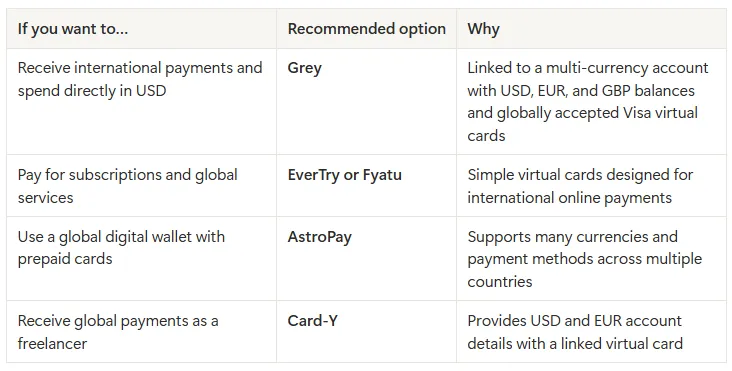
For most freelancers, remote workers, and online entrepreneurs in Egypt, a virtual card linked to a multi-currency account is often the most practical option. It allows you to receive money from abroad, hold foreign currencies, and pay for global services without converting funds every time you make a transaction.
Also read: Grey card vs other virtual cards: What you should know
Make international payments with Grey
The advent of virtual cards has brought significant flexibility to managing international payments. Grey gives Egyptians a virtual card linked to your multi-currency account. This allows you to receive international payments and spend internationally from the same platform. Whether you are paying for software subscriptions, running digital ads, shopping on international platforms, or managing online tools for your work, Grey's virtual card is accepted globally and straightforward to set up.
Ready to get your virtual card? Sign up on Grey and download the app to create your virtual USD card in minutes.
ALL ARTICLES
Gift tax: How much money can you give tax-free?
The IRS lets you gift up to the annual exclusion per recipient with no tax owed and no form to file. See the current limits. Check the limits.
Tunde Aladeloba
•
October 19, 2026
•
6 min read
Giving money to another person may seem straightforward, but large financial gifts can come with tax reporting requirements. In the United States, the Internal Revenue Service (IRS) determines how much you can give each year before you may need to report the gift. Understanding these rules is particularly important when transferring substantial sums, sharing wealth, or planning your finances.
The good news is that exceeding the annual gift tax limit does not automatically mean you owe tax. The IRS provides a lifetime exemption that allows you to give more than the annual limit before gift tax becomes payable. Knowing the difference between the annual exclusion, reporting requirements and lifetime exemption can help you make informed financial decisions.
The IRS annual gift tax exclusion lets you give up to a set amount per recipient each year with no tax owed and no form to file. Gifts above that amount count against your lifetime exemption and require Form 709, though tax is rarely owed until the lifetime exemption itself is used up.
How much can you gift tax-free per year?
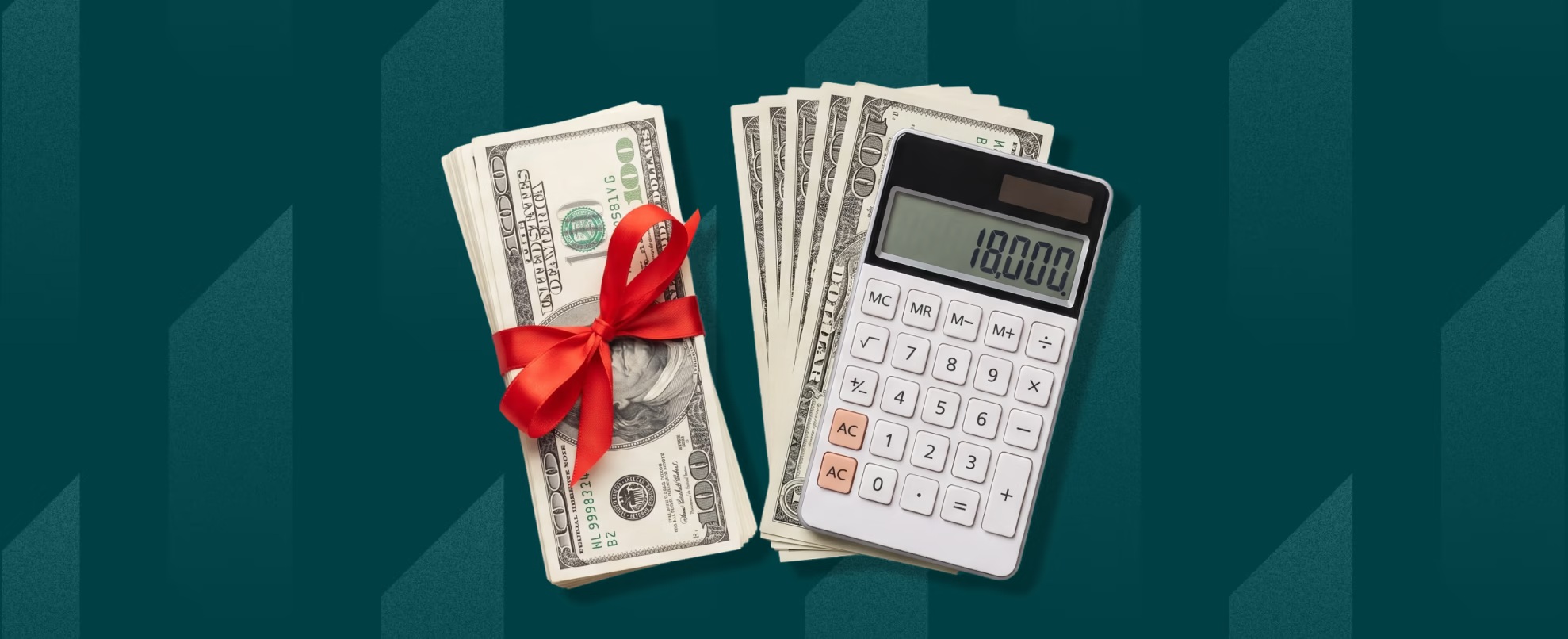
For 2026, you can give up to $19,000 per recipient per year without owing federal gift tax or generally needing to file a gift tax return. This annual exclusion applies to qualifying gifts of money or property under US Internal Revenue Service (IRS) rules.
The limit resets every calendar year, beginning January 1. This means gifts made in 2026 are counted separately from gifts made in 2025. You can give money to multiple recipients in the same year, provided each recipient’s total qualifying gifts from you stays within the annual limit.
The exclusion applies per giver and per recipient, rather than as one combined limit for all your gifts. For example, you could give $19,000 each to three people in 2026, totalling $57,000, without exceeding the annual exclusion for any recipient. If two spouses each give the same recipient $19,000, their combined gifts can reach $38,000 under their separate exclusions, subject to applicable IRS rules.
What is the lifetime gift tax exemption?
For 2026, the US lifetime gift and estate tax exemption is $15 million per individual. This is the total amount an individual can transfer through qualifying gifts during their lifetime and leave to beneficiaries at death before federal gift or estate taxes generally apply, subject to applicable rules.
The lifetime exemption works alongside the annual gift tax exclusion. While the annual exclusion allows qualifying gifts of up to $19,000 per recipient in 2026 without using the lifetime exemption, larger gifts generally count toward the $15 million limit. Gifts exceeding the annual exclusion may require you to file IRS Form 709, even when no tax is due.
The important distinction is that the lifetime gift tax exemption and estate tax exemption are shared, not separate allowances. For example, if you make $2 million in taxable gifts during your lifetime, that amount generally reduces the exemption remaining for your estate. Any unused exemption may apply to assets transferred at death, helping determine whether your estate owes federal estate tax.
When do you need to file form 709?
You generally need to file IRS Form 709 if you give more than $19,000 to one person in 2026, unless a specific exception applies. The form reports gifts exceeding the annual exclusion and helps the IRS track your use of the lifetime gift tax exemption.
The filing requirements, deadline and potential tax implications are important to understand before submitting your return.
Who Must File Form 709?
The person giving the gift is generally responsible for filing. You may need to file if your gifts to one recipient exceed the annual exclusion, you transfer certain future interests, or you elect to split gifts with your spouse.
When Is Form 709 Due?
The deadline is generally April 15 of the year following the gift. For gifts made in 2026, the filing deadline is April 15, 2027. An extension may be available, but it does not automatically extend the deadline for paying tax owed.
Does Filing Form 709 Mean You Owe Tax?
No. Filing the form does not automatically mean you owe gift tax. Gifts above the annual exclusion generally reduce your lifetime gift and estate tax exemption. Federal gift tax is typically payable only after your available exemption has been exhausted.
Gift tax vs Estate tax: how they connect
Gift tax and estate tax share one combined lifetime exemption. In 2026, the federal gift and estate tax exemption is $15 million per individual. This means large gifts made during your lifetime and assets transferred after your death generally count toward the same exemption.
If you give a substantial amount of money while alive, the portion exceeding the annual gift tax exclusion generally reduces the exemption remaining for your estate. For example, if you make $2 million in taxable gifts, that amount generally reduces your remaining exemption to $13 million, assuming no other taxable transfers or adjustments.
Alternatively, leaving the money in your estate means its value may be considered when calculating estate tax after your death. If your total taxable estate and applicable prior gifts remain within your available exemption, federal estate tax generally will not be due.
The main difference is when the transfer happens and how the assets are valued. Lifetime gifting can help transfer wealth earlier, but the best approach depends on your financial circumstances, future needs and estate planning goals.
If you're sending money as a gift to family members abroad, it's also worth considering transfer fees and exchange rates. For example, you can send money from the US to Mexico or send money from the US to India using available international transfer services. Just remember that sending money internationally doesn't automatically exempt a gift from US tax reporting requirements.
Frequently asked questions about gift taxes
Does the person receiving a Gift pay tax on it?
Generally, no. Under US federal tax rules, the recipient does not pay income tax on money received as a gift. The person giving the gift is usually responsible for any applicable gift tax reporting and payment. However, income generated by gifted assets may be taxable to the recipient.
Can you gift more than the annual exclusion without paying tax?
Yes. Gifts exceeding the 2026 annual exclusion of $19,000 per recipient may require you to file Form 709. However, the excess generally reduces your lifetime gift and estate tax exemption rather than triggering immediate tax. Gift tax usually becomes payable after the available exemption is exhausted.
Do Gifts to a spouse count toward the annual exclusion?
Generally, gifts to a US-citizen spouse qualify for the unlimited marital deduction and do not count toward the annual exclusion. Gifts to a non-US citizen spouse have a separate annual limit, which is $194,000 for 2026. Special rules may apply depending on the circumstances.
Is money sent to family abroad treated as a Gift for tax purposes?
Yes. Money sent to relatives abroad may qualify as a gift under US tax rules. If the giver is subject to US gift tax, the annual exclusion and reporting requirements may apply regardless of where the recipient lives.
Do you have to report a Gift from a foreign relative?
You may need to. US persons who receive gifts exceeding $100,000 in total from a nonresident alien individual or foreign estate generally must report them on Form 3520. Different thresholds apply to gifts from foreign corporations or partnerships.
What is the penalty for not filing Form 709 when required?
Failure to file Form 709 when required may result in penalties based on the unpaid gift tax, generally 5% per month, up to 25%. If no tax is due, penalties may differ, but the IRS can still assess consequences for noncompliance. Filing requirements should be checked carefully.
Managing money across borders involves more than understanding gift tax. Whether you are supporting family abroad, making international payments or managing everyday expenses, having the right financial tools matters. Grey offers multi-currency accounts and virtual cards that make it easier to manage international finances, pay for online services and handle supported cross-border transactions.

USDC on Solana vs Ethereum: Which should you use?
USDC on Solana settles in seconds for cents, while Ethereum costs more but has deeper support. See which network fits your transfer. Compare both now.
Tunde Aladeloba
•
October 9, 2026
•
6 min read
Solana or Ethereum? Both can move the same dollar-backed stablecoin, but the difference becomes clear when speed and transaction fees matter.
Solana can settle a USDC transfer in a few seconds, usually for a fraction of a cent. Ethereum, on the other hand, can take several minutes, with fees that increase when the network is busy. For a straightforward payment, Solana can be the more practical option when keeping costs low matters.
Both versions of USDC are issued by Circle and designed to maintain a 1:1 value with the US dollar. The real choice is therefore not between two different stablecoins, but between two networks. The better option depends on where the money is going, which network the recipient supports, and whether speed, low fees or access to Ethereum’s wider ecosystem matters most.
What is the difference between USDC on Solana and Ethereum?
The main difference between USDC on Solana and Ethereum is the blockchain network used to settle your transaction, even though both versions are issued by Circle, designed to maintain a 1:1 value with the US dollar and redeemable through the same issuer. When you choose between them, you are therefore choosing a different settlement layer, with Solana generally offering faster and cheaper transfers while Ethereum can become more expensive when the network is busy.
The distinction becomes more important when you come across native and bridged USDC. Native USDC is issued directly by Circle on the blockchain where you hold it, so USDC issued natively on Solana is Circle-issued USDC on Solana, while native USDC on Ethereum is issued directly on Ethereum. This means you should not assume that every token labelled “USDC” has the same issuance structure.
Bridged USDC represents USDC that has been moved between blockchains using a bridge, rather than being directly issued by Circle on the destination network. Before sending your USDC, check the network supported by the recipient and whether you are dealing with native or bridged USDC, because sending through an unsupported network can make it difficult or impossible to recover your funds.
How fees and settlement times compare
When you compare Ethereum and Solana for USDC transfers, the biggest differences you'll notice are the network fee and how quickly your transaction settles. Ethereum fees change with supply and demand, so when more people compete for limited block space, the base fee rises and you may pay an additional tip to have your transaction prioritised. Solana generally offers lower and more predictable fees, which can make it more practical for frequent transfers.
On Ethereum Layer 1, you may pay around 0.01–0.20, with settlement taking roughly 12 seconds to several minutes depending on network conditions and the level of finality you require. Solana typically settles transactions within seconds at a fraction of a cent.
Ethereum Layer 2 networks can reduce the cost further by processing transactions away from the main chain and later posting transaction data to Ethereum. This gives you faster execution and lower fees, although the final settlement process works differently from a direct Layer 1 transaction. Network conditions change, so check current fees before sending.
Also read: USDC to USD: How to convert your stablecoin to cash
What happens if you send USDC to the wrong network?
Sending USDC to the wrong network can put your funds at risk, and whether you can recover them depends on where the money was sent and who controls the receiving wallet. If the destination supports the network you used, recovery may be possible, but if it does not, you may need help from the exchange or wallet provider, with no guarantee that the funds can be recovered.
Before sending, check that the network selected on your platform matches the network supported by the recipient. Do not rely on the wallet address alone, because the same address format can sometimes work across different networks. If you use a USD bridge to move USDC between blockchains, confirm the destination network and the type of USDC being received before approving the transaction.
For a large transfer, send a small test amount first, then check the network name, token and destination address before sending the remaining balance. Once a blockchain transaction is confirmed, it generally cannot be reversed.
Also read: How to convert and use USDC in Nigeria
How to choose a network for your transfer
Choosing a network for your USDC transfer comes down to three things: how much you are sending, where the money is going and how quickly you need it to arrive. Start with the destination, because the cheapest or fastest network is not useful if the recipient’s wallet or exchange does not support it. Check the supported networks before you enter the amount or confirm the transaction.
Next, consider the amount you are sending. For a small transfer, a network with very low transaction fees can help you avoid losing a noticeable percentage of your money to fees. For a larger transfer, the fee may matter less, but you should still confirm that the network supports the exact USDC you are sending.
Finally, consider urgency. If you need the money to arrive within seconds or minutes, a faster network may make more sense. If timing is flexible, you can compare fees and choose the cheaper option. Whatever you choose, confirm the network on both sides before sending.
Open a multi-currency account to send and receive USDC
Turning USDC into local currency usually involves one more step after receiving your payment: moving the funds from your crypto wallet or exchange into a bank account where you can spend them. A multi-currency account can fit between these steps, giving you a place to receive and hold funds before converting them into the currency you need.
With Grey, you can open a multi-currency account and use it to manage your international payments in one place. Once you receive USDC, you can move the funds through the available conversion and withdrawal options rather than immediately sending everything to a local bank account. This can give you more control over when you convert and where your money goes.
The process is straightforward: receive your USDC, convert or off-ramp it through a supported route, then withdraw the resulting currency to your local bank account. The exact steps depend on the currencies and payment routes available to you, so check the supported options before starting your transfer.
Frequently asked questions
Is USDC on Solana the same as USDC on Ethereum?
USDC on Solana and USDC on Ethereum are both issued by Circle and designed to maintain a 1:1 value with the US dollar, but they operate on different blockchains. The main differences are transaction speed, network fees and where you can send or receive each version of USDC.
Which network has lower USDC fees?
Solana generally has lower USDC transaction fees than Ethereum, with transfers typically costing a fraction of a cent. Ethereum fees can increase when the network is busy because users compete for limited block space. Before sending, check the current network fee and make sure the recipient supports your chosen network.
Can I send USDC from Solana to an Ethereum wallet?
You cannot send native USDC on Solana directly to an Ethereum-only address and expect it to arrive correctly. To move USDC between networks, you need a supported bridge or exchange that handles the transfer. Always confirm both the sending and receiving networks before approving the transaction.
What happens if I pick the wrong network?
Choosing the wrong network can make your USDC difficult or impossible to recover, depending on the receiving wallet or exchange. Before sending, check the network supported by the recipient and make sure it matches the network selected in your wallet. For larger amounts, consider sending a small test transaction first.
Is USDC on Solana safe?
USDC on Solana can be safe when you use the official, native version of USDC and send it through a supported wallet or exchange. Your biggest risks usually come from choosing the wrong network, using an unsupported token or sending funds to an incorrect address. Always verify the token and destination.
How do I convert USDC to my local currency?
To convert USDC into your local currency, you typically send it to a supported exchange or financial platform, sell or convert the USDC, then withdraw the resulting funds to your bank account. A multi-currency account can also give you a place to receive and manage funds before converting them.

How to save money in USD in Nigeria: Best ways and apps
How to save money in USD in Nigeria. Domiciliary accounts vs fintech apps compared by fees, access, and risk. Protect your savings from naira depreciation.
Priscila Marotti
•
October 6, 2026
•
6 min read
If you saved NGN 1,000,000 in a Nigerian bank account five years ago, that money has lost more than half its purchasing power in dollar terms. The naira has depreciated from roughly NGN 410/USD to over NGN 1,500/USD since 2021. Saving in naira means watching your wealth shrink. Saving in dollars means preserving it.
Nigerians can save in USD through domiciliary accounts at commercial banks, fintech apps like Grey, PiggyVest, and Bamboo, or by holding dollar-denominated stablecoins. Each method has different costs, access requirements, and risk profiles. The best option depends on how much you're saving, how quickly you need access, and how comfortable you are with digital platforms.
This guide compares every method available in Nigeria for saving in dollars, with the real costs, risks, and trade-offs for each. For a broader look at saving in foreign currencies from anywhere, see how to save in foreign currency.
Why save in USD from Nigeria?
The case for saving in dollars is straightforward: the naira has lost value against the dollar consistently for over a decade. This isn't a temporary dip. It's a structural trend driven by Nigeria's dependence on oil exports, foreign exchange shortages, and monetary policy decisions.
Saving in naira means your money buys less every year, even when the number in your account stays the same or grows. A Nigerian who saved NGN 5 million in 2020 had roughly $13,000 at the time. That same NGN 5 million is now worth under $3,500. The account balance didn't change. The purchasing power collapsed.
Saving in USD preserves your purchasing power relative to the global economy. Your dollar savings buy the same amount of imported goods, school fees, medical treatment, and international services regardless of what happens to the naira.
That said, saving in USD isn't without risk. If the naira strengthens (it has happened in short bursts, usually after CBN interventions), your dollar savings lose value in naira terms temporarily. Converting naira to dollars also carries a cost: the exchange rate spread, which runs 1 to 5% depending on the method. The decision to save in dollars should be a long-term one, not a short-term speculation on the naira.
Don't convert your rent money or next month's food budget to dollars. Keep 3 to 6 months of living expenses in naira for immediate needs. Save in dollars with what you can afford to hold for at least 6 to 12 months.
Method 1: Domiciliary accounts
A domiciliary account ("dom account") is a foreign currency account at a Nigerian commercial bank. You hold USD, GBP, or EUR in the account and can deposit or withdraw in those currencies. GTBank, Access Bank, Zenith Bank, First Bank, and UBA all offer them. For a step-by-step guide, see how to open a domiciliary account.
Requirements: BVN, NIN, a valid ID (international passport or national ID card), a utility bill not older than 3 months, two reference letters (some banks still require these; others have dropped the requirement), and a minimum opening deposit (typically $100 to $500, depending on the bank). The process requires a branch visit, and the documentation verification can take 3 to 7 business days.
Pros: Regulated by CBN, funds are NDIC-insured (up to NGN 500,000 equivalent per depositor per bank), physical branch access for withdrawals, and you can receive international wire transfers directly into the account via SWIFT.
Cons: The biggest issue is sourcing dollars. Nigerian banks don't sell USD to individuals at the official rate. You need to deposit dollars you already have, whether from exports, remittances, freelance income, or the parallel market. Interest is typically 0% on most domiciliary accounts. Withdrawals can be restricted during FX shortages, with some banks limiting cash withdrawals to $5,000 per month. Monthly maintenance fees of $1 to $5 are common, and some banks charge for incoming wire transfers.
Who should use this: Anyone with large dollar savings ($10,000+) who wants maximum regulatory protection and doesn't need frequent access. The NDIC insurance and CBN regulation make this the safest option on paper.
Method 2: Fintech apps
Several Nigerian fintech apps let you save in dollars or dollar-equivalent instruments from your phone. They're faster to set up than dom accounts, don't require a branch visit, and typically have lower minimum deposits. The trade-off is different (and sometimes less clear) regulatory protection.
PiggyVest: One of Nigeria's most popular savings apps. Offers USD savings with up to 7% annual interest through their dollar savings feature. You buy dollars within the app at the prevailing rate.
Pros: User-friendly interface, competitive interest rates, automated savings features.
Cons: $20 fee to transfer USD out to a domiciliary account, USD isn't always available for purchase (demand often exceeds supply), and the platform is not a bank, so deposit insurance works differently. Best for people who want to save small amounts regularly and don't mind limited withdrawal windows.
Bamboo: Primarily an investment app for US stocks and ETFs, but its fixed-income dollar product lets you save idle USD at up to 8% interest for 90-day lock-in periods.
Pros: Dollar-denominated, SEC-regulated (for the stocks side), accessible from Nigeria.
Cons: the 90-day lock-in means no access during that period, and the platform is more investment-oriented than a pure savings product. Best for people who want to park $500+ for 3 months and earn yield while they wait.
Rise: Another investment platform with dollar savings features. Offers fixed-income and real estate dollar funds alongside stock investments.
Pros: Diversified dollar savings options, regulated, and accessible.
Cons: Returns vary by fund, minimum investments apply, and liquidation times depend on the fund type. Real estate funds can take days to liquidate. Best for people who want dollar exposure beyond simple savings.
Cowrywise: Offers naira and dollar mutual fund investments. Dollar savings come through dollar-denominated fixed-income funds managed by licensed fund managers.
Pros: Automated savings, SEC-regulated fund managers, and accessible.
Cons: Dollar availability can be limited during high-demand periods, returns aren't guaranteed (they're based on fund performance, not a fixed interest rate), and withdrawals may take 24 to 72 hours.
Who should use fintech apps: anyone saving $50 to $5,000 monthly who wants easy access, doesn't want a branch visit, and is comfortable with digital platforms. Compare the interest rates, lock-in periods, and withdrawal policies before committing.
Method 3: Stablecoins (USDT, USDC)
Stablecoins are cryptocurrencies pegged 1:1 to the US dollar. Buying USDT (Tether) or USDC (Circle) is effectively buying digital dollars. You purchase them on exchanges like Binance, Bybit, or Luno using naira via P2P trading.
Pros: Instant access at any hour, no bank involved, 24/7 liquidity (you can convert back to naira at 2am on a Sunday), and the ability to earn yield through DeFi protocols (though this adds substantial risk). Converting back to naira via P2P is straightforward and settles within minutes.
Cons: Not regulated by CBN, which means no deposit insurance. The exchange rate spread on P2P purchases runs 1 to 3% above the mid-market rate, eating into your savings immediately. Platform insolvency is a real risk (FTX collapsed owing billions to depositors). You need basic crypto knowledge to manage wallets, avoid scams, and understand the difference between custodial and non-custodial storage. P2P trading also carries counterparty risk: the counterparty could fail to deliver.
Who should use stablecoins: People comfortable with crypto who want maximum flexibility and don't mind managing their own security. Keep holdings on reputable exchanges (Binance, Bybit) or in a hardware wallet for larger amounts. This isn't a savings account. It's holding a digital asset pegged to the dollar.
Method 4: Grey USD account
Grey lets Nigerian residents open a USD account that holds real dollars with US routing and account details. You can receive USD from international clients, freelance platforms, or transfers, hold the dollars, and convert to naira when you choose.
What makes it different: Grey isn't a savings app that lets you buy dollars at a markup. It's an account that receives and holds USD directly. If you earn in dollars (freelancing, remote work, exports), the money lands in your Grey account as USD. You decide when to convert to naira, based on the rate you see in the app. No forced conversion, no lock-in period, no minimum balance.
You can also spend directly from your USD balance using a Grey virtual card for online purchases, subscriptions, and international payments. This means you don't need to convert to naira just to pay for a Netflix subscription or buy something from an international merchant.
To organise money for a specific goal (a trip, tuition, an emergency fund), set it aside in a Grey Pouch so it's visually separate from your spending balance.
Pros: Real USD account details (ACH routing number and account number), no minimum deposit, no lock-in period, instant setup, virtual card for spending.
Cons: No interest earned on balances; 1% conversion fee (capped at $6) when you swap to naira.
Who should use Grey: Anyone earning in dollars who wants to hold those dollars and convert on their own terms. Especially freelancers, remote workers, and small business owners receiving payments from US clients.
Cost comparison: Converting NGN 500,000 to USD
Here's what it costs to convert NGN 500,000 (roughly $330 at parallel market rates) into dollars through each method:
Domiciliary account: You bring cash dollars to the bank. The cost is whatever you paid to source those dollars, typically the parallel market rate, which includes a 1 to 3% premium over the official rate. No conversion fee from the bank, but you're paying the spread on acquisition.
PiggyVest: You buy dollars within the app at their rate, which includes a spread. The effective cost is typically 1 to 3% above the parallel market rate. On $330, that's $3 to $10 in spread.
Stablecoins (P2P): Binance P2P rates for USDT include a 1 to 3% spread over the mid-market rate. On $330, that's $3 to $10 in spread, plus any trading fees (typically 0%).
Grey: If you're receiving dollars from clients, the cost is zero on receiving. When you convert from naira to dollars within Grey, the 1% swap fee (capped at $6) applies. On $330, that's $3.30.
The real cost isn't the platform fee. It's the exchange rate you get when sourcing dollars. Compare the effective rate (how many naira per dollar) across methods before converting a large amount.
Which method should you use?
If you earn in dollars (freelancing, remote work, exports): Grey. Your income arrives in USD and stays in USD until you choose to convert. No intermediary, no markup on receiving.
If you want to convert naira to dollars for long-term savings: PiggyVest or a domiciliary account. PiggyVest is easier to set up and pays interest; dom accounts offer more regulatory protection. If the amount is large ($10,000+), the dom account's NDIC insurance matters.
If you want dollar-denominated investments: Bamboo or Rise. These go beyond simple savings into fixed-income and equity products that earn returns.
If you're comfortable with crypto: Stablecoins (USDT/USDC) offer the most flexibility and 24/7 access, but with no deposit insurance and additional platform risk. Keep no more than you can afford to lose on any single exchange.
If you want both savings and spending: Grey. Hold dollars, spend with a virtual card, convert to naira when you need to. One account covers receiving, saving, and spending.
Frequently asked questions about saving in USD in Nigeria
Is it legal to save in dollars in Nigeria?
Yes. Nigerian residents can legally hold and operate domiciliary accounts in USD, GBP, or EUR at commercial banks. The CBN permits individuals to hold foreign currency for legitimate purposes, including savings, investment, and business transactions. Fintech apps operate under different regulatory frameworks depending on the specific licence. Stablecoins exist in a regulatory grey area but are not prohibited for individual holding.
How much interest can I earn on dollar savings in Nigeria?
Domiciliary accounts at banks: typically 0% (banks don't pay interest on foreign currency deposits). PiggyVest: up to 7% annually. Bamboo: up to 8% on 90-day fixed-income lock-in. Stablecoin DeFi yields vary widely (2 to 15%) but carry proportionally higher risk. Grey doesn't pay interest on USD balances but lets you hold and convert on your terms with no lock-in.
What is the safest way to save in dollars in Nigeria?
A domiciliary account at a CBN-regulated bank offers the most regulatory protection, with NDIC insurance covering up to NGN 500,000 equivalent per depositor per bank. Fintech apps offer convenience but may not carry the same level of deposit insurance. Stablecoins offer no deposit protection. For amounts under $5,000, a regulated fintech app is a reasonable balance of convenience and safety. For larger amounts, consider splitting across a dom account and a fintech platform.
Can I open a domiciliary account without a salary account at the same bank?
Yes. You don't need a salary account at the same bank to open a dom account. You need your BVN, NIN, valid ID, proof of address, and the minimum opening deposit ($100 to $500, depending on the bank). Some banks ask for reference letters. The process requires a branch visit at most banks, though some now offer partial online applications.
Ready to save in dollars? Open a Grey USD account and hold real dollars with US account details.
Disclaimer: This article is for informational purposes only. All costs and details are estimates based on mid-2026 data. Verify current information before making decisions. Grey isn't a bank. We're a licensed financial services provider offering multi-currency accounts.
How to save in foreign currency: A practical guide
How to save in foreign currency. Domiciliary accounts, multi-currency fintechs, and stablecoins compared by cost, access, and risk. Read now.
Priscila Marotti
•
October 6, 2026
•
6 min read
Saving in a foreign currency is a hedge, not a guaranteed win. If the currency you save in depreciates against yours, you lose money. If it appreciates, you gain. Most people save in foreign currency because they don't trust their local currency to retain its value, not because they've run the numbers on exchange-rate forecasts.
That's a reasonable instinct. Over the past decade, the Nigerian naira has lost roughly 70% of its value against the US dollar. The Egyptian pound lost about 60% of its value. The Pakistani rupee lost about 40%. If you earned in those currencies and saved locally, your purchasing power eroded every year. Saving in USD, EUR, or GBP protects against that erosion.
To save in foreign currency, open a domiciliary account at a local bank or a multi-currency fintech account with a provider like Grey or Wise. Dom accounts have limited access and high minimums. Fintech accounts offer flexible digital holding with lower conversion costs. Stablecoins (USDC, USDT) offer a third path for crypto-comfortable savers who want dollar exposure without a bank account.
This guide covers every option, the costs involved, and who each one is actually for.
Why save in foreign currency?
Three reasons make the case for most people.
1. Currency depreciation protection. If your country's currency has a history of losing value against the dollar or euro, holding savings in a stronger currency preserves your purchasing power. This isn't speculation. It's insurance. The naira's depreciation from approximately 360/USD in 2020 to over 1,500/USD in 2026 turned NGN savings into a losing position regardless of interest rates earned. An NRE account earning 7% in naira still loses purchasing power compared to someone holding dollars at 0% interest.
2. Planning for international expenses. If you'll pay for education abroad, travel, medical treatment, or property in another country, saving in that country's currency eliminates exchange-rate uncertainty. You know exactly how much you have in the currency you'll spend. Converting from a depreciating currency at the last minute means you need more of it every month you wait.
3. Diversification. Financial advisors recommend diversifying across asset classes. Currency diversification applies the same logic: don't hold all your savings in a single currency, especially one with high inflation or political instability. Even a small allocation (10 to 20% of savings) in a stable foreign currency reduces portfolio volatility.
Who should NOT save in foreign currency: if your local currency is stable (USD, EUR, GBP, CHF, SGD), the benefits are minimal, and the conversion costs eat into returns. Swiss residents don't need to save in dollars. Americans don't need to save in euros unless they have specific euro-denominated expenses. If you live in a strong-currency country, invest rather than hedge currency risk.
Option 1: Domiciliary accounts
A domiciliary account (dom account) is a foreign-currency account held at a local bank. In Nigeria, most major banks (GTBank, Access Bank, Zenith Bank, UBA, First Bank) offer USD, GBP, and EUR domiciliary accounts. Similar products exist in Ghana (forex accounts), Kenya (FCY accounts), and other African and Asian markets.
How it works: you deposit foreign currency into the account, and it stays in that currency. No conversion on deposit. No conversion until you choose to withdraw in local currency. The bank holds your dollars as dollars. Interest rates are typically 0 to 1% on domiciliary accounts, sometimes zero.
Pros: Your foreign currency is held at a regulated local bank. NDIC insurance (up to NGN 500,000 equivalent in Nigeria). Familiar banking interface. You can receive SWIFT transfers directly into the account from abroad.
Cons: The access friction is real. Opening requires a branch visit with ID, utility bills, and sometimes a minimum deposit of $100 to $1,000. Withdrawals often require another branch visit. Some banks restrict online transfers from domiciliary accounts. The SWIFT fees on incoming transfers (ranging from $10 to $25 at many Nigerian banks) reduce the value of smaller deposits. And the bank's exchange rate when you convert to local currency includes a 1-3% spread over the mid-market rate, which is higher than fintech alternatives.
Best for: people who want to keep foreign currency at a traditional bank they already use, and who make infrequent, larger deposits ($500+) where the fixed SWIFT fee is proportionally small.
Option 2: Multi-currency fintech accounts
Fintechs like Grey, Wise, and Revolut let you hold multiple currencies in a single digital account. No branch visit. No minimum balance in most cases. Currency conversion happens instantly in the app at rates close to the mid-market rate.
Grey: Hold USD, EUR, and GBP with real account details. Receive payments via ACH (USD), SEPA (EUR), or FPS (GBP). Convert between currencies at a 1% fee, capped at $6. Withdraw to a local bank in 50+ countries. Virtual card for online spending directly from your foreign currency balance. No minimum balance. No monthly fee.
The Grey advantage for savers in Africa and South Asia: you get real US account details (routing and account numbers) that let you receive ACH transfers from US employers and clients with no receiving fees. A dom account can only receive SWIFT transfers, which cost $15 to $50 per incoming payment.
Wise: Multi-currency account with 40+ currencies. Conversion fees vary by currency pair (typically 0.5 to 1.5%). No receiving fee on major currencies. Real account details in USD, GBP, EUR, and several others. Competitive on per-transfer cost for smaller amounts.
Revolut: Similar to Wise. 30+ currencies. Free exchanges up to a monthly limit (standard plan), then 0.5 to 1%. Full banking features in the UK and EU. Limited availability in Africa and South Asia. If you're in Nigeria, Kenya, or India, Revolut likely isn't an option for you right now.
Best for: People who save foreign currency regularly (monthly income in USD, for example), who want instant access and low conversion costs, and who value the ability to spend directly from the foreign currency balance using a virtual card. If you'd otherwise lose 2 to 3% on every bank conversion, the fintech route saves $20 to $30 per $1,000 converted over a dom account.
Option 3: Stablecoins (USDC, USDT)
Stablecoins are cryptocurrencies pegged to a fiat currency, usually the US dollar. USDC (issued by Circle) and USDT (issued by Tether) are the two largest. Holding USDC is functionally similar to holding digital dollars, without needing a bank account.
How it works: buy USDC or USDT on a crypto exchange (Binance, Bybit, Luno, Quidax) using local currency. Hold the stablecoins in the exchange wallet or a personal crypto wallet (MetaMask, Trust Wallet, Phantom). When you want to convert back to local currency, sell on the exchange at the current rate.
Pros: accessible from almost any country. No bank required. No minimum balance. Transfers between wallets are fast and cheap on certain networks (Solana USDC transfers cost less than $0.01 and settle in seconds). You can hold dollar-equivalent value without a US bank account, which matters in countries where USD bank accounts are restricted or expensive.
Cons: you're holding crypto, even if it's a stablecoin. Exchange risk exists (the exchange could freeze your account, get hacked, or face regulatory action). USDT's reserve backing has been questioned repeatedly, though it has maintained its peg. USDC is considered more transparent but has occasionally frozen addresses at law enforcement request. Selling USDC back to local currency on peer-to-peer platforms can involve a 1 to 3% premium or discount depending on demand. No deposit insurance of any kind.
Grey's USDC integration: Grey supports receiving, holding, sending, and spending USDC. You can receive USDC via Solana or BNB Smart Chain, hold it in your Grey account alongside your fiat balances, and spend it directly with your Grey virtual card (the card draws from USD first, then USDC, then other balances). This bridges the gap between stablecoin holding and everyday spending without a manual conversion step. See Grey virtual cards for details.
Best for: crypto-comfortable savers in countries where foreign currency bank accounts are restricted, expensive, or unreliable. Not for people uncomfortable with crypto custody and exchange risks.
How to Time Your Currency Conversions
The honest answer: you probably shouldn't try to time currency conversions. Academic research consistently shows that even professional currency traders struggle to beat a simple dollar-cost-averaging strategy (converting the same amount at regular intervals regardless of the rate).
Dollar-cost averaging: convert a fixed amount every week or month. Some conversions will be at good rates, some at bad rates, and over time, they average out. This eliminates the paralysis of waiting for "the right rate" and the regret of converting at a bad one.
Rate alerts: set a target rate and convert when it hits. Grey and Wise both offer rate alert notifications. If you're not in a rush, setting a rate alert for 2 to 3% above the current rate and converting when it triggers gives you a consistent discount without the stress of monitoring daily.
Don't hold indefinitely. If you're saving in foreign currency for a specific purpose (tuition, property, travel), convert when you have enough, regardless of the rate. The goal is certainty of the amount in the target currency, not maximising the exchange rate. A bad conversion rate is better than being short of funds when the tuition bill arrives.
The costs of saving in foreign currency
Every method has costs. Account for them before assuming foreign currency savings are pure profit.
Conversion costs: 0.5 to 3% per conversion, depending on the method. Grey charges 1% capped at $6. Wise charges 0.5 to 1.5% depending on the pair. Dom accounts charge 1 to 3% via the bank's exchange rate spread. Stablecoin exchanges charge 0.1 to 0.5% in trading fees plus the spread.
Transfer fees: SWIFT transfers cost $15 to $50. ACH transfers to a Grey account are free. SEPA transfers to a Wise account are free. Stablecoin transfers vary by network (nearly free on Solana, $1 to $5 on Ethereum).
Holding costs: Dom accounts may charge monthly maintenance fees ($5 to $20). Fintech accounts are typically free. Stablecoins have no holding cost, but exchange wallets may have withdrawal fees.
Opportunity cost: dollars held in a zero-interest account lose purchasing power to US inflation (~3 to 4% annually). If you're holding $10,000 in a Grey account earning 0%, you're losing $300 to $400 per year in real purchasing power. An FCNR deposit at 4% offsets this. A US high-yield savings account at 4 to 5% does too, but that requires a US bank account.
Total your costs before committing. If you convert $500 per month at 1% cost ($5), that's $60 per year in conversion fees. If the currency you're saving in appreciates 5% against your local currency, you've gained $300 minus $60 in fees, netting $240. If it doesn't appreciate, you've spent $60 for no benefit. Know your break-even.
Want to start saving in foreign currency? Open a Grey account and hold USD, EUR, or GBP with real account details and no monthly fee.
Frequently asked questions about saving in foreign currency
What is the safest currency to save in?
The US dollar is the most common choice because it's the world's reserve currency, widely accepted, and relatively stable. The euro and British pound are alternatives. The Swiss franc (CHF) is traditionally the safest haven but conversion costs are higher for most people. No currency is risk-free. Dollar inflation means USD savings lose 3 to 4% in purchasing power annually unless earning interest.
Can I save in foreign currency without a bank account?
Yes. Stablecoins (USDC, USDT) let you hold dollar-equivalent value without a bank account. Buy on a crypto exchange using local currency, hold in a wallet. You can also use fintech accounts (Grey, Wise) that aren't traditional banks but offer regulated, insured foreign currency holding. For Grey specifically, sign up at grey.co/foreign-accounts.
How much should I save in foreign currency?
A common rule of thumb is 10 to 20% of total savings for currency diversification. If you have specific foreign currency expenses planned (education abroad, property, medical travel), save the full estimated cost in that currency. Don't convert your entire savings to foreign currency. Keep enough in local currency for 3 to 6 months of expenses.
Is saving in dollars better than investing?
Different purposes. Dollar savings protect purchasing power and provide liquidity. Investing (stocks, bonds, real estate) aims for growth and carries higher risk. Use dollar savings for emergency funds, short-term goals, and currency hedging. Use investments for long-term wealth building. They're complementary, not competing strategies.
Does Grey pay interest on foreign currency balances?
Grey does not currently pay interest on USD, EUR, or GBP balances held in the account. The value proposition is holding foreign currency with real account details, low conversion costs (1% capped at $6), and the ability to spend directly from the balance using a virtual card, not interest income. For interest-earning options, consider FCNR deposits (for NRIs) or US high-yield savings accounts (if you have US banking access).
Start saving in foreign currency. Open a Grey account and hold USD, EUR, or GBP.
Disclaimer: This article is for informational purposes only. All costs and details are estimates based on mid-2026 data. Verify current information before making decisions. Grey isn't a bank. We're a licensed financial services provider offering multi-currency accounts.

FX futures trading: How currency futures work
FX futures are exchange-traded contracts on currency pairs. Learn how they work, how to trade them, and how they compare to spot FX. Read the full guide today.
Olayoyin Olorunmota
•
September 30, 2026
•
6 min read
If you’ve read our FX trading beginner's guide, you already know that the forex market is primarily an over-the-counter market, with no central exchange and trades happening directly between participants. FX futures are different. They are exchange-traded, standardised contracts regulated by a recognised authority, with fixed contract sizes, set expiration dates, and publicly visible prices.
That distinction matters. It shapes everything from how you access the market to who regulates it to how much it costs to trade. This guide explains how FX futures work mechanically, how they compare to spot FX, and when they’re the right tool for a specific financial problem, and when they’re not.
What is FX futures trading?
FX futures trading is the buying and selling of standardised contracts that commit the holder to exchange a specified amount of one currency for another at a predetermined price on a specific future date.
Unlike spot FX, where currencies are bought and sold for immediate delivery (typically two business days), FX futures contracts have a defined expiration date in the future, typically quarterly: March, June, September, and December. You don’t have to hold the contract until expiration: most futures positions are closed before the contract expires by taking the opposite position.
The major FX futures markets are operated by CME Group, which runs the Chicago Mercantile Exchange (CME). The CME is one of the world’s largest derivatives exchanges and lists futures contracts on major currency pairs, including EUR/USD, GBP/USD, USD/JPY, AUD/USD, CAD/USD, CHF/USD, and MXN/USD, among others.
Because FX futures trade on a regulated exchange rather than over-the-counter, all participants see the same prices, all transactions are cleared through a central counterparty (the CME Clearing House), and the Commodity Futures Trading Commission (CFTC) in the US regulates the market. This centralised structure is one of the primary differences from spot FX.
Currency futures explained
Understanding the mechanics of a currency futures contract requires knowing its key specifications. Here is how the major CME EUR/USD futures contract works, using CME Group’s published contract specifications.
Contract size: Each EUR/USD futures contract represents 125,000 euros. This is the standardised unit. You cannot trade a partial contract: if you want exposure to EUR/USD, the minimum is one full contract worth 125,000 euros.
Tick size: The minimum price movement (tick) for EUR/USD futures is 0.00005 dollars per euro, which equals $6.25 per contract (125,000 × 0.00005). This is the smallest profit or loss increment per contract per tick.
Expiration months: EUR/USD futures expire quarterly: March, June, September, and December. The contract expiration date is the third Wednesday of the delivery month. The front-month contract (the one with the nearest expiration date) is typically the most liquid.
Settlement: CME currency futures are physically settled, meaning the actual exchange of currency can occur at expiration if a position is held open. In practice, most traders close their positions before expiration by taking the opposite trade, avoiding physical delivery.
Margin requirements: To trade FX futures, you don’t pay the full value of the contract upfront. You deposit an initial margin, a percentage of the contract’s notional value, as a performance bond. CME publishes initial and maintenance margin requirements. For EUR/USD futures, initial margin requirements vary but are typically between $2,000 and $3,000 per contract, depending on market volatility. This means you’re controlling a contract worth approximately $137,500 (at EUR/USD 1.10) with a margin of a few thousand dollars.
Mark-to-market: Unlike some financial instruments, futures positions are marked to market daily. At the end of each trading session, gains and losses are calculated based on the day’s settlement price and credited or debited from your margin account. If your account falls below the maintenance margin level, you receive a margin call and must deposit additional funds or have your position liquidated.
How to trade FX futures
Trading FX futures requires access to a futures broker and a funded margin account. The process differs from opening a standard retail forex account.
- Choose a CFTC-regulated futures broker
FX futures must be traded through a registered Futures Commission Merchant (FCM). Check CFTC registration at cftc.gov before depositing funds with any broker. Major regulated FCMs include Interactive Brokers, TD Ameritrade Futures, and others. Verify that the broker specifically offers access to CME currency futures. - Open a futures account and complete compliance requirements
Futures accounts require more documentation than standard brokerage accounts. You’ll complete risk disclosures, provide financial information, and confirm you understand the risks of leveraged derivatives trading. - Deposit initial margin
Transfer funds to meet the initial margin requirement for the number of contracts you intend to trade. Remember that margin requirements can change based on market volatility: CME can raise them at any time. - Place an order. Select the contract (e.g., EURO FX Futures, symbol 6E), the expiration month, the direction (buy or sell), and the order type (market, limit, or stop). Your broker’s platform will show the current bid and ask price for the contract.
- Monitor your position and margin
Because futures are marked to market daily, your account balance will change each day based on price movement. Monitor your account to ensure it remains above the maintenance margin. - Close or roll before expiration
To exit a long position, sell the same number of contracts in the same expiration month. To exit a short position, buy. To maintain exposure beyond the current contract’s expiration, “roll” the position by closing the front-month contract and opening the next expiration month.
FX futures vs spot trading
The two primary ways to trade currency markets are FX futures (exchange-traded, standardised, regulated) and spot FX (over-the-counter, flexible, broker-dependent). Here’s how they compare:
| Feature | FX futures | Spot FX (retail forex) |
|---|---|---|
| Trading venue | Regulated exchange (CME, ICE) | Over-the-counter, through brokers |
| Regulation | CFTC (US), FCA (UK), other regulators | Varies; some markets lightly regulated |
| Price transparency | Full order book visible; same price for all participants | Broker-set spread; prices can vary between brokers |
| Contract size | Standardised (EUR/USD = 125,000 EUR) | Flexible; can trade micro lots (1,000 units) |
| Minimum trade size | One contract (typically large notional value) | Much smaller; micro lots available |
| Settlement | Physical delivery at expiration (usually closed before) | Cash settled; no physical delivery |
| Leverage | Yes; margin-based | Yes; margin-based (often higher leverage available) |
| Expiration | Quarterly expiration dates | No expiration; positions held indefinitely |
| Counterparty risk | Cleared by exchange (low; exchange guarantees trades) | Counterparty is the broker (higher risk with unregulated brokers) |
| Transaction costs | Commission per contract plus bid-ask spread | Spread only (plus sometimes swap/overnight fees) |
| Who uses it | Institutional hedgers, professional traders | Retail traders, smaller hedgers |
| Access | Requires futures broker account | Retail forex broker account |
The key practical differences: FX futures offer greater regulatory protection and price transparency, but the standardised contract sizes make them less accessible for small-volume traders. Spot FX offers more flexibility on position size, but with variable broker quality and less regulatory oversight in some jurisdictions.
Hedging with FX futures
One of the primary legitimate uses of FX futures, beyond speculation, is hedging: locking in an exchange rate for a future transaction to protect against adverse currency movement.
Worked example: a UK exporter hedging a USD receivable
A UK manufacturer has agreed to sell £500,000 worth of equipment to a US buyer. The invoice is denominated in USD at today’s GBP/USD rate of 1.27, making the USD invoice amount approximately $635,000. Payment is due in three months.
The risk: if the pound strengthens against the dollar (GBP/USD rises) over those three months, the $635,000 will convert to fewer pounds when received. At GBP/USD 1.35, for example, the same $635,000 would only convert to approximately £470,000, a loss of £30,000 versus today’s rate.
The hedge: the exporter sells GBP/USD futures contracts with an approximate notional value of $635,000. If GBP/USD rises to 1.35, the exporter’s futures position profits, offsetting the loss on the physical receivable. If GBP/USD falls (good news for the exporter), the futures position loses money, but that loss is offset by the better conversion rate on the physical USD received.
The hedge doesn’t make the exporter money. It removes the currency risk, allowing the business to plan based on a known effective exchange rate rather than an unknown future rate. This is what hedging is for.
Who uses FX futures to hedge:
Exporters and importers who invoice in foreign currencies, multinational companies consolidating overseas earnings, and fund managers with foreign currency exposure in their portfolios. For most of these users, the objective is risk reduction, not profit generation.
Risks of FX futures trading
The risks in FX futures are specific and worth naming precisely.
Leverage risk: A $3,000 margin controls a contract worth approximately $137,500. A 1% adverse move in EUR/USD costs approximately $1,375 per contract, nearly 50% of the initial margin. The same move in the favourable direction yields the same gain, but most traders focus on the asymmetry: losses can quickly exceed the initial deposit.
Margin calls: If the market moves against your position and your account balance falls below the maintenance margin level, your broker will issue a margin call: deposit more funds immediately or have your position closed at the current market price, potentially at a significant loss.
Expiration management: Futures contracts expire. If you’re not actively monitoring your position, a contract you intended to hold can expire without you realising it, resulting in automatic closing at the expiration settlement price or, for physically settled contracts, an obligation to deliver or receive currency.
Basis risk for hedgers: FX futures hedge currency risk but introduce basis risk: the risk that the futures price and the spot price don’t move perfectly in tandem. For most major currency pairs, basis risk is small, but it exists and means a futures hedge is rarely a perfect offset.
Liquidity risk in less active contracts: Front-month contracts for major pairs (EUR/USD, GBP/USD, USD/JPY) are highly liquid. Further-out expiration months and minor pair contracts can be less liquid, meaning wider bid-ask spreads and potentially difficulty closing positions at the desired price.
A simpler way to manage real-world currency exposure
FX futures are a sophisticated tool designed primarily for institutional hedgers and experienced traders who need to manage specific, quantifiable currency exposures. For most freelancers, remote workers, expats, and small business owners, the practical currency problem is different: receiving income in one currency, holding it efficiently, and converting at a fair rate when needed.
That doesn’t require a futures account. It requires a multi-currency account with a competitive conversion rate.
Grey lets you hold balances in USD, EUR, and GBP, receive payments from international clients through local payment rails (ACH for USD, SEPA for EUR, Faster Payments for GBP), and convert currencies at mid-market rates with Grey at a conversion fee of 1%, capped at $6. The conversion rate is shown before you confirm; there’s no expiration date to manage, no margin calls, and no leverage amplifying your exposure.
For someone who needs to hold USD earned from US clients and convert it to GBP or local currency at an appropriate time, opening a multi-currency account with Grey is a more practical approach than establishing a futures hedging programme. FX futures are the right tool for managing large, quantifiable, time-specific currency exposures. For everyday multi-currency financial management, a Grey account is more practical.
Download the Grey app today to begin.
Frequently asked questions
What is the minimum to trade FX futures?
The minimum to trade FX futures is the initial margin requirement for one contract, plus enough buffer to avoid an immediate margin call if the market moves against you. For EUR/USD futures on the CME, initial margin requirements are typically $2,000 to $3,000 per contract, but this varies with market volatility and can be raised by the exchange at any time. In practice, most experienced futures traders maintain significantly more than the minimum margin in their account to absorb adverse moves without being forced out of a position.
How are FX futures different from forex spot trading?
FX futures are standardised contracts traded on regulated exchanges like the CME, with fixed contract sizes, quarterly expiration dates, and prices visible to all participants equally. Spot forex is traded over-the-counter through brokers, with flexible position sizes, no expiration dates, and prices set by the broker. Futures offer greater regulatory oversight and price transparency but require larger minimum positions. Spot forex is more accessible to retail traders, but broker quality and regulatory protection vary by jurisdiction.
Are FX futures suitable for beginners?
No. FX futures involve leverage, daily mark-to-market settlement, contract expiration management, and margin call risk. The standardised contract sizes mean a single EUR/USD futures contract controls 125,000 euros, which represents significant notional exposure for a beginning trader. Beginners who want to understand currency markets should start with educational reading rather than live trading, practice on simulated accounts before risking capital, and understand leverage mechanics fully before entering any leveraged position. The FX trading beginner's guide covers foundational concepts for those starting from scratch.
What is the contract size for EUR/USD futures?
One EUR/USD futures contract on the CME represents 125,000 euros. At an exchange rate of EUR/USD 1.10, one contract has a notional value of approximately $137,500. The minimum price move (tick) is 0.00005, worth $6.25 per contract. CME also offers E-micro EUR/USD futures contracts at one-tenth the size (12,500 euros per contract), which lowers the capital required per contract and may be more accessible for smaller traders.
When do FX futures expire?
CME currency futures expire quarterly: in March, June, September, and December. The specific expiration date is the third Wednesday of the delivery month, though the last trading day is typically the Monday before that Wednesday. Most traders close their positions before expiration to avoid the settlement process. Those who want to maintain exposure beyond the front-month contract “roll” their position by closing the expiring contract and opening the next quarterly contract.
Is Grey an alternative to FX futures for hedging small businesses?
For small businesses with straightforward multi-currency needs, Grey addresses the practical problem more simply than futures contracts do. A Grey multi-currency account lets you hold USD, EUR, and GBP balances, receive payments from international clients at low cost, and convert at a transparent rate. This is effective for managing the timing of currency conversion and avoiding forced conversion at poor bank rates, which covers the currency exposure most small businesses actually face. FX futures are appropriate when a business has a specific, large, time-defined currency exposure it needs to hedge precisely, such as a confirmed export contract in a foreign currency with a known settlement date. For most small businesses, that level of complexity and capital commitment isn’t justified.

Why separating your money makes it easier to keep
Your spending money and savings do not need to live together. See why separating your money makes it easier to keep, then open a Pouch to start.
Olayoyin Olorunmota
•
September 26, 2026
•
6 min read
A friend checked their balance at the end of last month, and thankfully, it was more than he expected. He hadn’t deliberately saved anything, but nothing catastrophic had happened either. I can’t remember the fine details, but I know he ended up spending it.
On the surface, it looked like a spending or discipline problem. But I had a different view, and in the following paragraphs, I’ll explain my thoughts and what I believe the best fix was, and the fix is simpler than most financial advice suggests.
Why one balance makes saving hard
When your savings and your spending money are in the same account, every pound or dollar in that account looks available. The balance doesn’t distinguish between money you’re keeping and money you’re spending.
This creates a specific cognitive problem. You make spending decisions based on whether the balance looks healthy, not based on whether you’ve set anything aside. If the number looks fine, spending feels fine. If you’ve mentally noted that £400 of that balance is “for savings,” that mental note competes with every spending opportunity you encounter between now and whenever you transfer it somewhere else, and mental notes lose that competition regularly.
The money then seeps out in small, individually reasonable amounts. A round at the bar. A delivery fee that didn’t seem worth avoiding. A subscription that renewed, and you forgot to cancel. Each decision was fine in isolation. Collectively, the balance is gone before you’ve done anything intentional with it.
The psychology of separating your money
There is a well-established concept in behavioural economics called mental accounting: the tendency people have to treat money differently depending on where it is and what they’ve labelled it as. The same £50 feels very different depending on whether it arrived as a birthday gift, a work bonus, or leftover change from a supermarket run, even though all three are identical once they’re in your account.
This tendency is usually described as a bias to be corrected. But I think it can be a useful tool. When money is in a named savings account, clearly separate from your spending account, it takes on a different psychological status. It’s not spending money. It's the holiday fund, the emergency buffer, the new laptop money. Spending it requires a conscious decision to override its purpose, which creates friction that a vague mental note never does.
The separation doesn’t have to be dramatic. A second account at the same bank, a different balance in the same app, a jar on a shelf: all of these work because they create a visual and psychological boundary between money that is available and money that is not. Artificial barriers are what make behaviour change sustainable without requiring constant willpower.
Separation is not the same as locking money away
A common hesitation about separating money is the fear of losing access to it. If something comes up, will it be there? If an emergency happens, can it be reached quickly?
The answer is yes. Separating your money is not the same as locking it away. It’s not a fixed-term account, a notice period, or a commitment you can’t undo.
What separation does is add one small step between you and the money. That step shouldn’t be a barrier for genuine emergencies. It is a barrier for the kind of casual, unconsidered spending that drains balances without leaving any clear decision behind.
This is precisely the kind of friction that works in your favour. It works passively in the background every day, without you having to actively choose to protect your money each time you open your banking app.
Simple ways to separate your money today
The simplest version of this is a second account. Open one, give it a name that reflects its purpose, and move a fixed amount into it on payday and don’t touch it until the purpose it was created for arrives.
If you have more than one goal you’re working toward, the approach extends naturally. One account for the emergency fund. One for the holiday. One for the thing you’re saving toward that doesn’t have a name yet but represents a general sense of having something to show for the year. For a method to handle several goals at once, see our piece on how to save for several goals at once.
The amount you move matters less than the consistency with which you move it. A small amount transferred every payday builds the habit and the structure, and it grows over time, even if the early contributions feel negligible. For a closer look at how this plays out in practice, see our piece on how small amounts add up.
How Pouches create separation without friction
The Pouch feature on Grey takes this idea and removes most of the friction. A Pouch is a named savings space within your Grey account. You give it a name and contribute to it from your balance. It sits separately from your spending money in the same app, clearly labelled, tracking its own balance against its own purpose.
The name is more important than it might seem. “£1,200” is abstract. “Japan trip” is not. A named Pouch for a specific goal carries the same psychological weight as money in a jar labelled on the outside. You know what it’s for, and you can see how close you are. Spending it means consciously deciding to set the goal back, which is a different decision from spending money that has no label.
Because the Pouch is within your Grey account, there’s no need for multiple bank accounts or juggling between apps.
Create your first Pouch and set money aside today.
Frequently asked questions
Why is it easier to save when money is separate?
Because money sitting beside your spending money looks spendable. When your savings are in the same account as everything else, every spending decision competes with the saving intention, and the saving intention usually loses. Separation removes the competition. The savings are in a different space with a different purpose, and spending them requires overriding that purpose consciously rather than just not thinking about it.
What is mental accounting?
Mental accounting is the tendency to treat money differently based on where it is or how it arrived, even though money is functionally identical regardless of source or location. People spend windfall money more freely than earned money, treat a bonus differently from a salary, and protect money that’s been given a specific purpose more carefully than money that sits in an undifferentiated balance. When used deliberately, it’s a useful tool. By naming and separating money for a specific purpose, you activate the same psychological protection that makes people reluctant to “break into” money they’ve mentally reserved.
Does separating money mean locking it away?
No. The money remains fully accessible. Separation creates a psychological barrier, not a legal or structural one. A Pouch in your Grey account, a second current account at your bank, or a named savings pot: all of these can be accessed immediately if needed. The purpose of separation is to make casual or unintentional spending less likely, not to make genuine access impossible. For real emergencies, the money is always there.
How many savings pots should I have?
As many as you have distinct goals, within reason. One pot per clear goal is a useful starting point: one for an emergency fund, one for a specific planned purchase or trip, one for a medium-term goal like a deposit or career break. Beyond five or six active pots, contributions start to feel too small to be meaningful, and the system becomes harder to manage. Focus on the goals that matter most right now, and add new pots as old goals are reached.
How do I start separating my money?
Start on your next payday. Before spending any discretionary funds, move a fixed amount to a separate account. It doesn’t have to be large. The first move establishes the structure and the habit, and both of those matter more than the initial amount. Name the space after what you're saving for. Set a target if you have one. Then repeat the transfer every payday until the goal is reached. The system is as simple as that, and its power comes from consistency rather than size.
How much should you save from each paycheck?
See how much of each paycheck to save using the 50/30/20 rule and simple targets, then automate it so saving happens before you spend. Start now.
Olayoyin Olorunmota
•
September 24, 2026
•
6 min read
There is no single correct answer to how much of each paycheck you should save. What can help, however, are guidelines and methods for determining what’s realistic for your specific income, costs, and goals.
The most common mistake in savings advice is presenting targets as fixed obligations rather than starting points. Telling someone they must save 20% of their income when their rent takes up 50% of it is great, but it isn’t always helpful. Neither is suggesting they save nothing until the perfect amount is clear. The right savings rate is the highest one you can maintain consistently, and it will change as your income and circumstances do.
This guide covers the standard guidelines, how to adapt them, and how to make saving automatic so the decision doesn’t have to happen every payday.
How much of each paycheck should you save?
The most widely cited starting point is 20% of your take-home pay. This figure comes from the 50/30/20 rule, a budgeting framework that allocates income across three broad categories.
For many people in high-cost-of-living areas, or in the early stages of their careers when income is lower, and rent takes a larger share, 20% is not realistic from day one. That’s fine. The goal is to establish a consistent saving habit at whatever level is sustainable now, and increase it over time.
A more useful framing than a fixed percentage is to build an emergency fund first. Before you think about longer-term savings goals, having three months of essential expenses set aside protects you from going into debt when something unexpected happens. Once that foundation is in place, directing additional savings toward specific goals becomes the priority.
If you're starting from nothing and 20% feels out of reach, start with 5%. On a £2,000 monthly take-home, that’s £100. It won’t build wealth quickly, but it establishes the habit and the account structure that larger contributions can flow into as your income grows. Consistently saving a small amount reliably beats irregularly saving a large amount.
The 50/30/20 rule and other savings percentages
The 50/30/20 rule divides your take-home pay into three categories
50% for needs: Essential expenses that you can't avoid: rent or mortgage, utilities, groceries, insurance, transport to work, and minimum debt repayments. If this category is consuming more than 50% of your take-home pay, which is common in high-cost cities, the other percentages have to adjust accordingly.
30% for wants: Discretionary spending: dining out, subscriptions, entertainment, holidays, and new clothes. This is the category that can be reduced most easily if you need to redirect more toward savings.
20% for savings and debt repayment. This covers everything from an emergency fund to retirement contributions to a deposit for a flat. If you carry high-interest debt, prioritising accelerated debt repayment within this 20% makes sense before directing it all toward long-term savings.
Here’s a worked example on a take-home salary of £2,400 per month:
For someone whose needs take 60% of income, the adjusted version might look like:
The saving percentage stays the same while the wants category absorbs the adjustment.
Alternative savings percentages
The Consumer Financial Protection Bureau notes that the right savings rate varies significantly by household size, income level, and financial goals. Some financial planners suggest directing the first 10% of income to retirement savings before anything else, treating it as non-negotiable. Others advocate a flat 1% annual increase, so someone saving 5% today saves 6% next year, 7% the year after, and reaches 20% over time without a single dramatic change.
The common thread across all frameworks is that you should consistently save, increase it gradually, and automate it so the decision doesn’t require willpower each month.
How to set your own savings target
A more reliable method than applying a percentage is working backwards from your actual goals.
List every financial goal you’re currently saving toward or know you should be: an emergency fund, a holiday, a deposit, a career break fund, or retirement. Give each one a target amount and a date. Divide each target by the number of months until the deadline. This gives you the minimum monthly contribution required for each goal.
Add the required contributions together. That’s your savings floor. It’s the minimum you need to save each month to hit every goal on the current timeline. If it’s more than you can currently direct toward savings, something has to give: a timeline extends, a target reduces, or spending in another category decreases.
For people with irregular income, freelancers, contractors, and commission-based workers, a fixed percentage works better than a fixed amount. Saving 15 or 20% of whatever comes in means savings scale with income without requiring monthly adjustments. In low-income months, contributions are lower. In high-income months, they're higher. The percentage stays consistent.
For decisions about whether to direct savings toward short-term goals or longer-term investments, see our guide on saving vs investing. The answer varies depending on your timeline and the specific goal. For people in economies where local currency devaluation is a concern, consider holding savings in a stable currency when structuring your emergency fund and medium-term savings.
How to automate saving every payday
The most reliable savings system is one that doesn’t require a decision each month. When saving is automatic, it happens in good months and difficult months equally, without relying on remembering or on having enough willpower to resist spending first.
The principle is called paying yourself first. Before any discretionary spending, before any non-essential transfers, a fixed amount moves from your income account to your savings account on payday. What remains in the income account is what you spend. You never see the savings as available.
Here’s how to set it up:
Step one: Decide your monthly contribution amount or percentage. Use the worked method above if the right figure isn’t clear.
Step two: Set up a standing order or automatic transfer to leave your account on the same day your salary arrives, or the day after.
Step three: Direct that transfer to a separate account or named goal, not your current account. When savings sit in the same account as spending money, they get spent. A named goal with a visible target and a separate balance is significantly harder to spend casually.
Grey's Pouch feature lets you set money aside for each financial target you're working toward. Each Pouch is named, has a target amount, and is separate from your main balance. You can also save part of it in USD if protecting against local currency depreciation is relevant to your situation. The combination of automation and separation is what makes saving consistent over time rather than occasional.
Set up a Pouch goal with Grey and move a set amount aside every payday at grey.co/pouch.
Frequently asked questions
How much should I save per paycheck?
The 50/30/20 rule suggests saving 20% of take-home pay. In practice, the right amount is the highest percentage you can save consistently, given your actual income and costs. Starting at 5 to 10% is reasonable if 20% isn't currently achievable. The priority is establishing a consistent habit and increasing the percentage incrementally over time, particularly when income rises.
Is saving 20% of income enough?
For most people at most stages of life, 20% is a solid savings rate that covers an emergency fund, retirement contributions, and medium-term goals if maintained consistently over time. Whether it's "enough" depends on your specific goals, your timeline, and when you start. Someone who starts saving 20% at 22 is in a very different position from someone who starts at 42. Earlier is always better, and more is always better, but 20% consistently over a long period produces substantial results.
What is the 50/30/20 rule?
The 50/30/20 rule is a budgeting framework that divides take-home pay into three categories: 50% for needs (rent, utilities, groceries, insurance, minimum debt payments), 30% for wants (dining out, subscriptions, entertainment), and 20% for savings and debt repayment. It's a starting structure, not a fixed rule. People in high-cost areas often need to allocate more to needs, which adjusts the other categories accordingly.
Should I save or pay off debt first?
It depends on the interest rate on the debt. High-interest debt (above 7 to 8%) typically costs more than savings earn, so accelerating repayment on high-interest debt before building savings beyond an emergency fund usually makes financial sense. For low-interest debt (below 5%), it's generally reasonable to save and repay simultaneously. The exception is an emergency fund: having at least one to three months of essential expenses saved before aggressively paying down debt protects you from going further into debt if an emergency occurs during repayment.
What happens if I can't save 20% right now?
Save less. Start with whatever is realistic, 5%, 3%, even £50 a month, and increase it gradually. A consistent small saving habit is more valuable than an inconsistent large one. Each time your income increases, direct a portion of the increase toward savings before adjusting your spending. Over several years, incremental increases compound into a meaningful savings rate without requiring a dramatic change at any single point.
What is an emergency fund and how much should you really have?
An emergency fund covers 3 to 6 months of expenses. Learn what it is, how much you need, and where to hold it so inflation does not erode it. Start.
Olayoyin Olorunmota
•
September 16, 2026
•
6 min read
Most financial advice assumes you have a safety net. Emergency fund guidance tells you how big that net should be. What it rarely covers is what the fund is for, how to calculate your specific number, and where the money should sit so it’s genuinely available when you need it without quietly losing value while it waits.
This article covers all three: a plain definition of what an emergency fund is and isn’t, a worked method for calculating your own target, and the practical question of where to hold the money once you’ve built it.
What is an emergency fund?
An emergency fund is a reserve of money held separately from your everyday spending, set aside specifically to cover costs that are unexpected, essential, and cannot be covered from regular income alone.
The word “emergency" is doing some heavy lifting in that definition. Not every unexpected expense qualifies. An emergency fund generally covers:
- Job loss or sudden income reduction
- Medical bills not covered by insurance
- Urgent home repairs (a broken boiler, a roof leak)
- Car repairs that affect your ability to work
- Travel for a family crisis
It does not cover a sale you didn’t expect to find, a holiday that came up at the last minute, or a new phone because yours is slow. Those are wants, not emergencies, and funding them from an emergency reserve defeats the purpose of having one.
The reason an emergency fund matters is simple: without one, an unexpected cost becomes debt. A £1,200 boiler repair that you can’t cover from income goes on a card at 20% interest or, worse, goes unfunded until a problem that was manageable becomes critical. An emergency fund converts a financial emergency into an inconvenience. That is the entire point of it.
The fund should be accessible quickly, ideally within one to two business days. It should not be invested in assets that can lose value at the moment you need to draw on them. And it should be separate from your current account, because money in your daily spending account has a way of becoming daily spending.
How much should you have in an emergency fund?
The Consumer Financial Protection Bureau recommends saving enough to cover three to six months of essential expenses. This is the standard guidance, and it holds up for most people.
Step one: calculate your monthly essentials.
Essential expenses are the costs that don’t stop if your income does. They are the non-negotiables:
- Rent or mortgage
- Utilities (electricity, water, gas, internet)
- Groceries
- Insurance premiums
- Minimum debt repayments
- Transport to work (if applicable)
- Childcare or dependent care (if applicable)
It is almost always lower than your total monthly spending, which is the point. Your emergency fund covers survival costs, not lifestyle costs.
Worked example:
| Essential expense | Monthly amount |
|---|---|
| Rent | £900 |
| Utilities | £120 |
| Groceries | £250 |
| Insurance | £80 |
| Transport | £100 |
| Minimum debt repayment | £150 |
| Monthly essential total | £1,600 |
At the standard three-to-six-month range, this person needs £4,800 to £9,600. Their starting target should be £4,800 (three months), with a longer-term target of £9,600 (six months).
Step two: adjust for your circumstances.
Three months is the minimum. Six months is a more comfortable target for most people. But some situations warrant aiming higher.
Save toward the higher end (six months or more) if:
- Your income is irregular. Freelancers, contractors, and commission-based workers can have income that disappears for a month or two without warning. A larger buffer covers longer gaps.
- You are the sole earner in a household. If your income stops, the whole household stops. Two incomes provide a natural buffer that a single income doesn’t.
- You work in a sector where finding a new role takes time. Niche industries, senior roles, and specialist fields often have longer job search timelines.
- You have dependants. Children, elderly parents, or anyone financially reliant on you increases the cost of an income gap and the stakes of not having one covered.
Three months is a reasonable starting point for someone with a stable income from employment, no dependants, and a partner who also works. Six months is a more appropriate target for most other situations.
Where should you keep your emergency fund?
The two requirements for an emergency fund are accessibility and stability. The money needs to be available quickly when you need it, and it needs to hold its value while it waits.
These requirements create some sort of tension. The highest interest rates tend to come with notice periods or investment risk. Easy-access accounts pay less. The right answer for most people is not to optimise for return but to optimise for availability and protection.
Separate from your current account.
The most important thing is that the fund is in a different account from your daily spending because, psychologically, money that is seen as available. Most people have a harder time resisting the urge to spend money they can see in their balance. A separate account, ideally at a separate provider, removes the fund from your daily financial view without making it inaccessible.
Easy access
Avoid fixed-term accounts or investments for emergency funds. The scenario you’re protecting against may require the money within 48 hours. A 30-day notice savings account or a stock market account that happens to be down when you need it defeats the purpose.
Consider the currency you hold it in
If your home currency has historically depreciated against major global currencies, holding an emergency fund entirely in local currency means the fund may be worth significantly less in real terms at the moment of an emergency than it was when you built it. Holding a portion of your emergency fund in a stable currency like USD provides a hedge against local currency devaluation without locking the money into investments or inaccessible vehicles.
Grey lets you hold your emergency fund in USD in a separate account from your everyday spending. You can set up a Pouch specifically for your emergency fund, giving it its own named space, and a visible balance that sits apart from your main account. The fund is accessible when you need it, clearly labelled so you’re less likely to dip into it casually, and held in a stable currency if that matters for your situation.
For more on this decision, see our guide on where to keep your emergency fund.
Open a Grey account, hold your emergency fund in USD, and ring-fence it in a Pouch goal so it is there when you need it, at grey.co/pouch.
How to build an emergency fund from zero
The target can feel large, particularly at the beginning. A £9,600 six-month fund is a significant sum, and trying to save it all at once is neither realistic nor necessary. Building it consistently over time is.
- Set your target: Use the worked method above to calculate your monthly essentials, multiply by three to start, and put that number somewhere visible. That is what you’re working toward.
- Automate a monthly transfer: On payday, before any discretionary spending, transfer a fixed amount to your emergency fund account. Start with whatever is realistic given your current income, even if that’s £50 or £100 per month. The habit matters more than the amount at this stage. A fund that grows slowly is infinitely more useful than one that never gets started.
- Top up with windfalls: A tax refund, a bonus, a freelance project that pays more than expected: direct a meaningful portion of any irregular income straight to the emergency fund before it can be absorbed into general spending. Windfalls are one of the fastest ways to close the gap between where your fund is and where it needs to be.
- Don’t stop once you hit three months: Three months is the minimum, not the goal. Once you reach the three-month mark, keep the automatic transfer running at a lower rate until you reach six months.
For guidance on how to size your monthly contribution relative to your income, see our guide on how much to save from each paycheck. Once your emergency fund is fully built, shifting attention to longer-term goals is the natural next step; our guide on longer-term savings goals by age covers what to prioritise from there.
Frequently asked questions
How much should I have saved in an emergency fund?
The standard guidance from the Consumer Financial Protection Bureau is three to six months of essential expenses. Essential expenses are the costs that don't stop if your income does: rent or mortgage, utilities, groceries, insurance, and minimum debt repayments. Calculate your monthly essential total and multiply by three for a starter target. Adjust toward six months or higher if your income is irregular, you are the sole earner in your household, or you have dependents.
Where should I keep my emergency fund?
In a separate account from your daily spending, accessible within one to two business days, and not exposed to investment risk. Easy-access savings accounts or dedicated goal-based accounts are the most suitable options. For people in high-inflation economies or countries with depreciating currencies, holding part of the fund in a stable currency like USD adds a layer of protection against the fund losing real value while it waits to be used.
Is three months enough for an emergency fund?
Three months is the minimum, not the ideal. It covers a short income gap or a single major expense for most people. Six months is the more appropriate target for anyone with irregular income, a single-earner household, dependants, or a role where finding new work takes time. If your circumstances are stable, you're employed, have dual income, and have no dependants, three months is a reasonable first milestone on the way to six.
Should an emergency fund be in a savings account?
Yes, in the sense that it should be somewhere separate from your current account and accessible within a short window. It should not be in a fixed-term account that charges a penalty for early withdrawal, and it should not be invested in stocks or funds that can fall in value at the moment you need to draw on them. The goal is stability and accessibility, not growth. The return on your emergency fund is irrelevant compared to the certainty that the money will be there, at roughly the right value, when a genuine emergency arises.
Can I invest my emergency fund?
No. This is a common and costly mistake. The defining feature of an emergency is that it arrives unexpectedly and often at inconvenient times. If your fund is invested and markets are down at the moment you need to draw from it, you are forced to sell at a loss or go into debt instead. Emergency funds are not investment capital. Keep them in a stable, accessible account and invest separately from whatever remains after the fund is fully built.
.jpg)
Where to Keep Your Emergency Fund (and Why the Currency Matters)
Compare where to keep an emergency fund: savings accounts, currency choice, and access. See why the currency you hold in matters, then open one. Compare.
Tunde Aladeloba
•
September 9, 2026
•
6 min read
Where to keep your emergency fund is not simply a question of finding an account that pays interest. The place you choose needs to give you quick access when an unexpected bill, job loss or family expense arrives, while also helping your money retain its value over time. Keeping emergency savings in an account that is difficult to access can create unnecessary stress when you need the money most, while leaving everything in cash can expose you to inflation and currency movements.
The simplest approach is to keep your emergency fund somewhere separate from your everyday spending account, with access available within a day or two. A dedicated savings account can work well because the money remains accessible without sitting in your main account where it may be easier to spend.
Currency matters too, particularly if your local currency is unstable. Holding part of your emergency fund in a stable currency such as USD can help protect its real value against inflation. The right balance depends on where you live, where your future expenses will arise and which currencies you regularly use.
Where should you keep an emergency fund?
An emergency fund needs to be available when life does not go according to plan, so the account you choose matters almost as much as the amount you save. The best place should protect your money, give you reasonably quick access and make it less tempting to spend on everyday purchases.
A strong emergency fund should do four things:
- Keep your money safe: Keep the money with a reputable bank or financial institution where your savings are protected under the relevant deposit protection rules.
- Stay liquid: You should be able to access the money within a day or two without paying significant withdrawal penalties or waiting for a long transfer period.
- Be separated: Keeping emergency savings in a separate account reduces the temptation to dip into the fund for regular spending.
- Protect its value: Interest can help offset inflation, while holding part of your savings in a stable currency may be worth considering if your local currency frequently loses value.
If you earn in USD, get paid by global clients, or regularly spend in foreign currencies, a dedicated account offers a practical balance between access, safety and keeping the money separate from everyday spending.
Best savings accounts for an emergency fund: HYSA vs MMA vs checking
The right account for an emergency fund needs to balance safety, access and the opportunity to earn interest. High-yield savings accounts (HYSAs) and money market accounts (MMAs) can offer competitive yields while keeping deposits protected by FDIC or NCUA insurance. Checking accounts make everyday spending easier, but usually offer little or no interest.
When choosing where to keep an emergency fund, consider how quickly you may need the money and whether earning interest or having immediate access matters more. The comparison below looks at the main differences in access, yield and safety.
Moderate.You may be unable to spend with a card. You may need to move funds to a checking account.
Top-tier. Leading accounts may offer 3.85%–4.50% APY, though rates can vary.
FDIC or NCUA insured. Eligible deposits are generally protected up to $250,000 per depositor, per institution.
Competitive. Leading accounts may offer 3.50%–4.00% APY, but higher minimum balances may apply.
FDIC or NCUA insured. Eligible deposits get standard protection, unlike money market mutual funds, which are investments.
When choosing where to keep an emergency fund, ask yourself one honest question: Would I be tempted to spend this if it’s too easy to reach?
Also read: How to build an emergency fund when you get paid in a foreign currency
Emergency fund vs general savings: what is the difference?
An emergency fund and general savings may sit in similar accounts, but they serve very different purposes. The emergency fund is reserved for unexpected situations that affect your ability to meet essential expenses, while general savings can be used for goals you have planned and can anticipate.
- Emergency fund: This is your financial safety net for situations such as losing your job, facing an unexpected medical bill or needing urgent car repairs. It should remain separate from everyday spending and be easy to access when a genuine emergency arises.
- General savings: This money is set aside for planned expenses and personal goals, such as a holiday, wedding, new car or home deposit. Because you expect to spend it, there is less reason to treat the balance as untouchable.
Keeping the two separate can make it easier to protect your emergency fund while still allowing you to enjoy the money you have deliberately saved for other priorities.
Why the currency you save in matters
The value of an emergency fund is not determined only by the number on your balance. Inflation can reduce what that money buys, while a fall in the value of your local currency can make imported goods, international bills and dollar-priced services more expensive. This is why the currency you save in can matter, particularly when some of your future expenses are priced in USD.
Consider a simple example. Suppose you save the equivalent of $1,000 in a local currency at the beginning of the year. If that currency loses 20% of its value against the dollar over the next 12 months, the same local-currency balance would be worth only about $800 in USD. Holding $1,000 in USD instead would preserve the dollar value, although it would not eliminate inflation or other risks.
For people who earn internationally, Grey provides eligible users with USD accounts, making it possible to hold money in dollars rather than converting everything into local currency immediately. You can set up a Grey Pouch to set some of that money aside and keep your savings separate from everyday spending.
Frequently asked questions
Should an emergency fund be in a high-yield savings account?
A high-yield savings account can be a good place for an emergency fund because it keeps your money accessible while allowing you to earn interest. Choose an account with low fees and appropriate deposit protection. The priority should be safety and access, not simply finding the highest rate.
Is it safe to keep an emergency fund in dollars?
It can be, particularly if you expect some future expenses in USD or your local currency is prone to losing value. However, holding dollars does not remove inflation or currency risk completely. Consider keeping enough in the currency you are most likely to need for everyday emergencies.
How quickly should I be able to access my emergency fund?
Ideally within a day or two., You should be able to access your emergency fund quickly enough to cover an unexpected expense without relying on credit. A dedicated savings account with straightforward transfers can work well, while accounts with withdrawal penalties or long lock-in periods may be less suitable.
Should an emergency fund be kept separate from everyday savings?
Yes. Keeping your emergency fund in a separate account can make it easier to avoid spending the money on routine purchases or planned expenses. It also creates a clear boundary between money reserved for unexpected costs and savings intended for holidays, major purchases or other financial goals.
How much money should you keep in an emergency fund?
A common target is 3–6 months of essential expenses, but the right number depends on how stable your income is, how many people rely on you, and how easy it would be to replace income if you lost it. If saving that much feels overwhelming, start with a smaller milestone (for example one month of essentials) and build from there.
Should you invest your emergency fund?
Usually, no. Emergency funds are for stability and quick access, not long-term growth. Investments can fall in value at the wrong time, and selling may take longer than you want. If you want to invest, do it with money that is separate from your emergency buffer.
.jpg)
Retirement Savings Goals by Age: A Saver's Roadmap
See retirement savings goals by age, how much to have saved by 30, 40 and 50, and how to protect long-term savings from currency risk.
Tunde Aladeloba
•
September 9, 2026
•
6 min read
Retirement savings rarely feel urgent when you are in your 20s, particularly when your income is still developing and most of what you earn is already committed to rent, family responsibilities, debt, travel or simply building a life. As your career progresses, however, your priorities begin to change. By your 30s, you may be earning more and able to put more aside, while your 40s and 50s often bring a different question: is what I have saved actually enough for the future I want?
This is where Retirement Savings Goals can provide a useful point of reference. One commonly used benchmark suggests having about one times your salary saved by 30, three times by 40, six times by 50 and around eight to ten times your salary by retirement.
These figures should not be treated as strict rules because the right amount depends on your income, lifestyle, pension arrangements, investments and the age at which you plan to retire. Instead, they offer a simple way to see where your savings stand and whether you may need to increase your contributions as your income and circumstances change.
Also read: How to build an emergency fund when you get paid in a foreign currency
How much should you have saved at each age?
Retirement savings benchmarks are designed to give you a simple way to judge whether your savings are broadly keeping pace with your income as you move through different stages of your working life. The familiar figures, such as one times your salary by 30, three times by 40 and six times by 50, are not random numbers. They come from financial planning models that make assumptions about when someone starts saving, how much they contribute each year, investment growth and the income they may need to maintain their lifestyle after leaving work.
One widely used approach assumes that a person begins saving around age 25 and puts about 15% of their annual income towards retirement. The aim is to build enough wealth over time to replace part of their pre-retirement income, with the required savings increasing as retirement gets closer.
To use the benchmarks, take your current annual salary and multiply it by the target for your age. If you earn $70,000 at 40, for example, a 3x benchmark would suggest $210,000 in retirement savings. These figures are guides rather than rules, so your actual target may be higher or lower.
If you are deciding how to balance saving and investing across different time horizons, see our guide to saving vs. investing.
How much should you have saved by 30?
By 30, a commonly used retirement savings target is about one times your annual salary. So, if you earn $50,000 a year, the benchmark would put your retirement savings at around $50,000. Reaching that figure can be difficult when you are still building your career, paying off debt or dealing with major expenses, so it is better viewed as a guide than a pass-or-fail test.
Starting early matters because your first contributions have more time to grow. Money invested for retirement can earn returns, which can then generate further returns over the years. This compounding effect becomes increasingly valuable when you give your savings several decades to build.
The bigger lesson is not to wait until your income is higher before saving. Even if you cannot reach the 1x target by 30, regular contributions can put you on a stronger path. Increasing the amount you save as your salary grows can also help you catch up and build towards the higher Retirement Savings Goals that apply in your 40s and 50s.
Also read: Should you save in dollars, pounds or euros?
Retirement savings targets at 40, 50 and 60
By ages 40, 50 and 60, your retirement savings target increases as your income and working years progress. Common Fidelity benchmark frameworks suggest aiming for around 3x your annual salary by 40, 6x by 50 and 8x by 60. The examples below show what those multiples look like at two different salary levels.
These figures are useful for checking your progress, but they should not become a source of unnecessary pressure. Your retirement savings target depends on factors such as your income, lifestyle, retirement age, pension and investments. Use the multiples as a guide, then adjust your savings plan to reflect your own circumstances and the retirement you want.
Behind your retirement target? This can help you catch up
Falling below the retirement savings benchmark for your age does not mean you have missed your chance to build a comfortable retirement. What matters is what you do from this point forward, particularly if your income has increased and you now have more room to save than you did earlier in your career.
Several changes can help you close the gap over time:
- Increase your savings rate: Raising your retirement contribution by even a few percentage points can make a meaningful difference over several years, especially when your income increases.
- Put salary increases to work: Instead of allowing every pay rise to become additional spending, direct part of each increase towards retirement.
- Reduce investment fees: High fees can quietly erode the returns on your savings over the long term. Review your pension and investment accounts to understand what you are paying.
- Make the most of employer contributions: If your workplace offers a pension contribution or matching scheme, contribute enough to receive the full benefit where possible.
- Keep investing consistently: Avoid trying to make up lost ground through unnecessarily risky investments. Consistent contributions and a suitable long-term investment strategy can give your savings more time to grow.
If you are rebuilding, it can help to track it somewhere visible, you can set set money aside for long-term goals in a Pouch.
Protecting your retirement savings when you earn and live across currencies
Retirement savings can lose value in practical terms when the currency you save in weakens against the currency you expect to use later. This matters more for people who work across borders, receive income in different currencies or expect to retire in another country. Holding part of your long-term savings in a stable, widely used currency can provide some protection against these movements, although it does not remove currency risk entirely.
The key is to avoid putting all your retirement money into one currency simply because it feels safer today. Consider where your future expenses will be, which currencies you earn in and how often you may need to convert your savings.
For people who receive international income, Grey makes holding and spending multiple currencies simple. You can receive supported foreign currencies, hold balances and convert funds when needed, rather than converting every payment immediately into your local currency. This can give globally mobile savers more control over when they exchange money and how they manage their international finances.
Frequently asked questions
How much should I have saved by 30?
A commonly used retirement benchmark is to have around one times your annual salary saved by age 30. For someone earning $60,000, that would mean about $60,000. It is a guide rather than a strict requirement, particularly if you started saving later or had competing financial priorities.
Is it too late to start saving at 40?
Starting at 40 is not too late. You may have fewer years for your money to grow, but increasing your contribution rate and investing consistently can still build substantial retirement savings. Review your current position, set a realistic target and increase contributions when your income allows.
How much do I need to retire?
There is no single retirement savings figure that works for everyone. The amount you need depends on your expected spending, retirement age, income sources, healthcare costs and investment returns. Estimating your yearly retirement expenses can give you a clearer starting point for setting a personal savings target.
Should I save more if I am behind my retirement target?
If your savings are below the benchmark for your age, increasing your contribution rate can help close the gap. Consider directing part of each pay rise towards retirement, reducing unnecessary investment fees and taking full advantage of any employer pension contributions available to you.
Does my salary affect my retirement savings target?
Yes. Many retirement benchmarks are based on multiples of your annual salary, so a higher income produces a higher target. However, salary alone does not determine how much you need. Your spending habits, pension, investments, retirement age and expected lifestyle should also shape your personal goal.