<script type="application/ld+json" data-schema-version="grey-blog-v4"> [{"@context":"https://schema.org","@type":"BlogPosting","@id":"https://grey.co/blog/cost-of-living-dubai#article","headline":"Cost of living in Dubai: A real monthly breakdown","description":"See the real cost of living in Dubai, from rent and bills to food, transport and school fees. Honest ranges, not single figures. Start budgeting.","inLanguage":"en","url":"https://grey.co/blog/cost-of-living-dubai","mainEntityOfPage":{"@id":"https://grey.co/blog/cost-of-living-dubai#webpage"},"datePublished":"2026-11-04T01:08:19.730Z","dateModified":"2026-11-04T01:08:31.788Z","author":{"@type":"Person","@id":"https://grey.co/authors/priscila-marotti#person","name":"Priscila Marotti","url":"https://grey.co/authors/priscila-marotti","jobTitle":"Content Writer","sameAs":["https://www.linkedin.com/in/priscila-marotti/"]},"publisher":{"@type":"Organization","@id":"https://grey.co/#organization","name":"Grey","url":"https://grey.co","logo":{"@type":"ImageObject","url":"https://cdn.prod.website-files.com/6360022338a81bd6fdbb1145/6564ae1077a67e39d3c491a6_Grey%20Logo%20Lockup%20Black.svg"}},"image":{"@type":"ImageObject","@id":"https://grey.co/blog/cost-of-living-dubai#primaryimage","url":"https://cdn.prod.website-files.com/636a85d290ee58e70c17e1c0/6aea85758d133aab944f3189_Cost%20of%20Living%20in%20Dubai-compressed.jpg","contentUrl":"https://cdn.prod.website-files.com/636a85d290ee58e70c17e1c0/6aea85758d133aab944f3189_Cost%20of%20Living%20in%20Dubai-compressed.jpg","width":1200,"height":675}},{"@context":"https://schema.org","@type":"WebPage","@id":"https://grey.co/blog/cost-of-living-dubai#webpage","url":"https://grey.co/blog/cost-of-living-dubai","name":"Cost of living in Dubai: A real monthly breakdown | Grey","description":"See the real cost of living in Dubai, from rent and bills to food, transport and school fees. Honest ranges, not single figures. Start budgeting.","inLanguage":"en","primaryImageOfPage":{"@id":"https://grey.co/blog/cost-of-living-dubai#primaryimage"},"breadcrumb":{"@id":"https://grey.co/blog/cost-of-living-dubai#breadcrumb"}},{"@context":"https://schema.org","@type":"BreadcrumbList","@id":"https://grey.co/blog/cost-of-living-dubai#breadcrumb","itemListElement":[{"@type":"ListItem","position":1,"name":"Home","item":"https://grey.co/"},{"@type":"ListItem","position":2,"name":"Blog","item":"https://grey.co/blog"},{"@type":"ListItem","position":3,"name":"Cost of living in Dubai: A real monthly breakdown","item":"https://grey.co/blog/cost-of-living-dubai"}]},{"@context":"https://schema.org","@type":"FAQPage","@id":"https://grey.co/blog/cost-of-living-dubai#faq","inLanguage":"en","mainEntity":[{"@type":"Question","name":"How much does it cost to live in Dubai per month?","acceptedAnswer":{"@type":"Answer","text":"A single person might need approximately AED 5,000 to AED 10,000 per month, including rent, while a family of four could spend AED 15,000 to AED 30,000 or more. The actual amount depends on accommodation, transport, schooling and lifestyle choices. Sharing accommodation and using public transport can help reduce expenses."}},{"@type":"Question","name":"How much is rent in Dubai?","acceptedAnswer":{"@type":"Answer","text":"Rent varies considerably by neighbourhood and property size. A studio apartment might cost AED 2,500 to AED 7,500 per month, while a one-bedroom apartment could range from AED 3,500 to AED 11,000 in the areas covered in this guide. Larger family homes can cost considerably more. These are illustrative monthly equivalents, and actual rental prices change over time."}},{"@type":"Question","name":"Is Dubai tax-free?","acceptedAnswer":{"@type":"Answer","text":"Dubai does not generally impose personal income tax on employment salaries, which is one reason it attracts international workers. However, that doesn't mean everything is tax-free. The UAE applies a 5% VAT to many goods and services, and other taxes or charges can apply depending on the activity. Personal tax obligations in another country may also depend on your tax residency and circumstances."}},{"@type":"Question","name":"How much does a family need to live comfortably in Dubai?","acceptedAnswer":{"@type":"Answer","text":"A family of four might budget AED 15,000 to AED 30,000 or more per month for a reasonably comfortable lifestyle. Housing, school fees and transport are usually among the largest expenses. Families with employer-provided accommodation, education allowances or health insurance may need less income to cover their regular expenses."}},{"@type":"Question","name":"Is Dubai expensive compared with Nigeria?","acceptedAnswer":{"@type":"Answer","text":"Dubai is generally more expensive than many Nigerian cities when comparing rent, schooling and everyday expenses in nominal terms. However, salaries, purchasing power and available benefits can also differ considerably. If you're relocating from Nigeria, compare your expected Dubai salary with your projected monthly expenses rather than looking at prices alone."}},{"@type":"Question","name":"How do I send money home from Dubai?","acceptedAnswer":{"@type":"Answer","text":"You can send money from Dubai through banks and authorised international money transfer providers that support transfers to your destination country. Before choosing a provider, compare exchange rates, fees, delivery times and payout options. If you're sending money to Nigeria, check that the service supports your preferred recipient bank or payment method and the currency you want your recipient to receive."}}]}] </script>

Cost of living in Dubai: A real monthly breakdown

Priscila Marotti

TABLE OF CONTENT

SHARE THIS POST

Dubai attracts people from all over the world with its career opportunities, international lifestyle and tax advantages. For Nigerians considering a move, the possibility of earning in a stronger currency can be particularly appealing. But how much of that salary will actually be left after paying for everyday life?

The cost of living in Dubai varies considerably depending on where you live, how you get around and your family size. Rent is usually the biggest expense, followed by groceries, transport, utilities and, for families, schooling.

A single person might spend AED 5,000 to AED 10,000 per month, including rent, while a family of four could need AED 15,000 to AED 30,000 or more. These are planning estimates rather than fixed costs, and your actual budget will depend heavily on your housing choices and lifestyle.

Here's a closer look at what you can expect to spend each month, from finding an apartment to managing your money and sending some of your earnings back home.

Average monthly cost of living in Dubai

There's no single answer to how much you need to live in Dubai. You could share an apartment, take the metro to work and keep your monthly spending fairly modest. Or you could rent your own place in Dubai Marina, drive everywhere and enjoy the city's restaurant scene. Naturally, those two lifestyles come with very different price tags.

To help you work out where your budget might fall, here's a look at typical monthly expenses for a single person and a family of four.

Expense Single person (USD) Family of four (USD)
Rent $681–$1,770 $1,634–$3,540
Utilities and internet $123–$245 $245–$436
Groceries $218–$408 $545–$953
Transport $68–$218 $218–$545
Eating out and entertainment $109–$272 $272–$681
Healthcare and personal expenses $82–$191 $163–$408
Schooling Not applicable $545–$1,634+
Estimated monthly total $1,280–$3,104 $3,622–$8,196+

‍

These are approximate monthly costs converted from AED to USD. Actual expenses vary depending on location, lifestyle and household needs.

For a rough USD comparison, AED 1,000 is approximately $272, based on the UAE dirham's longstanding peg to the US dollar. This is a general conversion guide, not a live exchange rate.

What does this mean for your salary?

If you're moving to Dubai for a job paying AED 8,000 per month, renting a private apartment in an expensive neighbourhood could leave very little room for savings. Sharing accommodation or living farther from the city centre might make that salary more comfortable.

Someone earning AED 15,000 could have greater flexibility, although the amount left over will still depend on rent, lifestyle and financial responsibilities.

For families, the calculation becomes more complicated. School fees, larger homes and additional healthcare costs can quickly change what initially looks like a generous salary.

It's also important to consider the expenses involved in relocating. You may need money for a rental deposit, agency fees, furniture, transport and setting up utilities before receiving your first salary.

The official Dubai government portal provides information about residency, housing and everyday services that can help you prepare.

If you're considering staying in the UAE long term, you may also want to read about the UAE Golden Visa and the residency options available to eligible professionals and investors.

Rent and housing in Dubai

Housing will probably take the largest share of your monthly budget. The difference between renting a studio in an older residential neighbourhood and a waterfront apartment in Dubai Marina can amount to thousands of dirhams every month.

Dubai's rental market offers everything from shared rooms and compact studios to large villas in gated communities. Your choice will depend on your salary, workplace location, family needs and how much you're prepared to spend commuting.

How much is rent in Dubai?

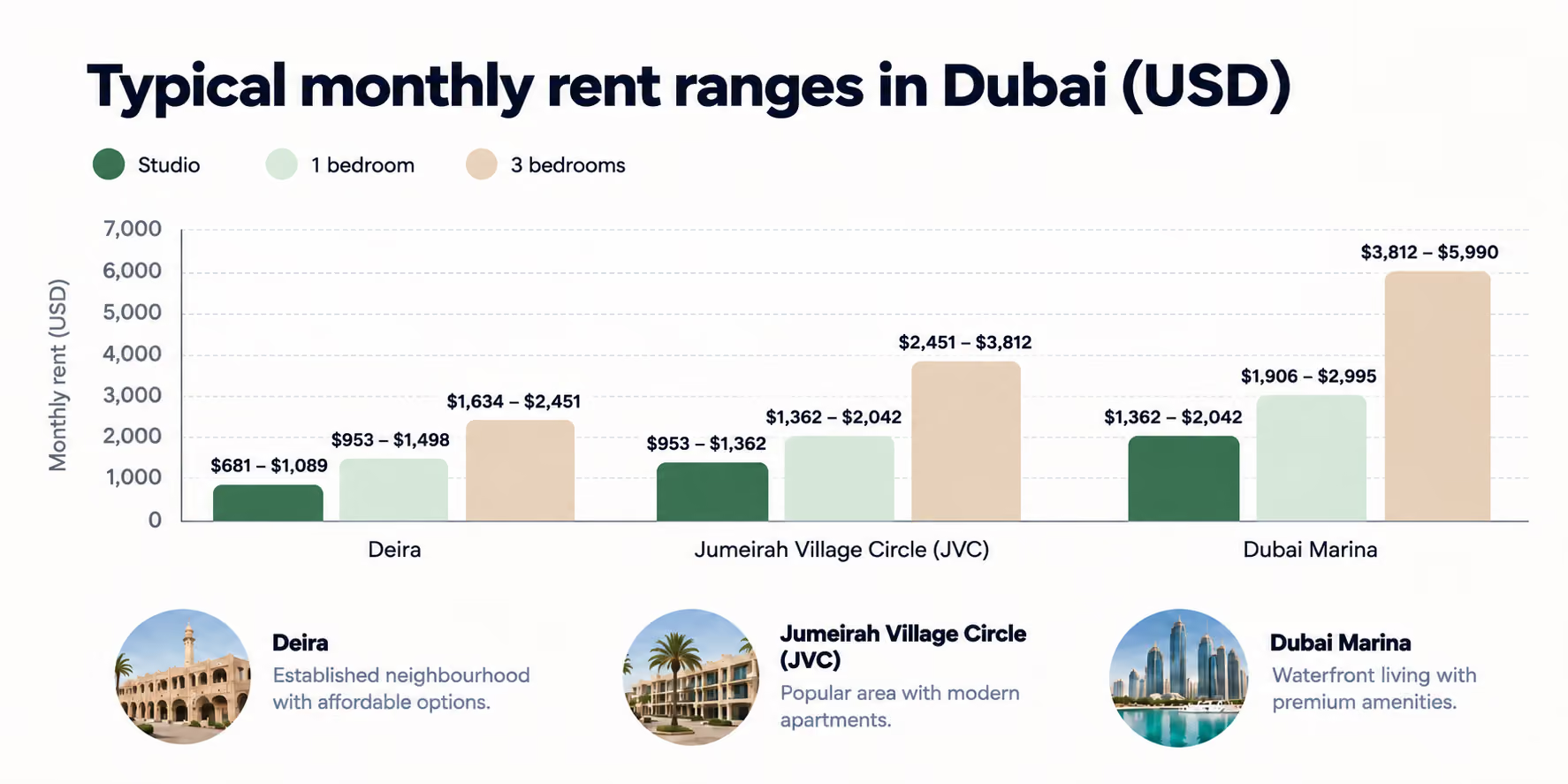
Rent is likely to take up the biggest share of your monthly budget in Dubai, and prices can vary significantly between neighbourhoods. To give you a better idea of what to expect, here's a comparison of typical monthly rents for studios, one-bedroom and three-bedroom apartments in three popular areas, with prices in USD.

Chart of typical monthly rent ranges in Dubai by property size and neighbourhood.

These are general costs for one person and may vary depending on your lifestyle and location.

Deira is one of Dubai's older, more established neighbourhoods. It offers access to shops, public transport and a variety of relatively affordable housing options. For newcomers working in central or older commercial districts, it can be a practical starting point.

Jumeirah Village Circle, commonly called JVC, attracts residents looking for newer apartments at prices that may be lower than those in premium waterfront locations. However, commuting can be less convenient without a car, depending on your building and workplace.

Dubai Marina offers a very different experience, with waterfront restaurants, modern residential towers and access to beaches and entertainment. That lifestyle comes with higher housing costs.

Renting alone or sharing accommodation

For someone moving to Dubai on a modest salary, shared accommodation can make a significant difference.

Instead of paying AED 5,000 for an entire apartment, you might rent a private room in a shared flat for considerably less. Prices depend on the neighbourhood, room size and facilities.

Before agreeing to share, check that the arrangement complies with local housing and occupancy regulations. You should also confirm exactly which bills are included in the rent.

Another detail worth knowing is that rent in Dubai is often advertised annually, even though people discuss their budgets monthly.

Landlords may request payment through one or several cheques rather than twelve equal monthly payments. That means you could need a substantial amount of money upfront, even if your monthly salary comfortably covers the annual rent.

You should also budget for a security deposit, possible agency fees, Ejari registration and utility connection charges.

For this reason, it's worth having enough savings to cover your first few months before relocating.

Bills, food and transport: everyday life expenses in Dubai

Beyond rent, your regular expenses will include electricity, water, internet, groceries and transport. These costs are easier to control than housing, but small lifestyle choices can still make a noticeable difference to your monthly budget.

For example, cooking most meals at home and using public transport could save you hundreds of dirhams compared with ordering food frequently and relying on taxis.

Utilities, internet and mobile plans

Dubai's climate makes air conditioning essential for much of the year, which means electricity bills can rise considerably during the hotter months.

Electricity and water services are provided by the Dubai Electricity and Water Authority (DEWA). The amount you pay depends on your consumption, property size and applicable housing charges.

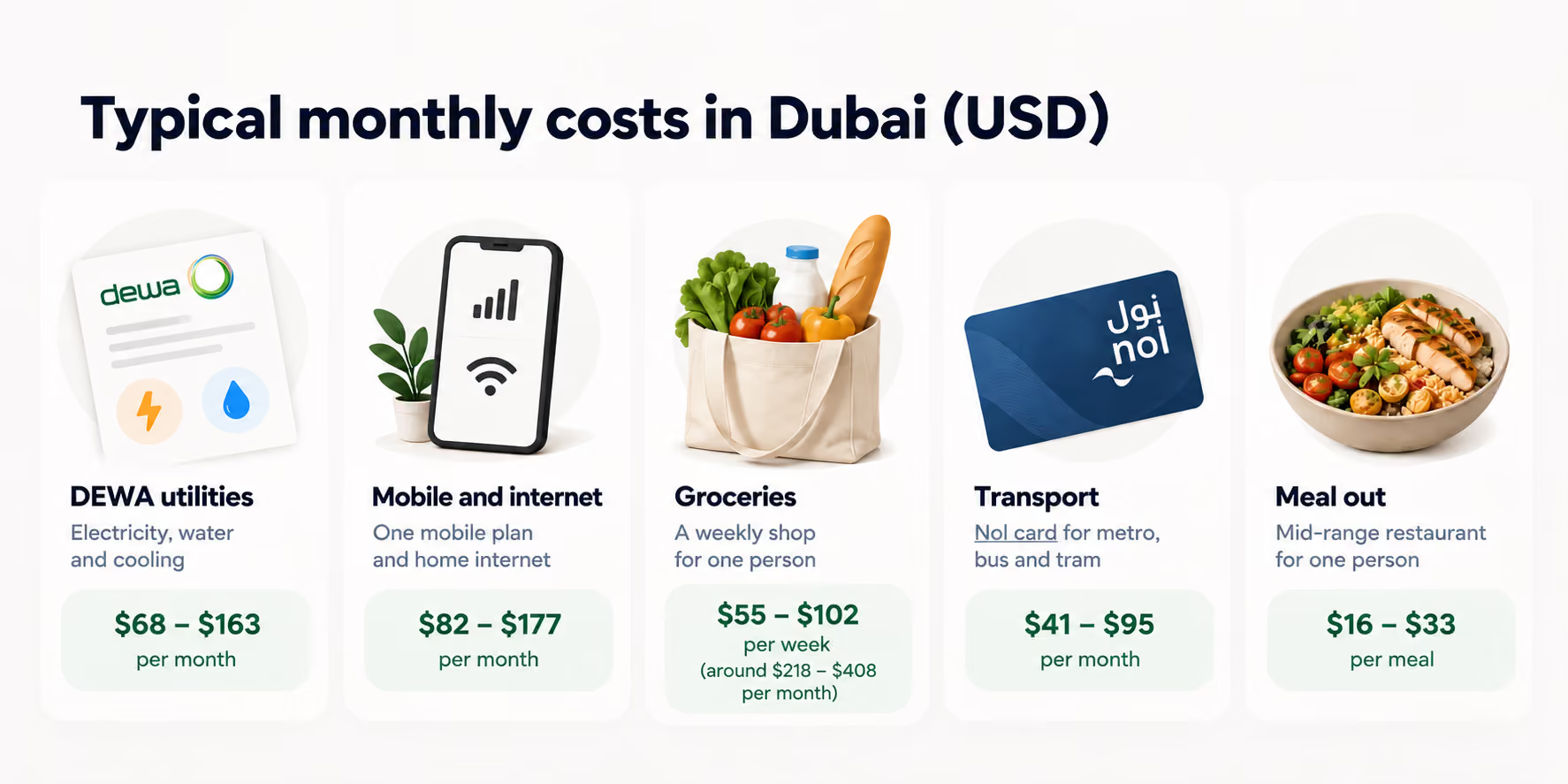
Here's a rough guide to common monthly expenses:

‍

 Illustration of typical monthly utility, grocery, transport and eating out costs in Dubai.

These are general costs for one person and may vary depending on your lifestyle and location.

When comparing apartments, ask whether the building uses a separate district cooling system. Some properties have additional cooling charges that aren't included in the regular DEWA bill.

Groceries in Dubai typically cost around $250 to $450 per month for one person, depending on shopping habits and food preferences. Supermarkets such as Carrefour and Lulu offer affordable everyday essentials, while imported products, including some Nigerian ingredients, can be more expensive. Eating out varies considerably, with simple meals costing around $10 to $15 and mid-range restaurants charging $20 to $40 per person.

Beyond food, entertainment expenses depend on your lifestyle, with cinema trips, beach clubs and other paid activities adding to your monthly budget. Dubai also has plenty of free options, including public beaches, parks and community events. Cooking at home, comparing supermarket prices and choosing affordable activities can help keep your spending under control.

Getting around Dubai

Transport is another important consideration when calculating the living cost in UAE Dubai, particularly if your workplace is far from your accommodation.

Dubai has a public transport network that includes the metro, buses and trams. You can pay for journeys using a Nol card, with fares depending on the zones travelled and ticket type.

If you use public transport for a regular commute, budgeting approximately AED 150 to AED 350 per month is a reasonable starting point, although longer journeys and additional connections may cost more.

Taxis are convenient, especially during the hotter months, but using them daily can increase your transport expenses considerably.

Owning a car introduces additional costs, including fuel, insurance, registration, parking, maintenance and possible financing payments.

For someone living alone, choosing accommodation near a metro station could reduce the need for a car. Families, particularly those living farther from public transport routes, may find driving more practical.

If you regularly make purchases in foreign currencies, it's also worth understanding how to avoid foreign transaction fees when using your card for online purchases, travel or international subscriptions.

Schooling and healthcare in Dubai

If you're moving with children, schooling and healthcare deserve their own place in your budget. These expenses can be substantial, and they aren't always covered by the benefits offered in an employment contract.

How much do schools cost in Dubai?

Dubai has a large private education sector, with schools offering British, American, Indian, International Baccalaureate and other curricula.

Fees vary significantly depending on the school, curriculum, facilities and year group.

For budgeting purposes, annual tuition might fall into the following broad ranges:

School category Estimated annual fees (USD)
Lower-cost private schools $2,723–$6,807
Mid-range international schools $6,807–$14,976
Premium international schools $14,976–$27,229+

‍

These ranges are indicative rather than official school fee quotations. Some schools charge outside these bands.

For a family with two children, school fees could become the second-largest household expense after rent.

It's also important to remember that tuition isn't the only cost. Uniforms, books, transport, school meals, extracurricular activities and registration fees may be charged separately.

Before accepting a job offer, check whether your employer provides an education allowance. Some companies offer benefits that cover part of their employees' children's school fees.

If you're comparing schools, look at the total annual cost rather than tuition alone. You should also consider the school's location, as a long daily journey could increase transport costs and affect your family's routine.

Healthcare and health insurance

Health insurance is an essential part of living in Dubai.

Employers are generally responsible for arranging mandatory health insurance for their employees in Dubai. However, the level of coverage can vary, and dependants may need separate arrangements.

Before relocating, ask your employer what the insurance policy includes, particularly regarding hospital visits, specialist consultations, prescription medicines and maternity care.

For families, it's worth checking whether your spouse and children are covered and whether there are additional premiums or out-of-pocket expenses.

Private healthcare can be expensive without suitable insurance. Even with coverage, you may still need to pay consultation fees, deductibles or co-payments.

If you take regular medication or have specific healthcare needs, check whether your prescriptions and preferred healthcare providers are included in the insurance network.

Other costs to consider before moving

Monthly budgets are useful, but they don't capture every expense involved in relocating.

You may need to pay for document attestation, medical tests, residency processing, flights and temporary accommodation. Depending on your employment arrangement, some of these costs may be covered by your employer.

Setting up your home can also require a substantial initial investment, especially if you're renting an unfurnished apartment.

For Nigerians moving to Dubai, keeping some money available in both AED and NGN can be useful during the transition. You may still have financial responsibilities in Nigeria while paying for your new life in the UAE.

It's worth building an initial relocation budget separately from your regular monthly expenses so you don't underestimate how much money you'll need before settling in.

Managing money and sending it home from Dubai

Moving to Dubai can change how you earn, spend and save money, particularly if you continue supporting family members in Nigeria or working with clients in other countries.

You might receive your salary in AED, pay international subscriptions in USD, save in another currency and send money home regularly.

Keeping track of those transactions matters because exchange rates and transfer fees can affect how much money you actually have available.

Managing money across different currencies

If you earn in AED but have expenses in USD, GBP or EUR, converting money every time you need to make an international payment can become costly.

One way to organise your finances is to separate the money you need for everyday expenses from the money you intend to save or use internationally.

For example, you could keep enough AED in your local bank account for rent, groceries and transport while managing eligible foreign-currency payments through a separate account.

Grey offers multi-currency accounts that can help eligible users hold and send multiple currencies, including USD, GBP and EUR.

This can be useful if you work with international clients, receive payments from abroad or regularly manage expenses in different currencies.

However, Grey's available services, funding methods and transfer routes depend on your country of residence and account eligibility. You should confirm which features are supported for UAE residents before relying on them.

Sending money from Dubai to Nigeria

If you're supporting family members back home, remittances may be one of your most important monthly expenses.

Imagine you earn AED 12,000 per month and plan to send the equivalent of AED 1,500 to Nigeria.

That transfer should be included in your budget alongside rent, groceries and transport. Otherwise, you might overestimate how much money you can spend or save.

When comparing international transfer services, look beyond the advertised transfer fee.

The exchange rate matters just as much. A service might charge a small upfront fee but offer a less favourable exchange rate, reducing the amount your recipient receives.

It's also worth checking the expected delivery time, supported payout methods and any transfer limits.

Grey provides information about options to send money from the UAE, including its UAE-to-Nigeria money transfer route.

Before initiating a transfer, check the current availability, applicable fees and payout options for your account.

Building a realistic budget in Dubai

Once you understand your regular expenses, you can start deciding how much of your salary to allocate to spending, savings and financial responsibilities abroad.

For example, someone earning AED 12,000 (approximately $3,300)per month might organise their budget as follows:

Expense Monthly allocation (USD)
Rent $1,089
Utilities, internet and mobile $204
Groceries $327
Transport $109
Eating out and personal expenses $218
Money sent home $408
Savings $545
Remaining buffer $368
Total $3,268

This is an illustrative budget, not a recommendation that everyone should follow the same percentages.

Someone sharing accommodation might be able to save more. A person with children, a car or higher rent could have considerably less money available after paying their bills.

The important thing is to calculate your budget using the amount you actually receive, including any applicable deductions, and account for financial commitments in both countries.

You should also leave room for unexpected expenses. Medical costs, travel, family emergencies and annual payments can affect your finances even when your regular monthly spending seems predictable.

Dubai offers plenty of opportunities to earn and build an international career, but the amount you can save depends on how your income compares with your actual living expenses.

Before accepting a job offer, compare the salary with realistic housing costs, transport options, employer benefits and any financial responsibilities you have back home.

That will give you a much clearer picture of the lifestyle you can afford.

Manage money in Dubai with Grey and organise your international finances with access to eligible multi-currency account services.

Frequently asked questions about the cost of living in Dubai

How much does it cost to live in Dubai per month?

A single person might need approximately AED 5,000 to AED 10,000 per month, including rent, while a family of four could spend AED 15,000 to AED 30,000 or more. The actual amount depends on accommodation, transport, schooling and lifestyle choices. Sharing accommodation and using public transport can help reduce expenses.

How much is rent in Dubai?

Rent varies considerably by neighbourhood and property size. A studio apartment might cost AED 2,500 to AED 7,500 per month, while a one-bedroom apartment could range from AED 3,500 to AED 11,000 in the areas covered in this guide. Larger family homes can cost considerably more. These are illustrative monthly equivalents, and actual rental prices change over time.

Is Dubai tax-free?

Dubai does not generally impose personal income tax on employment salaries, which is one reason it attracts international workers. However, that doesn't mean everything is tax-free. The UAE applies a 5% VAT to many goods and services, and other taxes or charges can apply depending on the activity. Personal tax obligations in another country may also depend on your tax residency and circumstances.

How much does a family need to live comfortably in Dubai?

A family of four might budget AED 15,000 to AED 30,000 or more per month for a reasonably comfortable lifestyle. Housing, school fees and transport are usually among the largest expenses. Families with employer-provided accommodation, education allowances or health insurance may need less income to cover their regular expenses.

Is Dubai expensive compared with Nigeria?

Dubai is generally more expensive than many Nigerian cities when comparing rent, schooling and everyday expenses in nominal terms. However, salaries, purchasing power and available benefits can also differ considerably. If you're relocating from Nigeria, compare your expected Dubai salary with your projected monthly expenses rather than looking at prices alone.

How do I send money home from Dubai?

You can send money from Dubai through banks and authorised international money transfer providers that support transfers to your destination country. Before choosing a provider, compare exchange rates, fees, delivery times and payout options. If you're sending money to Nigeria, check that the service supports your preferred recipient bank or payment method and the currency you want your recipient to receive.

Last updated:

November 7, 2026

Open a free Grey account to get startedJoin 1 million digital nomads
IF YOU ENJOYED THIS, CHECK THESE OUT

Take your career to Germany with the Opportunity Card (Chancenkarte)

•

•

2 min read

Moving to Germany might have been on your mind for a while. You've probably browsed job listings, researched cities and wondered how much you would need to save. But finding a German employer willing to hire you while you're still in Nigeria can be one of the biggest challenges.

So what if you could move to Germany first and look for a job once you're there?

The Germany Opportunity Card, also known as the Chancenkarte, is a residence permit that allows qualified non-EU nationals to live in Germany for up to one year while looking for work. Applicants can qualify through recognised professional or academic qualifications or by meeting the requirements of a points-based system.

Planning your move money? You can open a euro account with Grey to receive and hold euros, or send money from Nigeria to Germany.

In this guide, I'll explore who qualifies, how to calculate your points, how to apply from Nigeria and how much money you'll need to prepare for the move.

What is the Chancenkarte?

The Chancenkarte is a German job-seeking residence permit that allows skilled workers from outside the EU to enter Germany without having a job offer.

Introduced in June 2024 as part of Germany's Skilled Immigration Act, the Opportunity Card was designed to attract international talent and address labour shortages.

For Nigerian professionals, this means you can attend interviews in person, meet potential employers and explore career opportunities while living in Germany.

With the Opportunity Card, you can:

  • Stay in Germany for up to 12 months to search for employment.
  • Work part-time for up to 20 hours per week in total.
  • Participate in work trials for up to two weeks per employer, subject to applicable conditions.
  • Apply for an appropriate work residence permit once you secure qualifying employment.

Keep in mind that the Opportunity Card doesn't guarantee employment or permanent residency. It gives you time and permission to find a suitable job.

How does the Germany Opportunity Card points system work?

You need at least six points to qualify for the Opportunity Card through the points system. However, if your academic or professional qualifications are already fully recognised in Germany, you can apply without collecting points.

For everyone applying through the points system, factors such as professional experience, qualifications, language skills and age determine your score.

According to Germany's official Make it in Germany portal, this is how points are awarded:

Eligibility criteria Points
Partial recognition of professional qualifications in Germany 4
Qualification in a shortage occupation 1
Five years of relevant work experience within the past seven years 3
Two years of relevant work experience within the past five years 2
German language skills at B2 or above 3
German language skills at B1 2
German language skills at A2 1
English language skills at C1 or above, or native proficiency 1
Under 35 years old 2
Between 35 and 40 years old, excluding 40 1
Previous qualifying stay in Germany of at least six consecutive months within the past five years 1
Accompanying spouse or registered partner who qualifies for the Opportunity Card 1
Minimum required score 6

Points within the same age, German language, and work experience categories cannot be combined. English-language points can be earned in addition to German-language points.

Example: How to calculate your Opportunity Card points

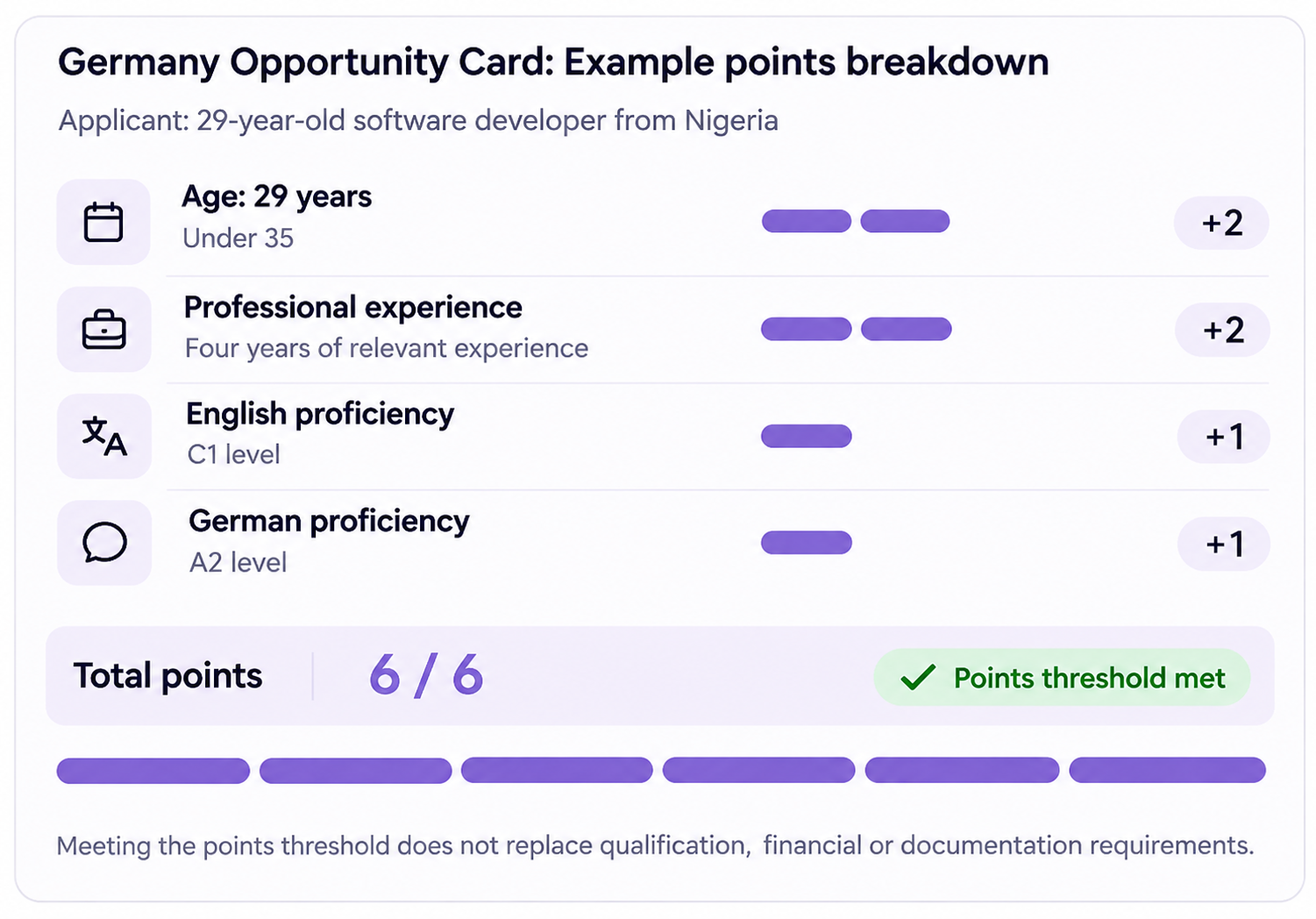
Imagine you're a 29-year-old Nigerian software developer with a university degree recognised in Nigeria, four years of relevant professional experience and certified English and German language skills.
__wf_reserved_inherit

You've reached the six-point threshold without ever having lived in Germany or received a job offer.

If you're a few points short, it is time to sign up to a few classes and work on your German language skills. Obtaining formal recognition of your qualifications could help you qualify in the future.

Who is eligible for the Germany Opportunity Card?

Nigerian citizens with suitable academic or vocational qualifications, sufficient financial resources and the relevant recognition or points requirements can apply for the Opportunity Card.

There are two routes to eligibility.

Option 1: Apply with fully recognised qualifications

If your university degree or vocational qualification is fully recognised in Germany, you can apply as a skilled worker without going through the points system.

You don't need to demonstrate a minimum language level for this route, although speaking German can significantly improve your employment prospects.

Option 2: Apply through the points system

If your qualifications are not fully recognised in Germany, you must meet the following requirements:

  • Have a university degree or a qualifying vocational qualification recognised in the country where you obtained it.
  • Have completed at least two years of training if applying with a vocational qualification.
  • Demonstrate German proficiency at A1 level or English proficiency at B2 level or higher.
  • Achieve at least six points.

Both routes require proof that you can financially support yourself during your stay.

As of 2026, the minimum financial requirement is €1,091 per month, equivalent to €13,092 for a full year if you are financing your entire stay through a blocked account.

Can Nigerians apply without speaking German?

Yes, you can qualify through the points system with sufficient English proficiency, even if you don't speak German.

However, don't assume that being Nigerian or completing your university education in English automatically exempts you from language certification. You may need an accepted certificate, such as IELTS or TOEFL.

Even if German isn't required for your application, learning some before moving can make everything from apartment hunting to job interviews much easier.

How to apply for the Germany Opportunity Card from Nigeria

You can apply for the Germany Opportunity Card online through the German Federal Foreign Office's Consular Services Portal. Here's how the process works.

Step 1: Check your eligibility

Start by finding out which of the two application routes applies to you.

Check the recognition status of your qualifications and, if necessary, calculate your points. Do this before spending money on language examinations, document preparation or application fees.

Step 2: Get your qualifications assessed

If you studied at a Nigerian university, you can check your institution and degree through Germany's Anabin database.

Depending on the results, you may need a Statement of Comparability from the Central Office for Foreign Education (ZAB).

Applicants with vocational qualifications may require a Digital Statement on Professional Qualification or other recognition documents.

Give yourself enough time for this stage, particularly if your qualifications require an individual assessment.

Step 3: Gather your documents

The German missions in Nigeria have specific documentation requirements for Opportunity Card applicants.

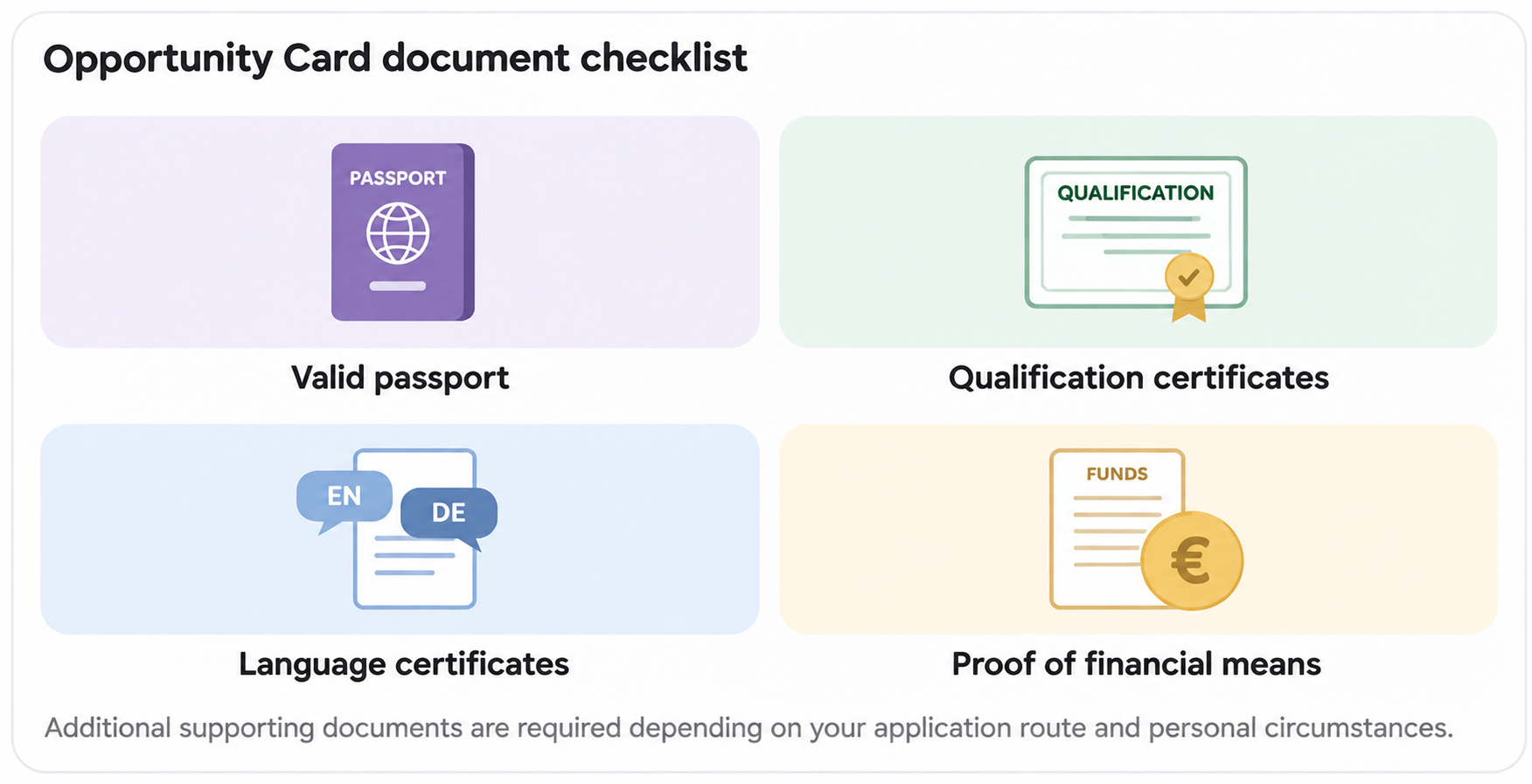
Your checklist will generally include the following:
__wf_reserved_inherit

You'll also need to prepare:

  • Completed visa application and required declarations.
  • CV outlining your education and professional experience.
  • Signed motivation letter explaining your plans in Germany.
  • Evidence of job applications or correspondence with German employers.
  • Employment references and supporting documents for any points claimed.
  • Birth certificate, academic transcripts and relevant civil records.
  • Biometric passport photographs and a prepaid courier envelope.

Check the complete Opportunity Card application checklist for Nigeria before submitting your application. You may also need to arrange appropriate health insurance before travelling.

Step 4: Arrange your proof of funds

You'll have to prepare evidence that you can cover your living expenses in Germany through a blocked account, eligible part-time employment or a formal declaration of commitment.

If you're relying on savings, remember to account for exchange rate fluctuations when converting your naira into euros.

Step 5: Submit your application online

Create an account on the Consular Services Portal, complete your application and upload the required documents.

Your application will undergo a preliminary review before you receive instructions for scheduling an in-person appointment.

Step 6: Attend your visa appointment

Bring your original documents and the required copies to your appointment at the relevant German mission.

You'll provide biometric information, attend an interview and pay the visa application fee, which is generally €75 or its equivalent in local currency.

Step 7: Wait for a decision

Processing times vary depending on appointment availability, application volumes and the complexity of your case.

It's worth starting the process several months before your intended departure, especially if you still need to get your qualifications assessed.

Avoid booking non-refundable flights or accommodation until your visa has been approved.

What happens after you arrive in Germany?

Once you arrive, you can start looking for qualified employment, work within the permitted part-time limits and apply for a different residence permit when you secure a suitable job.

But before diving into job applications, there are a few practical things to organise, including registering your address, arranging health insurance and setting up access to your money.

Finding a job in Germany

You don't have to wait until you arrive to start applying for jobs. In fact, building a list of potential employers while you're still in Nigeria could save you valuable time and money.

Platforms such as LinkedIn, StepStone, Indeed Germany and the Federal Employment Agency's job portal are useful starting points.

You can also explore German companies that sponsor work visas to identify employers familiar with international recruitment.

Consider looking beyond Berlin and Munich, too. Smaller cities may offer interesting career opportunities alongside more affordable accommodation.

Switching to a German work permit

Once you receive a qualifying job offer, you can apply for an appropriate employment residence permit through the local immigration authority.

Depending on your qualifications, occupation and salary, your options may include:

  • A work visa for qualified professionals.
  • A residence permit for professionally experienced workers.
  • The EU Blue Card route.
  • A residence permit for qualification recognition.

In certain circumstances, the Opportunity Card can also be extended for up to two additional years if you have secured qualified employment but cannot obtain another eligible employment residence permit.

Make sure you apply before your current permit expires and obtain the necessary authorisation before starting work beyond the Opportunity Card's permitted limits.

Proving funds and sending money to Germany

Moving from Nigeria to Germany involves more than paying for your visa and booking a flight. You'll need enough money to support yourself while searching for employment, particularly during those first few months.

How much money do you need for the Opportunity Card?

The financial requirement for 2026 is €1,091 for each month of your planned stay.

Length of stay Required financial proof
3 months €3,273
6 months €6,546
9 months €9,819
12 months €13,092

These figures assume you are covering the full financial requirement through savings.

Remember that the required amount is an immigration threshold, not necessarily a realistic budget for every German city. Flights, rental deposits, insurance and initial relocation expenses can add considerably to your costs.

What is a blocked account in Germany?

A blocked account, known in Germany as a Sperrkonto, is a special bank account used to demonstrate that you have sufficient funds to support yourself.

You deposit the required amount before moving to Germany. Once you arrive and activate the account, you can access your money in monthly instalments rather than withdrawing the entire balance at once.

Other accepted ways to demonstrate financial resources may include a formal declaration of commitment from an eligible sponsor or a qualifying part-time employment contract.

If your part-time earnings don't cover the monthly requirement, you may be able to cover the difference through a blocked account.

Managing your relocation money with Grey

Between saving for your move, paying for accommodation and covering everyday expenses, you'll probably find yourself converting naira into euros quite regularly.

And when you're working towards a savings target of over €13,000, exchange rate movements and transfer fees can make a noticeable difference.

With Grey, eligible users can open a euro account, hold EUR and manage international payments without having to convert their money immediately after receiving it.

You can also explore available payment options to send money to Germany for eligible expenses, such as accommodation and other relocation costs.

If you're planning to send money from Nigeria to Germany, check the exchange rate, applicable fees, transfer limits and supported payment methods before making your payment.

Keep in mind that a regular Grey euro account is not a German blocked account and does not replace the official financial proof required for your visa.

Frequently asked questions about the Germany Opportunity Card

What is the Germany Opportunity Card?

The Germany Opportunity Card, or Chancenkarte, is a residence permit that allows eligible non-EU nationals to live in Germany for up to one year while looking for qualified employment, without needing a job offer before travelling.

How many points do I need for the Germany Opportunity Card?

You need a minimum of six points if applying through the points-based route. Applicants with qualifications fully recognised in Germany can qualify without meeting the points threshold.

Who qualifies for the Germany Opportunity Card?

Qualified non-EU nationals, including Nigerians, can apply if they meet the applicable academic or vocational qualification, financial and recognition requirements. Those applying through the points system must also meet the minimum language requirement and score at least six points.

How long is the Germany Opportunity Card valid?

The initial Opportunity Card is valid for up to 12 months, depending on your circumstances and available financial resources. A further extension of up to two years may be possible under specific employment-related conditions.

Can I work in Germany with the Opportunity Card?

Yes. You can work part-time for a combined maximum of 20 hours per week and undertake qualifying work trials of up to two weeks per employer. For regular full-time employment, you'll generally need an appropriate employment residence permit.

How do I show proof of funds for the Germany Opportunity Card?

You can demonstrate financial resources through a blocked account, an accepted declaration of commitment or qualifying part-time employment income. In 2026, the monthly financial requirement is €1,091.

Preparing for a new life in Germany? From paying for accommodation to managing your relocation savings, give yourself more control over your money as you plan your next chapter.


Send money to Germany with Grey.

How to open a USD or GBP account as an international student in the UK

•

•

2 min read

Studying in the UK as an international student is an opportunity to receive a world-class education and improve your prospects. However, you could be easily distracted from your academic goals if you constantly have to worry about managing your finances. Tuition, accommodation, transportation, and daily expenses all require financial resources. It is essential to have a bank account that supports your needs in British pounds (GBP) or US dollars (USD).

Owning a USD or GBP account as an international student in the UK significantly improves your quality of life. You can easily receive money and make payments without worrying about transaction charges and conversion rates. This article provides a guide on how to open a USD or GBP account as an international student in the UK.

Also read: International student money hacks: Budgeting in multiple currencies

Why do you need a USD or GBP account as an international student?

There are reasons why a USD or GBP account will be relevant to you as an international student in the UK.

  • Daily expenses in the UK: Most of your spending will be in pounds, from rent to groceries. So, you need a GBP account.
  • Receiving international payments: If your family or sponsor sends money in US dollars, holding a USD account can help you avoid unnecessary exchange rate losses.
  • Avoiding double conversions: Having a USD or GBP account helps you avoid frequent conversions and saves money on fees.
  • Proof of funds: A lot is tied to you owning a bank account in the UK. A UK bank account is often required when you’re paying rent, mobile phone contracts, or part-time job payments.
  • Financial flexibility: Holding funds in multiple currencies helps protect you from exchange rate fluctuations, especially if your local currency has less value.
  • Building a credit history: Regular use of a UK bank account can help establish a financial footprint, potentially aiding future loan or mortgage applications.

Also read: Affordable UK universities with the lowest tuition fees for international students

How to open a USD or GBP account as an international student in the UK

International students are generally eligible to open bank accounts in the UK, but requirements vary by bank and currency. Here are the general steps and requirements:

1. Choose a bank

You can choose between a traditional bank and fintech solutions. Consider the transaction costs, requirements, and banking restrictions before choosing an option.

  • Traditional banks: Many major banks, including HSBC, Barclays, Lloyds, NatWest, and Santander, offer accounts specifically for international students. Having a traditional bank account gives you access to credit facilities, which is great for official purposes, such as providing proof of address. However, transactions may be more expensive, and the exchange rates are usually less favourable.
  • Digital banks: Consider options like Grey, which allows you to open accounts in GBP and USD from anywhere. Fintech solutions require less paperwork, transactions are swifter and cheaper. However, you might not have access to credit facilities.

2. Gather your documents

The documents you require vary from bank to bank. Review the requirements on their website or speak with their support staff. Generally, the documents required are:

  • A valid passport.
  • Valid student visa or biometric residence permit.
  • Proof of address in the UK (e.g., tenancy agreement, letter from university).
  • Proof of enrollment from your university (e.g., acceptance letter, student ID, or a letter of introduction for UK banking facilities).
  • Proof of address from your home country (in some cases).
  • A UK mobile phone number
  • Initial deposit money (may be required).
  • A bank statement from your bank account in your home country (required by some banks).

Digital banks would mostly require a valid means of identification, a photograph, and proof of address.

3. Application process

Many traditional banks allow you to start the application online. But you may need to visit a branch to complete the process and verify your identity. Fill out the application form with your personal details, UK address, home country address, course details, and expected graduation date. Opening an account may take a few days to a week.

Opening an account on digital payment solutions is usually fully online. It requires verifying your identity by uploading certain documents and your photo. Your banking details should be ready within hours.

Also read: Living abroad on a student visa: managing rent and bills in foreign currency

Multi-currency accounts with Grey

International students in the UK require a GBP account for everyday spending, and a USD account can be very useful if your funding comes in dollars. Traditional banks can provide these services, but often with strict conditions. For greater flexibility, Grey offers multicurrency accounts that enable you to open USD, EUR, and GBP accounts more easily, allowing you to receive, hold, and convert money at better rates. Transaction fees are low and transparent. You can also obtain a virtual USD debit card for managing your online purchases and subscriptions.

Also read: How Grey differs from a UK bank

Follow these simple steps to create an account:

  1. Sign up online
  1. Verify your identity (KYC)
  • Upload a valid government ID (passport recommended for international students) and a proof of address (utility bill, statement of account)
  • Provide a selfie for verification.
  • Input your personal details (name, date of birth, nationality).
  1. Create your accounts
  • Once verified, you can generate USD and GBP accounts.
  • You will receive your banking details to share with your family or sponsors for direct transfers.
  1. Manage your money
  • Receive USD or GBP directly into your account.
  • Convert between currencies at competitive rates.
  • Use your GBP balance to pay rent, bills, and other local expenses.

Get started with Grey today to simplify your finances.

‍

Your financial toolkit for moving and working abroad

•

•

2 min read

Moving to a new country is an adventure that completely changes your life and perspective.

As someone who has lived in four different countries across two continents, I can say without a doubt: if this is your dream and the opportunity finally shows up, take it. Go. Even the challenges and regrets will become some of your life’s most valuable experiences.

And while the adventure is worth every step, getting your finances in order before moving abroad can (and will) make all the difference. I learned many things the hard way, through trial, error, and a fair share of chaos. So, think of this guide as the financial toolkit I wish I had when I first left home.

Change the way you think about moving abroad and money

Living abroad is a total shift in how you earn, spend, save, and think about money. What felt normal back home might not apply in your new country. You’ll likely need to manage multiple currencies, send money home, and deal with unfamiliar banking systems while trying to budget in a language or culture you’re still adjusting to.

Many people underestimate the emotional side of money when relocating. You may earn more, but feel less secure. You might feel rich in one country and broke in the next. That’s why your first year living abroad often comes with surprises no one warns you about, from hidden costs to the anxiety of financial uncertainty.

Also read: How to manage international payments while living abroad

Before the move: Build your finance checklist

1. Research the cost of living in your new city

Budget for your new city realistically. Rent, groceries, transport, and healthcare can vary a lot from place to place.

  • Start with tools like Numbeo, Expatistan, and The Earth Awaits for city-by-city breakdowns.
  • Then just go beyond the numbers. Join Facebook expat groups, Reddit threads or local forums where people share their real-life costs, hidden expenses, and tips based on different lifestyles. These insights can be gold. I still check them to this day.
  • And don’t forget to account for exchange rate changes and leave room in your budget for unexpected surprises.

The more sources you tap into, the more accurate and stress-free your financial planning will be.

2. Open a multi-currency account as soon as you can

One of the best things I did when I started working with international clients was opening a multi-currency account. It honestly saved me so much stress.

At first, I was getting paid in USD while still living in Brazil. That’s when reality first hit me. Traditional banks just aren’t built for this setup. Receiving foreign currencies, dealing with conversion fees, waiting forever for the money to land… a complete headache.

What changed everything:

  • I did some research and found a multi-currency account on Grey that lets me receive USD directly and convert it to my local currency without any back-and-forth.
  • Later, when I lived in Spain for a while, I created an EUR account on the same app and had one less thing to worry about abroad.
  • It’s super handy for getting paid by international clients or through platforms like Upwork and Fiverr.
  • I can easily send USD, EUR, or GBP from the same app to my local account and receive it in my currency, without having to pay the high fees. And I can do it whenever the exchange rates are better.

So if you’re freelancing, working remotely, or moving abroad, trust me: set up your multi-currency account early. You don’t want to deal with payment headaches later. Grey makes it very simple, and everything’s in one app. Just verify your ID and you’re good to go.

3. Have an emergency fund ready

Relocating always comes with surprises. Medical expenses, housing deposits, or job delays happen more often than you think. A safety net of 3–6 months’ worth of expenses in a stable currency (like USD) is essential.

You may also like: Moving abroad checklist: 6 Essential considerations for a smooth transition

Once you arrive, manage your money wisely

1. Be strategic with currency conversion

Not all conversions are equal. Airport kiosks and standard banks often charge high rates. Use services that let you convert at real market rates or avoid unnecessary conversions altogether.

  • I usually hold part of my money in USD for a while, especially if the exchange rate isn’t great, and only convert it to my local currency when I really need to or the rates get better.
  • If I’m spending online on something priced in dollars, I don’t even convert. I just use a virtual USD card to pay for it.
  • It’s also made budgeting way easier: I know exactly how much I’ve earned in each currency, and I avoid losing money on unnecessary conversions.

2. Track income and expenses with the right tools

Staying on top of your money means using tools that fit your lifestyle. From apps to spreadsheets, there are plenty of ways to keep your finances organised across currencies and countries.

  • Nomads and remote workers love tools like Grey, Revolut, Wise, and Spendee to manage multiple currencies and keep track of daily spending.
  • If you prefer a more hands-on approach, set up a custom Google Sheets or Excel template with categories, exchange rates, and savings goals.
  • Look for free templates online and tweak them to fit recurring bills or specific currencies.
  • Schedule weekly or monthly check-ins to update records, review your budget, and plan for big expenses.

3. Keep a tax record from day one

Even if your income is remote or freelance, you’ll likely need to declare it in your country of residence, your country of citizenship, or both, depending on tax treaties. Keep all invoices and track your earnings in detail. Consider speaking to a cross-border accountant if you’re unsure about your obligations. Doing this saved me a lot of unnecessary stress.

Also read: The biggest financial challenges expats face in the UK, US and Canada

Keep learning from others

The first year abroad can feel like you’re constantly playing catch-up. There’s culture shock, unexpected expenses, confusing paperwork, and moments where you wonder if you’re doing it all wrong. That’s normal, and it’s part of the learning curve.

But one thing that makes a huge difference? Talking to people who’ve already done it.

Ask questions. Read blogs, listen to podcasts, or even follow creators who share their experience of living abroad. It really helps.

Quick recap: What to sort out before and after you move abroad

Before packing your bags, take a moment to get your finances in order. Knowing how money works where you’re going will save you a lot of stress later.

Here’s what we covered:

  • Open a multi-currency account so you can earn, spend, and save in global currencies like USD or EUR.
  • Look into the cost of living: rent, insurance, transport, groceries — and plan your budget accordingly.
  • Check recent exchange rates and how they’ve shifted over time. A stronger or weaker local currency can impact your budget more than you think.
  • Set aside an emergency fund in a stable currency like USD, GBP. or EUR, just in case.
  • Track your income and expenses from day one, especially if you earn in foreign currencies.
  • Keep proper tax records across countries to avoid surprises when filing taxes or applying for visas.
  • Stay connected and informed by joining communities, following expat content, and learning from others who’ve done it.

Financial flexibility is freedom

With smart travel finance planning, you can fully embrace the experience of living in a new country, from exploring a new city to saying yes to unexpected opportunities.

And it’s okay not to get it all right at once. Everyone makes mistakes, especially in their first year. But with the right tools, mindset, and planning, your financial life abroad can be just as exciting as the destination itself.

I would start by opening a free account on Grey so you can have more money flexibility to spend less time worrying about logistics and more time enjoying the experience.

More from this series:

‍

Receiving foreign income in Morocco without a domiciliary account

•

•

2 min read

Is it possible to receive foreign income in Morocco without a domiciliary account? The simple answer is yes. However, it is not always straightforward, especially with the wrong payment services.

Domiciliary (foreign currency) accounts were once the standard for Moroccans earning in USD, EUR, or GBP, but they are becoming less popular. Opening one often involves extensive paperwork, multiple bank visits, minimum balance requirements, and strict compliance with local regulations. Beyond these,  SWIFT fees, intermediary charges, and poor conversion rates when converting to MAD make them too expensive for the average person.

The good thing is that you don’t need a traditional domiciliary account at banks such as Attijariwafa Bank or Banque Centrale Populaire to manage international payments efficiently. Freelancers, remote workers, and expats earning from abroad can not find alternatives that suit their needs.

This article explains how Moroccans can receive foreign income without a domiciliary account and describes the pros and cons of each option.

Why do many Moroccans avoid domiciliary accounts?

A domiciliary account allows you to receive foreign currencies without immediate conversion to MAD. On paper, this sounds ideal. In practice, these accounts come with significant problems. A domiciliary (or foreign currency) account allows you to receive USD, EUR, or GBP without automatically converting to MAD. However, these accounts have considerable limitations, including:

  • You have to visit the banking hall.
  • It might require cumbersome paperwork.
  • It takes a while to open an account.
  • SWIFT fees and other bank charges can eat into earnings.
  • There is limited flexibility when trying to make online payments and subscriptions.
  • Transactions may take a few days to complete.

How Moroccans receive foreign income without a domiciliary account

There are three main alternatives: online payment platforms, fintech multi-currency accounts, and cash pickup services. Each serves a different purpose, depending on how often you get paid and how much control you want over your money.

LDMAG1

PayPal

PayPal is one of the most widely recognised international payment platforms. Many foreign clients already trust and use PayPal, which makes it easy to request payments without lengthy explanations or setup.

PayPal allows Moroccans to receive payments in foreign currency and withdraw funds to a local bank account or card. Transactions are usually instant, and the platform is easy to use. However, PayPal is designed more for convenience than cost efficiency. Withdrawal requires automatic conversion to MAD, often at exchange rates that include hidden mark-ups. Fees can be substantial, especially for regular income, and users have little control over when or how conversion happens. There are also frequent reports of account restrictions and suspensions that can interrupt your cash flow or lead to losses.

PayPal works best for occasional payments or short-term use, but it becomes expensive and restrictive for consistent freelance or remote income.

Fintech platforms and multi-currency accounts

This is easily a top recommendation for managing international payments in Morocco. Most of these platforms are designed to address the challenges posed by the rigid traditional domiciliary account payment system. They let you complete cross-border transactions like it is local payments and convert to MAD whenever you like.

Also read: Top digital nomad hotspots in Morocco for remote workers

Grey

Grey offers Moroccans USD, EUR, and GBP account details that you can share directly with international clients or employers.  You can hold your income in foreign currency, convert it to MAD when exchange rates are favourable, and withdraw it to your Moroccan bank account.

Grey also supports automated invoicing, integrates with freelance platforms, and provides virtual cards for paying subscriptions, tools, and services directly in foreign currency. This setup gives freelancers and remote workers far more control over exchange timing, fees, and spending, making it well-suited for regular international income.

Also read: How freelancers in Morocco can switch from traditional banks to Grey

Payoneer

Payoneer is widely used by freelancers working with global marketplaces and companies. It offers foreign accounts and allows withdrawals to Moroccan bank accounts. Payoneer is reliable and well-integrated with major freelance platforms, but its fee structure can be cumbersome. Currency conversion and withdrawal fees can be relatively high, and customer support is often slow. It remains a practical option for platform-based freelancers, though it offers less flexibility than newer fintech solutions.

Wise

Wise is known for transparent pricing and mid-market exchange rates. While it offers strong multi-currency functionality globally, features for Moroccan residents are limited, especially regarding local withdrawals and employer payments. Wise is effective for individuals with international banking needs, but may not be the most seamless solution for Moroccan-based freelancers who rely on frequent payouts.

Also read: Freelancing legally in Morocco: licences, taxes and foreign income rules

Cash pickup services

Cash pickup services are another way to receive foreign income without a domiciliary account, but you should treat them more like a fallback than as your main payment solution.

MoneyGram and Western Union allow senders abroad to transfer money for cash pickup in Morocco without a bank account. These services provide fast access to cash and nationwide availability. However, they come with high fees, unfavourable exchange rates, and low transaction limits. They are also not recommended for freelancers and remote workers with regular foreign income, invoicing, and financial  planning.

Managing international payments with Grey

You don’t need a domiciliary account to receive foreign income in Morocco. Freelancers, remote workers, and expats who regularly earn in USD, EUR, or GBP need an alternative that suits their needs. Grey offers you control over exchange rates, lower fees, faster payment processing, and the flexibility required to manage a global income. With the newly improved Grey cards, you now manage your payments globally by creating multiple cards, spend directly from your balance without top ups, and link with Apple Pay and Google Pay. Grey bypasses the paperwork and restrictions of domiciliary accounts, allowing you maximise you income without hassles.

Sign up for a Grey account by downloading the app to manage your foreign income with ease.

‍

How expats are saving hours each week with Grey

•

•

2 min read

Managing international transactions as an expat in a foreign country can be tricky. Many expats end up wasting time in banking halls, on support call lines, or chasing delayed payments. This can impact your productivity and consume your work hours.

Grey helps expats manage international payments more easily with multi-currency accounts, simple sign-up, and quick transfers. In this article, you’ll see how expats are saving hours each week by using Grey.

Also read: Managing money across countries as an expat: A complete guide

Multicurrency accounts

Expats often need to manage different currencies. Traditional banks usually require you to open a separate account for each one, sometimes at different banks, which can be time-consuming. With Grey, you can open multi-currency accounts in EUR, GBP, and USD in just a few minutes. This means you can handle all your main currencies in one place and save time.

Easy onboarding

Opening an account with Grey is simple and secure. All you need is a valid ID, proof of address, and a photo. You can sign up online without having to visit a bank or fill out lots of paperwork.

Fast transfers

With Grey, international transfers usually take just minutes or a few hours. This makes it a great option if you need to send money quickly. Traditional banks can take days to process cross-border payments, which can cause delays.

Accessible customer support

With Grey, you can reach customer support anytime you need help. This means you don’t have to wait in long lines or spend hours on hold to get your questions answered.

Swift currency conversion

Grey offers instant currency conversion at competitive exchange rates within the app. This is quicker and more accessible than traditional banks and exchange services.

Also read: Expat banking 101: Opening an account before relocation

Managing international transactions with Grey

Time matters for expats. Whether you’re working, travelling, or staying in touch with family, saving time on banking can make a real difference. Grey helps you avoid delays with seamless onboarding processes, multi-currency accounts, low-cost transactions, and competitive exchange rates. By simplifying cross-border payments, Grey is helping expats focus on what really matters.

Get started on Grey today for seamless international transactions.

‍

How Grey reduces stress for international students managing money

•

•

2 min read

For most international students, money from home is their lifeline. But getting it isn’t always simple. Parents send funds through banks, only for transfers to get stuck in bottlenecks, be delayed for days, or arrive in another currency that costs even more to convert. All of this adds unnecessary stress on top of tuition, rent, and everyday expenses. That’s where digital cross-border solutions like Grey come in; fast, reliable, and built for students. This article shows how Grey makes managing money simpler and stress-free.

Read also: Best ways for parents to send money to students overseas

Why managing finances abroad is stressful for international students

1. Money delays

Many international students depend on parents for tuition and living expenses. But bank transfers can take days, or even weeks, to arrive. Imagine waiting to pay rent while constantly refreshing your banking app. That uncertainty creates anxiety, making it hard to focus on classes or daily life.

2. Currency conversion struggles

Parents may send money in their local currency, but students need dollars, pounds, or euros. Each conversion chips away at the amount through fees or bad rates. A student expecting $1,000 might end up with far less. That constant loss makes budgeting stressful and unpredictable.

3. Hidden bank charges

Traditional banks often add surprise deductions, processing fees, international transfer charges, or compliance costs. Students get less than expected and scramble to cover expenses. For example, a $50 bank charge might mean skipping groceries or delaying textbook purchases, all because of a system they can’t control.

4. Managing daily expenses

From paying for transport to splitting bills with friends, expenses pile up quickly. Without quick, reliable access to funds, students may borrow from classmates or use credit cards, adding more stress. The pressure of simply keeping up with daily costs weighs heavily on their mental well-being.

Read also: Top mistakes international students make with money transfers

How Grey simplifies international students’ money transfers

1. Fast access to funds

Late money transfers often leave students anxious about paying rent or buying food. With Grey, money from home arrives almost instantly. That speed reduces the stress of waiting and guessing, so students can breathe easy knowing their essentials are covered without delays.

2. Better currency conversion

Watching your support shrink because of poor exchange rates is frustrating and stressful. Grey’s fair rates ensure students keep more of their money when converting. That means less worry about “losing value” and more freedom to focus on school instead of calculating every dollar.

3. Lower fees, more savings

Hidden bank charges quietly eat into funds, leaving students stressed about making ends meet. Grey keeps fees transparent and minimal. Their families see the exact amount students will receive before sending money, which reduces financial pressure and helps them plan better without the constant worry of shortfalls.

4. Stress-free money management

Complicated banking processes can pile on stress when students are already adapting to life abroad. Grey offers an easy, digital platform to manage transfers and currencies. Removing those hurdles frees students to focus on classes, friendships, and opportunities instead of financial headaches.

Step-by-step guide: How international students can use Grey

1. Sign up in minutes

Download the Grey app or visit the website. Enter your name, email, and set a password. It’s quick and easy.

2. Select your country of residence

Tell Grey where you live. This ensures your account is tailored to local regulations and makes payouts smooth.

3. Verify your identity

Upload a valid government-issued ID and a clear selfie. Verification protects your money and unlocks full access.

4. Get your virtual foreign accounts

Instantly receive USD, GBP, and EUR accounts, perfect for parents, sponsors, or clients to send you money directly.

5. Receive, convert, and use seamlessly

Funds arrive faster than traditional banks. Convert to your local currency at fair rates and withdraw or spend stress-free

Stress-free payments for students abroad

Managing money as an international student doesn’t have to feel like a constant struggle. With Grey, you can finally leave behind the long waits, banking bottlenecks, and hidden fees that make life stressful. Whether it’s tuition, rent, or a quick allowance from home, Grey ensures your money arrives fast, in the right currency, and with no headaches.

Create your Grey account today or download the app and experience the peace of mind that comes with seamless cross-border payments.

‍

Arrow (up)

Back to top