STAY UP TO DATE
The Grey Blog


FEATURED ARTICLES
Virtual cards in Egypt for online payments
Grey, EverTry, Card-Y, Fyatu, and AstroPay: Here is how virtual cards work for online payments in Egypt and your top options.

Adeolu Titus Adekunle
•
6 min read
It is one thing to have the funds for online payments; it is another thing to have the means to complete the payment without getting frustrated. Managing international payments in Egypt can be quite a hassle. If you’ve tried paying for an international subscription, a work tool, online shopping, or an online course from Egypt, perhaps you can relate to the struggle. Local Egyptian bank cards are often restricted from international transactions, offer poor exchange rates, or aren’t supported by global platforms.
Virtual cards exist mostly to solve these problems, and they have become one of the most efficient options for anyone who shops online, pays for subscriptions, or needs a reliable way to spend in foreign currency without the limitations of a standard local bank card.
This article explains how virtual cards work, who they are for, and the main options available to people in Egypt right now.
What is a virtual card, and how does it work?
A virtual card is a digital payment card that works just like a traditional debit or credit card, except it exists only electronically. Instead of receiving a plastic card, you get the card details instantly on your phone or computer, including the card number, expiration date, and CVV security code.
Because virtual cards are issued digitally, they are typically available within minutes, unlike physical cards that must be printed and delivered.
Most virtual cards operate as prepaid or debit cards, meaning you spend funds you already have. In many cases, the card is connected to a multi-currency account, so payments are deducted directly from your balance in currencies such as USD, GBP, or EUR. This eliminates the need to manually top up the card before each purchase.
For example, Grey virtual cards are linked directly to your foreign currency balance, allowing you to pay online or in apps without transferring funds to the card first.
In practice, using a virtual card is no different from using a physical one. You simply enter the card details at checkout when making online payments, subscriptions, or international purchases. Many virtual cards can also be added to Apple Pay or Google Pay, enabling secure contactless payments with your phone wherever mobile wallets are supported.
Also read: Managing USD income as a remote worker in Egypt
What to look for when choosing
Not all virtual cards work the same way. The best option for you will depend on how you plan to use it, which currencies you deal with most often, and how frequently you make international payments. Before choosing a provider, it’s worth looking closely at a few key factors.
Currency support. Many virtual cards are designed primarily for USD payments, but international platforms often charge in other currencies such as EUR or GBP. If you regularly use services based in Europe or the UK, a card that supports multiple currencies can help you avoid additional conversion fees. Choosing a provider with a multi-currency account allows you to hold and spend different currencies more efficiently.
Funding options. Different platforms allow you to add funds in different ways. Some accept local bank transfers, others allow crypto deposits such as USDT, and some link directly to a multi-currency account balance, like Grey. Before signing up, check that the funding method available actually works for your situation and location.
Platform compatibility. Not every virtual card works equally well across all international platforms. Some services, particularly advertising platforms or large marketplaces, may reject certain cards depending on the issuing network or region. If you plan to use your card for a specific purpose, such as paying for Google Ads or cloud hosting, it’s worth confirming that the card is widely accepted on those platforms.
Fees and exchange rates. Virtual card costs can vary significantly between providers. Some charge a card creation fee, others add transaction fees, and most apply a small markup on currency conversions. A card that appears free at first glance may become more expensive if the exchange rate spread is high. Always look at the total cost of using the card, not just the upfront fee.
Security and regulation. Security should always be a priority when choosing a financial platform. Look for providers that follow proper identity verification processes and operate with licensed financial partners. Features such as two-factor authentication, transaction alerts, spending limits, and the ability to instantly freeze your card add an important layer of protection.
Contactless payments. Some virtual cards can be added to mobile wallets like Apple Pay or Google Pay, allowing you to make contactless payments with your phone. This can be particularly useful when travelling or making in-store purchases abroad. If this feature matters to you, make sure the card supports mobile wallet integration in your region.
Taking a few minutes to compare these factors can help you choose a virtual card that fits your spending habits and avoids unnecessary fees or payment issues later.
The top virtual cards in Egypt for online payments
While cards issued by local banks work well for domestic spending, they are not always reliable for international payments. Here is a list of the top virtual cards in Egypt for online payments.
Grey
Grey offers virtual cards linked to a multi-currency account that supports USD, EUR, and GBP. You can create multiple cards for various uses to properly plan your finances. One card can be for online shopping while another could be for subscriptions and or online course. Grey cards are globally accepted and works with the full range of international platforms
You can receive international payments into your Grey USD, GBP, or EUR account or fund your account in EGP and convert to USD to spend on your cards directly.
Fees: Grey virtual USD cards cost a one-time creation fee of $4, plus a minimum of $1 to fund the card, totalling $5 to get started. There are no monthly maintenance fees.
EverTry
EverTry offers a solution for international payment restrictions in Egypt through their virtual dollar card platform. It allows Egyptian users to pay for global services that often decline local bank cards. It supports funding in local currency and USDT, making it accessible to users who are comfortable with crypto. The card works across a wide range of international platforms, including Netflix, Spotify, AWS, DigitalOcean, Namecheap, Facebook Ads, and Google Ads.
Fees: Card creation typically costs $2.5, with no monthly maintenance fees.
Card-Y
Card-Y is a fintech platform that offers multi-currency global accounts with a linked virtual card, designed for Egyptian freelancers and remote workers. It offers USD and EUR account details for receiving international payments, with a free virtual card included that draws from those account balances. It also issues local Egyptian bank cards to subscribers.
Fees: Card-Y offers virtual Mastercard issuance for a $20 USD fee, which is valid for one year and does not add to the card balance. The service features a $1 monthly maintenance fee, a 1% USD transaction fee ($1 min/$5 max), and a 1.5% foreign currency conversion fee.
Fyatu
Fyatu provides instant virtual Mastercards with support for multiple currencies, aimed at users who need to make global payments and manage international subscriptions. Onboarding is digital, and card issuance is immediate. It is a straightforward option for users whose primary need is an international spending card rather than a full suite of banking features.
Fees: Fyatu virtual card costs include a 1.5% fee for card usage (for either withdrawal or payments), with card replacement fees of $5 for World cards and $10 for Platinum cards. A $1.00 fee applies to declined transactions. Funding methods vary, with fees such as 3% for MTN MoMo and various percentages for online wallets like PayPal (3.5% + $0.30).
AstroPay
AstroPay is a globally recognised digital wallet and virtual card platform, available in over 150 countries, including Egypt. It has been around since 2009 and has a particularly strong footprint in emerging markets across Africa, Latin America, and Asia. The platform supports more than 50 currencies, issues virtual prepaid cards instantly, and does not require a traditional bank account to sign up.
For Egyptian users, AstroPay works as a prepaid spending tool. You load funds onto your wallet using a local payment method, then use the virtual card for international purchases on platforms that accept Visa or Mastercard. Card details are issued instantly through the app, and the platform supports one-time or multi-use cards depending on the denomination.
However, bank withdrawals from AstroPay can attract fees of up to 6% depending on the institution. There is a margin of 1% to 3% on exchange rate.
Fees: No card purchase or maintenance fee. No annual fee. Transaction fees of 2–5% depending on the payment method used. FX markup of approximately 1–3% on non-native currency transactions. Withdrawals to a bank account: up to 6%.
Comparison of the top virtual cards in Egypt
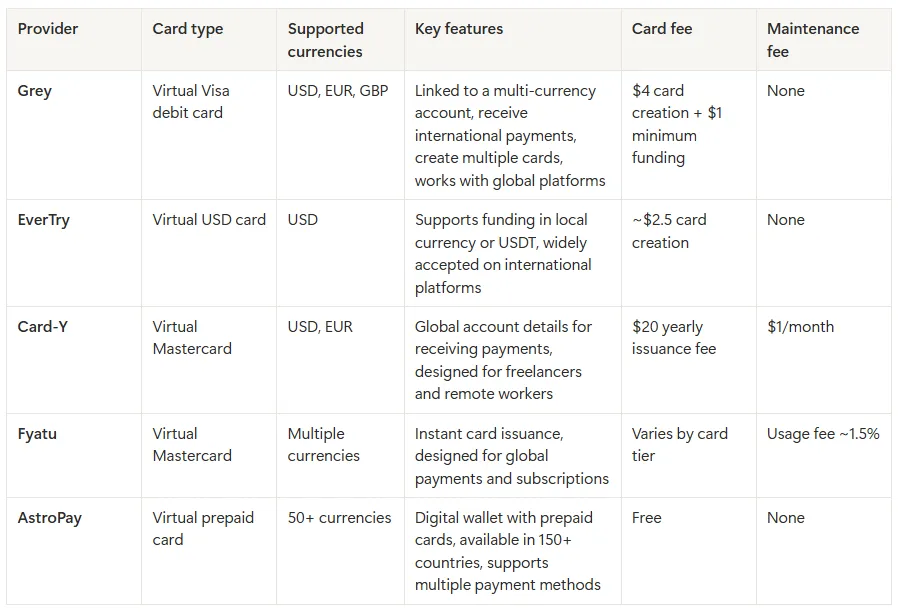
Before exploring each option in detail, the table below summarises some of the key differences between the most popular virtual cards available to users in Egypt, including supported currencies, card type, and typical fees.
Quick recommendations
If you’re not sure which virtual card to choose, here’s a quick guide based on common use cases in Egypt.
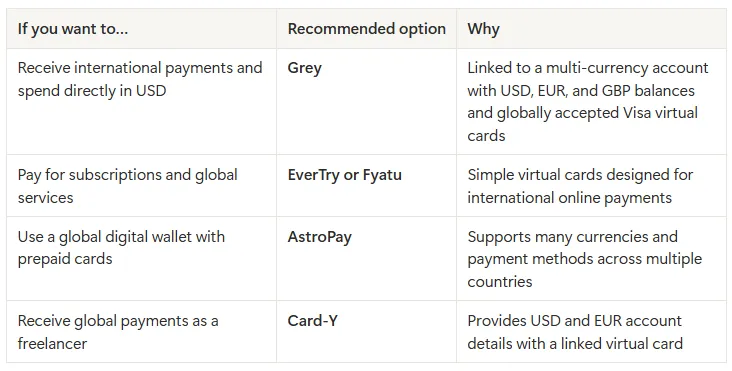
For most freelancers, remote workers, and online entrepreneurs in Egypt, a virtual card linked to a multi-currency account is often the most practical option. It allows you to receive money from abroad, hold foreign currencies, and pay for global services without converting funds every time you make a transaction.
Also read: Grey card vs other virtual cards: What you should know
Make international payments with Grey
The advent of virtual cards has brought significant flexibility to managing international payments. Grey gives Egyptians a virtual card linked to your multi-currency account. This allows you to receive international payments and spend internationally from the same platform. Whether you are paying for software subscriptions, running digital ads, shopping on international platforms, or managing online tools for your work, Grey's virtual card is accepted globally and straightforward to set up.
Ready to get your virtual card? Sign up on Grey and download the app to create your virtual USD card in minutes.
ALL ARTICLES
eSIM vs Google Fit: Which is better for international travel?
Google Fi eSIM or a prepaid travel eSIM? Compare cost, data speeds abroad, coverage and keeping your US number to see which suits your trip. Choose yours.
Olayoyin Olorunmota
•
October 10, 2026
•
6 min read
Before comparing these two options, I need to clarify something. Google Fi and a travel eSIM are not different technologies. Google Fi is a US mobile carrier plan that can run on an eSIM. A travel eSIM is a prepaid data plan from a different provider, also delivered as an eSIM.
The choice you have to make is between staying on your existing Google Fi plan while travelling internationally, versus buying a separate prepaid travel eSIM for the trip. That distinction shapes everything about the comparison: cost, coverage, your US phone number, and whether you need to think about your phone plan at all while you’re abroad.
What is the difference between Google Fi and a travel eSIM?
Google Fi is a US mobile carrier that roams internationally on partner networks in over 200 countries, keeping your US number active the entire time. A travel eSIM, on the other hand, is a prepaid, data-only plan purchased specifically for travel that gives you a local or regional data connection without affecting your existing carrier plan.
Google Fi can itself be delivered as an eSIM. If your phone supports eSIM and you activate Fi that way, you’re using an eSIM for your primary carrier plan. A travel eSIM would then be a second eSIM profile loaded alongside that primary eSIM, which is possible on many modern smartphones that support dual eSIM.
So while Google Fi roaming keeps your US number for calls and texts, charges within your existing monthly plan, and requires no setup before you travel. A travel eSIM gives you a separate data connection, usually at a lower per-gigabyte cost for the trip, but doesn’t carry your US number for incoming calls.
How Google Fi works abroad
Google Fi’s Unlimited Premium and Flexible plans include international data in over 200 destinations, with 5G speeds available in 110+ countries on compatible phones, tablets, laptops, and other devices.
Here’s how the plans break down for international use.
Flexible plan ($20/month base + $10/GB)
International data is included in 200+ destinations at the same $10/GB rate as domestic data. Bill Protection caps your total data charges at $60 per month, regardless of usage, so heavy data months cost at most $80 ($20 base + $60 data cap). This makes the Flexible plan surprisingly competitive for moderate users who don’t stream heavily.
Unlimited Standard (from $35/month)
Unlimited Standard supports data, calls and texts within the US, Canada and Mexico. International data beyond Canada and Mexico is not included.
Unlimited Premium ($65/month for one line)
The Unlimited Premium plan caps high-speed international roaming data at 50 GB per billing cycle, after which speeds reduce to 256 Kbps. You can pay a flat rate of $10 per gigabyte to restore unthrottled speeds before the billing cycle resets.
Unlimited Essentials
On Unlimited Essentials, international data coverage is not available. If you’re on this plan and travelling outside North America, you’ll need to either upgrade or buy a travel eSIM for data.
Extended international use
One important limitation applies to all Fi plans: extended international travel can trigger data suspension. Google Fi is designed as a US plan with international roaming, not a plan for people living abroad. Using it as your primary data source for more than 60 days continuously can result in a review of your account. This makes it excellent for trips but unsuitable as a long-term solution for digital nomads or expats.
Cost comparison for a one-week and one-month trip
The cost comparison depends on how much data you use, which plan you’re on, and where you’re travelling.
For travel eSIM pricing, verified current rates show that regional data eSIMs for popular destinations typically cost $5 to $15 for 1 GB (seven days), $15 to $30 for 5 GB (30 days), and $25 to $50 for 10 GB (30 days), depending on the region. Europe and Southeast Asia tend to be cheaper than Africa, the Middle East, and some parts of Latin America.
Prices are indicative ranges based on current market pricing. Exact cost depends on provider, destination, and data package chosen.
For a one-week trip using moderate data, a travel eSIM is often cheaper than Google Fi Flexible. For a one-month trip using heavy data, Unlimited Premium at $65 flat becomes competitive.
The comparison also shifts depending on whether you use a Grey virtual card for spending abroad: paying for your travel eSIM in USD from a Grey balance avoids conversion fees on the purchase if you’re buying internationally.
Is Google Fi better than a travel eSIM?
It depends on your trip type. There’s no universal answer, but the decision framework is clear.
When Google Fi is the better choice:
It’s a great option if you want zero setup and is ideal for business travellers and people who change plans at the last minute. This frictionless experience is worth the price premium.
A travel eSIM typically covers one country or region. So, for example, if you’re crossing from France to Morocco to Portugal in two weeks, it is much simpler with Google Fi than with multiple travel eSIMs.
If you need your US number to be active for incoming calls, two-factor authentication, or banking apps that send SMS codes to your US number, then Google Fi is the better option. Travel eSIMs are data-only and won’t receive your US calls or texts.
Google Fi is also a better choice if you’re on Unlimited Premium and using enough data to justify the plan cost. At $65/month for 50 GB of international data, it competes well with travel eSIMs for heavy users.
When a travel eSIM is the better choice:
I’ll recommend a travel eSIM if you’re going to a single destination for a specific trip. A 10-day trip to Japan on a 5 GB travel eSIM costs $15-$25. The same trip on Google Fi Flexible costs $20 + data, and on Unlimited Premium, you’re paying $65 for a monthly plan when you only need it for 10 days.
If you’re on Unlimited Standard or Unlimited Essentials and don’t want to upgrade your whole plan for one trip, a travel eSIM can work. It lets you add international data for the trip without changing your underlying Fi plan.
Budget-conscious heavy data users will also prefer a travel eSIM. A 20 GB regional eSIM for Southeast Asia costs less than $40 from most providers. On Google Fi Flexible, 20 GB abroad costs $200 before Bill Protection kicks in.
Another scenario is when you’re travelling to a country where Fi’s partner network is weak. In some destinations, the local network Fi roam on is slower than what a local travel eSIM would give you, because travel eSIM providers can partner with multiple networks in each country rather than being tied to a single roaming agreement.
For trips that span multiple countries and involve heavy data use, buying a travel eSIM on Grey gives you a straightforward data option without committing to a full monthly plan upgrade.
How to use both: keep your number and add local data
The most practical setup for frequent international travellers is to use Google Fi and a travel eSIM simultaneously.
Most modern smartphones support dual eSIM, which means two eSIM profiles can be active simultaneously. You keep your Google Fi eSIM active for US calls, texts, and two-factor authentication codes. You activate a travel eSIM for data, which gives you faster or cheaper local connectivity without changing your primary number.
In practice, data is routed through the travel eSIM, and Calls and SMS default to your Fi number. When someone calls your US number, it rings on your phone even though your data is running on a separate line. Banking apps that send SMS codes to your US number continue to work normally.
This dual approach costs slightly more than either option alone, but solves the two main problems simultaneously: you don’t lose your number, and you don’t overpay for data in countries where local connectivity is cheap.
To set this up, you install the travel eSIM before departing (most scan a QR code in under two minutes), then in your phone’s settings assign data to the travel eSIM and calls to Fi. For detailed instructions on managing multiple eSIM profiles on an iPhone, see our guide on how to transfer an eSIM between iPhones.
Frequently asked questions about eSIM and Google Fit
Does Google Fi work internationally?
Yes. The Unlimited Premium and Flexible plans include international data in over 200 destinations. Unlimited Standard covers Canada and Mexico only. Unlimited Essentials has no international data. On Flexible, international data costs $10/GB, the same as domestic. On Unlimited Premium, up to 50 GB of high-speed international data is included, with speeds dropping to 256 Kbps after that.
Is Google Fi an eSIM?
Google Fi can be activated as an eSIM on compatible devices, but it doesn’t have to be. You can also use Google Fi with a physical SIM card. Whether Fi runs as an eSIM or a physical SIM doesn’t affect its international functionality. The relevant question for most travellers is whether to use Fi’s built-in international roaming or add a separate travel eSIM for data.
Is a travel eSIM cheaper than Google Fi?
For short trips with moderate to heavy data use, a travel eSIM is usually cheaper than Google Fi’s per-gigabyte rate on the Flexible plan. A 5 GB regional eSIM for Europe or Southeast Asia typically costs $15 to $35, while 5 GB on Google Fi Flexible costs $50 in data plus the $20 base fee. Google Fi Unlimited Premium at $65/month is more competitive for longer trips with heavy data use, as it includes 50 GB of international data.
Can I use Google Fi and a travel eSIM together?
Yes, on phones that support dual eSIM. You keep your Google Fi eSIM active for calls, texts, and your US number. You activate a travel eSIM for data. In your phone settings, you assign which line handles calls and which handles data. This gives you the best of both options: a US number that stays active for incoming calls and authentication codes, plus cheaper local data from the travel eSIM.
Does Google Fi slow data abroad?
The Unlimited Premium plan caps high-speed international roaming data at 50 GB per billing cycle, after which speeds reduce to 256 Kbps. On the Flexible plan, data continues at full speed until the Bill Protection cap is reached. In some countries, the speed you experience depends on which local network Fi is roaming on, which varies by destination and is outside Fi’s direct control. In markets where Fi’s partner network is congested or slower than alternatives, a travel eSIM on a stronger local network can be meaningfully faster.
Which is better for a long trip?
For trips longer than 30 days, Google Fi Unlimited Premium at $65/month offers 50 GB of included international data, which suits most travellers who aren’t constantly streaming video. However, Google Fi’s extended international use policy means it’s not suitable as a permanent international solution: sustained use as a primary international data source for 60+ days can trigger account review. For long-term nomads or expats, a travel eSIM renewed regularly, or a local SIM in each country, is more practical than relying on Fi as a permanent international data source.

29 countries that speak French as an official language
Which countries speak French as an official language? Here is the full list by region, from Europe to Africa and the Americas. Explore the list now.
Tunde Aladeloba
•
August 20, 2026
•
6 min read
Across four continents, French connects people through government, education, business, diplomacy and everyday life. From the streets of Paris to the markets of Dakar and Abidjan, it takes on different accents and cultural influences while remaining a shared official language.
Today, French is an official language in 29 countries, making it one of the world's most geographically widespread official languages. Africa accounts for the largest share, with countries such as Senegal, Côte d’Ivoire, the Democratic Republic of the Congo, Cameroon and Gabon among the nations where French plays an important institutional role.
The language also reaches well beyond Africa. France, Belgium, Switzerland, Luxembourg and Monaco use French officially in Europe, while countries and territories in the Americas, Caribbean and Pacific add to its global footprint. For travellers, students and professionals, understanding where French is spoken can open doors to very different cultures, destinations and opportunities.
Also read: Spanish words to know before you travel
How many countries speak French officially?
French is the sole official language in 13 countries, including France, Senegal, Côte d’Ivoire, Benin, Togo, Burkina Faso and the Democratic Republic of the Congo.
The number becomes 29 countries when you include nations where French shares official status with one or more other languages. This wider figure represents the countries where French has constitutional or legal official-language status. Beyond these countries, French is also widely spoken across the broader Francophone world, including places where it is commonly used in education, business, media or government without being an official language.
Also read: Living in Spain as an expat: Complete banking and finance guide
French-speaking countries in Europe
These European countries give French official status, reflecting the language’s long-standing role across Western and Central Europe.
- France: French is naturally the official language here, and the country remains the centre of French language and culture worldwide.
- Belgium: French is widely spoken, particularly in Wallonia and Brussels, making it one of Europe’s major French-speaking destinations.
- Switzerland: Western Switzerland is predominantly French-speaking, with Geneva and Lausanne among the country’s best-known French-speaking cities.
- Luxembourg: French is widely used across Luxembourg, particularly in everyday business, administration, shopping and professional settings.
- Monaco: Monaco sits directly beside France, and its close historical ties explain why French remains the country’s official language.
Which African countries speak French?
Africa is home to the largest concentration of countries where French has official status, with 21 of the 29 countries worldwide.
West Africa
- Benin (sole official language)
- Burkina Faso
- Côte d’Ivoire (sole official language)
- Guinea (sole official language)
- Mali
- Niger (sole official language)
- Senegal (sole official language)
- Togo (sole official language)
Central Africa
- Burundi
- Cameroon
- Central African Republic
- Chad
- Republic of the Congo (sole official language)
- Democratic Republic of the Congo (sole official language)
- Equatorial Guinea
- Gabon (sole official language)
- Rwanda
Indian Ocean
- Comoros
- Madagascar
- Mauritius
Where is French spoken in the Americas and Caribbean?
French has a smaller but fascinating footprint across the Americas and Caribbean, shaped by colonial history, migration and long-standing cultural ties.
- Canada: French is one of Canada’s official languages, with Quebec serving as the heart of French-speaking Canada. Montreal and Quebec City are major Francophone centres.
- Haiti: French is one of Haiti’s two official languages and remains important in government, education, media and formal communication, alongside Haitian Creole.
- French overseas territories: French is also the official language in territories such as French Guiana, Guadeloupe, Martinique and Saint Martin, connecting these Caribbean and South American destinations directly to the wider Francophone world.
Managing money across Francophone countries
Travelling between Francophone countries can mean dealing with different currencies. France and several other European destinations use the euro, while Senegal and other West African countries use the CFA franc. Having a way to manage your money across currencies can make travelling, shopping and paying for everyday expenses much simpler. With Grey, you can open a multicurrency account that includes euros, giving you a convenient place to hold and manage your money before and during your travels. Simply download the Grey app and create your account to get started.
When you are travelling, the Grey virtual card can also be used for online or offline payments wherever Visa is accepted, so you do not have to rely entirely on cash. Grey can also help when sending money to people or accounts in supported Francophone destinations, giving you another way to manage cross-border payments from the same app.
Frequently asked questions on countries that speak French as an official language
How many countries speak French?
French is an official language in 29 countries, although the wider Francophone world is much larger. French is also widely spoken or used in education, government, business and media across several countries where it is not an official language.
Which country has the highest population of French speakers?
France has the largest number of French speakers in the world, with over 63 to 66 million people speaking the language. French is the country’s official language and is widely used in education, administration, media and professional life across its large population.
Is French an official language in Canada?
Yes. French is one of Canada’s two official languages at the federal level. It is particularly dominant in Quebec, where French is the main language of everyday life, government, education and business.
What currency do Francophone African countries use?
There is no single currency across Francophone Africa. Many West and Central African countries use the CFA franc, while others have their own national currencies. Senegal, Côte d’Ivoire and Benin, for example, use the West African CFA franc.
Can I spend abroad with a Grey Card?
Yes, you can use a Grey Card for payments abroad wherever Visa is accepted. It can be useful when travelling between Francophone destinations, allowing you to pay for hotels, restaurants, shopping and other everyday expenses without relying entirely on cash.
How do I send money to France or Senegal?
You can use Grey to manage and send money internationally where the relevant destination and transfer route are supported. The app also lets you manage multiple currencies, including euros, making it useful when sending or managing money across Francophone countries.
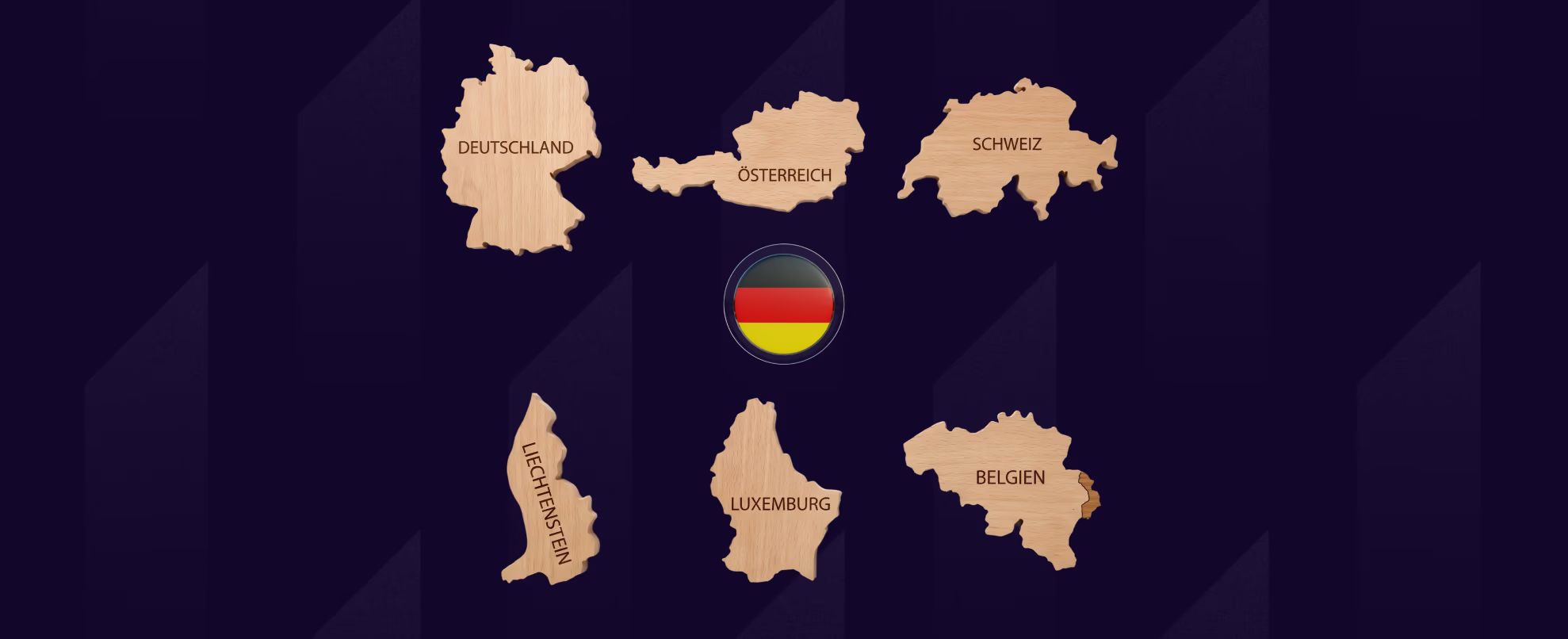
6 countries that speak German as an official language
Which countries speak German as an official language? Here is the full list, from Germany and Austria to Switzerland and beyond. Explore the list now.
Adeolu Titus Adekunle
•
August 17, 2026
•
6 min read
German is spoken by around 130 million people worldwide, making it one of Europe’s major languages. While many people associate it only with Germany, it is actually an official language in a few other countries and is spoken in various territories and expat communities.
German is an official language in six countries: Germany, Austria, Switzerland, Liechtenstein, Luxembourg, and Belgium. It is also widely spoken in parts of Italy (South Tyrol) and by communities worldwide. Germany and Austria have the largest number of native speakers.
This article explores countries where German is spoken, whether as an official language or widely spoken without official status.
How many countries speak German?
German is an official national language in six countries: Germany, Austria, Switzerland, Liechtenstein, Luxembourg, and Belgium. When you add the autonomous region of South Tyrol in Italy to these countries, they make up the German Sprachraum, or German-speaking area.
Together, these countries form the main German-speaking region of Europe. German is also widely spoken in parts of Italy and Poland, as well as by German-speaking communities in countries such as the US, Canada, Brazil, and Argentina.
Germany has by far the largest German-speaking population, with around 78% of the world's estimated 130 million German speakers living there.
Countries where German is official
| Country | Status | Notes |
|---|---|---|
| Germany | Sole official language | German is the main language spoken across the country. |
| Austria | Sole official language | Austrian German has some differences in vocabulary and pronunciation. |
| Switzerland | Co-official (with French, Italian, Romansh) | German is the country's most widely spoken language (63% of the population). Swiss German dialects differ significantly from Standard German. |
| Liechtenstein | Sole official language | German is the country's only official language. |
| Luxembourg | Co-official (with French and Luxembourgish) | German is used in government, media, and education, though Luxembourgish is the national language spoken most in daily life. |
| Belgium | Co-official (with Dutch and French) | German is official in the German-speaking Community in eastern Belgium. |
If you're thinking about moving to a German-speaking country, our guide to living in Germany as an expat covers practical topics such as banking, visas, and the cost of living.
Regions where German is widely spoken
German is not limited to these six countries. Several other regions have sizeable German-speaking populations.
South Tyrol, Italy
This is an autonomous province in northern Italy that borders Austria. German is its co-official language alongside Italian. The majority of the local population speaks German as their first language. This is because of the region's history as part of Austria-Hungary before being annexed to Italy after the First World War.
Poland
German is a recognised minority language in southern Poland, particularly in the Opole and Silesian voivodeships. These regions are home to communities with historical German heritage.
Brazil
German is spoken by communities in southern Brazil, particularly in Espírito Santo, Santa Catarina, and Rio Grande do Sul. Some municipalities also recognise German as a co-official language. This is because Germans migrated to southern Brazil in the 19th and 20th centuries.
Diaspora communities
German-speaking communities can also be found in the US, Canada, Argentina, and other countries with a history of German immigration. However, German is not recognised as an official language in these countries.
German dialects and variation
Spoken German can sound very different depending on where you are. Standard German (Hochdeutsch) is the version taught in schools and used in formal writing, business, education, and the media. It provides a common form of communication across German-speaking countries.
- Swiss German (Schweizerdeutsch): Differs significantly from Standard German and can be difficult for native German speakers to understand. Pronunciation, vocabulary, and even some grammar can be different. Swiss German is used in everyday conversation, while Standard German is generally used for writing and formal contexts.
- Austrian German: This is much closer to Standard German than Swiss German, but it has its own distinct vocabulary, particularly in food, administrative terms, and everyday expressions. It also has a distinct, recognisable accent.
- Regional dialects in Germany: German dialects vary considerably. Bavarian in southern Germany, for example, can sound very different from the Low German dialects in the north. However, almost everyone understands Standard German, which is used in formal settings throughout the country.
For travellers and language learners, however, Standard German is usually enough. You may notice different accents and expressions, but you should be able to communicate across all six countries.
Travelling and sending money to German-speaking countries
The currencies used across German-speaking countries are not all the same. Germany, Austria, Luxembourg, and Belgium use the euro (€/EUR). Liechtenstein and Switzerland use the Swiss franc (CHF), as they are not members of the EU. Some shops, especially in tourist centres in Liechtenstein, might, however, accept euros.
Card acceptance in German-speaking countries
In Germany, Austria, Luxembourg, and Belgium, Visa and Mastercard are widely accepted in cities. However, smaller businesses in Germany might favour cash payments or local debit systems (EC-Karte) more than in many other European countries. In Switzerland, card payments are widely accepted and reliable nationwide.
If you ever find yourself in any of these countries, spending abroad with a Grey card connected to a foreign-currency balance avoids foreign transaction fees. This differs from many home bank cards, which charge extra fees on international transactions and convert your currency to euros at undisclosed, marked-up rates.
Read our guide on how to avoid foreign transaction fees before travelling.
Sending money to Germany
Germany is one of the world's largest economies and a common destination for business and personal transfers. If you are sending money from the US to Germany, Grey allows you to access USD, EUR, and GBP accounts with the associated account details. This means you can send money to Germany or euro accounts in other countries from anywhere using SEPA. This avoids the international wire transfer fees associated with cross-border payments using traditional banks.
Grey shows the applicable exchange rate and fees before you confirm your transfer, so you know the cost upfront. You can receive EUR payments at a 0.8% deposit fee, capped at 10 EUR. Conversions cost 0.5% to 1%, and sometimes are capped at $6 (EUR equivalent), depending on the corridor.
Whether you're travelling through Germany, paying for something in Switzerland, or sending money to someone in Europe, managing multiple currencies can make international payments easier. Spend and send money abroad with Grey across German-speaking countries with fees and exchange rates shown upfront.
Frequently asked questions about German-speaking countries
How many countries speak German?
German is an official national language in six countries: Germany, Austria, Switzerland, Liechtenstein, Luxembourg, and Belgium. It also holds co-official or regionally recognised status in South Tyrol (Italy), parts of Poland, and several Brazilian states. It is widely spoken unofficially in diaspora communities worldwide.
Which country has the most German speakers?
Germany has by far the most German speakers, both native and total, with its population accounting for about 78% of the world's German-speaking population. Austria has the second-largest concentration of native speakers, followed by Switzerland.
Is German spoken in Switzerland?
Yes. German is one of Switzerland's four national languages, alongside French, Italian, and Romansh, and it is the majority language, spoken natively by roughly 63% of the Swiss population, concentrated in the northern, central, and eastern cantons. Swiss German dialects differ significantly from Standard German in everyday spoken use, though Standard German is used in writing and formal contexts.
What currency do German-speaking countries use?
Five of the six German-speaking countries use the euro: Germany, Austria, Luxembourg, and Belgium as EU members, plus the effective use of the euro in parts of Liechtenstein. Switzerland uses the Swiss franc, as it is not part of the eurozone or the European Union. Liechtenstein officially uses the Swiss franc as its currency, given its close economic ties to Switzerland.
Can I spend abroad with a Grey card?
Yes. The Grey virtual card is linked to your foreign currency balance and can be used wherever Visa is accepted, including in Germany, Austria, Switzerland, Luxembourg, and Belgium.
How do I send money to Germany?
Grey allows you to send money to Germany at transparent rates, with the fee and exchange rate shown before you confirm the transfer. This applies whether you are sending from the US or another country, and covers both personal transfers and business payments.

15 Cape Verdean Creole words and phrases to know before you visit Cape Verde
The Cape Verde language is Portuguese, with Creole (Kriolu) spoken day to day. Learn 15 handy Creole words and phrases before you visit. Read on.
Adeolu Titus Adekunle
•
August 7, 2026
•
6 min read
Cape Verde is the Caribbean of Africa and a great choice for a vacation. The official language of Cape Verde is Portuguese, but the everyday spoken language is Cape Verdean Creole, known locally as Kriolu. Most people speak Kriolu at home and in the street, while Portuguese is used in schools, government and the media. A few Creole phrases go a long way with locals.
If you are planning a trip to Cape Verde, knowing a few words of Kriolu can significantly improve your experience and help you feel more welcome. This guide explains the language situation in Cape Verde and gives you 15 practical Creole phrases to use during your visit.
What language is spoken in Cape Verde?
You are likely to hear two languages in Cape Verde. Portuguese is the official language in Cape Verde. It is the language used in schools and official settings. Newspapers and legal documents are in Portuguese. Most educated Cape Verdeans speak Portuguese fluently and can communicate in it with visitors.
On the other hand, the Cape Verdean Creole, known as Kriolu (or Crioulo), is the mother tongue language spoken at home, on the street, in local markets, and in daily conversation. While you can get by with Portuguese, you are likely to encounter people who are more comfortable speaking only Creole.
If you are planning to visit Cape Verde, it might be better to learn a few phrases in Creole than to brush up on Portuguese, even though most people also understand Portuguese.
It is also important to note that there are some regional variations to Cape Verde’s Creole. Cape Verde consists of ten islands, and the language is slightly different from one island to another. The two main varieties are
- Santiago Creole (also called Badiu), which is spoken in the southern islands, including Santiago
- São Vicente Creole (also called Sampadjudo), which is spoken in the northern islands, including São Vicente and Santo Antão.
The phrases in this article are mostly the Santiago variety because it is more widely spoken and can be understood on other islands with minor adjustments.
See our guide on the best things to do in Cape Verde for more on planning your trip.
About Cape Verdean Creole (Kriolu)
Cape Verdean Creole started to form in the 15th and 16th centuries on the islands of Santiago and Fogo. Portuguese colonists met West Africans there. They mixed their words and rules together to make a brand new language. So, the Cape Verdean Creole has vocabulary and grammatical features from both Portuguese and West African languages.
Today, Kriolu is very different from Portuguese. It is not simply broken or simplified Portuguese. It has its own grammar, phonology, and vocabulary. Such that if a Portuguese speaker hears Kriolu for the first time, they most likely won’t recognise many words but will not automatically understand the language.
Kriolu has historically been an oral language. A phonetic spelling system called ALUPEC, which is gradually being adopted for writing Kriolu. So, you will see more of written Portuguese than Kriolu in Cape Verde, especially in formal settings.
Greetings and polite basics in Kriolu
| Kriolu | English | Approximate pronunciation |
|---|---|---|
| Ola | Hello | OH-lah |
| Bon dia | Good morning | bon DEE-ah |
| Bon tardi | Good afternoon | bon TAR-dee |
| Bon noti | Good night | bon NO-tee |
| Obrigadu / Obrigada | Thank you (male speaker / female speaker) | o-bree-GAH-doo / o-bree-GAH-dah |
| Di nada | You are welcome | dee NAH-dah |
| Dizculpa | Excuse me / Sorry | deez-COOL-pah |
| Tudo bem? | How are you? / Is everything well? | TOO-doo baym |
| Tudo bem, obrigadu | Fine, thank you | TOO-doo baym, o-bree-GAH-doo |
Additional note: Traditionally, men say obrigadu and women say obrigada when thanking someone. Locals will appreciate hearing the correct form, though either is generally understood.
Cape Verdean Creole phrases when getting around and eating out
| Kriolu | English | Approximate pronunciation |
|---|---|---|
| Undi ke? | Where is...? | OON-dee keh |
| Kantú ku e? | How much does it cost? | kan-TOO koo EH |
| Un serveja, pur favor | A beer, please | oon ser-VEH-zhah, poor fah-VOR |
| Konta | The bill | KON-tah |
| Gostei mutu | I liked it very much | gos-TAY MOO-too |
| Tchau | Goodbye | chow |
Additional note: Cape Verdean food is quite different from what you might have experienced in other places, and it is absolutely worth trying. Cachupa is the national dish made from a slow-cooked stew of corn, beans, and vegetables or meat. At local markets and small restaurants (known as snack-bares), pointing at what you want is totally fine when language is a barrier, but locals will enjoy it if you try a few Kriolu words.
Numbers, money and useful extras
Cape Verde uses the Cape Verdean escudo (CVE), which is pegged to the euro at a fixed exchange rate. Euros are also widely accepted, particularly on the tourist islands of Sal, Boa Vista, and São Vicente.
| Number | Kriolu | Approximate pronunciation |
|---|---|---|
| 1 | un | oon |
| 2 | dos | dos |
| 3 | tres | tres |
| 4 | kuatru | KWAH-troo |
| 5 | sinku | SEEN-koo |
| 6 | seis | say-ees |
| 7 | seti | SEH-tee |
| 8 | oitu | OY-too |
| 9 | novi | NO-vee |
| 10 | dez | dez |
| Kriolu | English | Approximate pronunciation |
|---|---|---|
| Skridu | Escudo (the currency) | SKEE-doo |
| Dinheru | Money | dee-NYEH-roo |
| Merkadu | Market | mer-KAH-doo |
Additional note: Cards are accepted at many hotels, resorts, and larger restaurants, especially on Sal, Boa Vista, and São Vicente. However, you'll still need cash at local markets, small cafés, and on quieter islands like Santo Antão and Brava. ATMs are available on all inhabited islands, but they can be harder to find outside major towns.
For card-accepted payments, using a card connected to a euro balance avoids foreign transaction fees, since the Cape Verdean escudo is pegged to the euro. You can spend abroad with a Grey virtual card anywhere Visa cards work in Cape Verde.
Read our guide on how to avoid foreign transaction fees before visiting Cape Verde.
Spend in Cape Verde with a Grey Card and avoid unnecessary foreign transaction fees while you travel.
Frequently asked questions
What language do they speak in Cape Verde?
Cape Verde has two main languages. Portuguese is the official language used in schools, government, and formal settings, while Cape Verdean Creole (Kriolu) is the language most people use in everyday life.
Is Kriolu a written language?
Kriolu has historically been an oral language. A phonetic spelling system called ALUPEC (Alfabeto Unificado para a Escrita do Crioulo Cabo-verdiano) has been developed and is gradually being adopted, but written Kriolu is not yet standardised or universal. You will see written Kriolu in some contexts, particularly in music, literature, and informal signage, but most formal writing in Cape Verde is in Portuguese.
Is English spoken in Cape Verde?
English is spoken in many hotels and tourist businesses, especially on Sal and Boa Vista. Outside tourist areas, Portuguese and Kriolu are much more common. Learning a few local phrases can make your trip easier and more enjoyable.
How do you say hello in Cape Verdean Creole?
The most common greeting is ola (hello). For a time-specific greeting: bon dia (good morning), bon tardi (good afternoon), or bon noti (good night). Tudo bem? (How are you / is everything well?) is another very common greeting that will get a warm response.
Is Portuguese useful in Cape Verde?
Yes. Portuguese is understood across the country and is used in official situations. However, Kriolu is the language people use most in everyday conversation, so even a few Kriolu words will be warmly appreciated.
What currency is used in Cape Verde?
The Cape Verdean escudo (CVE) is the local currency, pegged to the euro at a fixed rate. Euros are widely accepted on tourist islands. On less-visited islands and at local markets, escudos are preferred. ATMs dispense escudos and are available on all inhabited islands, though coverage can be limited in rural areas.
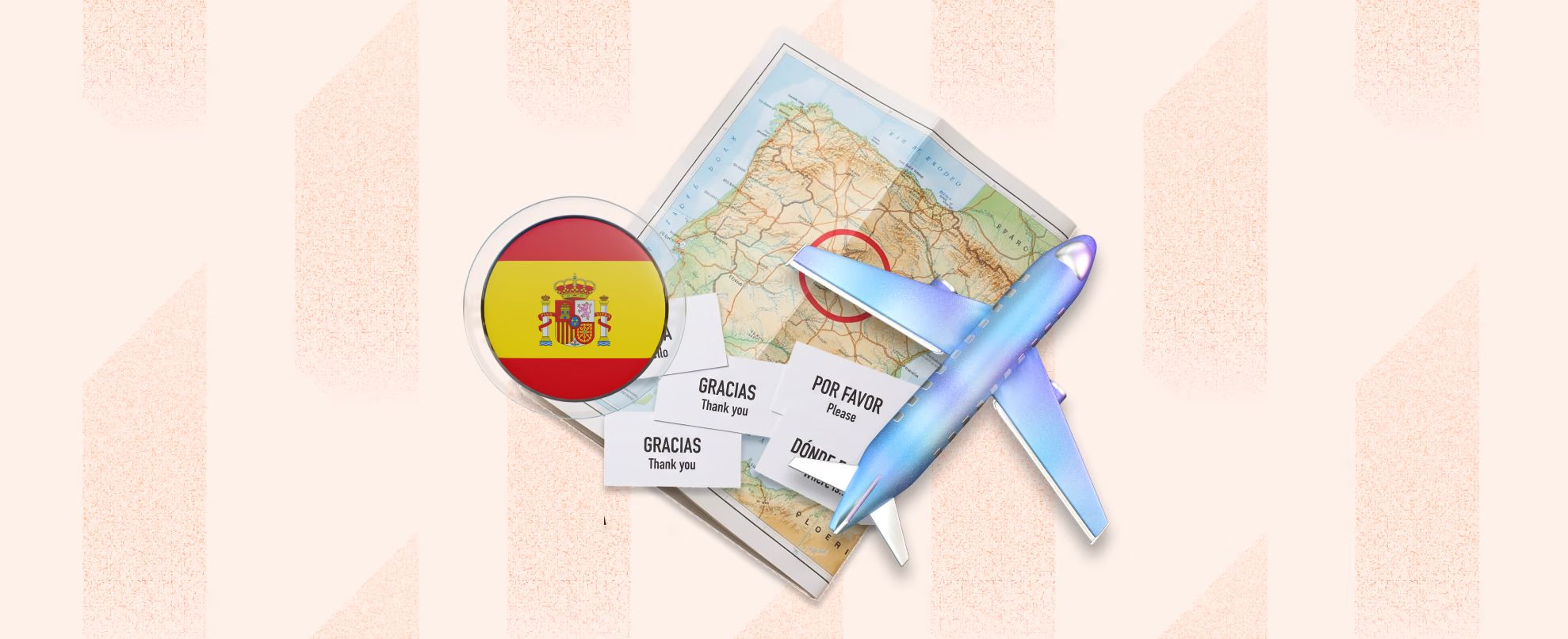
42 Spanish words and phrases to know before you visit Spain
Learn 42 essential Spanish words and phrases before you visit Spain, from greetings to the months in Spanish and numbers. Travel smarter with Grey.
Adeolu Titus Adekunle
•
August 6, 2026
•
6 min read
“Hola” and “gracias” are two of the most common Spanish words you can pick up without intentionally trying to learn the language. You find them sprinkled in movies and songs. But these are usually not enough when you are trying to order a meal or ask for directions.
A few Spanish words go a long way in Spain. Learn greetings such as “hola” and “buenos días”, polite phrases like “por favor” and “gracias”, the numbers one to ten, and the months in Spanish. Locals appreciate the effort, and it makes ordering, shopping and getting around far easier.
Spain is a welcoming country for English speakers, and you will find English widely understood in cities and tourist areas. But learning a handful of Spanish words before you arrive makes a genuine difference, both practically and in terms of how locals respond to you. This guide gives you 42 essential words and phrases organised by situation, including a full list of the months in Spanish.
Greetings and polite basics in Spanish
These are the words you will use more than any others in Spain. Getting these right from the start creates a good impression everywhere you go.
| Spanish | English | Pronunciation |
|---|---|---|
| Hola | Hello | OH-lah |
| Buenos días | Good morning | BWAY-nos DEE-as |
| Buenas tardes | Good afternoon / Good evening | BWAY-nas TAR-des |
| Buenas noches | Good night | BWAY-nas NO-ches |
| Por favor | Please | por fah-VOR |
| Gracias | Thank you | GRA-thee-as |
| De nada | You are welcome | deh NAH-da |
| Perdón | Excuse me / Sorry | pair-DON |
| Disculpe | Excuse me (to get attention) | dees-COOL-peh |
| Sí / No | Yes / No | see / no |
Additional note: In Spain, the letter 'c' before 'e' or 'i', and the letter 'z', are pronounced like the English 'th' in "think." So gracias sounds like "GRA-thee-as" rather than "GRA-see-as." This is different from Latin American Spanish.
Phrases for getting around in Spanish
These phrases help you navigate transport, find the bathroom, and ask basic directions.
| Spanish | English | Pronunciation |
|---|---|---|
| ¿Dónde está? | Where is...? | DON-deh es-TAH |
| La estación | The station | la es-tah-SYON |
| El aeropuerto | The airport | el ah-eh-ro-PWER-to |
| El baño | The bathroom | el BAN-yo |
| A la derecha | To the right | ah lah deh-REH-cha |
| A la izquierda | To the left | ah lah ees-KYAIR-da |
| Todo recto | Straight ahead | TO-do REK-to |
| ¿Cuánto cuesta? | How much does it cost? | KWAN-to KWES-ta |
Additional note: You might notice the use of the upside-down question mark (¿) at the very beginning of a direct question or an interrogative clause in Spanish. It acts as a warning opening tag so readers can change their voice tone right away, and it always pairs with a normal question mark (?) at the end.
Spanish phrases when eating out
If you are visiting a restaurant or cafe in Spain, these phrases can come in handy:
| Spanish | English | Pronunciation |
|---|---|---|
| Una mesa para dos | A table for two | OO-na MEH-sa PA-ra dos |
| La carta | The menu | la KAR-ta |
| La cuenta | The bill | la KWEN-ta |
| Agua | Water | AH-gwa |
| Vino | Wine | BEE-no |
| Sin gluten | Gluten-free | seen GLOO-ten |
| Para llevar | To take away | PA-ra lyeh-BAR |
| Está muy rico | It is very tasty | es-TA mwee REE-ko |
Numbers and money in Spanish
Spain uses the euro (€). Card payment is widely accepted in cities and tourist areas, but you will still need cash for some smaller businesses, local markets, and tips.
| Number | Spanish | Pronunciation |
|---|---|---|
| 1 | Uno | OO-no |
| 2 | Dos | dos |
| 3 | Tres | tres |
| 4 | Cuatro | KWAH-tro |
| 5 | Cinco | SEEN-ko |
| 6 | Seis | say-ees |
| 7 | Siete | SYEH-teh |
| 8 | Ocho | OH-cho |
| 9 | Nueve | NWEH-veh |
| 10 | Diez | dyeth |
| Spanish | English | Pronunciation |
|---|---|---|
| El euro | The euro | el EH-ro |
| Efectivo | Cash | eh-fek-TEE-bo |
| Tarjeta | Card | tar-HEH-ta |
| ¿Acepta tarjeta? | Do you accept card? | ah-sep-ta tar-HEH-ta |
Additional note: Always carry some euros for emergencies. As an international traveller, using a card linked to a euro account avoids foreign transaction fees on every purchase, unlike when you use a card from your home country. You can spend abroad with a Grey Card anywhere Visa is accepted across Spain. Read our guide on how to avoid foreign transaction fees before you travel.
Months in Spanish
Learning the months of the year in Spanish might be useful if you are making reservations, booking flights, reading signage, or trying to figure out the date on tickets and documents. In Spain, the months are not capitalised.
| Month | Spanish | Pronunciation |
|---|---|---|
| January | enero | eh-NEH-ro |
| February | febrero | feh-BREH-ro |
| March | marzo | MAR-tho |
| April | abril | ah-BREEL |
| May | mayo | MY-o |
| June | junio | HOO-nyoh |
| July | julio | HOO-lyoh |
| August | agosto | ah-GOS-to |
| September | septiembre | sep-TYEM-breh |
| October | octubre | ok-TOO-breh |
| November | noviembre | no-VYEM-breh |
| December | diciembre | dee-THYEM-breh |
Using months in conversation:
- "Mi cumpleaños es en abril" = "My birthday is in April"
- "Llegamos en agosto" = "We are arriving in August"
- "El evento es el cinco de marzo" = "The event is on the fifth of March"
In Spanish, dates follow this order: day before month: 5 de marzo (5 March). This is important when reading tickets and booking confirmations.
Days of the week and emergencies
| Day | Spanish | Pronunciation |
|---|---|---|
| Monday | lunes | LOO-nes |
| Tuesday | martes | MAR-tes |
| Wednesday | miércoles | MYAIR-ko-les |
| Thursday | jueves | HWEH-ves |
| Friday | viernes | VYAIR-nes |
| Saturday | sábado | SAH-ba-do |
| Sunday | domingo | do-MEEN-go |
Emergency phrases
Hopefully, you don’t need any emergency phrases. But it is great to learn some in case of an emergency.
| Spanish | English | Pronunciation |
|---|---|---|
| Ayuda | Help | ah-YOO-da |
| Llame a la policía | Call the police | neh-seh-SEE-to oon MEH-dee-ko |
| Necesito un médico | I need a doctor | YAH-meh ah la po-lee-SEE-ah |
| El hospital | The hospital | eh pehr-DEE-do mee pah-sah-POR-teh |
Useful everyday phrases in Spanish
These are phrases travellers use constantly.
| Spanish | English | Pronunciations |
|---|---|---|
| ¿Habla inglés? | Do you speak English? | AH-bla een-GLAYS |
| No hablo español | I don't speak Spanish | no AH-blo es-pan-YOL |
| Entiendo | I understand | en-tee-EN-do |
| No entiendo | I don't understand | no en-tee-EN-do |
| ¿Puede ayudarme? | Can you help me? | PWEH-de ah-yoo-DAR-me? |
| Mucho gusto | Nice to meet you | MOO-cho GOOS-to |
If you are planning a longer stay in Spain or considering a move there, see our living in Spain as an expat guide for practical information on banking, housing, and visas.
Knowing a few Spanish words can make travelling around Spain much easier, but managing your money is just as important. With Grey, you can spend abroad in euros wherever Visa is accepted, avoid unnecessary foreign transaction fees, and manage multiple currencies from one account. Whether you're exploring Madrid, Barcelona, Seville, or Valencia, Grey helps you pay with confidence throughout your trip.
Spend in euros with a Grey Card and avoid foreign transaction fees across Spain.
Frequently asked questions
Is English widely spoken in Spain?
In major cities including Madrid, Barcelona, Seville, and Valencia, and in popular tourist areas along the coasts, English is widely understood, particularly among younger people and those working in hospitality. In rural areas and smaller towns, English is less common. A few Spanish words go a long way wherever you are.
How do you say hello in Spanish?
The most common greeting is hola, pronounced "OH-lah." For a more formal or time-specific greeting, use buenos días (good morning), buenas tardes (good afternoon or evening), or buenas noches (good night).
What are the months in Spanish?
The twelve months in Spanish are: enero (January), febrero (February), marzo (March), abril (April), mayo (May), junio (June), julio (July), agosto (August), septiembre (September), octubre (October), noviembre (November), and diciembre (December). Unlike English, months are not capitalised in Spanish.
Should I tip in Spain?
Tipping in Spain is appreciated but not expected in the same way as in the US. At restaurants, rounding up the bill or leaving a few euros is common and well-received. Tipping 10% for good service is generous. At bars, leaving small change on the counter when you pay is common. There is no cultural pressure to tip heavily.
Is it better to pay by card or cash in Spain?
Both are useful. Card payment is accepted in most restaurants, hotels, and shops in cities. Cash is still needed for some smaller businesses, local markets, and in rural areas. If you use an international card, check whether your bank charges a foreign transaction fee on each purchase. Using a card connected to a euro balance, such as the Grey Plus Card, avoids this fee entirely.
How do I avoid card fees in Spain?
Use a card connected to a euro balance rather than a card that converts from your home currency at the point of each purchase. The Grey card is a virtual Visa card connected to a EUR balance. Purchases in euros draw from that balance with no cross-border conversion fee. Read our full guide on how to avoid foreign transaction fees.
%20(1)%20(1).png)
How to Pay for ChatGPT Plus in Nigeria
ChatGPT Plus costs $20/month and needs a dollar card. Nigerian naira cards are not accepted. Here is how to subscribe using a Grey virtual dollar card.
Olayoyin Olorunmota
•
June 29, 2026
•
6 min read
ChatGPT Plus costs $20 a month. The first problem for most Nigerians is that OpenAI does not accept naira-denominated debit cards, which means your standard Nigerian bank card will be declined at checkout every time.
The solution is a virtual dollar card. With a Grey account, you can create one in minutes and complete the ChatGPT Plus subscription on the same day. This guide covers the full process: what you are paying for, how much it costs in naira, how to set up your Grey card, and exactly how to complete the subscription on desktop and mobile.
What is ChatGPT Plus?
ChatGPT is the AI assistant developed by OpenAI and launched in November 2022. The free version gives you access to a limited version of OpenAI’s models with lower message caps and slower responses during busy periods.
ChatGPT Plus is OpenAI’s paid subscription tier at $20 per month. It gives you significantly more capability across every dimension of the product.
ChatGPT Plus vs Free: what you actually get
| Feature | Free | Plus |
|---|---|---|
| GPT-5.5 Instant (standard model) | Limited access | Expanded access |
| GPT-5.5 Thinking (reasoning model) | Not available | Expanded access |
| Message limits | Limited | Expanded |
| Response speed | Limited by demand | Fast |
| Voice conversations | Yes (basic) | Expanded |
| Voice with video | No | Yes |
| Image generation | Limited | Yes (including with Thinking) |
| File uploads and data analysis | Limited | Yes |
| Deep research and agent mode | Limited | Expanded |
| Custom GPT creation | No | Yes |
| Tasks and scheduled actions | No | Yes |
| Apps connecting to internal tools | No | Yes |
| Early access to new features | No | Yes |
| Context window (Instant model) | 27K tokens (about 12 pages) | 54K tokens (about 40 pages) |
| Price | Free | $20 per month |
Is there a higher-tier plan?
Yes. Above Plus, OpenAI offers ChatGPT Pro at $100 per month (billed in GBP on the UK pricing page; USD equivalent applies for Nigerian users). Pro gives you five to twenty times more usage than Plus, access to GPT-5.5 Pro (the most powerful version), unlimited image generation, maximum deep research and agent mode, and a research preview of new features before they reach Plus.
For most Nigerian users, Plus at $20 per month covers everything. Pro is designed for power users who hit Plus usage limits regularly.
OpenAI does not currently offer annual billing for ChatGPT Plus or Pro. All plans are billed monthly.
How much does ChatGPT Plus cost in naira?
OpenAI charges $20 per month, billed in USD. The naira equivalent shifts with the exchange rate. At typical market rates, $20 works out to roughly N25,000 to N30,000 per month. Verify the current rate in the Grey app before subscribing, since this changes daily.
Because the charge is in USD and your Grey card operates in USD, there is no currency conversion on the ChatGPT transaction itself. You only pay the Grey FX swap fee once, when you convert naira to USD to fund your account.
Why do Nigerian naira cards not work for ChatGPT subscription?
OpenAI processes all payments in USD through Stripe, its payments processor. Stripe requires a card with a valid USD billing relationship. Nigerian naira debit cards issued by local banks are naira-denominated and do not meet this requirement, so they are declined at the payment step regardless of your card balance.
This is not a Grey-specific issue. Any naira card, whether issued by GTBank, Access, Zenith, UBA, First Bank, or any other Nigerian bank, will be declined. The only cards that work are dollar-denominated Visa or Mastercard cards, either physical (from a domiciliary account) or virtual (such as Grey’s virtual dollar card).
OpenAI also does not accept PayPal on the web checkout, gift cards, or prepaid cards without a matching billing address. Apple Pay and Google Pay work on mobile apps only, and only if your Apple or Google account is linked to a valid dollar payment method.
What you need before you subscribe
- A Grey account (download the Grey app from the App Store or Google Play and complete signup)
- A Grey virtual dollar card
- A ChatGPT account, which is free to create at chatgpt.com
Step 1: Create a Grey account
If you already have a Grey account, skip to Step 2.
- Download the Grey app from the App Store (iOS) or Google Play (Android).
- Open the app and tap Sign Up.
- Enter your email address and create a password.
- Complete identity verification. Grey requires a valid government-issued ID to comply with financial regulations.
- Your account is active once verification is approved.
Step 2: Get a Grey virtual dollar card
If you already have a Grey virtual card, skip to Step 3.
- Open the Grey app and tap the Cards section on the dashboard.
- Select Create Virtual Card.
- Review the card creation fee. A $5 one-time creation fee will be charged. You need a minimum of $5 USD in your account before creating the card.
- Confirm, and your card is created immediately. Your card number, expiry date, and CVV appear in the Cards section of the app.
Your Grey virtual dollar card is a Visa card which pulls directly from your USD balance. It’s accepted anywhere Visa is supported internationally, including on ChatGPT and on every major USD-billed subscription platform.
Step 3: Fund your Grey USD balance
You need at least $20 in your USD balance to pay for ChatGPT Plus. The recommended method is to swap naira to USD inside the Grey app.
- Open the Grey app and tap “Convert”.
- Select NGN to USD and enter the amount. A 1% currency conversion fee (capped at $6) will apply.
- Review the rate and confirm. Your USD balance updates immediately.
You can also fund your USD balance via ACH transfer from a US bank account if you have one. The ACH receiving fee is 0.5% (minimum $2, maximum $10). For most Nigerian users, the in-app naira-to-USD swap is the most straightforward route.
Step 4: Subscribe to ChatGPT plus
On a desktop browser (recommended)
- Go to chatgpt.com and log into your account.
- Click your profile icon in the bottom-left corner.
- Select Upgrade Plan.
- Choose the Plus plan at $20 per month.
- On the payment screen, enter your Grey virtual card number, expiry date, and CVV. Use the name on your Grey account and any valid billing address.
- Click Subscribe. Your subscription activates immediately, and $20 is charged to your Grey card balance.
On Android
- Open the ChatGPT app and go to Settings.
- Select Upgrade to Plus.
- Payment is processed through Google Play. Add your Grey virtual card as a payment method on Google Play before proceeding if you have not already done so.
On iOS
- Open the ChatGPT app and tap the menu at the top.
- Select Get Plus.
- Payment goes through Apple’s in-app purchase system. Add your Grey card to your Apple ID payment methods first. You can do this in iPhone Settings under your Apple ID, then Payment and Shipping.
Payment methods: what works and what does not
| Method | Works? | Notes |
|---|---|---|
| Grey virtual dollar card (Visa) | Yes | Recommended. Works on web, Android, and iOS. |
| Physical dollar card (domiciliary) | Yes | Works, but requires sourcing USD separately through your bank. |
| Nigerian naira debit card | No | OpenAI does not accept naira-denominated cards on any platform. |
| PayPal | Not on web | Works on iOS or Android only if PayPal is linked to your Apple or Google account. |
| Gift cards | No | OpenAI does not accept gift cards for ChatGPT subscriptions. |
| Annual billing | No | OpenAI currently offers monthly billing only for Plus and Pro. |
How to manage your ChatGPT subscription
To view your subscription details, invoices, or cancel your plan, log into chatgpt.com, click your profile icon, select Settings, then Account.
To cancel, go to Manage My Subscription and select Cancel Plan. Cancelling stops the next renewal charge. Your Plus access continues until the end of the billing period you have already paid for.
If you subscribed through the iOS app, manage and cancel through iPhone Settings, then your Apple ID, then Subscriptions. The same applies to Android subscriptions managed through Google Play.
What happens at renewal?
ChatGPT Plus renews automatically every month on the same date you first subscribed. OpenAI charges your Grey card for $20 on that date.
If your Grey USD balance is below $20 at renewal time, the charge will fail, and your account will be downgraded to the free plan. You will need to top up your balance and resubscribe. To avoid this, set a reminder to check your Grey balance a few days before each renewal date, or keep a small buffer in your USD balance above the $20 threshold.
OpenAI sends a receipt by email for each billing cycle. If you see an unexpected charge, you can request a refund through OpenAI’s support. Refunds are typically processed within five to ten business days after approval.
Troubleshooting common issues
Payment declined at checkout
- Check that your Grey USD balance has at least $20 available.
- Confirm that the card number, expiry date, and CVV are entered correctly from the Grey app.
- Make sure the billing name matches the name on your Grey account.
- If using a billing address, use a consistent format. Grey’s registered address works.
- If the issue persists, contact Grey support through the app.
Subscribed but account still shows “free plan”
- Log out of ChatGPT on all devices and log back in using the exact email address you used to subscribe.
- If you subscribed through Apple and used Hide My Email, find the private relay address in your Apple ID settings and use that to sign in.
- On iOS or Android, go to Settings and tap Restore Purchases to sync your subscription.
- If none of these work, contact OpenAI support with your receipt or the last four digits of the card charged.
Grey card not accepted on Google Play or Apple
- On Google Play: go to pay.google.com, add your Grey card as a new payment method, then return to the ChatGPT app to subscribe.
- On Apple: go to iPhone Settings, tap your name, then Payment and Shipping, and add your Grey card. Once added, it will be available for in-app purchases.
Other USD subscriptions you can pay with your Grey card
Once your Grey virtual dollar card is set up, it works across every major USD-billed subscription platform. You do not need to create a new card for each service.
| Service | What you can pay for |
|---|---|
| Adobe Creative Cloud | Photoshop, Illustrator, Premiere Pro, Acrobat, the full Creative Cloud suite |
| Notion AI | Notion Plus and AI add-on plans |
| Canva Pro | Canva Pro monthly and annual plans |
| Spotify Premium | Spotify individual and family plans billed in USD |
| Netflix | Netflix plans billed in USD |
| AWS | Amazon Web Services usage and reserved instance billing |
| Shopify | Shopify Basic, Grow, and Advanced plans |
| Figma | Figma Starter and Professional plans |
| GitHub Copilot | GitHub Copilot Individual and Business plans |
| Midjourney | Midjourney AI image generation plans |
The smart way to manage dollar subscriptions from Nigeria
A Grey multi-currency account lets you hold a USD balance and spend it directly with a virtual dollar card across all of the above. One account, one card, no currency conversion at the point of payment on any USD-billed service. You convert naira to USD once, at Grey’s 1% rate, and spend from that balance across every subscription you run.
If you also send money internationally, Grey pays out to bank accounts and mobile money in Nigeria, India, Ghana, Kenya, the Philippines, and over 50 other destinations. You can manage everything from one app.
Open a Grey account, create your virtual dollar card, and have ChatGPT Plus running today at grey.co.
Frequently asked questions
Does ChatGPT Plus renew automatically?
Yes. OpenAI charges your card $20 on the same date each month. Make sure your Grey USD balance has at least $20 before each renewal date to avoid the payment failing and your account reverting to free.
Is there a transaction fee when ChatGPT charges my Grey card?
No fee on the card transaction itself. ChatGPT charges in USD, and your Grey card operates in USD, so no currency conversion happens at the point of payment.
What if my card balance is too low at renewal?
OpenAI will attempt the charge. If it fails, your account is downgraded to the free plan. Top up your Grey USD balance and re-subscribe. OpenAI does not automatically retry failed payments, so you need to go back into the subscription flow to reactivate.
Can I use one Grey card for multiple subscriptions?
Yes. Your Grey virtual card is a standard Visa card. Use it for ChatGPT Plus, Adobe, Notion, Canva, AWS, Shopify, and any other USD-billed service simultaneously. There is no limit on the number of services you can subscribe to from one card.
Does the 2% cross-border card fee apply to ChatGPT?
No. The 2% plus $0.50 cross-border card fee applies only when a merchant processes a transaction in a currency other than USD. ChatGPT Plus is billed in USD, so you pay no cross-border fee on this subscription. The same applies to any other service that charges in USD.
Can I get a refund if I cancel ChatGPT Plus?
OpenAI does not automatically refund unused time if you cancel mid-cycle. If you believe you were incorrectly charged, you can submit a refund request through OpenAI’s support pages. Refunds typically take five to ten business days to process after approval.’
Is there a ChatGPT Go plan below Plus?
Yes. OpenAI introduced ChatGPT Go at $7 per month (GBP equivalent on the UK pricing page). Go gives you more access than Free, including more messages and uploads, longer memory, and the ability to create and share custom GPTs. It does not include GPT-5.5 Thinking, deep research tools, or tasks. Go is a middle-ground option if $20 per month is too much. You can pay for it with your Grey card using the same process described in this guide.
Is ChatGPT data private on Plus?
OpenAI may use conversations to improve model performance and safety on all individual plans including Plus. You can opt out of having your data used for training at any time through Settings in your ChatGPT account. Business and Enterprise plans do not use data for training by default.
This article is for general information purposes only. Subscription pricing, plan features, and accepted payment methods are set by OpenAI and may change at any time. Always verify current pricing and terms at chatgpt.com before subscribing. Grey’s fees are accurate as of June 2026; verify current rates in the Grey app before transacting.

How to send money from the Netherlands to Morocco
Here are options for sending money from the Netherlands to Morocco, the actual cost of converting EUR to MAD, and how to get more of your money to its destination.
Adeolu Titus Adekunle
•
March 31, 2026
•
6 min read
The Netherlands has one of the largest Moroccan diaspora communities in Europe, with over 433,000 people of Moroccan origin residing in the country, constituting roughly 2.4% of the total Dutch population. Morocco is also home to a growing number of global freelancers, remote workers, and businesses working with international clients, including those in the Netherlands. These factors explain why it is common for people to send money from the Netherlands to Morocco. They might be supporting family back home in Fez, paying freelancers in Casablanca, or settling invoices with businesses in Marrakech.
It can still be confusing that international payments from the Netherlands to Morocco remain challenging. From transaction costs and conversion complexities to payment delays, Morocco’s proximity to Europe does not fully simplify cross-border payments. This article covers the main payment options for sending money from the Netherlands to Morocco, how each one works, and how to choose the right one for your specific situation.
Also read: How to open US, UK and Euro bank accounts in Netherlands
The traditional bank route: SWIFT transfers
International wire transfers from traditional banks via the SWIFT network are among the most widely used international payment methods. For a long time, this was the default option. Dutch banks, including ING, ABN AMRO, and Rabobank, all offer international transfers. However, traditional banks are not specifically designed for cost-efficient cross-border payments. When you send money from the Netherlands, it typically passes through multiple intermediary banks before reaching its destination.
By the time the funds arrive, correspondent banks may have deducted intermediary fees, and the amount has been converted to MAD at an exchange rate that is not always clearly visible upfront. While this is a familiar option, it is often one of the more expensive ones on this corridor.
The total cost of a bank transfer typically includes:
- A fixed outgoing transfer fee, usually between €5 and €15, depending on the bank and transfer type
- An exchange rate markup of around 3% to 5% above the mid-market rate
- In some cases, a receiving fee from the Moroccan bank, typically MAD 30 to MAD 60
Payment processing usually takes 2 to 5 business days because the funds move through multiple banks.
Wise
Wise is a cross-border payment platform that offers multi-currency accounts supporting EUR and withdrawals to MAD accounts. It applies the mid-market exchange rate on conversions and displays the fee before you confirm the transfer. For EUR to MAD, the fee has typically ranged from 0.4% to 0.8% of the transfer amount, although the exact figure varies depending on the amount and payment method.
Wise holds local EUR balances and pays out from Moroccan accounts, which means many transfers are completed without using SWIFT. This reduces intermediary bank involvement and potential delays. Transactions are usually completed within one business day, and in some cases on the same day.
Also read: How to receive and convert foreign currencies to USDC in the Netherlands
Remitly
Remitly is often positioned as a cost-effective option for sending money from the Netherlands to Morocco. New customers may receive promotional offers such as €0 fees or improved exchange rates on their first transfer.
It offers two transfer speed options with different pricing:
- Economy transfers: lower fee, typically settled within three to five business days
- Express transfers: higher fee, typically settled within minutes to hours
Remitly also supports multiple delivery options:
- Cash pickup: available at locations like Wafacash, Cash Plus, and Banque Populaire (fee typically around €1.99)
- Mobile wallet: sent to services like Orange Money (fee typically around €0.49)
- Bank deposit: supported for major Moroccan banks such as Attijariwafa Bank, Bank of Africa (BMCE), and Société Générale (fee typically around €0.49)
Fees and exchange rates may vary depending on the transfer details.
TransferGo
TransferGo is an FCA-regulated transfer platform operating across Europe, including the Netherlands. It offers both standard and express transfer options to Moroccan bank accounts:
- Standard transfers: lower fee, delivery within one to three business days
- Express transfers: higher fee, delivery within 30 minutes in many cases
The first transfers for new users are often free, depending on promotions. After that, fees remain competitive, and exchange rate margins are typically lower than those of traditional banks.
Western Union
Western Union is a widely used option for sending money from the Netherlands to Morocco, especially for cash-based transfers. It is particularly useful if the recipient does not have a bank account.
For urgent transfers, especially cash pickup, Western Union can deliver funds within minutes. It has a large agent network across Morocco, with locations in most cities and towns.
Fees vary significantly depending on the transfer type:
- Bank transfers may have low or zero upfront fees
- Instant cash transfers can cost over €50 for larger amounts
Western Union also applies an exchange rate margin, which can range from around 0.5% to over 3%.
Western Union is available online, via its app, and through physical agent locations across the Netherlands.
Grey
Grey is a fintech platform offering multicurrency accounts (USD, EUR, and MAD) and supports payouts to local MAD accounts. It provides competitive exchange rates and structured fees:
- Conversion fee: typically 1% (capped at around $6 or equivalent for certain currency pairs)
- Withdrawal fee (EUR): 0.5% (minimum €2, maximum €10) when sending EUR via supported routes
- Exchange rate: transparent and shown before confirming the transaction
Transfers are typically completed within a few hours to a couple of business days, depending on the route used.
How to send money from the Netherlands to Morocco with Grey
- Create an account on the Grey website or mobile app
- Complete the KYC (Know Your Customer) process
- Deposit EUR via SEPA from a Dutch bank (e.g. ING, Rabobank)
- Select “Send”, choose Morocco, enter recipient details, and confirm
Also read: How to get an instant USD debit card in the Netherlands
Managing international payments with Grey
Managing international payments from the Netherlands to Morocco is now more accessible with digital payment platforms. Grey provides virtual EUR accounts alongside USD and GBP, allowing you to receive funds via SEPA, hold balances in EUR, and convert at a visible rate.
Grey virtual cards allow you to make international payments, manage multiple currencies, and spend directly from your balances without manual top-ups. They can also be added to Google Pay and Apple Pay for contactless payments.
Sending money from the Netherlands to Morocco becomes easier when you choose a setup that fits your needs. You can sign up on Grey or download the app to get started.

Receive US payroll payments outside the US
How remote workers receive US payroll payments outside the US at transparent exchange rates.
Olayoyin Olorunmota
•
March 31, 2026
•
6 min read
How do US employers make domestic US payroll payments?
The general process is to enter a US address, provide a US routing number and account number, and the system will process direct deposit smoothly. Usually, everyone gets paid on schedule.
The dynamics change when someone the employer hires someone from outside the US. Their payroll system requires US banking details that this person doesn’t have. Finance could suggest international wire transfers, which trigger manual processing, about $20 sending fees, week-long delays, and significant deductions from intermediary banks before the money arrives.
In this article, I explain how US payroll systems work, why they create problems for international workers, your actual payment options, and how to receive a US salary efficiently regardless of where you live.
How does US payroll actually work?
Most US companies don’t process payroll manually, instead they use platforms that automate salary calculations, tax withholding, compliance reporting, and payment distribution. These platforms are designed around US domestic assumptions:
- Employees have US bank accounts with routing and account numbers
- Employees live in states with specific tax codes
- Employees fall under US employment law and tax jurisdiction.
The standard payment method is direct deposit through the Automated Clearing House (ACH) network. On payday, the payroll platform initiates ACH transfers from the company’s bank account to each employee’s account. Money moves through the ACH network and typically clears within one to three business days.
ACH is fundamentally domestic. It requires US routing numbers that identify specific US banks and US account numbers that identify specific customers at those banks. International bank accounts don’t participate in the ACH network.
A Nigerian bank account, for example, has an account number and a sort code that follow Nigerian banking standards. An Indian bank account uses IFSC codes and account numbers in the Indian format. These don’t translate into the nine-digit routing numbers and account numbers that US payroll systems expect.
When you don’t have US banking details, several complications arise immediately. The payroll system flags your profile as incomplete or problematic because required fields are empty. Some companies refuse to hire international workers specifically because they find payment too complicated to navigate.
Companies willing to pay internationally face additional challenges. International wire transfers require manual processing outside the normal automated payroll flow. Someone in finance usually must log into the banking platform, enter wire transfer details manually, obtain approval for international payments (often requiring senior authorisation that domestic payroll doesn’t), and initiate the transfer separately from the rest of payroll. Each wire costs the company about $20 in sending fees.
Beyond logistics, there’s the complexity of tax withholding. US payroll systems automatically withhold federal income tax, Social Security, Medicare, and state taxes from employee paychecks. These withholdings apply to US tax residents.
If you’re not a US tax resident or you’re not a US citizen or green card holder, these withholdings shouldn’t apply to you. But payroll systems assume everyone is subject to US tax withholding. Configuring the system to pay someone without US tax withholding requires manual intervention and understanding of tax treaty provisions and IRS regulations.
Then there’s the employment classification question. If you’re working full-time remotely from outside the US, the company needs to determine whether you’re a US employee working abroad temporarily. Are you a foreign employee of a foreign subsidiary? Are you actually an independent contractor despite operational aspects that appear to be employment?
Each classification has different tax implications, different legal obligations, and different payment processes. Many US companies, especially startups and small businesses, aren’t equipped to navigate this. They want to hire talented people regardless of location, but their finance and legal advisors raise compliance concerns that feel insurmountable.
This is why understanding the mechanics matters.
Also read: How consultants structure international client payments
Employment classification: Employee vs contractor
How you’re classified legally determines how payment works, what tax obligations apply, and what documentation both you and the company need.
If you’re classified as an employee, the US company has specific legal obligations. They must provide benefits as required by law if you’re a US-based employee, though obligations differ for foreign employees. They must ensure compliance with employment laws both in the US (for aspects of the employment relationship governed by US law) and potentially in your country of residence.
For non-US residents working remotely outside the US, employment can be complex. Many countries require foreign companies employing local residents to register as employers, withhold local income taxes and social contributions, and comply with local employment standards.
This is why many US companies use Employer of Record services for international employees. The EOR becomes your legal employer in your country, handling local compliance whilst you work operationally for the US company.
Independent contractor classification simplifies payment significantly. As a contractor, you’re self-employed and responsible for your own taxes in your country. The US company has no tax withholding obligations (as long as you’re not a US tax resident). There are no employment law obligations in your country because you’re not an employee.
Payment works the same way as paying any other vendor. You submit invoices, and the company pays them. You don’t receive employee benefits like health insurance or paid time off, but you also have more flexibility in how you structure your work.
Now if you’re properly classified as an employee, the company needs to run you through payroll, which requires addressing all the payment and tax complexities discussed earlier. They may need to establish legal presence in your country by registering an entity or by using an expensive Employer of Record (EOR) service. Payment comes as regular salary on the company’s normal payroll schedule, and you may be subject to local tax withholding depending on how the company structures your employment.
If you’re properly classified as a contractor, you invoice the company for completed work. They pay your invoices the same way they’d pay any vendor. There’s no payroll involvement and no company obligation to withhold taxes. You’re fully responsible for tax compliance in your country. Payment methods are flexible, and the company can use whatever method works best: wire transfer, payment platforms, or modern cross-border payment infrastructure.
The practical reality for most remote international workers is that many who join US startups are technically contractors, even if the company internally calls them “employees.” The company doesn’t want to navigate foreign employment law or establish legal entities in your country, so they structure the relationship as independent contracting, whilst treating you like a team member operationally.
This works as long as you’re comfortable with contractor classification, you handle tax obligations properly in your country, and the company doesn’t exert so much control over your work that you’re actually a misclassified employee. Misclassification creates legal risk that can result in penalties, back taxes, and employment law violations.
Before accepting any position, clarify whether you’re being hired as an employee or contractor. If you’re an employee, understand how the company will handle international employment compliance. If you’re a contractor, understand the invoicing schedule, payment terms, and your tax obligations.
Also read: Global bank accounts vs offshore accounts: what’s the difference
The traditional methods that US companies use to pay international workers and their problems
When companies decide to pay workers outside the US, they typically choose from several established approaches. Each has significant limitations.
International wire transfers via SWIFT are the most common default. The company initiates a wire from their US bank to your bank account in your country. Money passes through the SWIFT network, typically involving one or more intermediary correspondent banks that facilitate cross-border transfers.
The problems are cost and speed. The company pays $30-50 per wire in sending fees. Intermediary banks deduct $20-40 combined for processing the transfer. Your local bank charges a receiving fee of $15-25. Then comes currency conversion. If your account is in local currency, your bank converts the USD at a rate that includes a 3-5% markup over the mid-market rate.
On a $5,000 monthly payment, you can lose up to $250-400 to fees and conversion. The transfer takes three to five business days, sometimes longer, depending on the countries involved and any compliance holds. For the company, this is a manual process. Someone in finance must initiate each wire separately outside the normal payroll system. This doesn’t scale when paying multiple international workers monthly.
Employer of Record (EOR) services like Deel, Remote, and Oyster solve the compliance problem by becoming your legal employer in your country. They handle local tax withholding, benefits administration where required, employment law compliance, and regulatory reporting. The US company pays the EOR, and the EOR pays you in local currency through local banking.
From a compliance perspective, EORs are excellent. They handle complexity that the US company doesn’t want to navigate. You get true employee status with proper local compliance. The relationship is clear and legally sound.
The problems are cost and the employment relationship structure. EOR services charge companies 15–30% above your salary in fees. On a $100,000 salary, the company pays $115,000–130,000 total. Many startups and small companies can’t afford this premium, especially when hiring multiple international workers.
From your perspective, you’re employed by the EOR, not the US company. This can affect equity grants, promotion paths, and a sense of belonging to the team. You’re legally an employee of Deel or Remote, working for the US company through a services agreement. For some people, this matters. For others, it’s irrelevant as long as payment and compliance work smoothly.
Cryptocurrency and stablecoin payments are experimental. Some companies pay contractors in USDC or other stablecoins. Transfers are fast and cheap, but tax reporting is complex in most countries, not all workers are comfortable with crypto, regulatory frameworks are uncertain, and most professional payroll systems don’t support cryptocurrency payments. This remains a niche solution for specific situations, not a mainstream payroll approach.
The pattern across these traditional methods is that they’re either expensive (losing 5–10% to fees), slow (taking a week for payment to clear), administratively burdensome for companies (manual processes outside normal payroll), or legally complex (requiring entity formation or expensive EOR services).
Also read: Alternatives to domiciliary accounts in Nigeria
What you actually need to receive US payroll payments
Strip away complexity and focus on what actually needs to happen for payment to work.
For the company’s payroll system to process your payment smoothly, they need banking details that their system recognises. Most US payroll platforms expect US routing and account numbers. If you can provide those, payment works exactly like paying any other employee. The system validates the routing number, confirms the account number, and queues the ACH transfer for the next payroll run.
For payment to reach you efficiently, you need to receive USD without incurring significant fees or currency conversion costs. Payment should arrive within reasonable timeframes, 1 to 3 business days, not 7. You should be able to convert USD to your local currency at transparent rates when you choose, not when a bank forces immediate conversion.
For tax compliance, if you’re a contractor, you need to provide the company with Form W-8BEN certifying that you’re not a US taxpayer. This prevents them from withholding 30% of your payment for US taxes. If you’re an employee, tax withholding depends on your residency status and the company’s employment structure. This typically requires professional tax advice specific to your situation.
For legal compliance, the company needs to properly classify you as an employee or a contractor. If you’re a contractor, they need a clear contract specifying deliverables, payment terms, and intellectual property ownership. If you’re an employee, they need to address employment law compliance in your country, either through EOR services or by establishing legal presence themselves.
For documentation and record-keeping, you need transaction records for your country's tax filing. The company needs records for their accounting and potential audits.
What solves most of these requirements simultaneously is a USD account with US banking details that you provide to the company’s payroll system. This makes you payable through their normal automated process without requiring special international payment procedures.
The account should provide legitimate US routing and account numbers that payroll systems accept, allow you to hold USD without forced immediate conversion, offer transparent and affordable conversion to your local currency when needed, and generate proper transaction records suitable for tax documentation.
Also read: Best dollar account apps in Nigeria compared
How USD accounts enable US payroll reception outside the US
Modern financial infrastructure has developed solutions specifically designed to address this problem.
Fintech platforms partner with US banks through what’s called banking-as-a-service arrangements. The platforms hold financial services licenses in regulated jurisdictions for example, FINTRAC in Canada, FinCEN in the US and FCA in the UK. These partnerships enable the platform to provide US bank account details to customers worldwide without requiring them to establish direct relationships with US banks.
When you sign up with one of these platforms, you provide identification documents and proof of address from your country. Once your KYC is completed and verified, you receive a US routing number that identifies the platform’s partner bank and a US account number unique to you.
These details function exactly like traditional US bank account details for receiving ACH payments. When your US employer’s HR team asks for banking information, you provide your routing and account number. From their perspective, you’re providing standard domestic banking details. The payroll system validates the routing number, confirms it’s a legitimate US bank, and saves your information alongside other employees.
On payday, the payroll platform initiates an ACH transfer to your routing and account number. Payment enters the US ACH network, the same system used for all domestic payroll. Payment clears in one to two business days, sometimes same-day for instant payroll platforms. Funds are credited to your USD balance held by the fintech platform, segregated in accounts at the partner bank.
You can then hold the USD without converting it, convert to your local currency at transparent rates (typically 1–2% over mid-market rate, significantly better than the 3–5% markup traditional banks apply), withdraw to your local bank account in local currency, or spend directly using a USD debit card if the platform provides one.
This works for both you and your employer because it requires no changes to their payroll process, involves no special international payment procedures, creates no additional fees beyond normal payroll costs, eliminates manual wire transfers each pay period, and produces clean payroll records exactly like any other employee.
For you, it means receiving the full salary amount via ACH with no wire fees or intermediary bank deductions, control over currency conversion timing, transparent exchange rates when you do convert, proper documentation for tax purposes, and fast payment clearing in one to two days instead of seven to ten.
The financial difference is significant. With a traditional international wire transfer on $5,000 monthly salary, wire transfer fees cost $40, intermediary banks deduct $30, your bank charges $20 receiving fee, and currency conversion markup at 3% costs $150. You receive approximately $4,760. You’ve lost $240 or 4.8% of your salary.
When a USD account receives an ACH payment, there are no receiving fees. You hold $5,000 in your USD balance. When you convert at a 1.5% margin, the conversion costs $75. You receive approximately $4,925 in local currency. You’ve lost $75 or 1.5%. The savings are $165 per paycheck.
On a $60,000 annual salary paid bi-weekly over 26 paychecks, this saves approximately $4,290 annually. That’s meaningful money that was simply disappearing into banking infrastructure because payment methods weren’t designed for international work.
The regulatory framework that makes this legitimate and safe involves fintech platforms operating under financial services regulations in their jurisdictions. They must maintain licenses, comply with anti-money laundering requirements, implement know-your-customer procedures, and submit to regulatory oversight. Partner banks are fully licensed US institutions, typically FDIC-insured. Your funds are held in segregated accounts at these banks, separated from the platform’s operational funds.
You remain fully responsible for tax compliance in your country of residence. The USD account is a payment reception infrastructure, not a tax avoidance mechanism. All income must be declared and taxed according to your country’s tax laws.
Also read: How US startups pay remote workers outside the US
Grey: Multi-currency accounts for receiving US payroll
Grey provides USD, EUR, and GBP business accounts designed specifically for professionals receiving international payments, including US payroll and contractor income.
When you open a Grey account, you receive a USD account with US routing and account numbers. These details function exactly like traditional US bank accounts for receiving ACH payments from payroll systems.
The setup process involves signing up, providing identification and proof of address from your country, and completing the verification, which typically takes one to three business days. You then receive your USD account details, including routing number, account number, and bank name.
When providing details to your employer, you enter your Grey USD routing and account number in their payroll system. From the company’s perspective, you’re providing standard US banking details. Their payroll platform validates and accepts the routing number without any indication that this is anything other than a normal US bank account. No special international payment setup is required.
On payday, the company’s payroll system initiates an ACH transfer. Payment clears through the US banking system in one to two business days. Grey charges a 0.8% fee, with a minimum charge of $2 and a maximum charge of $10. For example, a $5,000 deposit will cost $10, while a €500 deposit will cost €4
When you need local currency, you convert only the amount required. Exchange rates are shown before you confirm, typically 1-2% over mid-market rate, which is significantly more affordable than traditional bank markups of 3-5%.
You control conversion timing. If USD to local currency rates are unfavourable, you can wait. If rates improve, you can convert more. This control is impossible with traditional wire transfers, where conversion occurs automatically at the rate that applies when the wire arrives.
Withdrawals to your local bank account process in one to three business days, depending on your country. You transfer converted local currency for local expenses like rent, utilities, and purchases that require local currency.
Beyond USD, because Grey provides EUR and GBP accounts with local banking details, if you work for multiple companies or do freelance work alongside your main employment, you can receive a US salary in your USD account, European client payments in your EUR account, and UK client payments in your GBP account, managing all currencies from one platform.
Grey is regulated by FINTRAC in Canada and FinCEN in the US. Your funds are held in segregated accounts at partner banks, which are FDIC-insured for USD balances. You remain responsible for tax compliance in your country of residence. Grey provides the infrastructure and documentation you need, but doesn’t file taxes on your behalf or provide tax advice.
This infrastructure works particularly well for remote workers receiving a US salary as contractors or employees, professionals working for multiple US companies or clients simultaneously, freelancers supplementing full-time income with contract work, and anyone receiving regular USD income who wants to minimise conversion losses and maintain control over currency management.
Global talent, global payment
Geographic location has become irrelevant for many professional roles. Talented developers, designers, marketers, and other professionals work for US companies from anywhere in the world, contribute to US startups meaningfully, and earn competitive salaries.
Payment infrastructure has finally evolved to match this reality. You don’t need to relocate to the US, form US business entities, or navigate expensive EOR services to receive US payroll efficiently. Modern financial infrastructure solves the payment problem cleanly.
With proper setup, a USD account with US banking details, a clear employment classification as an employee or contractor, and tax compliance handled correctly in your country, receiving a US salary outside the US is straightforward. Your location shouldn’t limit your opportunities. The infrastructure now exists to support genuinely global work with seamless payment.
Open your grey account or download the app to receive your US salary without paying wire fees, incurring poor exchange rates, or experiencing payment delays. Start receiving your paycheck the same way US-based employees do, with full control over your money and transparent costs at every step.
Frequently asked questions
Can I receive US payroll without a US bank account?
Yes, but it’s inefficient and expensive. Most US payroll systems use ACH direct deposit, which requires US routing and account numbers. Without these, companies must send international wire transfers, which cost them and you significant fees and poor exchange rates. Modern USD account platforms provide US banking details without requiring US residency.
Do I need to be a US citizen to receive a U.S. salary?
No. US companies can hire and pay non-US citizens working remotely from outside the US. Employment classification and tax implications vary based on your residency status and where you perform work, but citizenship isn’t required.
Will the US company withhold taxes from my salary?
It depends on your classification and tax residency. If you’re a contractor and not a US tax resident, complete Form W-8BEN to prevent 30% withholding. If you’re an employee, tax withholding depends on how the company structures your employment. Consult tax professionals for your specific situation.
What’s the difference between contractor and employee classification?
Contractors are self-employed, invoice for services, handle their own taxes, receive no benefits, and have work flexibility. Employees are on the company’s payroll, receive regular salary, may get benefits, and have employment protections. Classification depends on the nature of the working relationship, not just on contract language.
How long does US payroll take to arrive via ACH?
ACH transfers typically clear within 1-2 business days of payday. Some modern payroll platforms offer same-day ACH. This is substantially faster than international wire transfers, which take 5-10 business days.
What is Form W-8BEN, and why is it important?
Form W-8BEN certifies you’re not a US taxpayer. Without it, US companies must withhold 30% of contractor payments for US taxes. Completing W-8BEN prevents this withholding and confirms you’ll handle taxes in your country of residence.
How much will I lose to currency conversion?
Traditional bank wire transfers typically cost 5-7% total in fees and poor exchange rates. USD accounts with transparent conversion rates cost approximately 1–2% total. On a $60,000 annual salary, this difference saves $3,000–3,600 annually.
Can my employer pay me in my local currency?
Some employers offer this, but it’s usually worse financially. They convert USD to your currency at unfavourable corporate exchange rates, often with a 4–6% markup. Receiving USD and handling conversion yourself using competitive rates is typically better.
What if the company says they can’t pay internationally?
They likely mean their payroll system only supports domestic ACH. Provide USD account details (routing and account number) from a platform like Grey Business. From their perspective, you’re providing standard US banking information that works with existing systems.

Is Grey legit and safe to use? Honest review for 2026
Grey is registered with FinCEN and FINTRAC. It has served hundreds of thousands of users across Nigeria, Kenya, Ghana, and 30+ countries. Here is an honest breakdown of what Grey does well and what to know before signing up.
Olayoyin Olorunmota
•
March 31, 2026
•
6 min read
We built Grey to make it easier for people and businesses to receive, manage, and spend money across borders.
With Grey, you can hold foreign currencies, convert between them, spend with a linked card, and send money internationally, all from one platform.
But when it comes to financial services, the important question of trust always comes up.
If you’re considering using Grey to receive payments, hold foreign currency, or manage international transactions, it’s completely normal to ask questions.
Here’s a clear breakdown of how Grey works and the systems we put in place to keep your money and data secure.
Is Grey safe?
Grey is a fintech platform that provides multi-currency accounts and payment infrastructure. We’re not a bank, and it’s important to be clear about that upfront. You can hold USD, EUR, and GBP, convert between currencies, spend using cards, and withdraw funds to your local bank account.
As a financial service provider, we operate within compliance frameworks designed to protect users and ensure accountability. These include:
- KYC (Know Your Customer) requirements
- AML (Anti-Money Laundering) regulations
- Ongoing transaction monitoring and compliance checks
These frameworks are standard across the financial industry and are essential for preventing fraud and illegal activity.
We also work with regulated partner institutions to provide our services.
Website and app security
We designed Grey primarily for online and in-app use, so we built security into every layer of the experience.
To open an account, you must complete a verification process and set secure login credentials. Once active, your account is protected with:
- Two-factor authentication
- Device-level security (such as biometrics)
- Continuous system monitoring
Behind the scenes, we run security checks and monitoring systems to detect and prevent suspicious activity.
On your end, you can:
- Monitor transactions in real time
- Freeze or unfreeze cards instantly
- Manage multiple cards for different use cases
- Track balances across currencies
These features give you transparency and control over your finances.
Is it safe to send money with Grey?
Yes, Grey is safe for sending money internationally.
To make a transfer, you need to verify your account first. This ensures that all transactions are tied to verified identities, reducing the risk of fraud.
Your payments are processed through secure financial networks, and you can track the transactions within the app.
If you need help with anything, you can reach out to support@grey.co for assistance with transactions or account-related issues.
Is it safe to leave money in your Grey account?
When you hold funds in your Grey account, they aren’t mixed with our operational finances. Instead, we hold them with regulated partner institutions in segregated accounts.
This means:
- Your money always remains separate from company funds
- Your funds are available when you need them
- You can convert, spend, or withdraw at any time
Unlike traditional banks, Grey does not use customer funds for lending. Our focus is on enabling access, movement, and control of money, not leveraging deposits.
Also read: Why creators move away from Payoneer and PayPal
Why does verification matter?
Why do you need to submit identity documents, proof of address, and sometimes additional information about income sources or business activities?
The answer is regulation. Financial services are legally required to verify the identity of their customers. This is KYC (Know Your Customer) compliance, designed to prevent money laundering, fraud, and other financial crimes. Every legitimate bank, fintech platform, or payment processor must do this.
When we ask for your ID, proof of address, or business documentation for Grey Business, we’re complying with the law and keeping you safe.
Also read: How to budget in foreign currencies using the Grey card
Where does Grey Business fit in?
We designed Grey Business for SMEs, agencies, startups, and growing teams that need proper business-level financial infrastructure for international operations.
This way, there’s a clearer separation between personal and business finances, which is important for accounting, tax compliance, and professional credibility.
For businesses, compliance and structure matter even more than for individuals. You’re managing company funds, potentially with partners, investors, or regulatory obligations. With this reality in mind, Grey Business offers USD and USDC accounts, bulk pay outs in multiple currencies and access to multiple virtual USD cards.
Also read: Meet Grey Business: the growth engine for global finances
LDMAG1
When Grey might not be the right fit for you
If you need traditional banking services like loans, mortgages, or overdrafts, we don’t provide those. Our focus is on multi-currency accounts and payments, not full-service banking.
If you operate entirely in one currency and never deal with international payments, Grey probably isn’t necessary.
If you’re uncomfortable with digital-only financial services and prefer in-person banking, Grey won’t suit you. You can mange everything through the app and our 24/7 online support.
So, is Grey legit and safe?
Is it legit? Yes. Is it safe? Yes
The question shouldn’t be whether Grey is safe in some absolute sense, it’s whether it’s the right tool for your needs. If you’re managing foreign currency, receiving international payments, or running a business with cross-border operations, Grey is perfect.
Trust takes time to build, and that’s fair. Start small if you’re cautious. Use Grey for one payment, see how it works, and decide from there.
Open your free Grey account or explore Grey Business if you’re ready to manage international payments with proper infrastructure behind them.
Open a USD business account without a US address
Learn how global founders are opening US business accounts without staying in the US.
Olayoyin Olorunmota
•
March 29, 2026
•
6 min read
The dream of any business with international ambitions is landing its first major client. It’s fulfilling and justifies all the hard work you’ve put in. That email that reads “We’ll need your US bank account details for ACH transfer” just leaves you smiling.
If you don’t have US bank account details because you’re not operating from the US, the easy solution is for the client to send an international wire transfer. Unfortunately, this can be expensive and delay payments.
Ideally, you start researching. Many articles say you need a US business entity, a physical US address, and an in-person visit to a US bank branch. The cheapest path involves spending $2,000 to form a Delaware LLC, hiring a registered agent, obtaining an EIN, and then somehow convincing a US bank to open an account for a foreign-operated business. The entire process could take months.
There’s a gap between “I need US banking details to get paid” and “I need to incorporate in Delaware and maintain a US legal entity.” Many businesses fall directly into that gap. In this article, I explain how USD business accounts actually work, why the traditional path doesn’t make sense for most non-US businesses, and how modern financial infrastructure lets you access US banking capabilities without US incorporation, US addresses, or US travel.
What is a USD business account?
Confusion around terminology causes many businesses to pursue the wrong solutions.
Domiciliary accounts are USD-denominated accounts offered by banks in your local country. These accounts let you hold US dollars, receive international wire transfers, and store foreign currency.
They, however, don’t provide you with US routing numbers, US account numbers, or integration with the US payment system. You cannot receive ACH payments into a domiciliary account. US clients cannot pay you the way they pay domestic vendors. The account holds USD, but it functions outside the US banking infrastructure.
Foreign currency accounts are essentially the same as domiciliary accounts, just named differently in different countries. They have the same capabilities and the same limitations.
US bank accounts have actual US routing numbers and account numbers, integrated into the US banking system. They can receive ACH transfers and domestic US wire transfers, and they can integrate with US payment platforms. When someone asks for your “US bank account details,” this is what they mean: a routing number (9 digits identifying the bank), an account number (unique to your account), the bank’s name and address, and your account holder’s name.
Also read: Alternatives to domiciliary accounts in Nigeria
Why businesses outside the US need USD accounts
The need for USD banking infrastructure is driven by specific, practical requirements that emerge when serving US clients or operating in USD-denominated markets.
Client payment systems are built for domestic transfersThe accounting and procurement systems of many US companies are configured for ACH payments within the US banking network. International wire transfers trigger different workflows, require additional approvals, and often involve manual processing that slows everything down. Providing US bank account details removes friction from what would otherwise be a straightforward transaction.
International payments can be expensiveIf a US client sends you $10,000 via international wire transfer, the money will pass through multiple banks before reaching you. Your client’s bank will charge a wire fee, typically $30-50. Intermediary banks (correspondent banks that facilitate cross-border transfers) may charge about $20-40. Your local bank could also charge a receiving fee, often $15-25.
Then comes currency conversion. If your account is in local currency, your bank converts USD to your local currency at a rate that includes a 3-5% markup over the mid-market rate. A $10,000 payment can be reduced to $9,400 by the time it reaches your account. Over a year, across multiple clients, this adds up to thousands of dollars.
With a USD business account, the client pays via ACH (with minimal fees), the funds clear through the US banking system in 1–3 business days, and you receive the amount in USD. You decide when and how to convert it to local currency, giving you control over conversion timing and rates.
Many platforms require US accountsIf you’re selling through Amazon US, using Stripe for payment processing, or receiving payouts from US-based platforms, you’ll need US bank account details to receive your payments. International alternatives exist but are often slower, more expensive, or restricted. Having US banking details unlocks full platform functionality and faster access to your money.
Business credibility matters in contract negotiations.When negotiating with US clients, particularly larger companies or enterprises, having a US bank account signals operational maturity. It shows you’re set up to work professionally with US businesses. Some RFPs (requests for proposals) explicitly request US banking information. Being able to provide it removes a potential barrier to winning contracts.
How USD business accounts work without US entities
Modern financial infrastructure has created solutions specifically for this gap. Understanding the mechanics helps you evaluate whether these solutions are legitimate, safe, and suitable for your business.
The infrastructure supporting modern USD accounts relies on banking-as-a-service partnerships. Fintech platforms hold financial services licenses in regulated jurisdictions, such as FinCEN in the US. These platforms partner with FDIC-insured US banks. The partnerships allow them to issue US bank account details (routing numbers and account numbers) to their customers without those customers needing to open accounts directly with the US bank.
What to look for in a USD business account provider
Before committing to any provider, evaluate them across several critical dimensions, as choosing the wrong one creates problems that offset the benefits of having USD access.
Regulatory legitimacy is the foundation
- Verify the provider holds actual financial services licenses. Check whether they’re regulated by FinCEN.
- Find out who the partner bank is. The bank should be publicly named and verifiable through banking directories.
- Check how long the provider has been in operation. Although newer isn’t necessarily bad, track record matters when you’re trusting someone with business funds.
- Review their compliance history. Have there been regulatory actions, fines, or public complaints about frozen accounts, fund access issues, or regulatory violations?
Confirm the account features
- Make sure you receive real US routing and account numbers. Not all “USD accounts” provide these, as some only offer USD balance storage without access to the US payment system.
- Confirm ACH receiving capability, which is essential for receiving payments from most US businesses.
- Check domestic and international wire support for clients who can’t or won’t use ACH.
- Evaluate multi-currency support if you need EUR, GBP, or other currencies beyond USD, as having everything in one platform is more efficient than juggling multiple providers.
- Understand account limits: receiving limits (maximum per transaction or per month), balance limits (maximum you can hold), and transaction limits (number of transactions allowed).
Cost structure requires careful analysis
- Look at account-opening fees, which are typically one-time charges ranging from $0–100, depending on the provider.
- Check monthly maintenance fees. Some providers charge $0, others charge $10–50 monthly.
- Understand FX conversion margins, which are the real cost for most users. This is the spread between the mid-market exchange rate and the rate the provider offers you.
- Check withdrawal fees for moving money from your USD account to your local bank account.
Speed and reliability
- Understand how long ACH payments take to settle and become available. It’s typically 1–3 business days, but confirm.
- Know whether you can access funds immediately upon arrival or if there’s a holding period.
- Research the platform’s uptime history. Platform downtime means you can’t access money, which can be critical during time-sensitive situations.
Integration and operational efficiency
- Check whether the platform integrates with accounting software such as Xero or QuickBooks.
- Evaluate the quality of transaction records and statements. Are they detailed enough for accounting and tax purposes?
- If you need programmatic access, verify the API availability and documentation quality.
Customer support
- Check how quickly their support team typically respond to queries and review the support channels: chat, email or phone.
- Verify business hours and whether they align with your timezone.
- Read reviews specifically about support quality, not just platform features.
Security features
- Ensure two-factor authentication is required and robust.
- Check what transaction monitoring and fraud detection systems are in place.
- Review their security incident history.
- Have there been breaches, and how were they handled?
Also read: Receiving foreign income as a solo founder
Grey Business: USD accounts for non-US businesses
Grey Business provides USD business accounts for companies operating outside the US who need US banking infrastructure to receive payments and manage USD income efficiently.
What Grey Business provides:
When you open a Grey Business account, you receive a USD business account that includes a US routing number and account number, enabling you to receive ACH payments exactly as US businesses do.
You can also deposit or withdraw USDC via the BEP20 network, send funds to any compatible wallet in seconds, and create multiple virtual USD cards. And if you want to make bulk payments, you can do that easily by uploading a CSV file with their details.
How account setup works:
- Visit www.business.grey.co to create an account
- Provide your business registration documents. The requirements vary by country, such as CAC documents in Nigeria, business registration certificates in Kenya, incorporation documents in South Africa, or equivalent from wherever your business is registered.
- Then you provide information about directors and beneficial owners, business address, and business activities.
- Once approved, you get access to your USD accounts with full banking details.
LDMAG1
Regulatory framework and fund protection
Grey is regulated by FINTRAC (Financial Transactions and Reports Analysis Centre of Canada) and FinCEN (Financial Crimes Enforcement Network in the US). These regulatory bodies oversee anti-money laundering compliance, know-your-customer requirements, and financial services operations.
Your funds are held in segregated accounts at our partner banks, keeping them separate from operational funds and providing protection.
Also read: Meet Grey Business: the growth engine for global finances
Access, not relocation
Years ago, serving US clients from Nigeria, Kenya, South Africa, or India meant either navigating expensive, slow international payment infrastructure or forming costly US entities you didn’t actually need.
Today, that market gap is filled by modern financial infrastructure specifically designed for businesses operating globally without relocating their legal or physical presence.
Open your Grey Business account today and get a USD business account with local banking details as your business takes the next step in its globalisation.