<script type="application/ld+json" data-schema-version="grey-blog-v4">
[{"@context":"https://schema.org","@type":"BlogPosting","@id":"https://grey.co/blog/best-dollar-account-apps-in-nigeria-compared#article","headline":"7 top apps to open a USD account in Nigeria","description":"Compare Grey, Cleva, Geegpay, Wise, Payoneer, Payday, and Chipper Cash: fees, features, and who each USD account is best for in Nigeria.","inLanguage":"en","url":"https://grey.co/blog/best-dollar-account-apps-in-nigeria-compared","mainEntityOfPage":{"@id":"https://grey.co/blog/best-dollar-account-apps-in-nigeria-compared#webpage"},"datePublished":"2026-03-10T15:30:00.330Z","dateModified":"2026-06-15T16:55:02.859Z","author":{"@type":"Person","@id":"https://grey.co/authors/adeolu-titus-adekunle#person","name":"Adeolu Titus Adekunle","url":"https://grey.co/authors/adeolu-titus-adekunle","jobTitle":"Content Writer","sameAs":["https://www.linkedin.com/in/titusadeoluadekunle/"]},"publisher":{"@type":"Organization","@id":"https://grey.co/#organization","name":"Grey","url":"https://grey.co","logo":{"@type":"ImageObject","url":"https://cdn.prod.website-files.com/6360022338a81bd6fdbb1145/6564ae1077a67e39d3c491a6_Grey%20Logo%20Lockup%20Black.svg"}},"image":{"@type":"ImageObject","@id":"https://grey.co/blog/best-dollar-account-apps-in-nigeria-compared#primaryimage","url":"https://cdn.prod.website-files.com/636a85d290ee58e70c17e1c0/6a300a51f573870469a4074f_6a300a50be4b788c69dc50e1_best-dollar-account-apps-in-nigeria-compared__header-image.webp","contentUrl":"https://cdn.prod.website-files.com/636a85d290ee58e70c17e1c0/6a300a51f573870469a4074f_6a300a50be4b788c69dc50e1_best-dollar-account-apps-in-nigeria-compared__header-image.webp","width":1200,"height":675}},{"@context":"https://schema.org","@type":"WebPage","@id":"https://grey.co/blog/best-dollar-account-apps-in-nigeria-compared#webpage","url":"https://grey.co/blog/best-dollar-account-apps-in-nigeria-compared","name":"7 top apps to open a USD account in Nigeria","description":"Compare Grey, Cleva, Geegpay, Wise, Payoneer, Payday, and Chipper Cash: fees, features, and who each USD account is best for in Nigeria.","inLanguage":"en","primaryImageOfPage":{"@id":"https://grey.co/blog/best-dollar-account-apps-in-nigeria-compared#primaryimage"},"breadcrumb":{"@id":"https://grey.co/blog/best-dollar-account-apps-in-nigeria-compared#breadcrumb"}},{"@context":"https://schema.org","@type":"BreadcrumbList","@id":"https://grey.co/blog/best-dollar-account-apps-in-nigeria-compared#breadcrumb","itemListElement":[{"@type":"ListItem","position":1,"name":"Home","item":"https://grey.co/"},{"@type":"ListItem","position":2,"name":"Blog","item":"https://grey.co/blog"},{"@type":"ListItem","position":3,"name":"7 top apps to open a USD account in Nigeria","item":"https://grey.co/blog/best-dollar-account-apps-in-nigeria-compared"}]},{"@context":"https://schema.org","@type":"FAQPage","@id":"https://grey.co/blog/best-dollar-account-apps-in-nigeria-compared#faq","mainEntity":[{"@type":"Question","name":"Which is the cheapest dollar account app in Nigeria?","acceptedAnswer":{"@type":"Answer","text":"It depends on your usage pattern. For receiving payments, Grey and Geegpay both charge 0.8% with different caps. Cleva's flat ACH fee ($1.50 to $20) is cheaper for large single transactions. For conversion, Wise offers the lowest rate (0.7% to 1.2% at mid-market) but has no card in Nigeria. For overall value, including a card and multi-currency support, Grey and Geegpay are the most cost-effective for regular use."}},{"@type":"Question","name":"Is Grey or Cleva better?","acceptedAnswer":{"@type":"Answer","text":"Grey supports USD, GBP, EUR, and USDC. Cleva supports USD only. If you only work with US clients and only need dollars, Cleva's simpler fee structure may work. If you need multiple currencies, a card with Apple Pay support, or an invoicing tool, Grey covers more ground."}},{"@type":"Question","name":"Is Payoneer still worth it in 2026?","acceptedAnswer":{"@type":"Answer","text":"For marketplace payouts (Upwork, Fiverr, Amazon), yes, because the native integration is hard to replace. For direct client payments, newer platforms like Grey and Geegpay offer better rates and more features. Many freelancers keep Payoneer for platform payouts and use a separate app for everything else."}},{"@type":"Question","name":"Do I need a dollar account app or a domiciliary account?","acceptedAnswer":{"@type":"Answer","text":"For regular freelance income and online USD spending, a dollar account app is faster, cheaper, and more flexible. A domiciliary account at a Nigerian bank makes more sense for large, infrequent wire transfers or long-term USD storage under banking regulation. Many people use both."}},{"@type":"Question","name":"Can I use these apps for business payments?","acceptedAnswer":{"@type":"Answer","text":"Most of these platforms are designed for individuals and sole proprietors. If you run a registered business with multiple team members, check whether the platform offers a business tier. Grey offers Grey Business for companies that need multi-user access and business-level features."}}]},{"@context":"https://schema.org","@type":"ItemList","@id":"https://grey.co/blog/best-dollar-account-apps-in-nigeria-compared#list","name":"7 top apps to open a USD account in Nigeria","numberOfItems":6,"itemListElement":[{"@type":"ListItem","position":1,"name":"Grey"},{"@type":"ListItem","position":2,"name":"Cleva"},{"@type":"ListItem","position":3,"name":"Geegpay (Raenest)"},{"@type":"ListItem","position":4,"name":"Wise"},{"@type":"ListItem","position":5,"name":"Payoneer"},{"@type":"ListItem","position":6,"name":"Chipper Cash"}]}]
</script>
Freelancer
•
March 10, 2026
•
8 min read
7 top apps to open a USD account in Nigeria
Adeolu Titus Adekunle
TABLE OF CONTENT
SHARE THIS POST
Every eke market day, a new payment platform joins the market, promising Nigerians an efficient way to manage USD. While the healthy competition has helped the Nigerian payment sector grow over the last couple of years, it has also left Nigerians with many questions when choosing a payment platform. Doing 'eeny, meeny, miny, moe' with how you manage your money is never a good idea. It is imperative that you weigh your options, the perks and the drawbacks before choosing.
This article breaks down the best dollar account apps in Nigeria right now, what each does well, where each falls short, and which user type each is best suited for.
What to look for before choosing
Before getting into the individual platforms, here are the factors that actually matter when comparing dollar account apps.
Account details. The goal is to have real US banking details, including a routing number and account number, so clients and platforms can pay into the account directly. Not all apps provide this. Some only offer wallet-to-wallet transfers, which limits who can pay you.
Currencies supported. Some apps are USD-only. If you work with UK or European clients, you may need GBP or EUR accounts as well. Multi-currency support in a single app means fewer platforms to manage.
Fees and conversion rates. This is where most of the differences lie. Consider receiving fees, conversion spreads, card creation fees, monthly maintenance charges, and withdrawal costs. Some platforms have low headline fees but add markups to the exchange rate. Others are transparent upfront but charge for services you might not expect.
Spending options. A virtual dollar card lets you spend your USD directly on subscriptions, software, and online purchases without converting to naira first. Check whether the app offers a card, what it costs, and whether it supports Apple Pay or Google Pay for contactless payments.
With those criteria in mind, here is how the main options compare.
Grey is one of the most popular apps for Nigerians who regularly receive international payments. It provides multi-currency accounts in USD, GBP, and EUR, with real US banking details (routing number and account number) that you can share with clients or add to freelancing platforms. Grey also supports USDC, which bridges the gap for users who receive payments in stablecoins.
The platform is designed for remote workers and digital professionals who need to manage foreign income without relying on traditional banks. Account setup takes a few minutes with a valid ID, and you get your USD account details immediately. Grey's virtual Visa card costs $5 to create, has no monthly maintenance fee, and supports Apple Pay and Google Pay in supported regions. The card works everywhere Visa is accepted, so you can spend your USD directly on subscriptions, software, and advertising without converting to naira first.
Grey also includes a built-in invoicing tool, which is useful if you bill international clients directly rather than through a platform.
Fees: 0.8% for payments received via ACH, SEPA, and FPS, with a minimum of $2 and a cap of $10. GBP deposits via BACS cost a flat £15, and CHAPS costs £25. Currency conversion is 1%, capped at $6 per transaction. Cross-border card transactions (using your USD card on non-USD websites) incur a 2% + $0.50 fee, which is a standard card network charge. N35 for naira withdrawals. No account maintenance fee. Virtual card creation is $5.
Limitations: The conversion spread, while transparent, is not the lowest in the market for every currency pair. Grey works best when you receive payments regularly and use the card for USD spending. If your only need is a one-off transfer with the absolute lowest conversion cost, Wise may edge it out on rate.
Best for: Freelancers, remote workers, and entrepreneurs who receive regular international payments and want to receive, convert, spend, and invoice in one platform.
Cleva
Cleva is gaining popularity among Nigerian freelancers for its speed and reliability. The platform provides real US account details and supports USD transactions via ACH and wire transfers. Withdrawals to Nigerian bank accounts are typically fast, and the platform has an active, growing user base.
Cleva currently supports only USD, which is a significant limitation if any of your clients are based in the UK or Europe. If a UK client pays you in GBP, you either need a second platform for that currency or you take a conversion hit somewhere in the chain. Cleva offers a virtual USD card with a small creation fee, and the capped withdrawal fees make it cost-effective for higher-value transactions.
Fees: ACH transfers have a minimum fee of $1.50 and a maximum of $20. Card creation is a one-time $3 fee (includes $1 initial deposit). 1% fee to fund the card.
Limitations: USD only. No GBP or EUR support. No built-in invoicing.
Best for: Freelancers who work exclusively with US clients and only need USD.
Geegpay (now rebranded as Raenest) is a financial platform designed for freelancers, remote workers, and digital nomads in Africa. It provides multi-currency accounts in USD, GBP, and EUR with real bank details. Users can receive payments from platforms like Upwork, Fiverr, and Deel. The onboarding process is straightforward, the app has a responsive interface, and support is generally well-reviewed. Geegpay is a solid all-rounder and one of the more competitive options in terms of rates.
Fees: 0.8% for USD deposits, capped at $15. Virtual card creation is $3. $0.50 per card transaction. 2% international transaction fee for non-USD transactions. No monthly maintenance fees.
Limitations: The $0.50 per card transaction fee adds up if you use the card frequently for small purchases. The 2% non-USD transaction fee is notable if you spend in currencies other than dollars.
Best for: African freelancers and remote workers who want a multi-currency account with competitive receiving fees and a clean app experience.
Wise
Wise is one of the most recognised names in international money movement globally. Nigerian residents can open a Wise account and get USD, GBP, and EUR account details for receiving payments. Wise's biggest advantage is that it uses the mid-market exchange rate and charges a transparent, low conversion fee of typically 0.7% to 1.2%. For outbound transfers and one-off conversions, this is genuinely cheaper than most alternatives.
However, Wise has significant limitations for Nigerians. The Wise multi-currency card is not available in Nigeria. The platform has periodically disrupted its services in Nigeria (suspended USD transfers to Nigeria in 2022). And Wise has a strict anti-crypto policy; if the platform detects transactions linked to crypto exchanges, it may close your account. Wise is also an Electronic Money Institution, not a bank, which means your funds are held in safeguarding accounts rather than in a bank account in your name.
Fees: Conversion fee of 0.7% to 1.2% depending on the currency pair. Mid-market exchange rate with no markup. Receiving USD or CAD wire transfers costs a fixed $6.11 or $10 CAD, respectively. No monthly fees.
Limitations: No card in Nigeria. Periodic service disruptions. Strict anti-crypto policy. Not ideal as a primary account for Nigerian residents.
Best for: Occasional international transfers where you want the absolute best exchange rate. Less suitable as a primary dollar account for regular use in Nigeria.
Payoneer
If you have been around for some time, you might be familiar with Payoneer. It is a household name in freelancing, thanks to its seamless integration with platforms like Upwork, Fiverr, and Amazon. If your income primarily comes from those platforms, Payoneer is often the default payout option and requires the least additional setup.
Unfortunately, the exchange rates have hidden margins that make them less favourable than newer platforms. The fees are spread across multiple touchpoints, and it is only a matter of time before they add up and significantly erode your earnings.
Fees: Up to 1% for receiving USD. Up to 3% for credit card payments. $3.15 for ATM withdrawals. Annual fee of $29.95 if you receive less than $6,000 in 12 months. 0.5% to 2% for currency conversion. Up to 2.75% for certain bank withdrawals.
Limitations: High cumulative fees. Annual inactivity charge. Conversion margins not transparent. Customer support can be slow.
Best for: Freelancers receiving payouts from Upwork, Fiverr, Amazon, and similar marketplaces where Payoneer is natively integrated.
Chipper Cash is best known for peer-to-peer transfers across Africa, but it also offers a virtual dollar card. Nigerians who already use Chipper for local transfers can use the dollar account feature without opening a separate app. It is the most convenient option if you are already in the Chipper ecosystem.
Fees: $5 to create a USD card. $1 monthly maintenance fee per card. $0.90 flat fee on USD card transactions. 1% fee for original credit transactions (receiving money from external sources).
Limitations: The $1 monthly maintenance fee is charged whether you use the card or not. The $0.90 per-transaction flat fee makes it expensive for frequent small purchases. Limited to USD.
Best for: Existing Chipper Cash users who want a simple dollar card for occasional international purchases without switching apps.
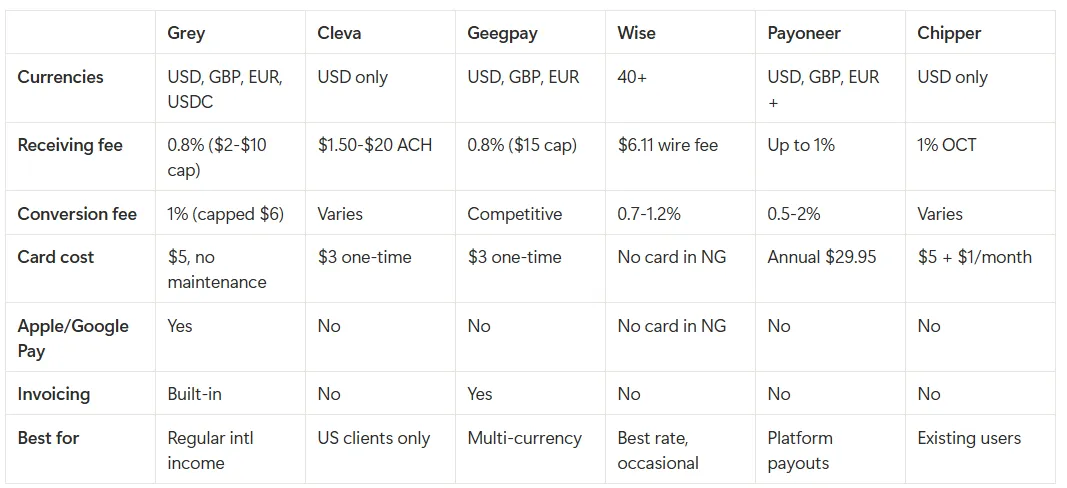
Side-by-side comparison
Which app is right for you?
You earn regularly from international clients in multiple currencies. Grey or Geegpay. Both support USD, GBP, and EUR with competitive fees. Grey adds USDC support, Apple Pay/Google Pay, and built-in invoicing. Geegpay has a slight edge on the receiving fee cap ($15 vs $10 on Grey, but Grey's minimum is lower).
You work exclusively with US clients and only need USD. Cleva. USD-only, but the fee structure is straightforward, and the capped ACH fees are cost-effective for larger transactions.
Your income comes through Upwork, Fiverr, or Amazon. Start with Payoneer for the native integration. But if the fees start eating into your earnings, add Grey or Geegpay for direct client payments and route new income there.
You need the absolute lowest conversion cost per transaction. Wise. The mid-market rate is hard to beat. But without a card in Nigeria or reliable full-service access, it is a transfer tool, not a primary account.
You already use Chipper Cash and just want a dollar card. Chipper's USD card works, but the $1 monthly fee and $0.90 per-transaction fee make it expensive for regular use. Worth it for convenience if you are already in the ecosystem, not worth switching to.
Most Nigerian freelancers managing high international income end up using two platforms: one primary account for receiving and spending (Grey, Geegpay, or Cleva), and Payoneer for marketplace payouts. That combination covers most situations.
Get started with Grey
Grey gives you USD, GBP, EUR, and USDC accounts, a Visa virtual card with Apple Pay and Google Pay, built-in invoicing, and naira withdrawals, all in one app. Sign up at grey.co or download the app to get your account details in minutes.
Note: Exchange rates on Grey are variable and include a margin over the mid-market rate. Fees listed are accurate as of the date of publication and may change. Always check the platform's current pricing before committing.
Frequently asked questions
Which is the cheapest dollar account app in Nigeria?
It depends on your usage pattern. For receiving payments, Grey and Geegpay both charge 0.8% with different caps. Cleva's flat ACH fee ($1.50 to $20) is cheaper for large single transactions. For conversion, Wise offers the lowest rate (0.7% to 1.2% at mid-market) but has no card in Nigeria. For overall value, including a card and multi-currency support, Grey and Geegpay are the most cost-effective for regular use.
Is Grey or Cleva better?
Grey supports USD, GBP, EUR, and USDC. Cleva supports USD only. If you only work with US clients and only need dollars, Cleva's simpler fee structure may work. If you need multiple currencies, a card with Apple Pay support, or an invoicing tool, Grey covers more ground.
Is Payoneer still worth it in 2026?
For marketplace payouts (Upwork, Fiverr, Amazon), yes, because the native integration is hard to replace. For direct client payments, newer platforms like Grey and Geegpay offer better rates and more features. Many freelancers keep Payoneer for platform payouts and use a separate app for everything else.
Do I need a dollar account app or a domiciliary account?
For regular freelance income and online USD spending, a dollar account app is faster, cheaper, and more flexible. A domiciliary account at a Nigerian bank makes more sense for large, infrequent wire transfers or long-term USD storage under banking regulation. Many people use both.
Can I use these apps for business payments?
Most of these platforms are designed for individuals and sole proprietors. If you run a registered business with multiple team members, check whether the platform offers a business tier. Grey offers Grey Business for companies that need multi-user access and business-level features.
Ready to compare for yourself?Sign up at grey.co and get your USD account details in minutes.
One of the earliest challenges remote workers face when working with international clients is how to receive their payments. While you are sure you don’t want to use your Opay, you are not certain your GTB account would work either. You might even have been jumping from one platform to another, only to get disappointed. Maybe you are even considering PayPal now with their recent announcement of partnering with Paga.
Earning in foreign currency has become one of the biggest advantages of remote work for Nigerians. It often means higher purchasing power and better income stability than earning in naira. However, earning in foreign currency is only half the story. How you manage that income determines whether you truly benefit from it or lose a lot to fees, poor exchange rates, and inefficiencies.
This article breaks down how Nigerian remote workers can manage foreign currency income more effectively.
Nigeria’s financial system makes foreign income management a bit of a struggle. Traditional banks don’t manage inbound international payments efficiently, especially for individuals. Payments are delayed, and when they finally arrive, funds are usually converted immediately to naira at unfavourable rates.
By the time you add the high transfer fees and intermediary charges, you can easily relate to the frustration of many remote workers. This environment has pushed experienced freelancers and remote employees to reconsider how they manage their earnings.
How to manage your foreign currency earnings as a remote worker in Nigeria
To ensure you maximise your earnings and have firm control over your cash flow, here are some measures to put in place to manage your foreign currency earnings as a remote worker in Nigeria
Receive income in foreign currency first
You deserve some control over your foreign income. One of the most important principles is avoiding immediate conversion to naira. When your income is converted the moment it arrives, you lose control over timing and exchange rates.
This is why many remote workers are turning to multi-currency accounts that allow them to receive and hold USD, GBP, or EUR directly. This approach offers flexibility. You decide when to convert, how much to convert, and whether to spend directly in foreign currency instead of converting at all. And with the way naira is behaving, keeping your earnings in a stable foreign currency helps preserve its value. Here are some of your options
Cleva: Cleva is a platform that provides Nigerian freelancers with a US-based bank account to receive USD payments from clients, Upwork, or Deel. While it doesn't support receiving payments in EUR and GBP, it features swift USD conversion to Naira, virtual USD cards, and low fees.
Crypto: If your client is familiar with crypto, it is a viable alternative to traditional banks for payments. Payment is instant, and the fee is typically lower than that of traditional banks. Some fintech platforms like Grey support stablecoins like USDC, which helps you streamline your income.
Separate your earnings, savings, and spending
Managing foreign income becomes easier with some structure. Keeping earnings in foreign currency keeps you safe from whatever the naira and the country’s economic policies are up to. Ensure that you convert only what they need for monthly naira expenses. Automate your savings, and this separation improves discipline and reduces the pressure to convert funds impulsively.
Plan your conversion
Exchange rates will always fluctuate, and this should inform how you manage your conversion. Don’t convert money out of urgency or fear because you are more likely to lose more money than you had. Here are some suggestions that can help:
Convert money in smaller batches (especially when the rates don’t look great) rather than all at once
Only convert when you actually need naira
Avoid exchanging during the weekends and in emergency situations
Pay for global tools in foreign currency
Many remote workers don’t realise they're losing money when they pay for international tools and subscriptions in naira. If you earn in USD, pay for these tools directly. It makes sense to pay directly in foreign currency. Virtual USD debit cards like Grey’s make this possible and reduce unnecessary conversion costs.
Managing foreign currency earnings might be unfamiliar territory for many Nigerian remote workers and freelancers. With the right system in place, you can minimise losses and payment delays. With multi-currency accounts for USD, GBP, and EUR, competitive exchange rates, virtual USD cards, and fast local withdrawals, Grey helps Nigerian remote workers receive, manage, and protect their foreign income without unnecessary hassles.
Ghana is among the leading African countries attracting international clients to work with freelancers. From creatives to tech professionals, Ghanaian freelancers own their work and don’t allow time zone differences to become a challenge.
Many of these opportunities come through platforms like Upwork, Fiverr, and other global freelance marketplaces. But beyond securing international gigs, freelancers face one important question: what is the most reliable way to get paid?
Just like other freelancers around the world, Ghanaians need safe and efficient payment options. This article shows how international clients pay freelancers in Ghana, and what you must put in place to ensure you get paid smoothly and on time.
How Ghanaian freelancers receive payments from international clients
Multicurrency accounts
Multicurrency accounts enable Ghanaian freelancers to receive payments in foreign currencies such as USD, GBP, and EUR. This makes it easier to work with international clients without immediate currency conversion. They are popular because they reduce transfer fees, speed up payments, and give freelancers flexibility to hold, convert, or withdraw funds when exchange rates are favourable.
Grey: Grey helps Ghanaian freelancers receive USD, GBP, and EUR easily, offering fast settlements, low fees, virtual foreign accounts, and seamless withdrawals to local banks.
Wise: Wise allows freelancers receive international payments with transparent fees and real exchange rates, supporting multiple currencies, though setup and verification can take longer.
Geegpay: Geegpay provides virtual dollar accounts for freelancers, enabling international payments and quick withdrawals, but with fewer supported currencies compared to other multicurrency platforms
International bank transfers are a common payment method, especially for corporate clients. Payments are sent directly to a Ghanaian bank account but usually take about three business days to reflect. While secure and suitable for larger amounts, the process often involves higher fees, exchange rate charges, and detailed banking information, which can slow things down.
Speed & fees: International bank transfers typically take up to three business days, with processing fees and exchange rate charges that can reduce the final amount received.
Accurate details: Correct account numbers, SWIFT codes, and beneficiary details are integral to avoid delays, failed transfers, or additional charges during international payments.
Mobile money
Mobile money payments are ideal for smaller transactions and quick settlements. Some international clients use platforms that allow TapTap transfers directly to MTN MoMo or Vodafone Cash. This method is fast, convenient, and widely accessible, making it a preferred option for short-term projects, one-off payments, or clients who need a simple, instant solution.
Payoneer
Payoneer is widely used by international freelance platforms like Upwork and Fiverr to pay Ghanaian freelancers. It allows users to receive payments in foreign currencies and withdraw directly to local bank accounts or use a Payoneer card. It’s trusted, reliable, and especially convenient for freelancers working with multiple global clients.
USDT
USDT is gaining steady acceptance among freelancers working with international clients, especially for fast, borderless payments. Its stability makes it attractive for avoiding currency volatility and high transfer fees. In Ghana, peer-to-peer USDT trading continues to grow, with weekly volumes estimated between $8–12 million. This rising activity reflects increasing trust, ease of cash conversion, and growing awareness among freelancers seeking flexible payment alternatives.
Yellow Card enables freelancers receive USDT and other crypto, convert instantly to cedis, and withdraw to banks or mobile money with ease, nationwide availability.
Binance supports P2P USDT trading, allowing freelancers to get paid globally, trade with verified merchants, and enjoy competitive rates, high liquidity, and fast local settlement options.
Getting paid consistently as a freelancer goes beyond landing international clients. You must put a few essential systems in place to avoid delays, disputes, and missed payments.
Active bank account: Maintain an active local bank account that can receive international transfers. Ensure your account is enabled for foreign remittances and linked correctly to any freelance or payment platforms.
Invoice: A clear invoice outlines your services, amount due, currency, payment method, and deadline. It helps clients pay faster, reduces confusion, and creates a professional record for follow-ups and accountability.
Contract: A contract defines scope, timelines, payment terms, and dispute resolution. It protects both parties, builds trust, and ensures clients understand expectations before work begins or payments are released.
LDMAG1
Smart payments with Grey
Ghanaian freelancers are securing more international jobs than ever, and getting paid shouldn’t be the hardest part of the work. As global opportunities grow, having a fast and reliable payment solution is essential. Grey makes this easy by offering secure transactions, quick settlements, and excellent conversion rates. Sign up on Grey or download the app to start receiving international payments smartly and stress-free.
Working from home and earning in foreign currencies has become a dream of many professionals. It offers better earning potential, especially when your local currency is weak, flexibility, and autonomy. Whether you have been a freelancer or remote worker working with local clients, or you are just transitioning from the traditional work structure to the free world of freelancing, then you must know the remote jobs that pay in foreign currency. We have pulled together some top options based on the current gig market.
Oh well, these are the original tech bros. This role entails designing and maintaining software products, apps, and websites. It usually requires programming and problem-solving skills. Tech skills are in high demand globally, and the pay is usually really good. Typical roles range from full-stack developers to frontend engineers, backend engineers, DevOps engineers, mobile app developers, QA engineers, and site reliability engineers (SREs).
Product design and UI/UX
Have you ever used a website or app and just really wanted to leave ASAP because it seemed so tough to figure out? It might just be because the product design and UI/UX might need some work. Product and UI/UX designers structure and design user interfaces, user experiences, and product flows for digital services. Their roles are important because they influence the customer’s perception of the product or service and revenue generation. So, it is easily one of the best-paid remote roles out there. Designers can work as freelancers, on a contract, or in full-time remote roles that pay in foreign currencies. Having a strong portfolio matters more than degrees. You need to be proficient with product design tools such as Figma and Sketch.
Data analysis
The role of the data analyst is like that of detectives who probe systems, manipulate data, and draw inferences to help the team make more informed decisions and have better outcomes. A good data analyst should have an eye for details, spot trends, and identify anomalies. The role also involves representing the data with charts and dashboards (visualisation and reporting). The technical skills that might be relevant include SQL, Python/R, spreadsheets, Tableau, and Power BI.
If you have ever been stuck on a line on the phone waiting to reach a brand’s customer support, then you understand how important their role is. Customers often run into issues when using a product or service, and helping them resolve these conflicts is key to reviews and customer retention. This is where customer support staff come in. It goes beyond phone calls and involves other managing support channels (live chats, emails, social media), helpdesks (Zendesk, Freshdesk), CRM (Salesforce, HubSpot), and project management tools.
LDMAG1
Content marketing
Saving the best for the last. The global market is quite competitive and no one wants to build good products that won’t have enough visibility and adoption. This is why content marketing is in high demand. It entails promoting products and services using media content like blogs, videos, emails, and social media. The roles here range from content strategy to content writing, email marketing, and social media management. Relevant skills in this space include content creation, search engine optimisation, video editing, and content strategy. The tools you might have to work with depend on your role, including keyword research (Ahrefs, Semrush), graphic design (Canva, Adobe Photoshop), SEO (Surfer SEO), CRM (Hubspot, Salesforce), content editing (Grammarly, Hemingway Editor), and workspaces (Notion, Asana).
Where do you find remote jobs that pay in foreign currency?
You can filter your search location on these platforms with "worldwide" or "anywhere" to get global roles. Let’s just make a list of places to look into.
Landing one of these roles can seriously boost your finances, but managing those cross-border payments is key to avoiding losing money to unfair conversion rates and high charges. That's where reliable payment services like Grey come in handy, offering free accounts in USD, GBP, or EUR so you can receive earnings efficiently and convert seamlessly. You can link your Grey account details with global freelancing platforms to receive your payouts without delays and high platform charges.
If you are planning to start freelancing in the Philippines, you need to double up. You don’t have to second-guess your decision. Freelancing in the Philippines is now more mainstream than it was a decade ago. This offers global opportunities, great income potential, and lifestyle flexibility. As 2026 begins, the landscape is more competitive but also more rewarding. Here is a step-by-step guide to set you up nicely as a novice freelancer in the Philippines.
Why should you consider freelancing in the Philippines?
Freelancing remains attractive because it:
Removes location restrictions: Freelancing is a global market. You get the opportunity to work with clients in the US, Europe, Australia, and more.
Pays in stable foreign currencies: Many freelancers earn in USD, EUR, and GBP with better purchasing power and are safe from local economic problems.
Supports flexible schedules: Freelancers have better control over their work structure without strict office hours
Provides autonomy: Be your own boss, choose clients and projects that align with your interests, and avoid traditional workplace drama.
How to start freelancing in the Philippines in 2026
Having a lay of the land helps freelancers transition better and increase their chances of success. Here is a guide to starting a freelancing career in the Philippines in 2026.
Step 1: Choose a globally relevant skill
Some skills are in higher demand internationally. In 2026, the most marketable freelance services include:
Software development (web, mobile, backend, AI tools)
UI/UX and product design
Data analytics, BI, and machine learning
Digital marketing (SEO, performance ads, content strategy)
Copywriting and content creation
Virtual assistance and project operations
Teaching/tutoring online
Step 2: Build a portfolio before chasing clients
This is a ‘show workings’ era. If you claim to have certain skills, you must be able to demonstrate them. Before pitching, create a portfolio that showcases your skills for international clients to have the confidence to hire you.
Your portfolio can include case studies, GitHub repositories (for developers), design samples, writing samples, and even client testimonials. Ensure each sample shows what you did and the outcome.
Step 3: Choose where you’ll find clients
There are various ways freelancers in the Philippines find gigs. Different types of work thrive on different platforms:
Tech-oriented and curated platforms: Toptal, Gun.io, Hired
Remote job boards:Remote.co, We Work Remotely, FlexJobs
Professional networks: Cold messages on LinkedIn and industry communities (Slack, Discord)
Step 4: Set up how you will get paid
One of the biggest practical challenges for Filipino freelancers is reliably and cost-effectively receiving foreign income. To protect your income, set up a multi-currency account that accepts USD, EUR, or GBP payments and supports PHP withdrawals at a competitive rate for your routine spending. Avoid traditional banks and payment platforms that require immediate conversion to PHP, as rates are typically unfavourable. Pay in foreign currency for tools, hosting, and subscriptions when possible. Some of these payment options, such as Grey’s virtual USD debit cards, simplify this.
This is a very tricky part for even expert freelancers – trying find a balance between not charging too low or too high. On one hand, your rate sometimes gives the client a hint of your quality. “If this person is charging this amount, maybe they are really good.” Or they might just opt for a more affordable freelancer. So, setting is both a skill and a strategy. First, you should bill in stable foreign currencies (EUR, USD, or GBP) whenever possible. Start with a sustainable base rate, then increase it as you earn positive reviews and return clients. It is better to price per project than based on time.
Step 6: Create a professional presence
Creating a professional presence is a critical step for aspiring freelancers in the Philippines, as it establishes credibility and trust with potential clients. A strong online presence acts as your digital portfolio, and it is essential to showcase your skills effectively to stand out in a competitive market.
Optimise your LinkedIn profile with a high-quality, professional headshot and a compelling headline that highlights your expertise. List your skills, education, certifications, and work history. Regularly share industry news, your own work, or thoughts to establish authority in your niche
Managing your freelancing income
Starting freelancing in the Philippines in 2026 is realistic and rewarding, but you have to put in the work. It requires building structure, honing skills, and understanding how the freelancing system works, especially for managing payments. Freelancers in the Philippines use Grey for multi-currency accounts (USD, GBP, EUR), competitive exchange rates, and fast, secure transfers to local banks. It helps streamline invoicing, manage payments, and protect earnings for international clients at lower fees than traditional banks.
That question guided every decision behind the new Grey virtual card. We wanted to raise the bar of what your card can do and make everyday spending feel lighter, faster, and more intuitive.
Grey’s new card was designed to simplify global payments, connect directly to your foreign currency balances, enhance security, and seamlessly integrate with Apple Pay and Google Pay.
If your life spans different countries and currencies, this card was built with you in mind.
What makes the new virtual card better
This card was built for the way global citizens actually move, earn, and spend. Here’s what makes it quietly powerful.
Spend directly from your balance
Gone are the days of pausing mid-payment to top up your virtual card.
Your Grey card is automatically connected to your available balances. When you pay, it pulls straight from the right currency, whether that’s USD, EUR, GBP, or NGN. If the funds are there, the payment goes through.
You can book a flight, pay for software, grab lunch abroad, or renew your favourite subscription; your card keeps up without asking you to do extra work.
Add your card to Apple Pay or Google Pay
You can now use Apple Pay and Google Pay (in supported regions) with your Grey Plus Card. That means fast, secure, contactless payments online and in-store, everywhere Visa is accepted.
Tap to pay for groceries.
Tap to board public transport.
Tap to check out online.
Wherever life takes you next, your virtual card is always with you, in your smartphone.
Create multiple spend cards for different needs
You use your money in different ways, so your card should work for all of them.
With Grey, you can create multiple virtual cards for:
Each card can have its own limits and settings, helping you manage your money with clarity and confidence.
Built-in 3D Secure (3DS) protection
With 3D Secure, you’ll be asked to verify transactions yourself, making it much harder for anyone else to use your card without permission. It helps block suspicious activity, prevent fraud, and keep your money protected, all while giving you more control over your payments.
Accepted everywhere Visa works
And of course, the Plus Card is globally accepted, online, on apps, and in physical stores.
You also get access to Visa’s global protections and benefits.
Whether your day involves an airport lounge, an online meeting, or a street market in a city you’re just getting to know, your virtual card is ever ready to complete payments.
Designed with you at the centre
More than anything, this new card reflects how we build at Grey: by listening, improving, and creating tools that match the pace of the world you live in. Your feedback helped shape this upgrade. Your experience guided every decision.
The result is a card that feels lighter, smarter, and more flexible, ready for your next move, whatever and wherever it may be.
Pay from anywhere, in anything
Your new Grey card was made for the kind of days that don’t fit neatly into one country. Maybe you’re earning in dollars this morning, shopping in another currency by lunch, and racing through a couple of airports before dinner. It bends with your plans, slips easily into your routine, and crosses borders as much as you do.
Like many other people, I gave up on freelancing after searching every corner of the earth for opportunities. I later found out I had been looking in the wrong places. Of course, the gig market is highly competitive, but that does not mean there are no jobs. Some other freelancers end up getting exploited by platforms charging high fees or scammers posing as clients.
If you look in the right places, you will find the right jobs. It is not just about signing up to every job board or freelancing platform. Let’s show you how freelancers choose the right platform to work with.
Freelancers consider their skills and roles when choosing a freelancing platform. Those with specialised skills opt for restricted platforms like Toptal, which have highly selective vetting processes. Others might opt for open talent marketplaces with high client volumes. They consider platforms that value their skills and have a high demand for them. Choosing a niche platform can reduce competition, such as 99designs and Dribbble for designers, ProBlogger or ClearVoice for writers and content strategists.
Fee structure
Freelancers consider the fee structure when choosing the platform to work on. Platforms take a cut from freelancers’ earnings. That is not a problem. But when it becomes excessive, it can cause problems for freelancers. Look into:
Platform commission rates
Withdrawal fees
Minimum payout thresholds
Payout frequency and delays
Prioritise platforms that are transparent with the fees to avoid surprises.
If you run into trouble, you want a freelancing platform with accessible support channels for conflict resolution. Freelancers consider the responsiveness of the support team and their reputation. As the talent market keeps growing, you might find more freelancing marketplaces springing up and promising heaven and earth. Freelancers do their research and stick with the reputable ones.
Payment options
The entire point of freelancing is to make money, so freelancers cannot compromise on reliable and flexible payout options. Freelancers choose platforms that protect them from non-payment through escrow systems, milestone releases, or platform-backed dispute resolution. They also consider how easy it is to withdraw earnings and whether they can receive funds in stable currencies like USD, GBP, or EUR without forced conversion. Platforms that integrate well with multi-currency accounts offer greater control and reduce losses from exchange rate fluctuations.
Choosing the right freelancing platform puts you one step ahead of others. You are less worried about being scammed or losing your money to high platform fees. Grey takes it up a notch by offering multi-currency accounts that support USD, EUR, and GBP payments. This means you can link your Grey and directly access your income.



.svg)