It’s 3 am, and the phone is lighting up the ceiling. What if my main client does not renew next month? What if that transfer went to the wrong account number and it has already left? What if the card declines in a city where I know nobody? What if someone at home calls tonight and needs money by morning?
We rarely say these out loud, yet most of us carry some version of them. At that hour, they feel shapeless. In daylight, most turn out to be a few specific risks and a few specific steps.
Five money fears tend to keep people awake: losing income, a payment that never arrives, a transfer sent to the wrong person, running out of money abroad, and an emergency at home. Each is partly rational and partly reducible.
This is how we can get ahead of these worries and how to make each situation easier to handle.
What if I lose my income?
Of the five, this is the one with the most reason behind it. Clients leave, contracts end, companies restructure, and a salary that felt permanent can stop with a month’s notice. We are not being dramatic when we worry about it.
What we can usually reduce is how fast the fear turns into a crisis. Two numbers do most of the work. The first is the cost of one month: rent, food, transport, data, and any fixed obligations such as school fees or loan repayments. The second is how much of your income comes from one source. If a single client or employer pays most of it, losing them hurts differently from losing one of five.
Always have a buffer of one month’s costs, kept somewhere separate from the account you spend from, like in a Pouch. One month is not a deep cushion but it’s enough to turn a sudden stop into a few weeks of choices instead of a few days of panic. From there, three months is a common target if you can reach it.
This is not to forsee stalled income but to be prepared if it does.
What if the payment never comes through?
Late payment is perhaps the least troubling of the five, because it does not feel like a disaster. It feels like waiting, refreshing the account, and drafting a polite email for the third time. Invoices do get paid late, and some clients, rather annoyingly, treat the due date, as a suggestion.
Part of the fear can be shrunk before you send an invoice. Here's what you can do:
- State the due date and the payment method in writing, and agree what happens if the date passes, such as a late fee or a pause on work. Ask for a deposit on larger jobs so you are never fully exposed.
- Check that the name on your invoice matches the name on the account that will receive the money. Many banks and payment providers hold a payment for review when the sender's details and the receiving account name do not match, and you may be asked for documents before it is released. A payment can be on its way and still not be spendable.
- A follow-up routine helps too: a reminder two days before the due date, one on the day, and one a week later. A scheduled message is easier to send than an anxious one.
What if I send money to the wrong person?
This is the fear with the sharpest edge, because many transfers cannot simply be taken back. Once a bank transfer has left, getting it returned usually depends on the receiving bank, and on the person who received it, more than on how quickly we notice.
What we can reduce is the chance of it happening, and how fast we act if it does:
Check the account number, the bank, and the name twice, and read the digits out loud instead of skimming them.
For a large amount or a new recipient, send a small test first and confirm it arrived before sending the rest.
Save a recipient only after a transfer has landed with them, so the saved details are the ones that worked.
If something goes wrong, contact your bank or provider straight away, with the date, amount, reference, and recipient details ready.
Be honest about the odds. Recalls depend on the receiving bank, can carry a fee, and do not always succeed. Speed improves the chances. It does not guarantee a return.
We cannot remove this fear completely, and we should not pretend to. We can make the mistake less likely and the response faster, which is most of what is in our control.
What if I run out of money abroad?
Being abroad changes the shape of this worry. At home, a failed card is an annoyance at best. Somewhere else, it can mean a missed ride, a stalled hotel check-in, or a long call to a bank that is closed. Some of the fear is justified: cards do get declined abroad, banks do flag unfamiliar transactions, and the exchange rate at a till can be worse than the one on your phone.
These steps can help:
Carry a second way to pay that does not depend on your main card, ideally from a different provider, and keep it apart from your main card.
Keep a small amount of cash in the local currency for the first day.
Keep a buffer in the currency you will be spending, not only in naira, so a swing in the exchange rate does not shrink your trip while you are on it.
Check what each card charges for payments abroad before you leave, because the fee can differ a lot from one card to another.
The part of this fear that is not rational is the idea that one failed payment means everything has failed. Usually, it means we need the second option, and the point of having one is that the first failure becomes a small event.
This is the fear that does not stay in our own heads, because it arrives as a phone call and a familiar voice. Money for a hospital deposit or a parent's rent is needed quickly, and to a specific place. An emergency usually comes with a deadline, and the person usually asking cannot wait for an exchange rate to improve.
In these instances, what you can decide in advance is the route and the amount. Know how money reaches that person: which bank, which account name, which details, and whether it can arrive at all on a weekend or a public holiday. You can confirm the details and when you are a little calmer, in a calm moment, send what you can without without putting your housing or tuition and other commitments at risk.
Transfer times vary by route and by day, so learn how long your usual route takes before you need it, not on the day. Treat any delivery estimate as an estimate, and leave room around bank cut-off times.
We carry this fear because we care about the people on the other end of it. That is not something to fix. What we can do is make the next call a little less frightening by doing the dull preparation before it comes.
Frequently asked questions
Can you reverse a bank transfer sent to the wrong person?
Sometimes, but not always. It depends on the receiving bank, the type of transfer, and whether the money has already been spent. Contact your bank or provider immediately, because speed improves the chances, and expect that a fee may apply.
What should I do first if I sent money to the wrong account?
Contact your bank or provider straight away. Have the date, amount, transaction reference, and the recipient's details ready, and say what went wrong in plain terms. Do not wait to see whether the recipient notices.
How big should my emergency fund be if my income is irregular?
Start with one month of essential costs, then build towards three to six months. People with irregular income often aim for the higher end, because a gap can last longer. These are general guidelines, not financial advice.
Why is my payment pending or on hold?
Providers often hold a payment for verification when the sender's details and the receiving account name do not match, or when more information is needed about the source of the funds. You may be asked for documents before the money is released.
How do I avoid running out of money when I travel?
Carry two ways to pay from different providers, keep a little cash in the local currency, keep a buffer in the currency you will spend, and check each card's fees for payments abroad before you leave.
Is it normal to be anxious about money?
Yes. Money worries are common, and some of them are rational. A useful way to handle them is to separate the part that is a real risk from the part that is not, and then act on the part you can change.
Fees and rates: deposits by ACH, SEPA, or Faster Payments cost 0.8%, with a minimum of $2, €2, or £2 and a maximum of $10, €10, or £10. Currency conversion costs 1%, capped at $6. Withdrawals to a Nigerian bank account cost ₦35. A virtual card costs $5 to create, once, with no monthly fee, and payments on non-US websites can carry a cross-border fee of 2% plus $0.50. A recall of a USD, EUR, or GBP payment carries a fixed fee of $50, €25, or £25, even if it fails. Exchange rates vary with a margin over the mid-market rate.
If you live in Nigeria and get paid from abroad, yes: since 1 January 2026 the Nigeria Tax Act taxes your foreign salary, freelance fees and platform payouts at the same 0% to 25% rates as local pay. Because no Nigerian employer deducts PAYE for you, you work out the tax yourself, declare it to your state tax authority and pay by 31 March of the following year. That makes 31 March 2027 the deadline for your first full year under the new rules.
The WhatsApp group version of this story swings between panic ("they're taxing every dollar that lands") and denial ("they can't see my USD account"). Neither is right. Below, I'll show you who counts as resident, what's taxed and what isn't, how a ₦24 million income works out, and what to keep so filing takes an afternoon, not a week.
This guide is general information, not tax advice. For your own situation, speak to a chartered tax practitioner or your state tax authority.
Do remote workers in Nigeria pay tax on foreign income?
Yes, if you're a Nigerian tax resident. PwC's Nigeria tax summary (reviewed 29 May 2026) puts it plainly: individuals resident in Nigeria are taxed on their worldwide income. Where the employer or client sits, and which currency they pay in, doesn't change that.
Non-residents are different. Taiwo Oyedele, chair of the Presidential Fiscal Policy and Tax Reforms Committee, said income earned abroad and brought into Nigeria by a non-resident is now specifically exempt (P.M. News, 29 October 2025).
So the first question isn't "how much do I earn?" It's "am I resident?"
Are you a Nigerian tax resident? It's not only the 183-day rule
Most explainers stop at 183 days. Under the new Act you're resident if any one of these applies, according to PwC's residence summary (reviewed 29 May 2026):
You're domiciled in Nigeria.
You keep a permanent home available for your use in Nigeria.
You have a place of habitual abode in Nigeria.
You spend at least 183 days in Nigeria in any 12-month period, counting temporary absences.
You have substantial economic ties or immediate family ties in Nigeria.
You serve abroad as a Nigerian diplomat.
Read that list again if you split your year between Lagos and somewhere else. A flat you keep in Nigeria, or a spouse and children living here, can make you resident even if you spend fewer than 183 days in the country. To count as non-resident, none of the tests can apply.
If you live and work in Nigeria full time, you're resident. The rest of this guide is for you.
What foreign income is taxed, and what isn't
Taxable income is money you earn from work, business or investments. Money that simply moves to you, like a gift from family, is not. Here's how the common cases fall under the new rules:
Type of income
Taxed in Nigeria if you're resident?
Salary from a foreign employer
Yes, as employment income
Freelance or contract fees from overseas clients
Yes, as business or professional income
Platform payouts (YouTube, Upwork, Fiverr, TikTok and similar)
Yes
Profits from selling digital assets such as crypto
Yes (losses only offset gains from similar transactions)
Interest on a foreign currency domiciliary account
Yes, it is no longer exempt
Foreign dividends, interest, rent or royalties brought in through government-approved channels
Exempt
Genuine family remittances and gifts
Not treated as taxable income
Sources: PwC Worldwide Tax Summaries, Nigeria significant developments (reviewed 29 May 2026); Oyedele on remittances via P.M. News (29 October 2025).
Two rows surprise people. Interest on a foreign currency domiciliary account used to be exempt and no longer is. And if your sister in London sends you £200 for your birthday through a UK to Nigeria transfer, that's a remittance, not income, so it stays out of your return.
Does it matter that the money lands in a USD account?
No. Tax follows the income, not the account. Fees paid into a dollar account, a domiciliary account at a Nigerian bank or a Grey USD account are all taxable for a resident, and none of them are taxed twice just for being moved around.
Your return is in naira, so convert each payment at the exchange rate on the day you received it and write down the rate you used. Techpoint Africa's guide for remote tech workers (5 May 2026) reports that the Nigeria Revenue Service expects the official Central Bank of Nigeria rate, not the parallel-market rate. You can check today's USD to NGN or GBP to NGN rate as a reference, but keep the CBN figure for your records.
Converting your own dollars to naira is not new income. Count the payment once, when it arrives, and don't add it again when you convert or withdraw it.
PAYE or self-assessment: which applies to you?
PAYE (pay as you earn) only works when someone in Nigeria runs payroll for you. A foreign company paying you directly has no reason to do that. As Oyedele put it in November 2025, if you earn it from "XYZ Limited in the Bahamas, you have to declare your income yourself" (Nairametrics, 13 November 2025).
Your setup
Who deducts tax?
What you do
Employed by a Nigerian company
Your employer, through PAYE
Check your payslip; file your own return too
Employed directly by a foreign company with no Nigerian entity
Nobody
Self-assess and pay your state tax authority
Hired through an employer-of-record with a Nigerian entity
Usually the Nigerian entity, through PAYE
Confirm PAYE appears on your payslip
Freelancer or contractor paid by overseas clients
Nobody in Nigeria
Self-assess on your profit after expenses
Freelancer paid by Nigerian companies
The client may deduct withholding tax
Keep the receipts and claim the credit when you file
Not sure which box you're in? Our guide to freelancer vs employee tax explains the difference between salary and contract income.
The 2026 personal income tax bands
The Act replaced the old bands and the consolidated relief allowance with a simpler scale. The first ₦800,000 of taxable income is tax-free for everyone, and the top rate is 25%.
Each rate applies only to the slice of income inside its band. Earning ₦1 more than ₦12 million doesn't push your whole income into the 21% band, only that extra naira.
Worked example: what ₦24 million of foreign income costs in tax
Say your foreign pay for 2026 converts to ₦24,000,000 and you pay ₦2,000,000 a year in rent. One version of you is a remote employee; the other is a freelancer with ₦1,500,000 of genuine work expenses. Here's the arithmetic:
Line
Remote employee (₦)
Freelancer (₦)
Foreign income converted to naira
24,000,000
24,000,000
Business expenses (software, internet, payment fees)
0
1,500,000
Rent relief (20% of ₦2,000,000 rent)
400,000
400,000
Taxable income
23,600,000
22,100,000
Tax on first 800,000 at 0%
0
0
Tax on next 2,200,000 at 15%
330,000
330,000
Tax on next 9,000,000 at 18%
1,620,000
1,620,000
Tax on the remainder at 21%
2,436,000 (on 11,600,000)
2,121,000 (on 10,100,000)
Total tax for the year
4,386,000
4,071,000
Share of gross income
18.3%
17.0%
Illustrative figures using the bands and rent relief in PwC Worldwide Tax Summaries (reviewed 29 May 2026). Calculated 28 November 2026; your own figures will differ.
Two lessons sit in that table. Keeping expense receipts saved the freelancer ₦315,000. And the effective rate (about 17% to 18%) is well below the 21% headline band, because the lower slices are taxed at 0%, 15% and 18%.
Deductions and reliefs you can claim
There's no blanket deduction, so you only get what you can document. PwC's deductions summary (reviewed 29 May 2026) lists these for individuals:
Rent relief: 20% of the annual rent you pay, capped at ₦500,000, as long as you declare the rent accurately.
Pension: contributions under the national pension scheme.
National Housing Fund (NHF) and National Health Insurance Scheme (NHIS) contributions.
Life assurance premiums for you and your spouse, including deferred annuities.
Interest on a loan to build an owner-occupied home.
Business expenses for freelancers: costs incurred wholly and exclusively to earn the income.
Already paid tax abroad on the same income? Nigeria gives a credit, either under a double taxation agreement or through unilateral relief where there's no treaty, per PwC. There's no treaty with the US, and most US clients don't withhold tax from overseas freelancers who submit a W-8BEN form, so for many remote workers there's simply nothing to credit.
How to register, file and pay
Get your Tax ID. The Nigeria Tax Administration Act 2025 requires every taxable person to register with the relevant tax authority. You can check whether you already have one with your NIN on the Tax ID lookup portal.
Register with your state tax authority. Residents pay personal income tax to the state they live in. In Lagos, that's the LIRS eTax portal, which TechCabal (April 2026) reports is now the only approved filing channel.
File your return by 31 March. Oyedele confirmed that individuals "must file returns by 31st March of the year in respect of the previous fiscal year" (ThisDay, 1 February 2026). Declare all your income in naira, including foreign income.
Pay what you owe. Pay through your state portal or its designated banks and keep the receipt.
Missing the deadline costs money. Under the Nigeria Tax Administration Act, failing to file attracts ₦100,000 in the first month and ₦50,000 for each month after, and failing to register attracts ₦50,000 then ₦25,000 a month (Banwo & Ighodalo, via Mondaq, 16 December 2025).
Records to keep, and how Grey statements help
The Act requires records to be kept for at least six years after the year of assessment they relate to (Nigeria Tax Administration Act 2025, section 31(5)). For a remote worker, that means:
Record
Why you need it
Contracts and offer letters
Show who paid you and for what
Invoices and platform payout reports
Prove the gross amount before fees
Account statements for each currency
Show the date and amount of every payment received
The exchange rate used for each payment
Backs up your naira figures
Receipts for work expenses
Support every deduction you claim
Rent receipts or tenancy agreement
Support your rent relief
Proof of foreign tax paid, if any
Needed to claim a credit
Withholding tax receipts from Nigerian clients
Needed to claim the credit
If you receive USD, GBP or EUR into Grey, you can download a statement for any supported currency and any date range from the web app or mobile app; on mobile it's sent to your registered email. Our guide shows how to download statements step by step. One statement per currency, per year, covers most of the "when and how much" questions a tax officer will ask.
If you bill clients directly, Grey's free invoicing tool creates PDF invoices you can email or save, which gives you a clean record of the gross amount each client owed. Grey is a financial technology company, not a bank, and it doesn't file or calculate your taxes for you, so treat these as your evidence, not your return.
A simple habit helps most: when each payment lands, note the gross amount, any fee, the date and the naira rate in one spreadsheet. In March, you add up one column instead of hunting through a year of emails.
Frequently asked questions
I live abroad and work remotely. Do I pay tax in Nigeria?
Not on income you earn abroad, as long as none of the residence tests applies to you. Non-residents are taxed only on income from Nigeria, such as Nigerian rent or dividends. Keeping a home or immediate family here can make you resident, so check every test, not just the 183 days.
Can the tax authority see my foreign income?
Increasingly, yes. In November 2025 Oyedele said Nigeria has an agreement with over 100 countries that are already sending data about Nigerians with money and property abroad. Declaring the income yourself is far cheaper than explaining it later.
Is money my family sends me from abroad taxed?
No. Genuine personal transfers such as family remittances are not treated as taxable income. Payment for work is different, even if a relative pays it.
Do I pay tax when I convert dollars to naira?
Converting money you've already counted as income doesn't create a second income tax charge. If you hold large foreign currency balances and convert after big exchange rate moves, ask a tax adviser how any gain should be treated.
When is my first return under the new rules due?
Income you earn in 2026, the Act's first full year, goes on the return due by 31 March 2027. Check with your state tax authority in case it announces a different date, as Lagos did when it extended the 2026 deadline to 14 April as a one-off.
Get it right once, then it's routine
The new rules ask one thing of remote workers that the old informal habits didn't: own the paperwork, because nobody else is deducting tax for you. Work out whether you're resident, keep a record of every payment in naira, claim the reliefs you're entitled to and file by 31 March.
Do that for one year and every year after is a copy of the first. If you want your foreign income landing in one place with statements ready for March, open an account on Grey, and take your figures to a chartered tax practitioner if your situation is anything but simple.
Getting a job in Qatar can be a serious career move. With opportunities across oil and gas, construction, healthcare, aviation and hospitality, the country continues to attract foreign workers looking for better-paying jobs and international work experience. But before you start updating your CV and scrolling through job listings, there's one important detail to consider: will your prospective employer sponsor your work visa?
For many foreigners, getting hired is only half the battle. You also need an employer willing to handle the paperwork that allows you to live and work legally in Qatar. This is why targeting companies with established international recruitment processes can save you time, effort and unnecessary disappointment.
The good news is that several major employers in Qatar recruit foreign talent across different professional levels. From engineers and healthcare workers to drivers, technicians, hospitality staff and corporate professionals, there are opportunities worth exploring.
In this guide, we've rounded up 31 companies that work visa Qatar applicants can look into when searching for employment. We cover the industries they operate in, the kinds of roles they recruit for and where to find their career opportunities.
We also explain how work visa sponsorship works, what to expect during the application process and the documents you may need to prepare. Whether you're applying from Africa, Asia, Europe or elsewhere, here's a practical starting point for finding an employer in Qatar.
How work visa sponsorship works in Qatar
Before applying to any of the companies on this list, it's important to understand how Qatar's work visa sponsorship system operates. Unlike a tourist visa, a work visa requires an employment arrangement with a company authorised to recruit foreign workers. This means you generally need a confirmed job offer before your employer can begin the sponsorship process.
In Qatar, the employer acts as your sponsor and is responsible for initiating the necessary work authorisation and residency applications through the relevant government authorities, including the Ministry of Labour and Ministry of Interior.
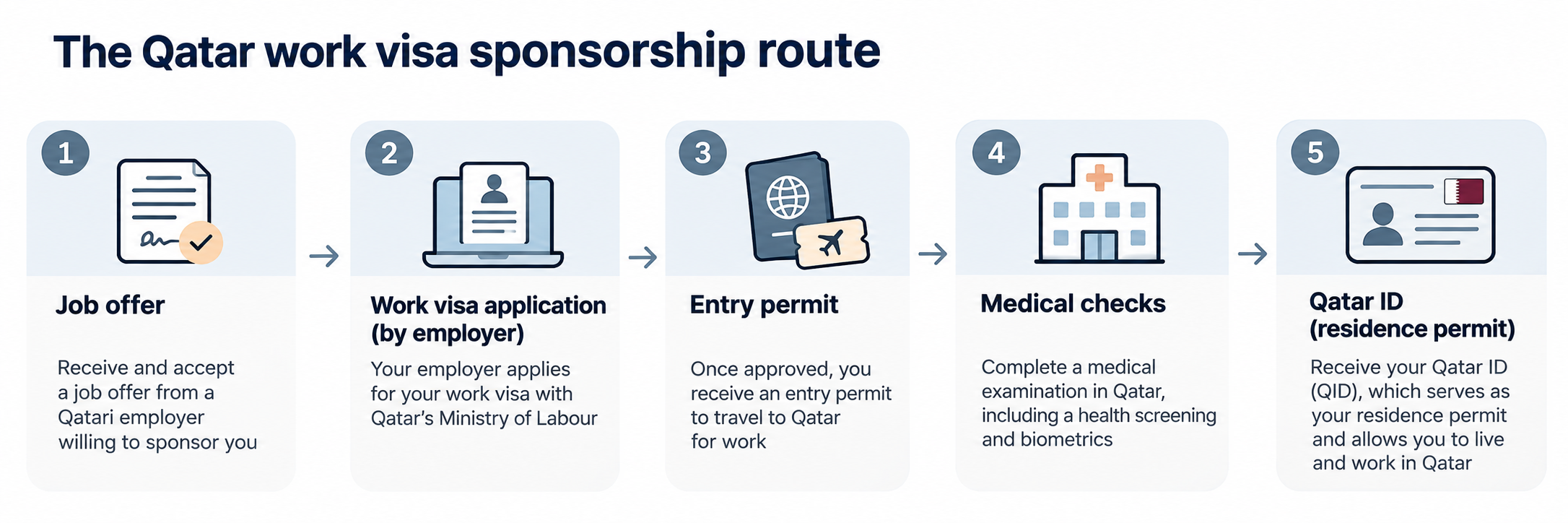
The process typically involves the following steps:
1. Secure a job offer: Apply for a vacancy, attend interviews and sign an employment contract with a Qatari employer.
2. Work visa approval: Your employer applies for the necessary work authorisation and entry visa.
3. Prepare your documents: Depending on your nationality and job category, you may need your passport, educational certificates, professional qualifications, police clearance and medical examination results.
4. Travel to Qatar: Once your entry visa is approved, you can travel to Qatar to take up employment.
5. Complete residency formalities: After arrival, you generally undergo medical examinations and biometric registration before your employer arranges your Work Residence Permit (RP) and Qatar ID (QID).
For foreign nationals comparing employment opportunities across the Gulf, Qatar is not the only destination attracting international workers. Saudi Arabia also recruits foreign professionals across several industries, and companies in Saudi Arabia that sponsor work visas offer another avenue worth considering when assessing employment opportunities in the region.
Can you change employers after arriving in Qatar?
Yes. Qatar abolished the No Objection Certificate (NOC) requirement for changing jobs. However, workers must still follow the applicable notice periods and official employer-transfer procedures.
Before accepting an offer, confirm that the employer will handle your work authorisation and residence permit. Also, remember that Qatari law prohibits employers from charging workers recruitment fees.
31 Qatari companies that sponsor work visas
Qatar has employers across several industries that recruit international talent, from oil and gas engineers to healthcare professionals, aviation staff, IT specialists and hospitality workers. The following companies are worth considering when searching for companies that sponsor work visas for Qatar applicants.
Sponsorship is subject to the role, qualifications, recruitment needs and the employer's current hiring policy. Not every vacancy comes with visa sponsorship, so confirm this before accepting an offer.
Oil, Gas & Energy
1. QatarEnergy: Qatar's state-owned energy company recruits international engineers, geoscientists, project managers and technical specialists across its oil and gas operations.
2. QatarEnergy LNG: One of the world's leading LNG producers, it offers opportunities in engineering, plant operations, maintenance, safety and technical management.
3. Qatar Shell: Shell's Qatari operations include the Pearl GTL project, with potential roles for chemical engineers, process specialists and project professionals.
4. TotalEnergies Qatar: The international energy company's local operations offer opportunities in engineering, offshore operations, drilling, safety and energy project management.
5. North Oil Company: Operating the Al-Shaheen offshore oil field, this joint venture between QatarEnergy and TotalEnergies recruits offshore engineers, technical specialists and operations personnel.
Aviation, maritime & logistics
6. Qatar Airways: Qatar's national airline recruits pilots, cabin crew, aircraft engineers, customer service professionals and corporate staff from international markets.
7. Qatar Aviation Services (QAS): Its ground-handling operations create opportunities in passenger services, cargo handling, ramp operations and airport support.
8. Nakilat: A major LNG shipping and maritime company, Nakilat recruits marine engineers, naval architects, vessel operators and shipyard specialists.
9. Milaha: This maritime and logistics company offers roles in shipping, port operations, supply chain management and vessel services.
10. Gulf Warehousing Company (GWC): GWC operates across logistics, warehousing and supply chain management, recruiting warehouse supervisors, fleet coordinators and logistics professionals.
11. Mwani Qatar: The organisation responsible for managing Qatar's ports offers opportunities in maritime operations, port management and logistics.
Engineering, construction & infrastructure
12. Qatar Rail: The state-owned company behind Doha Metro and Lusail Tram offers opportunities in railway engineering, infrastructure maintenance, project management and transport operations.
13. Al Jaber Engineering: A major construction contractor in Qatar, recruiting civil engineers, quantity surveyors, site supervisors and construction managers for infrastructure projects.
14. Galfar Al Misnad: This engineering and contracting company operates in construction, oil and gas and facility management, with roles for technicians, engineers and project supervisors.
15. AECOM Qatar: The international infrastructure consultancy recruits architects, urban planners, civil engineers and project management specialists for major development projects.
16. Mannai Corporation: A diversified Qatari conglomerate with business interests in engineering, automotive, technology and heavy equipment, offering opportunities across technical and corporate departments.
Technology & Telecommunications
17. Ooredoo Group: Qatar's leading telecommunications provider recruits network engineers, cybersecurity professionals, software developers and digital technology specialists.
18. Tata Consultancy Services (TCS Qatar): The global IT consulting company offers opportunities in software development, systems analysis, business technology and digital transformation.
19. Accenture Qatar: Its consulting and technology operations recruit cloud engineers, data analysts, cybersecurity specialists and business consultants.
20. Talabat Qatar: The regional delivery platform has opportunities in software development, logistics, marketing, commercial operations and business management.
Healthcare, education & media
21. Hamad Medical Corporation (HMC): Qatar's principal public healthcare provider recruits international doctors, nurses, pharmacists, laboratory scientists and allied health professionals.
22. Qatar Foundation: This organisation supports education, research and innovation, offering opportunities for international educators, researchers and administrative professionals.
23. Hamad Bin Khalifa University (HBKU): Located in Education City, HBKU recruits international lecturers, researchers, postdoctoral fellows and academic support staff.
24. Nord Anglia Education Qatar: Its international school operations recruit qualified teachers, school administrators, department heads and education professionals.
25. Al Jazeera Media Network: Headquartered in Doha, the international broadcaster employs journalists, producers, editors, camera operators and broadcast technology specialists.
Hospitality, retail, food & finance
26. Katara Hospitality: Qatar's international hotel investment and operating company offers opportunities in hotel management, culinary services, guest relations and hospitality operations.
27. Hilton Qatar: With hotels across the country, Hilton recruits chefs, receptionists, housekeeping staff, hotel managers and customer service professionals.
28. Accor Qatar: The hospitality group operates several hotel brands in Doha, creating opportunities in food services, front-office operations, housekeeping and hotel management.
29. Al Meera consumer goods: This major Qatari supermarket retailer recruits store managers, cashiers, supply chain professionals and retail operations staff.
30. Baladna: One of Qatar's leading dairy and food producers, Baladna offers opportunities in food technology, agricultural operations, manufacturing and quality control.
31. PwC Qatar: The professional services firm's Doha office recruits auditors, accountants, tax consultants, financial analysts and business advisory professionals.
How to get a work visa sponsorship in Qatar
Finding a company willing to sponsor your work visa is the first step, but knowing where to apply and how to prepare your documents can make the process much easier. Most Qatari employers advertise vacancies through their official websites and international recruitment platforms. Here are some practical steps to improve your chances of getting hired.
1. Where to apply
Start with the official careers pages of the companies listed above. You can also find vacancies through international recruitment platforms such as:
LinkedIn: Search for Qatar-based vacancies and follow company recruitment pages for new openings.
Bayt: Find opportunities across engineering, healthcare, finance, hospitality and other industries.
GulfTalent: Browse professional and managerial vacancies across the Middle East.
Company websites: Apply directly through verified employer recruitment portals rather than relying on unverified job advertisements.
Although requirements vary by employer and job category, you should generally have the following ready:
A valid international passport.
An updated CV and relevant work experience records.
Educational certificates and professional qualifications.
Attested academic documents, where required.
Police clearance certificate, if requested.
Passport-sized photographs.
Medical fitness results, when required during the visa process.
3. Tips to improve your chances
Tailor your CV to the position, highlight relevant experience and include professional certifications. Ensure your qualifications are properly authenticated where necessary, and begin the attestation process early because it can take time.
Most importantly, verify that your employer will arrange your work authorisation and residence permit before accepting an offer. Qatar's Labour Law prohibits employers from charging recruited workers recruitment fees, so be cautious of agents demanding payment for guaranteed jobs or visas.
Sending money from Qatar to Nigeria
Working in Qatar may put your earnings in a different currency, but you can still support family and manage expenses back home without the usual transfer stress. Grey makes this easier with a platform designed for international money transfers and multiple-currency transactions.
With Grey, you can send money from Nigeria and manage transfers across supported currencies at competitive exchange rates and with low fees. You can also hold, receive and send multiple currencies, making it easier to handle payments across borders without constantly switching between financial platforms.
Grey is registered with financial regulators, including FinCEN in the US and FINTRAC in Canada, and uses security measures to protect users' accounts and transactions.
Once you've settled into your new job and your account is eligible, Grey's card also makes online shopping convenient, whether you're buying from international stores or paying for subscriptions.
Frequently asked questions about Qatar work visa sponsorship
1. Which companies sponsor work visas in Qatar?
Major employers include QatarEnergy, Qatar Airways, Hamad Medical Corporation, Ooredoo, Qatar Foundation, Nakilat, Milaha, Al Jaber Engineering, Galfar Al Misnad, Accenture and Hilton Qatar. These companies recruit foreign professionals across different industries, although sponsorship depends on the vacancy and the employer's current recruitment policy.
2. How does work visa sponsorship work in Qatar?
Your employer initiates the work authorisation and residence permit process through Qatar's relevant government authorities. This includes obtaining work-entry approval and arranging your Qatar ID (QID). Under Qatari labour law, employers cannot charge recruited workers recruitment fees. Always confirm which visa-related expenses your employer covers before accepting an offer.
3. Do I need a job offer before applying?
Yes. You generally need a formal employment offer and contract from a Qatari employer before obtaining a standard work visa. Your employer acts as your sponsor and initiates the necessary applications. You cannot independently obtain a standard employer-sponsored work residence permit without an eligible sponsoring employer in Qatar.
4. Which sectors hire the most foreign workers?
Qatar's major employment sectors include oil and gas, construction, engineering, healthcare, aviation, hospitality, information technology and logistics. These industries recruit international professionals for technical, operational and managerial positions. Opportunities vary depending on qualifications, experience and current labour market demand.
5. Can I bring my family to Qatar?
Yes. Foreign workers with valid residence permits can apply to sponsor eligible family members, subject to Qatar's immigration requirements. Eligibility depends on factors such as salary, profession, accommodation and supporting documents. A commonly cited salary threshold is QAR 10,000 monthly, although qualifying conditions should be checked against current rules.
6. How can I send money from Qatar to Nigeria?
You can send money from Qatar to Nigeria through licensed remittance providers, banks and authorised exchange houses. Grey also supports international transfers and multiple currencies, making it easier to manage your earnings and financial commitments back home. Compare exchange rates, transfer fees and delivery times before choosing a provider.
7. Can I change employers after arriving in Qatar?
Yes. Qatar abolished the No Objection Certificate (NOC) requirement for changing employers. However, you must follow the applicable notice period and official employer-transfer procedures. Ensure your new employment arrangement is properly registered before starting work with another company
The US universities with the highest acceptance rates admit nine or more of every ten international students who apply. On the latest U.S. News figures (fall 2023 admissions, published in the 2025 Best Colleges edition), the University of Mississippi accepted 98.96% of international applicants. Missouri Southern State University (98.45%), UNC Pembroke (98.16%) and Kansas State University (98.01%) were close behind.
That is remarkable when the average across the 360 ranked universities that reported this number was 39.1%. But for a student in Lagos, Accra or Nairobi, the offer letter is rarely the hard part. The harder tests come after it: proving you can pay for a full year before the school issues your I-20, and getting the visa.
Below are all 15 schools on that list, what six of them say a year costs an international undergraduate, the steps from offer to visa, the 2026 visa restriction every Nigerian applicant needs to know about, and how to pay a US school from abroad without losing money in fees.
The 15 US universities with the highest acceptance rates for international students
U.S. News ranked these universities by the share of international first-year applicants they admitted for fall 2023, using data the schools reported. Only ranked universities that received at least 500 international applications were counted, so very small colleges are not on the list.
#
University
International acceptance rate, fall 2023 (%)
U.S. News 2025 rank and category
1
University of Mississippi (Ole Miss)
98.96
171 (tie), National Universities
2
Missouri Southern State University
98.45
131 (tie), Regional Universities (Midwest)
3
University of North Carolina at Pembroke
98.16
41 (tie), Regional Universities (South)
4
Kansas State University
98.01
165 (tie), National Universities
5
St. Cloud State University (Minnesota)
96.66
98 (tie), Regional Universities (Midwest)
6
University of South Dakota
96.07
273 (tie), National Universities
7
University of Kansas
95.28
152 (tie), National Universities
8
Northern Arizona University
95.16
244 (tie), National Universities
9
South Dakota State University
93.60
266 (tie), National Universities
10
School of Visual Arts (New York)
92.97
120 (tie), Regional Universities (North)
11
Wright State University (Ohio)
91.82
392 to 434, National Universities
12
Penn State Behrend
91.02
138, Regional Universities (North)
13
Kent State University (Ohio)
90.56
231 (tie), National Universities
14
Murray State University (Kentucky)
90.37
20 (tie), Regional Universities (South)
15
University of Massachusetts Dartmouth
90.18
244 (tie), National Universities
Source: U.S. News & World Report list of universities with the highest acceptance rates for international students, fall 2023 data, as republished by WTOP on 24 October 2024. These are the most recent international-only figures we could verify on 27 November 2026, and rates move every year, so check each school's latest number before you apply.
Most of these schools are large public universities in the Midwest and South. Nine of the 15 are in the U.S. News National Universities category, so a high acceptance rate here does not mean a small or unknown college.
A high rate is still not guaranteed entry. Each school sets its own minimum grades and English test scores, and the rate only shows how many of the students who applied were admitted.
What a year costs at six of these universities
Before a US university issues your I-20, the form you need for an F-1 student visa, it asks you to prove you can pay for your first year. The University of Kansas, for example, says you must submit proof of financial support before it can issue an I-20.
So the number that decides whether you can go is not the acceptance rate. It is the yearly cost the school expects to see covered in your bank statements or sponsor letters.
Tuition and fees ($33,854) plus living costs, books and health insurance ($18,424)
Checked 27 November 2026 on each university's international admissions or cost page. Kent State and Northern Arizona label their figures 2026-2027; the other four pages do not state an academic year.
Here is what most "easy admission" lists leave out. On these numbers, getting into Kansas State is close to a formality, but its I-20 amount asks you or a sponsor to show $48,769 for the year. South Dakota State admits a slightly smaller share of international applicants, yet its own estimate is about $19,000 lower.
So when you compare high-acceptance schools, sort them by the yearly cost you can prove, not by the acceptance rate. A 93% chance at a school you can fund beats a 98% chance at one you can't. If the figure is out of reach, look at study abroad funding before you rule a school out.
From offer letter to visa: the steps in order
Apply to each school. Check the international application fee, deadline and English test requirement on its admissions page.
Accept your offer and send financial documents. The school checks that your bank statements or sponsor letters cover its yearly estimate, then issues your I-20.
Pay the SEVIS I-901 fee. It is $350 for F-1 students, according to US Immigration and Customs Enforcement.
Complete the DS-160 and book your visa interview. Check the current application fee on the State Department fees page.
Pay your deposit or first-semester tuition. Ask which payments are refundable if your visa is refused, before you send anything.
Our student visa guide covers the DS-160 and the interview in more detail.
Nigerian applicants: check the 2026 visa restriction first
Since 1 January 2026, Presidential Proclamation 10998 has partially suspended new US visas for Nigerian nationals, including F and M student visas and J exchange visas. The University of North Texas international office, in an update current as of 16 November 2026, still lists Nigeria among the partially restricted countries, alongside Benin, Côte d'Ivoire, Senegal, Tanzania, Zambia and Zimbabwe.
The US Mission in Nigeria said in February 2026 that Nigerians who already hold valid F-1 or J-1 visas are not affected. If you don't yet have a student visa, an offer letter will not get you one while the restriction stands, apart from limited exceptions, so hold off on non-refundable deposits until you have checked the latest position with the school and the US Embassy.
Ghana, Kenya, Egypt and Pakistan were not on the full or partial lists on that page when we checked on 27 November 2026. The rules changed in June 2025 and again in December 2025, so check again before you pay.
How to pay a US university from Nigeria, Ghana or Kenya
Once you have an I-20 and a visa route, the next job is moving tuition from naira, cedis or shillings into dollars at the school. If your university accepts a domestic US bank transfer (ACH), you can send USD to it from a Grey USD balance.
Grey's published ACH terms, checked 27 November 2026: each transfer can be $10 to $5,000, it usually clears in 1 to 2 business days, and the fee is 0.5% per transfer with a minimum of $2 and a maximum of $10. Converting your local currency to USD in Grey costs 1%, capped at $6.
Here is what that looks like for one semester at Kent State, half of its $24,298 yearly tuition and fees, paid from cedis in Ghana.
Step
Amount (USD)
Grey fee (USD)
Convert cedis to USD in the app (one conversion)
12,149
6 (1%, capped at $6)
ACH transfer 1 to the university
5,000
10 (0.5%, capped at $10)
ACH transfer 2 to the university
5,000
10 (0.5%, capped at $10)
ACH transfer 3 to the university
2,149
10 (0.5%, capped at $10)
Total
12,149 paid
36
Checked 27 November 2026. The total excludes the exchange rate, which the app shows before you confirm; if you convert in several batches, each conversion is capped at $6. Check today's USD to NGN rate, USD to GHS or USD to KES before you budget.
Three habits stop a payment going missing. Put your student ID in the reference, send at least three business days before the deadline, and email the student accounts office your receipt, because Grey notes that ACH payments are not traceable.
Some universities take international payments only through their own payment portal or by international wire, so check your school's payment page first. For application fees and other online charges, a Grey virtual card can pay online card charges and costs $5 to create.
Parents in Nigeria can follow our school fees guide to add the university as a recipient, and families in Egypt have an Egypt-specific guide. Grey is a financial technology company, not a bank.
Frequently asked questions
Which US university has the highest acceptance rate for international students?
On the latest U.S. News list we could verify (fall 2023 data), the University of Mississippi (Ole Miss) had the highest rate, admitting 98.96% of international applicants. Missouri Southern State University (98.45%) and the University of North Carolina at Pembroke (98.16%) came next.
Is a high acceptance rate a bad sign?
Not by itself. Nine of the 15 schools on this list sit in the U.S. News National Universities category. A high rate tells you how selective the admissions office is, not how good your course will be, so compare programmes, costs and graduate outcomes too.
How much money do I need to show for an I-20?
You need to show the school's estimated cost for one year. On the university pages we checked on 27 November 2026, that ranged from $29,795 at South Dakota State University to $52,278 at the University of Kansas.
Can Nigerians get a US student visa in 2026?
Nigerians who already hold a valid F-1 or J-1 visa are not affected by Presidential Proclamation 10998, according to the US Mission in Nigeria. New F, M and J visas for Nigerian nationals have been partially suspended since 1 January 2026, so check the current position with the US Embassy before you pay any deposit.
Where to start
A 98% acceptance rate feels like the finish line, but it is only the first gate. The real filters are the yearly cost you can prove and the visa you can get.
Shortlist two or three schools you can fund, confirm your visa route, then plan how the money will move. When you arrive, our guide to banking options covers everyday money in the US, and a Grey account lets you pay tuition in dollars when the bill comes.
Accepting ACH payments for free is possible through payment providers that offer zero-fee bank transfers or allow businesses to receive payments directly into their bank accounts. The best option depends on whether you are collecting money from customers, receiving freelance payments or accepting recurring business payments.
Start by checking whether your bank offers free ACH collections. Some banks provide this service through business accounts, while platforms such as payment processors may charge transaction or monthly fees. Compare their pricing, settlement times, transaction limits and return fees before choosing.
If you need a free instant ACH transfer online, check whether the provider supports same-day processing. Standard ACH transfers usually take one to three business days, so instant settlement is not guaranteed. Also, confirm that free transfers apply to receiving payments, not just sending money.
What are ACH payments?
ACH (Automated Clearing House) payments are electronic bank-to-bank money transfers processed through a centralised US financial network. They allow individuals and businesses to send and receive money directly between US bank accounts without using paper cheques or physical cash. Common examples include direct deposits, bill payments, payroll and recurring subscriptions.
How the ACH network works
When you initiate an ACH payment, your bank collects the transaction details and groups them with other payments into a batch. It then sends the batch to an ACH operator, either the Federal Reserve or The Clearing House, which sorts the transactions and routes them to the recipient's bank. The recipient's account is credited using their bank routing and account numbers.
ACH timing and wire transfer differences
Standard ACH transfers typically take one to three business days to settle, although eligible Same-Day ACH transactions can arrive sooner. If you are comparing payment options, understanding how long a wire transfer takes can help you choose the right method.
Unlike ACH, wire transfers are processed individually rather than in batches. They can arrive within hours, are generally harder to reverse, and often cost $15–50 per transaction. ACH payments are usually cheaper, but settlement is not always immediate.
How to accept ACH payments step by step
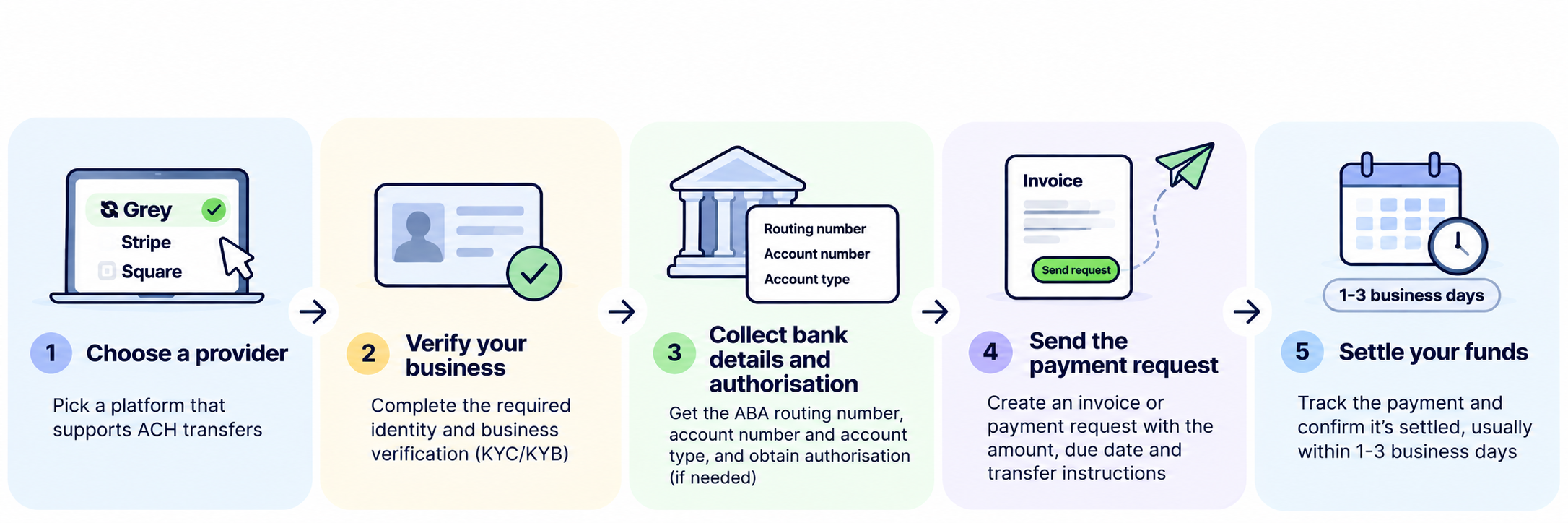
Accepting ACH payments involves choosing a payment provider, verifying your account, collecting the necessary bank details and obtaining authorisation before initiating a transfer. Whether you run a US-based business or work as an international freelancer, follow these five steps to start receiving ACH payments.
Choose a provider: Select a platform that supports ACH transfers. US businesses can use Stripe, Square or QuickBooks, while international freelancers may use virtual USD accounts such as Grey, Geegpay or Payoneer.
Verify your business: Complete the required identity and business verification (KYC/KYB). This may involve submitting a government-issued ID, business registration documents, an Employer Identification Number (EIN), relevant tax forms such as W-9 or W-8BEN, and your payout bank details.
Collect bank details and authorisation: For ACH payments, you need the recipient's nine-digit ABA routing number, bank account number and account type (checking or savings). Understanding what a routing number is helps you identify the correct bank details and avoid failed transactions. If you are collecting payments through ACH debit, obtain the customer's authorisation before initiating the transfer. For ACH credit, provide your receiving account details to the sender.
Send the payment request: Create an invoice or payment request through your provider's dashboard. Include the payment amount, due date and instructions for completing the bank transfer.
Settle your funds: Once initiated, standard ACH transfers typically take one to three business days to settle. Monitor your dashboard for completed payments, failed transactions or returned deposits before treating the money as available.
How to accept ACH payments for free
Freelancers looking for apps for freelancers to get paid often need more than a way to receive money; they also want to avoid unnecessary transaction fees. ACH payments offer one option, with several ways to receive funds without paying a receiving fee. These include direct bank-to-bank transfers, Zelle and contractor payment platforms such as Deel, although each comes with different requirements and limitations.
Here are three options worth considering:
Direct bank-to-bank ACH credit (Mercury, Relay or US checking accounts): Clients send money directly to your account using your routing and account numbers, often at no additional receiving cost. However, you sacrifice automated invoicing, recurring payment collection and built-in payment management. This works best for US-registered businesses receiving payments from trusted clients.
Zelle (US Bank accounts): Zelle allows eligible users to send and receive money between participating US banks without transfer fees. Payments are typically delivered within minutes. However, it has transaction limits and is not designed for formal business invoicing. It is better suited to individuals and freelancers collecting smaller payments.
Deel (contractor payouts): International contractors can receive payments through Deel's contractor payment system, including ACH payouts where supported. Receiving fees may be covered, depending on the payment arrangement. However, currency conversion and withdrawal fees may apply when moving funds into another currency. This option suits freelancers working with international companies.
The hidden costs of "free" ACH
While many platforms advertise free ACH payments, the actual costs can appear elsewhere. Monthly subscriptions, failed-payment fees, withdrawal charges and transaction limits can make a supposedly free service expensive. Settlement delays can also affect cash flow, particularly for freelancers who depend on timely payments.
Even when a provider charges no fee to receive funds, transferring funds from a US account to Nigeria may involve additional fees or unfavourable exchange rates.
Payment option
Monthly fee
Other potential costs
Settlement and limitations
US business checking (Mercury, Relay)
$0 on eligible plans
Returned ACH fees may apply
1–3 business days; eligibility and transfer limits vary
Zelle
$0
Generally no transfer fee
Usually minutes; bank-specific sending limits
Deel
$0 for contractors
Currency conversion and withdrawal fees may apply
1–3 business days after funding clears
Grey / Geegpay
$0
Receiving, reversal and FX fees may apply
Limits depend on account verification
Wave / Zoho Invoice
Free tiers available
ACH processing and failed-payment fees may apply
Processing times and limits vary
Stripe / Square
Free basic accounts
ACH processing and dispute fees may apply
Settlement delays and reserves may apply
Before choosing a provider, check its current fee schedule, especially if you receive frequent payments or withdraw funds in Naira. A zero receiving fee does not necessarily mean zero overall cost.
Getting paid by US clients from abroad
Receiving payments from US clients while living abroad can be challenging if your local bank account does not support ACH transfers. The ACH network only processes payments between eligible US bank accounts, meaning international freelancers often need a US-based receiving account to collect payments from American businesses.
One option is to open a USD account that provides US bank details, including a routing number and account number. This allows clients to send money through ACH without relying on international wire transfers, which can attract higher fees and longer processing times.
Platforms such as Grey provide virtual USD accounts that allow eligible users outside the US to receive payments from American clients. Once your account is set up and verified, you can share your receiving details with clients who want to get paid from the US through a domestic bank transfer.
After receiving your funds, you can move your money abroad by withdrawing or converting your USD balance into your local currency, subject to Grey's supported countries, withdrawal options and applicable fees. This gives international freelancers another way to manage cross-border payments without needing to maintain a traditional US bank account.
Frequently asked questions about how to accept ACH payments for free
1. Can I accept ACH payments for free?
Yes. You can accept ACH payments without receiving fees through direct bank-to-bank ACH credits or eligible contractor payout services. However, a free transfer does not always mean a free account. Monthly subscriptions, withdrawal charges, return fees and currency conversion costs may still apply. Check the provider’s fee schedule and eligibility requirements before choosing an option for receiving payments.
2. How long does an ACH payment take?
Standard ACH transfers typically settle within one to three business days. Eligible transactions may qualify for Same-Day ACH, while some payment processors take five to seven business days, particularly for first-time payments. The actual arrival time depends on the provider’s processing schedule, bank cut-off times, weekends and public holidays. Check the estimated settlement date before relying on funds.
3. Is ACH cheaper than a card payment?
Yes. ACH payments are generally cheaper than card transactions because processing fees are usually lower. Depending on the provider, receiving an ACH payment may be free or cost less than 1%. Card payments often carry higher processing charges, especially for international transactions. Compare the full fees, including currency conversion, before choosing how to collect payments in most cases.
4. Can I accept ACH without a US bank account?
Yes. International freelancers may be able to receive ACH payments through eligible virtual USD accounts from providers such as Grey or Geegpay. These services can provide US routing and account numbers for clients making domestic bank transfers. Availability depends on your country, account verification and provider terms, so confirm that your account supports incoming ACH payments before sharing its details.
5. What is an ACH return fee?
An ACH return fee is a charge applied when a bank transfer is rejected or returned. Common reasons include insufficient funds, incorrect account details, a closed account or a payment dispute. The amount varies by bank and payment provider, and some providers may pass the fee to the business receiving the payment. Review the return policy before accepting payments for each transaction.
6. Can international freelancers receive ACH payments in dollars?
Yes. International freelancers can receive ACH payments in US dollars through eligible virtual USD accounts that provide US routing and account numbers. After the funds arrive, they may be able to hold the balance, withdraw it or convert it into local currency. Available options, processing times and fees depend on the provider, your country and account verification before making withdrawals.
A freelance developer in Lagos may finish a project for a client in London, while a virtual assistant (VA) in Nairobi could be waiting for payment from a company in New York. Both have completed their work, but getting the money into their local accounts can be a different challenge altogether. Between currency conversion, international transfer fees, delayed payments and limited withdrawal options, receiving money across borders is not always straightforward.
That is why choosing the right apps for freelancers to get paid internationally matters just as much as finding clients. Some platforms let you hold multiple currencies, send professional invoices and receive payments directly from overseas clients, while others offer convenient local withdrawals. However, not every app supports every country or currency, and the cheapest option is not always the most convenient.
To help you make the right choice, we have rounded up 15 apps for freelancers to get paid internationally, comparing their payment options, fees, currency support and accessibility. Whether you work with clients across continents or manage projects for a few overseas businesses, this guide will help you find an option that makes getting paid easier.
How do freelancers get paid by international clients?
Freelancers generally receive international payments through three main routes: freelance marketplaces, virtual foreign bank accounts, and direct bank transfers or payment links. Each route offers a different level of convenience, payment protection and control over how money moves from the client to the freelancer.
1. Global freelancing marketplaces
Freelance marketplaces provide an all-in-one environment where freelancers find clients, agree on project terms, submit completed work and receive payments. Platforms such as Upwork and Fiverr collect payments from clients and release the funds according to their payment policies. Some also offer escrow protection, which helps reduce the risk of working with clients who refuse to pay after receiving completed work.
The main advantage is that freelancers do not have to negotiate international payment arrangements with every new client. However, marketplace service fees and withdrawal charges can reduce earnings, and freelancers have less control over the payment process.
2. Virtual foreign bank accounts
Virtual foreign bank accounts allow freelancers to receive money in currencies such as US dollars, euros and British pounds without necessarily having a physical bank account in those countries. Providers such as Payoneer, Wise, Grey and Geegpay offer different types of foreign currency receiving details that clients can use to send payments through supported banking networks.
This route is particularly useful for freelancers who work with multiple international clients outside freelancing marketplaces. Instead of asking every client to arrange an international wire transfer, they can provide suitable receiving account details. However, currency conversion, account eligibility and withdrawal options vary by provider and country.
3. Direct bank transfers and payment links
Freelancers who find clients independently can collect payments through traditional international bank transfers or online payment links. With a bank transfer, the client sends money directly to the freelancer's designated account, sometimes through the SWIFT network. Payment links offer another option, allowing clients to pay invoices using supported debit or credit cards.
Services such as Stripe, Paystack and Flutterwave make it easier to collect digital payments, depending on the freelancer's country and account eligibility. This approach gives freelancers greater control over their client relationships and payment terms, although transfer charges, card processing fees and currency conversion costs can affect the final amount received.
Comparison of the three international payment routes
Payment route
Common platforms
Typical fees and speed
Best for
Freelance marketplaces
Upwork, Fiverr
Service fees and withdrawal charges; varies by platform and payment method
New client relationships requiring escrow protection
Virtual foreign bank accounts
Payoneer, Grey, Geegpay, Wise
Receiving and currency conversion fees vary; often 1–3 business days
Direct clients paying in supported foreign currencies
Direct transfers and payment links
SWIFT, Paystack, Flutterwave, Stripe
Wire, card processing and conversion fees vary; often 2–5 business days
Established clients, high-value projects and recurring retainers
Multi-currency accounts
A multi-currency account allows freelancers to receive, hold and manage money in different currencies, particularly USD, GBP and EUR. Instead of having every international payment converted automatically into naira or another local currency, you receive the money in the currency your client sends.
For example, a client in the US can pay you in dollars using your USD receiving details, while a UK client can send pounds to your GBP account. The same applies to euros from eligible European clients.
This is different from receiving international payments directly into a regular local bank account, where:
Automatic conversion: Your bank may convert incoming foreign currency into your local currency immediately.
Exchange-rate markups: Your bank may offer a less favourable exchange rate, reducing the amount you receive.
Less control: You cannot always choose when to convert your earnings or hold them for future expenses.
With a multi-currency account, you can keep your money in its original currency and convert it when needed. This gives you more control over exchange rates and helps avoid unnecessary conversion losses.
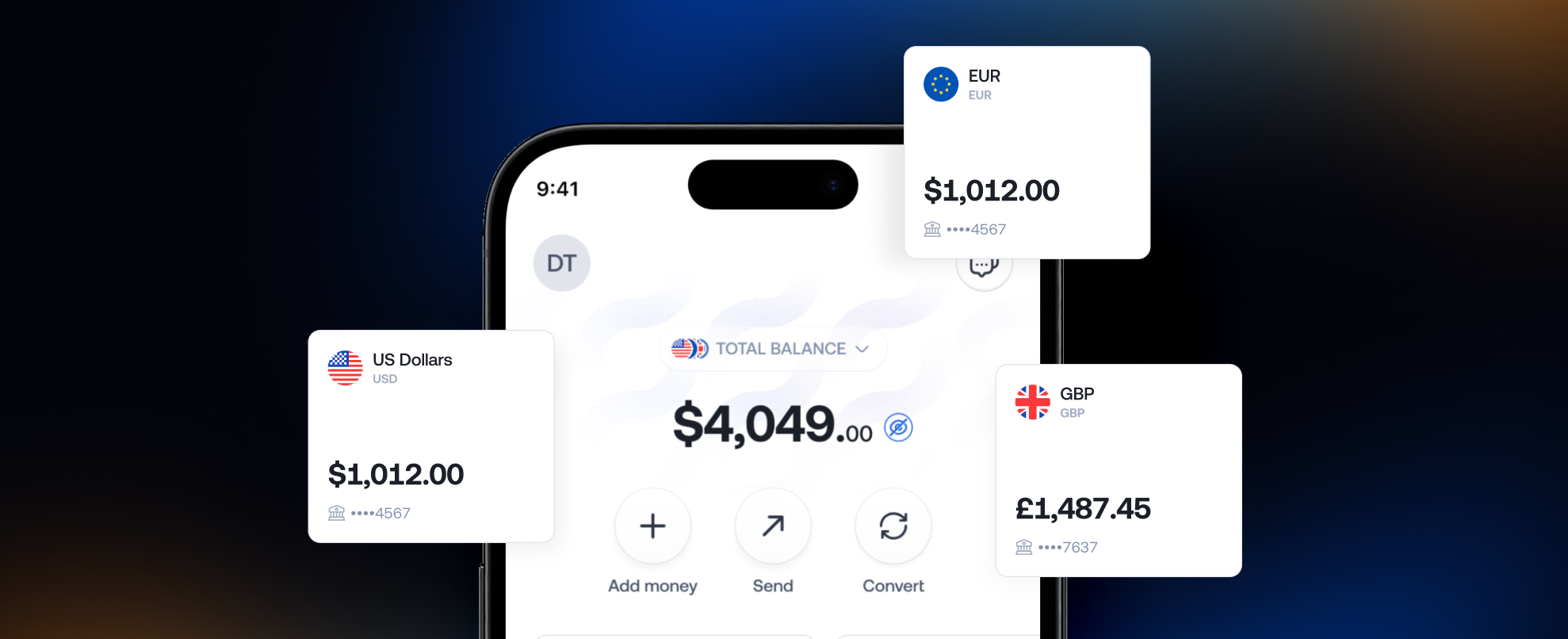
Grey makes this easier by offering a multi-currency account where freelancers can manage USD, GBP and EUR balances from one place. You can find out what to look for in a multi-currency account and see how features such as transparent fees, currency support and conversion flexibility can help you manage international earnings more effectively.
Invoicing and payment request apps
These apps help freelancers create professional invoices, send payment requests and collect money from international clients without handling every transaction manually.
1. Payoneer: Sends professional payment requests and allows freelancers to receive international payments through virtual bank details and multiple supported currencies.
2. Paystack: Lets Nigerian freelancers create branded payment links and collect international card payments directly from clients through a simple checkout process.
3. Flutterwave: Supports multi-currency payment links and invoicing, allowing freelancers to bill overseas clients and collect payments through supported international payment methods.
4. Grey: Allows freelancers to create foreign currency invoices and receive payments through USD, GBP and EUR virtual accounts with local banking details.
5. Geegpay: Helps African freelancers create professional invoices, share payment requests and receive international payments through supported foreign currency virtual accounts.
6. Wise: Enables freelancers to request payments, share account details and receive money in multiple currencies through supported international and local banking networks.
7. Stripe: Offers hosted invoices and payment links that allow freelancers to collect international payments through cards and supported bank payment methods.
8. PayPal: Allows freelancers to create and send customised invoices that international clients can pay using their PayPal balances or eligible cards.
9. Deel: Provides contractor invoicing and payment management, helping freelancers submit invoices and receive earnings from international companies through supported withdrawal methods.
10. Wave: Offers free invoicing software that helps freelancers create estimates, send professional invoices, track payments and accept online payments.
11. FreshBooks: Combines invoicing, expense tracking and accounting tools, allowing freelancers to send payment requests and manage client transactions in one place.
12. Zoho Invoice: Provides free invoicing tools for creating customised invoices, automating payment reminders and collecting payments through supported third-party payment gateways.
13. Bonsai: Combines invoicing, contracts, proposals and client management tools, helping freelancers organise projects and collect payments through integrated payment processors.
14. HoneyBook: Helps freelancers manage client bookings, send invoices, automate payment reminders and collect payments through an integrated client management platform.
15. Square Invoices: Allows freelancers to create digital invoices, send payment reminders and collect payments online through supported card and payment methods.
The amount an international client sends is not always the amount that reaches your local bank account. Payment apps charge different fees for receiving money, processing card payments and converting foreign currencies. Some advertise low receiving fees but make their money through exchange-rate markups, while others charge a higher upfront fee with more competitive conversion rates.
The table below compares the estimated costs of popular payment apps, including the additional charges freelancers should consider before choosing one.
App
Receiving / card fee
FX markup
Estimated total cost
Wise
0% for local receiving details
0.4%–1.2%
0.6%–1.2%
Grey
0.8% (capped at $10)
~1% (capped at $6) + ₦35 payout
1.4%–1.8%
Geegpay
0.7%–0.8% (capped at $12)
1%–1.5% + ₦12 payout
1.7%–2.3%
Deel
$0 to freelancer
1%–2% on NGN withdrawal
1%–2%
Paystack
3.9% + ₦100 (international cards)
1%–2%
4.9%–5.9%
Flutterwave
3.8%–4.8% + VAT
1%–2%
4.8%–6.8%
Payoneer
0%–1% (ACH); 3.99% (card)
Up to 3.5%–4.5%
4.5%–8.5%
Stripe
2.9% + $0.30 + 1.5% (international cards)
1%–2%
5.4%–6.4%
PayPal
4.49% + fixed fee
3%–4%
7.5%–8.5%
Wave
2.9% + $0.60 (cards)
1%–3%
4%–6.5%
FreshBooks
2.9%–3.5% + $0.30
1%–3%
4%–6.5%
Zoho Invoice
Depends on payment gateway
Depends on payment gateway
Depends on payment gateway
Bonsai
Standard Stripe or PayPal processing fees
1%–3%
4%–6.5%
HoneyBook
2.9% + $0.25 (cards)
1%–3%
4%–6.5%
Square Invoices
3.3% + $0.30 (online invoices)
1%–3%
4.3%–6.5%
Choosing a payment app by client location
The easiest way to choose a payment app is to consider where your client is based and how they prefer to send money. Not every client wants to make an international bank transfer, especially when they can pay through a familiar local banking method. Choosing an app that supports your client's local payment network can help reduce transfer fees, delays and payment difficulties.
If most of your clients are in the US, consider Grey, Geegpay or Payoneer. These services offer eligible freelancers USD receiving details that allow US clients to pay through domestic ACH transfers rather than expensive international wires. This makes payment more familiar and convenient for American businesses.
2. UK and Europe: Faster Payments and SEPA
For clients in the UK or Europe, Wise, Grey and Geegpay are worth considering. They provide eligible freelancers with GBP or EUR receiving details, allowing clients to pay through UK Faster Payments or SEPA bank transfers. These local payment methods are generally cheaper and simpler than sending money internationally.
3. International clients who prefer card payments
Some clients would rather pay an invoice using a debit or credit card than arrange a bank transfer. In this case, Paystack and Flutterwave offer payment links that let clients pay online without setting up a bank transfer. This is particularly useful when working with multiple clients who have different banking preferences.
Frequently asked questions about the best apps for freelancers to get paid internationally
1. What is the cheapest way for freelancers to get paid abroad?
Virtual multi-currency accounts are often among the cheapest options, especially when clients can pay through local bank transfers. Services such as Grey, Wise and Geegpay offer foreign currency receiving options. Compare receiving, conversion and withdrawal fees before choosing.
2. Can I receive USD without a US bank account?
Yes. You can use virtual USD receiving accounts from providers such as Grey, Payoneer and Geegpay, subject to eligibility. These accounts provide US banking details that eligible international clients can use to send payments without you owning a physical US bank account.
3. How long do international freelance payments take?
Payment times depend on the app and transfer method. Local bank transfers can arrive within hours or 1–3 business days, while international SWIFT transfers may take 2–5 business days. Card payments and marketplace withdrawals also have different processing and settlement periods.
4. Do I pay tax on foreign client payments?
Yes, foreign freelance income may be taxable in your country of residence, even when clients pay you in another currency. Your tax obligations depend on local regulations, income thresholds and applicable exemptions. Keep invoices and payment records to support accurate tax reporting.
5. Which app is best for African freelancers?
Grey, Payoneer and Geegpay are worth considering because they offer foreign currency receiving options for eligible African freelancers. The best choice depends on your country, supported currencies, withdrawal methods and transaction fees. Check local availability before opening an account.
6. Can I invoice in one currency and receive in another?
Yes. Some invoicing and payment platforms allow you to bill clients in USD, GBP or EUR and receive the converted amount in your local currency. The conversion may happen automatically or when you withdraw, depending on the provider and account settings.
A flight can be booked, your bags packed, and your travel documents ready, only for an item in your luggage to cause an unexpected problem at the airport. Sometimes, it is something passengers consider harmless, such as a particular tool, liquid, battery or household product, that attracts attention during security screening. What you can carry also depends on whether the item is going in your hand luggage or checked baggage.
Understanding the prohibited items on flights in Nigeria before leaving home can save you from unnecessary delays, having your belongings confiscated or missing your flight. Some items are banned because they pose fire, explosion or injury risks, while others are restricted under aviation security, customs or airline regulations.
In this guide, we break down the items you cannot take on domestic and international flights departing from Nigeria, including weapons, explosives, flammable products, dangerous chemicals and restricted goods. We also explain the difference between items that are completely prohibited and those you may carry under specific conditions. That way, you can check your luggage properly, avoid airport surprises and know what to leave behind before heading to the airport.
What items are prohibited on flights in Nigeria?
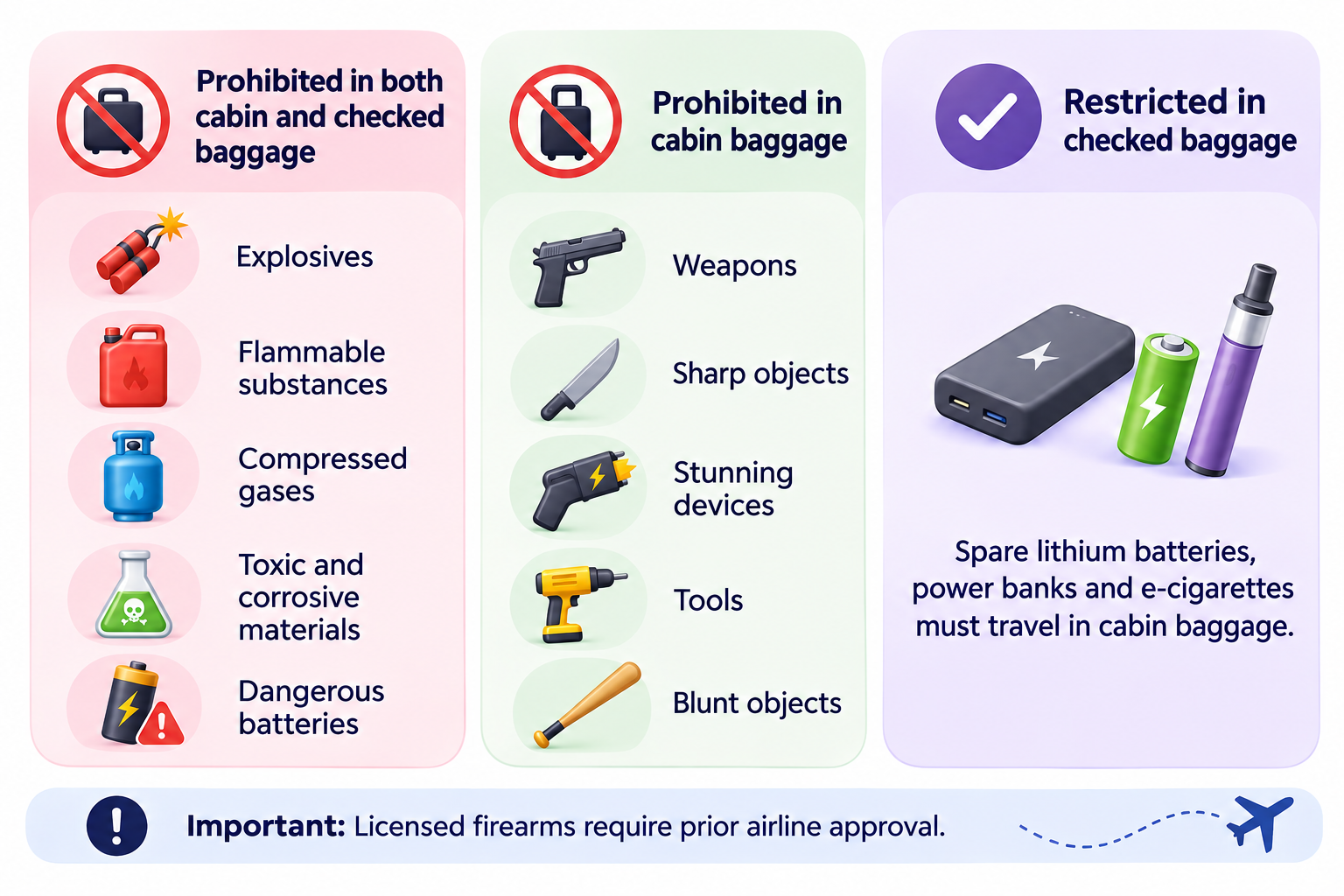
The Nigeria Civil Aviation Authority (NCAA) restricts items that could threaten passenger safety, cause fires or interfere with aircraft security. Some are prohibited in both cabin and checked baggage, while others cannot be carried in hand luggage but may travel in checked baggage under specific conditions. The main categories include:
1. Prohibited in both cabin and checked baggage
Explosives: Fireworks, firecrackers, grenades, gunpowder, detonators and flares.
Flammable substances: Petrol, diesel, kerosene, lighter fluid, paint thinners and other highly flammable liquids.
Compressed gases: Butane, propane, camping gas and certain dangerous aerosols.
Toxic and corrosive materials: Acids, poisons, pesticides, bleach, chlorine and radioactive substances.
Dangerous batteries: Damaged or recalled lithium batteries and certain high-risk electronic devices.
2. Prohibited in cabin (carry-on) baggage
Weapons: Firearms, ammunition, replica guns, bows, arrows and slingshots.
Sharp objects: Knives, scissors with blades over permitted limits, razor blades, axes and box cutters.
Stunning devices: Tasers, stun guns and incapacitating sprays.
Tools: Drills, saws, hammers, crowbars and long-shaft screwdrivers.
Blunt objects: Baseball bats, clubs and martial arts equipment.
3. Restricted in checked baggage
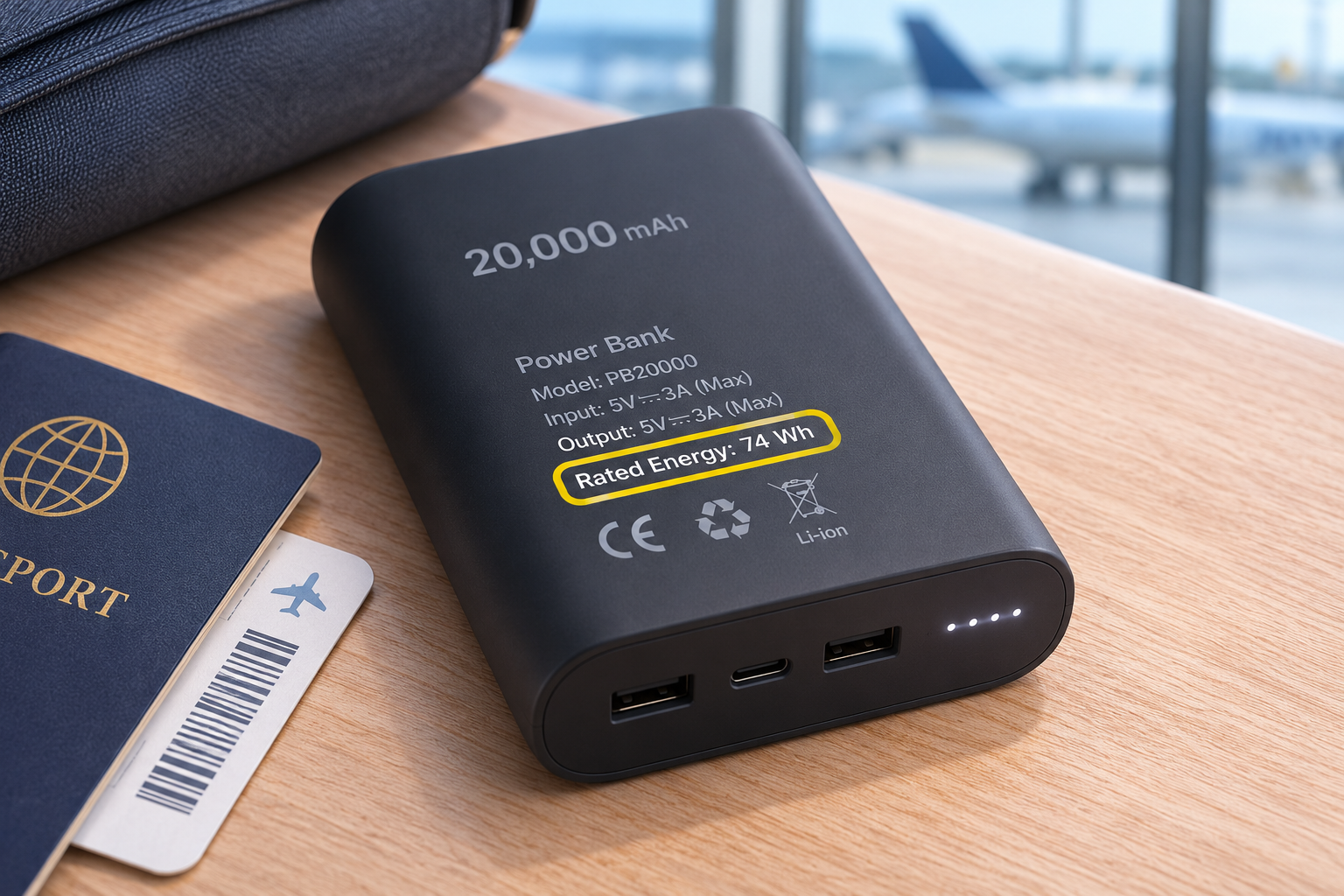
Spare lithium batteries, power banks and e-cigarettes must generally travel in cabin baggage, with terminals protected against short circuits.
Important: Licensed firearms require prior airline approval and special handling. Liquid restrictions also vary by route and airport. Check the NCAA's 2023 Civil Aviation Regulations, particularly Parts 15 and 17, and confirm your airline's requirements before travelling.
What can go in hand luggage on Nigerian flights?
Hand luggage is for items you may need during your journey, such as your phone, laptop, medication, and travel documents. However, not everything can go into the cabin. Nigerian aviation security rules place restrictions on liquids, batteries, sharp objects and other potentially dangerous items. Knowing what is allowed helps you pack correctly and avoid having belongings confiscated at security.
1. Liquids, aerosols and gels
You can carry toiletries, creams, perfumes, toothpaste and other liquids in your hand luggage, subject to airport security limits.
Each container should hold no more than 100 ml.
All containers should fit inside one transparent, resealable plastic bag with a capacity of up to one litre.
Prescription medicines and essential baby food may receive special allowances, subject to screening.
These restrictions are particularly important for international flights. For more examples of liquids and other restricted items, see Grey's guide to items banned on a plane.
2. Batteries and electronic devices
Laptops, mobile phones, tablets, digital cameras and other personal electronic devices can generally travel in your cabin bag. Spare lithium batteries and power banks must also go in hand luggage rather than checked baggage.
Batteries up to 100Wh are generally permitted.
Batteries between 100Wh and 160Wh require airline approval.
Batteries above 160Wh are generally prohibited.
Protect spare battery terminals against short circuits. Damaged or swollen batteries should not be carried.
3. Items that must stay in your hand luggage
Some items are permitted on board but cannot be placed in checked baggage due to fire risks or safety concerns. These include:
Power banks: Keep them in your cabin bag, with their terminals protected against accidental contact.
Spare lithium batteries: Carry them in hand luggage and protect exposed terminals.
E-cigarettes and vapes: Keep these in the cabin and never use or charge them during the flight.
What does Nigerian customs restrict on export?
The Nigeria Customs Service (NCS) maintains an export prohibition list covering certain agricultural products, raw materials and cultural items. These restrictions are designed to protect local industries, preserve natural resources, support food security and prevent the illegal removal of Nigeria's cultural heritage.
The main restricted export categories include:
1. Maize
Unprocessed maize grains are restricted from export to help maintain domestic food supply and prevent shortages.
2. Timber
Rough and sawn wood are prohibited under the export restrictions, helping to discourage deforestation and encourage local processing.
3. Raw hides and skins
Unprocessed animal hides and skins, including wet blue leather and other unfinished forms, fall under export restrictions.
4. Scrap metals
Ferrous and non-ferrous metal scraps cannot be freely exported, as the restriction supports local recycling and manufacturing industries.
5. Unprocessed rubber
Raw rubber latex and rubber lumps are restricted to encourage domestic processing and value addition.
6. Artefacts and antiquities
Cultural objects and historical artefacts cannot be exported without the necessary government authorisation and clearance.
How much currency can you carry out of Nigeria?
You can carry foreign currency worth US$10,000 or more (or its equivalent in other currencies) out of Nigeria, but you must declare it to the Nigeria Customs Service (NCS). The declaration threshold applies to cash and relevant negotiable instruments. Declaring your money does not automatically mean you cannot travel with it. However, additional information and supporting documents may be required, particularly for larger amounts.
How to declare foreign currency at the airport
Nigeria Customs now provides an Electronic Currency Declaration Form (e-CDF) for travellers carrying amounts at or above the reporting threshold.
Complete the online form: Visit the NCS Electronic Currency Declaration portal and enter your travel details, passport information and the amount of each currency you are carrying.
Submit your declaration: Review your information, confirm that it is accurate and submit the form.
Save your acknowledgement: Keep your declaration reference number or acknowledgement slip.
Visit Customs at the airport: Present yourself and your declaration reference to a Customs officer for physical verification. Your declaration remains pending until validated.
Provide supporting documents: Bring relevant bank withdrawal slips, transaction records or other evidence showing the source of the funds, where requested
You can also avoid the inconvenience of travelling with large amounts of physical dollars by using a virtual USD account with Grey. This offers a more convenient way to access your foreign earnings without needing to withdraw and travel with physical currency.
Moving money instead of carrying cash
Carrying large amounts of cash across borders is not the only way to access your money abroad. Bank transfers and digital payment services allow you to move funds internationally without physically transporting banknotes. They also provide transaction records that help establish the source of your money when required.
Traditional SWIFT transfers typically take 1–5 business days, while digital transfers can arrive within minutes or a few business days, depending on the destination and payment method.
Instead of travelling with physical dollars or pounds, you can keep your money in a foreign currency account and transfer it when needed. A traditional domiciliary account lets you receive, hold and send foreign currencies such as USD, GBP and EUR through a Nigerian bank. This means you can keep your earnings in their original currency rather than converting everything to naira immediately.
Grey offers another way to manage foreign currency without the usual bank visits and account-opening processes associated with traditional domiciliary accounts. You can open virtual USD, GBP and EUR accounts online, receive international payments, hold multiple currencies and convert your money when you need it. You can also send money directly from Nigeria to the UK, making it easier to manage international payments without carrying physical cash.
Frequently asked questions about prohibited items on flights in Nigeria
1. What is banned in hand luggage on Nigerian flights?
Firearms, sharp objects, explosives, flammable substances, certain tools, blunt weapons and dangerous chemicals are prohibited in cabin baggage. Liquids, aerosols and gels in containers exceeding 100 ml are generally restricted on international flights. Always check your airline's specific baggage rules before packing, as some items may be allowed in checked baggage instead.
2. How much cash can you take out of Nigeria?
You can carry foreign currency worth US$10,000 or more, or its equivalent, but you must declare it to Nigeria Customs. The declaration threshold does not mean larger amounts are automatically prohibited. You may need supporting documents showing the source of your money, particularly when carrying substantial sums. Confirm the latest requirements before travelling.
3. Can you carry food out of Nigeria on a flight?
Yes, you can carry certain foods, particularly commercially packaged and properly labelled products, subject to airline and destination-country rules. However, fresh fruits, vegetables, meat, seeds and other agricultural products may face restrictions. Some Nigerian agricultural commodities are also subject to export prohibitions. Check the destination country's customs requirements before packing food.
4. Are power banks allowed on Nigerian flights?
Yes. Power banks are generally allowed in hand luggage but must not be placed in checked baggage. Those rated up to 100Wh are generally permitted, while batteries between 100Wh and 160Wh usually require airline approval. Protect their terminals against short circuits and check your airline's capacity limits before departure.
5. What happens if you carry a prohibited item?
Airport security may remove and confiscate prohibited items during baggage screening. Depending on the item and circumstances, you could face additional questioning, missed flights, fines or legal action. Carrying undeclared currency, illegal weapons or dangerous substances can have more serious consequences. Always check your luggage before leaving for the airport.
6. Do domestic and international flights have the same rules?
Both follow core aviation safety restrictions covering weapons, explosives, flammable materials and dangerous goods. However, international flights may have additional requirements involving liquid limits, customs declarations, agricultural exports and destination-country restrictions. Domestic routes may also have airline-specific baggage policies. Check both your airline's rules and applicable customs requirements before travelling.
Nothing can beat that feeling of waiting for a text/email alert telling you that your salary has landed, only to finally receive it and see that part of your income is missing because you've had ‘income tax’ taken out.
Income tax is a tax charged by governments on the income earned by individuals. This could be money earned from a salary, wages, business profits, or other personal income. In many countries, income tax will automatically be deducted from your salary as an employee. Self-employed individuals may be required to calculate and pay personal income tax themselves.
Governments use this to fund public services and infrastructure such as healthcare, education, transport, and security.
However, how much is paid, who pays, and how income is taxed will depend on the country. A handful of countries charge no personal income tax, mostly Gulf states, Caribbean islands, and small European territories. They usually raise money through VAT, customs duties, or residency fees instead. Becoming a tax resident takes time and money, and US citizens still file on worldwide income.
There are 12 countries globally where you can legally live and work in 2026 with 100% of your personal income and investment earnings.
While you won’t pay any income tax, you will still have to pay tax in some form. All governments need to pay for their roads, hospitals, and public services. So, instead of charging you tax on your payslip, you will pay tax on your groceries, importing a car, renting a flat, or running a business.
If you are working abroad, working remotely, or considering moving abroad, understanding the differences can help you make smarter financial decisions. Here are 12 countries where you can earn income without paying personal income tax.
What does “tax-free” mean?
When searching for countries with no tax, people often imagine they can earn 100% of their income with no further interaction with a revenue body. However, zero-tax countries rely heavily on indirect and corporate taxes such as
VAT and sales duties: Value Added Tax is a consumption tax charged on everyday items and services. Instead of charging tax on the income you earn, you’ll pay tax on the money you spend. Many Gulf states have introduced VAT in the last decade. While you may not pay any tax on your salary in Riyadh or Manama, you’ll pay 15% VAT in Saudi Arabia and 10% VAT in Bahrain.
Import and customs duties: Taxes charged on goods imported into a country. It is usually paid by the importer at the border and will therefore increase the price you pay in shops. Many Caribbean and Pacific island economies depend heavily on imported goods, so customs duties, shipping costs and insurance can make everyday items such as food, electronics and vehicles more expensive.
Corporate and freelance tax: This is a tax paid on the net profit of a registered business or self-employed individual. Just because a country has no general personal income tax does not mean businesses operating there are excluded from taxation.
As of 2026, the United Arab Emirates charges 9% corporate tax on profits from businesses and freelance work over AED 375,000. Bermuda charges 15% corporate income tax on large multinational groups and progressive payroll tax on local earnings.
Property and stamp duty: Stamp duty and property tax are taxes charged by the government, either one-off or annually, on the purchase, sale, or registration of property. If you’re buying or renting property, you’ll pay a high transfer tax, stamp duty, or fees.
Understanding where tax will be charged can help you understand how much it will really cost to live there.
Countries with no personal income tax
There are more than 20 countries and states globally that charge no personal income tax. However, some are difficult to relocate to due to strict visa requirements. Using data from PwC Worldwide Tax Summaries and OECD Automatic Exchange of Information Portal, here are 12 countries with no income tax in 2026. They have been split by region.
The Middle East (Gulf Cooperation Council)
These countries earn enough from oil and gas to fund their roads, schools, and public services without taxing your salary.
1. United Arab Emirates (UAE)
Dubai and Abu Dhabi are popular destinations for remote workers, business founders, and expats. In 2026, you pay 0% tax on your salary and share dividends and profits from selling personal assets.
You can get a residency visa through a local job, a remote work visa, a freelance permit, or a 10-year Golden Visa by buying property worth at least AED 2 million. On the flip side, you will pay 5% VAT on shopping, a 4% fee when buying property in Dubai and a 9% corporate tax on business profits over AED 375,000.
2. Bahrain
Bahrain charges 0% tax on your wages and investment profits. You can move there with a job offer or get a 10-year Golden Residency by buying property worth at least BHD 130,000 or earning BHD 2,000 a month after living there for five years. Everyday costs include a 10% VAT and a 2% property registration fee.
3. Qatar
Your salary and personal investment profits are completely tax-free in Qatar.
Property investments of at least QAR 730,000 can qualify eligible foreign buyers for a residence permit without a local sponsor. A higher investment of at least QAR 3.65 million can provide additional permanent-residency-related benefits.
Qatar has no general VAT in force as of November 2026. However, qualifying Qatar-source business income is subject to a 10% income tax. This can include income earned by self-employed individuals carrying out taxable business activities in the country.
4. Saudi Arabia
Saudi Arabia charges 0% personal income tax on salaries. Expats usually move there on a work visa or through the Premium Residency programme.
The Premium Residency programme offers different products. These include a renewable one-year residency option costing SAR 100,000 annually and a permanent residency option with a one-time fee of SAR 800,000. Foreign property owners may also qualify for the Real Estate Owner Residency product by owning or holding qualifying rights to residential property worth at least SAR 4 million, subject to the programme’s conditions.
Foreign-owned businesses and qualifying non-Saudi ownership interests in companies may be subject to a 20% corporate income tax on their taxable share of profits. Shoppers pay 15% VAT on most taxable goods and services.
This corporate tax should not be confused with personal income tax on an employee’s salary.
5. Kuwait
Kuwait has no personal income tax and no VAT. However, moving there is difficult unless you have a local job offer, family sponsorship, or a licensed local business.
Foreign-owned companies also pay a 15% corporate income tax on profits made in Kuwait.
6. Oman
Residents in Oman currently pay 0% general personal income tax. You can move there through an employment arrangement or qualifying property investment and residency programmes.
Oman has introduced legislation on personal income tax from 1 January 2028. Under Royal Decree No. 56/2025, a 5% tax will apply to taxable income above OMR 42,000 annually.
The Caribbean and Atlantic
These island nations pay for public services using tourism, financial services, import taxes, and visa investment fees instead of taxing your salary.
7. The Bahamas
The Bahamas charges 0% tax on your salary, investment profits, and inheritance. You can move there on an annual residence permit or get permanent residency by buying property worth at least BSD 750,000.
Since 1 January 2025, the minimum investment for economic permanent residency has been BSD 1 million, maintained for at least 10 years.
Everyday shopping comes with VAT and import duties on many shipped goods. The standard VAT rate is 10%.
However, from 1 April 2026, unprepared food has been made zero-rated for VAT, so the standard rate does not apply to every grocery purchase.
8. Cayman Islands
The Cayman Islands charges zero personal income tax, zero tax on investment gains, and zero corporate tax.
It also has no general inheritance or gift tax. However, residents and businesses still face other government charges, including import duties, work permit fees and property stamp duty.
Foreign workers can move there through a local employment arrangement or qualify for certain investment-based residency programmes.
One option is a Certificate of Permanent Residence for Persons of Independent Means, which requires an investment of at least US$2 million in developed real estate in the Cayman Islands. Another route, the Certificate of Direct Investment, requires an investment of at least US$1 million in an employment-generating business. Both routes have additional eligibility requirements.
The Global Citizen Concierge Programme is no longer available. It ended in 2022 and should not be considered a current remote-work visa option.
Instead of income tax, the government relies on import duties, financial services licence fees, work permit fees and stamp duties.
9. Bermuda
Bermuda does not charge personal income tax or general tax on personal capital gains. However, it does charge payroll tax on employment income.
Employers pay this tax, but they can deduct the employee’s share from their salaries. For the 2026/27 tax year (1 April 2026 to 31 March 2027), employees pay between 0.25% and 12.50%, depending on how much they earn each year. The first BMD 48,000 is taxed at 0.25%, while the highest rate of 12.50% applies to annual earnings between BMD 500,001 and BMD 1 million.
If you want to move to Bermuda, you will need a work permit or another qualifying residency option.
Investors may also qualify through Bermuda’s Economic Investment Residential Certificate (EIRC) programme. The programme requires a minimum investment of BMD 2.5 million in approved areas, such as local property, businesses or certain charitable contributions. Applicants must also meet the programme’s investment, holding and residency requirements.
Bermuda also charges a 15% corporate income tax, but only on qualifying multinational groups with annual global revenues of at least €750 million. This tax does not apply to every business in Bermuda.
10. Antigua and Barbuda
Residents of Antigua and Barbuda pay 0% general personal income tax on salaries and personal investment income.
You can explore relocation through the country’s ordinary immigration routes or its Citizenship by Investment Programme, which gives qualifying applicants options such as approved real estate investments and contributions to the National Development Fund. Citizenship is not automatic and is subject to due diligence and other eligibility requirements.
The country’s Nomad Digital Residence programme, which previously allowed remote workers to live there for up to two years, ended on 15 November 2025 and is no longer available to new applicants.
Local companies pay a 25% corporate income tax, while shoppers pay a standard 17% Antigua and Barbuda Sales Tax (ABST) on taxable goods and services.
11. Saint Kitts and Nevis
Saint Kitts and Nevis does not charge general personal income tax on employment earnings. Individuals also generally do not pay personal income tax on dividends, interest and capital gains.
Although business income and other specific transactions may be subject to separate tax rules, the absence of personal income tax should not be interpreted as an exemption from every tax obligation.
People from other countries can explore residency or citizenship through qualifying investment routes, including approved real estate purchases or contributions to the Sustainable Island State Contribution.
Applicants must satisfy the programme’s due diligence, financial and other eligibility requirements before citizenship can be granted.
The government generates revenue through a 17% standard VAT, import duties and corporate income tax, which is generally 33% on taxable company profits.
Europe
12. Monaco
Monaco charges 0% personal income tax on most residents, except for French nationals who are subject to French income tax under the 1963 agreement between France and Monaco.
To obtain a residence card (carte de séjour), you must demonstrate that you have suitable accommodation in Monaco, provide the required criminal record documentation and show that you have enough financial resources to support yourself.
If you are relying on independent financial means, you can provide a certified statement from a Monaco-based bank with sufficient funds.
You may also qualify through employment, business activity or financial support from another person.
Companies that earn at least 25% of their turnover outside Monaco are subject to corporate profits tax, currently at 25%.
Monaco also applies a standard 20% VAT rate, in line with the French VAT system.
2026 summary of tax-free countries
Country
Region
Personal income tax (2026)
Main residency route
Alternative taxes
United Arab Emirates
Middle East
0%
Work visa, remote visa, investment or AED 2M property
5% VAT; 9% corporate tax on qualifying taxable income above AED 375,000
Bahrain
Middle East
0%
Work visa or BHD 200k property
10% VAT; 2% property registration fee
Qatar
Middle East
0%
Work permit or QAR 730k property
10% tax on non-Qatari business profit
Kuwait
Middle East
0%
Employer or family sponsorship
15% corporate tax on foreign companies
Saudi Arabia
Middle East
0%
Work visa or SAR 100k/year premium residency
15% VAT; 20% non-Saudi business profit tax
Oman
Middle East
0% (5% from 2028)
Work visa or investor residency
5% VAT; 5% personal income tax on taxable income above OMR 42,000 from 2028
The Bahamas
Caribbean
0%
Annual permit or BSD 750k real estate
10% VAT; custom duties
Cayman Islands
Caribbean
0%
Work permit, remote visa, or residency for persons of independent means (CI$2 million property route)
Import duties; property stamp duty; work permit fees
The Bermuda
Atlantic
0%
Work permit; limited residential investment
Employee payroll tax (0.25% - 12.50%); customs
Antigua and Barbuda
Caribbean
0%
Digital nomad visa or investment route
15% - 17% sales tax; 25% corporate tax
St Kitts and Nevis
Caribbean
0%
Investment residency or citizenship
17% VAT; 33% corporate tax
Monaco
Europe
0% (except French citizens)
Lease/buy property, €500k bank deposit
20% VAT; 25% corporate profits tax for qualifying businesses
How to qualify as a tax resident
Getting a visa to live in a country doesn’t mean you’ll be a legal tax resident. Most countries have 3 main rules to determine if you’re a tax resident:
The 183-day rule: Many countries use the 183-day rule as one of the criteria for determining tax residency, but it is not a universal requirement.
For example, the UAE recognises several routes to tax residency. An individual may qualify after spending at least 183 days in the country within a consecutive 12-month period. There is also a route for individuals who spend between 90 and 182 days in the UAE, provided they meet conditions such as having UAE employment, conducting business there or maintaining a permanent place of residence. A separate route considers whether the UAE is the individual’s primary residence and the centre of their financial and personal interests.
Meeting the requirements for a tax residency certificate is not necessarily the same as meeting the immigration requirements for a residence visa. Always check the rules that apply to your destination and circumstances.
Money and investment requirements: If you are not moving for a local job, you may need to show that you can support yourself financially.
Depending on the country and immigration programme, you may have to show proof of remote employment, a minimum monthly income, sufficient savings or qualifying investments.
For example, the Cayman Islands requires at least US$2 million in developed real estate for its Certificate of Permanent Residence for Persons of Independent Means. Monaco requires evidence of sufficient financial resources, which can be proven through a certified statement from a local bank. Bermuda’s 2026 Economic Investment Residential Certificate programme requires an investment of at least BMD 2.5 million.
These are separate immigration requirements, not universal tax-residency thresholds. A person can qualify for a residence permit without automatically becoming a tax resident.
Cutting ties with your home country:
Moving abroad is only half the job. Your previous country may still consider you a tax resident.
Tax authorities in countries such as the UK, Canada and Australia look at factors including where you maintain your permanent home, where your family lives, your employment arrangements and the location of your economic interests.
Having a bank account, owning property or running a company in your former country does not automatically make you a tax resident there.
Reading up on how dual citizenship works or tools like Estonia e-Residency can help you understand international legal status, though neither replaces actually moving away to end your home tax obligations.
Visa approvals usually take anywhere from four weeks for a Gulf work permit to six months or more for Caribbean and European investor visas. Make sure to budget for legal fees, health insurance, document checks, and property deposits before you apply.
What does it mean for US citizens and other nationals?
Looking for zero-tax countries for expats works very differently if you hold a US passport because the United States taxes its citizens no matter where they live in the world.
According to the IRS guide for U.S. citizens and residents abroad, American citizens and green card holders must file a US tax return and report their worldwide income every year, even if they live full-time in Dubai, Monaco, or the Cayman Islands.
US citizens living abroad may reduce their US tax bill through the Foreign Earned Income Exclusion (Form 2555).
For the 2026 tax year, eligible Americans can exclude up to $132,900 of foreign-earned income from US federal income tax. To qualify, they must have a tax home abroad and meet either the physical presence test (spending at least 330 full days outside the US within a 12-month period) or the bona fide residence test (living in another country for an uninterrupted period that includes a full tax year).
The exclusion covers eligible employment and self-employment income, but not dividends, interest or capital gains. Income above the exclusion limit may still be taxable, and rental income follows separate rules.
US citizens abroad may also need to file an FBAR (Foreign Bank Account Report) **if the combined value of their foreign bank and financial accounts exceeds $10,000 at any point during the year.
If you want to reduce your US tax bill without dealing with overseas tax rules, consider moving to a US state with no personal income tax.
Other countries have their own rules for people who stop being tax residents. Canada and South Africa, for example, may tax certain assets as though they were sold when someone leaves. France has an exit tax for some shareholders, while Australia has capital gains tax rules for certain assets. These taxes do not apply to everyone and depend on individual circumstances.
Note: Breaking international tax rules can lead to heavy fines. This article is not tax advice, so always speak with a qualified cross-border tax advisor about your personal situation.
Managing money in multiple currencies
Moving to a zero-income-tax country almost always means dealing with more than one currency. You might earn freelance income in US dollars from clients in New York, collect dividends in British pounds, and pay your rent in Emirati dirhams or euros.
Using traditional banks to switch between currencies can eat into the tax savings you want to enjoy. They often add 3% to 5% in hidden exchange rate fees, plus high international transfer fees every time you move money across borders.
Grey is built to make international living and handling your money much simpler. With Grey, you can open a multi-currency account in minutes, hold multiple currencies like USD, GBP, and EUR, and convert your money at clear, minimal rates.
When you need to pay rent, cover bills, or send money home, you can move money between countries straight from your phone without waiting days for bank transfers to clear.
Living across borders? Hold and move multiple currencies with Grey.
Frequently asked questions about tax-free countries
Which countries have no income tax?
12 major countries and territories with zero personal income tax for residents include the United Arab Emirates, Bahrain, Qatar, Saudi Arabia, Kuwait, Oman, the Bahamas, the Cayman Islands, Bermuda, Antigua and Barbuda, Saint Kitts and Nevis, and Monaco. Oman has passed legislation to introduce a 5% personal income tax on high earners starting in January 2028.
Can Americans avoid tax by moving?
No. Under IRS rules, US citizens and green card holders are taxed on their worldwide income no matter where they live. While qualifying expats can exclude up to $132,900 of foreign-earned salary in 2026 under the Foreign Earned Income Exclusion, earnings above that threshold and passive investment income remain taxable by the US government.
Is Dubai really tax-free?
Dubai charges 0% personal income tax on salaries, dividends, and personal capital gains. However, residents still pay indirect and business levies, including a 5% Value-Added Tax (VAT) on most goods and services, a 4% property transfer fee, municipal housing fees, and a 9% corporate tax on business or freelance profits above AED 375,000.
How long must I stay?
Most zero-tax jurisdictions require you to spend at least 183 days per year inside the country to qualify as a tax resident and obtain a Tax Residency Certificate. Some destinations, such as the UAE, offer a 90-day residency route if you maintain a permanent residence and strong economic ties locally, while US citizens claiming the Foreign Earned Income Exclusion must spend at least 330 full days abroad.
Are there hidden costs?
Yes. Countries without personal income tax fund public services through higher everyday costs. Expect steeper prices driven by customs duties on imported goods, VAT rates between 5% and 20%, mandatory private health insurance, expensive property minimums, and annual visa or residency renewal fees.
Disclaimer: This article contains general information only and should not be considered tax advice. Tax laws and residency requirements can change frequently, so always consult a qualified cross-border tax professional.
You are filling out a shipping form for an important client, or perhaps checking the return address on a package from a US supplier, when three mysterious letters catch your eye: PMB. It is not a street name, nor is it a suite number, and it certainly does not look like a standard post office box. If you have ever paused mid-checkout wondering if that address is legitimate or if your courier will get lost trying to find it, you are not alone.
PMB stands for private mailbox. It is a mailbox rented from a private company rather than the postal service, and it appears on the address line as "PMB" followed by your box number. In comparison to a PO Box, which uses a numbered box address within a post office, a PMB uses a street address, so it can receive regular mail and packages from private couriers.
What does PMB mean in an address?
When you encounter the abbreviation PMB in letters or emails, it indicates that the recipient uses a private mailbox service rather than a standard residential or commercial street address. For anyone researching “what does 'PMB' mean in an address”, understanding how it works is important. A PMB address is typically hosted by commercial mail receiving agencies, UPS stores, or independent shipping outlets.
Compared to government-issued postal boxes, a PMB gives you a real, physical street address rather than just a post office box number. This changes how mail and packages can be delivered to your location. To format a US PMB address correctly, include the recipient’s name, the PMB designation and box number, the facility’s street address, and the city, state and ZIP code. For example:
JOHN DOE PMB 456 123 BUSINESS AVENUE CITY, STATE 12345
You can also place the PMB designation and number on the same line as the facility’s street address, provided the address follows USPS formatting guidelines. Correct formatting helps postal services and delivery companies identify the intended recipient and mailbox.
How a private mailbox works
Renting a private mailbox provides a secure and flexible alternative to using your home address for public-facing correspondence. When you sign up for a PMB, the provider performs strict identity checks in compliance with postal regulations, often requiring government-issued photo identification and proof of address.
In the United States, customers renting a PMB through a commercial mail receiving agency must complete USPS Form 1583, which authorises the agency to receive mail on their behalf. Applicants must provide two acceptable forms of identification. One must be a government-issued photo ID, while the other must establish a permanent address.
Once your account is active, the facility accepts all incoming mail and packages on your behalf. Depending on the provider and your mailbox agreement, this can include deliveries from USPS and private carriers such as FedEx, UPS and DHL.
Some providers also have features such as mail scanning, forwarding and package notifications. If you travel frequently or manage your operations remotely, staff can photograph your mail envelopes as they arrive or forward your packages to another address, sometimes internationally. You may need to pay additional fees for opening and scanning mail, package handling or forwarding. This setup keeps your personal location private while ensuring you can manage your deliveries remotely.
PMB vs PO box vs virtual address
Trying to decide which postal option to use can be confusing when abbreviations start to get mixed up. To clarify the differences between a private mailbox, a traditional post office box, and a virtual address, consider the comparison below.
According to official guidelines on postal and private mailbox address conventions, understanding these operational boundaries helps you select the right service for your needs (learn more via USPS).
A PO Box usually accepts deliveries from USPS only. However, some locations have street addresses, which allow customers to receive packages from private couriers. PMBs and virtual mailboxes can also accept deliveries from different carriers, depending on the provider.
How to get a PMB address
Securing a private mailbox is a straightforward process, though it requires specific documentation to prevent fraud. If you are establishing a professional presence or exploring how to get a PMB address, the steps remain consistent across most commercial providers.
First, locate a commercial mail receiving agency or shipping store near your target location, or choose an online provider if you prefer digital management. Next, complete the required verification paperwork.
Typical costs range from $10 to $30 per month depending on the box size, location, and additional services like mail scanning. Many freelancers and independent professionals find that securing a mailing address goes hand in hand with structuring their business, especially when evaluating whether they need an LLC to freelance and protect their personal assets.
Using a US address from abroad
For international founders, digital creators, and remote professionals operating outside the United States, having a reputable US mailing address is a smart operational move.
It gives you a US address for business mail and packages while keeping your home address private. However, having a PMB does not make you a US resident, register your business or establish a physical business location.
A mailing address only solves the logistics side of running a cross-border business, and it comes with some limitations. A PMB may not meet the address requirements for opening a bank account. US banks generally require individuals to provide a residential or business address, while businesses must provide their principal place of business or another physical location. Requirements may vary between banks, so a PMB alone may not be enough.
Once your mail handling is sorted, the bigger task is moving your money without losing a chunk of your money to high wire fees or sluggish transfer times. This is where Grey steps in to make things easy for you.
Built for global freelancers, remote workers, and international businesses, Grey bridges the financial gap when you are working with US clients from abroad. Eligible users can open a USD account in their name to receive local ACH and wire payouts.
Frequently asked questions about Private Mailboxes
What does PMB mean?
PMB stands for Private Mailbox. It refers to a mailbox rented from a private company, usually a Commercial Mail Receiving Agency (CMRA), which receives and holds mail on behalf of individuals and businesses.
Is a PMB the same as a PO box?
No. A PO Box is issued by the postal service and uses a post office box number, whereas a PMB is rented from a private mailbox provider and generally uses the provider’s street address alongside your individual mailbox number.
Can I use a PMB for my business?
Yes. Many freelancers and small business owners use a PMB to maintain privacy and receive professional mail and packages. Note that a PMB may not meet the address requirements for business registration, licensing or certain financial services. Check the relevant institution’s requirements before using one for official purposes.
Can I open a bank account with a PMB?
Not necessarily. US banks generally require a residential or business street address for identity verification, although their requirements vary. A PMB may be accepted as a separate mailing address, but you should not assume it will satisfy the physical address requirement.
Can couriers deliver to a PMB?
Yes, many private mailbox providers accept packages from couriers such as FedEx, UPS and DHL. However, delivery acceptance depends on the provider, location and mailbox agreement. Check these conditions before renting a mailbox.
Some everyday items you wouldn't think twice about packing can become a problem at airport security. That perfume you use every day, the power bank you carry everywhere, your favourite pocket knife or even a bottle of water could cause problems at airport security if you don't know the rules. What seems harmless in your handbag or suitcase may be restricted or completely prohibited on an aircraft.
Items banned on a plane generally fall into six groups: explosives and flammables, compressed gases, corrosives, toxic substances, lithium batteries above permitted limits, and sharp or blunt weapons. Some items are prohibited in carry-on luggage but allowed in checked baggage, while others cannot be carried on an aircraft at all. Restrictions vary depending on your airline, destination and aviation authority.
This is why checking your luggage before heading to the airport matters. You don't want to arrive at security only to have an expensive item confiscated, face unnecessary delays or risk missing your flight.
In this article, we'll cover more than 200 restricted and prohibited items, explain where they belong and help you understand what you can safely pack before your next trip.
What items are banned on a plane entirely?
Six main hazard categories are prohibited from aircraft entirely: explosives, flammable materials, toxic substances, corrosives, radioactive materials and disabling devices. These items pose risks to passengers, crew and aircraft safety, so they cannot be packed in either carry-on or checked luggage.
What is banned from hand luggage but allowed in the hold?
Some items are too sharp, heavy or potentially dangerous to be carried inside the aircraft cabin but can travel safely in checked baggage. These include certain sharp objects, work tools, sporting equipment and liquids that exceed airport security limits. If you're unsure whether something belongs in your hand luggage, check the rules before packing to avoid having it confiscated at security.
Category
Items not allowed in hand luggage
Sharp objects
Pocket knives, box cutters, loose razor blades, large scissors and other sharp-bladed items. Small scissors may be permitted depending on blade length and local security rules.
Tools
Hammers, screwdrivers, wrenches, pliers, drills, saws and other heavy tools that could cause injury or be used as weapons.
Sporting goods
Baseball bats, cricket bats, golf clubs, hockey sticks, ski poles and pool cues. These are generally accepted in checked baggage, subject to airline size and weight restrictions.
Liquids above the cabin limit
Shampoo, perfume, lotions, creams, gels and beverages in containers exceeding 100 ml (3.4 oz). These generally belong in checked baggage rather than your cabin bag.
What is banned from the hold but allowed in the cabin?
Certain battery-powered devices and spare lithium batteries must travel in the cabin rather than checked baggage because of the fire risk they pose. According to the FAA's PackSafe guidance, power banks and spare batteries must remain with passengers, subject to capacity limits.
Item
Cabin baggage rules
Watt-hour (Wh) limits
Lithium battery-powered devices
Devices such as laptops, phones and cameras can generally travel in the cabin.
Up to 100 Wh generally allowed. Between 100 and 160 Wh requires airline approval. Above 160 Wh is prohibited on passenger aircraft.
Power banks
Must be carried in hand luggage, not checked baggage. Terminals should be protected against short circuits.
Up to 100 Wh generally allowed; 100–160 Wh requires airline approval. Above 160 Wh is prohibited.
E-cigarettes and vapes
Must remain in cabin baggage. Charging or use onboard is prohibited.
Battery capacity restrictions and airline rules apply.
Spare lithium cells
Loose rechargeable and non-rechargeable lithium batteries must travel in the cabin with protected terminals.
Up to 100 Wh generally allowed; 100–160 Wh requires airline approval
Country and airline differences you should check
Packing your suitcase according to your airline's baggage policy is a good start, but it doesn't mean every item will automatically be allowed throughout your journey. Air travel restrictions operate at different levels: national aviation regulations, airport security requirements, transit-country rules and individual airline policies. An item permitted on your departure flight could still cause problems when you land or pass through another airport.
Here are three important differences to consider before travelling.
1. Smart luggage restrictions
Airlines have specific rules for suitcases containing built-in lithium batteries. If the battery is removable, you may be allowed to check in the suitcase after removing it and carrying the battery in the cabin. However, smart luggage with non-removable batteries exceeding permitted limits may be refused altogether. Always check your airline's battery policy before purchasing or packing one. While preparing for your trip, a Grey travel eSIM can also help you stay connected when you land, without having to search for a local SIM card at the airport.
2. Transit airport security
Connecting flights can introduce additional restrictions because you may have to pass through security screening again. For example, liquids purchased at an airport duty-free shop may be confiscated during transit if they are not properly sealed in an approved tamper-evident bag with proof of purchase. Check the transit airport's requirements before buying perfumes, alcohol or other liquids.
3. Local customs and import restrictions
Some countries prohibit items that airlines might otherwise allow onboard. Australia, for example, has strict biosecurity requirements covering fresh food, plants and animal products. Thailand also prohibits the importation of e-cigarettes and vaping products. Travellers should check destination-country customs rules rather than assuming cabin or checked baggage approval means an item can enter the country. For international purchases and travel expenses, a Grey virtual card gives you another way to manage eligible online payments while abroad.
What happens if a banned item is found?
Finding a prohibited item in your luggage doesn't always mean you'll be denied boarding or face legal trouble. What happens next depends on the item, where it is discovered and whether it poses a safety risk. Airport security officers and airline staff follow specific procedures to deal with prohibited items, ranging from confiscation to reporting dangerous goods to the relevant authorities.
Here are three possible outcomes:
1. Confiscation and disposal
If security finds an item that is prohibited in hand luggage but permitted in checked baggage, you may be given the opportunity to return to the check-in counter and repack it, provided time and airport procedures allow. Otherwise, the item may be surrendered or confiscated. Oversized liquids, pocket knives and prohibited tools are common examples. Some airports also provide facilities for mailing certain items home, although this isn't guaranteed.
2. Fines and legal penalties
Carrying dangerous goods, undeclared explosives, or prohibited weapons can have more serious consequences. Depending on the country's laws and the circumstances, you could face financial penalties, questioning by airport police, prosecution or refusal of carriage. In the United States, for example, the FAA can impose substantial civil penalties for dangerous goods violations. The severity depends on the nature of the violation and applicable regulations.
3. Dangerous goods reporting
When airport staff discover hazardous materials, they may isolate the affected baggage, prevent it from being loaded and notify the airline's dangerous goods personnel. Suspected serious incidents can also be reported to airport authorities and national aviation regulators. These reports help investigators identify safety risks and prevent similar incidents on future flights.
Frequently asked questions about items banned on a plane
1. Can you take a power bank on a plane?
Yes, you can bring a power bank on a plane, but it must travel in your hand luggage rather than checked baggage. Most airlines allow power banks up to 100 watt-hours (Wh) without special approval. Those between 100 and 160 Wh generally require airline approval, while anything above 160 Wh is prohibited on passenger aircraft. Always protect the terminals against short circuits.
2. Are nail scissors allowed in hand luggage?
Yes, small nail scissors are generally permitted in hand luggage, provided they meet the airport's blade-length restrictions. Rules vary by country: some authorities use a 6 cm limit, while US rules generally allow scissors with blades shorter than 4 inches. Larger scissors may need to go in checked baggage.
3. Can you fly with aerosols?
Yes, personal-care aerosols such as deodorant and hairspray are generally allowed, subject to airline and aviation authority restrictions. In hand luggage, they must normally be in containers of 100 ml or less. Checked baggage may allow larger toiletry aerosols, commonly up to 500 ml per item, subject to quantity and packaging limits.
4. What liquids are banned on a plane?
Flammable fuels, certain chemicals, corrosive liquids and other dangerous substances are prohibited from passenger aircraft. Ordinary liquids such as shampoo, perfume and drinks are generally allowed in checked baggage. However, hand luggage usually has a 100 ml container limit under standard airport security rules, although some airports operate approved alternative screening systems.
5. Can you bring food through airport security?
Yes, most solid foods, including sandwiches, biscuits, bread, fruit and packaged snacks, can pass through airport security. However, foods with liquid, gel or spreadable consistency, such as yoghurt, jam, sauces and peanut butter, generally fall under cabin liquid restrictions. International travellers should also check destination customs rules because some countries restrict fresh produce, meat and dairy products.
6. What happens if security finds a banned item?
The outcome depends on the item and the applicable aviation rules. Harmless restricted items, such as oversized liquids or prohibited cabin tools, may be confiscated or returned to you for repacking in checked baggage if permitted. Dangerous goods, explosives and prohibited weapons can result in seizure, questioning, financial penalties or prosecution. Serious incidents may also be reported to aviation authorities.
Hiring someone in another country sounds exciting until you start looking into employment laws, payroll taxes, contracts and local regulations. Suddenly, bringing one new person onto your team involves a lot more than sending an offer letter.
If you're expanding internationally, you've probably come across two options: an employer of record (EOR) and a professional employer organisation (PEO). Both help businesses manage employees, but they work in very different ways.
So, when comparing an employer of record vs PEO, which one makes more sense for your business?
An employer of record (EOR) legally employs staff on your behalf, allowing you to hire in another country without setting up a local company. A professional employer organisation (PEO) shares certain employment responsibilities with your existing business through co-employment. The biggest difference is who legally employs your workers and whether you need a registered local entity.
Let's look at how both models work, what they cost and how to choose the right one for your growing team.
EOR vs PEO: How do they compare?
The easiest way to understand the difference between an EOR and a PEO is to look at who takes responsibility for employment.
An EOR becomes the legal employer of your workers in the relevant country, while a PEO works alongside your existing business to manage employment-related tasks.
Here's how the two compare:
Feature
Employer of record (EOR)
Professional employer organisation (PEO)
Legal employer
EOR is the formal legal employer
Your company remains an employer under a co-employment arrangement
Local entity required
No, typically not
Yes, generally
Employment model
Third-party legal employment
Co-employment
Geographic reach
Particularly useful for international hiring
Commonly used for domestic HR management
Payroll
EOR administers local payroll
PEO administers payroll on behalf of the client
Compliance
EOR handles many formal employer obligations
Responsibilities are shared according to the agreement and applicable law
Employee benefits
EOR arranges locally compliant benefits
PEO helps administer benefits and may provide access to group plans
Liability
EOR assumes specified legal employer responsibilities, but the client retains some risks
Responsibilities and liabilities are divided between the PEO and client
Best for
Hiring in countries where you don't have a registered business
Managing HR and payroll where your business already operates
Typical pricing
Often a monthly fee per employee
Often a fee per employee or a percentage of payroll
You may also see the term PEO employer of record used when researching international hiring. This can be confusing because a PEO may handle payroll administration and certain employer-related filings without becoming the sole legal employer of your staff.
The important thing is to check the actual employment arrangement, not just the terminology a provider uses.
What is an EOR?
An employer of record (EOR) is a third-party organisation that legally employs workers on behalf of another company, allowing businesses to hire internationally without setting up a local entity.
Imagine you run a US-based technology company and find an excellent developer in the Philippines. You want to hire them full-time, but you don't have a registered company there or the infrastructure to manage local payroll and employment regulations.
An EOR becomes the developer's legal employer, taking care of these responsibilities while you manage their everyday work.
How does an EOR work?
An EOR typically handles the legal and administrative aspects of employment, including:
Preparing locally compliant employment contracts
Processing salaries, taxes and statutory deductions
Managing employee benefits, leave and contributions
Handling onboarding, offboarding and employment compliance
Your company remains in charge of daily operations, including assigning tasks, managing performance and setting team goals.
This arrangement is particularly useful for businesses looking to explore new markets, build international teams or expand without investing in local subsidiaries.
However, working with an EOR doesn't remove all your legal responsibilities. Your company may still be accountable for workplace practices, intellectual property and data protection, depending on local laws and contractual arrangements.
A professional employer organisation (PEO) shares certain employment responsibilities with your business through a co-employment arrangement. Unlike an EOR, a traditional PEO generally requires your company to have an existing legal entity in the country where your employees work.
Imagine you run a growing marketing agency in California with 30 employees, but managing payroll, benefits and HR paperwork is becoming increasingly time-consuming.
A PEO helps you manage these responsibilities while your company remains an employer.
How does a PEO work?
A PEO typically helps businesses manage employment-related tasks, including:
Processing payroll and managing tax filings
Administering employee benefits
Providing HR support and employment documentation
Assisting with employment compliance
Your company continues to manage employees' daily work, performance and business decisions.
Working with a PEO may also give smaller businesses access to employee benefits that would otherwise be expensive or difficult to manage independently.
However, employment responsibilities are shared. Your company remains accountable for workplace practices, employee supervision and its obligations under applicable laws.
If you're exploring this option, our guide to what a PEO is explains the model in more detail.
Key differences between an EOR and a PEO
The main differences between an EOR and a PEO come down to four things: local entity requirements, geographic coverage, compliance responsibilities and costs.
1. Local entity requirements
An EOR allows you to hire employees in another country without establishing your own local entity, while a traditional PEO generally requires an existing registered business.
For example, if you're a US company hiring your first employee in Germany, an EOR may be the more practical option. If you already have a German subsidiary, a PEO or local HR outsourcing provider may be a better fit.
2. Geographic coverage
EOR services are designed for international hiring, allowing businesses to build teams across multiple countries without establishing a separate company in each location.
Traditional PEOs are more commonly used for domestic employment, particularly in the US.
Some providers offer international PEO services, but these may operate through an EOR or another employment structure. Always check which model applies in your target country.
3. Compliance and legal responsibility
An EOR becomes the formal legal employer, handling responsibilities such as employment contracts, payroll taxes and statutory contributions.
With a PEO, these responsibilities are shared between your company and the provider through a co-employment agreement.
Neither model removes all your legal obligations. Your business may still be responsible for workplace safety, employee classification and other employment matters.
EOR providers typically charge a fixed monthly fee per employee, while PEOs often charge a fee per employee or a percentage of payroll.
For example, an EOR charging $500 per employee would cost $2,500 per month for five employees. A PEO charging $150 per employee would cost $750 for the same number of workers, assuming your business already has a local entity.
These figures are illustrative and exclude salaries, taxes, benefits and additional charges.
When comparing costs, look beyond the monthly fee. An EOR may be more expensive per employee but save you the cost of establishing and maintaining a foreign entity. A PEO may offer better value if your business is already established and you're looking to scale your HR operations.
When should you choose an EOR or a PEO?
Choose an EOR if you want to hire employees in a country where you don't have a legal entity. A PEO is a better fit if your business is already established and needs support managing HR, payroll and employee benefits.
Choose an EOR when you're expanding internationally
An EOR is particularly useful when hiring your first overseas employees, exploring new markets or building a global team.
Imagine your US-based software company wants to hire a designer in Brazil, a developer in India and a customer support specialist in the Philippines. Instead of establishing three separate legal entities, an EOR can manage local employment arrangements while you focus on running your team.
However, as your workforce grows in a particular country, establishing your own entity may become more cost-effective.
Choose a PEO when you're scaling an existing business
A PEO makes sense when your business is growing and managing HR internally is becoming increasingly demanding.
For example, if your consulting firm has grown from 10 to 80 employees, a PEO can help manage payroll, benefits, onboarding and HR administration without the need to build a large internal HR department.
You get professional HR support while maintaining your existing employment structure.
What if you're hiring contractors instead?
If you're working with independent contractors, you may not need an EOR or PEO. You can generally engage them directly through a service agreement and pay them for their work.
However, the working relationship must meet local classification rules. If someone follows a fixed schedule, works under direct supervision and operates like a regular employee, they may need to be classified as one.
Understanding the difference between a contractor and an employee can help you avoid legal and tax complications.
Paying a global team: How does it work with an EOR or PEO?
With an EOR, you fund the provider, which handles local payroll. With a PEO, payroll is managed through your existing business and its agreed payroll arrangements.
When managing an international team, you'll also need to consider exchange rates, transfer fees and payment delivery times.
Paying employees through an EOR
The payroll process with an EOR typically involves four steps:
Your company submits salary details and payroll adjustments.
The EOR calculates taxes, contributions and benefits.
Your company funds the EOR according to its invoice.
The EOR pays employees through the local payroll system.
For example, if your US company employs someone in Brazil, you might receive an invoice in USD while the employee gets paid in Brazilian reais.
Make sure you understand how your EOR handles currency conversion, funding deadlines and additional payroll fees.
Paying employees through a PEO
A PEO manages payroll, tax deductions and employee benefits through your existing business's employment structure.
If you operate in multiple countries, you may need separate payroll arrangements for each location. A traditional US PEO, for example, won't necessarily handle payroll for employees in the Philippines or Kenya.
Check which countries your provider supports and what payment options are available.
Managing international payments with Grey
Beyond payroll, running a global team involves moving money across borders. You might need to fund an overseas payroll provider, transfer money between business accounts or pay international contractors.
Grey helps businesses manage eligible international payments and hold and send multiple currencies, giving them more flexibility over when they convert their money.
Grey complements your employment arrangements by helping you manage international payments rather than replacing your EOR, PEO or payroll provider.
What should you check before paying an international team?
Before choosing a payment method, consider:
Who is responsible for processing payroll and statutory deductions
Which currencies and payment methods your team can receive
Exchange rates, transfer fees and delivery times
Local employment and payroll requirements
Remember that paying a contractor's invoice is different from processing an employee's salary. Choosing the right employment model and payment method can help you manage costs and keep your international team paid on time.
Frequently asked questions about EOR vs PEO
What is the difference between an EOR and a PEO?
The main difference is who legally employs your staff. An EOR becomes the formal legal employer of workers on your behalf, while a PEO shares certain employment responsibilities with your existing company through co-employment.
An EOR is particularly useful for hiring internationally without establishing a local entity. A PEO generally supports businesses that already have a registered presence where their employees work.
Which do I need to hire abroad?
An EOR is usually the better option if you want to hire employees in another country without establishing your own local company.
If your business already has a legal entity in that country, a PEO or local payroll and HR provider may be suitable.
The best choice depends on your existing business structure, workforce size, budget and long-term hiring plans.
Does a PEO require a local entity?
Yes, a traditional PEO generally requires your business to have a registered legal entity in the jurisdiction where employees work.
This is because a PEO operates through a co-employment arrangement rather than replacing your company as the employer.
Some providers offer international PEO services without requiring a local entity, but these may actually use an EOR structure. Always confirm the legal employment model before signing an agreement.
Who is the legal employer under an EOR or PEO?
Under an EOR arrangement, the EOR is the formal legal employer, although your company still directs the employee's daily work and may retain certain legal responsibilities.
Under a traditional PEO arrangement, your company remains an employer, while the PEO assumes specified employment-related responsibilities through co-employment.
The exact allocation of responsibilities depends on local laws and the provider agreement.
Which is cheaper, an EOR or a PEO?
A PEO may be cheaper per employee for an established business with a larger workforce, but an EOR can be more economical when you're hiring a small number of employees in countries where you don't have a legal entity.
EOR fees often reflect the additional responsibilities and infrastructure involved in international employment.
To compare costs accurately, include service fees, employer taxes, benefits, local entity expenses, payroll charges and any currency conversion costs.
How do I pay an international team?
You can pay an international team through an EOR, a local payroll arrangement supported by a PEO or direct contractor payments, depending on the worker's legal classification.
For employees hired through an EOR, you'll generally fund the provider, which processes salaries and statutory deductions locally.
For independent contractors, you may be able to use an international payment platform such as Grey to send money to supported countries, subject to account eligibility and payment requirements.
Pay your global team with Grey
Hiring internationally gives your business access to people and skills beyond your home market. But managing the money behind a global team deserves just as much attention as finding the right people.
Once you've chosen the appropriate employment model, Grey can help you explore cross-border payment options, manage supported currencies and send money internationally.
The way people work has changed, and so has the language we use to describe independent work. Today, someone can earn a living designing websites for clients in three different countries, while another person works with a single company on a six-month project without becoming a permanent employee. Both may work remotely, set their own rates and enjoy a level of independence that traditional employment rarely offers. Yet, one is often described as a freelancer and the other as a contractor.
A freelancer works with multiple clients on short-term projects, usually setting their own rates and working hours. A contractor typically works with one client for an agreed period, often under a fixed contract. Both work independently, but contract work generally offers more predictable income.
The difference matters more than you might think, especially if you're trying to build a sustainable career outside the traditional 9-to-5. Your working arrangement can influence how you find clients, negotiate payments, manage your workload and plan your finances. It can also determine the kind of agreements you sign and the responsibilities you take on.
Understanding freelance vs contract work is important before accepting your next remote opportunity or deciding how to offer your services. Although both arrangements have plenty in common, they are not interchangeable. Here's what separates them and how to decide which arrangement works best for you.
What is the difference between a freelancer and a contractor?
The main difference between a freelancer and a contractor is how they work with clients, how long their engagements last and how much control they have over their daily responsibilities. While both are self-employed and offer services to businesses, their working arrangements are not quite the same. A freelancer typically works with several clients on short-term projects, while a contractor is usually hired by one company for a fixed period or specific assignment.
Here are four important differences to understand:
1. Number of clients
Freelancers often work with several clients at the same time. For example, a freelance graphic designer might create social media designs for three businesses while managing other projects. Contractors, on the other hand, usually dedicate their time to a single client during an agreed-upon engagement, although they can take on additional clients if their contracts permit.
2. Contract length
Freelance projects are often shorter and based on specific deliverables. A client might hire a freelance writer to produce five articles or a designer to create a brand identity. Contractors typically sign agreements covering longer periods, such as three, six or twelve months. Some freelancers also work on ongoing arrangements, including freelance retainer agreements , where clients pay regularly for an agreed amount of work.
3. Control over working hours
Freelancers generally decide when and where they work, provided they meet deadlines. Contractors may have more structured schedules, particularly when working closely with a company's internal team or following its operational hours.
4. Who supplies the tools?
Freelancers typically provide their own laptops, software, internet connection and other equipment. Contractors may also use personal equipment, but companies sometimes provide work laptops, software licences and access to internal systems, depending on the agreement.
How tax works for freelancers and contractors
One thing freelancers and contractors quickly discover is that earning money independently also means taking responsibility for their taxes. Unlike traditional employees, whose employers deduct income tax from their salaries through payroll systems such as PAYE, independent workers generally receive their payments without tax deductions. This means you must calculate what you owe and make the necessary payments yourself.
In the United States, freelancers and contractors are generally treated similarly for federal tax purposes when they operate as self-employed individuals. According to the IRS rules on independent contractors, their tax responsibilities typically involve four important areas:
1. No PAYE-style tax withholding
Clients generally pay your agreed fees without deducting income tax or Social Security and Medicare contributions. You are responsible for reporting your earnings and settling your tax obligations. Unlike salaried employees, you must set aside money from each payment to cover your tax bill and avoid unexpected financial pressure when filing your annual returns.
2. Form 1099-NEC
Businesses may issue Form 1099-NEC to report payments made to independent contractors for services. This document helps the IRS track nonemployee compensation, although you must report all taxable income even if you don't receive one. Generally, businesses use it when they pay an independent worker $600 or more during the tax year for qualifying services.
3. Self-employment tax
Self-employed individuals generally pay both the employer and employee portions of Social Security and Medicare taxes. This is known as self-employment tax and is calculated based on qualifying net earnings, separately from federal income tax.
4. Quarterly estimated tax payments
Because taxes aren't automatically deducted from your earnings, you may need to make estimated tax payments four times a year. This helps you avoid accumulating a large tax bill and potential underpayment penalties when filing your annual return.
Ultimately, whether you freelance or work on contract, understanding your tax obligations helps you price your services properly, manage your earnings and avoid unpleasant surprises during tax season
How pay and rates compare
The way freelancers and contractors earn money often comes down to how they price their services and structure agreements with clients. While freelancers have more freedom to choose how much they charge and how they get paid, contractors typically negotiate an hourly or daily rate for an agreed period. Neither arrangement guarantees a higher income; it depends on the work, experience, client budget and ability to negotiate.
Here are four ways their payment structures differ:
1. Project rates
Freelancers often charge a fixed amount for completing a specific task or deliverable. For example, a freelance writer might charge $300 for five articles, while a graphic designer could charge $500 for a complete brand identity. This arrangement allows experienced freelancers to earn more when they complete projects efficiently without compromising quality.
2. Hourly rates
Both freelancers and contractors can charge by the hour. This model works particularly well when the workload is unpredictable, or the client needs ongoing support. The client pays for the actual hours worked, making it easier to account for additional tasks, revisions and meetings.
3. Day rates on contracts
Contractors frequently negotiate daily rates, particularly when working with companies on longer engagements. Instead of charging for individual deliverables, they receive an agreed amount for each working day. This arrangement can provide more predictable earnings throughout the contract period.
4. Pricing for gaps between contracts
Freelancers must account for periods when they have no paying projects. Time spent pitching clients, marketing their services, handling administration and waiting for new assignments can affect their income. This is why experienced freelancers build these unpaid periods into their rates rather than charging only for hours spent working.
Whether you're freelancing or contracting, having clear payment terms matters. A well-written freelance contract helps establish agreed rates, payment schedules, deliverables and expectations before work begins.
How to get paid by international clients
Working with clients overseas means thinking beyond simply agreeing on a price. You also need a reliable way to invoice clients, receive payments and avoid losing too much money to conversion fees. Start by agreeing on your payment currency, whether USD, GBP or EUR, and include your rates, payment deadlines and preferred payment method on every invoice.
Grey makes receiving international payments easier. You can open a multi-currency account to receive and hold supported currencies without needing a traditional local bank account in your client's country. You can also send an invoice to an overseas client to request payment professionally.
Before converting your earnings, compare exchange rates and fees, as currency spreads can reduce the amount you receive. Also, check transfer processing times so you can plan around payment deadlines and cash flow.
Which model suits you?
Choosing between freelancing and contracting depends on what you want from your career, how comfortable you are with income fluctuations and how much independence you need. Neither option is automatically better; the right choice comes down to your financial priorities, preferred working style and long-term goals.
The table below compares both arrangements across four important factors to help you decide.
Factors
Freelancing
Contracting
Income stability
Earnings fluctuate depending on available projects, client demand and payment schedules.
Generally offers more predictable income throughout an agreed contract period.
Autonomy
You typically choose your working hours, clients, projects and how you complete assignments.
You may have to follow the client's working hours, processes and project requirements.
Benefits
Usually responsible for arranging your own health insurance, retirement savings and paid time off.
Generally responsible for your own benefits too, although some contracts include additional provisions.
Client concentration risk
Working with several clients spreads your income risk if one client leaves.
Depending heavily on one client means losing the contract could temporarily eliminate your income.
The bottom line: Choose freelancing if independence, flexible schedules and working with multiple clients matter most to you. Contracting may suit you better if you prefer longer engagements, structured assignments and more predictable earnings.
Frequently asked questions about freelancers and contractors
1. Is a freelancer the same as an independent contractor?
Not exactly. Both are generally classified as self-employed workers rather than traditional employees. However, freelancers typically work with multiple clients on shorter projects, while independent contractors often take on longer assignments with one company. The distinction is mainly about working arrangements rather than a separate legal employment status.
2. Do freelancers and contractors file the same tax forms?
In the United States, both generally follow self-employment tax rules when operating as independent workers. They may receive Form 1099-NEC from clients reporting their nonemployee compensation and typically report business income and expenses on Schedule C. However, receiving a 1099-NEC is not compulsory for reporting taxable earnings.
3. Can you be a freelancer and a contractor at the same time?
Yes. You can work as a contractor for one company while taking on freelance projects for other clients. For example, a software developer might have a six-month contract with a technology company while building websites for smaller businesses. Just check your main contract for exclusivity, confidentiality and conflict-of-interest clauses.
4. Who earns more, a freelancer or a contractor?
Neither automatically earns more. Contractors may enjoy more predictable earnings through longer engagements and negotiated hourly or daily rates. Freelancers, however, can increase their income by working with multiple clients, specialising in high-demand skills and charging premium project rates. Ultimately, experience, industry, pricing and client demand determine earning potential.
5. Do contractors get benefits?
Independent contractors generally don't receive the same employer-sponsored benefits as permanent employees. This means you're usually responsible for arranging your own health insurance, retirement savings, paid holidays and sick leave. Some clients offer additional benefits through specific agreements, but these aren't guaranteed. Always review your contract before accepting an assignment.
6. How do freelancers get paid by international clients?
Freelancers can receive international payments through platforms like Grey, which makes working with overseas clients easier. With Grey, you can open multi-currency accounts, receive payments in USD, GBP and EUR, and hold funds without needing a traditional bank account in your client's country.
When you receive money through PayPal, Venmo, or other payment apps, those platforms may report certain transactions to the IRS. They do this using a tax document called Form 1099-K. This form helps the IRS keep track of payments made through digital platforms, particularly when people use them to sell products or provide services.
A Form 1099-K, also known as a Payment Card and Third Party Network Transactions form, reports payments you receive through payment apps, online marketplaces, and other third-party payment processors. If your transactions meet the applicable reporting requirements, the platform may send a copy of the form to you and the IRS. The amount shown on the form generally represents the total payments processed, not necessarily your profit or taxable income.
Receiving this form does not automatically mean you owe taxes on all the money reported. The tax treatment depends on why you received the money. For example, payments for products you sell or services you provide may be taxable, while personal gifts and reimbursements generally are not. Understanding how Form 1099-K works, including the reporting requirements, can help you identify taxable payments, avoid reporting errors, and prepare your tax return correctly.
What is a 1099-K form?
A 1099-K form is an IRS tax document that reports the gross payments you receive for goods or services through payment cards and third-party payment networks. It helps the IRS track digital transactions and gives you a record of payments processed through online platforms.
For example, imagine you run an online store, offer freelance services, or sell handmade products through a marketplace. Customers pay you using PayPal, Venmo, Cash App, eBay, or Etsy. These platforms record your transactions and may issue you a 1099-K when your payments meet the applicable reporting requirements.
Who issues a 1099-K form?
Payment settlement entities (PSEs) are responsible for issuing Form 1099-K to eligible recipients and submitting a copy to the IRS. These include payment card processors and third-party settlement organisations (TPSOs) that facilitate transactions between buyers and sellers. If you're unfamiliar with how these tax documents work, understanding what a Form 1099 is can help you see where Form 1099-K fits into the wider tax reporting process.
Why does the 1099-K form exist?
The main purpose of Form 1099-K is to improve tax reporting accuracy and help the IRS track payments made through digital platforms. It allows the agency to compare payment records with the income you report on your tax return.
However, receiving a 1099-K does not automatically mean the entire amount shown is taxable income. Personal gifts, reimbursements, and other non-income transactions may receive different tax treatment
What are the 1099-K reporting thresholds?
The 1099-K reporting threshold is the minimum payment amount and transaction count that trigger a payment platform's federal reporting requirement. These limits have changed over the years, so the tax year matters when determining whether you should receive the form.
How the 1099-K threshold has changed by tax year
As of November 17, 2026, the federal reporting rules for third-party payment apps and online marketplaces are:
Note: These are federal reporting thresholds for third-party payment network transactions, not thresholds for whether income is taxable.
Does the threshold apply to every payment method?
No. If you accept direct credit or debit card payments for goods or services, your payment processor must report those transactions regardless of the amount or number of payments. The $20,000 and 200-transaction requirements apply to third-party payment networks, such as PayPal and online marketplaces.
Which platforms send a 1099-K?
Form 1099-K is issued by payment settlement entities that process payments you receive for selling goods or providing services. These include payment apps, online marketplaces, gig-economy platforms, and payment card processors. If you use digital payment services, understanding how virtual wallets work can help you understand how money moves between customers, platforms, and sellers.
Payment apps and virtual wallets
Payment apps and virtual wallets allow you to send, receive, and store money electronically. Examples include services that facilitate peer-to-peer transfers and commercial payments. If you accept customer payments through these platforms, you may receive a 1099-K when the applicable reporting requirements are met. However, personal transfers between friends and family are generally treated differently from business payments.
Online marketplaces
Online marketplaces connect buyers and sellers through e-commerce stores, auction websites, and craft platforms. When these marketplaces collect and process payments for your products, they may issue a 1099-K to report qualifying transactions. Whether you sell clothing, electronics, handmade products, or other items, the platform's payment processing arrangement matters.
Gig-economy and service platforms
Rideshare, food delivery, freelance, and ticket-resale platforms may process payments on behalf of independent workers and service providers. If you earn money through these services, a 1099-K may be issued for payments processed through the platform.
Payment card processors
Payment card processors handle credit, debit, and gift card transactions for businesses. Unlike third-party payment networks, card transactions have no federal minimum reporting threshold.
Who gets a 1099-K?
A 1099-K form is generally issued to people and businesses receiving payments for goods or services through payment cards, apps, or online marketplaces. Recipients may include online sellers, gig workers, freelancers, and independent contractors. Whether you receive one depends on how you are paid and the reporting rules. Even without the form, taxable income must be reported.
Sellers, gig workers, and freelancers
If you sell products online, drive for a rideshare service, deliver food, or provide freelance work, you may receive a 1099-K when a platform processes customer payments and reporting requirements are met. Direct card payments can be reported regardless of the amount or transaction count.
Personal payments versus business payments
Not every transfer through a payment app is business income. Payments for goods or services may be reportable, while personal gifts and reimbursements between friends or family are not. Money a friend sends to split dinner differs from a customer paying you for work. Keep personal and business transactions separate, and save records showing what each payment was for
Avoiding double counting with Form 1099-NEC
Form 1099-NEC reports payments made to independent contractors for services, while Form 1099-K covers payments processed through payment cards and third-party networks. Understanding what Form 1099-NEC reports and who receives it helps you distinguish between the two documents and identify potential overlaps. If a payment appears on both forms, compare the amounts with your invoices, payment platform statements, and other business records. This helps you avoid reporting the same income twice when preparing your tax return.
Receiving platform income efficiently
If you earn money through international marketplaces, freelance platforms, or overseas clients, how you receive and manage your earnings matters. Grey makes this easier by providing USD account options that allow eligible users to receive and manage international payments. Instead of converting every dollar immediately, you can hold your funds in USD and decide when to exchange them based on your needs and available exchange rates.
With Grey, you can open a USD account to receive eligible payments from international clients and platforms. This gives you more flexibility when managing your earnings, particularly if you regularly work with customers or businesses abroad. And when you need to send your money elsewhere, you can move money across borders using Grey's available international transfer services.
Whether you're a freelancer, online seller, or independent professional, having access to a USD account can simplify how you receive, hold, and manage your income. Rather than worrying about immediate currency conversion, you have more control over when and how you access your earnings.
Frequently asked questions about the Form 1099-K
What is a 1099-K used for?
Form 1099-K is an information return showing gross payments you received for goods or services through payment cards, payment apps, or online marketplaces. The payment processor sends a copy to you and the IRS. Use it alongside your own records to work out what income, gains, fees, refunds, and expenses belong on your tax return.
What is the 1099-K threshold this year?
For the 2026 tax year, federal rules generally require third-party settlement organisations to report when your gross payments for goods or services exceed $20,000, and you have more than 200 transactions. Both conditions must be met for each calendar year. Payment-card transactions have no minimum federal threshold, and some states require reporting at lower amounts.
Will I get a 1099-K from PayPal?
PayPal may send you Form 1099-K if your 2026 payments for goods and services exceed $20,000 and involve more than 200 transactions during that year. Both federal conditions apply, although state rules may require reporting at a lower threshold. PayPal may also issue a form below the federal threshold. Personal transfers generally are not reportable.
Is a 1099-K taxable?
No. Form 1099-K reports gross payments, not your taxable profit. For business income, you generally calculate taxable profit after allowable business expenses. If you sell a personal item, a gain may be taxable, while a loss is generally not deductible. Gifts and reimbursements for shared personal costs are not taxable income under federal tax rules.
What if my 1099-K includes personal payments?
First, contact the payment platform or form issuer and request a corrected 1099-K. If it cannot provide one, the IRS says you can still file and zero out the error on Schedule 1 of Form 1040: report it on line 8z and offset it on line 24z. Keep supporting records and correspondence for your files.
Do I have to report income if I don't receive a 1099-K?
Yes. The 1099-K threshold determines when a platform must send an information form; it does not determine whether income is taxable. You must report taxable income even if you receive no 1099-K. Keep records of cash, card, app, and marketplace payments, along with fees, refunds, expenses, and purchase costs, for accurate tax reporting each year.