

What to put in a freelance retainer agreement (and a template)

Tunde Aladeloba

TABLE OF CONTENT

SHARE THIS POST

Imagine finishing a successful project for a client, only to find yourself negotiating another contract a few weeks later. You're back to discussing rates, agreeing on deadlines, and figuring out when the next payment will arrive. Now, imagine having that same client pay you consistently every month for ongoing work. That's where a retainer agreement comes in.

A retainer agreement is a contract where a client pays a freelancer a fixed fee on a recurring basis in exchange for ongoing services or availability. It outlines the scope of work, fees, payment terms, agreed hours or deliverables, and how either party can end the arrangement.

For example, a freelance graphic designer might receive a monthly fee to create social media graphics, design promotional materials, and handle regular brand updates. The agreement establishes the expected deliverables, deadlines, and additional charges for requests outside the original scope.

It should also address revisions, unused hours, late payments, and termination notice. These details protect your time, manage client expectations, and ensure both parties understand their responsibilities. With clear terms in place, you can spend less time chasing new projects and more time building stable, long-term client relationships.

What is a retainer agreement?

A retainer agreement is a contract where a client pays a freelancer a fixed fee on a recurring basis for ongoing services or availability. It outlines the scope of work, payment terms, deliverables, timelines and responsibilities of both parties. For example, a freelance writer might receive $800 monthly to produce eight articles and provide editorial support.

Retainer agreements are particularly useful when clients need your services regularly rather than for one-off projects. However, before settling on this arrangement, consider how you operate as a freelancer. Understanding whether you need an LLC as a freelancer and the differences between a contractor vs. employee can help you clarify your business structure, responsibilities, and working relationship with clients. These considerations also make it easier to establish retainer terms that suit your business and the services you provide.

Here are four benefits of a retainer agreement:

  • Predictable income: Being certain that a client will pay you $1200 every month makes it  easier to budget, save and manage business expenses.
  • Stronger client relationships: Working continuously with a client helps you understand their business, audience and expectations.
  • Better workload planning: Agreed deliverables and hours help you manage capacity and avoid overcommitting.
  • Less time finding clients: Recurring engagements reduce the pressure to constantly pitch for new projects to maintain your income.

Types of retainer agreements

Retainers generally fall into two categories: pay-for-work and pay-for-access, depending on what clients are paying you to provide.

If you're comparing retainers with other ways of charging clients, Grey's freelance pricing models explains how hourly, project-based and retainer arrangements differ.

1. Pay-for-work retainer

With a pay-for-work retainer, a client pays you a recurring fee for an agreed amount of work or specific deliverables. You know what you are expected to produce, and the client knows what they are paying for. For example, a freelance social media manager might charge $1,000 monthly to manage three platforms, create 20 posts and provide monthly performance reports. Any work outside the agreed scope attracts an additional fee.

2. Pay-for-access retainer

A pay-for-access retainer means a client pays to secure your availability and expertise when needed, rather than for a fixed number of deliverables. Lawyers commonly use this arrangement, charging clients a recurring fee to retain their services and access legal advice when issues arise. Similarly, a freelance consultant might charge $500 monthly to be available for strategy calls, urgent consultations and professional advice, even when the client does not need support every week.

What to include in your freelance retainer agreement

Before signing, make sure your retainer agreement covers these seven areas. Each one helps establish clear expectations, protect your time and prevent disagreements as the working relationship develops.

1. Scope of work

Define the services you will provide and the deliverables expected within each billing cycle. A freelance graphic designer may agree to create 12 social media graphics and two promotional banners each month. You can use a statement of work (SOW) to document these deliverables, timelines, and responsibilities, including what falls outside the agreed scope and attracts additional fees.

2. Retainer fee

State the agreed fee, currency and billing frequency. Whether you charge $500 or $2,000 monthly, ensure the amount reflects your workload, expertise and the value you provide. Also clarify whether the fee is fixed or subject to review after an agreed period.

3. Payment terms

Specify when invoices are issued, payment deadlines and accepted payment methods. For example, you might require clients to pay on the first of every month before work begins. Include provisions for late payments, missed payments and any applicable penalties.

4. Hours and availability

Clarify the working hours covered by the retainer, your availability and expected response times. If your agreement includes 15 hours per month, explain how additional hours will be billed and whether unused hours roll over to the next billing cycle.

5. Revisions

Establish how many revision rounds are included and what qualifies as additional work. For instance, you might offer two rounds of revisions per article. Requests that require a complete rewrite or change the original brief should attract additional fees.

6. Intellectual property

Explain who owns the completed work and when ownership transfers. You might agree that clients receive full ownership of approved deliverables upon payment, while you retain the right to showcase selected projects in your portfolio, subject to confidentiality agreements.

7. Termination

State how either party can end the agreement, including notice periods and outstanding payment obligations. For example, you could require 30 days' written notice before termination. Also clarify how unfinished assignments, final invoices and access to completed work will be handled.

Free freelance retainer agreement template

Use this simplified template to outline your working arrangement with a client. Fill in the relevant details, agree on the terms and have both parties sign before work begins.

Effective date:

Client: Client Name

Freelancer: Your Name / Business Name

1. Scope of services

The Freelancer agrees to provide the following services:

  • [List agreed services and deliverables]
  • [Specify monthly hours or availability]

Any work outside this scope will require separate approval and additional fees.

2. Retainer fee and payment

  • Fee:
  • Payment date:
  • Payment deadline:
  • Additional work:

3. Duration and termination

This agreement begins on [Start Date] and continues on a [monthly / fixed-term] basis.

Either party may end the agreement by providing [30 days] written notice. Immediate termination may apply if either party breaches the agreement and fails to resolve the issue within [7 days] of written notice.

4. Independent contractor status

The Freelancer operates as an independent contractor, not an employee of the Client, and is responsible for their own taxes, insurance and business obligations.

5. Confidentiality and ownership

Both parties agree to protect confidential business information. Ownership of final deliverables transfers to the Client once all outstanding payments have been made, unless otherwise agreed in writing.

6. Liability and disputes

Each party is responsible for claims arising from its own negligence or misconduct. The Freelancer's total liability will not exceed [agreed amount or fees paid in the preceding three months], subject to applicable law.

Any disagreement will first be addressed through good-faith discussions, followed by mediation or arbitration if necessary.

7. Governing law

This agreement is governed by the laws of [State / Country].

8. Signatures

By signing below, both parties confirm that they understand and accept these terms.

Getting paid on a retainer

Set up recurring invoicing so you receive payments consistently. You can invoice at the beginning of each billing cycle, with a clear payment deadline. This makes it easier to track income, plan expenses and follow up on overdue payments.

If you work with international clients, receiving payments in foreign currencies can introduce additional costs and conversion challenges. With Grey, you can open a multi-currency account to receive and hold USD, GBP and EUR payments from clients abroad.

When you need access to your earnings in Nigeria, you can convert your balance and withdraw to your local bank account. You can also send money from the US to Nigeria directly to a Nigerian bank account, making it easier to manage your freelance income across borders.

Frequently asked questions about freelance retainer agreements

1. What is a retainer agreement?

A retainer agreement is a contract between a freelancer and a client for ongoing services or availability in exchange for a recurring fee. It outlines the work involved, payment arrangements, timelines and responsibilities, giving both parties clarity and helping freelancers secure more predictable income.

2. How does a freelance retainer work?

A freelance retainer works by establishing a recurring payment for agreed services. You and your client decide on the fee, deliverables, working hours and billing cycle. You then provide the agreed services throughout that period, invoice according to your arrangement and receive payment at the agreed time.

3. What should a retainer agreement include?

A retainer agreement should include the scope of work, recurring fee, payment deadlines, working hours, deliverables, revision limits, intellectual property rights and termination conditions. You should also clarify how additional work, unused hours, confidentiality and expenses will be handled to prevent misunderstandings during the engagement.

4. Are retainers paid upfront?

Yes, many retainers are paid upfront at the beginning of each billing cycle, usually monthly. This allows freelancers to secure payment before committing their time and availability. However, payment arrangements depend on what both parties agree to, so specify invoice dates and deadlines in your contract.

5. Can I end a retainer agreement?

Yes. Most retainer agreements include termination clauses that allow either party to end the arrangement with written notice, typically 14 or 30 days. Check your contract for notice requirements, outstanding payments and unfinished deliverables before ending the engagement to avoid disputes with your client.

6. How do I get paid on a retainer from overseas?

You can receive overseas retainer payments through international bank transfers or multi-currency payment platforms. With Grey, you can open a USD, GBP or EUR account to receive client payments, hold foreign currency and transfer your earnings to your local Nigerian bank account when needed.
Last updated:

November 18, 2026

Open a free Grey account to get startedJoin 1 million digital nomads
IF YOU ENJOYED THIS, CHECK THESE OUT

What to put in a freelance retainer agreement (and a template)

•

•

2 min read

Imagine finishing a successful project for a client, only to find yourself negotiating another contract a few weeks later. You're back to discussing rates, agreeing on deadlines, and figuring out when the next payment will arrive. Now, imagine having that same client pay you consistently every month for ongoing work. That's where a retainer agreement comes in.

A retainer agreement is a contract where a client pays a freelancer a fixed fee on a recurring basis in exchange for ongoing services or availability. It outlines the scope of work, fees, payment terms, agreed hours or deliverables, and how either party can end the arrangement.

For example, a freelance graphic designer might receive a monthly fee to create social media graphics, design promotional materials, and handle regular brand updates. The agreement establishes the expected deliverables, deadlines, and additional charges for requests outside the original scope.

It should also address revisions, unused hours, late payments, and termination notice. These details protect your time, manage client expectations, and ensure both parties understand their responsibilities. With clear terms in place, you can spend less time chasing new projects and more time building stable, long-term client relationships.

What is a retainer agreement?

A retainer agreement is a contract where a client pays a freelancer a fixed fee on a recurring basis for ongoing services or availability. It outlines the scope of work, payment terms, deliverables, timelines and responsibilities of both parties. For example, a freelance writer might receive $800 monthly to produce eight articles and provide editorial support.

Retainer agreements are particularly useful when clients need your services regularly rather than for one-off projects. However, before settling on this arrangement, consider how you operate as a freelancer. Understanding whether you need an LLC as a freelancer and the differences between a contractor vs. employee can help you clarify your business structure, responsibilities, and working relationship with clients. These considerations also make it easier to establish retainer terms that suit your business and the services you provide.

Here are four benefits of a retainer agreement:

  • Predictable income: Being certain that a client will pay you $1200 every month makes it  easier to budget, save and manage business expenses.
  • Stronger client relationships: Working continuously with a client helps you understand their business, audience and expectations.
  • Better workload planning: Agreed deliverables and hours help you manage capacity and avoid overcommitting.
  • Less time finding clients: Recurring engagements reduce the pressure to constantly pitch for new projects to maintain your income.

Types of retainer agreements

Retainers generally fall into two categories: pay-for-work and pay-for-access, depending on what clients are paying you to provide.

If you're comparing retainers with other ways of charging clients, Grey's freelance pricing models explains how hourly, project-based and retainer arrangements differ.

1. Pay-for-work retainer

With a pay-for-work retainer, a client pays you a recurring fee for an agreed amount of work or specific deliverables. You know what you are expected to produce, and the client knows what they are paying for. For example, a freelance social media manager might charge $1,000 monthly to manage three platforms, create 20 posts and provide monthly performance reports. Any work outside the agreed scope attracts an additional fee.

2. Pay-for-access retainer

A pay-for-access retainer means a client pays to secure your availability and expertise when needed, rather than for a fixed number of deliverables. Lawyers commonly use this arrangement, charging clients a recurring fee to retain their services and access legal advice when issues arise. Similarly, a freelance consultant might charge $500 monthly to be available for strategy calls, urgent consultations and professional advice, even when the client does not need support every week.

What to include in your freelance retainer agreement

Before signing, make sure your retainer agreement covers these seven areas. Each one helps establish clear expectations, protect your time and prevent disagreements as the working relationship develops.

1. Scope of work

Define the services you will provide and the deliverables expected within each billing cycle. A freelance graphic designer may agree to create 12 social media graphics and two promotional banners each month. You can use a statement of work (SOW) to document these deliverables, timelines, and responsibilities, including what falls outside the agreed scope and attracts additional fees.

2. Retainer fee

State the agreed fee, currency and billing frequency. Whether you charge $500 or $2,000 monthly, ensure the amount reflects your workload, expertise and the value you provide. Also clarify whether the fee is fixed or subject to review after an agreed period.

3. Payment terms

Specify when invoices are issued, payment deadlines and accepted payment methods. For example, you might require clients to pay on the first of every month before work begins. Include provisions for late payments, missed payments and any applicable penalties.

4. Hours and availability

Clarify the working hours covered by the retainer, your availability and expected response times. If your agreement includes 15 hours per month, explain how additional hours will be billed and whether unused hours roll over to the next billing cycle.

5. Revisions

Establish how many revision rounds are included and what qualifies as additional work. For instance, you might offer two rounds of revisions per article. Requests that require a complete rewrite or change the original brief should attract additional fees.

6. Intellectual property

Explain who owns the completed work and when ownership transfers. You might agree that clients receive full ownership of approved deliverables upon payment, while you retain the right to showcase selected projects in your portfolio, subject to confidentiality agreements.

7. Termination

State how either party can end the agreement, including notice periods and outstanding payment obligations. For example, you could require 30 days' written notice before termination. Also clarify how unfinished assignments, final invoices and access to completed work will be handled.

Free freelance retainer agreement template

Use this simplified template to outline your working arrangement with a client. Fill in the relevant details, agree on the terms and have both parties sign before work begins.

Effective date:

Client: Client Name

Freelancer: Your Name / Business Name

1. Scope of services

The Freelancer agrees to provide the following services:

  • [List agreed services and deliverables]
  • [Specify monthly hours or availability]

Any work outside this scope will require separate approval and additional fees.

2. Retainer fee and payment

  • Fee:
  • Payment date:
  • Payment deadline:
  • Additional work:

3. Duration and termination

This agreement begins on [Start Date] and continues on a [monthly / fixed-term] basis.

Either party may end the agreement by providing [30 days] written notice. Immediate termination may apply if either party breaches the agreement and fails to resolve the issue within [7 days] of written notice.

4. Independent contractor status

The Freelancer operates as an independent contractor, not an employee of the Client, and is responsible for their own taxes, insurance and business obligations.

5. Confidentiality and ownership

Both parties agree to protect confidential business information. Ownership of final deliverables transfers to the Client once all outstanding payments have been made, unless otherwise agreed in writing.

6. Liability and disputes

Each party is responsible for claims arising from its own negligence or misconduct. The Freelancer's total liability will not exceed [agreed amount or fees paid in the preceding three months], subject to applicable law.

Any disagreement will first be addressed through good-faith discussions, followed by mediation or arbitration if necessary.

7. Governing law

This agreement is governed by the laws of [State / Country].

8. Signatures

By signing below, both parties confirm that they understand and accept these terms.

Getting paid on a retainer

Set up recurring invoicing so you receive payments consistently. You can invoice at the beginning of each billing cycle, with a clear payment deadline. This makes it easier to track income, plan expenses and follow up on overdue payments.

If you work with international clients, receiving payments in foreign currencies can introduce additional costs and conversion challenges. With Grey, you can open a multi-currency account to receive and hold USD, GBP and EUR payments from clients abroad.

When you need access to your earnings in Nigeria, you can convert your balance and withdraw to your local bank account. You can also send money from the US to Nigeria directly to a Nigerian bank account, making it easier to manage your freelance income across borders.

Frequently asked questions about freelance retainer agreements

1. What is a retainer agreement?

A retainer agreement is a contract between a freelancer and a client for ongoing services or availability in exchange for a recurring fee. It outlines the work involved, payment arrangements, timelines and responsibilities, giving both parties clarity and helping freelancers secure more predictable income.

2. How does a freelance retainer work?

A freelance retainer works by establishing a recurring payment for agreed services. You and your client decide on the fee, deliverables, working hours and billing cycle. You then provide the agreed services throughout that period, invoice according to your arrangement and receive payment at the agreed time.

3. What should a retainer agreement include?

A retainer agreement should include the scope of work, recurring fee, payment deadlines, working hours, deliverables, revision limits, intellectual property rights and termination conditions. You should also clarify how additional work, unused hours, confidentiality and expenses will be handled to prevent misunderstandings during the engagement.

4. Are retainers paid upfront?

Yes, many retainers are paid upfront at the beginning of each billing cycle, usually monthly. This allows freelancers to secure payment before committing their time and availability. However, payment arrangements depend on what both parties agree to, so specify invoice dates and deadlines in your contract.

5. Can I end a retainer agreement?

Yes. Most retainer agreements include termination clauses that allow either party to end the arrangement with written notice, typically 14 or 30 days. Check your contract for notice requirements, outstanding payments and unfinished deliverables before ending the engagement to avoid disputes with your client.

6. How do I get paid on a retainer from overseas?

You can receive overseas retainer payments through international bank transfers or multi-currency payment platforms. With Grey, you can open a USD, GBP or EUR account to receive client payments, hold foreign currency and transfer your earnings to your local Nigerian bank account when needed.

Transparent vs hidden exchange rates: how freelancers can spot the difference

•

•

2 min read

When you work with clients across borders, understanding FX rates becomes crucial. The rate you see isn’t always what you actually get. Some platforms show the true interbank rate and clearly disclose fees, while others hide markups in the rate itself, quietly reducing your payment.

Learning to spot the difference can save you hundreds or even thousands over time. By comparing interbank and FX rates, you can choose the best platforms, plan your invoices accurately, and make sure your international payments reach you in full.

Read also: How to optimise your global payment strategy for minimal fees

What are the benefits of transparent fees for freelancers?

Transparent fees mean knowing exactly what you’re being charged for transfers or conversions. For freelancers, understanding these fees helps avoid surprises and keeps more of your earnings.

1. Clear cost structure

Transparent fees show you exactly what each transaction costs, including any conversion or transfer charges. This means you can see precisely what you’re paying, avoid surprises, and manage your finances with confidence. Without hidden deductions, it’s easier for you to track income accurately, understand the true value of payments, and make sure every invoice reflects what you actually receive.

2. Better budgeting

When fees are clear, you can plan your budget more effectively. Knowing the exact costs upfront lets you set rates, calculate profits, and anticipate cash flow without worrying about hidden deductions. This clarity helps you stay financially stable, avoid unexpected shortfalls, and ensure international payments don’t disrupt your monthly expenses or long-term savings plans.

3. Trust and reliability

Platforms with transparent fees give you peace of mind. You can rely on these services, knowing exactly what will be deducted from each payment. This predictability removes anxiety around receiving international payments and lets you focus on your work instead of constantly checking for hidden costs.

Read also: How to avoid high fees when receiving international payments

4. Save money over time

Hidden fees and poor exchange rates can quietly erode a freelancer’s income over time. By using services with transparent pricing, you can compare providers, make informed choices, and consistently maximise your earnings. Over multiple transactions, the savings accumulate, giving you more take-home pay and reducing unnecessary losses from conversions or undisclosed charges.

How hidden exchange rates affect freelancer earnings.

1. Reduced earnings

Hidden exchange rates mean freelancers receive less money than expected. Even small differences per transaction can add up over time, significantly lowering overall income, especially for those paid regularly in foreign currencies.

2. Unpredictable budgeting

When the amount you actually receive differs from what you invoiced, it becomes harder to plan your monthly expenses or savings. This unpredictability can create stress and make managing your finances more complicated.

3. Extra costs

Some platforms hide fees within poor conversion rates, meaning freelancers unknowingly pay more for currency conversion. Over multiple transactions, these hidden costs can quickly become a substantial drain on income.

4. Loss of trust

Hidden rates make you wary of using certain payment platforms. When you can’t see exactly what’s being deducted, it’s hard to rely on them, which adds stress and uncertainty to your financial management.

Steps on how to identify hidden fees vs transparent costs

Freelancers need to distinguish between transparent and hidden exchange rates. Spotting the difference ensures you keep more of your hard-earned money.

Check the advertised rate

Always compare the platform’s offered exchange rate with the real mid-market rate you find on trusted sites. A significantly lower rate usually means hidden fees are built in, quietly reducing the amount you actually receive from your clients.

Look for additional charges

Some platforms tempt you with low fees upfront, but tack on extra costs during currency conversion or withdrawals. Don’t just trust the headline, read the fine print carefully before committing your payments.

Small transactions first

Before trusting a platform with large payments, send a small amount. This practical test reveals how much arrives after fees and conversion. It’s the best way to spot unclear or hidden charges and avoid nasty surprises later.

Use comparison tools

Use online currency calculators and rate comparison websites to check discrepancies between advertised and actual exchange rates. Regular use of these tools helps freelancers to choose the most cost-effective payment platforms and keep more of their earnings.

Monitor your transaction history

Regularly review the amounts deducted and the exchange rates applied on your statements. Unexpected reductions or inconsistent rates might indicate hidden fees you didn’t anticipate or were not properly explained.

LDMAG1

Protect your earnings with transparent fees

Hidden exchange rates can quietly chip away at a freelancer’s hard-earned income, turning wins into disappointments. Choosing platforms with clear, transparent fees is essential to safeguard your earnings. By learning to spot hidden charges and routinely comparing rates, you take control of your payments and keep more of what you deserve.

Take charge of your global payments now, review your platform, compare exchange rates, and ensure every penny reaches you intact. Sign up or download the Grey app today to simplify your payments and maximise your income.

‍

Understanding exchange rates and transfer fees

•

•

2 min read

If you're a freelancer, remote worker, online business owner, and anyone receiving international payments, understanding exchange rates and transfer fees is essential. These factors can significantly impact your earnings especially when converting from one currency to another. Whether you're getting paid in United States Dollars (USD), Great British Pounds (GBP), or Euros (EUR), knowing how currency exchange works ensures you’re not losing valuable income to hidden charges or unfavourable rates.

Also read: How freelancers can access the best exchange rates for USD payments

In this guide, we’ll explore who needs to understand exchange rates, why Grey stands out, and how to seamlessly exchange your foreign funds into local currency with ease.

Who benefits from knowing exchange rates and fees?

Whether you're just starting out or already working with global clients, currency exchange affects your bottom line. Here's why it matters to different people:

1. Freelancers and remote workers

When you're paid in USD, GBP, or EUR but spend in your local currency, the exchange rate directly determines how much you take home. A bad rate or high transfer fee could reduce your income before it even lands in your account.

2. Small business owners

Business owners who deal with overseas suppliers or receive international payments must be aware of fluctuating exchange rates. These differences can affect pricing, profitability, and operating costs.

3. Digital entrepreneurs

Running an online store or selling digital products internationally? Every time a transaction is processed in a foreign currency, your earnings are subject to conversion,and that’s where fees can quietly chip away at your revenue.

4. Students, families and expats

If you send or receive money from abroad, understanding what affects the total amount that arrives in your account ensures you're getting the most out of every transaction.

Also read: Five major factors that determine foreign exchange rates

Why Grey is the best choice for exchange and transfer

  • Great exchange rates: Grey offers competitive exchange rates with no inflated or hidden conversions.
  • Zero transfer fees: Unlike other platforms that deduct a certain percentage per transaction, Grey ensures you keep what you earn.
  • Multi-currency accounts: You can get your US, UK, or EU bank account and receive money like a local.
  • Fast and secure: Withdraw to your local bank account within minutes after conversion.
  • Supports USDC payments: Send or receive stablecoin payments (like USDC) for even faster, borderless transactions.

Also read: How to send and receive USDC directly in your USD account

Steps to exchange funds on Grey

Sign up

Go to Grey.co and register for a free account. You’ll need to verify your identity with a valid ID and basic information.

Get your foreign account

Upon verification, you can request and receive a US, UK or  EU bank account. You can use these accounts to receive payments directly from clients, employers, or platforms like Upwork, Fiverr or Toptal.

Receive funds

Send your account details to your client or payment provider. Once funds hit your Grey account, you’ll receive a notification.

Convert currency

Log in to your Grey dashboard, check the exchange rate, and initiate a conversion to your local currency

Also read: Best money transfer platforms for remote workers in Europe

Maximise your earnings with Grey

Whether you're receiving client payments, sending money abroad, or converting currencies, knowing how rates and fees work helps you earn more. With fair rates and zero hidden charges, Grey makes international payments simple and cost-effective. Sign up for free and exchange smarter with Grey.

‍

Where to find the best GBP to CNY exchange rates online

•

•

2 min read

Exchange rates matter. The difference in cost becomes wider during large or recurring transfers.

With the growing demand for cross-border transfers between the UK and China, finding the best GBP to CNY exchange rates online is necessary. I’ll be wearing my teaching hat today as you’ll learn what to look out for, how to avoid hidden fees, and how platforms like Grey make the process simple, fast and transparent.

Why exchange rates matter when sending GBP to CNY

Let’s say you’re converting £1,000 to Chinese yuan. The mid-market rate (the real rate you see on Google or Reuters) might give you ¥9,000. But by the time a traditional bank applies its markup and fees, you could be left with closer to ¥8,600. That’s a loss of ¥400 — nearly £45 — for the same transaction.

This is why it’s crucial to use platforms that offer rates close to the mid-market with low or no hidden fees. The savings add up over time, especially if you’re sending money regularly.

Also read: How wealthy people in China send money abroad

What to consider when choosing an online currency exchange platform

When comparing platforms, here’s what to look for beyond just the advertised rate:

  • Live exchange rates: Does the platform reflect real-time market fluctuations, or do they fix rates that work in their favour?
  • Transparency: Are the fees and markups clearly stated before you confirm the transfer?
  • Transfer speed: How quickly does the money reach the CNY bank account?
  • Ease of use: Is the app or dashboard simple to navigate?
  • Regulation and security: Is the platform licensed and secure?
  • Currency pair availability: Not all services support both GBP and CNY. Make sure they do.

Also read: Fastest way to receive USD freelance payments in China

Grey – the smart way to exchange GBP to CNY

Grey is designed for people who move money across borders, especially freelancers, remote workers, digital nomads and global entrepreneurs. With Grey, you can open virtual foreign bank accounts in multiple currencies, including GBP, and send or convert funds easily.

The platform offers:

  • Real-time exchange rates with minimal markup.
  • Multi-currency support, including GBP, USD, EUR, and more.
  • Transparent fees so you know exactly what you're getting.
  • Quick transfers, helping you beat banking delays.
  • Secure infrastructure that complies with financial regulations globally.

So if you want to convert GBP into CNY without surprises, Grey is an excellent choice.

How to convert GBP to CNY using Grey

Getting started with Grey is easy, even if it’s your first time using an international payments platform.

1. Sign up for a free account

Head over to Grey's website or download the mobile app and register with your email address.

2. Verify your identity

Upload a valid government-issued ID and a proof of address document. This helps keep your account safe and compliant with financial regulations.

3. Fund your GBP account

You’ll get a virtual GBP account once verified. Send money into your Grey account using bank transfer or other supported methods.

4. Convert your GBP to CNY

From your dashboard, choose the “Convert” option, select GBP as the source currency and CNY as the destination. You’ll see the real-time rate before confirming the transaction.

5. Transfer or hold your CNY

Send the converted amount to a recipient in China or hold it in your Grey account for future use.

Tips to get the best exchange rates from GBP to CNY

If you want to make the most of your money, keep these tips in mind:

  • Track the mid-market rate: Use Grey's currency converter to see what the real rate is before converting.
  • Convert larger amounts: Many platforms charge lower fees for higher amounts.
  • Avoid bank exchange desks: These typically offer the worst rates with the highest hidden fees.
  • Plan ahead: Exchange rates fluctuate daily. Timing your transfer when the GBP is stronger can save you money.

Also read: Convert pounds to naira at the best rates online

If you know what to look for, getting the best GBP to CNY exchange rates online is a straightforward process. Create your Grey account today or download the app to enjoy inclusive global banking, designed to carry your dreams across borders.

‍

How to receive US dollar payments in India: 4 ways compared

•

•

2 min read

The default way Indian banks handle inbound USD is: receive the wire, convert to INR immediately at their own rate, credit your account in rupees, and deduct fees at every step. You never see the dollars. You never choose the conversion rate. You never decide when to convert. The bank decides all three, and the bank's rate is never the mid-market rate. That automatic conversion is where freelancers, consultants, and remote workers lose the most money on international payments.

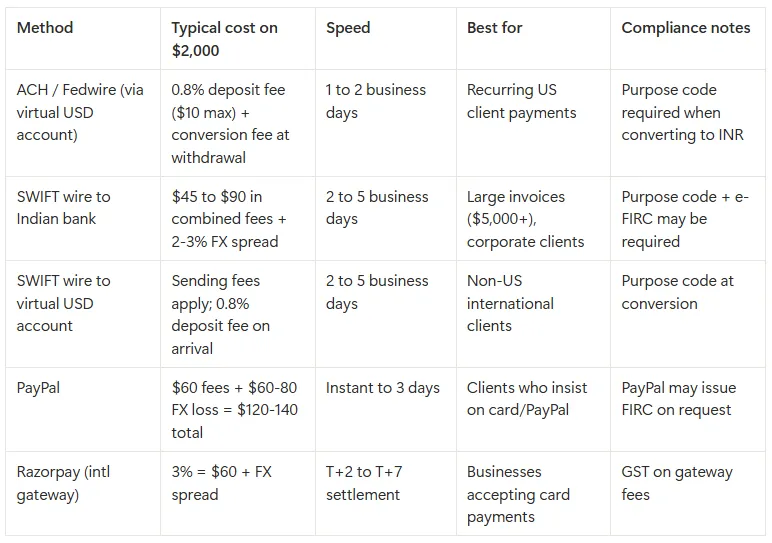
The cost of this setup is not small. A 2% to 3% FX spread on every transfer, intermediary deductions on SWIFT wires, and receiving bank charges add up to lakhs lost annually for anyone earning regular USD income. This guide covers the four main ways to receive US dollar payments in India, what each one actually costs on a real invoice, the compliance requirements (purpose codes, FIRC, FEMA) that most payment guides skip entirely, and how to set up an infrastructure that gives you control over when and at what rate your dollars become rupees.

The four main ways to receive USD in India

1. US ACH or Fedwire transfers

ACH (Automated Clearing House) and Fedwire are US domestic transfer systems. When a US client pays you via ACH or Fedwire, the money moves within the US banking system to a US-based account. This is important because US companies strongly prefer paying vendors through their domestic payment rails. Their finance teams process ACH payments the same way they pay local contractors, which means less friction on the client side and faster approval on yours.

ACH transfers typically cost the sender nothing or a small flat fee (usually under $1). Fedwire transfers may cost the sender $15 to $30, depending on their bank. On your end, the cost depends on where the funds land. If you are receiving into a virtual USD account from a fintech provider, the provider charges a deposit fee (Grey charges 0.8%, minimum $2, maximum $10). There is no intermediary bank deduction because the payment never leaves the US banking system.

ACH is best for recurring payments from US-based clients, such as monthly retainers, project milestones, or regular consulting fees. If most of your clients are American, setting up a virtual USD account that supports ACH and Fedwire deposits is typically the lowest-cost option for regular income.

2. International wire transfers (SWIFT)

SWIFT is the global messaging network that banks use to route cross-border payments. When a client outside the US (or a US client whose bank does not support ACH to your provider) sends you a wire transfer, it travels through the SWIFT network. This is the most universally accepted method, but it is also the most expensive.

The costs stack up at multiple points. The sending bank charges a wire fee, typically $20 to $50, depending on the country and bank. If the payment routes through an intermediary (correspondent) bank, that bank deducts another $10 to $25 from the transfer amount. Your receiving bank may charge an additional inward remittance fee of $5 to $15. On a $2,000 invoice, total fees can range from $45 to $90, which is 2.25% to 4.5% before any currency conversion. Settlement takes 2 to 5 business days.

SWIFT makes sense for large, infrequent payments where the fixed fees represent a smaller percentage of the total: invoices above $5,000, corporate contracts, or one-off project payments. For smaller recurring payments, the per-transfer cost makes SWIFT significantly more expensive than ACH.

Also read: Top platforms to earn US dollars in India

3. Payment aggregators

Payment aggregators collect funds from your client (usually via card or local bank transfer) and remit the proceeds to your Indian bank account. The most common ones Indian freelancers encounter are PayPal, Razorpay (for businesses accepting international payments), and Stripe (with limited availability for payouts in India).

PayPal charges 2.99% on incoming goods and services payments, plus a currency conversion spread of 3% to 4% above mid-market when you withdraw to INR. On a $2,000 payment, that is roughly $60 in transaction fees plus $60 to $80 in conversion loss, totalling $120 to $140. Razorpay's international payment gateway charges 3% per transaction for international cards. These platforms are convenient for clients who prefer paying by card or who are not set up for bank transfers, but the cumulative cost is the highest of all four methods.

Aggregators are best for small, one-off projects where the client insists on paying by card, or for marketplace payouts (Upwork, Fiverr) where the platform dictates the payment method.

4. Cross-border transaction caps

India's cross-border payment framework includes transaction-level limits in certain categories. Some payment setups cap individual cross-border transactions at ₹25 lakh per unit of goods or services. If your invoice size approaches that range, bank-led rails such as SWIFT are usually more suitable than aggregator platforms. Having access to a USD receiving account through a provider like Grey gives you more flexibility when handling higher-value international payments, because the funds arrive in USD first and you control the conversion timing and method.

How the four methods compare

__wf_reserved_inherit

The compliance layer most freelancers overlook

Receiving USD payments in India is regulated under the Foreign Exchange Management Act (FEMA) and RBI reporting guidelines. Getting the compliance right upfront prevents delays, frozen transfers, and problems during audits.

Purpose codes

Indian banks require a purpose code on every inward remittance to classify the transaction under FEMA. Common codes for freelancers include those for software development, consulting, and marketing services. These codes are defined under the RBI purpose code list for inward remittances. Providing the correct code on your invoice and communicating it to your client's bank reduces the risk of your payment being held for manual review. Vague or missing purpose codes are one of the most common reasons for delayed credits.

You may also like: How to receive money from UK clients in India

FIRC and e-FIRC

If you export services (which includes freelancing for foreign clients), you may need a Foreign Inward Remittance Certificate (FIRC or e-FIRC) for GST export documentation, audits, and platform compliance. Only authorised dealer banks issue e-FIRC documentation. Confirm your bank's process for issuing these certificates in advance, because requesting them after the fact can take weeks. If you receive payments through a virtual USD account and then transfer to your Indian bank, the e-FIRC is issued by the Indian bank that receives the final INR credit.

‍

Export realisation timelines

India requires that export proceeds be realised (received in India) within a prescribed period. Long-pending invoices can create compliance issues. Keep your documentation organised and follow up on overdue payments early. For a complete explanation of FIRC requirements, tax implications, and RBI compliance rules, see Grey's guide on FIRC, taxes, and compliance for Indians earning foreign currency.

Which setup is right for your situation

The right payment method depends on three factors: where your clients are located, your average invoice size, and whether you want to hold USD or convert to INR immediately.

For most clients in the US, a virtual USD account that supports ACH and Fedwire is typically the lowest-cost option. Your US client pays you the same way they pay a local vendor. You receive the funds in USD, hold them until you are ready to convert, and withdraw to your Indian bank at a rate and time you choose. SWIFT works as a backup for clients whose banks do not support ACH to their provider.

Global clients across multiple countries: Ensure your account can receive international SWIFT wires without intermediary deductions eating into your payment. A multi-currency account lets you hold USD, GBP, or EUR and convert only when the rate is favourable, rather than accepting your bank's automatic conversion on arrival.

Large invoices ($5,000+): Direct bank rails (SWIFT or Fedwire) are preferable to aggregator platforms. The fixed fees are lower as a percentage of the total than the percentage-based fees aggregators charge. A $10,000 invoice through PayPal costs roughly $600-$700 in combined fees and FX losses. The same invoice received via SWIFT to a virtual USD account costs $10 in deposit fees plus the conversion cost when you move to INR.

Priority is maximising take-home INR. Compare the total cost at every step: incoming transfer fees, deposit fees, FX margin versus the mid-market rate, and withdrawal fees. Small differences in FX margins compound significantly over a year of regular payments. A 1% difference on $3,000 per month is $360 annually.

Also read: A guide for Indians getting paid by clients abroad

Common mistakes to avoid

Relying on a single payment method leaves you exposed if that channel has downtime, compliance issues, or fee changes. The safest setup is ACH or Fedwire as your primary rail with SWIFT as a fallback. Ignoring FX spreads is the most expensive mistake: the difference between mid-market and a 3% markup on $2,000 is $60 per transfer. Waiting until a compliance request arrives to organise your documentation can delay your funds for days or weeks. Sending invoices without detailed service descriptions triggers manual review at Indian banks because the purpose of the remittance is unclear. Include the service type, project reference, and your client's details on every invoice.

How Grey works for Indian freelancers receiving USD

Grey provides Indian freelancers, consultants, and remote professionals with USD, GBP, and EUR foreign currency accounts that can receive payments via ACH, Fedwire, or international SWIFT wire transfers. The setup is fully digital: sign up at grey.co or download the Grey app, complete KYC verification with your PAN card, Aadhaar, and proof of address, and your account details are available within 24 hours.

When a payment arrives via ACH or Fedwire, Grey charges a 0.8% deposit fee (minimum $2, maximum $10). The funds sit in your USD wallet. You can hold them in dollars for as long as you need, which is useful if you want to wait for a more favourable exchange rate or if you have USD expenses (software subscriptions, SaaS tools, advertising spend) that you can pay directly using a Grey virtual card. The virtual card costs $5 to create with no monthly maintenance fee. Transactions on USD-priced sites incur no additional fee; purchases on non-USD websites carry a 2% + $0.50 cross-border fee.

When you are ready to convert to INR, Grey charges a 1% conversion fee capped at $6 per transaction. The conversion rate is displayed before you confirm, so you see exactly how much INR you will receive. Transfers to your Indian bank account require your IFSC code and typically arrive the same day. You can check Grey's fee calculator to see the exact cost for any transaction amount before you commit.

Instead of relying on automatic bank conversions that happen at arrival, or juggling multiple platforms for different currencies, you receive USD through one account, manage your balance in dollars, and convert to INR when the timing and rate suit you.

Grey charges a 0.8% fee on deposits (minimum $2, maximum $10), a 1% conversion fee (capped at $6), and a withdrawal fee that varies by currency. Exchange rates on Grey are variable and include a margin over the mid-market rate. Cross-border card transactions on non-USD websites incur a 2% + $0.50 fee. Always review fees and the conversion rate before confirming a transaction.

ACH vs wire transfer: differences, speed, fees and which to use

•

•

2 min read

After confirming payment terms with a US client, you will typically receive your payment via wire transfer or ACH. While both options let you receive USD from a US bank account, they share little in common. How the money moves, how much it costs, and how long it takes vary significantly.

In short, ACH is cheaper and works within the US banking system, usually taking one to three business days. A wire transfer is faster for urgent or large payments and works internationally, but costs more and is very hard to reverse. This article compares the two on speed, cost, limits and reversibility, and shows which is cheaper if you want to keep more of your earnings.

What is the difference between ACH and wire transfer?

Here is a table that gives you a quick overview of the differences between ACH and wire transfers.

Feature ACH transfer Wire transfer
Processing method Batch processing through ACH network Individual, real-time gross settlement
Speed 1 to 3 business days; Same Day ACH available for qualifying transactions Same day (domestic Fedwire); 1 to 5 days (international SWIFT)
Cost Often free; $0 to $1 for outgoing at most banks; $25 per month for same-day ACH at some banks $15 to $50 (domestic); $25 to $75 (international)
Reversibility Returnable within defined windows (up to 60 days for unauthorised consumer debits) Very difficult to reverse once settled
Domestic / international US domestic only Domestic and international
Transaction limit Daily limits typically $5,000 to $100,000 depending on bank and account type No universal limit; large transfers require documentation
Security Bank-level encryption; regulated by Nacha and Electronic Fund Transfer Act Bank-level encryption; regulated by Fedwire/SWIFT compliance standards
Best for Payroll, bill payment, recurring transfers, everyday business payments Real estate, international payments, urgent large-value transfers

How wire transfers work

A wire transfer is a direct instruction from one bank to another to initiate a transaction. When your US client wants to pay you:

  • The sender bank sends a payment instruction through the SWIFT network.
  • The money passes through one or more intermediary banks
  • Each bank deducts a processing fee before forwarding the remaining funds
  • The money is converted to your local currency at your bank's rate that includes some margins.
  • The money will be deposited into your account in 2 to 5 business days.

Total deductions can range from $30–$75, plus $25–$45 charged by the sender’s bank. Hence, the exact fees are often unpredictable until the money arrives. It is usually difficult to tell how many banks will be involved in a wire transfer. It depends on the specific institutions, the currencies involved, and the destination country.

How ACH transfers work

ACH stands for Automated Clearing House. It is an electronic network that operates entirely within the US  banking system. When a US client sends money to your USD account via ACH, the funds move from their bank to yours via the network.

Unlike SWIFT, ACH is not a messaging system, and money is not being passed through different banks. This means:

  • No intermediary fees between the sender's bank and the recipient's bank.
  • Faster processing, typically within 3 days.
  • Little or no charge on transfers, at most a nominal flat fee under $1.
  • No forced conversion

Many banks now offer same-day ACH, meaning you can receive your payment within a few hours.

If it is that straightforward, why doesn’t every global remote worker use it?

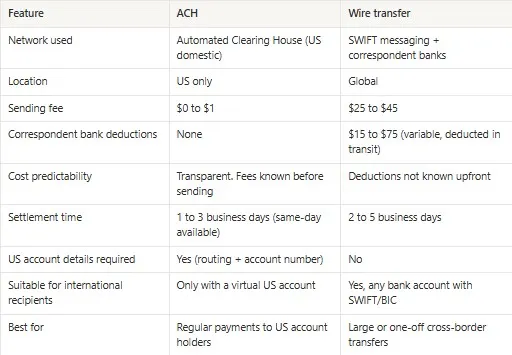
The problem is that ACH only works within the US banking system. For a client to pay you via ACH, you need a USD account with a US routing number and account number. Without those details, ACH is not an option, regardless of how much both parties would prefer it.

Also read: Digital banks vs traditional banks for non-US residents

Which is faster, ACH or wire transfer?

Wire transfers are generally faster than ACH transfers, especially for urgent payments. However, Same Day ACH makes the difference less obvious.

  • Standard ACH: Usually takes one to three business days. The exact timing depends on when the payment is submitted, as ACH transactions are processed in batches several times throughout the business day.
  • Same Day ACH: Eligible payments submitted before the bank's cut-off time (typically around 2:45 pm ET) can settle on the same business day. Availability varies by bank and transaction type.
  • Domestic wire transfers: Processed individually through Fedwire or CHIPS and usually arrive the same business day if sent before the bank's cut-off time (often between 4 pm and 6 pm ET). Once completed, a wire transfer is generally final and cannot be reversed.
  • International wire transfers: Typically take one to five business days, depending on the countries involved, the currencies being transferred, and whether intermediary banks are part of the payment route. Transfers between major currencies such as USD and GBP or USD and EUR often arrive within one to two business days.

So, if speed matters, choose domestic wire transfer or Same Day ACH for urgent payments within the US and international wire transfer for cross-border payments.

If time is on your side, then a standard ACH is usually the better option. It works fine for payrolls, recurring bills, supplier payments, and routine invoices where waiting an extra day or two is not a problem.

The cost comparison in real numbers

The difference between wire and ACH becomes more real when you apply it to an actual transaction. So, let’s use some numbers to illustrate.

Let’s say you have sent a $1,500 invoice to a US client and are expecting payment.

Using international wire: your client’s bank charges $35 to initiate the transfer. One correspondent bank deducts $20 in transit. Your receiving bank may charge an inward transfer fee of $10 to $15. The total deducted from that $1,500 before it reaches your account is $65 to $70, close to 5% of the invoice amount.

Using ACH to a virtual USD account: your client pays nothing or a nominal fee under $1. No correspondent banks are involved. The full $1,500 lands in your account, or, let’s say, $ 1,499. Your payment platform may charge a deposit fee, typically 0.35% to 1%. There might be a flat fee for withdrawing the money to your local bank. Total cost on your end: $5.25 to $15 on a $1,500 payment, or 0.35% to 1%.

On a $1,500 transaction, that is a difference of $50 to $65. On $1,500 received monthly, that is $600 to $780 in avoidable costs per year.

Here is a table comparing ACH and wire transfers:

__wf_reserved_inherit

Why wire transfers still exist

If ACH is cheaper and more predictable, you might wonder why anyone still uses wire transfers for international payments. ACH works only in the US. If your client’s bank is in the UK, Germany, or Japan, they cannot initiate an ACH transfer regardless of what account details you provide. For those clients, SWIFT wire is the only direct bank-to-bank option.

For US clients, wire transfers are often used for large transactions, with higher fees accepted as a cost of doing business. For regular freelance or consulting payments of $1,000 to $5,000, wire transfers are rarely the better choice when ACH is available.

Also, some international companies have rigid payment structures built around wire transfers, which can be an administrative hassle to change. They might stick with the traditional wire transfer, which they are more familiar with.

Getting an account that accepts ACH

Opening a traditional US account requires having a US address and a Social Security Number or an Individual Taxpayer Identification Number. This might not be possible if for a Filipino developer working with a San Francisco startup, a Kenyan designer invoicing a Boston agency, or an Indian consultant serving US clients.

How then can you get a US routing number and account number for ACH transactions?

Virtual USD accounts issued by regulated fintech platforms solve this directly. When you open a virtual USD account through a platform like Grey, Wise, or Raenest, you get a real US routing number and account number from a US banking partner. These details are similar to those for any other US bank account. Your client initiates an ACH transfer from their end, the funds move through the ACH network, and they arrive in your virtual account without any intermediary bank taking a cut.

Also read: Virtual US accounts explained: who they work for

Receiving USD via ACH with Grey

Grey gives freelancers, consultants, and remote workers virtual USD accounts with real US routing numbers and account numbers that accept ACH transfers directly.  The deposit fee on Grey’s USD account is 0.8% of the amount received, capped at $10. You can keep the USD in your account or convert to your local currency at mid-market exchange rates. Grey shows you the exact cost of each transaction and accounts for any deduction. Its multi-currency feature makes it easy to manage GBP and EUR on the same platform.

With a virtual USD bank account, you can now receive ACH payments and maximise your earnings. Sign up on Grey and download the app to get your USD account details today.

Frequently asked questions

Can an ACH transfer be reversed?

Yes, within defined windows. ACH credits (money sent to a recipient) can be reversed within five banking days if they were sent in error. ACH debits (money pulled from a payer's account) can be returned by the receiving bank within two business days for administrative reasons, and consumers have up to 60 days to dispute an unauthorised ACH debit under EFTA protections. Business accounts have shorter windows governed by contract rather than EFTA.

Is a wire transfer safer than ACH?

Both are highly secure, but they have different risk profiles. Wire transfers are final once settled, which protects the recipient against returns but offers the sender no recourse if they make an error or are defrauded. ACH transfers are returnable within defined windows, which gives senders some recourse but also means recipients should wait for transfers to fully clear before releasing goods or services of significant value. For verified, expected transactions, both are safe.

What is the ACH transfer limit per day?

Limits vary by bank and account type. Most US retail bank accounts limit outgoing ACH transfers to $5,000 to $25,000 per day and $25,000 to $100,000 per month for standard accounts. Business accounts typically have higher limits. Premium or verified accounts may have limits up to $500,000 or higher. Contact your bank to confirm your specific account limits.

How do I send a wire transfer internationally?

Contact your bank via online banking, mobile app, or branch visit. You will need: the recipient's full name, their bank account number or IBAN, the bank's SWIFT code or BIC, the bank's name and address, the amount and currency, and your reason for the transfer. Some banks require identity verification or additional documentation for international wires above certain amounts.

Does Grey use ACH or wire transfer?

Grey routes transfer through the most appropriate local payment network for each corridor. For payments to or from US bank accounts, Grey uses ACH. For UK transfers, Grey uses Faster Payments. For EU transfers, Grey uses SEPA. This removes correspondent banks from the chain and avoids the deductions associated with SWIFT international wires. Grey also supports international wire transfers where local network routing is not available.

What happens if a wire transfer is sent to the wrong account?

Contact your sending bank immediately. The bank will initiate a recall process via the SWIFT gpi tracking system or domestic wire network, requesting that the receiving bank return the funds. Recovery success depends on whether the recipient bank is cooperative and whether the funds have been further moved. This process can take weeks and is not guaranteed to succeed. Always verify account details with the recipient before initiating any wire transfer.

Send money internationally with Grey and avoid correspondent bank deductions and undisclosed fees.

Arrow (up)

Back to top