<script type="application/ld+json" data-schema-version="grey-blog-v4"> [{"@context":"https://schema.org","@type":"BlogPosting","@id":"https://grey.co/blog/fx-trading-beginners#article","headline":"FX trading for beginners: How currency trading works","description":"What is FX trading? Learn how currency trading works, the basics of currency pairs, risks, and how to start safely. Get the beginner’s guide today.","inLanguage":"en","url":"https://grey.co/blog/fx-trading-beginners","mainEntityOfPage":{"@id":"https://grey.co/blog/fx-trading-beginners#webpage"},"datePublished":"2026-07-25T00:53:13.705Z","dateModified":"2026-07-25T09:00:00+01:00","author":{"@type":"Person","@id":"https://grey.co/authors/olayoyin-olorunmota#person","name":"Olayoyin Olorunmota","url":"https://grey.co/authors/olayoyin-olorunmota","jobTitle":"Content Writer","sameAs":["http://www.linkedin.com/in/olayoyinolorunmota","http://x.com/yoyin_michael"]},"publisher":{"@type":"Organization","@id":"https://grey.co/#organization","name":"Grey","url":"https://grey.co","logo":{"@type":"ImageObject","url":"https://cdn.prod.website-files.com/6360022338a81bd6fdbb1145/6564ae1077a67e39d3c491a6_Grey%20Logo%20Lockup%20Black.svg"}},"image":{"@type":"ImageObject","@id":"https://grey.co/blog/fx-trading-beginners#primaryimage","url":"https://cdn.prod.website-files.com/636a85d290ee58e70c17e1c0/6a6408c6503c99e91522d26a_FX%20Trading%20for%20Beginners%20How%20Currency%20Trading%20Works-compressed.jpg","contentUrl":"https://cdn.prod.website-files.com/636a85d290ee58e70c17e1c0/6a6408c6503c99e91522d26a_FX%20Trading%20for%20Beginners%20How%20Currency%20Trading%20Works-compressed.jpg","width":1200,"height":675}},{"@context":"https://schema.org","@type":"WebPage","@id":"https://grey.co/blog/fx-trading-beginners#webpage","url":"https://grey.co/blog/fx-trading-beginners","name":"What Is FX Trading? Beginners Guide to Currency | Grey","description":"What is FX trading? Learn how currency trading works, the basics of currency pairs, risks, and how to start safely. Get the beginner’s guide today.","inLanguage":"en","primaryImageOfPage":{"@id":"https://grey.co/blog/fx-trading-beginners#primaryimage"},"breadcrumb":{"@id":"https://grey.co/blog/fx-trading-beginners#breadcrumb"}},{"@context":"https://schema.org","@type":"BreadcrumbList","@id":"https://grey.co/blog/fx-trading-beginners#breadcrumb","itemListElement":[{"@type":"ListItem","position":1,"name":"Home","item":"https://grey.co/"},{"@type":"ListItem","position":2,"name":"Blog","item":"https://grey.co/blog"},{"@type":"ListItem","position":3,"name":"FX trading for beginners: How currency trading works","item":"https://grey.co/blog/fx-trading-beginners"}]},{"@context":"https://schema.org","@type":"FAQPage","@id":"https://grey.co/blog/fx-trading-beginners#faq","mainEntity":[{"@type":"Question","name":"Is FX trading the same as forex trading?","acceptedAnswer":{"@type":"Answer","text":"Yes. FX trading and forex trading are the same. It involves buying and selling currencies in the foreign exchange market to profit from changes in exchange rates. “Forex” is short for foreign exchange. \"FX\" is an abbreviation for the same thing. Both terms are used interchangeably in financial markets, news media, and among retail traders. The market, the instruments, and the mechanics are identical regardless of which term is used."}},{"@type":"Question","name":"How much money do you need to start FX trading?","acceptedAnswer":{"@type":"Answer","text":"Some regulated brokers allow you to open a live micro account with as little as $50 to $100. However, the amount needed to trade responsibly is different from the minimum required to open an account. Even with very small deposits, micro lot positions carry a proportionally high risk relative to the account balance. Most experienced traders suggest that a meaningful starting balance for live trading, after extensive demo practice, is between $1,000 and $2,000. Never deposit an amount whose loss would affect your financial well-being."}},{"@type":"Question","name":"Can you make a living from FX trading?","acceptedAnswer":{"@type":"Answer","text":"A very small percentage of full-time retail traders sustain consistent profitability over the long term. Most who attempt to trade full-time experience significant account drawdowns before either developing a consistent edge or stopping. Making a living from FX trading typically requires years of development, substantial trading capital, and the psychological discipline to manage losses without deviating from a tested strategy. It is not an appropriate financial goal for a beginner."}},{"@type":"Question","name":"Is FX trading legal in the US?","acceptedAnswer":{"@type":"Answer","text":"Yes. Retail FX trading is legal in the United States. Retail FX brokers must be registered with the National Futures Association (NFA) and the Commodity Futures Trading Commission (CFTC), which regulate the industry and set rules around leverage limits, capital requirements, and customer protection. Trading with an unregistered broker is not illegal for the individual, but it removes all regulatory protection. Always verify a broker’s NFA registration at nfa.futures.org before depositing funds."}},{"@type":"Question","name":"What is the safest way to start FX trading?","acceptedAnswer":{"@type":"Answer","text":"The safest approach is to spend several months learning the mechanics of the FX market and practising on a demo account before committing any real capital. When you do move to a real account, use a regulated broker, trade the smallest available position sizes, and deposit only money whose complete loss would not affect your financial situation. Treat early real-money trading as continued education rather than income generation. The goal in the first year is to understand how you behave under real financial risk, not to become profitable immediately."}},{"@type":"Question","name":"How is Grey different from an FX trading platform?","acceptedAnswer":{"@type":"Answer","text":"Grey is a multi-currency account for everyday financial needs: receiving international income, holding balances in USD, EUR, and GBP, converting currencies at a transparent rate, and paying for international expenses. It is not a trading platform. There is no leverage, no speculation, no bid-ask spread to overcome, and no risk of losing a deposit through market movements."}}]},{"@context":"https://schema.org","@type":"DefinedTermSet","@id":"https://grey.co/blog/fx-trading-beginners#terms","name":"FX trading for beginners: How currency trading works glossary","hasDefinedTerm":[{"@type":"DefinedTerm","name":"FX trading","description":"FX trading is the simultaneous buying of one currency and selling another, with the intention of profiting from changes in their relative value over time. The foreign exchange market, commonly called the forex or FX market, is where this activity happens.","inDefinedTermSet":{"@id":"https://grey.co/blog/fx-trading-beginners#terms"}},{"@type":"DefinedTerm","name":"Pip","description":"A pip (percentage in point) is the standard unit of movement in the FX market.","inDefinedTermSet":{"@id":"https://grey.co/blog/fx-trading-beginners#terms"}},{"@type":"DefinedTerm","name":"Spread","description":"The spread is the difference between the price at which you can buy a currency pair (the ask) and the price at which you can sell it (the bid).","inDefinedTermSet":{"@id":"https://grey.co/blog/fx-trading-beginners#terms"}},{"@type":"DefinedTerm","name":"Leverage","description":"Leverage is the most important risk concept in FX trading.","inDefinedTermSet":{"@id":"https://grey.co/blog/fx-trading-beginners#terms"}}]}] </script>

FX trading for beginners: How currency trading works

Olayoyin Olorunmota

TABLE OF CONTENT

SHARE THIS POST

Most people encounter foreign exchange when they travel. If you hand over pounds at an airport kiosk and receive euros, that’s currency exchange for practical purposes.

FX trading (foreign exchange trading) is the buying and selling of currencies to profit from changes in their exchange rates. Currencies are traded in pairs, such as EUR/USD or GBP/JPY. The FX market is the largest financial market in the world, with over $7 trillion traded daily. Most retail FX trading is done through online brokers and involves significant risk, including the potential to lose more than the initial deposit.

The scale is enormous, dwarfing stock markets by comparison.

Understanding what FX trading is, how it works mechanically, and what the risks look like is useful for anyone curious about it. This guide covers all of that and draws a clear line between FX trading as speculation and currency exchange as a practical financial tool.

What is FX trading?

FX trading is the simultaneous buying of one currency and selling another, with the intention of profiting from changes in their relative value over time. The foreign exchange market, commonly called the forex or FX market, is where this activity happens.

Unlike stock markets, the FX market has no central exchange. There is no equivalent of the New York Stock Exchange for currencies. Trading happens over-the-counter (OTC), meaning it occurs directly between participants via electronic networks, with no single physical location.

Currencies are traded as pairs. When you trade EUR/USD, you are simultaneously buying euros and selling US dollars (or vice versa). Every currency transaction in the world involves two currencies and a rate at which they exchange, which is the foundation of how FX trading works.

Who participates in the FX market? The largest participants are central banks, commercial banks, and institutional investors. They account for the vast majority of daily FX volume and trade for purposes ranging from monetary policy implementation to hedging commercial exposure. Retail traders, individuals trading through online brokers, represent a small fraction of overall volume but have access to the same price feeds.

FX trading differs from currency exchange for travel, remittances, or business payments. For example, converting pounds to euros before a holiday is currency exchange, buying EUR/USD at 1.0800 and selling it at 1.0850 to capture a 50-pip gain is FX trading. The underlying currencies are the same. The purpose, the risk profile, and the mechanics are entirely different. For a look at how currencies differ in value across the world, see our guide on the least valuable currencies in the world.

FX trading explained for beginners

The FX market operates 24 hours a day, five days a week, opening on Sunday evening (US Eastern time) when the Sydney session begins and closing on Friday afternoon when the New York session ends. There is no single opening bell and no single close.

The market is divided into four major trading sessions, each corresponding to the business hours of a major financial centre:

Sydney session: Opens the trading week. Volume is relatively low. The Australian dollar and New Zealand dollar are the most active.

Tokyo session: The Asian session. Japanese yen pairs, including USD/JPY and EUR/JPY, see their highest activity.

London session: The busiest session, accounting for the largest share of daily FX volume. Major pairs, including EUR/USD, GBP/USD, and USD/CHF, are most liquid during London hours.

New York session: Overlaps with London for several hours, creating the highest-volume period of the trading day. USD pairs dominate. Most major US economic data releases occur during this session.

The overlap between London and New York is when spreads (the difference between the buy and sell price) are typically tightest, and liquidity is highest. Most retail traders focus their activity on major pairs during these hours because the market moves more predictably and transaction costs are lowest.

Participants beyond retail traders include commercial banks trading on behalf of clients, hedge funds speculating on currency movements, multinational corporations hedging foreign-currency revenue, and central banks managing exchange-rate policy. The actions of large participants, particularly central banks, can significantly move currency prices. A central bank interest rate decision or a major economic data release can move a currency pair by hundreds of pips within minutes.

How does FX trading work?

Understanding FX trading requires understanding a few specific concepts. These are the building blocks that every retail FX trader needs to know before they place a single trade.

Currency pairs

Every FX trade involves a currency pair. The first currency in the pair is the base currency. The second is the quote currency. In EUR/USD, the euro is the base currency and the US dollar is the quote currency. The price of EUR/USD tells you how many US dollars one euro buys. If EUR/USD is 1.0850, one euro buys 1.0850 US dollars.

Major pairs involve the US dollar on one side: EUR/USD, GBP/USD, USD/JPY, USD/CHF, USD/CAD, AUD/USD, NZD/USD. These are the most traded pairs and typically have the tightest spreads. Minor pairs don’t include the US dollar; instead, they feature other major currencies, such as EUR/GBP or GBP/JPY. Exotic pairs involve one major currency and one from a smaller or emerging market economy.

Pips

A pip (percentage in point) is the standard unit of movement in the FX market. For most currency pairs, one pip is a movement of 0.0001 in the price. If EUR/USD moves from 1.0850 to 1.0851, it has moved one pip. For pairs involving the Japanese yen, one pip is 0.01.

Lots

FX positions are measured in lots. A standard lot is 100,000 units of the base currency. A mini lot is 10,000 units. A micro lot is 1,000 units. Most retail brokers allow trading in micro lots, which allows beginners to participate with smaller amounts. The lot size determines the monetary value of each pip movement.

Leverage

Leverage is the most important risk concept in FX trading. It allows a trader to control a larger position than the amount they have deposited. A broker offering 30:1 leverage allows a trader to control $30,000 worth of currency with a $1,000 deposit. This amplifies both gains and losses equally. A 1% move against a leveraged position can wipe out the entire deposit. Most regulated brokers in the US and Europe cap retail leverage at 30:1 or 50:1 for major pairs. Some offshore brokers offer higher leverage, which significantly increases risk.

Long and short positions

Going long means buying the base currency, expecting it to rise against the quote currency. Going short means selling the base currency, expecting it to fall. In EUR/USD, going long means you expect the euro to strengthen against the dollar. Going short means you expect euros to weaken.

Bid-ask spread

The spread is the difference between the price at which you can buy a currency pair (the ask) and the price at which you can sell it (the bid). This is the broker’s primary source of income on standard accounts. If EUR/USD has a bid of 1.0848 and an ask of 1.0850, the spread is 2 pips. Every trade starts at a small loss equal to the spread, which must be overcome before any profit is realised.

FX trading beginner’s guide: Where to start

If you’re curious about FX trading and want to explore it responsibly, here is a sequence that reduces unnecessary risk.

Step one: Learn before you invest
Read about how the FX market works, how to read currency pairs, what economic data affects currency prices, and how leverage works in practice. This phase should take weeks, not days. Understanding the mechanics before placing any trade is not optional.

Step two: Choose a regulated broker
Regulation matters in FX trading. In the US, retail FX brokers must be registered with the National Futures Association (NFA) and the Commodity Futures Trading Commission (CFTC). In the UK, brokers are regulated by the FCA. Using an unregulated broker exposes you to the risk of fraud, manipulation, and having no recourse if something goes wrong. The NFA’s investor education resources at nfa.futures.org are a reliable starting point for US-based traders evaluating brokers.

Step three: Open a demo account and practise
Every reputable regulated broker offers a demo account with virtual money. A demo account uses real market prices but no real capital. Practise placing trades, managing positions, and understanding how leverage affects your balance. Spend three to six months on a demo account before considering real money.

Step four: Start with the smallest position size possible
If you move to a real account, start with a micro account and trade the smallest available lot sizes. The goal at this stage is experience, not profit. Accept that early trades will likely lose money and treat the losses as tuition.

Step five: Never deposit money you cannot afford to lose entirely
This is the reality of retail FX trading. Your initial deposit should be an amount that would not affect your financial situation if it were lost.

The risks of FX trading

The risks of retail FX trading are specific, well-documented, and frequently underestimated by beginners.

  1. Most retail traders lose money: Regulated brokers in the EU are required to disclose the percentage of their retail clients who lose money. Across major regulated brokers, this figure typically ranges from 70% to 80%. Some brokers even report higher loss rates.
  2. Leverage amplifies losses, not just gains: A 30:1 leveraged position on EUR/USD means a 1% move against you wipes out 30% of your deposit. A 3.3% move against you wipes it out entirely. Currency pairs can move several per cent in a single session following a major economic announcement or central bank decision.
  3. Emotional decision-making is a primary cause of losses: Holding a losing position hoping it will recover, closing a winning position too early out of fear, and increasing position sizes after losses to “make it back” are patterns that affect most retail traders at some point. Developing the discipline to follow a consistent strategy regardless of short-term outcomes is harder than understanding the technical mechanics.
  4. Broker risks: Even with regulated brokers, operational risks exist. Trading platform outages during high-volatility events, requotes that execute your trade at a worse price than requested, and slippage (the difference between your intended entry price and your actual entry price) are real experiences that affect retail traders.

FX trading vs currency exchange for everyday use

FX trading and currency exchange involve the same underlying currencies but serve entirely different purposes and carry entirely different risk profiles.

FX trading is active speculation. You are taking a position on the direction of a currency pair, using leverage, accepting the risk of loss, and paying spreads and commissions on every trade. The goal is to profit from short-term price movements. It requires time, attention, risk capital, and the discipline to manage positions in real time.

Currency exchange for everyday use is an operational infrastructure. You need to receive USD from a US client, hold euros before a European trip, pay for GBP-denominated tools from your GBP balance, or send money home to family. The goal is to move money at a fair rate without unnecessary fees or poor exchange rates. This requires the right account setup, not market speculation.

Grey is built for the second category. If you earn in USD, EUR, or GBP from international clients, or need to hold and convert currencies for real-world financial needs, a multi-currency account handles that without the risk profile of an FX trading account. You convert currencies with Grey at mid-market rates and hold balances in multiple currencies from one account.

For people with genuine multi-currency financial needs, whether freelancers receiving foreign income, remote workers managing international expenses, or anyone regularly converting between currencies, opening a multi-currency account with Grey addresses those needs directly. No leverage, no speculation, no risk of losing your deposit. Just a transparent fee structure and a rate shown before you confirm. Download the Grey app today to begin.

Frequently asked questions

Is FX trading the same as forex trading?

Yes. FX trading and forex trading are the same. It involves buying and selling currencies in the foreign exchange market to profit from changes in exchange rates. “Forex” is short for foreign exchange. "FX" is an abbreviation for the same thing. Both terms are used interchangeably in financial markets, news media, and among retail traders. The market, the instruments, and the mechanics are identical regardless of which term is used.

How much money do you need to start FX trading?

Some regulated brokers allow you to open a live micro account with as little as $50 to $100. However, the amount needed to trade responsibly is different from the minimum required to open an account. Even with very small deposits, micro lot positions carry a proportionally high risk relative to the account balance. Most experienced traders suggest that a meaningful starting balance for live trading, after extensive demo practice, is between $1,000 and $2,000. Never deposit an amount whose loss would affect your financial well-being.

Can you make a living from FX trading?

A very small percentage of full-time retail traders sustain consistent profitability over the long term. Most who attempt to trade full-time experience significant account drawdowns before either developing a consistent edge or stopping. Making a living from FX trading typically requires years of development, substantial trading capital, and the psychological discipline to manage losses without deviating from a tested strategy. It is not an appropriate financial goal for a beginner.

Is FX trading legal in the US?

Yes. Retail FX trading is legal in the United States. Retail FX brokers must be registered with the National Futures Association (NFA) and the Commodity Futures Trading Commission (CFTC), which regulate the industry and set rules around leverage limits, capital requirements, and customer protection. Trading with an unregistered broker is not illegal for the individual, but it removes all regulatory protection. Always verify a broker’s NFA registration at nfa.futures.org before depositing funds.

What is the safest way to start FX trading?

The safest approach is to spend several months learning the mechanics of the FX market and practising on a demo account before committing any real capital. When you do move to a real account, use a regulated broker, trade the smallest available position sizes, and deposit only money whose complete loss would not affect your financial situation. Treat early real-money trading as continued education rather than income generation. The goal in the first year is to understand how you behave under real financial risk, not to become profitable immediately.

How is Grey different from an FX trading platform?

Grey is a multi-currency account for everyday financial needs: receiving international income, holding balances in USD, EUR, and GBP, converting currencies at a transparent rate, and paying for international expenses. It is not a trading platform. There is no leverage, no speculation, no bid-ask spread to overcome, and no risk of losing a deposit through market movements.

Last updated:

October 13, 2026

Open a free Grey account to get startedJoin 1 million digital nomads
IF YOU ENJOYED THIS, CHECK THESE OUT

TikTok monetisation in the UAE: how to get paid in USD

•

•

2 min read

Yes, UAE creators can earn US dollars on TikTok, but not from views. As of November 2026, TikTok's Creator Rewards Program, the feature that pays per qualified view, is not open in the UAE. The money comes from brand deals, TikTok One campaigns, LIVE gifts and affiliate links, and a lot of it arrives in USD from international brands and platforms.

That changes what you should worry about. The dirham has been pegged at 3.6725 to the US dollar since 1997, so exchange-rate swings are not where your earnings leak; conversion fees, withdrawal charges and fines are. Since late 2025, promotional posts also need a UAE Media Council Advertiser Permit, with fines starting at AED 20,000.

This guide covers what TikTok actually pays for in the UAE, the permit, how each income stream reaches you, and what it costs to receive $2,000 through different routes.

Is TikTok monetisation available in the UAE?

Partly. TikTok's Creator Rewards Program is not available to UAE accounts. Independent trackers checked in October and November 2026 list eight countries where it runs: the US, the UK, Germany, France, Japan, South Korea, Brazil and Mexico.

Where it does run, TikTok's own announcement sets the bar at age 18, 10,000 followers and 100,000 views in the last 30 days, and it only rewards original videos longer than a minute. The quickest check for your own account is TikTok Studio: if Creator Rewards isn't listed there, it isn't open to you.

Everything else depends on the feature. Here is where each income stream stands for a creator based in the UAE.

Income streamOpen to UAE creators? (Nov 2026)Who pays youHow the money reaches you
Creator Rewards ProgramNoTikTokNot applicable
Direct brand dealsYes, with an Advertiser PermitThe brand or its agencyBank transfer or PayPal, often in USD
TikTok One campaignsWhere TikTok offers it to your account; permit neededThe brand, through TikTokRewards Center payout to a bank or other supported method
LIVE giftsCheck TikTok Studio; you must be 18 or olderViewers, through TikTokWithdrawal from your TikTok balance to a method listed for your region
External affiliate linksDepends on the programmeThe affiliate networkThe network's own payout options
TikTok Shop sellingNo UAE seller marketplaceNot applicableNot applicable

Checked 25 November 2026. Sources: TikTok Newsroom (Creator Rewards Program, March 2024), TikTok Ads Help Center (TikTok One payouts, April 2026), and independent trackers for country availability. TikTok's own help pages could not be read directly, so confirm in TikTok Studio before you plan around any row.

What pays UAE TikTok creators instead

Without per-view pay, a UAE creator's TikTok income is mostly a business of selling attention to brands. The platform is the shop window; the payments come from elsewhere.

Brand deals and sponsored videos

This is where the real money sits. Brands in luxury, fashion, travel, beauty, fitness and tech constantly look for creators who can sell to the UAE's mixed, high-spending audience in short videos.

International brands and agencies usually pay in USD by bank transfer or PayPal. Put the currency, the payment method and the payment date in the contract before you film, because the route you agree on decides how much of the fee you keep.

TikTok One campaigns

TikTok One is TikTok's marketplace where brands find and book creators. According to the TikTok Ads Help Center (last updated April 2026), you connect a bank account or another supported method in the Rewards Center, and creators outside Europe and Canada can request a payout at any time once their payment account is verified.

LIVE gifts

Viewers buy Coins, send you gifts during a LIVE, and those gifts become Diamonds in your TikTok balance. You withdraw from your balance in the app, using the payout methods TikTok lists for your region.

You must be 18 or older to receive gifts. Diamond values, withdrawal minimums and daily caps change, so treat any figure you read online as a rough guide and check the numbers on your own withdrawal screen.

Affiliate links

You can promote products through external affiliate programmes and earn a commission per sale. TikTok Shop is a different story: independent checks in 2026 found no seller marketplace for the UAE, so the in-app shop model that pays creators in other countries isn't an option here yet.

For a wider view of the platforms that pay creators across borders, see our guide on how to get paid globally.

Do you need a permit to make money on TikTok in the UAE?

For anything promotional, yes. The UAE Media Council announced the Advertiser Permit on 30 July 2025, and Al Tamimi & Company reports it became mandatory in late October 2025, after a three-month grace period.

According to The National (January 2026), the permit covers promotional content whether it is paid or unpaid, and creators had until 31 January 2026 to get one. Here is what else the two sources say:

  • Cost: free for citizens and residents for the first three years, renewed every year.
  • Visitors: non-residents apply through a licensed advertising or talent agency, for three months, renewable once.
  • Exemption: promoting your own products, or a company you own, on your personal account.
  • Fines: from AED 20,000 for a first offence, up to AED 1 million for serious or repeat breaches.

The sources don't say whether LIVE gifts alone need a permit, because the rules target promotional content. If you're unsure whether a post counts, ask the Media Council before you publish it.

Tax is simpler. There is no personal income tax in the UAE, but Neo Legal (July 2026) notes VAT registration is mandatory once taxable supplies pass AED 375,000. Our creator tax guide covers the paperwork platforms ask for.

How your USD reaches you, and where fees eat it

Because of the dirham peg, $2,000 is worth about AED 7,345 today and will be worth the same next month. What changes the amount you keep is the route the money takes.

Here is what one sponsored video paid at $2,000 costs to receive through common routes.

RouteFee ruleFee on $2,000 (USD)Arrival time
Grey USD account, ACH0.8%, minimum $2, maximum $10$101 to 2 business days
Grey USD account, FedNow0.8%, minimum $2, maximum $10$10Seconds
Grey USD account, FedwireFlat $20$20About 1 business day
PayPal UAE, withdraw USD to a UAE bank1.5%, minimum $15$30Set by PayPal and your bank
PayPal UAE, convert USD balance to AED3.0% conversion fee$60Set by PayPal and your bank

Checked 25 November 2026. Sources: Grey Help Centre, Deposit fees (USD) and Guidelines for receiving payments to your US bank account; PayPal UAE consumer fees (last updated 28 September 2026). PayPal figures exclude any fee for receiving a commercial payment, and an AED withdrawal over AED 750 has no extra PayPal fee.

The pattern is clear. Grey's ACH and FedNow fee stops growing at $10, so any payment above $1,250 costs the same to receive, while percentage fees keep climbing with your rate card.

How to receive TikTok and brand payments in USD with Grey

Grey gives UAE residents a USD account with US routing and account numbers, so brands and agencies can pay you the way they pay a US creator. Grey is a financial technology company, not a bank, and is registered with FinCEN.

  1. Sign up on your phone. Download the Grey app, choose the UAE as your country and verify your identity with a valid passport or Emirates ID. Verification usually takes a few minutes and can take up to 24 hours.
  2. Open your USD account. Your US account and routing numbers are ready to share once you're verified. There is no account opening or maintenance fee.
  3. Put the details on your invoices. Ask brands and agencies to pay by ACH or FedNow where they can. Payments from businesses have no limit; payments from individuals must be under $4,000 each.
  4. Move PayPal balances across. If a brand or platform pays you through PayPal, you can link your Grey account to PayPal as a US bank account. The names must match, transfers take 1 to 2 working days, and you should check the fee PayPal shows before you confirm.
  5. Spend or hold. The UAE is on Grey's supported list for its Visa virtual dollar card, so you can pay for subscriptions, ads and gear in USD without converting first.

One rule to know: Grey does not accept payments for crypto, P2P, betting or forex trading. If you also take work from overseas clients, our guide for UAE freelancers covers GBP and EUR payments too, and this comparison of creator USD accounts sets Grey against the alternatives.

Common mistakes UAE creators make

  • Waiting for Creator Rewards. Building a channel around per-view pay that isn't offered in the UAE leaves you with views and no income.
  • Posting a paid video without a permit. The AED 20,000 starting fine can wipe out the fees from several brand deals.
  • Letting PayPal convert for you. At 3.0%, the conversion fee on a $2,000 payment is $60, for a currency that is pegged anyway.
  • Leaving payment terms out of the contract. "We'll pay you" is not a currency, a method or a date.

Frequently asked questions

Does TikTok pay UAE creators for views?

No. As of November 2026, the Creator Rewards Program, which pays per qualified view, isn't open to UAE accounts. UAE creators earn through brand deals, TikTok One campaigns, LIVE gifts and affiliate links.

How many followers do you need to make money on TikTok in the UAE?

There is no single number. Brands judge your audience and engagement, not a fixed threshold, and you must be 18 or older to receive LIVE gifts.

Can I withdraw TikTok earnings to a UAE bank account?

TikTok shows the payout methods available for your region on your balance screen. If the money goes through PayPal, PayPal UAE charges 1.5% (minimum $15) to withdraw USD to a UAE bank, or 3.0% to convert your balance to AED first.

Do I need an Advertiser Permit for TikTok in the UAE?

Yes, if you post promotional content, paid or unpaid. The permit is free for UAE citizens and residents for the first three years, and fines start at AED 20,000.

The short version

In the UAE, TikTok pays creators through brands, not views, so what you keep depends on the permit you hold and the route your dollars take. Get the permit first, agree USD payment terms in every contract, and open a Grey account so brands can pay you in USD.
Top 10 sites to get international remote jobs in Nigeria

•

•

2 min read

The best sites for international remote jobs in Nigeria depend on the kind of work you want. For freelance projects, start with Upwork, Fiverr or Freelancer.com. For full-time salaried roles, use LinkedIn, Wellfound, We Work Remotely and Remote OK, and if you are a mid-level or senior tech professional, apply to vetted networks like Toptal and Andela.

The site matters less than one filter most people skip. A large share of "remote" listings are open only to people in the US, Canada or Europe, and applying to them is wasted effort. This guide shows you which sites fit which kind of work, what each one costs you, how to spot listings that are genuinely open to Nigerians, and how to get paid once you land the job.

Which remote job site should you use?

Freelance marketplaces suit people who want quick, project-based income and can sell a clear skill. Job boards suit people who want a salary from one employer. Vetted networks suit experienced professionals who can pass a technical screening.

SiteType of workBest forWhat it costs you (USD)
UpworkFreelance projectsWriters, developers, designers, virtual assistantsFree Basic plan; 0% to 15% service fee per contract; extra Connects $0.15 each
FiverrFreelance gigs you package and priceClear, repeatable services (logos, edits, voiceovers)Commission deducted from each order
Freelancer.comFreelance projects by biddingBeginners building a first portfolio10% or $5 per fixed-price project (whichever is higher); 10% on hourly; $20 minimum balance to bid
ToptalVetted freelance networkSenior developers, designers, finance experts, product managersEntry is by screening
AndelaVetted tech talent networkMid to senior software engineers and technologistsEntry is by screening
LinkedIn JobsFull-time and contract rolesEveryone, especially experienced professionalsFree basic account
WellfoundStartup jobsTech, product and growth rolesFree for candidates
We Work RemotelyRemote-only job boardFull-time roles in tech, support, marketingFree Basic account; Pro $14.95 a month
Remote OKRemote-only job boardTech, design and marketing rolesFree to browse; premium upgrade offered
FlexJobsScreened remote and flexible jobsPeople who want fewer junk listings$29.85 every 3 months or $71.40 a year

Checked 25 November 2026. Sources: Upwork pricing, Freelancer.com fees, We Work Remotely, Wellfound, FlexJobs pricing. Platform fees change often, so confirm before you sign up.

Freelance marketplaces

Freelance sites are the fastest way to earn your first foreign income, because clients hire for a single task rather than a long-term role. The trade-off is competition and fees. If you are still deciding between the two biggest platforms, our Upwork vs Fiverr guide compares them side by side.

1. Upwork

Upwork connects freelancers with businesses hiring for writing, development, design, customer service, data and virtual assistance. You create a profile, send proposals using Connects, and build a reputation through client reviews. The Basic plan is free, and Upwork shows you the exact service fee (between 0% and 15%) before you submit a proposal.

Niche down. A profile that says "Shopify developer for fashion brands" wins more replies than "web developer", because clients search for a specific problem.

2. Fiverr

Fiverr flips the model. Instead of bidding on jobs, you list a "gig" with fixed packages and clients come to you. It works best for services that are easy to describe and deliver in a set time, such as logo design, video editing or translation.

3. Freelancer.com

Freelancer.com works like Upwork, with clients posting projects and freelancers bidding. It is a reasonable place to win small first jobs and reviews. Watch the costs: Freelancer.com takes 10% of fixed-price projects (minimum $5) and 10% of hourly payments, and you need a $20 minimum balance to place standard bids.

Vetted talent networks

Vetted networks do the client hunting for you, but you have to pass their screening first. They suit people with solid professional experience rather than beginners.

4. Toptal

Toptal is a premium network for software developers, designers, finance experts and product managers. It markets its freelancers as the "top 3%", and the screening is demanding. Once accepted, you get matched with global companies, so a strong portfolio and real work history are essential before you apply.

5. Andela

Andela matches technologists with companies around the world, and its talent page features members based in Nigeria. It says it works primarily with mid to senior-level software engineers and tech professionals, including developers, QA engineers and product managers. If you are early in your career, build experience elsewhere first.

Job boards for full-time remote roles

Job boards list salaried roles with one employer. This is where the location filter matters most, so read the next section before you start applying.

6. LinkedIn Jobs

LinkedIn is both a job board and the place recruiters look for candidates. Search with the location set to "Worldwide" or "EMEA" and the remote filter on, and keep your headline specific so recruiters find you. A complete profile with measurable results does more than a long list of skills.

7. Wellfound

Wellfound (formerly AngelList Talent) is your go-to if you are into startups. It is free for candidates, and most listings show the salary range and equity up front, so you know what is on the table before you apply. Pitch each startup on what you would do for that specific company.

8. We Work Remotely

We Work Remotely lists only remote roles, mostly full-time, in programming, customer support, design and marketing. You now need a free account to browse and apply, with a paid Pro plan for extras like unlimited applications. Its own advice is blunt: if you do not live in the region a job lists, do not apply, because you will not be considered.

9. Remote OK

Remote OK is a large remote-only job board covering tech, design and marketing. Its region filter includes a "Worldwide" option, which is the fastest way to cut listings down to roles you can actually take from Nigeria. You can also sort by highest pay and set a minimum salary.

10. FlexJobs

FlexJobs screens listings before publishing them, which removes a lot of the low-quality and scam posts you will find on free boards. The catch is the subscription: $29.85 every three months or $71.40 a year. It is worth it only if you will apply consistently.

Want more options? Our longer list of 100 remote job websites covers niche boards by industry.

How to tell if a remote job is open to Nigerians

Most rejections for Nigerian applicants happen before anyone reads the CV, because the role was never open to Nigeria. Check these signals before you apply:

  • Location line: "Anywhere", "Worldwide", "EMEA" or "Africa" are good signs. "Remote (US)" or "Remote, UK only" means you will not be considered.
  • Time zone requirements: Nigeria runs on West Africa Time (UTC+1), which overlaps the full UK and European working day. Roles asking for "UTC+0 to UTC+3 overlap" are often a good fit. Read more about Nigeria's time zone advantage.
  • Contractor wording: phrases like "hire as a contractor" or "via an employer of record" usually mean the company already pays people outside its home country.
  • Payment method: if the listing mentions paying through platforms like Deel or Upwork, the company is set up for international hires.

If you are not sure which roles companies are hiring Nigerians for, see our guide to top remote jobs for Nigerians, with roles and pay.

Red flags that a remote job is a scam

A real employer never asks you to pay to get hired. Walk away if a "recruiter" asks for a training fee, an equipment deposit or a "processing" charge.

  • The interview happens only over WhatsApp or Telegram chat, with no video call or company email.
  • The salary is far above what similar roles list on Wellfound or Remote OK.
  • You are asked to receive money and forward part of it to someone else.
  • The company has no website, LinkedIn page or employees you can find.

Our guide to avoiding payment scams covers the most common tricks aimed at freelancers.

How to get paid from an international remote job in Nigeria

Landing the job is half the work. The other half is receiving foreign pay without losing a chunk of it to slow transfers and poor exchange rates.

With Grey, you can open foreign accounts in USD, GBP and EUR from Nigeria, with no account opening or maintenance fee. Verification uses a government ID and a video selfie, and usually takes a few minutes (up to 24 hours in some cases). How you connect it depends on where your money comes from:

  • Upwork: add your Grey USD account details under Get paid, then choose Direct to US Bank (USD). Our guide to Upwork payouts walks through each step.
  • Deel: add your Grey GBP or EUR account as a bank transfer withdrawal method. See how to receive Deel payments.
  • Direct clients and employers: share your USD account details for ACH, FedNow or Fedwire transfers, or send a professional invoice from the Grey app.
How the money arrivesGrey feeTypical arrival time
ACH (USD)0.8% (min $2, max $10)1 to 2 business days
FedNow (USD)0.8% (min $2, max $10)Seconds
Fedwire (USD)$20 flatAbout 1 business day
Withdrawal to a Nigerian bank (NGN)₦35 per transactionInstant

Checked 25 November 2026. Source: Grey Help Centre, US account guidelines and NGN withdrawal fee.

Here is what the cap means in practice: a $1,000 ACH payment costs 0.8%, so $8, and $992 lands in your account. A $3,000 ACH payment would be $24 at 0.8%, but the $10 cap applies, so you keep $2,990. When you are ready to spend in naira, check the live USD to naira rate in the app before you convert.

Two rules to know before you share your details. Payments from individual third parties must be under $4,000 each, while payments from businesses have no such cap. Grey also does not accept payments for crypto, P2P, betting or forex trading.

Frequently asked questions

Are there genuine international remote jobs for Nigerians?

Yes. Many companies hire Nigerians as contractors or through employer-of-record platforms. The key is to filter for roles marked "Worldwide", "Anywhere", "EMEA" or "Africa" and skip listings restricted to one country.

Can I get an international remote job from Nigeria with no experience?

It is harder but possible. Start with small projects on Fiverr or Freelancer.com to build reviews and a portfolio, then move to job boards. Entry-level support, data entry and virtual assistant roles are common first steps.

Do I need to pay to apply for remote jobs?

No. LinkedIn, Wellfound and the basic plans on Upwork and We Work Remotely are free. Some sites sell optional subscriptions, but an employer asking you to pay to get the job is a scam.

How do I receive my salary from a foreign company in Nigeria?

Ask how the company pays, then match it to an account. A USD account receives ACH, FedNow and Fedwire transfers and Upwork withdrawals, while GBP and EUR accounts suit UK and European clients and Deel bank transfers. You can then convert to naira and withdraw to your Nigerian bank.

Find the work, then keep more of the pay

The right site gets you hired, but the right filter and the right account decide how much of that foreign pay actually reaches you. Pick one marketplace and one job board from the list, apply only to roles open to Nigeria, and set up your payout account before your first invoice.

Open a free Grey account to receive USD, GBP and EUR from clients and platforms abroad.

Can a foreigner open a bank account in Egypt as a visitor?

•

•

2 min read

Yes, a foreigner can open a bank account in Egypt as a visitor. In August 2024 the Central Bank of Egypt told banks to open accounts for non-resident foreigners, so a residence permit is no longer a formal requirement. In practice, though, the branch still decides how smooth that is, and the paperwork it asks for (an Egyptian address in your name, a local phone number, proof of where your money comes from) is what trips most visitors up.

That gap between the rule and the counter is what this guide is about. I'll walk you through what the central bank actually said, the documents banks ask for, the steps, the costs, and when a visitor is better off not opening an Egyptian account at all.

Can a foreigner open a bank account in Egypt without residency?

On paper, yes. Ahram Online reported on 11 August 2024 that the Central Bank of Egypt (CBE) had directed banks to open accounts for foreign clients who don't live in Egypt. The letter keeps the existing account-opening rules and normal due diligence in place, so banks can still say no if your documents don't satisfy their checks.

This wasn't the first time. The same report notes that the CBE had already written to banks in April 2016 about refusals to open accounts for non-resident foreigners. A second letter eight years later tells you the refusals didn't stop.

That matches what people report on the ground. A 2026 guide from The Rio Times describes a residence permit as the single document that makes the process easiest, and says acceptance for non-residents still varies from bank to bank and even branch to branch.

Do you actually need an Egyptian bank account as a visitor?

Often you don't. The right answer depends on how long you're staying and what you need to pay for. Here's how I'd decide.

Your situationEgyptian account needed?What usually works
Holiday of a few weeksNoYour home card, plus some cash in Egyptian pounds from an ATM or a licensed exchange
Working remotely for one to six monthsUsually notAn account you can manage from anywhere for receiving pay, plus a card for spending
Renting long term and paying local billsHelpfulAn Egyptian pound account, which also lets you use InstaPay, Egypt's instant transfer app
Moving to Egypt on a residence permitYesOpen the account once your permit is issued; it is the document banks trust most

If you're on a short trip, the bigger risk is losing money on exchange, not lacking an account. Our guide to currency exchange traps covers that, and this one explains buying Egyptian pounds as a non-citizen.

Types of bank accounts available to visitors

Banks that accept non-residents generally offer two kinds of account. Many visitors end up with both, because each solves a different problem.

Foreign currency accounts

These hold US dollars, euros or pounds sterling. They suit you if money arrives from abroad and you only want to convert to Egyptian pounds (EGP) when you need to.

Receiving an international transfer straight into a foreign currency account is the cleanest route. Keep the sending bank's confirmation, because Egyptian banks can ask where funds came from, especially when you later move money out. Egypt's currency controls are the reason for that extra scrutiny.

Egyptian pound accounts

A current or savings account in EGP is for life in Egypt: rent, utilities, local transfers and cash withdrawals. Some banks pay interest on savings accounts, depending on the product.

Documents you need to open a bank account in Egypt as a foreigner

Each bank sets its own list, so call ahead. These are the documents that come up most often.

DocumentWhat banks usually acceptWatch out for
PassportOriginal and a copy, showing your valid visa or residence permitAn expired or soon-to-expire visa makes refusal likely
Proof of Egyptian addressA registered or notarised lease, or a recent utility bill in your nameThe document branches question most; ask before relying on a hotel booking
Local mobile numberAn Egyptian SIM registered to your passportNeeded for alerts and online banking
Proof of income or source of fundsAn employer letter, contract, payslips or bank statementsOften asked of non-residents as part of due diligence
Minimum deposit (EGP)Roughly EGP 1,000 to 5,000, more for some accountsVaries by bank and account type

Checked 25 November 2026. Sources: The Rio Times (2026) for documents; Andersen Egypt (page updated December 2025) for the deposit range.

Some banks also ask for a tax registration number or a reference letter from your current bank. Use the USD to EGP converter to see what the deposit means in dollars today.

How to open the account, step by step

  1. Get a local SIM first. Banks want an Egyptian number on the form, and you'll need it for the card and app.
  2. Sort your address proof. If you're renting, ask your landlord for a registered or notarised lease, or put a utility bill in your name.
  3. Pick a large branch. Main branches in Cairo or Alexandria tend to be more used to foreign customers. Big banks include National Bank of Egypt, Banque Misr, CIB, QNB Alahli and Emirates NBD Egypt.
  4. Call ahead. Ask for a "non-resident foreigner account", the exact document list and the minimum deposit.
  5. Visit with originals and copies. If a clerk says non-residents can't open accounts, politely mention the central bank's August 2024 instruction and ask for a manager.
  6. Ask for the tariff in writing. Card issuance, low-balance charges, international transfers and currency spreads all follow the bank's own fee list.

Once your documents are complete, opening usually takes a few days, and some banks open accounts the same day, according to Andersen Egypt. The debit card can take longer, and each bank sets its own timing.

Common mistakes that get visitors turned away

  • Arriving with only a hotel booking. Address proof is the weakest link for most visitors, so confirm what the branch accepts before you go.
  • Trying a small branch first. Staff there may never have opened a non-resident account and default to "no".
  • No paper trail for your money. If you can't show where your funds come from, due diligence can stall the application.
  • Expecting to open it online from abroad. Andersen Egypt notes you may need at least one branch visit to verify your identity, even where banks take online applications.

The alternative: an account you open from home

If what you really need is somewhere to receive pay and spend while you travel, a foreign currency account you control from your phone can do the job without a branch visit. That's where Grey fits.

Grey is a financial technology company, not a bank, and it is registered with FinCEN in the United States and FINTRAC in Canada. It works for people who live in its supported countries, which include Egypt, Nigeria, Kenya, Ghana, Algeria, Morocco, India and Indonesia. The full list appears during sign-up, so check it before you plan around Grey.

If your home country is supported, you can open foreign currency accounts in USD, GBP and EUR before you fly. You verify with a government ID and a short video selfie, which usually takes a few minutes and can take up to 24 hours. There are no account opening or maintenance fees, and you get a virtual USD card that you can add to Apple Pay or Google Pay.

How you're paidGrey receiving feeTypical arrival time
USD by ACH0.8% (min $2, max $10)1 to 2 business days
USD by FedNow0.8% (min $2, max $10)Seconds
USD by Fedwire$20 flatAbout 1 business day
GBP by Faster Payments0.8% (min £2, max £10)Not stated
EUR by SEPA or SEPA Instant0.8% (min €2, max €10)Not stated

Checked 25 November 2026. Source: Grey Help Centre, US account guidelines and "Everything you need to know about your Grey account".

Two limits to know. Payments from individual third parties into your USD account must be under $4,000 each, and Grey doesn't accept payments for crypto, P2P, betting or forex trading. Withdrawal options depend on your country of residence, so Grey sits alongside an Egyptian account rather than replacing one if you need to pay local bills in pounds.

Frequently asked questions

Can I open a bank account in Egypt on a tourist visa?

The central bank's August 2024 instruction allows banks to open accounts for non-resident foreigners, so a tourist visa doesn't rule you out. Acceptance still varies by bank and branch, and a residence permit makes approval much easier.

Can I open an Egyptian bank account online from abroad?

Not usually as a foreigner. Even banks that take online applications may want a branch visit to check your original documents, and Banque Misr's account-opening initiative for people abroad is written for Egyptian citizens, who apply through an Egyptian embassy.

Can a US citizen open a bank account in Egypt?

Yes, under the same rules as other foreigners: a passport with a valid visa, proof of an Egyptian address and the bank's due diligence checks. If you're still planning the trip, start with the US visa rules.

How much money do I need to open an account?

Andersen Egypt puts typical minimum deposits at roughly EGP 1,000 to 5,000, with more for some account types. Ask your branch for its exact figure.

The short version

Egypt's rulebook says yes to visitors, but the branch decides how easy that yes is. If you're staying long enough to need one, bring a lease, a local number and proof of your income, and go to a main branch. If you're only passing through, sort your visit visa, set up an account you can manage from home, and keep the bank queue for when you move.

Can you open an offshore bank account online for free?

•

•

2 min read

Yes, you can open an account outside your home country online without paying an opening fee, but probably not at a traditional offshore bank. Banks in offshore centres usually want proof of where your money comes from, and many charge monthly or transaction fees. What most freelancers and remote workers really need is foreign account details to get paid in US dollars, pounds or euros, and that part you can get free from your phone.

Getting this wrong costs money either way. You either pay for a private banking product you don't need, or you sign up for something that can't receive the payments you're expecting. Here, I'll show you what an offshore account really is, whether it's legal, what you have to report, and how to open a free USD, GBP or EUR account with Grey, including what it costs once money starts arriving.

What is an offshore bank account?

An offshore bank account is an account held with a bank outside the country where you live. "Offshore" sounds shady, but it only describes location. A Ghanaian designer with a UK account and a British retiree with an account in the Isle of Man are both, technically, banking offshore.

People open them for different reasons:

  • Getting paid by foreign clients in the currency they pay in
  • Holding savings outside a local currency that keeps losing value
  • Managing money while travelling, studying or relocating
  • For wealthier clients, investing, estate planning and spreading risk across countries

The first three are about moving money. The last one is about storing it, and that's where traditional offshore banks earn their fees. If you want the longer comparison, read our guide to global accounts versus offshore ones.

Is it legal to have an offshore bank account?

Yes, in most countries holding an account abroad is legal. What's illegal is hiding the account, or the income in it, from your tax authority. And banking secrecy is mostly gone.

Under the OECD's Common Reporting Standard, banks in participating countries collect information on customers who live elsewhere and pass it to their tax authority, which shares it with the customer's home country. Under FATCA, foreign financial institutions report accounts held by US persons to the IRS. Assume your government can find out about an account abroad.

Some countries also limit how much money residents can move out. South Africa, for example, sets annual allowances for money sent offshore, so check your central bank's rules before you move savings.

What you may have to report

  • US persons: if your foreign accounts together were worth more than $10,000 at any time in the year, you must file an FBAR (FinCEN Form 114) through FinCEN's BSA E-Filing System. It's due 15 April, with an automatic extension to 15 October, according to the IRS. Our FBAR guide walks through it.
  • Everyone else: income paid into a foreign account is usually still taxable where you're tax resident, and many tax returns ask about foreign income or accounts. If you move between countries, our guide to digital nomad tax covers where you might owe.

This isn't tax advice. Your tax authority or a qualified adviser can confirm what applies to you.

Can you open an offshore bank account online for free?

At a traditional offshore bank, rarely. Checking a non-resident's identity and source of funds is expensive, so these banks either ask for a meaningful balance or charge fees to cover it. GlobalBanks, an offshore account-opening adviser, says no-deposit offshore accounts do exist, but the bank usually earns the money back through monthly or transaction fees.

What you can get free is foreign currency account details from a financial technology company. Here's how the two compare.

FeatureTraditional offshore bankGrey foreign currency account
Who provides itA licensed bank in another countryGrey, a financial technology company, through licensed banking partners
Opening feeVaries by bank; some charge oneNone
Minimum depositOften required; varies by bankNone
Monthly feeCommon, unless you keep a set balanceNone
DocumentsID, proof of address, often source of funds and bank referencesGovernment ID, short video of your face, recent bank statement as proof of address
Best forHolding and investing larger savings abroadGetting paid in USD, GBP and EUR, then converting or withdrawing locally

Checked 25 November 2026. Sources: grey.co/foreign-accounts; support.grey.co KYC verification article; GlobalBanks on no-deposit offshore accounts.

How to open a free USD, GBP or EUR account with Grey

Grey is a financial technology company, not a bank, and it's registered with FinCEN. Banking services come from licensed banking partners, which is how you get account details in the US, UK and Europe without living there.

Strictly speaking, that makes a Grey account a foreign currency account rather than an offshore bank account. It gives you local account details inside another country's payment system, which is what most people searching for an offshore account want. Here's how to open one:

  1. Sign up. Create an account on grey.co or in the Grey app. Opening is free and there's no minimum deposit.
  2. Verify your identity. Upload a photo of your original government ID (driving licence, national ID card or passport), record a short video of your face and add a bank statement from the last three months as proof of address. Turn off any VPN first. Reviews usually take a few minutes and can take up to 24 hours.
  3. Create your accounts. Which currencies you can open depends on your country of residence. A USD account gives you an account number plus separate ACH and wire routing numbers; a GBP account gives you an account number, sort code and IBAN; a EUR account gives you an IBAN and SWIFT/BIC code.
  4. Share your details. Give them to clients, your employer or platforms such as Upwork, Deel, Fiverr and Amazon.
  5. Convert and withdraw. Convert at a real-time rate with a small built-in spread, shown before you confirm, then send money to a local bank account or mobile wallet, depending on your country.

What it costs once money arrives

Free to open doesn't mean free to use. Grey charges a fee when money lands in your account, and the fee depends on how the sender pays.

How the sender paysReceiving feeArrival time
USD by ACH0.8% (min $2, max $10)1 to 2 business days
USD by FedNow0.8% (min $2, max $10)Seconds
USD by Fedwire$20 flatAbout 1 business day
GBP by Faster Payments0.8% (min £2, max £10)Up to 2 business days after the transaction date
GBP by Bacs£15 flatUp to 2 business days after the transaction date
GBP by CHAPS£25 flatUp to 2 business days after the transaction date
EUR by SEPA or SEPA Instant0.8% (min €2, max €10)Up to 2 business days after the transaction date

Checked 25 November 2026. Source: support.grey.co guidelines for receiving payments to your US, UK and European accounts. There is no account opening fee, maintenance fee or minimum deposit (grey.co/foreign-accounts).

Here's a worked example. A client pays you $1,000 by ACH: the 0.8% fee is $8, so you receive $992. If they pay $3,000, 0.8% would be $24, but the fee is capped at $10, so you receive $2,990.

The same $3,000 sent by Fedwire costs $20. Because ACH and FedNow never cost more than $10, ask US clients to use them unless they can only send a wire. Conversion fees vary by currency, so check the fee calculator before you convert.

Limits to know before you share your details

Each account works on its own country's payment system, so check these rules before you send your details to a client:

  • USD: the account can only be reached by ACH, FedNow or Fedwire. A client outside the US will need to pay from a US account or through a platform that pays out by ACH.
  • GBP: you can only receive pounds, sent from the UK or the EEA, by Faster Payments, Bacs or CHAPS. International SWIFT and wire transfers aren't supported.
  • EUR: you can only receive euros by SEPA from the EEA. International SWIFT and wire transfers aren't supported.
  • Third parties: each payment from another individual into your USD account must be under $4,000. Payments from business accounts have no such limit.
  • Payment purposes: Grey doesn't accept payments for crypto, P2P, betting or forex trading.

Who should open a Grey account, and who needs an offshore bank

A Grey account suits you if you freelance for foreign clients, work remotely for a company abroad, sell through online platforms or want to hold USD, GBP or EUR instead of a currency that keeps sliding. It's built for receiving, converting and withdrawing money.

A traditional offshore bank, or a tax adviser, makes more sense if you want to invest large savings abroad, set up a trust or receive SWIFT transfers from anywhere in the world. If you specifically need a full account at a US bank, see how non-residents can open a US bank account online.

Whichever route you take, check who holds your money and what protects it. Our guide to global virtual accounts covers the questions to ask.

Common mistakes to avoid

  • Assuming offshore means tax free. Where the account sits doesn't change where you owe tax.
  • Giving a foreign client your EUR or GBP details for a SWIFT payment. The money can't arrive that way, so agree the payment method first.
  • Paying $20 for a wire when ACH would cost $10 at most. On a $5,000 invoice, ACH saves you $10.
  • Picking a bank for its location instead of your needs. If you mainly need to get paid, a free foreign currency account does the job.

Frequently asked questions

Are offshore bank accounts legal?

Yes, in most countries. Holding money abroad is legal as long as you declare the account and the income in it where your country's rules require it.

Are offshore bank accounts tax free?

No. You usually owe tax where you're tax resident, wherever the account is. Interest or income earned offshore is normally still reportable at home.

Can my government see my offshore account?

Usually, yes. Under the OECD's Common Reporting Standard and the US FATCA rules, banks share information about foreign customers' accounts with tax authorities.

Is Grey an offshore bank?

No. Grey is a financial technology company, not a bank, and it's registered with FinCEN. It provides USD, GBP and EUR account details through licensed banking partners.

Can I open a foreign account online with no deposit?

With Grey, yes. There's no opening fee, no maintenance fee and no minimum deposit, though fees apply when you receive and convert money.

Get paid globally without the offshore price tag

For most people searching for an offshore bank account, the part that matters is foreign account details to get paid in the currency their clients use, and those cost nothing to open.

Open a free foreign currency account with Grey, check which payment method each client will use, and keep a note of the account for your next tax return.

How to become a registered freelancer on Upwork in 7 steps

•

•

2 min read

To become a registered freelancer on Upwork, you sign up for a free freelancer account, complete your profile, submit it for review and verify your identity with a government ID. Once Upwork approves your profile, you can spend Connects to send proposals and start earning. You can do most of the setup in one sitting.

The catch is that "registered" and "ready to get paid" are two different things. Plenty of new freelancers sit in review for days, or win a first job and then wait over a week to touch the money, because nobody told them about the identity check, the security holds or the new withdrawal fee. This guide covers every step in the order you'll meet it, plus what it costs and how long each stage takes.

What you need before you sign up

Have these ready and the process goes much faster:

  • An email address, or a Google or Apple account. Pick one sign-in method and stick with it, because Upwork asks you to log in the same way every time.
  • A valid government ID, such as a passport, national ID card or driver's licence. Upwork doesn't accept student IDs, employee IDs, photocopies or temporary IDs.
  • A phone with a working camera for the identity check.
  • Two or three samples of your best work for your portfolio.
  • A rough hourly rate. You can change it later, and you can set a different rate on each proposal.

One detail trips people up: Upwork wants your profile country to match the country on your ID, and the name on your withdrawal account to match your verified name. Use your legal name from day one.

How to register as a freelancer on Upwork

Step 1: Create your freelancer account

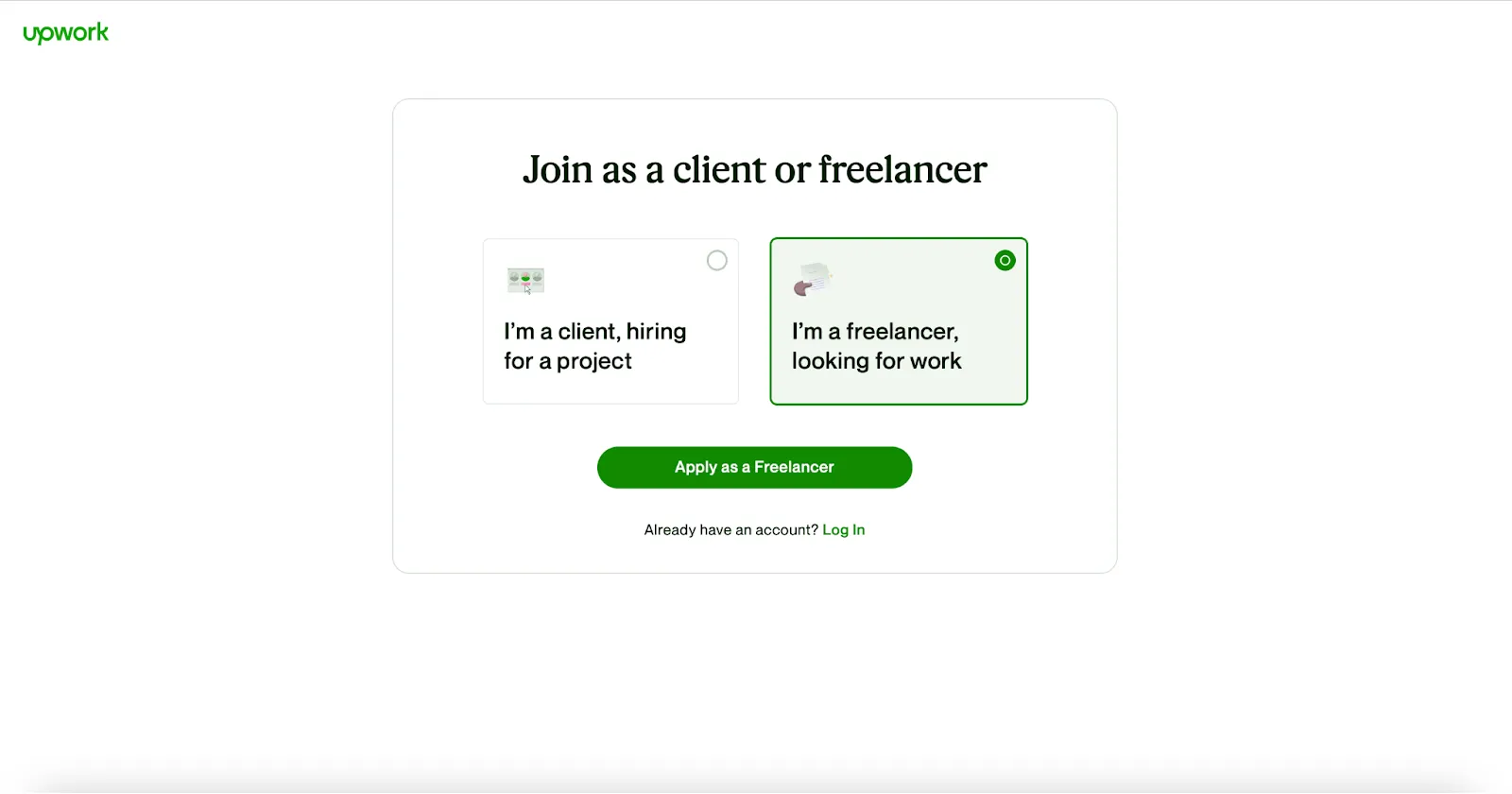
Go to Upwork and click Sign up. You'll be asked whether you want to hire or work as a freelancer. Choose the freelancer option.

Upwork sign-up screen asking whether you want to join as a client or as a freelancer

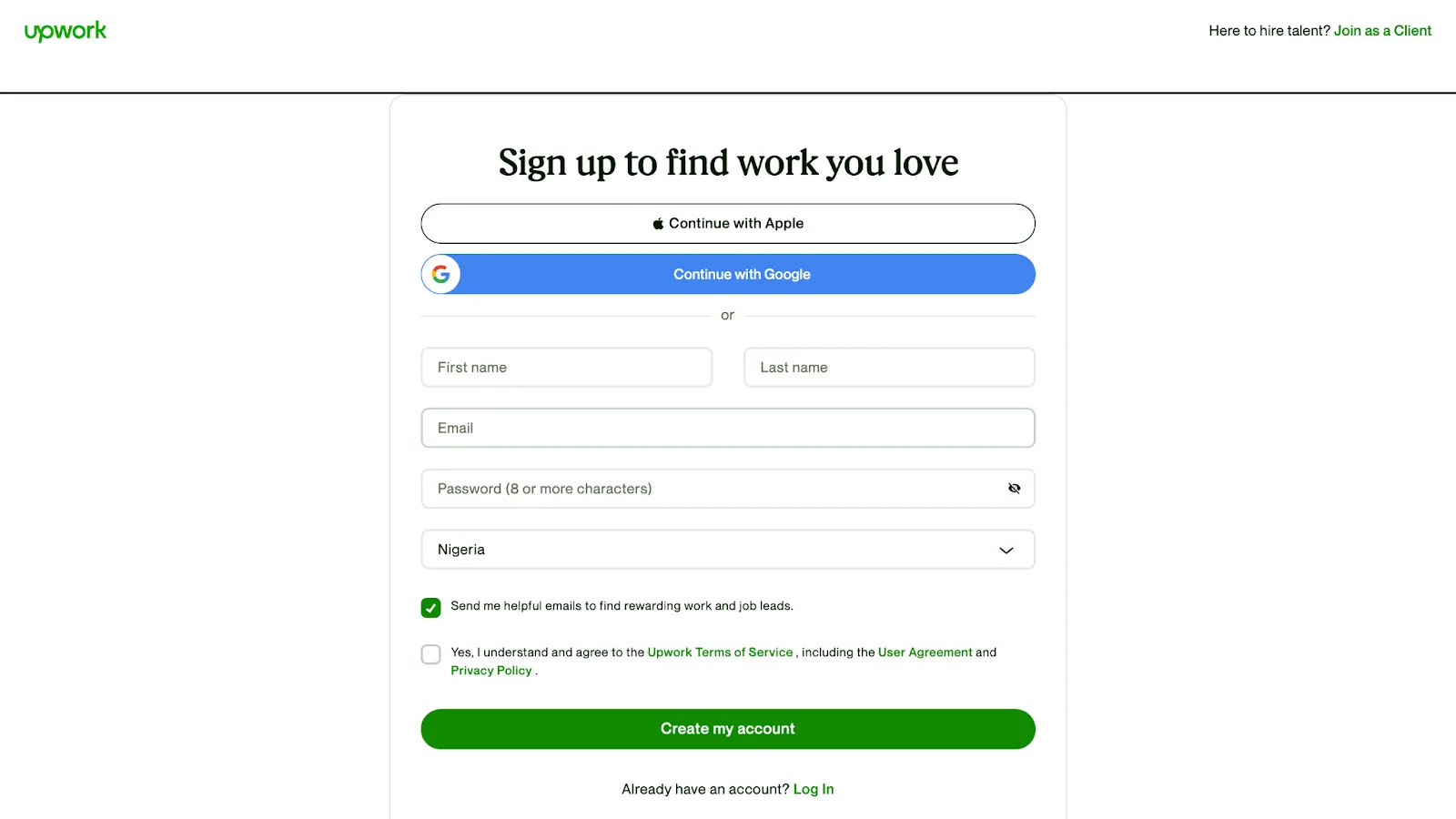
Then pick your sign-up method, enter your name, email address, password and country, and accept the terms.

Upwork freelancer sign-up form with fields for name, email address, password and country

Step 2: Build your profile

Upwork walks you through the profile one screen at a time. You'll add your work categories and skills, work history, education, languages, hourly rate, a professional title, an overview, a photo and your contact details, including your address and phone number.

Treat the profile as your shop window, because clients judge it before they read a word of your proposal. A few things make a real difference:

  • A specific title. "Shopify developer for fashion brands" beats "Web developer". Upwork's own guidance notes that titles get cut off on mobile after about 35 characters, so put the important words first.
  • A short overview. Open with the problem you solve for clients, then your proof. Keep it to a few short paragraphs.
  • A clear photo. Your face, well lit, with no logos or cartoons.
  • An honest rate. A common mistake is copying your old salary as an hourly rate. That figure ignores equipment, taxes, training and the weeks between contracts.
Upwork profile setup screen where a new freelancer adds work experience, skills and education

Step 3: Add a portfolio

A portfolio shows clients what your work actually looks like, which matters most when you have no Upwork reviews yet. Two or three strong pieces beat ten average ones, and each should showcase your best work for the kind of client you want.

To add an item, open your profile, scroll to the Portfolio section and click to add a project. Give it a title, describe your role and the result, upload your files or links, then publish it so it appears on your profile.

Step 4: Submit your profile for review

When your profile is complete, preview it and submit it. Upwork reviews new profiles before you can apply for work. Its review notice says it will email you within 24 hours, though freelancers on the Upwork Community forum report waiting much longer in busy categories.

If you're not sure whether you've been approved, Upwork Community members and staff suggest a simple test: try to submit a proposal. If you can't, your profile is still pending or needs changes, and you can improve it and resubmit.

Step 5: Verify your identity

Upwork asks freelancers to verify their identity, and it may do so during signup or later. You'll photograph your ID and scan a QR code to finish the check on your phone. If the images match your profile, verification can be instant, but the verified badge can take up to three business days to appear.

Don't ignore the email. You have seven days to complete the check, and until you do, Upwork may put your account on hold, which stops you sending proposals or withdrawing money.

Step 6: Set up your withdrawal method early

Do this before you win your first job, not after. Upwork activates every new withdrawal method only after a three-day security wait, so adding it on payday means waiting three extra days.

The options depend on your country and can include bank transfer, PayPal, Payoneer and M-Pesa. If you'd like to receive in US dollars, Upwork's Direct to U.S. Bank option works with a USD account in your own name. A free Grey USD account gives you US account details you can add as an Individual Checking account, and our Upwork withdrawal guide shows each screen.

Step 7: Use your Connects to send proposals

Connects are Upwork's tokens for applying to jobs. New freelancers get 50 free Connects within 48 hours of creating a profile, and Basic accounts get 10 free Connects a month. Extra Connects cost $0.15 each, and the number a job needs varies.

Spend them carefully. A proposal that answers the client's actual question will beat ten copy-and-paste ones, so read our proposal guide and these bidding strategies before you apply.

How much does it cost to be a freelancer on Upwork?

Joining is free. You pay when you apply for jobs and when you earn.

CostAmount (USD)When you pay it
AccountFreeNever
Connects$0.15 each (minimum purchase of 10), after your free ConnectsWhen you submit most proposals
Freelancer Service Fee0% to 15% of earnings, fixed when each contract startsDeducted from each payment
Freelancer Plus (optional)$19.99 a month, includes 100 Connects a monthMonthly, if you upgrade
Direct to U.S. Bank withdrawalFree with a US tax address; $2.99 per withdrawal with a tax address outside the US (since 1 September 2026)Each withdrawal
Receiving into a Grey USD account by ACH0.8% (minimum $2, maximum $10)Each deposit

Checked 25 November 2026. Sources: Upwork pricing, Upwork Freelancer Service Fee, Upwork Direct to U.S. Bank, Grey deposit fees.

A worked example: your first $500 milestone

Say you're a designer outside the US and you finish a $500 fixed-price milestone. Upwork uses a 10% service fee in its own examples, so we'll use that here, but your contract's fee could be anywhere from 0% to 15%.

  • Milestone: $500.00
  • Upwork service fee at 10%: minus $50.00, leaving $450.00
  • Direct to U.S. Bank withdrawal fee for a non-US tax address: minus $2.99, leaving $447.01
  • Grey ACH receiving fee at 0.8%: minus $3.58, leaving $443.43 in your Grey USD account

For tips on keeping more of each payment, see our guide to Upwork withdrawal fees.

How long until you can withdraw your first payment?

Longer than most beginners expect. On a fixed-price contract, once the client approves your work, the money moves to Pending for a five-day security hold. If the client doesn't respond, Upwork releases the funds automatically after 14 days.

After the hold, a Direct to U.S. Bank withdrawal takes two to five business days to arrive, according to Upwork. Add the three-day wait on any brand-new withdrawal method, and a first payment can take well over a week from approval to your account. Setting up your withdrawal method in Step 6 removes the avoidable part of that wait.

Mistakes that keep new Upwork freelancers stuck

  • Using a nickname or a different country. Your profile country should match your ID, and your withdrawal account name should match your verified name, or Upwork may flag it.
  • Submitting a half-finished profile. An empty portfolio and a one-line overview give a reviewer, and later a client, nothing to go on.
  • Spending all 50 Connects in a day. Apply to jobs you're a strong fit for, and write each proposal for that client.
  • Taking payment off the platform. A "client" who asks you to move to another app, pay for equipment or accept an overpayment is a classic warning sign. Read up on payment scams before your first contract.

Frequently asked questions

Is Upwork free for freelancers?

Yes, joining Upwork is free. You pay for Connects once your free ones run out, a service fee of 0% to 15% on what you earn, and sometimes a withdrawal fee.

How long does Upwork take to approve a profile?

Upwork's review notice says it will email you within 24 hours. Some freelancers wait longer, especially in crowded categories, and you can improve your profile and resubmit if it isn't approved.

Can I join Upwork if I live outside the US?

Yes. Upwork's own help pages cater for freelancers with a tax address outside the United States, for example in its withdrawal fee rules. The withdrawal methods you see depend on your country.

Do I need a US bank account to get paid on Upwork?

No, but it can help. Depending on your country, you may be able to withdraw to a local bank, PayPal, Payoneer or M-Pesa. A USD account in your own name lets you use Direct to U.S. Bank and keep your earnings in dollars.

Should I choose Upwork or Fiverr?

On Upwork you usually apply to jobs that clients post; on Fiverr, clients usually buy packages you list. Our Upwork vs Fiverr comparison sets out the differences.

Get registered, then get paid

Registering on Upwork is the easy part; getting paid on time depends on the setup most people skip until their first client clicks approve.

Finish your profile, verify your identity and add your withdrawal method before you send your first proposal. If you want to receive in US dollars, open a free Grey account and add your USD account details to Upwork today.

What is a 1099-K form? Payment apps and reporting thresholds

•

•

2 min read

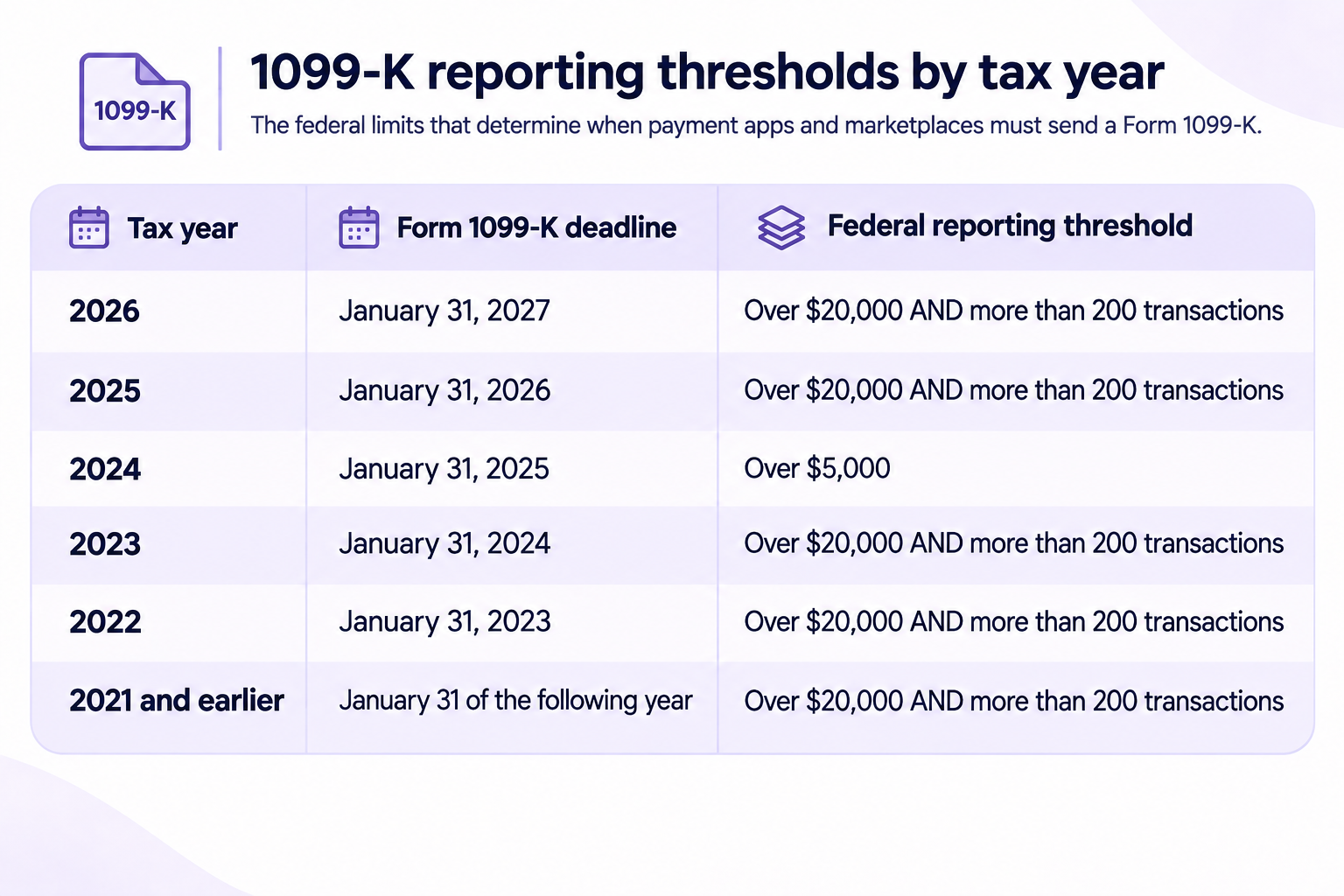
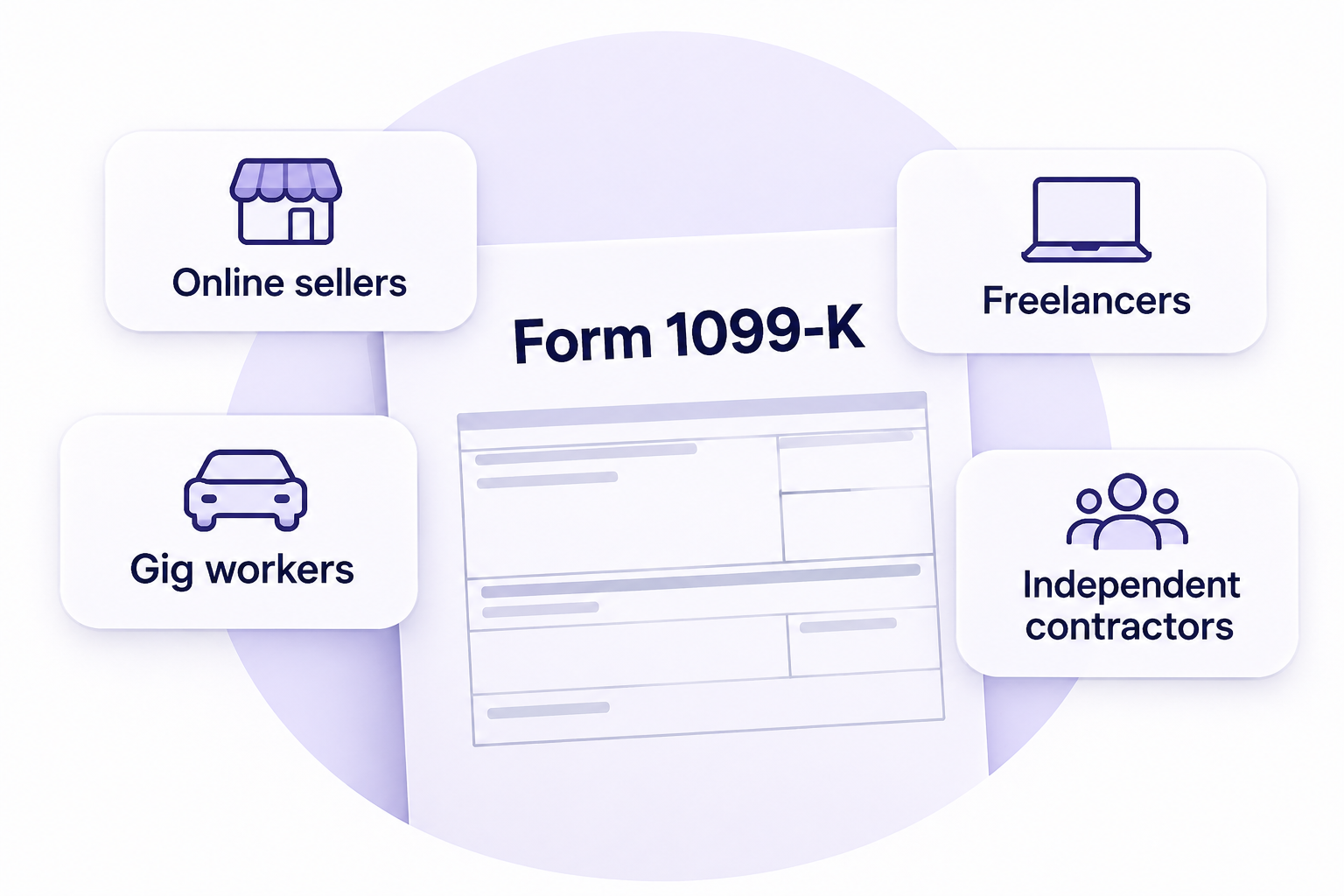
When you receive money through PayPal, Venmo, or other payment apps, those platforms may report certain transactions to the IRS. They do this using a tax document called Form 1099-K. This form helps the IRS keep track of payments made through digital platforms, particularly when people use them to sell products or provide services.

A Form 1099-K, also known as a Payment Card and Third Party Network Transactions form, reports payments you receive through payment apps, online marketplaces, and other third-party payment processors. If your transactions meet the applicable reporting requirements, the platform may send a copy of the form to you and the IRS. The amount shown on the form generally represents the total payments processed, not necessarily your profit or taxable income.

Receiving this form does not automatically mean you owe taxes on all the money reported. The tax treatment depends on why you received the money. For example, payments for products you sell or services you provide may be taxable, while personal gifts and reimbursements generally are not. Understanding how Form 1099-K works, including the reporting requirements, can help you identify taxable payments, avoid reporting errors, and prepare your tax return correctly.

What is a 1099-K form?

A 1099-K form is an IRS tax document that reports the gross payments you receive for goods or services through payment cards and third-party payment networks. It helps the IRS track digital transactions and gives you a record of payments processed through online platforms.

For example, imagine you run an online store, offer freelance services, or sell handmade products through a marketplace. Customers pay you using PayPal, Venmo, Cash App, eBay, or Etsy. These platforms record your transactions and may issue you a 1099-K when your payments meet the applicable reporting requirements.

Who issues a 1099-K form?

Payment settlement entities (PSEs) are responsible for issuing Form 1099-K to eligible recipients and submitting a copy to the IRS. These include payment card processors and third-party settlement organisations (TPSOs) that facilitate transactions between buyers and sellers. If you're unfamiliar with how these tax documents work, understanding what a Form 1099 is can help you see where Form 1099-K fits into the wider tax reporting process.

Why does the 1099-K form exist?

The main purpose of Form 1099-K is to improve tax reporting accuracy and help the IRS track payments made through digital platforms. It allows the agency to compare payment records with the income you report on your tax return.

However, receiving a 1099-K does not automatically mean the entire amount shown is taxable income. Personal gifts, reimbursements, and other non-income transactions may receive different tax treatment

What are the 1099-K reporting thresholds?

The 1099-K reporting threshold is the minimum payment amount and transaction count that trigger a payment platform's federal reporting requirement. These limits have changed over the years, so the tax year matters when determining whether you should receive the form.

How the 1099-K threshold has changed by tax year

As of November 17, 2026, the federal reporting rules for third-party payment apps and online marketplaces are:

Table showing Form 1099-K reporting thresholds and deadlines by tax year, from 2021 to 2026

Note: These are federal reporting thresholds for third-party payment network transactions, not thresholds for whether income is taxable.

Does the threshold apply to every payment method?

No. If you accept direct credit or debit card payments for goods or services, your payment processor must report those transactions regardless of the amount or number of payments. The $20,000 and 200-transaction requirements apply to third-party payment networks, such as PayPal and online marketplaces.

Which platforms send a 1099-K?

Form 1099-K is issued by payment settlement entities that process payments you receive for selling goods or providing services. These include payment apps, online marketplaces, gig-economy platforms, and payment card processors. If you use digital payment services, understanding how virtual wallets work can help you understand how money moves between customers, platforms, and sellers.

Payment apps and virtual wallets

Payment apps and virtual wallets allow you to send, receive, and store money electronically. Examples include services that facilitate peer-to-peer transfers and commercial payments. If you accept customer payments through these platforms, you may receive a 1099-K when the applicable reporting requirements are met. However, personal transfers between friends and family are generally treated differently from business payments.

Online marketplaces

Online marketplaces connect buyers and sellers through e-commerce stores, auction websites, and craft platforms. When these marketplaces collect and process payments for your products, they may issue a 1099-K to report qualifying transactions. Whether you sell clothing, electronics, handmade products, or other items, the platform's payment processing arrangement matters.

Gig-economy and service platforms

Rideshare, food delivery, freelance, and ticket-resale platforms may process payments on behalf of independent workers and service providers. If you earn money through these services, a 1099-K may be issued for payments processed through the platform.

Payment card processors

Payment card processors handle credit, debit, and gift card transactions for businesses. Unlike third-party payment networks, card transactions have no federal minimum reporting threshold.

Who gets a 1099-K?

Form 1099-K illustration showing online sellers, gig workers, freelancers and independent contractors.

A 1099-K form is generally issued to people and businesses receiving payments for goods or services through payment cards, apps, or online marketplaces. Recipients may include online sellers, gig workers, freelancers, and independent contractors. Whether you receive one depends on how you are paid and the reporting rules. Even without the form, taxable income must be reported.

Sellers, gig workers, and freelancers

If you sell products online, drive for a rideshare service, deliver food, or provide freelance work, you may receive a 1099-K when a platform processes customer payments and reporting requirements are met. Direct card payments can be reported regardless of the amount or transaction count.

Personal payments versus business payments

Not every transfer through a payment app is business income. Payments for goods or services may be reportable, while personal gifts and reimbursements between friends or family are not. Money a friend sends to split dinner differs from a customer paying you for work. Keep personal and business transactions separate, and save records showing what each payment was for

Avoiding double counting with Form 1099-NEC

Form 1099-NEC reports payments made to independent contractors for services, while Form 1099-K covers payments processed through payment cards and third-party networks. Understanding what Form 1099-NEC reports and who receives it helps you distinguish between the two documents and identify potential overlaps. If a payment appears on both forms, compare the amounts with your invoices, payment platform statements, and other business records. This helps you avoid reporting the same income twice when preparing your tax return.

Receiving platform income efficiently

If you earn money through international marketplaces, freelance platforms, or overseas clients, how you receive and manage your earnings matters. Grey makes this easier by providing USD account options that allow eligible users to receive and manage international payments. Instead of converting every dollar immediately, you can hold your funds in USD and decide when to exchange them based on your needs and available exchange rates.

With Grey, you can open a USD account to receive eligible payments from international clients and platforms. This gives you more flexibility when managing your earnings, particularly if you regularly work with customers or businesses abroad. And when you need to send your money elsewhere, you can move money across borders using Grey's available international transfer services.

Whether you're a freelancer, online seller, or independent professional, having access to a USD account can simplify how you receive, hold, and manage your income. Rather than worrying about immediate currency conversion, you have more control over when and how you access your earnings.

Frequently asked questions about the Form 1099-K

What is a 1099-K used for?

Form 1099-K is an information return showing gross payments you received for goods or services through payment cards, payment apps, or online marketplaces. The payment processor sends a copy to you and the IRS. Use it alongside your own records to work out what income, gains, fees, refunds, and expenses belong on your tax return.

What is the 1099-K threshold this year?

For the 2026 tax year, federal rules generally require third-party settlement organisations to report when your gross payments for goods or services exceed $20,000, and you have more than 200 transactions. Both conditions must be met for each calendar year. Payment-card transactions have no minimum federal threshold, and some states require reporting at lower amounts.

Will I get a 1099-K from PayPal?

PayPal may send you Form 1099-K if your 2026 payments for goods and services exceed $20,000 and involve more than 200 transactions during that year. Both federal conditions apply, although state rules may require reporting at a lower threshold. PayPal may also issue a form below the federal threshold. Personal transfers generally are not reportable.

Is a 1099-K taxable?

No. Form 1099-K reports gross payments, not your taxable profit. For business income, you generally calculate taxable profit after allowable business expenses. If you sell a personal item, a gain may be taxable, while a loss is generally not deductible. Gifts and reimbursements for shared personal costs are not taxable income under federal tax rules.

What if my 1099-K includes personal payments?

First, contact the payment platform or form issuer and request a corrected 1099-K. If it cannot provide one, the IRS says you can still file and zero out the error on Schedule 1 of Form 1040: report it on line 8z and offset it on line 24z. Keep supporting records and correspondence for your files.

Do I have to report income if I don't receive a 1099-K?

Yes. The 1099-K threshold determines when a platform must send an information form; it does not determine whether income is taxable. You must report taxable income even if you receive no 1099-K. Keep records of cash, card, app, and marketplace payments, along with fees, refunds, expenses, and purchase costs, for accurate tax reporting each year.

Arrow (up)

Back to top