

<script type="application/ld+json" data-schema-version="grey-blog-v4"> [{"@context":"https://schema.org","@type":"BlogPosting","@id":"https://grey.co/blog/nomad-visa-free-countries#article","headline":"11 best countries for digital nomads without a visa requirement","description":"The best countries for digital nomads with no visa requirement. Work remotely without applying for a visa. Ranked by ease and lifestyle. Read now.","inLanguage":"en","url":"https://grey.co/blog/nomad-visa-free-countries","mainEntityOfPage":{"@id":"https://grey.co/blog/nomad-visa-free-countries#webpage"},"datePublished":"2026-09-16T23:40:58.835Z","dateModified":"2026-09-16T23:41:14.603Z","author":{"@type":"Person","@id":"https://grey.co/authors/priscila-marotti#person","name":"Priscila Marotti","url":"https://grey.co/authors/priscila-marotti","jobTitle":"Content Writer","sameAs":["https://www.linkedin.com/in/priscila-marotti/"]},"publisher":{"@type":"Organization","@id":"https://grey.co/#organization","name":"Grey","url":"https://grey.co","logo":{"@type":"ImageObject","url":"https://cdn.prod.website-files.com/6360022338a81bd6fdbb1145/6564ae1077a67e39d3c491a6_Grey%20Logo%20Lockup%20Black.svg"}},"image":{"@type":"ImageObject","@id":"https://grey.co/blog/nomad-visa-free-countries#primaryimage","url":"https://cdn.prod.website-files.com/636a85d290ee58e70c17e1c0/6aab28e8453b58b9a14ca426_11%20Best%20Countries%20for%20Digital%20Nomads%20Without%20a%20Visa%20Requirement-compressed.jpg","contentUrl":"https://cdn.prod.website-files.com/636a85d290ee58e70c17e1c0/6aab28e8453b58b9a14ca426_11%20Best%20Countries%20for%20Digital%20Nomads%20Without%20a%20Visa%20Requirement-compressed.jpg","width":1200,"height":675}},{"@context":"https://schema.org","@type":"WebPage","@id":"https://grey.co/blog/nomad-visa-free-countries#webpage","url":"https://grey.co/blog/nomad-visa-free-countries","name":"11 Best Countries for Digital Nomads Without a Visa Requirement | Grey","description":"The best countries for digital nomads with no visa requirement. Work remotely without applying for a visa. Ranked by ease and lifestyle. Read now.","inLanguage":"en","primaryImageOfPage":{"@id":"https://grey.co/blog/nomad-visa-free-countries#primaryimage"},"breadcrumb":{"@id":"https://grey.co/blog/nomad-visa-free-countries#breadcrumb"}},{"@context":"https://schema.org","@type":"BreadcrumbList","@id":"https://grey.co/blog/nomad-visa-free-countries#breadcrumb","itemListElement":[{"@type":"ListItem","position":1,"name":"Home","item":"https://grey.co/"},{"@type":"ListItem","position":2,"name":"Blog","item":"https://grey.co/blog"},{"@type":"ListItem","position":3,"name":"11 best countries for digital nomads without a visa requirement","item":"https://grey.co/blog/nomad-visa-free-countries"}]},{"@context":"https://schema.org","@type":"FAQPage","@id":"https://grey.co/blog/nomad-visa-free-countries#faq","mainEntity":[{"@type":"Question","name":"Can I use co-working spaces on a tourist visa?","acceptedAnswer":{"@type":"Answer","text":"Yes. Co-working spaces are private businesses and do not check immigration status. They sell desk access, not work permits. The legal question is whether your country of entry permits you to perform work on a tourist visa, not whether a co-working space will let you in. In practice, co-working spaces in every country on this list welcome tourists and nomads without documentation beyond a passport for signup."}},{"@type":"Question","name":"What is a visa run, and is it risky?","acceptedAnswer":{"@type":"Answer","text":"A visa run means leaving a country before your tourist visa expires and immediately re-entering to start a new entry period. It is common in Vietnam, Thailand, and Indonesia. Agencies in all three countries offer day-trip border crossings for $30 to $80. The risk is that immigration officers notice the pattern and deny your re-entry. Thailand and Indonesia have both increased scrutiny on repeated visa runs since 2023. If you plan to stay longer than two consecutive tourist entries, applying for a longer-term visa is safer."}},{"@type":"Question","name":"Do I need travel insurance or health insurance?","acceptedAnswer":{"@type":"Answer","text":"Both Thailand and Indonesia may ask for proof of health insurance at the border, though enforcement is inconsistent. Beyond entry requirements, your home country's health insurance almost certainly does not cover you for more than 30 to 90 days abroad. Nomad-specific policies like SafetyWing, World Nomads, or Genki start at $40 to $80 per month and cover medical emergencies, evacuation, and sometimes lost equipment. Carry proof of coverage regardless of whether the destination requires it."}},{"@type":"Question","name":"Can I open a local bank account as a tourist?","acceptedAnswer":{"@type":"Answer","text":"In most countries on this list, no. Local banks typically require a residence permit, a local tax number, or proof of address to open an account. Georgia and Mexico are partial exceptions: some banks accept tourists with passports, but the process is inconsistent and branch-dependent. This is the core reason multi-currency accounts matter for nomads: they function across borders without requiring local residency."}},{"@type":"Question","name":"What happens to my tax status if I work from multiple countries in one year?","acceptedAnswer":{"@type":"Answer","text":"If you spend fewer than 183 days in any single country, you are unlikely to trigger tax residency in that country. However, you may still owe tax in your home country on worldwide income, even while abroad. The US taxes citizens regardless of where they live. The UK uses a Statutory Residence Test that considers days spent, ties to the UK, and work patterns. Other countries have their own rules. Working from three different countries in one year does not erase your tax obligations in any of them. Consult a tax professional who specialises in international or expat taxation."}},{"@type":"Question","name":"Which countries are cracking down on digital nomads?","acceptedAnswer":{"@type":"Answer","text":"Thailand, Indonesia, and Mexico have all tightened enforcement since 2023. Thailand has increased scrutiny of repeated visa runs and occasionally arrests nomads who work publicly without a work permit. Indonesian immigration raised fines for overstays and is more likely to deny extensions than in previous years. Mexico has reduced the default tourist visa duration from 180 days to as little as 14 days at the officer's discretion, primarily targeting repeat visitors without proof of onward travel. None of these amounts to a blanket crackdown, but the days of unlimited casual stays are narrowing."}}]},{"@context":"https://schema.org","@type":"ItemList","@id":"https://grey.co/blog/nomad-visa-free-countries#list","name":"11 best countries for digital nomads without a visa requirement","numberOfItems":11,"itemListElement":[{"@type":"ListItem","position":1,"name":"Georgia"},{"@type":"ListItem","position":2,"name":"Albania"},{"@type":"ListItem","position":3,"name":"Mexico"},{"@type":"ListItem","position":4,"name":"Colombia"},{"@type":"ListItem","position":5,"name":"Montenegro"},{"@type":"ListItem","position":6,"name":"Serbia"},{"@type":"ListItem","position":7,"name":"Malaysia"},{"@type":"ListItem","position":8,"name":"Indonesia"},{"@type":"ListItem","position":9,"name":"Thailand"},{"@type":"ListItem","position":10,"name":"Vietnam"},{"@type":"ListItem","position":11,"name":"Portugal"}]}] </script>

11 best countries for digital nomads without a visa requirement

Priscila Marotti

TABLE OF CONTENT

SHARE THIS POST

More than 60 countries now offer dedicated digital nomad visas, each with its own income threshold, application form, and processing timeline. But a growing number of remote workers skip that process entirely. They land on a tourist visa, find a cafe with decent Wi-Fi, and start working.

Many countries allow visitors to stay for 30 to 90 days without a visa, which is long enough for short-term remote work. However, working remotely for a foreign employer on a tourist visa is a legal grey area in most countries. Destinations like Georgia, Albania, and Serbia are popular because they offer long-stay options and rarely enforce remote-work restrictions.

This guide covers 11 digital nomad visa-free countries where a formal permit is not required. Each entry explains how long you can stay, whether remote work is explicitly permitted or quietly tolerated, what the destination actually costs and feels like, and how to manage money across borders while you are there.

Can you work remotely without a visa?

The honest answer is that most countries have not written rules for this situation, so remote workers exist in a gap between what is technically legal and what is practically enforced. A tourist visa permits leisure, not employment. But "employment" in most immigration law means working for a local employer or earning from a local source. A remote worker paid by a company in London, depositing into a US bank account, and not competing with any local worker, does not fit that definition cleanly.

A handful of countries have addressed this directly. Georgia explicitly permits remote work during its one-year visa-free stay. Albania and Serbia allow long tourist entries and have shown no interest in policing what visitors do on their laptops. At the other end, several Schengen states, including Germany and the Netherlands, technically classify any work activity on a tourist entry as a violation, though enforcement against remote workers typing in cafes is effectively zero.

The countries you can work remotely without a visa are not breaking the law in any dramatic sense. They are operating in a space that immigration systems have not caught up with. If you plan to stay beyond 90 days, consult a local immigration lawyer. And for countries that have formalised remote work permits, see the full guide to digital nomad visa countries or compare the cheapest digital nomad visas worldwide.

Best visa-free countries for digital nomads

These 11 destinations are visa-free countries for remote workers who want to land and start working without an application, proof of income, or a wait. Ordered by maximum visa-free stay, then overall quality of life for someone earning in foreign currency.

1. Georgia

Stay: Up to 1 year, no visa required for 94 nationalities.

Georgia is the closest thing to a free pass in the digital nomad world. One year, no application, no income proof, no questions asked at the border. The government has actively courted remote workers since 2020, and Tbilisi now has a co-working density that rivals Lisbon. A one-bedroom apartment in the centre of Tbilisi rents for $350 to $500 per month. A full meal at a local restaurant costs $3 to $6. The internet averages 40-60 Mbps in the capital, with faster speeds in newer buildings. The catch is winter: Tbilisi gets cold (down to minus 5 Celsius in January), and heating infrastructure in older apartments is unreliable. If you prefer warmth, Batumi on the Black Sea coast is milder but quieter.

2. Albania

Stay: 1 year for US, EU, and several other nationalities. Others can apply for a Unique Stay Visa (annual income threshold of $9,800).

Albania offers the same one-year entry as Georgia, but in a Mediterranean climate. Tirana has a cafe culture built for laptop work, with strong espresso and fast Wi-Fi in most central spots. The Albanian Riviera (Saranda, Ksamil, Himara) has a coastline that draws comparisons to Croatia and Greece at roughly a third of the cost. A comfortable month runs $700 to $1,100. The internet is 30 to 50 Mbps in Tirana, slower on the coast. What most guides skip: Albania uses the lek, and ATM withdrawal fees from foreign cards can be steep. Carrying a multi-currency account that avoids double conversion saves real money here.

3. Mexico

Stay: Up to 180 days on a tourist permit, but duration is at the immigration officer's discretion.

Mexico is the most popular nomad destination in the Americas, and the one most likely to surprise you at the border. Immigration officers have been issuing shorter stays since 2023, sometimes as little as 14 days, without giving a reason. If you receive the full 180 days, it is one of the longest tourist entries in the region. Mexico City has world-class internet (50 to 100 Mbps), a massive nomad community centred around Roma and Condesa, and monthly costs of $1,200 to $1,800. Merida is quieter, cheaper ($900 to $1,300), and brutally hot from April to September. The food alone justifies the trip, but bring documentation of onward travel and sufficient funds to show at immigration.

4. Colombia

Stay: 90 days on arrival, extendable to 180 days at a local Migracion Colombia office.

Medellin has been a top-tier nomad hub for years because the combination of cost, climate, and community is hard to beat. The city sits at 1,500 meters and holds a steady 22 to 28 degrees Celsius year-round. The internet is 30 to 60 Mbps, co-working spaces are abundant in El Poblado and Laureles, and a comfortable month costs $900 to $1,500. Colombia also offers a formal digital nomad visa, but the 90-day tourist entry with a 90-day extension is simpler for short stays. One thing to know: Colombia charges an exit tax (approximately $38) that is usually included in your flight fare but occasionally shows up as a surprise at the airport.

5. Montenegro

Stay: 90 days for most nationalities. Digital nomad visa available (can apply in-country).

Montenegro is a coastal country in the Balkans on a budget. The Bay of Kotor looks like the Norwegian fjords crossed with the Amalfi Coast, and a month there costs $1,000 to $1,600, roughly half what you would pay in Croatia or southern Italy. Internet speeds run 20 to 50 Mbps, adequate but not exceptional. The country is small enough to drive end to end in four hours, so weekend trips to the Durmitor mountains or across the border into Dubrovnik are easy. The biggest variable is seasonality: summer is busy and prices spike; winter is quiet and some coastal businesses close entirely. If you apply for the digital nomad visa while in-country, you can extend well beyond 90 days.

6. Serbia

Stay: 90 days for most nationalities. Not in the Schengen Zone.

Serbia is the strategic pick for nomads working through Europe. Because it sits outside the Schengen Zone, your 90 days in Serbia do not count toward the Schengen 90/180 limit. That means you can spend three months in Serbia, then three months in Schengen countries, and repeat the cycle without visa complications. Belgrade has fast internet (50 to 100 Mbps), a nightlife scene that runs until dawn, and monthly costs of $800 to $1,300. The co-working scene is smaller than Lisbon or Tbilisi, but growing. Serbian cuisine is heavy, meat-forward, and very cheap: a full meal with a drink costs $5 to $8 at a neighbourhood restaurant.

7. Malaysia

Stay: 90 days for most nationalities.

Malaysia ranks first in several global digital nomad indices for a reason: fast internet (averaging 100 Mbps), modern infrastructure, low costs, and food that rivals any destination in Southeast Asia. Kuala Lumpur is a genuinely cosmopolitan city where $800 to $1,400 per month covers a comfortable life, including a gym membership and regular eating out. Penang is smaller, cheaper, and has what many consider the best street food in the world. Malaysia also offers the DE Rantau digital nomad visa with just a $24,000 annual income requirement, one of the lowest thresholds globally, for those wanting to stay beyond 90 days. English is widely spoken, which removes the language barrier that complicates daily life in much of Southeast Asia.

8. Indonesia

Stay: 30-day visa on arrival, extendable once for an additional 30 days (60 total).

Bali remains the single most recognisable digital nomad destination in the world, and the infrastructure reflects it. Canggu and Ubud have co-working spaces on nearly every block, nomad-friendly cafes that expect you to stay for hours, and a well-established community. Monthly costs run $900 to $1,500. Internet speeds average 25 to 50 Mbps, which is fine for calls and standard work, but users can struggle with large file uploads. The 60-day limit is firm: Indonesian immigration has tightened enforcement, and overstaying triggers fines and potential entry bans. The B211A social visa (available through an agent for roughly $300) can extend your stay to 180 days, but it requires a sponsor.

9. Thailand

Stay: 30 to 60 days visa-free, depending on nationality and entry point.

Chiang Mai is where the modern digital nomad movement arguably began, and the city still delivers: internet speeds of 50 to 100 Mbps, monthly costs ranging from $700 to $1,200, and a density of co-working spaces, gyms, and communities built specifically for remote workers. Bangkok is larger, louder, and marginally more expensive but offers better transport and more variety. Thailand has a Long-Term Resident visa for those earning over $80,000 per year, but the tourist entry is where most nomads start. Immigration has been cracking down on repeated visa runs (leaving and immediately re-entering to reset the clock), so if you plan to stay long-term, the LTR or an education visa is safer than serial border hops.

10. Vietnam

Stay: 90 days on a tourist visa (e-visa). No digital nomad visa exists.

Vietnam is the most affordable destination on this list and one of the most rewarding if you adapt to the pace. Da Nang is the nomad pick: beachfront, reliable internet (30 to 50 Mbps), a growing co-working scene, and monthly costs of $600 to $1,000. Ho Chi Minh City is chaotic, exhilarating, and slightly more expensive. Vietnam has no digital nomad visa and no legal framework for remote work on tourist entry, so you operate entirely in the grey zone. Visa run agencies handle border crossings for $30 to $50, and the process is routine. The risk is that immigration periodically tightens renewal policies without warning, as happened in 2021 when visa extensions stopped for months.

11. Portugal

Stay: 90 days within any 180-day period (Schengen Zone).

Portugal is the most expensive destination on this list, but also the most polished. Lisbon and Porto have fast internet (100+ Mbps), walkable neighbourhoods built for cafe work, and a deeply established nomad and expat community. Monthly costs range from $1,500 to $2,500, driven largely by rent, which has climbed sharply since 2022. The critical detail: your 90 days are shared across all 27 Schengen countries. A week in Barcelona, a long weekend in Amsterdam, and two months in Lisbon all draw from the same 90-day pool. Portugal also offers the D8 digital nomad visa (€3,480 monthly income requirement) for stays beyond 90 days, making it one of the few countries on this list with a clear legal path to upgrade.

Countries where you can stay the longest without a visa

If you are looking for the best countries for nomads with no visa paperwork and the option to stay in one place for as long as possible, this is the shortlist. Georgia and Albania appear in the main list above. The three below did not make the top 11 but are worth knowing about for long-haul stays where extensions are routine and enforcement is relaxed.

Country Maximum Stay Conditions
Georgia

1 year 94 nationalities. No application, no income proof.
Albania

1 year US, EU, and others. Unique Stay Visa available for shorter visa-free nationalities.
Kosovo 90 days, easy to extend Extensions are routine and inexpensive. Very low cost of living ($500-$800/month). Limited but improving internet.
Kyrgyzstan 60 days, easy to extend Extensions processed locally with minimal paperwork. Bishkek is affordable ($400 to $700/month) and increasingly popular with Central Asia-curious nomads.
Paraguay 90 days, low enforcement Overstays are rarely enforced. Asuncion is very affordable but has a thin nomad community and limited co-working infrastructure.

What to check before you go

Entry rules change faster than articles can keep up with. Before committing to a destination, work through each of these.

  1. Entry conditions for your specific passport. Do not assume your nationality gets the same treatment as others. A US passport and a South African passport are subject to very different entry terms in Thailand. Use the IATA Travel Centre or your government's travel advisory for the latest.
  2. Tax residency triggers. Spending more than 183 days in a single country within a calendar year typically makes you a tax resident there, which can mean owing tax on your worldwide income. Some countries count partial days; others count only overnight stays. The threshold matters more than most nomads realise.
  3. Health insurance. Some countries (Thailand, Indonesia) ask for proof at the border. Even where they do not, your home health policy almost certainly excludes long-term overseas stays. Nomad-specific insurance, such as SafetyWing or World Nomads, fills this gap.
  4. Banking and card access. Foreign transaction fees, ATM withdrawal limits, and your bank's fraud detection algorithms all vary by country. A card that works perfectly in Lisbon might get frozen after your first withdrawal in Tbilisi because the bank flags the location as unusual. Test before you rely on it.
  5. Internet speed at your actual accommodation. National averages are misleading. A country with an average of 100 Mbps might have only 5 Mbps in the specific apartment you booked. Ask for a speed test screenshot before signing a lease. For a deeper look at financial planning around international moves, see how to choose tax-friendly destinations.

Managing money as a visa-free digital nomad

The financial friction of country-hopping is more expensive than most nomads expect. Thai ATMs charge 220 baht ($6 to $7) per withdrawal on top of whatever your home bank charges. A merchant in Bali offers to charge your card "in your home currency," and the dynamic conversion markup is 3-5%. Your UK bank freezes your card after a transaction in Belgrade because the fraud algorithm has never seen Serbia before. You pay rent in Georgian lari but get paid in US dollars, and every conversion eats 1.5 to 3%, depending on who does it.

These are not edge cases. They are the daily reality of earning in one currency and spending in another across multiple countries.

A multi-currency account cuts through most of this. With Grey, you hold USD, GBP, and EUR in one account, spend from your balance with a virtual card, and avoid the double-conversion trap where your dollars convert to your home currency and then back to the local one. There is no fumbling with local bank accounts that require a residence permit to open, and no risk of your primary bank shutting you out for "suspicious" overseas activity. For more on managing finances while working abroad, see financial tips for digital nomads.

Frequently Asked Questions

Can I use co-working spaces on a tourist visa?

Yes. Co-working spaces are private businesses and do not check immigration status. They sell desk access, not work permits. The legal question is whether your country of entry permits you to perform work on a tourist visa, not whether a co-working space will let you in. In practice, co-working spaces in every country on this list welcome tourists and nomads without documentation beyond a passport for signup.

What is a visa run, and is it risky?

A visa run means leaving a country before your tourist visa expires and immediately re-entering to start a new entry period. It is common in Vietnam, Thailand, and Indonesia. Agencies in all three countries offer day-trip border crossings for $30 to $80. The risk is that immigration officers notice the pattern and deny your re-entry. Thailand and Indonesia have both increased scrutiny on repeated visa runs since 2023. If you plan to stay longer than two consecutive tourist entries, applying for a longer-term visa is safer.

Do I need travel insurance or health insurance?

Both Thailand and Indonesia may ask for proof of health insurance at the border, though enforcement is inconsistent. Beyond entry requirements, your home country's health insurance almost certainly does not cover you for more than 30 to 90 days abroad. Nomad-specific policies like SafetyWing, World Nomads, or Genki start at $40 to $80 per month and cover medical emergencies, evacuation, and sometimes lost equipment. Carry proof of coverage regardless of whether the destination requires it.

Can I open a local bank account as a tourist?

In most countries on this list, no. Local banks typically require a residence permit, a local tax number, or proof of address to open an account. Georgia and Mexico are partial exceptions: some banks accept tourists with passports, but the process is inconsistent and branch-dependent. This is the core reason multi-currency accounts matter for nomads: they function across borders without requiring local residency.

What happens to my tax status if I work from multiple countries in one year?

If you spend fewer than 183 days in any single country, you are unlikely to trigger tax residency in that country. However, you may still owe tax in your home country on worldwide income, even while abroad. The US taxes citizens regardless of where they live. The UK uses a Statutory Residence Test that considers days spent, ties to the UK, and work patterns. Other countries have their own rules. Working from three different countries in one year does not erase your tax obligations in any of them. Consult a tax professional who specialises in international or expat taxation.

Which countries are cracking down on digital nomads?

Thailand, Indonesia, and Mexico have all tightened enforcement since 2023. Thailand has increased scrutiny of repeated visa runs and occasionally arrests nomads who work publicly without a work permit. Indonesian immigration raised fines for overstays and is more likely to deny extensions than in previous years. Mexico has reduced the default tourist visa duration from 180 days to as little as 14 days at the officer's discretion, primarily targeting repeat visitors without proof of onward travel. None of these amounts to a blanket crackdown, but the days of unlimited casual stays are narrowing.

Open a Grey account before your first flight and hold USD, GBP, and EUR in one place. Spend in local currency wherever you land. See Grey for digital nomads.

Disclaimer: This article is for informational purposes only and does not constitute legal, tax, or immigration advice. Entry conditions, visa rules, and tax obligations change frequently. Verify current requirements with official government sources or a qualified professional before making travel or financial decisions. Grey is not a bank. Grey is a licensed financial services provider offering multi-currency accounts.

Last updated:

October 2, 2026

Open a free Grey account to get startedJoin 1 million digital nomads
IF YOU ENJOYED THIS, CHECK THESE OUT

How to find accommodation as a digital nomad: Short-term and long-term

•

•

2 min read

Finding accommodation as a digital nomad is a skill in itself. Unlike a holiday, where you book something nice for a week and call it done, nomadic living involves a constant cycle of research, short-term stays, longer-term negotiations, and the occasional bad Wi-Fi situation you didn't see coming.

The good news is that the infrastructure for nomadic accommodation has improved significantly in recent years. More landlords understand what nomads need. More co-living spaces have opened in major nomad cities. And the playbook for finding good, affordable housing on the road is well established, even if it's not always well documented.

This guide covers the full range of accommodation options available to digital nomads, from short-term platforms to local rental markets, along with practical tips for finding housing quickly in a new city and managing cross-border payments when you do. For a broader introduction to the lifestyle itself, see our digital nomad lifestyle guide.

Short-term accommodation options for digital nomads

Short-term stays, typically under one month, are where most nomads start when arriving in a new location. They're more expensive per night than long-term rentals but are usually more flexible, have no lease requirements, and are often furnished and include utilities.

Airbnb and Vrbo

Airbnb and Vrbo are the most familiar options. Both offer furnished apartments, private rooms, and entire properties for nightly, weekly, or monthly bookings. Airbnb has a monthly discount feature built into the pricing: hosts can set a percentage off for bookings of 28 days or more, and many do. Make sure to contact the host directly to negotiate a monthly rate, even if the discount isn’t advertised.

Pros: wide selection, clear guest reviews, flexible booking terms, and host communication before arrival.

Cons: higher cost than local rentals, Wi-Fi quality varies significantly, and some hosts are optimised for tourists rather than working professionals.

Booking.com monthly stays

Booking.com has expanded significantly into the long-stay market and often surfaces options that don’t appear on Airbnb, particularly serviced apartments and aparthotels. Filter for “apartments” and select monthly stays for better pricing.

Pros: broad inventory, often includes properties not listed elsewhere, good cancellation policy options.

Cons: varies by property; some listings have minimum requirements for monthly pricing.

Hostels with private rooms

In budget destinations across Southeast Asia, Latin America, and Eastern Europe, hostels with private rooms offer a surprisingly good option for short stays. Private rooms in hostels are often significantly cheaper than equivalent Airbnb listings, include shared common areas and sometimes coworking spaces, and come with a built-in social environment.

Pros: cost-effective, social, often include breakfast and utilities.

Cons: thin walls, shared bathrooms in some cases, variable Wi-Fi, and not suitable for long client calls in shared spaces.

Hotel long-stay deals

Many hotels, particularly business hotels and aparthotels, offer significantly reduced monthly rates for extended stays that are never listed on their standard booking pages. These are negotiated directly by calling the hotel and asking for long-stay or corporate rates.

Pros: Hotel amenities, cleaning service, reliable infrastructure.

Cons: Typically more expensive than private rentals, even with long-stay discounts, and less "home-like.”

Cost comparison by accommodation type and region

Accommodation type Southeast Asia (monthly est.) Southern Europe (monthly est.) Latin America (monthly est.)
Airbnb (entire apartment) $400–$900 $900–$2,000 $500–$1,200
Co-living space (private room) $500–$1,200 $1,000–$2,200 $600–$1,500
Hostel private room $200–$500 $500–$1,000 $300–$700
Local rental (unfurnished) $250–$600 $600–$1,400 $350–$900
Serviced apartment / aparthotel $600–$1,400 $1,200–$2,500 $700–$1,600

‍

Figures are estimates based on Nomad List city data and market research. Costs vary significantly by city, neighbourhood, and season.

Long-term accommodation options for digital nomads

Once you’ve settled on staying somewhere for two months or more, the economics shift. The short-stay premium no longer makes sense, and the right approach is to find accommodation the way a local would.

Local rental market

In most cities, the cheapest furnished apartments are found through local channels rather than international platforms. This typically means Facebook groups (search for "[city name] expats", "[city name] apartments for rent", or "[city name] digital nomads"), local property listing sites, and WhatsApp groups that circulate among the expat and nomad community in that city.

The trade-off: finding a place this way takes more time and requires being either in the city already or trusting photos and video tours remotely. The upside is that a furnished apartment found through local channels can cost 30 to 50% less than the equivalent on Airbnb for the same city and quality level.

Furnished apartment agencies

Many cities have local agencies that specifically handle furnished apartments for short- to medium-term rentals. These agencies often cater to business travellers and relocating professionals, which means their inventory is typically furnished to a reasonable standard and includes utilities. A quick search for “furnished apartments [city name]” plus the local language equivalent often surfaces these.

House-sitting through TrustedHousesitters

TrustedHousesitters matches homeowners who need their home and pets looked after with nomads and travellers willing to house-sit for free accommodation. If you're comfortable with pets and flexible on location, this is a legitimate way to live rent-free in exchange for daily pet care and property oversight.

It requires advance planning: good house-sitting opportunities in desirable locations fill quickly, and building a strong TrustedHousesitters profile with reviews takes time. But for nomads who want to significantly reduce accommodation costs in high-cost countries, it’s a genuine option.

Sublets

Locals who are travelling temporarily often sublet their furnished apartments at rates closer to local market prices than tourist prices. These can be found through the same Facebook groups and WhatsApp networks as local rentals. Sublets are typically informal arrangements, so due diligence on the space and the landlord’s willingness to let is important.

How do digital nomads find housing abroad?

The most common mistake first-time nomads make is trying to solve the accommodation problem entirely from home, before arriving. Booking three months of Airbnb before you’ve spent a single week in a place is expensive and inflexible. The approach experienced nomads use is different.

Book one to two weeks of short-term accommodation first
Arrive at your destination with a comfortable, central place already sorted for the first week or two. This gives you time to explore neighbourhoods, join local nomad and expat groups, and get a feel for where you actually want to be before committing to something longer.

Join the Facebook and WhatsApp groups for that city
Search for “[city] expats”, “[city] digital nomads", and “[city] apartments for rent” on Facebook. Request access. Post asking what you’re looking for. Many of the best long-term finds come through these groups within 48 hours of posting.

Ask on Nomad List
Nomad List’s community forum and chat are organised by city and are among the most useful real-time sources for what's available, which areas are best for working, and what pitfalls to avoid in any given place.

Talk to other nomads already there
The nomad community is generally generous with practical information. If you’re staying in a hostel or co-living space during your first week, ask other residents where they found their accommodation. Recommendations from people currently living in the city are more reliable than anything you’ll find through a search engine.

Be ready to move quickly on local listings
Good furnished apartments at local prices go fast, particularly in popular nomad cities like Chiang Mai, Medellín, Lisbon, and Tbilisi. If you find something good, don’t spend days deliberating.

Co-living spaces for digital nomads: are they worth it?

Co-living spaces are purpose-built or adapted residential properties that offer private or semi-private rooms with shared common areas, Wi-Fi, and often a built-in community of other remote workers and nomads. They sit somewhere between a high-end hostel and a furnished apartment in terms of experience and price.

What co-living typically includes:

  • Private furnished room with reliable, fast internet
  • Shared kitchen, living areas, and sometimes coworking desks
  • Utilities and cleaning are included in the price
  • Community events, networking opportunities, and social programming
  • Often: rooftop access, gym, pool, or other amenities, depending on the property

Is it worth it?
Co-living is worth it in two situations. First, when you’re new to a city, you want a built-in social environment to meet people quickly without putting in weeks of social effort. Second, when the all-inclusive price is genuinely competitive with furnished apartments, once you factor in utilities, internet, and cleaning. In some cities, it is, in others, it’s significantly more expensive per month than an equivalent local rental.

The experience varies considerably between properties. Read reviews specifically about the internet speed, noise levels, and the current community atmosphere (which changes as residents cycle in and out). A co-living space with a dead atmosphere or patchy Wi-Fi solves neither the social nor the work problem.

Tips for finding and securing nomad housing

  • Test the Wi-Fi before committing: Ask the host or property for the broadband speed, or run a speed test during a video call or in-person visit before signing anything. Minimum functional speed for most remote work is 25 Mbps download and 10 Mbps upload; 50 Mbps or more is comfortable for video calls.
  • Use a VPN to search local listing sites: Some regional property platforms show different results or prices based on your detected location. Searching with a local VPN node can surface listings that don’t appear when searching from abroad.
  • Always have a backup option: Before checking out of your current place, have your next accommodation confirmed and paid. Moving cities without a fallback creates unnecessary stress.
  • Read reviews for noise level, not just overall score: A 4.8-rated apartment can still be on a main road above a bar. Look specifically for reviews mentioning noise, street sounds, and sleep quality.
  • Ask for a monthly discount, even if one isn’t listed: Hosts and landlords generally prefer a reliable occupant for a month to the uncertainty of nightly bookings. A direct message asking for a monthly rate almost always gets a response, even if the answer is no.
  • Confirm check-in flexibility before booking: Many nomads arrive on late flights or unconventional schedules. Clarify check-in times before booking, particularly for entire-apartment listings where a lockbox or key exchange must be arranged.
  • Arrive with one month’s rent in local cash if possible: Many local landlords in emerging market countries prefer or require cash deposits. Having local currency ready, rather than relying on finding an ATM on arrival, simplifies the move-in process.

How to manage payments and deposits as a digital nomad

The financial side of finding accommodation abroad creates its own set of complications. Deposits are often due in advance, in local currency. Monthly rent may need to be transferred internationally. And paying through your home bank can mean losing 3 to 5% on every conversion.

For deposits sent ahead of arrival, the cleaner approach is a multi-currency account that lets you convert at a fair rate and send internationally at low cost. Grey lets you send money abroad with Grey at a conversion fee of 1%, capped at $6, with the rate shown before you confirm. For nomads regularly moving money between countries, this is significantly cheaper than bank wire transfers that typically carry a $25 to $50 sending fee plus a 2 to 4% conversion spread.

For ongoing rent payments in foreign currencies, opening a multi-currency account for nomads lets you hold USD, EUR, and GBP balances, pay from whichever currency is most cost-effective for the transaction, and avoid converting back and forth on every monthly payment.

The practical workflow: hold income in the currency you earn it in, convert only what you need for the current month’s expenses, and use a Grey virtual card for USD-denominated online subscriptions and tools you’re paying for, regardless of where you’re living.

Open a multi-currency account with Grey today to begin.

Frequently asked questions about finding accommodation as a digital nomad

How much should a digital nomad budget for accommodation?

It depends significantly on the destination. In Southeast Asia (Chiang Mai, Bali, Ho Chi Minh City), comfortable furnished apartments run $400 to $800 per month. In Southern Europe (Lisbon, Barcelona, Athens), expect $900 to $1,800 for a similar standard. In Latin America (Medellín, Mexico City, Buenos Aires), the range is $500 to $1,200. Co-living and Airbnb add a premium of 20 to 50% above the local rental market rate for equivalent quality. A general planning range for most nomad-friendly destinations is $600 to $1,500 per month for accommodation, with high-cost-of-living cities (Western Europe, Japan, US) falling above that range.

Is it safe to rent from local landlords as a digital nomad?

Generally, yes, with reasonable precautions. Request a video call to see the apartment in real time before paying any deposit. Pay the deposit using a method that leaves a record (bank transfer or a traceable payment method), rather than in cash, if possible. Confirm the landlord’s identity and verify the address on maps before arrival. In cities with established nomad communities, Facebook groups and WhatsApp recommendations for specific landlords are useful vetting tools: others have rented from the same person and can confirm their experience.

Can I get a lease as a digital nomad without a fixed address?

Formal leases typically require proof of income and sometimes a local guarantor, which many nomads can’t provide. In practice, most nomad accommodation is arranged informally: a written agreement, a WhatsApp exchange, or a platform booking confirmation rather than a legally binding lease. This is the norm in the nomad market, and most landlords catering to nomads expect it. For any significant deposit, having a written agreement (even via email or WhatsApp) that specifies the amount, the return conditions, and the rental period is worth the effort.

What is the best app for finding digital nomad accommodation?

No single app covers everything. For short stays, Airbnb and Booking.com are the most practical starting points. For co-living, Selina and Outsite have their own booking platforms. For local rentals, the most effective tool is Facebook Groups combined with Nomad List’s city-specific community chats. Many experienced nomads use Airbnb for the first week in a new city and then transition to a local rental found through Facebook or community recommendations.

How do digital nomads handle deposits in a foreign country?

Most deposits for nomad accommodation are paid by bank transfer, local cash, or through a platform (for Airbnb bookings, Airbnb holds the payment). For local rentals requiring a direct bank transfer in foreign currency, a multi-currency account with a competitive conversion rate is the most cost-effective method: converting at a bank’s standard rate typically costs 3 to 5% of the deposit amount, whereas a platform like Grey charges 1%, capped at $6, on conversion. Keep a record of every deposit paid, the agreed return conditions, and the landlord’s contact details.

Do I need travel insurance if I am renting accommodation long-term?

Travel insurance needs change when you’re a long-term renter rather than a short-stay tourist. Standard travel insurance often excludes stays beyond 30 to 90 days or has reduced coverage for long-term accommodation. Nomad-specific insurance products (such as SafetyWing or World Nomads) are designed for extended travel and cover medical emergencies, trip interruption, and sometimes personal belongings. For long-term rentals, contents insurance for your possessions in the rental property is worth investigating separately, as landlord insurance typically doesn’t cover tenants’ belongings.
11 best coworking spaces in Bali

•

•

2 min read

Working from Bali sounds great until you actually need somewhere reliable to take a video call, finish a deadline, or spend a full day getting work done. A beach café might be great for an hour, but it is not always practical when you need fast Wi-Fi, a comfortable desk, and a quiet place to focus.

With more than 50 coworking spaces across Bali, you have plenty of options. Canggu, Ubud, Seminyak, and Sanur all have spaces designed for remote workers, freelancers, entrepreneurs, and digital nomads. Prices can range from around IDR 50,000 per day for a basic hot desk to IDR 2,500,000 per month for a dedicated desk at a premium space.

For most digital nomads, Canggu and Ubud are the first places to look because they have some of the island’s largest remote-working communities. But the right coworking space in Bali depends on where you are staying, how long you plan to work, and whether you need meeting rooms, community events, or simply a quiet desk and reliable internet.

This guide covers 11 coworking spaces worth considering, so you can find one that fits your workday and your Bali plans. For visa options, see our list of visa-free countries for digital nomads.

What should you check before choosing a coworking space in Bali?

The first coworking space you find may look great in photos, but your priorities become clearer once you are sitting there trying to finish a deadline. A beautiful view means little when the Wi-Fi drops during a client call or your desk is too noisy to concentrate.

Check the internet

For regular video calls, aim for at least 50 Mbps and ask whether the space has a backup connection in case the main network goes down. Anything below 30 Mbps will frustrate you if you have to screen-share and upload large files. Test at the time of day you'll actually be working, not at 6 am when the space is empty and the bandwidth is uncontested.

Air conditioning

Open-air spaces look beautiful on Instagram, but working in 32 °C heat with 80% humidity can be miserable for laptop-intensive work. If you run hot, choose an air-conditioned space. Your laptop’s fan will thank you, too. Overheating laptops throttle their processors, which makes everything slower.

Time zone compatibility

Bali is GMT+8. If your clients are in New York (GMT-5), your overlap is 7 am to 11 am Bali time. If they're in London (GMT+0/+1), the overlap is 3 pm to 8pm Bali time. Check that the coworking space opens early enough (or stays open late enough) for your schedule. Some spaces don’t open until 8 am or 9 am, which cuts into your US overlap window.

Think about where you are staying

A 30-minute commute can become frustrating when you are working every day. Canggu works well if you want a social beach scene, while Ubud suits a quieter, nature-based environment.

Compare the actual price

Check whether you are paying daily or monthly and what comes with the membership. Some spaces include coffee, meeting rooms, or events, while others charge separately.

Look beyond the desk

Meeting rooms, phone booths, printers, comfortable seating, and reliable power can make a big difference. Community events matter too if you want to meet other founders, freelancers, and remote workers.

These factors also matter when exploring the best cities in Indonesia for digital nomads, because where you stay can shape both your workday and your experience outside work.

The 11 best coworking spaces in Bali

Whether you’re spending a few weeks in Bali or making the island your new base, you’ll find coworking spaces to suit different ways of working. From quiet spaces where you can focus to lively hubs where you can meet other remote workers, here are 11 places to consider for your next workday.

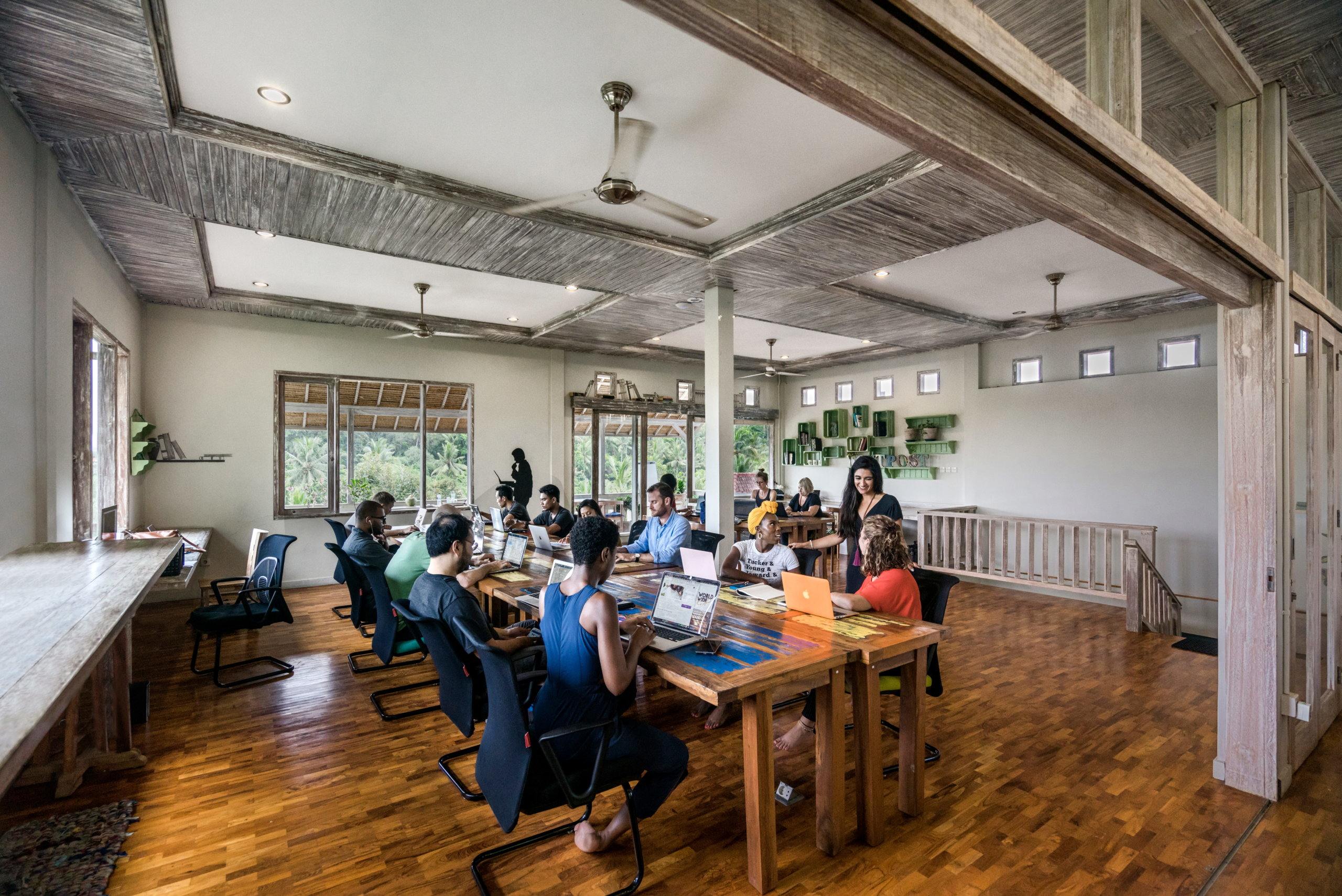
Outpost

__wf_reserved_inherit

Location: Ubud and Canggu

Daily rate: Around IDR 225,000 USD(15–16)

Monthly rate: Around IDR 2,935,000 USD(195–210)

Internet: Up to 200 Mbps with load-balanced connections

Best for: Remote professionals who need reliable Wi-Fi, quiet spaces and access to more than one location. The phone booths are the key differentiator. If you're on Zoom 3 hours a day, Outpost handles that better than any open-air space in Bali. The downside? It feels like a nice office, not like Bali. That's either a feature or a bug, depending on what you're here for.

Bali

Location: Legian/Kuta, Dewi Sri

Daily rate: Around IDR 150,000 ($10)

Monthly rate: Around IDR 2,000,000 ($133) for a hot desk pass

Internet: Around 30–60 Mbps

Best for: Expats and digital nomads who want a convenient live-and-work setup.

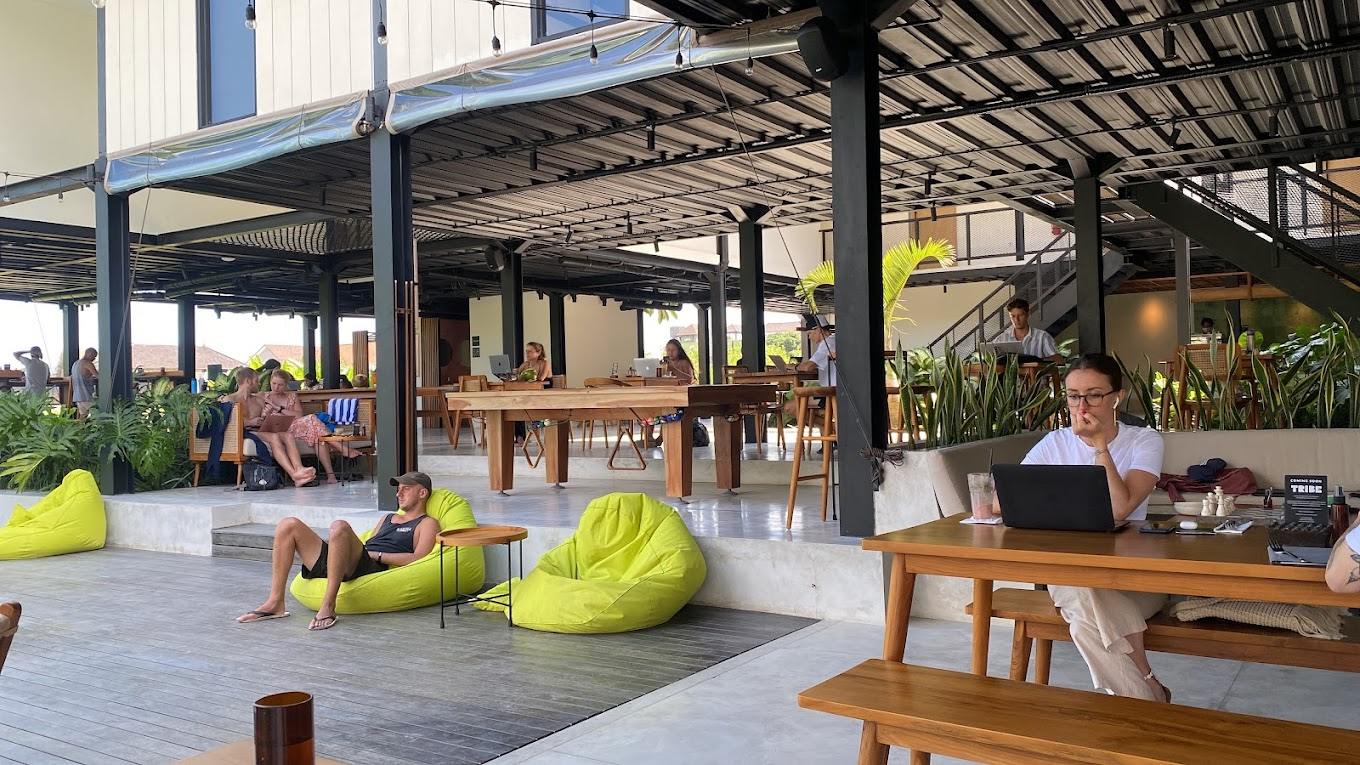
Tribal Bali

__wf_reserved_inherit

Location: Canggu, Pererenan

Daily rate: Free entry, with an expected café spend of around IDR 100,000

Monthly rate: No monthly membership

Internet: Around 100 Mbps fibre

Best for: Social digital nomads, creatives and people who enjoy meeting others while they work.

Livit Hub

__wf_reserved_inherit

Location: Sanur

Daily rate: Around IDR 275,000 ($18)

Monthly rate: Around IDR 4,875,000 ($325) for unlimited access

Internet: Up to 150 Mbps backup fibre

Best for: Startup teams, developers and remote professionals who want a professional workspace.

Workmates Canggu

Location: Canggu

Daily rate: No fixed coworking fee; café spending applies

Monthly rate: Not available

Internet: Around 50–70 Mbps

Best for: Digital nomads who prefer a relaxed café atmosphere over a conventional coworking office.

Kumpul

Location: Multiple locations, including Denpasar and Kuta

Daily rate: Around IDR 200,000 ($13)

Monthly rate: Around IDR 2,500,000 ($165)

Internet: Around 50 Mbps

Best for: Entrepreneurs who want to build connections with local businesses and founders.

The Office Bali

Location: Seminyak

Daily rate: Available on request

Monthly rate: From around IDR 3,500,000 ($230), depending on the desk

Internet: Around 100 Mbps dedicated fibre

Best for: Corporate professionals, consultants and independent professionals who prefer a structured office.

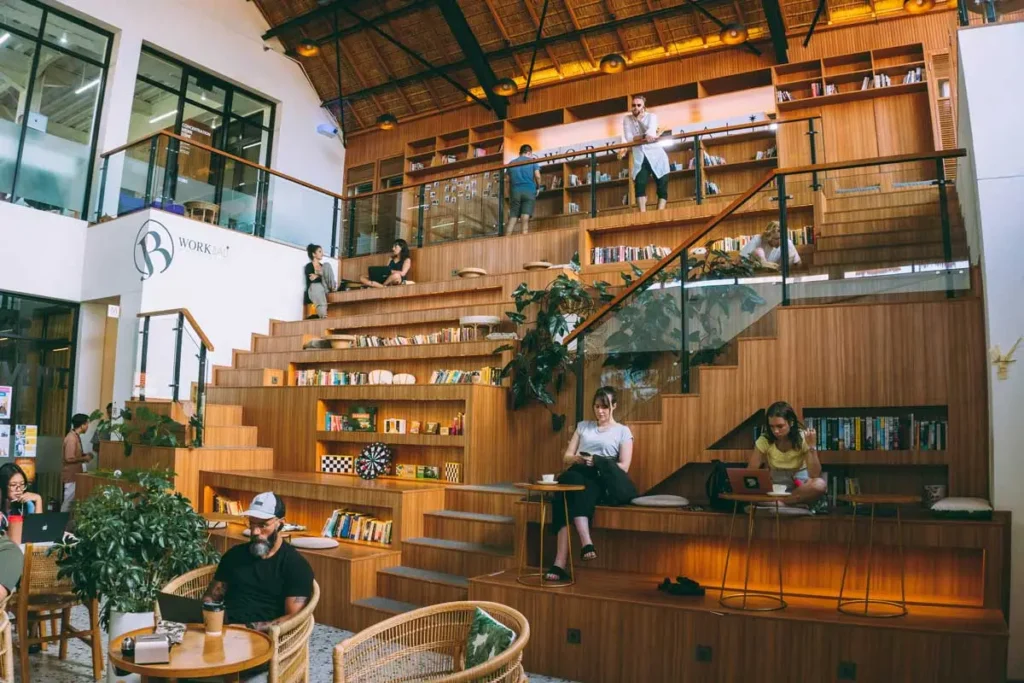
BWork Bali

__wf_reserved_inherit

Location: Canggu, Berawa

Daily rate: Around IDR 150,000–200,000 (10–13)

Monthly rate: Around IDR 2,300,000 ($150)

Internet: Around 150 Mbps dual fibre

Best for: Developers, content creators and remote professionals who need a quieter place to focus.

Dojo Bali

__wf_reserved_inherit

Location: Canggu, Echo Beach

Daily rate: N/A — permanently closed

Monthly rate: N/A — permanently closed

Best for: Understanding the history of Bali's digital nomad community.

Hubud

Location: Ubud, Monkey Forest

Daily rate: N/A — permanently closed

Monthly rate: N/A — permanently closed

Best for: Exploring the history and evolution of coworking in Bali.

Komunitas Co

Location: Ubud

Daily rate: Not available as a standard coworking rate

Monthly rate: Not available

Best for: Travellers interested in local creative communities and cultural experiences.

Best coworking spaces in Ubud for focused work

If you need a quiet place to work in Ubud, these three coworking spaces offer a mix of peaceful surroundings, reliable workspaces and meeting facilities.

Outpost Ubud (Penestanan & Nyuh Kunin)

Atmosphere: A tropical workspace with open-air areas, greenery, ravine views and a jungle pool.

Typical clientele: Remote executives, tech founders and long-term expats.

Distance: Around 7 minutes by scooter from central Ubud.

Meeting rooms: Yes, with private booths, conference rooms and whiteboards**.**

Ubud Co-Working

Atmosphere: A peaceful workspace overlooking green rice fields, designed for focused work.

Typical clientele: Writers, software engineers and digital nomads.

Distance: Around 6 minutes northeast of central Ubud.

Meeting rooms: Yes, including private rooms and dedicated meeting spaces.

The Hidden Space Ubud Cafe

Atmosphere: A quiet, plant-filled café with a garden setting away from the busy centre.

Typical clientele: Creative freelancers, slow-travelling nomads, and professionals.

Distance: Around 13 minutes by scooter from central Ubud.

Meeting rooms: Yes, with space for small workshops and private events.

How much does Coworking in Bali cost?

Your coworking budget depends largely on how long you plan to work from Bali. If you’re only staying for a few days, a day pass usually costs IDR 50,000–200,000.

A weekly pass can give you better value. For a longer stay, expect to pay around IDR 1,000,000–3,000,000 (56–167) a month for a hot desk. Dedicated desks cost more and often include extras such as storage and meeting-room access.

Before choosing a space, check the payment options. Some places offer better rates when you pay in cash, so keeping some IDR with you can help. You can keep your larger travel budget in your Grey account and use your multi-currency card when you need to pay by card.

If you’re planning a longer stay, our budgeting tips for nomads in Bali can help you plan your daily spending too.

For data on the go, grab a travel eSIM instead of buying a local SIM at the airport (where you'll overpay by 30-50% compared to ordering one online before you arrive). And if you're earning in USD while living in Bali, hold your dollars in a Grey account and convert to rupiah only when you need local currency. The rupiah fluctuates against the dollar, so converting in smaller amounts as needed often gets you a better average rate than converting a lump sum on arrival.

ATM fees can add up quickly, especially when you’re withdrawing regularly. A Grey card can help you manage your spending abroad by letting you pay by card without foreign transaction fees and withdraw cash at a fair exchange rate, depending on the ATM and applicable charges.

If you’re planning to work and spend more time in Indonesia, having a simple way to manage your money can make everyday payments easier. You can open a Grey account for Indonesia and manage your international spending from one place.

Frequently asked questions

What is the best area in Bali for digital nomads?

Canggu is popular with digital nomads because you’ll find plenty of coworking spaces, cafés, accommodation and a large remote-work community. Ubud is a better fit if you prefer a quieter environment surrounded by nature. Your choice ultimately depends on whether you prioritise social connections, convenience or a slower pace.

How fast is the internet at Bali coworking spaces?

Internet speeds vary between spaces, but many established coworking spaces offer reliable fibre connections suitable for video calls, cloud-based work and large file transfers. Some advertise speeds of 100 Mbps or more. Before choosing a space, check whether it has backup internet if reliable connectivity is essential to your work.

How much does a day pass cost at a Bali coworking space?

A day pass typically costs between IDR 50,000 and IDR 200,000, depending on the location and facilities. Some cafés and coworking spaces offer free entry with a minimum spend, while premium spaces charge more for access to meeting rooms, private areas, pools and other facilities.

Can I legally work remotely in Bali?

You need to check Indonesia’s current visa and immigration rules before working remotely from Bali. The rules depend on your nationality, visa type and the nature of your work. If you’re earning from overseas clients or an employer, confirm that your planned activities are permitted under the visa you intend to use.

Which is better for digital nomads: Canggu or Ubud?

Canggu may suit you if you want a lively digital nomad community, more coworking options and easy access to cafés and social activities. Ubud offers a quieter setting with more greenery and a slower pace. Neither is universally better; the right choice depends on how you prefer to work and live.

Do Bali coworking spaces offer accommodation?

Some coworking spaces in Bali are connected to coliving properties, so you can combine your accommodation and workspace in one place. Others only provide workspace access. If you want both, look specifically for coworking and coliving packages, and check whether accommodation, workspace access and other amenities are included.

The best regions in the world for first-time digital nomads

•

•

2 min read

Are you a first-time nomad looking to explore regions beyond your home country? Taking this step is exciting; it opens your eyes to new cultures, lifestyles, and ways of working. But since it’s your first time, you probably won’t want to just jump on a plane without planning.

To help you get started, I’ve put together a list of ideal places for first-time digital nomads. These destinations are beginner-friendly, offer strong remote work infrastructure, and let you experience the world without feeling overwhelmed. Read through, try them out, and hopefully, you’ll be sending me a thank-you message after your journey.

Also read: Balancing travel and work: Time management tips for nomads

Which countries are best for First-time digital nomads?

Choosing your first digital nomad destination can feel overwhelming. With so many options around the world, it helps to start with countries that make the transition smoother and less intimidating for beginners.

Thailand

If it’s your first time venturing abroad as a digital nomad, Thailand is gentle and welcoming. Chiang Mai, Bangkok, and Phuket offer affordable short-term stays, strong internet, and friendly co-working spaces. The food is cheap and delicious, transport is easy, and the community is vibrant. You can work in a café in the morning, explore temples in the afternoon, and still feel safe and supported throughout your first adventure.

  • Living cost: $600–$1,000/month for comfortable short-term stays in Chiang Mai or Phuket.
  • Visa type/Duration: Tourist visa (30–60 days), multiple-entry options for extended stays; some nomad visa trials in development.

Vietnam

Vietnam is a first-timer’s delight, balancing affordability, culture, and practicality. HoChi Minh City, Hanoi, and Da Nang provide reliable Wi-Fi, welcoming co-working spaces, and a lively expat community. Street food is cheap, local markets are fascinating, and daily life is easy to navigate. For a first-time nomad, Vietnam offers structure, comfort, and adventure in equal measure, so you can focus on work and exploration without stress.

  • Living cost: $500–$900/month including rent, food, and transport.
  • Visa type/Duration: Tourist visa 30–90 days, extendable; e-visas available for many nationalities.

Indonesia (Bali)

Bali is perfect for easing into the nomad lifestyle. Ubud and Canggu have thriving co-working spaces, friendly communities, and affordable short-term rentals. You can enjoy beaches, yoga, and tropical scenery after work while being part of an international network of remote workers. For first-timers, Bali balances inspiration and practicality, letting you feel supported as you discover how rewarding working while travelling can be.

Mexico

Mexico is ideal for a gentle first-time introduction to nomad life. Mexico City, Playa del Carmen, and Oaxaca have affordable living, great food, and safe, connected areas. Co-working spaces are welcoming, and there’s a strong sense of community among other remote workers. You can explore culture, history, and beaches without worrying about logistics. Mexico is kind to first-time travellers, easing into working abroad.

  • Living cost: $700–$1,200/month in Mexico City or Playa del Carmen.
  • Visa type/Duration: Tourist visa up to 180 days; Temporary Resident Visa for longer stays.

Also read: Portuguese for nomads: everyday expressions remote workers need

Portugal

Portugal is beginner-friendly and easy to navigate for first-time nomads. Lisbon, Porto, and Madeira offer reliable internet, safe streets, and accessible co-working hubs. Costs are reasonable, and the country moves at a calm, balanced pace. For a first experience abroad, Portugal lets you focus on work while slowly exploring cities, beaches, and culture, providing reassurance and a gentle entry into the nomadic lifestyle.

  • Living cost: $1,000–$1,500/month in Lisbon or Porto.
  • Visa type/Duration: Temporary stay visa 1–2 years; can include family members.

Georgia

Georgia is an unexpected gem for first-time nomads. Tbilisi and Batumi are affordable, safe, and full of charm. Co-working spaces are friendly and welcoming, the internet is reliable, and living costs are low. The culture is rich, the food is hearty, and the locals are warm. For first-timers, Georgia offers comfort, support, and adventure, making it a great place to dip your toes into international remote work.

  • Living cost: $500–$900/month, including accommodation, food, and transport.
  • Visa type/duration: Visa-free for 1 year for many nationalities; simple registration process.

Best tips for first-time nomads preparing to travel

Starting your first digital nomad journey is exciting. Exploring new countries, cultures, and ways of working can feel overwhelming, but with a bit of guidance, you’ll feel confident, prepared, and ready for adventure.

  • Easy countries: Start with countries that welcome remote workers and are beginner-friendly. Places like Thailand, Portugal, and Vietnam offer strong internet, affordable living, and good communities.
  • Passport validity: Check your passport before booking flights. Many countries require six months’ validity beyond your travel dates. Ensuring your passport is up to date avoids last-minute stress, missed flights, or denied entry. Always double-check each country’s rules.
  • Use a multicurrency account: Set up a multicurrency account to receive payments seamlessly, convert funds at fair rates, and spend locally without extra fees. This makes managing your money across countries simple, fast, and worry-free while you focus on enjoying your travels.
  • Use nomad visas: Research nomad visas, they’re designed for remote workers. They allow longer stays without overstaying tourist limits. Many countries now offer easy applications online. We even have a list of countries ready to help you choose the best option.
  • Double taxation laws: Understand tax obligations before travelling. Some countries tax worldwide income, while others have agreements to avoid double taxation. Knowing the rules keeps you compliant, prevents surprises, and ensures your earnings stay secure as you enjoy your new adventure.

Also read: How to choose destinations that maximise tax benefits for nomads

LDMAG1

Manage your global income with Grey

Embarking on your first nomad adventure is exciting, and managing money shouldn’t slow you down. Grey offers a multicurrency account that lets you receive payments globally, convert funds instantly, and spend in local currencies without extra fees. Grey's virtual card makes online payment easy and secure anywhere in the world. With Grey, handling your finances becomes simple, fast, and stress-free, so you can focus on exploring. Take the next step, sign up with Grey today and make your travels smoother and smarter.

‍

Best countries to move to on a digital nomad visa in 2026

•

•

2 min read

The way we work is changing fast, and in 2026, more people than ever are choosing careers untethered from a single location. With fast internet, flexible remote jobs, and a growing number of countries welcoming location-independent professionals, the digital nomad lifestyle has moved from niche to mainstream.

But the freedom to work anywhere comes with responsibilities. Doing it legally is key to a sustainable experience, and that’s where digital nomad visas make a difference. They let you live abroad for months, or even years, while working for foreign employers or running online businesses, removing the uncertainty and risks of staying on a tourist visa. These visas make remote work not just possible, but safe and long-term.

Also read: The best online jobs for digital nomads around the world

Best countries offering digital nomad visas in 2026

As more countries welcome remote workers, digital nomad visas make it easier to live and work abroad legally. Here are some of the best countries offering digital nomad visas in 2026.

Spain

Spain offers a digital nomad visa valid for up to three years, renewable for five. Remote workers can base themselves in cities like Madrid, Valencia, or the Canary Islands. The visa is ideal for those seeking vibrant culture, strong infrastructure, and easy access to other European destinations. Spain’s lifestyle, combined with a long-term legal framework for remote work, makes it one of the most appealing options for nomads looking to settle in Europe.

Als read: Best digital nomad rentals: affordable living options in Spain

Portugal

Portugal’s digital nomad visa lasts two years and extends to family members. To qualify, your income must come from outside Portugal. Popular hubs include Lisbon, Porto, and Madeira. Portugal combines affordability, excellent climate, and a welcoming remote work culture, making it perfect for long-term stays. The visa allows nomads to enjoy the country’s coastal cities, historic charm, and robust infrastructure while legally working for international clients.

Estonia

Estonia offers a one-year digital nomad visa, with reapplication required for continued residence. Remote workers cannot work for local Estonian companies under this visa. Cities like Tallinn and Pärnu are popular hubs, offering high-quality internet, co-working spaces, and a tech-friendly environment. Estonia is ideal for nomads seeking a structured, modern European base with excellent connectivity while legally working for foreign clients.

Also read: How to receive payments from Upwork in Estonia in 2025

Croatia

Croatia provides a one-year digital nomad visa for applicants earning at least €2,500 per month. Zagreb and Zadar are the main destinations. Croatia’s visa allows you to live and work legally while exploring a scenic country with a rich cultural heritage and access to the Adriatic coast. The affordable lifestyle, beautiful landscapes, and growing digital community make it a strong choice for remote professionals.

Indonesia

Indonesia offers a digital nomad visa that allows remote workers to live and work legally while earning from abroad. Popular destinations include Bali, Jakarta, and Yogyakarta. Nomads are attracted by affordable living, tropical climate, and vibrant expat communities. With reliable co-working spaces and strong internet in key cities, Indonesia provides a balanced lifestyle for remote professionals who want to combine work with adventure and immerse themselves in rich local culture.

Namibia

Namibia offers a digital nomad visa for remote workers earning at least $2,000 per month. Windhoek, Swakopmund, and Walvis Bay are ideal cities for settling. Namibia combines natural beauty, wildlife experiences, and a relaxed pace of life. The visa allows nomads to live legally in a country with breathtaking landscapes, clear skies, and a slower, inspiring environment for focused remote work.

Also read: Digital nomad essentials: tech gear that actually matters

Norway

Norway’s digital nomad visa is highly regarded for life quality. Remote workers can enjoy high wages, excellent healthcare, and stunning natural landscapes. Cities like Oslo, Bergen, and Tromsø provide reliable internet, strong infrastructure, and a high standard of living. While the cost of living is higher, the combination of legal security, work-life balance, and social benefits makes Norway one of the best options for long-term nomadic life.

Finland

Finland offers one of the most accessible digital nomad visas, requiring proof of at least $1,260 per month. Helsinki and Tampere are the top cities for remote professionals. The country is renowned for excellent public services, reliable internet, and a high quality of life. Finland’s visa provides a straightforward path for remote workers to live legally, experience a stable, well-organised society, and focus on their international clients with peace of mind.

What you need to know before moving abroad as a nomad in 2026

Before packing your bags, it’s essential to weigh practical and lifestyle factors. The right preparation ensures your digital nomad experience is smooth, legal, and enjoyable.

  • Official digital nomad visa availability: Check whether the country offers a recognised digital nomad visa, including eligibility, duration, and renewal options. Understanding the legal framework prevents overstaying or breaking immigration rules, allowing you to work abroad with peace of mind and long-term security.
  • Income requirements: Ensure your earnings meet the minimum thresholds for the visa and living standards. Factor in taxes, currency fluctuations, and personal expenses to guarantee that your income supports a comfortable, sustainable lifestyle abroad without financial stress.
  • Cost of living vs. quality of life: Compare the country’s living costs with your lifestyle expectations. Include housing, utilities, food, healthcare, and leisure, ensuring your income maintains a good balance between affordability and quality of life while living as a digital nomad.
  • Remote work infrastructure: Assess internet speed, reliability, and availability of co-working spaces. Time zone differences, digital services, and connectivity tools are crucial to maintain productivity, meet clients’ expectations, and work efficiently from anywhere in the world.
  • Digital nomad communities: A supportive community eases adaptation and provides networking, advice, and social opportunities. Engaging with other nomads or expats helps you feel connected, share experiences, and balance work with exploration in a new country.

Also read: How digital nomads can open bank accounts in Europe easily

LDMAG1

Receive your nomad income easily with Grey

Once you start living and working in these countries, having a reliable payment solution becomes essential. Managing income from international clients can be complicated, but with the right tools, you can focus on work and enjoy your new lifestyle. Grey solves cross-border payment challenges, letting you receive money seamlessly in multiple currencies at competitive exchange rates. Sign up or download the Grey app today and make your digital nomad experience

‍

How people working globally organise income streams

•

•

2 min read

People working globally are quietly rewriting how income works. You’re no longer tied to a single employer, country, or pay cycle. Designers in Lagos earn in pounds, writers in London invoice in dollars, and developers juggle retainers, contracts, and digital products at the same time. This shift isn’t about excess or luxury, but about resilience. When markets slow, currencies fluctuate, or clients pause budgets, multiple income streams protect you.In this article, you’ll learn how global workers intentionally organise income streams, combine active and recurring earnings and build systems that keep money moving even when work changes.

Also read: How to simplify money management when juggling multiple clients

How multiple income streams work for global workers

For global workers, multiple income streams often start as a mental shift rather than a financial one. When you earn across borders, you quickly realise how fragile a single income can feel. One delayed invoice, one paused contract, or a sudden currency drop of 10-15% can disrupt your entire month. That experience rewires how you think about money. You stop asking, “How much do I earn?” and start asking, “How exposed am I?” Psychologically, having more than one income source reduces anxiety because your survival is no longer tied to a single decision you don’t control.

Over time, this changes behaviour. Global workers intentionally spread income across two or three streams to regain control. Research consistently shows people feel more financially secure with diversified income, even when total earnings stay the same. It creates calm, better decision-making, and the confidence to think long term instead of living from invoice to invoice. Below are the main income types that make global work more stable and sustainable.

Active income

This is income you earn by directly trading time and skill for money. Examples include working with multiple clients, freelance contracts, consulting, or project-based work where payment stops when work stops.

Passive income

Passive income comes from assets you create once and sell repeatedly. Examples include online courses, paid newsletters, templates, ebooks, or digital tools that generate income without daily involvement.

Also read: Building a financial buffer as a global worker

Leveraged income

Leveraged income allows you to earn more without increasing hours by using systems or people. Examples include agency models, subcontracting work, or productised services delivered at scale.

Portfolio income

Portfolio income comes from investments that grow over time. Examples include dividends, index funds, ESG investments, or profit-sharing arrangements that support long-term wealth beyond active work

Steps to organise multiple income streams as a global worker

Global workers face unique financial challenges: multiple currencies, cross-border taxation, and diverse income streams. Proper systems and strategies help maintain clarity, protect wealth, and enable strategic financial planning.

1. Use one system to track everything

Managing income across spreadsheets, apps, and manual records increases errors, creates blind spots, and wastes time. Using a single centralised system, like an integrated finance platform or cloud-based tracker, ensures every payment, expense, and tax liability is recorded accurately. It allows real-time visibility, simplifies reporting, and provides insights into cash flow patterns, helping workers make informed decisions across multiple countries and clients.

Also read: How to make smarter money decisions as a global worker

2. Review your finances monthly

Waiting until the end of the year to review finances leaves risks hidden and decisions reactive. Monthly reviews allow global workers to spot income fluctuations, track exchange rate impacts, manage tax obligations proactively, and adjust spending or savings strategies. Regular monitoring also strengthens budgeting discipline, ensures compliance, and reduces stress, turning financial management into a forward-looking, strategic process rather than a last-minute scramble.

3. Keep digital copies of financial documents

Physical paperwork can be lost, delayed, or inaccessible when travelling or working remotely. Storing contracts, invoices, tax documents, and bank statements digitally in organised, secure folders ensures immediate access anytime. Cloud backups and encrypted storage prevent data loss and unauthorised access. Maintaining an organised digital archive also simplifies audits, visa requirements, and financial planning, giving global workers confidence in both security and efficiency.

4. Work with finance professionals

Cross-border income introduces tax, compliance, and investment challenges that vary by jurisdiction. Working with accountants, lawyers, or financial advisors experienced in global taxation and wealth management helps optimise tax efficiency, ensure regulatory compliance, and protect assets. Experts provide guidance on retirement planning, estate structuring, and cross-border transactions, reducing risk and creating a long-term strategy that aligns with both personal and professional financial goals.

LDMAG1

Managing global income streams with Grey

Managing multiple income streams as a global worker can quickly become overwhelming without the right structure. With reliable tools like Grey, you can earn securely and receive payments quickly in multiple currencies, all at competitive conversion rates. Grey also supports automated invoicing, helping you keep your cash flow organised across different clients and countries. Sign up or download the Grey app to simplify how you manage money across borders.

‍

Financial habits that make global work sustainable

•

•

2 min read

Global work opens doors to freedom, flexibility, and income without borders, but it also exposes you to financial uncertainty if you’re not intentional. Many freelancers and remote workers chase fast money, taking risky moves that look good in the short term but collapse under pressure. Sustainable wealth is built differently. It grows from consistent financial habits that don’t rely on luck or constant hustle.

These routines help you save more, stabilise your income, reduce stress, and protect what you earn, even when work slows down. For freelancers and remote professionals, strong financial habits are the foundation that turns global work into a long-term advantage. Below are practical habits that help you build a reliable base for wealth that lasts a lifetime.

Multi-currency account management

Working globally means earning in different currencies, and managing them poorly can quietly drain your income. A multi-currency account helps you receive, hold, and convert money efficiently without losing value to hidden fees. It gives you flexibility, protects your earnings from exchange-rate shocks, and makes working with international clients feel stable, professional, and sustainable over the long term.

Tips:

  • Use dedicated multi-currency accounts to receive payments without forced conversions or excessive international transfer fees.
  • Hold earnings in stronger currencies and convert only when rates are favourable.

Savings and investing

Freelance income can fluctuate, which makes saving and investing non-negotiable. Setting aside a fixed percentage of every payment builds discipline and long-term security. Investing those savings helps your money grow beyond your labour, creating financial stability that supports periods of slow work and long-term wealth creation without relying solely on active income.

Tips:

  • Automate saving a fixed percentage from every payment before spending anything else.
  • Reinvest surplus income regularly to build long-term financial momentum.

Emergency fund

An emergency fund is your safety net in a global freelance career. It protects you when clients delay payments, contracts end suddenly, or unexpected expenses arise. Having three to six months of expenses saved reduces stress, improves decision-making, and gives you the confidence to say no to low-value work without fear.

Tips:

  • Save three to six months of essential living expenses as a financial buffer.
  • Keep emergency funds liquid and easily accessible, not locked in long-term investments.

Tax compliance

Staying tax-compliant is essential for sustainable global work. Tracking income, setting aside taxes early, and understanding local obligations prevent costly surprises. Good tax habits protect your earnings, maintain credibility with clients, and ensure your freelance career grows without legal or financial setbacks that could derail long-term plans.

Tips:

  • Track all income and expenses weekly to avoid end-of-year panic.
  • Set aside a percentage of every payment specifically for taxes.
  • Consult a tax professional familiar with freelance or cross-border income.

More clients

Relying on a single client is risky in freelance and remote work. Building a diverse client base spreads risk, stabilises income, and increases earning potential. More clients also mean more referrals, stronger networks, and greater freedom to choose work that aligns with your skills, values, and financial goals.

Tips:

  • Ask satisfied clients for referrals immediately after successful project delivery.
  • Maintain an active professional presence on platforms like LinkedIn or personal websites.
  • Focus on retaining good clients while gradually adding new ones

LDMAG1

Sustainable global work is not defined by how fast you earn, but by how well you manage what comes in. Whether you prefer steady cash flow or larger monthly payments, what truly matters is getting paid reliably, without stress or delays. When payments are seamless, it becomes easier to save, plan, and build long-term stability.

Grey helps freelancers receive international payments quickly and securely in their preferred currency, making income management simpler and more predictable. Sign up today or download the Grey app and take control of how you get paid.

‍

Arrow (up)

Back to top