<script type="application/ld+json" data-schema-version="grey-blog-v4">
[{"@context":"https://schema.org","@type":"BlogPosting","@id":"https://grey.co/blog/how-to-open-a-uk-bank-account-remotely-from-egypt#article","headline":"How to open a UK bank account remotely from Egypt","description":"Need a UK bank account while in Egypt? Discover how to open a UK bank account from Egypt using Grey.","inLanguage":"en","url":"https://grey.co/blog/how-to-open-a-uk-bank-account-remotely-from-egypt","mainEntityOfPage":{"@id":"https://grey.co/blog/how-to-open-a-uk-bank-account-remotely-from-egypt#webpage"},"datePublished":"2025-05-07T19:56:45.579Z","dateModified":"2026-06-15T17:04:44.118Z","author":{"@type":"Person","@id":"https://grey.co/authors/adeolu-titus-adekunle#person","name":"Adeolu Titus Adekunle","url":"https://grey.co/authors/adeolu-titus-adekunle","jobTitle":"Content Writer","sameAs":["https://www.linkedin.com/in/titusadeoluadekunle/"]},"publisher":{"@type":"Organization","@id":"https://grey.co/#organization","name":"Grey","url":"https://grey.co","logo":{"@type":"ImageObject","url":"https://cdn.prod.website-files.com/6360022338a81bd6fdbb1145/6564ae1077a67e39d3c491a6_Grey%20Logo%20Lockup%20Black.svg"}},"image":{"@type":"ImageObject","@id":"https://grey.co/blog/how-to-open-a-uk-bank-account-remotely-from-egypt#primaryimage","url":"https://cdn.prod.website-files.com/636a85d290ee58e70c17e1c0/681bb177d532d84ece3964e3_How%20to%20open%20a%20UK%20bank%20account%20remotely%20from%20Egypt.webp","contentUrl":"https://cdn.prod.website-files.com/636a85d290ee58e70c17e1c0/681bb177d532d84ece3964e3_How%20to%20open%20a%20UK%20bank%20account%20remotely%20from%20Egypt.webp","width":1200,"height":675}},{"@context":"https://schema.org","@type":"WebPage","@id":"https://grey.co/blog/how-to-open-a-uk-bank-account-remotely-from-egypt#webpage","url":"https://grey.co/blog/how-to-open-a-uk-bank-account-remotely-from-egypt","name":"How to open a UK bank account remotely from Egypt","description":"Need a UK bank account while in Egypt? Discover how to open a UK bank account from Egypt using Grey.","inLanguage":"en","primaryImageOfPage":{"@id":"https://grey.co/blog/how-to-open-a-uk-bank-account-remotely-from-egypt#primaryimage"},"breadcrumb":{"@id":"https://grey.co/blog/how-to-open-a-uk-bank-account-remotely-from-egypt#breadcrumb"}},{"@context":"https://schema.org","@type":"BreadcrumbList","@id":"https://grey.co/blog/how-to-open-a-uk-bank-account-remotely-from-egypt#breadcrumb","itemListElement":[{"@type":"ListItem","position":1,"name":"Home","item":"https://grey.co/"},{"@type":"ListItem","position":2,"name":"Blog","item":"https://grey.co/blog"},{"@type":"ListItem","position":3,"name":"How to open a UK bank account remotely from Egypt","item":"https://grey.co/blog/how-to-open-a-uk-bank-account-remotely-from-egypt"}]}]
</script>
Personal Finance
•
May 7, 2025
•
8 min read
How to open a UK bank account remotely from Egypt
Adeolu Titus Adekunle
TABLE OF CONTENT
SHARE THIS POST
Owning a UK bank account in Egypt as a freelancer, remote worker, businessperson, international student, or frequent traveller makes international transactions easier. Unfortunately, opening a UK bank account remotely from Egypt without living in the United Kingdom could be challenging.
Thanks to digital financial platforms like Grey, you can now access UK bank accounts remotely from Egypt without ever setting foot in the UK.
This article explores the benefits of a UK bank account and how to open a UK bank account remotely from Egypt.
Why you need a UK bank account in Egypt
There are many reasons why someone in Egypt might want to open a UK bank account. These include:
Receiving payments in GBP from UK clients or employers.
Paying for UK-based services like online courses, software subscriptions, or eCommerce platforms.
Planning for relocation or studies in the UK.
Avoiding excessive currency conversion fees when dealing with the British pound (GBP).
Opening a UK bank account remotely from Egypt with Grey
Grey is a financial technology platform that allows users in Egypt to open virtual UK bank accounts. It’s one of the easiest ways for residents of Egypt to access international financial systems without local banking restrictions or paperwork hassles.
Benefits of using Grey to open a UK account
Opening a UK bank account with Grey offers numerous benefits, including:
Quick signup and verification – You can register and verify your identity in minutes.
Instant access to a UK account – Once approved, you’ll receive a virtual UK account (sort code and account number).
Doesn’t require a UK address – Unlike traditional banks, Grey doesn’t require you to be a UK resident to open a UK bank account in Egypt.
Multi-currency wallets – Grey lets you manage USD, GBP, and EUR, all in one platform.
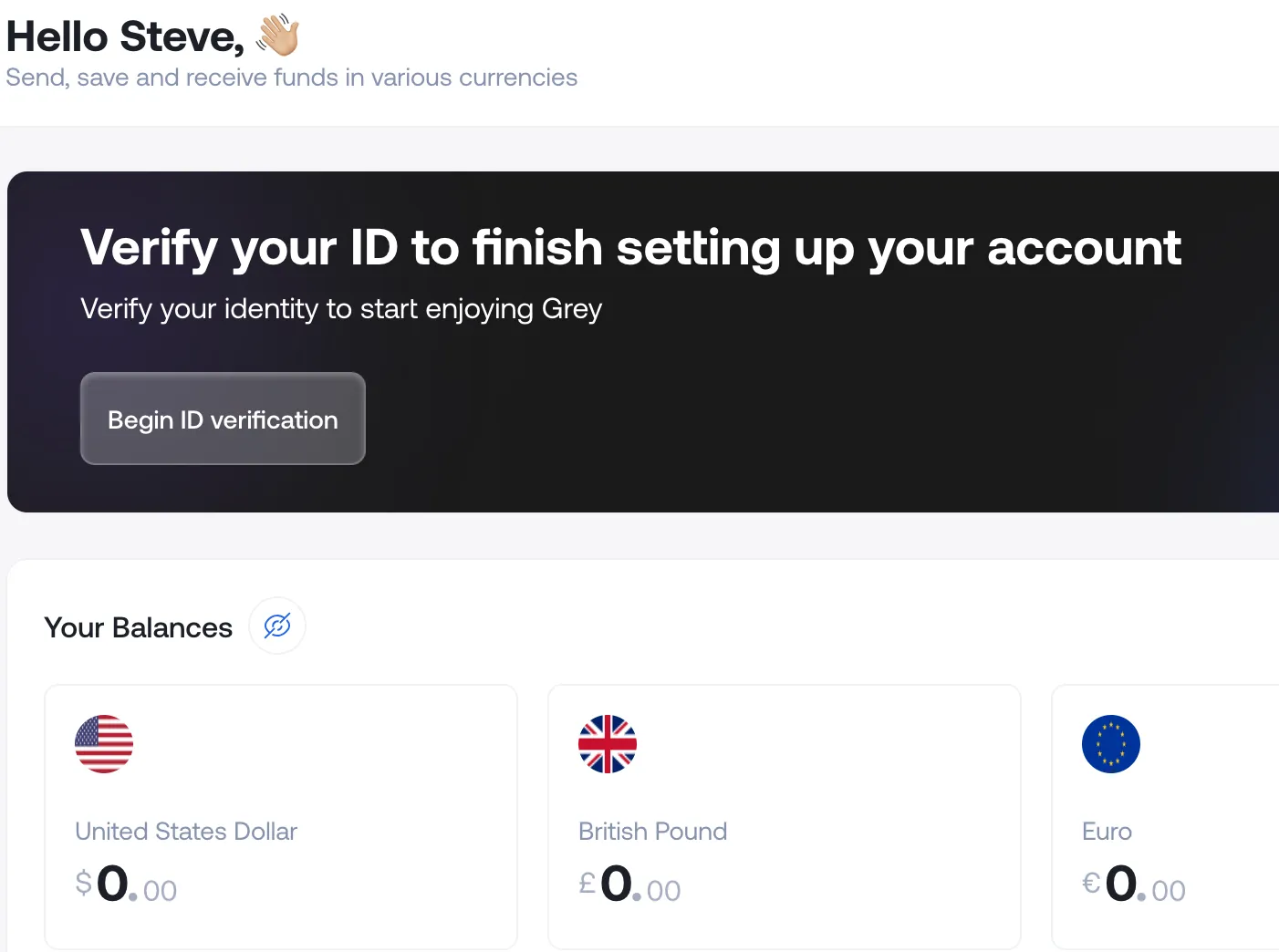
Opening a UK bank account on Grey is fast and straightforward. Here’s how to do it:
Visit Grey.co on your browser or download the app.
Click “Get Started – it’s free” to begin the registration process.
Fill in your personal details, including name, email, country of residence (Egypt), and phone number.
Verify your identity by uploading a valid government-issued ID (such as your passport) and a recent proof of address (e.g., utility bill or bank statement).
Submit your application and wait for approval. This usually takes a few minutes to a couple of hours.
Once verified, go to your dashboard and request a GBP account. Grey will issue you a UK account number and sort code.
Just like that, you’re ready to start receiving payments in GBP and sending money abroad.
Owning a UK bank account makes transacting with the global economy easy. You no longer have to deal with piles of paperwork, long waits and unfair charges to get one. With Grey, you can now enjoy simple, secure access to UK banking services from Egypt.
Whether you’re a student planning to study abroad, a freelancer working with UK clients, or simply looking for easier international payments, managing a UK bank account with Grey makes them all seamless.
The easiest way to send USD from the Philippines to the US depends on one thing: whether your money is already in dollars. If it is, a transfer from a USD account to the recipient's US bank account is the simplest and usually the cheapest route. If you're starting with pesos, a digital money transfer service that converts PHP to USD and pays a US bank account directly will beat a traditional bank wire on fees in most cases.
That matters because the fees you can see are only half the cost. The exchange rate, a correspondent bank charge or a 4% conversion spread can quietly take more than the transfer fee itself. Below, we compare the realistic options with the fees each provider published when we checked on 26 November 2026, so you can see the total before you send.
The quick answer
You already hold US dollars (for example, freelance income paid into a USD account): send them by local US bank transfer (ACH). There's no currency conversion, so you only pay the transfer fee.
You're starting with pesos and want the lowest fee: use a digital transfer service that converts PHP to USD and pays out to a US bank account, such as Wise. Grey fits only once you hold dollars, because it doesn't accept peso deposits.
The recipient needs cash today: Western Union offers cash pick-up at agent locations in the US.
You're moving a large sum and want to stay with your bank: a telegraphic transfer (SWIFT wire) from your Philippine bank works, but fixed fees add up: Security Bank, for example, charges $20, plus $15 if you also cover the US bank's charges.
Your options compared
Here's what each option cost to send about PHP 50,000 (roughly $784 at the PHP 63.76 per dollar mid-market rate Wise's calculator showed) to a US bank account.
Option
Published fees on about PHP 50,000 (USD)
Exchange rate
Typical speed
Grey, sending from a USD balance
About $3.92 (ACH fee of 0.5%, minimum $2, maximum $10)
No conversion needed
1 to 2 business days
Wise
About $3.53 (PHP 225.18, paying by bank transfer)
Mid-market rate
Conversion can take up to 2 working days
PayPal (personal payment)
About $36.36 ($4.99 fee plus a 4% conversion spread)
PayPal's rate plus the 4% spread
Instant to the recipient's PayPal account
Bank wire (Security Bank example)
About $37.35 ($20 commission, $15 correspondent charge if you pay all fees, and PHP 150 documentary stamp tax)
The bank's selling rate
Not published
Western Union
Shown in its estimator, varies by payment and payout method
Two things stand out. If you already have dollars, nothing beats skipping the conversion. If you're starting in pesos, the gap between the cheapest and the most expensive option on the same PHP 50,000 is more than $30.
1. Grey: best if you already earn or hold US dollars
Grey lets people in the Philippines open a free USD account with US account details, which is how many Filipino freelancers get paid by foreign clients. Once dollars are in that account, you can send them straight to any US bank account by ACH, without converting to pesos and back again.
Grey's fee page lists outgoing USD ACH transfers at 0.5%, with a $2 minimum and a $10 maximum, and the app shows the exact fee before you confirm. On $784, that's about $3.92. The recipient doesn't need a Grey account, only a US bank account.
Grey doesn't accept peso deposits. In the Philippines, pesos are a payout currency on Grey: you can convert dollars to pesos and withdraw them, but you can't fund your account in pesos. Once your dollars are in Grey, sending them on to the US is covered on the Philippines to US page. If you're starting with pesos, use one of the options below.
How to send USD to the US with Grey
Sign up on the Grey app or website and verify your identity with a valid Philippine government-issued ID or passport.
Get dollars into your USD account, for example by giving a client your US account details.
Tap Send, choose USD and Send via bank transfer, then pick ACH as the payment scheme.
Enter the recipient's details, review the fee and confirm with your PIN or 2FA code.
Transfers usually arrive in 1 to 2 business days.
2. Wise: lowest published fee when you start in pesos
Wise converts at the mid-market rate and shows its fee upfront. On PHP 50,000 paid by bank transfer, its calculator showed PHP 225.18 in fees, about 0.45%.
The trade-off is timing: Wise says conversion can take up to 2 working days. Wise is a strong choice for one-off peso transfers, but you still need a separate account if you also want to receive dollars from clients.
3. PayPal: convenient, but the most expensive app here
PayPal is instant if your recipient already uses it. For a Philippine account sending a personal payment to the US, PayPal charges $4.99 when funded from your balance or bank, and $4.99 plus 3.4% plus $0.30 when funded by card.
The bigger cost is the 4% conversion spread PayPal adds when it converts your pesos to dollars. On PHP 50,000, that alone is about $31. Use PayPal when speed or convenience matters more than cost, or when you already hold a USD balance in PayPal.
4. Bank wire (SWIFT telegraphic transfer)
Philippine banks such as BDO, BPI, Metrobank and Security Bank send USD abroad by telegraphic transfer. Security Bank, for example, charges a USD 20 commission, a USD 15 correspondent charge if you choose to pay all fees ("OUR"), and documentary stamp tax of PHP 0.60 per PHP 200 when the transfer is funded in pesos.
That's about $37 on PHP 50,000, before the bank's exchange rate. Because most of it is fixed, a wire makes more sense for large amounts, and less sense for regular small transfers. If you already hold dollars in a Philippine USD savings account, sending from that account avoids Security Bank's peso-funding tax.
5. Western Union: when the recipient needs cash
Western Union is the option to pick when your recipient in the US needs cash in hand, since it can pay out at agent locations. You can also send to a US bank account, but you'll need the recipient's SWIFT/BIC code.
Western Union lets you send up to $15,000 equivalent in PHP per transfer, or $7,500 to US Southwest Border states. It earns money on the exchange rate as well as fees, so check the total in its estimator.
A common mistake: picking an app that only sends into the Philippines
Some remittance apps that send money into the Philippines don't support sending money out of it. WorldRemit, for example, says it only offers airtime top-up when you send from the Philippines. Before you sign up anywhere, check that the Philippines is listed as a sending country and the US as a destination.
What you need before you send
For a US bank transfer by ACH, you'll need the recipient's:
Full name and street address, city, state and ZIP code
Bank name
Account number and account type (checking or savings)
Routing number (nine digits)
A wire usually needs the bank's SWIFT code as well. If you're not sure which to use, here's how ACH and wire differ on speed and fees.
Paying a US business instead of a person?
If you're paying a US school, landlord or online service, you may not need a transfer at all. Many US businesses accept card payments, and a USD card lets you pay in dollars directly.
Frequently asked questions
Does the recipient need a Grey account?
No. Grey pays out to the recipient's US bank account in USD, so they only need a US bank account. You need a verified Grey account to send.
What is the cheapest way to send money from the Philippines to the US?
If you already hold US dollars, sending them by ACH from a USD account is cheapest because there's no conversion. If you're starting with pesos, Wise had the lowest published fee in our 26 November 2026 check, so compare the final amount on the day you send. Grey doesn't accept peso deposits, so it only helps once you hold dollars.
How long does a transfer from the Philippines to the US take?
With Grey, it typically takes 1 to 2 business days from a funded USD balance. Wise says conversion can take up to 2 working days, and Western Union cash pick-up can be ready within minutes.
Is there a limit on how much I can send?
Yes, and it depends on the provider. Western Union allows up to $15,000 equivalent per transfer, and Grey's limit depends on your verification level and is shown in the app.
The cheapest transfer is often the one that skips a conversion you didn't need. If you're paid in dollars, keep them in dollars until they reach the US. Open a free Grey account and check today's USD to PHP rate before you send.
Nothing can beat that feeling of waiting for a text/email alert telling you that your salary has landed, only to finally receive it and see that part of your income is missing because you've had ‘income tax’ taken out.
Income tax is a tax charged by governments on the income earned by individuals. This could be money earned from a salary, wages, business profits, or other personal income. In many countries, income tax will automatically be deducted from your salary as an employee. Self-employed individuals may be required to calculate and pay personal income tax themselves.
Governments use this to fund public services and infrastructure such as healthcare, education, transport, and security.
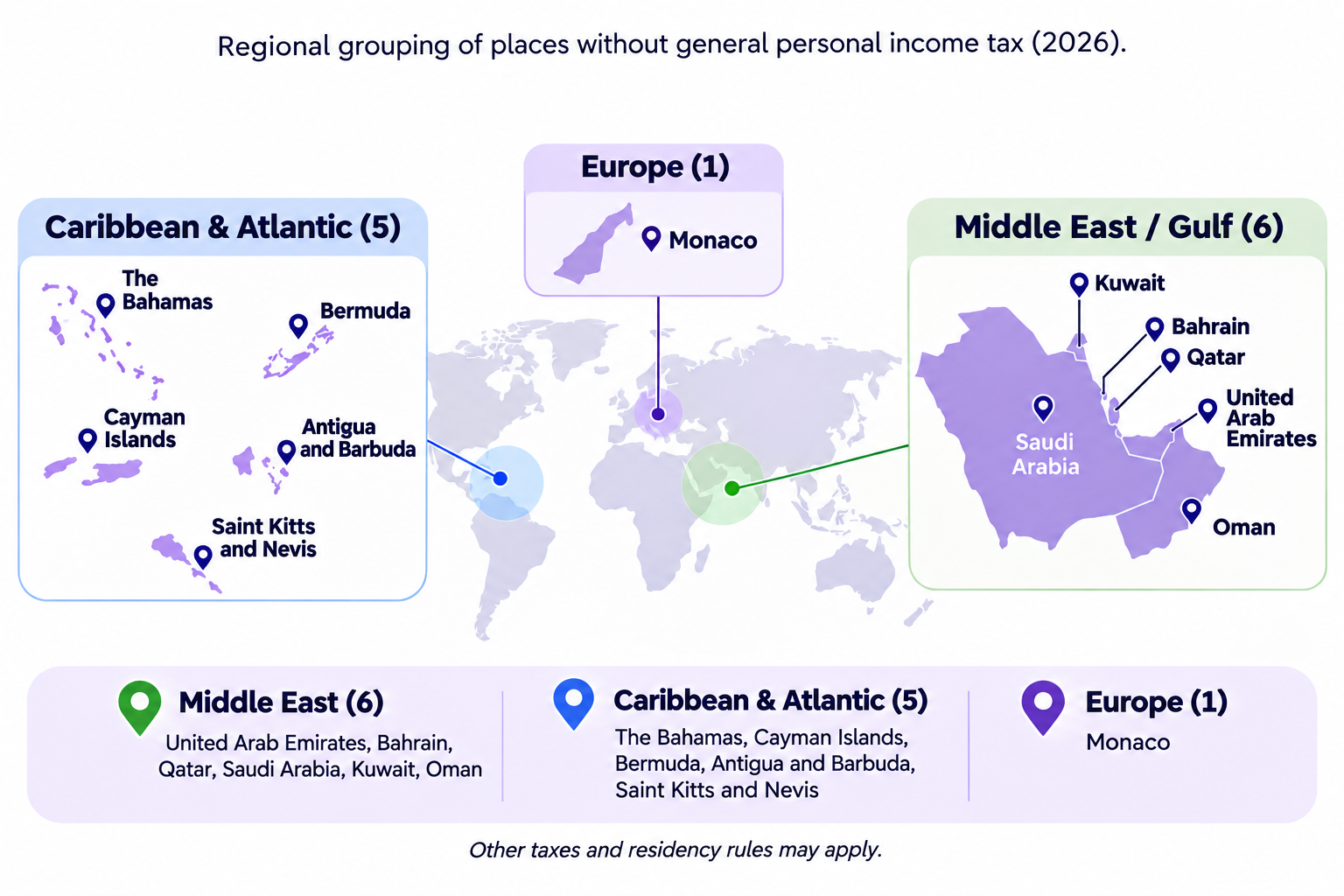
However, how much is paid, who pays, and how income is taxed will depend on the country. A handful of countries charge no personal income tax, mostly Gulf states, Caribbean islands, and small European territories. They usually raise money through VAT, customs duties, or residency fees instead. Becoming a tax resident takes time and money, and US citizens still file on worldwide income.
There are 12 countries globally where you can legally live and work in 2026 with 100% of your personal income and investment earnings.
While you won’t pay any income tax, you will still have to pay tax in some form. All governments need to pay for their roads, hospitals, and public services. So, instead of charging you tax on your payslip, you will pay tax on your groceries, importing a car, renting a flat, or running a business.
If you are working abroad, working remotely, or considering moving abroad, understanding the differences can help you make smarter financial decisions. Here are 12 countries where you can earn income without paying personal income tax.
What does “tax-free” mean?
When searching for countries with no tax, people often imagine they can earn 100% of their income with no further interaction with a revenue body. However, zero-tax countries rely heavily on indirect and corporate taxes such as
VAT and sales duties: Value Added Tax is a consumption tax charged on everyday items and services. Instead of charging tax on the income you earn, you’ll pay tax on the money you spend. Many Gulf states have introduced VAT in the last decade. While you may not pay any tax on your salary in Riyadh or Manama, you’ll pay 15% VAT in Saudi Arabia and 10% VAT in Bahrain.
Import and customs duties: Taxes charged on goods imported into a country. It is usually paid by the importer at the border and will therefore increase the price you pay in shops. Many Caribbean and Pacific island economies depend heavily on imported goods, so customs duties, shipping costs and insurance can make everyday items such as food, electronics and vehicles more expensive.
Corporate and freelance tax: This is a tax paid on the net profit of a registered business or self-employed individual. Just because a country has no general personal income tax does not mean businesses operating there are excluded from taxation.
As of 2026, the United Arab Emirates charges 9% corporate tax on profits from businesses and freelance work over AED 375,000. Bermuda charges 15% corporate income tax on large multinational groups and progressive payroll tax on local earnings.
Property and stamp duty: Stamp duty and property tax are taxes charged by the government, either one-off or annually, on the purchase, sale, or registration of property. If you’re buying or renting property, you’ll pay a high transfer tax, stamp duty, or fees.
Understanding where tax will be charged can help you understand how much it will really cost to live there.
Countries with no personal income tax
There are more than 20 countries and states globally that charge no personal income tax. However, some are difficult to relocate to due to strict visa requirements. Using data from PwC Worldwide Tax Summaries and OECD Automatic Exchange of Information Portal, here are 12 countries with no income tax in 2026. They have been split by region.
The Middle East (Gulf Cooperation Council)
These countries earn enough from oil and gas to fund their roads, schools, and public services without taxing your salary.
1. United Arab Emirates (UAE)
Dubai and Abu Dhabi are popular destinations for remote workers, business founders, and expats. In 2026, you pay 0% tax on your salary and share dividends and profits from selling personal assets.
You can get a residency visa through a local job, a remote work visa, a freelance permit, or a 10-year Golden Visa by buying property worth at least AED 2 million. On the flip side, you will pay 5% VAT on shopping, a 4% fee when buying property in Dubai and a 9% corporate tax on business profits over AED 375,000.
2. Bahrain
Bahrain charges 0% tax on your wages and investment profits. You can move there with a job offer or get a 10-year Golden Residency by buying property worth at least BHD 130,000 or earning BHD 2,000 a month after living there for five years. Everyday costs include a 10% VAT and a 2% property registration fee.
3. Qatar
Your salary and personal investment profits are completely tax-free in Qatar.
Property investments of at least QAR 730,000 can qualify eligible foreign buyers for a residence permit without a local sponsor. A higher investment of at least QAR 3.65 million can provide additional permanent-residency-related benefits.
Qatar has no general VAT in force as of November 2026. However, qualifying Qatar-source business income is subject to a 10% income tax. This can include income earned by self-employed individuals carrying out taxable business activities in the country.
4. Saudi Arabia
Saudi Arabia charges 0% personal income tax on salaries. Expats usually move there on a work visa or through the Premium Residency programme.
The Premium Residency programme offers different products. These include a renewable one-year residency option costing SAR 100,000 annually and a permanent residency option with a one-time fee of SAR 800,000. Foreign property owners may also qualify for the Real Estate Owner Residency product by owning or holding qualifying rights to residential property worth at least SAR 4 million, subject to the programme’s conditions.
Foreign-owned businesses and qualifying non-Saudi ownership interests in companies may be subject to a 20% corporate income tax on their taxable share of profits. Shoppers pay 15% VAT on most taxable goods and services.
This corporate tax should not be confused with personal income tax on an employee’s salary.
5. Kuwait
Kuwait has no personal income tax and no VAT. However, moving there is difficult unless you have a local job offer, family sponsorship, or a licensed local business.
Foreign-owned companies also pay a 15% corporate income tax on profits made in Kuwait.
6. Oman
Residents in Oman currently pay 0% general personal income tax. You can move there through an employment arrangement or qualifying property investment and residency programmes.
Oman has introduced legislation on personal income tax from 1 January 2028. Under Royal Decree No. 56/2025, a 5% tax will apply to taxable income above OMR 42,000 annually.
The Caribbean and Atlantic
These island nations pay for public services using tourism, financial services, import taxes, and visa investment fees instead of taxing your salary.
7. The Bahamas
The Bahamas charges 0% tax on your salary, investment profits, and inheritance. You can move there on an annual residence permit or get permanent residency by buying property worth at least BSD 750,000.
Since 1 January 2025, the minimum investment for economic permanent residency has been BSD 1 million, maintained for at least 10 years.
Everyday shopping comes with VAT and import duties on many shipped goods. The standard VAT rate is 10%.
However, from 1 April 2026, unprepared food has been made zero-rated for VAT, so the standard rate does not apply to every grocery purchase.
8. Cayman Islands
The Cayman Islands charges zero personal income tax, zero tax on investment gains, and zero corporate tax.
It also has no general inheritance or gift tax. However, residents and businesses still face other government charges, including import duties, work permit fees and property stamp duty.
Foreign workers can move there through a local employment arrangement or qualify for certain investment-based residency programmes.
One option is a Certificate of Permanent Residence for Persons of Independent Means, which requires an investment of at least US$2 million in developed real estate in the Cayman Islands. Another route, the Certificate of Direct Investment, requires an investment of at least US$1 million in an employment-generating business. Both routes have additional eligibility requirements.
The Global Citizen Concierge Programme is no longer available. It ended in 2022 and should not be considered a current remote-work visa option.
Instead of income tax, the government relies on import duties, financial services licence fees, work permit fees and stamp duties.
9. Bermuda
Bermuda does not charge personal income tax or general tax on personal capital gains. However, it does charge payroll tax on employment income.
Employers pay this tax, but they can deduct the employee’s share from their salaries. For the 2026/27 tax year (1 April 2026 to 31 March 2027), employees pay between 0.25% and 12.50%, depending on how much they earn each year. The first BMD 48,000 is taxed at 0.25%, while the highest rate of 12.50% applies to annual earnings between BMD 500,001 and BMD 1 million.
If you want to move to Bermuda, you will need a work permit or another qualifying residency option.
Investors may also qualify through Bermuda’s Economic Investment Residential Certificate (EIRC) programme. The programme requires a minimum investment of BMD 2.5 million in approved areas, such as local property, businesses or certain charitable contributions. Applicants must also meet the programme’s investment, holding and residency requirements.
Bermuda also charges a 15% corporate income tax, but only on qualifying multinational groups with annual global revenues of at least €750 million. This tax does not apply to every business in Bermuda.
10. Antigua and Barbuda
Residents of Antigua and Barbuda pay 0% general personal income tax on salaries and personal investment income.
You can explore relocation through the country’s ordinary immigration routes or its Citizenship by Investment Programme, which gives qualifying applicants options such as approved real estate investments and contributions to the National Development Fund. Citizenship is not automatic and is subject to due diligence and other eligibility requirements.
The country’s Nomad Digital Residence programme, which previously allowed remote workers to live there for up to two years, ended on 15 November 2025 and is no longer available to new applicants.
Local companies pay a 25% corporate income tax, while shoppers pay a standard 17% Antigua and Barbuda Sales Tax (ABST) on taxable goods and services.
11. Saint Kitts and Nevis
Saint Kitts and Nevis does not charge general personal income tax on employment earnings. Individuals also generally do not pay personal income tax on dividends, interest and capital gains.
Although business income and other specific transactions may be subject to separate tax rules, the absence of personal income tax should not be interpreted as an exemption from every tax obligation.
People from other countries can explore residency or citizenship through qualifying investment routes, including approved real estate purchases or contributions to the Sustainable Island State Contribution.
Applicants must satisfy the programme’s due diligence, financial and other eligibility requirements before citizenship can be granted.
The government generates revenue through a 17% standard VAT, import duties and corporate income tax, which is generally 33% on taxable company profits.
Europe
12. Monaco
Monaco charges 0% personal income tax on most residents, except for French nationals who are subject to French income tax under the 1963 agreement between France and Monaco.
To obtain a residence card (carte de séjour), you must demonstrate that you have suitable accommodation in Monaco, provide the required criminal record documentation and show that you have enough financial resources to support yourself.
If you are relying on independent financial means, you can provide a certified statement from a Monaco-based bank with sufficient funds.
You may also qualify through employment, business activity or financial support from another person.
Companies that earn at least 25% of their turnover outside Monaco are subject to corporate profits tax, currently at 25%.
Monaco also applies a standard 20% VAT rate, in line with the French VAT system.
2026 summary of tax-free countries
Country
Region
Personal income tax (2026)
Main residency route
Alternative taxes
United Arab Emirates
Middle East
0%
Work visa, remote visa, investment or AED 2M property
5% VAT; 9% corporate tax on qualifying taxable income above AED 375,000
Bahrain
Middle East
0%
Work visa or BHD 200k property
10% VAT; 2% property registration fee
Qatar
Middle East
0%
Work permit or QAR 730k property
10% tax on non-Qatari business profit
Kuwait
Middle East
0%
Employer or family sponsorship
15% corporate tax on foreign companies
Saudi Arabia
Middle East
0%
Work visa or SAR 100k/year premium residency
15% VAT; 20% non-Saudi business profit tax
Oman
Middle East
0% (5% from 2028)
Work visa or investor residency
5% VAT; 5% personal income tax on taxable income above OMR 42,000 from 2028
The Bahamas
Caribbean
0%
Annual permit or BSD 750k real estate
10% VAT; custom duties
Cayman Islands
Caribbean
0%
Work permit, remote visa, or residency for persons of independent means (CI$2 million property route)
Import duties; property stamp duty; work permit fees
The Bermuda
Atlantic
0%
Work permit; limited residential investment
Employee payroll tax (0.25% - 12.50%); customs
Antigua and Barbuda
Caribbean
0%
Digital nomad visa or investment route
15% - 17% sales tax; 25% corporate tax
St Kitts and Nevis
Caribbean
0%
Investment residency or citizenship
17% VAT; 33% corporate tax
Monaco
Europe
0% (except French citizens)
Lease/buy property, €500k bank deposit
20% VAT; 25% corporate profits tax for qualifying businesses
How to qualify as a tax resident
Getting a visa to live in a country doesn’t mean you’ll be a legal tax resident. Most countries have 3 main rules to determine if you’re a tax resident:
The 183-day rule: Many countries use the 183-day rule as one of the criteria for determining tax residency, but it is not a universal requirement.
For example, the UAE recognises several routes to tax residency. An individual may qualify after spending at least 183 days in the country within a consecutive 12-month period. There is also a route for individuals who spend between 90 and 182 days in the UAE, provided they meet conditions such as having UAE employment, conducting business there or maintaining a permanent place of residence. A separate route considers whether the UAE is the individual’s primary residence and the centre of their financial and personal interests.
Meeting the requirements for a tax residency certificate is not necessarily the same as meeting the immigration requirements for a residence visa. Always check the rules that apply to your destination and circumstances.
Money and investment requirements: If you are not moving for a local job, you may need to show that you can support yourself financially.
Depending on the country and immigration programme, you may have to show proof of remote employment, a minimum monthly income, sufficient savings or qualifying investments.
For example, the Cayman Islands requires at least US$2 million in developed real estate for its Certificate of Permanent Residence for Persons of Independent Means. Monaco requires evidence of sufficient financial resources, which can be proven through a certified statement from a local bank. Bermuda’s 2026 Economic Investment Residential Certificate programme requires an investment of at least BMD 2.5 million.
These are separate immigration requirements, not universal tax-residency thresholds. A person can qualify for a residence permit without automatically becoming a tax resident.
Cutting ties with your home country:
Moving abroad is only half the job. Your previous country may still consider you a tax resident.
Tax authorities in countries such as the UK, Canada and Australia look at factors including where you maintain your permanent home, where your family lives, your employment arrangements and the location of your economic interests.
Having a bank account, owning property or running a company in your former country does not automatically make you a tax resident there.
Reading up on how dual citizenship works or tools like Estonia e-Residency can help you understand international legal status, though neither replaces actually moving away to end your home tax obligations.
Visa approvals usually take anywhere from four weeks for a Gulf work permit to six months or more for Caribbean and European investor visas. Make sure to budget for legal fees, health insurance, document checks, and property deposits before you apply.
What does it mean for US citizens and other nationals?
Looking for zero-tax countries for expats works very differently if you hold a US passport because the United States taxes its citizens no matter where they live in the world.
According to the IRS guide for U.S. citizens and residents abroad, American citizens and green card holders must file a US tax return and report their worldwide income every year, even if they live full-time in Dubai, Monaco, or the Cayman Islands.
US citizens living abroad may reduce their US tax bill through the Foreign Earned Income Exclusion (Form 2555).
For the 2026 tax year, eligible Americans can exclude up to $132,900 of foreign-earned income from US federal income tax. To qualify, they must have a tax home abroad and meet either the physical presence test (spending at least 330 full days outside the US within a 12-month period) or the bona fide residence test (living in another country for an uninterrupted period that includes a full tax year).
The exclusion covers eligible employment and self-employment income, but not dividends, interest or capital gains. Income above the exclusion limit may still be taxable, and rental income follows separate rules.
US citizens abroad may also need to file an FBAR (Foreign Bank Account Report) **if the combined value of their foreign bank and financial accounts exceeds $10,000 at any point during the year.
If you want to reduce your US tax bill without dealing with overseas tax rules, consider moving to a US state with no personal income tax.
Other countries have their own rules for people who stop being tax residents. Canada and South Africa, for example, may tax certain assets as though they were sold when someone leaves. France has an exit tax for some shareholders, while Australia has capital gains tax rules for certain assets. These taxes do not apply to everyone and depend on individual circumstances.
Note: Breaking international tax rules can lead to heavy fines. This article is not tax advice, so always speak with a qualified cross-border tax advisor about your personal situation.
Managing money in multiple currencies
Moving to a zero-income-tax country almost always means dealing with more than one currency. You might earn freelance income in US dollars from clients in New York, collect dividends in British pounds, and pay your rent in Emirati dirhams or euros.
Using traditional banks to switch between currencies can eat into the tax savings you want to enjoy. They often add 3% to 5% in hidden exchange rate fees, plus high international transfer fees every time you move money across borders.
Grey is built to make international living and handling your money much simpler. With Grey, you can open a multi-currency account in minutes, hold multiple currencies like USD, GBP, and EUR, and convert your money at clear, minimal rates.
When you need to pay rent, cover bills, or send money home, you can move money between countries straight from your phone without waiting days for bank transfers to clear.
Living across borders? Hold and move multiple currencies with Grey.
Frequently asked questions about tax-free countries
Which countries have no income tax?
12 major countries and territories with zero personal income tax for residents include the United Arab Emirates, Bahrain, Qatar, Saudi Arabia, Kuwait, Oman, the Bahamas, the Cayman Islands, Bermuda, Antigua and Barbuda, Saint Kitts and Nevis, and Monaco. Oman has passed legislation to introduce a 5% personal income tax on high earners starting in January 2028.
Can Americans avoid tax by moving?
No. Under IRS rules, US citizens and green card holders are taxed on their worldwide income no matter where they live. While qualifying expats can exclude up to $132,900 of foreign-earned salary in 2026 under the Foreign Earned Income Exclusion, earnings above that threshold and passive investment income remain taxable by the US government.
Is Dubai really tax-free?
Dubai charges 0% personal income tax on salaries, dividends, and personal capital gains. However, residents still pay indirect and business levies, including a 5% Value-Added Tax (VAT) on most goods and services, a 4% property transfer fee, municipal housing fees, and a 9% corporate tax on business or freelance profits above AED 375,000.
How long must I stay?
Most zero-tax jurisdictions require you to spend at least 183 days per year inside the country to qualify as a tax resident and obtain a Tax Residency Certificate. Some destinations, such as the UAE, offer a 90-day residency route if you maintain a permanent residence and strong economic ties locally, while US citizens claiming the Foreign Earned Income Exclusion must spend at least 330 full days abroad.
Are there hidden costs?
Yes. Countries without personal income tax fund public services through higher everyday costs. Expect steeper prices driven by customs duties on imported goods, VAT rates between 5% and 20%, mandatory private health insurance, expensive property minimums, and annual visa or residency renewal fees.
Disclaimer: This article contains general information only and should not be considered tax advice. Tax laws and residency requirements can change frequently, so always consult a qualified cross-border tax professional.
You can pay on Amazon and ASOS from Nigeria, Ghana and Kenya with a Visa or Mastercard that is enabled for international online payments, and Shein shows the methods available for your country at checkout. The catch is delivery, not payment: Amazon ships to all three countries, ASOS listed delivery to Nigeria and Ghana but not Kenya when we checked, and Shein only confirms delivery at checkout.
If your local bank card keeps getting declined, a USD virtual card is the usual fix. Below, we cover what each store accepts, where it delivers, the fees that surprise people on foreign sites, and how to set up a card that works, with everything checked on 26 November 2026.
Store by store: delivery and payment at a glance
Store
Nigeria
Ghana
Kenya
Payment methods
Amazon.com
Ships (AmazonGlobal)
Ships (AmazonGlobal)
Ships (AmazonGlobal)
Visa, Mastercard and American Express cards; Amazon gift card balance
ASOS
Standard delivery £17.50, free over £100
Standard delivery £10, free over £100
No delivery options shown
Visa, Mastercard, American Express, PayPal, Apple Pay, Google Pay; Klarna and Clearpay where offered
Most declines on Amazon, ASOS or Shein come down to the card, not the store. The usual reasons are a local card that isn't enabled for international online payments, a bank limit on foreign spending, or the store's fraud checks flagging a mismatch between your card details and your billing address.
Start by asking your bank whether your card works for foreign online payments and what the limit is. If it doesn't, or the limit is too low for your order, a USD virtual card funded from your own balance gets around both problems.
How to pay on Amazon from Nigeria, Ghana or Kenya
Amazon lists Nigeria, Ghana and Kenya as eligible countries for AmazonGlobal, its international shipping service. Not every item ships, though: some marketplace sellers don't ship internationally, so check the delivery message on the product page with your address selected.
Sign in, go to Your Account and add your delivery address in Nigeria, Ghana or Kenya.
Under Your Payments, add your card number, name, expiry date and security code.
At checkout, choose that card and check the order total, including any import fees deposit.
If your card is in US dollars, leave the card currency as it is. Amazon's Change card currency option is for cards in other currencies.
Amazon says customs fees and import duties are the recipient's responsibility. Look at the import charges line before you pay, so the total doesn't surprise you.
You can also pay with an Amazon gift card balance. Redeem the code under Your Account and Amazon applies it to eligible orders, with a card covering any difference.
How to pay on ASOS from Nigeria, Ghana or Kenya
ASOS accepts Visa, Mastercard and American Express cards, plus PayPal, Apple Pay and Google Pay. It also lists Klarna and Clearpay, but ASOS notes that some payment services may not always be offered, so expect fewer options at checkout outside the UK.
When we checked, ASOS's delivery page showed standard delivery to Nigeria for £17.50 and to Ghana for £10, both free on orders over £100. For Kenya, it showed no delivery options at all. If you're shopping for Christmas, the page quoted delivery on or before 15 December 2026 for Nigeria and 17 December 2026 for Ghana on orders placed that day.
ASOS is a UK retailer, which matters for your card. Payments on non-US websites can attract a cross-border fee, so a £40 order won't cost you exactly £40 on a USD card.
LDMAG1
How to pay on Shein from Nigeria, Ghana or Kenya
Shein doesn't publish a single list of the countries it delivers to, and shopping guides disagree. The reliable test is the checkout itself: enter your address in Nigeria, Ghana or Kenya and see whether Shein offers delivery and which payment methods appear.
If Shein accepts your address, pay by card in the checkout's payment step, or use a Shein gift card balance if you have one. If it doesn't, shoppers use a parcel forwarding service, which gives you an overseas address and then sends the parcel on to you for an extra fee.
Paying with a Grey virtual card
A Grey virtual card is a USD Visa card that people in Nigeria, Ghana and Kenya can create in the Grey app. It works for online payments wherever Visa is accepted, which includes Amazon and ASOS, and in supported regions you can add it to Apple Pay or Google Pay.
What it costs
Card creation: a one-time $5 fee, with no monthly maintenance fee.
Currency conversion: the card spends from your Grey balance. Paying from your USD balance avoids conversion; converting naira, cedis or shillings to USD costs 1%, capped at $6.
Cross-border fee: up to 2% plus $0.50 on payments to non-US websites, charged by the merchant or card processor, not Grey.
Grey's help centre gives an example of how the cross-border fee works: a £50 purchase debits £51 plus $0.50. Amazon.com is a US store, so paying there in dollars from your USD balance avoids both the conversion and the cross-border fee.
How to set it up
Sign up on the Grey app and verify your identity.
Add money in your local currency. In Nigeria, transfer naira from a bank account in your own name. In Ghana, fund from a bank account or mobile money such as MTN MoMo. In Kenya, use M-Pesa or a bank transfer.
Go to Cards, select Virtual card, then Create card, accept the terms and set a 4-digit PIN.
Add the card details to your Amazon, ASOS or Shein account at checkout.
Keep enough in your balance before you shop. If a card balance goes negative and reaches $50, Grey automatically terminates the card. Country-specific guides for Nigeria, Ghana and Kenya go into more detail.
Frequently asked questions
Is the Grey card Visa or Mastercard in Nigeria, Ghana and Kenya?
Visa. Grey's supported country list for its Visa card includes Nigeria, Ghana and Kenya, and Grey has discontinued Mastercard except in specific regions.
Can I use my naira, cedi or shilling bank card on Amazon?
Sometimes. It works if your bank has enabled it for international online payments and your order is within your foreign spending limit, so ask your bank first.
Why was I charged more than the price on ASOS?
Payments to non-US websites can carry a cross-border fee of up to 2% plus $0.50, charged by the merchant or card processor. If the store bills in pounds, the amount is also converted to dollars.
Does Shein deliver to Kenya?
Shein doesn't publish a list we could verify. Enter your Kenyan address at checkout: if delivery and payment options appear, you can order directly; if not, use a parcel forwarder.
Getting the card right is only half of a successful foreign order; the other half is knowing the store will actually deliver before you pay. Check delivery with your address, keep your card funded in dollars, and sign up on Grey to create your virtual card.
Yes, you can sell on Etsy from South Africa, and Etsy pays you directly. South Africa is one of the countries where Etsy Payments is available, so buyers pay by card, PayPal, Apple Pay or Google Pay, and Etsy deposits your earnings in rand into your South African bank account.
You don't need PayPal, Payoneer or a foreign account to get paid for Etsy sales. What you do need is to know the fees, because two of them catch South African sellers out and both are avoidable. This guide covers setup, payout timing, every fee with a worked example in rand, and where a dollar account still helps.
Can you sell on Etsy from South Africa?
Yes. To use Etsy Payments, Etsy asks for "a residential address and a valid bank account in an eligible country", and South Africa is on its eligible country list. Unlike sellers in some countries, South Africans don't have to go through Payoneer.
Etsy may also charge a one-time shop set-up fee when you open your shop. The amount varies by location, so check what Etsy shows you at sign-up.
How Etsy pays South African sellers
Choose South Africa as your bank country. When you open a shop, the bank country you pick becomes your shop's country. Etsy says you must use a bank account from that country, and outside the eurozone it can't change your bank country later.
Add and verify your South African bank account. Non-US accounts are verified with small test deposits, so have your banking app ready.
Make sales. Whatever the buyer pays with, the money lands in your Etsy Payment account, minus fees.
Get your deposit. Etsy pays the balance into your bank in rand on the schedule you choose.
New shops start on weekly deposits every Monday, and you can switch to daily, weekly, biweekly or monthly. Etsy says standard deposits take up to one to five business days to reach your bank, according to its deposit guide.
Two holds can slow your first payouts. Etsy may hold back a reserve on new shops, and changing your bank details puts a five-day hold on your funds.
Etsy fees for South African sellers
Etsy charges in several layers, and the payment processing fee depends on where your bank account is. For a South African bank, it is 4.5% plus R8.
Fee
Amount (USD, ZAR or %)
When it applies
Listing fee
$0.20 per listing
Every listing, sold or not
Transaction fee
6.5%
Order total, including shipping and gift wrap
Payment processing
4.5% + R8
Gross order amount, including shipping and tax
Currency conversion
2.5%
Only if your listing currency differs from your Payment account currency
Deposit fee
R30
Deposits under R1,500
Offsite Ads
15%, or 12% once you've made $10,000 in 365 days; max $100 per order
Say you sell a beaded necklace for R450 and charge R150 shipping, listed in rand. The transaction fee is 6.5% of R600, which is R39. Payment processing is 4.5% of R600 plus R8, which is R35.
That leaves R526 before the $0.20 listing fee and any VAT on fees, so Etsy keeps about 12% of the order. List the same necklace in US dollars and the 2.5% conversion fee adds another R15.
Two fees you can avoid
Match your listing currency to your Payment account
Etsy charges the 2.5% conversion fee when your shop's listing currency is different from your Payment account currency, and South African deposits are paid in rand. Check the currency shown in your Payment account, then set your listing currency to match. Buyers abroad can still see prices in their own browsing currency.
Pick a deposit schedule that avoids the R30 fee
On the default weekly schedule, a quiet week can mean a R526 deposit with R30 taken off, nearly 6% of it. On the daily schedule, Etsy only deposits once your balance reaches R1,500, which is also the fee threshold, so you shouldn't pay the fee. A monthly schedule also helps if you sell steadily.
Can Etsy pay you into a USD account instead?
Not for a South African shop. Etsy's rule is that "you must use a bank account from the country on file with your shop", so a shop registered in South Africa is paid into a South African bank in rand.
Some older guides, including an earlier version of this one, suggested adding US, UK or EU account details to an Etsy shop. For a South African seller that would mean registering the shop in a country you don't live in, which we don't recommend.
Where Grey fits for South African Etsy sellers
Grey is a financial technology company, not a bank. It gives South African residents foreign currency accounts in USD, GBP and EUR, which help with the money that doesn't come through Etsy.
Customers who find you outside Etsy. A boutique in London that spotted you on Instagram, or a customer in Texas who ordered a custom piece through your own website, can pay your Grey account by local transfer. Our guide for South African freelancers paid by US, UK and EU clients covers the details. Keep Etsy buyers on Etsy, though: its off-platform policy says a transaction that starts on Etsy must stay there.
Paying for tools in dollars. Many listing, design and SEO tools bill in USD, and a Grey virtual card can pay USD subscriptions from a dollar balance.
Converting and withdrawing. Converting dollars costs 1%, capped at $6, and a withdrawal to a South African bank costs $1.50 and takes from a few hours to one business day. Check the live USD to ZAR rate before you convert.
Receiving into a Grey USD account by ACH costs 0.8% (minimum $2, maximum $10), and payments from individuals must be under $4,000 each. GBP and EUR accounts take payments from UK and EEA payers in the matching currency, and Faster Payments or SEPA deposits cost 0.8%, capped at £10 or €10.
Tax on your Etsy income
Etsy sales are income. SARS says residents are taxed on their worldwide income, subject to certain exclusions, so keep your Etsy sales reports for your return. Our guide to freelance tax in South Africa covers record keeping.
Frequently asked questions
Is Etsy available in South Africa?
Yes. South Africa is on Etsy's list of countries eligible for Etsy Payments, so you can open a shop and get paid into a South African bank account.
Can South African Etsy sellers get paid through PayPal?
Etsy pays you through Etsy Payments, into your bank account. PayPal is one of the ways buyers can pay you, but the money still reaches you as an Etsy deposit.
How long do Etsy payouts take in South Africa?
New shops are paid weekly on Mondays by default, and Etsy says deposits take up to one to five business days to reach your bank. Reserves on new shops and recent bank detail changes can delay them.
How much does Etsy take per sale in South Africa?
A 6.5% transaction fee plus 4.5% and R8 for payment processing, both charged on the order including shipping, plus $0.20 per listing. On a R600 order that comes to R74 before the listing fee and any VAT.
Sell in rand, keep more of it
For South African sellers, Etsy is already a direct line to buyers worldwide, paid in rand. Match your listing currency to your Payment account, pick a deposit schedule that clears R1,500, and use a Grey account for the dollar, pound and euro income that comes from outside Etsy.
For PayPal, a foreign bank account almost always means a US one. PayPal lets you link a bank account from the country where your PayPal account is registered, or a US bank account in some countries, according to its help centre. So the steps are: check that your PayPal country accepts US banks, open a USD account you can hold from abroad, and link it with your name matching exactly.
Most people do it the other way round. They open an account first, then find PayPal will not take it. This guide shows how to check before you start, which accounts work for which PayPal countries, how to set up and link a Grey account, what it costs, and what to do if PayPal says no.
Which foreign bank accounts PayPal accepts
PayPal decides by the country your PayPal account is registered in, not by where your bank is. Its rule is a bank in that same country and in the local currency, with US banks allowed as an extra option in some countries. The name on the bank account must also match the name on the PayPal account.
Your PayPal account is registered in
What PayPal lets you link
Can a Grey account receive your withdrawals?
A country where PayPal offers US bank linking
A local bank, or a US bank account
Yes, a Grey USD account, if you live in a country where Grey offers one
The United Kingdom
A UK bank account in GBP
Yes, a Grey GBP account
A eurozone country
A local bank account in EUR
No. Grey declines EUR deposits from PayPal, so withdraw to a local bank
A country where PayPal offers only local banks or cards
A local bank account or an eligible card
No. Withdraw locally, or get clients to pay you outside PayPal
Sources: PayPal help centre and Grey's help centre, checked on 26 November 2026.
Your PayPal country is the one you registered with, and you cannot switch it. PayPal says that if you move abroad, you need to close your account and open a new one, so registering PayPal in a country you do not live in is not a shortcut to better withdrawal options.
How to check what your PayPal account accepts
Do this before you open anything. It takes two minutes.
Log in to PayPal and open your Wallet.
Start adding a bank account and look at what PayPal asks for.
If PayPal offers a US bank or asks for a US routing number and account number, a US account can work for you.
If it only asks for a local bank, or only offers to add a card, PayPal does not accept US banks for your country.
Morocco is a good example of the last case: Moroccan users in PayPal's community forum report seeing only the option to add a card. If that is you, our guide for Moroccan PayPal accounts covers the routes that do work.
How to open a Grey USD or GBP account
Grey gives you US, UK and EU account details in your own name. Grey is a financial technology company, not a bank.
Check two things first. Grey's US accounts are offered to residents of a list of eligible countries, including Nigeria, Ghana, Egypt, India, Indonesia, the Philippines and South Africa, and only to full-time employees and freelancers, according to Grey's help centre. If your country is not on that list, a Grey USD account is not an option for PayPal yet.
Sign up. Create an account on the Grey web app or mobile app, choose your country of residence and verify your email.
Verify your identity. Upload a valid government ID. Grey says verification usually takes a few minutes and can take up to 24 hours.
Request your account. In the app, request a USD account, or a GBP account if your PayPal is registered in the UK. Your account number and routing details then appear in the app.
If you are wondering how a US account can exist without you living in the US, our explainer on virtual US accounts covers how they work and who they suit.
How to link your Grey account to PayPal
In your PayPal Wallet, choose to link a bank account.
Enter the routing number and account number from your Grey USD account, or the sort code and account number from your GBP account.
Confirm the account. PayPal sends up to two small deposits of between $0.01 and $0.99 and says to look for them after three business days. Find them in Grey and enter the exact amounts in PayPal, carefully, because three wrong attempts disable the bank.
Once PayPal shows the account as confirmed, withdraw your balance to it.
Three rules from Grey's PayPal guide keep withdrawals from bouncing:
The name on your Grey account must match your PayPal account.
Grey accepts USD and GBP from PayPal but declines EUR for compliance reasons.
Withdrawals take one to two working days, not counting weekends or public holidays.
What PayPal withdrawals to Grey cost
The biggest cost is usually the currency conversion. PayPal adds a conversion fee on top of its base rate whenever it converts your balance, and its Morocco fee page, for example, lists 3%.
Keep your PayPal balance in USD and withdraw it as USD, and that fee does not apply on the way out. PayPal may still charge for USD withdrawals in some countries, so check your country's PayPal fee page.
On the Grey side, here is what $1,500 withdrawn from PayPal and moved to your local bank costs.
Step
Grey fee rule
Fee on $1,500 (USD)
PayPal to your Grey USD account (ACH)
0.8%, minimum $2, maximum $10
$10 (0.8% would be $12, so the cap applies)
Converting to your local currency
1%, capped at $6
$6 (1% would be $14.90)
Withdrawing to your local bank
Depends on your country
Varies; Grey lists ₦35 for Nigeria and $1.50 for South Africa
Total before the local withdrawal fee
$16
Fees and rates checked on 26 November 2026, from Grey's help centre and Grey's fees page. GBP received by Faster Payments costs 0.8%, capped at £10.
For comparison, if PayPal converted the same $1,500 at a 3% fee, that fee alone would be $45. You do not have to convert at all: you can hold the dollars and convert when the rate suits you.
If PayPal will not link your account
PayPal's help centre lists the usual reasons. Work down this list before contacting support.
Country or currency. Your PayPal country does not accept US banks, or the account is not in your local currency.
Name mismatch. The bank account name does not match your PayPal name exactly.
Bank type. PayPal says it may not support some banks, including most online-only or prepaid accounts.
Link history. A bank account can only ever be linked to three PayPal accounts.
Limitations. The bank is already active on a PayPal account that is limited or has a negative balance.
Failed confirmation. Three wrong attempts at the confirmation amounts disable the bank until PayPal reactivates it.
If none of these can be fixed, the cleaner route is to take PayPal out of the chain. A US client can pay your Grey USD account directly by ACH, which our guide to getting paid without PayPal walks through.
Frequently asked questions
Can a non-US resident link a US bank account to PayPal?
Sometimes. PayPal allows US bank accounts in some countries in addition to local banks. Start adding a bank in your PayPal Wallet: if PayPal offers a US bank or asks for a US routing number, it works for your country.
Can I link a Grey EUR account to PayPal?
You should not. Grey declines EUR deposits from PayPal for compliance reasons, so use a Grey USD or GBP account where PayPal allows it, or a local bank for euros.
How long does a PayPal withdrawal to Grey take?
One to two working days, not counting weekends or public holidays, according to Grey's help centre.
The account you open matters less than the country your PayPal is registered in, so check your Wallet first and open the account PayPal will actually take. When you are ready, create a free Grey account or download the app.
Yes, UAE creators can earn US dollars on TikTok, but not from views. As of November 2026, TikTok's Creator Rewards Program, the feature that pays per qualified view, is not open in the UAE. The money comes from brand deals, TikTok One campaigns, LIVE gifts and affiliate links, and a lot of it arrives in USD from international brands and platforms.
That changes what you should worry about. The dirham has been pegged at 3.6725 to the US dollar since 1997, so exchange-rate swings are not where your earnings leak; conversion fees, withdrawal charges and fines are. Since late 2025, promotional posts also need a UAE Media Council Advertiser Permit, with fines starting at AED 20,000.
This guide covers what TikTok actually pays for in the UAE, the permit, how each income stream reaches you, and what it costs to receive $2,000 through different routes.
Is TikTok monetisation available in the UAE?
Partly. TikTok's Creator Rewards Program is not available to UAE accounts. Independent trackers checked in October and November 2026 list eight countries where it runs: the US, the UK, Germany, France, Japan, South Korea, Brazil and Mexico.
Where it does run, TikTok's own announcement sets the bar at age 18, 10,000 followers and 100,000 views in the last 30 days, and it only rewards original videos longer than a minute. The quickest check for your own account is TikTok Studio: if Creator Rewards isn't listed there, it isn't open to you.
Everything else depends on the feature. Here is where each income stream stands for a creator based in the UAE.
Income stream
Open to UAE creators? (Nov 2026)
Who pays you
How the money reaches you
Creator Rewards Program
No
TikTok
Not applicable
Direct brand deals
Yes, with an Advertiser Permit
The brand or its agency
Bank transfer or PayPal, often in USD
TikTok One campaigns
Where TikTok offers it to your account; permit needed
The brand, through TikTok
Rewards Center payout to a bank or other supported method
LIVE gifts
Check TikTok Studio; you must be 18 or older
Viewers, through TikTok
Withdrawal from your TikTok balance to a method listed for your region
External affiliate links
Depends on the programme
The affiliate network
The network's own payout options
TikTok Shop selling
No UAE seller marketplace
Not applicable
Not applicable
Checked 25 November 2026. Sources: TikTok Newsroom (Creator Rewards Program, March 2024), TikTok Ads Help Center (TikTok One payouts, April 2026), and independent trackers for country availability. TikTok's own help pages could not be read directly, so confirm in TikTok Studio before you plan around any row.
What pays UAE TikTok creators instead
Without per-view pay, a UAE creator's TikTok income is mostly a business of selling attention to brands. The platform is the shop window; the payments come from elsewhere.
Brand deals and sponsored videos
This is where the real money sits. Brands in luxury, fashion, travel, beauty, fitness and tech constantly look for creators who can sell to the UAE's mixed, high-spending audience in short videos.
International brands and agencies usually pay in USD by bank transfer or PayPal. Put the currency, the payment method and the payment date in the contract before you film, because the route you agree on decides how much of the fee you keep.
TikTok One campaigns
TikTok One is TikTok's marketplace where brands find and book creators. According to the TikTok Ads Help Center (last updated April 2026), you connect a bank account or another supported method in the Rewards Center, and creators outside Europe and Canada can request a payout at any time once their payment account is verified.
LIVE gifts
Viewers buy Coins, send you gifts during a LIVE, and those gifts become Diamonds in your TikTok balance. You withdraw from your balance in the app, using the payout methods TikTok lists for your region.
You must be 18 or older to receive gifts. Diamond values, withdrawal minimums and daily caps change, so treat any figure you read online as a rough guide and check the numbers on your own withdrawal screen.
Affiliate links
You can promote products through external affiliate programmes and earn a commission per sale. TikTok Shop is a different story: independent checks in 2026 found no seller marketplace for the UAE, so the in-app shop model that pays creators in other countries isn't an option here yet.
For a wider view of the platforms that pay creators across borders, see our guide on how to get paid globally.
Do you need a permit to make money on TikTok in the UAE?
For anything promotional, yes. The UAE Media Council announced the Advertiser Permit on 30 July 2025, and Al Tamimi & Company reports it became mandatory in late October 2025, after a three-month grace period.
According to The National (January 2026), the permit covers promotional content whether it is paid or unpaid, and creators had until 31 January 2026 to get one. Here is what else the two sources say:
Cost: free for citizens and residents for the first three years, renewed every year.
Visitors: non-residents apply through a licensed advertising or talent agency, for three months, renewable once.
Exemption: promoting your own products, or a company you own, on your personal account.
Fines: from AED 20,000 for a first offence, up to AED 1 million for serious or repeat breaches.
The sources don't say whether LIVE gifts alone need a permit, because the rules target promotional content. If you're unsure whether a post counts, ask the Media Council before you publish it.
Tax is simpler. There is no personal income tax in the UAE, but Neo Legal (July 2026) notes VAT registration is mandatory once taxable supplies pass AED 375,000. Our creator tax guide covers the paperwork platforms ask for.
How your USD reaches you, and where fees eat it
Because of the dirham peg, $2,000 is worth about AED 7,345 today and will be worth the same next month. What changes the amount you keep is the route the money takes.
Here is what one sponsored video paid at $2,000 costs to receive through common routes.
Route
Fee rule
Fee on $2,000 (USD)
Arrival time
Grey USD account, ACH
0.8%, minimum $2, maximum $10
$10
1 to 2 business days
Grey USD account, FedNow
0.8%, minimum $2, maximum $10
$10
Seconds
Grey USD account, Fedwire
Flat $20
$20
About 1 business day
PayPal UAE, withdraw USD to a UAE bank
1.5%, minimum $15
$30
Set by PayPal and your bank
PayPal UAE, convert USD balance to AED
3.0% conversion fee
$60
Set by PayPal and your bank
Checked 25 November 2026. Sources: Grey Help Centre, Deposit fees (USD) and Guidelines for receiving payments to your US bank account; PayPal UAE consumer fees (last updated 28 September 2026). PayPal figures exclude any fee for receiving a commercial payment, and an AED withdrawal over AED 750 has no extra PayPal fee.
The pattern is clear. Grey's ACH and FedNow fee stops growing at $10, so any payment above $1,250 costs the same to receive, while percentage fees keep climbing with your rate card.
How to receive TikTok and brand payments in USD with Grey
Grey gives UAE residents a USD account with US routing and account numbers, so brands and agencies can pay you the way they pay a US creator. Grey is a financial technology company, not a bank, and is registered with FinCEN.
Sign up on your phone. Download the Grey app, choose the UAE as your country and verify your identity with a valid passport or Emirates ID. Verification usually takes a few minutes and can take up to 24 hours.
Open your USD account. Your US account and routing numbers are ready to share once you're verified. There is no account opening or maintenance fee.
Put the details on your invoices. Ask brands and agencies to pay by ACH or FedNow where they can. Payments from businesses have no limit; payments from individuals must be under $4,000 each.
Move PayPal balances across. If a brand or platform pays you through PayPal, you can link your Grey account to PayPal as a US bank account. The names must match, transfers take 1 to 2 working days, and you should check the fee PayPal shows before you confirm.
Spend or hold. The UAE is on Grey's supported list for its Visa virtual dollar card, so you can pay for subscriptions, ads and gear in USD without converting first.
One rule to know: Grey does not accept payments for crypto, P2P, betting or forex trading. If you also take work from overseas clients, our guide for UAE freelancers covers GBP and EUR payments too, and this comparison of creator USD accounts sets Grey against the alternatives.
Common mistakes UAE creators make
Waiting for Creator Rewards. Building a channel around per-view pay that isn't offered in the UAE leaves you with views and no income.
Posting a paid video without a permit. The AED 20,000 starting fine can wipe out the fees from several brand deals.
Letting PayPal convert for you. At 3.0%, the conversion fee on a $2,000 payment is $60, for a currency that is pegged anyway.
Leaving payment terms out of the contract. "We'll pay you" is not a currency, a method or a date.
Frequently asked questions
Does TikTok pay UAE creators for views?
No. As of November 2026, the Creator Rewards Program, which pays per qualified view, isn't open to UAE accounts. UAE creators earn through brand deals, TikTok One campaigns, LIVE gifts and affiliate links.
How many followers do you need to make money on TikTok in the UAE?
There is no single number. Brands judge your audience and engagement, not a fixed threshold, and you must be 18 or older to receive LIVE gifts.
Can I withdraw TikTok earnings to a UAE bank account?
TikTok shows the payout methods available for your region on your balance screen. If the money goes through PayPal, PayPal UAE charges 1.5% (minimum $15) to withdraw USD to a UAE bank, or 3.0% to convert your balance to AED first.
Do I need an Advertiser Permit for TikTok in the UAE?
Yes, if you post promotional content, paid or unpaid. The permit is free for UAE citizens and residents for the first three years, and fines start at AED 20,000.
The short version
In the UAE, TikTok pays creators through brands, not views, so what you keep depends on the permit you hold and the route your dollars take. Get the permit first, agree USD payment terms in every contract, and open a Grey account so brands can pay you in USD.