

Even if you enjoy what you do, the sweetest part of working is getting paid. But we can all agree that the administrative side of being a freelancer or business owner can be a thorn in the flesh. Invoicing in naira is stressful, but not as bad as when you are working with international clients. Now you are managing currency differences, exchange rate volatility, tax wahala, payment delays, and currency conversion costs. Yet invoicing is important because it helps you look professional and avoid payment issues.
One of the most amazing parts of being a Lagos freelancer is that we will always find an easier way to get the job done. This guide covers every step of invoicing international clients from Lagos: how to set up your payment accounts, which currency to bill in, what belongs on a professional invoice, how to protect yourself from late payments, which tools to use, and what the 2026 NRS tax rules mean for your foreign income.
Set up to receive international payments before you invoice
Before you send your first invoice, you need somewhere for the money to land. The payment details on your invoice are only as good as the account behind them. Here are the real options available to you from Lagos, with an honest look at the trade-offs.
Nigerian bank account (SWIFT transfer)
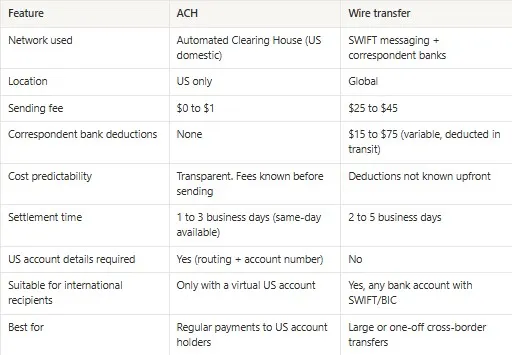
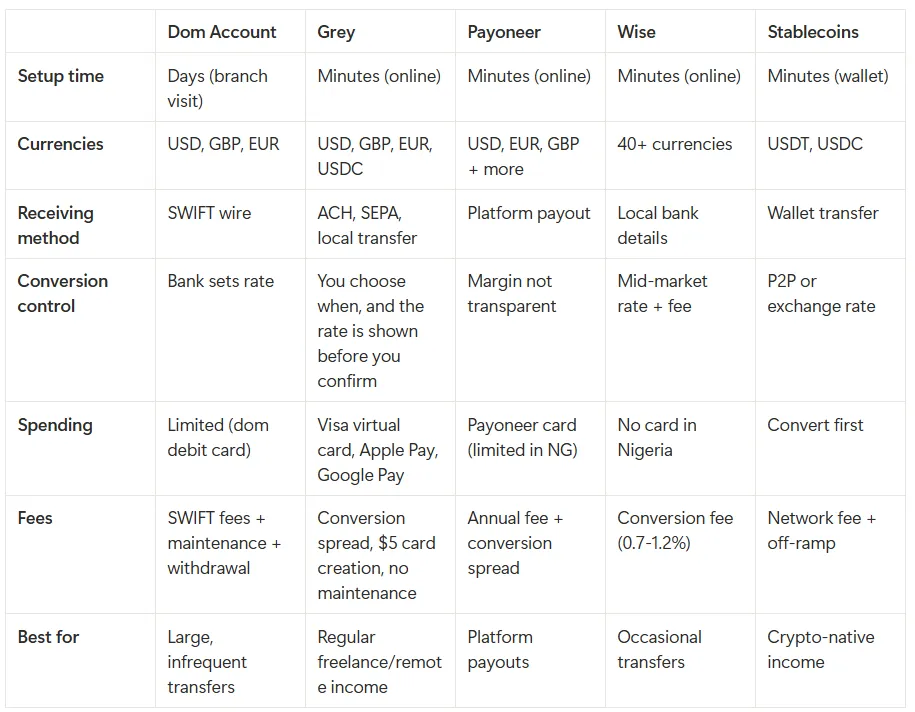
Your regular bank account can receive international payments via SWIFT. The problem is that SWIFT transfers are slow (3 to 5 business days), expensive (intermediary bank fees of $15 to $50 per transaction), and the conversion from USD to naira happens at your bank's rate, which you have no control over. For a $500 freelance payment, you could lose $30 to $50 in fees and unfavourable conversion before the money hits your account. This works in a pinch, but it is the most expensive option for regular freelance payments.
Domiciliary account
A domiciliary account is a USD-denominated account at a Nigerian commercial bank. It lets you hold dollars without automatic conversion to naira, which gives you control over when and at what rate you convert. The downsides are the setup process (branch visit, paperwork, sometimes minimum balance requirements) and the fact that spending from a dom account is clunky. The debit cards linked to dom accounts often have poor online acceptance and high fees. Domiciliary accounts are better suited for receiving large, infrequent payments than for regular freelance invoicing.
PayPal
PayPal is the payment method most international clients recognise. The challenge for Nigerian freelancers is on the receiving end. PayPal's withdrawal options in Nigeria are limited, conversion rates include a margin, and fees on received payments (typically 2.9% plus a fixed fee) add up quickly. PayPal works well when a client insists on it, but it should not be your primary invoicing method if you have better alternatives.
Payoneer
Payoneer is popular with freelancers who receive payments through platforms like Upwork, Fiverr, and Toptal. It provides a USD receiving account and allows withdrawal to Nigerian bank accounts. The conversion spread is reasonable but not the best in the market, and withdrawals can take 2 to 5 business days. Payoneer is a strong option if most of your work comes through freelancing platforms that integrate with it natively.
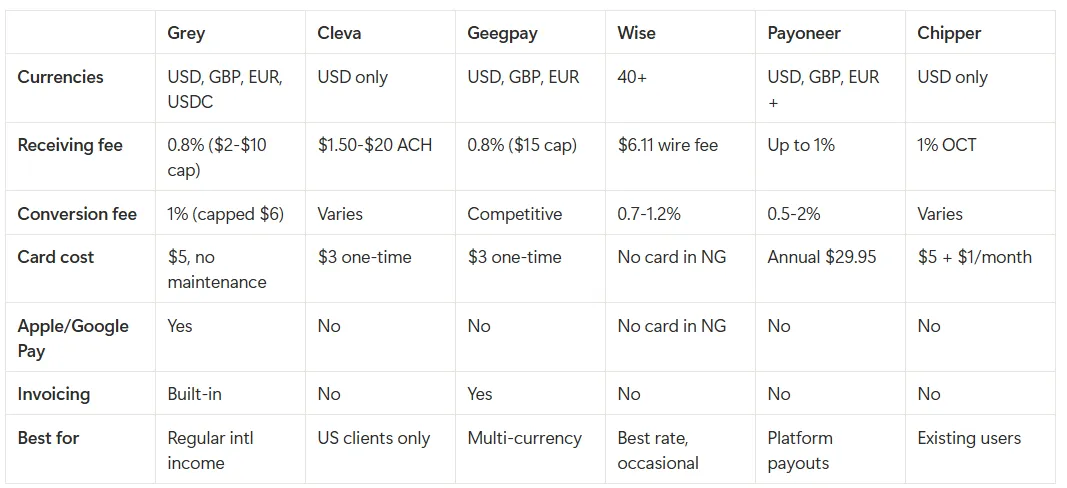
Multi-currency fintech accounts (Grey, Wise, Geegpay)
These platforms give you USD, EUR, and GBP account details that you can put directly on your invoices. When your client pays, the funds are deposited into your foreign currency wallet. You can hold the balance, convert to naira when the rate suits you, or spend directly using a virtual card. The key advantages are speed (payments often arrive same-day for ACH), transparency (you see the exchange rate before converting), and flexibility (you control when to convert). The cost primarily comes from the exchange rate margin when you convert, which varies by provider.
The practical recommendation: Most Lagos-based freelancers doing regular international work will get the best combination of speed, cost, and convenience from a multi-currency fintech account. Keep a domiciliary account as a backup for larger transfers if needed, and maintain PayPal for the occasional client who will only pay that way. The key is to have your payment method decided and set up before you start discussing terms with a client, not after you have already done the work.
Also read: Setting up payment terms and timelines with international clients
Choose your invoicing currency
The currency you bill in affects your earnings more than most freelancers realise. There are three options, and each carries different risks.
Invoice in USD, EUR, or GBP. This is the standard approach for most international freelancing from Nigeria. You bill in a major international currency, typically whichever your client is most comfortable paying in. US clients pay in USD, European clients in EUR, UK clients in GBP. This gives you a stable, internationally recognised currency, avoids the client having to deal with naira conversion on their end, and lets you hold the foreign currency until you choose to convert.
Invoice in the client's local currency. If your client is in a country with a different local currency (say, Australian dollars or Japanese yen), you could invoice in their currency. This removes friction for the client but creates exchange rate risk for you, since you are now exposed to a currency you might not hold or track. This approach can make sense for a long-term retainer client, but for one-off projects, stick to USD, EUR, or GBP.
Invoice in naira. Technically possible, but rarely practical. Most international clients cannot easily send naira, and even if they can, the conversion from their currency to NGN will be unfavourable on their end, meaning they are effectively paying more. This creates friction and can cost you the client relationship. The only scenario in which naira invoicing makes sense is if the client has a Nigerian entity or already holds naira.
A note on long projects: If a project spans several weeks or months, the exchange rate can move significantly between the date you send the invoice and the date you receive payment. There are two ways to handle this. You can lock in the rate by specifying in your contract that the invoice amount is final in the invoiced currency, regardless of rate movements. Or you can add a clause that allows for rate adjustment if the currency moves more than a certain percentage. Most freelancers go with the first approach because it is simpler, and clients prefer certainty.
What goes on your invoice
A professional invoice is a document that prevents disputes, speeds up processing, and keeps your records clean. Here is what every invoice to an international client should include.
Your details. Full name or registered business name, address, email, and phone number in international format. If you have a business registration number (CAC number in Nigeria), include it.
Client details. The client's full legal business name and billing address. This is important because some companies require the invoice to match their internal records exactly. Ask for the correct billing entity name before you send the first invoice.
Invoice number. A unique, sequential number for tracking. Use a format that is easy to sort: GREY-2026-001, GREY-2026-002, and so on. This also makes it easier to reference specific invoices in follow-up emails.
Date of issue and due date. State both explicitly. The due date should match the payment terms you agreed to in your contract. Never leave the due date blank or say "upon receipt" unless you enjoy chasing payments.
Description of services. Be specific enough that the client's accounts team knows exactly what they are paying for. "Design services" is too vague. The "Brand identity package for Project Atlas: logo, brand guidelines, business card design, and social media kit (delivered March 2026)" provides the client with everything they need to process the invoice without asking follow-up questions. For milestone-based projects, reference the milestone or deliverable phase.
Currency and amount. State the currency code explicitly (USD, EUR, GBP) alongside the amount. Do not assume the client will know which currency you mean from context.
Payment details. This is where your account information goes. For US clients paying via ACH, include your routing number and account number. For European clients, include your IBAN and SWIFT/BIC code. If you accept multiple payment methods, list your preferred method first. Example: "Payment via ACH preferred. Wire transfer also accepted."
Payment method preferences. If there are methods you do not accept (e.g., cheques, cryptocurrency), state that. If your client's payment will incur fees on your end, you can note that the client is responsible for the transfer fees, so the full invoice amount is credited to your account.
Tax information. Some countries require invoices to include the recipient's or sender's tax identification number. US clients may ask for a W-8BEN form to confirm you are not subject to US withholding tax. Have this ready before they ask.
Late payment terms. A sentence stating the consequence of late payment: "Invoices unpaid after 14 days past the due date will incur a 2% monthly late fee." Even if you never enforce it, having it on the invoice encourages timely payment.
Also read: Invoice like a pro: Tools African freelancers are using to get paid faster
Set payment terms that protect you
Payment terms should be agreed in your contract or scope document before the first invoice is sent, not decided on the fly. Here is how to think about them.
Net 14 (payment due within 14 days). Best for new clients, smaller projects, and one-off engagements. Shorter terms reduce your exposure to non-payment and keep your cash flow healthy.
Net 21 to Net 30 (payment due within 21 or 30 days). Standard for established client relationships, larger companies (which often have longer internal payment processing cycles), and retainer arrangements. If a client asks for Net 30, that is normal. If they ask for Net 60 or longer, negotiate or build the cost of waiting into your rate.
Deposits and milestones. For larger projects, a deposit is required before starting work. A common structure is 30% upfront, 40% at the midpoint of delivery, and 30% at final delivery. This protects you from doing significant work without compensation and gives the client checkpoints to review progress. Never start a project worth more than $500 without at least a 25% deposit, especially with a new client.
Who covers transfer fees? This is a detail many freelancers forget to address. If a wire transfer incurs $25 in intermediary fees and you are invoiced $500, you receive $475. Specify in your terms whether the client covers transfer fees or whether you absorb them. The cleanest approach is to state: "Client is responsible for any bank or transfer fees so that the full invoiced amount is received."
How to handle late payments
Late payments are a reality of freelancing, and they are harder to chase across borders. Prevention is better than collection, which is why deposits, clear terms, and professional invoicing matter so much. But when a payment is late, here is how to handle it.
Day 1 overdue: Send a polite reminder. Keep it simple: "Hi [name], just a quick note that invoice #[number] was due on [date]. Could you let me know the status? Happy to resend if needed." Most late payments are administrative delays, not intentional non-payment.
Day 7 overdue: Follow up with a slightly firmer tone. Reference the invoice number, amount, and original due date. Attach the invoice again. Ask for a specific expected payment date.
Day 14 overdue: Send a formal notice stating that the payment is now overdue, referencing any late payment clause in your contract. If you have a late fee clause, note that it will apply. This is also the point where you should pause any ongoing work for the client and communicate that clearly: "I have paused work on [project] pending resolution of the outstanding invoice."
Beyond 30 days: At this point, your options narrow. You can escalate to a collections service (though cross-border collections are difficult and expensive), pursue small claims in the client's jurisdiction (impractical for most freelancers), or write it off and move on. The lesson is almost always the same: the deposit and milestone structure you set up at the beginning is your real protection. Chasing money across borders is expensive and stressful. Prevention is the strategy.
Choose the right invoicing tool
The tool you use should align with your workflow and payment setup. Here is how the main options compare.
Grey Invoice. Built into the Grey platform, so your invoice is directly linked to your Grey USD, EUR, or GBP account. The client sees your payment details on the invoice and pays into your Grey wallet. You can track invoice status in the same app where you manage your money. The main advantage is that invoicing and payment receipt are in one place, eliminating the disconnect between sending an invoice in one tool and checking for payment in another.
Wave. Free, widely used, and supports multi-currency invoicing. Good for freelancers just starting out who want a professional-looking invoice without paying for a subscription. The limitation is that Wave's payment processing has geographic restrictions, so you may need to add your payment details manually rather than relying on Wave's built-in payment gateway.
FreshBooks. A paid tool that goes beyond invoicing into time tracking, expense management, and recurring invoices. If you bill hourly or need to track project time against invoices, FreshBooks is worth the subscription. It supports multi-currency invoicing and sends automatic reminders for overdue payments.
Zoho Invoice. Part of the Zoho ecosystem, which means it integrates with Zoho Books, Zoho CRM, and other tools. Multi-currency support, automated recurring invoices, and location-based tax application. A good choice if you are scaling beyond solo freelancing into a small consultancy.
PayPal Invoicing. The simplest option is if your client already uses PayPal. You create the invoice in PayPal, the client pays via PayPal, and the funds land in your PayPal balance. The downside is PayPal's fees on received payments (approximately 2.9% plus a fixed fee) and the limited withdrawal options in Nigeria. Use this when a client specifically requests PayPal, not as your default.
Choosing: If you use Grey for receiving payments, Grey Invoice is the path of least friction. If you need a standalone invoicing tool with accounting features, FreshBooks or Zoho are the strongest options. If you are just starting out and want something free, Wave does the job. The most important thing is consistency: pick a tool, use it for every invoice, and keep all your records in one place.
Understand your tax obligations under the 2026 NRS rules
This is the section most invoicing guides skip, and it is the one that matters most for Nigerian freelancers right now. The Nigeria Tax Act, signed in June 2025 and effective from January 1, 2026, changes how foreign income is taxed. If you are a freelancer earning from international clients, these rules apply to you.
The basics
If you are a Nigerian tax resident (you live in Nigeria for 183 days or more in a year, or you have strong economic and family ties to Nigeria), the NRS taxes you on your worldwide income. That includes every dollar, euro, and pound you earn from international clients, whether or not you bring the money into Nigeria.
You are required to register for a Tax Identification Number (TIN) with the Nigeria Revenue Service, self-declare your annual income, and file your tax return by March 31 of the following year.
How your income is calculated
Foreign income must be converted to naira at the official CBN exchange rate on the date you received the payment, not the parallel market rate. If you received $1,000 on March 15 and the CBN rate that day was N1,550 to $1, your taxable income for that transaction is N1,550,000.
Tax bands (2026)
The first N800,000 of annual income is tax-free. Above that, progressive rates apply. Income from N800,001 to N2,400,000 is taxed at 15%. From N2,400,001 to N4,800,000 at 20%. Above N4,800,000, the rate is 25%. These rates are lower than many other African countries. South Africa's top rate is 45%, Kenya's is 35%.
What you can deduct
As a self-employed person, you can deduct legitimate business expenses before calculating your taxable income. This includes software subscriptions (Adobe, Figma, hosting), internet costs, coworking space or home office expenses, equipment (laptop, phone, peripherals), and professional development (courses, certifications). Keep receipts and records for everything you claim.
Double taxation agreements
Nigeria has double taxation agreements with 16 countries, including the UK, Canada, and South Africa. If your income has already been taxed in one of these countries, you can claim a credit against your Nigerian tax liability. For countries without a DTA (including the US), Nigeria offers unilateral relief, meaning you can still claim credit for tax paid abroad, but you need to provide documentation.
Penalties for non-compliance
Failure to register for a TIN attracts a fine of N50,000 in the first month and N25,000 for each subsequent month. Failure to file returns attracts a fine of N100,000 in the first month and N50,000 per month thereafter. False declarations can result in fines up to N1,000,000 or three years' imprisonment. The NRS has stated it will use data analytics to cross-check bank transactions and foreign inflows, so the era of flying under the radar is effectively over.
The practical takeaway: Track every payment you receive, record the CBN rate on the date of receipt, keep records of all deductible expenses, and file on time. If your tax situation is complex (multiple income streams, income from DTA countries, significant deductions), consult a certified tax professional. The cost of a tax advisor is far less than the cost of penalties.
Disclaimer: This section provides general information about Nigerian tax obligations for freelancers. It is not professional tax advice. Tax rules are subject to change, and individual circumstances vary. Consult a qualified tax professional for advice specific to your situation.
Invoice and get paid with Grey
Grey brings invoicing and payment reception into one platform. You create your account at grey.co or on the Grey app, complete KYC verification, and receive USD, EUR, and GBP account details. These are the details you put on your invoices.
When your client pays, the funds are deposited into your Grey wallet. For US clients paying via ACH, the transfer is typically same-day. For European clients paying via SEPA, payments are usually processed within 1 business day. You can hold the foreign currency in your wallet, convert to naira when the rate suits you, or spend directly using your Grey virtual card on tools, subscriptions, or advertising.
Grey Invoice lets you create and send professional invoices directly from the app, with your Grey account details pre-filled. The client receives a clean invoice, pays into your account, and you can track the payment status without switching between platforms.
For freelancers who also need to make international payments (buying software, paying subcontractors, running ads), Grey's virtual card and money transfer features mean you can handle both incoming and outgoing international transactions from one account.
Note: Exchange rates on Grey are variable and include a margin over the mid-market rate. Grey does not charge transfer fees on incoming payments; the cost is in the exchange rate when you convert. Always review the rate before confirming a conversion.
Frequently asked questions
Should I charge VAT on international invoices from Nigeria?
Generally, services exported from Nigeria (i.e., services performed for a client outside Nigeria) are zero-rated for VAT purposes. However, VAT rules can be complex, and the NRS may update guidance. If you are unsure, consult a tax professional.
What happens if my client pays in a currency other than the one I invoiced?
If you invoice in USD and the client pays in EUR, a currency conversion will happen somewhere in the chain, either at the client's bank or at your payment provider. This conversion may not be favourable, and you may receive less than the invoiced amount. To avoid this, state the invoicing currency clearly and specify that payment should be made in the same currency.
How long do international payments take to arrive?
It depends on the method. ACH transfers to a US-based account (like a Grey USD wallet) are typically same-day. SEPA transfers for EUR are usually 1 business day. SWIFT wire transfers take 3 to 5 business days. PayPal transfers are instant, but withdrawal to a Nigerian bank adds 1 to 3 days.
Can I invoice in naira for international clients?
You can, but most international clients cannot easily pay in naira. The conversion on their end will be unfavourable, and it creates unnecessary friction. Invoicing in USD, EUR, or GBP is almost always the better approach.
Do I need a business registration to invoice internationally from Nigeria?
No. You can invoice as an individual freelancer using your personal name. However, having a CAC-registered business name or limited company adds credibility, may be required by some clients for their internal compliance, and allows you to claim business expense deductions more cleanly at tax time.
Should I ask for a deposit from new international clients?
Yes. A 25% to 50% deposit before starting work is standard practice in freelancing. It protects you from non-payment and demonstrates the client's commitment. Frame it as standard terms, not as a sign of distrust: "My standard terms include a 30% deposit before project kickoff, with the balance due on delivery."
What if my client asks for a W-8BEN form?
A W-8BEN is a US tax form that certifies you are not a US person for tax purposes. US clients may request this to confirm they do not need to withhold tax from your payments. You can fill it out using your Nigerian address and TIN. It is a standard process, not a cause for concern.
Ready to start invoicing international clients? Sign up at grey.co to get your USD, EUR, and GBP account details and start sending invoices today.
.svg)