<script type="application/ld+json" data-schema-version="grey-blog-v4">
[{"@context":"https://schema.org","@type":"BlogPosting","@id":"https://grey.co/blog/how-to-get-an-instant-usd-debit-card-in-morocco#article","headline":"How to get an instant USD debit card in Morocco","description":"Here's how to get an instant USD virtual card in Morocco that works globally, with verified fees and setup steps for each option.","inLanguage":"en","url":"https://grey.co/blog/how-to-get-an-instant-usd-debit-card-in-morocco","mainEntityOfPage":{"@id":"https://grey.co/blog/how-to-get-an-instant-usd-debit-card-in-morocco#webpage"},"datePublished":"2025-01-24T08:34:06.264Z","dateModified":"2026-06-15T17:13:37.406Z","author":{"@type":"Person","@id":"https://grey.co/authors/adeolu-titus-adekunle#person","name":"Adeolu Titus Adekunle","url":"https://grey.co/authors/adeolu-titus-adekunle","jobTitle":"Content Writer","sameAs":["https://www.linkedin.com/in/titusadeoluadekunle/"]},"publisher":{"@type":"Organization","@id":"https://grey.co/#organization","name":"Grey","url":"https://grey.co","logo":{"@type":"ImageObject","url":"https://cdn.prod.website-files.com/6360022338a81bd6fdbb1145/6564ae1077a67e39d3c491a6_Grey%20Logo%20Lockup%20Black.svg"}},"image":{"@type":"ImageObject","@id":"https://grey.co/blog/how-to-get-an-instant-usd-debit-card-in-morocco#primaryimage","url":"https://cdn.prod.website-files.com/636a85d290ee58e70c17e1c0/6a30164d65c4f70f3dd41077_6a30164c78e40e52862b7262_how-to-get-an-instant-usd-debit-card-in-morocco__header-image.webp","contentUrl":"https://cdn.prod.website-files.com/636a85d290ee58e70c17e1c0/6a30164d65c4f70f3dd41077_6a30164c78e40e52862b7262_how-to-get-an-instant-usd-debit-card-in-morocco__header-image.webp","width":1200,"height":675}},{"@context":"https://schema.org","@type":"WebPage","@id":"https://grey.co/blog/how-to-get-an-instant-usd-debit-card-in-morocco#webpage","url":"https://grey.co/blog/how-to-get-an-instant-usd-debit-card-in-morocco","name":"How to get an instant USD debit card in Morocco","description":"Here's how to get an instant USD virtual card in Morocco that works globally, with verified fees and setup steps for each option.","inLanguage":"en","primaryImageOfPage":{"@id":"https://grey.co/blog/how-to-get-an-instant-usd-debit-card-in-morocco#primaryimage"},"breadcrumb":{"@id":"https://grey.co/blog/how-to-get-an-instant-usd-debit-card-in-morocco#breadcrumb"}},{"@context":"https://schema.org","@type":"BreadcrumbList","@id":"https://grey.co/blog/how-to-get-an-instant-usd-debit-card-in-morocco#breadcrumb","itemListElement":[{"@type":"ListItem","position":1,"name":"Home","item":"https://grey.co/"},{"@type":"ListItem","position":2,"name":"Blog","item":"https://grey.co/blog"},{"@type":"ListItem","position":3,"name":"How to get an instant USD debit card in Morocco","item":"https://grey.co/blog/how-to-get-an-instant-usd-debit-card-in-morocco"}]},{"@context":"https://schema.org","@type":"FAQPage","@id":"https://grey.co/blog/how-to-get-an-instant-usd-debit-card-in-morocco#faq","mainEntity":[{"@type":"Question","name":"Why does my Moroccan bank card get declined on international platforms?","acceptedAnswer":{"@type":"Answer","text":"Many Moroccan banks block foreign charges by default, and Morocco's Office des Changes limits how much residents can spend abroad annually. Even when international use is activated, some platforms specifically decline MAD-denominated cards for USD billing. A USD virtual card from a non-Moroccan provider bypasses these restrictions because it is denominated in USD and issued outside Morocco's banking system. Exchangerates"}},{"@type":"Question","name":"Is the Wise card available for Moroccan residents?","acceptedAnswer":{"@type":"Answer","text":"No. The Wise Multi-Currency Card is not available for residents of Morocco. Wise supports money transfers to Morocco and account services for Moroccan users, but cannot issue a card to someone with a Moroccan residential address. Grey and Payoneer are the two regulated international alternatives offering virtual cards to Moroccan residents. RemitAnalyst"}},{"@type":"Question","name":"How do I fund a Grey virtual USD card from Morocco?","acceptedAnswer":{"@type":"Answer","text":"You fund the card from a USD balance in your Grey account. To build a USD balance, receive EUR from European clients via SEPA to your Grey EUR IBAN, then convert to USD at a rate shown before you confirm (1% fee, capped at $6). You can also deposit via USDC. Once you have a USD balance, fund the card directly from the Grey app."}},{"@type":"Question","name":"Can I use a Grey virtual card for Facebook Ads and Google Ads from Morocco?","acceptedAnswer":{"@type":"Answer","text":"Yes. Grey's virtual card works on any platform that accepts Mastercard for international payments. Facebook Ads and Google Ads both accept Mastercard. Because the card is issued by a non-Moroccan provider in USD, it is not subject to the Office des Changes restrictions that cause Moroccan bank cards to fail on advertising platforms."}},{"@type":"Question","name":"What happens if my virtual card is compromised?","acceptedAnswer":{"@type":"Answer","text":"With Grey, you can freeze or delete the card instantly from the app. Because the card is separate from your main Grey balance, a compromised card doesn't expose your full account balance. You create a new card if needed. This compartmentalised approach is one of the primary security advantages of virtual cards over physical bank cards."}},{"@type":"Question","name":"Does Payoneer offer a virtual card to Moroccan users?","acceptedAnswer":{"@type":"Answer","text":"Yes. Payoneer's virtual card supports Mastercard and can be used for online purchases on most international platforms. However, you must receive a minimum of $100 into your Payoneer account before qualifying for card access. For new users without prior Payoneer income, Grey is the more immediately accessible option since card access is available after KYC verification, not after a minimum receipt threshold."}}]},{"@context":"https://schema.org","@type":"DefinedTermSet","@id":"https://grey.co/blog/how-to-get-an-instant-usd-debit-card-in-morocco#terms","name":"How to get an instant USD debit card in Morocco glossary","hasDefinedTerm":[{"@type":"DefinedTerm","name":"USD virtual card","description":"A USD virtual card is a digital payment card denominated in US dollars. It has a card number, expiry date, and CVV, with no physical card. You can use it exactly as you would use a debit card at checkout by simply entering the details on the website or platform.","inDefinedTermSet":{"@id":"https://grey.co/blog/how-to-get-an-instant-usd-debit-card-in-morocco#terms"}}]}]
</script>
Business
•
January 24, 2025
•
8 min read
How to get an instant USD debit card in Morocco
Adeolu Titus Adekunle
TABLE OF CONTENT
SHARE THIS POST
Somewhere in Casablanca, a freelance developer just finished setting up her AWS account. Upon reaching the billing screen, she entered her local card details, and it was declined, prompting her to begin a long search for an alternative.
After a bit of research, she found out that AWS, like most international subscription services, either blocks international charges by default or requires USD-denominated cards. She realised she needed a USD virtual card.
Cards are used in about 17% of Moroccan e-commerce purchases, making them an important option for many people. Unfortunately, many Moroccan banks even block foreign charges by default or require special activation for international payments. On the regulatory side, Morocco’s Foreign Exchange Office tightly controls overseas spending.
The result is that paying for international platforms, whether AWS, Google Ads, Shopify, Netflix, Figma, or a ChatGPT Plus subscription, is genuinely difficult with a standard Moroccan bank card. The solution for most Moroccan users is a USD virtual card.
This article covers what a USD virtual card is, why Moroccan bank cards fail on international platforms, and how some real options available to Moroccan users compare in 2026.
Why do Moroccan bank cards fail on international platforms?
Understanding the problem makes the solution clearer. There are three specific reasons why standard Moroccan bank cards get declined on international platforms.
1. The foreign exchange control problem
Morocco maintains a system of foreign exchange controls managed by the Foreign Exchange Office (Office des Changes). The dirham trades within a 5% band of a reference rate weighted 60% to the euro and 40% to the US dollar, and the Foreign Exchange Office sets limits on the amount Moroccan residents can spend abroad each year. Once a cardholder exceeds their annual foreign spending allowance, their bank will usually automatically block further international transactions. For freelancers paying for cloud infrastructure, advertising, and multiple SaaS tools monthly, these limits are reached faster than most people expect.
2. The default blocking problem
Most Moroccan banks disable international payments on debit cards by default. To activate international use, you’ll need to make a branch visit or submit a specific request through online banking. Even after activation, some USD-denominated platforms may still decline the card because it’s issued in MAD rather than USD. The bank converts at the moment of the transaction, and some platforms specifically reject non-USD cards for USD billing.
3. The fraud prevention problem
Some international sites detect Moroccan connections and block transactions to guard against fraud. This is a platform-level decision, not something the cardholder or their bank can override.
A USD virtual card solves all three problems simultaneously. It is denominated in USD, usually issued by a non-Moroccan provider, and funded from a foreign currency balance rather than converting from MAD at the point of transaction.
What is a USD virtual card?
A USD virtual card is a digital payment card denominated in US dollars. It has a card number, expiry date, and CVV, with no physical card. You can use it exactly as you would use a debit card at checkout by simply entering the details on the website or platform.
For most virtual cards, if your balance runs out, the transaction declines. There’s usually no credit facility, no credit check, and no debt.
What can you use a virtual USD card for in Morocco?
Pay for international subscriptions: Netflix, Spotify, Adobe Creative Cloud, ChatGPT Plus, Figma, Notion, and similar services that bill monthly in USD. A USD virtual card handles these without any of the bank-level blocking problems.
Pay for professional tools: AWS, Google Cloud, DigitalOcean, GitHub, and similar platforms that require a USD-denominated card for account verification and billing.
Running digital advertising: Facebook Ads, Google Ads, TikTok Ads, and LinkedIn Ads usually bill in USD.
Online shopping: Amazon, eBay, Etsy, and other international e-commerce platforms that bill in USD.
What USD virtual card options do you have in Morocco?
Grey
Grey offers virtual USD debit cards to Moroccan users instantly through the Grey app.
After paying the initial $5 card-creation fee, you no longer have to pay any additional fees, as there are none. The card is also funded directly from your Grey balance, so you don’t need to worry about manually funding your card. The card integrates with Apple Pay and Google Pay, so you can tap to pay, and it works across almost everywhere Visa is accepted.
Cross-border card transactions (non-USD purchases on the USD card) incur a 2% fee plus $0.50. For USD-denominated platforms, which is the primary use case, no cross-border fee applies. Grey also allows users in Morocco to create EUR and GBP accounts to send and receive payments from international clients.
Grey is regulated by FINTRAC and FinCEN, and customer funds are held in segregated accounts at licensed US partner banks.
It’s a good option for Moroccan freelancers who want a USD virtual card alongside EUR and GBP multicurrency accounts in a single platform.
Payoneer
Payoneer’s virtual card supports Mastercard and can be used for online purchases on most international platforms and services. The card is linked to your Payoneer balance in USD, EUR, or GBP, although a fee of up to 3.5% may apply to transactions in a currency other than the card’s base currency.
To order a Payoneer card, you must have a Payoneer account and have received at least $100, or its equivalent, to qualify. This means the card isn’t instantly available to new users who haven’t yet received a payment into their Payoneer account. If you’re a Moroccan freelancer already receiving income on platforms like Upwork or Fiverr, you can meet this threshold fairly quickly.
The $29.95 annual fee applies to the first card if account activity is low. For active users, the card fee structure is usually more favourable.
VCCMaroc
VCCMaroc provides rechargeable virtual Mastercard and Visa cards for Moroccan users, funded in USDT. The card is designed specifically for the Moroccan market and positions itself as a solution for users who want to pay on international platforms such as eBay, Amazon, AliExpress, Facebook, and Google.
VCCMaroc is a local Moroccan provider rather than an internationally regulated fintech. Since cards are funded primarily with USDT, users need a crypto wallet to top up. The setup is fast once the USDT funding step is complete.
Moroccan users who are comfortable with crypto, need a quick virtual card for one-off international purchases, and don’t need the broader financial infrastructure, will love it.
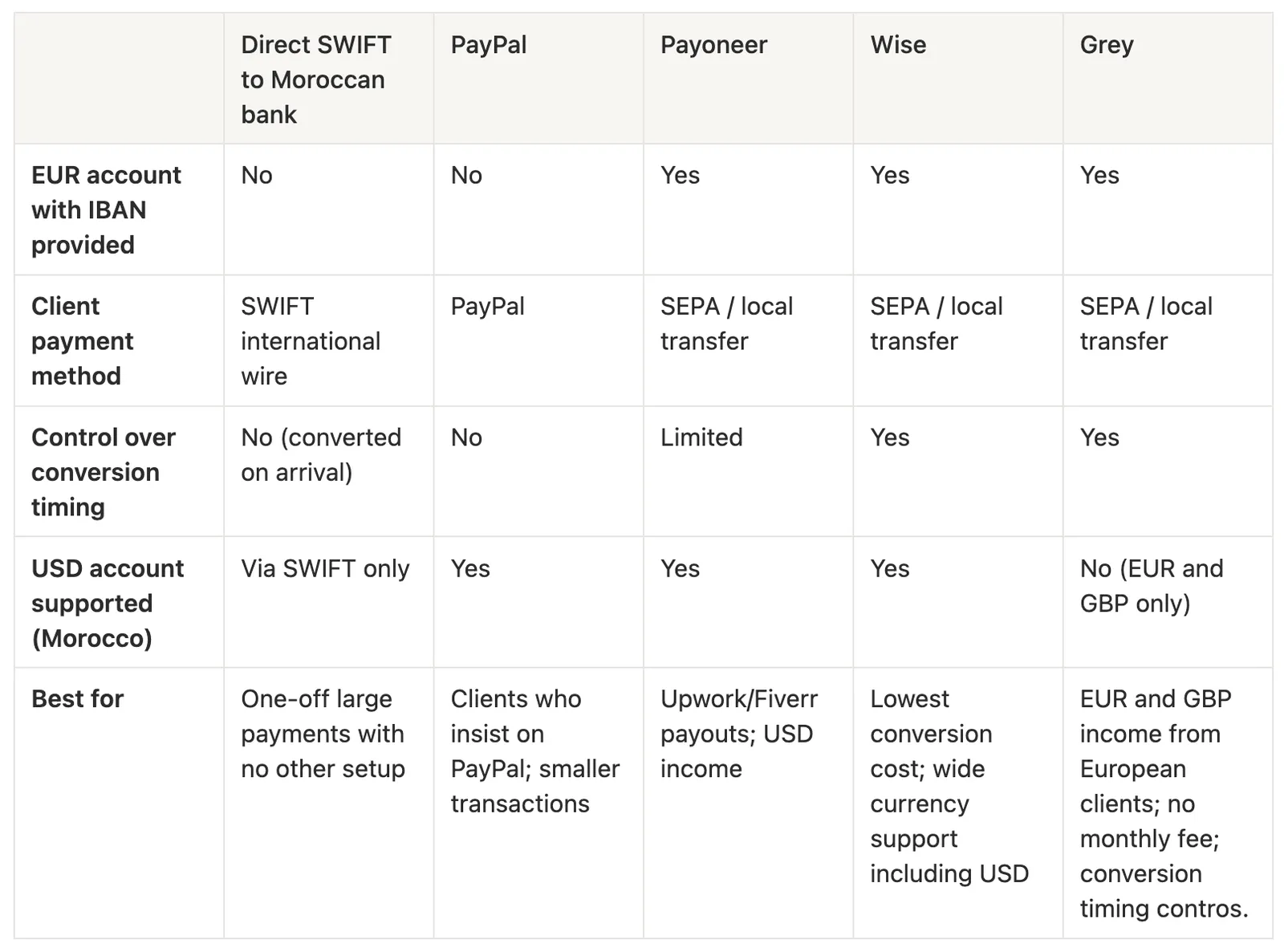
Comparison table: USD virtual card options for Moroccan users
How does the Grey virtual card work for Moroccan users
When you open a Grey account as a Moroccan user, you get access to a EUR account with a SEPA IBAN, a GBP account with a UK sort code, and you can also create a virtual USD card for spending.
The flow for most Moroccan freelancers looks like this: a European client pays €1,000 via SEPA to your Grey EUR IBAN. The money is credited to your EUR balance. When you use your Grey virtual card, it pulls from your available balance, although a 1% conversion fee (capped at $6) applies.
You can use the card to pay for AWS, Google Ads, Figma, ChatGPT Plus, or any other USD-billed platform.
The Grey virtual card works on any platform accepting Visa and can be added to Apple Pay or Google Pay. It is not subject to Morocco’s Office des Changes annual spending limits because it is issued by a non-Moroccan provider and denominated in USD from a foreign-held balance.
For spending in non-USD currencies on the USD card, a 2% cross-border fee plus $0.50 applies. For USD-billed platforms, which cover the majority of professional tools, no cross-border fee applies.
You can also withdraw MAD from your Grey account when you need local currency.
Create an account with your email address and a secure password
Complete KYC verification: upload a valid government-issued ID (passport or national identity card), proof of residence, and a photo
Once verified, request your EUR account to receive your SEPA IBAN
Fund your account via SEPA transfer
Navigate to the Cards section in the Grey app and select “Get started”
Pay the one-time card creation fee and follow the prompts
Your virtual USD card will be issued instantly with card number, expiry, and CVV ready to use
The bottom line
The Casablanca developer whose AWS billing kept getting declined isn’t facing an unsolvable problem, it’s just a gap between Morocco’s banking infrastructure and the USD-denominated platforms the global professional world runs on. That gap has straightforward solutions, and two of them, Grey and Payoneer, come from regulated providers with transparent fee structures and proper fund protection.
The key distinctions come down to what you need the card for. If you want a virtual USD card alongside EUR and GBP receiving accounts from a single platform, and you want it linked to Apple Pay and Google Pay, Grey covers that. If you’re already on Payoneer through a marketplace like Upwork or Fiverr and have an existing balance, the Payoneer card is the most frictionless addition. If you’re comfortable with crypto and need something quickly without a full account setup, VCCMaroc fills that gap.
Why does my Moroccan bank card get declined on international platforms? Many Moroccan banks block foreign charges by default, and Morocco's Office des Changes limits how much residents can spend abroad annually. Even when international use is activated, some platforms specifically decline MAD-denominated cards for USD billing. A USD virtual card from a non-Moroccan provider bypasses these restrictions because it is denominated in USD and issued outside Morocco's banking system. Exchangerates
Is the Wise card available for Moroccan residents? No. The Wise Multi-Currency Card is not available for residents of Morocco. Wise supports money transfers to Morocco and account services for Moroccan users, but cannot issue a card to someone with a Moroccan residential address. Grey and Payoneer are the two regulated international alternatives offering virtual cards to Moroccan residents. RemitAnalyst
How do I fund a Grey virtual USD card from Morocco? You fund the card from a USD balance in your Grey account. To build a USD balance, receive EUR from European clients via SEPA to your Grey EUR IBAN, then convert to USD at a rate shown before you confirm (1% fee, capped at $6). You can also deposit via USDC. Once you have a USD balance, fund the card directly from the Grey app.
Can I use a Grey virtual card for Facebook Ads and Google Ads from Morocco? Yes. Grey's virtual card works on any platform that accepts Mastercard for international payments. Facebook Ads and Google Ads both accept Mastercard. Because the card is issued by a non-Moroccan provider in USD, it is not subject to the Office des Changes restrictions that cause Moroccan bank cards to fail on advertising platforms.
What happens if my virtual card is compromised? With Grey, you can freeze or delete the card instantly from the app. Because the card is separate from your main Grey balance, a compromised card doesn't expose your full account balance. You create a new card if needed. This compartmentalised approach is one of the primary security advantages of virtual cards over physical bank cards.
Does Payoneer offer a virtual card to Moroccan users? Yes. Payoneer's virtual card supports Mastercard and can be used for online purchases on most international platforms. However, you must receive a minimum of $100 into your Payoneer account before qualifying for card access. For new users without prior Payoneer income, Grey is the more immediately accessible option since card access is available after KYC verification, not after a minimum receipt threshold.
Grey charges fees on deposits, conversions, and withdrawals. Deposits via SEPA incur a 0.8% fee (minimum €2, maximum €10). Currency conversions are charged at 1%, capped at $6. Withdrawal fees: 0.5% for EUR (minimum €2, maximum €10). Virtual card creation: $5 one-time fee, no monthly fee. Cross-border card transactions (non-USD purchases on USD card) incur a 2% fee plus $0.50. Exchange rates are variable and include a margin over the mid-market rate. Grey does not currently support USD receiving accounts for Moroccan users. Always review fees and current product availability at grey.co/pricing before transacting.
The global volume of cross-border payments is increasing, driven by international students, freelancers with foreign clients, expatriates, digital nomads, and frequent travellers. While fintechs frequently enter the market touting unique selling points, true competitive advantage demands more than differentiated features alone.
The traditional payment options were riddled with hidden fees, markups on exchange rates, and uncertain processing speed, leading to a lack of trust. These downsides contribute to the popularity of cross-border payment solutions. Amidst this competition, a standout feature to consider is transparency. Transparency fosters trust and can be a competitive advantage in cross-border payments.
Transparency in cross-border payments covers several aspects. It requires disclosing transaction fees, exchange rates, and other charges before transactions. It also means allowing users to track payments and ensuring that data collection and privacy are managed securely.
Fintechs and payment platforms now see transparency as both a regulatory requirement and a competitive differentiator. Key transparency aspects include:
Transaction costs: Many traditional banks and exchange houses add mark-ups to foreign exchange rates or embed hidden charges within transfers. This affects financial planning and can be frustrating for users.
Payment processing speed: Users need clear payment timelines. Uncertainty hurts businesses and freelancers who depend on prompt payments. Communicating transfer durations helps users plan.
Fair exchange rates: Transparent providers display the mid-market rate and their fees upfront, so users know exactly how much will arrive. When this isn’t clear, users may feel exploited.
How transparency is a competitive edge
Customers want control and confidence when managing their money. Transparency enables users to make informed decisions and fosters trust between users and payment platforms. Here are the benefits of transparency and how it gives a competitive edge.
Builds trust and loyalty
Transparency fosters trust, a crucial aspect in finance. People won’t commit funds to your care if they cannot trust you with them. When users know exactly what they’re paying for and why, they are more likely to be satisfied. This trust translates into loyalty and referrals.
Creates fewer disputes
Transparency enables businesses to manage their cash flow more effectively by providing users with clear information, reducing the likelihood of disputes and support queries. Enhances fraud prevention and security:
Enhances fraud prevention and security:
Transparency in processes includes transaction monitoring, clear documentation, and adherence to anti-money laundering (AML) and Know Your Customer (KYC) regulations. These measures significantly prevent fraud and build confidence. Real-time monitoring also helps identify and address suspicious activities promptly.
Promotes economic growth
Transparent payments support economic growth by facilitating cross-border trade and remittances. When transactions are faster and cheaper, businesses can expand globally. Families in developing nations benefit significantly from remittances, which in turn improve the local economy.
Grey: Seamless cross-border payments with transparency
By prioritising transparent practices, payment providers meet regulatory demands and gain a competitive edge. Transparency builds trust, reduces costs, and fosters stronger, more lasting relationships. Grey exemplifies transparency by being upfront with fees and offering competitive exchange rates without markups. Users enjoy swift transactions and monitor payment processes on their dashboard. Grey is regulated by leading regulatory agencies – FinCEN and FiNTRAC, and complies with anti-money laundering and counter-terrorism financing policies. Users’ data and funds are protected by layers of encryption, conferring robust security.
It used to be simple: after a month of commuting to work, you got paid, walked into your local bank to withdraw cash, and that was it. But simple isn’t always better. Remote work has introduced new layers to how people work and, by extension, how they get paid. My product designer friend in Lagos works for a digital marketing agency in Manchester. Not long ago, the closest connection someone in Lagos might have had with Manchester was cheering for the Red Devils on a Saturday afternoon.
This shift has created both opportunity and complexity. Freelancers and remote workers are no longer limited by geography. However, navigating payments across borders can be difficult, with hidden fees, unpredictable exchange rates, and shifting regulations being the most common issues. Instead of getting stuck, many are finding smarter ways to adapt by rethinking how they invoice, where they store their money, and which tools they trust to get paid.
In this article, I’ll explain how freelancers and remote workers are responding to these global payment trends and what lessons you can learn to help you keep more of what you earn.
Work is no longer tied to one office, city, or country. Remote work has completely changed how people, including me, see work. For example, I started writing this article in one city and completed it a few days later in another after getting some inspiration. A couple of years ago, I would have had to write the entire article crouched behind a desktop monitor in a tie that took me seven tries to knot.
This global reach has helped provide freelancers with new opportunities, resulting in more clients who often pay in foreign currency. While all of this is great, the question of how you get paid remains. And even more importantly, adapting to different payment trends.
What are the key global payment trends shaping 2025
Here are the biggest shifts happening in global payments right now:
1. Digital wallets and multi-currency accounts
Instead of relying on old-school bank transfers, freelancers are opening accounts in multiple currencies, with USD, GBP, and EUR accounts being the most common. Fintech platforms like Grey help with this. This makes receiving payments directly and converting them to local currencies at fair rates easier.
2. Stablecoins and crypto adoption
Stablecoins like USDT and USDC have become important payment alternatives for many freelancers. They’re faster than bank wires and often cheaper. The slight problem with them is the regulations. Government laws on crypto keep changing, and freelancers must always be updated.
3. Direct payouts from platforms
YouTube, Meta, Upwork, and Fiverr now allow creators and freelancers to get paid directly in dollars. This bypasses messy intermediaries but still requires the proper account setup to use the funds locally.
4. Fewer traditional bank transfers
Wire transfers are slowly becoming a last resort. High fees, long waits, and unpredictable FX rates have pushed freelancers toward faster, more transparent options. However, huge corporations still depend heavily on them, so they definitely still have their uses.
5. Compliance and regulation
Governments are paying more attention to cross-border payments. Freelancers must be aware of tax laws, anti-money laundering rules, and changing regulations in both their country and their clients’.
So, what does this all look like on the ground? Here’s how freelancers and remote workers are responding:
Diversifying payment channels: Instead of relying on one method, many freelancers use a mix of multicurrency fintech platforms and stablecoins, so if one fails, they have a backup.
Protecting income in stronger currencies: Freelancers avoid the worst of local currency depreciation by holding earnings in USD, GBP or EUR.
Budgeting in FX and local currency: Many freelancers now plan their finances in two layers: stable global earnings + everyday local expenses.
Becoming payment literate: Freelancers are actively learning how platform payout rules work, their fees, and actively comparing FX rates before converting.
LDMAG1
Do freelancers still face challenges?
Of course, it’s not all smooth sailing. Freelancers still deal with:
High conversion fees and hidden charges that reduce their pay.
Delays in payouts that disrupt cash flow.
Limited access to foreign accounts in some countries.
Time zones and cultural differences sometimes affect payment timelines.
Even with better tools, navigating these challenges takes patience and strategy.
Why smarter tools are the future
The future of freelance payments is one that’s benchmarked on simplicity and control. Instead of juggling multiple accounts, payment apps, and P2P trades, freelancers are turning to platforms designed for their reality.
Grey is perfect for this. With Grey, freelancers and remote workers can:
Open USD, GBP, and EUR accounts in minutes with their local address.
Receive payments directly from clients or platforms.
Convert to local currency at competitive rates.
Withdraw instantly into their bank or mobile money account.
It’s fast, transparent, and built for freelancers who want to focus on work.
Adapting means thriving
Global payments are evolving quickly, and freelancers who adapt will thrive. You must learn to negotiate smarter and switch to tools that keep more money in your pocket. Your payment strategy is just as important as your skillset.
If you’re reading this… no, it’s not too late. You just want to learn more about USDC and how it works in Nigeria. Some of you may already be familiar with the basics, but I won’t assume.
So we’ll start at the beginning, what USDC is, its relevance to Nigerians, and how to make the most of it.
What is USDC?
USDC is a stablecoin issued by Circle, backed one-for-one by US dollars. This 1:1 peg makes it useful for people who need to receive payments in US dollars but don't have access to a US bank account.
It’s a practical way to get paid by international clients, protect earnings from naira volatility, and move money faster than some traditional routes. But the “how” is what trips people up as networks, fees, exchanges, and local rules all complicate things. I’ll walk you through the realistic options I use (and why), show step-by-step processes, and flag the risks so you don’t learn the hard way like I did.
What are the options for converting USDC into naira?
I’m breaking this into two practical routes I’ve used or seen work reliably:
Fintechs/modern accounts that accept USDC and convert
Major exchanges and P2P
So we’ll go through these options one by one.
1. Use a digital platform that accepts USDC and can convert to naira for you
Anyone can convert USDC to naira without having to deal with on-exchange trading or P2P buyers. You can receive USDC directly and convert it instantly into a USD bank balance or a local currency in-app. That removes extra steps and reduces exposure to price swings during conversion.
So how exactly does converting USDC to naira work?
You give the sender the wallet address provided by the fintech (USDC on a supported network).
Sender moves USDC to that address.
Fintech receives USDC, converts it to USD or local currency in your account.
You withdraw to your Nigerian bank or mobile wallet.
Africhange Africhange has interesting crypto-friendly rails. It allows users to fund their accounts with USDC and has USD virtual accounts. This makes it easy to convert USDC into USD or local currency. I like that they combine crypto access with fiat payout options, providing users with flexibility.
Breet Breet is solid for people who already deal with crypto. You can generate a wallet address for USDC, and when you receive coins, the app detects the transaction and converts it to naira.
Cryptonia Cryptonia, as a platform, is focused on crypto trades. When you receive USDC or USDT, the platform converts it, and you can withdraw your NGN. Many users like the conversion speed, although the payout to the bank depends on local banking processes. It feels more “exchange-first” than casual wallet use.
Grey Grey offers direct USDC receipt and conversion into a USD account. You can receive USDC payments, convert or hold them, and finally withdraw to your local Nigerian bank or mobile wallet. The conversion rates are transparent, and you can see exactly how much you’ll receive before making a withdrawal. It offers smoother payouts than most P2P or exchange-heavy paths. Many freelancers I know prefer Grey for consistency and reliability.
2. Sell USDC on a major exchange or P2P marketplace
There are two common sub-routes: centralised exchange and P2P marketplaces.
Centralised exchange
Deposit USDC into an exchange that supports NGN trading pairs or easy payout rails.
Sell for NGN (if NGN pair exists) or route to P2P on the same platform.
Withdraw Naira to your bank or mobile wallet.
Many global exchanges let you trade USDC for other stablecoins or fiat, but direct withdrawal to a Nigerian bank can be limited by local rails; that’s why P2P often follows. Also, be sure to check the exchange’s withdrawal options before making a deposit.
P2P marketplaces
P2P platforms like Bybit can let you post an ad to sell USDC for NGN. Buyers deposit NGN into your bank account or a specified payment method, and escrow releases USDC upon payment confirmation. This is how many Nigerians obtain naira without a direct bank transfer. You should also use the built-in escrow if available and follow the platform’s instructions to stay safe.
Check the network: Ask the sender which network they’ll use (e.g., Polygon, Solana, ERC-20). Confirm your receiving wallet or platform supports that network, as mismatched networks can cause irreversible loss.
Choose a platform: I always use a reputable exchange with P2P functionality, such as Bybit, or a fintech that accepts USDC. Create and verify your account (KYC is required).
Deposit USDC to the platform wallet: Copy the deposit address carefully. Always double-check the network. Sometimes I send a small test amount first just to be extra sure.
Create a sell order on P2P: Set your price, preferred bank/payment method, and wait for a buyer.
Complete the trade using escrow: Confirm the buyer has paid into your bank account; then confirm on the P2P platform to release USDC from escrow.
Withdraw: You can now withdraw NGN to your Nigerian bank account or mobile wallet.
Why I use P2P sometimes: It’s flexible and widely used in Nigeria when direct bank rails aren’t available. You can find buyers quickly and often get competitive rates.
There’s no single perfect path. It depends on how hands-on you want to be, how quickly you need your cash, and how comfortable you are with cryptocurrency and peer-to-peer transactions. For many people, a mix works best: channel larger amounts through a trusted fintech that accepts USDC for simplicity, and use P2P for occasional top-ups when rates are favourable.
If you want a low-friction starting point to test the idea, Grey helps you receive USDC and convert it within one app. However, whichever route you choose, remember that safety is the most important thing.
Invoicing is a crucial part of freelancing or managing a business. Disclosing payment terms clearly avoids payment delays, builds trust, and prevents disputes. Net 30 is one of the most common payment terms you will see on invoices as a freelancer and business owner.
Net 30 is a payment term that means the full invoice amount is due 30 days from the invoice date, not from when the work was completed. It is the most common B2B payment term in the US. A "2/10 net 30" variation offers a 2% early payment discount if paid within 10 days, with the full amount due in 30 days otherwise.
Whether you're a freelancer sending your first invoice, a small business setting payment terms, or a client trying to understand what "net 30" means, this guide explains how it works, how it compares with other payment terms like net 15 and net 60, and when you should use it. You'll also learn how to follow up on overdue invoices and get international clients to pay more efficiently.
What does net 30 mean on an invoice?
"Net 30" means the full amount on the invoice is due within 30 calendar days of the invoice date.
The word "net" refers to the total amount owed, with no deductions. So "net 30" simply means: pay the full amount within 30 days. But there are a few other things that confuse people, and we need to clarify them.
The countdown starts from the invoice date, not the delivery date. If you complete work on 1 June but send the invoice on 5 June, the 30 days run from 5 June, making the due date 5 July.
Net 30 counts calendar days, not business days. Weekends and public holidays count. A 30-day period always means 30 full days.
Until the client agrees to the payment terms (either in a contract or by accepting the invoice), net 30 is still a request. So, it is better to add the payment terms in the contract your client signs before commencing the work. This way, you are not just springing it on the client after the job is done.
Net 30 invoice example
Here is a Net 30 invoice example:
Field
Example
Invoice number
INV-047
Invoice date
1 July 2026
Payment due date
31 July 2026
Payment terms
Net 30
Amount due
USD 2,500
You can also offer early-payment incentives to clients who pay sooner.
For example, you can use the "2/10 Net 30" format, which means:
If the client pays within 10 days, they get a 2% discount (so they pay $2,450 instead of $2,500)
If the client pays between 11 and 30 days, they pay the full $2,500
If the client pays after 30 days, they will pay the full amount ($2,500) plus any late fee specified in the contract.
This format gives clients an incentive to pay early, helping your cash flow without shortening your standard terms beyond what the client expects.
Net 30 vs Net 60: which is better?
When you send an invoice, the payment terms you choose directly affect how quickly you get paid and how healthy your cash flow remains. Two of the most common options are net 30 and net 60. Understanding the difference between them helps you decide which one works better for your business.
Net 30 means the client has 30 days from the invoice date to pay the full amount.
Net 60 means the client has 60 days from the invoice date to pay the full amount
The right payment terms depend on who you are working with and what you can afford to wait for. Here is a quick comparison of net 30 vs net 60:
Feature
Net 30
Net 60
Payment timeline
30 calendar days from invoice
60 calendar days from invoice
Common with
Small to mid-size businesses, freelancers
Large enterprises, government contracts
Benefit to seller
Faster cash flow
May be required to win large clients
Benefit to buyer
More time to process payment
Aligns with longer internal payment cycles
Risk to seller
Client may still pay late
Two months without payment can affect cash flow
Advantages of Net 30
Better cash flow: You receive money sooner, which makes it easier to pay your own bills, suppliers, or team.
Lower risk: The shorter the payment window, the lower the chance the client will delay or fail to pay.
Easier to manage: You can follow up quickly if payment is late, and you spend less time chasing invoices.
Stronger position: Offering Net 30 shows you value prompt payment and helps set professional expectations from the start.
Disadvantages of Net 30
Some larger companies may push back and ask for longer terms.
You might lose a deal if a client insists on Net 60 or longer.
It can feel stricter to new or long-term clients who are used to more generous terms.
Advantages of Net 60
Attracts bigger clients: Many corporations and agencies prefer net 60 (or even net 90) because they have more complex payout systems and bureaucracy
Can help win contracts: Offering longer terms can make your proposal more competitive when bidding against other freelancers or agencies.
Builds goodwill: Some clients appreciate the flexibility and may be more likely to give you repeat work.
Disadvantages of Net 60
Your money is tied up for two months, which can create cash flow problems.
Higher risk of late or missed payments.
You may need to use personal savings, a line of credit, or invoice financing to cover expenses while waiting.
Following up on overdue invoices becomes more common and time-consuming.
Choosing between Net 30 and Net 60
Net 30 is usually better for most freelancers, independent contractors, and small businesses. It protects your cash flow and reduces the risk of waiting too long for payment.
Net 60 can be better in these situations:
You work mainly with large corporations that have strict payment policies.
The project value is high enough that you can afford to wait 60 days.
You have strong cash reserves or access to short-term financing.
The client is reliable and has a proven track record of paying on time.
Before you decide what’s right for you, ask yourself these questions:
How important is quick cash flow to my business right now?
Do most of my clients prefer longer payment terms?
Can I comfortably wait 60 days without financial stress?
Am I willing to risk delayed payments for the chance of winning bigger contracts?
How to set payment terms on a freelance invoice
For most freelancers, net 30 is the industry default. But that does not mean it has to be your default, too. See our freelance contract guide for how to build payment terms into a contract before starting work.
Here is a practical guide that can help you structure your payment terms:
New clients, small projects: Net 14. You do not yet know this client. Opting for a shorter payment term reduces the risk of the client defaulting on payment.
Ongoing relationships, mid-size projects: Use Net 30 for mid-range projects or where you have built a strong relationship with the client. It is standard and widely accepted.
Large enterprise clients: Net 30 to 60, depending on the contract value and how important the relationship is.
What happens when the client does not pay within the stipulated timeframe? In reality, most clients will honour payment terms. But there are times when the client fails to hold their side of the bargain. This is where late fees come in, and why you should have disclosed it from the beginning. It is not a mere threat. It is a guiding principle that ensures the client remains compliant.
Late payment fees are extra charges you add when a client pays after the due date. They encourage on-time payment and help cover the cost of chasing overdue invoices. This fee can be a percentage of the unpaid invoice (e.g., 1.5% or 2% per month), a flat fee (e.g., $25 or $50 per overdue invoice), or a combination (e.g., $20 + 1.5% per month).
Here is an example of how you can phrase the late payment fees on the contract and invoice:
“Payment is due within 30 days of the invoice date (net 30). A late fee of 1.5% per month (or the maximum allowed by law) will be applied to any overdue balance.”
Late fee rules differ by country and sometimes by state. In some places, there are legal limits on the percentage you can charge. Make sure your fee is reasonable and enforceable. You can also give a short grace period (e.g., 3–5 days) before applying the fee if you want to stay flexible. Send a polite reminder a few days before or right after the due date, before adding the fee.
Requesting a deposit on new projects
Asking for a deposit before starting work is one of the best ways to protect your time and cash flow. It confirms the client is serious and gives you money upfront to cover early costs. This amount typically depends on the project type and size. Here is a quick guide:
Small projects: 30–50%
Medium projects: 40–50%
Large or long-term projects: 30–50% (better divided into milestones)
New or untested clients: 50%
Trusted repeat clients: 20–30% or none
Don’t be sceptical about asking for a deposit from a new client. It is standard practice, and most professional clients would expect it. Include the deposit requirement in both your proposal and contract. Examples:
“A 50% deposit is required to begin the project. The remaining 50% is due upon completion.”
“Work will commence once the initial 40% deposit has been received.”
“Payment schedule: 50% upfront, 50% on final delivery.”
On the invoice, label it clearly as “Project Deposit – 50%” so there is no confusion.
What to do when a client misses a net 30 deadline
Missing a payment deadline does not always mean a client is acting in bad faith. There might be a lot more going on behind the scenes. Clients can misplace invoices or forget about them. Bigger corporations might require sign-offs from various approvals, which can cause delays. Some might even have specified periods for processing payments, which might fall outside your payment terms.
However, while you want to be understanding and preserve the relationship with the client, you must also ensure you protect your cash flow. So, here are some tips on what to do when a client misses a net 30 deadline or any other payment terms.
Day 31 (due date passed): Send a friendly reminder.
"Hi [Name], just following up on invoice INV-047 for USD 2,500, due on 31 July. Please let me know if you need anything from my side to process this. Happy to resend the invoice if helpful."
Day 33-Day35 (3-5 days overdue): Follow up again, slightly more direct.
"Hi [Name], I wanted to follow up again on invoice INV-047, now 5 days overdue. Is there anything holding up the payment on your end? I am happy to jump on a quick call if useful."
Day 37 ( 7 days overdue): Apply the late fee and state it clearly.
"Hi [Name], invoice INV-047 is now 15 days overdue. As per our agreed payment terms, a late payment fee of 1.5% is now being applied. The updated total is USD 2,537.50. Please arrange payment at your earliest convenience."
Day 60 and beyond
If payment has still not arrived, escalate. Options include: involving a collections agency, pursuing the matter through small claims court, or engaging a solicitor (UK) or lawyer (US) to send a formal demand letter. At this point, it is fine to sacrifice the relationship to get your money.
How to get paid faster than net 30
Net 30 is standard, but that does not mean you have to wait an entire month for every payment.
Require deposits: A 50% deposit means you have real money in before you invest significant time. The client who pays a deposit is also less likely to disappear before the final invoice.
Use milestones: For larger projects, break payments into stages: 40% deposit to start, 30% at the midpoint, and 30% on final delivery. This way, you receive money throughout the project instead of waiting until the very end.
Offer early payment discounts: A 2% discount for paying within 10 days (2/10 net 30) is a good incentive for most clients looking to save money.
Send invoices immediately after you finish the project. Don’t wait. Send the invoice the same day the work is finished or the milestone is reached. The payment clock starts only when the invoice is issued.
Use faster payment methods: Clients are more likely to pay quickly when they can use familiar local payment methods instead of expensive international wire transfers.
If you work with overseas clients, giving them local bank details can significantly reduce payment delays. Instead of sending an international wire, a US client can pay you via ACH, a UK client via Faster Payments, and a European client via SEPA. These domestic payment networks are typically faster, cheaper, and avoid the correspondent bank fees often associated with SWIFT transfers.
Open a multi-currency account with Grey and give international clients local payment details in USD, GBP, or EUR. This makes it easier for international clients to pay you using their local banking system. Payments arrive without correspondent bank deductions, and you can manage multiple currencies from one account before converting when needed. Grey’s invoicing to receive international payments from multiple clients and currencies in one place.
The net 30 period starts on the invoice date, not the date the work was completed or delivered. If you issue an invoice on 1 July, the payment is due by 31 July. This is why it is important to send invoices promptly after completing work.
Is net 30 calendar days or business days?
Net 30 is calendar days unless you explicitly state otherwise on the invoice. Weekends and public holidays count. If the due date falls on a weekend or holiday, it is common practice to treat the next business day as the effective due date, though this is worth specifying if it matters to you.
What happens if I cannot pay a net 30 invoice on time?
Contact the supplier before the due date, not after. Most businesses are willing to arrange a short extension if you communicate proactively. Waiting until after the deadline without notice is more likely to trigger late fees and damage the relationship.
Can I charge a late fee on a net 30 invoice?
Yes, if late fees are included in your payment terms and either agreed in a signed contract or printed on the invoice, the client has accepted. The fee must be stated clearly before the work begins. Retroactively adding a late fee to terms that were not originally agreed upon is not enforceable.
What is the difference between net 30 and due on receipt?
"Due on receipt" means payment is expected immediately when the client receives the invoice, or within a very short window, such as 24 to 48 hours. Net 30 gives the client 30 days. Due on receipt is sometimes used for small one-off transactions or when working with new clients, where you want faster payment.
How can international clients pay me faster?
Provide international clients with local payment details in their own country. A US client with a US routing number and account number can pay via ACH, which settles in one to three business days with no fees on their side. A UK client with a sort code and account number pays via Faster Payments, which settles within hours. Grey provides both account types alongside EUR IBANs from a single multi-currency account.
Freelancers live for creativity. You sit down to create, ideas flowing, momentum building, then suddenly you remember that invoice you haven’t sent, or that overdue client payment. Just like that, the spark fizzles.
Bad financial admin essentially hijacks your creativity. That’s why you need to manage it well, to give you more time to focus on creativity.
Before writing this article, I conducted a thorough study to determine what freelancers find most difficult. One of the most common answers was “sorting out finances.” Okay, looking back now, maybe asking a couple of my freelancer friends shouldn’t count as a “thorough study,” but you get the point.
You can also try it. Ask any freelancer what they dread most, and chances are “chasing payments” will rank near the top. Add in tracking expenses, converting currencies, and worrying about tax season, and you’ve got a recipe for constant distraction.
Switching between “creative brain” and “spreadsheet brain” is exhausting. Every time you break focus to send a reminder email or check an exchange rate, you lose momentum. That lost flow is harder to get back than the admin was worth.
Creativity thrives on freedom, exploration, and uninterrupted focus. Admin is its opposite: rigid, repetitive, and structured. Trying to balance the two can be a problem.
The problem isn’t that admin exists, it’s that it constantly interrupts the creative process. And the more interruptions, the less space your brain has to experiment, imagine, and innovate.
The real cost for freelancers
When admin creeps into your creative hours, three things happen:
Lost time: Hours spent sending invoices or calculating fees are not spent creating or earning.
Lost money: Late payments, hidden transaction fees, or missed deductions quietly reduce your income.
Lost opportunities: Stress kills creativity. The more admin weighs you down, the harder it is to produce your best work, leading to burnout.
Your creativity is your biggest asset as a freelancer. The goal isn’t to eliminate financial admin — that’s impossible — but to manage it in a way that lets your creativity thrive.
Because at the end of the day, clients don’t hire you for your invoicing skills. They hire you for the fresh ideas, the bold designs, and the creative spark that only you can bring. Don’t let financial admin snuff that out.
With Grey, you can open multi-currency accounts, have instant conversions, and enjoy stress-free payments. We take the admin off your plate so you can focus on what you do best, creating.
There’s no mistaking the near-superhuman stunts that have become a staple in many Bollywood movies. Many of these movies thrive on characters who play larger-than-life heroes and I can never seem to get enough of them. But away from the big screen, many Indian freelancers are pulling off their own kind of superhuman feats by pushing boundaries as software engineers, writers, and designers. And they are showing no signs of slowing down.
A small cog in this wheel is managing currency risks. Exchange rates, conversion fees, and fluctuating currencies can quietly reduce your hard-earned money.
I know you’d rather be designing logos or writing copy than obsessively checking “USD to INR rate today.” But tackling currency risk is essential if you want your freelancing career abroad to be sustainable.
Why do Indian freelancers need to know about currency risks?
The thing about freelancing is that your income is already unpredictable, up and down like a toddler on a trampoline. Adding currency fluctuations on top of that could make basic planning very difficult. For example, if the dollar drops against the rupee right after you’ve been paid, your actual income in INR shrinks, even though you did the same work.
And it’s not just the exchange rate. Payment platforms and banks often charge high fees or use unfair conversion rates. Those hidden cuts can hurt when you’re living from invoice to invoice. I’ll be teaching you how to maximise your earnings.
Smart ways to protect your earnings as an Indian freelancer
Now, I’m not saying you need to turn into a forex trader, but there are some practical steps you can take to keep more of what you earn:
1. Hold payments in foreign currency for a while
Instead of converting everything immediately, consider keeping some of your money in USD or EUR. This gives you flexibility, especially if you expect the exchange rate to improve later.
2. Use the right platforms
Some platforms charge sky-high conversion fees, while others let you receive in foreign currency and withdraw when it suits you. Grey enables you to open USD, GBP, or EUR accounts from India and send to your local bank account when you’re ready.
3. Plan your withdrawals
If you know you’ll need INR at a specific time (like rent or bills), plan your conversions around that. This way, you won’t be forced to convert at a terrible rate.
4. Diversify your client base
If all your clients pay you in one currency, you’re more exposed to swings. Working with a mix of US, UK, and European clients spreads the risk out a bit.
At the end of the day, freelancing is supposed to give you freedom: freedom to choose your projects, your clients and your working hours. But that freedom can quickly feel restricted if you constantly worry about how much you’ll take home after fees and exchange rates.
The goal isn’t to eliminate currency risk entirely (you can’t), but to manage it in a way that doesn’t leave you broke or anxious. With the right tools and some planning, you can make sure the money you earn abroad actually works for you here in India.
So focus on your craft, pitch those clients abroad, and let smart money management do the heavy lifting in the background.