

Paying international contractors at scale can quickly become complex. Between different banking systems, currencies, compliance requirements, and rising transfer costs, what starts as a simple payment process can turn into an operational bottleneck.
Today, many companies are rethinking how they run bulk payouts, moving away from manual wires and toward more structured, cost-efficient systems that work across borders without friction.
Also read: How to choose a cross-border payments platform you can trust
Why traditional bulk payouts break at scale
Sending individual wire transfers to contractors in different countries is expensive and difficult to manage.
1. High transaction costs
Sending multiple wire transfers individually adds up quickly. Each payment can carry $20–$50 in fees, making bulk payouts extremely expensive for companies managing hundreds or thousands of international contractors.
2. Slow processing times
Traditional wire transfers often take 2–5 business days to complete. When managing large teams across different countries, delays can disrupt operations, project timelines, and contractor satisfaction.
3. Complex management
Handling multiple accounts, currencies, and intermediaries increases administrative burden. Finance teams must track each transaction manually, reconcile payments, and resolve errors, making scaling payouts cumbersome and error-prone.
How modern bulk payout systems transform payment
Modern payout systems centralise and automate the process. Instead of sending separate wires, companies fund a single account and distribute payments programmatically.
Here’s how it typically works:
- The company uploads a payout list (contractor details, amounts, currencies).
- Funds are deposited once into a payout platform.
- Payments are routed locally, via ACH in the US, SEPA in Europe, or equivalent local rails elsewhere.
- Contractors receive funds in their local or foreign currency accounts.
Also read: Grey Business vs Grey personal banking
Key factors companies optimise for in bulk payouts
Running bulk payouts efficiently is not just about sending money; it’s about control, visibility, and cost management. Strong systems are designed around:
- Fee efficiency at scale: Reducing per-transaction costs compared to traditional wires allows companies to save money on large payouts while ensuring contractors receive more of their earnings.
- Consistent FX rates: Transparent, stable exchange rates prevent losses due to fluctuating currency margins, protecting contractor earnings and providing predictable budgeting for the finance team.
- Speed and reliability: Predictable settlement timelines across regions ensure contractors are paid on time, reducing delays, disputes, and administrative follow-ups for finance and operations teams.
- Compliance and documentation: Proper record-keeping for tax reporting, anti-money laundering, and regulatory requirements ensures that payouts are legally compliant and auditable across multiple countries.
- Automation: API integrations or dashboard workflows minimise manual intervention, reduce errors, streamline reconciliation, and allow finance teams to manage bulk payments efficiently at scale.
Platforms to simplify international bulk payments
Grey
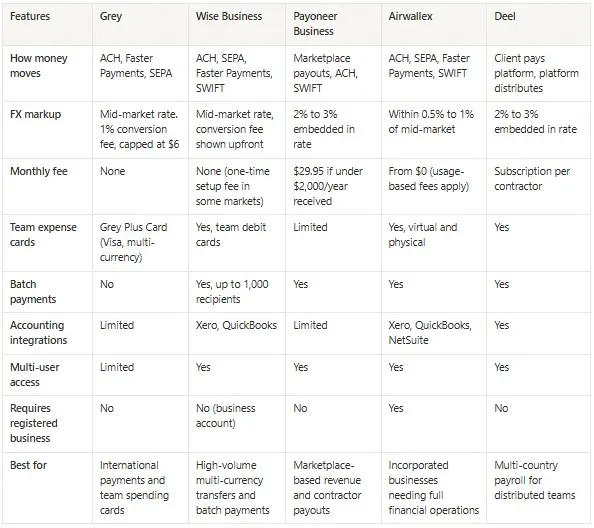
Grey Business allows companies to send mass payments in USD effortlessly. Using the “Bulk upload” feature, you can upload a simple CSV file containing multiple recipients and process all payments simultaneously. Transfers settle in 1–3 business days, with fees at 0.8% per transaction (minimum $2, maximum $10). Contractors can withdraw locally at competitive rates, and virtual USD cards enable direct online payments. With full KYC/KYB verification and fraud monitoring, Grey Business ensures secure, fast, and compliant bulk payouts at scale.
Payoneer
Payoneer allows bulk cross-border payments to freelancers and contractors globally. ACH deposits usually settle in 2–5 business days, with fees ranging from $1–$3 per ACH or $15 per wire. FX margins are applied on currency conversions. While it integrates well with marketplaces like Amazon or Upwork, direct client payments can incur additional fees. Payoneer is best suited for businesses managing multiple freelancers or recurring payments, providing reliable, scalable, and secure international payouts.
Wise
Wise enables bulk payments in multiple currencies, using real mid-market exchange rates with transparent fees between 0.35–1% depending on destination and currency. Transfers typically reach recipients in 1–3 business days. Wise is ideal for businesses and freelancers seeking cost-effective, predictable payments without hidden margins. It supports sending to local bank accounts globally, simplifying payroll, vendor payments, or freelancer settlements while offering fast, secure, and transparent transfers with minimal administrative overhead.
Veem
Veem is tailored for international B2B payouts, supporting ACH, local bank transfers, and PayPal settlements. Transfers typically complete in 1–3 business days, with ACH fees from $0–$5 and wire fees around $10, using competitive exchange rates. Veem integrates with accounting software to simplify bookkeeping and reconciliation for businesses paying multiple vendors or contractors. Its platform ensures secure, traceable, and compliant payments, making it efficient for scaling international operations while keeping costs low and processes transparent.
Read also: 5 red flags when choosing an international payment platform.
LDMAG1
Managing bulk payment with Grey business
Modern bulk payout platforms give companies full control, transparency, and speed, while keeping costs low and FX rates competitive. By automating processes and leveraging local payment rails like ACH, businesses can scale payments globally without friction. For contractors, this means faster access to funds and more predictable earnings.
Grey simplifies global payouts by providing real US banking details, low transparent fees, fast ACH settlements, and competitive FX rates, so contractors get paid quickly, and companies save on costs. Sign up today or download the grey app to get started
.svg)