


<script type="application/ld+json" data-schema-version="grey-blog-v4"> [{"@context":"https://schema.org","@type":"BlogPosting","@id":"https://grey.co/blog/what-is-an-offshore-account#article","headline":"What is an offshore bank account? A complete guide","description":"What is an offshore bank account, how does it work, and is it legal? A plain guide to offshore and multi-currency accounts. Compare your options today.","inLanguage":"en","url":"https://grey.co/blog/what-is-an-offshore-account","mainEntityOfPage":{"@id":"https://grey.co/blog/what-is-an-offshore-account#webpage"},"datePublished":"2026-08-13T20:46:34.411Z","dateModified":"2026-08-17T09:00:00+01:00","author":{"@type":"Person","@id":"https://grey.co/authors/adeolu-titus-adekunle#person","name":"Adeolu Titus Adekunle","url":"https://grey.co/authors/adeolu-titus-adekunle","jobTitle":"Content Writer","sameAs":["https://www.linkedin.com/in/titusadeoluadekunle/"]},"publisher":{"@type":"Organization","@id":"https://grey.co/#organization","name":"Grey","url":"https://grey.co","logo":{"@type":"ImageObject","url":"https://cdn.prod.website-files.com/6360022338a81bd6fdbb1145/6564ae1077a67e39d3c491a6_Grey%20Logo%20Lockup%20Black.svg"}},"image":{"@type":"ImageObject","@id":"https://grey.co/blog/what-is-an-offshore-account#primaryimage","url":"https://cdn.prod.website-files.com/636a85d290ee58e70c17e1c0/6a7e2d19e455e9aed8d3d8be_What%20Is%20an%20Offshore%20Bank%20Account%20How%20to%20Open%20One-compressed.jpg","contentUrl":"https://cdn.prod.website-files.com/636a85d290ee58e70c17e1c0/6a7e2d19e455e9aed8d3d8be_What%20Is%20an%20Offshore%20Bank%20Account%20How%20to%20Open%20One-compressed.jpg","width":1200,"height":675}},{"@context":"https://schema.org","@type":"WebPage","@id":"https://grey.co/blog/what-is-an-offshore-account#webpage","url":"https://grey.co/blog/what-is-an-offshore-account","name":"What Is an Offshore Bank Account? Full Guide","description":"What is an offshore bank account, how does it work, and is it legal? A plain guide to offshore and multi-currency accounts. Compare your options today.","inLanguage":"en","primaryImageOfPage":{"@id":"https://grey.co/blog/what-is-an-offshore-account#primaryimage"},"breadcrumb":{"@id":"https://grey.co/blog/what-is-an-offshore-account#breadcrumb"}},{"@context":"https://schema.org","@type":"BreadcrumbList","@id":"https://grey.co/blog/what-is-an-offshore-account#breadcrumb","itemListElement":[{"@type":"ListItem","position":1,"name":"Home","item":"https://grey.co/"},{"@type":"ListItem","position":2,"name":"Blog","item":"https://grey.co/blog"},{"@type":"ListItem","position":3,"name":"What is an offshore bank account? A complete guide","item":"https://grey.co/blog/what-is-an-offshore-account"}]},{"@context":"https://schema.org","@type":"FAQPage","@id":"https://grey.co/blog/what-is-an-offshore-account#faq","mainEntity":[{"@type":"Question","name":"Is there a minimum deposit to open an offshore bank account?","acceptedAnswer":{"@type":"Answer","text":"It depends on the provider. Traditional offshore banks, particularly those serving high-net-worth clients, often require minimum deposits of $10,000 or more. Modern multi-currency fintech accounts, including Grey, typically have no minimum deposit, making them more accessible to freelancers, remote workers, and small businesses."}},{"@type":"Question","name":"Is an offshore bank account worth it?","acceptedAnswer":{"@type":"Answer","text":"If you earn, spend, or save in multiple currencies, an offshore or multi-currency account can be useful. It can reduce the need for repeated currency conversions through a domestic bank, which may become expensive over time. For most individuals, a modern multi-currency account can provide the practical benefits of offshore banking with less cost and complexity."}},{"@type":"Question","name":"Can anyone open an offshore bank account?","acceptedAnswer":{"@type":"Answer","text":"Most people can open a modern multi-currency account online if they can complete standard identity verification, usually with a government-issued ID and proof of address. Traditional offshore banks may have stricter requirements, including minimum deposits and restrictions based on nationality or country of residence."}},{"@type":"Question","name":"Is money in an offshore account taxable?","acceptedAnswer":{"@type":"Answer","text":"Yes. Income earned through an offshore or foreign account is generally taxable in your country of tax residence. Depending on your location, you may also need to declare the account even if it does not generate income. For example, US persons may have FBAR reporting requirements. Failing to declare an account when required can lead to significant penalties. This is general information, not tax advice, so speak to a qualified tax professional about your situation."}},{"@type":"Question","name":"What is the difference between an offshore account and a savings account?","acceptedAnswer":{"@type":"Answer","text":"A savings account describes the purpose of an account: holding money and potentially earning interest. An offshore account describes where the account is held: outside your home country. They are not mutually exclusive. You can have an offshore savings account or an offshore transaction account for"}}]},{"@context":"https://schema.org","@type":"DefinedTermSet","@id":"https://grey.co/blog/what-is-an-offshore-account#terms","name":"What is an offshore bank account? A complete guide glossary","hasDefinedTerm":[{"@type":"DefinedTerm","name":"offshore bank account","description":"An offshore bank account is simply a bank account held in a country other than the country you live in or are a citizen. The term originally referred to accounts in jurisdictions physically separate from major economies, such as island nations. Today, it is used more broadly for accounts held outside your home country.","inDefinedTermSet":{"@id":"https://grey.co/blog/what-is-an-offshore-account#terms"}}]}] </script>

What is an offshore bank account? A complete guide

Adeolu Titus Adekunle

TABLE OF CONTENT

SHARE THIS POST

Say the words “offshore bank account”, and most people instinctively think of a shadowy villain in a spy movie, casually wiring millions of dollars to a secret Swiss account. But this image is not quite accurate.

An offshore bank account is simply an account held in a country other than the one you live in. People use them to hold foreign currency, receive international payments, and protect savings against local currency swings. Offshore accounts are legal when declared to your tax authority. A multi-currency account offers most of the same benefits online.

So, it is not about popular culture with secrecy, tax evasion, or complex wealth structures reserved for the very rich. And this guide clarifies this by explaining what an offshore bank account actually is, how it works, whether it is legal, and how modern multi-currency accounts have made many of the practical benefits accessible to anyone.

What is an offshore bank account?

An offshore bank account is simply a bank account held in a country other than the country you live in or are a citizen. The term originally referred to accounts in jurisdictions physically separate from major economies, such as island nations. Today, it is used more broadly for accounts held outside your home country.

That makes offshore banking less mysterious than it often sounds. For example, if you live in the UK and open a bank account in Ireland, that is technically an offshore account. Similarly, if a US freelancer opens a foreign currency account with a UK-regulated fintech to receive payments from European clients, that can also be considered offshore banking.

The idea of offshore accounts as secret bank accounts comes largely from how it has been abused in the past, especially in certain jurisdictions with strict banking secrecy. But with International information-sharing agreements now in play, the secrecy has declined significantly.

Today, offshore accounts are commonly used to hold foreign currencies, manage international income, and access financial services that may not be available in someone's home country.

How do offshore bank accounts work?

An offshore account works much like a regular bank account, although there are some important differences.

  • Holding foreign currency: One of the main reasons people use offshore or foreign accounts is to hold money in another currency without converting it immediately. This can be useful if you earn in a foreign currency or expect to spend money in that currency later.
  • Receiving and sending money internationally: Many offshore accounts provide local banking details for the currency they support. For example, a USD account may provide a US routing number, while a GBP account may provide a UK sort code. Your clients, employers, or family can then send money to you as a local transfer rather than an expensive international wire.
  • Interest and account features: Some offshore accounts pay interest on your balance, although rates vary by provider and currency. Many also offer features such as debit cards, online banking, and international transfers.
  • Access: Traditional offshore bank accounts may require in-person verification, minimum deposits, or ongoing maintenance fees. Modern fintech and multi-currency accounts have made the process much easier, with many allowing you to open an account online after completing identity verification.

Are offshore accounts legal?

Yes, offshore accounts are legal, as long as you follow the tax and reporting rules that apply in your country. Simply keeping money in a foreign account is not illegal in itself. What matters is whether you accurately declare that account and any income earned from it to your relevant tax authority.

Many countries participate in international information-sharing frameworks, including the OECD's Common Reporting Standard (CRS). US citizens and residents are also subject to the Foreign Account Tax Compliance Act (FATCA).

These rules mean foreign banks may be required to report information about foreign account holders to the relevant tax authorities. US citizens and residents with foreign accounts above certain thresholds may also need to file a Foreign Bank Account Report (FBAR) with FinCEN and report foreign income on their tax return.

In other words, the legal issue is usually not having an offshore account. It is failing to declare it when required.

This is general information, not tax or legal advice; consult a qualified tax professional for guidance specific to your situation and jurisdiction.

Who should consider an offshore or multi-currency account?

An account outside your home country can be useful for several groups of people.

  • Expats and people living abroad: If you live in one country but earn money, own assets, or plan to retire in another, an offshore or foreign account can make managing money across both countries easier and reduce unnecessary currency conversions.
  • Freelancers and remote workers with foreign clients: Receiving payments in your client's currency through local banking details can help you avoid international wire fees and repeated currency conversions.
  • Savers dealing with local currency volatility: If your local currency is losing value quickly, holding some savings in a more stable currency such as USD, GBP, or EUR can help protect your purchasing power.
  • Frequent travellers: Holding balances in multiple currencies simplifies spending across countries without repeated conversion at unfavourable rates each time.
  • International business owners: Businesses with customers or suppliers in different countries can use multiple currency accounts to receive and make payments without converting money unnecessarily.

Offshore account vs foreign bank account: what is the difference?

The terms offshore bank account and foreign bank account are often used interchangeably, although there is a slight difference in how they are viewed.

A foreign bank account is simply an account held outside your country of residence. It is a straightforward and neutral description.

An offshore account can mean the same thing, but the term has historical associations with low-tax or high-secrecy jurisdictions such as the Cayman Islands, Switzerland, and the Channel Islands.

In everyday financial discussions, the two terms are often used to describe the same thing. They both refer to a bank account held outside your home country. The distinction becomes more important in specific legal, tax, and compliance situations.

Whether you need an account as an individual or a small business, the use is essentially the same. They allow you to hold, receive, and spend money in another currency or through a financial system different from that of your country.

How to open an offshore or multi-currency account online

Opening a traditional offshore account can be complicated. Many banks require you to visit the bank to open the account, make a large miminum deposit (sometimes over $10,000), and pay the relevant fees (including maintenance fees). You will also need to provide extensive documents for anti-money laundering (AML) checks.

Multicurrency accounts are more modern and opening an account is more straightfoward. Here is how to open a multi-currency account. Note that there might be some slight variations based on your location and the digital platform.

  1. Choose a provider based on the currencies you need: Find a multi-currency account provider that gives real foreign account details in USD, EUR, and GBP, such as a routing number, sort code, or IBAN
  2. Complete identity verification online: Most providers require a government-issued ID and proof of address, which you can usually submit via the provider's app or website.
  3. Access your account details. Once your account is approved, you can access your local banking details and start receiving and sending money.
  4. Fund the account: You can add funds by transferring from your existing bank account or receive your first payment directly once your account details are active.

Opening a multi-currency account with Grey requires these simple steps. And at the end, you can request USD, EUR, and GBP accounts with the relevant details. A Grey account doesn’t require a physical hospital visit, a minimum deposit, or a lengthy account-opening process like traditional offshore banks. For non-residents specifically, see our guide on how non-residents can open international accounts online.

Offshore account vs modern multi-currency account

International offshore accounts and modern multi-currency accounts can solve similar problems, but the experience and costs can be very different.

Feature Traditional offshore account Modern multi-currency account (Grey)
Account opening
Often requires in-person verification Fully online, typically completed same day
Minimum deposit
Often $10,000 or more None
Monthly fees
Common, sometimes significant None
Local banking details
Available, varies by provider Real routing number, sort code, or IBAN provided
Currencies supported Varies, often limited USD, GBP, EUR
Transaction fees
Varies by bank, not usually transparent Disclosed upfront - 0.8% deposit fee, 0.5% to 1% conversion, sometimes capped at $6)
Regulatory oversight
Varies by jurisdiction FinCEN (US) and FINTRAC (Canada)
Best for High-net-worth individuals with complex needs Freelancers, remote workers, expats, and small businesses

For most individuals and small businesses, a modern multi-currency account offers many of the benefits once reserved for traditional offshore accounts, but at lower cost and with less complexity. Our guide on how a multi-currency bank account works explains the mechanics in more detail.

If you earn, spend, or receive payments in different currencies, you don't necessarily need a traditional offshore bank. A multi-currency account can give you local account details, help you receive international payments, and let you hold multiple currencies in one place.

Compare your options and open a multi-currency account with Grey today.

Frequently asked questions about offshore bank account opening

Is there a minimum deposit to open an offshore bank account?

It depends on the provider. Traditional offshore banks, particularly those serving high-net-worth clients, often require minimum deposits of $10,000 or more. Modern multi-currency fintech accounts, including Grey, typically have no minimum deposit, making them more accessible to freelancers, remote workers, and small businesses.

Is an offshore bank account worth it?

If you earn, spend, or save in multiple currencies, an offshore or multi-currency account can be useful. It can reduce the need for repeated currency conversions through a domestic bank, which may become expensive over time. For most individuals, a modern multi-currency account can provide the practical benefits of offshore banking with less cost and complexity.

Can anyone open an offshore bank account?

Most people can open a modern multi-currency account online if they can complete standard identity verification, usually with a government-issued ID and proof of address. Traditional offshore banks may have stricter requirements, including minimum deposits and restrictions based on nationality or country of residence.

Is money in an offshore account taxable?

Yes. Income earned through an offshore or foreign account is generally taxable in your country of tax residence. Depending on your location, you may also need to declare the account even if it does not generate income. For example, US persons may have FBAR reporting requirements. Failing to declare an account when required can lead to significant penalties. This is general information, not tax advice, so speak to a qualified tax professional about your situation.

What is the difference between an offshore account and a savings account?

A savings account describes the purpose of an account: holding money and potentially earning interest. An offshore account describes where the account is held: outside your home country. They are not mutually exclusive. You can have an offshore savings account or an offshore transaction account for

Last updated:

October 2, 2026

Open a free Grey account to get startedJoin 1 million digital nomads
IF YOU ENJOYED THIS, CHECK THESE OUT

USDC on Solana vs Ethereum: Which should you use?

•

•

2 min read

Solana or Ethereum? Both can move the same dollar-backed stablecoin, but the difference becomes clear when speed and transaction fees matter.

Solana can settle a USDC transfer in a few seconds, usually for a fraction of a cent. Ethereum, on the other hand, can take several minutes, with fees that increase when the network is busy. For a straightforward payment, Solana can be the more practical option when keeping costs low matters.

Both versions of USDC are issued by Circle and designed to maintain a 1:1 value with the US dollar. The real choice is therefore not between two different stablecoins, but between two networks. The better option depends on where the money is going, which network the recipient supports, and whether speed, low fees or access to Ethereum’s wider ecosystem matters most.

What is the difference between USDC on Solana and Ethereum?

The main difference between USDC on Solana and Ethereum is the blockchain network used to settle your transaction, even though both versions are issued by Circle, designed to maintain a 1:1 value with the US dollar and redeemable through the same issuer. When you choose between them, you are therefore choosing a different settlement layer, with Solana generally offering faster and cheaper transfers while Ethereum can become more expensive when the network is busy.

The distinction becomes more important when you come across native and bridged USDC. Native USDC is issued directly by Circle on the blockchain where you hold it, so USDC issued natively on Solana is Circle-issued USDC on Solana, while native USDC on Ethereum is issued directly on Ethereum. This means you should not assume that every token labelled “USDC” has the same issuance structure.

Bridged USDC represents USDC that has been moved between blockchains using a bridge, rather than being directly issued by Circle on the destination network. Before sending your USDC, check the network supported by the recipient and whether you are dealing with native or bridged USDC, because sending through an unsupported network can make it difficult or impossible to recover your funds.

How fees and settlement times compare

When you compare Ethereum and Solana for USDC transfers, the biggest differences you'll notice are the network fee and how quickly your transaction settles. Ethereum fees change with supply and demand, so when more people compete for limited block space, the base fee rises and you may pay an additional tip to have your transaction prioritised. Solana generally offers lower and more predictable fees, which can make it more practical for frequent transfers.

On Ethereum Layer 1, you may pay around 0.01–0.20, with settlement taking roughly 12 seconds to several minutes depending on network conditions and the level of finality you require. Solana typically settles transactions within seconds at a fraction of a cent.

Ethereum Layer 2 networks can reduce the cost further by processing transactions away from the main chain and later posting transaction data to Ethereum. This gives you faster execution and lower fees, although the final settlement process works differently from a direct Layer 1 transaction. Network conditions change, so check current fees before sending.

Also read: USDC to USD: How to convert your stablecoin to cash

What happens if you send USDC to the wrong network?

Sending USDC to the wrong network can put your funds at risk, and whether you can recover them depends on where the money was sent and who controls the receiving wallet. If the destination supports the network you used, recovery may be possible, but if it does not, you may need help from the exchange or wallet provider, with no guarantee that the funds can be recovered.

Before sending, check that the network selected on your platform matches the network supported by the recipient. Do not rely on the wallet address alone, because the same address format can sometimes work across different networks. If you use a USD bridge to move USDC between blockchains, confirm the destination network and the type of USDC being received before approving the transaction.

For a large transfer, send a small test amount first, then check the network name, token and destination address before sending the remaining balance. Once a blockchain transaction is confirmed, it generally cannot be reversed.

Also read: How to convert and use USDC in Nigeria

How to choose a network for your transfer

Choosing a network for your USDC transfer comes down to three things: how much you are sending, where the money is going and how quickly you need it to arrive. Start with the destination, because the cheapest or fastest network is not useful if the recipient’s wallet or exchange does not support it. Check the supported networks before you enter the amount or confirm the transaction.

Next, consider the amount you are sending. For a small transfer, a network with very low transaction fees can help you avoid losing a noticeable percentage of your money to fees. For a larger transfer, the fee may matter less, but you should still confirm that the network supports the exact USDC you are sending.

Finally, consider urgency. If you need the money to arrive within seconds or minutes, a faster network may make more sense. If timing is flexible, you can compare fees and choose the cheaper option. Whatever you choose, confirm the network on both sides before sending.

Open a multi-currency account to send and receive USDC

Turning USDC into local currency usually involves one more step after receiving your payment: moving the funds from your crypto wallet or exchange into a bank account where you can spend them. A multi-currency account can fit between these steps, giving you a place to receive and hold funds before converting them into the currency you need.

With Grey, you can open a multi-currency account and use it to manage your international payments in one place. Once you receive USDC, you can move the funds through the available conversion and withdrawal options rather than immediately sending everything to a local bank account. This can give you more control over when you convert and where your money goes.

The process is straightforward: receive your USDC, convert or off-ramp it through a supported route, then withdraw the resulting currency to your local bank account. The exact steps depend on the currencies and payment routes available to you, so check the supported options before starting your transfer.

Frequently asked questions

Is USDC on Solana the same as USDC on Ethereum?

USDC on Solana and USDC on Ethereum are both issued by Circle and designed to maintain a 1:1 value with the US dollar, but they operate on different blockchains. The main differences are transaction speed, network fees and where you can send or receive each version of USDC.

Which network has lower USDC fees?

Solana generally has lower USDC transaction fees than Ethereum, with transfers typically costing a fraction of a cent. Ethereum fees can increase when the network is busy because users compete for limited block space. Before sending, check the current network fee and make sure the recipient supports your chosen network.

Can I send USDC from Solana to an Ethereum wallet?

You cannot send native USDC on Solana directly to an Ethereum-only address and expect it to arrive correctly. To move USDC between networks, you need a supported bridge or exchange that handles the transfer. Always confirm both the sending and receiving networks before approving the transaction.

What happens if I pick the wrong network?

Choosing the wrong network can make your USDC difficult or impossible to recover, depending on the receiving wallet or exchange. Before sending, check the network supported by the recipient and make sure it matches the network selected in your wallet. For larger amounts, consider sending a small test transaction first.

Is USDC on Solana safe?

USDC on Solana can be safe when you use the official, native version of USDC and send it through a supported wallet or exchange. Your biggest risks usually come from choosing the wrong network, using an unsupported token or sending funds to an incorrect address. Always verify the token and destination.

How do I convert USDC to my local currency?

To convert USDC into your local currency, you typically send it to a supported exchange or financial platform, sell or convert the USDC, then withdraw the resulting funds to your bank account. A multi-currency account can also give you a place to receive and manage funds before converting them.
USDC to USD: How to convert your stablecoin to cash

•

•

2 min read

Converting USDC to USD is one of the most common ways to turn your digital assets into spendable cash. Whether you've been paid in USDC, received crypto from a client, or hold stablecoins as part of your portfolio, knowing how to convert them safely and efficiently helps you access your money when you need it. The process is straightforward, but choosing the right platform can affect how much you pay in fees and how quickly you receive your funds.

To convert USDC to USD, you'll need a crypto exchange or platform that supports USDC. Once your USDC is in your account, you can sell or swap it for USD and withdraw the proceeds to your linked bank account. Depending on the platform, the withdrawal process typically takes between one and three business days, while conversion fees generally range from 0% to around 1.5% of the transaction.

This guide explains how to convert USDC to USD step by step, the fees and timelines you should expect, and the key factors to consider when choosing a reliable platform for your conversion.

Also read: USDC vs. other stablecoins: what's best for global transactions?

What is USDC and how does it work?

USDC (USD Coin) is a stablecoin. It'sa type of cryptocurrency designed to maintain a stable value by being pegged to the US dollar. Unlike cryptocurrencies such as Bitcoin or Ethereum, which can experience significant price swings, one USDC is equal to one US dollar. It's issued by Circle and is backed by reserves of cash and cash-equivalent assets, making it one of the most widely used dollar-backed stablecoins.

USDC maintains its 1:1 peg through a reserve system. When a new USDC is issued, an equivalent value in US dollars or highly liquid assets is held in reserve. Likewise, when USDC is redeemed for cash, the tokens are removed from circulation. This mint-and-redeem process helps keep its value close to one US dollar, while regular reserve attestations provide additional transparency.

Many individuals and businesses hold USDC because it offers the stability of the US dollar while retaining the speed and flexibility of blockchain technology. It's commonly used for international payments, cross-border transfers, online trading, and protecting funds from the price volatility associated with other cryptocurrencies.

How to convert USDC to USD

Converting USDC to USD is a straightforward process if you use a platform that supports stablecoin trading and bank withdrawals. Before you begin, make sure your account is verified, and your bank account is linked.

  1. Choose a platform and sign in: Select a cryptocurrency exchange or payment platform that supports USDC and USD conversions. Create an account if you're new, complete any required identity verification, and log in securely before starting the transaction.
  2. Deposit your USDC: Transfer the amount of USDC you want to convert into your platform account. Double-check the blockchain network and wallet address before sending your funds to avoid irreversible transfer mistakes.
  3. Sell your USDC for USD: Navigate to the trading or conversion section, choose the USDC-to-USD option, review the exchange rate and fees, then confirm the transaction once you're satisfied with the details.
  4. Withdraw the USD to your bank account: After the conversion is complete, request a withdrawal to your linked bank account. Review the withdrawal fee, processing time, and banking details before confirming the transfer.

Also read: Understanding USDC and how it enables safe global payments

How to cash out USDC to your bank account

After converting your USDC to USD, the final step is withdrawing the funds to your bank account.

  • Choose your withdrawal method: Most platforms let you withdraw via ACH or bank wire. ACH transfers are typically cheaper but may take one to three business days, while wire transfers are often faster but usually come with higher fees.
  • Link and verify your bank account: Before withdrawing, you'll need to connect a bank account in your name. Many platforms require identity verification and may ask you to confirm your bank details for security and regulatory compliance.
  • **Check the minimum withdrawal amount:**Some platforms set a minimum USD withdrawal limit. Review the withdrawal page to ensure your balance meets the requirement before submitting your request.
  • Review fees and processing times: Withdrawal fees and timelines differ by provider and payment method. Always check the estimated delivery time and total cost before confirming the transaction to avoid surprises.
  • Confirm the withdrawal and monitor its status: Once you've reviewed the details, submit the withdrawal request. Most platforms provide a transaction status or reference number so you can track the transfer until the funds reach your bank account.

How much does it cost to withdraw USDC to a bank account?

Converting USDC to cash can involve several charges depending on the platform and payment method you choose. Understanding each fee helps you estimate your total cost and identify opportunities to reduce unnecessary expenses before completing your withdrawal.

What it covers Typical cost When it's charged How to reduce it
Platform fee Converting USDC into USD 0%–1.5% of the transaction When you sell or convert USDC Compare conversion rates and fees before trading
Network gas fee Processing the USDC transfer on the blockchain Varies by blockchain network and congestion When transferring USDC to or from a platform Use a lower-cost supported network where available
Bank withdrawal fees Sending USD from the platform to your bank account Free to around $30, depending on the method When withdrawing USD Choose lower-cost withdrawal options, such as ACH where available
Bank charges Fees charged by your receiving or intermediary bank Varies by bank After the transfer is processed Choose providers that use local payment rails and offer transparent fees.

How long does it take to convert USDC to USD?

The time it takes to convert USDC to USD depends on how want to withdraw and where you're sending the funds. Converting USDC to USD within a cryptocurrency exchange or wallet is usually completed instantly or within a few minutes, provided there's enough market liquidity. If you choose an instant cash-out option, such as a supported debit card payout or instant ACH transfer, you could receive your money in as little as 30 minutes, although these services may attract additional fees.

The longest part of the process is typically transferring your USD to a bank account. Standard ACH transfers to US banks generally take one to three business days, while international wire transfers sent through the SWIFT network can take between two and five business days, depending on the receiving bank and country.

Processing times can also be affected by identity verification, bank holidays, compliance checks, blockchain network congestion, and your chosen payment method. Checking these factors before you start can help you avoid delays and receive your funds as quickly as possible.

Also read: How USDC is revolutionising international money transfers

Receiving USD payments internationally with Grey

If you earn in USDC or USD as a freelancer, remote worker, or online business owner, getting your money into your local bank account shouldn't be complicated. While many clients prefer paying in US dollars, accessing those funds locally can involve multiple platforms, high fees, or lengthy processing times. Having reliable foreign account details simplifies the payment process and gives clients a familiar way to pay you.

With Grey, you receive dedicated foreign account details, including US accounts, that you can share with international clients as your payment destination. Clients can send USD directly to these account details just as they would with a local bank account. Once the funds arrive, you can convert your USD to your local currency within Grey and transfer the money to your local bank account when you're ready.

This creates a practical bridge between international earnings and everyday banking. Whether your income comes from freelance projects, remote employment, or clients who prefer paying in USD, Grey helps you receive payments more easily, manage your foreign currency, and access your money without the complexity often associated with cross-border payments.

Frequently asked questions

1. Does USDC always stay at exactly $1?

USDC is designed to maintain a 1:1 value with the US dollar, but its market price can fluctuate slightly due to supply, demand, or market conditions. These movements are usually minimal, and the stablecoin is intended to return close to its one-dollar peg.

2. Do you have to pay tax when converting USDC to USD?

Tax treatment depends on your country of residence. In some jurisdictions, converting USDC to USD may be a taxable event, while in others it may not. If you're unsure, consult your local tax authority or a qualified tax adviser before converting.

3. Can you cash out USDC without using a crypto exchange?

Yes, in some cases. Certain payment providers, crypto wallets, and over-the-counter (OTC) services allow you to convert or redeem USDC without trading through a traditional cryptocurrency exchange. Availability depends on your location and the services supported.

4. Is there a minimum amount required to convert USDC to USD?

Most platforms set a minimum conversion or withdrawal amount, but the limit varies by provider. Before initiating a transaction, check the platform's conversion rules and bank withdrawal requirements to ensure your balance meets the minimum threshold.

5. Is converting USDC to USD safe?

It can be, provided you use a reputable and regulated platform, enable two-factor authentication, and verify all wallet and banking details before confirming a transaction. Avoid sending funds to unknown addresses or using unverified services offering unrealistic exchange rates.

6. Can you receive USD in your Grey account?

Yes. Grey provides foreign account details that allow you to receive USD from international clients. After receiving the funds, you can convert them to your local currency at competitive exchange rates and low fees before transferring the money to your local bank account.

7. Can you convert only part of your USDC balance?

Yes. You don't have to convert your entire balance unless the platform requires it. Most exchanges and payment providers let you choose the exact amount of USDC you want to convert, giving you greater flexibility over when and how much you cash out.

Holding USDC is a smart way to protect the value of your funds while enjoying the flexibility of digital payments. When it's time to receive or manage USD internationally, Grey makes the process simple and seamless. Open a Grey account or download the Grey app today to start receiving USD payments with ease.

Grey Business vs Grey personal banking

•

•

2 min read

“Should I be using Grey Business, or is my personal Grey account enough?”

It’s a common question, especially once your income starts growing.

At the beginning, everything feels simple. You get paid and you withdraw your money easily. But as your work evolves, whether that’s taking on more clients, earning from multiple platforms, or starting a company, the way you manage money needs to evolve too.

Grey offers two account types for this exact reason: Grey Personal and Grey Business. They are not better or worse than each other. They are built for different stages of your earning process.

This guide breaks down the differences, including fees, features, and when to switch, so you can choose the right setup without second-guessing.

‍Also read: Receiving foreign income as a solo founder

What is a Grey personal account?

A Grey personal account is designed for individuals who receive and manage international payments.

If you are a freelancer, remote worker, or creator earning from global clients or platforms, this is the account you are expected to use.

With a personal account, you can open USD, GBP, and EUR balances with real banking details. This allows clients to pay you as if they were making a local transfer in their own country. Instead of receiving an expensive international wire, you receive money through local rails like ACH, SEPA, and FPS.

Once the money arrives, you can hold it in foreign currency, convert it when the rate works for you, or withdraw it to your local bank account. You can also spend directly using your Grey virtual card without needing to manually move funds around.

The focus here is simplicity. You are managing your own income, and the account is designed to make that as flexible as possible.

What fees does Grey Personal charge?

Understanding fees is where most people get confused, so here’s how it actually works.

When you receive money through ACH, SEPA, or FPS, Grey charges a 0.8% fee, with a minimum of $2, €2, or £2 and a maximum of $10, €10, or £10. This means larger payments become proportionally cheaper because of the cap.

Currency conversion depends on the currency pair. Some routes are free, while others range from 0.5% to 1%. For certain major pairs, the fee is capped at $6. The important detail is that Grey shows the rate before you confirm, so there are no hidden charges after the fact.

Withdrawals vary depending on the country, but for major currencies like EUR and GBP, the fee is typically 0.5%, with a minimum and maximum cap. Other corridors may use fixed fees instead.

For less common deposit methods like Fedwire, BACS, or CHAPS, fixed fees apply. These are generally used less often, since local rails like ACH or FPS are cheaper.

Read more: Grey charges explained: what every transaction costs

What is Grey Business?

Grey Business is designed for companies rather than individuals.

If you are running a registered business, working under a company name, or managing revenue that belongs to a business entity, this is the account structure you need.

Unlike a personal account, a Grey Business account is built for your company. This means you can receive payments on behalf of the business, manage funds at a company level, and keep financial records properly organised for accounting and compliance.

The functionality goes beyond receiving payments. Grey Business allows you to manage team access, assign roles, and give multiple people control over finances without sharing a single login.

You can also pay contractors globally, send payments in local currencies, and handle bulk payouts by uploading recipient details. This becomes important as soon as you are working with a team or scaling operations.

The goal of Grey Business is not just to receive money, but to structure how your business handles it.

What fees does Grey Business charge?

Grey Business follows the same core pricing model as personal accounts.

Receiving payments still comes with the 0.8% fee capped at $10. Conversion fees follow the same tiered structure, and withdrawals depend on the payout country.

The difference is not in lower fees, but in what the account enables.

With Grey Business, you are paying for structure, team management, and the ability to operate at scale without mixing personal and company finances.

Grey Personal vs Grey Business: what is the difference?

The main difference comes down to ownership.

A personal account is for money that belongs to you as an individual. A business account is for money that belongs to a company.

Everything else builds from that.

Grey Personal is simpler, quicker to set up, and designed for individuals managing their own income. Grey Business requires verification of a registered company but provides tools to manage payments, teams, and operations effectively.

If you are working alone and getting paid for your own work, a personal account is enough. If you are invoicing as a company, hiring people, or managing shared finances, you need a business account.

‍Also read: Can non-residents open a US bank account online in 2026?

When should you use Grey for personal use?

You should use a personal account if you are earning in your own name.

This includes freelancers, remote employees, and creators earning from platforms like YouTube, TikTok, or Upwork. At this stage, your income is still personal, even if it comes from multiple sources.

A personal account keeps things simple.

When should you use Grey Business?

You should use Grey Business when your income is no longer just yours.

If you have registered a company, invoice under a business name, or manage revenue that belongs to a business entity, a personal account is no longer the right structure.

This is especially important if you are paying contractors, working with a team, or preparing financial records for accounting and tax purposes.

Can you have both Grey for personal use and Grey Business?

Yes, and in many cases, this is the best setup.

If you run a company but also earn income personally, keeping both accounts separate helps avoid confusion. Your business transactions stay within the business account, while your personal income remains separate.

This makes accounting cleaner and reduces the risk of mixing funds.

Grey for personal use vs Grey Business: key differences

Feature Grey Personal Grey Business
Who it’s for Individuals (freelancers, creators, remote workers) Registered companies, startups, agencies
Account ownership Personal use Business entity
Currencies supported USD, GBP, EUR, USDC USD, USDC (business-focused)
Receiving payments Yes (ACH, SEPA, FPS) Yes (for business transactions)
Team access No Yes (multi-user access with roles)
Bulk payouts No Yes (CSV uploads supported)
Virtual cards Yes (for personal use) Yes (multiple cards for teams, tools, ads)
Best use case Getting paid individually Managing company finances and scaling operations
Setup process Fast (ID verification) More detailed (business verification required)

So, which Grey account should you choose?

Most people overthink this decision, but it comes down to one simple question:

Who does the money belong to?

If you’re earning as an individual, whether that’s freelancing, remote work, or content creation, a Grey Personal account is the right fit. It keeps things simple and flexible while giving you full access to international payments.

If you’re operating as a registered business, invoicing clients under a company name, or managing team payments, Grey Business is the structure you need. It helps you separate finances properly and handle growth without creating confusion later.

If you’re in between, which is common, you can start with a personal account and move to business when your setup requires it. Many users also keep both, using one for personal income and the other for company operations.

The goal isn’t to pick the most advanced option. It’s to choose the one that fits how you earn today and won’t slow you down as you grow.

Getting started with Grey

Opening a Grey Personal account takes just a few minutes. You can sign up in under 5 minutes, and once your identity is verified, you can usually start receiving payments the same day.

Opening Grey Business takes a bit longer because it involves business verification. You’ll need to submit your company registration and ownership details, and approval typically takes 1 to 3 business days, depending on the documents provided. This ensures your account is set up correctly from the start.

Frequently asked questions

What is the difference between Grey for persona use and Grey Business?

Grey Personal is for individuals receiving and managing their own income, such as freelancers, creators, and remote workers. Grey Business is for registered companies that need to manage business revenue, pay contractors, and give team members access to finances.

The main difference is ownership. Personal accounts are for your money. Business accounts are for company funds.

Can I use a Grey Personal account for business payments?

You can use a personal account while you are freelancing under your own name. However, once you register a company or start invoicing under a business name, it is better to switch to Grey Business.

Using a personal account for business transactions can create confusion with accounting, taxes, and financial tracking.

Does Grey Business have different fees from Grey Personal?

Grey Business follows the same core pricing structure as personal accounts. Receiving fees are typically 0.8% with a cap, and conversion fees depend on the currency pair.

The main difference is not pricing, but functionality. Grey Business adds tools for team access, bulk payments, and structured financial management.

Can I have both a Grey Personal and Grey Business account?

Yes. Many users have both accounts.

This is useful if you have personal income, such as freelance work or creator earnings, and also run a registered business. Keeping them separate makes accounting cleaner and easier to manage.

When should I switch from Grey Personal to Grey Business?

You should consider switching when your income becomes business revenue instead of personal income.

This usually happens when you register a company, start invoicing clients as a business, hire contractors, or need proper financial records for tax and reporting purposes.

What documents are required to open a Grey Business account?

To open a Grey Business account, you will need to provide company registration documents, ownership details, and verification information about the business.

The process is more detailed than a personal account because it involves verifying a legal entity.

Is Grey Personal enough for freelancers and creators?

Yes. For most freelancers, remote workers, and creators, Grey Personal is more than enough.

It allows you to receive international payments, hold foreign currency, convert when needed, and withdraw locally without needing business-level setup.

Can I receive USD, GBP, and EUR with both accounts?

Yes. Both Grey Personal and Grey Business support multi-currency functionality.

Personal accounts focus on individual income, while business accounts structure those same capabilities for company use.

Which Grey account is better?

Neither is better. They are designed for different use cases.

Grey Personal is better for individuals managing their own income. Grey Business is better for companies managing business finances and scaling operations.

Ready to get started?

Open your Grey Personal account to start receiving international payments as an individual, or set up Grey Business if you’re managing company finances and need a more structured setup.

What is a domiciliary account? How it works in Nigeria and better alternatives

•

•

2 min read

For a long time, a domiciliary account was the go-to answer for Nigerians who needed to hold or receive foreign currency. If you had reasons to manage USD, GBP, or EUR, you would need to visit a Nigerian bank and complete the rigorous paperwork to open a domiciliary account at a local bank. Despite the transaction delays and restricted access to foreign currency, it seemed like the best thing since sliced bread. Dom accounts were all we had, and we had to make do with them.

Things have now changed. We have better options for managing foreign currency and many Nigerians are looking away from dom accounts. This article explores the alternatives, what each offers, and helps you pick the right one for how you earn and spend.

What is a domiciliary account?

A domiciliary account is a foreign currency account offered by Nigerian commercial banks. It lets you hold USD, GBP, or EUR without immediate conversion to naira, and receive international transfers directly into a local account.

On paper, that sounds like a reasonable way to manage international payments. In practice, the experience rarely matches the description.

Opening a dom account typically requires a visit to a physical branch, a referee who already holds an account at the bank, a utility bill, a passport photograph, and, depending on the bank, an opening deposit of $100 to $200. The process can take days or longer. If you need to start receiving international payments urgently, going the dom account route means you are standing on a long thing.

Then there are the costs. SWIFT transfers to a domiciliary account incur charges on both the sending and receiving ends. The sender's bank charges a fee, intermediary banks take their cut ($15 to $50 is common), and your own bank charges a receiving fee on top. By the time the money settles, you could be looking at $30 to $70 less than what was sent, with no clear line-item breakdown of why. Some banks also impose monthly maintenance fees, withdrawal limits (both cash and transfers), and minimum balance requirements, which add friction to every interaction.

Despite the downsides, dom accounts still make sense for certain situations. If you are receiving large, infrequent wire transfers, or you want to hold a significant USD balance long-term under the regulation and deposit protection of a licensed Nigerian bank, a dom account serves that purpose. But for freelancers, remote workers, and entrepreneurs managing regular international income, the costs and friction add up quickly. That is where the alternatives come in.

Also read: Managing foreign currency earnings as a remote worker in Nigeria

What are the alternatives to dom accounts in Nigeria?

Here are the real options, with enough detail on each to make a decision.

Virtual foreign currency accounts

This is where most Nigerians who have moved away from dom accounts have landed, and the reasons are straightforward.

Platforms like Grey give you real USD, EUR, and GBP account details, including routing numbers, account numbers, and IBANs. These work the same way as foreign bank accounts from the sender's perspective. When your client in New York pays you via ACH using your Grey USD account details, it looks like a standard domestic transfer on their end. There is no SWIFT involved, which means no intermediary bank fees eat into your payment. The funds arrive in your Grey wallet, typically the same day for ACH transfers, and you can see the balance in the app immediately.

From there, you have options. You can hold the dollars in your wallet and convert to naira when the rate works for you, rather than being forced to convert at your bank's rate on the day the transfer arrives. You can spend the dollars directly using a Grey virtual card on subscriptions, software, advertising, or anything else that charges in USD. The card works everywhere Visa is accepted and supports Apple Pay and Google Pay, so you can tap to pay at physical stores in supported regions. Or you can withdraw to your Nigerian bank account when you need naira.

Virtual foreign currency accounts open in minutes, completely online. There is no branch visit, no referee, and no minimum deposit. You see the exchange rate before you confirm a conversion, so you know exactly what you are paying. This is the biggest contrast with dom accounts, where SWIFT fees and conversion costs are often opaque until after the transaction has settled.

Grey is the platform on which this article is published, so take that into account. Other platforms in this category include Geegpay (popular with freelancers, offers USD/GBP/EUR wallets and a virtual dollar card), Eversend (multi-currency wallets across several African countries), and Cleva (US-based USD account with FinCEN registration). Each has a slightly different fee structure, supported currencies, and feature set. Compare them based on the currencies you need, the exchange rate spread, and how quickly you can access your funds.

Best for: Freelancers, remote workers, consultants, and anyone receiving regular international payments from clients or employers. This is the most direct replacement for a dom account for day-to-day use.

Also read: How Nigerian freelancers scale income beyond one platform

Wise

Wise (formerly TransferWise) is one of the most well-known names in international money movement, and many Nigerians use it. You can open a Wise account from Nigeria and get USD, GBP, and EUR account details for receiving payments. Wise's biggest selling point is that it uses the mid-market exchange rate with a transparent fee on top, rather than hiding the cost in the rate spread. For outbound transfers, this is genuinely cheaper than most alternatives.

However, Wise has significant limitations for Nigerian residents that are worth understanding before you rely on it as your primary account.

No physical card in Nigeria. The Wise multi-currency card is not available for Nigerian residents, which limits your spending options to transfers and online payments.

Service disruptions. Wise has periodically adjusted its operations in Nigeria. In 2022, it suspended USD transfers to Nigeria due to infrastructure constraints. These disruptions can be disruptive if Wise is your only receiving option.

Strict anti-crypto policy. Wise prohibits transactions related to cryptocurrency. If the platform detects a transfer to or from a crypto exchange, it may permanently close your account. For Nigerian professionals who also deal in stablecoins, this is a real risk.

Not a bank. Wise is an Electronic Money Institution, not a bank. Your funds are held in safeguarding accounts, not in a bank account in your name. This is a technical distinction, but it matters if you are considering where to hold a large balance in the long term.

Best for: One-off or occasional international transfers where you want the best exchange rate. Less suitable as a primary account for Nigerian residents who need a card, regular access, or crypto flexibility.

Payoneer

Payoneer is an option many Nigerian freelancers encounter first, largely because of its strong integration with major international platforms. Upwork, Fiverr, Amazon, and dozens of other marketplaces offer Payoneer as a payout option. If your income comes primarily through those platforms, Payoneer remains a viable option.

However, Payoneer's conversion rates are not as transparent as those of newer platforms. There are also annual fees for accounts that do not meet certain activity thresholds, relatively high transaction charges compared to fintech alternatives, and an occasionally frustrating customer support experience. The NGN withdrawal rate is not always the best either; you may find better naira conversion rates on platforms like Grey or Geegpay.

Payoneer works best when your income flows through freelancing platforms that have native Payoneer integration. For direct client payments where you control the payment method, a virtual foreign currency account is typically a better option.

Best for: Freelancers receiving payouts from Upwork, Fiverr, Amazon, and other marketplaces that integrate Payoneer natively.

Also read: Top PayPal and Payoneer alternatives for African freelancers

Stablecoins and crypto

Despite the evolving regulatory landscape around crypto in Nigeria, stablecoins remain a practical option for professionals who know how to use them. Some Nigerian freelancers and entrepreneurs receive payments in USDT or USDC because they retain their dollar value, transactions settle in minutes, and fees are low.

The challenge is not in holding stablecoins. It is in the off-ramp: converting USDC or USDT back to naira. Peer-to-peer conversions are popular but carry counterparty risk if the buyer is not trustworthy. Exchange platforms offer more structure but may have their own fees and verification requirements. Some fintech platforms, including Grey, support USDC alongside their multi-currency offering, which bridges the gap between the crypto and traditional banking worlds.

One important note for 2026: under the new Nigeria Tax Act, stablecoin payments are treated as foreign income. If you receive $1,000 in USDC on a given date, that income must be converted to naira at the CBN exchange rate on the date of receipt for tax purposes. The same self-declaration and filing obligations that apply to USD bank transfers apply to crypto income. This does not make stablecoins impractical, but it means you need to track your receipts the same way you would track any other foreign income.

Best for: Crypto-native professionals, developers in the Web3 space, and anyone whose clients or platforms pay in stablecoins. Not a replacement for a bank account or virtual foreign account for most people, but a useful complement.

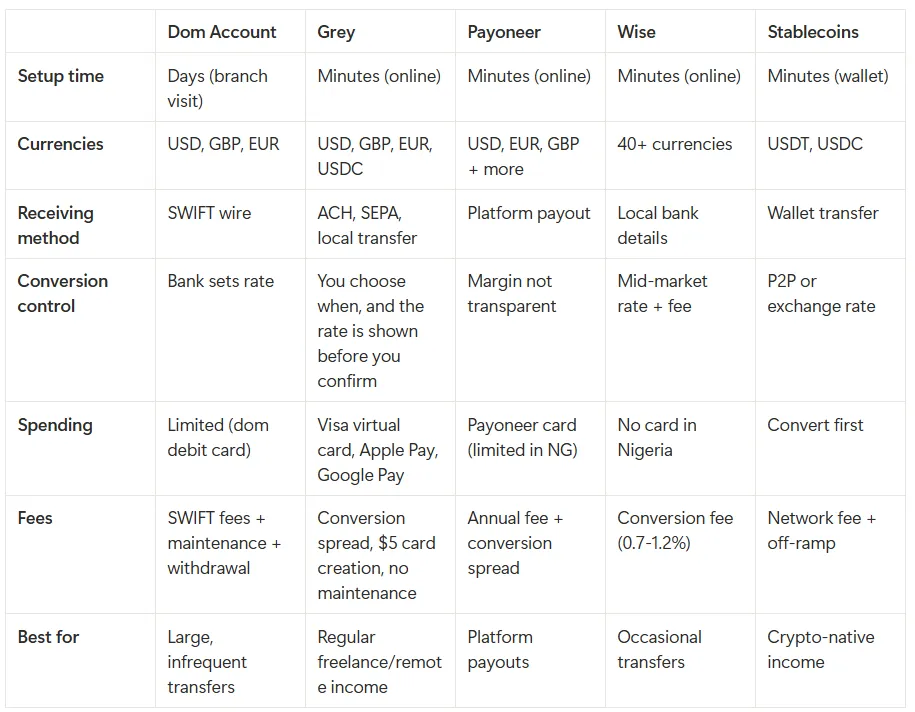
How the alternatives compare

Here is a side-by-side comparison of the key factors that matter when choosing how to manage foreign currency in Nigeria.

Table comparing domiciliary accounts, Grey, Payoneer, Wise and stablecoins

Which is right for you?

You earn regularly from international clients or an employer. A virtual foreign currency account is your best option. You get foreign bank details to share with clients, control over when you convert, and a card to spend directly in USD. This replaces a dom account for most day-to-day use cases.

Your income comes through Upwork, Fiverr, or Amazon. Start with Payoneer since these platforms integrate it natively. If you find the conversion rates eating into your earnings, consider adding a Grey or similar account and routing future direct client payments there instead.

You need to send a one-off international transfer and want the best rate. Wise is hard to beat on exchange rates for single transactions. Just be aware of its limitations as a full-time financial tool for Nigerian residents.

You receive large, infrequent transfers and want to hold USD for the long term. A dom account at a reputable Nigerian bank still works for this. The setup friction is a one-time cost, and the banking regulation provides a level of institutional protection that fintech platforms do not.

You are paid in crypto or stablecoins. Hold your stablecoins and use a platform that supports USDC conversion to naira when you need to spend locally. Track your receipts for tax purposes under the 2026 NRS rules.

Most Nigerians managing regular international income end up using a combination of methods. A virtual foreign account for the majority of their income, Payoneer for platform payouts, and occasionally a dom account or Wise for specific transactions. The key is to stop defaulting to the dom account for everything, because for regular use, the alternatives are faster, cheaper, and more flexible.

Manage your international income with Grey

Grey gives you USD, EUR, GBP, and USDC account details to receive international payments, a virtual Visa card with Apple Pay and Google Pay support for spending, a built-in invoicing tool for billing clients, and naira withdrawals to your Nigerian bank account. Sign up at grey.co or download the app to get started.

Note: Exchange rates on Grey are variable and include a margin over the mid-market rate. Always review the rate before confirming a conversion.

Frequently asked questions

Is a domiciliary account still worth it in 2026?

For specific use cases, yes. If you receive large wire transfers infrequently, want to hold a significant USD balance under banking regulation, or need the institutional credibility of a commercial bank account, a dom account still serves those purposes. For regular freelance income and everyday USD spending, virtual foreign accounts are more practical.

Can I receive USD in Nigeria without a domiciliary account?

Yes. Virtual foreign currency accounts from platforms like Grey, Geegpay, and Cleva give you USD account details that work as US bank accounts from the sender's perspective. Your client pays via ACH or wire, and the funds are deposited into your wallet without ever touching a Nigerian bank.

What is the cheapest way to receive dollars in Nigeria?

Virtual foreign currency accounts that support ACH transfers are typically the cheapest because they avoid SWIFT intermediary fees entirely. The main cost is the exchange rate spread when you convert to naira, which varies by provider (typically 1% to 3%).

Is Wise or Grey better for Nigerian freelancers?

They serve different needs. Wise offers the mid-market exchange rate, which is excellent for occasional transfers, but it has no card in Nigeria and has periodically disrupted its services in Nigeria. Grey offers a virtual card, Apple Pay/Google Pay, USDC support, and an invoicing tool, making it more practical for Nigerian residents managing regular international income. Many freelancers use both.

Are stablecoins legal in Nigeria?

The regulatory landscape around crypto in Nigeria is evolving. Holding stablecoins is not illegal, and many professionals use them for international payments. Under the 2026 Nigeria Tax Act, stablecoin income is treated as foreign income and must be declared. The main risk is in the off-ramp: converting to naira through unregulated channels can expose you to fraud or compliance issues.

Do I need a Dom account to receive a wire transfer?

Not necessarily. A virtual foreign currency account with SWIFT or wire receiving capability can also receive wire transfers. However, some senders (particularly corporate treasury departments) may prefer to send to a traditional bank account. Check with your payment source whether they accept fintech account details.

Ready to move beyond the dom account? Sign up at grey.co and get your USD, EUR, and GBP account details in minutes.

How consultants structure international client payments

•

•

2 min read

A consultant who sends a rough invoice three weeks late tells a different story than one who has clear terms, structured milestones, and a payment setup that works seamlessly regardless of the client's location. Being your own boss is cool and all, but there are other responsibilities you might not have been informed about. If you work with global clients, you need to manage foreign income. How well you do this can make or mar your experience. So, getting that structure right matters. It is not just about the money coming in, but also how it makes you appear to clients who are constantly evaluating your professionalism. This article covers structuring international client payments for consultants.

One of the biggest mistakes consultants make with international clients is waiting until invoicing to think about payment. By that time, key decisions have already been missed, which can cause problems starting work. Make sure your contract clearly states the billing currency, payment schedule, payment method, what happens if a payment is late, and who covers any transaction or conversion fees.

Also read: Negotiating cross-border freelance contracts: Tips and templates

Choose your billing currency deliberately

Most international consultants bill in USD, EUR, or GBP. Choose your currency based on where most of your clients are, which currency you prefer to hold or convert, and which gives you the clearest pricing when converting to your local currency. You can bill in your local currency, but this can make things harder for international clients, especially if your currency is unstable or unfamiliar. Billing in a major foreign currency and converting when you withdraw, using a platform with good rates, usually gives you more control and predictability over your earnings.

Decide on your payment structure

Payment structures consultants commonly use include

Full upfront payment

This means the client pays the full fee before any work starts. It is most common for short, clearly defined projects, such as a one-day workshop, a strategy review, or a specific deliverable with a fixed scope.

With international clients, upfront payment removes the risk of not getting paid and makes administration easier. However, not all clients will agree to this, especially for bigger projects or if they have not worked with you before. You need enough credibility and a proven track record to ask for full payment upfront.

Deposit plus balance

A more common setup for mid-sized projects is to take a deposit, usually 30% to 50% of the total fee, before starting work. The rest is paid at a set time, often on delivery or a specific date.

This approach balances risk for both sides. The consultant gets some payment before putting in a lot of work, and the client does not pay for something they have not received yet. For international projects, this is a practical default that most clients know and accept.

LDMAG1

Milestone-based payments

Longer projects can be divided into phases, and sometimes, your role is a long-term arrangement. Milestone-based payments usually make the most sense for such projects. You get paid after each phase is finished. This ensures money keeps coming without  waiting until the end. It also gives both you and the client regular points to check progress.

Monthly retainer

For ongoing advisory or long-term consulting relationships, a monthly retainer is a great structure. The client pays you a fixed monthly amount to cover a set number of hours, calls, or deliverables. Retainers are excellent for consultants because they provide a predictable income stream. They are also attractive to clients who want reliable access to expertise without having to go through a scoping and contracting process every time they need something. A payment setup that supports recurring payments can eliminate the back-and-forth of invoicing for every interaction.

Also read: Setting up payment terms and timelines with international clients

Other things consultants should note while setting their payment structure

  • Net terms. You might have heard of Net 15, Net 30, and Net 45. These are the number of days the client has to pay an invoice from the date it is issued. For international clients, shorter terms are better. Net 30 is a reasonable standard. For new clients, consider offering Net 14 or Net 15.
  • Late payment clauses. Your contract should specify what happens when an invoice is not paid on time. Your options include a late payment fee, interest on the outstanding balance, or the right to pause work until you receive the payment.
  • Currency fluctuation. If you are billing in a foreign currency and the engagement spans several months, it is worth deciding in advance how to handle exchange rate movements.
  • Transaction costs. International transfers often come with fees on both ends. Be specific about who pays what. A common approach is to specify that the client is responsible for ensuring the full invoiced amount arrives, net of any fees — meaning they cover the sending fees on their end.

Also read: Managing money across countries as an expat: A complete guide

Set up your payment option

You need to choose a payment option that is convenient for you and your clients while maximising your income. An account that supports multi-currency payments at low transaction fees should be a priority. Your choice should also support withdrawals in local currency at competitive exchange rates, without unnecessary cost or delay.

Digital payment platforms like Grey offer  USD, EUR, and GBP account details that you can include directly on your invoices. Your client pays as though they are making a local transaction, which is often faster and cheaper for them. The money arrives in your account in the foreign currency, and you convert and withdraw to your local bank when you are ready.

Automate your invoicing

Automating your invoicing on platforms like Grey gives your operation a professional touch. You also don’t have to think too much about that happening for long-term projects. For international clients, the invoice should include all the details they need to make a transfer.

Also read: How expats are saving hours each week with Grey

Receive international consulting income with Grey

Grey provides consultants with virtual USD, EUR, and GBP accounts that come with real foreign account details. You can put these details directly on your invoice, making it easy for clients to pay. Payments arrive quickly, conversion rates are good, and you can withdraw to your local bank in minutes. With virtual cards that simplify online payments, you can easily pay for your tools, travels, online shopping, and subscriptions.

Sign up on Grey or download the app to get started.

‍

Why creators move away from Payoneer and PayPal

•

•

2 min read

If you are from where I am from, then you’ll understand when I say Payoneer and PayPal are the “Old Takers” of cross-border payments. For a long time, they were the popular answers to the question of how creators get paid online. If you were monetising content, selling digital products, or working with international brands, one or both of these platforms were almost certainly part of the conversation.

That still holds true for many creators. However, for some reason, many creators seem to be drifting away from both platforms, and it's easy to understand their frustration. This article explores the experiences of these looks at the real reasons behind that shift.

Also read: How creators receive payouts from international platforms

Why are creators moving away from Payoneer?

Payoneer built its reputation on marketplace integrations. Amazon, Upwork, Fiverr, and many other global platforms integrated seamlessly with Payoneer, allowing users to manage their payouts from these platforms.  However, seamless integration is not enough to keep creators using the platform. Here are some reasons Payoneer might not be as favoured:

  • High fees: Payoneer charges multiple fees that add up into significant transaction cost. Key costs include up to 3.99% to receive credit card payments, 1% for ACH bank debits, and 0-1% for currency conversions. While receiving payments from other Payoneer users is free, a $29.95 annual fee applies if the account is inactive for 12 months or if you receive less than $2,000 in a year.
  • Poor exchange rates: Payoneer does not charge a visible conversion fee like some other platforms do. Instead, it builds a margin into the exchange rate it applies when converting your balance. Payoneer generally charges a markup of 0.5% to 2% (up to 3.5% for cards/wallets) above the mid-market exchange rate. While often cheaper than traditional banks', this fee is higher than competitors'.
  • Customer support might not be responsive: From delayed responses, confusing account freezes, and unresolved disputes, Payoneer users often complain about the customer support.
  • Limited reach in some regions: Despite being a global platform, Payoneer's ability to pay out in local currencies is inconsistent. In some markets, your only option is to receive USD and convert it yourself. In others, certain features are restricted or unavailable entirely. Creators who assumed global coverage sometimes discover the gaps at precisely the wrong moment.

Why are creators moving away from PayPal?

PayPal is a big name in the cross-border payment space, widely used by creators for the reliance adnd familiariy. Again, these benefits are not enough, as emerging digital payment platforms offer more perks. These are the reasons creators are moving from PayPay.

  • High fees: Like Payoneer, PayPal users face high fees as the platform charges a percentage fee on incoming payments, and a fixed fee depending on the currency.
  • Holds and freezes are common: Sometimes, it just feels like PayPal's fraud detection is aggressive. Creators often experience account restrictions and suspensions that lead to losses or getting stranded.
  • It is not available everywhere: Theoretically, PayPal is available in over 200 countries, but in reality, creators in either cannot receive PayPal payments at all or face such significant limitations.
  • Limited feature: Over the years, PayPal has not evolved much compared to what fintech platforms now offer creators. With multi-currency accounts, real-time conversion, instant local withdrawals, and invoicing tools, PayPal seems to be running behind platforms like Grey and Wise.

What creators are moving towards

The shift away from Payoneer and PayPal is not a move away from digital payments. It is a move towards better digital payments. And the things creators are looking for when they switch are fairly consistent.

  • Transparent fee structure
  • Low transaction fees
  • Swift payment processing
  • Responsive customer service
  • Competitive exchange rates
  • Reliable access to funds
  • Multi-currency flexibility

Also read: How to collect international creator funds in local currency

Making the move with Grey

As creators move away from Payoneer and PayPal, platforms like Grey offer virtual USD, EUR, and GBP accounts that they can share directly with clients and integrate with other platforms. Payments are swift, conversion rates are competitive, fees aretransparent, and withdrawals to local bank accounts are processed in minutes.

Sign up on Grey or download the app to get started.

‍

Arrow (up)

Back to top

