
<script type="application/ld+json" data-schema-version="grey-blog-v4"> [{"@context":"https://schema.org","@type":"BlogPosting","@id":"https://grey.co/blog/how-to-send-and-receive-british-pounds-in-south-africa#article","headline":"How to send and receive British pounds in South Africa","description":"Looking for how to send and receive British pounds in South Africa? Here are some of your options. ","inLanguage":"en","url":"https://grey.co/blog/how-to-send-and-receive-british-pounds-in-south-africa","mainEntityOfPage":{"@id":"https://grey.co/blog/how-to-send-and-receive-british-pounds-in-south-africa#webpage"},"datePublished":"2025-06-19T22:43:10.093Z","dateModified":"2026-06-15T14:54:42.201Z","author":{"@type":"Person","@id":"https://grey.co/authors/adeolu-titus-adekunle#person","name":"Adeolu Titus Adekunle","url":"https://grey.co/authors/adeolu-titus-adekunle","jobTitle":"Content Writer","sameAs":["https://www.linkedin.com/in/titusadeoluadekunle/"]},"publisher":{"@type":"Organization","@id":"https://grey.co/#organization","name":"Grey","url":"https://grey.co","logo":{"@type":"ImageObject","url":"https://cdn.prod.website-files.com/6360022338a81bd6fdbb1145/6564ae1077a67e39d3c491a6_Grey%20Logo%20Lockup%20Black.svg"}},"image":{"@type":"ImageObject","@id":"https://grey.co/blog/how-to-send-and-receive-british-pounds-in-south-africa#primaryimage","url":"https://cdn.prod.website-files.com/636a85d290ee58e70c17e1c0/6a301232fdca1a64ceb612f2_6a301231acf28d6695c27f89_how-to-send-and-receive-british-pounds-in-south-africa__header-image.webp","contentUrl":"https://cdn.prod.website-files.com/636a85d290ee58e70c17e1c0/6a301232fdca1a64ceb612f2_6a301231acf28d6695c27f89_how-to-send-and-receive-british-pounds-in-south-africa__header-image.webp","width":1200,"height":675}},{"@context":"https://schema.org","@type":"WebPage","@id":"https://grey.co/blog/how-to-send-and-receive-british-pounds-in-south-africa#webpage","url":"https://grey.co/blog/how-to-send-and-receive-british-pounds-in-south-africa","name":"How to send and receive British pounds in South Africa","description":"Looking for how to send and receive British pounds in South Africa? Here are some of your options. ","inLanguage":"en","primaryImageOfPage":{"@id":"https://grey.co/blog/how-to-send-and-receive-british-pounds-in-south-africa#primaryimage"},"breadcrumb":{"@id":"https://grey.co/blog/how-to-send-and-receive-british-pounds-in-south-africa#breadcrumb"}},{"@context":"https://schema.org","@type":"BreadcrumbList","@id":"https://grey.co/blog/how-to-send-and-receive-british-pounds-in-south-africa#breadcrumb","itemListElement":[{"@type":"ListItem","position":1,"name":"Home","item":"https://grey.co/"},{"@type":"ListItem","position":2,"name":"Blog","item":"https://grey.co/blog"},{"@type":"ListItem","position":3,"name":"How to send and receive British pounds in South Africa","item":"https://grey.co/blog/how-to-send-and-receive-british-pounds-in-south-africa"}]}] </script>

How to send and receive British pounds in South Africa

Adeolu Titus Adekunle

TABLE OF CONTENT

SHARE THIS POST

South Africa is home to stunning landscapes, friendly locals and a growing expat community.  Whether locals or foreigners, many people in the country need to send and receive British pounds (GBP) to support family members abroad, pay for goods and services, shop online, or cover educational expenses.

If you’re an expat, digital nomad, international student, businessperson, or freelancer, you need a reliable platform to simplify receiving and sending GBP. In this article, we’ll consider your best options for GBP transactions in South Africa, along with key considerations, before choosing a method.

Also read: South Africa visa requirements for UK citizens

What to consider before choosing a GBP transfer method

When dealing with international money transfers, consider the total cost and convenience. Here are the key factors to consider:

Exchange rates

Some providers add a markup to the exchange rate instead of charging transparent fees. This can lead to greater losses during currency conversion. Use trusted sources like Grey, Google, or XE to compare mid-market rates.

Fees

Watch out for hidden costs. Some services advertise “zero fees” but make up for it with poor exchange rates. Others may charge upfront transaction or processing fees depending on your chosen payment method.

Processing time

Transfer speed varies across platforms. Some complete transfers instantly, while others take days or even longer, especially on weekends or public holidays. If time is critical, opt for faster services like Grey.

Local payout options

Some platforms allow you to receive GBP directly into a local account, while others only support ZAR payouts. Receiving GBP is often better, as it avoids unnecessary conversion losses. Platforms like Grey offer local GBP bank account details even in South Africa.

Transaction size

Providers have different limits based on your account tier, country of residence, or destination. Ensure your platform supports the transaction size you plan to process.

Security and licensing

Stick with reputable platforms appropriately licensed in South Africa and the UK. Lax security can lead to data breaches or lost funds.

Options for sending and receiving British pounds in South Africa

Once you’ve considered these factors, you can choose the best option based on your needs. These options include digital payment solutions, traditional banks, and cash pickup options.

1. Digital payment solutions

These platforms are fast, convenient, and often more affordable than traditional methods. They’re ideal for freelancers, remote workers, and global businesses seeking efficiency.

Grey (Recommended)

Grey is an international money transfer platform designed specifically for Africans. It provides virtual GBP, USD, and EUR accounts, making it easy to send or receive GBP from South Africa.

Why choose Grey for GBP transfers?

  • Virtual GBP account: Get your own UK bank details to receive GBP from clients, employers, or platforms like PayPal and Fiverr.
  • Favourable exchange rates: Enjoy competitive exchange rates with no hidden markups.
  • Easy funding and transfers: Fund your account locally and send GBP abroad with just a few clicks.
  • Fast onboarding: Open your account within minutes using minimal documents.
  • Secure and compliant: Licensed and protected with robust security features.

How to use it:

Sign up on Grey’s website or download the mobile app, complete your verification, activate your GBP account, and start sending or receiving funds using your UK account details.

WorldRemit

WorldRemit supports sending and receiving GBP from South Africa. Users can track transactions in real-time and choose between bank transfers or cash pickups via partners like Mukuru and Sikhona.

Key features:

  • Real-time tracking of transfers
  • Multiple payout options (including cash pickup)
  • Transfer limits depend on the method
  • Requires valid ID and address verification

How to use it:

Create an account at worldremit.com, enter the sender and recipient details, choose a delivery method, and make payment using your preferred option.

Payoneer

Payoneer is ideal for freelancers and remote workers receiving GBP from international clients or platforms. Users can receive GBP via a UK virtual account and withdraw to a South African bank account in ZAR. You can use your Payoneer balance to pay other Payoneer users or to a recipient’s bank account. However, Payoneer charges higher withdrawal fees.

How to use it:

Sign up at payoneer.com and activate your receiving account. You can share your GBP bank details with clients or platforms and withdraw funds to your South African bank account.

2. Traditional banks

These are best for larger amounts or users who already bank with them. However, they are usually slower, require more paperwork, and incur higher fees.

First National Bank (FNB)

FNB allows international SWIFT transfers and can process GBP payments to and from South Africa. The bank offers global accounts for saving and transacting in foreign currencies, international payments via the FNB app, and receiving international payments into an FNB account. The bank supports GBP transactions through online banking or physical branches.

Standard Bank

Standard Bank allows GBP transactions through various services, including online banking, mobile app, and forex outlets. To make or receive GBP payments, you must provide specific details to the sender, such as your account number, the Standard Bank SWIFT address (SBZAZAJJ), and the branch/sort code (051001). You can use the Standard Bank mobile app or internet banking platform to initiate transfers for online payments.

Absa Bank

Absa offers various services for GBP transactions, including international money transfers, foreign exchange services, and a Cash Passport preloaded with GBP. You can conduct these transactions through Absa Online Banking, the Absa Banking App, or by visiting a branch.

3. Cash pickup options

These are perfect for situations where the recipient doesn’t have a bank account or needs quick access to cash.

Western Union

Western Union can be used for GBP (British Pounds) transactions in South Africa. You can send GBP to South Africa using Western Union, and the recipient can receive the money either as a bank deposit or for cash pickup at a Western Union agent location. If the recipient chooses to pick up the cash at an agent location, they must provide the tracking number (MTCN) and a valid ID.

MoneyGram

Like Western Union, MoneyGram allows GBP transfers and cash pickup in ZAR across numerous outlets in South Africa. The transaction fees vary depending on location and method. However, it is usually more expensive than digital platforms like Grey.

Xoom (by PayPal)

Xoom is a PayPal service that allows users in the UK to send GBP to South Africa. You can send money to bank accounts for cash pickup or for home delivery in South Africa. Xoom provides a way to transfer funds quickly, with options for sending money directly to bank accounts or for cash pickup at various locations.

How to receive and send GBP in South Africa using Grey

Sending or receiving GBP payments with Grey is a swift and seamless process. Here’s how you can get started with GBP transactions on Grey.

To receive GBP:

  1. Create a Grey account: Sign up on the Grey website or download the app.
  2. Verify your identity: Complete KYC to unlock your virtual GBP account.
  3. Get GBP account details: Grey will issue a UK-based GBP account (with sort code and account number).
  4. Receive funds: Share these details with UK-based senders to receive GBP directly into your Grey wallet.

Also read: How to get an instant USD debit card in South Africa

To send GBP:

  1. Fund your Grey account (in ZAR or other supported currencies).
  2. Convert from ZAR to GBP
  3. ‍Enter recipient details (UK bank account or supported country).
  4. Confirm and send.

Simplifying GBP transactions in South Africa

Whether you’re a freelancer, student, or supporting family back home, sending and receiving British pounds in South Africa doesn’t have to be difficult or expensive. With the growing availability of flexible, secure, and affordable financial platforms, you can transact in GBP seamlessly.

Grey makes it easy to manage GBP across borders. You can handle international payments on your terms with virtual accounts, transparent fees, and fast transfers.

Open your free Grey account today to easily send and receive GBP from South Africa.

‍

Last updated:

October 13, 2026

Open a free Grey account to get startedJoin 1 million digital nomads
IF YOU ENJOYED THIS, CHECK THESE OUT

How Nigerian creators can get USD payouts without a US address

•

•

2 min read

So, the dollars have started coming in, and then a payout form asks for a US bank account and a US address. Good news: you can get a US account number and routing numbers from Nigeria without either, through a fintech account such as Grey. Where a form insists on a US address, Grey's help centre says you can use the bank address that comes with your account details.

The catch is that a US account only helps on platforms willing to pay a non-US creator into one. Upwork, Patreon and US brands paying you directly will. YouTube and Gumroad pay Nigerian creators into a Nigerian bank instead, and Substack and TikTok's Creator Rewards Program are mostly closed to Nigerian accounts.

Below is the platform-by-platform picture, what a Grey USD account can and can't receive, what turning dollars into naira really costs, and the US tax form platforms will ask you to sign.

Which platforms pay a Nigerian creator into a US account?

Here is the short version. The sections further down explain each row and link to the platform's own rules.

PlatformHow it pays creators in NigeriaInto a Grey USD account?
UpworkDirect to U.S. Bank (ACH), local bank, wire, Payoneer or PayPalYes, with Direct to U.S. Bank (ACH)
PatreonUSD bank transfer (you can choose the US as your bank country), PayPal or PayoneerYes, with the US as your bank country
US brands and clients paying you directlyACH, FedNow or a domestic wire from their US bankYes
YouTube (AdSense)A bank in the same country as your payment address, so a Nigerian bankNo
GumroadNaira deposit to a Nigerian bank accountNo
SubstackNeeds a Stripe account in a country Stripe supportsNo, the blocker is the Stripe account
TikTokCreator Rewards is not open in Nigeria; LIVE rewards go out by the methods TikTok shows your accountNot directly

Checked 27 November 2026 against each platform's help pages and Grey's help centre.

What a Grey USD account can and can't receive

Once your account is approved, you get a US account number, an ACH routing number and a wire routing number. It is a checking account, and Grey's receiving guidelines list three ways money can arrive: ACH, FedNow and Fedwire. All three are US domestic payment networks.

That one fact tells you which platforms fit. If a platform pays by ACH or direct deposit and lets non-US creators use a US bank, your Grey details work. If it only pays to a bank in your home country, or sends an international SWIFT wire, which Grey's guidelines don't list, it isn't a fit.

How the money arrivesTypical speedGrey fee (USD)
ACH1 to 2 business days0.8%, minimum $2, maximum $10
FedNowSeconds, including weekends0.8%, minimum $2, maximum $10
Fedwire (domestic wire)Same business day if sent before the cut-off, typically 5pm ET$20 flat
Converting USD to NGNShown in the app before you confirm1%, capped at $6

Checked 27 November 2026, from Grey's USD deposit fees page and its guide to ACH, FedNow and wire.

Two rules are worth knowing before you share your details. A payment from another individual must be under $4,000 each time, while payments from business accounts have no limit. And the account can't receive payments for crypto, P2P, betting or forex trading.

Grey is a financial technology company, not a bank.

Platform by platform: where your US details go

Upwork

Upwork is the cleanest fit. Grey's help centre walks through the Upwork setup: go to Settings, then Get paid, then Add method, pick the direct US bank (USD) option, choose Individual Checking and enter your ACH routing number and account number.

The name on Upwork must match your Grey account name exactly. Our Upwork guide compares this route with Upwork's other withdrawal options for Nigeria.

Patreon

Patreon's payout guide for creators outside the US is clear on the key point: "You may select the United States as your bank country, even if you reside outside the U.S." Choose the US, then enter your Grey USD details.

Patreon charges $0.50 for a USD bank transfer to a USD account, with a $10 minimum payout.

Adding a new payout method puts a 5-day hold on payouts, so don't switch the week money is due.

PayPal (1%, minimum $0.25, capped at $20) and Payoneer ($1) remain as fallbacks. Our Patreon payout guide covers the setup screens.

US brand deals and direct clients

When a US brand or agency pays you directly, it is just a US bank transfer. Send them your account number, the right routing number (ACH for ACH or FedNow, the wire routing number for a wire) and your name as it appears on your Grey account. If their payment form wants an address, use the bank address shown with your details.

Ask for ACH on smaller invoices. A wire costs a flat $20 to receive, which is 10% of a $200 payment and less than 1% of a $5,000 one.

YouTube (AdSense)

YouTube is the exception that matters most. Google's AdSense payment rules say "Your bank (or branch) must be located in the same country as the address in your payments settings." For a creator living in Nigeria, that means a Nigerian bank account.

So a Grey USD account, or any other US account you hold from Nigeria, can't receive your AdSense payments. Google also says that if a method doesn't appear on your "Add payment method" page, it isn't available in your country.

Gumroad

Gumroad's payout rules list Nigeria as a bank-payout country, paid in naira to a local account. It doesn't support Payoneer, Wise or wire transfers, and if you sell as a business, the bank account must be in the country where the business is registered.

In practice, your Gumroad money reaches your Nigerian bank in naira once you clear the $100 minimum for weekly, monthly or quarterly payouts. You don't need a US account for it, and Gumroad's rules point a Nigeria-based individual to a local naira account, not a US one.

Substack

Substack's help centre says paid subscriptions need a Stripe account in a country Stripe supports. On Stripe's availability page, Nigeria sits under its "extended network" and points to Paystack rather than a standard Stripe sign-up.

That makes paid subscriptions hard to switch on from Nigeria today, and a US bank account doesn't change it. The missing piece is the Stripe account, not somewhere for the money to land.

TikTok

TikTok's Creator Rewards Program, which pays for views, runs only in selected countries, and Nigeria isn't one of them as of 27 November 2026. Nigerian creators aged 18 and over can still earn from LIVE gifts and withdraw rewards using the methods TikTok offers their account, often PayPal or Payoneer.

The bigger dollar opportunity is usually brand deals, which brands pay outside TikTok. That is exactly where your US account details fit. Our TikTok earnings guide covers every TikTok income stream open to Nigerian creators.

How to get your Grey USD account details

  1. Sign up on Grey or in the Grey app with your email address and phone number.
  2. Verify your identity with a valid ID, such as a national ID card, international passport or driver's licence. The name must match the one you signed up with.
  3. Request your USD account, then copy your account number and routing numbers from the app into each platform's payout settings.

Copy and paste rather than retyping. One wrong digit is enough to send a payout back.

What it costs to turn your dollars into naira

Say a $300 payout and a $1,500 payout each arrive by ACH, and you convert all of it to naira in the app. Here is what Grey's published fees come to.

Step$300 payout (USD)$1,500 payout (USD)
ACH deposit fee (0.8%, minimum $2, maximum $10)$2.40$10.00
Balance after deposit$297.60$1,490.00
Conversion fee (1%, capped at $6)$2.98$6.00
Dollars converted to naira, after fees$294.62$1,484.00
Grey fees as a share of the payout1.8%1.1%

Checked 27 November 2026, from Grey's USD deposit fees and its 1% conversion fee capped at $6. Platform fees, such as Patreon's $0.50, come off before the money reaches you.

The caps are the useful part. The conversion fee stops growing at $600 and the ACH fee at $1,250, so from $1,250 upwards your Grey fees stay at $16 per payout, however large it is. If you don't need the naira today, let a few payouts build up and convert once.

Your naira amount is the dollars converted multiplied by the rate the app shows before you confirm. You can check today's USD to NGN rate before you decide when to convert.

The W-8BEN form, in plain terms

US platforms usually ask non-US creators for a W-8BEN before they pay. According to the IRS, you give it "to the withholding agent or payer if you are a foreign person", meaning the platform, not the IRS, and you submit it when they ask. It confirms your foreign status for US tax withholding and reporting.

Nigeria isn't on the IRS's list of US income tax treaty countries, so there is no Nigeria treaty rate to claim on the form. Our W-8BEN walkthrough goes line by line. This is general information, not tax advice.

Four mistakes that bounce a payout

  • A name that doesn't match. Use your name exactly as it appears on your Grey account, with no nicknames or initials the account doesn't have.
  • The wrong routing number. ACH and FedNow use the ACH routing number. Wires use the wire routing number.
  • A large payment from a friend. Money from another individual must be under $4,000 per payment. Ask a business client to pay from its business account instead.
  • Switching payout methods on payday. Patreon holds payouts for 5 days after you add a method, and other platforms run their own checks. Set up early.

Frequently asked questions

Can I get a US bank account from Nigeria without a US address?

Yes. A Grey USD account gives you a US account number and routing numbers, opened online with a valid ID. When a payout form asks for a US address, Grey's help centre says you can use the bank address shown with your account details.

Can YouTube pay into my Grey USD account?

No. AdSense requires your bank to be in the same country as the address in your payments settings, so creators in Nigeria are paid into a Nigerian bank account.

Is TikTok's Creator Rewards Program available in Nigeria?

Not as of 27 November 2026. Nigerian creators can still earn from LIVE gifts and from brand deals paid outside TikTok.

How long does a USD payout take to reach my Grey account?

ACH takes 1 to 2 business days, FedNow takes seconds and a domestic wire arrives the same business day if it is sent before the cut-off. The platform's own processing time comes first.

Set it up where it works

A US account fixes the "add a US bank" step, not every platform. Use it for Upwork, Patreon and US brands, keep your Nigerian bank for YouTube and Gumroad, and convert in fewer, bigger batches so the fee caps work for you.

If you are still choosing an app, see how the dollar account apps in Nigeria compare. For money from family or clients rather than platforms, read our guide to receiving US dollars, and creators outside Nigeria can check platform payouts by country. Create a Grey account to get your USD details and see how it works.

Beyond the basics: how to grow as a digital nomad after year one

•

•

2 min read

Most people picture nomad life as Wi-Fi cafés, sunrise meetings and Slack messages sent from a beachside hammock. That's year one. Growing as a digital nomad after that means three things: earning more for each hour you work, losing less of each payment on its way to you, and sorting the visa and tax paperwork that lets you stay somewhere long enough to build.

Every move below serves one of those three goals. If you haven't left home yet, start with how to become a digital nomad and come back after a few months on the road.

Nomad life isn't a phase for most people who try it. MBO Partners' 2025 Digital Nomads report counts 18.5 million American workers as digital nomads, and 93% say they will definitely or maybe keep going. But the same report found that self-employed nomads fell 7% in a year, to 7.3 million, while nomads with traditional jobs grew by about 10%.

Plenty of freelancers make it through the first year. Fewer build a setup that still works in year five. Here's your roadmap to being one of them.

Where are you stuck? A quick self-check

Growth looks different depending on what's holding you back. Find the line that sounds most like you and start with that move.

If this sounds like youWhat's really holding you backStart with
"I'm busy, but my income hasn't moved in a year."Your rate, not your hours1. Specialise, then raise your rates
"Every month starts from zero."One-off projects2. Swap one-off gigs for retainers
"Losing one client would sink me."A single source of income3. Add one income stream that doesn't need your hours
"All my work comes from platforms or one referral."Nobody knows your name yet4. Build a reputation that travels with you
"I'm never sure what I actually earned this month."No money system5. Run your money like a business
"I'm always counting days until my next border run."Short-stay entries and no plan7. Put your visa and tax position on paper

1. Specialise, then raise your rates

Most nomads start with one broad skill: copywriting, coding, design or translation. Broad skills compete on price, because a client can find a hundred people who do the same thing. A specialism lets you charge for the problem you solve instead of the hours you log.

  • Narrow your offer. Be "the web developer for eco startups" or "the travel copywriter for boutique hotels", not just a developer or a writer.
  • Upskill into the part clients value most. A content writer can add SEO strategy; an engineer can add DevOps. Both move you from doing the task to owning the result.
  • Review your rates on a schedule. Put a date in your calendar every six months. New clients get the new rate straight away; existing clients get notice before it applies to them.

Our guide on how to negotiate freelance rates covers what to say in that conversation. The key? Your income grows when your rate does, not when your calendar fills up.

2. Swap one-off gigs for retainers

One-off projects mean you spend part of every month hunting for the next one, often from a new time zone. A retainer turns a good client into predictable monthly income. That predictability is what lets you sign a longer lease, plan your next move or show the steady earnings many nomad visas ask for.

  • Package what clients already buy. Four articles, ten design requests or a set number of support hours a month becomes one monthly fee.
  • Put the terms in writing. Agree the scope, what happens to unused hours and the notice period before work starts.
  • Automate the onboarding. Keep one template for contracts, payment details, FAQs and timelines, so a new retainer client is set up in an afternoon.

Check our list of what goes in a retainer agreement before you send the offer.

3. Add one income stream that doesn't need your hours

Retainers steady your income. A second stream protects it when a big client leaves. Turn what you already know into something you can sell more than once.

  • Products: eBooks, Notion templates, short courses or paid workshops.
  • Coaching: a few calls a month with people one or two steps behind you.
  • Affiliate links and sponsorships: worth it if you already have a blog, newsletter or small social audience.

Pick one and give it six months before adding another. Three half-built side projects rarely beat one finished one. Our list of passive income ideas shows what each takes to set up.

4. Build a reputation that travels with you

People hire people they trust, and trust builds faster when clients can see your work before they meet you. When you change cities every few months, your reputation is the one thing you don't have to rebuild each time.

  • Own your niche in public. Write about the problems your ideal client has, on LinkedIn, a newsletter, YouTube or your own site.
  • Show results, not just samples. A short case study with the before and after beats a folder of screenshots.
  • Stay consistent. Use the same photo, name, bio and tone across every platform and pitch deck.

Our guide to building a personal brand as a remote worker goes step by step. And don't wait to be discovered: pitch agencies, past clients and collaborators directly. You'd be surprised what doors open when you just ask.

5. Run your money like a business

You are the business, so give it a finance department, even if that department is you and a spreadsheet on Sunday evening.

  • Know your burn rate. Track what a month really costs you, city by city. It tells you which bases are worth going back to.
  • Set tax aside as you earn. Move a fixed share of every payment into a separate pot the day it lands, so a tax bill never catches you out.
  • Build a buffer for slow months. Work won't always be consistent. Keep that safety net in the currency you spend most, as our guide on where to keep your emergency fund explains.
  • Get paid in your client's currency. Every conversion between your client's bank and yours is a chance to lose a few per cent.

That last point is where many nomads leak money without noticing. With a Grey foreign currency account, you get your own USD, GBP and EUR account details, so a US client pays you in dollars and a client in Europe pays you in euros.

Which accounts you can open depends on your country of residence. Grey is a financial technology company, not a bank.

Worked example: a $3,000 retainer, spent in euros

Say a US client pays your $3,000 monthly retainer into your Grey USD account by ACH, and you convert it to euros for a few months in Lisbon. Here's what Grey's published fees add up to on that payment.

StepGrey's fee ruleFee on this payment (USD)
Receive $3,000 by ACH0.8%, minimum $2, maximum $10$10
Convert the remaining $2,990 to EUR1%, capped at $6$6
Known fees in totalPlus the exchange rate on the day$16 (about 0.5% of the invoice)

Checked 27 November 2026, from Grey's help centre articles on USD deposit fees and conversion fees.

The exchange rate still matters, so compare Grey's quote with today's USD to EUR rate before you convert. To make sure the money lands in the right account first time, send the invoice from Grey's free invoicing tool, which adds your Grey account details for the client.

6. Choose your bases for a reason

Not every nomad hub fits every goal. Some cities are great for meeting people, others for saving money or for months of deep focus. Decide what this season is for, then pick the city.

  • To grow your network: social, creative hubs with busy meetup and co-working scenes, such as Lisbon, Mexico City or Tbilisi.
  • To save: a base where your monthly costs sit well below your income, so the gap goes into your buffer. Medellín, Bangkok and Cape Town are popular, budget-friendly picks.
  • To focus: a quieter city where you can sign a three-month lease and protect your deep-work hours with a "quiet mode" routine.

Moving less often is a growth move in itself. Every travel day is a day you're not working on the business.

7. Put your visa and tax position on paper

Plenty of nomads spend years on tourist entries, counting days and hoping nobody asks what they do for work. Growth means swapping that for a position you can explain to a border officer, a landlord or a tax office.

  • Get a long-stay visa. Dozens of countries, including Portugal and Spain, now run digital nomad or remote work visas; see our list of 50+ countries that offer one. Most ask for proof of a steady income, which is one more reason retainers matter.
  • Know where you owe tax. Moving around doesn't make tax disappear. What you owe depends on your citizenship, your tax residence and where you spend your time. Our digital nomad tax guide covers the main rules, and a qualified tax adviser can confirm your position.
  • Cover your health. Nomad life is unpredictable. Protect your body as carefully as your income, with insurance that works in the countries you actually live in.
  • Invest the surplus. Once your buffer is full, put extra income into long-term investments that suit your risk level instead of leaving it idle.

The more stable your foundation, the more adventurous your journey can be.

Your next 90 days

You don't need to do all seven at once. Here's a simple order that works for most nomads who are already earning.

WhenFocusOne concrete action
Month 1Rates and moneySet a higher rate for new clients, work out your burn rate and start a separate tax pot.
Month 2Steady incomeOffer your two best clients a monthly retainer, and ask them to pay in their own currency.
Month 3Reputation and paperworkPublish one case study, and shortlist two long-stay visas whose income rules you already meet.

Frequently asked questions

How do digital nomads make money?

Most earn through freelancing, remote employment or running an online business, in fields such as writing, design, software development, marketing and teaching. Once you're established, income usually grows by charging more for a specialism and adding retainers, not by working more hours.

How much do digital nomads earn?

It varies widely. In MBO Partners' 2024 survey of 1,178 American digital nomads (June 2024), 46% reported household income of $75,000 or more a year, while 17% reported less than $25,000.

Is being a digital nomad worth it long term?

Most people who do it think so: 93% of American nomads in MBO Partners' 2025 report said they would definitely or maybe carry on. It stays worth it when your income is steady, your visa status is legal and you have a buffer for slow months.

Do digital nomads have to pay tax?

Almost always, yes. Where you pay depends on your citizenship, your tax residence and how long you spend in each country, so check your situation with a qualified tax adviser.

A plane ticket and a laptop get you started. A higher rate, steady clients and paperwork that lets you stay are what keep you going. Pick the move from the self-check that matches where you're stuck, and start it this month.

Open a Grey account to get USD, GBP and EUR account details your clients can pay into, with no account opening fee.

Easiest way to send USD from the Philippines to the USA

•

•

2 min read

The easiest way to send USD from the Philippines to the US depends on one thing: whether your money is already in dollars. If it is, a transfer from a USD account to the recipient's US bank account is the simplest and usually the cheapest route. If you're starting with pesos, a digital money transfer service that converts PHP to USD and pays a US bank account directly will beat a traditional bank wire on fees in most cases.

That matters because the fees you can see are only half the cost. The exchange rate, a correspondent bank charge or a 4% conversion spread can quietly take more than the transfer fee itself. Below, we compare the realistic options with the fees each provider published when we checked on 26 November 2026, so you can see the total before you send.

The quick answer

  • You already hold US dollars (for example, freelance income paid into a USD account): send them by local US bank transfer (ACH). There's no currency conversion, so you only pay the transfer fee.
  • You're starting with pesos and want the lowest fee: use a digital transfer service that converts PHP to USD and pays out to a US bank account, such as Wise. Grey fits only once you hold dollars, because it doesn't accept peso deposits.
  • The recipient needs cash today: Western Union offers cash pick-up at agent locations in the US.
  • You're moving a large sum and want to stay with your bank: a telegraphic transfer (SWIFT wire) from your Philippine bank works, but fixed fees add up: Security Bank, for example, charges $20, plus $15 if you also cover the US bank's charges.

Your options compared

Here's what each option cost to send about PHP 50,000 (roughly $784 at the PHP 63.76 per dollar mid-market rate Wise's calculator showed) to a US bank account.

OptionPublished fees on about PHP 50,000 (USD)Exchange rateTypical speed
Grey, sending from a USD balanceAbout $3.92 (ACH fee of 0.5%, minimum $2, maximum $10)No conversion needed1 to 2 business days
WiseAbout $3.53 (PHP 225.18, paying by bank transfer)Mid-market rateConversion can take up to 2 working days
PayPal (personal payment)About $36.36 ($4.99 fee plus a 4% conversion spread)PayPal's rate plus the 4% spreadInstant to the recipient's PayPal account
Bank wire (Security Bank example)About $37.35 ($20 commission, $15 correspondent charge if you pay all fees, and PHP 150 documentary stamp tax)The bank's selling rateNot published
Western UnionShown in its estimator, varies by payment and payout methodWestern Union's rateCash pick-up can be ready in minutes

Fees and rates checked on 26 November 2026. Sources: Grey's published fees, Wise Philippines, PayPal Philippines fees, Security Bank telegraphic transfer charges and Western Union. Grey and Wise figures exclude any difference between their rate and the mid-market rate.

Two things stand out. If you already have dollars, nothing beats skipping the conversion. If you're starting in pesos, the gap between the cheapest and the most expensive option on the same PHP 50,000 is more than $30.

1. Grey: best if you already earn or hold US dollars

Grey lets people in the Philippines open a free USD account with US account details, which is how many Filipino freelancers get paid by foreign clients. Once dollars are in that account, you can send them straight to any US bank account by ACH, without converting to pesos and back again.

Grey's fee page lists outgoing USD ACH transfers at 0.5%, with a $2 minimum and a $10 maximum, and the app shows the exact fee before you confirm. On $784, that's about $3.92. The recipient doesn't need a Grey account, only a US bank account.

Grey doesn't accept peso deposits. In the Philippines, pesos are a payout currency on Grey: you can convert dollars to pesos and withdraw them, but you can't fund your account in pesos. Once your dollars are in Grey, sending them on to the US is covered on the Philippines to US page. If you're starting with pesos, use one of the options below.

How to send USD to the US with Grey

  1. Sign up on the Grey app or website and verify your identity with a valid Philippine government-issued ID or passport.
  2. Get dollars into your USD account, for example by giving a client your US account details.
  3. Tap Send, choose USD and Send via bank transfer, then pick ACH as the payment scheme.
  4. Enter the recipient's details, review the fee and confirm with your PIN or 2FA code.
Sending USD from the Philippines to a US bank account in the Grey app

Transfers usually arrive in 1 to 2 business days.

2. Wise: lowest published fee when you start in pesos

Wise converts at the mid-market rate and shows its fee upfront. On PHP 50,000 paid by bank transfer, its calculator showed PHP 225.18 in fees, about 0.45%.

The trade-off is timing: Wise says conversion can take up to 2 working days. Wise is a strong choice for one-off peso transfers, but you still need a separate account if you also want to receive dollars from clients.

3. PayPal: convenient, but the most expensive app here

PayPal is instant if your recipient already uses it. For a Philippine account sending a personal payment to the US, PayPal charges $4.99 when funded from your balance or bank, and $4.99 plus 3.4% plus $0.30 when funded by card.

The bigger cost is the 4% conversion spread PayPal adds when it converts your pesos to dollars. On PHP 50,000, that alone is about $31. Use PayPal when speed or convenience matters more than cost, or when you already hold a USD balance in PayPal.

4. Bank wire (SWIFT telegraphic transfer)

Philippine banks such as BDO, BPI, Metrobank and Security Bank send USD abroad by telegraphic transfer. Security Bank, for example, charges a USD 20 commission, a USD 15 correspondent charge if you choose to pay all fees ("OUR"), and documentary stamp tax of PHP 0.60 per PHP 200 when the transfer is funded in pesos.

That's about $37 on PHP 50,000, before the bank's exchange rate. Because most of it is fixed, a wire makes more sense for large amounts, and less sense for regular small transfers. If you already hold dollars in a Philippine USD savings account, sending from that account avoids Security Bank's peso-funding tax.

5. Western Union: when the recipient needs cash

Western Union is the option to pick when your recipient in the US needs cash in hand, since it can pay out at agent locations. You can also send to a US bank account, but you'll need the recipient's SWIFT/BIC code.

Western Union lets you send up to $15,000 equivalent in PHP per transfer, or $7,500 to US Southwest Border states. It earns money on the exchange rate as well as fees, so check the total in its estimator.

A common mistake: picking an app that only sends into the Philippines

Some remittance apps that send money into the Philippines don't support sending money out of it. WorldRemit, for example, says it only offers airtime top-up when you send from the Philippines. Before you sign up anywhere, check that the Philippines is listed as a sending country and the US as a destination.

What you need before you send

For a US bank transfer by ACH, you'll need the recipient's:

  • Full name and street address, city, state and ZIP code
  • Bank name
  • Account number and account type (checking or savings)
  • Routing number (nine digits)

A wire usually needs the bank's SWIFT code as well. If you're not sure which to use, here's how ACH and wire differ on speed and fees.

Paying a US business instead of a person?

If you're paying a US school, landlord or online service, you may not need a transfer at all. Many US businesses accept card payments, and a USD card lets you pay in dollars directly.

Frequently asked questions

Does the recipient need a Grey account?

No. Grey pays out to the recipient's US bank account in USD, so they only need a US bank account. You need a verified Grey account to send.

What is the cheapest way to send money from the Philippines to the US?

If you already hold US dollars, sending them by ACH from a USD account is cheapest because there's no conversion. If you're starting with pesos, Wise had the lowest published fee in our 26 November 2026 check, so compare the final amount on the day you send. Grey doesn't accept peso deposits, so it only helps once you hold dollars.

How long does a transfer from the Philippines to the US take?

With Grey, it typically takes 1 to 2 business days from a funded USD balance. Wise says conversion can take up to 2 working days, and Western Union cash pick-up can be ready within minutes.

Is there a limit on how much I can send?

Yes, and it depends on the provider. Western Union allows up to $15,000 equivalent per transfer, and Grey's limit depends on your verification level and is shown in the app.

The cheapest transfer is often the one that skips a conversion you didn't need. If you're paid in dollars, keep them in dollars until they reach the US. Open a free Grey account and check today's USD to PHP rate before you send.

Grey virtual card vs Chipper, Geegpay and others: fees compared

•

•

2 min read

If you live in Nigeria and want a virtual dollar card for regular online spending, the fee that matters most is the one you pay every time you use the card, not the one you pay to open it. Grey charges a one-time $5 to create its Visa card and nothing per payment. Raenest (formerly Geegpay) charges $3 to create plus $0.70 on every successful payment, and Chipper's Nigerian USD card charges $5, then $0.90 per payment and $1 a month.

That sounds like small change, until you add up a year of subscriptions. Every figure below comes from each provider's own pricing or help pages, checked on 26 November 2026, so you can see the source and check it yourself.

A lot has changed since this comparison was first published. Grey's card for Nigeria, Ghana and Kenya is now Visa, Raenest has moved to a new Visa card that spends straight from your balances, and Chipper now offers two different USD cards in Nigeria.

Grey vs Raenest vs Chipper: card fees side by side

Here are the published fees for the three virtual dollar cards most people in Nigeria compare. Where a provider's own pages don't state a fee, the table says so rather than guessing.

Fee or featureGrey Visa cardRaenest Visa cardChipper NG-USD cardChipper US-USD card
Creation fee (USD)$5 one-time$3 one-time$5$5
Fee per successful payment (USD)None$0.70$0.90Not stated
Monthly fee (USD)NoneNone$1$1
Non-US merchant feeUp to 2% + $0.502% + $0.40Not statedNot stated
Decline for insufficient fundsNot listed$0.40₦250Not stated
FundingSpends from your Grey balances, no top-upSpends from USD, GBP, EUR or NGN balancesAdd funds from Chipper, no funding feeNot stated
Spending limits (USD)$10,000 a day, $50,000 a monthUp to $20,000 a day, $60,000 a month (by KYC level)Not stated$2,000 per transaction

Fees and rates checked on 26 November 2026. Sources: Grey card fees and limits from Grey's support centre, Raenest virtual card charges, Chipper NG-USD card and Chipper US-USD card.

What a year of subscriptions costs on each card

Creation fees get the attention, but per-payment fees decide the real cost. Take a common pattern: 10 card payments a month on US websites, such as streaming, cloud storage, design tools and ad top-ups, all paid from a USD balance.

CardFirst month (USD)First year (USD)Each year after (USD)
Grey Visa card$5$5$0
Raenest Visa card$10$87$84
Chipper NG-USD card$15$125$120

Fees and rates checked on 26 November 2026. The example assumes US merchants and a USD balance, so no cross-border or conversion fees apply.

Raenest's lower creation fee only wins if you make two payments or fewer in total. By the third payment, $3 plus three $0.70 charges ($5.10) already costs more than Grey's one-off $5.

When the merchant is outside the US

Grey and Raenest both pass on a cross-border fee when you pay a merchant outside the US or in a currency other than USD. On a $20 payment to a non-US website, Grey's fee is up to 2% plus $0.50, so up to $0.90. Raenest charges 2% plus $0.40 ($0.80) on top of its $0.70 transaction fee, so $1.50 in total.

Chipper's Nigerian help pages don't publish a cross-border fee, so check the in-app fee screen before you rely on it for non-US merchants. If you shop on UK or European sites often, our guide to shopping abroad covers how to keep those charges down.

Paying from a naira, pound or euro balance

If your card payment comes from a balance that isn't USD, there's a conversion step. Grey charges 1% for currency conversion, capped at $6, at the rate shown in the Grey app at the time of the payment. Raenest says its conversion fee applies only when a purchase is funded from a non-USD wallet and links to a separate conversion fee page that doesn't publish a fixed percentage.

LDMAG1

Grey virtual card: what you pay and what you get

Grey's card is a debit card, so there's no credit check and nothing to repay. It spends straight from your available Grey balance, so you never top up the card itself.

  • Network: Visa. Grey's support centre lists Nigeria, Ghana and Kenya among the countries that can create the Visa card. Grey Mastercard creation is now limited to specific regions such as India, Turkey and Vietnam.
  • Cost: a one-time $5 creation fee, and you need at least $5 in your USD balance to create it. Grey charges no card maintenance, transaction or funding fees.
  • Balances: pay from USD, EUR, GBP or your local currency. Non-USD balances are converted at 1%, capped at $6.
  • Cross-border fee: up to 2% plus $0.50 on non-USD card payments. It also applies to refunds from non-USD merchants, and conversion fees aren't refunded.
  • Limits: up to $10,000 a day and $50,000 a month.
  • Multiple cards: create as many as you need, each with its own limits, and pause any card from the app.
  • Where it works: online, in apps and in stores wherever Visa is accepted, plus Apple Pay and Google Pay in supported regions. It can't be used for cash withdrawals.

Separate cards make it easier to see where your money goes, for example one for subscriptions and one for ads. Our Grey card budgeting guide shows how people set that up.

One rule worth knowing: if a card's balance goes negative and the shortfall reaches $50, Grey automatically terminates that card. Keep your balance above your recurring charges.

Raenest (formerly Geegpay) virtual card

Raenest's help centre introduced its new Visa card in August 2026. The card now spends directly from your USD, GBP, EUR or NGN balance, so there's no separate card funding step.

  • Cost: $3 to create, free funding and no monthly fee, then $0.70 on every successful transaction.
  • Non-US merchants: 2% plus $0.40 for purchases or refunds on non-US websites.
  • Declines and disputes: $0.40 when a payment is declined for insufficient balance, and $50 to process a chargeback or dispute.
  • Limits: up to $20,000 a day and $60,000 a month, depending on your verification level.
  • Physical card: Raenest's cards page says a physical card is available on request.

Raenest is the stronger pick if you need a physical card or daily limits above $10,000. For frequent small payments, the $0.70 charge on each one makes it more expensive than Grey within a few transactions.

Chipper Cash USD cards

Chipper now offers two USD cards in Nigeria, and they work differently. Its help pages don't name the card network for either.

Chipper NG-USD card

  • Cost: $5 to create, $0.90 on every successful transaction, and a $1 monthly maintenance fee charged on the 28th.
  • Declines: a non-refundable ₦250 fee for each transaction that fails for insufficient funds. Chipper cut this from ₦500.
  • Funding: no fee to add or withdraw funds, and naira to dollar conversions use Chipper's real-time rate. Money sent to the card from external sources, such as Visa Direct, carries a 1% fee.

Chipper US-USD card

  • Cost: $5 to create and $1 a month, charged on the 28th.
  • Limit: $2,000 maximum per transaction.
  • Use: issued through a US partner, with wider acceptance on international platforms, and it can be used for some financial service transactions where the merchant supports them. Issuance can take up to 48 hours.

If you already keep money in Chipper and only pay for something occasionally, the NG-USD card is convenient. For regular spending, the per-payment fee, the monthly charge and the ₦250 decline fee add up quickly.

Can you get a Wise or Payoneer card in Nigeria?

Wise's card is not currently available to residents of Nigeria, Ghana or Kenya. Wise's own card availability list doesn't include them and offers a waitlist instead.

Payoneer says card availability depends on each customer's eligibility and jurisdiction. Where it is offered, its fees page lists a $29.95 annual card fee and up to 3.5% on card transactions with currency conversion, which makes it a costly card for everyday spending.

If you mainly want a card for receiving and converting freelance income, the cards matter less than the account behind them. Our receiving fees comparison covers that side.

Which virtual card should you choose?

  • Lots of small USD payments every month (subscriptions, software, ads): Grey, because there's no per-payment or monthly fee.
  • You need a physical card or limits above $10,000 a day: Raenest.
  • You already use Chipper and pay for something now and then: Chipper's NG-USD card, as long as you budget for the $1 monthly fee and avoid declines.
  • You want to compare more options: see our wider list of virtual dollar cards available in Nigeria.

Whichever you pick, keep enough in your balance to cover recurring charges. Declines cost money on Raenest and Chipper, and a declined subscription can lock you out of a service you rely on.

Frequently asked questions

Is the Grey virtual card free?

No. Grey charges a one-time $5 fee to create the card and no monthly, funding or per-transaction fees after that. You may pay a cross-border fee of up to 2% plus $0.50 on non-USD payments, and 1% (capped at $6) if the payment is converted from a non-USD balance.

Is the Grey card Visa or Mastercard in Nigeria?

Visa. Grey's support centre lists Nigeria, Ghana and Kenya among the countries that can create the Visa card, while Grey Mastercard creation is now limited to specific regions such as India, Turkey and Vietnam.

Which virtual dollar card has the lowest fees in Nigeria?

Of the three cards compared here, Grey costs the least for regular spending because it has no per-transaction or monthly fee. Raenest has the lowest creation fee at $3, but its $0.70 per-transaction fee overtakes Grey's $5 by the third payment.

Is Geegpay the same as Raenest?

Yes. Geegpay renamed itself Raenest, and its help centre still describes the product as Raenest (formerly Geegpay).

Can I get a Wise card in Nigeria?

Not at the moment. Wise's list of countries where personal customers can get its card doesn't include Nigeria, Ghana or Kenya, and Wise offers a waitlist for unlisted countries.

The price on the box is the creation fee, but the price you actually pay is what the card charges every time you use it. If most of your spending is regular USD payments, create a Grey card in the app and see the fee before you confirm.

How to open a foreign bank account for PayPal payments

•

•

2 min read

For PayPal, a foreign bank account almost always means a US one. PayPal lets you link a bank account from the country where your PayPal account is registered, or a US bank account in some countries, according to its help centre. So the steps are: check that your PayPal country accepts US banks, open a USD account you can hold from abroad, and link it with your name matching exactly.

Most people do it the other way round. They open an account first, then find PayPal will not take it. This guide shows how to check before you start, which accounts work for which PayPal countries, how to set up and link a Grey account, what it costs, and what to do if PayPal says no.

Which foreign bank accounts PayPal accepts

PayPal decides by the country your PayPal account is registered in, not by where your bank is. Its rule is a bank in that same country and in the local currency, with US banks allowed as an extra option in some countries. The name on the bank account must also match the name on the PayPal account.

Your PayPal account is registered inWhat PayPal lets you linkCan a Grey account receive your withdrawals?
A country where PayPal offers US bank linkingA local bank, or a US bank accountYes, a Grey USD account, if you live in a country where Grey offers one
The United KingdomA UK bank account in GBPYes, a Grey GBP account
A eurozone countryA local bank account in EURNo. Grey declines EUR deposits from PayPal, so withdraw to a local bank
A country where PayPal offers only local banks or cardsA local bank account or an eligible cardNo. Withdraw locally, or get clients to pay you outside PayPal

Sources: PayPal help centre and Grey's help centre, checked on 26 November 2026.

Your PayPal country is the one you registered with, and you cannot switch it. PayPal says that if you move abroad, you need to close your account and open a new one, so registering PayPal in a country you do not live in is not a shortcut to better withdrawal options.

How to check what your PayPal account accepts

Do this before you open anything. It takes two minutes.

  1. Log in to PayPal and open your Wallet.
  2. Start adding a bank account and look at what PayPal asks for.
  3. If PayPal offers a US bank or asks for a US routing number and account number, a US account can work for you.
  4. If it only asks for a local bank, or only offers to add a card, PayPal does not accept US banks for your country.

Morocco is a good example of the last case: Moroccan users in PayPal's community forum report seeing only the option to add a card. If that is you, our guide for Moroccan PayPal accounts covers the routes that do work.

How to open a Grey USD or GBP account

Grey gives you US, UK and EU account details in your own name. Grey is a financial technology company, not a bank.

Check two things first. Grey's US accounts are offered to residents of a list of eligible countries, including Nigeria, Ghana, Egypt, India, Indonesia, the Philippines and South Africa, and only to full-time employees and freelancers, according to Grey's help centre. If your country is not on that list, a Grey USD account is not an option for PayPal yet.

  1. Sign up. Create an account on the Grey web app or mobile app, choose your country of residence and verify your email.
  2. Verify your identity. Upload a valid government ID. Grey says verification usually takes a few minutes and can take up to 24 hours.
  3. Request your account. In the app, request a USD account, or a GBP account if your PayPal is registered in the UK. Your account number and routing details then appear in the app.

If you are wondering how a US account can exist without you living in the US, our explainer on virtual US accounts covers how they work and who they suit.

How to link your Grey account to PayPal

  1. In your PayPal Wallet, choose to link a bank account.
  2. Enter the routing number and account number from your Grey USD account, or the sort code and account number from your GBP account.
  3. Confirm the account. PayPal sends up to two small deposits of between $0.01 and $0.99 and says to look for them after three business days. Find them in Grey and enter the exact amounts in PayPal, carefully, because three wrong attempts disable the bank.
  4. Once PayPal shows the account as confirmed, withdraw your balance to it.

Three rules from Grey's PayPal guide keep withdrawals from bouncing:

  • The name on your Grey account must match your PayPal account.
  • Grey accepts USD and GBP from PayPal but declines EUR for compliance reasons.
  • Withdrawals take one to two working days, not counting weekends or public holidays.

What PayPal withdrawals to Grey cost

The biggest cost is usually the currency conversion. PayPal adds a conversion fee on top of its base rate whenever it converts your balance, and its Morocco fee page, for example, lists 3%.

Keep your PayPal balance in USD and withdraw it as USD, and that fee does not apply on the way out. PayPal may still charge for USD withdrawals in some countries, so check your country's PayPal fee page.

On the Grey side, here is what $1,500 withdrawn from PayPal and moved to your local bank costs.

StepGrey fee ruleFee on $1,500 (USD)
PayPal to your Grey USD account (ACH)0.8%, minimum $2, maximum $10$10 (0.8% would be $12, so the cap applies)
Converting to your local currency1%, capped at $6$6 (1% would be $14.90)
Withdrawing to your local bankDepends on your countryVaries; Grey lists ₦35 for Nigeria and $1.50 for South Africa
Total before the local withdrawal fee$16

Fees and rates checked on 26 November 2026, from Grey's help centre and Grey's fees page. GBP received by Faster Payments costs 0.8%, capped at £10.

For comparison, if PayPal converted the same $1,500 at a 3% fee, that fee alone would be $45. You do not have to convert at all: you can hold the dollars and convert when the rate suits you.

If PayPal will not link your account

PayPal's help centre lists the usual reasons. Work down this list before contacting support.

  • Country or currency. Your PayPal country does not accept US banks, or the account is not in your local currency.
  • Name mismatch. The bank account name does not match your PayPal name exactly.
  • Bank type. PayPal says it may not support some banks, including most online-only or prepaid accounts.
  • Link history. A bank account can only ever be linked to three PayPal accounts.
  • Limitations. The bank is already active on a PayPal account that is limited or has a negative balance.
  • Failed confirmation. Three wrong attempts at the confirmation amounts disable the bank until PayPal reactivates it.

If none of these can be fixed, the cleaner route is to take PayPal out of the chain. A US client can pay your Grey USD account directly by ACH, which our guide to getting paid without PayPal walks through.

Frequently asked questions

Can a non-US resident link a US bank account to PayPal?

Sometimes. PayPal allows US bank accounts in some countries in addition to local banks. Start adding a bank in your PayPal Wallet: if PayPal offers a US bank or asks for a US routing number, it works for your country.

Can I link a Grey EUR account to PayPal?

You should not. Grey declines EUR deposits from PayPal for compliance reasons, so use a Grey USD or GBP account where PayPal allows it, or a local bank for euros.

How long does a PayPal withdrawal to Grey take?

One to two working days, not counting weekends or public holidays, according to Grey's help centre.

The account you open matters less than the country your PayPal is registered in, so check your Wallet first and open the account PayPal will actually take. When you are ready, create a free Grey account or download the app.

EOR vs PEO: What is the difference?

•

•

2 min read

Hiring someone in another country sounds exciting until you start looking into employment laws, payroll taxes, contracts and local regulations. Suddenly, bringing one new person onto your team involves a lot more than sending an offer letter.

If you're expanding internationally, you've probably come across two options: an employer of record (EOR) and a professional employer organisation (PEO). Both help businesses manage employees, but they work in very different ways.

So, when comparing an employer of record vs PEO, which one makes more sense for your business?

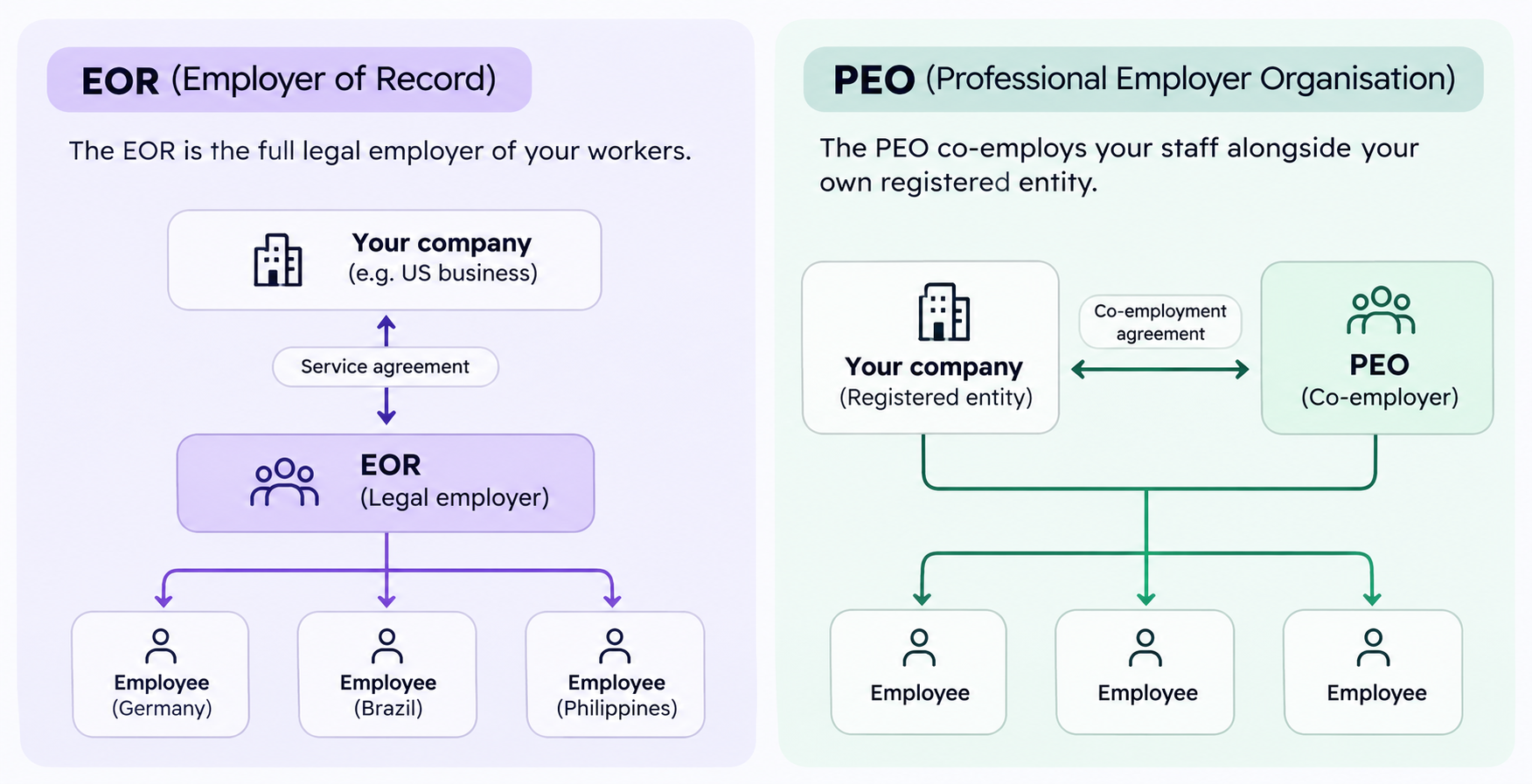
An employer of record (EOR) legally employs staff on your behalf, allowing you to hire in another country without setting up a local company. A professional employer organisation (PEO) shares certain employment responsibilities with your existing business through co-employment. The biggest difference is who legally employs your workers and whether you need a registered local entity.

Let's look at how both models work, what they cost and how to choose the right one for your growing team.

EOR vs PEO: How do they compare?

The easiest way to understand the difference between an EOR and a PEO is to look at who takes responsibility for employment.

An EOR becomes the legal employer of your workers in the relevant country, while a PEO works alongside your existing business to manage employment-related tasks.

Here's how the two compare:

Feature Employer of record (EOR) Professional employer organisation (PEO)
Legal employer EOR is the formal legal employer Your company remains an employer under a co-employment arrangement
Local entity required
No, typically not Yes, generally
Employment model
Third-party legal employment Co-employment
Geographic reach
Particularly useful for international hiring Commonly used for domestic HR management
Payroll
EOR administers local payroll PEO administers payroll on behalf of the client
Compliance EOR handles many formal employer obligations Responsibilities are shared according to the agreement and applicable law
Employee benefits EOR arranges locally compliant benefits PEO helps administer benefits and may provide access to group plans
Liability EOR assumes specified legal employer responsibilities, but the client retains some risks Responsibilities and liabilities are divided between the PEO and client
Best for Hiring in countries where you don't have a registered business Managing HR and payroll where your business already operates
Typical pricing
Often a monthly fee per employee Often a fee per employee or a percentage of payroll

‍

You may also see the term PEO employer of record used when researching international hiring. This can be confusing because a PEO may handle payroll administration and certain employer-related filings without becoming the sole legal employer of your staff.

The important thing is to check the actual employment arrangement, not just the terminology a provider uses.

What is an EOR?

An employer of record (EOR) is a third-party organisation that legally employs workers on behalf of another company, allowing businesses to hire internationally without setting up a local entity.

Imagine you run a US-based technology company and find an excellent developer in the Philippines. You want to hire them full-time, but you don't have a registered company there or the infrastructure to manage local payroll and employment regulations.

An EOR becomes the developer's legal employer, taking care of these responsibilities while you manage their everyday work.

How does an EOR work?

An EOR typically handles the legal and administrative aspects of employment, including:

  • Preparing locally compliant employment contracts
  • Processing salaries, taxes and statutory deductions
  • Managing employee benefits, leave and contributions
  • Handling onboarding, offboarding and employment compliance

Your company remains in charge of daily operations, including assigning tasks, managing performance and setting team goals.

This arrangement is particularly useful for businesses looking to explore new markets, build international teams or expand without investing in local subsidiaries.

However, working with an EOR doesn't remove all your legal responsibilities. Your company may still be accountable for workplace practices, intellectual property and data protection, depending on local laws and contractual arrangements.

For a closer look at the model, read our guide explaining what an employer of record is.

What is a PEO?

A professional employer organisation (PEO) shares certain employment responsibilities with your business through a co-employment arrangement. Unlike an EOR, a traditional PEO generally requires your company to have an existing legal entity in the country where your employees work.

Imagine you run a growing marketing agency in California with 30 employees, but managing payroll, benefits and HR paperwork is becoming increasingly time-consuming.

A PEO helps you manage these responsibilities while your company remains an employer.

How does a PEO work?

A PEO typically helps businesses manage employment-related tasks, including:

  • Processing payroll and managing tax filings
  • Administering employee benefits
  • Providing HR support and employment documentation
  • Assisting with employment compliance

Your company continues to manage employees' daily work, performance and business decisions.

Working with a PEO may also give smaller businesses access to employee benefits that would otherwise be expensive or difficult to manage independently.

However, employment responsibilities are shared. Your company remains accountable for workplace practices, employee supervision and its obligations under applicable laws.

If you're exploring this option, our guide to what a PEO is explains the model in more detail.

Key differences between an EOR and a PEO

The main differences between an EOR and a PEO come down to four things: local entity requirements, geographic coverage, compliance responsibilities and costs.

Diagram comparing the EOR and PEO employment models.

1. Local entity requirements

An EOR allows you to hire employees in another country without establishing your own local entity, while a traditional PEO generally requires an existing registered business.

For example, if you're a US company hiring your first employee in Germany, an EOR may be the more practical option. If you already have a German subsidiary, a PEO or local HR outsourcing provider may be a better fit.

2. Geographic coverage

EOR services are designed for international hiring, allowing businesses to build teams across multiple countries without establishing a separate company in each location.

Traditional PEOs are more commonly used for domestic employment, particularly in the US.

Some providers offer international PEO services, but these may operate through an EOR or another employment structure. Always check which model applies in your target country.

3. Compliance and legal responsibility

An EOR becomes the formal legal employer, handling responsibilities such as employment contracts, payroll taxes and statutory contributions.

With a PEO, these responsibilities are shared between your company and the provider through a co-employment agreement.

Neither model removes all your legal obligations. Your business may still be responsible for workplace safety, employee classification and other employment matters.

The US Department of Labor's guidance on joint employment explains how employment responsibilities can extend to more than one organisation under certain US labour laws.

4. Costs and pricing

EOR providers typically charge a fixed monthly fee per employee, while PEOs often charge a fee per employee or a percentage of payroll.

For example, an EOR charging $500 per employee would cost $2,500 per month for five employees. A PEO charging $150 per employee would cost $750 for the same number of workers, assuming your business already has a local entity.

These figures are illustrative and exclude salaries, taxes, benefits and additional charges.

When comparing costs, look beyond the monthly fee. An EOR may be more expensive per employee but save you the cost of establishing and maintaining a foreign entity. A PEO may offer better value if your business is already established and you're looking to scale your HR operations.

When should you choose an EOR or a PEO?

Choose an EOR if you want to hire employees in a country where you don't have a legal entity. A PEO is a better fit if your business is already established and needs support managing HR, payroll and employee benefits.

Choose an EOR when you're expanding internationally

An EOR is particularly useful when hiring your first overseas employees, exploring new markets or building a global team.

Imagine your US-based software company wants to hire a designer in Brazil, a developer in India and a customer support specialist in the Philippines. Instead of establishing three separate legal entities, an EOR can manage local employment arrangements while you focus on running your team.

However, as your workforce grows in a particular country, establishing your own entity may become more cost-effective.

Choose a PEO when you're scaling an existing business

A PEO makes sense when your business is growing and managing HR internally is becoming increasingly demanding.

For example, if your consulting firm has grown from 10 to 80 employees, a PEO can help manage payroll, benefits, onboarding and HR administration without the need to build a large internal HR department.

You get professional HR support while maintaining your existing employment structure.

What if you're hiring contractors instead?

If you're working with independent contractors, you may not need an EOR or PEO. You can generally engage them directly through a service agreement and pay them for their work.

However, the working relationship must meet local classification rules. If someone follows a fixed schedule, works under direct supervision and operates like a regular employee, they may need to be classified as one.

Understanding the difference between a contractor and an employee can help you avoid legal and tax complications.

Paying a global team: How does it work with an EOR or PEO?

With an EOR, you fund the provider, which handles local payroll. With a PEO, payroll is managed through your existing business and its agreed payroll arrangements.

When managing an international team, you'll also need to consider exchange rates, transfer fees and payment delivery times.

Cross-border salary payments from the US to a global team.

Paying employees through an EOR

The payroll process with an EOR typically involves four steps:

  1. Your company submits salary details and payroll adjustments.
  2. The EOR calculates taxes, contributions and benefits.
  3. Your company funds the EOR according to its invoice.
  4. The EOR pays employees through the local payroll system.

For example, if your US company employs someone in Brazil, you might receive an invoice in USD while the employee gets paid in Brazilian reais.

Make sure you understand how your EOR handles currency conversion, funding deadlines and additional payroll fees.

Paying employees through a PEO

A PEO manages payroll, tax deductions and employee benefits through your existing business's employment structure.

If you operate in multiple countries, you may need separate payroll arrangements for each location. A traditional US PEO, for example, won't necessarily handle payroll for employees in the Philippines or Kenya.

Check which countries your provider supports and what payment options are available.

Managing international payments with Grey

Beyond payroll, running a global team involves moving money across borders. You might need to fund an overseas payroll provider, transfer money between business accounts or pay international contractors.

Grey helps businesses manage eligible international payments and hold and send multiple currencies, giving them more flexibility over when they convert their money.

You can explore different payment routes to pay your team from the US. For example, if you're working with a freelance developer in Manila, you can send money from the US to the Philippines through supported payment methods.

Grey complements your employment arrangements by helping you manage international payments rather than replacing your EOR, PEO or payroll provider.

What should you check before paying an international team?

Before choosing a payment method, consider:

  • Who is responsible for processing payroll and statutory deductions
  • Which currencies and payment methods your team can receive
  • Exchange rates, transfer fees and delivery times
  • Local employment and payroll requirements

Remember that paying a contractor's invoice is different from processing an employee's salary. Choosing the right employment model and payment method can help you manage costs and keep your international team paid on time.

Frequently asked questions about EOR vs PEO

What is the difference between an EOR and a PEO?

The main difference is who legally employs your staff. An EOR becomes the formal legal employer of workers on your behalf, while a PEO shares certain employment responsibilities with your existing company through co-employment.

An EOR is particularly useful for hiring internationally without establishing a local entity. A PEO generally supports businesses that already have a registered presence where their employees work.

Which do I need to hire abroad?

An EOR is usually the better option if you want to hire employees in another country without establishing your own local company.

If your business already has a legal entity in that country, a PEO or local payroll and HR provider may be suitable.

The best choice depends on your existing business structure, workforce size, budget and long-term hiring plans.

Does a PEO require a local entity?

Yes, a traditional PEO generally requires your business to have a registered legal entity in the jurisdiction where employees work.

This is because a PEO operates through a co-employment arrangement rather than replacing your company as the employer.

Some providers offer international PEO services without requiring a local entity, but these may actually use an EOR structure. Always confirm the legal employment model before signing an agreement.

Who is the legal employer under an EOR or PEO?

Under an EOR arrangement, the EOR is the formal legal employer, although your company still directs the employee's daily work and may retain certain legal responsibilities.

Under a traditional PEO arrangement, your company remains an employer, while the PEO assumes specified employment-related responsibilities through co-employment.

The exact allocation of responsibilities depends on local laws and the provider agreement.

Which is cheaper, an EOR or a PEO?

A PEO may be cheaper per employee for an established business with a larger workforce, but an EOR can be more economical when you're hiring a small number of employees in countries where you don't have a legal entity.

EOR fees often reflect the additional responsibilities and infrastructure involved in international employment.

To compare costs accurately, include service fees, employer taxes, benefits, local entity expenses, payroll charges and any currency conversion costs.

How do I pay an international team?

You can pay an international team through an EOR, a local payroll arrangement supported by a PEO or direct contractor payments, depending on the worker's legal classification.

For employees hired through an EOR, you'll generally fund the provider, which processes salaries and statutory deductions locally.

For independent contractors, you may be able to use an international payment platform such as Grey to send money to supported countries, subject to account eligibility and payment requirements.

Pay your global team with Grey

Hiring internationally gives your business access to people and skills beyond your home market. But managing the money behind a global team deserves just as much attention as finding the right people.

Once you've chosen the appropriate employment model, Grey can help you explore cross-border payment options, manage supported currencies and send money internationally.

Explore how to pay your global team with Grey.

Arrow (up)

Back to top