
<script type="application/ld+json" data-schema-version="grey-blog-v4"> [{"@context":"https://schema.org","@type":"BlogPosting","@id":"https://grey.co/blog/save-in-usd-gbp-eur#article","headline":"Should you save in dollars, pounds or euros?","description":"Getting paid in dollars, pounds or euros? See how to choose the right currency to save in, and when to convert, then open a Pouch to start saving.","inLanguage":"en","url":"https://grey.co/blog/save-in-usd-gbp-eur","mainEntityOfPage":{"@id":"https://grey.co/blog/save-in-usd-gbp-eur#webpage"},"datePublished":"2026-09-01T20:10:08.408Z","dateModified":"2026-09-27T02:20:35.422Z","author":{"@type":"Person","@id":"https://grey.co/authors/priscila-marotti#person","name":"Priscila Marotti","url":"https://grey.co/authors/priscila-marotti","jobTitle":"Content Writer","sameAs":["https://www.linkedin.com/in/priscila-marotti/"]},"publisher":{"@type":"Organization","@id":"https://grey.co/#organization","name":"Grey","url":"https://grey.co","logo":{"@type":"ImageObject","url":"https://cdn.prod.website-files.com/6360022338a81bd6fdbb1145/6564ae1077a67e39d3c491a6_Grey%20Logo%20Lockup%20Black.svg"}},"image":{"@type":"ImageObject","@id":"https://grey.co/blog/save-in-usd-gbp-eur#primaryimage","url":"https://cdn.prod.website-files.com/636a85d290ee58e70c17e1c0/6a9730f3d0a7a3ea45d6f250_Should%20You%20Save%20in%20Dollars%2C%20Pounds%20or%20Euros-compressed.jpg","contentUrl":"https://cdn.prod.website-files.com/636a85d290ee58e70c17e1c0/6a9730f3d0a7a3ea45d6f250_Should%20You%20Save%20in%20Dollars%2C%20Pounds%20or%20Euros-compressed.jpg","width":1200,"height":675}},{"@context":"https://schema.org","@type":"WebPage","@id":"https://grey.co/blog/save-in-usd-gbp-eur#webpage","url":"https://grey.co/blog/save-in-usd-gbp-eur","name":"Should You Save in Dollars, Pounds or Euros? | Grey","description":"Getting paid in dollars, pounds or euros? See how to choose the right currency to save in, and when to convert, then open a Pouch to start saving.","inLanguage":"en","primaryImageOfPage":{"@id":"https://grey.co/blog/save-in-usd-gbp-eur#primaryimage"},"breadcrumb":{"@id":"https://grey.co/blog/save-in-usd-gbp-eur#breadcrumb"}},{"@context":"https://schema.org","@type":"BreadcrumbList","@id":"https://grey.co/blog/save-in-usd-gbp-eur#breadcrumb","itemListElement":[{"@type":"ListItem","position":1,"name":"Home","item":"https://grey.co/"},{"@type":"ListItem","position":2,"name":"Blog","item":"https://grey.co/blog"},{"@type":"ListItem","position":3,"name":"Should you save in dollars, pounds or euros?","item":"https://grey.co/blog/save-in-usd-gbp-eur"}]},{"@context":"https://schema.org","@type":"FAQPage","@id":"https://grey.co/blog/save-in-usd-gbp-eur#faq","mainEntity":[{"@type":"Question","name":"Is it better to save in dollars or euros?","acceptedAnswer":{"@type":"Answer","text":"Neither currency is automatically better for saving. A useful approach is to consider the currency you earn and the currency you expect to spend. If you earn in USD and are saving for an expense priced in dollars, keeping the money in USD can avoid an unnecessary conversion. If your goal is priced in EUR, saving that portion in euros may make more sense."}},{"@type":"Question","name":"Should I save in the same currency I get paid in?","acceptedAnswer":{"@type":"Answer","text":"It can make sense, particularly if you expect to use the money in that currency later. Keeping part of your income in its original currency also means you don’t have to convert all of it as soon as you’re paid. For goals in another currency, you may prefer to set money aside in the currency you expect to spend."}},{"@type":"Question","name":"Is it good to keep savings in different currencies?","acceptedAnswer":{"@type":"Answer","text":"It can be useful when you earn or spend in multiple currencies. For example, someone earning USD but planning to move to the UK may keep part of their savings in USD and set aside a separate GBP fund for moving expenses. The decision should reflect your actual plans rather than trying to predict which currency will increase in value."}},{"@type":"Question","name":"When should I convert my foreign currency income?","acceptedAnswer":{"@type":"Answer","text":"Consider converting the portion you know you’ll need in another currency. If you’re paid in USD but need local currency for your monthly expenses, converting enough to cover those expenses makes sense. Money intended for a future USD expense may not need to be converted at all."}},{"@type":"Question","name":"Can I save in USD, GBP and EUR at the same time?","acceptedAnswer":{"@type":"Answer","text":"Yes. With a multi-currency account that supports these currencies, you can keep money in USD, GBP and EUR at the same time. Grey Pouch also lets you create separate Pouches in each supported currency, so different goals can have their own currency and target."}},{"@type":"Question","name":"What is multi-currency saving?","acceptedAnswer":{"@type":"Answer","text":"Multi-currency saving means keeping money for different goals in more than one currency rather than converting everything into a single currency. For example, you might keep an emergency fund in USD, save for UK expenses in GBP and set aside EUR for a European trip. The currencies you choose depend on how you earn and what you’re saving for."}},{"@type":"Question","name":"Does Pouch pay interest?","acceptedAnswer":{"@type":"Answer","text":"No. Pouch is not an investment or interest-bearing savings product. It is a way to separate money from your main Grey balance and organise it around specific goals in USD, GBP or EUR."}}]}] </script>

Should you save in dollars, pounds or euros?

Priscila Marotti

TABLE OF CONTENT

SHARE THIS POST

I used to live in Spain while getting paid in dollars, which meant my income was in USD but most of my expenses were in euros. Whenever I wanted to save part of what I earned, I had to decide if it made more sense to keep the money in dollars or convert it to euros.

If you earn internationally, you may have asked yourself the same question. And the answer depends less on which currency is “better” and more on what you’re saving for.

There isn’t one currency that always makes the most sense. It depends on where your money comes from and, just as importantly, where it will eventually go.

A simple rule is to save in the currency you earn or plan to spend. If you’re paid in dollars and your goal is in dollars, keeping that money in USD avoids converting it twice. If you know you’ll eventually spend in another currency, you can plan your savings around that instead.

Let’s look at when saving in USD, GBP or EUR makes sense and how to choose the right currency for different goals.

Does the currency you save in matter?

Yes, especially when your income and expenses involve more than one currency.

Imagine you’re paid $2,000 each month and want to set $300 aside. You could immediately convert that $300 into your local currency, but what happens if you’re saving for something you’ll eventually pay for in dollars?

When the time comes, you may need to convert the money back to USD. That means going through two currency conversions when you could have simply kept part of your original payment in dollars.

Every currency conversion comes with an exchange rate, and providers may include a margin or charge a conversion fee. Exchange rates also change over time, so the amount you get when converting today may be different from what you would get a few months from now.

This is where thinking about the purpose of your savings becomes useful.

Rather than asking which currency is the “best” to save in, ask yourself two questions: What currency do I earn in, and what currency will I need when I spend this money?

The answers can help you decide where to keep it.

When it makes sense to save in dollars, pounds or euros

USD, GBP and EUR are widely used currencies, but that doesn’t mean you need to pick one and keep all your savings there.

The right choice depends on your income, expenses and plans.

Saving in USD

Keeping savings in dollars can make sense if most of your income already arrives in USD.

If part of that money is intended for future expenses in USD, keeping it in dollars means you don’t need to convert it until there’s a reason to.

USD may also make sense for a general buffer if dollars are a regular part of your financial life. The important part is that the currency matches how you expect to use the money.

Saving in GBP

GBP can be a practical choice if you earn or regularly spend in pounds.

Perhaps you work with UK clients and receive part of your income in GBP. Or maybe you’re saving for tuition, rent, a move to the UK or another expense that you know will be charged in pounds.

Keeping that money in GBP means you already have the currency you’ll eventually need.

If you earn in another currency, however, moving everything into pounds just because you think GBP might become stronger introduces another variable. Exchange rates can move in either direction, so your decision is better based on a real future need than trying to predict the market.

Saving in EUR

The same logic applies to euros.

If you receive EUR from clients or employers, you may want to keep part of those earnings in euros rather than immediately converting the full payment.

EUR can also be useful when you have a specific euro-denominated goal. You might be planning a trip around Europe, saving for a move, paying for a course or preparing for another expense that will eventually come out of your pocket in euros.

In that case, gradually setting aside EUR can help you build towards the amount you know you’ll need.

Here’s a simple way to think about it:

If you... Plan to spend in... It may make sense to save in...
Earn in USD from US clients USD USD
Earn in GBP and are building an emergency buffer GBP GBP
Earn in EUR and are planning a European trip EUR EUR
Earn in USD but are moving to the UK GBP GBP for the moving goal
Earn in GBP but are planning a trip priced in EUR EUR EUR for the trip
Earn in several currencies Have goals in different currencies Match each goal to the currency you expect to spend

‍

You don’t necessarily have to make the same choice for every goal. Your emergency money, next holiday and future move can each have different timelines and currency needs.

The real cost of converting too early

It’s tempting to convert foreign income as soon as you receive it, especially if that’s what you’ve always done. But converting before you know what the money is for can sometimes mean paying for an extra conversion later.

Say you receive $1,000 and want to save $200 for something priced in USD. If you keep that $200 in dollars, it’s ready when you need it. But if you convert everything to your local currency, you’ll eventually have to convert part of it back to USD.

That extra conversion can come with fees, and exchange rates may change in the meantime.

Of course, converting the money you need for rent, groceries and other local expenses makes sense. For the rest, think about what you’re saving for before deciding which currency to keep it in.

How to match your savings currency to your goals

Once you start thinking about savings as individual goals rather than one big pot of money, choosing a currency becomes easier.

Say you have three plans: an emergency fund, a trip to Spain and money for an upcoming move to London.

Each one serves a different purpose.

Your emergency fund might stay in the currency you earn or use most often. For your Spain trip, you could gradually set aside EUR because that’s what you’ll spend when you get there. And your moving fund could be kept in GBP because you already know you’ll need pounds for deposits, rent and other expenses.

Instead of trying to decide if USD, GBP or EUR is universally “better”, you’ve matched each currency to a real goal.

You can apply the same approach to smaller plans, like a new laptop priced in USD, a course charged in GBP or a holiday budget in EUR.

If you earn internationally, opening a multi-currency account can make this easier because you don’t have to move everything into one currency as soon as you get paid.

And you can take the idea a step further by separating the money for each goal.

Save in USD, GBP and EUR with Pouch

With Pouch, you can create individual Pouches in USD, GBP and EUR and give each one its own purpose. You might have an Emergency Pouch in USD, a London Pouch in GBP and a Summer Trip Pouch in EUR.

You can also set a target for each Pouch, making it easier to see how close you are to your goal without mixing that money with your everyday balance.

If your first priority is having money available for unexpected expenses, you can also start by learning how to build an emergency fund.

There’s also Round-ups if you want to build towards a goal little by little. When you enable Round-ups, eligible Grey card payments are rounded up and the difference is moved into the Pouch you choose.

Pouch doesn’t pay interest, and the money you put there isn’t invested. It simply gives your savings and plans their own space within Grey, separate from the money sitting in your everyday balance.

If you already receive your income through Grey, you can save in the currency you earn and start building towards your next goal without converting the money first.

The goal is to give the money you’re setting aside a currency that makes sense for how you plan to use it.

Frequently asked questions about saving in dollars, pounds or euros

Is it better to save in dollars or euros?

Neither currency is automatically better for saving. A useful approach is to consider the currency you earn and the currency you expect to spend.

If you earn in USD and are saving for an expense priced in dollars, keeping the money in USD can avoid an unnecessary conversion. If your goal is priced in EUR, saving that portion in euros may make more sense.

Should I save in the same currency I get paid in?

It can make sense, particularly if you expect to use the money in that currency later. Keeping part of your income in its original currency also means you don’t have to convert all of it as soon as you’re paid.

For goals in another currency, you may prefer to set money aside in the currency you expect to spend.

Is it good to keep savings in different currencies?

It can be useful when you earn or spend in multiple currencies. For example, someone earning USD but planning to move to the UK may keep part of their savings in USD and set aside a separate GBP fund for moving expenses.

The decision should reflect your actual plans rather than trying to predict which currency will increase in value.

When should I convert my foreign currency income?

Consider converting the portion you know you’ll need in another currency.

If you’re paid in USD but need local currency for your monthly expenses, converting enough to cover those expenses makes sense. Money intended for a future USD expense may not need to be converted at all.

Can I save in USD, GBP and EUR at the same time?

Yes. With a multi-currency account that supports these currencies, you can keep money in USD, GBP and EUR at the same time.

Grey Pouch also lets you create separate Pouches in each supported currency, so different goals can have their own currency and target.

What is multi-currency saving?

Multi-currency saving means keeping money for different goals in more than one currency rather than converting everything into a single currency.

For example, you might keep an emergency fund in USD, save for UK expenses in GBP and set aside EUR for a European trip. The currencies you choose depend on how you earn and what you’re saving for.

Does Pouch pay interest?

No. Pouch is not an investment or interest-bearing savings product. It is a way to separate money from your main Grey balance and organise it around specific goals in USD, GBP or EUR.

Give each goal its own currency

There’s no need to choose one currency for every part of your savings.

Start with what the money is for. If the goal is to be paid for in dollars, saving in USD may make sense. If you know you’ll need pounds or euros, you can build towards the goal in that currency instead.

With Grey Pouch, you can separate those plans, set targets and keep your USD, GBP and EUR savings organised in one place.

Open a Pouch in the currency you earn and fund it today.

Last updated:

October 2, 2026

Open a free Grey account to get startedJoin 1 million digital nomads
IF YOU ENJOYED THIS, CHECK THESE OUT

Saving vs investing for short-term goals: Which is right?

•

•

2 min read

Saving and investing can both help you reach your financial goals, but choosing the wrong approach could leave you short when you need the money. The difference comes down to when you plan to use it and how much risk you can afford to take.

Saving is usually the better choice for short-term goals, such as paying for a holiday, covering moving expenses, or building an emergency fund within the next one to three years. Your money stays accessible, and you avoid the risk of losing part of it to a market downturn just before your deadline.

Investing may be more suitable for goals that are at least five years away, giving your money more time to recover from market fluctuations and potentially grow.

But how do you decide what to set aside and where to put it? Understanding how much you should invest each month starts with your income, expenses, financial priorities, and timeline. The right choice depends on your goal, not just the returns you hope to earn.

Saving vs investing: The key differences

Saving means putting money aside in a safe, accessible place, such as a savings account. It works best for money you may need soon, whether for rent, school fees, a holiday, or an unexpected bill. The main benefit is that your money is less exposed to market losses, and you can usually withdraw it when needed. However, savings may grow slowly, especially when inflation reduces what your money can buy.

Investing means putting money into assets such as stocks, bonds, or mutual funds to grow your wealth over time. Unlike savings, investments can lose value, particularly in the short term. You may earn higher returns, but there is no guarantee. Risk is the key difference: savings balances are generally more stable, while investment values can rise or fall. Access also varies; some investments take days to sell, and others may charge withdrawal fees or have restrictions.

Your timeline should guide your choice. For goals within one to three years, saving is generally safer. For longer-term goals, investing may help your money grow. Before investing, build an emergency fund first so unexpected expenses do not force you to sell investments at a loss.

How to invest for short-term goals (and when not to)

Imagine you are saving for a wedding next year, a car in 18 months, or your tuition fees in two years. You know exactly when you need the money, so the last thing you want is to discover that your investment has lost value just before payment is due.

That is why short-term goals usually favour saving over investing. The stock market can rise or fall within weeks, and you may not have enough time to recover from a loss. Keeping your money in a savings account helps protect it while making it available when you need it. You may earn less, but you have more certainty about your balance.

If you want your money to earn some interest, consider lower-risk options such as high-yield savings accounts, money market funds, or short-term government Treasury bills. Each comes with different risks, access rules, and possible fees, so check the terms before choosing.

Avoid putting money you cannot afford to lose into volatile investments for a deadline that is only months away. The goal is to have your money ready on time, not to chase the highest return.

How much of your income should you invest?

Deciding how much to invest each month can feel difficult when rent, groceries, bills, and other expenses already take a big chunk of your income. The good news is that you do not need a large salary to start investing. What matters is choosing an amount you can afford consistently without struggling to cover your basic needs.

A common rule of thumb is to invest 10% to 15% of your income, especially when you have covered essential expenses and built an emergency fund. However, this is a guide, not a strict rule. Start with a smaller amount if money is tight, and increase it as your income grows.

For example, imagine you earn $3,000 a month after tax. Investing 10% means putting aside $300 monthly. You could use the remaining $2,700 for rent, food, bills, savings, and other expenses. If $300 feels too high, start with $100 and build gradually.

Before deciding what to invest, work out how much to save each payday for emergencies and upcoming expenses. Invest only money you can leave untouched for the time your goal requires.

Where to keep your short-term money

Short-term savings need a home where your money stays accessible when you need it. For example, if you are saving for a holiday in six months or a laptop next year, you do not want to risk losing that money in the stock market just before making your purchase. A savings account or another low-risk option can help you keep your money available. Before choosing, check the interest rate, fees, and withdrawal conditions.

You should also consider the currency you save in. If you plan to pay for a trip, course, or online purchase in US dollars, keeping your savings in your local currency could leave you short if the exchange rate changes. Holding USD may help you prepare for dollar expenses, although exchange rates can move in either direction.

Grey Pouch gives you a way to set money aside for specific goals. You can keep short-term money in a Pouch goal to organise your savings, while holding USD may help you protect your money from currency swings when saving for expenses priced in dollars. Check the applicable fees, terms, and access conditions before deciding.

Frequently asked questions

1. Should I save or invest?

Save when you need your money within the next few years or cannot afford to lose it. Investing is generally better for long-term goals because your money has more time to recover from market losses. Your timeline, financial situation, and comfort with risk should guide your decision.

2. How much should I invest each month?

A common starting point is 10% to 15% of your monthly income, but you do not have to meet this target immediately. Cover essential expenses, manage expensive debt, and build an emergency fund first. Start with an affordable amount and increase it as your income grows.

3. Is it worth investing for two years?

Investing for two years can be risky because market prices may fall just before you need your money. For goals with a fixed deadline, savings accounts or suitable low-risk options may be better. Choose investments only when you understand the risks and can handle potential losses.

4. What is the safest place to keep short-term savings?

A savings account with a regulated financial institution is often suitable for short-term money. Depending on your country, deposit protection may apply within certain limits. Check withdrawal conditions, fees, and interest rates to ensure your money remains accessible when you need it.

5. Can I save and invest at the same time?

Yes, you can save and invest simultaneously. Keep savings for emergencies, upcoming bills, and goals within the next few years. Invest money intended for longer-term goals, such as retirement. This approach helps you prepare for immediate expenses while giving some of your money time to grow.

6. Should I save in USD or my local currency?

Choose based on what you plan to spend the money on. Local currency may suit everyday expenses, while USD savings may help prepare for dollar-priced costs, such as international travel or tuition. Exchange rates can move both ways, so consider conversion fees and when you will need the money.

Keep short-term goal money safe and separate. Open a Grey account, hold it in USD, and track it in a Pouch.
What is a W-2 form? How to read yours

•

•

2 min read

Tax season can be confusing, especially when you are trying to figure out how much you earned and how much tax you paid. Your W-2 form helps you understand both. What is a W-2? It is a US tax form your employer sends you each year. It shows your total earnings and the taxes taken out of your pay. You need it to file your income tax return.

Your employer generally sends your W-2 by January 31 for the previous year. The form has different boxes showing your wages, taxes, and other details about your pay.

If you work as an employee, you will usually receive a W-2. Independent contractors generally receive a 1099 instead. Knowing what a W-2 means and how to read yours can help you file your taxes correctly. Let’s look at what the boxes on your form mean.

What is a W-2 form?

A W-2 form shows how much you earned from your job during the year and how much tax your employer took out of your pay. You need it to file your US income tax return and report your earnings correctly.

Your employer prepares and sends you the form. If you worked for multiple employers during the year, each one should give you a separate W-2. Check your name, wages, and tax details when it arrives to make sure everything is correct.

The deadline for employers to send W-2 forms is generally January 31 each year. The form covers the previous tax year, so your W-2 received in January 2027 will usually report your 2026 earnings.

A W-2 reports what you earned and the taxes withheld. A W-4, on the other hand, helps your employer determine how much federal income tax to withhold from your paycheck. Understanding the difference between the two forms can help you manage your tax paperwork and avoid confusion when filing your return.

How to read your W-2 box by box

Your W-2 form contains several boxes that show your earnings and the taxes taken from your paycheck. Knowing what each box means helps you check your details before filing your tax return.

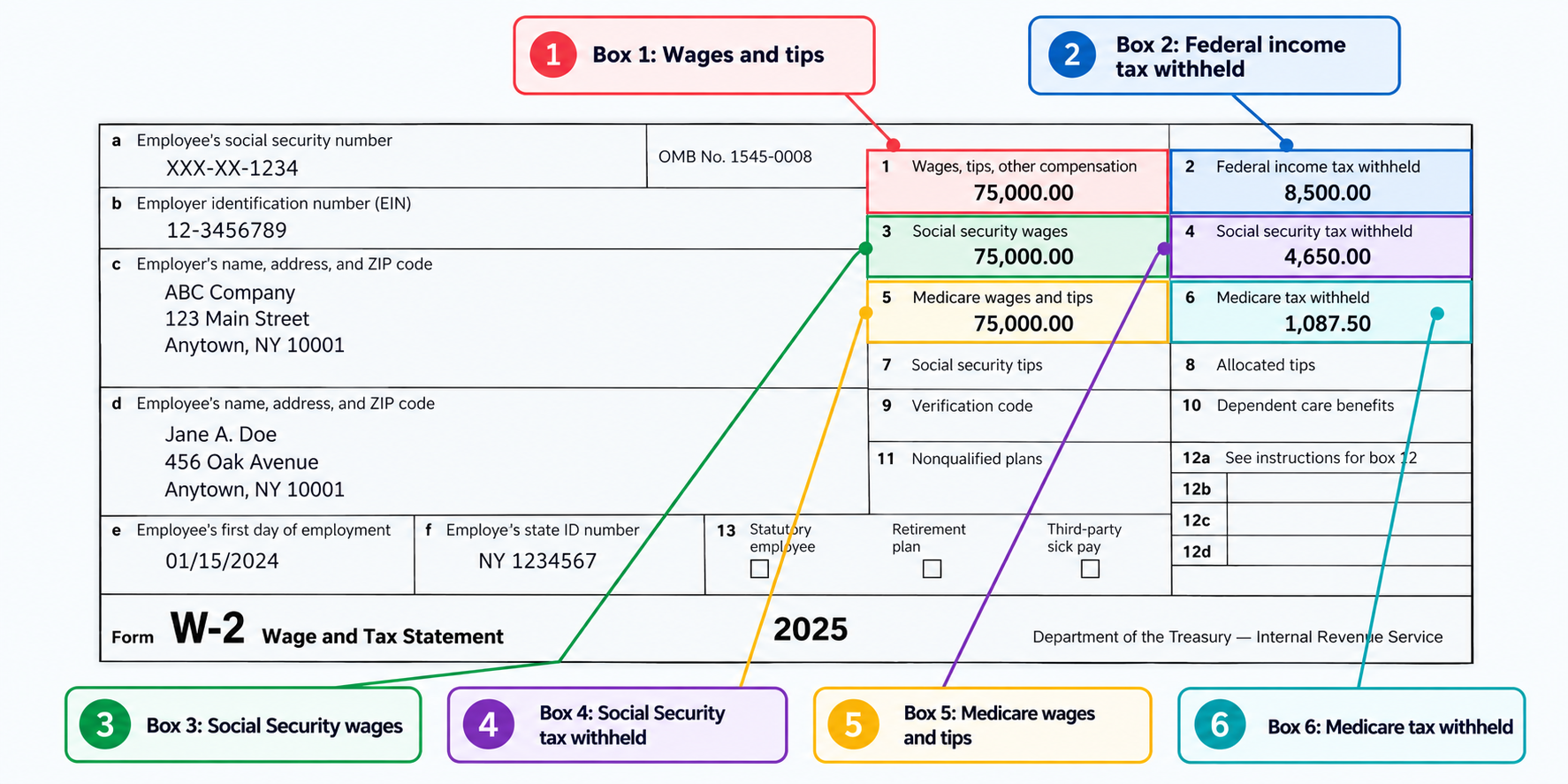
An annotated W-2 form with callouts on the wages, withholding, Social Security and Medicare boxes.
  • Box 1: Wages and tips. Shows the income subject to federal income tax.
  • Box 2: Federal income tax withheld. Shows how much federal income tax your employer took from your pay.
  • Box 3: Social Security wages. Shows the earnings subject to Social Security tax.
  • Box 4: Social Security tax withheld. Shows the Social Security tax deducted from your paycheck.
  • Box 5: Medicare wages and tips. Shows the earnings used to calculate Medicare tax.
  • Box 6: Medicare tax withheld. Shows the Medicare tax withheld from your pay.

These boxes help you understand your reported income and tax payments. Compare the figures with your pay records, and contact your employer if you notice any errors. Correct information helps you file your tax return accurately.

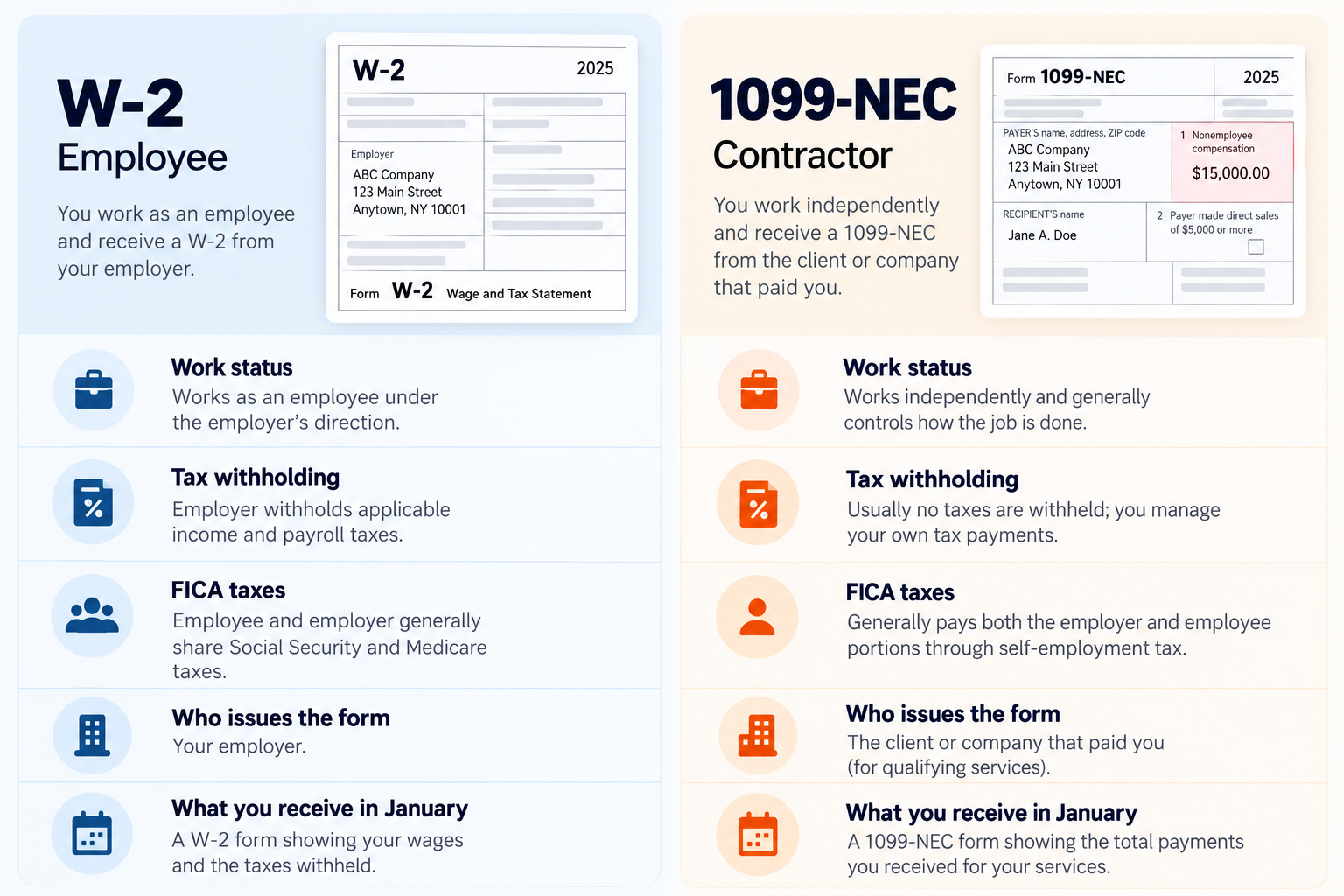
W-2 vs. 1099: What is the difference?

The main difference between a W-2 and a 1099-NEC is your work status and how you pay taxes. A W-2 is for employees, while a 1099-NEC is generally used to report payments to independent contractors. Understanding the difference between 1099 and W-2 can help you know which form applies to your work.

Comparison graphic showing the differences between a W-2 employee and a 1099 contractor.

Your classification affects how you handle taxes and other work responsibilities. If you are unsure whether you are an employee or an independent contractor, look at the nature of your working relationship, not just the form you receive.

What to do if your W-2 is wrong or missing

If your W-2 has the wrong income, tax details, or Social Security number, or you have not received it, do not ignore the problem. You need the correct information to file your tax return.

Contact your employer first: Explain what is wrong or ask when your missing W-2 will arrive. If your original form has an error, your employer can issue a corrected form called Form W-2c. Check the updated details before filing your taxes.

Contact the IRS if the problem continues: If your W-2 is still missing or has not been corrected by the end of February, call the IRS at 800-829-1040 for help. The IRS can contact your employer and explain your next steps.

What if the deadline is near: If you cannot get your W-2 in time to file, the IRS may direct you to use Form 4852, which serves as a substitute. Use your pay records to estimate your wages and taxes accurately. If you already filed using incorrect figures, you may need to submit an amended tax return.

Getting paid across borders

Getting paid by a US employer or client should not be difficult just because you live in another country. You still need a reliable way to receive your money, manage it in dollars, and use it where you live. This is where getting paid across borders becomes important, especially for freelancers, remote workers, and businesses working with international clients.

Grey helps you receive international payments through a foreign currency account. With a Grey USD account, you can share your account details with eligible US employers or clients to get paid from the US without relying on a traditional US bank account. You can then keep your money in dollars or convert it to your local currency when you need it.

To get started, you can open a USD account with Grey, complete identity verification, and check the available receiving options and fees for your location. This makes it easier to manage your international earnings from one place.

Frequently asked questions about the W-2 form

What is a W-2 form?

A W-2 form is an official US tax document that shows how much you earned from your employer during the year and how much tax was withheld from your pay. You use it to report your earnings and taxes when filing your annual income tax return.

When should I get my W-2?

Employers generally must send your W-2 by January 31 each year for the previous tax year. You may receive it by mail or through your employer’s online payroll portal. If it has not arrived by early February, contact your employer to confirm when it will be available.

How do I read a W-2?

Box 1 shows wages subject to federal income tax, while Box 2 shows federal income tax withheld. Boxes 3 and 4 cover Social Security wages and tax, while Boxes 5 and 6 show Medicare wages and tax withheld.

What is the difference between a W-2 and a 1099?

W-2 employees generally have income and payroll taxes withheld by their employers. 1099 contractors usually receive payments without tax withholding and must manage their own tax payments, including self-employment taxes when applicable.

What if my W-2 is wrong?

Contact your employer’s payroll department as soon as possible and explain the error. Ask them to issue a corrected form called Form W-2c. Check the corrected details carefully and use accurate information when filing your tax return.

What if I do not receive my W-2?

Contact your employer first to request your missing form. If it has not arrived by the end of February, call the IRS at 800-829-1040 for assistance. Keep your pay stubs handy to help estimate your earnings and taxes if needed.

USDC vs USDT: 11 major differences

•

•

2 min read

The rise of stablecoins has made it possible to hold and transfer digital dollars without relying on traditional bank transfers for every transaction. Two of the most widely used options are USDT (Tether) and USDC (USD Coin). Although both aim to maintain a value of $1 per token, they differ in several important ways that can affect how you use them.

Understanding USDT vs USDC starts with knowing who issues each stablecoin. Tether issues USDT, while Circle issues USDC. Both use reserves to support their dollar pegs, but their reserve disclosures, reporting practices, regulatory approaches, blockchain availability, and adoption differ.

USDT generally has a larger circulating supply and broad trading support, making it popular across crypto markets. USDC is known for its regular reserve attestations and emphasis on transparency and regulatory compliance.

These differences matter if you want to trade crypto, transfer money internationally, or hold digital dollars. This guide compares 11 major differences to help you understand how each stablecoin works and which may suit your needs.

What is the main difference between USDT and USDC?

The main differences between USDT and USDC are their issuer, reserve transparency, and adoption across crypto markets. USDT is issued by Tether, while USDC is issued by Circle. Both aim to maintain a value of $1 per token, but they differ in how they disclose their reserves, approach regulatory compliance, and support trading and transfers across blockchain networks.

USDT is widely used for crypto trading because of its large circulating supply and broad exchange support. USDC emphasises reserve transparency, with backing primarily in cash and short-term US Treasury securities.

Neither stablecoin is risk-free. Their value can temporarily move away from $1, and their availability, transaction costs, and protections depend on the platform and blockchain you use.

Feature USDT (Tether) USDC (USD Coin)
Issuer
Tether Circle
Dollar peg
Aims for $1 Aims for $1
Reserve composition Primarily US Treasury bills and other assets, including repurchase agreements and money market funds Cash and eligible cash-equivalent assets, including short-term US Treasuries and overnight Treasury-backed repurchase agreements
Reserve reporting
Independent quarterly attestations Monthly third-party reserve attestations
Market adoption
Generally broader global trading use Strong adoption among institutions and regulated financial services
Blockchain support
Multiple networks, including Tron and Ethereum Multiple networks, including Ethereum and Solana

‍

Circle publishes monthly third-party reserve assurances, while Tether also publishes independent reserve attestations. These are attestations, not full independent audits of all reserve holdings.

Which one should you choose?

  • USDT: May suit you if you prioritise exchange liquidity and broad trading-pair support.
  • USDC: May suit you if you prioritise published reserve disclosures and its institutional payment ecosystem.

How the reserves compare

When comparing USDT vs USDC, one of the biggest differences is how each stablecoin backs its dollar peg. USDC, issued by Circle, is backed by cash and short-term US Treasury securities held in its reserve structure. USDT, issued by Tether, once held significant amounts of commercial paper but has since shifted its reserves toward US Treasury bills and other assets.

Both issuers publish independent attestations to provide information about their reserves and liabilities. However, an attestation reflects the position at a specific point in time. It does not guarantee continuous backing, immediate access to every reserve asset, or protection against legal and liquidity problems during a sudden market sell-off.

Why does this matter to you? If you hold stablecoins to preserve dollar value or plan to convert them into cash, reserve quality and redemption access are important considerations. Before cashing out, learn how USDC to USD conversion works so you understand the process and what to consider when turning your stablecoins into dollars.

Transparency, audits, and regulation

When comparing USDT vs USDC, transparency and regulation can help you understand how each stablecoin manages its reserves and reports financial information. However, it is important to distinguish between an attestation and a full audit.

An attestation checks whether reported assets and liabilities match at a specific point in time. A full audit examines financial records, transactions, internal controls, and other relevant information over a defined period. Both provide useful information, but neither automatically guarantees that a stablecoin will maintain its dollar peg under every market condition.

Circle, the issuer of USDC, operates within applicable US regulatory frameworks, including state money transmission requirements. Tether is registered with FinCEN as a Money Services Business (MSB). However, MSB registration is not the same as federal approval or insurance of a stablecoin's reserves.

If you use stablecoins for international payments, consider their transparency, regulatory status, and availability across your preferred platforms. Understanding how USDC compares with other stablecoins for global transactions can help you weigh these factors before choosing a suitable option.

Network support and transaction costs

When comparing USDT vs USDC, the blockchain you choose can make a big difference in how much you pay to send money. Both stablecoins operate across multiple networks, but their availability varies. USDT is widely used on Tron and Ethereum, while USDC is available on Ethereum, Solana, Base, and other supported blockchains.

Transaction fees depend mainly on the network, its congestion, and the type of transaction, rather than the stablecoin itself. For example, sending USDC on Ethereum can cost several dollars during busy periods, while transferring USDC on Solana typically costs a fraction of a cent. Base can also offer low-cost transfers. Tron is a popular option for USDT transfers, often with different fees depending on your wallet and available network resources.

Network Typical fee level What it means for you
Ethereum Can be several dollars or more Costs can rise when the network is busy.
Solana Usually a fraction of a cent for a basic transfer A low-cost option for sending USDC.
Base Generally low Can make USDC transfers cheaper than Ethereum mainnet.
Tron Varies with account resources and wallet fees Commonly used for USDT transfers.

‍

Ethereum fees fluctuate with demand, while Solana's standard transaction fees are generally very low.

What should you choose? If you are sending USDC, compare Solana, Base, and Ethereum before confirming your transaction. Check the estimated fee displayed in your wallet or exchange, and make sure the recipient supports the same network. Also account for any withdrawal or service fees charged by your platform, as these are separate from blockchain fees.

Also read: USDC on Solana compared with Ethereum

Converting USDT and USDC into money in your bank account

To turn stablecoins into money you can spend through a bank account, you need a platform that converts cryptocurrency into traditional currency. One option is to use a crypto exchange such as Coinbase or Kraken, where supported. You can deposit USDT or USDC, sell your tokens for USD or another available currency, and withdraw the funds to a linked bank account.

Another option is to use an off-ramp service. Circle Mint, for example, supports eligible institutional customers converting USDC into USD. Access depends on your location and account eligibility.

Once your funds are converted, a multi-currency account can help you manage your dollars and international payments. Grey supports sending and receiving USDC and offers multi-currency financial services for eligible users. Depending on your account and location, this can help you manage USD alongside cross-border transactions without converting everything immediately into your local currency. Before transferring funds, check supported networks, conversion rates, fees, and withdrawal options to understand the full cost of moving your money.

Frequently asked questions

1. Is USDC safer than USDT?

USDC may appeal to users who prioritize reserve transparency and regular reporting, while USDT benefits from broad market adoption and liquidity. However, neither stablecoin is risk-free. Both depend on their issuers, reserve management, redemption arrangements, and market conditions. Compare their disclosures and consider your intended use before choosing either option.

2. Which stablecoin is more widely accepted?

USDT generally has broader adoption across global cryptocurrency exchanges and trading pairs, particularly in markets where stablecoins support everyday crypto trading. USDC is also widely supported and has strong adoption among institutions and payment platforms. Acceptance varies by exchange, wallet, blockchain network, and country, so check compatibility before transferring funds.

3. Can you swap USDT for USDC?

Yes, you can swap USDT for USDC through supported cryptocurrency exchanges and decentralized trading platforms. You typically deposit USDT, select USDC as the asset you want to receive, and confirm the transaction. Check the exchange rate, trading fees, network costs, and withdrawal options before completing your swap.

4. Do USDT and USDC ever lose the dollar peg?

Yes, both USDT and USDC can temporarily trade above or below $1. These deviations may occur during market volatility, liquidity shortages, or concerns about an issuer's reserves. Although both aim to maintain their dollar pegs, neither guarantees a constant market price. Check current market prices before buying or selling.

5. Which has lower transfer fees?

Neither USDT nor USDC always has lower transfer fees. Costs depend mainly on the blockchain network, network congestion, and any exchange or wallet charges. For example, transfers on Solana or Base can be inexpensive, while Ethereum fees may rise during busy periods. Compare the estimated total cost before sending.

6. How do you turn a stablecoin into cash?

You can convert USDT or USDC into cash by selling it through a supported cryptocurrency exchange and withdrawing the proceeds to your bank account. Alternatively, eligible services may offer stablecoin conversion and payment options. Check your country's availability, supported networks, exchange rates, withdrawal fees, and identity verification requirements before proceeding.

How to earn yield on USDC: Best options in 2026

•

•

2 min read

USDC is a stablecoin designed to maintain a value close to one US dollar, making it an option for people who want to hold digital dollars without the usual price swings associated with cryptocurrencies like Bitcoin. However, holding USDC in a wallet does not automatically generate interest. To earn a return, you need to invest your holdings in a programme or platform that pays a yield.

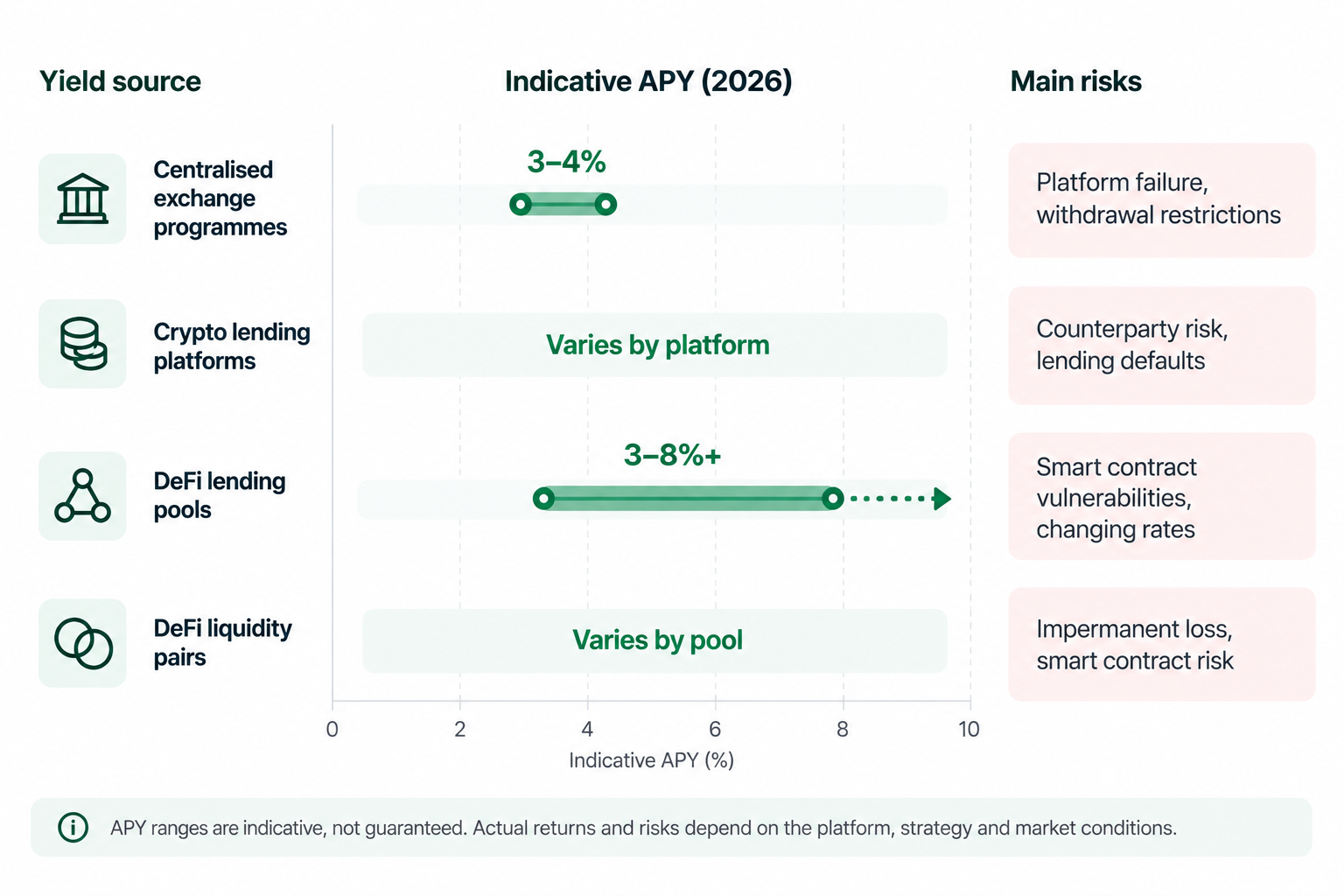
USDC itself pays no interest. Yield comes from lending it out through a centralised exchange programme, a crypto lending platform, or a DeFi protocol such as a lending pool or liquidity pair. Rates ranged from about 2 to 8% APY in 2026, depending on the platform, strategy and market conditions.

Each option comes with different levels of risk, access requirements and withdrawal conditions. Before choosing where to earn yield, understand how returns are generated, whether your funds are protected, and what could happen if a platform fails or a smart contract is exploited.

Does USDC pay interest on its own?

No, holding USDC in a crypto wallet does not earn interest by itself. USDC is a stablecoin designed to maintain a value close to one US dollar, but simply owning it does not generate additional income. Whether it sits in a personal wallet or an exchange account, your balance remains unchanged unless you receive additional USDC through another transaction or service.

To earn yield, you need to use a separate financial product built on top of USDC. These products generate returns through activities such as lending your stablecoins to borrowers, supplying liquidity to decentralised finance (DeFi) protocols, or participating in yield programmes offered by cryptocurrency exchanges.

Each option works differently and carries its own risks. A lending platform may pay interest from borrower repayments, while a DeFi protocol may distribute fees or lending revenue to participants. Centralised exchanges may offer promotional rates or rewards under specific conditions.

Before depositing USDC into any yield product, understand how returns are generated, what fees apply, and whether you can withdraw your funds when needed. Yield is never guaranteed.

Also read: How USDC compares with USDT

Centralised exchange and lending platforms

Centralised exchanges and crypto lending platforms allow you to earn yield by depositing your USDC into programmes that generate returns. Exchange earn programmes may lend your USDC to borrowers or use other permitted strategies to generate revenue, sharing a portion of the earnings with you.

Crypto lending platforms work similarly, connecting you with borrowers and paying interest on the funds you supply.
The annual percentage yield (APY) you receive depends on the platform, market demand, lending activity and programme conditions. Rates can change, and promotional offers may have limits or eligibility requirements.

Custody is another important consideration. When you deposit USDC into a centralised platform, the platform typically controls your assets rather than you holding the private keys directly. It may lend, transfer or otherwise use your deposited coins according to its terms.

This exposes you to counterparty risk. If the platform becomes insolvent, freezes withdrawals or suffers a hack, you may struggle to access your funds or lose them entirely. Before depositing your USDC, review the withdrawal terms, fees, security measures and how the platform uses your assets.

DeFi options: lending pools and liquidity pairs

Decentralised finance (DeFi) offers another way to earn yield on USDC without relying on a traditional financial intermediary. Two common options are lending pools and liquidity pairs, each generating returns in different ways.

With a lending pool, you deposit USDC into a protocol where borrowers can access the funds and pay interest. A portion of that interest is distributed to depositors as yield. Your returns depend on borrowing demand, utilisation rates and the protocol’s rules.

With a liquidity pair, you deposit USDC alongside another cryptocurrency into a trading pool. Traders use this pool to swap assets, and liquidity providers may earn a share of trading fees. However, the value of the two deposited assets can change relative to each other, creating impermanent loss.

Both strategies carry risks. Smart contract bugs can expose deposited funds to theft or loss. Impermanent loss can reduce returns compared with simply holding the assets. Depegging occurs when USDC falls below its intended one-dollar value, reducing the value of your holdings even when the yield remains positive.

How the main risks compare

When you earn yield on USDC, your biggest risks depend on where you deposit your funds and how the platform generates returns. Counterparty risk, smart contract risk and depeg risk can all affect how much you earn and whether you recover your initial deposit.

Counterparty risk arises when you trust a centralised exchange or lending platform with your USDC. If the provider fails or freezes withdrawals, you may lose access to your funds. Smart contract risk affects you when a vulnerability in a DeFi protocol allows your deposited funds to be stolen or lost. Depeg risk means your USDC falls below its intended $1 value, reducing the value of your holdings.

Chart comparing USDC yield options by risk and return.

There is no universal ranking because your exposure depends on the product you choose. However, higher advertised APY usually means higher risk. Before depositing, consider how returns are generated, who controls your funds and what could go wrong.

Your choice of blockchain also matters. Learn how USDC on Solana compares with Ethereum when considering transaction fees, network activity and the platforms available to you.

USDC yield vs a bank savings account

USDC yield can offer a potentially higher return than a regular savings account, but you give up an important protection: USDC does not have government-backed deposit insurance. Your returns depend on the platform and strategy you use, and higher yields often come with greater risk. A bank savings account may offer less, but eligible deposits have protection and more predictable access to your money.

Before choosing USDC for yield, consider whether you can afford the risks, including platform failure, smart contract vulnerabilities and changes in USDC’s value. It is generally better to keep emergency funds in an insured bank account rather than expose money you need urgently to crypto-related risks.

USDC can also make moving money across borders easier. For example, if you need to send money from the US to Nigeria, you can use a platform that supports USDC transfers and local withdrawals. With Grey, you can send, receive and spend USDC, then convert your balance and withdraw funds to a supported local bank account.

The right choice depends on your priorities: bank deposits for protection, USDC for global access and potential yield.

Frequently asked questions about how to earn yield on USDC

1. Is earning yield on USDC safe?

Earning yield on USDC carries risks, including platform failure, smart contract vulnerabilities and loss of funds. Although USDC is designed to maintain a one-dollar value, your investment is not guaranteed. Review the platform’s security, withdrawal terms and yield strategy before depositing funds, and never invest money you cannot afford to lose.

2. What is a typical USDC APY in 2026?

USDC yield varies by platform, market conditions and strategy. In 2026, some centralised reward programmes offer around 3–4% APY, while DeFi lending may offer approximately 3–8% or more. These are indicative ranges, not guaranteed rates. Check current offers, fees and risks before choosing a platform.

3. Do you pay tax on USDC yield?

Yes, USDC yield may be taxable, depending on your country’s tax laws and how you earn it. In the United States, rewards are generally reportable as income. Keep records of payments, dates and amounts, and consult a qualified tax professional to understand your reporting obligations.

4. Can you lose your USDC principal earning yield?

Yes, you can lose some or all of your USDC principal. Platform insolvency, lending defaults, smart contract exploits and liquidity problems can prevent withdrawals or cause losses. USDC can also trade below one dollar. Assess the risks carefully, diversify where appropriate and avoid committing essential savings.

5. What is the difference between USDC yield and USDC staking?

USDC yield usually comes from lending, reward programmes or providing liquidity through a platform or DeFi protocol. Staking typically involves locking cryptocurrency to support a proof-of-stake blockchain. USDC does not use proof-of-stake itself, so products marketed as USDC staking generally involve a different yield-generating mechanism.

6. How do you convert USDC yield into cash you can spend?

First, withdraw your USDC and earn rewards to a supported exchange or financial platform. Convert the balance into your preferred currency, then withdraw it to an eligible bank account or payment method. With Grey, you can send, receive and spend USDC, subject to supported services, currencies and applicable fees.

While USDC yield offers the potential for higher returns, a bank savings account provides greater protection for eligible deposits. For international transactions, Grey gives you a practical way to send, receive and spend USDC, with access to supported currencies for your everyday financial needs.

Gift tax: How much money can you give tax-free?

•

•

2 min read

Giving money to another person may seem straightforward, but large financial gifts can come with tax reporting requirements. In the United States, the Internal Revenue Service (IRS) determines how much you can give each year before you may need to report the gift. Understanding these rules is particularly important when transferring substantial sums, sharing wealth, or planning your finances.

The good news is that exceeding the annual gift tax limit does not automatically mean you owe tax. The IRS provides a lifetime exemption that allows you to give more than the annual limit before gift tax becomes payable. Knowing the difference between the annual exclusion, reporting requirements and lifetime exemption can help you make informed financial decisions.

The IRS annual gift tax exclusion lets you give up to a set amount per recipient each year with no tax owed and no form to file. Gifts above that amount count against your lifetime exemption and require Form 709, though tax is rarely owed until the lifetime exemption itself is used up.

How much can you gift tax-free per year?

For 2026, you can give up to $19,000 per recipient per year without owing federal gift tax or generally needing to file a gift tax return. This annual exclusion applies to qualifying gifts of money or property under US Internal Revenue Service (IRS) rules.

The limit resets every calendar year, beginning January 1. This means gifts made in 2026 are counted separately from gifts made in 2025. You can give money to multiple recipients in the same year, provided each recipient’s total qualifying gifts from you stays within the annual limit.

The exclusion applies per giver and per recipient, rather than as one combined limit for all your gifts. For example, you could give $19,000 each to three people in 2026, totalling $57,000, without exceeding the annual exclusion for any recipient. If two spouses each give the same recipient $19,000, their combined gifts can reach $38,000 under their separate exclusions, subject to applicable IRS rules.

What is the lifetime gift tax exemption?

For 2026, the US lifetime gift and estate tax exemption is $15 million per individual. This is the total amount an individual can transfer through qualifying gifts during their lifetime and leave to beneficiaries at death before federal gift or estate taxes generally apply, subject to applicable rules.

The lifetime exemption works alongside the annual gift tax exclusion. While the annual exclusion allows qualifying gifts of up to $19,000 per recipient in 2026 without using the lifetime exemption, larger gifts generally count toward the $15 million limit. Gifts exceeding the annual exclusion may require you to file IRS Form 709, even when no tax is due.

The important distinction is that the lifetime gift tax exemption and estate tax exemption are shared, not separate allowances. For example, if you make $2 million in taxable gifts during your lifetime, that amount generally reduces the exemption remaining for your estate. Any unused exemption may apply to assets transferred at death, helping determine whether your estate owes federal estate tax.

When do you need to file form 709?

You generally need to file IRS Form 709 if you give more than $19,000 to one person in 2026, unless a specific exception applies. The form reports gifts exceeding the annual exclusion and helps the IRS track your use of the lifetime gift tax exemption.

The filing requirements, deadline and potential tax implications are important to understand before submitting your return.

Who Must File Form 709?

The person giving the gift is generally responsible for filing. You may need to file if your gifts to one recipient exceed the annual exclusion, you transfer certain future interests, or you elect to split gifts with your spouse.

When Is Form 709 Due?

The deadline is generally April 15 of the year following the gift. For gifts made in 2026, the filing deadline is April 15, 2027. An extension may be available, but it does not automatically extend the deadline for paying tax owed.

Does Filing Form 709 Mean You Owe Tax?

No. Filing the form does not automatically mean you owe gift tax. Gifts above the annual exclusion generally reduce your lifetime gift and estate tax exemption. Federal gift tax is typically payable only after your available exemption has been exhausted.

Gift tax vs Estate tax: how they connect

Gift tax and estate tax share one combined lifetime exemption. In 2026, the federal gift and estate tax exemption is $15 million per individual. This means large gifts made during your lifetime and assets transferred after your death generally count toward the same exemption.

If you give a substantial amount of money while alive, the portion exceeding the annual gift tax exclusion generally reduces the exemption remaining for your estate. For example, if you make $2 million in taxable gifts, that amount generally reduces your remaining exemption to $13 million, assuming no other taxable transfers or adjustments.

Alternatively, leaving the money in your estate means its value may be considered when calculating estate tax after your death. If your total taxable estate and applicable prior gifts remain within your available exemption, federal estate tax generally will not be due.

The main difference is when the transfer happens and how the assets are valued. Lifetime gifting can help transfer wealth earlier, but the best approach depends on your financial circumstances, future needs and estate planning goals.

If you're sending money as a gift to family members abroad, it's also worth considering transfer fees and exchange rates. For example, you can send money from the US to Mexico or send money from the US to India using available international transfer services. Just remember that sending money internationally doesn't automatically exempt a gift from US tax reporting requirements.

Frequently asked questions about gift taxes

Does the person receiving a Gift pay tax on it?

Generally, no. Under US federal tax rules, the recipient does not pay income tax on money received as a gift. The person giving the gift is usually responsible for any applicable gift tax reporting and payment. However, income generated by gifted assets may be taxable to the recipient.

Can you gift more than the annual exclusion without paying tax?

Yes. Gifts exceeding the 2026 annual exclusion of $19,000 per recipient may require you to file Form 709. However, the excess generally reduces your lifetime gift and estate tax exemption rather than triggering immediate tax. Gift tax usually becomes payable after the available exemption is exhausted.

Do Gifts to a spouse count toward the annual exclusion?

Generally, gifts to a US-citizen spouse qualify for the unlimited marital deduction and do not count toward the annual exclusion. Gifts to a non-US citizen spouse have a separate annual limit, which is $194,000 for 2026. Special rules may apply depending on the circumstances.

Is money sent to family abroad treated as a Gift for tax purposes?

Yes. Money sent to relatives abroad may qualify as a gift under US tax rules. If the giver is subject to US gift tax, the annual exclusion and reporting requirements may apply regardless of where the recipient lives.

Do you have to report a Gift from a foreign relative?

You may need to. US persons who receive gifts exceeding $100,000 in total from a nonresident alien individual or foreign estate generally must report them on Form 3520. Different thresholds apply to gifts from foreign corporations or partnerships.

What is the penalty for not filing Form 709 when required?

Failure to file Form 709 when required may result in penalties based on the unpaid gift tax, generally 5% per month, up to 25%. If no tax is due, penalties may differ, but the IRS can still assess consequences for noncompliance. Filing requirements should be checked carefully.

Managing money across borders involves more than understanding gift tax. Whether you are supporting family abroad, making international payments or managing everyday expenses, having the right financial tools matters. Grey offers multi-currency accounts and virtual cards that make it easier to manage international finances, pay for online services and handle supported cross-border transactions.

USDC on Solana vs Ethereum: Which should you use?

•

•

2 min read

Solana or Ethereum? Both can move the same dollar-backed stablecoin, but the difference becomes clear when speed and transaction fees matter.

Solana can settle a USDC transfer in a few seconds, usually for a fraction of a cent. Ethereum, on the other hand, can take several minutes, with fees that increase when the network is busy. For a straightforward payment, Solana can be the more practical option when keeping costs low matters.

Both versions of USDC are issued by Circle and designed to maintain a 1:1 value with the US dollar. The real choice is therefore not between two different stablecoins, but between two networks. The better option depends on where the money is going, which network the recipient supports, and whether speed, low fees or access to Ethereum’s wider ecosystem matters most.

What is the difference between USDC on Solana and Ethereum?

The main difference between USDC on Solana and Ethereum is the blockchain network used to settle your transaction, even though both versions are issued by Circle, designed to maintain a 1:1 value with the US dollar and redeemable through the same issuer. When you choose between them, you are therefore choosing a different settlement layer, with Solana generally offering faster and cheaper transfers while Ethereum can become more expensive when the network is busy.

The distinction becomes more important when you come across native and bridged USDC. Native USDC is issued directly by Circle on the blockchain where you hold it, so USDC issued natively on Solana is Circle-issued USDC on Solana, while native USDC on Ethereum is issued directly on Ethereum. This means you should not assume that every token labelled “USDC” has the same issuance structure.

Bridged USDC represents USDC that has been moved between blockchains using a bridge, rather than being directly issued by Circle on the destination network. Before sending your USDC, check the network supported by the recipient and whether you are dealing with native or bridged USDC, because sending through an unsupported network can make it difficult or impossible to recover your funds.

How fees and settlement times compare

When you compare Ethereum and Solana for USDC transfers, the biggest differences you'll notice are the network fee and how quickly your transaction settles. Ethereum fees change with supply and demand, so when more people compete for limited block space, the base fee rises and you may pay an additional tip to have your transaction prioritised. Solana generally offers lower and more predictable fees, which can make it more practical for frequent transfers.

On Ethereum Layer 1, you may pay around 0.01–0.20, with settlement taking roughly 12 seconds to several minutes depending on network conditions and the level of finality you require. Solana typically settles transactions within seconds at a fraction of a cent.

Ethereum Layer 2 networks can reduce the cost further by processing transactions away from the main chain and later posting transaction data to Ethereum. This gives you faster execution and lower fees, although the final settlement process works differently from a direct Layer 1 transaction. Network conditions change, so check current fees before sending.

Also read: USDC to USD: How to convert your stablecoin to cash

What happens if you send USDC to the wrong network?

Sending USDC to the wrong network can put your funds at risk, and whether you can recover them depends on where the money was sent and who controls the receiving wallet. If the destination supports the network you used, recovery may be possible, but if it does not, you may need help from the exchange or wallet provider, with no guarantee that the funds can be recovered.

Before sending, check that the network selected on your platform matches the network supported by the recipient. Do not rely on the wallet address alone, because the same address format can sometimes work across different networks. If you use a USD bridge to move USDC between blockchains, confirm the destination network and the type of USDC being received before approving the transaction.

For a large transfer, send a small test amount first, then check the network name, token and destination address before sending the remaining balance. Once a blockchain transaction is confirmed, it generally cannot be reversed.

Also read: How to convert and use USDC in Nigeria

How to choose a network for your transfer

Choosing a network for your USDC transfer comes down to three things: how much you are sending, where the money is going and how quickly you need it to arrive. Start with the destination, because the cheapest or fastest network is not useful if the recipient’s wallet or exchange does not support it. Check the supported networks before you enter the amount or confirm the transaction.

Next, consider the amount you are sending. For a small transfer, a network with very low transaction fees can help you avoid losing a noticeable percentage of your money to fees. For a larger transfer, the fee may matter less, but you should still confirm that the network supports the exact USDC you are sending.

Finally, consider urgency. If you need the money to arrive within seconds or minutes, a faster network may make more sense. If timing is flexible, you can compare fees and choose the cheaper option. Whatever you choose, confirm the network on both sides before sending.

Open a multi-currency account to send and receive USDC

Turning USDC into local currency usually involves one more step after receiving your payment: moving the funds from your crypto wallet or exchange into a bank account where you can spend them. A multi-currency account can fit between these steps, giving you a place to receive and hold funds before converting them into the currency you need.

With Grey, you can open a multi-currency account and use it to manage your international payments in one place. Once you receive USDC, you can move the funds through the available conversion and withdrawal options rather than immediately sending everything to a local bank account. This can give you more control over when you convert and where your money goes.

The process is straightforward: receive your USDC, convert or off-ramp it through a supported route, then withdraw the resulting currency to your local bank account. The exact steps depend on the currencies and payment routes available to you, so check the supported options before starting your transfer.

Frequently asked questions

Is USDC on Solana the same as USDC on Ethereum?

USDC on Solana and USDC on Ethereum are both issued by Circle and designed to maintain a 1:1 value with the US dollar, but they operate on different blockchains. The main differences are transaction speed, network fees and where you can send or receive each version of USDC.

Which network has lower USDC fees?

Solana generally has lower USDC transaction fees than Ethereum, with transfers typically costing a fraction of a cent. Ethereum fees can increase when the network is busy because users compete for limited block space. Before sending, check the current network fee and make sure the recipient supports your chosen network.

Can I send USDC from Solana to an Ethereum wallet?

You cannot send native USDC on Solana directly to an Ethereum-only address and expect it to arrive correctly. To move USDC between networks, you need a supported bridge or exchange that handles the transfer. Always confirm both the sending and receiving networks before approving the transaction.

What happens if I pick the wrong network?

Choosing the wrong network can make your USDC difficult or impossible to recover, depending on the receiving wallet or exchange. Before sending, check the network supported by the recipient and make sure it matches the network selected in your wallet. For larger amounts, consider sending a small test transaction first.

Is USDC on Solana safe?

USDC on Solana can be safe when you use the official, native version of USDC and send it through a supported wallet or exchange. Your biggest risks usually come from choosing the wrong network, using an unsupported token or sending funds to an incorrect address. Always verify the token and destination.

How do I convert USDC to my local currency?

To convert USDC into your local currency, you typically send it to a supported exchange or financial platform, sell or convert the USDC, then withdraw the resulting funds to your bank account. A multi-currency account can also give you a place to receive and manage funds before converting them.

Arrow (up)

Back to top