<script type="application/ld+json" data-schema-version="grey-blog-v4"> [{"@context":"https://schema.org","@type":"BlogPosting","@id":"https://grey.co/blog/nordvpn-subscription-pricing#article","headline":"NordVPN subscription pricing: Plans compared for 2026","description":"NordVPN Basic, Complete and Prime pricing compared for 2026. Two-year plans from $3.49 per month. How to pay from Nigeria, India or Ghana without card issues.","inLanguage":"en","url":"https://grey.co/blog/nordvpn-subscription-pricing","mainEntityOfPage":{"@id":"https://grey.co/blog/nordvpn-subscription-pricing#webpage"},"datePublished":"2026-06-30T21:54:33.640Z","dateModified":"2026-07-01T10:48:00+01:00","author":{"@type":"Person","@id":"https://grey.co/authors/tunde-aladeloba#person","name":"Tunde Aladeloba","url":"https://grey.co/authors/tunde-aladeloba","jobTitle":"Content Writer","sameAs":["https://ng.linkedin.com/in/aladeloba-babatunde-b1114b100"]},"publisher":{"@type":"Organization","@id":"https://grey.co/#organization","name":"Grey","url":"https://grey.co","logo":{"@type":"ImageObject","url":"https://cdn.prod.website-files.com/6360022338a81bd6fdbb1145/6564ae1077a67e39d3c491a6_Grey%20Logo%20Lockup%20Black.svg"}},"image":{"@type":"ImageObject","@id":"https://grey.co/blog/nordvpn-subscription-pricing#primaryimage","url":"https://cdn.prod.website-files.com/636a85d290ee58e70c17e1c0/6a443afa621153ccb76589cb_NordVPN%20Subscription%20Pricing%20Plans%20Compared%20for%202026-compressed.jpg","contentUrl":"https://cdn.prod.website-files.com/636a85d290ee58e70c17e1c0/6a443afa621153ccb76589cb_NordVPN%20Subscription%20Pricing%20Plans%20Compared%20for%202026-compressed.jpg","width":1200,"height":675}},{"@context":"https://schema.org","@type":"WebPage","@id":"https://grey.co/blog/nordvpn-subscription-pricing#webpage","url":"https://grey.co/blog/nordvpn-subscription-pricing","name":"NordVPN Subscription Pricing: Plans Compared for 2026 | Grey","description":"NordVPN Basic, Complete and Prime pricing compared for 2026. Two-year plans from $3.49 per month. How to pay from Nigeria, India or Ghana without card issues.","inLanguage":"en","primaryImageOfPage":{"@id":"https://grey.co/blog/nordvpn-subscription-pricing#primaryimage"},"breadcrumb":{"@id":"https://grey.co/blog/nordvpn-subscription-pricing#breadcrumb"}},{"@context":"https://schema.org","@type":"BreadcrumbList","@id":"https://grey.co/blog/nordvpn-subscription-pricing#breadcrumb","itemListElement":[{"@type":"ListItem","position":1,"name":"Home","item":"https://grey.co/"},{"@type":"ListItem","position":2,"name":"Blog","item":"https://grey.co/blog"},{"@type":"ListItem","position":3,"name":"NordVPN subscription pricing: Plans compared for 2026","item":"https://grey.co/blog/nordvpn-subscription-pricing"}]},{"@context":"https://schema.org","@type":"FAQPage","@id":"https://grey.co/blog/nordvpn-subscription-pricing#faq","mainEntity":[{"@type":"Question","name":"What is the cheapest NordVPN plan in 2026?","acceptedAnswer":{"@type":"Answer","text":"The Basic plan on the two-year subscription is the lowest monthly equivalent at $3.49 per month, billed $94.23 for the first 27 months. After that, it renews at $139.08 annually."}},{"@type":"Question","name":"Is the Complete teir worth the extra cost over the Basic tier?","acceptedAnswer":{"@type":"Answer","text":"For most users, yes. The step up is $1 per month on the two-year plan and it adds Dark Web Monitor Pro covering 8 emails plus phone, credit card, and national ID numbers, an unlimited password manager with breach scanning, and 1TB of encrypted cloud storage. Basic only monitors 5 emails and has no password manager or cloud storage."}},{"@type":"Question","name":"What is the difference between NordVPN Basic, Plus, and Ultimate?","acceptedAnswer":{"@type":"Answer","text":"NordVPN has updated its plan names. The current tiers are Basic, Complete, and Prime. Earlier articles may refer to Basic, Plus, and Ultimate, which were the previous names. Always check nordvpn.com/pricing for current plan names and features."}},{"@type":"Question","name":"Can I pay for NordVPN from Nigeria or India?","acceptedAnswer":{"@type":"Answer","text":"Yes. NordVPN accepts international cards. If your local bank card is declined or applies a foreign transaction fee on USD checkouts, a Grey virtual card funded in USD processes the payment without those issues."}},{"@type":"Question","name":"Does NordVPN offer a money-back guarantee?","acceptedAnswer":{"@type":"Answer","text":"Yes. All NordVPN plans include a 30-day money-back guarantee on subscriptions purchased directly on their website. This applies to all three tiers."}},{"@type":"Question","name":"What happens when my NordVPN subscription auto-renews?","acceptedAnswer":{"@type":"Answer","text":"Subscriptions auto-renew at the renewal rate disclosed at checkout, which is higher than the introductory promotional rate. You can check your renewal date and manage auto-renewal settings in your NordVPN account dashboard."}},{"@type":"Question","name":"Is NordVPN's antivirus actually built in or a separate app?","acceptedAnswer":{"@type":"Answer","text":"NordVPN's next-gen antivirus is built into the NordVPN app across all three plan tiers. It runs in the background alongside the VPN connection and does not require a separate download or installation."}}]}] </script>

NordVPN subscription pricing: Plans compared for 2026

Tunde Aladeloba

TABLE OF CONTENT

SHARE THIS POST

If you are comparing NordVPN plans, pricing is usually where you start. NordVPN has moved beyond a standalone VPN into a security suite that bundles next-generation antivirus, a password manager, dark web monitoring, and identity protection tools depending on the tier you choose. That makes the plan comparison more involved than a simple price-per-month decision.

This guide breaks down every NordVPN plan and what it costs in 2026. It also covers how to pay from Nigeria, India, Ghana, or any country where a local bank card may be declined or marked up on a USD-priced checkout.

NordVPN plans at a glance

NordVPN offers three tiers. All include a secure high-speed VPN, protection for up to 10 devices, and a Dark Web Monitor for up to 5 emails. The tiers differ in antivirus depth, password management, cloud storage, and identity protection.

Plan 2-year rate Key features added over Basic Best for
Basic $3.49/month VPN, next-gen antivirus, Dark Web Monitor (5 emails), scam call protection, ad and tracker blocker Users who want a VPN with antivirus bundled in
Complete $4.49/month Everything in Basic plus Dark Web Monitor Pro (8 emails, phone, credit card, national ID), unlimited password manager with data breach scanner, 1TB encrypted cloud storage Users who want broader security with password management and cloud storage
Prime $7.49/month Everything in Complete plus identity theft protection ($1M coverage), cyber extortion insurance ($100K coverage), credit monitoring and personal data removal via Incogni Users who want full identity protection on top of the security suite

Two-year rates are the discounted monthly equivalent for the first 27 months (2 years plus 3 bonus months). After that, plans renew at a higher annual rate. All prices in USD. Sales tax may apply.

Monthly plan pricing

The monthly plan has no commitment. It is the most flexible option and the most expensive per month. Worth it for short-term coverage but for consistent use the longer plans are substantially cheaper.

Plan Monthly price Devices Saving vs 2-year
Basic $14.99/month 10 Save ~69% with 2-year
Complete $19.99/month 10 Save ~75% with 2-year
Prime $21.99/month 10 Save ~69% with 2-year

One-year plan pricing

The one-year plan sits between monthly flexibility and two-year value. It reduces the monthly cost significantly and avoids the larger upfront commitment of the two-year plan.

Plan Monthly equivalent Total billed Devices
Basic $5.49/month $65.88/month 10
Complete $6.49/month $77.88/month 10
Prime $8.49/month $101.88/month 10

Two-year plan pricing

The two-year plan delivers the biggest savings and is the best value if you plan to use a VPN consistently. NordVPN adds 3 bonus months on top of the two years, giving you 27 months at the discounted rate.

Plan Monthly rate First 27 months total Then renews at Saving
Basic $3.49/month $94.23 $139.08/year 69%
Complete $4.49/month $121.23 $219.48/year 75%
Prime $6.49/month $175.23 $296.28/year 69%

The renewal rate after the initial 27-month period is significantly higher than the promotional rate. Note the renewal price at checkout and set a reminder before your renewal date.

Feature comparison by plan

Here is how the three tiers compare across every included tool:

Feature Basic Complete Prime
VPN (10 devices, high-speed, all servers) Yes Yes Yes
Next-gen antivirus Yes Yes Yes
Ad and tracker blocker Yes Yes Yes
Scam call protection Yes Yes Yes
Dark Web Monitor (5 emails) Yes Yes Yes
Dark Web Monitor Pro (8 emails, phone, card, ID) No Yes Yes
Password manager with data breach scanner No Yes Yes
1TB encrypted cloud storage No Yes Yes
Identity theft protection ($1M insurance) No No Yes
Cyber extortion insurance ($100K) No No Yes
Credit monitoring and VantageScore No No Yes
Personal data removal (Incogni) Add-on Add-on Add-on
Dedicated IP Add-on Add-on Add-on
30-day money-back guarantee Yes Yes Yes

Incogni and Dedicated IP are available as add-ons at checkout for all three plans. Identity theft protection under Prime is provided by Coveron. Additional terms apply.

Which NordVPN plan should you choose?

The first thing to note is that NordVPN's Basic plan already includes next-gen antivirus, which neither Surfshark nor ExpressVPN Basic includes at the same price point. If antivirus bundled with a VPN is what you need, Basic is competitive value even as the entry tier.

  • Basic: Basic is the right starting point if you want a VPN, built-in antivirus, scam call protection, and Dark Web Monitor for up to 5 emails. It covers the essentials at the lowest price and does not require upgrading just to get the antivirus.
  • Complete: Complete is the most popular tier and the best value for most users. The step up from Basic is $1 per month on the two-year plan and you gain Dark Web Monitor Pro covering 8 emails plus phone, credit card, and national ID numbers, an unlimited password manager with breach scanning, and 1TB of encrypted cloud storage. For users who want one subscription to cover VPN, antivirus, passwords, and cloud storage, Complete is the clear choice.
  • Prime: Prime adds identity theft protection with $1 million in insurance coverage, cyber extortion insurance, and credit monitoring. It is worth it if you specifically want those protections. Most users will find Complete covers everything they need at a significantly lower price.

What payment methods does NordVPN accept?

NordVPN accepts credit and debit cards, PayPal, Amazon Pay, Google Pay, and cryptocurrency payments. A range of regional payment methods are also available depending on your country. For users in Nigeria, India, and Ghana, the question is which of those methods will process without a declined card or a foreign transaction fee added on top of the USD price.

How to pay for NordVPN from Nigeria, India, or Ghana

NordVPN prices its plans in USD. For users whose accounts are in naira, rupees, or cedis, paying a USD-priced subscription can mean a declined card, a foreign transaction fee on top of the stated price, or both.

Pay with a Grey virtual card. Grey gives you a virtual Visa card linked to your USD balance. When you pay for NordVPN, the charge processes in USD from your Grey account, with no foreign transaction markup from a Nigerian or Indian bank and no risk of the card being declined on a foreign checkout. The card works on NordVPN's checkout, on auto-renewals, and on every other USD-priced subscription you use.

Auto-renewal is handled cleanly too: the card stays active for recurring charges without re-entering details at each renewal. Your multi-currency account keeps your USD balance ready for the next billing cycle.

One note: subscribing via the iOS App Store or Google Play uses a different billing flow managed by Apple or Google. Subscribing directly on nordvpn.com gives you more control over billing and is covered by the 30-day money-back guarantee.

Frequently asked questions

What is the cheapest NordVPN plan in 2026?

The Basic plan on the two-year subscription is the lowest monthly equivalent at $3.49 per month, billed $94.23 for the first 27 months. After that, it renews at $139.08 annually.

Is the Complete teir worth the extra cost over the Basic tier?

For most users, yes. The step up is $1 per month on the two-year plan and it adds Dark Web Monitor Pro covering 8 emails plus phone, credit card, and national ID numbers, an unlimited password manager with breach scanning, and 1TB of encrypted cloud storage. Basic only monitors 5 emails and has no password manager or cloud storage.

What is the difference between NordVPN Basic, Plus, and Ultimate?

NordVPN has updated its plan names. The current tiers are Basic, Complete, and Prime. Earlier articles may refer to Basic, Plus, and Ultimate, which were the previous names. Always check nordvpn.com/pricing for current plan names and features.

Can I pay for NordVPN from Nigeria or India?

Yes. NordVPN accepts international cards. If your local bank card is declined or applies a foreign transaction fee on USD checkouts, a Grey virtual card funded in USD processes the payment without those issues.

Does NordVPN offer a money-back guarantee?

Yes. All NordVPN plans include a 30-day money-back guarantee on subscriptions purchased directly on their website. This applies to all three tiers.

What happens when my NordVPN subscription auto-renews?

Subscriptions auto-renew at the renewal rate disclosed at checkout, which is higher than the introductory promotional rate. You can check your renewal date and manage auto-renewal settings in your NordVPN account dashboard.

Is NordVPN's antivirus actually built in or a separate app?

NordVPN's next-gen antivirus is built into the NordVPN app across all three plan tiers. It runs in the background alongside the VPN connection and does not require a separate download or installation.

Choosing the right VPN subscription is an investment in your online security, helping protect your personal data whether you're working, travelling or browsing on public Wi-Fi. Once your digital life is secure, simplify your global finances with Grey. Open a Grey account to receive international payments, manage multiple currencies and spend seamlessly across borders.

‍

Sources last checked: June 2026. NordVPN pricing and plan features change frequently. Always verify on nordvpn.com/pricing before subscribing.

This article is for general information purposes only. NordVPN pricing, features, and availability change at Nord Security's discretion. Grey product features and fees are subject to change. See grey.co/pricing for current Grey rates. This article is not affiliated with or endorsed by Nord Security.

Last updated:

October 9, 2026

Open a free Grey account to get startedJoin 1 million digital nomads
IF YOU ENJOYED THIS, CHECK THESE OUT

How to receive US dollars in Nigeria: 4 ways and what each costs

•

•

2 min read

You can receive US dollars in Nigeria in four main ways: USD account details from an app like Grey, a domiciliary account at a Nigerian bank, a platform wallet such as Payoneer or PayPal, or a money transfer service that pays into your bank or as cash. The right one depends on who is paying you and how they pay, not on which app your friends use.

Get that match wrong and you pay for it: a flat $20 wire fee on a $100 payment, a transfer that loses money to an intermediary bank on the way, or a naira rate you never agreed to. Below, you will find which route suits each kind of sender, what Grey charges at every step (checked today on grey.co and support.grey.co), a worked example for $1,000, and how to get your USD account details.

Which way to receive dollars fits your sender

Start with the person or platform sending the money. Each sender can only use certain payment methods, and that decides where your dollars should land.

Who is paying youBest routeHow they payTypical cost to you (USD)
A US client or employerGrey USD account detailsACH, FedNow or wire from a US bank0.8% by ACH or FedNow (min $2, max $10); $20 by wire
Payoneer, Upwork, Fiverr, Deel or AmazonGrey USD account details saved as your withdrawal bankPayout to a US accountGrey's receiving fee, plus any fee the platform charges
A client outside the US who can only send SWIFTDomiciliary account at a Nigerian bankInternational wireSet by the sender's bank, intermediary banks and your bank
Family or friends abroadMoney transfer serviceApp or agent transfer to your bank, or cash pickupFee and exchange rate set by the provider
Your own PayPal balanceWithdraw to a linked bank account, if your PayPal account allows itPayPal withdrawalPayPal's withdrawal and conversion fees

Checked 27 November 2026 on grey.co and support.grey.co. Fees charged by banks, platforms and transfer services vary and are not shown.

Option 1: get USD account details on Grey

A Grey USD account gives you US account details in your own name: an account number, an ACH routing number and a wire routing number for a US checking account. Anyone paying from a US bank, or any platform that pays out to US accounts, can send to those details as if you lived there.

The account receives money through three US payment networks: ACH, FedNow and Fedwire. It is built for dollars coming from inside the US system, so a client in Europe or Asia sending a SWIFT wire should use Option 2 instead. Grey is a financial technology company, not a bank.

Two eligibility points are worth knowing before you sign up. Nigeria is on Grey's list of countries that can request a US account, and US accounts are currently issued only to full-time employees and freelancers. If you want dollars for gifts from family, skip to Option 4.

How to get your USD account details on Grey

  1. Create your account. Download the Grey app or start at grey.co, then enter your name, email, phone number and country, set a password and verify your email.
  2. Add your address. Tap Complete My Account Setup, enter your address and date of birth, and upload a bank statement from the last three months (PDF, PNG or JPEG, under 3MB).
  3. Answer the PEP question. Confirm whether you are, or are related to, a politically exposed person.
  4. Verify your identity. Take a photo of your original ID, such as your national ID card, international passport or driver's licence, then record a short selfie video in good light. Turn off any VPN first, and make sure the name on your ID matches your Grey account.
  5. Wait for approval. Reviews usually take a few minutes and can take up to 24 hours. You get an email once you are verified.
  6. Open your USD account and copy the details. Your details sit under the USD wallet in the app. Give payers the ACH routing number for ACH or FedNow payments and the wire routing number for wires, with Checking as the account type.

If a form insists on a US address, Grey's help centre says you can use the bank's address shown with your account details.

What Grey charges to receive and convert dollars

StepGrey feeHow long it takes
Receive by ACH0.8% (minimum $2, maximum $10)1 to 2 business days
Receive by FedNow0.8% (minimum $2, maximum $10)Seconds, if the sender's bank supports FedNow
Receive by wire (Fedwire)$20 flatUsually the same or next business day
Convert USD to NGN1%, capped at $6In the app; you see the rate before you confirm
Withdraw naira to your Nigerian bank₦35 per withdrawalInstant
Open and hold the account$0, no minimum balanceNot applicable

Checked 27 November 2026 on support.grey.co and grey.co.

Two limits apply. Payments from other individuals into your US account must be under $4,000 each, while payments from business accounts, such as a company settling your invoice, have no limit. Grey also does not accept payments for crypto, P2P, betting or forex trading.

Worked example: $1,000 from a US client to your naira account

Say a client in Texas owes you $1,000. Here is what reaches your Nigerian bank if they pay by ACH, compared with a wire.

StepClient pays by ACHClient pays by wire
Client sends (USD)$1,000$1,000
Grey receiving fee (USD)$8 (0.8%)$20 (flat)
Lands in your USD balance (USD)$992$980
Conversion fee (USD)$6 (1% would be $9.92, so the cap applies)$6 (1% would be $9.80, so the cap applies)
Converted at ₦1,416.26 per $1 (NGN)$986 = ₦1,396,432$974 = ₦1,379,437
Withdrawal to your bank (NGN)₦35₦35
In your Nigerian bank (NGN)₦1,396,397₦1,379,402

Checked 27 November 2026. The rate is the indicative USD to NGN rate listed on Grey's converter page that day; the app shows your actual rate before you confirm.

Two things stand out. First, on Grey's fees ACH is never dearer than a wire: the ACH fee stops at $10, while a wire always costs $20. On this invoice, asking for ACH puts about ₦17,000 more in your pocket.

Second, the $6 cap does more work the more you convert at once. Converting $600 or more always costs $6, so on $5,000 the conversion fee is 0.12%.

If you don't need the naira today, let payments build up and convert in one go. You can watch today's USD to NGN rate while you wait.

For more on how the two payment types differ for the sender, see our guide to ACH vs wire.

Option 2: a domiciliary account at a Nigerian bank

A domiciliary account is a US dollar account at a Nigerian bank. It is the route to use when your payer can only send an international SWIFT wire, or when you want to collect physical dollars over the counter.

You share your account name and number, your bank's SWIFT code and any correspondent bank details your bank gives you. The money usually takes a few business days, and intermediary banks can take a fee on the way, so the amount that lands is often less than what was sent.

Opening one means your bank's own forms and ID checks, and some banks still want a branch visit. Cash withdrawals, transfer charges and the rate you get when you convert to naira all follow your bank's policy, so ask for its tariff before you give out the details. Our comparison of a domiciliary account with a virtual dollar account covers the trade-offs in more depth.

Option 3: PayPal, Payoneer and other platforms

If you sell or freelance on a platform, the money first sits in your platform balance. The question is where you withdraw it to.

Payoneer. Add your Grey USD details as a US bank account, using the ACH routing number and Checking as the account type. Withdrawals usually arrive in 1 to 3 working days, and Grey's ACH fee applies when they land.

PayPal. Grey accepts USD withdrawals from PayPal into your US account details, usually within 1 to 2 working days, as long as the name on your Grey account matches your PayPal name. Whether your PayPal account lets you link a US bank at all is up to PayPal, and our guide to PayPal in Nigeria explains what works for Nigerian accounts.

Creator and seller platforms. Payout rules differ by platform: if you earn from content, read how Nigerian creators set up USD payouts. If you sell crafts or digital goods, see how to get paid as an Etsy seller.

Option 4: money transfer services for family abroad

When a sister in Houston or an uncle in London wants to send support home, a money transfer service is usually the simplest route. Services such as Western Union and WorldRemit pay into a Nigerian bank account or offer cash pickup at partner banks, and the sender pays the fee.

The catch is the exchange rate. Each provider sets its own, so the fairest comparison is the final amount you receive, not the advertised fee. If your relative has a Grey account in the US, they can also send money to Nigeria straight to your bank and see the USD to NGN rate before they confirm.

This is also why family support belongs here rather than in a Grey US account. Those accounts are issued for employment and freelance income, and payments from other individuals must stay under $4,000.

Frequently asked questions

Can I receive dollars in my naira account?

Not as dollars. A naira account only holds naira, so if someone sends dollars through a service that pays into it, the money is converted to naira first at that service's rate. To keep the dollars, you need a domiciliary account or USD account details.

Which app can I use to receive dollars in Nigeria?

Grey gives Nigerian freelancers and full-time employees US account details that accept ACH, FedNow and wire payments from US payers and platforms. Several other apps offer USD accounts too, and our comparison of the best dollar account apps sets them side by side.

How long does it take to receive USD in Nigeria?

On Grey, FedNow payments arrive in seconds, ACH takes 1 to 2 business days and wires usually arrive the same or next business day. SWIFT wires to a domiciliary account usually take a few business days, depending on the banks in the chain.

Is there a limit on what I can receive into a Grey USD account?

Payments from other individuals must be under $4,000 each. Payments from business accounts, such as a client's company paying your invoice, have no limit.

Do I need a US address to receive US dollars?

No. If a payer or platform asks for a US address, Grey's help centre says you can use the bank's address shown with your USD account details.

The cheapest way to receive US dollars in Nigeria is the one that matches your sender: US account details for US clients and platforms, a domiciliary account for SWIFT, and a transfer service for family. If most of your dollars come from US clients or platforms, open a Grey USD account and send your next invoice with ACH details on it.
How creators receive payouts from YouTube, TikTok, Patreon and other platforms

•

•

2 min read

Creators outside the US get paid in one of three ways, and the platform decides which. YouTube (through AdSense) and Gumroad pay into a local bank account in your own country, while Patreon lets you pick the bank country, including the US. Substack, Twitch, TikTok and Meta pay through their own payout systems or processors, with options that depend on where you live.

Brand deals and direct clients are the exception: they pay however you agree, which is where your own USD, GBP or EUR account details matter.

I learned this the slow way. My first YouTube payout arrived after months of work, and somewhere between California and my bank account, part of it simply vanished. This guide is what I wish I had read first: every major platform's payout methods, minimums and timing in one table, the reasons payouts fail, and an honest view of where a Grey account helps and where it can't.

Creator payouts by platform at a glance

PlatformHow it pays creators outside the USMinimum payoutWhen it paysCan it pay a Grey USD, GBP or EUR account?
YouTube (AdSense)EFT to a local bank in local currency where available; otherwise wire transfer, SEPA, cheque or PayPal Hyperwallet, depending on your payment address$100 (£60, €70)Issued between the 21st and 26th of the month; EFT arrives within 7 business days, wire within 15No. Your bank must be in the same country as your AdSense payment address
PatreonBank transfer in local currency or USD, PayPal or Payoneer Wallet$10 (Payoneer Wallet: $25)Automatic on the 5th if you opt in, or manual once every 24 hours; usually 1 to 5 days to arriveYes, for USD. Patreon lets you choose the US as your bank country
TwitchACH or direct deposit, eCheck or local bank, PayPal, cheque or wire$50 ($100 for wire)Automatic once you pass the minimum (Partners and Affiliates only)Not confirmed. Use the options Twitch shows for your country
TikTokBank account or another method TikTok supports in your region; Creator Rewards is open in selected countries onlyShown in the appOn request outside Europe and Canada for TikTok One brand campaignsDepends on your region's options
Facebook and Instagram (Meta)The payout account you set up in Meta's monetisation settings; methods vary by country$25 for US creators on Stars and Subscriptions; others see payout settingsShown in your payout settingsNot confirmed
SubstackStripe only, to a bank account in a country Stripe supportsNone statedUsually within 48 hours of each payment; first payout 7 to 14 daysNo. You need Stripe in your own country
GumroadLocal bank in local currency where supported; PayPal (in USD) everywhere else$100Daily, weekly, monthly or quarterly; sales up to the previous Friday; 7-day hold on most schedulesNo. Gumroad pays only a local bank account in your local currency
Brand deals and direct clientsWhatever you agree: bank transfer, PayPal or an invoicing platformNoneOn your invoice termsYes. USD by ACH, FedNow or Fedwire; GBP by Faster Payments, BACS or CHAPS; EUR by SEPA

Checked 27 November 2026 on each platform's own help pages, linked in the sections below. Platforms change these rules, so check your payout settings before you rely on a figure.

LDMAG1

The one rule that decides where your money can land

Every platform above answers one question differently: does the bank account have to be in your country? That single rule explains most of the confusion online.

  • Local-bank platforms (YouTube, Gumroad) pay only a bank in your own country, usually in your local currency. No foreign account can change that.
  • Choose-your-bank platforms (Patreon) let you set the bank country separately from where you live, so a USD account in your name works.
  • Processor platforms (Substack, and in places Twitch, TikTok and Meta) pay through Stripe, PayPal, Payoneer or their own systems, so what you get depends on what that processor supports in your country.
  • Direct payers (brands, agencies, clients) send money wherever you tell them, so this is where you have the most control over fees.

When I first wrote this guide, I lumped YouTube in with every other platform and suggested pointing it at a foreign account. That was wrong, and the next section explains why.

Platform by platform: what each one actually requires

YouTube and Google AdSense

YouTube pays through AdSense, and Google is strict about location: your bank or branch must be in the same country as the address in your payment settings, or your SWIFT code won't be accepted. Where it's offered, EFT pays you in local currency. Elsewhere you get a wire transfer, which can arrive with intermediary bank deductions.

Earnings are finalised early in the month, and if your balance on the 20th has passed the $100 threshold, Google issues the payment between the 21st and the 26th. If you're below the threshold, the balance simply rolls over.

So a US or virtual USD account does not work for AdSense if you live outside the US, and that includes Grey. If your problem is the cost of the wire into your local bank, the fix is choosing the right local account to receive it, which our guide for Nigerian creators covers in detail.

Patreon

Patreon is the most flexible platform here. Its payout guide for creators outside the US says your bank country is separate from your country of residence, and you can choose the US to receive USD bank transfers.

Fees per payout are $0.50 for a local-currency or USD bank transfer, $0.25 plus 1.55% if Patreon converts USD into your local currency, 1% for PayPal (minimum $0.25, capped at $20) and $1 to a Payoneer Wallet. Adding or changing a payout method triggers a 5-day hold, so don't switch accounts the week rent is due. Our Patreon payout guide walks through the setup screen by screen.

Twitch

Twitch pays Partners and Affiliates automatically once earnings reach the $50 minimum. The $50 threshold covers ACH or direct deposit, eCheck or local bank, PayPal and cheque, while wire transfers still need $100 because of transfer fees, according to Twitch.

TikTok

TikTok's Creator Rewards Program is only open in selected countries, so many creators earn from LIVE gifts and brand campaigns instead. For TikTok One brand work, creators registered outside Europe and Canada can request a payout at any time to a bank account or another supported method, and TikTok says wrong or unverified details are a common reason payments fail.

The options differ a lot by country. If you're in Egypt, read our guide for TikTok creators in Egypt.

Facebook and Instagram

Meta pays into the payout account you add in its monetisation settings, and the methods offered depend on your country. In the US, Meta has cut the payout threshold for Stars and Subscriptions from $100 to $25. Outside the US, your payout settings show the methods and threshold that apply to you.

Substack

Substack uses Stripe as its only payment provider, so you can only take paid subscriptions if Stripe works in your country. Payments usually reach your bank within 48 hours of each transaction, and the first payout takes 7 to 14 days, according to Substack's help centre.

Gumroad

Gumroad's payout page is blunt: it pays only to a local bank account, in your local currency, and needs a $100 balance. Where bank payouts aren't available, PayPal is the only option and costs 2% per payout. Payoneer, Wise and wire transfers aren't supported, and new accounts go through a review of 1 to 3 weeks.

Brand deals and direct clients

Brand deals are the payments you control. You send an invoice with your payment details, and the brand pays by bank transfer. If those details are a USD, GBP or EUR account, the brand pays a domestic transfer in its own currency instead of an international wire.

Why creator payouts fail, and how to fix each one

The platforms' own help pages point to five causes of failed or frozen payouts. All of them are fixable, but some cost you a month.

  • The bank is in the wrong country. AdSense rejects banks outside the country on your payment address, and Gumroad needs a local account. Match the bank to the platform's rule before you add it.
  • The name doesn't match. Use the account holder's name exactly as your bank holds it. Patreon asks for the name on the account and doesn't accept special characters, so drop accents and symbols.
  • Your country isn't supported. TikTok Creator Rewards and Substack's Stripe payouts only work in certain countries. If yours isn't one of them, focus on the platforms that pay you directly.
  • Tax information is missing. If an individual YouTube creator hasn't submitted US tax info, Google may withhold 24% of total earnings worldwide. With tax info submitted, only earnings from US viewers face withholding, at 0% to 30% depending on your country's tax treaty.
  • A hold or review is running. Patreon holds payouts for 5 days after a new payout method, and Gumroad reviews new accounts for 1 to 3 weeks. A balance below the minimum also rolls over rather than paying out.

Sort out tax forms before your first payout, not after. Our guide to creator taxes explains the W-8BEN and treaty claims.

Where Grey fits, and where it doesn't

Grey gives you foreign accounts with USD, GBP and EUR account details, so payers who send bank transfers can pay you like a local. Grey is a financial technology company, not a bank.

It fits brand deals, agency payments, direct clients and Patreon USD payouts. It does not fit AdSense, Gumroad or Substack, because those platforms decide where they pay, not you.

Here is what Grey charges to receive money into each account.

AccountHow the payer sends itGrey deposit fee
USDACH or FedNow0.8% (minimum $2, maximum $10)
USDFedwire$20 flat
GBPFaster Payments0.8% (minimum £2, maximum £10)
GBPBACS / CHAPS£15 flat / £25 flat
EURSEPA or SEPA Instant0.8% (minimum €2, maximum €10)
AnyConverting to another currency1%, capped at $6

Checked 27 November 2026 against Grey's deposit fee page on support.grey.co.

Worked example: a $1,000 brand deal

Say a US brand pays you $1,000 by ACH. Grey's deposit fee is 0.8%, so $8, leaving $992 in your USD account. If you convert all of it to your local currency, the 1% fee would be $9.92, but the cap brings it down to $6.

That's $14 in Grey fees on $1,000, plus your local withdrawal fee (in Nigeria, for example, a flat ₦35). If the brand insists on Fedwire instead, the deposit fee is $20, so the total is $26.

Compare that with my early wires: I once received $2,000 by international wire and lost nearly $90 to the sender's fee, an intermediary bank, my bank's receiving fee and a poor exchange rate. The domestic transfer is what makes the difference, because no intermediary bank touches it.

How I'd set up my creator payouts today

  1. Map each platform to its rule. Write down which of your platforms pay a local bank only, which let you choose and which pay through a processor.
  2. Keep a local bank account for the strict ones. AdSense and Gumroad need it, so make sure the name and address match your payout profile exactly.
  3. Give direct payers USD, GBP or EUR details. Put them on every invoice, and a free tool like Grey invoicing adds your account details automatically.
  4. Submit tax forms before your first payout. On YouTube, that is what stops 24% withholding on your worldwide earnings.
  5. Convert when you need local currency. Keeping earnings in USD, GBP or EUR until you need them avoids converting every small payout, and you can check rates on the currency converter first.

Frequently asked questions

Can I receive YouTube AdSense payments in a Grey USD account?

No, not if you live outside the US. AdSense requires your bank to be in the same country as the address in your payment settings, so it pays a local bank in your country.

Which creator platforms pay into a USD account outside the US?

Patreon lets you choose the US as your bank country, so it can pay a USD account in your name. Brands, agencies and clients who pay by bank transfer can also pay a USD, GBP or EUR account.

Why was my creator payout returned or put on hold?

The usual causes are a bank in the wrong country, a name that doesn't match, an unsupported country, missing tax information or a hold after you changed payout details. Check your payout settings for the exact reason before you add a new account.

What is the minimum payout on YouTube, Twitch, Patreon and Gumroad?

YouTube (AdSense) pays from $100, Twitch from $50 ($100 by wire), Patreon from $10 and Gumroad from $100, as of 27 November 2026.

Getting paid is part of the job

Platforms decide how they pay you; you decide everything else. Set up each platform the way its rules require, and send brands and clients account details that save them a wire.

Open your free Grey account or download the app to get USD, GBP and EUR account details for your next brand deal.

Can you sell on Etsy from Nigeria? What Etsy allows and how to get paid

•

•

2 min read

No, not if you live in Nigeria. When we checked on 27 November 2026, Nigeria was not on Etsy's list of countries eligible for Etsy Payments, and every new Etsy shop has to enrol in Etsy Payments. No Etsy Payments means no shop.

That's not the answer most Nigerian makers want, and it's not what many guides say, including an earlier version of this one. Those guides tell you to pick the US, UK or EU as your bank's country and add foreign account details. We no longer recommend that, because it means telling Etsy you live somewhere you don't.

Below is what Etsy actually allows, why the popular workarounds put your shop at risk, what a sale costs on Etsy for sellers who are eligible, and the legitimate ways to sell abroad from Nigeria and get paid in dollars, pounds or euros.

Is Etsy available in Nigeria?

Not for sellers. Etsy's eligible countries page listed 62 locations when we checked, and Nigeria, Ghana and Kenya are not among them.

Three African countries are on the list: Egypt (where sellers sign up through a Payoneer account), Morocco and South Africa. If you live in one of those, our guide for South African sellers shows how Etsy deposits and fees work there.

Why Etsy won't let you open a shop from Nigeria

Etsy ties selling to its own payment system. Its help page What is Etsy Payments? says "Enrolling in Etsy Payments is part of opening a shop", and that you need "a residential address and a valid bank account in an eligible country" to enrol.

The same page is blunt about everywhere else: "In most markets where Etsy Payments isn't currently available, you won't be able to open a shop at this time." Etsy's stated reason is buyer protection. When a shop doesn't take Etsy Payments, Etsy can't help its buyers with payment or order problems.

Etsy hasn't said why Nigeria in particular is missing, and it hasn't given a date for adding it.

Why the foreign address workaround is a bad idea

The setup you'll see in videos and older blog posts goes like this: choose the US or UK as your country, enter an address there, then add a US or UK bank account. Some versions borrow a relative's address or bank account. It can look as if it works for a while.

The problem is what you agree to. Etsy's Payments Policy says you are "solely responsible for keeping your location information accurate and current" and that sellers "must provide accurate personal information" when they register. It also says Etsy "may also terminate or suspend a seller's use of Etsy Payments at any time."

A shop built on an address you don't live at is a shop Etsy can close, and the listings and reviews you built go with it. That's months of work staked on one form field.

Workaround you'll see onlineWhat Etsy's rules sayShould you do it?
Registering with a US, UK or EU address you don't live atYour location information must be accurate and current, and enrolment needs a residential address in an eligible countryNo
Using a friend's or relative's bank account or detailsSellers must give accurate personal information and must not use a name they aren't legally authorised to useNo
Adding a foreign account (Grey or any other) and choosing the US or UK as your bank country"Your shop must be located in a country eligible for Etsy Payments." Where your bank sits doesn't change where you liveNo

Rules checked on 27 November 2026 in Etsy's Payments Policy (last updated 31 July 2026) and Etsy's help centre.

A note on Grey, since this page used to send Etsy sellers to us: a Grey USD, GBP or EUR account does not make you eligible to sell on Etsy. Etsy looks at where you and your shop are, and an account in another currency doesn't change that.

What Etsy charges on a sale

If you genuinely move to an eligible country, or Etsy adds Nigeria later, this is what you would pay. Here is a $60 order (a $48 item plus $12 shipping) for a seller whose bank account is in the US, using the rates in Etsy's Fees and Payments Policy.

Etsy feeHow Etsy works it outAmount (USD)
Listing fee$0.20 per listing, which lasts four months0.20
Transaction fee6.5% of the item price plus shipping ($60)3.90
Payment processing fee3% + $0.25 for a US bank account2.05
Total fees on a normal saleAbout 10% of the order6.15
You keep$60 minus $6.1553.85
Offsite Ads fee, only if an Etsy ad brought the sale15% of the order, capped at $1009.00
You keep on an Offsite Ads sale$60 minus $15.1544.85

Checked 27 November 2026 in Etsy's Fees and Payments Policy (last updated 5 October 2026) and Etsy Payments Policy (last updated 31 July 2026). Processing fees depend on your bank's country: a UK account pays 4% + £0.20, for example. The example assumes no sales tax; regulatory operating fees and tax, where they apply, are extra.

So Etsy keeps about 10% of a normal order and about 25% of one that came through Offsite Ads. That's the price of Etsy's traffic: buyers who were already searching for what you make.

How to sell abroad from Nigeria without breaking any rules

1. Sell directly and invoice in dollars, pounds or euros

Plenty of Nigerian makers already sell to customers abroad through Instagram, WhatsApp, their own website or repeat buyers such as boutiques and stockists. What you lose without Etsy is its audience. Getting paid, you can handle yourself.

A Grey account gives you USD, GBP and EUR account details in your own name. Send your buyer an invoice with those details (Grey's free invoice generator fills them in for you), and they pay by bank transfer from their own bank. Our guide to invoicing from Lagos covers what the invoice should include.

Grey is a financial technology company, not a bank. If a buyer asks to pay by PayPal instead, our guide to receiving dollars without PayPal walks through the other options.

2. Use a platform that pays Nigerian sellers

For digital products such as templates, e-books or courses, Selar is a Nigerian platform that pays local sellers. Its help centre says naira earnings reach your Nigerian bank account or Selar wallet within 24 hours, while USD and GBP earnings become available after 10 days.

3. Open a shop only where you actually live

If you move to the UK, Canada or another eligible country to study or work, you can open a shop there with your real address and a local bank account. Plan for the move back. Outside the eurozone, Etsy says you can't switch deposits to a bank in another country once your account is verified, so if you can't keep that bank account, you'll need a new shop.

4. Keep an eye on Etsy's list

Etsy says it is working to bring Etsy Payments to more countries and will announce new ones. Past expansions added countries such as Thailand, Ukraine, India, Japan and Peru, according to Etsy's seller announcements. Check the eligible countries page before you take anyone's shortcut.

What a direct sale costs with Grey

Here is the same $60 order sold directly to a buyer in the US who pays your Grey USD account by bank transfer (ACH), and the dollars converted to naira.

StepGrey feeAmount (USD)
Buyer pays your USD account by ACH0.8%, minimum $2, maximum $10 (0.8% of $60 is $0.48, so the $2 minimum applies)2.00
Convert the remaining $58 to naira1%, capped at $60.58
Withdraw to your Nigerian bank account₦35 flat₦35, paid in naira
You receive$60 minus $2.58, in naira57.42, less ₦35

Checked 27 November 2026 on Grey's fees page. GBP and EUR bank transfers cost the same 0.8%, with a minimum of £2 or €2 and a maximum of £10 or €10. Check today's USD to NGN rate before you set your dollar prices.

That's about $2.58 in fees against Etsy's $6.15. But the comparison is only fair if you can find the buyer yourself, because the money Etsy keeps pays for its search traffic. Direct selling makes most sense for repeat customers, wholesale orders and buyers who already follow your work.

Our guide on how to receive US dollars in Nigeria covers the account setup step by step.

Frequently asked questions

Can Nigerians buy from Etsy?

Buying is a separate question from selling. Each shop chooses where it ships, and the listing shows whether it delivers to Nigeria. To pay in dollars, you can use a virtual dollar card such as Grey's Visa card.

Can Nigerians sell digital products on Etsy?

No. Digital downloads still need a shop, and a shop still needs Etsy Payments, which isn't available in Nigeria.

Why isn't Etsy available in Nigeria?

Etsy hasn't given a reason specific to Nigeria. Its general explanation is that new shops must use Etsy Payments, and Etsy Payments only works in certain countries.

I opened an Etsy shop years ago. Can I still use it?

Check your shop's payment settings first. Etsy says a closed shop that wasn't enrolled in Etsy Payments will most likely not reopen unless the seller can accept Etsy Payments.

Can I use a Grey account to get paid by Etsy?

Not if you live in Nigeria. Etsy pays sellers through Etsy Payments, which needs a residential address and a bank account in an eligible country. Use your Grey account for buyers you sell to directly.

A shop you can't lose beats a shop you opened faster

Until Etsy adds Nigeria, the safest way to sell abroad is directly, into accounts in your own name, on rules you can defend if anyone asks. Your work deserves a business that can't be switched off by one address check.

Create a Grey account to get USD, GBP and EUR account details for your overseas buyers.

How to accept ACH payments for free

•

•

2 min read

Accepting ACH payments for free is possible through payment providers that offer zero-fee bank transfers or allow businesses to receive payments directly into their bank accounts. The best option depends on whether you are collecting money from customers, receiving freelance payments or accepting recurring business payments.

Start by checking whether your bank offers free ACH collections. Some banks provide this service through business accounts, while platforms such as payment processors may charge transaction or monthly fees. Compare their pricing, settlement times, transaction limits and return fees before choosing.

If you need a free instant ACH transfer online, check whether the provider supports same-day processing. Standard ACH transfers usually take one to three business days, so instant settlement is not guaranteed. Also, confirm that free transfers apply to receiving payments, not just sending money.

What are ACH payments?

ACH (Automated Clearing House) payments are electronic bank-to-bank money transfers processed through a centralised US financial network. They allow individuals and businesses to send and receive money directly between US bank accounts without using paper cheques or physical cash. Common examples include direct deposits, bill payments, payroll and recurring subscriptions.

How the ACH network works

When you initiate an ACH payment, your bank collects the transaction details and groups them with other payments into a batch. It then sends the batch to an ACH operator, either the Federal Reserve or The Clearing House, which sorts the transactions and routes them to the recipient's bank. The recipient's account is credited using their bank routing and account numbers.

ACH timing and wire transfer differences

Standard ACH transfers typically take one to three business days to settle, although eligible Same-Day ACH transactions can arrive sooner. If you are comparing payment options, understanding how long a wire transfer takes can help you choose the right method.

Unlike ACH, wire transfers are processed individually rather than in batches. They can arrive within hours, are generally harder to reverse, and often cost $15–50 per transaction. ACH payments are usually cheaper, but settlement is not always immediate.

How to accept ACH payments step by step

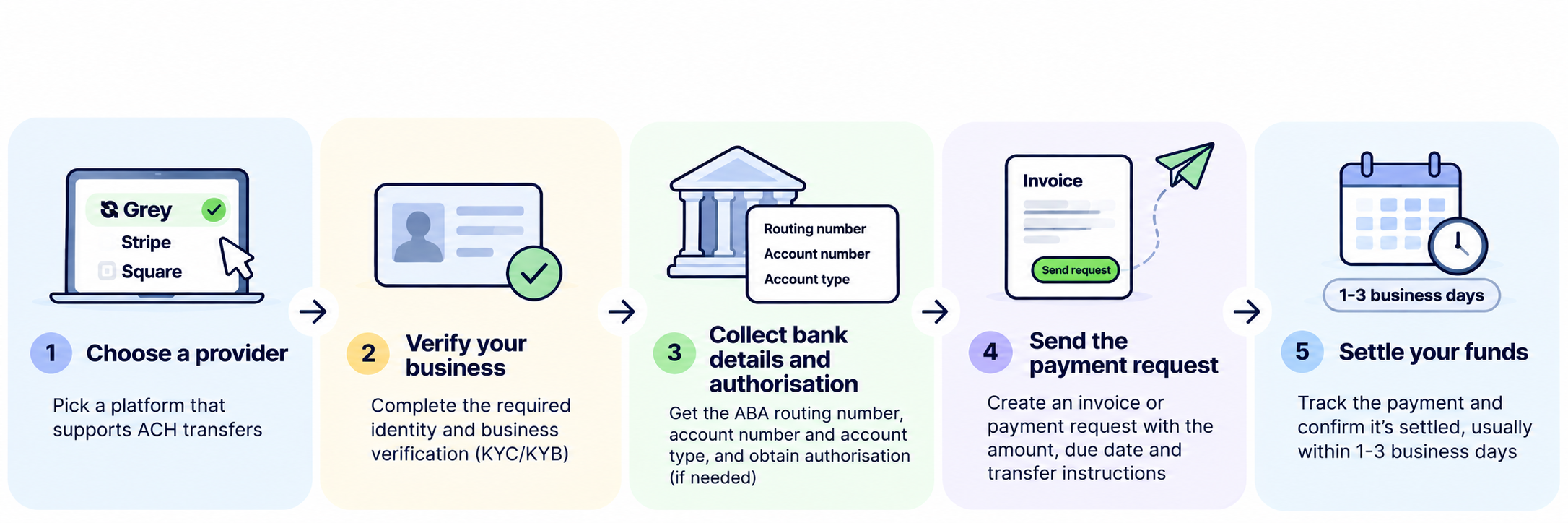
Accepting ACH payments involves choosing a payment provider, verifying your account, collecting the necessary bank details and obtaining authorisation before initiating a transfer. Whether you run a US-based business or work as an international freelancer, follow these five steps to start receiving ACH payments.

Five-step ACH payment setup flow diagram
  1. Choose a provider: Select a platform that supports ACH transfers. US businesses can use Stripe, Square or QuickBooks, while international freelancers may use virtual USD accounts such as Grey, Geegpay or Payoneer.
  2. Verify your business: Complete the required identity and business verification (KYC/KYB). This may involve submitting a government-issued ID, business registration documents, an Employer Identification Number (EIN), relevant tax forms such as W-9 or W-8BEN, and your payout bank details.
  3. Collect bank details and authorisation: For ACH payments, you need the recipient's nine-digit ABA routing number, bank account number and account type (checking or savings). Understanding what a routing number is helps you identify the correct bank details and avoid failed transactions. If you are collecting payments through ACH debit, obtain the customer's authorisation before initiating the transfer. For ACH credit, provide your receiving account details to the sender.
  4. Send the payment request: Create an invoice or payment request through your provider's dashboard. Include the payment amount, due date and instructions for completing the bank transfer.
  5. Settle your funds: Once initiated, standard ACH transfers typically take one to three business days to settle. Monitor your dashboard for completed payments, failed transactions or returned deposits before treating the money as available.

How to accept ACH payments for free

Freelancers looking for apps for freelancers to get paid often need more than a way to receive money; they also want to avoid unnecessary transaction fees. ACH payments offer one option, with several ways to receive funds without paying a receiving fee. These include direct bank-to-bank transfers, Zelle and contractor payment platforms such as Deel, although each comes with different requirements and limitations.

Here are three options worth considering:

  • Direct bank-to-bank ACH credit (Mercury, Relay or US checking accounts): Clients send money directly to your account using your routing and account numbers, often at no additional receiving cost. However, you sacrifice automated invoicing, recurring payment collection and built-in payment management. This works best for US-registered businesses receiving payments from trusted clients.
  • Zelle (US Bank accounts): Zelle allows eligible users to send and receive money between participating US banks without transfer fees. Payments are typically delivered within minutes. However, it has transaction limits and is not designed for formal business invoicing. It is better suited to individuals and freelancers collecting smaller payments.
  • Deel (contractor payouts): International contractors can receive payments through Deel's contractor payment system, including ACH payouts where supported. Receiving fees may be covered, depending on the payment arrangement. However, currency conversion and withdrawal fees may apply when moving funds into another currency. This option suits freelancers working with international companies.

The hidden costs of "free" ACH

While many platforms advertise free ACH payments, the actual costs can appear elsewhere. Monthly subscriptions, failed-payment fees, withdrawal charges and transaction limits can make a supposedly free service expensive. Settlement delays can also affect cash flow, particularly for freelancers who depend on timely payments.

Even when a provider charges no fee to receive funds, transferring funds from a US account to Nigeria may involve additional fees or unfavourable exchange rates.

Payment option Monthly fee Other potential costs Settlement and limitations
US business checking
(Mercury, Relay)
$0 on eligible plans Returned ACH fees may apply 1–3 business days; eligibility and transfer limits vary
Zelle $0 Generally no transfer fee Usually minutes; bank-specific sending limits
Deel $0 for contractors Currency conversion and withdrawal fees may apply 1–3 business days after funding clears
Grey / Geegpay $0 Receiving, reversal and FX fees may apply Limits depend on account verification
Wave / Zoho Invoice Free tiers available ACH processing and failed-payment fees may apply Processing times and limits vary
Stripe / Square Free basic accounts ACH processing and dispute fees may apply Settlement delays and reserves may apply

‍

Before choosing a provider, check its current fee schedule, especially if you receive frequent payments or withdraw funds in Naira. A zero receiving fee does not necessarily mean zero overall cost.

Getting paid by US clients from abroad

Receiving payments from US clients while living abroad can be challenging if your local bank account does not support ACH transfers. The ACH network only processes payments between eligible US bank accounts, meaning international freelancers often need a US-based receiving account to collect payments from American businesses.

One option is to open a USD account that provides US bank details, including a routing number and account number. This allows clients to send money through ACH without relying on international wire transfers, which can attract higher fees and longer processing times.

Platforms such as Grey provide virtual USD accounts that allow eligible users outside the US to receive payments from American clients. Once your account is set up and verified, you can share your receiving details with clients who want to get paid from the US through a domestic bank transfer.

After receiving your funds, you can move your money abroad by withdrawing or converting your USD balance into your local currency, subject to Grey's supported countries, withdrawal options and applicable fees. This gives international freelancers another way to manage cross-border payments without needing to maintain a traditional US bank account.

Frequently asked questions about how to accept ACH payments for free

1. Can I accept ACH payments for free?

Yes. You can accept ACH payments without receiving fees through direct bank-to-bank ACH credits or eligible contractor payout services. However, a free transfer does not always mean a free account. Monthly subscriptions, withdrawal charges, return fees and currency conversion costs may still apply. Check the provider’s fee schedule and eligibility requirements before choosing an option for receiving payments.

2. How long does an ACH payment take?

Standard ACH transfers typically settle within one to three business days. Eligible transactions may qualify for Same-Day ACH, while some payment processors take five to seven business days, particularly for first-time payments. The actual arrival time depends on the provider’s processing schedule, bank cut-off times, weekends and public holidays. Check the estimated settlement date before relying on funds.

3. Is ACH cheaper than a card payment?

Yes. ACH payments are generally cheaper than card transactions because processing fees are usually lower. Depending on the provider, receiving an ACH payment may be free or cost less than 1%. Card payments often carry higher processing charges, especially for international transactions. Compare the full fees, including currency conversion, before choosing how to collect payments in most cases.

4. Can I accept ACH without a US bank account?

Yes. International freelancers may be able to receive ACH payments through eligible virtual USD accounts from providers such as Grey or Geegpay. These services can provide US routing and account numbers for clients making domestic bank transfers. Availability depends on your country, account verification and provider terms, so confirm that your account supports incoming ACH payments before sharing its details.

5. What is an ACH return fee?

An ACH return fee is a charge applied when a bank transfer is rejected or returned. Common reasons include insufficient funds, incorrect account details, a closed account or a payment dispute. The amount varies by bank and payment provider, and some providers may pass the fee to the business receiving the payment. Review the return policy before accepting payments for each transaction.

6. Can international freelancers receive ACH payments in dollars?

Yes. International freelancers can receive ACH payments in US dollars through eligible virtual USD accounts that provide US routing and account numbers. After the funds arrive, they may be able to hold the balance, withdraw it or convert it into local currency. Available options, processing times and fees depend on the provider, your country and account verification before making withdrawals.

How US creators receive YouTube and TikTok payments while living abroad

•

•

2 min read

Two different rules decide how a US creator gets paid abroad. YouTube pays according to your AdSense payment address, so once you have really moved, Google says you must close your US AdSense account and open a new one that pays a bank in your new country, in that country's currency. The IRS works from your passport instead: as a US citizen you keep filing a W-9 with Google and keep reporting your worldwide income, wherever you live.

Most guides treat this as a banking problem and suggest a dollar account as the fix. It isn't one, because no account can override where AdSense is allowed to pay. This guide covers what changes for YouTube, TikTok and brand deals when you leave the US, with the rules quoted from Google, TikTok and the IRS.

Travelling or moved? The short answer

Start with an honest answer to one question: is the US still your home? Everything else follows from it.

Your situationYouTube (AdSense)TikTokUS tax form with Google
Travelling, the US is still homeNo change. Keep your US payment address and US bank or HyperwalletNo change expected. Check payout options in the app before you goW-9
Moved abroadClose the US AdSense account and open a new one with your new address and a local bankCreator Rewards only pays where the programme is available, so check your new countryStill a W-9, updated with your new address

How YouTube pays a US payment address

YouTube pays members of the YouTube Partner Programme through AdSense for YouTube, which pools ad revenue, memberships, Super Chat, Super Thanks and YouTube Premium earnings into one balance. For a dollar account the payment threshold is $100.

For a US address, Google's payment methods table lists two options: EFT (a direct deposit in US dollars to a US bank) and PayPal Hyperwallet. Cheques and wire transfers are not offered to US addresses, so older advice about mailing cheques abroad no longer applies.

The monthly payment timeline is fixed. Last month's earnings are finalised on the 3rd, changes to payment details must be made by the 20th, Google issues payment between the 21st and the 26th, and an EFT can take up to seven business days to arrive.

Hyperwallet works differently from a bank deposit. Google pays your earnings into a PayPal Hyperwallet account, and you then add a transfer method, such as PayPal, to cash out, which may carry PayPal fees. It is tied to your payment address too, so it only stays available while that address is in the US.

LDMAG1

What happens to your AdSense account when you move

Google's address help page is direct: "it's not possible to change the country of your payment address in AdSense." If you've moved to a new country, you close the existing account and create a new one.

Google also says your bank "must be located in the same country or region as the address in your payments settings", and that you can't change your payment currency. So a creator who settles in Lisbon gets paid in euros to a Portuguese bank, and one who moves to Mexico City gets pesos in a Mexican bank.

Payment address countryEFT (bank deposit)EFT currencyWire transferChequePayPal Hyperwallet
United StatesYesUS dollarNoNoYes
MexicoYesMexican pesoYesNoNo
PortugalYesEuroNoNoNo
SpainYesEuroYesNoNo
CanadaYesCanadian dollarNoNoNo
JapanYesYenYesNoNo
ColombiaNoNot offeredYesYesYes
ThailandNoNot offeredYesNoNo

Checked 26 November 2026. Source: Google AdSense for YouTube payment methods and EFT country list.

How to switch without losing a payment

  1. Let the old balance clear. When you close an AdSense for YouTube account, Google only pays a final balance above the cancellation threshold ($10 for dollar accounts), to a verified address with no payment hold, within about 90 days of the end of the month.
  2. Open a local bank account in your new country first, because the new AdSense account can only pay a bank there.
  3. Create the new AdSense account with your new address and link it to your channel.
  4. Expect checks. EFT in each non-US country above that offers it needs a small test deposit, so use an address where post and bank details are current.
  5. Make every change before the 20th, or that month's payment rolls into the next cycle.

UK creators face the same address rule, and our guide for UK creators abroad covers it from the pound side. For Americans, the bigger difference is tax.

Your tax form stays a W-9

Every monetising creator has to give Google US tax information, wherever they live. Many Americans abroad assume they now need the W-8BEN that foreign creators fill in, but the IRS W-8BEN instructions say not to use that form if "you are a U.S. citizen (even if you reside outside the United States)". Use a W-9 instead.

Getting this right protects your whole income. YouTube's tax page says that without valid tax info, backup withholding applies and 24% of an individual's total worldwide earnings is withheld, while valid tax info means Google won't withhold. When you move, update the address on your W-9 as part of the new AdSense setup.

Living abroad doesn't end your US filing either. The IRS says citizens abroad generally must file if their worldwide gross income reaches the filing threshold, and the foreign earned income exclusion only applies if you file a return and report the income. Your new country may tax the same money, so take advice in both places for the year you move.

The exclusion also leaves self-employment tax untouched. The IRS says you pay self-employment tax on all your net profit once net earnings reach $400, even if you claim the foreign earned income exclusion. The exception is when the US has a social security (totalisation) agreement with your new country, so you pay into one system rather than both.

One more form catches people out. The local bank account you open for AdSense is a foreign account in the IRS's eyes, and if your foreign accounts together exceed $10,000 at any time in the year, you must file an FBAR with FinCEN. Our FBAR filing guide walks through it.

How TikTok pays when you live abroad

The Creator Rewards Program pays for original videos over a minute long. TikTok's launch announcement sets the bar at 18 or older, at least 10,000 followers and 100,000 views in the last 30 days, with a personal account in good standing "where the program is available".

That last condition is the one that matters after a move. The programme doesn't run in every country, so check that your new home is covered before you count on the income.

Money from Creator Rewards, LIVE Gifts and subscriptions is withdrawn inside the app, and TikTok shows the payout methods available for your account. If yours goes to PayPal, you can withdraw from PayPal to a Grey account in USD. Grey says these withdrawals take one to two working days and the names on both accounts must match.

Brand deals: the income that travels best

Sponsorships don't care where you live. A US brand or agency pays your invoice by bank transfer, and if you give it US account details, that payment is a domestic transfer rather than an international wire.

Grey gives you foreign currency accounts in USD, GBP and EUR. The USD account takes ACH, FedNow and Fedwire payments (not SWIFT), so a US sponsor pays it like any domestic transfer.

Grey USD accountFee (USD)
Receive by ACH or FedNow0.8% (min $2, max $10)
Receive by Fedwire$20 flat
Convert to another currency1%, capped at $6
Payments from individualsEach must be under $4,000 (no limit for business payers)

Fees and rates checked on 26 November 2026. Source: Grey help centre, US account guidelines. Grey doesn't accept payments for crypto, P2P, betting or forex trading.

Here is what the caps mean in practice. A US brand pays you $3,000 by ACH: 0.8% would be $24, but the cap makes it $10, so $2,990 lands. Converting all of it to euros costs at most $6, so check the live USD to EUR or USD to MXN rate before you move a large sum.

Grey is a financial technology company, not a bank, and which accounts you can open depends on your country of residence. Its sign-up list includes popular bases for Americans such as Mexico, Portugal, Spain, the UK, the UAE, Thailand, Colombia and the Philippines, but not Canada or Japan. For how it compares with the account you already have at home, our US bank comparison explains the differences.

Common mistakes US creators make after moving

  • Keeping a US address you no longer live at. Google's rule for a move is to close and reopen, and PIN letters and test deposits go wrong when the address is stale.
  • Switching to a W-8BEN. US citizens use a W-9 even when they live abroad.
  • Pointing a new foreign AdSense account at a dollar account. It can only pay a bank in your new country, in a currency you can't change.
  • Closing the old account too early. A balance at or under $10 isn't paid out.
  • Forgetting the FBAR. The new local account counts towards the $10,000 test.

Frequently asked questions

Can I keep my US AdSense account if I move abroad?

Only while the US is still your real home. Google says the country of your payment address can't be changed, and that if you've moved to a new country you need to close your AdSense account and create a new one.

Do US citizens living abroad fill in a W-9 or a W-8BEN for YouTube?

A W-9. The IRS instructions for Form W-8BEN say not to use it if you are a US citizen, even if you reside outside the United States.

Can YouTube pay me in US dollars if I live abroad?

Not by choice. AdSense pays a bank in the same country as your payment address, in that country's currency, and Google says you can't change your payment currency.

Do I still pay US tax on YouTube income if I live abroad?

US citizens abroad generally still have to file a US return and report worldwide income. Relief such as the foreign earned income exclusion only applies if you file and report the income, and it doesn't reduce self-employment tax. Get advice in both countries.

Your passport and your address both get a say

For a US creator abroad, YouTube pays wherever your AdSense address says you live, the IRS still treats you as a US taxpayer, and brand deals go wherever you send the invoice. Set up AdSense with a local bank, keep your W-9 current, and give US sponsors dollar account details in your own name. You can open a Grey account in minutes to receive them.

Grey virtual card vs Chipper, Geegpay and others: fees compared

•

•

2 min read

If you live in Nigeria and want a virtual dollar card for regular online spending, the fee that matters most is the one you pay every time you use the card, not the one you pay to open it. Grey charges a one-time $5 to create its Visa card and nothing per payment. Raenest (formerly Geegpay) charges $3 to create plus $0.70 on every successful payment, and Chipper's Nigerian USD card charges $5, then $0.90 per payment and $1 a month.

That sounds like small change, until you add up a year of subscriptions. Every figure below comes from each provider's own pricing or help pages, checked on 26 November 2026, so you can see the source and check it yourself.

A lot has changed since this comparison was first published. Grey's card for Nigeria, Ghana and Kenya is now Visa, Raenest has moved to a new Visa card that spends straight from your balances, and Chipper now offers two different USD cards in Nigeria.

Grey vs Raenest vs Chipper: card fees side by side

Here are the published fees for the three virtual dollar cards most people in Nigeria compare. Where a provider's own pages don't state a fee, the table says so rather than guessing.

Fee or featureGrey Visa cardRaenest Visa cardChipper NG-USD cardChipper US-USD card
Creation fee (USD)$5 one-time$3 one-time$5$5
Fee per successful payment (USD)None$0.70$0.90Not stated
Monthly fee (USD)NoneNone$1$1
Non-US merchant feeUp to 2% + $0.502% + $0.40Not statedNot stated
Decline for insufficient fundsNot listed$0.40₦250Not stated
FundingSpends from your Grey balances, no top-upSpends from USD, GBP, EUR or NGN balancesAdd funds from Chipper, no funding feeNot stated
Spending limits (USD)$10,000 a day, $50,000 a monthUp to $20,000 a day, $60,000 a month (by KYC level)Not stated$2,000 per transaction

Fees and rates checked on 26 November 2026. Sources: Grey card fees and limits from Grey's support centre, Raenest virtual card charges, Chipper NG-USD card and Chipper US-USD card.

What a year of subscriptions costs on each card

Creation fees get the attention, but per-payment fees decide the real cost. Take a common pattern: 10 card payments a month on US websites, such as streaming, cloud storage, design tools and ad top-ups, all paid from a USD balance.

CardFirst month (USD)First year (USD)Each year after (USD)
Grey Visa card$5$5$0
Raenest Visa card$10$87$84
Chipper NG-USD card$15$125$120

Fees and rates checked on 26 November 2026. The example assumes US merchants and a USD balance, so no cross-border or conversion fees apply.

Raenest's lower creation fee only wins if you make two payments or fewer in total. By the third payment, $3 plus three $0.70 charges ($5.10) already costs more than Grey's one-off $5.

When the merchant is outside the US

Grey and Raenest both pass on a cross-border fee when you pay a merchant outside the US or in a currency other than USD. On a $20 payment to a non-US website, Grey's fee is up to 2% plus $0.50, so up to $0.90. Raenest charges 2% plus $0.40 ($0.80) on top of its $0.70 transaction fee, so $1.50 in total.

Chipper's Nigerian help pages don't publish a cross-border fee, so check the in-app fee screen before you rely on it for non-US merchants. If you shop on UK or European sites often, our guide to shopping abroad covers how to keep those charges down.

Paying from a naira, pound or euro balance

If your card payment comes from a balance that isn't USD, there's a conversion step. Grey charges 1% for currency conversion, capped at $6, at the rate shown in the Grey app at the time of the payment. Raenest says its conversion fee applies only when a purchase is funded from a non-USD wallet and links to a separate conversion fee page that doesn't publish a fixed percentage.

LDMAG1

Grey virtual card: what you pay and what you get

Grey's card is a debit card, so there's no credit check and nothing to repay. It spends straight from your available Grey balance, so you never top up the card itself.

  • Network: Visa. Grey's support centre lists Nigeria, Ghana and Kenya among the countries that can create the Visa card. Grey Mastercard creation is now limited to specific regions such as India, Turkey and Vietnam.
  • Cost: a one-time $5 creation fee, and you need at least $5 in your USD balance to create it. Grey charges no card maintenance, transaction or funding fees.
  • Balances: pay from USD, EUR, GBP or your local currency. Non-USD balances are converted at 1%, capped at $6.
  • Cross-border fee: up to 2% plus $0.50 on non-USD card payments. It also applies to refunds from non-USD merchants, and conversion fees aren't refunded.
  • Limits: up to $10,000 a day and $50,000 a month.
  • Multiple cards: create as many as you need, each with its own limits, and pause any card from the app.
  • Where it works: online, in apps and in stores wherever Visa is accepted, plus Apple Pay and Google Pay in supported regions. It can't be used for cash withdrawals.

Separate cards make it easier to see where your money goes, for example one for subscriptions and one for ads. Our Grey card budgeting guide shows how people set that up.

One rule worth knowing: if a card's balance goes negative and the shortfall reaches $50, Grey automatically terminates that card. Keep your balance above your recurring charges.

Raenest (formerly Geegpay) virtual card

Raenest's help centre introduced its new Visa card in August 2026. The card now spends directly from your USD, GBP, EUR or NGN balance, so there's no separate card funding step.

  • Cost: $3 to create, free funding and no monthly fee, then $0.70 on every successful transaction.
  • Non-US merchants: 2% plus $0.40 for purchases or refunds on non-US websites.
  • Declines and disputes: $0.40 when a payment is declined for insufficient balance, and $50 to process a chargeback or dispute.
  • Limits: up to $20,000 a day and $60,000 a month, depending on your verification level.
  • Physical card: Raenest's cards page says a physical card is available on request.

Raenest is the stronger pick if you need a physical card or daily limits above $10,000. For frequent small payments, the $0.70 charge on each one makes it more expensive than Grey within a few transactions.

Chipper Cash USD cards

Chipper now offers two USD cards in Nigeria, and they work differently. Its help pages don't name the card network for either.

Chipper NG-USD card

  • Cost: $5 to create, $0.90 on every successful transaction, and a $1 monthly maintenance fee charged on the 28th.
  • Declines: a non-refundable ₦250 fee for each transaction that fails for insufficient funds. Chipper cut this from ₦500.
  • Funding: no fee to add or withdraw funds, and naira to dollar conversions use Chipper's real-time rate. Money sent to the card from external sources, such as Visa Direct, carries a 1% fee.

Chipper US-USD card

  • Cost: $5 to create and $1 a month, charged on the 28th.
  • Limit: $2,000 maximum per transaction.
  • Use: issued through a US partner, with wider acceptance on international platforms, and it can be used for some financial service transactions where the merchant supports them. Issuance can take up to 48 hours.

If you already keep money in Chipper and only pay for something occasionally, the NG-USD card is convenient. For regular spending, the per-payment fee, the monthly charge and the ₦250 decline fee add up quickly.

Can you get a Wise or Payoneer card in Nigeria?

Wise's card is not currently available to residents of Nigeria, Ghana or Kenya. Wise's own card availability list doesn't include them and offers a waitlist instead.

Payoneer says card availability depends on each customer's eligibility and jurisdiction. Where it is offered, its fees page lists a $29.95 annual card fee and up to 3.5% on card transactions with currency conversion, which makes it a costly card for everyday spending.

If you mainly want a card for receiving and converting freelance income, the cards matter less than the account behind them. Our receiving fees comparison covers that side.

Which virtual card should you choose?

  • Lots of small USD payments every month (subscriptions, software, ads): Grey, because there's no per-payment or monthly fee.
  • You need a physical card or limits above $10,000 a day: Raenest.
  • You already use Chipper and pay for something now and then: Chipper's NG-USD card, as long as you budget for the $1 monthly fee and avoid declines.
  • You want to compare more options: see our wider list of virtual dollar cards available in Nigeria.

Whichever you pick, keep enough in your balance to cover recurring charges. Declines cost money on Raenest and Chipper, and a declined subscription can lock you out of a service you rely on.

Frequently asked questions

Is the Grey virtual card free?

No. Grey charges a one-time $5 fee to create the card and no monthly, funding or per-transaction fees after that. You may pay a cross-border fee of up to 2% plus $0.50 on non-USD payments, and 1% (capped at $6) if the payment is converted from a non-USD balance.

Is the Grey card Visa or Mastercard in Nigeria?

Visa. Grey's support centre lists Nigeria, Ghana and Kenya among the countries that can create the Visa card, while Grey Mastercard creation is now limited to specific regions such as India, Turkey and Vietnam.

Which virtual dollar card has the lowest fees in Nigeria?

Of the three cards compared here, Grey costs the least for regular spending because it has no per-transaction or monthly fee. Raenest has the lowest creation fee at $3, but its $0.70 per-transaction fee overtakes Grey's $5 by the third payment.

Is Geegpay the same as Raenest?

Yes. Geegpay renamed itself Raenest, and its help centre still describes the product as Raenest (formerly Geegpay).

Can I get a Wise card in Nigeria?

Not at the moment. Wise's list of countries where personal customers can get its card doesn't include Nigeria, Ghana or Kenya, and Wise offers a waitlist for unlisted countries.

The price on the box is the creation fee, but the price you actually pay is what the card charges every time you use it. If most of your spending is regular USD payments, create a Grey card in the app and see the fee before you confirm.

Arrow (up)

Back to top