


<script type="application/ld+json" data-schema-version="grey-blog-v4"> [{"@context":"https://schema.org","@type":"BlogPosting","@id":"https://grey.co/blog/holiday-travel-what-many-kenyans-forget-to-plan-for#article","headline":"Holiday travel: what many Kenyans forget to plan for","description":"Wondering what you are forgetting? Let’s remind you of what many Kenyans forget to plan for on their holiday travel.","inLanguage":"en","url":"https://grey.co/blog/holiday-travel-what-many-kenyans-forget-to-plan-for","mainEntityOfPage":{"@id":"https://grey.co/blog/holiday-travel-what-many-kenyans-forget-to-plan-for#webpage"},"datePublished":"2025-11-26T13:23:45.779Z","dateModified":"2026-06-15T14:34:54.325Z","author":{"@type":"Person","@id":"https://grey.co/authors/adeolu-titus-adekunle#person","name":"Adeolu Titus Adekunle","url":"https://grey.co/authors/adeolu-titus-adekunle","jobTitle":"Content Writer","sameAs":["https://www.linkedin.com/in/titusadeoluadekunle/"]},"publisher":{"@type":"Organization","@id":"https://grey.co/#organization","name":"Grey","url":"https://grey.co","logo":{"@type":"ImageObject","url":"https://cdn.prod.website-files.com/6360022338a81bd6fdbb1145/6564ae1077a67e39d3c491a6_Grey%20Logo%20Lockup%20Black.svg"}},"image":{"@type":"ImageObject","@id":"https://grey.co/blog/holiday-travel-what-many-kenyans-forget-to-plan-for#primaryimage","url":"https://cdn.prod.website-files.com/636a85d290ee58e70c17e1c0/6a300d8d14a1c625fe0e2bc5_6a300d8c6386987090c7f053_holiday-travel-what-many-kenyans-forget-to-plan-for__header-image.webp","contentUrl":"https://cdn.prod.website-files.com/636a85d290ee58e70c17e1c0/6a300d8d14a1c625fe0e2bc5_6a300d8c6386987090c7f053_holiday-travel-what-many-kenyans-forget-to-plan-for__header-image.webp","width":1200,"height":675}},{"@context":"https://schema.org","@type":"WebPage","@id":"https://grey.co/blog/holiday-travel-what-many-kenyans-forget-to-plan-for#webpage","url":"https://grey.co/blog/holiday-travel-what-many-kenyans-forget-to-plan-for","name":"Holiday travel: what many Kenyans forget to plan for","description":"Wondering what you are forgetting? Let’s remind you of what many Kenyans forget to plan for on their holiday travel.","inLanguage":"en","primaryImageOfPage":{"@id":"https://grey.co/blog/holiday-travel-what-many-kenyans-forget-to-plan-for#primaryimage"},"breadcrumb":{"@id":"https://grey.co/blog/holiday-travel-what-many-kenyans-forget-to-plan-for#breadcrumb"}},{"@context":"https://schema.org","@type":"BreadcrumbList","@id":"https://grey.co/blog/holiday-travel-what-many-kenyans-forget-to-plan-for#breadcrumb","itemListElement":[{"@type":"ListItem","position":1,"name":"Home","item":"https://grey.co/"},{"@type":"ListItem","position":2,"name":"Blog","item":"https://grey.co/blog"},{"@type":"ListItem","position":3,"name":"Holiday travel: what many Kenyans forget to plan for","item":"https://grey.co/blog/holiday-travel-what-many-kenyans-forget-to-plan-for"}]}] </script>

Holiday travel: what many Kenyans forget to plan for

Adeolu Titus Adekunle

TABLE OF CONTENT

SHARE THIS POST

Is it just me who always knows there is something I am forgetting before a trip, and usually don’t remember until I am on the trip? It got so frustrating that I eventually had to create a travel checklist containing the most common things I forget, especially my glasses case. Very often, these things aren’t even the most important things to the trip, but they could make your experience a little less comfortable.

Travelling during the holidays is exciting, but many Kenyans focus so much on tickets and accommodation that they overlook small but important details. These missed steps often lead to delays, extra costs, or unnecessary stress. This simple guide highlights the things most people forget to plan for, so your holiday trip goes smoothly from start to finish.

Also read: Best ways to send money to Kenya for Christmas and New Year celebrations

Health and safety

May the universe forbid you from catching a bug on your holiday trip. But until that happens, you will not truly understand how relevant it is to plan for your health and safety.

  • Get necessary vaccinations and prophylaxis: Before travelling, consult a doctor about recommended vaccinations such as Typhoid, Hepatitis A, and Yellow Fever, and consider malaria prevention, especially in safari areas or coastal regions.
  • Secure appropriate travel insurance: Ensure it covers potential medical needs in your destination, including emergency evacuation.
  • Be aware of security risks: Stay informed about the general safety and security situation in your destination and take necessary precautions.
  • Don’t forget your medications and reports: Pack your routine medications, as well as relevant OTC medications such as pain relievers, antihistamines, and motion-sickness tablets.

Also read: How Kenyan freelancers are building global careers from home

Bookings

I am the type of trip planner who tends to underestimate the late-minute rush during the festive seasons. I often put off booking for transport and stays until later, and I pay dearly for it.

  • Book early: Especially for popular destinations like safari lodges, booking well in advance can secure better accommodation and prices.
  • Consider local logistics: Plan for local transport, which can be costly and logistically challenging, particularly in rural areas.
  • Book direct flights: If possible, book direct flights to minimise layovers and potential disruptions.
  • Activity tickets: Beat the queue for your planned activities by booking earlier. There might be a lot of rush during the peak holiday season, and tickets can sell out early.

LDMAG1

Road safety measures

This is not to scare you. But if you are travelling by road, note that festive periods see a surge in road accidents due to speeding, overloading, and drunk driving. Amidst all of the mishaps you can or cannot avoid, don’t forget basic safety checks. Inspect tyres, brakes, and lights before long drives. Insist on belts for all passengers and avoid night travel to reduce risks. Download emergency apps like NTSA for real-time alerts if you are travelling within Kenya.

Packing the essentials

One more thing about me: I end up packing the things I don’t need and leaving out the things I need. You might find yourself overpacking for a trip while not packing what you’ll really need, especially people like me who pack more books than they’ll ever read on a trip. Have a checklist of weeks including your bodycare products, chargers, power banks, cameras, etc. Choose weather and activity-appropriate gear, e.g swimming trunks.

Plan for connectivity and documentation

Staying online is very crucial to your trip.

  • Internet connectivity: Find out how you can access the internet before you set out. Some embassies provide e-Sims. Roaming is usually too expensive. Buy a local SIM or eSIM at the airport.
  • Documents: Pack your valid IDs, accommodation bookings, international passports, and other relevant travel documents. It is advisable to have digital copies of tickets and IDs on cloud storage.]

Also read: Grey vs. local banks: The best currency exchange method in Kenya

Payment plans

You might set yourself up for a frustrating experience if you do not plan for payment when you arrive at your destination. It is advisable to know which payment options are available so you can plan accordingly. Relying on international ATMs and airport and hotel exchange services might be too expensive. Your local Kenyan card might also not work in other countries. While carrying some cash can be great, you cannot carry too much cash because of local restrictions and safety reasons. This is why a multi-currency account that lets you hold USD, GBP, and EUR in one place is your best bet for holiday travel.

Travel anywhere with Grey

One thing you must not forget on your holiday trips is travelling Grey. Users enjoy seamless international transactions at low charges and competitive exchange rates. Grey’s virtual USD debit card also makes it easy to pay for online services and purchases. You can also link the card to Google or Apple Pay for swift, contactless payments where available.

Get started with Grey today to complete your travel checklist.

‍

Last updated:

October 13, 2026

Open a free Grey account to get startedJoin 1 million digital nomads
IF YOU ENJOYED THIS, CHECK THESE OUT

Egypt visa requirements for US citizens

•

•

2 min read

From the Great Pyramid of Giza and the Nile River to the temples of Luxor and the beaches of Sharm El Sheikh, Egypt remains one of the world’s most visited destinations. Every year, thousands of US citizens, all drawn by the country’s rich history and growing hospitality sector, travel to Egypt for tourism, business, study, and cultural experiences.

However, before booking your flight, it is important to understand Egypt’s visa requirements for US citizens. Entry rules vary depending on the purpose and duration of your stay, and travellers may need an e-visa, visa on arrival, or other supporting travel documents before entering the country.

Understanding the process early helps you avoid airport delays, rejected applications, or unexpected immigration issues. This guide explains Egypt visa requirements for US citizens, including documents, visa options, processing times, fees, and other important travel considerations before your trip.

Also read: How to get an instant USD debit card in Egypt

Why do US citizens need visas for Egypt?

Egypt requires visas from US citizens as part of its national security and immigration control policies. Like many countries, Egypt monitors who enters and exits its borders to reduce security risks, track foreign visitors, and ensure travellers meet legal entry requirements before arrival.

Visa systems also help Egyptian authorities manage immigration records, prevent overstays, and verify the purpose of travel, whether for tourism, business, study, or work. During the application process, travellers may be required to provide passport details, travel plans, accommodation information, or supporting documents to confirm their identity and intended stay.

For US citizens, the visa process is generally straightforward, with options including e-visas, visas on arrival, and embassy applications depending on travel circumstances. Applying correctly before departure helps avoid delays, denied boarding, or entry complications at Egyptian airports and border checkpoints

Also read: Egypt visa requirements for EU citizens

Egypt visa types for US citizens

US citizens travelling to Egypt can choose between short-term tourist visas and long-term visas, depending on the purpose of their stay. While Egypt offers relatively accessible visa options for Americans, understanding the right category before travelling helps avoid delays, overstays, or immigration issues after arrival.

1. Tourist visas

A. Visa on arrival

US citizens can obtain a visa on arrival at major Egyptian international airports, including Cairo International Airport. This remains one of the most convenient options for tourists visiting Egypt for short stays, vacations, or family visits.

Validity: 30 days (single-entry)

Cost: $30, paid in cash at the bank counters before passport control. At Cairo International Airport the visa on arrival is now a QR code costing $36 ($30 plus a $6 processing fee), bought by card at self-service machines in the arrivals hall.

Best for: Short tourism trips and flexible travel plans

Requirements

  • A US passport valid for at least six months from the arrival date
  • At least one blank passport page
  • Proof of onward or return flight ticket
  • Hotel booking or accommodation details may sometimes be requested

Outside Cairo, carry US dollars in cash for the bank counters. At Cairo, bring a card for the QR code machines instead. While the process is generally straightforward, queues can become long during peak tourism seasons.

Also read: Legal alternatives to black market exchange rates in Egypt

B. Egypt e-Visa

The Egypt e-Visa allows US citizens to complete the visa application process online before departure, reducing airport processing time after arrival. Many travellers prefer this option because approval arrives digitally through email before travelling.

Validity:

  • 30-day single-entry visa
  • Multiple-entry options also available

Cost:

  • $30 (single-entry)
  • $65 (multiple-entry)

Fees are listed on the official portal, visa2egypt.gov.eg, and were checked on 27 November 2026. Egypt has also announced a visa fee rise from 1 January 2027, and travel agents expect the single-entry visa to reach $33.

Requirements

  • Passport valid for at least six months
  • Scanned passport bio page
  • Digital passport photograph
  • Valid email address
  • A Visa, Mastercard or other debit card for payment

Processing time

Most e-Visas are approved within 3 to 5 business days, and the portal asks you to apply at least seven days before departure in case additional verification is required.

The e-Visa is often the smoother option for families, business travellers, and first-time visitors who want fewer airport formalities.

Also read: Egypt visa requirements for UK citizens

2. Long-term visas

US citizens planning to stay in Egypt beyond tourism must apply for a long-term visa in a work, study, or residency category.

A. Work visa

Foreign nationals cannot legally work in Egypt using a tourist visa. US citizens intending to work must secure sponsorship from an Egyptian employer before applying.

Requirements

  • Valid employment contract
  • Employer sponsorship
  • Ministry of Labour approval
  • Educational and professional certificates
  • Medical examination
  • Police clearance certificate

Work visa approval may take several weeks because Egyptian authorities carefully review foreign employment applications.

B. Student visa

US citizens studying Arabic, Islamic studies, archaeology, medicine, or other academic programmes in Egypt must apply for a student visa through an accredited institution.

Requirements

  • Official admission letter
  • Proof of tuition payment or financial support
  • Medical examination report
  • Police clearance certificate
  • Valid passport

Many universities assist international students during the visa process after admission is confirmed.

C. Residence visa

Residence visas apply to retirees, dependents, investors, or foreigners joining family members already living in Egypt.

Requirements

  • Proof of financial stability
  • Health insurance coverage
  • Accommodation details
  • Police clearance certificate
  • Valid passport

Approval length varies depending on the residency category and supporting documentation submitted during application.

Also read: Planning a summer trip to Egypt? Avoid currency exchange traps

D. Sinai resort permission

US citizens visiting only the Sinai resort areas of Sharm El Sheikh, Dahab, Nuweiba, or Taba for short stays do not need a full Egyptian tourist visa. Instead, travellers receive a free Sinai entry permission stamp upon arrival.

Validity: Up to 15 days

Cost: Free

Best for: Beach vacations and short resort stays in Sinai

Requirements

  • US passport valid for at least six months
  • Confirmed accommodation within Sinai resort areas
  • Return or onward travel ticket

This permission is valid only within the Sinai Peninsula resort zone. Travellers who plan to visit Cairo, Luxor, Alexandria, or other Egyptian cities outside Sinai must obtain a regular tourist visa or e-Visa before travelling beyond the permitted region

Frequently asked questions

Can US citizens enter Egypt without a visa?

Yes, but only under specific conditions. US citizens visiting Sinai resort areas like Sharm El Sheikh, Dahab, Taba, or Nuweiba for less than 15 days can receive a free Sinai entry stamp. Travelling outside these areas, including Cairo or Luxor, requires a standard Egyptian tourist visa or e-Visa.

Is the Egypt e-Visa better than a visa on arrival?

For many travellers, yes. The e-Visa reduces airport waiting time and provides approval before departure, which lowers the risk of entry issues after landing. Visa on arrival remains convenient, but long queues, payment rules that differ by airport, or documentation checks can slow the process at busy airports.

How long does Egypt visa processing take for US citizens?

Tourist e-Visas are usually processed within 3 to 5 business days, although delays can happen during peak travel periods or additional verification checks. Long-term visas such as work or residence permits may take several weeks because they involve background reviews, sponsorship approvals, and immigration documentation requirements.

Can US citizens extend their stay after arriving in Egypt?

Yes, extensions are possible. Travellers usually need a valid passport, visa copies, passport photos, and proof of accommodation. Approval is not automatic, and overstaying without extension approval may result in fines, departure delays, or future travel restrictions into Egypt.

What happens if my passport expires soon before travelling to Egypt?

Egypt requires US passports to remain valid for at least six months from the arrival date. Airlines may refuse boarding if the passport validity is shorter. Even with an approved visa, immigration officers can deny entry if passport validity requirements are not fully satisfied upon arrival.

Managing travelling funds with Grey

Travelling to Egypt becomes easier when you understand visa rules, entry options, and the documents required before arrival. From e-Visas and visa on arrival to Sinai entry permissions, choosing the right option helps you avoid delays and entry issues at the border. Once in Egypt, managing your money efficiently is just as important as planning your trip.

Grey helps you hold USD and convert to Egyptian pounds when needed, giving you more control over your spending and reducing unnecessary currency loss. Sign up or download the app to get started and manage your money more smoothly while in Egypt.

Grey charges fees on deposits, conversions, and withdrawals. Deposits via ACH, SEPA, or FPS incur a 0.8% fee (minimum $2/€2/£2, maximum $10/€10/£10). Currency conversions are charged at 1%, capped at $6. Withdrawal fees vary by currency: ₦35 for NGN, 0.5% for EUR/GBP (minimum €2/£2, maximum €10/£10), and $2 for Egypt. Cross-border card transactions (non-USD purchases on a USD card) incur a 2% fee plus $0.50. Exchange rates are variable and include a margin over the mid-market rate. Always review fees and the rate before confirming a transaction. Visit our guide to fees and charges on Grey for current rates.
‍

Egypt visa requirements for UK citizens: The complete 2026 guide

•

•

2 min read

Egypt remains one of the most visited destinations for UK travellers, from the Red Sea resorts to Cairo and the Nile. The entry rules are more nuanced than most guides suggest: there is a visa-free route that only applies to part of the country, a visa on arrival that must be paid in cash, an e-Visa, and a consulate route with a little-known free visa for travellers of Egyptian origin.

This guide covers every route for UK citizens in 2026: who genuinely does not need a visa, what each option costs, how to avoid being overcharged at the airport, the border crossing rules from Israel and Jordan, and the money rules that determine how you should carry and spend funds in Egypt.

And because Egypt is a largely cash-based economy with strict limits on its own currency, we also cover the practical side: how a multi-currency account handles GBP to EGP without airport exchange desks.

Do UK citizens need a visa for Egypt?

Yes, in most cases. UK passport holders normally need a visa to enter Egypt. There is one genuine exception: if you arrive by air at Sharm El-Sheikh and stay for less than 15 days within the Sinai resorts of Sharm El Sheikh, Dahab, Nuweiba, or Taba, you receive a free entry permission stamp on arrival and do not need a visa.

The exemption is strictly limited. If you plan to travel outside those resorts, take a Nile cruise, visit Cairo or Luxor, or stay longer than the permitted period, you must get a visa. You can buy one at Sharm El-Sheikh Airport or apply online before travelling.

Your four visa options compared

Route Cost Validity Best for
Sinai free entry stamp Free Up to 15 days, Sinai resorts only Resort-only holidays via Sharm El-Sheikh
e-Visa (online) $30 single / $65 multiple Tourist e-visas valid up to 3 months Most travellers; avoids airport queues
Visa on arrival $30 cash at bank kiosks; $36 QR code by card at Cairo airport Up to 30 days, single entry Last-minute trips; bring exact USD cash
Consulate (London) £32 single / £53 multiple tourist 6 months validity; 30 days stay (single) or 90 days collective (multiple) Long stays, work, study, non-tourist purposes

Two warnings for the airport route. First, outside Cairo the visa on arrival is paid in cash at the bank kiosks before the immigration counters, so bring the exact amount in US dollars. At Cairo International it is now a QR code costing $36 ($30 plus a $6 processing fee), bought by card at self-service machines in arrivals. Second, you do not need to buy your visa from an agent. Agents in arrival halls often charge well above the $30 official price. If an agent harasses you, report it to the tourist police in the terminal.

The e-Visa is paid online in US dollars, which means a UK debit card adds a foreign transaction fee on top of the visa cost. Paying with a Grey virtual card from a USD balance avoids that markup.

Fees are due to rise on 1 January 2027. Egypt has raised a fixed fee built into tourist visas from that date, and travel agents expect the single-entry visa to reach $33 and Cairo's QR code visa $39. Fees in the table were checked on 27 November 2026 on the official e-Visa portal.

Free multiple-entry visa for travellers of Egyptian origin

Applicants of Egyptian origin, or applicants married to an Egyptian national, can obtain a multiple-entry visa free of charge through the consulate by providing official proof: an Egyptian ID if you are of Egyptian origin, or your spouse's Egyptian ID plus your marriage certificate if your spouse is Egyptian.

For the large UK-Egyptian community visiting family, this changes the calculation entirely. A free multiple-entry visa, valid 6 months with up to 90 days of collective stay, makes frequent trips realistic, and it shifts the real planning question from paperwork to money, which we cover below.

Also read: Step-by-step guide to applying for an Egypt visit visa

Applying through the Egyptian Consulate in London

  • A passport valid for at least 6 months on the date the visa is issued
  • Two recent coloured passport photographs (45mm x 35mm) on a white background, with your name written on the back
  • A completed application form per applicant
  • Card payment when applying in person; postal order with a pre-paid return envelope when applying by post
  • Business visa applications: a company letter stating the purpose of the visit and the name and address of the organisation being visited in Egypt

Collection takes 5 to 7 business days once all documents are provided, and passports must be collected in person if you applied in person. One passport covers children under 16 added to it; children with their own passports, including babies, need their own visa.

Visa extensions and overstays

You can apply for an extension at the Egyptian Passport and Immigration Offices in-country. Do not leave it late: if you try to leave Egypt on a visa that has expired by more than 14 days, you will get a fine and face difficulties at departure. If you are hospitalised or delayed, start the extension process before your visa lapses.

Long-term visas: work, study, and residency

Work visa

Working in Egypt requires a job offer from an Egyptian employer, who sponsors the work permit application through the Egyptian Ministry of Labour. Expect background checks and medical tests, and note one requirement that surprises people: you must show HIV test results to apply for a work permit. Work permits can only be obtained from the local authorities in Egypt, not from the consulate in London.

Student visa

Students need an official letter of acceptance from a recognised Egyptian institution, proof of funds for tuition and living costs, and medical clearance. Visas generally run for the duration of the course.

Residency

Retirees, entrepreneurs, and long-stay residents apply for a residence permit, which can only be applied for and obtained within Egypt. Requirements include proof of sufficient income, a rental contract or property ownership, and a UK police clearance certificate.

Also read: Egypt visa requirements for US citizens

Crossing into Egypt by land or sea

If you are combining Egypt with Israel or Jordan, the border arithmetic matters, because everything is paid in US dollars cash.

From Israel at Taba

  • Staying in Taba only: $20 border tax for a 15-day entry stamp
  • Travelling within Sinai (including Sharm El-Sheikh): $120 border tax for a 15-day stamp
  • Travelling beyond Sinai (including flying from Cairo or Hurghada): $120 border tax plus a $30 entry visa plus a letter of guarantee from a travel agent, around $20
  • Crossing by car: an additional charge of around $100, plus parking fees

The FCDO recommends bringing at least 170 US dollars in cash per person, with extra to cover changes, because charges at Taba have been increasing at short notice since March 2026. The ATMs at the crossing are unreliable and frequently empty, so obtain your dollars before travelling. Border officials may also ask travellers to remove hats, coats, or other items of clothing, including religious clothing, as they pass through the terminal.

From Jordan by ferry

Ferries run from Aqaba to Taba Heights and Nuweiba. If you will stay beyond 15 days or travel past Sinai, an entry visa costs $35 at Taba Heights or $30 at Nuweiba, purchased at the port terminal, again usually in cash.

Health and entry conditions

You must show a yellow fever vaccination certificate if arriving from a country listed as a transmission risk; direct arrivals from the UK are not normally affected, but transit routes can trigger it. Check TravelHealthPro's Egypt guide for recommended vaccinations before you travel.

Two further conditions worth knowing. Egypt may deny entry if your gender expression or appearance does not match the sex marker or photograph in your passport. And high-value electronics and recording equipment should be declared on arrival; satellite phones and radio communications equipment are likely to be confiscated without prior clearance from the Ministry of Telecommunications.

Taking money into Egypt: the rules

Egypt's currency rules shape how you should carry funds. You can bring no more than 5,000 Egyptian pounds into or out of the country, which makes it pointless to buy EGP in the UK in any quantity. There is no limit on foreign currency, but you must declare anything worth more than 10,000 US dollars on arrival.

The practical setup for a UK traveller is foreign currency in and digital money throughout. A Grey multi-currency account lets you hold GBP, USD, and EUR and convert as you spend, at rates that beat airport exchange desks, with a virtual card for hotel and flight bookings. Keep some US dollars in cash for visa fees and border charges, and handle the rest digitally.

Sending money from the UK to Egypt before you travel

For the UK-Egyptian community, trips home usually come with money to move: support for parents, contributions to family costs, payments ahead of arrival. Rather than carrying declared cash, you can send money to Egypt before you travel. Grey pays out to banks operating in Egypt and to mobile money, with mobile money arriving same-day.

Combined with the free multiple-entry visa for travellers of Egyptian origin, a standing GBP to EGP setup means each trip starts with the paperwork and the money already handled. Opening an account takes minutes and you can do it before you fly.

Frequently asked questions

Do UK citizens need a visa for Egypt?

Yes, normally. The exception is arriving by air at Sharm El-Sheikh and staying under 15 days within the Sinai resorts of Sharm El Sheikh, Dahab, Nuweiba, or Taba, where you receive a free entry stamp.

Is Sharm El Sheikh visa-free for UK citizens?

Yes, for stays under 15 days within the Sinai resorts, arriving by air at Sharm El-Sheikh. Travelling beyond the resorts, including Cairo, Luxor, or a Nile cruise, requires a visa.

How much is the Egypt visa on arrival for UK citizens?

30 US dollars in cash at the official bank kiosks before immigration, or $36 by card as a QR code at Cairo International. Do not buy from agents in the arrival hall, who often charge more than the official price.

How much does the Egypt e-Visa cost for UK citizens?

$30 for single entry and $65 for multiple entry, paid online by card. Tourist e-visas are valid for up to 3 months. Verify current fees on the official portal before applying.

How long does the Egypt e-Visa take?

Typically 3 to 5 business days. Apply at least a week before travel to allow for delays or additional checks.

Can people of Egyptian origin get a free visa?

Yes. Applicants of Egyptian origin, or those married to an Egyptian national, can obtain a free multiple-entry visa through the consulate with official proof such as an Egyptian ID or a spouse's ID plus marriage certificate.

What happens if I overstay my Egypt visa?

You can apply for an extension at the Egyptian Passport and Immigration Offices. Leaving on a visa expired by more than 14 days risks a fine and difficulties at departure.

How much cash can I take into Egypt?

You can bring a maximum of 5,000 Egyptian pounds in or out. Foreign currency is unlimited but amounts worth over 10,000 US dollars must be declared on arrival.

What is the best way to manage money in Egypt as a UK visitor?

Carry some US dollars in cash for visa fees and border charges, and use a Grey multi-currency account for the rest: hold GBP, convert at competitive rates, and pay with a virtual card.

Understanding Egypt's visa requirements before you travel can help you avoid unnecessary delays and ensure a smoother journey from the UK. Once your travel plans are in place, open a Grey account to pay for visa fees, manage travel expenses in multiple currencies and spend abroad with greater convenience and competitive exchange rates.

‍

This article is for general information purposes only and does not constitute legal or immigration advice. Visa requirements and entry rules change frequently. Always verify current information with the Egyptian Consulate General in the UK or GOV.UK before travelling. Note that the FCDO advises against all travel to some parts of Egypt and against all but essential travel to others; check current travel advisories before booking.

Cost of living in London vs New York: a sourced comparison

•

•

2 min read

New York is more expensive than London for most people, but the gap is smaller than the headlines suggest and it sits in different places. A newly listed flat costs about 11% more in New York ($4,100 median asking rent in October 2026, against about $3,700 for London's £2,825 average), yet New York's subway is cheaper and London wins clearly on healthcare and childcare. The bigger surprise is how much you need to earn just to be allowed to sign a New York lease.

Plenty of comparison sites give you dozens of prices at once, many of them crowd-sourced and months old. This guide does the opposite: fewer numbers, each one tied to an official or named source and a date, so you can trust what you are planning with. Where we couldn't verify a like-for-like figure, we left it out.

All conversions use about $1.31 to the pound, the rate GBP/USD was trading at on 19 November 2026 (FXStreet). Grab your calculator.

London vs New York at a glance

CostLondon (GBP, approx. USD)New York (USD)Source and period
Asking rent, new let (per month)£2,825 average (about $3,700)$4,100 median citywide; $4,995 ManhattanRightmove, Q3 2026; StreetEasy, October 2026
Income landlords usually ask for (per year)30 x rent: £84,750 (about $111,000)40 x rent: $164,000Kinleigh Folkard & Hayward; StreetEasy
Deposit cap5 weeks' rent (annual rent under £50,000)1 month's rentGOV.UK Tenant Fees Act guidance; New York Attorney General
Public transport, weekly cap£44.70, zones 1 to 2 (about $59)$35, subway and local busMayor of London decision MD3464, from 1 March 2026; MTA, from January 2026
Local tax a renter paysCouncil tax: £2,068 a year average Band DCity income tax: 3.078% to 3.876%GOV.UK, 2026 to 2027; NYS Tax Department, 2026
Sales tax20% VAT, included in shelf prices8.875%, added at the tillGOV.UK; NYC Department of Finance

Rates and prices checked on 26 November 2026.

Rent: New York costs more, but not twice as much

Rent is the line that decides your budget in both cities. According to Rightmove's Q3 2026 rental price tracker, London's average advertised rent hit a record £2,825 a month, about $3,700. StreetEasy's October 2026 report puts New York's median asking rent at $4,100, up 3.8% on a year earlier.

That makes a newly listed New York home roughly 11% dearer. The gap widens in the most popular areas: Manhattan's median asking rent was $4,995 in October, Brooklyn's $3,866 and Queens' $3,350. Rightmove reports an average and StreetEasy a median, so treat the gap as a guide rather than an exact figure.

Asking rents are what newcomers pay. People who have been in their London flat for a while pay less: the ONS puts the average rent across all London tenancies at £2,338 in September 2026 (about $3,060), up 3.5% in a year. For the capital on its own, our London cost guide goes into more detail.

Verdict: New York is more expensive for a new renter, by about a tenth citywide and more in Manhattan. It is not the "twice as much" that some older comparisons claim.

The hidden gap: what you need to earn to sign a lease

This is where the two cities really part ways. New York landlords typically want your gross annual income to equal 40 times the monthly rent, according to StreetEasy, and some buildings ask for 50 times. On a $4,100 flat, that means earning $164,000 a year, or finding a guarantor who meets the test instead.

London letting agents usually work to 30 times the monthly rent; the London estate agency Kinleigh Folkard & Hayward describes the same rule. On £2,825 that is £84,750, about $111,000. So the income bar for an average new let is roughly 48% higher in New York, even though the rent itself is only about 11% higher.

Neither rule is law, and both cities offer guarantor services and shares for people who fall short. But if you are weighing a job offer, this test tells you more than any rent average: a New York salary has to clear the landlord's bar before it can pay the rent.

How much cash you need to move in

In England, the deposit is capped at five weeks' rent when annual rent is under £50,000, and a landlord can take at most one month's rent in advance, per GOV.UK's Tenant Fees Act guidance. On the £2,825 average that is about £3,260 of deposit plus the first month, roughly £6,085 (about $7,970).

New York caps the security deposit at one month's rent and the credit and background check fee at $20, according to the New York Attorney General. On a $4,100 flat that is about $8,200 with the first month. Under the city's FARE Act, you can't be charged a broker fee unless you hired the broker yourself.

Verdict: Move-in cash is similar. The real barrier in New York is the income test, not the deposit.

LDMAG1

Transport: New York is cheaper and simpler

New York charges one flat fare whatever the distance. Since January 2026 a subway or local bus ride costs $3, and OMNY caps what you pay at $35 for any seven days; the 30-day MetroCard has been retired in favour of that cap, says the MTA.

London charges by zone and time. From 1 March 2026 a peak Tube journey in zone 1 costs £3.10 on pay as you go, a bus ride is £1.75, and the zones 1 to 2 caps are £8.90 a day and £44.70 a week, under the Mayor of London's 2026 fares decision. Live further out and the caps rise.

Verdict: A New Yorker who rides every day pays about $35 a week; a zones 1 to 2 Londoner pays about $59.

Taxes: council tax vs city income tax

Both cities charge renters a local tax, just in different ways. In London you pay council tax on your home: the average Band D bill across London is £2,068 for 2026 to 2027, about £172 a month or $226, per GOV.UK. Your actual bill depends on your property's band and borough.

New York renters pay no property tax bill, but city residents pay New York City income tax on top of state and federal tax. The 2026 rate schedule starts at 3.078% and reaches 3.876% for single filers above $50,000 of taxable income. On $100,000 of taxable income the city takes about $3,751 a year, roughly $313 a month.

Shopping works differently too. UK shelf and menu prices already include 20% VAT, while New York adds 8.875% sales tax at the till, according to the NYC Department of Finance (clothing and footwear under $110 are exempt). Add a tip in a New York restaurant and a $25 menu price ends up well above $25.

Verdict: For a middle earner, New York's city income tax costs a little more each month than an average London council tax bill. Compare prices only after tax and tips.

Healthcare and childcare: London's biggest advantage

London residents use the NHS without a bill at the point of care. If you move to the UK on a visa, you pay the immigration health surcharge instead: £1,035 a year for most applicants, or £776 for students and under-18s, per GOV.UK.

In New York, most people rely on employer health insurance. KFF's 2026 Employer Health Benefits Survey found US workers pay an average of $7,471 a year towards family cover, and those with a single-cover deductible face an average of $1,955 before most benefits start. These are national figures, but they show the scale of a cost London residents mostly don't carry.

For parents, working families in England can get 30 hours a week of funded childcare for 38 weeks a year, from nine months old until school, if each parent earns at least £203.36 a week and neither has adjusted net income over £100,000 (GOV.UK). New York offers free, full-day 3-K for three-year-olds through NYC Public Schools, but care for babies and toddlers is mostly paid for privately.

Verdict: If you have young children or would buy your own insurance, London is cheaper by thousands a year.

What this comparison leaves out

We left out grocery baskets, restaurant meals, gym fees and utility bills on purpose. The figures you see for these on comparison sites are mostly crowd-sourced, change monthly and rarely compare like with like; one 2025 snapshot can be badly out of date by now. If they matter to your decision, check a live index on the day and compare after-tax prices, as above.

Which city costs more for you?

  • Single renter, commuting daily: New York costs more mainly through rent and the 40x income test; transport claws a little back.
  • Family with a toddler: London is usually cheaper, thanks to funded childcare hours and the NHS.
  • Moving on a visa: add the UK health surcharge to London's side, and US health insurance premiums and deductibles to New York's.
  • Earning in one currency, living in the other: the exchange rate becomes a cost line of its own.

For a wider checklist before you go, see our money checklist for anyone relocating overseas.

Earning in dollars, paying in pounds (or the other way round)

Plenty of people in this comparison are paid in one currency and spend in the other: a New York salary while relocating, US clients while living in London, or UK savings funding a Manhattan deposit. Every time you convert, the rate and the fee come out of your budget, which is why it pays to know the common conversion traps before you move.

Grey accepts sign-ups from both the UK and the US, and lets you receive and hold USD, GBP and EUR in one app. Receiving GBP by Faster Payments or USD by ACH costs 0.8%, capped at £10 or $10, and converting between currencies costs 1%, capped at $6. On the New York move-in example above, converting about £6,260 of pounds to dollars would cost $6 in Grey's fee rather than $82, plus whatever rate you see before you confirm.

The same works in reverse if you earn in the US and pay a London landlord: hold the dollars, then change dollars into pounds when the rent is due. If you only need a UK home for your US income, our guide to the best dollar accounts in the UK compares your options. Grey is a financial technology company, not a bank.

Frequently asked questions

Is London cheaper than New York?

For most people, yes. A new rental costs about 11% more in New York (StreetEasy, October 2026, against Rightmove, Q3 2026), healthcare costs far more, and New York landlords want a higher income. Transport is the main area where New York is cheaper.

What salary do you need to rent in New York compared with London?

New York landlords usually ask for 40 times the monthly rent in annual income, so $164,000 for the $4,100 median. London agents usually ask for 30 times, so £84,750 (about $111,000) for the £2,825 average.

Do you pay council tax in New York?

No. New York has no council tax for renters, but residents pay New York City income tax of 3.078% to 3.876% on top of state and federal income tax.

Is the Tube or the subway cheaper?

The subway. New York charges $3 a ride and caps spending at $35 a week. In London, zones 1 to 2 are capped at £8.90 a day and £44.70 a week, and fares rise with each extra zone.

The bottom line

New York costs more, but the real difference is how much you need to earn and what happens when you need a doctor or a nursery, not what you pay for a cappuccino. Price your own move with the rent, transport, tax and healthcare lines above, then decide which currency you want to earn and hold. If you'll be moving money between pounds and dollars, open a free Grey account or download the app before you go.

Figures were checked on 26 November 2026 from the sources linked above. Rents, fares and tax rates change, so check them again before you commit to a move.

Egypt visa requirements for EU citizens

•

•

2 min read

Yes, EU citizens need a visa to visit Egypt, unless they are only staying in the Sinai resorts for up to 15 days. You have three options: an e-Visa bought online before you fly ($30 single entry, $65 multiple entry), a visa on arrival ($30, or $36 as a QR code at Cairo airport), or a free Sinai entry stamp. Your passport must be valid for at least six months from the day you arrive.

The rules changed several times in 2026. Fees went up by $5 in March and April, Cairo airport swapped its paper visa sticker for a QR code over the summer, and another rise is due on 1 January 2027. Many guides still quote $25, so this one is dated and sourced: every rule below was checked on 26 November 2026 against Egypt's official e-Visa portal and EU foreign ministry travel advice.

Your Egypt visa options at a glance

OptionFee (USD)Stay allowedHow you get and pay for it
e-Visa, single entry$30Up to 30 daysOnline at visa2egypt.gov.eg, at least 7 days before you fly; pay by card
e-Visa, multiple entry$65Up to 30 days per visitOnline at visa2egypt.gov.eg; pay by card
Visa on arrival (paper sticker)$30Up to 30 daysBank counter before passport control; USD or the equivalent in EUR
Visa on arrival, Cairo airport (QR code)$36 ($30 plus $6 processing)Up to 30 daysSelf-service machine (card only), bank counter, app or visaonarrival.gov.eg
Sinai entry stampFreeUp to 15 days, Sinai resorts onlyStamped on arrival at Sharm El Sheikh airport or the Taba crossing

Fees checked on 26 November 2026. Sources: Egypt e-Visa portal, German Federal Foreign Office, Khaleej Times.

Do EU citizens need a visa for Egypt?

Yes. Ireland's Department of Foreign Affairs says plainly that its citizens "will normally need a visa to enter Egypt", and Germany's Federal Foreign Office says the same for Germans. The good news is that tourist visas for ordinary EU passports are easy to get, either online or on arrival.

All 27 EU member states are on the list of nationalities eligible for an e-Visa, according to the official e-Visa portal's FAQ, which we checked country by country. Business travellers and anyone who plans to work should apply for the right visa in advance through an Egyptian embassy instead.

Option 1: the Egypt e-Visa

The e-Visa is the safest choice if you want to land and walk straight to passport control. The official portal is visa2egypt.gov.eg; the portal asks you to apply at least seven days before departure.

  • Fee: $30 for single entry, $65 for multiple entry, as listed on the portal's FAQ. VisasNews reported the rise from $25 and $60 in April 2026.
  • Stay: up to 30 days per visit. VisasNews, reading the portal in April 2026, reported a single-entry e-Visa is valid for three months from issue and a multiple-entry one for six months.
  • What you need: a passport valid for at least six months from arrival, an email address to register, and a Visa, Mastercard or other debit card to pay online.
  • After you pay: the portal emails you the decision. Print it or keep it on your phone for the border.

The portal also notes that border officers can still refuse entry to an e-Visa holder, as with any visa. For a screen-by-screen walkthrough, see our step-by-step guide to the application.

Watch out for look-alike sites. Third-party agencies that sell Egypt e-Visas usually charge a service fee on top of the $30, so check the address bar says visa2egypt.gov.eg before you enter card details.

Option 2: visa on arrival

Most EU travellers can still buy a single-entry tourist visa when they land. The German Federal Foreign Office's travel advice (status 26 November 2026) puts the fee at $30, or the equivalent in euros, paid at the official bank counters before passport control. It also notes that Sharm El Sheikh airport sells a $30 visa valid for the whole of Egypt, alongside the free Sinai stamp.

Cairo airport now uses QR codes

Cairo International launched a digital visa on arrival as a pilot on 1 August 2026, Khaleej Times reported, and the German Federal Foreign Office says it replaced the paper sticker there from 1 September. You get a QR code from a self-service machine in the arrivals hall, a bank counter, the "Visa On Arrival" app or visaonarrival.gov.eg, then show it at immigration.

It costs $36 in total: the $30 visa plus a $6 processing fee. The machines take cards only, according to both the German Federal Foreign Office and the American University in Cairo's travel office, so don't rely on cash. A code bought in advance is valid for seven days from issue.

Which is cheaper? If you're flying into Cairo, the $30 e-Visa bought a week ahead beats the $36 QR code. If you're flying into another airport, the e-Visa and the paper visa on arrival cost the same, so the choice comes down to whether you'd rather queue at a bank counter or sort it from your sofa.

Option 3: the free Sinai entry stamp

If your whole trip is a beach holiday in South Sinai, you may not need a visa at all. Ireland's travel advice says citizens going only to Sharm El Sheikh, Dahab, Nuweiba and Taba can get a free entry permission stamp on arrival for up to 15 days. The German Federal Foreign Office says the stamp is issued at Sharm El Sheikh airport and the Taba land crossing.

The catch: the stamp doesn't cover the rest of Egypt. A day trip to Cairo, Luxor or the pyramids needs a full visa, and so does staying longer than 15 days. If there's any chance you'll leave the resorts, pay the $30.

Passport or ID card?

Bring a passport valid for at least six months from the date you arrive; airlines may refuse to board you otherwise.

National ID cards are a grey area. Germany's Federal Foreign Office says Germans can enter with a Personalausweis plus two biometric photos, but warns it isn't accepted by every Egyptian authority and recommends a passport. Ireland's advice says Irish passport cards can't be used.

If you hold another EU nationality, check your own foreign ministry's Egypt page before relying on an ID card. A passport removes the doubt.

Egypt visa fees are rising on 1 January 2027

Prime Ministerial Decree No. 2553 of 2026 raises a fixed fee built into entry and transit visas from $12 to $15 from 1 January 2027. Egypt Independent reported that the decree appeared in the Official Gazette on 30 August 2026. The government hasn't published new traveller prices yet.

A circular from the Egyptian Travel Agents Association expects the single-entry visa to rise from $30 to $33 and Cairo's QR code visa from $36 to $39, according to a September 2026 summary of the decree and circular by Wego. The American University in Cairo also lists $39 for the Cairo QR visa from 1 January 2027. If you're travelling in early 2027, buying your e-Visa in December won't help much: a single-entry e-Visa is only valid for three months.

Visiting for business, work or longer stays

A tourist visa is for tourism. If you're coming for meetings, Ireland's advice is to get a visa in advance from an Egyptian embassy; our guide to the Egypt business visa covers that process. Paid work, study and residence all need a visa or permit arranged through your employer, university or an Egyptian mission before you start.

Germans can also apply for a simple tourist visa at an Egyptian mission for €35 plus a €3 processing fee, the German Federal Foreign Office says. Fees at other EU missions vary, so check with the embassy in your country.

Paying in Egypt: euros, dollars and cash rules

Visa fees are priced in US dollars, but most EU travellers spend in euros. On arrival, the bank counters accept dollars or the euro equivalent, while Cairo's QR code machines take cards only. After that, day-to-day spending is in Egyptian pounds, so check the latest euros to Egyptian pounds rate before you budget, and use official exchange rather than black market rates.

Know the cash rules too. You must declare foreign currency worth more than $10,000 when you enter, and only declared amounts above that can leave with you, according to the German Federal Foreign Office. Egyptian pounds can only be carried in and out in limited amounts, published by the Egyptian Tourism Authority, and breaking these rules can lead to prosecution and seizure of the cash.

If you'd rather pay the e-Visa in dollars than let your bank convert euros at its own rate, a Grey virtual card works for EU residents and runs on a USD balance. Converting euros to dollars in Grey costs 1%, capped at $6. Because the portal isn't a US merchant, expect Grey's cross-border card fee of 2% plus $0.50 as well, so a $30 e-Visa comes to about $31.10, plus $1 each time you fund the card.

For more on card charges abroad, see how to avoid foreign transaction fees.

Frequently asked questions

Can EU citizens get a visa on arrival in Egypt?

Yes. Single-entry tourist visas cost $30 at the bank counters before passport control, payable in dollars or the euro equivalent. At Cairo International the visa on arrival is now a QR code costing $36, paid by card.

How much is the Egypt e-Visa for EU citizens?

$30 for single entry and $65 for multiple entry on the official portal, visa2egypt.gov.eg, as of November 2026. Each visit can last up to 30 days. A rise is expected from 1 January 2027.

Can EU citizens enter Egypt without a visa?

Only for a stay of up to 15 days in the South Sinai resorts of Sharm El Sheikh, Dahab, Nuweiba and Taba, using the free Sinai entry stamp. Leaving those areas or staying longer needs a full visa.

How long does the Egypt e-Visa take?

The portal asks you to apply at least seven days before you travel and emails you once your application has been processed. Don't leave it to the night before.

Can I enter Egypt with my EU national ID card?

It depends on your nationality. Germany says its ID card works with two biometric photos but isn't accepted by every authority, and Ireland says passport cards can't be used. Travel with a passport valid for six months to be safe.

Before you book

For most EU travellers, the cheapest and calmest route into Egypt is a $30 e-Visa bought at least a week ahead on the official portal, with a passport that has six months left on it. Buy it before 1 January 2027 only if you'll arrive within three months. Then plan how you'll pay once you're there; if you're heading to the capital, our guide to Cairo prices is a good place to start.

Visa rules and fees were checked on 26 November 2026 against the sources linked above. They change often, so confirm them on visa2egypt.gov.eg and your own foreign ministry's travel advice before you fly.

200+ items banned on a plane: The complete 2026 list

•

•

2 min read

Some everyday items you wouldn't think twice about packing can become a problem at airport security. That perfume you use every day, the power bank you carry everywhere, your favourite pocket knife or even a bottle of water could cause problems at airport security if you don't know the rules. What seems harmless in your handbag or suitcase may be restricted or completely prohibited on an aircraft.

Items banned on a plane generally fall into six groups: explosives and flammables, compressed gases, corrosives, toxic substances, lithium batteries above permitted limits, and sharp or blunt weapons. Some items are prohibited in carry-on luggage but allowed in checked baggage, while others cannot be carried on an aircraft at all. Restrictions vary depending on your airline, destination and aviation authority.

This is why checking your luggage before heading to the airport matters. You don't want to arrive at security only to have an expensive item confiscated, face unnecessary delays or risk missing your flight.

In this article, we'll cover more than 200 restricted and prohibited items, explain where they belong and help you understand what you can safely pack before your next trip.

What items are banned on a plane entirely?

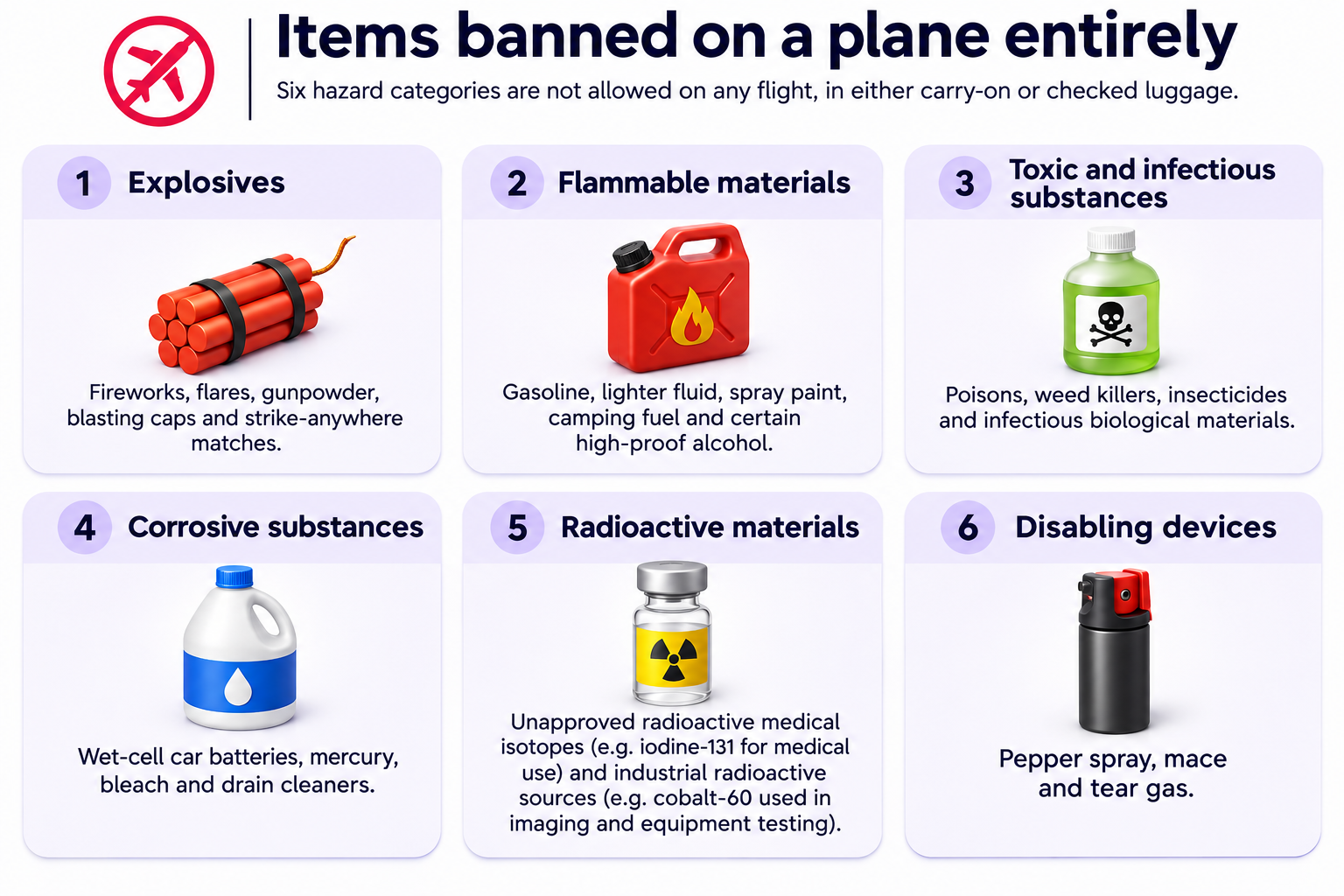
Six main hazard categories are prohibited from aircraft entirely: explosives, flammable materials, toxic substances, corrosives, radioactive materials and disabling devices. These items pose risks to passengers, crew and aircraft safety, so they cannot be packed in either carry-on or checked luggage.

Graphic showing the six categories of items banned on aircraft.

What is banned from hand luggage but allowed in the hold?

Some items are too sharp, heavy or potentially dangerous to be carried inside the aircraft cabin but can travel safely in checked baggage. These include certain sharp objects, work tools, sporting equipment and liquids that exceed airport security limits. If you're unsure whether something belongs in your hand luggage, check the rules before packing to avoid having it confiscated at security.

Category Items not allowed in hand luggage
Sharp objects Pocket knives, box cutters, loose razor blades, large scissors and other sharp-bladed items. Small scissors may be permitted depending on blade length and local security rules.

Tools
Hammers, screwdrivers, wrenches, pliers, drills, saws and other heavy tools that could cause injury or be used as weapons.
Sporting goods Baseball bats, cricket bats, golf clubs, hockey sticks, ski poles and pool cues. These are generally accepted in checked baggage, subject to airline size and weight restrictions.
Liquids above the cabin limit Shampoo, perfume, lotions, creams, gels and beverages in containers exceeding 100 ml (3.4 oz). These generally belong in checked baggage rather than your cabin bag.

‍

What is banned from the hold but allowed in the cabin?

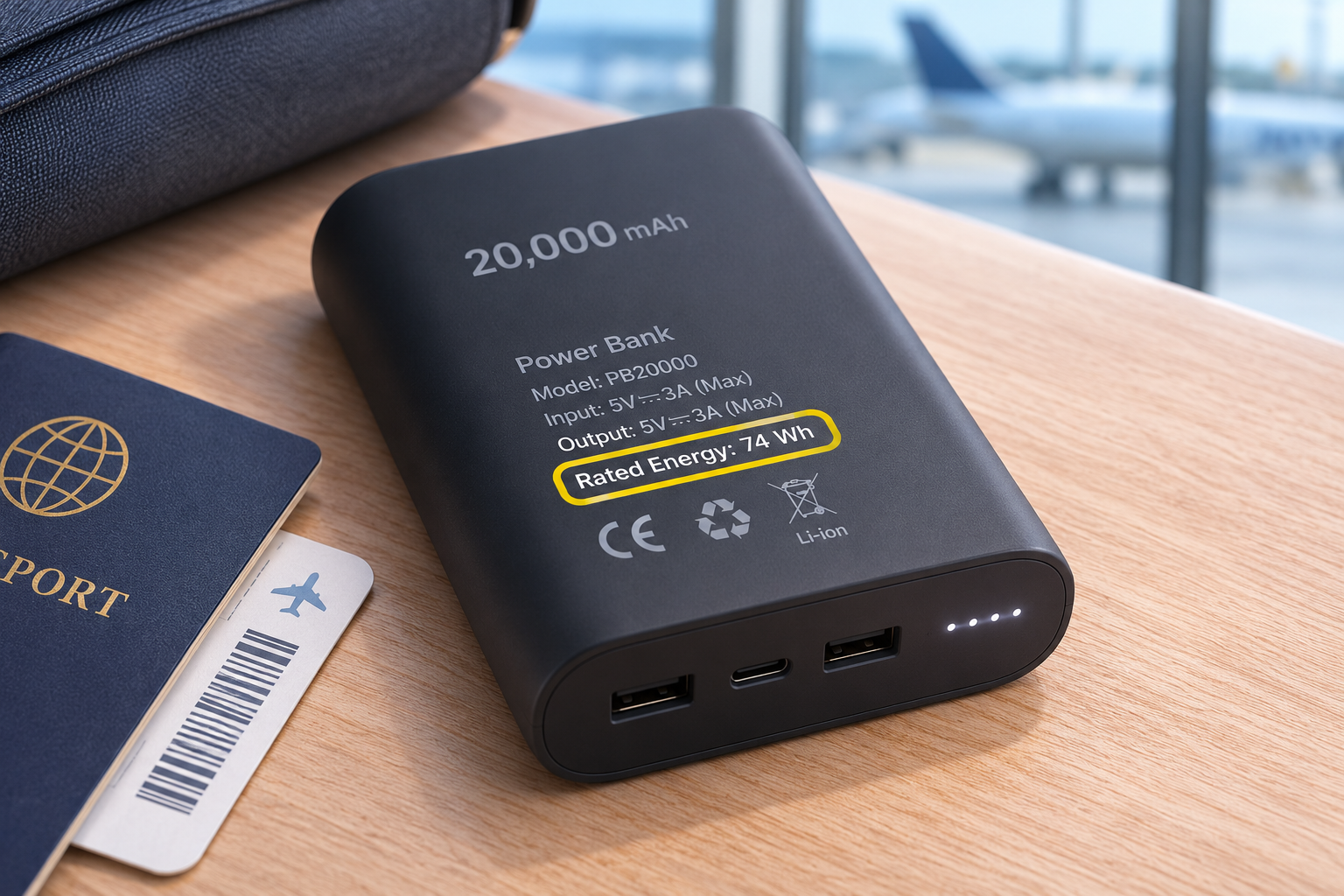
Power bank showing its watt-hour rating for air travel.

Certain battery-powered devices and spare lithium batteries must travel in the cabin rather than checked baggage because of the fire risk they pose. According to the FAA's PackSafe guidance, power banks and spare batteries must remain with passengers, subject to capacity limits.

Item Cabin baggage rules Watt-hour (Wh) limits
Lithium battery-powered devices Devices such as laptops, phones and cameras can generally travel in the cabin. Up to 100 Wh generally allowed. Between 100 and 160 Wh requires airline approval. Above 160 Wh is prohibited on passenger aircraft.
Power banks Must be carried in hand luggage, not checked baggage. Terminals should be protected against short circuits. Up to 100 Wh generally allowed; 100–160 Wh requires airline approval. Above 160 Wh is prohibited.

E-cigarettes and vapes
Must remain in cabin baggage. Charging or use onboard is prohibited. Battery capacity restrictions and airline rules apply.
Spare lithium cells Loose rechargeable and non-rechargeable lithium batteries must travel in the cabin with protected terminals. Up to 100 Wh generally allowed; 100–160 Wh requires airline approval

‍

Country and airline differences you should check

Packing your suitcase according to your airline's baggage policy is a good start, but it doesn't mean every item will automatically be allowed throughout your journey. Air travel restrictions operate at different levels: national aviation regulations, airport security requirements, transit-country rules and individual airline policies. An item permitted on your departure flight could still cause problems when you land or pass through another airport.

Here are three important differences to consider before travelling.

1. Smart luggage restrictions

Airlines have specific rules for suitcases containing built-in lithium batteries. If the battery is removable, you may be allowed to check in the suitcase after removing it and carrying the battery in the cabin. However, smart luggage with non-removable batteries exceeding permitted limits may be refused altogether. Always check your airline's battery policy before purchasing or packing one. While preparing for your trip, a Grey travel eSIM can also help you stay connected when you land, without having to search for a local SIM card at the airport.

2. Transit airport security

Connecting flights can introduce additional restrictions because you may have to pass through security screening again. For example, liquids purchased at an airport duty-free shop may be confiscated during transit if they are not properly sealed in an approved tamper-evident bag with proof of purchase. Check the transit airport's requirements before buying perfumes, alcohol or other liquids.

3. Local customs and import restrictions

Some countries prohibit items that airlines might otherwise allow onboard. Australia, for example, has strict biosecurity requirements covering fresh food, plants and animal products. Thailand also prohibits the importation of e-cigarettes and vaping products. Travellers should check destination-country customs rules rather than assuming cabin or checked baggage approval means an item can enter the country. For international purchases and travel expenses, a Grey virtual card gives you another way to manage eligible online payments while abroad.

What happens if a banned item is found?

Finding a prohibited item in your luggage doesn't always mean you'll be denied boarding or face legal trouble. What happens next depends on the item, where it is discovered and whether it poses a safety risk. Airport security officers and airline staff follow specific procedures to deal with prohibited items, ranging from confiscation to reporting dangerous goods to the relevant authorities.

Here are three possible outcomes:

1. Confiscation and disposal

If security finds an item that is prohibited in hand luggage but permitted in checked baggage, you may be given the opportunity to return to the check-in counter and repack it, provided time and airport procedures allow. Otherwise, the item may be surrendered or confiscated. Oversized liquids, pocket knives and prohibited tools are common examples. Some airports also provide facilities for mailing certain items home, although this isn't guaranteed.

2. Fines and legal penalties

Carrying dangerous goods, undeclared explosives, or prohibited weapons can have more serious consequences. Depending on the country's laws and the circumstances, you could face financial penalties, questioning by airport police, prosecution or refusal of carriage. In the United States, for example, the FAA can impose substantial civil penalties for dangerous goods violations. The severity depends on the nature of the violation and applicable regulations.

3. Dangerous goods reporting

When airport staff discover hazardous materials, they may isolate the affected baggage, prevent it from being loaded and notify the airline's dangerous goods personnel. Suspected serious incidents can also be reported to airport authorities and national aviation regulators. These reports help investigators identify safety risks and prevent similar incidents on future flights.

Frequently asked questions about items banned on a plane

1. Can you take a power bank on a plane?

Yes, you can bring a power bank on a plane, but it must travel in your hand luggage rather than checked baggage. Most airlines allow power banks up to 100 watt-hours (Wh) without special approval. Those between 100 and 160 Wh generally require airline approval, while anything above 160 Wh is prohibited on passenger aircraft. Always protect the terminals against short circuits.

2. Are nail scissors allowed in hand luggage?

Yes, small nail scissors are generally permitted in hand luggage, provided they meet the airport's blade-length restrictions. Rules vary by country: some authorities use a 6 cm limit, while US rules generally allow scissors with blades shorter than 4 inches. Larger scissors may need to go in checked baggage.

3. Can you fly with aerosols?

Yes, personal-care aerosols such as deodorant and hairspray are generally allowed, subject to airline and aviation authority restrictions. In hand luggage, they must normally be in containers of 100 ml or less. Checked baggage may allow larger toiletry aerosols, commonly up to 500 ml per item, subject to quantity and packaging limits.

4. What liquids are banned on a plane?

Flammable fuels, certain chemicals, corrosive liquids and other dangerous substances are prohibited from passenger aircraft. Ordinary liquids such as shampoo, perfume and drinks are generally allowed in checked baggage. However, hand luggage usually has a 100 ml container limit under standard airport security rules, although some airports operate approved alternative screening systems.

5. Can you bring food through airport security?

Yes, most solid foods, including sandwiches, biscuits, bread, fruit and packaged snacks, can pass through airport security. However, foods with liquid, gel or spreadable consistency, such as yoghurt, jam, sauces and peanut butter, generally fall under cabin liquid restrictions. International travellers should also check destination customs rules because some countries restrict fresh produce, meat and dairy products.

6. What happens if security finds a banned item?

The outcome depends on the item and the applicable aviation rules. Harmless restricted items, such as oversized liquids or prohibited cabin tools, may be confiscated or returned to you for repacking in checked baggage if permitted. Dangerous goods, explosives and prohibited weapons can result in seizure, questioning, financial penalties or prosecution. Serious incidents may also be reported to aviation authorities.

Can a foreigner open a bank account in Egypt as a visitor?

•

•

2 min read

Yes, a foreigner can open a bank account in Egypt as a visitor. In August 2024 the Central Bank of Egypt told banks to open accounts for non-resident foreigners, so a residence permit is no longer a formal requirement. In practice, though, the branch still decides how smooth that is, and the paperwork it asks for (an Egyptian address in your name, a local phone number, proof of where your money comes from) is what trips most visitors up.

That gap between the rule and the counter is what this guide is about. I'll walk you through what the central bank actually said, the documents banks ask for, the steps, the costs, and when a visitor is better off not opening an Egyptian account at all.

Can a foreigner open a bank account in Egypt without residency?

On paper, yes. Ahram Online reported on 11 August 2024 that the Central Bank of Egypt (CBE) had directed banks to open accounts for foreign clients who don't live in Egypt. The letter keeps the existing account-opening rules and normal due diligence in place, so banks can still say no if your documents don't satisfy their checks.

This wasn't the first time. The same report notes that the CBE had already written to banks in April 2016 about refusals to open accounts for non-resident foreigners. A second letter eight years later tells you the refusals didn't stop.

That matches what people report on the ground. A 2026 guide from The Rio Times describes a residence permit as the single document that makes the process easiest, and says acceptance for non-residents still varies from bank to bank and even branch to branch.

Do you actually need an Egyptian bank account as a visitor?

Often you don't. The right answer depends on how long you're staying and what you need to pay for. Here's how I'd decide.

Your situationEgyptian account needed?What usually works
Holiday of a few weeksNoYour home card, plus some cash in Egyptian pounds from an ATM or a licensed exchange
Working remotely for one to six monthsUsually notAn account you can manage from anywhere for receiving pay, plus a card for spending
Renting long term and paying local billsHelpfulAn Egyptian pound account, which also lets you use InstaPay, Egypt's instant transfer app
Moving to Egypt on a residence permitYesOpen the account once your permit is issued; it is the document banks trust most

If you're on a short trip, the bigger risk is losing money on exchange, not lacking an account. Our guide to currency exchange traps covers that, and this one explains buying Egyptian pounds as a non-citizen.

Types of bank accounts available to visitors

Banks that accept non-residents generally offer two kinds of account. Many visitors end up with both, because each solves a different problem.

Foreign currency accounts

These hold US dollars, euros or pounds sterling. They suit you if money arrives from abroad and you only want to convert to Egyptian pounds (EGP) when you need to.

Receiving an international transfer straight into a foreign currency account is the cleanest route. Keep the sending bank's confirmation, because Egyptian banks can ask where funds came from, especially when you later move money out. Egypt's currency controls are the reason for that extra scrutiny.

Egyptian pound accounts

A current or savings account in EGP is for life in Egypt: rent, utilities, local transfers and cash withdrawals. Some banks pay interest on savings accounts, depending on the product.

Documents you need to open a bank account in Egypt as a foreigner

Each bank sets its own list, so call ahead. These are the documents that come up most often.

DocumentWhat banks usually acceptWatch out for
PassportOriginal and a copy, showing your valid visa or residence permitAn expired or soon-to-expire visa makes refusal likely
Proof of Egyptian addressA registered or notarised lease, or a recent utility bill in your nameThe document branches question most; ask before relying on a hotel booking
Local mobile numberAn Egyptian SIM registered to your passportNeeded for alerts and online banking
Proof of income or source of fundsAn employer letter, contract, payslips or bank statementsOften asked of non-residents as part of due diligence
Minimum deposit (EGP)Roughly EGP 1,000 to 5,000, more for some accountsVaries by bank and account type

Checked 25 November 2026. Sources: The Rio Times (2026) for documents; Andersen Egypt (page updated December 2025) for the deposit range.

Some banks also ask for a tax registration number or a reference letter from your current bank. Use the USD to EGP converter to see what the deposit means in dollars today.

How to open the account, step by step

  1. Get a local SIM first. Banks want an Egyptian number on the form, and you'll need it for the card and app.
  2. Sort your address proof. If you're renting, ask your landlord for a registered or notarised lease, or put a utility bill in your name.
  3. Pick a large branch. Main branches in Cairo or Alexandria tend to be more used to foreign customers. Big banks include National Bank of Egypt, Banque Misr, CIB, QNB Alahli and Emirates NBD Egypt.
  4. Call ahead. Ask for a "non-resident foreigner account", the exact document list and the minimum deposit.
  5. Visit with originals and copies. If a clerk says non-residents can't open accounts, politely mention the central bank's August 2024 instruction and ask for a manager.
  6. Ask for the tariff in writing. Card issuance, low-balance charges, international transfers and currency spreads all follow the bank's own fee list.

Once your documents are complete, opening usually takes a few days, and some banks open accounts the same day, according to Andersen Egypt. The debit card can take longer, and each bank sets its own timing.

Common mistakes that get visitors turned away

  • Arriving with only a hotel booking. Address proof is the weakest link for most visitors, so confirm what the branch accepts before you go.
  • Trying a small branch first. Staff there may never have opened a non-resident account and default to "no".
  • No paper trail for your money. If you can't show where your funds come from, due diligence can stall the application.
  • Expecting to open it online from abroad. Andersen Egypt notes you may need at least one branch visit to verify your identity, even where banks take online applications.

The alternative: an account you open from home

If what you really need is somewhere to receive pay and spend while you travel, a foreign currency account you control from your phone can do the job without a branch visit. That's where Grey fits.

Grey is a financial technology company, not a bank, and it is registered with FinCEN in the United States and FINTRAC in Canada. It works for people who live in its supported countries, which include Egypt, Nigeria, Kenya, Ghana, Algeria, Morocco, India and Indonesia. The full list appears during sign-up, so check it before you plan around Grey.

If your home country is supported, you can open foreign currency accounts in USD, GBP and EUR before you fly. You verify with a government ID and a short video selfie, which usually takes a few minutes and can take up to 24 hours. There are no account opening or maintenance fees, and you get a virtual USD card that you can add to Apple Pay or Google Pay.

How you're paidGrey receiving feeTypical arrival time
USD by ACH0.8% (min $2, max $10)1 to 2 business days
USD by FedNow0.8% (min $2, max $10)Seconds
USD by Fedwire$20 flatAbout 1 business day
GBP by Faster Payments0.8% (min £2, max £10)Not stated
EUR by SEPA or SEPA Instant0.8% (min €2, max €10)Not stated

Checked 25 November 2026. Source: Grey Help Centre, US account guidelines and "Everything you need to know about your Grey account".

Two limits to know. Payments from individual third parties into your USD account must be under $4,000 each, and Grey doesn't accept payments for crypto, P2P, betting or forex trading. Withdrawal options depend on your country of residence, so Grey sits alongside an Egyptian account rather than replacing one if you need to pay local bills in pounds.

Frequently asked questions

Can I open a bank account in Egypt on a tourist visa?

The central bank's August 2024 instruction allows banks to open accounts for non-resident foreigners, so a tourist visa doesn't rule you out. Acceptance still varies by bank and branch, and a residence permit makes approval much easier.

Can I open an Egyptian bank account online from abroad?

Not usually as a foreigner. Even banks that take online applications may want a branch visit to check your original documents, and Banque Misr's account-opening initiative for people abroad is written for Egyptian citizens, who apply through an Egyptian embassy.

Can a US citizen open a bank account in Egypt?

Yes, under the same rules as other foreigners: a passport with a valid visa, proof of an Egyptian address and the bank's due diligence checks. If you're still planning the trip, start with the US visa rules.

How much money do I need to open an account?

Andersen Egypt puts typical minimum deposits at roughly EGP 1,000 to 5,000, with more for some account types. Ask your branch for its exact figure.

The short version

Egypt's rulebook says yes to visitors, but the branch decides how easy that yes is. If you're staying long enough to need one, bring a lease, a local number and proof of your income, and go to a main branch. If you're only passing through, sort your visit visa, set up an account you can manage from home, and keep the bank queue for when you move.

Arrow (up)

Back to top