
How to earn yield on USDC: Best options in 2026

Tunde Aladeloba

TABLE OF CONTENT

SHARE THIS POST

USDC is a stablecoin designed to maintain a value close to one US dollar, making it an option for people who want to hold digital dollars without the usual price swings associated with cryptocurrencies like Bitcoin. However, holding USDC in a wallet does not automatically generate interest. To earn a return, you need to invest your holdings in a programme or platform that pays a yield.

USDC itself pays no interest. Yield comes from lending it out through a centralised exchange programme, a crypto lending platform, or a DeFi protocol such as a lending pool or liquidity pair. Rates ranged from about 2 to 8% APY in 2026, depending on the platform, strategy and market conditions.

Each option comes with different levels of risk, access requirements and withdrawal conditions. Before choosing where to earn yield, understand how returns are generated, whether your funds are protected, and what could happen if a platform fails or a smart contract is exploited.

Does USDC pay interest on its own?

No, holding USDC in a crypto wallet does not earn interest by itself. USDC is a stablecoin designed to maintain a value close to one US dollar, but simply owning it does not generate additional income. Whether it sits in a personal wallet or an exchange account, your balance remains unchanged unless you receive additional USDC through another transaction or service.

To earn yield, you need to use a separate financial product built on top of USDC. These products generate returns through activities such as lending your stablecoins to borrowers, supplying liquidity to decentralised finance (DeFi) protocols, or participating in yield programmes offered by cryptocurrency exchanges.

Each option works differently and carries its own risks. A lending platform may pay interest from borrower repayments, while a DeFi protocol may distribute fees or lending revenue to participants. Centralised exchanges may offer promotional rates or rewards under specific conditions.

Before depositing USDC into any yield product, understand how returns are generated, what fees apply, and whether you can withdraw your funds when needed. Yield is never guaranteed.

Also read: How USDC compares with USDT

Centralised exchange and lending platforms

Centralised exchanges and crypto lending platforms allow you to earn yield by depositing your USDC into programmes that generate returns. Exchange earn programmes may lend your USDC to borrowers or use other permitted strategies to generate revenue, sharing a portion of the earnings with you.

Crypto lending platforms work similarly, connecting you with borrowers and paying interest on the funds you supply.
The annual percentage yield (APY) you receive depends on the platform, market demand, lending activity and programme conditions. Rates can change, and promotional offers may have limits or eligibility requirements.

Custody is another important consideration. When you deposit USDC into a centralised platform, the platform typically controls your assets rather than you holding the private keys directly. It may lend, transfer or otherwise use your deposited coins according to its terms.

This exposes you to counterparty risk. If the platform becomes insolvent, freezes withdrawals or suffers a hack, you may struggle to access your funds or lose them entirely. Before depositing your USDC, review the withdrawal terms, fees, security measures and how the platform uses your assets.

DeFi options: lending pools and liquidity pairs

Decentralised finance (DeFi) offers another way to earn yield on USDC without relying on a traditional financial intermediary. Two common options are lending pools and liquidity pairs, each generating returns in different ways.

With a lending pool, you deposit USDC into a protocol where borrowers can access the funds and pay interest. A portion of that interest is distributed to depositors as yield. Your returns depend on borrowing demand, utilisation rates and the protocol’s rules.

With a liquidity pair, you deposit USDC alongside another cryptocurrency into a trading pool. Traders use this pool to swap assets, and liquidity providers may earn a share of trading fees. However, the value of the two deposited assets can change relative to each other, creating impermanent loss.

Both strategies carry risks. Smart contract bugs can expose deposited funds to theft or loss. Impermanent loss can reduce returns compared with simply holding the assets. Depegging occurs when USDC falls below its intended one-dollar value, reducing the value of your holdings even when the yield remains positive.

How the main risks compare

When you earn yield on USDC, your biggest risks depend on where you deposit your funds and how the platform generates returns. Counterparty risk, smart contract risk and depeg risk can all affect how much you earn and whether you recover your initial deposit.

Counterparty risk arises when you trust a centralised exchange or lending platform with your USDC. If the provider fails or freezes withdrawals, you may lose access to your funds. Smart contract risk affects you when a vulnerability in a DeFi protocol allows your deposited funds to be stolen or lost. Depeg risk means your USDC falls below its intended $1 value, reducing the value of your holdings.

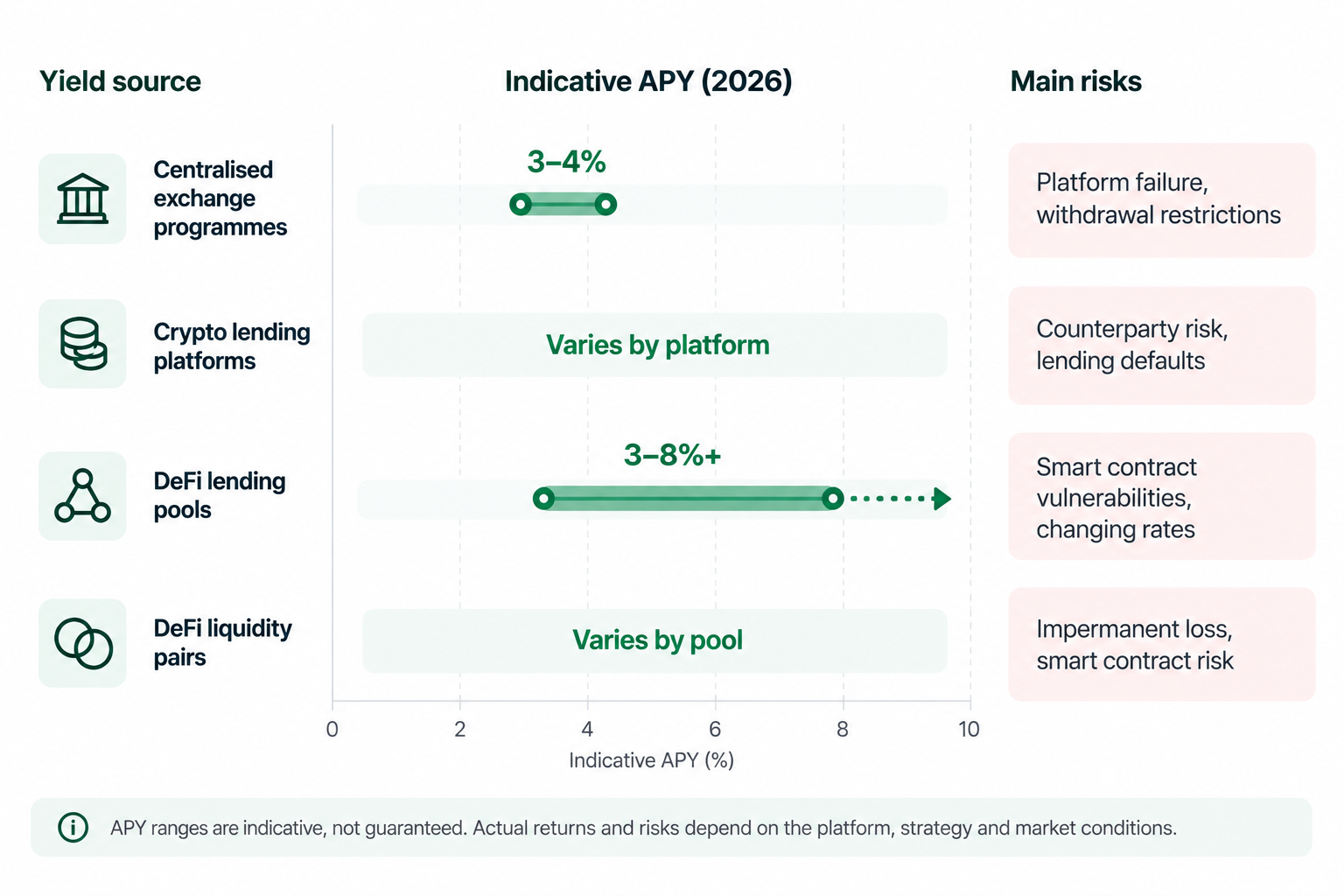
Chart comparing USDC yield options by risk and return.

There is no universal ranking because your exposure depends on the product you choose. However, higher advertised APY usually means higher risk. Before depositing, consider how returns are generated, who controls your funds and what could go wrong.

Your choice of blockchain also matters. Learn how USDC on Solana compares with Ethereum when considering transaction fees, network activity and the platforms available to you.

USDC yield vs a bank savings account

USDC yield can offer a potentially higher return than a regular savings account, but you give up an important protection: USDC does not have government-backed deposit insurance. Your returns depend on the platform and strategy you use, and higher yields often come with greater risk. A bank savings account may offer less, but eligible deposits have protection and more predictable access to your money.

Before choosing USDC for yield, consider whether you can afford the risks, including platform failure, smart contract vulnerabilities and changes in USDC’s value. It is generally better to keep emergency funds in an insured bank account rather than expose money you need urgently to crypto-related risks.

USDC can also make moving money across borders easier. For example, if you need to send money from the US to Nigeria, you can use a platform that supports USDC transfers and local withdrawals. With Grey, you can send, receive and spend USDC, then convert your balance and withdraw funds to a supported local bank account.

The right choice depends on your priorities: bank deposits for protection, USDC for global access and potential yield.

Frequently asked questions about how to earn yield on USDC

1. Is earning yield on USDC safe?

Earning yield on USDC carries risks, including platform failure, smart contract vulnerabilities and loss of funds. Although USDC is designed to maintain a one-dollar value, your investment is not guaranteed. Review the platform’s security, withdrawal terms and yield strategy before depositing funds, and never invest money you cannot afford to lose.

2. What is a typical USDC APY in 2026?

USDC yield varies by platform, market conditions and strategy. In 2026, some centralised reward programmes offer around 3–4% APY, while DeFi lending may offer approximately 3–8% or more. These are indicative ranges, not guaranteed rates. Check current offers, fees and risks before choosing a platform.

3. Do you pay tax on USDC yield?

Yes, USDC yield may be taxable, depending on your country’s tax laws and how you earn it. In the United States, rewards are generally reportable as income. Keep records of payments, dates and amounts, and consult a qualified tax professional to understand your reporting obligations.

4. Can you lose your USDC principal earning yield?

Yes, you can lose some or all of your USDC principal. Platform insolvency, lending defaults, smart contract exploits and liquidity problems can prevent withdrawals or cause losses. USDC can also trade below one dollar. Assess the risks carefully, diversify where appropriate and avoid committing essential savings.

5. What is the difference between USDC yield and USDC staking?

USDC yield usually comes from lending, reward programmes or providing liquidity through a platform or DeFi protocol. Staking typically involves locking cryptocurrency to support a proof-of-stake blockchain. USDC does not use proof-of-stake itself, so products marketed as USDC staking generally involve a different yield-generating mechanism.

6. How do you convert USDC yield into cash you can spend?

First, withdraw your USDC and earn rewards to a supported exchange or financial platform. Convert the balance into your preferred currency, then withdraw it to an eligible bank account or payment method. With Grey, you can send, receive and spend USDC, subject to supported services, currencies and applicable fees.

While USDC yield offers the potential for higher returns, a bank savings account provides greater protection for eligible deposits. For international transactions, Grey gives you a practical way to send, receive and spend USDC, with access to supported currencies for your everyday financial needs.

Last updated:

October 21, 2026

Open a free Grey account to get startedJoin 1 million digital nomads
IF YOU ENJOYED THIS, CHECK THESE OUT

International freelance platforms Indians trust for steady payments

•

•

2 min read

Finding freelance work as an Indian professional has never been easier. Many platforms connect you to clients worldwide, often paying in foreign currencies. However, the reality of how difficult it is to get paid eventually comes up.

If you’ve ever watched your earnings shrink because of hidden FX markups, or waited for weeks for a payout that was supposed to take five days, you’ll know what I’m talking about. For Indian freelancers, creating a payment system that doesn’t leak money at every step is a significant challenge.

This article breaks down the international freelance platforms Indian professionals actually trust for steady, reliable payments. I’m not ranking them by popularity or features. I’m focusing on what matters most: payout reliability, transparency, and how well they actually work for freelancers based in India.

What does "steady payments” actually mean for Indian freelancers?

Before diving into platforms, let’s clarify what steady payments look like in practice.

  1. Payout speed and frequency: Some platforms pay weekly, others monthly, and a few offer instant withdrawals. The key is predictability. For example, a platform that pays every Friday is more reliable than one that pays “within 7-10 business days”, which sometimes stretches to 15.
  2. FX transparency and hidden fees: This is where most freelancers lose money. A platform might advertise "no fees,” but then apply a 3 - 4% markup on currency conversion. Steady payments mean transparent foreign exchange rates with minimal hidden costs that eat into your earnings.
  3. Escrow and dispute protection: Platforms with escrow systems hold client payments until work is delivered and approved. This protects you from clients who ghost after you’ve completed the job. Dispute resolution processes are also important, especially when dealing with international clients across different time zones.
  4. Regulatory and compliance considerations: Indian freelancers earning foreign income must comply with FEMA regulations and file taxes properly. Platforms that provide clear invoices, payment records, and integrate well with Indian tax systems make compliance easier, not harder.

Also read: Best freelance platforms to earn US dollars in Indonesia

Trusted international freelance platforms

Let’s examine platforms grouped by what they excel at for Indian freelancers.

Platforms with escrow-based payment protection

  1. Upwork: Upwork remains one of the most trusted platforms for Indian freelancers, primarily due to its escrow system. The escrow system protects you from non-payment. Once a client funds a project, you know the money exists. Weekly billing cycles mean regular income if you’re on an hourly contract.
  2. Fiverr: Fiverr’s escrow model is simple: clients pay upfront, and funds are released to you after order completion. For Indian freelancers offering fixed-price services, this creates predictable cash flow. Once the order is marked complete and the buyer doesn’t request revisions within three days, payment is guaranteed. A small downside, however, is that the payment cycle is 14 days.
  3. Toptal: Toptal is an exclusive network for top freelancers in software development, design, and finance. It operates on an escrow basis, with clients funding work upfront and payments released on a predictable schedule. Toptal handles invoicing, contracts, and payment collection. Payments are reliable, and disputes are rare because clients are vetted as thoroughly as freelancers.

Also read: Freelance platforms with high payout rates in Egypt

LDMAG1

Platforms known for fast, predictable payouts

  1. Freelancer.com: Freelancer.com offers milestone-based escrow and weekly payouts for hourly projects. It’s not as polished as Upwork, but Indian freelancers appreciate the speed of payouts and flexibility. You can request withdrawals as frequently as you like (though fees apply per transaction).
  2. Guru: Guru operates with SafePay, an escrow system that releases funds after work approval. Payouts are processed quickly, and the platform supports multiple withdrawal methods for Indian freelancers. Guru’s relatively lower service fees (5 - 9%) make it attractive for many freelancers. Generally, payments are processed within 24 to 48 hours of receiving withdrawal requests.

Also read: Top platforms to receive freelance payments worldwide

What to consider when choosing the right freelance platform

Your ideal platform depends on where you are in your freelance journey.

Beginners

Start with Upwork or Fiverr. Both offer escrow protection, steady workflows, and built-in client pipelines. Yes, the fees are high, but the security and volume of available work justify the cost while you’re building your portfolio and reputation.

Full-time freelancers

Consider diversifying your work across Upwork, Toptal and direct clients found through LinkedIn. Use Grey to receive payments from direct clients.

Also read: Safe ways to receive international payments in India

Made a decision yet?

Steady payments don’t necessarily come from platform loyalty or luck. They come from understanding how money moves, choosing platforms that align with your work style, and setting up a payment stack that doesn’t leak income at every step.

For you, that could mean using escrow-based platforms for security, understanding FX markups, and pairing marketplace work with tools that give you better control over your earnings. The platforms you choose and how you get paid matter as much as the work itself.

Create your free Grey account today or download the app and start receiving international payments with better FX rates, faster payouts, and full transparency.


‍

Planning a location-flexible career from the UK

•

•

2 min read

A location-flexible role offers the freedom to choose where you work, a better work-life balance, and removes the constraints of a daily commute. It also bypasses the fixed, traditional office environment, which can feel like a cage at times. And even though it sounds like a promising idea, delving into remote work without taking the right steps can land you in trouble. So whether you want to work in various locations across the UK or embrace a full-time global digital nomad lifestyle, you must be adequately prepared. This is how to plan a location-flexible career from the UK to ensure a smooth transition.

Also read: What remote workers should plan before relocating

Get the right skills

To set yourself up for a successful location-flexible career, you need to get location-flexible skills. This means you should be able to use your skills remotely and that they should have cross-border relevance. Roles in software development, data, design, content, marketing, consulting, customer success, product management, and research are remote-friendly.

If your current role isn’t remote-friendly, look for ways to make it more remote or switch roles. This could mean looking into freelancing or contract-based jobs. Having a niche improves your odds for success and better pay. Build a portfolio that showcases your capabilities and keep honing your skills.

Also read: Paying abroad from the UK: a simple guide for first-time traveller

Review tax regulations and legal status

Before hopping on a flight to a new work destination, you must ensure that you have the right paperwork to work in that country. A UK passport might give you access to many countries, but confirm this with the right authorities. If you need to apply for a visa, prioritise countries with digital nomad visas.

Another overlooked aspect of a location-flexible career is tax planning. If you are a UK resident, your tax obligations depend on residency status, days spent in the UK, and where your income is sourced. Working abroad doesn’t always mean you don’t have to pay taxes in the UK anymore. Review the Statutory Residence Test, double taxation agreements, and how they apply in your situation.

Set up a travel-friendly payment system

A location-flexible career requires a location-flexible payment system that works across borders. Traditional UK bank accounts are often not optimised for international payments. Many UK remote workers now rely on multi-currency accounts to receive payments in USD, EUR, and GBP. They can choose to keep their money in foreign currencies and convert whenever they want without excessive fees. You can withdraw to local bank accounts at competitive rates wherever you go.

LDMAG1

Have a financial plan

In addition to setting up a reliable payment system, you should also plan your finances based on your income. Budget for your monthly expenses and set aside some money for savings and emergencies. Use separate accounts for income and daily spending. A clear financial structure reduces stress and gives you confidence to move freely without the fear of getting stranded. Don’t forget to always track your spending.

Also read: How Grey differs from a UK bank

Research your destination

Planning a location-flexible career means researching destinations in advance. Your destination largely determines your experience, positive or negative. Consider the living costs, security, time zone overlap, digital infrastructure, community, and quality internet coverage.

Have a work structure

Flexibility can easily breed indiscipline, and if you don’t check it early enough, you can end up with burnout and lower productivity. If you must be an excellent remote worker, you must have a strict work routine that ensures work doesn’t eat into social life, and your social life doesn’t affect your work. Have defined working hours, communication boundaries, reliable internet plans, and systems for productivity regardless of location.

Grey: Location-flexible payment solution for location-flexible workers

If you are tired of the rigid traditional work structure holding you back in the UK, then transitioning into a location-flexible career is a step in the right direction. Planning adequately for this transition ensures you have a great experience. The right cross-border payment solutions help you manage receiving payments and withdrawing funds to local bank accounts wherever you go.

Grey offers USD, EUR, and GBP accounts that let you receive payments easily and withdraw funds to various local currencies at competitive rates. You also get a virtual USD debit card to further simplify your payments while travelling. If you are freelancing on global platforms, you can add your Grey account details to withdraw your earnings without delays and cut-throat platform fees.

Get started on Grey today or download the app for a reliable location-flexible payment solution.

‍

How to earn yield on USDC: Best options in 2026

•

•

2 min read

USDC is a stablecoin designed to maintain a value close to one US dollar, making it an option for people who want to hold digital dollars without the usual price swings associated with cryptocurrencies like Bitcoin. However, holding USDC in a wallet does not automatically generate interest. To earn a return, you need to invest your holdings in a programme or platform that pays a yield.

USDC itself pays no interest. Yield comes from lending it out through a centralised exchange programme, a crypto lending platform, or a DeFi protocol such as a lending pool or liquidity pair. Rates ranged from about 2 to 8% APY in 2026, depending on the platform, strategy and market conditions.

Each option comes with different levels of risk, access requirements and withdrawal conditions. Before choosing where to earn yield, understand how returns are generated, whether your funds are protected, and what could happen if a platform fails or a smart contract is exploited.

Does USDC pay interest on its own?

No, holding USDC in a crypto wallet does not earn interest by itself. USDC is a stablecoin designed to maintain a value close to one US dollar, but simply owning it does not generate additional income. Whether it sits in a personal wallet or an exchange account, your balance remains unchanged unless you receive additional USDC through another transaction or service.

To earn yield, you need to use a separate financial product built on top of USDC. These products generate returns through activities such as lending your stablecoins to borrowers, supplying liquidity to decentralised finance (DeFi) protocols, or participating in yield programmes offered by cryptocurrency exchanges.

Each option works differently and carries its own risks. A lending platform may pay interest from borrower repayments, while a DeFi protocol may distribute fees or lending revenue to participants. Centralised exchanges may offer promotional rates or rewards under specific conditions.

Before depositing USDC into any yield product, understand how returns are generated, what fees apply, and whether you can withdraw your funds when needed. Yield is never guaranteed.

Also read: How USDC compares with USDT

Centralised exchange and lending platforms

Centralised exchanges and crypto lending platforms allow you to earn yield by depositing your USDC into programmes that generate returns. Exchange earn programmes may lend your USDC to borrowers or use other permitted strategies to generate revenue, sharing a portion of the earnings with you.

Crypto lending platforms work similarly, connecting you with borrowers and paying interest on the funds you supply.
The annual percentage yield (APY) you receive depends on the platform, market demand, lending activity and programme conditions. Rates can change, and promotional offers may have limits or eligibility requirements.

Custody is another important consideration. When you deposit USDC into a centralised platform, the platform typically controls your assets rather than you holding the private keys directly. It may lend, transfer or otherwise use your deposited coins according to its terms.

This exposes you to counterparty risk. If the platform becomes insolvent, freezes withdrawals or suffers a hack, you may struggle to access your funds or lose them entirely. Before depositing your USDC, review the withdrawal terms, fees, security measures and how the platform uses your assets.

DeFi options: lending pools and liquidity pairs

Decentralised finance (DeFi) offers another way to earn yield on USDC without relying on a traditional financial intermediary. Two common options are lending pools and liquidity pairs, each generating returns in different ways.

With a lending pool, you deposit USDC into a protocol where borrowers can access the funds and pay interest. A portion of that interest is distributed to depositors as yield. Your returns depend on borrowing demand, utilisation rates and the protocol’s rules.

With a liquidity pair, you deposit USDC alongside another cryptocurrency into a trading pool. Traders use this pool to swap assets, and liquidity providers may earn a share of trading fees. However, the value of the two deposited assets can change relative to each other, creating impermanent loss.

Both strategies carry risks. Smart contract bugs can expose deposited funds to theft or loss. Impermanent loss can reduce returns compared with simply holding the assets. Depegging occurs when USDC falls below its intended one-dollar value, reducing the value of your holdings even when the yield remains positive.

How the main risks compare

When you earn yield on USDC, your biggest risks depend on where you deposit your funds and how the platform generates returns. Counterparty risk, smart contract risk and depeg risk can all affect how much you earn and whether you recover your initial deposit.

Counterparty risk arises when you trust a centralised exchange or lending platform with your USDC. If the provider fails or freezes withdrawals, you may lose access to your funds. Smart contract risk affects you when a vulnerability in a DeFi protocol allows your deposited funds to be stolen or lost. Depeg risk means your USDC falls below its intended $1 value, reducing the value of your holdings.

Chart comparing USDC yield options by risk and return.

There is no universal ranking because your exposure depends on the product you choose. However, higher advertised APY usually means higher risk. Before depositing, consider how returns are generated, who controls your funds and what could go wrong.

Your choice of blockchain also matters. Learn how USDC on Solana compares with Ethereum when considering transaction fees, network activity and the platforms available to you.

USDC yield vs a bank savings account

USDC yield can offer a potentially higher return than a regular savings account, but you give up an important protection: USDC does not have government-backed deposit insurance. Your returns depend on the platform and strategy you use, and higher yields often come with greater risk. A bank savings account may offer less, but eligible deposits have protection and more predictable access to your money.

Before choosing USDC for yield, consider whether you can afford the risks, including platform failure, smart contract vulnerabilities and changes in USDC’s value. It is generally better to keep emergency funds in an insured bank account rather than expose money you need urgently to crypto-related risks.

USDC can also make moving money across borders easier. For example, if you need to send money from the US to Nigeria, you can use a platform that supports USDC transfers and local withdrawals. With Grey, you can send, receive and spend USDC, then convert your balance and withdraw funds to a supported local bank account.

The right choice depends on your priorities: bank deposits for protection, USDC for global access and potential yield.

Frequently asked questions about how to earn yield on USDC

1. Is earning yield on USDC safe?

Earning yield on USDC carries risks, including platform failure, smart contract vulnerabilities and loss of funds. Although USDC is designed to maintain a one-dollar value, your investment is not guaranteed. Review the platform’s security, withdrawal terms and yield strategy before depositing funds, and never invest money you cannot afford to lose.

2. What is a typical USDC APY in 2026?

USDC yield varies by platform, market conditions and strategy. In 2026, some centralised reward programmes offer around 3–4% APY, while DeFi lending may offer approximately 3–8% or more. These are indicative ranges, not guaranteed rates. Check current offers, fees and risks before choosing a platform.

3. Do you pay tax on USDC yield?

Yes, USDC yield may be taxable, depending on your country’s tax laws and how you earn it. In the United States, rewards are generally reportable as income. Keep records of payments, dates and amounts, and consult a qualified tax professional to understand your reporting obligations.

4. Can you lose your USDC principal earning yield?

Yes, you can lose some or all of your USDC principal. Platform insolvency, lending defaults, smart contract exploits and liquidity problems can prevent withdrawals or cause losses. USDC can also trade below one dollar. Assess the risks carefully, diversify where appropriate and avoid committing essential savings.

5. What is the difference between USDC yield and USDC staking?

USDC yield usually comes from lending, reward programmes or providing liquidity through a platform or DeFi protocol. Staking typically involves locking cryptocurrency to support a proof-of-stake blockchain. USDC does not use proof-of-stake itself, so products marketed as USDC staking generally involve a different yield-generating mechanism.

6. How do you convert USDC yield into cash you can spend?

First, withdraw your USDC and earn rewards to a supported exchange or financial platform. Convert the balance into your preferred currency, then withdraw it to an eligible bank account or payment method. With Grey, you can send, receive and spend USDC, subject to supported services, currencies and applicable fees.

While USDC yield offers the potential for higher returns, a bank savings account provides greater protection for eligible deposits. For international transactions, Grey gives you a practical way to send, receive and spend USDC, with access to supported currencies for your everyday financial needs.

Gift tax: How much money can you give tax-free?

•

•

2 min read

Giving money to another person may seem straightforward, but large financial gifts can come with tax reporting requirements. In the United States, the Internal Revenue Service (IRS) determines how much you can give each year before you may need to report the gift. Understanding these rules is particularly important when transferring substantial sums, sharing wealth, or planning your finances.

The good news is that exceeding the annual gift tax limit does not automatically mean you owe tax. The IRS provides a lifetime exemption that allows you to give more than the annual limit before gift tax becomes payable. Knowing the difference between the annual exclusion, reporting requirements and lifetime exemption can help you make informed financial decisions.

The IRS annual gift tax exclusion lets you give up to a set amount per recipient each year with no tax owed and no form to file. Gifts above that amount count against your lifetime exemption and require Form 709, though tax is rarely owed until the lifetime exemption itself is used up.

How much can you gift tax-free per year?

For 2026, you can give up to $19,000 per recipient per year without owing federal gift tax or generally needing to file a gift tax return. This annual exclusion applies to qualifying gifts of money or property under US Internal Revenue Service (IRS) rules.

The limit resets every calendar year, beginning January 1. This means gifts made in 2026 are counted separately from gifts made in 2025. You can give money to multiple recipients in the same year, provided each recipient’s total qualifying gifts from you stays within the annual limit.

The exclusion applies per giver and per recipient, rather than as one combined limit for all your gifts. For example, you could give $19,000 each to three people in 2026, totalling $57,000, without exceeding the annual exclusion for any recipient. If two spouses each give the same recipient $19,000, their combined gifts can reach $38,000 under their separate exclusions, subject to applicable IRS rules.

What is the lifetime gift tax exemption?

For 2026, the US lifetime gift and estate tax exemption is $15 million per individual. This is the total amount an individual can transfer through qualifying gifts during their lifetime and leave to beneficiaries at death before federal gift or estate taxes generally apply, subject to applicable rules.

The lifetime exemption works alongside the annual gift tax exclusion. While the annual exclusion allows qualifying gifts of up to $19,000 per recipient in 2026 without using the lifetime exemption, larger gifts generally count toward the $15 million limit. Gifts exceeding the annual exclusion may require you to file IRS Form 709, even when no tax is due.

The important distinction is that the lifetime gift tax exemption and estate tax exemption are shared, not separate allowances. For example, if you make $2 million in taxable gifts during your lifetime, that amount generally reduces the exemption remaining for your estate. Any unused exemption may apply to assets transferred at death, helping determine whether your estate owes federal estate tax.

When do you need to file form 709?

You generally need to file IRS Form 709 if you give more than $19,000 to one person in 2026, unless a specific exception applies. The form reports gifts exceeding the annual exclusion and helps the IRS track your use of the lifetime gift tax exemption.

The filing requirements, deadline and potential tax implications are important to understand before submitting your return.

Who Must File Form 709?

The person giving the gift is generally responsible for filing. You may need to file if your gifts to one recipient exceed the annual exclusion, you transfer certain future interests, or you elect to split gifts with your spouse.

When Is Form 709 Due?

The deadline is generally April 15 of the year following the gift. For gifts made in 2026, the filing deadline is April 15, 2027. An extension may be available, but it does not automatically extend the deadline for paying tax owed.

Does Filing Form 709 Mean You Owe Tax?

No. Filing the form does not automatically mean you owe gift tax. Gifts above the annual exclusion generally reduce your lifetime gift and estate tax exemption. Federal gift tax is typically payable only after your available exemption has been exhausted.

Gift tax vs Estate tax: how they connect

Gift tax and estate tax share one combined lifetime exemption. In 2026, the federal gift and estate tax exemption is $15 million per individual. This means large gifts made during your lifetime and assets transferred after your death generally count toward the same exemption.

If you give a substantial amount of money while alive, the portion exceeding the annual gift tax exclusion generally reduces the exemption remaining for your estate. For example, if you make $2 million in taxable gifts, that amount generally reduces your remaining exemption to $13 million, assuming no other taxable transfers or adjustments.

Alternatively, leaving the money in your estate means its value may be considered when calculating estate tax after your death. If your total taxable estate and applicable prior gifts remain within your available exemption, federal estate tax generally will not be due.

The main difference is when the transfer happens and how the assets are valued. Lifetime gifting can help transfer wealth earlier, but the best approach depends on your financial circumstances, future needs and estate planning goals.

If you're sending money as a gift to family members abroad, it's also worth considering transfer fees and exchange rates. For example, you can send money from the US to Mexico or send money from the US to India using available international transfer services. Just remember that sending money internationally doesn't automatically exempt a gift from US tax reporting requirements.

Frequently asked questions about gift taxes

Does the person receiving a Gift pay tax on it?

Generally, no. Under US federal tax rules, the recipient does not pay income tax on money received as a gift. The person giving the gift is usually responsible for any applicable gift tax reporting and payment. However, income generated by gifted assets may be taxable to the recipient.

Can you gift more than the annual exclusion without paying tax?

Yes. Gifts exceeding the 2026 annual exclusion of $19,000 per recipient may require you to file Form 709. However, the excess generally reduces your lifetime gift and estate tax exemption rather than triggering immediate tax. Gift tax usually becomes payable after the available exemption is exhausted.

Do Gifts to a spouse count toward the annual exclusion?

Generally, gifts to a US-citizen spouse qualify for the unlimited marital deduction and do not count toward the annual exclusion. Gifts to a non-US citizen spouse have a separate annual limit, which is $194,000 for 2026. Special rules may apply depending on the circumstances.

Is money sent to family abroad treated as a Gift for tax purposes?

Yes. Money sent to relatives abroad may qualify as a gift under US tax rules. If the giver is subject to US gift tax, the annual exclusion and reporting requirements may apply regardless of where the recipient lives.

Do you have to report a Gift from a foreign relative?

You may need to. US persons who receive gifts exceeding $100,000 in total from a nonresident alien individual or foreign estate generally must report them on Form 3520. Different thresholds apply to gifts from foreign corporations or partnerships.

What is the penalty for not filing Form 709 when required?

Failure to file Form 709 when required may result in penalties based on the unpaid gift tax, generally 5% per month, up to 25%. If no tax is due, penalties may differ, but the IRS can still assess consequences for noncompliance. Filing requirements should be checked carefully.

Managing money across borders involves more than understanding gift tax. Whether you are supporting family abroad, making international payments or managing everyday expenses, having the right financial tools matters. Grey offers multi-currency accounts and virtual cards that make it easier to manage international finances, pay for online services and handle supported cross-border transactions.

How creators earn from global audiences in 2026

•

•

2 min read

Some years ago, most creators focused on building audiences in their own countries. In 2026, that strategy feels outdated. The most successful creators today earn from audiences scattered across continents. Viewers in Lagos are watching content made in London, subscribers in New York are supporting creators based in Berlin, and brand deals are flowing from Singapore to São Paulo. Everything is global now.

The new creator economy has changed how people build sustainable creative careers. Geography still matters, but in a different way. Where your audience lives now determines how much you earn, which currencies you collect, and how efficiently you can access your money. Understanding these dynamics separates creators who thrive from those who struggle despite growing followings.

Why global audiences matter more than ever in 2026

Global audiences unlock earning potential that local audiences alone can’t match. A creator with 100,000 followers in the UK might earn differently from someone with the same following split between the US, Canada, Australia, and the UAE. The value of the audience matters more than the volume. I’ll explain.

Platforms pay creators based on where viewers live. Ad revenue from viewers in high-GDP countries typically pays more than from viewers in lower-GDP regions. Brand deals follow similar patterns, with companies in certain markets willing to pay significantly more for creator partnerships. Subscription platforms like Patreon or YouTube memberships charge differently by region, affecting how much creators actually receive per subscriber.

In 2026, smart creators analyse where those followers live and how that geography translates into income. A deliberately global audience strategy can double or triple earnings compared to focusing on a single market.

The main ways creators earn from global audiences

In 2026, creators monetise through multiple streams, and the most successful creators diversify rather than rely on a single source.

Ad revenue

This remains foundational for video creators. YouTube, TikTok, and other platforms share ad revenue based on views, but the payouts vary dramatically by viewer location. A thousand views from viewers in the United States typically generate more revenue than the same views from viewers in India or Brazil. Creators building global audiences must quickly learn which regions drive the highest CPMs (cost per mille, or revenue per thousand views).

Brand partnerships and sponsorships

This is also another very viable way to earn. A creator based in South Africa might work with brands headquartered in Germany, the UK, or Singapore. These deals often pay in USD, EUR, or GBP, regardless of the creator’s location, creating both opportunities and sometimes complexities in payment collection.

Affiliate marketing

This works globally but converts differently across regions. Products with international appeal, like software subscriptions, digital courses, and fashion, perform well with diverse audiences. Creators earn commissions when audiences purchase, and those commissions typically flow in the currency of the affiliate platform or merchant.

Subscriptions and memberships

The most common methods are through Patreon, YouTube, Substack, or other creator-owned platforms that generate recurring income. These platforms often handle multi-currency pricing, but creators still need to manage receiving payments in various currencies and converting them efficiently.

Digital products and courses

You can create a course in Nigeria and sell it to students in Canada, Australia, and the UAE simultaneously. Payment processors handle transactions in local currencies, but creators receive payouts in whichever currencies their payment setup supports.

Live gifting and tipping

On platforms like TikTok Live and Twitch, gifting has become a significant revenue stream. Audiences send virtual gifts during live streams, which convert to real money. The value of those gifts and the payout structures vary by platform and region.

How platforms pay creators differently by country

Not all views, clicks, or engagements are worth the same. Platforms calculate creator payouts based on advertiser demand in each region, and that demand fluctuates significantly.

Ad revenue from viewers in the United States, Canada, the UK, Australia, and parts of Western Europe typically pays the highest CPMs. Viewers in these regions see more ads, those ads cost more, and platforms share higher percentages with creators. A creator whose audience skews heavily toward these markets earns more per view than someone with identical content, but whose audience is concentrated in regions with lower advertiser spending.

Platform bonuses and creator funds also vary by location. Some platforms offer incentive programmes only in certain countries, or pay different amounts depending on the creator's location. A creator in Kenya and a creator in the UK producing similar content might qualify for different bonus structures simply based on geography.

This doesn’t mean creators outside high-CPM regions can’t succeed; it means they need larger audiences or stronger monetisation strategies beyond ad revenue to reach similar income levels.

The role of currency and exchange rates in creator earnings

Currency matters more than most creators realise until they start earning internationally. Many brand deals, affiliate programmes, and platform payouts happen in USD, EUR, or GBP. If you live outside those currency zones, you’re constantly converting money and losing a percentage each time unless you’ve set up efficient payment systems.

Exchange rates fluctuate daily. A brand deal worth $5,000 might convert to different amounts in your local currency depending on when you receive payment and how you convert it. Creators earning consistently in foreign currencies face a choice: convert immediately and accept whatever rate applies that day, or hold funds in foreign currency and convert strategically when rates improve.

Traditional banks typically offer poor exchange rates, often 3 - 5% worse than mid-market rates. Over time, this adds up. A creator earning $60,000 annually could lose $1,800–$3,000 in currency conversion fees if they're not paying attention.

LDMAG1

How smart creators receive global payments

The payment infrastructure you choose directly impacts how much money you actually keep. Many creators lose parts of their earnings to unnecessary fees, poor exchange rates, and inefficient transfer methods simply because they haven’t optimised how they collect income.

PayPal is ubiquitous but expensive for international creators. It charges transaction fees, applies unfavourable exchange rates, and withdrawal fees vary by country. A creator receiving $1,000 might see $920-$940 after PayPal’s various fees.

Stripe and similar payment processors work well for selling products or services, but still involve conversion fees and withdrawal costs for non-US creators.

Direct bank transfers via SWIFT are slow and expensive. International wires can take a week, and you spend a lot on combined fees from sending and receiving banks, plus poor exchange rates.

Payoneer is popular among creators working with international platforms. It offers multi-currency receiving accounts and reasonable fees, though conversion costs still apply.

Wise offers transparent exchange rates and multi-currency accounts, making it a strong choice for creators managing income across multiple currencies.

Grey is designed specifically for people earning internationally. You can create USD, EUR, and GBP accounts, allowing brands and platforms to pay directly without the complications of international transfers. You can hold funds in the original currency and convert only when you choose, at transparent rates. This matters when you’re managing income from multiple countries and want control over timing and conversion costs.

How creators can grow and monetise international audiences

Building a global audience starts with understanding platform algorithms that favour certain content types and specific regions. Creators who want international reach produce content with broad appeal and are less reliant on hyper-local references, available in widely spoken languages, or subtitled for accessibility.

Monetisation follows audience development. As your international audience grows, explore revenue streams that work across borders: digital products, memberships, affiliate partnerships with global brands, and sponsorships from companies targeting multiple markets.

Engage directly with your global community. Time zone differences mean some of your audience is always awake. Creators who interact across time zones build stronger international communities, which translates to better retention and higher lifetime value per follower.

What’s next for global creator earnings

The creator economy will continue globalising. Platforms are expanding creator programmes into more countries, payment infrastructure is improving, and brands increasingly view creators as global marketing channels rather than local influencers.

Expect more tools designed specifically for cross-border creator income, better multi-currency accounts, streamlined tax handling for international earnings, and platforms that simplify receiving money from anywhere. Creators who understand these systems early will have significant advantages.

Currency volatility, regulation changes, and platform policy shifts will create ongoing challenges. Still, the fundamental trend is clear: creators who think globally and build systems to manage international income will outperform those who don’t.

The world is now a creator’s marketplace

Geography used to limit creative careers. In 2026, it defines opportunity. Where your audience lives, which currencies you earn, and how efficiently you collect income directly impact your success as a creator.

The creators thriving today aren’t necessarily the most talented; they’re the ones who understand the business infrastructure behind global audiences. They’ve optimised how they receive payments, minimised fees and exchange-rate losses, and built systems that scale as their audiences grow.

If you’re earning from multiple countries, managing several currencies, or frustrated by how much money disappears between brands paying you and money reaching your account, your payment infrastructure needs attention. Grey helps creators receive, hold, and manage international payments in USD, EUR, and GBP, with accounts that work like local accounts for your global income. Open your free account or download the app and keep more of what you earn.

‍

Offshore accounts vs international bank accounts explained

•

•

2 min read

Offshore and international bank accounts are two distinct concepts, but they are often confused because some of their features overlap. If you have been trying to wrap your head around managing your finances across borders, then you have probably come across these terms. This article explores offshore accounts and international bank accounts to help you see their similarities, note the differences, and understand which of the two best meets your financial needs.

What is an offshore bank account?

The easiest way to explain an offshore account is that it is a bank account you open in a country where you don't live. An offshore account is a bank account opened outside your country of residence, usually in a jurisdiction known for financial services, foreign investment, or wealth management. Historically, offshore accounts were associated with tax planning, asset protection, and international investing.

Offshore accounts are often opened in countries such as Switzerland, Singapore, the Cayman Islands, or the Channel Islands. They are typically offered by traditional banks and often require a higher minimum balance, in-person verification, or extensive documentation.

Of course, many people believe offshore bank accounts are illegal and are commonly linked with politicians and business owners looting money or hiding from taxation. This is a misconception, as offshore accounts are completely legal and must be reported to the right financial authorities.

Offshore accounts are commonly used for:

  • Holding large sums of money
  • Long-term wealth preservation
  • International investments and trusts
  • Asset protection in politically or economically unstable regions

Also read: The easiest way to open an offshore bank account online for free

What is an international bank account?

On the other hand, an international bank account is designed to help individuals receive, hold, send, and spend money across multiple countries and currencies. These accounts are often provided by international banks (like HSBC and Standard Chartered), digital banks, or fintech platforms rather than traditional offshore banks. Unlike offshore accounts, international bank accounts are typically accessible online, have low or no minimum balances, and are built for everyday use by freelancers, remote workers, travellers, and globally mobile professionals.

LDMAG1

International accounts usually allow you to:

  • Manage multiple currencies (e.g. GBP, USD, EUR).
  • Receive international payments easily.
  • Convert currencies at transparent rates.
  • Spend internationally with physical or virtual cards.

Also read: 5 red flags when choosing an international payment platform

What are the differences between offshore accounts and international bank accounts?

Here are the key differences between the two:

Location: Offshore means the account is outside your country of residence, typically in jurisdictions with low tax rates and some financial privacy. International accounts don't have that requirement. They could be right in your country and support cross-border transactions.

Perks: Offshore accounts are often used to reduce taxes, protect assets, and maintain some financial privacy. International bank accounts are more about making international transactions, saving in stable currencies, and making currency conversions more convenient.

Access: Offshore accounts are usually more difficult to assess, as some require your physical presence to open an account. It also comes with higher fees and a minimum balance. International bank accounts are easier to open and access through digital platforms, enabling people to open and manage accounts anywhere.

Currency support: Offshore accounts typically impose currency restrictions, whereas most international accounts support USD, EUR, and GBP transactions.

Also read: Global accounts vs traditional exchange houses: which is better?

Managing international payments with Grey

Offshore accounts and international bank accounts serve very different purposes. Offshore accounts focus on where wealth is stored, while international bank accounts focus on how money moves. Understanding this distinction helps you choose the right tool for your financial goals. If you are looking for an international account that supports USD, EUR, and GBP transactions, then Grey is the most reliable platform. It offers low transaction fees, no hidden charges, favourable conversion rates, and swift payment processing. Grey is tailored to help global people make global transactions with ease.

Sign up on Grey or download the app for seamless cross-border payments.

‍

Arrow (up)

Back to top