<script type="application/ld+json" data-schema-version="grey-blog-v4"> [{"@context":"https://schema.org","@type":"BlogPosting","@id":"https://grey.co/blog/top-8-digital-nomad-cities-for-remote-workers-in-southeast-asia#article","headline":"Top 8 digital nomad cities for remote workers in Southeast Asia","description":"Southeast Asia is a top spot for digital nomads! Explore the 8 best cities for remote work, affordability, and adventure.","inLanguage":"en","url":"https://grey.co/blog/top-8-digital-nomad-cities-for-remote-workers-in-southeast-asia","mainEntityOfPage":{"@id":"https://grey.co/blog/top-8-digital-nomad-cities-for-remote-workers-in-southeast-asia#webpage"},"datePublished":"2024-11-21T13:19:32.586Z","dateModified":"2026-06-15T15:24:17.003Z","author":{"@type":"Person","@id":"https://grey.co/authors/adeolu-titus-adekunle#person","name":"Adeolu Titus Adekunle","url":"https://grey.co/authors/adeolu-titus-adekunle","jobTitle":"Content Writer","sameAs":["https://www.linkedin.com/in/titusadeoluadekunle/"]},"publisher":{"@type":"Organization","@id":"https://grey.co/#organization","name":"Grey","url":"https://grey.co","logo":{"@type":"ImageObject","url":"https://cdn.prod.website-files.com/6360022338a81bd6fdbb1145/6564ae1077a67e39d3c491a6_Grey%20Logo%20Lockup%20Black.svg"}},"image":{"@type":"ImageObject","@id":"https://grey.co/blog/top-8-digital-nomad-cities-for-remote-workers-in-southeast-asia#primaryimage","url":"https://cdn.prod.website-files.com/636a85d290ee58e70c17e1c0/6a301920291eb1c909622284_6a30191fb24e8fcf46a19454_top-8-digital-nomad-cities-for-remote-workers-in-southeast-asia__header-image.webp","contentUrl":"https://cdn.prod.website-files.com/636a85d290ee58e70c17e1c0/6a301920291eb1c909622284_6a30191fb24e8fcf46a19454_top-8-digital-nomad-cities-for-remote-workers-in-southeast-asia__header-image.webp","width":1200,"height":675}},{"@context":"https://schema.org","@type":"WebPage","@id":"https://grey.co/blog/top-8-digital-nomad-cities-for-remote-workers-in-southeast-asia#webpage","url":"https://grey.co/blog/top-8-digital-nomad-cities-for-remote-workers-in-southeast-asia","name":"Top 8 digital nomad cities for remote workers in Southeast Asia","description":"Southeast Asia is a top spot for digital nomads! Explore the 8 best cities for remote work, affordability, and adventure.","inLanguage":"en","primaryImageOfPage":{"@id":"https://grey.co/blog/top-8-digital-nomad-cities-for-remote-workers-in-southeast-asia#primaryimage"},"breadcrumb":{"@id":"https://grey.co/blog/top-8-digital-nomad-cities-for-remote-workers-in-southeast-asia#breadcrumb"}},{"@context":"https://schema.org","@type":"BreadcrumbList","@id":"https://grey.co/blog/top-8-digital-nomad-cities-for-remote-workers-in-southeast-asia#breadcrumb","itemListElement":[{"@type":"ListItem","position":1,"name":"Home","item":"https://grey.co/"},{"@type":"ListItem","position":2,"name":"Blog","item":"https://grey.co/blog"},{"@type":"ListItem","position":3,"name":"Top 8 digital nomad cities for remote workers in Southeast Asia","item":"https://grey.co/blog/top-8-digital-nomad-cities-for-remote-workers-in-southeast-asia"}]},{"@context":"https://schema.org","@type":"ItemList","@id":"https://grey.co/blog/top-8-digital-nomad-cities-for-remote-workers-in-southeast-asia#list","name":"Top 8 digital nomad cities for remote workers in Southeast Asia","numberOfItems":8,"itemListElement":[{"@type":"ListItem","position":1,"name":"Bali, Indonesia"},{"@type":"ListItem","position":2,"name":"Penang, Malaysia"},{"@type":"ListItem","position":3,"name":"Bangkok, Thailand"},{"@type":"ListItem","position":4,"name":"Chiang Mai, Thailand"},{"@type":"ListItem","position":5,"name":"Cebu City, Philippines"},{"@type":"ListItem","position":6,"name":"Ho Chi Minh City, Vietnam"},{"@type":"ListItem","position":7,"name":"Singapore"},{"@type":"ListItem","position":8,"name":"Phnom Penh, Cambodia"}]}] </script>

Top 8 digital nomad cities for remote workers in Southeast Asia

Adeolu Titus Adekunle

TABLE OF CONTENT

SHARE THIS POST

Southeast Asia has always been a dream tourist and vacation destination, long before its recent popularity among digital nomads. The enchanting beauty of the region's coastal line, rich culture, food variety, warm natives, and affordable lifestyle are some of its best-selling points.

From Bali to Bangkok,  Asia has several exciting destinations, and this article curates the top eight digital nomad cities for remote workers in Southeast Asia.

Read also: The most miraculous digital nomad cities in the world in 2024

Why should digital nomads choose Southeast Asia?

SEA is becoming a hotspot for digital nomads for many reasons. Here are some of the factors we considered in choosing these cities

  • Living cost: SEA is known for its low cost of living. With a monthly budget of $800-$1,500, you can easily cover rent, food, and transportation. You'll get more value for your money, compared to pricer cities in Western countries.
  • Internet infrastructure: Most areas in SEA have a solid internet infrastructure, which is crucial to remote workers. Coworking spaces, cafes, rentals, hotels, resorts and some public spaces have high-speed internet and ergonomic setups that ensure you stay connected always.

Also read: 5 simple ways for digital nomads to always stay connected

  • Tourist attractions: There is a lot to explore in SEA. The amazing coastlines and beach paradises, vibrant nightlife, and cultural expressions provide an opportunity to have a great work-life balance.
  • Digital nomad and expat communities: SEA has a budding community of expats and digital nomads settling in various cities in the region. This supportive community makes you feel at home and offers networking and collaboration opportunities.

Top digital nomad cities for remote workers in Southeast Asia

Curating this list wasn't easy, as there are so many great options to choose from. In no particular order, here are eight cities of the top digital nomad cities for remote workers in Southeast Asia, plus two bonus cities for you to consider.

1. Bali, Indonesia

Bali isn't just  about breathtaking beaches and an affordable lifestyle, it's become a haven  for digital nomads.  Thanks to Indonesia's relaxed digital nomad visa,  remote workers can live and work in the country up to five years tax-free.

Also read: Everything you need to know about the Indonesia digital nomad visa

Popular coworking spaces like Dojo and Outpost provide a conducive work environment with high-speed internet and networking opportunities with other digital nomads. When it's time to relax, Bali has many popular tourist attractions and fun activities, including waterfalls like Tegenungan and Sekumpul,  the famous sandy beaches of Seminyak, surfing in Canggu and Uluwatu, hiking on Mount Batur, temples and cultural gems like  Uluwatu Temple and Tanah Lot.

2. Penang, Malaysia

Away from the bustling capital city of Kuala Lumpur, freelancers find Penang's cosy, affordable, and laid-back vibe appealing. This Malaysian state has two regions— Penang Island and Senerang Perai—connected by the Second Penang Bridge.  Both parts of Penang are safe, with a low crime rate and a welcoming digital nomad community. You can explore the enchanting multicultural George Town, a UNESCO World Heritage site for its unique architecture and cultural townscape.

Also read: How to apply for a digital nomad visa in Malaysia

3. Bangkok, Thailand

Bangkok is a top choice for  digital nomads because of its vibrant streets and incredible food. If you're looking for a lively city to work from, then Bangkok is a great option. The city offers some of the best coworking spaces in the region, such as The Hive and Hubba, perfect for your productivity.  When you need a break, Bangkok has a well-planned and developed transport network that makes it easy to explore the city and visit  nearby beaches or cultural hotspots like Hua Hin Beach, Pattaya Beach, the Grand Palace, and the Temple of the Emerald Buddha.

4. Chiang Mai, Thailand

Chiang Mai is commonly regarded as the "digital nomad capital of the world" thanks to its affordability and relaxed lifestyle. The city has many coworking spaces with high-speed internet, and a welcoming community of remote workers and expats. With its low cost of living, you can enjoy a comfortable lifestyle while  on a budget. Beyond work, the city has historic temples, lively night markets, and lush mountains, making it an ideal place to recharge after a hard day of work. .

5. Cebu City, Philippines

Known as the Queen City of the South, Cebu City is a dream destination for digital nomads because of its serene, modern, laid-back lifestyle. The city is home to many  top coworking spaces, including the Company Cebu, Regus, and Workplace Cafe. Nomads Hub Coliving Hostel offers communal spaces like a shared kitchen, lounge, and conference room to help foster networking and experience sharing. You also enjoy a great work-life balance by exploring the Kawasan Falls, Fort San Pedro, and the Osmena Peak. The Philippines offers visa-free entry for up to 30 days for many nationalities, and there is the 9A Tourist Visa for more extended stays.

Also read: How to apply for a digital nomad visa in the Philippines

6. Ho Chi Minh City, Vietnam

Ho Chi Minh City is full of energy and opportunities. The city has a vibrant startup scene, with rapidly improving infrastructure that attracts tech-savvy professionals and entrepreneurs. Its coworking spaces and cafes cater to the growing number of digital workers and freelancers, and the affordable cost of living allows for an enjoyable and comfortable urban lifestyle.

7. Singapore

Singapore may be  more expensive than other cities on this list, but it is definitely worth a mention due to its unparalleled infrastructure, business-friendly environment, and opportunities. It is easily one of the most developed cities in the world that supports innovations and digital skills. With its excellent public transport system, spotless streets, and a food scene that's nothing short of legendary. Singapore is a great location for digital nomads looking for a polished and high-tech city to work from. You can enjoy the futuristic botanical paradise, Gardens by Bay, the iconic views from the Marina Bay Sands, and the cultural expressions of Little India and Chinatown.  Most passport holders can enjoy a 90-day entry visa, while entrepreneurs and startups can apply for the EntrePass.

8. Phnom Penh, Cambodia

Phnom Penh balances the contrast between historical sites and modern structures, a blend that many digital nomads find alluring. The city is affordable, with coworking spaces and cafes that cater to remote workers. Its slower pace of life allows for deep focus and productivity, while the warm community makes it easy to settle in.  Some must-visit landmarks include the Royal Palace**,** the official residence of the King of Cambodia, and the Tuol Sleng Genocide Museum. Cambodia offers an E-Visa (30 days) convenient for tourists and a business visa that allows extensions for long-term stays.

Honourable mentions

Da Nang, Vietnam: Located between the mountains and the sea, the coastal city of Da Nang is a rising star in the digital nomad world. It has a peaceful environment that's perfect for remote work, with great internet, emerging coworking spaces and an affordable cost of living.

Kuala Lumpur, Malaysia: Kuala Lumpur offers a beautiful mix of modernity and tradition. As a popular economic and technological hub in Southeast Asia, the city boasts excellent internet connectivity and coworking spaces. Its central location makes it a gateway to other parts of Asia, with frequent and affordable flights to neighbouring countries.

Conclusion

Whether it's  affordable cost of living, fast internet, thriving nomad communities, or endless opportunities for adventure,  Southeast Asian   offers a lifestyle that's hard to beat. From the buzz of urban life to the more serene islands, there's a city that's just right for every digital nomad.  And regardless of your next destination, Grey offers a reliable borderless transaction solution to help you manage your finances wherever you are. Sign up today to get your free Grey account!

‍

Last updated:

October 2, 2026

Open a free Grey account to get startedJoin 1 million digital nomads
IF YOU ENJOYED THIS, CHECK THESE OUT

Cost of living in Marrakech: rent, food, bills and monthly budgets

•

•

2 min read

A single person in Marrakech spends about 5,175 MAD (roughly US$525) a month before rent, according to Numbeo's crowd-sourced prices, last updated on 20 November 2026. Add a one-bedroom flat in the centre at around 4,995 MAD and the total lands near 10,170 MAD, about US$1,030 or €940. That's a fraction of New York prices, yet it is more than twice what the average local worker takes home.

Marrakech is a maze of colours, sounds and scents: red walls glowing under desert light, rooftop terraces facing the Atlas Mountains. What it costs to live here comes down to two choices, where you sleep and which currency you earn in. Below, I'll walk you through rent by neighbourhood, food, bills, transport and healthcare, with every figure in dirhams, its source and the date I checked it.

How much does it cost to live in Marrakech per month?

Expect roughly 8,700 to 10,200 MAD a month for one person and 23,500 to 26,200 MAD for a family of four, depending on whether you rent in the centre or further out. These totals add Numbeo's average rents to its estimate of everything else: food, transport, utilities and leisure.

HouseholdRent (MAD/month)Other costs (MAD/month)Total (MAD/month)Total (approx. US$/month)
Single person, 1-bed in the centre4,9955,17510,1701,030
Single person, 1-bed outside the centre3,5265,1758,701880
Family of four, 3-bed in the centre6,98919,16026,1492,645
Family of four, 3-bed outside the centre4,38519,16023,5452,380

Checked 25 November 2026. Source: Numbeo, Marrakech (updated 20 November 2026, 644 price entries from 36 contributors in the past 12 months); US dollar figures at 9.89 MAD per US$1 (OFX interbank rate, 18 November 2026); euro figure in the introduction at 10.84 MAD per €1 (OFX, 20 November 2026).

Treat these totals as a starting point, not a quote. Numbeo's prices come from residents' submissions, so a furnished flat in Gueliz or a riad in the Medina can cost far more than the average, and a long lease in a local neighbourhood far less.

Is Marrakech cheap to live in?

Marrakech is cheap if you earn in dollars, euros or pounds, and tight if you earn in dirhams. Numbeo puts its day-to-day costs 69.5% below New York's, and its rents 91.2% lower.

Now look at it from the other side. The average monthly net salary in Marrakech is about 4,805 MAD (Numbeo), which is less than a single person's spending before rent. Add a central one-bedroom flat and a newcomer's budget is 2.1 times a typical local pay packet.

That gap explains the city's split personality. Local produce and bus fares are priced for local wages: tomatoes cost about 7 MAD a kilo and a bus ride 4 MAD. Imported brands are not, and a pair of mid-range Nike trainers averages about 880 MAD (around US$89), close to a fifth of the average local monthly salary.

Tip: Shop at the souks, eat where locals eat and ride the bus, and Marrakech stays cheap. Live on imported groceries, international schools and Hivernage restaurants, and the savings shrink fast. If you're weighing up other Moroccan cities, compare it with living in Casablanca.

How much is rent in Marrakech?

A one-bedroom flat averages about 4,995 MAD a month in the city centre and 3,526 MAD further out, according to Numbeo. Rents swing with the district, with whether the flat is furnished and with whether bills are included, so the ranges matter as much as the averages.

FlatAverage (MAD/month)Typical range (MAD/month)Average (approx. US$/month)
1 bedroom, city centre4,9954,000 to 7,270505
1 bedroom, outside the centre3,5262,300 to 5,510355
3 bedrooms, city centre6,9896,000 to 10,000705
3 bedrooms, outside the centre4,3853,000 to 9,000445

Checked 25 November 2026. Source: Numbeo, Marrakech (updated 20 November 2026); US dollar figures at 9.89 MAD per US$1 (OFX, 18 November 2026).

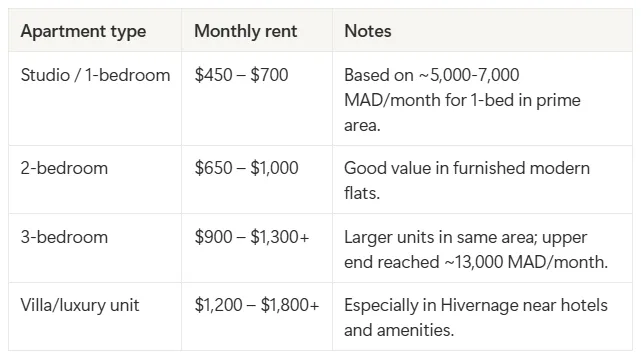
Sale prices are a fair guide to which districts cost the most. ReaConsult's 2026 price barometer (indicative ranges) puts apartments in Hivernage at 12,700 to 19,100 MAD per square metre, Gueliz at 9,900 to 15,300, the Medina and its riads at 8,000 to 13,600, and Targa at 8,000 to 12,000.

Gueliz and Hivernage

This is Marrakech's modern face, where European-style cafés, boutiques and coworking spaces meet Moroccan flair. Gueliz is lively and central, while Hivernage feels more upscale, with tree-lined streets and luxury hotels. Both are expat favourites for their walkability and nightlife, and both sit at the top of the price range.
__wf_reserved_inherit

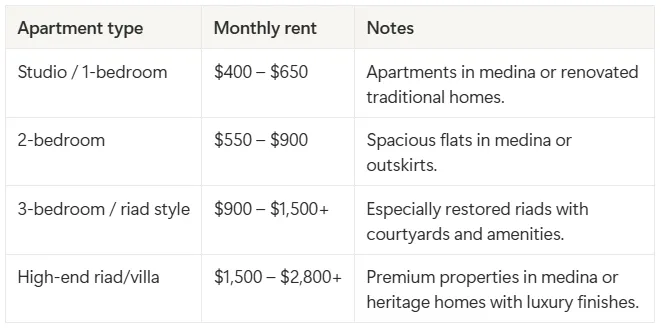
Medina and traditional riads

The Medina is the beating heart of the city: maze-like alleys, busy souks, rooftop terraces and historic riads full of tilework. It isn't the quietest place to live, and parking is hard to find, but nothing else matches it for atmosphere.

Tip: Riad prices vary hugely, from simple rooms to restored houses with plunge pools. Compare several listings and ask whether water and electricity are included before you sign.
__wf_reserved_inherit

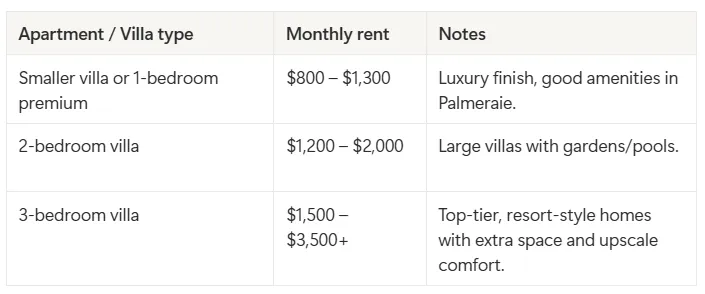
Palmeraie

The Palmeraie (the Palm Grove) is an oasis of calm on the city's outskirts, known for villas, gardens, gated communities and golf resorts. It suits people who value privacy and space, but you'll depend on a car or taxis for almost everything.
__wf_reserved_inherit

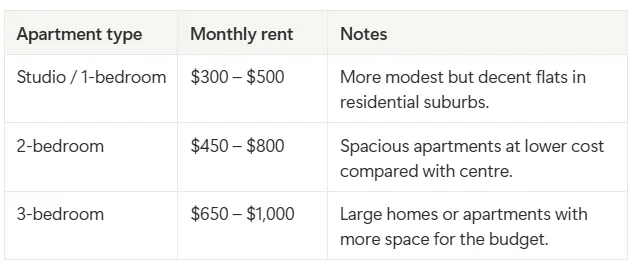
Targa and quieter residential districts

Peaceful and family-friendly, these districts sit away from the tourist buzz. Expect newer apartment blocks, local markets and easy access to schools and supermarkets, and in Targa, lower prices per square metre than in Gueliz. They suit remote workers and families who want a slower pace.
__wf_reserved_inherit

How much does a house cost in Marrakech?

Buying works out at about 19,100 MAD per square metre for an apartment in the centre and 10,900 MAD outside it, based on Numbeo's averages. A 70 square metre flat in the centre would cost roughly 1.34 million MAD (about US$135,000) before fees and taxes.

Food prices in Marrakech

Food is where Marrakech feels cheapest: an inexpensive restaurant meal averages 40 MAD (about US$4), and a three-course dinner for two at a mid-range restaurant about 300 MAD. Whether you're grabbing a tagine from a street stall or dining under lanterns in Gueliz, there's something for every budget.

ItemAverage price (MAD)Approx. price (US$)
Inexpensive restaurant meal404.00
Three-course dinner for two, mid-range restaurant30030.30
Fast-food combo meal606.10
Cappuccino23.302.35
Milk (1 litre)8.200.83
Eggs (12)191.90
Chicken fillets (1 kg)49.405.00
Beef (1 kg)111.9011.30
Tomatoes (1 kg)7.400.75
Potatoes (1 kg)6.800.70
Oranges (1 kg)8.900.90
Bottled water (1.5 litres)5.700.60
Mid-range bottle of wine757.60

Checked 25 November 2026. Source: Numbeo, Marrakech (updated 20 November 2026); per-kilo prices converted from Numbeo's per-pound figures; US dollar figures at 9.89 MAD per US$1 (OFX, 18 November 2026).

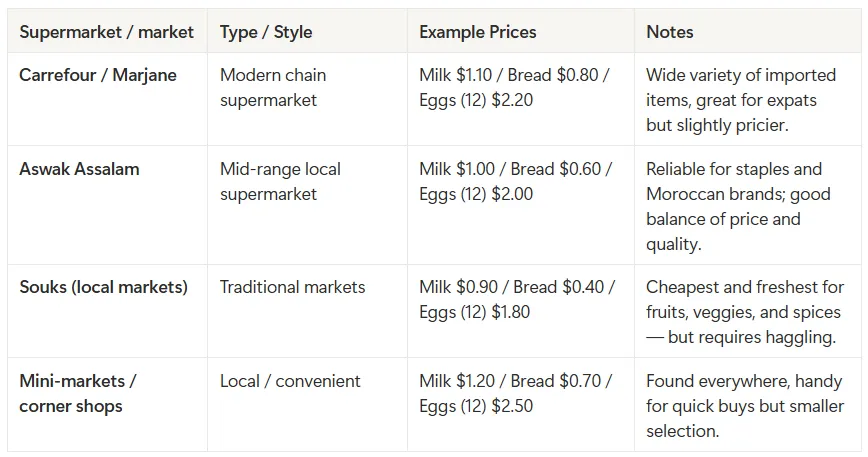
Most expats mix both worlds. They buy fresh produce and bread at the souks and neighbourhood shops, then pick up pantry staples and imported items such as cheese, cereal or wine at Carrefour or Marjane.
__wf_reserved_inherit

Tip: Haggling is normal at market stalls and in the souks, not in supermarkets. Learn the going rate for staples in your first week and you'll spot a tourist price straight away.

Utilities, internet and phone costs

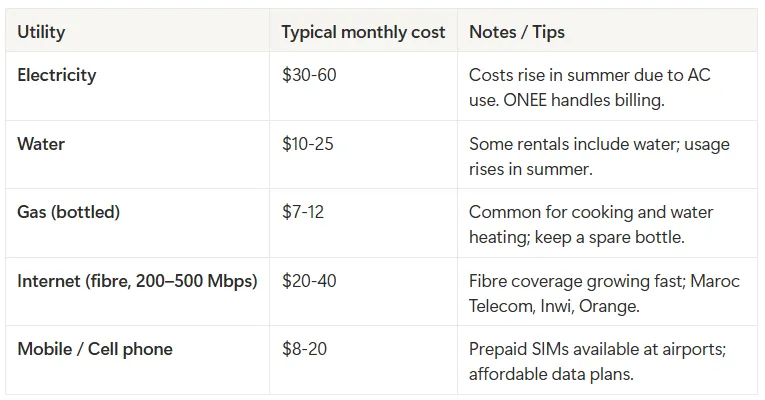
Basic utilities (electricity, heating, cooling, water and rubbish collection) average about 346 MAD a month for an 85 square metre flat, according to Numbeo. Bills climb in summer, when air conditioning runs most of the day.

BillAverage (MAD/month)Typical range (MAD/month)Average (approx. US$/month)
Basic utilities, 85 m² flat346283 to 53135
Home internet, 60 Mbps or faster346200 to 50035
Mobile plan with 10 GB or more data9650 to 2009.70

Checked 25 November 2026. Source: Numbeo, Marrakech (updated 20 November 2026); US dollar figures at 9.89 MAD per US$1 (OFX, 18 November 2026).

Since 1 November 2024, water, electricity and sanitation in Marrakech have been run by the SRM Marrakech-Safi, which replaced the city's former distributor, RADEEMA (Le Matin, November 2024). Some rentals, especially furnished ones, include water, so check what your lease covers before you budget for it.

Many homes cook with bottled butane. The 12 kg bottle rose from 40 to 50 MAD in 2024, and a further rise planned for 2025 was not applied (EcoActu, October 2025), so check the current price at your local shop.

Maroc Telecom, Orange and Inwi are the main internet and mobile providers. SIM cards are easy to buy at the airport or at kiosks, and prepaid plans suit short stays.
__wf_reserved_inherit

Transport costs in Marrakech

Getting around is cheap: a bus ride costs about 4 MAD, and a petit taxi starts at around 8 MAD on the meter plus roughly 6 MAD per kilometre (Numbeo, November 2026). Most residents mix walking, taxis and apps.

Petit and grand taxis

Petit taxis are small, metered and only run within the city, while grand taxis cover longer routes and intercity trips, often shared. Always ask the driver to switch on the meter (compteur), and if it stays off, agree the price before you set off. A few Darija phrases go a long way here.

Uber and ride-hailing apps

Uber returned to Morocco on 27 November 2025, launching in Marrakech and Casablanca with UberX and UberXL and using licensed vehicles only (Uber newsroom). Apps show the price before you ride, which many newcomers prefer to negotiating.

Buses

City buses are the cheapest option, at about 4 MAD a ride or 300 MAD for a monthly pass (Numbeo). They connect most districts, but they get crowded at rush hour.

Driving and scooters

Petrol costs about 14.67 MAD a litre (roughly US$1.50), according to Numbeo. A car makes sense in the Palmeraie or for weekends in the Atlas Mountains, but in the Medina parking is the hard part. Scooters are everywhere, even inside the Medina, so wear a helmet and expect traffic rules to be followed loosely.

Tip: In Gueliz or Hivernage you can walk to most cafés and shops, ideally early in the morning or in the evening when the heat eases. In the Palmeraie you'll rely on a car or taxis.

Healthcare costs in Marrakech

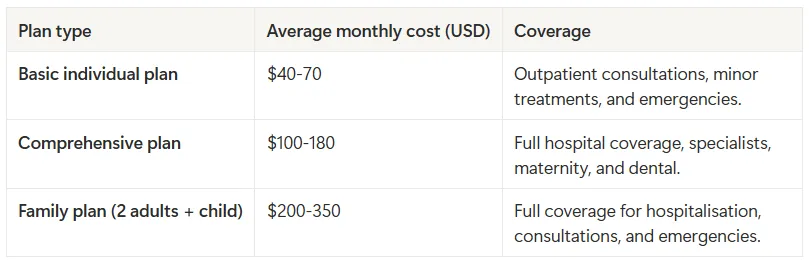
Private clinics in Morocco set their own consultation fees, so there is no single price to quote. Ask for the fee when you book, and budget for private health insurance if you're staying more than a few months.

Public hospitals offer low-cost consultations, emergency care and hospital treatment, but they can be crowded, waits are often long and few staff speak English. Many expats use private clinics for faster appointments and doctors who speak French or English.
__wf_reserved_inherit

Tip: Pharmacies are well stocked and many common medicines are sold over the counter, so a pharmacist is a good first stop for minor problems.

Other monthly costs: gym, childcare and school

Leisure is cheap by Western standards, but schooling is not. Here's what Numbeo's contributors report for everyday extras.

ItemAverage (MAD)Approx. (US$)
Gym membership, per month48249
Cinema ticket636.30
Men's haircut13013
Household cleaner, per hour808
Private preschool, per child per month96798
International primary school, per child per year123,58712,500

Checked 25 November 2026. Source: Numbeo, Marrakech (updated 20 November 2026); US dollar figures at 9.89 MAD per US$1 (OFX, 18 November 2026).

For families, school fees can outweigh rent. A year at an international primary school averages about 123,600 MAD per child, more than two years of the average local net salary.

Can you stay in Marrakech longer than 90 days?

US and UK passport holders can visit Morocco without a visa for up to 90 days (US State Department; GOV.UK). To stay longer, request an extension at a Moroccan police station before the 90 days run out, because overstaying can mean appearing before a judge and paying a fine when you leave.

Rules differ by nationality, so read our guides for US citizens and EU citizens before you sign a long lease.

Earning abroad, living well in Marrakech

Marrakech is an inspiring base for freelancers, remote workers and retirees who earn abroad and spend in dirhams. The weak spot is turning that income into MAD, because card fees, ATM charges and poor exchange rates can eat into a budget that looked generous on paper.

Grey is a financial technology company, not a bank. With Grey you can receive payments into international accounts, convert with a 1% fee capped at US$6 and no margin added to the exchange rate, and send dirhams to a Moroccan bank account for a US$2 fee. MAD payouts are processed Monday to Friday and arrive the next business day.

Before you move money, check today's USD to MAD rate or EUR to MAD rate, and read how to avoid ATM fees on your first trip.

Moving soon? Open a Grey account before you go, and keep more of every payment for the city itself.

Every number in this guide points the same way. In Marrakech, what counts as cheap depends on the currency you earn in.

Frequently asked questions

How much money do you need to live comfortably in Marrakech?

One person needs roughly 8,700 to 10,200 MAD a month (about US$880 to US$1,030), based on Numbeo's November 2026 averages for rent plus day-to-day costs. Budget more for a furnished flat in Gueliz or Hivernage, frequent restaurant meals or imported groceries.

How much is rent in Marrakech?

A one-bedroom flat averages about 4,995 MAD a month in the city centre and 3,526 MAD outside it, according to Numbeo. Three-bedroom flats average about 6,989 MAD in the centre and 4,385 MAD further out.

Is food expensive in Marrakech?

Local food is cheap: an inexpensive restaurant meal averages 40 MAD (about US$4) and tomatoes about 7 MAD a kilo. Imported products cost much more, so a diet built on supermarket imports will push your budget up quickly.

What non-US residents need to open a US bank account at major banks

•

•

2 min read

To open a US bank account at a major bank as a non-US resident, you usually need a valid passport, a second form of ID, a US address you can prove and a visit to a branch. Some banks also ask for an SSN or ITIN and your permanent address back home. The passport is the easy part; the US address and the branch visit are where most applications stall.

Getting this wrong can cost you a wasted trip to a branch, or a flight. Below is what Chase, Bank of America, Wells Fargo and Citi say on their own sites, side by side, plus a realistic plan if you can't get to the US at all.

Can a non-US resident open an account at a major US bank?

Yes, but usually only in person and usually only with a US address. Chase says the idea that non-residents can't open US accounts isn't true, though it warns there may be extra paperwork. Bank of America is blunter: its international professionals page says you must be living in the US to open an account, and non-resident aliens must apply in person at a branch.

In practice, the big banks are built for people who live in the US or are about to. If you are visiting, can prove a US address and bring the right documents, you have a real chance. If you live abroad and never set foot in the US, you will struggle.

Requirements at Chase, Bank of America, Wells Fargo and Citi compared

This is what each bank's own pages ask for. Branches have some discretion and rules change, so treat it as your packing list and confirm with the branch before you go.

RequirementChaseBank of AmericaWells FargoCiti
Where you applyBranch, with original documentsIn person at a branch (non-resident aliens)Branch; online needs an SSN or ITIN and a US addressNon-residents are served by Citi International Personal Bank
Primary IDPassport, foreign national ID, matrícula consular or US work permitForeign passport, or US non-immigrant visa with Border Crossing CardPassport or other listed government IDNot published for non-residents
Second IDRequired; originals only, not expiredRequired, for example a foreign driving licence or US employment IDRequired, for example a debit card or employee IDNot published for non-residents
US addressOne of your two IDs must show a US addressUS physical address; no PO box or mail dropProof of address requiredStandard US accounts generally need one
Home-country addressNot statedFull permanent foreign address requiredNot statedNot stated
SSN or ITINMay be asked for; an ITIN can stand in for an SSNForeign tax ID; US tax number only if you have oneSSN or ITIN listed for online and branch openingStandard US accounts generally need an SSN
Basic checking fee (USD per month)Total Checking: $15, or $0 if you meet a waiverAdvantage SafeBalance: $4.95Everyday Checking: $15, or $0 if you meet a waiverCitigold starts at US$200,000 in investible assets

Checked 25 November 2026. Sources: Chase acceptable forms of identification and Total Checking pages; Bank of America international professionals page and applying for accounts FAQ; Wells Fargo Everyday Checking requirements and account comparison pages; Citi International Personal Bank site. Bank of America's fee is from CNBC Select because bankofamerica.com product pages could not be read, and Citi's standard-account rules are from Wise's Citibank guide (May 2023), as Citi does not publish them for non-residents.

The documents to bring

Pack originals of everything. Chase's ID list says it cannot accept copies or screenshots, and expired documents don't count.

  • Passport: the primary ID every major bank accepts from non-residents.
  • Second ID: a foreign driving licence, national ID card or a debit card in your name. Ask the branch which ones it takes, because each bank's list is different.
  • Proof of US address: a utility bill, lease or rental agreement in your name. Chase wants utility bills dated within 60 days.
  • Proof of home address: Bank of America asks for your full permanent foreign address, including building number, street, city, state or province, and country.
  • Tax number: your home country's tax ID, plus an SSN or ITIN if you already have one.
  • Opening deposit: usually small. Bankrate (March 2026) lists $25 for Wells Fargo Everyday Checking.

If the account can earn interest, the bank may also ask for Form W-8BEN, which certifies to the payer that you are a foreign person for US tax withholding. Our guide on completing a W-8BEN walks through it line by line.

Why the US address is the real gatekeeper

The US address requirement stops more non-resident applications than any other. Chase's ID list says that for customers without a Green Card, the primary or secondary ID must contain a US address. Bank of America says a PO box or mail drop is not an acceptable US physical address.

That rules out the trick many people try first: a mail-forwarding address. If you don't have a lease, a utility bill or an ID showing where you actually live in the US, expect to be turned away, however good your passport is.

Do you need an SSN or ITIN?

Not always, and you probably can't get an ITIN just for this. Many guides, including an earlier version of this one, tell non-residents to apply for an ITIN first. The IRS says an ITIN is not issued solely for opening bank or investment accounts; you need a federal tax reason, such as filing a US tax return.

Even with a valid reason, the IRS asks you to allow about 7 weeks, and up to 11 weeks in peak season or if you apply from abroad. So check what each bank accepts instead:

  • Bank of America: its international page asks for a foreign tax ID and says a US taxpayer number is not required unless you've been issued one. Its general FAQ asks visa holders for an ITIN, so confirm at your branch.
  • Chase: says an ITIN may be used as a substitute where a bank requires an SSN.
  • Wells Fargo: lists an SSN or ITIN for both online and branch opening, and says non-US citizens without a US taxpayer ID must show a government ID proving nationality or residence.

For more on this route, see our no-SSN guide.

Can you open a major US bank account online from abroad?

Rarely. Wells Fargo's online application needs an SSN or ITIN, a physical US address and your own mobile number. Chase's online-opening guidance is written for US citizens and non-US citizens residing in the US, and Bank of America sends non-resident aliens to a branch.

Citi's offer for people outside the US is its International Personal Bank, where Citigold is pitched at clients with US$200,000 in investible assets. That works for globally mobile wealthy clients, not for a freelancer who wants to receive a $1,500 invoice. We cover the wider set of options in non-resident online accounts.

How each major bank differs

The core checklist is the same everywhere, but each bank has its own sticking point.

  • Chase: strictest on documents. Two originals, and one must show your US address. Extra ID rules apply to customers from OFAC-sanctioned countries. Our Chase guide covers the branch visit in detail.
  • Bank of America: the most explicit about non-residents, asking for a foreign tax ID and both a foreign and a US address. See our Bank of America guide.
  • Wells Fargo: leans hardest on a US taxpayer number and recommends booking an appointment. Read how to open a Wells Fargo account from outside the US.
  • Citi: separates standard US banking from international private banking, and the international route has a high entry point.

Tips before you walk into a branch

  • Book an appointment. Wells Fargo recommends it, and it saves you being sent away at a busy branch.
  • Call the branch first. Ask which second IDs and address documents it accepts for non-residents, since requirements vary by bank and by branch.
  • Plan for the monthly fee. Chase Total Checking and Wells Fargo Everyday Checking both charge $15 a month unless you meet a waiver, such as $500 in qualifying electronic deposits or a $1,500 balance. Without US payroll deposits, keeping the minimum balance is often the simpler route.

What if you can't visit the US?

Then a big-bank account isn't realistic, and you may not need one. If your goal is to get paid in USD by US clients, employers or platforms, a USD account from a financial technology company gives you US account details without a branch visit or a US address.

With Grey, you sign up online, verify with a government ID supported in your country and a video selfie, then request a US account with an account number and ACH or wire routing number. Verification usually takes a few minutes and can take up to 24 hours. US accounts are issued to full-time employees and freelancers in eligible countries.

What you needMajor US bank (typical)Grey USD account
Where you applyBranch in the USOnline, from an eligible country
IDPassport plus a second ID, originalsOne government ID supported in your country, plus a video selfie
US addressRequiredNot required
Opening and maintenance fees (USD)Monthly fee of up to $15 unless waivedNo account opening fee and no maintenance charge
Receiving fees (USD)Set by each bankACH or FedNow 0.8% (min $2, max $10); Fedwire $20
How money arrivesACH and wire transfersACH (1 to 2 business days), Fedwire (about 1 business day), FedNow (seconds)

Checked 25 November 2026. Source: Grey help centre (deposit fees, receiving guidelines, document verification, US account eligibility) and grey.co/foreign-accounts.

Know the limits before you share your details. Payments from individual third parties must be under $4,000 each, and Grey does not accept payments for crypto, P2P, betting or forex trading. Grey is a financial technology company, not a bank, and is registered with FinCEN.

You can open foreign currency accounts in USD, GBP and EUR on Grey and spend your dollars with a virtual card without converting first.

Frequently asked questions

Which US banks allow non-resident accounts?

Chase, Bank of America and Wells Fargo accept applications from non-US citizens who apply in person with the right ID and a US address, and Bank of America publishes a specific process for non-resident aliens. Citi serves non-residents mainly through its International Personal Bank, which is aimed at wealthier clients.

Can I get an ITIN just to open a US bank account?

No. The IRS says an ITIN is not issued solely for opening bank or investment accounts. You need a federal tax reason, such as filing a US tax return.

Can I use a mail-forwarding address as my US address?

Usually not. Bank of America says a PO box or mail drop is not an acceptable US physical address, and Chase requires one of your IDs to show a US address.

How much money do I need to open the account?

The opening deposit is usually small; Bankrate (March 2026) lists $25 for Wells Fargo Everyday Checking. The bigger cost is the monthly fee of up to $15 at Chase and Wells Fargo unless you meet a waiver.

The short version

Bring an original passport, a second ID, proof of a US address and proof of your home address, then book a branch appointment and confirm the bank's tax ID rules before you go. If you can't be in the US, skip the branch and join Grey to get USD account details from home. At a major US bank, your passport gets you through the door; a US address and a branch visit get you the account.

Can a non-US resident open a Bank of America account?

•

•

2 min read

Yes, but only if you live in the US. Bank of America's international banking page says "You must be living in the U.S. to open your account", and non-resident aliens must apply in person at a branch. If you live abroad, there is no online or remote route to a personal account.

That rule surprises people, because many guides, including an earlier version of this one, treat the Social Security number as the big hurdle. It isn't. Bank of America accepts a tax number from your home country, so the real gate is a US address you can prove.

Below I cover who qualifies, the documents Bank of America asks for, how the branch visit works, what the basic account costs and what to do if you live outside the US. Every rule here was checked on Bank of America's own pages on 25 November 2026.

Can a non-US resident open a Bank of America account?

A non-US citizen can, but someone who lives outside the US generally cannot. What decides it is your address, not your passport.

Your situationCan you open a personal account?How
Living in the US on a work or student visaYesIn person at a branch, with two IDs, proof of your US address and a tax number
Living in the US with an SSN and a US residential addressYesOnline or in a branch
Visiting the US on a tourist or business visaNot under the bank's stated rulesYou must be living in the US and prove a US physical address; a hotel booking is not on the list of accepted proofs
Living outside the USNoThere is no online or remote route for non-residents

Checked 25 November 2026. Source: Bank of America international banking page and applying for accounts FAQs.

Can you open a Bank of America account online as a non-resident?

No. Bank of America's FAQs say US visa holders currently living in the US "may open an account in person at one of our financial centers", and its international page says non-resident aliens "must apply in person".

The online application is built for people who already have a Social Security number and a US residential address. If that is you, the bank says it processes applications in 1 to 2 business days and posts your account documents within 7 to 10 business days.

Bank of America non-resident account requirements

Bring one item from each row. These are the options Bank of America lists for international customers opening a personal account.

RequirementWhat Bank of America accepts
Primary ID (one)Foreign passport, with or without a visa; US non-immigrant visa with Border Crossing Card (DSP-150); Mexican, Guatemalan, Dominican or Colombian consular ID; Canadian citizenship certificate card
Secondary ID (one)Foreign driver's licence with photo or a US driver's licence; US-issued work ID card or badge; a debit or other bank card with a Visa or Mastercard logo; a major retail store card from a nationally known company; US Department of State diplomat ID; Mexican voter registration card with photo
Proof of US physical addressGovernment-issued photo ID, work ID with address and photo, a current utility bill or a rental agreement in your name. PO boxes and mail drops are refused
Permanent foreign addressYour home address abroad: building number and street, city or town, state or province, and country
Tax identification numberA foreign tax identification number (FTIN) from your home country, or your US SSN or ITIN if you have been issued one
Opening deposit (USD)$25 or more for an Advantage SafeBalance account

Checked 25 November 2026. Source: Bank of America international banking page, applying for accounts FAQs and the Advantage SafeBalance Clarity Statement.

International students can use a US student ID validated for the current term as their second ID, according to Bank of America's student banking page.

Do you need an SSN or ITIN for Bank of America?

Not necessarily. Bank of America's international page says a US taxpayer number is not required unless you have been issued one, and it accepts a foreign tax identification number instead.

There is one wrinkle. The bank's general application FAQ mentions an ITIN for visa holders, so if you have an ITIN, bring it, and if you don't, bring your home-country tax number and confirm it when you book.

What you cannot swap out is the US address. A post office box or mail drop will not do, and neither will an address you cannot prove with a document in your name. For the wider picture, see our guide to opening a US account without an SSN.

How to open a Bank of America account as a non-resident

  1. Confirm you qualify: you live in the US and can prove a US physical address.
  2. Gather one primary ID, one secondary ID, proof of address, your full foreign address and a tax number.
  3. Book a time at a branch. Bank of America asks you to have everything ready before you choose a time and location.
  4. Bring your opening deposit. The Advantage SafeBalance account needs $25 or more.
  5. Once the account is open, set up the mobile app, your debit card and digital wallets.

If you are in the US on a short trip and none of this fits, our guide to banking on a visit visa covers what is realistic.

What a Bank of America account costs

The basic Advantage SafeBalance account costs $4.95 a month, according to its Clarity Statement (information current as of November 2025). The fee is waived if you keep a minimum daily balance of $500, if an account owner is under 25, or if you are a Preferred Rewards member.

Bank of America also notes that fees apply to wires and certain transfers, which matters if clients will pay you from abroad. Check the fees for your ZIP code before you rely on the account for income.

Why non-resident applications stall

These are the gaps that stop an application at the desk, based on Bank of America's own rules.

  • No US residence: the bank requires you to be living in the US.
  • The wrong address: a PO box, mail drop or hotel booking is not proof of a US physical address.
  • One ID instead of two: you need a primary ID and a secondary ID.
  • Applying online without an SSN: the online form asks for one, so non-residents go to a branch.
  • A thin foreign address: give the building, street, city, state or province and country.

What to do if you can't open a Bank of America account

If you live outside the US, Bank of America is not your route, and walking into a branch on holiday will not change that. Start by asking what you actually need: a US bank, or a way to get paid in US dollars.

If you need a full US bank because you are moving, open it after you arrive and have a US address you can prove. Other big US banks set their own conditions, which our guide to other major banks compares.

If you need to get paid in dollars from abroad, a USD account built for non-residents does that job without a branch visit.

Grey USD account compared with Bank of America

Bank of America personal accountGrey USD account
Where you must liveIn the USOne of Grey's eligible countries, such as Nigeria, Ghana, India, Egypt or the Philippines
Who it is forAnyone who meets the ID and address rulesFull-time employees and freelancers
How you applyIn person at a branch (online only with an SSN and US address)Online, in the app or on the website
DocumentsTwo IDs, proof of US address, foreign address, tax numberGovernment ID, a short selfie video and a bank statement from the last three months
US tax numberNot required unless you have been issued oneSSN asked for only if you live in the US
Monthly fee (USD)$4.95 for SafeBalance, waivableNone
Receiving US payments (USD)Fees apply to wires and certain transfersACH or FedNow 0.8% (min $2, max $10); Fedwire $20

Checked 25 November 2026. Source: Bank of America international banking page and SafeBalance Clarity Statement; Grey Help Centre articles on US account eligibility, KYC verification and USD deposit fees.

With a Grey USD account you get an account number plus ACH and wire routing numbers to give to US clients and platforms. ACH payments arrive in 1 to 2 business days and Fedwire in about one business day, and you can hold the dollars or convert them after checking the currency converter.

Read Grey's receiving guidelines before you share your details: individual third-party deposits must be under $4,000, and payments for crypto, peer-to-peer, betting or forex trading are not accepted. Grey is a financial technology company, not a bank, and is registered with FinCEN.

Frequently asked questions

Can a tourist open a Bank of America account?

Not under Bank of America's published rules. Its international page says you must be living in the US to open an account, and you need a document in your name proving a US physical address, such as a utility bill or rental agreement.

Can I open a Bank of America account with just a passport?

No. A foreign passport counts as your primary ID, but Bank of America also asks for a secondary ID, proof of your US address, your permanent foreign address and a tax identification number.

Can I open a Bank of America account without an SSN?

Yes, in a branch. Bank of America's international page says a US taxpayer number is not required unless you have been issued one, and it accepts a foreign tax identification number. The online application, however, asks for an SSN.

Is Bank of America right for you?

If you live in the US, opening a Bank of America account as a non-citizen takes two IDs, a provable address, a tax number from home and one branch visit. If you live abroad and mainly need to get paid in dollars, open a free Grey account and send your USD details with your next invoice.

At Bank of America, where you live matters more than which tax number you hold.

Best countries to work in Africa: pay, permits and job sites

•

•

2 min read

The best countries to work in Africa for most skilled professionals are South Africa, Kenya, Nigeria, Egypt, Morocco, Senegal and Namibia. Each has a big-city job market, international employers and a defined route to a work permit.

Choosing between them comes down to three questions: will an employer sponsor you, what will the job pay, and how will you move that money? The answers have shifted fast. All seven countries have raised their minimum wage since mid-2023, and South Africa, Nigeria and Egypt have reworked their rules for foreign workers since 2024.

Below you'll find each country's current minimum wage and permit route, taken from government notices, official immigration pages and named news reports, all checked on 25 November 2026. You'll also get the main job sites and a plan for getting paid across currencies.

Best countries to work in Africa compared

Start with this table, then read the country sections for the detail. Remember that a minimum wage is a legal floor, not what a skilled professional earns.

CountryStatutory minimum wage (local currency)Work permit route for foreignersMain job sites
South AfricaZAR 30.23 an hour, from 1 March 2026General or critical skills work visa, scored under a points systemPNet, Careers24, LinkedIn
KenyaKES 18,047.40 a month for a general labourer in the main cities, from 1 May 2026Class D employment permit, applied for online through eFNSBrighterMonday, MyJobMag, LinkedIn
NigeriaNGN 70,000 a month, set in 2024Employment visa under your employer's expatriate quota, then an e-CERPAC residence cardJobberman, MyJobMag, LinkedIn
EgyptEGP 7,000 a month in the private sector, rising to EGP 8,500 on 1 January 2027Annual work permit from the Ministry of LabourWuzzuf, Bayt, LinkedIn
SenegalXOF 370.52 an hour outside agriculture, since 1 July 2023Work permit approved by the Directorate of Labour before you startEmploi Dakar, LinkedIn
NamibiaNAD 18 an hour, from 1 January 2025Employment permit from the Ministry of Home AffairsLinkedIn, local newspapers
MoroccoMAD 17.92 an hour in industry, commerce and services, from 1 January 2026Employment contract approved by the Ministry of Employment, with an ANAPEC certificateRekrute, Emploi.ma, LinkedIn

Checked 25 November 2026. Sources: South Africa Department of Employment and Labour; Kenya Legal Notice 108 of 2026 (reported by The Star); Nigeria State House; Egypt National Wages Council (reported by The National); WageIndicator for Senegal; The Namibian; Bladi for Morocco; and the immigration pages linked in each section below.

The wider backdrop is steady growth. The African Development Bank's 2026 African Economic Outlook (May 2026) estimates that Africa grew 4.4% in 2025 and projects 4.2% growth for 2026 and 4.4% for 2027.

The rule that decides most moves

In most of these countries, the employer has to prove that a local can't do your job before you get a permit. That single rule shapes how you should job hunt.

  • Kenya: the Class D application must name a Kenyan understudy who will learn your role.
  • Nigeria: since April 2025, each expatriate quota position needs at least two Nigerian understudies.
  • Namibia: the employer must advertise the vacancy in a local newspaper and share the CVs of Namibians who applied and were turned down.
  • Morocco: the employer needs a certificate from ANAPEC, the national employment agency, showing your profile is scarce.

South Africa is the exception worth knowing. If your occupation is on its critical skills list, that alone scores the full 100 points you need for a visa. Everywhere else, the lesson is the same: find the job first, target roles where local talent is thin, and let your employer start the paperwork.

The seven best countries to work in Africa

South Africa: the clearest route for in-demand skills

South Africa's jobs for foreign professionals cluster in finance, mining, engineering and technology, mainly in Johannesburg and Cape Town. It is also the only country here that scores work visas on points.

__wf_reserved_inherit

The national minimum wage rose to R30.23 an hour on 1 March 2026, according to the Department of Employment and Labour. Skilled roles pay well above that, and the visa rules themselves tell you what counts as a strong salary.

Under the points-based system gazetted in October 2024, you need 100 points for a general or critical skills work visa. An occupation on the critical skills list scores all 100; otherwise a job offer is compulsory and scores 50 points above R976,194 a year or 20 points from R650,976, with more points for qualifications, experience, a trusted employer and language. Check the Department of Home Affairs for any updated thresholds before you apply.

Key considerations:

  • Job sites: LinkedIn, PNet and Careers24.
  • Cost of living: Cape Town and Johannesburg cost the most; Durban, Gqeberha and Kimberley are cheaper.
  • Comparing offers: convert a rand salary with our USD to ZAR converter so you can compare it with offers elsewhere.

Kenya: East Africa's tech and NGO hub

Nairobi, nicknamed the Silicon Savannah, draws professionals in tech, finance, agribusiness and international development. Demand is rising for IT professionals, engineers and digital marketers.

__wf_reserved_inherit

Kenya raised its general minimum wages by 12% from 1 May 2026. A general labourer in Nairobi, Mombasa, Kisumu, Nakuru and Eldoret must now earn at least KES 18,047.40 a month, under Legal Notice 108 of 2026 as reported by The Star.

Foreign employees need a Class D permit, which is issued for a specific job with a specific employer when the skills aren't available in Kenya. You apply online through the eFNS portal, pay a non-refundable KES 20,000 processing fee and submit your employer's documents, your certificates and the details of your Kenyan understudy.

Key considerations:

Nigeria: scale, if your employer holds a quota

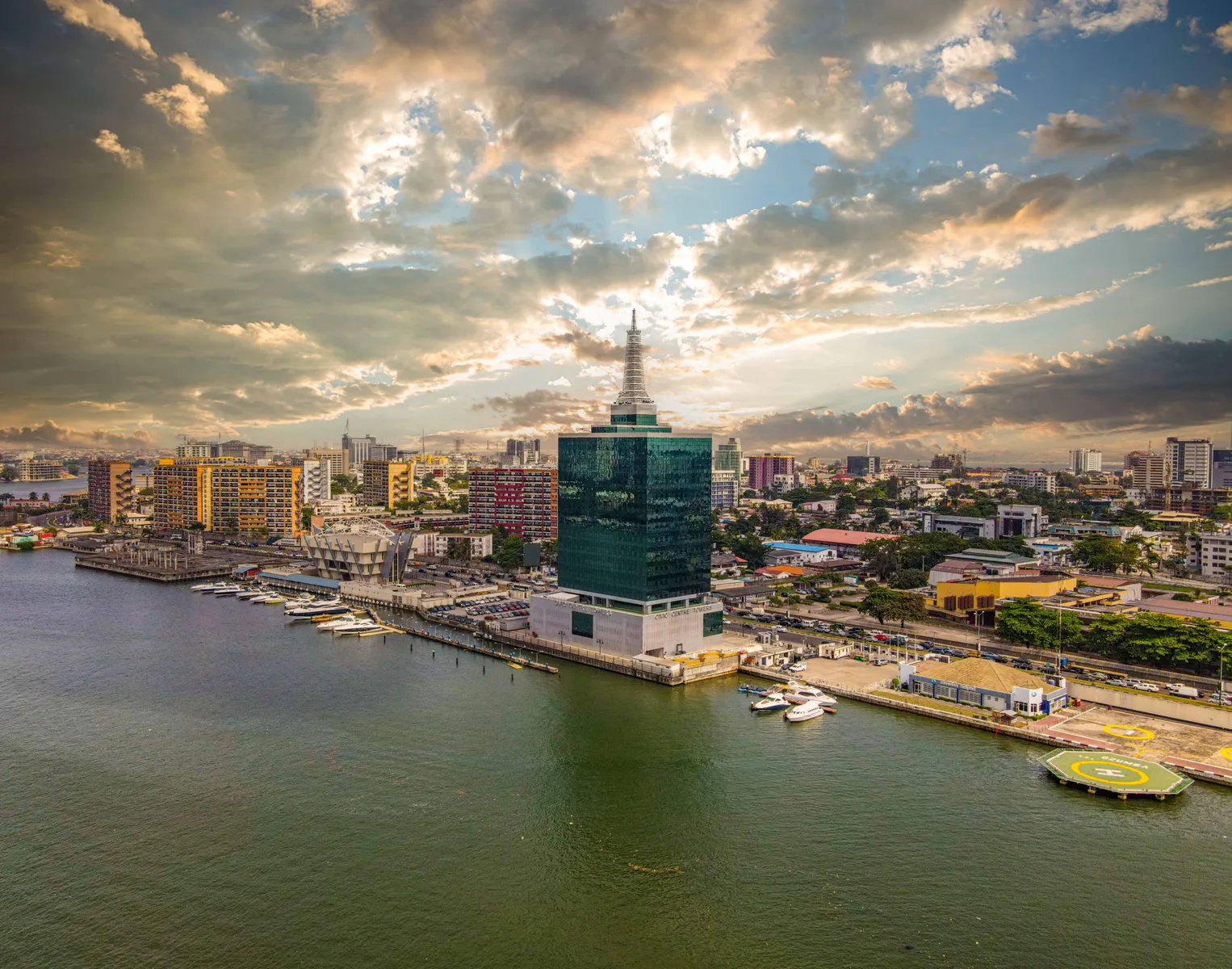
Lagos, Abuja and Port Harcourt offer roles in oil and gas, finance, telecoms and tech. The market is huge, but foreign hiring runs through a quota system that is getting stricter.

__wf_reserved_inherit

The national minimum wage is NGN 70,000 a month, approved in July 2024, and the government has committed to reviewing it every three years, according to State House. If your package is paid in naira, budget for exchange-rate swings before you sign.

The standard route is an R2A employment visa, which is subject to your employer's expatriate quota, and the Nigeria Immigration Service now issues the e-CERPAC residence card before you travel. Reforms announced by the Ministry of Interior in April 2025 require two Nigerian understudies per quota position and set Temporary Work Permit visa fees at $600 for three months and $1,100 for six, according to KPMG Nigeria.

Key considerations:

  • Job sites: LinkedIn, Jobberman and MyJobMag.
  • Where to live: rent and daily costs vary sharply between Lagos, Abuja and smaller cities; our cost of living breakdown compares them.
  • Work culture: trust and personal connections carry weight, and respect for seniority matters.

Egypt: multinational jobs with a rising pay floor

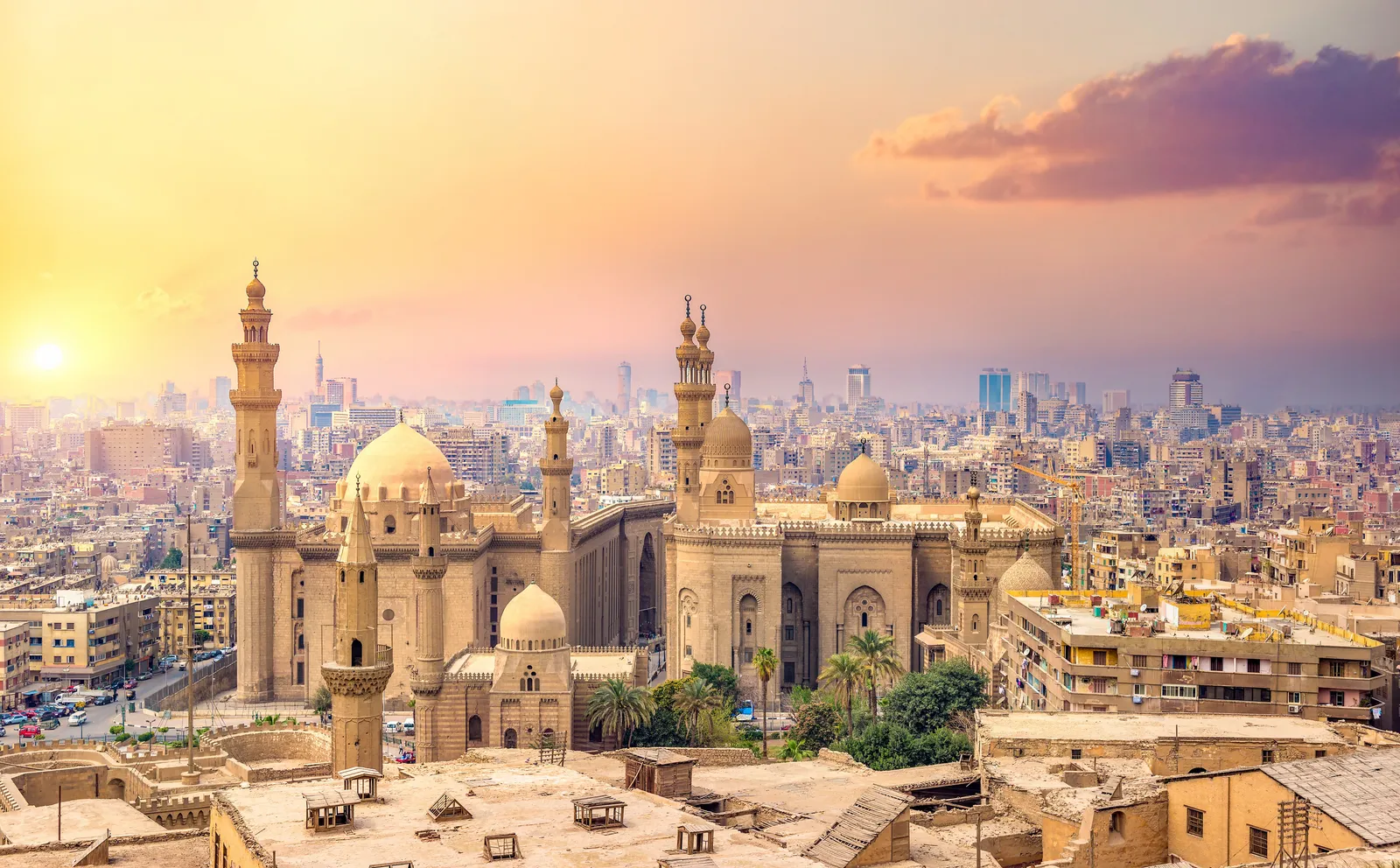
Cairo is the hub for banking, tech, telecoms and engineering, with Alexandria and New Cairo growing as business centres. Arabic helps a great deal outside multinational offices.

__wf_reserved_inherit

Egypt's private-sector minimum wage has been EGP 7,000 a month since March 2025, and the National Wages Council approved a rise to EGP 8,500 from 1 January 2027, as reported by The National on 18 November 2026.

Foreign employees need a work permit from the Ministry of Labour, issued for a year at a time. Enforcement is tighter under the new labour law that took effect in September 2025: the ministry recorded more than 7,000 work permit violations in 17 days, according to the Cairo Governorate.

Key considerations:

  • Job sites: LinkedIn, Wuzzuf and Bayt.
  • Cost of living: daily costs are moderate, but imported goods, private schools and upscale housing are expensive.
  • Comparing offers: track the pound with our USD to EGP converter.

Senegal: a French-speaking base in West Africa

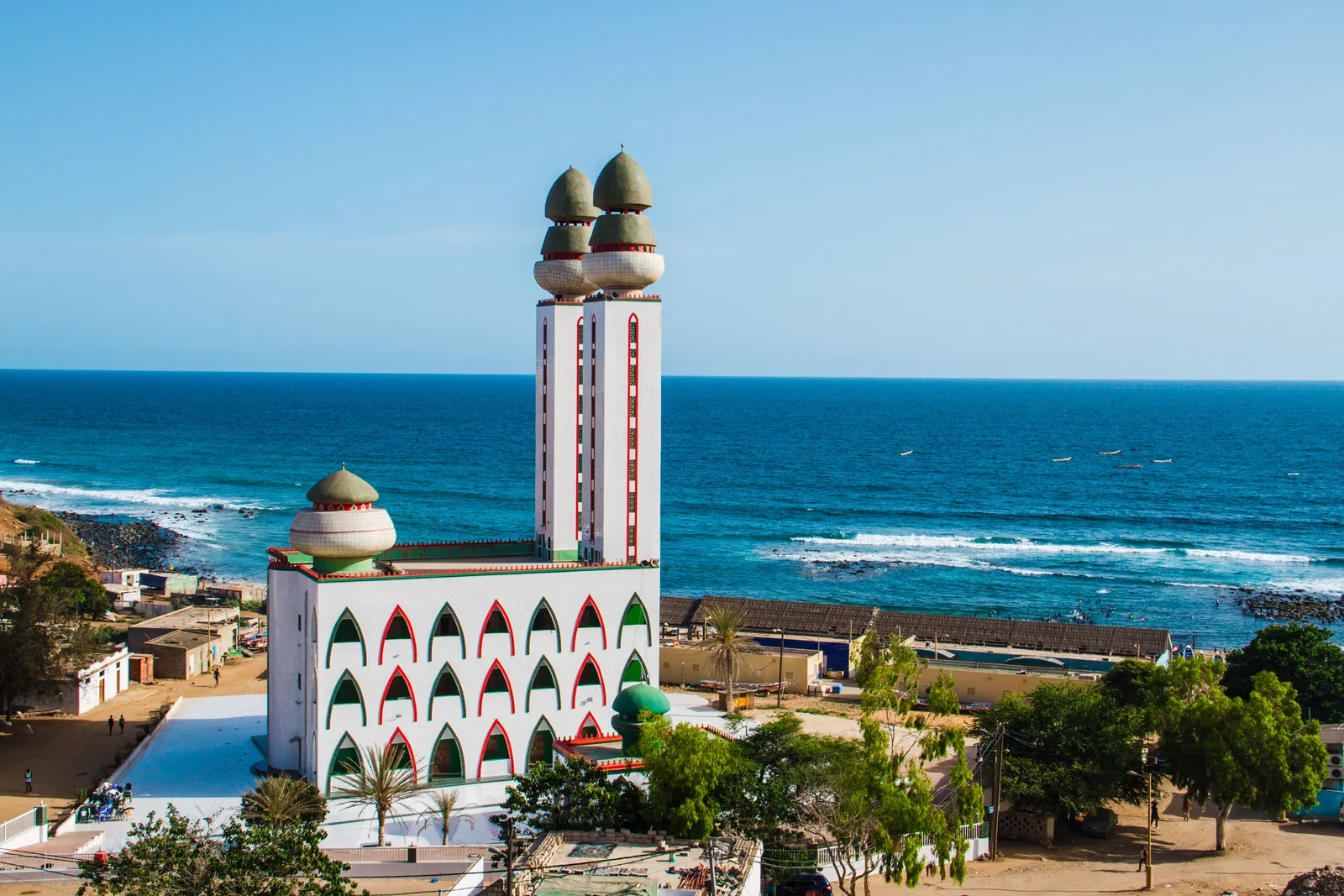
Dakar is Senegal's business centre, with jobs in banking, telecoms, agriculture, international trade and international organisations. French is the language of business, so fluency is usually expected.

__wf_reserved_inherit

The minimum wage outside agriculture has been XOF 370.52 an hour since 1 July 2023, set by Decree 2023-1710 and tracked by WageIndicator. Salaries at multinationals and NGOs sit well above this floor.

Your employer applies for your work permit through the Directorate of Labour, and you can't start work until it is issued. A 2018 directive ended the practice of starting before approval, and the wait can run to four weeks, according to Fragomen.

Key considerations:

  • Job sites: LinkedIn and Emploi Dakar.
  • Cost of living: everyday spending is affordable, but housing and imported goods in Dakar are costly.
  • Work culture: relationships are built on trust, and networking drives career growth.

Namibia: stable, English-speaking and selective

Namibia's economy runs on mining (diamonds and uranium), tourism, agriculture and a growing renewable energy sector. Windhoek is the business centre, and English is the official language, which makes settling in easier.

__wf_reserved_inherit

A national minimum wage of NAD 18 an hour has applied since 1 January 2025. Domestic and agricultural workers are phasing in, at NAD 15 and NAD 14 an hour in 2026, and both reach NAD 18 in 2027, according to The Namibian.

You need an employment permit, which costs NAD 2,600 a year. Alongside your police clearance and medical reports, your employer must prove it advertised the job locally and list the Namibian candidates it turned down.

Key considerations:

  • Job sites: LinkedIn and the job pages of local newspapers, where employers must advertise anyway.
  • Cost of living: Windhoek is pricier than other Namibian towns, and imported goods add up.
  • Work culture: fairly formal, with respect for hierarchy and protocol.

Morocco: a North African hub for industry and services

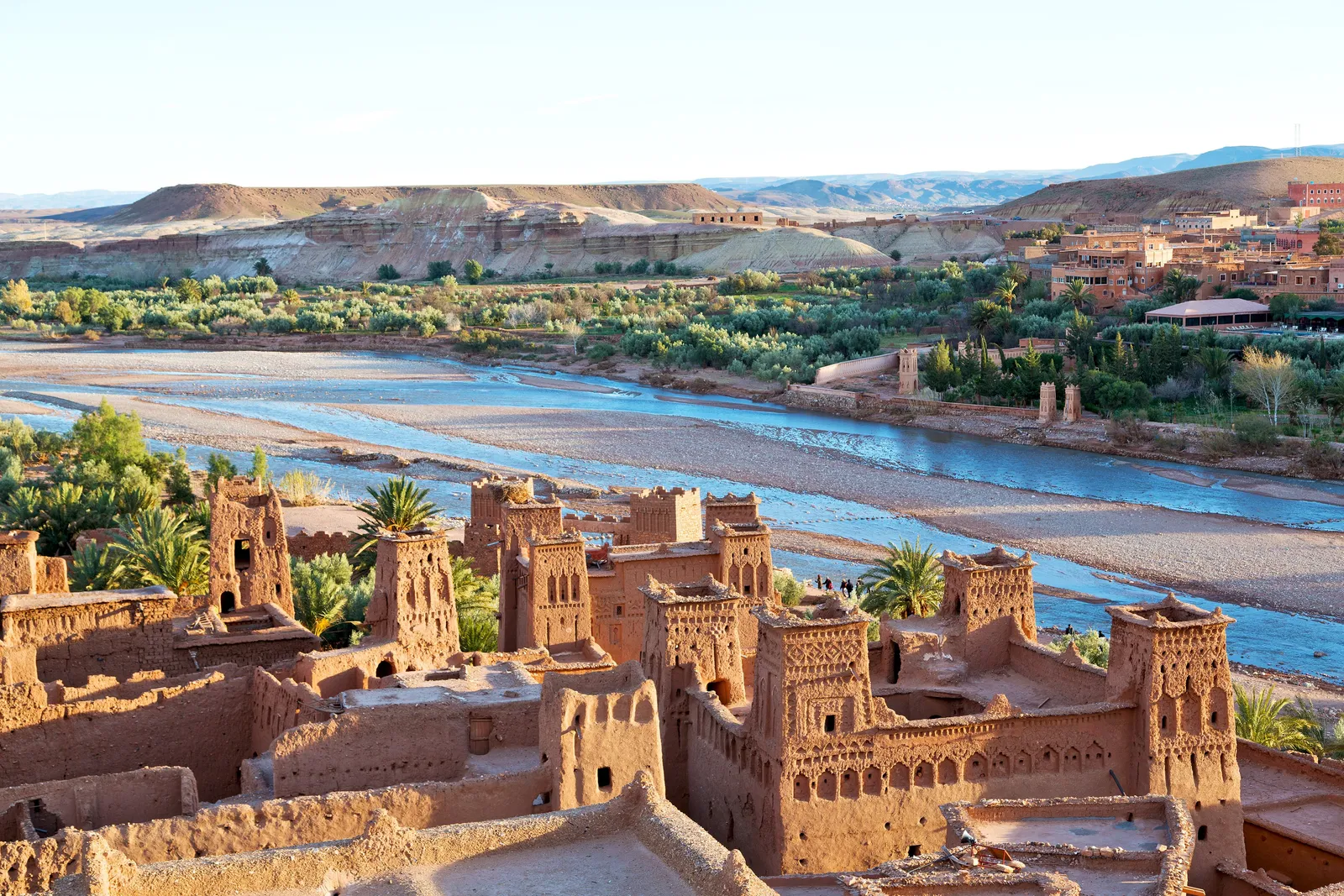
Casablanca is the financial centre, with jobs in banking, IT and logistics, while Marrakech and Agadir run on tourism. Automotive manufacturing and renewable energy are growing sectors. French and Arabic are the working languages in most offices.

__wf_reserved_inherit

The minimum wage in industry, commerce and services rose to MAD 17.92 an hour on 1 January 2026, according to Bladi. Skilled roles at multinationals pay far more.

Your employer must ask the Ministry of Employment for permission to hire you, backed by an ANAPEC certificate, and then have your contract stamped; the first approval usually lasts a year. Senegalese, Tunisian and Algerian nationals don't need a work permit at all, according to the Spanish Embassy in Rabat.

Key considerations:

  • Job sites: LinkedIn, Rekrute and Emploi.ma.
  • Where to live: Casablanca and Rabat cost more than other cities; our Moroccan city guide compares the main options.
  • Work culture: a mix of formal and relationship-based, with networking playing a big part.

What to check before you accept an offer

The permit and the salary get the attention, but these details decide how the move feels after six months.

  • Salary currency: a local-currency salary can lose value quickly when exchange rates move, so ask whether part of your package can be paid in US dollars, pounds or euros.
  • Health cover: public healthcare is limited in many areas, so check whether private medical insurance is part of the package.
  • Housing: rents near business districts climb fast; ask colleagues which neighbourhoods they live in before you sign a lease.
  • Safety: read your own government's travel advice for the city, not just the country.
  • Relationships: networking and introductions carry weight in all seven markets, an idea Southern Africans sum up as Ubuntu: a person is a person through other people.

How to get paid and move money across borders

A local bank will usually want to see your permit and proof of address, so your first salary can arrive before your local account is ready. A Grey account fills that gap: it is free to open, has no maintenance fees and gives you US, UK and European account details for receiving money from abroad.

You can hold your money, convert it at real-time rates when the timing suits you, withdraw to a local account and pay online with a virtual card. If your salary arrives in US dollars, euros or pounds, Grey Paycheck splits it automatically into spending, savings and an emergency fund.

If your employer pays by bank transfer from Europe, our guide to getting a virtual IBAN for salary payments walks through the setup. Grey is a financial technology company, not a bank, and availability depends on the country you live in, so check eligibility in the app.

No work permit? Work for a foreign company from home

If you are African and your main goal is a stronger salary rather than a new country, you don't need a permit at all. Many of the same employers hire remotely, and our list of remote jobs that pay in foreign currency is a good place to start.

Frequently asked questions

Which country in Africa has the most job opportunities?

No official ranking measures job openings across Africa. For foreign professionals, the best country is the one with the clearest permit route for your skills: South Africa if your occupation is on its critical skills list, Kenya or Nigeria if an employer will sponsor you, and Morocco or Senegal if you work in French.

Can foreigners work in South Africa?

Yes, with a work visa. Under the points-based system gazetted in October 2024, you need 100 points; an occupation on the critical skills list scores 100 on its own, and otherwise a job offer is compulsory, with extra points for salary, qualifications and experience.

How do I get a job in Africa as a foreigner?

Apply from abroad through LinkedIn and each country's main job sites, and focus on multinationals and roles with clear skills shortages. In Kenya, Nigeria, Namibia and Morocco the employer must justify hiring a foreigner, so secure the offer before you plan the move.

Choosing where to work in Africa

All seven countries offer real careers, but they reward different people: South Africa favours scarce skills, Kenya and Nigeria favour candidates whose employer will sponsor them and train a local understudy, and Morocco and Senegal favour French speakers. Shortlist two countries where your skills are hard to find, then approach employers there directly.

When the offer comes, open a free Grey account so your first pay cheque lands somewhere you can hold, convert and spend it. In Africa, your work permit starts with your employer, so find the job first and let the country follow.

From Delhi to Dallas: How the Indian gig economy is booming and what you can do to get in on it

•

•

2 min read

It used to be just a side gig. A few hours after work. A design tweak here, a quick edit there. But somewhere between late-night coffee and back-to-back client calls, India’s gig economy lit up.

Now, it’s a full-blown movement.

Today, India is home to around 15 million freelancers, making it the world's second fastest-growing freelance economy. By 2030, the country is expected to have 23.5 million gig workers, representing a major leap from today’s 1.5 per cent share of the total national workforce. That’s not growth. That’s lift-off.

Indian writers are editing podcasts for startups in New York. Developers in Pune are pushing code for Berlin tech firms. Designers in Kerala are shaping brand identities for London agencies. All from the comfort of home.

How exactly are they doing it? What’s powering this rise? And more importantly, how can you be part of it?

This article unpacks India’s freelance boom, the smart strategies freelancers are using to grow, and how you can get paid from anywhere in the world.

What is fuelling this rise?

Behind every freelance success story in India is a mix of skill, opportunity and timing. But there is more at play driving this boom. These are the forces reshaping how and where Indians work.

  • Freelancing has exploded, with software development and tech roles dominating the Indian freelance market, followed by creative and multimedia positions, and writing/translation jobs.
  • Global freelance platforms like Upwork, Fiverr, and LinkedIn have made it easier than ever for Indian freelancers to pitch, win, and manage international gigs. Over 1.6 million Indians use Upwork alone, making India the platform’s second-largest talent base after the U.S.
  • This shift is no longer confined to major cities. Professionals from smaller towns like Indore, Bhubaneswar, and Surat are successfully competing for international projects and building sustainable freelance careers.

India’s gig economy is evolving into a powerful engine for innovation, independence, and global connection. And for those ready to jump in, the timing has never been better.

Also read: Grey launches faster rupee payouts for Indians earning globally

Why Indian freelancers are expanding beyond borders

India’s freelance market is thriving, and many professionals are now reaching beyond their home country for new opportunities. And it is not just about earning more — it is about growing faster, learning more, and working on their own terms.

Here is why so many Indian freelancers are choosing to go global:

Higher pay for the same work

International clients often offer significantly better compensation compared to local clients. Indian freelancers can earn more for their time and skills, helping them reach financial goals more quickly.

Exposure to diverse industries and projects

Working with clients from around the world means exposure to different industries, cultures, and business models. This variety keeps the work interesting and helps freelancers expand their expertise.

Steady work and long-term contracts

Global clients often hire for ongoing roles or long-term projects. This consistency brings more financial stability and makes it easier to plan for the future.

Global careers, local lifestyle

With remote work, freelancers can live in any part of India and still access international jobs. They can be close to family, avoid relocation costs, and still work with leading global companies.

A path to personal growth and independence

Going global allows freelancers to build stronger portfolios, increase their confidence, and grow their networks. For many, it is also a step toward full independence and entrepreneurship.

Why global clients are choosing freelancers from India

When companies around the world look for freelance talent, India keeps showing up at the top of their list.

This preference isn’t just about affordability. It’s about value. Indian freelancers consistently deliver a combination of technical expertise, communication skills, and cultural adaptability that makes them stand out in a crowded global market.

Here’s what makes Indian professionals especially attractive to international clients:

High-quality work at competitive rates

Indian freelancers offer world-class skills, often at a fraction of the talent costs in North America or Europe. This balance of affordability and quality is hard to beat.

Strong English proficiency and communication

With English widely spoken and taught from an early age, Indian freelancers are able to collaborate seamlessly with clients across the globe. That clarity builds trust and helps projects move faster.

Time zone advantages

Indian time zones allow for round-the-clock productivity. Many Western clients appreciate waking up to progress updates or deliverables, thanks to this natural overlap.

Adaptability and professionalism

Cultural flexibility, strong work ethic, and a results-oriented mindset are qualities many clients cite when recommending Indian freelancers. They’re easy to work with, quick to learn, and committed to meeting expectations.

Tech-savvy, future-ready talent

India’s massive, digitally skilled workforce is constantly learning and evolving. From AI tools to the latest no-code platforms, Indian freelancers stay ahead of trends and bring modern solutions to the table.

Dominance across freelance platforms

Whether on Upwork, Fiverr, Freelancer.com, or LinkedIn, Indian professionals maintain a strong presence. Many are Top Rated, Level 2 sellers, or part of exclusive talent pools, which is a testament to their consistent delivery and client satisfaction.

What Indian freelancers are getting right

The success of Indian freelancers isn’t accidental. Those doing well share a few smart habits and strategies. Here’s what you can learn from them:

  • They specialise

Generalists may land occasional gigs, but specialists build sustainable freelance careers. Successful freelancers are focusing on niches like SaaS content writing, UI/UX design, Shopify development, and AI-related services — areas with global demand and room for premium pricing.

  • They show outcomes, not just skills

It’s no longer enough to say you “build websites” or “write content.” Top freelancers show results: how they helped increase conversions, reduce churn, improve UX, or drive SEO traffic. They present case studies, testimonials, and portfolios with real-world value.

  • They know where to be seen

Indian freelancers dominate many online platforms but invest in LinkedIn visibility, cold outreach, and personal websites. They engage in communities, speak on podcasts, and position themselves as experts, not just service providers.

  • They think globally about money

While many new freelancers struggle with international payments, the experienced ones know better. They avoid high fees and poor exchange rates by using modern tools designed for global work.

Going global as a freelancer isn’t about doing more. It’s about working smarter, choosing your lane, and setting yourself up with systems that scale. Start small, stay focused, and let your work speak for itself.

You may also like: How to receive money from UK clients in India

The hidden challenges of getting paid globally

Landing international clients is only part of the equation for Indian freelancers. The real challenge often begins when it’s time to get paid.

Despite the booming global demand for Indian talent, many freelancers still face barriers that can delay or reduce their earnings. These include:

  • Slow international transfers
  • Payments from clients abroad can take several business days to arrive, often passing through multiple intermediary banks along the way.
  • High transaction and conversion fees
  • Banks and payment platforms charge service fees and apply unfavourable exchange rates, meaning freelancers lose a chunk of their hard-earned money in the process.
  • Limited payout options
  • Many freelance platforms restrict how funds can be withdrawn, often limiting flexibility or requiring extra verification steps.
  • Lack of transparency
  • Freelancers are not always shown the exact fees or exchange rates upfront, making it difficult to predict what they will receive in Indian rupees.
  • Tax and compliance complexity
  • Managing foreign payments can be confusing without clear guidance on documentation, GST, or income tax reporting for overseas earnings.

How Grey can help

Designed for freelancers and remote workers earning from abroad, Grey makes it easy to receive, hold, convert, and withdraw international payments from one seamless platform.

The smart way to go global

India’s gig economy is growing rapidly, and freelancers are no longer limited by geography. With the right skills and the right tools, you can build a global career from wherever you are.

Grey gives you the freedom to receive payments from international clients without delays or unfair charges.

Ready to unlock your international earning potential?

Create your Grey account today and take the stress out of global payments.

‍

Grey vs traditional banks: which saves you more time

•

•

2 min read

The global digital evolution has not left the banking sector untouched. A fast-paced generation requires fast transactions. Many employees now work with clients they’ve never met, living in foreign countries they’ve never visited. The educational sector is seeing a growing number of international students. Digital nomads work remotely while hopping from country to country. Businesses are expanding, with growing cross-border trade. Our banking needs are evolving. We now need seamless and swift borderless payment solutions at the lowest cost possible.

Fintech companies like Grey offer solutions that fit today’s needs and help solve problems that traditional banks haven’t fixed.

In this article, we compare the new and the old, Grey vs. traditional banks, and examine where each stands in terms of time conservation.

Also read: Global accounts vs traditional banks: What remote workers should know

How Grey works

With Grey, you can open international bank accounts and manage money across borders easily. It’s made for freelancers, expats, and remote workers. You can open an account in just a few minutes, all online, with no need to visit a branch or fill out lots of paperwork. Grey offers:

  • Multi-currency support: Receive, send, hold, and convert between USD, GBP, EUR, and local currencies.
  • Swift conversions and transfers: Currency conversions and international transfers are completed within minutes to a few hours.
  • Additional feature: Grey also offers automated invoicing, expense tracking, and virtual USD debit cards for seamless online payments.
  • Security: Grey is fully regulated by FINTRAC and FinCEN, ensuring that your funds and data are adequately protected.

Unlike traditional banks, which are often constrained by regulatory hurdles and official bottlenecks, Grey leverages digital provisions to enable faster processing.

Also read: Global accounts vs traditional exchange houses: which is better?

How traditional banks work

Traditional banks, such as Chase and HSBC, as well as local branches in various countries, offer a wide array of banking services, including savings accounts, loans, mortgages, and investment advice. They operate through physical branches, ATMs, and digital platforms. They offer more robust banking services compared to emerging fintechs. However, many traditional banks remain traditional in practice, with lengthy paperwork and cumbersome processes, such as waiting in lines, scheduling appointments, or dealing with international money transfer delays, in a fast-paced economy.

Grey vs traditional banks: Which saves you more time

Fintechs like Grey don’t replace traditional banks, but they do some things differently. Let’s see which one saves you more time by looking through important banking processes.

1. Account opening

The onboarding process of a banking system basically shows you what to expect from them. This is why many strive for a streamlined account opening process. Now, let’s compare Grey and traditional banks.

  • Grey: Signing up and verifying your identity on Grey is a seamless process that takes only a few minutes. The process is entirely through the app or website and doesn’t require a physical branch visit or mailing documents. You simply need to upload a valid ID, proof of residence, and a selfie for Know Your Customer (KYC) compliance. Accounts in USD, GBP, or EUR can be opened from anywhere in the world, making it ideal for non-residents or travellers.
  • Traditional banks: Opening an account typically involves visiting a branch, filling out forms, providing multiple documents (e.g., proof of address, income statements), and waiting for approval, which can take days to weeks. For international accounts, additional hurdles, such as residency requirements or embassy verifications, may extend this to several months.

Grey takes the show here, with a swift account opening and verification process, with the ease of opening an account remotely without visiting a physical bank branch.

2. Transactions and money transfers

Transaction processing speed is crucial during emergencies, such as paying bills. Delayed payments can leave you stranded.

  • Grey: Transactions on Grey are swift, usually completed within minutes to a few hours using networks like SEPA or ACH. Users receive real-time notifications, and the app handles everything without the need for intermediary banks.
  • Traditional banks: Transfers, especially international ones (via SWIFT), can take 1-5 business days due to the involvement of multiple intermediaries, compliance checks, and banking hours. Even domestic transactions may require branch visits or phone confirmations, which can increase wait times.

With Grey, cross-border payments are done much faster, often saving you days compared to traditional banks.

3. Currency exchange and management

Many people now deal with different currencies, especially remote workers, students abroad, expats, and global businesses. Managing money across several banks or apps can take a lot of time, and converting currencies isn’t always quick.

  • Grey: Conversions occur within seconds in the app at competitive rates, with no hidden fees. Users can manage multiple currencies on a single platform, track expenses, and automate invoicing to streamline client payments.
  • Traditional banks: Exchanges often require branch visits or calls, with markups on exchange rates and fees. Processing may take hours or days, and managing multiple accounts requires logging into separate systems or handling paperwork for each currency.

Grey simplifies international finance management with multi-currency accounts and swift conversions.

4. Customer support and issue resolution

How quickly can your banking solution resolve your payment crisis? What mechanisms are available?

  • Grey: As a digital-first payment service, Grey offers fully digital support services that avoid phone queues. and features like language switching enhance accessibility. However, as a fintech, it may lack the depth required for complex issues, such as loans.
  • Traditional banks: Support involves calling hotlines with uncertain waiting times, visiting branches, or scheduling appointments. Traditional banks are evolving to offer 24/7 digital support through chats.

Grey generally offers faster initial responses and saves time on routine queries. Traditional banks offer a wide range of support, whether you visit a bank branch or use one of their remote options.

Also read: How to switch from traditional banking to Grey for remote work payments

Swift transactions with Grey

Grey is a payment solution designed for a fast-paced era, offering swift processing compared to traditional banks. From instant account openings to quick transfers and seamless multicurrency support, Grey removes the need for physical visits, paperwork, and delays.

Get started on Grey today for faster international transactions.

‍

Arrow (up)

Back to top