<script type="application/ld+json" data-schema-version="grey-blog-v4">
[{"@context":"https://schema.org","@type":"BlogPosting","@id":"https://grey.co/blog/how-creators-earn-in-us-dollars-without-ads-or-sponsorships#article","headline":"How creators earn in USD without ads or sponsorships in 2026","description":"Ad revenue and brand deals are not the only ways to earn in dollars as a creator. Here are the platforms and income streams that pay in USD — and how to receive the money wherever you are.","inLanguage":"en","url":"https://grey.co/blog/how-creators-earn-in-us-dollars-without-ads-or-sponsorships","mainEntityOfPage":{"@id":"https://grey.co/blog/how-creators-earn-in-us-dollars-without-ads-or-sponsorships#webpage"},"datePublished":"2026-02-13T08:48:33.270Z","dateModified":"2026-06-15T16:56:02.899Z","author":{"@type":"Person","@id":"https://grey.co/authors/tunde-aladeloba#person","name":"Tunde Aladeloba","url":"https://grey.co/authors/tunde-aladeloba","jobTitle":"Content Writer","sameAs":["https://ng.linkedin.com/in/aladeloba-babatunde-b1114b100"]},"publisher":{"@type":"Organization","@id":"https://grey.co/#organization","name":"Grey","url":"https://grey.co","logo":{"@type":"ImageObject","url":"https://cdn.prod.website-files.com/6360022338a81bd6fdbb1145/6564ae1077a67e39d3c491a6_Grey%20Logo%20Lockup%20Black.svg"}},"image":{"@type":"ImageObject","@id":"https://grey.co/blog/how-creators-earn-in-us-dollars-without-ads-or-sponsorships#primaryimage","url":"https://cdn.prod.website-files.com/636a85d290ee58e70c17e1c0/6a300b5434e5f2cbd3052a9e_6a300b543b0df799ce85b040_how-creators-earn-in-us-dollars-without-ads-or-sponsorships__header-image.webp","contentUrl":"https://cdn.prod.website-files.com/636a85d290ee58e70c17e1c0/6a300b5434e5f2cbd3052a9e_6a300b543b0df799ce85b040_how-creators-earn-in-us-dollars-without-ads-or-sponsorships__header-image.webp","width":1200,"height":675}},{"@context":"https://schema.org","@type":"WebPage","@id":"https://grey.co/blog/how-creators-earn-in-us-dollars-without-ads-or-sponsorships#webpage","url":"https://grey.co/blog/how-creators-earn-in-us-dollars-without-ads-or-sponsorships","name":"How Nigerian creators get paid in USD","description":"Ad revenue and brand deals are not the only ways to earn in dollars as a creator. Here are the platforms and income streams that pay in USD — and how to receive the money wherever you are.","inLanguage":"en","primaryImageOfPage":{"@id":"https://grey.co/blog/how-creators-earn-in-us-dollars-without-ads-or-sponsorships#primaryimage"},"breadcrumb":{"@id":"https://grey.co/blog/how-creators-earn-in-us-dollars-without-ads-or-sponsorships#breadcrumb"}},{"@context":"https://schema.org","@type":"BreadcrumbList","@id":"https://grey.co/blog/how-creators-earn-in-us-dollars-without-ads-or-sponsorships#breadcrumb","itemListElement":[{"@type":"ListItem","position":1,"name":"Home","item":"https://grey.co/"},{"@type":"ListItem","position":2,"name":"Blog","item":"https://grey.co/blog"},{"@type":"ListItem","position":3,"name":"How creators earn in USD without ads or sponsorships in 2026","item":"https://grey.co/blog/how-creators-earn-in-us-dollars-without-ads-or-sponsorships"}]},{"@context":"https://schema.org","@type":"FAQPage","@id":"https://grey.co/blog/how-creators-earn-in-us-dollars-without-ads-or-sponsorships#faq","mainEntity":[{"@type":"Question","name":"Can I receive YouTube AdSense payments directly to my Nigerian bank account?","acceptedAnswer":{"@type":"Answer","text":"Only if your bank account can receive international SWIFT wire transfers in USD, which typically means a domiciliary account at a commercial bank like GTBank, Access, or Zenith. A regular naira savings or current account will not work. An alternative is using a virtual USD account that supports incoming wire transfers, which avoids the branch visit and paperwork required for a dom account. Google deducts a small wire fee (around $5) from each AdSense payout regardless of which account type you use."}},{"@type":"Question","name":"How do I set up TikTok payouts without a US bank account?","acceptedAnswer":{"@type":"Answer","text":"TikTok requires ACH bank details (a US routing number and account number). You can get these from a virtual USD account provider like Grey, Cleva, or Geegpay. Once you have your ACH details, enter them in TikTok's payout settings. Make sure the name on your TikTok account matches the name on your virtual USD account exactly, as mismatches cause payouts to fail. Processing typically takes up to 15 business days after you request a withdrawal."}},{"@type":"Question","name":"Do Nigerian creators have to pay tax on USD income from platforms?","acceptedAnswer":{"@type":"Answer","text":"Under the 2026 Nigeria Tax Act, if you spend 183 days or more in Nigeria in a 12-month period, your worldwide income (including creator earnings from international platforms) is taxable. The first N800,000 annually is tax-free. Above that, progressive bands apply from 15% to 25%. You need a TIN and must file by March 31 each year. This is general guidance; consult a tax professional for your specific situation."}},{"@type":"Question","name":"Which is cheaper for regular creator payouts: Payoneer or a virtual USD account?","acceptedAnswer":{"@type":"Answer","text":"For creators receiving monthly platform payouts, a virtual USD account is typically cheaper. Payoneer charges an annual fee of $29.95 and applies conversion spreads of up to 2% above mid-market when you withdraw to naira. Grey charges no annual fee; the costs are a 0.8% deposit fee (capped at $10) when your payout arrives, a 1% conversion fee (capped at $6) when you convert USD to naira, and a flat N35 for the naira withdrawal. On a $500 monthly payout, Grey’s total cost is roughly $10 (deposit) + $5 (conversion) + N35, compared to Payoneer’s $2.50 annual fee equivalent plus up to $10 in conversion spread. Run the numbers for your typical payout amount using Grey’s pricing calculator before committing."}},{"@type":"Question","name":"Can I use the same USD account for YouTube, TikTok, and Patreon?","acceptedAnswer":{"@type":"Answer","text":"Yes. Grey's USD account provides both ACH and Fedwire routing details, which covers YouTube (wire transfer), TikTok, Meta, Patreon, and Gumroad (ACH direct deposit). If you also receive payments from UK or European clients, your Grey GBP account has a sort code and account number for FPS/BACS payments, and your EUR account has an IBAN for SEPA transfers. All payouts across these currencies arrive in one Grey account."}},{"@type":"Question","name":"Should I convert my USD to naira immediately or hold it?","acceptedAnswer":{"@type":"Answer","text":"That depends on your expenses. If most of your spending is in naira (rent, food, transport), converting when the rate is favourable makes sense. If you have significant USD expenses (software subscriptions, ad spend, online tools, domain renewals), holding in USD and paying directly with a virtual dollar card avoids double conversion. Many Nigerian creators use a hybrid approach: convert enough naira for monthly living expenses and keep the rest in USD for business costs."}}]}]
</script>
Grey Guides
•
February 13, 2026
•
8 min read
How creators earn in USD without ads or sponsorships in 2026
Tunde Aladeloba
TABLE OF CONTENT
SHARE THIS POST
Everyone talks about the earning part. YouTube money, TikTok coins, Patreon memberships, Gumroad sales. Nobody talks about the part where Google asks for SWIFT details your GTBank account does not have, or TikTok wants a US routing number you have never seen before, or your Patreon balance just sits there because none of the withdrawal options seem to work from Nigeria.
That gap between earning USD and actually holding USD is where Nigerian creators lose money, lose time, and sometimes lose entire payouts. Each platform has its own payout method, thresholds, and account requirements. YouTube pays via wire transfer. TikTok pays via ACH. Patreon offers three different options. Affiliate programmes vary by network. What works for one person does not necessarily work for another, and the wrong setup can lead to delayed payments, rejected transfers, or funds stuck in a dashboard you cannot access.
This guide covers the full payment chain for Nigerian creators earning in USD: how each major platform actually pays out and what account details it requires, which account options exist and what they cost, how to manage your dollars once they arrive, and what the 2026 Nigeria Tax Act means for your creator income. If you are earning from one platform or six, the mechanics start here.
How creator platforms actually pay you
Before choosing a payment account, you need to understand how each platform handles payouts. The payout method determines which account you need, so getting this right first saves you from signing up for one that does not work with your primary income source.
YouTube pays through Google AdSense, which offers two payout methods for Nigerian creators: wire transfer to a bank account or Western Union. The minimum payout threshold is $100. Once you reach it, AdSense processes payment around the 21st of the following month. Wire transfers require a bank account that can receive international SWIFT payments in USD. For Nigerian creators, this means either a domiciliary account at a commercial bank or a virtual USD account from a fintech provider. AdSense does not support Payoneer or PayPal as direct payout methods. The wire transfer takes 3 to 7 business days to arrive after AdSense initiates it. Google deducts a small wire fee (typically around $5) from each payout. If you choose Western Union, you pick up cash at a local branch, but the limit is $5,000 per transaction, and you have to visit in person each time, which is impractical for a regular monthly income.
TikTok Creator Rewards
TikTok requires a US bank account or PayPal to receive Creator Rewards payouts. The minimum withdrawal is $10, and payments are processed within 15 business days. This is the platform that causes the most confusion for Nigerian creators because a regular Nigerian bank account does not qualify. You need a virtual USD account that provides a US routing number and account number (ACH details). Several fintech platforms offer this. When you enter your payout details in TikTok, use the ACH option and input the routing and account numbers from your virtual USD account exactly as they appear in your provider's dashboard. Name mismatches between your TikTok profile and your bank account are the most common reason payouts fail, so confirm both match before submitting.
Instagram and Facebook (Meta)
Meta pays creators through in-stream ads, bonuses, and subscriptions. Payouts go through Meta's payment settings, which accept a US bank account (ACH), PayPal, or a direct deposit to a supported bank. For Nigerian creators, the most reliable method is adding your virtual USD account's ACH details under Payout Settings. The minimum payout is $100, and Meta pays monthly. Processing typically takes 3 to 5 business days after the payout date.
Patreon
Patreon processes payouts on the 1st to 5th of each month and offers several options: direct deposit (ACH to a US bank), PayPal, or Payoneer. Nigerian creators can use either a virtual USD account (via ACH) or Payoneer. Patreon takes a platform fee of 5% to 12%, depending on your plan, plus payment processing fees of around 2.9% + $0.30 per transaction. If you use Payoneer as your payout method, Payoneer charges its own withdrawal and conversion fees on top of the fees it charges. The direct deposit option to a virtual USD account bypasses the Payoneer layer entirely, typically saving 1% to 2% on each payout.
Gumroad pays via direct deposit (ACH to a US bank) or PayPal. Gumroad's platform fee is 10% of each sale. Payouts are processed every Friday for balances above $10. Selar, which is popular among Nigerian creators, pays out in both USD and naira. For USD payouts, Selar transfers to your bank account or virtual USD account. Selar's fee is 3.5% to 5% per transaction, depending on payment method. If you sell digital products through Selar, you can receive naira directly into your local bank account, avoiding conversion entirely for domestic sales. For international sales, the USD payout to a virtual account gives you control over when and at what rate you convert.
Affiliate programmes
Amazon Associates pays via direct deposit (ACH), Amazon gift card, or cheque. The minimum payout for direct deposit is $10. Impact, ShareASale, and CJ Affiliate also pay via ACH or PayPal. Commission rates vary widely, from 1% to 50%, depending on the programme and product category. Amazon Associates pays at the end of the month following the month the commission was earned, with a 60-day holding period. Most affiliate programmes process payouts monthly. For a detailed walkthrough of receiving affiliate earnings in Nigeria, Grey has a dedicated guide to affiliate marketing payouts that covers programme-specific setup.
What account do you need to receive creator payouts
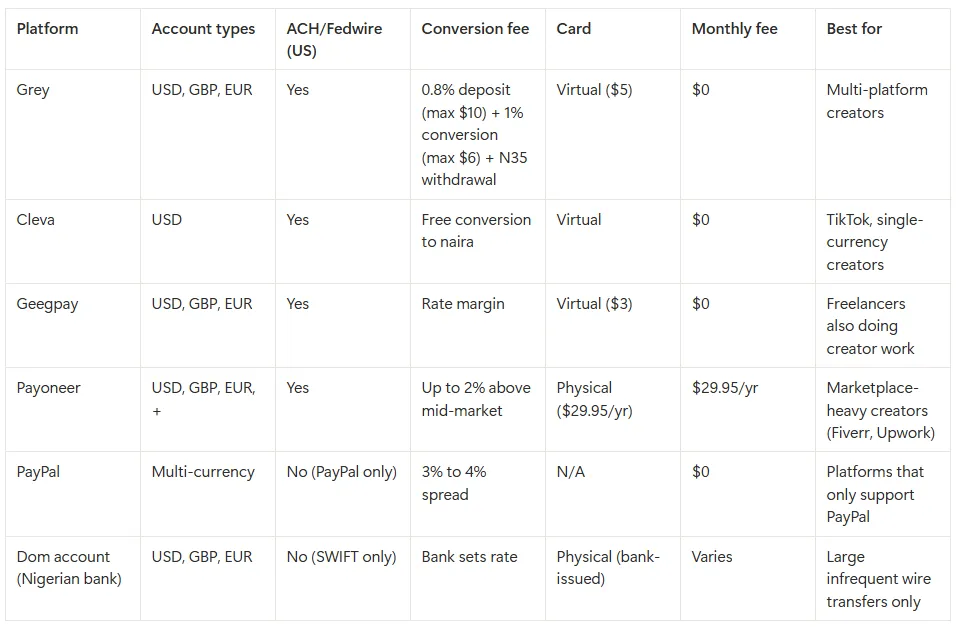
Almost every platform described above requires either a US bank account (ACH or Fedwire details) or a PayPal account. A regular Nigerian bank account, whether it is a savings account at GTBank, Access Bank, or Zenith, does not provide a US routing number and account number. A domiciliary account at a Nigerian bank can receive SWIFT wire transfers (which works for YouTube AdSense), but it does not provide the ACH or Fedwire details that TikTok, Meta, Patreon, and Gumroad require. This is why most Nigerian creators end up using a virtual USD account from a fintech provider.
A virtual USD account gives you a US-based routing number and account number that functions like a local US bank account from the platform's perspective. When TikTok, Patreon, or Gumroad sends your payout via ACH or Fedwire, it arrives in your virtual account just as it would arrive in a Chase or Bank of America account. You then convert to naira and withdraw to your Nigerian bank, or hold the USD and spend it directly using a virtual dollar card.
For a step-by-step walkthrough of setting up your USD account for creator payouts specifically, Grey published a detailed setup guide for Nigerian creators that covers the exact process for each platform.
How the main account options compare
The choice depends on where your income comes from. If you earn primarily from YouTube and only need to receive monthly AdSense wire transfers, a domiciliary account works, though the setup requires a branch visit, paperwork, and sometimes a minimum balance. If you earn from TikTok, Patreon, Meta, Gumroad, or affiliate programmes, you need ACH or Fedwire capability, which means a virtual USD account. If you earn from multiple platforms (which most established creators do), a multi-currency virtual account covers the widest range of payout methods from a single provider.
Managing your USD once it arrives
Getting paid is step one. What you do with the money after it lands in your account determines how much of it you actually keep. Nigerian creators who earn in USD have three broad options: convert to naira immediately, hold in USD and convert strategically, or spend directly in USD. Each has trade-offs.
Converting immediately is the simplest approach, but it locks you into the exchange rate available that day. If the rate moves in your favour a week later, you have already lost the upside. Holding in USD gives you control over timing, which matters when the naira is volatile. If your creator expenses (subscriptions, tools, ad spend, hosting) are priced in USD, holding and spending directly avoids conversion entirely. A virtual dollar card lets you pay for Adobe Creative Cloud, Canva Pro, Google Workspace, domain registrations, and ad campaigns directly from your USD balance without converting to naira first.
For a deeper look at conversion timing, fee reduction, and practical strategies for Nigerian remote workers managing foreign currency, Grey's guide to managing foreign currency earnings covers the specifics.
Invoicing direct brand deals and sponsorships
Platform payouts are automatic, but brand deals and sponsorships require you to invoice the client and provide payment details. This is where many Nigerian creators lose money or create delays. A brand in the US will expect to pay via ACH or Fedwire to a routing number and account number. A brand in the UK will expect to pay via FPS or BACS to a sort code and account number. A brand in Europe will expect to pay via SEPA to an IBAN. If you send your Nigerian bank's naira account details instead, the payment may be rejected, delayed, or converted at a poor rate by an intermediary bank.
The cleaner approach is to include the correct Grey account details on your invoice based on where the client is paying from: your USD routing number and account number for US clients (they pay a domestic ACH or Fedwire transfer), your GBP sort code and account number for UK clients (they pay via FPS or BACS), or your EUR IBAN for European clients (they pay via SEPA). In each case, the client makes what appears to be a local transfer on their end, which arrives faster and avoids SWIFT intermediary fees. On the invoice itself, state your preferred payment currency, include a scope summary matching any purchase order the brand issued, and specify payment terms (Net 14 or Net 21 for new clients; Net 30 for established relationships). For detailed guidance on structuring invoices and choosing tools, Grey has a comparison of invoicing tools for freelancers that covers Grey Invoice, Wave, FreshBooks, Zoho, and others.
What the 2026 tax rules mean for Nigerian creators earning in USD
This is the section that every other creator payment guide skips. The 2026 Nigeria Tax Act changed how foreign income is treated for Nigerian tax residents, and if you earn from YouTube, TikTok, Patreon, or any other international platform, it applies to you.
Under the reformed rules, if you spend 183 days or more in Nigeria over a 12-month period (which most Nigerian-based creators do), you are a Nigerian tax resident, and your worldwide income may be taxable. This includes platform payouts from YouTube AdSense, TikTok Creator Rewards, Patreon membership income, Gumroad sales, affiliate commissions, and brand deal payments. Personal remittances (money sent to you as a gift or family support) are not taxable, but creator income is classified as earned income from a trade or vocation.
The practical details: the first N800,000 of annual income is tax-free. Above that threshold, progressive tax bands apply, starting at 15% and increasing to 25% at higher income levels. Foreign income must be converted to naira at the CBN official rate on the date you receive the payment, not the rate you actually converted at. You are required to register for a Tax Identification Number (TIN) and file your annual return by March 31. Penalties for non-registration start at N50,000 for the first month, and penalties for non-filing start at N100,000 for the first month.
If you also pay tax in another country on the same income (for example, US withholding tax deducted from your YouTube AdSense earnings), Nigeria has double taxation agreements with several countries, including the UK, Canada, and South Africa. You can claim a credit for tax paid abroad to avoid being taxed twice on the same income.
Deductible expenses include tools and software you use for content creation (Adobe, Canva, cameras, microphones, lighting), internet costs, workspace expenses, and platform fees. Keeping records of these expenses reduces your taxable income.
This is general guidance, not professional tax advice. The 2026 reforms are new and implementation details are still being clarified. Consult a certified tax professional for your specific situation.
Grey provides virtual USD, GBP, and EUR accounts with the specific details each platform and payment method requires: a US routing number and account number (for ACH or Fedwire) on the USD account, a sort code and account number on the GBP account (for FPS, BACS, or CHAPS), and an IBAN and SWIFT/BIC code on the EUR account (for SEPA transfers). The setup is fully digital: download the Grey app or sign up at grey.co, complete KYC verification with your Nigerian ID (typically takes a few minutes), and your account details are available immediately. You then add the relevant details as your payout method on each platform.
When payouts arrive via ACH or Fedwire, Grey charges a 0.8% deposit fee (minimum $2, maximum $10). The funds then sit in your Grey USD wallet. You can convert to naira and withdraw to any Nigerian bank account (GTBank, Access, Zenith, UBA, First Bank, and others are all supported), or hold in USD if you prefer to convert later. Converting USD to naira incurs a 1% fee capped at $6 per transaction, and the conversion rate is displayed before you confirm, so you see exactly what you will receive. Withdrawing naira to your bank account costs a flat N35 and arrives instantly. Grey also offers virtual dollar cards for spending directly in USD on subscriptions, tools, and ad platforms without converting to naira first. The card costs $5 to create with no monthly maintenance fee, and it supports Apple Pay and Google Pay in supported regions. Transactions on USD-priced sites incur no additional fee; purchases on non-USD websites (EUR, GBP) carry a 2% + $0.50 cross-border fee.
If you invoice brands or clients directly, Grey's built-in invoicing tool lets you generate and send invoices linked to your Grey account. The client pays your Grey USD account details, and the funds arrive without an intermediary.
Grey charges a 0.8% fee on deposits (minimum $2, maximum $10), a 1% conversion fee (capped at $6), and a withdrawal fee that varies by currency (N35 for naira to a Nigerian bank account). Exchange rates on Grey are variable and include a margin over the mid-market rate. Cross-border card transactions on non-USD websites incur a 2% + $0.50 fee. Always review fees and the conversion rate before confirming a transaction.
Frequently asked questions
Can I receive YouTube AdSense payments directly to my Nigerian bank account?
Only if your bank account can receive international SWIFT wire transfers in USD, which typically means a domiciliary account at a commercial bank like GTBank, Access, or Zenith. A regular naira savings or current account will not work. An alternative is using a virtual USD account that supports incoming wire transfers, which avoids the branch visit and paperwork required for a dom account. Google deducts a small wire fee (around $5) from each AdSense payout regardless of which account type you use.
How do I set up TikTok payouts without a US bank account?
TikTok requires ACH bank details (a US routing number and account number). You can get these from a virtual USD account provider like Grey, Cleva, or Geegpay. Once you have your ACH details, enter them in TikTok's payout settings. Make sure the name on your TikTok account matches the name on your virtual USD account exactly, as mismatches cause payouts to fail. Processing typically takes up to 15 business days after you request a withdrawal.
Do Nigerian creators have to pay tax on USD income from platforms?
Under the 2026 Nigeria Tax Act, if you spend 183 days or more in Nigeria in a 12-month period, your worldwide income (including creator earnings from international platforms) is taxable. The first N800,000 annually is tax-free. Above that, progressive bands apply from 15% to 25%. You need a TIN and must file by March 31 each year. This is general guidance; consult a tax professional for your specific situation.
Which is cheaper for regular creator payouts: Payoneer or a virtual USD account?
For creators receiving monthly platform payouts, a virtual USD account is typically cheaper. Payoneer charges an annual fee of $29.95 and applies conversion spreads of up to 2% above mid-market when you withdraw to naira. Grey charges no annual fee; the costs are a 0.8% deposit fee (capped at $10) when your payout arrives, a 1% conversion fee (capped at $6) when you convert USD to naira, and a flat N35 for the naira withdrawal. On a $500 monthly payout, Grey’s total cost is roughly $10 (deposit) + $5 (conversion) + N35, compared to Payoneer’s $2.50 annual fee equivalent plus up to $10 in conversion spread. Run the numbers for your typical payout amount using Grey’s pricing calculator before committing.
Can I use the same USD account for YouTube, TikTok, and Patreon?
Yes. Grey's USD account provides both ACH and Fedwire routing details, which covers YouTube (wire transfer), TikTok, Meta, Patreon, and Gumroad (ACH direct deposit). If you also receive payments from UK or European clients, your Grey GBP account has a sort code and account number for FPS/BACS payments, and your EUR account has an IBAN for SEPA transfers. All payouts across these currencies arrive in one Grey account.
Should I convert my USD to naira immediately or hold it?
That depends on your expenses. If most of your spending is in naira (rent, food, transport), converting when the rate is favourable makes sense. If you have significant USD expenses (software subscriptions, ad spend, online tools, domain renewals), holding in USD and paying directly with a virtual dollar card avoids double conversion. Many Nigerian creators use a hybrid approach: convert enough naira for monthly living expenses and keep the rest in USD for business costs.
Ready to set up your creator payout account? Sign up at grey.co or download the Grey app at https://onelink.to/grey to create your virtual USD account and start receiving platform payouts.
One of the biggest challenges after getting international clients is protecting your income from exchange rate swings. The ideal sequence is that after you complete a project, you send your invoice, and then receive payment in dollars or pounds. It feels rewarding, but living in Nigeria means constantly thinking about the naira. Should you convert immediately or wait? In a market where FX rates change quickly, even a short delay can significantly affect how much ends up in your account.
From Lagos to Abuja to Port Harcourt, freelancers and tech professionals manage foreign income strategically. Some use domiciliary accounts, while others rely on fintech platforms to hold foreign currency. The goal is to avoid unnecessary conversions and reduce exposure to sudden drops.
This article explains practical methods Nigerians use to manage FX risk and protect the true value of their remote earnings.
How FX swings impact your remote earnings
Foreign exchange (FX) swings happen when the value of the naira rises or falls against currencies like the dollar or pound. In Nigeria, rates can change quickly because of inflation, demand for dollars, government policies, and market pressure. One week, the rate is stable; the next week it shifts sharply. For anyone earning in foreign currency, that movement is never just news, it directly affects your money.
First, FX swings can change how much your income is worth overnight. You might receive $1,000 feeling confident, only to see the rate drop before you convert. That difference can affect rent, family support, or savings plans.
Second, it affects planning. School fees, subscriptions, and travel costs become harder to budget when rates move unpredictably.
Finally, sudden swings create pressure to convert quickly, which can lead to rushed financial decisions and lost value.
Smart ways to protect your remote income from FX changes
In Nigeria, currency rates can change quickly, and protecting your foreign income takes planning and smart choices.
Earn in foreign currency
One of the easiest ways to avoid losing money to FX swings is to earn in foreign currency. Getting paid in dollars or pounds protects your income from the naira’s ups and downs.
Many Nigerian remote workers now look for international clients so their payments hold value before converting. This way, you keep more of what you earn. And once you start earning in foreign currency, the next step is knowing the best ways to receive your money safely and without losing value to unnecessary fees.
Grey: Grey lets Nigerians receive payments in USD, GBP, and EUR. You get foreign account details, hold funds safely, and convert when rates are favourable.
Payoneer: Payoneer allows freelancers to receive international payments from global clients and marketplaces. You can hold foreign currency and withdraw when exchange rates suit you.
Wise: Wise provides multi-currency accounts with local bank details abroad. Nigerian remote workers can receive, hold, and convert foreign income with transparent fees.
Monitor market rates
Exchange rates in Nigeria can move fast, and small changes affect your income. Checking the rates regularly, like people watch dollar or gold prices, helps you know when to convert. Converting straight away isn’t always best. Waiting for a better rate can mean keeping thousands of extra naira, especially when receiving bigger payments from overseas clients. Here’s how you can keep an eye on exchange rates.
Check both official and parallel market rates regularly to know the true value before converting.
Track trends over days or weeks instead of converting immediately for small fluctuations.
Set a target rate based on your expenses, like school fees, rent, or household bills, so you convert at the most useful time.
Another smart move is to save or invest some of your earnings in foreign assets, like dollars, stocks, or online savings accounts. By keeping part of your money in a stronger currency, you protect it from the naira losing value. This gives you more control, helps cover future expenses, and makes your income safer over the long term.
Open a trusted platform that allows Nigerians to buy foreign stocks, ETFs, or hold dollar-based investments.
Start small and invest a portion of your income, not everything at once.
Focus on stable, long-term options instead of risky**,** quick-profit schemes.
Keep records of your investments and review them regularly to ensure they still align with your financial goals.
Myths about FX swings for remote earners
You can always predict the rates: Many Nigerian remote workers think they can time the market perfectly, but FX rates are influenced by government policies, oil prices, and market demand. Even experts struggle to predict sudden changes. Relying on guesses can lead to converting at the wrong time and losing a significant portion of your hard-earned income.
Converting immediately is always best: It’s a common belief that you should convert your foreign earnings as soon as they arrive. In reality, converting immediately can mean losing money if the naira strengthens later. Waiting for a favourable rate, while monitoring trends, often helps you keep more value from international payments.
LDMAG1
Managing foreign earnings with Grey
Managing foreign currency earnings can be challenging as a Nigerian remote worker, especially with fluctuating exchange rates reducing your income. Grey helps protect your earnings from FX swings with multi-currency accounts for USD, GBP, and EUR, competitive exchange rates, virtual USD cards, and fast local withdrawals. You can receive, hold, and convert your income at the right time, keeping more of what you earn.
Budgeting used to be simple. You earned money, spent money, and tracked what was left. At that time, you had only one account with one currency, which required just one mental model.
Then remote work happened.
Now you might earn in EUR, pay for tools in USD, and travel in between. Discipline isn’t enough for budgeting anymore; you need structure. Without the right structure, even the most careful spender can lose track of where their money is going.
The Grey card comes in as a practical budgeting tool for people who live and spend across borders. I’ll explain.
Why budgeting in multiple currencies breaks down so easily
Most people don’t overspend because they’re irresponsible. Rather, they overspend because their money isn’t organised in a way that reflects how they live.
Here’s what usually goes wrong.
You’re spending across platforms, clients, and countries, but everything is tied to one card. Subscriptions, ads, one-off purchases, and travel expenses all blur together. When something goes wrong, such as a spike in ad spend or an unexpected renewal, it’s challenging to pinpoint the cause quickly.
Add foreign currencies to the mix, and it gets worse. The charges don’t always settle immediately, and these small amounts seem harmless until they quietly add up.
What should budgeting look like when you earn and spend globally?
Clarity, separation, and control are the most crucial factors when budgeting across multiple currencies. You should be able to:
See exactly what each type of spending is costing you.
Stop or pause spending instantly when needed.
Protect one part of your budget from another.
Make changes without disrupting everything else.
The Grey card is designed around solving these exact needs.
How does the Grey card help with budgeting?
Use multiple cards to separate your spending
One of the most effective budgeting habits is separation. Instead of using a single card for everything, you can create multiple cards with clear purposes.
For example, you can create:
One card for subscriptions and recurring tools
One card for ads and growth experiments
One card for travel or everyday spending
One card per client or project
Each card acts like its own budget lane. You don’t need to guess where the money went; you already know.
This is especially useful if you freelance, manage ads, or run multiple income streams. When spending is separated, budgeting becomes more straightforward.
Freeze cards instantly when spending goes off-track
Budgets fail when you can’t act fast enough.
With the Grey card, you can instantly freeze or unfreeze any card in the app. If an ad campaign starts burning cash, freeze the card. If a subscription you forgot about renews unexpectedly, freeze the card. If you’re travelling and want to lock down non-essential spending, freeze the card.
Freezing a card doesn’t affect your other cards or balances. It simply stops that specific spending lane, which is precisely how budgeting should work.
Set limits that protect your budget
Budgets can fail when they’re too rigid. Grey’s spending limits work more like guardrails.
You can set daily or monthly limits per card, receive alerts when you’re approaching your limit, and still stay flexible. The goal isn’t to punish spending. I mean, who wants that? It’s to keep you aware before things drift too far.
For shared cards or subscriptions, limits are especially useful. You know exactly how much can be spent, and nothing sneaks past unnoticed.
Track spending clearly in one place
When you’re budgeting across currencies, visibility matters more than perfection. Every Grey card transaction appears clearly in your app, linked to the card you used. That means you’re not just seeing how much you spent, but why you spent it.
When budgeting time comes around, you’re no longer reconstructing your month from memory. The structure is already there.
Spend confidently across borders
Trust helps with budgeting too. When you’re shopping internationally, paying for ads, or travelling, declined payments and unexpected charges can throw everything off. The Grey Card works across global merchants and even supports Apple Pay and Google Pay, so everyday spending feels normal, even when you’re far from home.
LDMAG1
A quick note on protection when spending abroad
An often-overlooked aspect of budgeting is preparing for contingencies in case things go wrong.
When you pay with your Grey card, you have access to Visa benefits, including purchase protection, extended warranties, and price protection, depending on the transaction and your activation status. It’s not something you think about daily, but it adds a layer of reassurance when you’re buying electronics, booking travel, or shopping internationally.
It’s one less thing to worry about while managing money across borders.
What budgeting in foreign currencies is like with the Grey card
When your card and your accounts are aligned, budgeting stops being guesswork. You know what you’re spending, which currency it’s coming from and more importantly, when something changes.
Instead of constantly reacting to your balance, you’re now making decisions with clarity. And that’s what good budgeting should be like, whether you’re at home, travelling, or working remotely.
If you’re ready to make your budget work wherever you are, create or update your Grey card and start spending and budgeting in the ways that matter to you.
Egypt has many creators who are building strong careers online, including well-known names like Yasmine Sabri and Radwa El Sherbiny. They are making waves and increasing Egypt's visibility across North Africa and beyond. In general, creators earn about $100,000 a year on average, and Egypt ranks among the leaders in Africa for viewership and earnings in the creator economy. Despite this success, many still struggle to receive their payments easily from global platforms.
In this guide, I will show you how to receive payouts smoothly from international platforms, whether you are a TikToker, YouTuber or Instagram creator.
Best platforms Egyptian creators use to share content
Egyptian creators use a mix of global platforms, choosing the ones that perform best for their content and audience. Here’s where most of them focus:
1. Facebook
Facebook remains one of the strongest platforms in Egypt and often serves as a creator’s starting point. Many build their first communities here, using pages and groups to grow loyal audiences. It has one of the highest market shares in the country, giving creators a wide reach across different age groups. With monetisation options, live features and strong engagement tools, Facebook continues to help creators maintain influence and consistent visibility.
2. TikTok
TikTok is widely used by Egyptian creators who enjoy short, creative videos. The platform allows them to express ideas quickly and connect with large audiences. Many secure brand deals and benefit from creator funds directly on the app. Creators like Ahmed Ghzayel have built strong personal brands here, especially in fashion and lifestyle, turning viral content into steady income opportunities.
3. Instagram
With more than 18 million users in Egypt, Instagram attracts creators targeting younger audiences. It is especially popular for fashion, lifestyle and marketing content. Reels, stories and sponsored posts make it easier for creators to collaborate with brands and grow their presence. Many use Instagram to present a more polished image, connect with Gen Z followers and drive engagement through visual storytelling and consistent brand partnerships.
YouTube remains the leading platform for long-form content in Egypt. Creators use it for education, vlogs, tech reviews and gaming. It offers stable ad revenue and strong search visibility, helping content stay relevant for years. Popular channels such as 7amoda Gaming show how niche content can attract loyal subscribers and generate income through ads, sponsorships and memberships.
How Egyptian creators can get paid from global platforms
Choosing the right payout method helps ensure your money arrives safely and on time, without unnecessary fees or currency conversion costs.
1. Direct bank transfers
Using SWIFT, brands or organisations can pay creators directly into their bank accounts. You need to provide an IBAN, and funds are converted automatically to your local currency. This method is secure and reliable, but fees and currency conversion costs are usually high, making it better for larger payments rather than frequent small payouts.
2. Grey
Grey is a fast option for Egyptian creators, especially with its multi-currency account. It allows you to receive payments in different currencies from international clients and convert them to EGP easily. Payments are quicker than traditional bank transfers, and you can manage multiple streams of income in one account, reducing delays and simplifying your financial workflow.
3. Wise
Wise is a transparent platform that supports multiple currencies and easy conversion to Egyptian pounds. It shows fees upfront and provides fast transfers from global clients. Many creators use Wise for its reliability and clear pricing, which helps reduce hidden charges while receiving payments from international platforms quickly and safely.
4. Raenest
Raenest is ideal for Egyptian creators who work with multiple international platforms. It supports various currencies and simplifies payment collection. The platform makes it easier to consolidate earnings, access money quickly, and reduce fees compared to traditional bank methods, making it suitable for creators who rely on multiple sources of global income.
Reducing fees during payouts helps Egyptian creators keep more of their earnings.
Get paid in foreign currency first, then convert to EGP later, keeping more of your earnings intact.
Handle the conversions yourself instead of clients to reduce hidden fees and retain a larger portion of your money.
Combine multiple payouts into fewer withdrawals to minimise processing fees and manage your income more efficiently.
Use Grey for fast payouts and excellent exchange rates.
LDMAG1
Managing your creator payout with Grey
Egypt is seeing more creators partnering with brands and organisations across TikTok, YouTube, and Instagram. However, finding the best payout platform remains a challenge. Grey is the ideal solution for Egyptian creators to receive money quickly, convert it securely, and access funds faster. Sign up or download the app today to start managing your earnings with ease.
As a non-US resident, one question you’ll often ask is how to receive money while you’re in the US. Should you open a traditional bank account, or hope your local bank works without restrictions? Both options are possible, but they can be stressful and costly due to multiple currency conversions.
A better solution is opening a multicurrency account while in the US. It allows you to receive money in different currencies like GBP and EUR, avoid extra conversions, and manage your funds more easily. With many options available, comparing platforms helps you choose the right one.
Key considerations before choosing a multicurrency account as a non-resident
Before exploring options, consider these factors when selecting a multicurrency account:
Documentation: The requirements vary by platform. Some may ask for a passport, proof of address, and tax identification, while others have simpler onboarding processes.
Fees: Check for account maintenance fees, international transfer costs, and currency conversion charges.
Currency support: Make sure the account supports the currencies you need, such as USD, GBP, or EUR.
Remote access and usability: Look for robust mobile apps and online platforms that let you manage multiple currencies easily.
Multicurrency platforms for non-US residents: key differences
Comparing multicurrency platforms helps non-US residents choose the best solution for receiving, holding, and managing funds globally with ease.
Supported currencies
Wise: Offers over 40 currencies, including USD, GBP, EUR, and others, allowing users to hold, convert, and receive money globally without needing multiple local accounts.
Revolut: Supports around 25–30 currencies depending on your plan, covering major currencies for personal and business use, ideal for frequent travellers and international spending.
Payoneer: Focuses on major currencies like USD, EUR, GBP, JPY, and AUD, making it suitable for freelancers, marketplaces, and businesses receiving international payments.
GrabrFi: Limited to USD, GBP, and EUR, but provides virtual accounts that make receiving funds internationally simpler for non-residents.
Grey: Offers USD, GBP, EUR, with virtual account options to manage multiple currencies, ideal for cross-border payments and global payroll.
HSBC Expat: Allows holding up to 19 currencies and sending in over 50 currencies, offering traditional banking reliability with global reach.
Grey: The ideal multicurrency account for non-residents
Grey is designed for non-residents who need access to US and global banking services.
No residency requirement: Open and hold accounts without needing proof of local residency.
Competitive fees: Low costs for currency conversion and international transfers, with no hidden charges.
User-friendly platform: Intuitive online platform and app make managing multiple currencies simple.
Secure: Offers strong security features to protect your funds globally.
For non-US residents, selecting the right multicurrency account is crucial to streamlining international payments and managing multiple currencies effectively. Grey stands out by offering competitive fees and support for major currencies like USD, EUR, and GBP. Its user-friendly platform and secure infrastructure make it an ideal choice for individuals and businesses navigating global financial transactions. Download the mobile app or sign up on the website to manage multicurrency without stress.
I was so shocked when I saw the news. “Netflix to Acquire Warner Bros.” It’s the kind of industry shift that usually comes with new bundles, price changes, region-specific catalogues, and the inevitable “Your plan has been updated” email.
If you’re already juggling multiple subscriptions, such as streaming platforms, cloud storage, creative tools, productivity apps, and gaming services, any minor hiccup with your payment method can cause everything to collapse at once. A low balance here, a declined international charge there, and suddenly Netflix stops streaming, Spotify logs you out, and your work tools start sending warnings.
Now, where subscription prices keep changing, platforms keep merging, and foreign services dominate the apps we use daily, the real need isn’t more subscriptions; it’s a card that can keep up with them. The Grey card is perfect for this. It’s a flexible and reliable way to manage all your subscriptions, without worrying about currencies, top-ups, or unexpected declines.
Why do subscriptions fail in the first place?
Before discussing the solution, it helps to understand the problem. Most subscription failures come down to:
1. Cards that don’t support international merchants
Some platforms, especially those based in the US or EU, automatically reject certain cards.
2. Low or inconsistent balance
Most cards require you to have the exact amount ready before the subscription date. If you forget to top up, your subscription will pause.
3. Currency conversion issues
If your card is billed in one currency and the service charges are in a different currency, the payment may fail due to delays or conversion errors.
4. Tracking too many subscriptions at once
When everything runs on one card, it’s easy to lose control of what’s being billed and when.
Grey’s card helps smooth out each of these challenges.
How does your Grey card make subscription management easier?
The card is designed to handle everyday payments, recurring charges, and international subscriptions without requiring you to jump through hoops. Here’s how it helps:
Spend from different currency wallets
This is one of the biggest advantages. Most cards are linked to a single currency, but your Grey card isn’t.
Although the card is primarily a USD card, the payment flow depends on the available balance: USD → USDC → the next-highest available balance (GBP or EUR).
Multiple cards for easy organisation
Instead of one card for everything, you can create two or three:
one for entertainment subscriptions
one for work tools
one for shared family plans
This makes it easy to track what’s coming out where, and freeze or cancel only the card linked to a specific group of subscriptions.
Accepted by most global platforms
The Grey card works across major international merchants, streaming services, cloud storage providers, gaming platforms, and productivity tools, so you don’t need multiple payment methods.
Add to Apple Pay or Google Pay
If you prefer not to type card details into every website, you can simply add the card to your mobile wallet and pay securely.
Instant freeze and unfreeze
If one subscription starts misbehaving or you just want to take a break, you can temporarily freeze the card.
If you already have a Grey account, getting a card is simple. Simply go to the cards section to request a card for $5.
2. Add your card to your subscriptions
It could be Netflix, Figma, or iCloud. Simply enter your card details or pay via Apple Pay / Google Pay.
3. Set up spending limits
A small monthly limit can help you stay in control, especially for family or shared cards.
4. Create additional cards if needed
I like to think of them like folders. Each card can represent a spending category.
Enjoy stress-free subscription management
There’s something about managing subscriptions that makes them seem a lot like admin work. Your Grey card helps keep everything organised.
Whenever you’re ready to try it (which I hope will be soon), create your card, link your first subscription, and enjoy the peace of mind that comes with everything just working.
Every day, thousands of professionals around the world work with international clients, delivering services, products, and expertise. Yet many struggle to receive payments on time. Traditional banks can hold funds for days, charge high fees, or reduce earnings through poor currency conversions, leaving hard-earned income delayed or diminished.
International bank accounts solve this problem. Remote workers, freelancers, and global businesses can open accounts online, get local banking details, and receive payments quickly. These accounts provide a simple, secure way to manage funds, minimise fees, and operate seamlessly across borders, no matter where they live.
In this blog, you will learn how international accounts work, why non-residents need them, and which platforms make managing global payments simple and secure.
Why non-residents need international bank accounts
I’m sure if you’ve ever had to wait days for a payment or lost money to currency conversion, you’ll understand the need for an international account. These accounts feel like a reward for working with global clients, giving you control over your earnings and the freedom to manage multiple currencies. International accounts make getting paid faster, easier, and fairer, while also providing security, transparency, and the flexibility to operate seamlessly no matter where you are. Here are a few benefits of having an international account:
Receive payments in multiple currencies like USD, EUR, GBP
For non-residents working globally, choosing the right international bank can make receiving payments, managing multiple currencies, and sending money smooth and stress-free.
1. Grey (Recommended)
Grey is designed for non-residents who need US and international banking without residency requirements. You can hold multiple currencies like USD, EUR, and GBP, receive payments quickly, and enjoy excellent conversion rates. Its digital platform is intuitive, making it ideal for freelancers, remote workers, and small businesses working with clients worldwide, simplifying cross-border money management.
Upload a valid identification (passport, national ID)
Verify your email and phone number.
Fund the account or connect your local bank for transfers
2. Payoneer
Payoneer is a favourite among freelancers, digital entrepreneurs, and e-commerce sellers. It allows you to receive payments from international clients and marketplaces as if you had a local bank account. You can hold multiple currencies, transfer funds easily, and access money via a prepaid Mastercard or direct bank transfer. Its global reach makes it convenient for online work and international commerce.
Upload a government-issued ID and proof of address.
Wait for verification and activate your account to start receiving payments.
3. Wise
Wise is built for transparent, low-cost international payments. It lets you hold multiple currencies, receive funds with local bank details, and convert money at real exchange rates. Its platform is simple to use, and transfers are fast. Freelancers, small businesses, and remote workers find it invaluable for managing payments from clients worldwide without hidden fees or long delays.
Provide personal information (name, date of birth, address)
Verify your identity with a passport or national ID
Set up your multi-currency account and start receiving payments
4. HSBC Expat
HSBC Expat offers a traditional, reliable international banking solution for non-residents. You can hold multiple currencies, send and receive global payments, and manage accounts online. While it has higher fees than fintech options, it provides global coverage, strong security, and dedicated support, making it ideal for expats, professionals, and businesses who prefer a trusted banking institution for cross-border finances.
Visit the HSBC Expat website and select your country
Choose the type of account (current or savings)
Fill in the online application form
Submit identification documents and proof of address
Wait for approval and fund your account to begin banking
LDMAG1
Why Grey is the ideal international account for non-residents
For non-residents working globally, Grey makes receiving, holding, and sending money simple, fast, and stress-free
No residency requirement: You don’t need to live in the US or Europe to open an account. Grey lets non-residents get local bank details instantly and start receiving payments worldwide without complicated paperwork.
Fast and reliable payments: Cross-border payments arrive quickly, often within minutes. Grey ensures your funds aren’t stuck in local banks or lost to hidden delays.
Secured: Grey uses strong security measures to protect your funds and personal information.
USDC support: Grey allows you to hold, send, and receive USDC stablecoins, making it easy to manage both crypto and traditional currencies in one account.
Excellent conversion rates: Grey offers competitive, transparent currency conversion rates, so you get more of your money when transferring between currencies or receiving payments from international clients.
With an international account like Grey, you can receive money from anywhere, hold multiple currencies, and manage your funds seamlessly. Take control of your global earnings today, sign up or download the app now, and get paid without borders.


.svg)