
<script type="application/ld+json" data-schema-version="grey-blog-v4"> [{"@context":"https://schema.org","@type":"BlogPosting","@id":"https://grey.co/blog/build-an-emergency-fund#article","headline":"How to build an emergency fund when you get paid in a foreign currency","description":"Build an emergency fund even on a variable or foreign-currency income. Learn how much you need and where to keep it, then open a Pouch to start.","inLanguage":"en","url":"https://grey.co/blog/build-an-emergency-fund","mainEntityOfPage":{"@id":"https://grey.co/blog/build-an-emergency-fund#webpage"},"datePublished":"2026-09-01T20:26:15.999Z","dateModified":"2026-09-02T09:00:00+01:00","author":{"@type":"Person","@id":"https://grey.co/authors/priscila-marotti#person","name":"Priscila Marotti","url":"https://grey.co/authors/priscila-marotti","jobTitle":"Content Writer","sameAs":["https://www.linkedin.com/in/priscila-marotti/"]},"publisher":{"@type":"Organization","@id":"https://grey.co/#organization","name":"Grey","url":"https://grey.co","logo":{"@type":"ImageObject","url":"https://cdn.prod.website-files.com/6360022338a81bd6fdbb1145/6564ae1077a67e39d3c491a6_Grey%20Logo%20Lockup%20Black.svg"}},"image":{"@type":"ImageObject","@id":"https://grey.co/blog/build-an-emergency-fund#primaryimage","url":"https://cdn.prod.website-files.com/636a85d290ee58e70c17e1c0/6a9734dce34ca7249879a9ec_How%20to%20Build%20an%20Emergency%20Fund%20When%20You%20Get%20Paid%20in%20a%20Foreign%20Currency-compressed.jpg","contentUrl":"https://cdn.prod.website-files.com/636a85d290ee58e70c17e1c0/6a9734dce34ca7249879a9ec_How%20to%20Build%20an%20Emergency%20Fund%20When%20You%20Get%20Paid%20in%20a%20Foreign%20Currency-compressed.jpg","width":1200,"height":675}},{"@context":"https://schema.org","@type":"WebPage","@id":"https://grey.co/blog/build-an-emergency-fund#webpage","url":"https://grey.co/blog/build-an-emergency-fund","name":"How to Build an Emergency Fund on Any Income | Grey","description":"Build an emergency fund even on a variable or foreign-currency income. Learn how much you need and where to keep it, then open a Pouch to start.","inLanguage":"en","primaryImageOfPage":{"@id":"https://grey.co/blog/build-an-emergency-fund#primaryimage"},"breadcrumb":{"@id":"https://grey.co/blog/build-an-emergency-fund#breadcrumb"}},{"@context":"https://schema.org","@type":"BreadcrumbList","@id":"https://grey.co/blog/build-an-emergency-fund#breadcrumb","itemListElement":[{"@type":"ListItem","position":1,"name":"Home","item":"https://grey.co/"},{"@type":"ListItem","position":2,"name":"Blog","item":"https://grey.co/blog"},{"@type":"ListItem","position":3,"name":"How to build an emergency fund when you get paid in a foreign currency","item":"https://grey.co/blog/build-an-emergency-fund"}]},{"@context":"https://schema.org","@type":"FAQPage","@id":"https://grey.co/blog/build-an-emergency-fund#faq","mainEntity":[{"@type":"Question","name":"How much should I put in an emergency fund?","acceptedAnswer":{"@type":"Answer","text":"A common target is enough to cover three to six months of essential expenses. Your ideal amount depends on your monthly costs, income stability, financial responsibilities, and how quickly you could replace lost income. If that target feels too large right now, start with a smaller amount and build from there."}},{"@type":"Question","name":"Is $1,000 enough for an emergency fund?","acceptedAnswer":{"@type":"Answer","text":"$1,000 can be a useful first target, especially if you’re starting from zero. It may cover smaller unexpected expenses without affecting your everyday budget. Over time, you can continue building towards an amount that covers several months of essential expenses."}},{"@type":"Question","name":"Should I build an emergency fund if my income is irregular?","acceptedAnswer":{"@type":"Answer","text":"Yes. An emergency fund can be particularly useful when your income changes from month to month because it gives you a buffer during quieter periods or when payments arrive later than expected. Instead of contributing a fixed amount, consider putting aside a percentage of each payment you receive."}},{"@type":"Question","name":"Where should I keep my emergency fund?","acceptedAnswer":{"@type":"Answer","text":"Keep your emergency fund somewhere separate from your everyday spending but easy to access when needed. Depending on your needs, this could be a dedicated account, a high-yield savings account, or a separate money-management space. Consider accessibility, fees, withdrawal restrictions, interest, and the currency you’ll eventually need."}},{"@type":"Question","name":"Should I keep my emergency fund in USD?","acceptedAnswer":{"@type":"Answer","text":"It depends on how you earn and spend your money. If you’re paid in USD and expect some future expenses to be in USD, keeping part of your emergency fund in dollars may make sense. If most of your essential expenses are in another currency, consider how exchange-rate movements could affect the amount available when you need to convert it."}},{"@type":"Question","name":"Should I pay off debt or build an emergency fund first?","acceptedAnswer":{"@type":"Answer","text":"You don’t necessarily have to choose one exclusively. Having a small emergency buffer can help you deal with unexpected expenses without taking on additional debt. From there, you can decide how to divide your available money between growing your emergency fund and paying down debt based on the cost and urgency of your debts."}},{"@type":"Question","name":"What should I use my emergency fund for?","acceptedAnswer":{"@type":"Answer","text":"Your emergency fund is for necessary expenses you couldn’t reasonably plan for, such as an unexpected loss of income, urgent repairs, essential travel, or another unforeseen cost. Planned expenses, holidays, shopping, and non-essential purchases are better kept separate so your emergency money remains available when you really need it."}}]},{"@context":"https://schema.org","@type":"DefinedTermSet","@id":"https://grey.co/blog/build-an-emergency-fund#terms","name":"How to build an emergency fund when you get paid in a foreign currency glossary","hasDefinedTerm":[{"@type":"DefinedTerm","name":"emergency fund","description":"An emergency fund is money you keep specifically for expenses you didn’t plan for. Think of it as your financial backup for the moments when life decides to ignore your budget.","inDefinedTermSet":{"@id":"https://grey.co/blog/build-an-emergency-fund#terms"}}]}] </script>

How to build an emergency fund when you get paid in a foreign currency

Priscila Marotti

TABLE OF CONTENT

SHARE THIS POST

A late client payment was what first pushed me to build an emergency fund. As a freelancer getting paid in dollars, though, putting money aside wasn’t quite as simple as choosing an amount each month.

My income could vary, and I also had to decide if it made more sense to keep my emergency savings in dollars or convert them.

If you earn in a foreign currency, these are questions worth considering when building your own emergency fund.

If you’re figuring out how to build an emergency fund on a variable or foreign-currency income, a common target is three to six months of essential expenses. You don’t need to get there all at once. Here’s how to start with what you have and build from there.

What is an emergency fund?

An emergency fund is money you keep specifically for expenses you didn’t plan for. Think of it as your financial backup for the moments when life decides to ignore your budget.

It could cover your expenses if you lose a source of income, pay for an urgent repair, replace a laptop you need for work, or help with another essential cost that comes out of nowhere.

The key word here is emergency. A holiday you’re planning or a new phone you want to buy shouldn’t come out of this fund. Those are expenses you can plan for separately.

This distinction can be especially important for freelancers, contractors, and anyone with an irregular income. If a client pays late or you have a quieter month, you may not have another paycheque arriving on a predictable date. Your emergency fund gives you a buffer so you’re not relying entirely on your next payment.

The same applies when you earn in a foreign currency. Your income may be affected by exchange rates when you convert it into the currency you use for everyday expenses, so having money specifically reserved for unexpected situations can give you more flexibility.

Why an emergency fund matters even more for freelancers

If you freelance, irregular income isn't always just about earning a little more one month and a little less the next. Sometimes, there may be a gap between projects or payments altogether.

A 2025 survey by Leapers found that 53.4% of freelancers had experienced a significant period without income because they couldn't find work during the year. And while some had substantial financial buffers, 28% said their emergency savings would last eight weeks or less.

That's where having money specifically reserved for emergencies can make a real difference. It gives you something to fall back on when work slows down, a client pays late, or an unexpected expense arrives during an already quiet month.

The United States Consumer Financial Protection Bureau also recommends using larger or one-off payments to build emergency savings, rather than relying solely on fixed monthly contributions.

How much emergency fund do you need?

A common starting point is enough to cover three to six months of essential expenses, but the right amount depends on your own costs and how predictable your income is.

Start by adding up the expenses you couldn’t easily pause if your income stopped: rent or mortgage payments, groceries, utilities, transport, insurance, debt repayments and other essential bills.

If those expenses total $2,000 per month, for example, your targets could look like this:

Months covered Emergency fund target
1 month $2,000
3 months $6,000
6 months $12,000
9 months $18,000

If you earn in a foreign currency but spend mainly in another, calculate your target based on the currency of your essential expenses first. That gives you a clearer picture of what the fund actually needs to cover.

You can then decide which currency, or combination of currencies, makes the most sense for keeping that money.

And remember, three to six months is a reference point, not a starting requirement. Your first goal could be $500, one month of expenses or another amount that feels achievable.

If your income varies significantly from month to month, you may eventually feel more comfortable towards the higher end of the range.

Where should you keep your emergency fund?

Your emergency fund should be separate from the money you use every day, but still easy to access when you need it. Keeping it in a dedicated account or savings space can make it easier to know what’s available to spend and what’s there for emergencies.

If you get paid in a foreign currency, there’s one more thing to think about: which currency should you keep it in?

You could keep some in the currency you earn and some in the currency you use for your essential expenses. It really comes down to where you live, how you get paid and what you’re most likely to need the money for.

A multi-currency account also gives you the flexibility to hold money in the currency you earn instead of converting everything as soon as you get paid.

Just keep exchange rates in mind. If you save in one currency but need to spend the money in another, its value may have changed by the time you convert it.

How to build an emergency fund on an irregular income

When you don’t receive the same salary on the same date every month, advice like “save $500 every payday” might not be particularly helpful.

Instead, you can build your emergency fund around the money that actually comes in.

1. Pay yourself first

When a payment arrives, decide what goes into your emergency fund before you start spending the rest.

It doesn’t need to be a huge amount. Even moving a small amount immediately creates a habit of treating your emergency fund as part of your financial priorities rather than something you contribute to only if there’s money left at the end of the month.

2. Use a percentage instead of a fixed amount

This is the method I find particularly useful for irregular income.

Instead of deciding that you need to put aside exactly $200 every month, choose a percentage of each payment. If you decide on 10%, for example, a $1,000 payment would add $100 to your emergency fund, while a $3,000 payment would add $300.

You contribute more during stronger months and less when your income is lower.

The percentage itself is up to you. The important thing is choosing something realistic enough that you can keep doing it.

3. Make small amounts count too

Not every contribution has to come from a big client payment.

Small amounts can quietly build your emergency fund over time, particularly when the process happens automatically.

One way to do this is through Round-ups. Instead of manually moving money every time you spend, the difference between your purchase and the rounded amount can be put aside automatically.

For example, a $7.60 card payment could be rounded to $8, with the extra $0.40 going towards your fund.

It won’t build three months of expenses overnight, but combined with your regular contributions, it can help keep your fund moving in the right direction.

4. Add more when you have a good month

Irregular income has an upside too: some months may be much better than expected.

When that happens, consider putting a little more into your emergency fund rather than immediately increasing your spending.

You don’t have to save every extra dollar. The idea is simply to use stronger months to make up for the months when contributing is harder.

5. Review your target every few months

Your emergency fund shouldn’t be a number you calculate once and never look at again.

Rent can increase. You might move countries, take on new financial responsibilities, or see your average monthly expenses change.

Check your target every few months and ask whether it would still cover the number of months you originally planned for.

And if you ever need to use the fund, that’s exactly what it’s there for. Once things settle down, you can start building it back up again.

How to start your emergency fund with Grey

If keeping your emergency money separate is the part you struggle with, Pouch gives you a dedicated space for it inside Grey.

You can create an Emergency Pouch, give it a target, and keep the money separate from your everyday Grey balance. Pouches are available in USD, EUR, and GBP, which can be particularly useful if you already receive income in one of those currencies.

For example, if you get paid in USD, you can create your emergency Pouch in USD and fund it directly from your USD balance. You can also fund a Pouch from another supported currency, with the applicable conversion details shown before you confirm.

You can then turn on Round-ups and choose your Emergency Pouch as the destination. Spare change from eligible Grey card payments will automatically go into that Pouch, adding to the contributions you make yourself.

You can track your progress towards your target in the app, while keeping the money separate from what you use for everyday spending.

Your emergency fund doesn’t need to start with thousands of dollars. The important part is giving it a place and starting with an amount that works for you.

Open an Emergency Pouch and make your first deposit today.

Frequently asked questions

How much should I put in an emergency fund?

A common target is enough to cover three to six months of essential expenses. Your ideal amount depends on your monthly costs, income stability, financial responsibilities, and how quickly you could replace lost income. If that target feels too large right now, start with a smaller amount and build from there.

Is $1,000 enough for an emergency fund?

$1,000 can be a useful first target, especially if you’re starting from zero. It may cover smaller unexpected expenses without affecting your everyday budget. Over time, you can continue building towards an amount that covers several months of essential expenses.

Should I build an emergency fund if my income is irregular?

Yes. An emergency fund can be particularly useful when your income changes from month to month because it gives you a buffer during quieter periods or when payments arrive later than expected. Instead of contributing a fixed amount, consider putting aside a percentage of each payment you receive.

Where should I keep my emergency fund?

Keep your emergency fund somewhere separate from your everyday spending but easy to access when needed. Depending on your needs, this could be a dedicated account, a high-yield savings account, or a separate money-management space. Consider accessibility, fees, withdrawal restrictions, interest, and the currency you’ll eventually need.

Should I keep my emergency fund in USD?

It depends on how you earn and spend your money. If you’re paid in USD and expect some future expenses to be in USD, keeping part of your emergency fund in dollars may make sense. If most of your essential expenses are in another currency, consider how exchange-rate movements could affect the amount available when you need to convert it.

Should I pay off debt or build an emergency fund first?

You don’t necessarily have to choose one exclusively. Having a small emergency buffer can help you deal with unexpected expenses without taking on additional debt. From there, you can decide how to divide your available money between growing your emergency fund and paying down debt based on the cost and urgency of your debts.

What should I use my emergency fund for?

Your emergency fund is for necessary expenses you couldn’t reasonably plan for, such as an unexpected loss of income, urgent repairs, essential travel, or another unforeseen cost. Planned expenses, holidays, shopping, and non-essential purchases are better kept separate so your emergency money remains available when you really need it.

Last updated:

October 2, 2026

Open a free Grey account to get startedJoin 1 million digital nomads
IF YOU ENJOYED THIS, CHECK THESE OUT

What is a 1099-K form? Payment apps and reporting thresholds

•

•

2 min read

When you receive money through PayPal, Venmo, or other payment apps, those platforms may report certain transactions to the IRS. They do this using a tax document called Form 1099-K. This form helps the IRS keep track of payments made through digital platforms, particularly when people use them to sell products or provide services.

A Form 1099-K, also known as a Payment Card and Third Party Network Transactions form, reports payments you receive through payment apps, online marketplaces, and other third-party payment processors. If your transactions meet the applicable reporting requirements, the platform may send a copy of the form to you and the IRS. The amount shown on the form generally represents the total payments processed, not necessarily your profit or taxable income.

Receiving this form does not automatically mean you owe taxes on all the money reported. The tax treatment depends on why you received the money. For example, payments for products you sell or services you provide may be taxable, while personal gifts and reimbursements generally are not. Understanding how Form 1099-K works, including the reporting requirements, can help you identify taxable payments, avoid reporting errors, and prepare your tax return correctly.

What is a 1099-K form?

A 1099-K form is an IRS tax document that reports the gross payments you receive for goods or services through payment cards and third-party payment networks. It helps the IRS track digital transactions and gives you a record of payments processed through online platforms.

For example, imagine you run an online store, offer freelance services, or sell handmade products through a marketplace. Customers pay you using PayPal, Venmo, Cash App, eBay, or Etsy. These platforms record your transactions and may issue you a 1099-K when your payments meet the applicable reporting requirements.

Who issues a 1099-K form?

Payment settlement entities (PSEs) are responsible for issuing Form 1099-K to eligible recipients and submitting a copy to the IRS. These include payment card processors and third-party settlement organisations (TPSOs) that facilitate transactions between buyers and sellers. If you're unfamiliar with how these tax documents work, understanding what a Form 1099 is can help you see where Form 1099-K fits into the wider tax reporting process.

Why does the 1099-K form exist?

The main purpose of Form 1099-K is to improve tax reporting accuracy and help the IRS track payments made through digital platforms. It allows the agency to compare payment records with the income you report on your tax return.

However, receiving a 1099-K does not automatically mean the entire amount shown is taxable income. Personal gifts, reimbursements, and other non-income transactions may receive different tax treatment

What are the 1099-K reporting thresholds?

The 1099-K reporting threshold is the minimum payment amount and transaction count that trigger a payment platform's federal reporting requirement. These limits have changed over the years, so the tax year matters when determining whether you should receive the form.

How the 1099-K threshold has changed by tax year

As of November 17, 2026, the federal reporting rules for third-party payment apps and online marketplaces are:
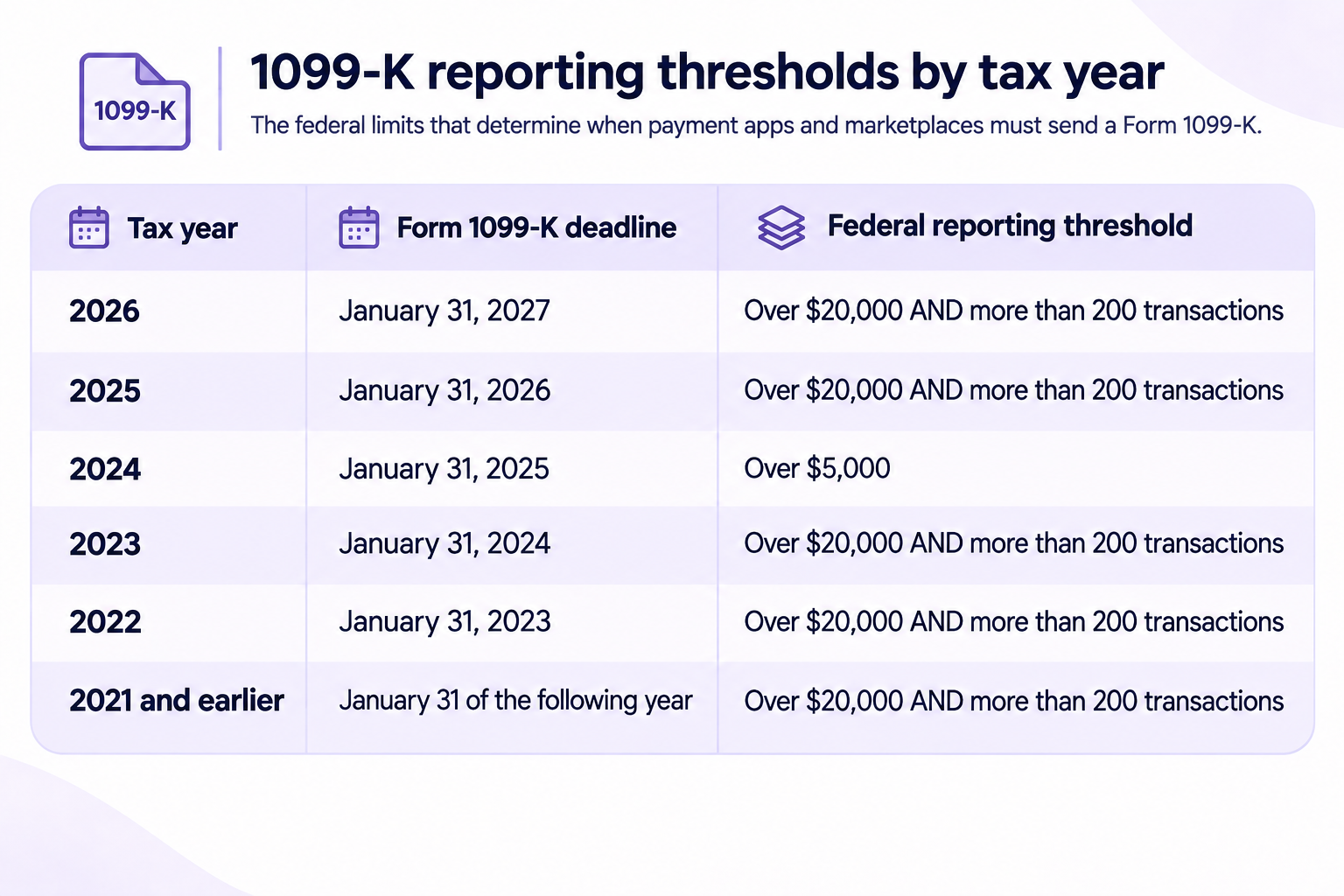
Table showing Form 1099-K reporting thresholds and deadlines by tax year, from 2021 to 2026

Note: These are federal reporting thresholds for third-party payment network transactions, not thresholds for whether income is taxable.

Does the threshold apply to every payment method?

No. If you accept direct credit or debit card payments for goods or services, your payment processor must report those transactions regardless of the amount or number of payments. The $20,000 and 200-transaction requirements apply to third-party payment networks, such as PayPal and online marketplaces.

Which platforms send a 1099-K?

Form 1099-K is issued by payment settlement entities that process payments you receive for selling goods or providing services. These include payment apps, online marketplaces, gig-economy platforms, and payment card processors. If you use digital payment services, understanding how virtual wallets work can help you understand how money moves between customers, platforms, and sellers.

Payment apps and virtual wallets

Payment apps and virtual wallets allow you to send, receive, and store money electronically. Examples include services that facilitate peer-to-peer transfers and commercial payments. If you accept customer payments through these platforms, you may receive a 1099-K when the applicable reporting requirements are met. However, personal transfers between friends and family are generally treated differently from business payments.

Online marketplaces

Online marketplaces connect buyers and sellers through e-commerce stores, auction websites, and craft platforms. When these marketplaces collect and process payments for your products, they may issue a 1099-K to report qualifying transactions. Whether you sell clothing, electronics, handmade products, or other items, the platform's payment processing arrangement matters.

Gig-economy and service platforms

Rideshare, food delivery, freelance, and ticket-resale platforms may process payments on behalf of independent workers and service providers. If you earn money through these services, a 1099-K may be issued for payments processed through the platform.

Payment card processors

Payment card processors handle credit, debit, and gift card transactions for businesses. Unlike third-party payment networks, card transactions have no federal minimum reporting threshold.

Who gets a 1099-K?
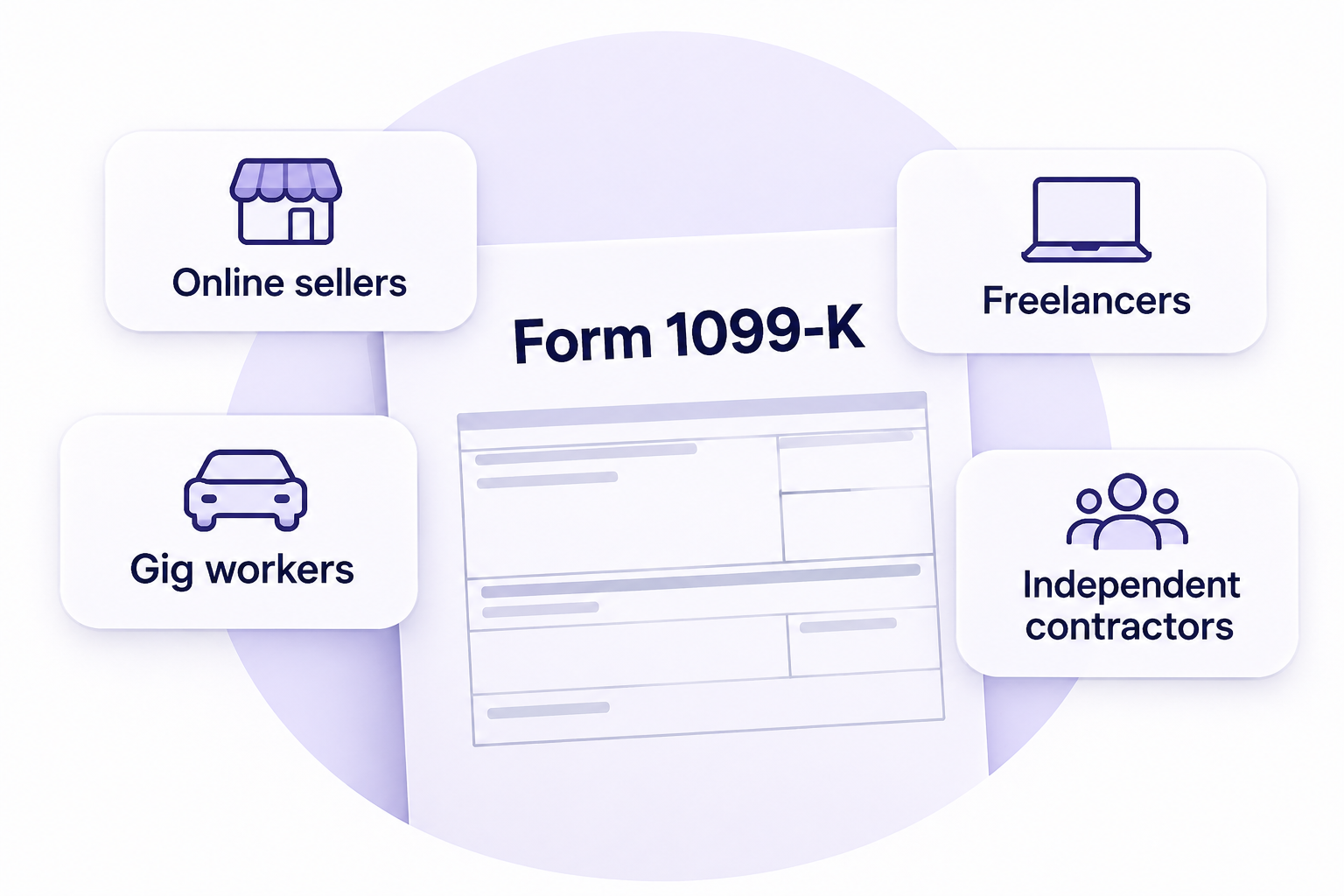
Form 1099-K illustration showing online sellers, gig workers, freelancers and independent contractors.

A 1099-K form is generally issued to people and businesses receiving payments for goods or services through payment cards, apps, or online marketplaces. Recipients may include online sellers, gig workers, freelancers, and independent contractors. Whether you receive one depends on how you are paid and the reporting rules. Even without the form, taxable income must be reported.

Sellers, gig workers, and freelancers

If you sell products online, drive for a rideshare service, deliver food, or provide freelance work, you may receive a 1099-K when a platform processes customer payments and reporting requirements are met. Direct card payments can be reported regardless of the amount or transaction count.

Personal payments versus business payments

Not every transfer through a payment app is business income. Payments for goods or services may be reportable, while personal gifts and reimbursements between friends or family are not. Money a friend sends to split dinner differs from a customer paying you for work. Keep personal and business transactions separate, and save records showing what each payment was for

Avoiding double counting with Form 1099-NEC

Form 1099-NEC reports payments made to independent contractors for services, while Form 1099-K covers payments processed through payment cards and third-party networks. Understanding what Form 1099-NEC reports and who receives it helps you distinguish between the two documents and identify potential overlaps. If a payment appears on both forms, compare the amounts with your invoices, payment platform statements, and other business records. This helps you avoid reporting the same income twice when preparing your tax return.

Receiving platform income efficiently

If you earn money through international marketplaces, freelance platforms, or overseas clients, how you receive and manage your earnings matters. Grey makes this easier by providing USD account options that allow eligible users to receive and manage international payments. Instead of converting every dollar immediately, you can hold your funds in USD and decide when to exchange them based on your needs and available exchange rates.

With Grey, you can open a USD account to receive eligible payments from international clients and platforms. This gives you more flexibility when managing your earnings, particularly if you regularly work with customers or businesses abroad. And when you need to send your money elsewhere, you can move money across borders using Grey's available international transfer services.

Whether you're a freelancer, online seller, or independent professional, having access to a USD account can simplify how you receive, hold, and manage your income. Rather than worrying about immediate currency conversion, you have more control over when and how you access your earnings.

Frequently asked questions about the Form 1099-K

What is a 1099-K used for?

Form 1099-K is an information return showing gross payments you received for goods or services through payment cards, payment apps, or online marketplaces. The payment processor sends a copy to you and the IRS. Use it alongside your own records to work out what income, gains, fees, refunds, and expenses belong on your tax return.

What is the 1099-K threshold this year?

For the 2026 tax year, federal rules generally require third-party settlement organisations to report when your gross payments for goods or services exceed $20,000, and you have more than 200 transactions. Both conditions must be met for each calendar year. Payment-card transactions have no minimum federal threshold, and some states require reporting at lower amounts.

Will I get a 1099-K from PayPal?

PayPal may send you Form 1099-K if your 2026 payments for goods and services exceed $20,000 and involve more than 200 transactions during that year. Both federal conditions apply, although state rules may require reporting at a lower threshold. PayPal may also issue a form below the federal threshold. Personal transfers generally are not reportable.

Is a 1099-K taxable?

No. Form 1099-K reports gross payments, not your taxable profit. For business income, you generally calculate taxable profit after allowable business expenses. If you sell a personal item, a gain may be taxable, while a loss is generally not deductible. Gifts and reimbursements for shared personal costs are not taxable income under federal tax rules.

What if my 1099-K includes personal payments?

First, contact the payment platform or form issuer and request a corrected 1099-K. If it cannot provide one, the IRS says you can still file and zero out the error on Schedule 1 of Form 1040: report it on line 8z and offset it on line 24z. Keep supporting records and correspondence for your files.

Do I have to report income if I don't receive a 1099-K?

Yes. The 1099-K threshold determines when a platform must send an information form; it does not determine whether income is taxable. You must report taxable income even if you receive no 1099-K. Keep records of cash, card, app, and marketplace payments, along with fees, refunds, expenses, and purchase costs, for accurate tax reporting each year.
What is a 1099-INT form? Reporting interest income

•

•

2 min read

A little extra money in a savings account can feel like a welcome reward, especially when it has been earning interest throughout the year while you're saving for a house, building an emergency fund, or simply setting some money aside for unexpected expenses. When January arrives, however, the bank may send a tax document showing exactly how much interest that money generated, leaving you wondering whether those earnings are taxable, whether they need to appear on your tax return, and what happens if the amount is relatively small.

This is where Form 1099-INT comes in. So, what is a 1099-INT form, and why does a bank send one? It is an IRS tax document used to report interest income paid to you by banks, credit unions, brokerage firms, and other financial institutions during the tax year. Generally, the payer must issue it when reportable interest reaches $10, although certain exceptions apply.

The form provides a record of your interest earnings and helps the IRS verify the income reported on your tax return, but receiving one does not mean the entire amount is an additional tax bill. Even when the interest seems insignificant, or no form arrives, taxable interest may still need to be reported. Understanding what a 1099-INT form is can help you know when to expect one, what the reporting threshold means, and how to include your interest income when filing your taxes.

What is a 1099-INT form?

Form 1099-INT is an IRS information return that reports interest income paid to you during the calendar year. If money in a bank account, certificate of deposit, or investments earns interest, the institution or organisation that pays it may send you this form. It gives you and the IRS a record of the interest to include on your federal tax return, even without a withdrawal.

Who issues Form 1099-INT?

Banks, credit unions, brokerage firms, and other organisations that pay interest issue Form 1099-INT when IRS reporting rules apply. A payer must send it if it paid you at least $10 in reportable interest during the year. A form may also be required for amounts below $10, such as when federal income tax was withheld. The payer sends a copy to you and the IRS.

What types of interest does it cover?

The form can report interest from savings and checking accounts, savings accounts, certificates of deposit (CDs), and money market deposit accounts. It can also include interest from bonds and U.S. Treasury securities, along with other debt investments. The source and amount are generally shown in separate boxes.

Receiving Form 1099-INT does not mean you owe tax on every dollar shown. Most bank interest is taxable, while qualifying tax-exempt interest is treated differently but may still need to be reported. You generally must report taxable interest even if you did not withdraw it or receive a form.

Who gets a 1099-INT?

Anyone who earns $10 or more in reportable interest during a calendar year will generally receive Form 1099-INT from the bank or financial institution that paid them. This $10 threshold remains unchanged for the 2026 tax year. It applies to people earning interest from savings accounts, fixed-term deposits, and certain investments.

Who may receive the form?

You may receive a 1099-INT if you have a savings account, certificate of deposit (CD), money market account, or bonds that pay interest. Your bank or financial institution sends you a copy and reports the same earnings to the IRS. If you're unfamiliar with the wider 1099 series, understanding what a 1099 form is also helps explain why different types of income have separate reporting forms.

What if you earn less than $10?

If your interest is below $10, you may not receive a 1099-INT. However, the bank must still send one if it took federal tax from your interest or paid foreign tax on your behalf, even when the amount is lower.

Remember, the $10 limit only determines when the bank must send the form. It does not mean smaller interest payments are tax-free. You must still report taxable interest on your tax return, even if you never receive a 1099-INT. The IRS explains the reporting rules for Form 1099-INT, including when banks must send it.

Reporting interest income

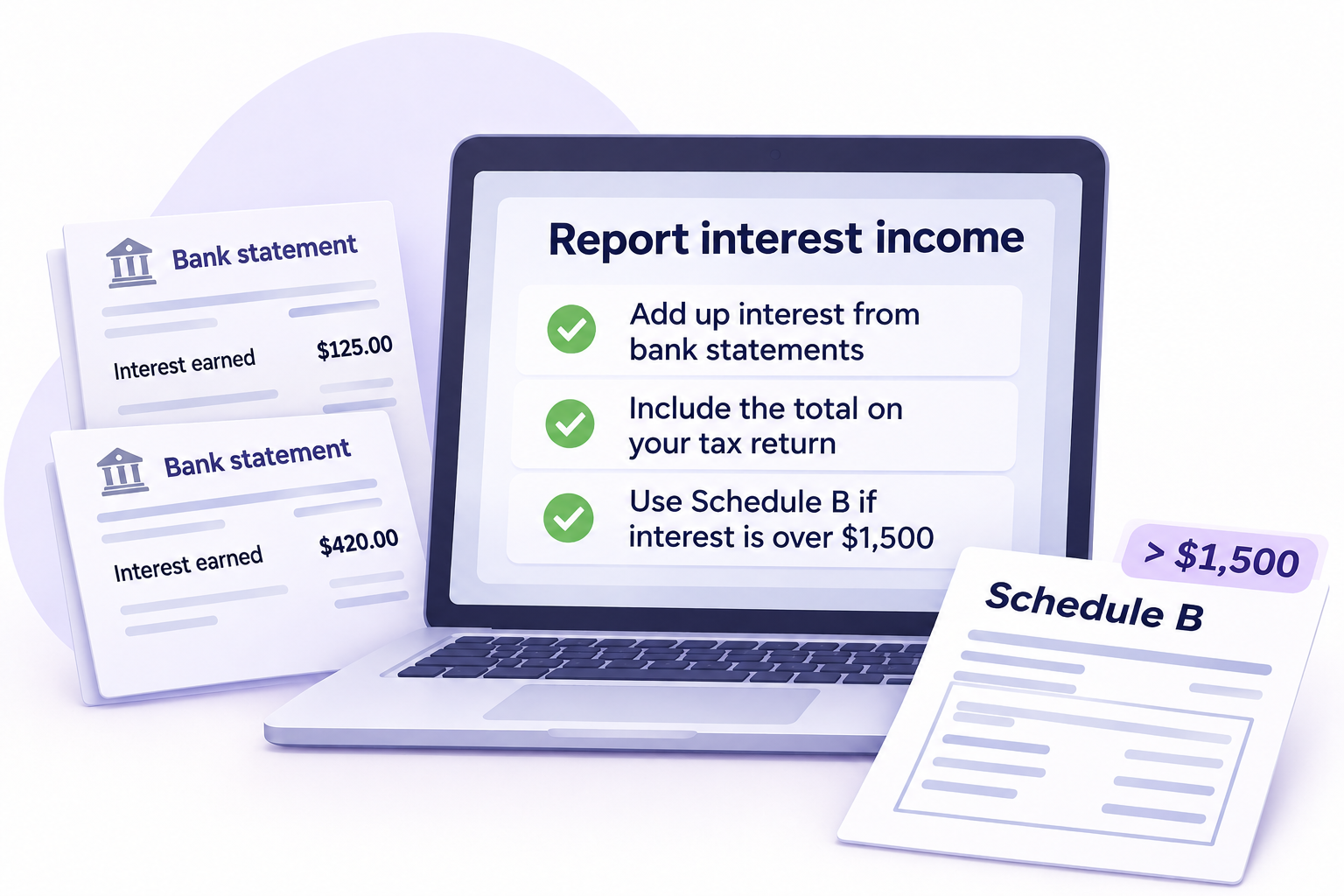
All taxable interest must be reported on your federal tax return, even if you did not receive Form 1099-INT. This means that if your bank paid you interest during the year, you still need to include it when filing your taxes, whether the amount was $5 or $500. Leaving the money in your account instead of withdrawing it does not make the interest tax-free.

Illustration showing how to report bank interest income and when to use Schedule B

How to report interest without Form 1099-INT

Start by checking your year-end bank statements to see how much interest you earned across your accounts. Add the amounts together and include the total taxable interest when preparing your federal tax return. Keep your statements as proof of the payments in case the IRS asks for more information.

When do you need Schedule B?

If your total taxable interest is more than $1,500, you generally need to complete an additional tax form called Schedule B and submit it with your federal tax return. This form lists the banks and other organisations that paid you interest. Other situations, including certain foreign account interests, may also require it.

Tax-exempt interest, such as interest from qualifying municipal bonds, is reported separately from ordinary taxable interest. Some investment funds also pay tax-exempt dividends, which are reported differently from bank interest. You can learn more about what a 1099-DIV reports to understand how investment income is recorded.

This information is for general educational purposes and is not professional tax advice. Check the relevant IRS instructions or speak with a tax professional about your circumstances.

Interest income and foreign accounts

Earning interest from a bank outside the US does not mean it is automatically exempt from US taxes. If you are a US citizen or resident alien, you generally need to report taxable interest from foreign accounts, just as you would interest earned from a US bank. This applies even if the foreign bank does not send you Form 1099-INT. Keep your bank statements so you can work out how much interest you earned and report the amount in US dollars.

If you regularly receive or save money in different currencies, having a place to hold those funds can also make managing your finances easier. Grey offers a USD account, allowing eligible customers to receive and hold USD without converting them immediately. You can also hold multiple currencies and explore how to save in foreign currency when managing money across borders.

Remember that reporting foreign interest income is different from reporting foreign bank accounts. If the total value of your foreign financial accounts exceeds $10,000 at any point during the year, you may also need to file an FBAR. Other reporting requirements may apply depending on your circumstances.

Frequently asked questions about the Form 1099-INT

What is a 1099-INT used for?

Form 1099-INT reports interest income paid to you during the tax year by banks, credit unions, brokerage firms, and other financial institutions. The payer sends a copy to you and the IRS, showing how much interest you earned. You use this information when preparing your federal income tax return.

What is the 1099-INT threshold?

Banks and other financial institutions generally issue Form 1099-INT when they pay you $10 or more in interest during the calendar year. The form may also be required below this amount if federal income tax or foreign tax was withheld. Remember, the $10 threshold does not make smaller interest payments tax-free.

Do I report interest without a 1099-INT?

Yes. You must report taxable interest on your federal tax return even if you earned less than $10 and never received Form 1099-INT. Check your year-end bank statements and add up the interest earned across your accounts. The responsibility to report taxable interest remains yours, whether or not the bank sends a form.

Is interest income taxable?

Most interest income is taxable at your ordinary federal income tax rate, including earnings from savings accounts, certificates of deposit, and money market accounts. However, some interest, such as qualifying interest from municipal bonds, is federally tax-exempt. You may still need to report tax-exempt interest separately when filing your federal tax return.

What about interest from foreign accounts?

US citizens and resident aliens generally must report taxable interest earned from foreign bank accounts, even if they do not receive Form 1099-INT. Depending on the total value of their foreign accounts and other circumstances, they may also need to file an FBAR or Form 8938. These are separate reporting requirements.

When should I receive my 1099-INT?

Banks and other financial institutions generally send Form 1099-INT by January 31 following the tax year in which you earned the interest. If the deadline falls on a weekend or public holiday, it moves to the next business day. Check your email, online banking account, or post for the document.

What should I do if my 1099-INT has incorrect information?

Contact the bank or financial institution that issued the form and ask for a corrected copy. Compare the reported amount with your bank statements to identify any differences. If the institution confirms the error, request that it send the corrected form to both you and the IRS before you file your tax return.

What is a 1099-DIV form? Reporting dividend income

•

•

2 min read

A 1099-DIV form is an important tax document that reports dividend income and certain distributions you received from investments during the tax year. If you own stocks, mutual funds, exchange-traded funds (ETFs), or other dividend-paying investments, you may receive this form from your bank, brokerage firm, or investment company. The institution also sends a copy to the Internal Revenue Service (IRS) to report the income paid to you.

Understanding what a 1099-DIV form is can help you report your investment earnings accurately and avoid common tax filing mistakes. The form provides a breakdown of different types of income, including ordinary dividends, qualified dividends, capital gain distributions, and other taxable distributions. This distinction matters because ordinary and qualified dividends may be subject to different federal tax rates.

Whether you are filing taxes for the first time or managing an established investment portfolio, knowing how to read your 1099-DIV form is essential. In this guide, we explain what the form covers, who receives it, how to report dividend income, and what to do if you receive one.

What is a 1099-DIV form?

A 1099-DIV form is an IRS tax document used to report dividends and other investment distributions paid to individuals during a tax year. If you own stocks, mutual funds, real estate investment trusts (REITs), or other dividend-paying investments, you may receive this form from the financial institution managing your investments.

The form provides a breakdown of the income you earned, helping you understand what needs to be reported on your federal income tax return. It is one of several documents used to track earnings, much like the 1099 form, which reports different types of income.

Who issues a 1099-DIV Form?

Banks, brokerage firms, corporations, mutual funds, and other financial institutions issue a 1099-DIV form to investors who receive reportable dividends or distributions. They also send a copy to the IRS so the reported income can be matched with your tax return.

What distributions does it cover?

The form covers several types of investment income, including:

  • Ordinary dividends: Regular payments from stocks and mutual funds.
  • Qualified dividends: Dividends that may qualify for lower federal tax rates.
  • Capital gain distributions: Profits passed on to investors by mutual funds and REITs.
  • Nondividend distributions: Payments generally treated as a return of capital rather than taxable income.

What does a 1099-DIV report?

A 1099-DIV form breaks down the different types of dividend income and distributions you receive from investments. Not all these payments are treated the same way for tax purposes, which is why the form separates them into specific categories.

Form 1099-DIV showing ordinary dividends, qualified dividends and capital gain distributions

Ordinary and qualified dividends

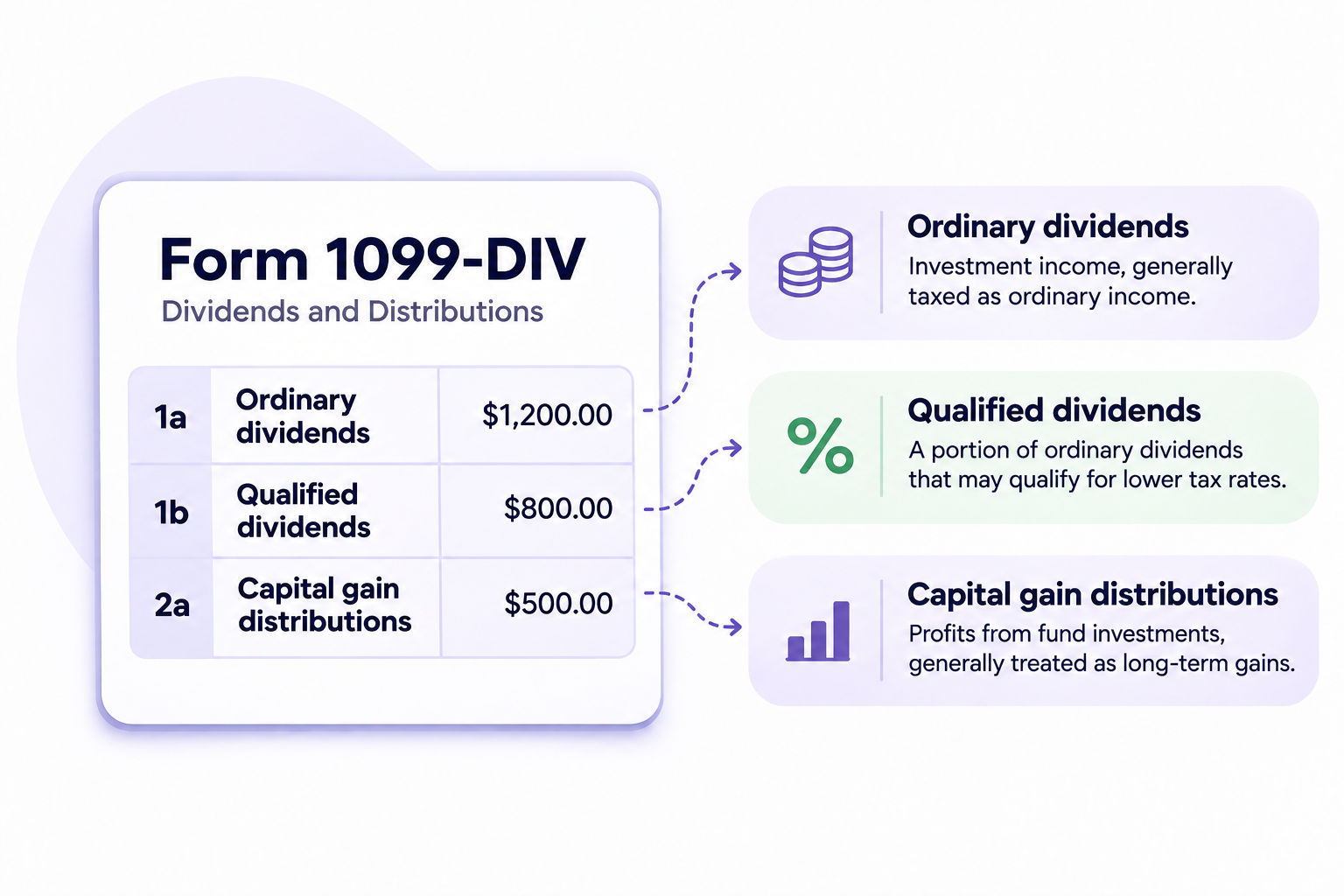
Ordinary dividends are payments you receive from investments such as stocks and mutual funds. They are reported in Box 1a and are generally taxed as ordinary income.

Qualified dividends are a portion of ordinary dividends that meet certain IRS requirements. They appear separately in Box 1b and may qualify for lower tax rates. The difference matters because the type of dividend you receive can affect how much tax you owe.

Not every dividend automatically qualifies for the lower rate. Factors such as the type of investment and how long you held the shares can determine whether the dividend meets the IRS requirements. This is why the distinction is worth paying attention to when reviewing your tax statement.

Capital gain distributions

A 1099-DIV form also reports capital gain distributions, usually in Box 2a. These are profits that mutual funds and other investment funds pass on to shareholders after selling investments at a gain. They are generally treated as long-term capital gains for tax purposes.

You may receive these distributions even if you did not sell any shares yourself. The fund may have sold investments within its portfolio and passed the resulting gains on to shareholders.

Understanding these categories makes it easier to see how your investments generate income and how that income is reported. It also connects to the bigger picture of saving vs investing, particularly when considering how different financial choices affect your money over time.

Dividends, foreign income, and holding USD

Receiving dividends from investments outside your home country can mean dealing with more than just the income itself. You may also need to consider the currency in which the money is paid, whether to convert it immediately, and how to hold it in a way that suits your financial needs.

For instance, if your dividends are paid in US dollars, keeping them in a USD account allows you to hold the funds in their original currency without converting them right away. This can be useful if you have future expenses in dollars or simply prefer to decide when to exchange your money.

With Grey's USD account, you can receive and hold USD, making it easier to manage dollar-denominated funds. And if you regularly receive money in different currencies, Grey also lets you hold and convert multiple currencies, all from one place.

The two features serve different but connected purposes: one gives you a place to keep your dollar funds, while the other makes managing money across currencies more convenient.

Currency management can also become important when you receive income from different sources. You might earn in one currency, receive dividends in another, and have everyday expenses in a third. Keeping track of these differences helps you understand how much money you actually have available without confusing the original amount with its converted value.

Exchange rates can change over time, so converting money immediately or holding it in its original currency are two separate considerations. Neither option is automatically better; it depends on your expenses, plans, and currency needs.

Whether you choose to hold your dividends in USD or convert them into another currency depends on your financial needs and preferences. Understanding your options can make managing foreign investment income a little less complicated.

Who gets a 1099-DIV?

If you own stocks, mutual funds, or other investments that pay dividends, you may receive a 1099-DIV form at the end of the tax year. Generally, financial institutions and other payers must issue the form when you receive $10 or more in dividends or other reportable distributions during the year.

This threshold applies to ordinary dividends, capital gain distributions, and certain other stock distributions. However, the $10 minimum is not the only reason you might receive the form. If the payer withheld any federal income tax under backup withholding rules or paid foreign taxes on your dividends, it must issue a 1099-DIV regardless of the amount.

There is also a separate threshold for liquidation distributions, which is generally $2,000 under the 2026 reporting rules.

You do not have to meet a minimum investment balance to receive this form. What matters is the income or distributions your investments generate.

One important detail: not receiving a 1099-DIV does not automatically mean your dividend income is exempt from reporting. Taxpayers may still need to report taxable dividend income even when it falls below the reporting threshold.

Frequently asked questions about the 1099-DIV Form

What is a 1099-DIV used for?

A 1099-DIV is used to report dividends and certain investment distributions you received during the tax year. It helps you and the IRS track investment income that may need to be included on your federal tax return. The form also separates different types of distributions, making it easier to understand their tax treatment.

What is the difference between ordinary and qualified dividends?

Ordinary dividends are generally taxed at your regular income tax rate. Qualified dividends are a portion of ordinary dividends that meet specific IRS requirements and may qualify for lower capital gains tax rates. The difference matters because the type of dividend you receive can affect how much federal tax you owe.

Who sends a 1099-DIV?

Banks, brokerage firms, mutual funds, corporations, and other financial institutions that pay reportable dividends or distributions send a 1099-DIV. They provide a copy to the investor and submit another to the IRS. The form helps both parties keep track of investment income for the relevant tax year.

Is dividend income taxable?

Yes, dividend income is generally taxable in the United States. However, the tax rate depends on the type of dividend, your income, and other applicable tax rules. Ordinary dividends are generally taxed as ordinary income, while qualified dividends may receive lower tax rates if they meet IRS requirements.

What about dividends from foreign investments?

Dividends from foreign investments may also be taxable in the United States, depending on your tax residency and circumstances. They may involve foreign withholding taxes, which can sometimes qualify for a foreign tax credit. Your 1099-DIV may report foreign tax paid, helping you understand what to include when filing your return.

Can I keep my dividends in US dollars without converting them?

Yes, if your investment provider allows USD withdrawals and you have access to an eligible USD account, you can keep your dividend payments in dollars rather than converting them immediately. This gives you flexibility over when to exchange the funds, depending on your expenses and currency needs.

Do exchange rates affect foreign dividend income?

Yes. Exchange rates can affect how much your foreign dividend income is worth when converted into your local currency. Even when the original dividend amount stays the same in USD, its equivalent value may change as exchange rates move. This is worth considering when tracking investment income across different currencies.

When your dividends arrive in USD, you may want to keep them in dollars rather than convert them immediately. Grey gives you a convenient way to hold your USD

How YouTube pays South African creators: rand, dates and tax

•

•

2 min read

Yes, YouTube pays South African creators, but not in dollars. Google sends your earnings by EFT, in rand, into a South African bank account once your balance reaches R1,000. No wire transfer, no PayPal and no foreign USD account sits in between.

That surprises a lot of creators, because plenty of advice online (including an earlier version of this guide) says to send your AdSense money to a US dollar account. Google's rules don't allow that for South African payees, and getting it wrong is one of the easiest ways to end up with a payment on hold.

Below you'll find who qualifies (and what changes on 1 February 2027), how the money reaches you, the exact payment calendar, what YouTube actually pays, and the US tax most new creators miss. Every rule comes from YouTube and Google help pages, checked on 25 November 2026.

Does YouTube pay in South Africa?

Yes. South Africa is on YouTube's list of countries where the YouTube Partner Program is available, so once your channel is accepted you can earn from ads, YouTube Premium and fan funding features such as channel memberships. You first need to reach one of two tiers.

YPP tierWhat it pays you forRequirements today
Expanded YPPFan funding features and YouTube Shopping500 subscribers and 3 public uploads in the last 90 days, plus 3,000 watch hours in 12 months or 3 million Shorts views in 90 days
Full YPPAd revenue and YouTube Premium revenue1,000 subscribers, plus 4,000 qualified watch hours in 12 months or 10 million Shorts views in 90 days

Checked 25 November 2026. Source: YouTube Help, expanded YouTube Partner Program overview.

You also need one active AdSense for YouTube account linked to your channel, 2-Step Verification on your Google account and no active Community Guidelines strikes, according to the YouTube Partner Program eligibility page.

What changes on 1 February 2027

The bar for ad revenue doubles for new applicants. In an August 2026 announcement, YouTube said creators applying for the Partner Program from 1 February 2027 will need 8,000 qualified watch hours in the last 365 days, or 20 million qualified Shorts views in the last 90 days.

If you're already in YPP, you keep your place, and the fan funding and Shopping thresholds stay the same. Two changes still reach existing partners:

  • Shorts revenue needs 10 million views. From 1 February 2027, only channels with 10 million qualified Shorts views in the last 90 days share in Shorts ad and Premium revenue. Channels below that keep earning on long-form videos.
  • New terms to accept. YouTube asks partners to review and accept the updated terms in YouTube Studio by 31 January 2027 to keep full monetisation.

So if your channel is close to 4,000 watch hours today, the next two months matter more than usual.

How does YouTube pay South Africans?

Through AdSense for YouTube, by electronic funds transfer (EFT) in South African rand. YouTube's payment method table lists EFT as the only option for South Africa, with wire transfer, cheque and PayPal's Hyperwallet all marked as unavailable.

Two rules shape everything else:

  • Your bank must be in South Africa. Google says your bank (or branch) must be in the same country as the address in your payments settings, and it won't accept a SWIFT code from a bank in another country. A US or UK account, including one from a fintech app, can't be your AdSense payout account.
  • You can't change the payment currency. A South African payee is paid in rand. Google converts your earnings every day at the prevailing market rate from the day before the ads ran, using rates from major banks and other industry sources.

That second rule has an upside the "get paid in dollars" advice ignores. Google does the conversion day by day at market rates, so you aren't hit with one big conversion on payday, and the money arrives as an EFT rather than an international wire.

How to set up your YouTube payment method

  1. Link AdSense for YouTube. When you apply for YPP, YouTube Studio asks you to create or link an AdSense for YouTube account. Only one active account can be linked to your channel.
  2. Submit your US tax info. You do this in AdSense, even though you live in South Africa (the tax section below explains why).
  3. Verify your identity and address. Once your balance reaches the verification threshold ($10 or the rand equivalent), Google asks you to verify, and address verification uses a PIN.
  4. Add your bank account. Go to Payments, then Payments info, then Add payment method, and enter your South African bank details for EFT. You can choose a payment method once your balance reaches R100.
  5. Finish everything by the 20th. Payment detail changes and fixes for payment holds must be done by the 20th, or they only count from the next month.

When does YouTube pay in South Africa?

Once a month, between the 21st and the 26th, for the previous month's earnings. Here's the cycle from YouTube's payment process page and its payment thresholds:

Date (each month)What happens
7th to 12thLast month's estimated earnings are finalised and appear under Payments
20thYour balance must be at least R1,000, and payment info changes or hold fixes must be complete
21st to 26thGoogle issues the payment (on the first business day after the 21st if the 21st is a weekend or holiday)
After issueThe EFT takes up to 7 business days to reach your bank

Checked 25 November 2026. Source: YouTube Help, AdSense for YouTube payment process and payment thresholds.

Take your November 2026 earnings. They're finalised between 7 and 12 December, and 20 December falls on a Sunday, so sort out any bank details before that weekend. If your balance is at least R1,000 and nothing is on hold, Google issues the payment between 21 and 26 December.

With Christmas inside that window and EFTs taking up to 7 business days, don't count on that money before early January. Below R1,000? The balance simply rolls over to the next month.

How much does YouTube pay in South Africa?

There's no fixed rate per view, in South Africa or anywhere else. YouTube pays you a share of what advertisers spend on your videos: 55% for long-form videos and 45% for Shorts. The Shorts share comes from a pooled amount that YouTube allocates across creators.

Two numbers in YouTube Analytics show what you're really earning:

  • CPM is what advertisers pay per 1,000 ad impressions, before YouTube takes its share.
  • RPM is what you earn per 1,000 views, after YouTube's share and including views that showed no ads. This is the number to watch.

Here's the part that matters most for South African channels. YouTube's ad revenue guide says CPMs vary by geography, because ad markets in different countries have different levels of competition, so what you earn depends on where your viewers are, not where you live.

That means two Joburg creators with identical view counts can earn very different amounts if one audience sits mostly in South Africa and the other mostly abroad. Advertisers also bid higher or lower depending on the time of year, so expect your RPM to move from month to month.

How much US tax does YouTube take?

Google withholds US tax on the part of your earnings that comes from US viewers, and it can take far more if you skip the paperwork. According to YouTube's US tax requirements page:

  • No tax info submitted: up to 24% of your total worldwide earnings can be withheld.
  • Tax info submitted, no treaty claimed: 30% of your earnings from US viewers.
  • Treaty benefits claimed: a rate between 0% and 30% on US-viewer earnings, depending on your country's treaty.

South Africa has a tax treaty with the US, and SARS's treaty summary notes that the US may not withhold tax on royalties paid to a South African resident. Ask a tax practitioner whether that applies to your channel income before you claim it.

Submit your tax info before Google's annual cut-off of 10 December, or the 24% worldwide deduction can apply. US withholding isn't the end of it either, because you may still owe SARS tax on the same income, so it's worth reading up on managing freelance taxes.

Can you get your YouTube money in dollars instead?

Not from AdSense, if your payments address is in South Africa. Google only pays EFTs to a bank in the same country, so no foreign USD account can be added as your YouTube payout method.

But AdSense is only one income stream. Plenty of what a YouTuber earns outside AdSense is paid in USD, GBP or EUR:

  • Brand sponsorships from US, UK or European companies, usually paid by bank transfer against your invoice (here's how to invoice overseas brands).
  • Affiliate programmes that pay commission in dollars.
  • Your own products or courses, sold through platforms such as Stripe that pay out to a bank account.

For more options, see the platforms where South Africans earn US dollars, and how creators get paid without ads.

Where Grey fits for South African YouTubers

Grey gives South Africans free USD, EUR and GBP accounts, so an overseas brand can pay you the way it pays a local supplier. Grey is a financial technology company, not a bank, and it issues US accounts to freelancers and full-time employees in eligible countries, South Africa included.

Grey serviceFee or limit (USD)Timing
Opening and keeping a USD, EUR or GBP accountFree (no account maintenance fee)Minutes to open
Receiving USD by ACH or FedNow0.8% (minimum $2, maximum $10)ACH 1 to 2 business days; FedNow in seconds
Receiving USD by Fedwire$20 flatAbout 1 business day
Payments from individuals (not businesses)Less than $4,000Not applicable
Withdrawing to a South African bank in rand$1.50A few hours to 1 business day

Checked 25 November 2026. Source: Grey Help Centre (USD deposit fees, US account guidelines, ZAR withdrawal fee) and grey.co/en-za.

Say a US brand pays you $1,500 for a sponsored video by ACH. The 0.8% fee works out at $12, but the $10 cap applies, so $1,490 lands in your USD balance.

From there you can hold the dollars, convert at the live USD to ZAR rate (a conversion fee applies, depending on the currency pair) and withdraw to your South African bank for $1.50. You can also keep some dollars back to pay for subscriptions such as editing software.

Common mistakes that hold up YouTube payments

  • Adding a foreign bank account. A US or UK account, or a SWIFT code from a bank outside South Africa, won't be accepted for a South African payments address.
  • Missing the 20th. Changes to payment details or holds made after the 20th push your payment to the next cycle.
  • Skipping the tax form. No tax info by 10 December can cost you up to 24% of your worldwide earnings.
  • Putting off verification. Google asks you to verify your identity and address once you pass the $10 verification threshold, so act on the PIN as soon as it arrives.
  • Expecting dollars. Your AdSense payment arrives in rand, already converted, so there is no USD amount to wait for.

Frequently asked questions

Does YouTube pay South Africans in dollars?

No. AdSense for YouTube pays South African creators in rand by EFT, and Google says the payment currency can't be changed. Your earnings are converted daily at the prevailing market rate.

Can I receive YouTube payments through PayPal or Payoneer in South Africa?

Not for AdSense. EFT to a bank in South Africa is the only AdSense for YouTube payout method listed for the country, and PayPal's Hyperwallet option isn't available here.

How much do I need to earn before YouTube pays me?

R1,000. If your balance on the 20th of the month is below that, it rolls over until it reaches the threshold.

How long does a YouTube EFT take to reach my bank?

Up to 7 business days after Google issues the payment, which happens between the 21st and 26th of each month.

Do YouTube Shorts pay in South Africa?

Yes, if your channel is in the YouTube Partner Program. You keep 45% of the Shorts revenue allocated to you, and from 1 February 2027 you'll need 10 million qualified Shorts views in the last 90 days to share in Shorts ad and Premium revenue.

What to do next

For a South African YouTuber, getting paid isn't about finding a clever dollar route. It's about a South African bank account, the R1,000 threshold, your tax form and the 20th of every month.

Get those right in AdSense, then give your brand deals and other overseas income a home of their own. Open a Grey account to receive USD, EUR and GBP from clients abroad and withdraw to rand when you're ready.

YouTube pays you in rand on Google's calendar, so put your energy into the dollars it doesn't touch.

What non-US residents need to open a US bank account at major banks

•

•

2 min read

To open a US bank account at a major bank as a non-US resident, you usually need a valid passport, a second form of ID, a US address you can prove and a visit to a branch. Some banks also ask for an SSN or ITIN and your permanent address back home. The passport is the easy part; the US address and the branch visit are where most applications stall.

Getting this wrong can cost you a wasted trip to a branch, or a flight. Below is what Chase, Bank of America, Wells Fargo and Citi say on their own sites, side by side, plus a realistic plan if you can't get to the US at all.

Can a non-US resident open an account at a major US bank?

Yes, but usually only in person and usually only with a US address. Chase says the idea that non-residents can't open US accounts isn't true, though it warns there may be extra paperwork. Bank of America is blunter: its international professionals page says you must be living in the US to open an account, and non-resident aliens must apply in person at a branch.

In practice, the big banks are built for people who live in the US or are about to. If you are visiting, can prove a US address and bring the right documents, you have a real chance. If you live abroad and never set foot in the US, you will struggle.

Requirements at Chase, Bank of America, Wells Fargo and Citi compared

This is what each bank's own pages ask for. Branches have some discretion and rules change, so treat it as your packing list and confirm with the branch before you go.

RequirementChaseBank of AmericaWells FargoCiti
Where you applyBranch, with original documentsIn person at a branch (non-resident aliens)Branch; online needs an SSN or ITIN and a US addressNon-residents are served by Citi International Personal Bank
Primary IDPassport, foreign national ID, matrícula consular or US work permitForeign passport, or US non-immigrant visa with Border Crossing CardPassport or other listed government IDNot published for non-residents
Second IDRequired; originals only, not expiredRequired, for example a foreign driving licence or US employment IDRequired, for example a debit card or employee IDNot published for non-residents
US addressOne of your two IDs must show a US addressUS physical address; no PO box or mail dropProof of address requiredStandard US accounts generally need one
Home-country addressNot statedFull permanent foreign address requiredNot statedNot stated
SSN or ITINMay be asked for; an ITIN can stand in for an SSNForeign tax ID; US tax number only if you have oneSSN or ITIN listed for online and branch openingStandard US accounts generally need an SSN
Basic checking fee (USD per month)Total Checking: $15, or $0 if you meet a waiverAdvantage SafeBalance: $4.95Everyday Checking: $15, or $0 if you meet a waiverCitigold starts at US$200,000 in investible assets

Checked 25 November 2026. Sources: Chase acceptable forms of identification and Total Checking pages; Bank of America international professionals page and applying for accounts FAQ; Wells Fargo Everyday Checking requirements and account comparison pages; Citi International Personal Bank site. Bank of America's fee is from CNBC Select because bankofamerica.com product pages could not be read, and Citi's standard-account rules are from Wise's Citibank guide (May 2023), as Citi does not publish them for non-residents.

The documents to bring

Pack originals of everything. Chase's ID list says it cannot accept copies or screenshots, and expired documents don't count.

  • Passport: the primary ID every major bank accepts from non-residents.
  • Second ID: a foreign driving licence, national ID card or a debit card in your name. Ask the branch which ones it takes, because each bank's list is different.
  • Proof of US address: a utility bill, lease or rental agreement in your name. Chase wants utility bills dated within 60 days.
  • Proof of home address: Bank of America asks for your full permanent foreign address, including building number, street, city, state or province, and country.
  • Tax number: your home country's tax ID, plus an SSN or ITIN if you already have one.
  • Opening deposit: usually small. Bankrate (March 2026) lists $25 for Wells Fargo Everyday Checking.

If the account can earn interest, the bank may also ask for Form W-8BEN, which certifies to the payer that you are a foreign person for US tax withholding. Our guide on completing a W-8BEN walks through it line by line.

Why the US address is the real gatekeeper

The US address requirement stops more non-resident applications than any other. Chase's ID list says that for customers without a Green Card, the primary or secondary ID must contain a US address. Bank of America says a PO box or mail drop is not an acceptable US physical address.

That rules out the trick many people try first: a mail-forwarding address. If you don't have a lease, a utility bill or an ID showing where you actually live in the US, expect to be turned away, however good your passport is.

Do you need an SSN or ITIN?

Not always, and you probably can't get an ITIN just for this. Many guides, including an earlier version of this one, tell non-residents to apply for an ITIN first. The IRS says an ITIN is not issued solely for opening bank or investment accounts; you need a federal tax reason, such as filing a US tax return.

Even with a valid reason, the IRS asks you to allow about 7 weeks, and up to 11 weeks in peak season or if you apply from abroad. So check what each bank accepts instead:

  • Bank of America: its international page asks for a foreign tax ID and says a US taxpayer number is not required unless you've been issued one. Its general FAQ asks visa holders for an ITIN, so confirm at your branch.
  • Chase: says an ITIN may be used as a substitute where a bank requires an SSN.
  • Wells Fargo: lists an SSN or ITIN for both online and branch opening, and says non-US citizens without a US taxpayer ID must show a government ID proving nationality or residence.

For more on this route, see our no-SSN guide.

Can you open a major US bank account online from abroad?

Rarely. Wells Fargo's online application needs an SSN or ITIN, a physical US address and your own mobile number. Chase's online-opening guidance is written for US citizens and non-US citizens residing in the US, and Bank of America sends non-resident aliens to a branch.

Citi's offer for people outside the US is its International Personal Bank, where Citigold is pitched at clients with US$200,000 in investible assets. That works for globally mobile wealthy clients, not for a freelancer who wants to receive a $1,500 invoice. We cover the wider set of options in non-resident online accounts.

How each major bank differs

The core checklist is the same everywhere, but each bank has its own sticking point.

  • Chase: strictest on documents. Two originals, and one must show your US address. Extra ID rules apply to customers from OFAC-sanctioned countries. Our Chase guide covers the branch visit in detail.
  • Bank of America: the most explicit about non-residents, asking for a foreign tax ID and both a foreign and a US address. See our Bank of America guide.
  • Wells Fargo: leans hardest on a US taxpayer number and recommends booking an appointment. Read how to open a Wells Fargo account from outside the US.
  • Citi: separates standard US banking from international private banking, and the international route has a high entry point.

Tips before you walk into a branch

  • Book an appointment. Wells Fargo recommends it, and it saves you being sent away at a busy branch.
  • Call the branch first. Ask which second IDs and address documents it accepts for non-residents, since requirements vary by bank and by branch.
  • Plan for the monthly fee. Chase Total Checking and Wells Fargo Everyday Checking both charge $15 a month unless you meet a waiver, such as $500 in qualifying electronic deposits or a $1,500 balance. Without US payroll deposits, keeping the minimum balance is often the simpler route.

What if you can't visit the US?

Then a big-bank account isn't realistic, and you may not need one. If your goal is to get paid in USD by US clients, employers or platforms, a USD account from a financial technology company gives you US account details without a branch visit or a US address.

With Grey, you sign up online, verify with a government ID supported in your country and a video selfie, then request a US account with an account number and ACH or wire routing number. Verification usually takes a few minutes and can take up to 24 hours. US accounts are issued to full-time employees and freelancers in eligible countries.

What you needMajor US bank (typical)Grey USD account
Where you applyBranch in the USOnline, from an eligible country
IDPassport plus a second ID, originalsOne government ID supported in your country, plus a video selfie
US addressRequiredNot required
Opening and maintenance fees (USD)Monthly fee of up to $15 unless waivedNo account opening fee and no maintenance charge
Receiving fees (USD)Set by each bankACH or FedNow 0.8% (min $2, max $10); Fedwire $20
How money arrivesACH and wire transfersACH (1 to 2 business days), Fedwire (about 1 business day), FedNow (seconds)

Checked 25 November 2026. Source: Grey help centre (deposit fees, receiving guidelines, document verification, US account eligibility) and grey.co/foreign-accounts.

Know the limits before you share your details. Payments from individual third parties must be under $4,000 each, and Grey does not accept payments for crypto, P2P, betting or forex trading. Grey is a financial technology company, not a bank, and is registered with FinCEN.

You can open foreign currency accounts in USD, GBP and EUR on Grey and spend your dollars with a virtual card without converting first.

Frequently asked questions

Which US banks allow non-resident accounts?

Chase, Bank of America and Wells Fargo accept applications from non-US citizens who apply in person with the right ID and a US address, and Bank of America publishes a specific process for non-resident aliens. Citi serves non-residents mainly through its International Personal Bank, which is aimed at wealthier clients.

Can I get an ITIN just to open a US bank account?

No. The IRS says an ITIN is not issued solely for opening bank or investment accounts. You need a federal tax reason, such as filing a US tax return.

Can I use a mail-forwarding address as my US address?

Usually not. Bank of America says a PO box or mail drop is not an acceptable US physical address, and Chase requires one of your IDs to show a US address.

How much money do I need to open the account?

The opening deposit is usually small; Bankrate (March 2026) lists $25 for Wells Fargo Everyday Checking. The bigger cost is the monthly fee of up to $15 at Chase and Wells Fargo unless you meet a waiver.

The short version

Bring an original passport, a second ID, proof of a US address and proof of your home address, then book a branch appointment and confirm the bank's tax ID rules before you go. If you can't be in the US, skip the branch and join Grey to get USD account details from home. At a major US bank, your passport gets you through the door; a US address and a branch visit get you the account.

Grey vs traditional banks: which saves you more time

•

•

2 min read

The global digital evolution has not left the banking sector untouched. A fast-paced generation requires fast transactions. Many employees now work with clients they’ve never met, living in foreign countries they’ve never visited. The educational sector is seeing a growing number of international students. Digital nomads work remotely while hopping from country to country. Businesses are expanding, with growing cross-border trade. Our banking needs are evolving. We now need seamless and swift borderless payment solutions at the lowest cost possible.

Fintech companies like Grey offer solutions that fit today’s needs and help solve problems that traditional banks haven’t fixed.

In this article, we compare the new and the old, Grey vs. traditional banks, and examine where each stands in terms of time conservation.

Also read: Global accounts vs traditional banks: What remote workers should know

How Grey works

With Grey, you can open international bank accounts and manage money across borders easily. It’s made for freelancers, expats, and remote workers. You can open an account in just a few minutes, all online, with no need to visit a branch or fill out lots of paperwork. Grey offers:

  • Multi-currency support: Receive, send, hold, and convert between USD, GBP, EUR, and local currencies.
  • Swift conversions and transfers: Currency conversions and international transfers are completed within minutes to a few hours.
  • Additional feature: Grey also offers automated invoicing, expense tracking, and virtual USD debit cards for seamless online payments.
  • Security: Grey is fully regulated by FINTRAC and FinCEN, ensuring that your funds and data are adequately protected.

Unlike traditional banks, which are often constrained by regulatory hurdles and official bottlenecks, Grey leverages digital provisions to enable faster processing.

Also read: Global accounts vs traditional exchange houses: which is better?

How traditional banks work

Traditional banks, such as Chase and HSBC, as well as local branches in various countries, offer a wide array of banking services, including savings accounts, loans, mortgages, and investment advice. They operate through physical branches, ATMs, and digital platforms. They offer more robust banking services compared to emerging fintechs. However, many traditional banks remain traditional in practice, with lengthy paperwork and cumbersome processes, such as waiting in lines, scheduling appointments, or dealing with international money transfer delays, in a fast-paced economy.

Grey vs traditional banks: Which saves you more time

Fintechs like Grey don’t replace traditional banks, but they do some things differently. Let’s see which one saves you more time by looking through important banking processes.

1. Account opening

The onboarding process of a banking system basically shows you what to expect from them. This is why many strive for a streamlined account opening process. Now, let’s compare Grey and traditional banks.

  • Grey: Signing up and verifying your identity on Grey is a seamless process that takes only a few minutes. The process is entirely through the app or website and doesn’t require a physical branch visit or mailing documents. You simply need to upload a valid ID, proof of residence, and a selfie for Know Your Customer (KYC) compliance. Accounts in USD, GBP, or EUR can be opened from anywhere in the world, making it ideal for non-residents or travellers.
  • Traditional banks: Opening an account typically involves visiting a branch, filling out forms, providing multiple documents (e.g., proof of address, income statements), and waiting for approval, which can take days to weeks. For international accounts, additional hurdles, such as residency requirements or embassy verifications, may extend this to several months.

Grey takes the show here, with a swift account opening and verification process, with the ease of opening an account remotely without visiting a physical bank branch.

2. Transactions and money transfers

Transaction processing speed is crucial during emergencies, such as paying bills. Delayed payments can leave you stranded.

  • Grey: Transactions on Grey are swift, usually completed within minutes to a few hours using networks like SEPA or ACH. Users receive real-time notifications, and the app handles everything without the need for intermediary banks.
  • Traditional banks: Transfers, especially international ones (via SWIFT), can take 1-5 business days due to the involvement of multiple intermediaries, compliance checks, and banking hours. Even domestic transactions may require branch visits or phone confirmations, which can increase wait times.

With Grey, cross-border payments are done much faster, often saving you days compared to traditional banks.

3. Currency exchange and management

Many people now deal with different currencies, especially remote workers, students abroad, expats, and global businesses. Managing money across several banks or apps can take a lot of time, and converting currencies isn’t always quick.

  • Grey: Conversions occur within seconds in the app at competitive rates, with no hidden fees. Users can manage multiple currencies on a single platform, track expenses, and automate invoicing to streamline client payments.
  • Traditional banks: Exchanges often require branch visits or calls, with markups on exchange rates and fees. Processing may take hours or days, and managing multiple accounts requires logging into separate systems or handling paperwork for each currency.

Grey simplifies international finance management with multi-currency accounts and swift conversions.

4. Customer support and issue resolution

How quickly can your banking solution resolve your payment crisis? What mechanisms are available?

  • Grey: As a digital-first payment service, Grey offers fully digital support services that avoid phone queues. and features like language switching enhance accessibility. However, as a fintech, it may lack the depth required for complex issues, such as loans.
  • Traditional banks: Support involves calling hotlines with uncertain waiting times, visiting branches, or scheduling appointments. Traditional banks are evolving to offer 24/7 digital support through chats.

Grey generally offers faster initial responses and saves time on routine queries. Traditional banks offer a wide range of support, whether you visit a bank branch or use one of their remote options.

Also read: How to switch from traditional banking to Grey for remote work payments

Swift transactions with Grey

Grey is a payment solution designed for a fast-paced era, offering swift processing compared to traditional banks. From instant account openings to quick transfers and seamless multicurrency support, Grey removes the need for physical visits, paperwork, and delays.

Get started on Grey today for faster international transactions.

‍

Arrow (up)

Back to top