




Western Union has been moving money across borders since 1871. More than 150 years of operations, agent locations in over 200 countries, and a brand that most people associate with international transfers. Grey launched in 2019 and operates digitally, serving 3+ million users across 80+ countries. These are fundamentally different products built for different eras of money transfer, and the comparison reflects that.
Western Union's core advantage is physical reach. If your recipient in India needs cash in hand at an agent location, particularly in a smaller city or town without reliable digital banking, WU can deliver that. Grey's core advantage is cost and features. If your recipient has a bank account or uses UPI, Grey will typically deliver significantly more INR for the same dollar amount. How much more? For a $1,000 transfer, the difference can be $20- $55, depending on the WU payout method and the exchange rate on the day. That is $240-$660 per year for monthly senders.
This guide breaks down how each platform prices transfers, what the real cost gap looks like at common amounts, and when each option makes more sense.
The dual-layer pricing problem
Understanding how Western Union earns money is essential to comparing it honestly. WU uses what the industry calls dual-layer pricing: a visible transfer fee plus a margin built into the exchange rate. Both layers extract revenue from the same transfer, but only the fee is shown as a clear cost.
Layer 1: The visible fee
Western Union charges a transfer fee that varies by amount, funding method, and payout method. Sending $500 from a US bank account to an Indian bank account costs roughly $3-$17. Sending the same amount for cash pickup incurs about $3 extra charge. Funding with a credit card or Google pay costs an additional $15. The fee is visible in the transaction summary.
Western Union frequently offers a $0 upfront transfer fee for sending over $1,000 USD to INR, provided you fund the transaction via a bank transfer or debit card and send it directly to the recipient's bank account. You will likely see $0.00 on your receipt when using the Western Union Currency Converter for large online bank-to-bank transfers to India
Layer 2: The exchange rate margin
The less visible cost is the exchange rate. If the mid-market rate on a given day is 95.00 INR per USD, Western Union might offer 92.50-94.50, depending on the payout method. That 0.5-3.0% spread on a $1,000 transfer costs the sender INR 1,500-2,550, equivalent to $17.65-$30.00. This margin does not appear as a line item. It is simply the gap between the rate WU offers and the rate available on the open market and can be as high as 6%.
Adding both layers together: on a $1,000 transfer, the visible fee might be $0, and the undisclosed rate margin might be $25. Grey's total cost for the same transfer (fee + rate difference from mid-market) is typically $5-$15. The gap widens further on cash pickup transfers, where WU's margin is wider and additional agent fees may apply.
Cost comparison at common amounts
| Amount | WU fee (bank) | WU rate margin (est.) | WU total cost | Grey fee (conversion + withdrawal fee) | Grey total cost | Savings with Grey |
|---|---|---|---|---|---|---|
| $500 | $2 | 0.5% to 6% | $4.5-$32 | $5 + $1.50 | $6.50 | Up to $25 |
| $1,000 | $0 | 0.5% to 6% | $5-$60 | $10 + $1.50 | $11.50 | Up to $38 |
| $2,500 | $0 | 0.5% to 6% | $12.5-150 | $25 +$1.50 | $25.5 | Up to $124 |
WU rate margins are estimated based on the gap between WU's offered rate and the mid-market rate. Figures are approximate and vary by day.
The annual impact
For a sender who transfers $1,000 per month to India, the cost difference between WU and Grey compounds significantly:
| Metric | Western Union (est.) | Grey (est.) |
|---|---|---|
| Per-transfer cost | $25-$40 | $5-$15 |
| Annual cost (12 transfers) | $300-$480 | $60-$180 |
| 5-year cost (60 transfers) | $1,500-$2,400 | $300-$900 |
| INR retained by recipient (annual) | INR 20,400-34,000 less | Baseline |
The difference is not theoretical. It is money that either stays in the recipient's account or goes to the transfer provider. Over 5 years of monthly transfers, a sender using WU instead of Grey loses $1,200-$1,500 to fees and rate margins. That is a round-trip flight from the US to India in transfer costs.
Also read: What is the best app to send money to India from the US?
Speed and payout methods
| Feature | Western Union | Grey |
|---|---|---|
| Bank account | 1-2 business days | Minutes |
| UPI | Yes | Yes |
| Cash pickup | Yes (minutes, agent network) | No |
| In-person sending | Yes (WU agent locations) | No (app only) |
| Funding: bank account | Yes | Yes (ACH) |
| Funding: debit card | Yes | No |
| Funding: credit card | Yes ($15) | No |
| Funding: in-person cash | Yes (WU agent) | No |
Western Union's cash network
India has approximately 500,000+ bank branches and over 200,000 ATMs. But financial access is unevenly distributed. While urban areas have dense banking infrastructure, rural and semi-urban India still has significant gaps. The Jan Dhan Yojana program has brought banking to hundreds of millions of previously unbanked Indians, but account usage patterns vary. Many Jan Dhan accounts have low balances and infrequent transactions.
Western Union's agent network reaches towns and villages that app-only providers cannot serve. If your recipient does not have a bank account, does not use UPI, or is in a location where digital banking is unreliable, WU's agent network is not just a convenience. It is the only option. This is the product. Western Union's pricing is higher because maintaining a physical agent network in 200+ countries costs more than running an app.
For everyone else, meaning the vast majority of Indian recipients who have a bank account or smartphone, the agent network is an expensive delivery method for something that can be done digitally for a fraction of the cost.
Grey's digital advantage
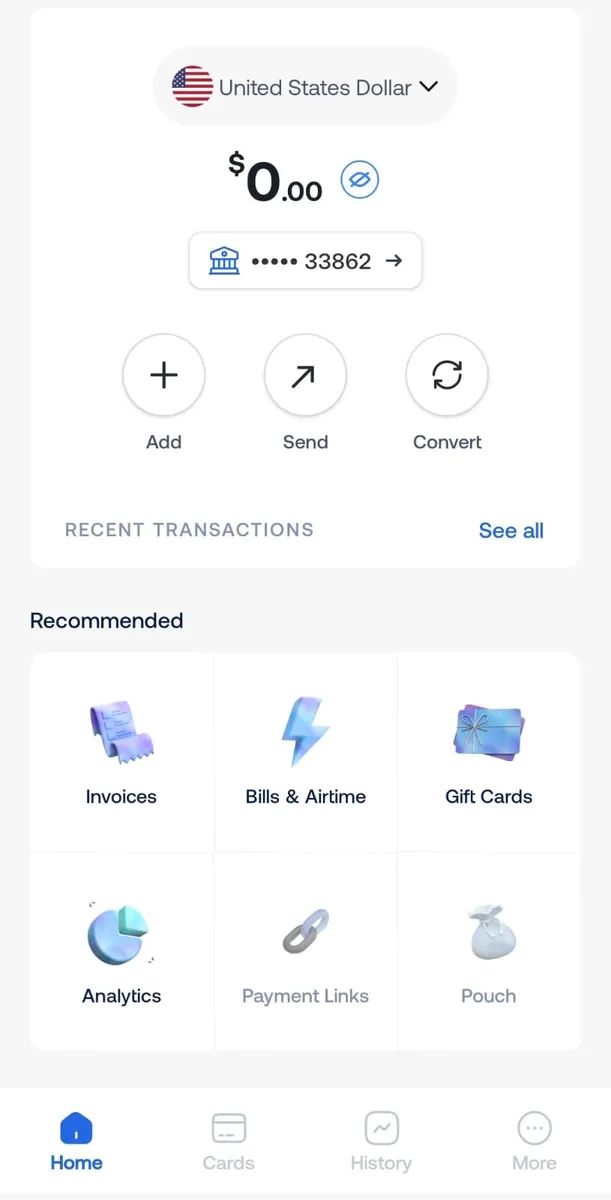
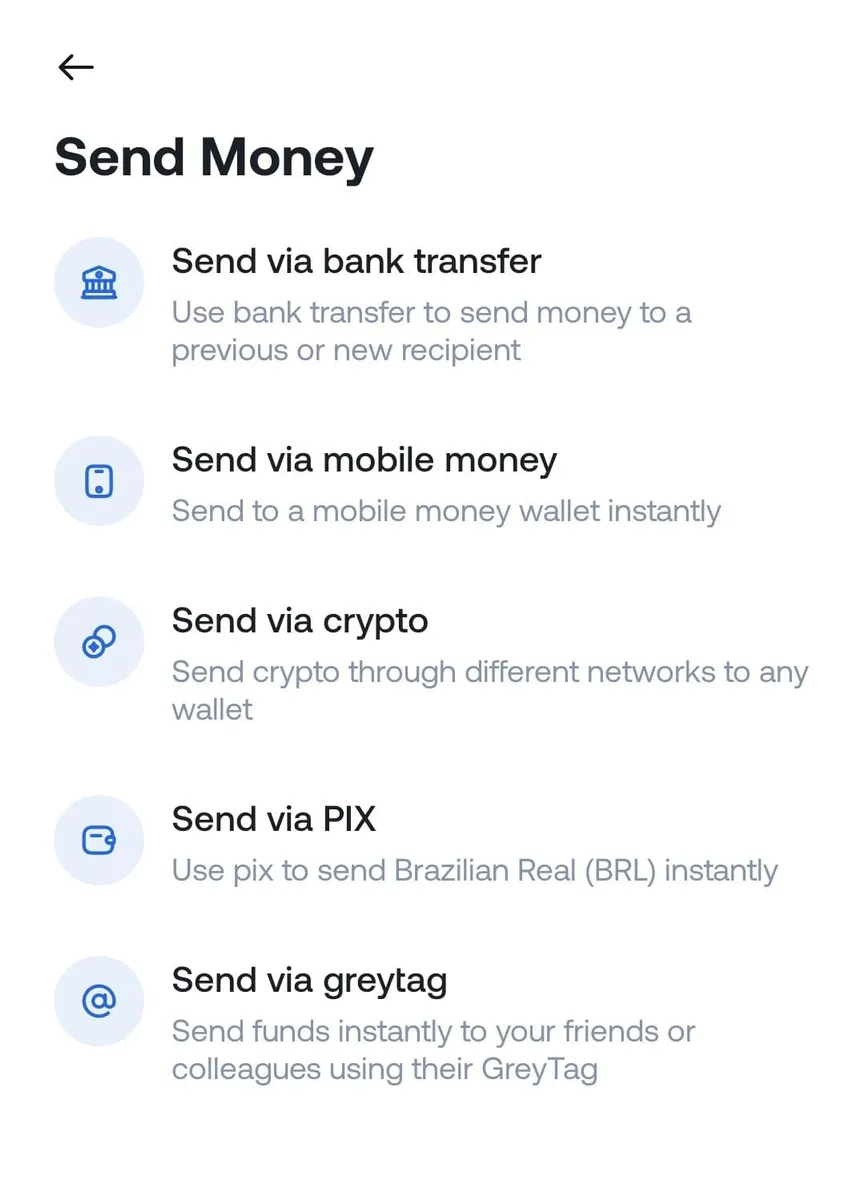
Grey transfers to Indian bank accounts arrive within minutes. UPI transfers are similarly fast. The entire transaction happens in the app: enter the amount, see the fee and rate, confirm, done. No driving to an agent location, no filling out paper forms, no carrying cash.
For the India corridor specifically, Grey's UPI support is a practical differentiator. UPI adoption has crossed 300 million active users in India. For most recipients under 50, UPI is the preferred way to receive money. Sending to a UPI ID with Grey is equivalent to WU's cash-in-minutes proposition, but digital and cheaper.
Also read: Grey vs Wise: Which delivers more INR to India?
Account features
| Feature | Western Union | Grey |
|---|---|---|
| Multi-currency balance | No | Yes (USD, GBP, EUR) |
| Virtual card | No | Yes (Visa) |
| GreyTag (free P2P) | No | Yes |
| Invoicing | No | Yes |
| Account type | Transfer service | Financial account |
| Physical presence | 500,000+ agent locations worldwide | App only |
| Business features | WU Business Solutions | Grey Business |
Western Union is a transfer service. You send money. That is the product. There are no balances, cards, or financial features beyond the transfer itself. WU Business Solutions exists for enterprise clients, but the consumer product is purely a remittance tool.
Grey is a financial account that includes transfers. You hold balances in three currencies, pay for things with a virtual card, receive payments via invoicing, and send money to other Grey users for free via GreyTag. For someone whose financial life spans two countries, Grey replaces multiple products: a transfer service, a foreign currency account, and an international payment card.
Also read: How to compare money transfer rates to India
When to use Western Union vs Grey
Use Western Union if:
- Your recipient needs physical cash at an agent location.
- Your recipient does not have a bank account or smartphone.
- You need to send in person (some senders prefer walking into a WU location).
- You need to fund with a credit card (WU allows it; Grey does not).
- You are sending to a location with unreliable digital banking infrastructure.
Use Grey if:
- Your recipient has a bank account or uses UPI (which covers the vast majority of urban and semi-urban India).
- You send money monthly or more often and want the lowest total cost.
- You want to see the fee and exchange rate separately before confirming.
- You need a multi-currency balance for holding USD, GBP, or EUR.
- You want a virtual Visa card for international payments.
- You invoice clients or receive payments in foreign currencies.
Common mistakes when comparing Western Union and Grey
- Looking only at the WU fee. A $7 WU fee looks comparable to Grey. But the exchange rate margin adds $15-$30 on a $1,000 transfer. The fee is the smaller cost. The rate margin is the larger one. Always check the total INR the recipient receives, not just the fee.
- Assuming WU is safer because it is bigger. Size does not equal safety in regulated financial services. Both WU and Grey are regulated. WU is publicly traded and licensed worldwide. Grey is backed by Y Combinator and holds appropriate US licenses. Both use bank-level encryption and identity verification. The relevant safety question is whether the provider is regulated, not how large it is.
- Using WU for bank transfers out of habit. If your recipient has a bank account, WU's bank deposit option is significantly more expensive than Grey or Wise and often slower (1-2 days vs minutes). WU's value proposition is the agent network. For bank transfers, digital-first platforms are cheaper and faster.
- Not accounting for the recipient's experience. WU cash pickup requires the recipient to travel to an agent location, present ID, and wait in line. Grey UPI delivery puts the money in their phone instantly. For regular transfers to someone with a smartphone, the recipient's experience with Grey is meaningfully better.
Frequently Asked Questions
1. Is Western Union more expensive than Grey for India transfers?
Yes, for bank account and UPI transfers. WU uses dual-layer pricing (a visible fee plus a margin in the exchange rate), which typically costs $25-$40 for a $1,000 transfer. Grey's total cost is usually $5-$15 for the same amount. The gap is widest for bank deposits and narrower for cash pickup, where WU's agent network provides value that Grey does not offer.
2. Does Grey offer cash pickup in India?
No. Grey delivers to Indian bank accounts and UPI IDs only. If your recipient needs physical cash at an agent location, Western Union, Remitly, or Xoom are the options. If your recipient has a bank account or uses UPI, Grey is typically faster and cheaper.
3. How much can I save by switching from Western Union to Grey?
On monthly $1,000 transfers, the savings are approximately $15-$30 per transfer, or $180-$360 per year. Over 5 years, that is $900-$1,800. The exact savings depend on the WU exchange rate margin on the day you compare. Run a side-by-side comparison on both platforms for your specific amount.
4. Is Western Union safe for sending money to India?
Yes. Western Union has been operating for over 150 years and is licensed as a money transmitter in every US state. It is publicly traded (NYSE: WU) and regulated globally. Grey is similarly regulated with FinCEN registration and state licenses. Both are safe for transfers.
5. Can I send from a WU agent to a Grey account?
Not directly. Western Union and Grey are separate services. You cannot initiate a WU transfer and have it land in a Grey account. To use Grey, you send from the Grey app funded by your US bank account. To use WU, you send from the WU app or an agent location. They are independent transfer paths.
6. Does Western Union support UPI in India?
No. Western Union delivers to Indian bank accounts and offers cash pickup at agent locations. It does not support UPI. Grey supports UPI delivery, allowing you to send directly to a recipient's UPI ID. This is faster and more convenient for recipients who use UPI as their primary payment method.
Grey shows the exchange rate and fee before every transfer. Compare for yourself at grey.co/blog/fees-and-charges-on-grey.



