

Hiring people in different countries can open up access to great talent, but paying everyone correctly is where things can become complicated. Different countries have their own tax rules, employment laws, currencies and payroll requirements, making international payroll far more difficult than simply sending a monthly payment.
Global payroll services take much of this administrative work off a company's hands. Depending on the provider, businesses can use them to pay international employees and contractors, manage taxes and deductions, handle local compliance and, in some cases, hire workers through an employer of record. This can make expanding a remote team much easier.
The right provider will usually depend on factors like where your team is based, how you hire and how much support you need. Some platforms focus on payroll, while others combine payroll with contractor management, benefits and HR tools. Below, we compare 15 global payroll services for remote teams, including what each offers and who they may suit best.
Also read: How companies run bulk payouts to international contractors
What is a global payroll service and how does it work?
A global payroll service helps businesses pay employees and contractors who work across different countries. Instead of managing every country's payroll rules separately, a company can use one provider to handle payments, tax requirements, payroll calculations and other administrative tasks across multiple locations. This becomes especially useful as a remote team grows.
Unlike domestic payroll, international payroll has to account for different tax systems, currencies, employment regulations, reporting requirements and payment schedules. A company paying someone in the UK, for example, may have very different obligations from one paying a worker in Brazil or Germany. A global payroll provider helps businesses manage these differences without building separate payroll processes for every country.
Some providers also offer Employer of Record (EOR) services. While payroll services primarily help manage payments and compliance, an EOR can legally employ workers on a company's behalf where the business does not have its own local entity. The two services can therefore work together, but they are not the same thing.
Read also: 5 red flags when choosing an international payment platform.
15 best global payroll providers for international teams
Deel: Comprehensive international hiring engine offering fast onboarding alongside powerful contractor management workflows.
- Strength: Rapid, automated global contractor onboarding and multi-currency payouts.
- Best fit: Fast-growing startups heavily relying on cross-border freelance teams.
Remote: Fully owned-entity legal infrastructure delivering highly stable, compliant cross-border payroll processing.
- Strength: Tighter risk management via direct entity ownership over third-party aggregators.
- Best fit: Compliance-focused organisations seeking transparent EOR and payroll combinations.
Rippling: Unified global workforce solution connecting localised payroll with domestic IT hardware provisioning.
- Strength: Deep cross-departmental automation linking employee data, applications, and hardware.
- Best fit: Tech companies wanting consolidated IT, finance, and global HR systems.
Papaya Global: Advanced fintech-driven engine delivering powerful gross-to-net reporting across global jurisdictions.
- Strength: Unified payments network automating direct cross-border worker bank deposits.
- Best fit: Mid-market and enterprise finance teams requiring deep accounting analytics.
ADP GlobalView: Heavy-duty global compliance network backed by unparalleled legacy payroll processing infrastructure.
- Strength: Robust governance designed to scale across complex multi-country operational structures.
- Best fit: Fortune 500 multinationals with existing domestic ADP infrastructure configurations.
Oyster HR: Dedicated international employment platform offering straightforward pricing and clear global onboarding.
- Strength: Intuitive, mission-driven dashboard minimising local worker misclassification risks.
- Best fit: Distributed remote-first companies expanding rapidly across diverse foreign markets.
Globalization Partners (G-P): Enterprise-grade employment framework providing high-touch legal guidance across many foreign jurisdictions.
- Strength: High-touch premium legal support reducing risks for multi-country expansions.
- Best fit: Established corporations prioritising strict risk management without local entities.
Multiplier: Highly cost-effective global platform delivering predictable flat-rate international employment service pricing.
- Strength: Instantly generated, fully localised benefits packages meeting specific country regulations.
- Best fit: Budget-conscious businesses requiring flat-rate multi-country employee management.
Remofirst: Budget-friendly international EOR provider omitting complex setup or costly onboarding fees.
- Strength: Exceptional cost transparency featuring lowest-in-industry baseline monthly service rates.
- Best fit: Capital-efficient early startups executing basic global remote hiring plans.
CloudPay: Specialised cloud-based treasury management platform organising multi-currency worker salary distributions.
- Strength: Integrated on-demand earned wage access feature for global payroll teams.
- Best fit: Mid-market operations requiring specialised global payroll and unified treasury apps
Safeguard Global:
- Strategic managed services provider blending modern software with regional payroll experts.
- Strength: Hybrid service architecture assisting companies navigating regional local tax regulations.
- Best fit: Mid-market organisations desiring an expert outsourced local payroll department.
Velocity Global: Advisory-led international growth firm providing tailored, high-touch workforce mobilisation solutions.
- Strength: Specialised human guidance assisting with complex corporate cross-border transition phases.
- Best Fit: Midsize firms seeking consultative advisory partnerships over basic self-serve software.
Lano: Modular multi-country network enabling unified management of existing local payroll providers.
- Strength: Aggregates disparate localised vendor dashboards into one centralised interface.
- Best fit: Businesses holding established local entities wishing to consolidate independent providers.
Atlas HXM: Direct international entity owner delivering centralised end-to-end global workforce management capabilities.
- Strength: Fully localised internal corporate compliance chain skipping volatile partner networks.
- Best fit: Middle-market companies seeking non-aggregated, single-source international workforce frameworks.
Justworks: Domestic payroll extension providing effortless, compliant cross-border independent contractor payments.
- Strength: Seamless international payment transitions for businesses already using Justworks domestically.
- Best fit: U.S. small businesses scaling globally by utilising international independent freelancers.
How to choose the right global payroll provider
- Countries covered: Check that the provider supports every country where your team currently works and any markets you plan to enter. Coverage matters if your remote workforce is likely to expand.
- Compliance support: Look for providers that keep up with local tax rules, employment regulations, reporting requirements and statutory payments. Strong compliance support can reduce mistakes and the risk of penalties.
- Pricing: Compare the full cost rather than looking only at the advertised starting price. Check transaction fees, employee charges, contractor costs, currency conversion fees and additional charges for extra services.
- Integrations: Choose a platform that connects with your existing HR, accounting, finance and time-tracking software. Good integrations can reduce duplicate data entry and make payroll administration much easier.
- Customer support: Consider how quickly you can reach the provider when something goes wrong. Responsive support is particularly important when dealing with payroll deadlines, international payments or country-specific compliance questions.
Do you need payroll to pay international contractors?
For a small business working with a few independent contractors, a full payroll service can sometimes be more than you actually need. If contractors are responsible for their own taxes and benefits, you may simply need a reliable way to pay them.
Direct contractor payments can make sense when you have a small, straightforward team, particularly if everyone works independently and you are not managing employees across multiple countries. In these cases, paying invoices directly can keep your setup simpler and reduce unnecessary payroll administration.
A full payroll service becomes more useful as your team grows or your hiring becomes more complex. If you are paying employees in several countries, managing tax requirements or dealing with different employment rules, specialist support can save considerable time and reduce compliance risks.
How to pay international contractors
Paying international contractors becomes more complicated as your team grows, especially when you have multiple contractors across different countries and need to make payments on a regular schedule. Businesses need a payment solution that can handle these payouts efficiently without creating a separate banking process for every contractor.
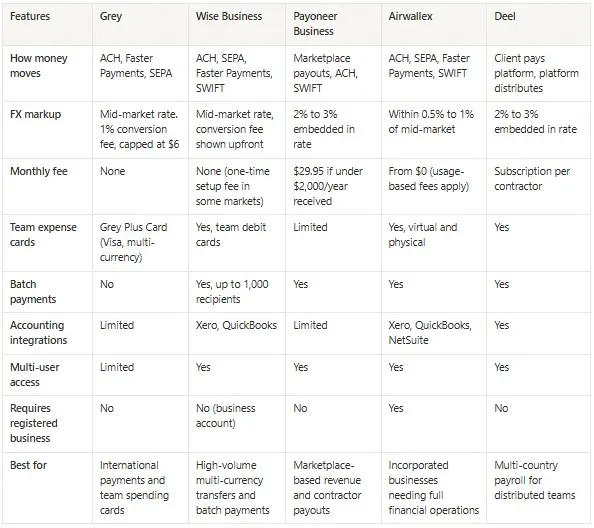
Grey Business helps companies simplify international contractor payments with bulk payouts, allowing businesses to pay multiple contractors across borders in one streamlined process. For example, a US company with contractors in the Philippines can use Grey Business to send payments in USD to its contractors, making it easier to manage recurring international payroll from one enabling businesses to pay multiple contractors across borders in a single, place.
This is particularly useful for businesses with distributed teams, agencies and companies working with contractors across multiple markets. Rather than processing each payment individually, finance teams can manage multiple contractor payments together, making international payroll faster and easier to manage.
Frequently asked questions on the best global payroll services for remote teams
What is global payroll?
Global payroll is the process of paying employees and contractors who work across different countries while managing the tax, reporting and employment requirements that apply in each location. A global payroll provider can bring these processes together, making it easier for businesses to manage international payments without running separate systems for every country.
Do I need payroll for contractors?
Not necessarily. If you only work with a small number of independent contractors, you may be able to pay them directly based on their invoices and agreed terms. A payroll service becomes more useful when your contractor network grows or you need help managing payments, compliance and records across multiple countries.
What is the difference from an EOR?
A payroll provider helps manage payments, tax requirements and payroll administration, while an Employer of Record (EOR) legally employs workers on your behalf in countries where you do not have a local entity. An EOR therefore handles employment responsibilities that go beyond simply processing someone's pay.
How much does global payroll cost?
Global payroll pricing varies depending on the provider, number of workers, countries covered and services included. Some charge per employee each month, while others use different pricing structures. Extra costs may apply for contractor payments, currency conversion, tax support, integrations or EOR services, so compare the complete cost.
How do contractors get paid?
Contractors usually submit an invoice or payment request based on the agreed work and payment schedule. Businesses can pay them through bank transfers or international payment platforms. For overseas contractors, services such as Grey can make it easier to receive international payments, manage supported currencies and move money.
What is the best option for a small team?
For a small team, the simplest option is often the most practical. If you only have a few contractors, paying them directly may be enough. As your team expands across countries, a payroll provider can reduce administrative work and help you manage international payments and compliance more efficiently.