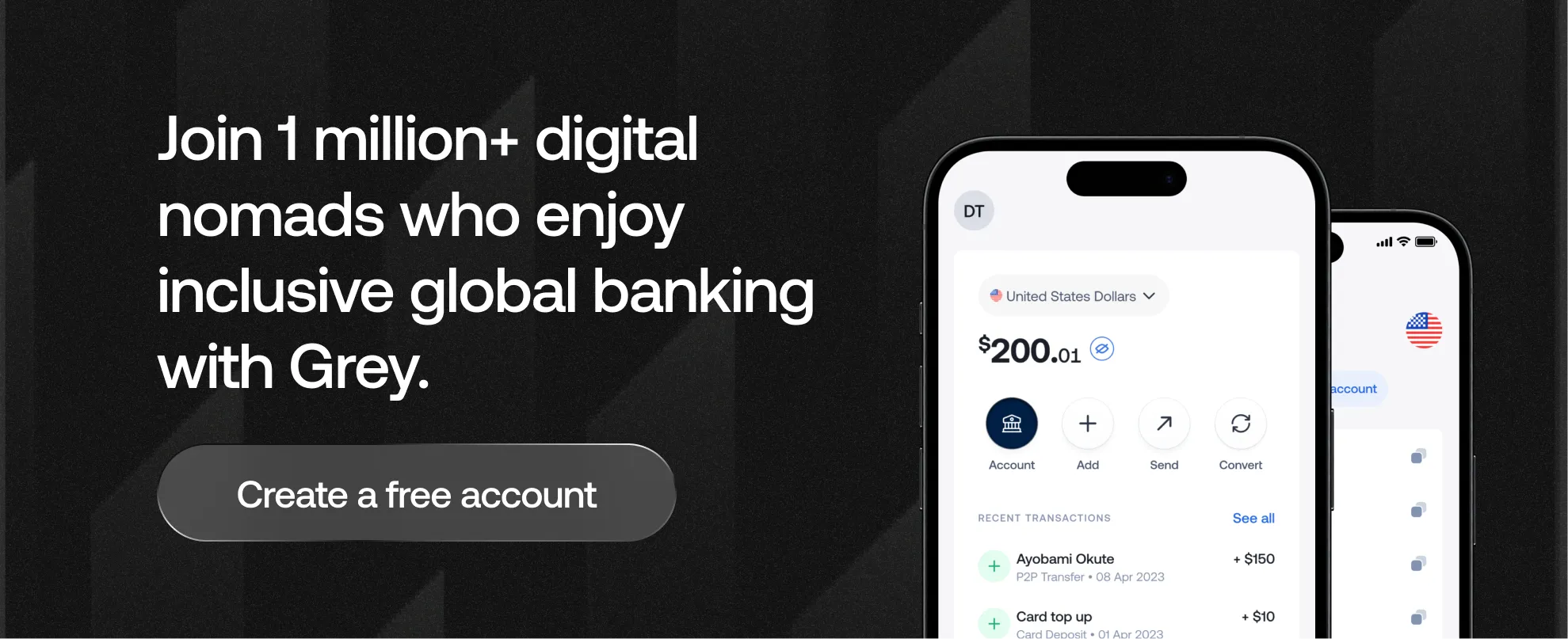


For too long, managing payments, compliance, and expenses has been complicated for global teams and businesses. Paying contractors abroad , handling multiple currencies, or even just tracking team expenses can quickly become overwhelming.
We set out to change this at Grey.
We’re excited to introduce Grey Business: an expanded suite of tools built to help you manage your company’s global finances with more control, clarity, and confidence.
Starting today, if your team in Indonesia needs to collect payments from clients in London, or your start-up in Nairobi needs to pay partners in New York, you can do it all seamlessly from your Grey Business dashboard.
Managing everything from multi-currency accounts and expenses to wage payouts and APIs is now simpler with Grey. All the tools you need to power your global operations in one simple, easy-to-use dashboard.
Here's a closer look at what Grey Business can help you achieve:
Foreign accounts for your business
With Grey Business, you can open and manage foreign bank accounts in USD, just like a local company would.
Each account comes with a unique IBAN, routing number, and SWIFT code, making it easier and faster to send and receive payments internationally.
No hidden charges. No long waiting times. No complicated paperwork.
All of this is built on a foundation of security and compliance. Every business account goes through KYC/KYB checks, with fraud prevention and transaction monitoring built in to keep your funds safe.
Empower your team with smart virtual cards
Stop playing "pass the credit card" or waiting for OTPs just to pay for a software subscription. With Grey Business, you can issue unlimited virtual USD cards instantly. Whether you need to cover digital ad spend, manage SaaS subscriptions, or equip your team for operational expenses, you can create dedicated cards in seconds.
But such speed doesn’t mean you lose control. You can set custom spending limits for each card, assign them to specific team members, and freeze or delete them instantly if a project ends.
Individual and bulk payouts made easy
As your business scales, your administrative load shouldn't have to keep pace. We built our payout engine to handle volume without the friction.
- One-off payments: send money to partners or vendors instantly with just a few clicks.
- Bulk payouts: Use our "Bulk upload" feature to ingest a simple CSV file and process mass payments simultaneously.
Whether you’re paying one vendor or a hundred, Grey Business gives you the flexibility you need.
- Individual payouts: Send one-off payments to partners or contractors in over 100 countries. Get real-time foreign exchange rates before confirming and choose between bank transfers or mobile money.
- Bulk payouts: Need to send multiple payments at once? Upload a CSV file, review everything in one dashboard, and let Grey handle the rest. You can even track payment statuses and retry failed ones instantly.
Whether it’s fiat or crypto, individual or bulk, local or global, Grey brings you speed, visibility, and reliability in one place.
Native USDC Support for the modern business
We know that for many modern companies, Fiat is only half the story. With Grey Business, you can hold a dedicated USDC balance alongside your fiat currencies, giving you total control over how you store your capital.
Need to move funds fast? You can deposit or withdraw USDC via the BEP20 network and send funds to any compatible wallet in seconds. It is the stability of the dollar with the speed of the blockchain, fully integrated into your dashboard.
APIs that grow with your business
If your company handles high-volume or automated payments, our developer APIs give you more control than ever.
You can now initiate payouts automatically through the Grey API — perfect for platforms, marketplaces, and payment-driven businesses that need to pay users regularly .
By integrating Grey directly into your systems, you can trigger local and international transfers with just a few lines of code.
We’ve also built P2P GreyTag APIs that let you verify user identities and send peer-to-peer payments directly from your platform.
This means you can embed Grey’s payment capabilities right into your product, with the same reliability and compliance we’re known for.
A unified dashboard for your finances
No need to toggle between different banking apps and spreadsheets to piece together your financial health. We built the Grey Business dashboard to give you a single, holistic view of your operations.
From one screen, you can track inflows, manage your USD balance, and monitor the real-time status of every payout. And when tax season arrives, you can easily generate detailed statements instantly, giving your accounting team exactly what they need without the headache.
Why Grey Business matters
Grey Business started as a way to help businesses make seamless cross-border payments.
But as our users grew, so did their needs. They didn’t just need to send payments; they needed to manage everything that comes with it: teams, approvals, accounts, reporting, and compliance.
Grey is no longer just a payments platform; we’re becoming the financial command centre for modern global businesses.
Whether you’re a start-up expanding into new markets, a remote team paying global talent, or a platform handling thousands of transactions, Grey Business is built to help you operate confidently across borders.
Start your global journey with Grey Business
The future of global business banking is here: faster, simpler, and built for the way modern teams work.
Open your Grey Business account today and experience:
- Instant access to USD and USDC accounts
- Smarter controls for teams and treasury
- Virtual USD cards for teams
- Powerful automation with APIs
- A unified dashboard track all your balances
Get started at grey.co/business
.svg)