
Accepting ACH payments for free is possible through payment providers that offer zero-fee bank transfers or allow businesses to receive payments directly into their bank accounts. The best option depends on whether you are collecting money from customers, receiving freelance payments or accepting recurring business payments.
Start by checking whether your bank offers free ACH collections. Some banks provide this service through business accounts, while platforms such as payment processors may charge transaction or monthly fees. Compare their pricing, settlement times, transaction limits and return fees before choosing.
If you need a free instant ACH transfer online, check whether the provider supports same-day processing. Standard ACH transfers usually take one to three business days, so instant settlement is not guaranteed. Also, confirm that free transfers apply to receiving payments, not just sending money.
What are ACH payments?
ACH (Automated Clearing House) payments are electronic bank-to-bank money transfers processed through a centralised US financial network. They allow individuals and businesses to send and receive money directly between US bank accounts without using paper cheques or physical cash. Common examples include direct deposits, bill payments, payroll and recurring subscriptions.
How the ACH network works
When you initiate an ACH payment, your bank collects the transaction details and groups them with other payments into a batch. It then sends the batch to an ACH operator, either the Federal Reserve or The Clearing House, which sorts the transactions and routes them to the recipient's bank. The recipient's account is credited using their bank routing and account numbers.
ACH timing and wire transfer differences
Standard ACH transfers typically take one to three business days to settle, although eligible Same-Day ACH transactions can arrive sooner. If you are comparing payment options, understanding how long a wire transfer takes can help you choose the right method.
Unlike ACH, wire transfers are processed individually rather than in batches. They can arrive within hours, are generally harder to reverse, and often cost $15–50 per transaction. ACH payments are usually cheaper, but settlement is not always immediate.
How to accept ACH payments step by step
Accepting ACH payments involves choosing a payment provider, verifying your account, collecting the necessary bank details and obtaining authorisation before initiating a transfer. Whether you run a US-based business or work as an international freelancer, follow these five steps to start receiving ACH payments.
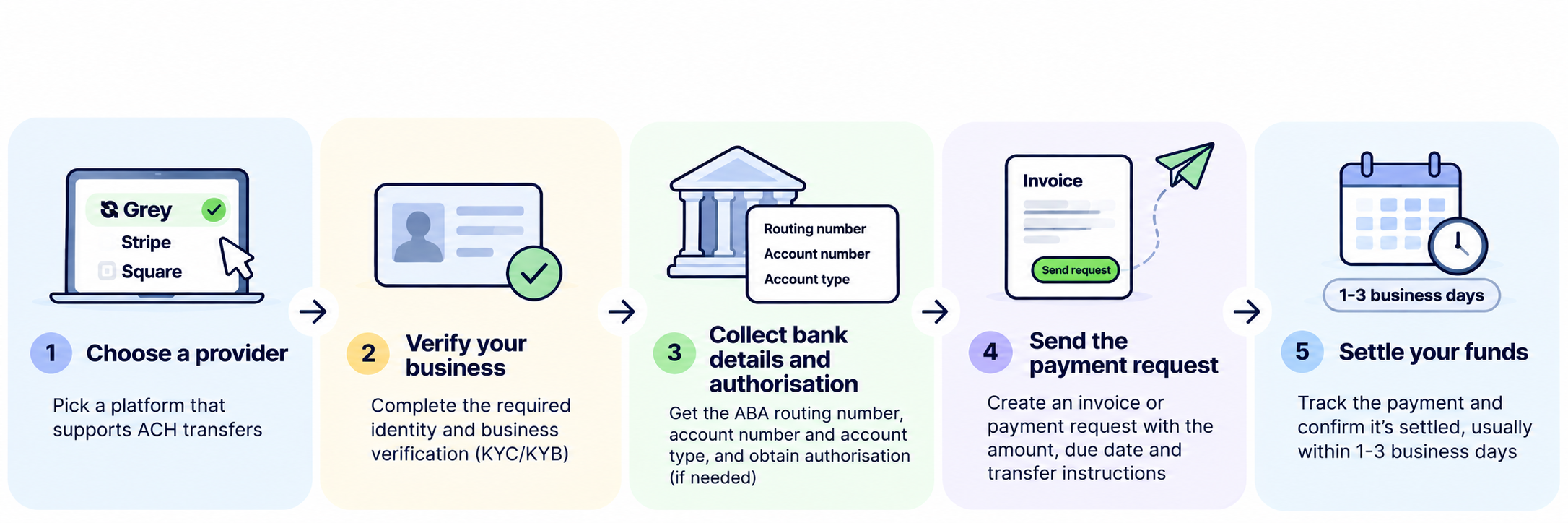
- Choose a provider: Select a platform that supports ACH transfers. US businesses can use Stripe, Square or QuickBooks, while international freelancers may use virtual USD accounts such as Grey, Geegpay or Payoneer.
- Verify your business: Complete the required identity and business verification (KYC/KYB). This may involve submitting a government-issued ID, business registration documents, an Employer Identification Number (EIN), relevant tax forms such as W-9 or W-8BEN, and your payout bank details.
- Collect bank details and authorisation: For ACH payments, you need the recipient's nine-digit ABA routing number, bank account number and account type (checking or savings). Understanding what a routing number is helps you identify the correct bank details and avoid failed transactions. If you are collecting payments through ACH debit, obtain the customer's authorisation before initiating the transfer. For ACH credit, provide your receiving account details to the sender.
- Send the payment request: Create an invoice or payment request through your provider's dashboard. Include the payment amount, due date and instructions for completing the bank transfer.
- Settle your funds: Once initiated, standard ACH transfers typically take one to three business days to settle. Monitor your dashboard for completed payments, failed transactions or returned deposits before treating the money as available.
How to accept ACH payments for free
Freelancers looking for apps for freelancers to get paid often need more than a way to receive money; they also want to avoid unnecessary transaction fees. ACH payments offer one option, with several ways to receive funds without paying a receiving fee. These include direct bank-to-bank transfers, Zelle and contractor payment platforms such as Deel, although each comes with different requirements and limitations.
Here are three options worth considering:
- Direct bank-to-bank ACH credit (Mercury, Relay or US checking accounts): Clients send money directly to your account using your routing and account numbers, often at no additional receiving cost. However, you sacrifice automated invoicing, recurring payment collection and built-in payment management. This works best for US-registered businesses receiving payments from trusted clients.
- Zelle (US Bank accounts): Zelle allows eligible users to send and receive money between participating US banks without transfer fees. Payments are typically delivered within minutes. However, it has transaction limits and is not designed for formal business invoicing. It is better suited to individuals and freelancers collecting smaller payments.
- Deel (contractor payouts): International contractors can receive payments through Deel's contractor payment system, including ACH payouts where supported. Receiving fees may be covered, depending on the payment arrangement. However, currency conversion and withdrawal fees may apply when moving funds into another currency. This option suits freelancers working with international companies.
The hidden costs of "free" ACH
While many platforms advertise free ACH payments, the actual costs can appear elsewhere. Monthly subscriptions, failed-payment fees, withdrawal charges and transaction limits can make a supposedly free service expensive. Settlement delays can also affect cash flow, particularly for freelancers who depend on timely payments.
Even when a provider charges no fee to receive funds, transferring funds from a US account to Nigeria may involve additional fees or unfavourable exchange rates.
Before choosing a provider, check its current fee schedule, especially if you receive frequent payments or withdraw funds in Naira. A zero receiving fee does not necessarily mean zero overall cost.
Getting paid by US clients from abroad
Receiving payments from US clients while living abroad can be challenging if your local bank account does not support ACH transfers. The ACH network only processes payments between eligible US bank accounts, meaning international freelancers often need a US-based receiving account to collect payments from American businesses.
One option is to open a USD account that provides US bank details, including a routing number and account number. This allows clients to send money through ACH without relying on international wire transfers, which can attract higher fees and longer processing times.
Platforms such as Grey provide virtual USD accounts that allow eligible users outside the US to receive payments from American clients. Once your account is set up and verified, you can share your receiving details with clients who want to get paid from the US through a domestic bank transfer.
After receiving your funds, you can move your money abroad by withdrawing or converting your USD balance into your local currency, subject to Grey's supported countries, withdrawal options and applicable fees. This gives international freelancers another way to manage cross-border payments without needing to maintain a traditional US bank account.
Frequently asked questions about how to accept ACH payments for free
1. Can I accept ACH payments for free?
Yes. You can accept ACH payments without receiving fees through direct bank-to-bank ACH credits or eligible contractor payout services. However, a free transfer does not always mean a free account. Monthly subscriptions, withdrawal charges, return fees and currency conversion costs may still apply. Check the provider’s fee schedule and eligibility requirements before choosing an option for receiving payments.
2. How long does an ACH payment take?
Standard ACH transfers typically settle within one to three business days. Eligible transactions may qualify for Same-Day ACH, while some payment processors take five to seven business days, particularly for first-time payments. The actual arrival time depends on the provider’s processing schedule, bank cut-off times, weekends and public holidays. Check the estimated settlement date before relying on funds.
3. Is ACH cheaper than a card payment?
Yes. ACH payments are generally cheaper than card transactions because processing fees are usually lower. Depending on the provider, receiving an ACH payment may be free or cost less than 1%. Card payments often carry higher processing charges, especially for international transactions. Compare the full fees, including currency conversion, before choosing how to collect payments in most cases.
4. Can I accept ACH without a US bank account?
Yes. International freelancers may be able to receive ACH payments through eligible virtual USD accounts from providers such as Grey or Geegpay. These services can provide US routing and account numbers for clients making domestic bank transfers. Availability depends on your country, account verification and provider terms, so confirm that your account supports incoming ACH payments before sharing its details.
5. What is an ACH return fee?
An ACH return fee is a charge applied when a bank transfer is rejected or returned. Common reasons include insufficient funds, incorrect account details, a closed account or a payment dispute. The amount varies by bank and payment provider, and some providers may pass the fee to the business receiving the payment. Review the return policy before accepting payments for each transaction.
6. Can international freelancers receive ACH payments in dollars?
Yes. International freelancers can receive ACH payments in US dollars through eligible virtual USD accounts that provide US routing and account numbers. After the funds arrive, they may be able to hold the balance, withdraw it or convert it into local currency. Available options, processing times and fees depend on the provider, your country and account verification before making withdrawals.