
<script type="application/ld+json" data-schema-version="grey-blog-v4"> [{"@context":"https://schema.org","@type":"BlogPosting","@id":"https://grey.co/blog/how-fiverr-freelancers-in-algeria-can-receive-payments-easily-in-2026#article","headline":"How Fiverr freelancers in Algeria can receive payments easily in 2026","description":"Explore the seamless way Algerian freelancers get paid on Fiverr through Grey.","inLanguage":"en","url":"https://grey.co/blog/how-fiverr-freelancers-in-algeria-can-receive-payments-easily-in-2026","mainEntityOfPage":{"@id":"https://grey.co/blog/how-fiverr-freelancers-in-algeria-can-receive-payments-easily-in-2026#webpage"},"datePublished":"2024-12-19T08:29:59.745Z","dateModified":"2026-06-01T10:40:54.206Z","author":{"@type":"Person","@id":"https://grey.co/authors/tunde-aladeloba#person","name":"Tunde Aladeloba","url":"https://grey.co/authors/tunde-aladeloba","jobTitle":"Content Writer","sameAs":["https://ng.linkedin.com/in/aladeloba-babatunde-b1114b100"]},"publisher":{"@type":"Organization","@id":"https://grey.co/#organization","name":"Grey","url":"https://grey.co","logo":{"@type":"ImageObject","url":"https://cdn.prod.website-files.com/6360022338a81bd6fdbb1145/6564ae1077a67e39d3c491a6_Grey%20Logo%20Lockup%20Black.svg"}},"image":{"@type":"ImageObject","@id":"https://grey.co/blog/how-fiverr-freelancers-in-algeria-can-receive-payments-easily-in-2026#primaryimage","url":"https://cdn.prod.website-files.com/636a85d290ee58e70c17e1c0/6763d91e9080d3c173ce0d9e_How%20Fiverr%20freelancers%20in%20Algeria%20can%20receive%20payments%20easily%20in%202025.webp","contentUrl":"https://cdn.prod.website-files.com/636a85d290ee58e70c17e1c0/6763d91e9080d3c173ce0d9e_How%20Fiverr%20freelancers%20in%20Algeria%20can%20receive%20payments%20easily%20in%202025.webp","width":1200,"height":675}},{"@context":"https://schema.org","@type":"WebPage","@id":"https://grey.co/blog/how-fiverr-freelancers-in-algeria-can-receive-payments-easily-in-2026#webpage","url":"https://grey.co/blog/how-fiverr-freelancers-in-algeria-can-receive-payments-easily-in-2026","name":"How Fiverr freelancers in Algeria can receive payments easily in 2026","description":"Explore the seamless way Algerian freelancers get paid on Fiverr through Grey.","inLanguage":"en","primaryImageOfPage":{"@id":"https://grey.co/blog/how-fiverr-freelancers-in-algeria-can-receive-payments-easily-in-2026#primaryimage"},"breadcrumb":{"@id":"https://grey.co/blog/how-fiverr-freelancers-in-algeria-can-receive-payments-easily-in-2026#breadcrumb"}},{"@context":"https://schema.org","@type":"BreadcrumbList","@id":"https://grey.co/blog/how-fiverr-freelancers-in-algeria-can-receive-payments-easily-in-2026#breadcrumb","itemListElement":[{"@type":"ListItem","position":1,"name":"Home","item":"https://grey.co/"},{"@type":"ListItem","position":2,"name":"Blog","item":"https://grey.co/blog"},{"@type":"ListItem","position":3,"name":"How Fiverr freelancers in Algeria can receive payments easily in 2026","item":"https://grey.co/blog/how-fiverr-freelancers-in-algeria-can-receive-payments-easily-in-2026"}]}] </script>

How Fiverr freelancers in Algeria can receive payments easily in 2026

Tunde Aladeloba

TABLE OF CONTENT

SHARE THIS POST

Imagine this: You're sitting in a café in Algiers, sipping mint tea, while a client from London praises the logo you just designed for their startup. The job’s done, and now it’s time to get paid. But how do you easily receive those hard-earned payments without hefty fees or delays?

For many freelancers in Algeria, this is a common challenge. Platforms like Fiverr have opened up the world for Algerian talent, with creatives and developers working for clients from across the globe. The struggle to access international payments without high fees or waiting weeks can be frustrating.

That’s where Grey comes in. With Grey, Algerian freelancers can easily receive Fiverr payments, giving you access to your earnings quickly and without the hassle.

Also read: How to start your freelancing career with Fiverr: A comprehensive guide

Why Grey is a game-changer for Algerian freelancers

  1. Multi-currency accounts: With Grey, freelancers get free virtual accounts in GBP,and EUR, allowing them to receive Fiverr payments directly. No need for traditional foreign bank accounts.
  2. Faster payments: Unlike many international systems, Grey ensures swift processing, so you can access your money without unnecessary delays.
  3. Low fees: Grey keeps transaction costs minimal, meaning more of your hard-earned money stays in your pocket.
  4. Favourable exchange rates: Easily convert your earnings into Algerian dinars (DZD) at competitive rates, maximising your income.
  5. Seamless withdrawals to local banks: Grey makes it simple to transfer funds to your local Algerian bank account, ensuring easy access to your money when you need it.

Also read: The ultimate guide to choosing the best freelancing platform in 2024.

How Algerian freelancers can connect Fiverr with Grey

  1. Sign up with Grey
    • Visit the Grey website and create a free account.
    • Receive your virtual multi-currency account details (GBP or EUR).
  2. Update your Fiverr payment settings
    • Log in to Fiverr and go to your payment preferences.
    • Select direct deposit or wire transfer and enter your Grey account details.
  3. Receive payments seamlessly
    • Once Fiverr processes your withdrawal, the money goes straight to your Grey account. From there, you can convert it to DZD or transfer it to a local bank.

Also read: How to receive and convert foreign currencies to USDC in Algeria

Freelancing in Algeria

With platforms like Fiverr and payment solutions like Grey, Algerian professionals are empowered to work seamlessly with clients worldwide.

Sign up with Grey today and start managing your Fiverr payments with ease and efficiency.

‍

Last updated:

October 2, 2026

Open a free Grey account to get startedJoin 1 million digital nomads
IF YOU ENJOYED THIS, CHECK THESE OUT

How freelancers receive recurring payments from US clients

•

•

2 min read

Freelancing income can be pretty unstable. One month is fully booked with steady client work. The next, you seem to be in a financial mess. This is exactly why many freelancers prefer ongoing gigs over one-time projects. Recurring payments are predictable, invoicing is routine, and you spend less energy taking up new gigs. If you work with US clients, these payments should be the most reliable part of your setup. properly

While managing recurring payments might seem easy on the surface, without the right payment process, you might struggle to chase payments and deal with payment delays. It is even more complicated if you are working with US clients while outside the United States. International transaction fees and currency conversion problems come into play. This article covers the main methods for receiving recurring payments from US clients.

Why do you need a recurring payment setup?

A one-off project payment is just a transaction, and that is all. When transactions are repeated, it becomes a payment system that requires a setup to guarantee efficiency. Here are some scenarios to help you see why you need to structure how you receive recurring payments:

  • If a client sends money to the wrong account once, they are likely to do that again if your payment setup is never corrected.
  • If you use a platform with high conversion fees, the costs pile up with every payment cycle and become significant.
  • If a payment method requires your client to initiate a transfer each month manually, the risk of errors increases with each payment.
  • If the payment terms are not clear enough, you might keep chasing your payment at the end of each payment cycle.

Getting the recurring payment setup right once and for all will save you the stress of running around trying to fix a faulty payment system.

Method 1: ACH direct deposit to a virtual USD account

For most freelancers receiving regular payments from US clients, an ACH payment to a virtual USD account is the most cost-efficient option. Since non-US freelancers don’t have a US address, don’t have a Social Security Number, and cannot visit a bank in person, fintechs offering virtual USD accounts provide a functional alternative.

The Automated Clearing House is a closed-loop network that operates entirely within the US banking system. Money moves directly from the client’s bank to your bank without going through correspondent banks, just like a local transaction. This means no intermediary fees are deducted during payment processing.

  • Open a virtual US account (Grey, Wise, or similar platforms designed for freelancers).
  • Share your routing and account details with the client.
  • Ask them to schedule a monthly ACH transfer in their banking app.
  • Money lands in 1–3 business days with a minimal fee
  • Convert to your local currency and withdraw to your account.

Let’s take Grey as an example. If you earn $2,000 monthly in recurring ACH payments to a Grey USD account, the deposit fee is 0.8% (capped at $10), the conversion is 1% (capped at $6), and withdrawals incur a flat fee depending on the currency.

Also read: How ACH payments work for freelancers outside the US

Method 2: ACH pull via a payment platform

When a client initiates a transaction via an ACH direct deposit, that is a push payment. But there is also an ACH pull that works the other way round. You or your platform initiates the transfer and pulls the money from the client’s account on a scheduled date.

This is just like how Netflix and other subscription services charge directly to your account. Here is the typical flow:

  • A US client agrees to a recurring payment arrangement via a platform such as Stripe or HoneyBook.
  • The platform collects the client’s US bank details once.
  • It automatically initiates an ACH debit on the agreed date each month, without the client taking any action.
  • The funds flow to the platform before being paid out to the freelancer.

Stripe is available in a limited number of countries. If Stripe isn’t available in your country, consider alternatives like HoneyBook, Dubsado, and Bonsai.

Method 3: Automated invoicing with payment links

Several invoicing platforms, including Wave, FreshBooks, QuickBooks, and Grey’s built-in invoicing tool, allow freelancers to send recurring invoices automatically and include a payment link that allows US clients to pay directly from the invoice.

  • Set up a recurring invoice template.
  • Link it to your virtual US account or Stripe.
  • Clients receive the invoice by email on a fixed date each month.
  • They click the payment link and choose their preferred method.
  • The payment processes without a phone call, bank transfer instruction, or any additional communication.

Method 4: Payroll platforms

If the recurring payment is structured as a genuine contractor relationship, platforms like Deel, Remote, and Ripple handle the payment chain on both sides.

  • The client adds you to their Deel or Remote account and schedules recurring payments.
  • The client pays the platform in USD.
  • The platform handles currency conversion and compliance documentation.
  • The freelancer receives funds through local payout methods available in their country, including direct bank transfers in local currency.

Payroll platforms are best suited to single-employer arrangements on a fixed monthly schedule. For freelancers managing multiple clients simultaneously, the added overhead outweighs the benefits.

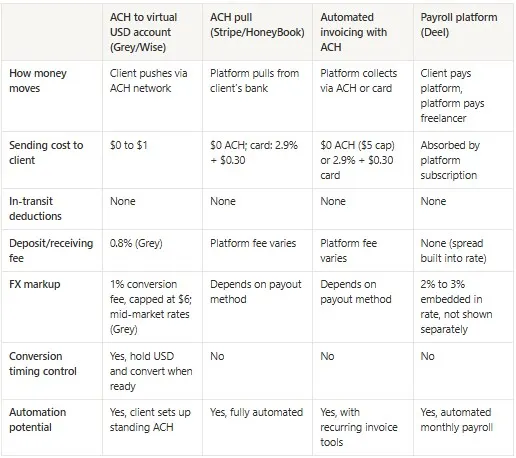
How the options compare

Let’s have a look at the options and how they compare:
__wf_reserved_inherit

Best practices when managing recurring payments

The goal is to set up a payment system that operates without errors, delays, failed payments, or excessive fees. Here is how to ensure that:

  • Provide complete payment details upfront, in the contract.
  • Ask explicitly whether the client can set up a standing ACH payment.
  • Invoice on a fixed date each month.
  • Follow up on the first late payment immediately.
  • Confirm the payment method is working before the second billing cycle.

Receive recurring payments from US clients with Grey

When it is a one-off payment, you might worry less about inefficiencies. But if you are managing recurring payments with an inefficient payment setup, inefficiencies tend to pile up and clog your cash flow pipeline.

Grey gives freelancers outside the US virtual USD accounts to receive recurring payments. You hold the balance in USD, convert at competitive exchange rates, and withdraw to your local bank account at a flat fee. Grey’s built-in invoicing tool also allows you to send recurring invoices and receive payment directly into your account without a separate platform.

Grey cards offer a unique way to manage international payments by letting you pay directly from your balance, without top-ups, in any currency. The cards also integrate with Apple Pay and Google Pay for fast, contactless payments.

Sign up on Grey and download the app to start managing your recurring payments without troubles.

‍

How to receive YouTube earnings in Nigeria

•

•

2 min read

If you’re a Nigerian YouTuber close to monetisation, first congratulations. You’ve earned it, or at least you’re about to. Now it’s important to understand how YouTube will pay you and how to properly set up your payment details, so you don’t lose out on your funds.

In this article, I will share exactly how YouTube pays creators, and what Nigerian creators need to do to maximise earnings.

How YouTube actually pays creators

YouTube doesn’t pay you directly. Instead, they pay through Google AdSense, which is Google’s advertising platform. When you’re accepted into the YouTube Partner Programme, you link your YouTube channel to an AdSense account, and that’s where your earnings accumulate.

AdSense pays in US dollars (USD). There’s a minimum payout threshold of $100, meaning you won’t receive anything until your earnings reach at least $100. Once you cross that threshold, AdSense processes payments monthly, typically between the 21st and 26th, for the previous month’s earnings.

So if you earn $150 in January, AdSense will pay you sometime between 21st and 26th February. Simple enough in theory, but where does that money actually go, and how do you access it in Nigeria?

Also read: How Indian YouTube creators receive their earnings from overseas

What do Nigerian creators need to be eligible?

To receive YouTube earnings in Nigeria, you need a few things in place:

A monetised YouTube channel: This means you’ve been accepted into the YouTube Partner Programme (1,000 subscribers, 4,000 watch hours in the past 12 months, and adherence to YouTube’s policies).

A Google AdSense account: You’ll create this when applying for monetisation. Make sure your AdSense account has your correct legal name and address.

A valid payment method: This is where it gets tricky for Nigerian creators. AdSense needs a way to send you money, and not every method works smoothly in Nigeria. I’ll discuss this in-depth later.

Tax information: AdSense requires you to submit tax details, even if you’re not in the US. Nigerian creators typically complete a W-8BEN form, which confirms that you’re a foreign person not subject to US tax withholding on most AdSense earnings.

Also read: How South Africans can receive YouTube payments from abroad

The problems Nigerian creators run into with receiving YouTube earnings

The first time I set up an AdSense payout, I added a Nigerian bank account and assumed everything would work smoothly. It didn’t.

First problem, delays. My first payment took nearly two weeks to arrive after AdSense marked it as sent. I had no visibility into where the money was or why it was taking so long.

The second problem was the fees and exchange rates. When the money finally arrived, I lost around 5 - 6% due to a combination of receiving fees and a terrible exchange rate set by my bank. On a $200 payout, that’s $10 - $12 gone, money I’d worked hard to earn.

I realised quickly that relying solely on wire transfers to a Nigerian bank wasn’t sustainable. I needed a better system.

Also read: How Ghanaian YouTubers can collect USD earnings

LDMAG1

How to receive YouTube payouts properly

After some research and talking to other Nigerian creators, I eventually figured out what actually works. The key is using a service that provides a US bank account or a more efficient way to receive USD payments than traditional Nigerian banks.

Here’s what I did:

Step 1: I opened an account on a platform that provides virtual USD accounts. Most people recommended Grey, and I obliged. Platforms like this give you US banking details (account number and routing number) that you can add to AdSense as your payout method. When AdSense sends payments, they go to this account instead of directly to a Nigerian bank.

Step 2: I updated my AdSense payment settings. In AdSense, under Payments > Payment methods, I added my new US bank details. AdSense verified the account by making small test deposits, which I confirmed.

Step 3: I waited for my next payout cycle. Once my earnings crossed $100 again, AdSense sent the payment to my US account. It arrived within 3 - 5 days, much faster than wire transfers to Nigerian banks.

Step 4: Instead of being forced to convert USD to naira immediately at whatever rate my bank decided, I held the money in USD and converted it when rates were favourable. I also had the option to spend directly from a USD card or withdraw to my Nigerian bank account.

This setup solved every problem I’d been facing: faster payments, better control over exchange rates, and no rejected transfers.

Also read: Valentine’s Day trips that work for remote couples

Tips I’d give a Nigerian YouTuber

Set up your payment method before you hit $100: Don’t wait until you’ve earned your first payout to sort this out. Get your USD account ready early so there are no delays when you finally qualify for payment.

Don’t rely on traditional wire transfers unless you have no other option: The fees and delays aren’t worth it. Get a free USD account with Grey, Wise to gain better control and faster access to your money.

Keep your AdSense details accurate: Make sure your name, address, and tax information match your official documents. Mismatches can delay payments or cause verification issues.

Track your earnings and fees: Know how much you’re actually receiving after conversion and fees. This helps you plan better and understand the real value of your content.

Focus on creating consistent content: The payment setup is important, but your primary job is still making videos people want to watch. Sort out the money side once, then get back to creating.

Create more, stress less

Once you’ve sorted out a reliable payment method, you can focus on making great videos and growing your audience.

Set up your USD receiving account now, link it to AdSense, and get back to creating. Your content deserves to be rewarded properly, and you deserve to receive that money without unnecessary stress.

Open your free Grey account today, or download the app, and start receiving your YouTube earnings faster, at better rates, and with full control over your money. Because you’ve earned it, you should actually get to keep it.

‍

Receiving foreign income in Morocco without a domiciliary account

•

•

2 min read

Is it possible to receive foreign income in Morocco without a domiciliary account? The simple answer is yes. However, it is not always straightforward, especially with the wrong payment services.

Domiciliary (foreign currency) accounts were once the standard for Moroccans earning in USD, EUR, or GBP, but they are becoming less popular. Opening one often involves extensive paperwork, multiple bank visits, minimum balance requirements, and strict compliance with local regulations. Beyond these,  SWIFT fees, intermediary charges, and poor conversion rates when converting to MAD make them too expensive for the average person.

The good thing is that you don’t need a traditional domiciliary account at banks such as Attijariwafa Bank or Banque Centrale Populaire to manage international payments efficiently. Freelancers, remote workers, and expats earning from abroad can not find alternatives that suit their needs.

This article explains how Moroccans can receive foreign income without a domiciliary account and describes the pros and cons of each option.

Why do many Moroccans avoid domiciliary accounts?

A domiciliary account allows you to receive foreign currencies without immediate conversion to MAD. On paper, this sounds ideal. In practice, these accounts come with significant problems. A domiciliary (or foreign currency) account allows you to receive USD, EUR, or GBP without automatically converting to MAD. However, these accounts have considerable limitations, including:

  • You have to visit the banking hall.
  • It might require cumbersome paperwork.
  • It takes a while to open an account.
  • SWIFT fees and other bank charges can eat into earnings.
  • There is limited flexibility when trying to make online payments and subscriptions.
  • Transactions may take a few days to complete.

How Moroccans receive foreign income without a domiciliary account

There are three main alternatives: online payment platforms, fintech multi-currency accounts, and cash pickup services. Each serves a different purpose, depending on how often you get paid and how much control you want over your money.

LDMAG1

PayPal

PayPal is one of the most widely recognised international payment platforms. Many foreign clients already trust and use PayPal, which makes it easy to request payments without lengthy explanations or setup.

PayPal allows Moroccans to receive payments in foreign currency and withdraw funds to a local bank account or card. Transactions are usually instant, and the platform is easy to use. However, PayPal is designed more for convenience than cost efficiency. Withdrawal requires automatic conversion to MAD, often at exchange rates that include hidden mark-ups. Fees can be substantial, especially for regular income, and users have little control over when or how conversion happens. There are also frequent reports of account restrictions and suspensions that can interrupt your cash flow or lead to losses.

PayPal works best for occasional payments or short-term use, but it becomes expensive and restrictive for consistent freelance or remote income.

Fintech platforms and multi-currency accounts

This is easily a top recommendation for managing international payments in Morocco. Most of these platforms are designed to address the challenges posed by the rigid traditional domiciliary account payment system. They let you complete cross-border transactions like it is local payments and convert to MAD whenever you like.

Also read: Top digital nomad hotspots in Morocco for remote workers

Grey

Grey offers Moroccans USD, EUR, and GBP account details that you can share directly with international clients or employers.  You can hold your income in foreign currency, convert it to MAD when exchange rates are favourable, and withdraw it to your Moroccan bank account.

Grey also supports automated invoicing, integrates with freelance platforms, and provides virtual cards for paying subscriptions, tools, and services directly in foreign currency. This setup gives freelancers and remote workers far more control over exchange timing, fees, and spending, making it well-suited for regular international income.

Also read: How freelancers in Morocco can switch from traditional banks to Grey

Payoneer

Payoneer is widely used by freelancers working with global marketplaces and companies. It offers foreign accounts and allows withdrawals to Moroccan bank accounts. Payoneer is reliable and well-integrated with major freelance platforms, but its fee structure can be cumbersome. Currency conversion and withdrawal fees can be relatively high, and customer support is often slow. It remains a practical option for platform-based freelancers, though it offers less flexibility than newer fintech solutions.

Wise

Wise is known for transparent pricing and mid-market exchange rates. While it offers strong multi-currency functionality globally, features for Moroccan residents are limited, especially regarding local withdrawals and employer payments. Wise is effective for individuals with international banking needs, but may not be the most seamless solution for Moroccan-based freelancers who rely on frequent payouts.

Also read: Freelancing legally in Morocco: licences, taxes and foreign income rules

Cash pickup services

Cash pickup services are another way to receive foreign income without a domiciliary account, but you should treat them more like a fallback than as your main payment solution.

MoneyGram and Western Union allow senders abroad to transfer money for cash pickup in Morocco without a bank account. These services provide fast access to cash and nationwide availability. However, they come with high fees, unfavourable exchange rates, and low transaction limits. They are also not recommended for freelancers and remote workers with regular foreign income, invoicing, and financial  planning.

Managing international payments with Grey

You don’t need a domiciliary account to receive foreign income in Morocco. Freelancers, remote workers, and expats who regularly earn in USD, EUR, or GBP need an alternative that suits their needs. Grey offers you control over exchange rates, lower fees, faster payment processing, and the flexibility required to manage a global income. With the newly improved Grey cards, you now manage your payments globally by creating multiple cards, spend directly from your balance without top ups, and link with Apple Pay and Google Pay. Grey bypasses the paperwork and restrictions of domiciliary accounts, allowing you maximise you income without hassles.

Sign up for a Grey account by downloading the app to manage your foreign income with ease.

‍

Managing foreign currency earnings as a remote worker in Nigeria

•

•

2 min read

One of the earliest challenges remote workers face when working with international clients is how to receive their payments. While you are sure you don’t want to use your Opay, you are not certain your GTB account would work either. You might even have been jumping from one platform to another, only to get disappointed. Maybe you are even considering PayPal now with their recent announcement of partnering with Paga.

Earning in foreign currency has become one of the biggest advantages of remote work for Nigerians. It often means higher purchasing power and better income stability than earning in naira. However, earning in foreign currency is only half the story. How you manage that income determines whether you truly benefit from it or lose a lot to fees, poor exchange rates, and inefficiencies.

This article breaks down how Nigerian remote workers can manage foreign currency income more effectively.

Also read: Top sites to get international remote jobs in Nigeria

Understanding the Nigerian context

Nigeria’s financial system makes foreign income management a bit of a struggle. Traditional banks don’t manage inbound international payments efficiently, especially for individuals. Payments are delayed, and when they finally arrive, funds are usually converted immediately to naira at unfavourable rates.

By the time you add the high transfer fees and intermediary charges, you can easily relate to the frustration of many remote workers. This environment has pushed experienced freelancers and remote employees to reconsider how they manage their earnings.

How to manage your foreign currency earnings as a remote worker in Nigeria

To ensure you maximise your earnings and have firm control over your cash flow, here are some measures to put in place to manage your foreign currency earnings as a remote worker in Nigeria

Receive income in foreign currency first

You deserve some control over your foreign income. One of the most important principles is avoiding immediate conversion to naira. When your income is converted the moment it arrives, you lose control over timing and exchange rates.

This is why many remote workers are turning to multi-currency accounts that allow them to receive and hold USD, GBP, or EUR directly. This approach offers flexibility. You decide when to convert, how much to convert, and whether to spend directly in foreign currency instead of converting at all. And with the way naira is behaving, keeping your earnings in a stable foreign currency helps preserve its value. Here are some of your options

Separate your earnings, savings, and spending

Managing foreign income becomes easier with some structure. Keeping earnings in foreign currency keeps you safe from whatever the naira and the country’s economic policies are up to. Ensure that you convert only what they need for monthly naira expenses. Automate your savings, and this separation improves discipline and reduces the pressure to convert funds impulsively.

Plan your conversion

Exchange rates will always fluctuate, and this should inform how you manage your conversion. Don’t convert money out of urgency or fear because you are more likely to lose more money than you had. Here are some suggestions that can help:

  • Monitor exchange rate trends
  • Convert money in smaller batches (especially when the rates don’t look great) rather than all at once
  • Only convert when you actually need naira
  • Avoid exchanging during the weekends and in emergency situations

Pay for global tools in foreign currency

Many remote workers don’t realise they're losing money when they pay for international tools and subscriptions in naira. If you earn in USD, pay for these tools directly. It makes sense to pay directly in foreign currency. Virtual USD debit cards like Grey’s make this possible and reduce unnecessary conversion costs.

Also read: How Nigerian freelancers scale income beyond one platform

Managing foreign currency earnings with Grey

Managing foreign currency earnings might be unfamiliar territory for many Nigerian remote workers and freelancers. With the right system in place, you can minimise losses and payment delays. With multi-currency accounts for USD, GBP, and EUR, competitive exchange rates, virtual USD cards, and fast local withdrawals, Grey helps Nigerian remote workers receive, manage, and protect their foreign income without unnecessary hassles.

Download the mobile app to sign up for Grey today and manage your foreign currency without stress.

‍

Do you need an LLC to freelance in the US?

•

•

2 min read

An old classmate of mine started freelancing in the US a couple of years ago. At first, it was a few small projects, and he got paid in his personal account, with nothing formal in place. He’s always had a great work ethic, so it wasn’t surprising to see his business take on getting steady clients, bigger contracts, and subsequently, a large, sustainable income that had grown massively.

During one of our catch-up calls, I got to understand that, as a sole proprietor, his business and personal finances are legally one and the same, so a dispute or debt on the business side could generally reach his personal savings. He’d been thinking about whether he needed an LLC. We researched together and found that the answer depended on his risk, income, and his clients, not on a legal rule.

This guide details our findings and covers what an LLC does, what it costs, and when it’s worth forming.

Typically, you don’t need an LLC to freelance in the US. Most freelancers start as sole proprietors and can work legally without one. You should consider an LLC once you want liability protection, have more to lose, or want a more professional setup. It generally separates your personal and business assets.

Do freelancers need an LLC?

No. You do not need an LLC to freelance in the US. If you do freelance work without registering any other business structure, you are automatically treated as a sole proprietor.

That is the default for most freelancers, and it is simple. There is no formation filing, no separate business entity, and no annual state fee to maintain one. Your business income is reported on your personal tax return, and you pay self-employment tax on your profits.

The trade-off is that a sole proprietorship is not separate from you. The SBA says sole proprietors can be held personally liable for the business’s debts and obligations. If a client sues you or a business debt goes unpaid, your personal savings and property may be exposed.

Being a sole proprietor does not mean you can ignore the paperwork. Depending on your city, state, and line of work, you may still need a business licence or permit, and you may need to register a trade name if you work under a name other than your own. Check with your state and local offices.

For a side-by-side look at the two options, read our guide to LLC vs sole proprietorship. If you are new to the default option, we also explain what a sole proprietorship is.

Benefits of an LLC for freelancers

The main benefit of an LLC for a freelancer is liability protection: it creates a separate legal entity, so your personal assets are generally shielded from the business’s debts and lawsuits. That is not the only advantage. Here are the benefits worth weighing:

  • Liability protection
    The SBA says LLCs protect you from personal liability in most instances, so your personal assets are generally not at risk if the LLC is sued or cannot pay its debts. The protection has limits. It does not usually cover debts you personally guaranteed, fraud, or your own wrongful acts. Professional insurance is a separate layer of protection, and many freelancers use it with or without an LLC.
  • Separate business and personal money
    An LLC gives you a reason to run a dedicated business bank account, which makes your records cleaner at tax time. Keeping the two apart is also generally expected if you want the liability protection to hold up.
  • Credibility
    “Jane Doe Design LLC” immediately looks more established to some clients than an individual name, and some larger clients prefer to contract with a registered business.
  • Simple pass-through taxation by default
    The SBA says LLC profits and losses can pass through to your personal income without facing corporate taxes. For income tax purposes, the IRS treats a single-member LLC as a disregarded entity separate from its owner unless it elects otherwise.
  • Tax options later
    An LLC can file Form 8832 to elect to be taxed as a corporation, and a qualifying LLC can elect S corporation status. These elections change how the business is taxed and add filing requirements, so they are worth discussing with a tax professional before you commit. See the IRS guidance on LLCs filing as a corporation or partnership.

One thing an LLC does not do by default is cut your tax bill. The SBA notes that LLC members are considered self-employed and pay self-employment tax contributions toward Social Security and Medicare, just as sole proprietors do.

Downsides and costs

The main downsides of an LLC are the costs and the admin: you pay a state filing fee to form it, and most states charge fees or taxes to keep it active. Weigh these against the benefits above:

  • Filing fees: Every state charges a fee to form an LLC, and the amount varies widely.
  • Ongoing costs: Many states require an annual or biennial report, and some charge a yearly fee or tax on top.
  • More paperwork: You need a registered agent, a filing with your state, and, in many cases, an operating agreement. You also need to keep business and personal money apart.
  • No automatic tax savings: A single-member LLC is taxed like a sole proprietorship by default, and self-employment tax still applies.
  • Protection is not absolute: Personal guarantees, fraud, and your own wrongful acts can still put your personal assets at risk.

Costs depend heavily on where you form the LLC. These examples come from state agencies, and you should check the current figures before you file:

  • Wyoming: a $100 filing fee for Articles of Organisation, and an annual report fee that starts at $60.
  • Florida: $125 to file, made up of a $100 filing fee and a $25 registered agent designation fee, plus a $138.75 annual report.
  • Texas: a $300 filing fee for the certificate of formation.
  • California: an $800 annual tax for every LLC doing business or organised in the state, and an extra fee once California income passes $250,000. The California Franchise Tax Board sets out the details.

The gap between states can be large. A freelancer in a low-fee state pays far less to keep an LLC than one in a state with a high annual tax, and an LLC formed in one state may need to register in another if you work from there. For a state-by-state breakdown, see our guide to how much it costs to start an LLC.

When should a freelancer form an LLC?

A freelancer should form an LLC when the risk of losing personal assets or of a client’s requirements outweighs the yearly cost of maintaining one. If you are asking at what income level you need an LLC, there is no income threshold that makes one mandatory. It is a judgment about risk, not a legal threshold.

These signs suggest it may be time:

  • You have more to protect: A home, savings, or other assets are all exposed if you are sued or owe a business debt as a sole proprietor.
  • Your work carries real risk: If a mistake could cost a client a lot of money or cause injury or damage, the stakes rise.
  • Your clients are getting bigger: Larger clients may prefer or require a registered business, and their contracts often carry more liability.
  • You are hiring or subcontracting: Working with other people adds risk and paperwork.
  • You are taking on debt or signing leases:. Contracts like these are where limited liability matters most.
  • Your income is steady: If the business is no longer a side project, the annual cost is easier to justify.

There are also good reasons to wait. If you are just starting out, earn little, do low-risk work, or live in a state with a high annual tax, staying a sole proprietor and using clear written contracts may be enough. Many freelancers start that way and convert later.

The SBA’s guide to choosing a business structure is a useful starting point. It notes that ownership rules, liability, taxes, and filing requirements vary by state, and that LLCs can have a limited life in many states, so check the rules where you live.

This is general guidance, not professional tax advice. Consult a certified tax professional for your specific situation. It is also not legal advice, so speak to a qualified lawyer about your liability.

Getting paid as a freelancer

Whatever structure you choose, you get paid by sending clear invoices and giving clients an easy way to pay. Both matter more when your clients are overseas.

Start with the paperwork. A written agreement that sets out the scope, rate, due date, and payment method prevents most disputes. Our guide to writing a freelance contract covers the key clauses. On each invoice, state the currency, the due date, and exactly how the client should pay.

Payment is where freelancers often lose time. Overseas clients may pay by international wire, which can come with intermediary fees and unclear exchange rates. If you form an LLC, you will also want your client payments to land in a separate business account, not your personal one.

Grey can help with the money side. You can open a USD account with Grey, a multi-currency account that lists no account opening fees, no maintenance charges, and no minimum deposit. That gives you a place to receive and hold your freelance income. Grey also lets you get paid from the US and move the money onward: fund a transfer from a US bank account by ACH or wire, then check the exchange rate and fee before you confirm. If you support family or a team in Nigeria, for example, you can send money from the US to Nigeria, and the recipient does not need a Grey account.

Transfer times and fees depend on the destination, the funding method, and the recipient’s bank, so check the details on Grey before you send.

Frequently asked questions

Do I need an LLC to freelance?

No. You can legally freelance in the US as a sole proprietor without forming a business entity. An LLC is optional and mainly adds liability protection.

When should I form one?

Form an LLC when the risk of losing personal assets or a client's requirements outweighs the annual cost of maintaining one. Common triggers are bigger clients, higher-risk work, hiring help, signing leases or taking on debt, and having more assets to protect.

How much does an LLC cost?

It depends on the state. For example, Wyoming charges $100 to form an LLC and at least $60 for its annual report, while Florida charges $125 to form one and $138.75 for the annual report. California charges every LLC an $800 annual tax. Check your state's Secretary of State for current fees.

Can I freelance as a sole proprietor?

Yes. If you do freelance work without registering another structure, you are a sole proprietor by default. You may still need a local business licence or permit, and you are personally liable for business debts.

Does an LLC save tax?

Not by itself. A single-member LLC is taxed like a sole proprietorship by default, and self-employment tax still applies. An LLC can elect corporate or S corporation treatment, which may change your tax, so speak to a tax professional first.

How do I get paid by overseas clients?

Agree on the currency and payment method in your contract, then state them on every invoice. Clients can pay by bank transfer, and a multi-currency account such as Grey's can provide a place to receive and hold the funds. Check the rate and fee before you move it.

Ready to collect your freelance income without the wire-fee headaches? Get paid as a freelancer with Grey.

Grey is a financial technology company, not a bank. Exchange rates, fees, limits, and transfer times vary by destination and are subject to change.

3 ways Grey helps you focus more on work, less on payments

•

•

2 min read

You know what's interesting about modern work? We’ve got these incredible global opportunities, clients from different continents, collaborators across time zones, projects that span multiple currencies. But the money side of things still feels like an old story.

I was chatting with a freelance designer recently who told me she spends about four hours every week just dealing with payment admin. Four… hours… That’s half a working day spent on currency conversions, bank transfers, and chasing payments instead of doing what she’s actually brilliant at.

If that sounds familiar, then we need to talk because there’s a much better way to handle all this financial stuff. One that actually lets you focus on your work instead of constantly managing money logistics. Here are three ways Grey does exactly that, and I think once you see what’s possible, you’ll wonder how you managed without it.

Also read: Why freelancers lose productivity chasing late payments

1. Your banking finally catches up with how you actually work

Your work has gone completely global. You’re probably collaborating with people across different continents, serving clients in multiple countries, maybe even living somewhere different from where you grew up. Your career operates like it’s 2025, but we know many banks haven’t left 1995.

Grey gets this. You can open proper USD, EUR, or GBP accounts in minutes. These are not pretend accounts or complicated wallet things, but actual accounts that understand you live in the modern world and sometimes need to move money between countries without it being treated like a big deal.

Think about all the time you spend each week on money admin. Checking exchange rates, comparing transfer fees, and explaining to customer service why you need to receive payments from multiple countries. With Grey, that time just comes back to you. All that stuff happens automatically in the background whilst you’re getting on with actual work.

2. Your money moves as quickly as your brilliant ideas do

You’ve done the work, sent the invoice, the client’s paid... and then you're sitting there, checking your banking app, hoping today’s the day it finally shows up.

Sound familiar? Of course it does.

Here’s what happens with Grey instead: when your client in New York pays you or that European company finally sorts out your invoice, the money just appears. Properly appears. In your Grey account. Instantly.

You can have separate USD, EUR, and GBP accounts all at once. So when you get paid in dollars, it goes to your dollar account. Euros go to your euro account. Pounds to your pound account. Each currency stays put until you decide what to do with it. No automatic conversions you didn't ask for.

And it does gets better. Do you know how you usually have to sort out conversion rates, bank transfers, and all that admin? With Grey, you can convert between currencies (we’re talking MXN, BRL, PHP, IDR, ZAR, NGN, KES, TZS, GHS, and loads more) and send it straight to your local bank account. No phone calls to explain why you’re receiving international payments. No surprise bank charges.

The mental shift this creates is huge. Instead of having part of your brain constantly occupied with “Has it arrived yet? What’s the exchange rate today? Will there be hidden fees?”, you can actually focus on what you’re supposed to be doing. You know, the work that pays the bills in the first place.

You may also like: The best currencies to hold for global freelancers

3. One virtual card that actually gets on with the job

Alright, let’s talk about your subscription situation. Go on, tell me you don’t have at least three different cards on the go. There’s your main one that works sometimes, the backup one for when the first one gets declined by international sites, and maybe even a third one that you’re not entirely sure why you have, but you're afraid to cancel in case you need it.

Am I close? Thought so.

Grey's virtual USD card basically solves all that. It’s one card that works everywhere. That design software you need at 2 am for a client deadline? Works. Cloud storage that keeps declining your local card? Works. That subscription service that's only available in certain regions? Works perfectly.

The clever bit is that it draws directly from your USD balance, so no surprise charges, no odd conversion rates applied at random moments, no maintenance fees that appear out of nowhere. And because it’s virtual, if you ever need a new card number (maybe you’ve signed up for one too many free trials), you get it instantly. No waiting around for plastic to turn up.

Also read: How to automate your freelance money flow in 2025

‍

LDMAG2

Just sort this out for yourself

If you’re still dealing with payment stress, currency headaches, and banking admin that takes up hours of your week, you’re making your life more complicated than it needs to be.

When Grey users talk about why they love the platform— the speed, the simplicity, how everything just works— what they’re really describing is relief. Relief from complexity, relief from constant low-level worry about money, relief from having to be their own international banking expert.

Set up your Grey account, get your payments flowing smoothly, and give yourself permission to focus on what you’re actually good at. Your productivity and your peace of mind will thank you for it.

Trust me on this one.

‍

Arrow (up)

Back to top