
How to plan a trip on a budget

Tunde Aladeloba

TABLE OF CONTENT

SHARE THIS POST

A good trip doesn’t have to cost a fortune. Whether you’re planning a weekend getaway or a two-week holiday abroad, knowing how much you can afford before you start booking helps you enjoy the experience without worrying about money throughout your trip.

Learning how to plan a trip on a budget starts with setting a total spending limit and working backwards. Think about flights, accommodation, food, transport, activities and the extra costs that are easy to overlook. Once you know what you can spend, you can make smarter choices about where to go, when to travel and what to book.

Small decisions can also make a noticeable difference. Travelling during shoulder season, keeping your dates flexible and choosing accommodation with a kitchen can help you save. It’s also worth checking foreign transaction fees before using your card abroad. During your trip, tracking daily expenses helps you spot overspending early and keep your plans on track without missing out on the experiences that matter most.

How to travel on a budget: Set your number first

Before you compare flight prices or save pictures of hotels, decide how much you can comfortably spend on your trip. Starting with a total budget helps you make choices based on what you can afford rather than adding bookings together and hoping the final cost works out.

To understand how to travel on a budget, break your total into the main expenses: flights, accommodation, food, local transport, activities and travel insurance. Set aside some money for unexpected costs, too. This gives you a clearer picture of how much you can spend in each area without stretching your finances.

For example, if your budget is $1,500, you might allocate $450 to flights, $400 to accommodation, $250 to food, $150 to transport, $150 to activities and $100 for emergencies. These amounts are only a starting point; your destination and travel dates will affect the actual costs.

Once you have your limits, compare options and adjust your plans where necessary. You could choose a less expensive hotel to afford a special activity or shorten your stay to keep flights within budget. A free trip itinerary template can help you organise your bookings, daily plans and estimated expenses in one place.

Budget travel tips that actually save money

Saving money on a trip doesn’t mean choosing the cheapest option every time. It means knowing where to spend less so you have more money for the experiences you care about. A few practical changes to your plans can make a noticeable difference.

Be flexible with your travel dates: Flights and hotels often cost more during school holidays, festive periods and major events. Compare different dates and consider travelling during shoulder season, when destinations may be quieter and prices lower.

Compare flights before booking: Check different airlines, nearby airports and departure times. Look at the total fare, including baggage and seat selection, rather than choosing based on the advertised price alone.

Choose accommodation carefully: Hostels, guesthouses and holiday rentals can cost less than hotels. Staying somewhere with a kitchen also lets you prepare some meals instead of eating out every day. If you’re interested in backpacking on a budget, travelling light and choosing affordable accommodation can help you stretch your money further.

Spend less on food and transport: Shop at local markets, carry snacks and use public transport where practical. Walking between nearby attractions can save money while helping you see more of your destination.

Finally, track your spending each day. Small purchases can add up quickly, and checking your budget regularly helps you adjust before you overspend.

Worked example: A Disney World trip on a budget

A trip to Walt Disney World in Florida can get expensive quickly, especially when you add park tickets, accommodation, meals and souvenirs. The key to keeping costs down is deciding what matters most and setting limits before you book.

Imagine you’re planning a three-day trip for one adult. Here’s a sample budget to show how the costs might add up:

Expense Estimated cost
Three-day park tickets $400
Budget hotel for three nights $360
Food and drinks $150
Local transport $50
Souvenirs and extras $60
Estimated total $1,020

‍

These figures are illustrative, not live prices. Actual ticket costs vary by date and park, while accommodation prices depend on location and availability. Flights are also excluded, so include them if you’re travelling from outside Florida.

How can you bring the total down? Visit during a less busy period, compare hotels away from the resort, share accommodation with a travel companion and set a daily food budget. You could also bring snacks where permitted and decide on a souvenir limit before arriving.

The goal isn’t to cut every expense. It’s to spend intentionally, so you can enjoy the attractions you care about without returning home to a holiday bill you can’t comfortably afford.

Avoid the hidden costs: Card fees and roaming

You may have planned your flights, hotel and daily spending, only to discover that your trip costs more than expected. The reason could be the small charges that come with spending money abroad: foreign exchange markups, ATM withdrawal fees and mobile roaming charges.

Card fees: Some banks and card providers add a foreign transaction fee or use an exchange rate that costs more than the market rate. Before travelling, check your card’s fees and compare the rate you’ll receive. With Grey, you can pay with a virtual card without a markup, helping you manage eligible international purchases without additional exchange markups from Grey. Check the card’s current terms for any other applicable charges.

ATM fees: Withdrawing cash abroad may attract fees from both your bank and the ATM operator. Take out cash only when needed, and check the charges before confirming a withdrawal.

Roaming costs: Using your regular mobile plan overseas can lead to unexpectedly high bills. Instead, consider buying a travel eSIM instead of paying for roaming to access mobile data at a price that suits your trip.

These costs may look small individually, but they can quickly eat into your travel budget. Check them before departure so more of your money goes towards enjoying your trip.

Save towards your trip and track your spending

Planning a trip on a budget becomes easier when you can see how much you’ve saved and how much you have left to spend. Instead of keeping your travel money mixed with your everyday funds, set it aside in a dedicated place and track your progress as your departure date approaches.

With Grey, you can use a Pouch goal to organise money for a specific purpose, such as flights, accommodation or your spending money abroad. You can save towards your trip in a Pouch and build your travel fund gradually, setting aside an amount that fits your income and timeline.

Once your trip begins, track your spending daily. Record what you spend on meals, transport, activities and small purchases, then compare it with your budget. This helps you spot overspending early and decide where to cut back without missing the experiences you planned for.

Saving ahead and checking your expenses regularly gives you a clearer picture of your finances, helping you enjoy your holiday with greater confidence and fewer money worries.

Frequently asked questions about planning a trip on a budget

1. How do I plan a trip on a budget?

Start by deciding how much you can comfortably spend, then divide that amount between flights, accommodation, food, transport, activities and emergencies. Compare prices before booking, stay flexible with travel dates and track your spending. Having a clear budget helps you make choices without overspending or missing experiences that matter.

2. How can I travel cheaply?

Travel during shoulder season, compare flight prices across different dates and consider budget accommodation, hostels or guesthouses. Preparing some meals, using public transport and exploring free attractions can also reduce costs. Plan ahead, but leave room for affordable local experiences that make your trip memorable without stretching your budget.

3. How do I avoid card fees abroad?

Check your bank’s foreign transaction fees and exchange rates before travelling. Choose a card with low or no foreign exchange markup, and always check the currency displayed at checkout. When offered a choice, paying in the local currency often helps you avoid unfavourable conversion rates set by merchants.

4. Is it cheaper to book flights early?

Booking ahead can give you more options and help you avoid last-minute price increases, especially during busy travel periods. However, there is no single booking window that guarantees the lowest fare. Compare prices across dates, check baggage charges and consider nearby airports before deciding when to book.

5. How can I avoid spending too much on holiday?

Set a daily spending limit and check your expenses each evening. Include meals, transport, activities and small purchases in your tracking. Keep some money aside for unexpected costs, and prioritise experiences you genuinely want. Reviewing your spending regularly helps you make adjustments before you exceed your overall budget.

6. How much extra money should I budget for a trip?

Set aside a contingency fund for unexpected expenses, such as transport changes, medical needs or unplanned purchases. The amount depends on your destination, trip length and personal circumstances. Include this reserve when calculating your total budget, rather than relying on credit cards or money intended for essential expenses.

Travelling on a budget? Save in a Grey Pouch, pay with no markup on a virtual card, and skip roaming with a travel eSIM.


Last updated:

October 31, 2026

Open a free Grey account to get startedJoin 1 million digital nomads
IF YOU ENJOYED THIS, CHECK THESE OUT

How to plan a trip on a budget

•

•

2 min read

A good trip doesn’t have to cost a fortune. Whether you’re planning a weekend getaway or a two-week holiday abroad, knowing how much you can afford before you start booking helps you enjoy the experience without worrying about money throughout your trip.

Learning how to plan a trip on a budget starts with setting a total spending limit and working backwards. Think about flights, accommodation, food, transport, activities and the extra costs that are easy to overlook. Once you know what you can spend, you can make smarter choices about where to go, when to travel and what to book.

Small decisions can also make a noticeable difference. Travelling during shoulder season, keeping your dates flexible and choosing accommodation with a kitchen can help you save. It’s also worth checking foreign transaction fees before using your card abroad. During your trip, tracking daily expenses helps you spot overspending early and keep your plans on track without missing out on the experiences that matter most.

How to travel on a budget: Set your number first

Before you compare flight prices or save pictures of hotels, decide how much you can comfortably spend on your trip. Starting with a total budget helps you make choices based on what you can afford rather than adding bookings together and hoping the final cost works out.

To understand how to travel on a budget, break your total into the main expenses: flights, accommodation, food, local transport, activities and travel insurance. Set aside some money for unexpected costs, too. This gives you a clearer picture of how much you can spend in each area without stretching your finances.

For example, if your budget is $1,500, you might allocate $450 to flights, $400 to accommodation, $250 to food, $150 to transport, $150 to activities and $100 for emergencies. These amounts are only a starting point; your destination and travel dates will affect the actual costs.

Once you have your limits, compare options and adjust your plans where necessary. You could choose a less expensive hotel to afford a special activity or shorten your stay to keep flights within budget. A free trip itinerary template can help you organise your bookings, daily plans and estimated expenses in one place.

Budget travel tips that actually save money

Saving money on a trip doesn’t mean choosing the cheapest option every time. It means knowing where to spend less so you have more money for the experiences you care about. A few practical changes to your plans can make a noticeable difference.

Be flexible with your travel dates: Flights and hotels often cost more during school holidays, festive periods and major events. Compare different dates and consider travelling during shoulder season, when destinations may be quieter and prices lower.

Compare flights before booking: Check different airlines, nearby airports and departure times. Look at the total fare, including baggage and seat selection, rather than choosing based on the advertised price alone.

Choose accommodation carefully: Hostels, guesthouses and holiday rentals can cost less than hotels. Staying somewhere with a kitchen also lets you prepare some meals instead of eating out every day. If you’re interested in backpacking on a budget, travelling light and choosing affordable accommodation can help you stretch your money further.

Spend less on food and transport: Shop at local markets, carry snacks and use public transport where practical. Walking between nearby attractions can save money while helping you see more of your destination.

Finally, track your spending each day. Small purchases can add up quickly, and checking your budget regularly helps you adjust before you overspend.

Worked example: A Disney World trip on a budget

A trip to Walt Disney World in Florida can get expensive quickly, especially when you add park tickets, accommodation, meals and souvenirs. The key to keeping costs down is deciding what matters most and setting limits before you book.

Imagine you’re planning a three-day trip for one adult. Here’s a sample budget to show how the costs might add up:

Expense Estimated cost
Three-day park tickets $400
Budget hotel for three nights $360
Food and drinks $150
Local transport $50
Souvenirs and extras $60
Estimated total $1,020

‍

These figures are illustrative, not live prices. Actual ticket costs vary by date and park, while accommodation prices depend on location and availability. Flights are also excluded, so include them if you’re travelling from outside Florida.

How can you bring the total down? Visit during a less busy period, compare hotels away from the resort, share accommodation with a travel companion and set a daily food budget. You could also bring snacks where permitted and decide on a souvenir limit before arriving.

The goal isn’t to cut every expense. It’s to spend intentionally, so you can enjoy the attractions you care about without returning home to a holiday bill you can’t comfortably afford.

Avoid the hidden costs: Card fees and roaming

You may have planned your flights, hotel and daily spending, only to discover that your trip costs more than expected. The reason could be the small charges that come with spending money abroad: foreign exchange markups, ATM withdrawal fees and mobile roaming charges.

Card fees: Some banks and card providers add a foreign transaction fee or use an exchange rate that costs more than the market rate. Before travelling, check your card’s fees and compare the rate you’ll receive. With Grey, you can pay with a virtual card without a markup, helping you manage eligible international purchases without additional exchange markups from Grey. Check the card’s current terms for any other applicable charges.

ATM fees: Withdrawing cash abroad may attract fees from both your bank and the ATM operator. Take out cash only when needed, and check the charges before confirming a withdrawal.

Roaming costs: Using your regular mobile plan overseas can lead to unexpectedly high bills. Instead, consider buying a travel eSIM instead of paying for roaming to access mobile data at a price that suits your trip.

These costs may look small individually, but they can quickly eat into your travel budget. Check them before departure so more of your money goes towards enjoying your trip.

Save towards your trip and track your spending

Planning a trip on a budget becomes easier when you can see how much you’ve saved and how much you have left to spend. Instead of keeping your travel money mixed with your everyday funds, set it aside in a dedicated place and track your progress as your departure date approaches.

With Grey, you can use a Pouch goal to organise money for a specific purpose, such as flights, accommodation or your spending money abroad. You can save towards your trip in a Pouch and build your travel fund gradually, setting aside an amount that fits your income and timeline.

Once your trip begins, track your spending daily. Record what you spend on meals, transport, activities and small purchases, then compare it with your budget. This helps you spot overspending early and decide where to cut back without missing the experiences you planned for.

Saving ahead and checking your expenses regularly gives you a clearer picture of your finances, helping you enjoy your holiday with greater confidence and fewer money worries.

Frequently asked questions about planning a trip on a budget

1. How do I plan a trip on a budget?

Start by deciding how much you can comfortably spend, then divide that amount between flights, accommodation, food, transport, activities and emergencies. Compare prices before booking, stay flexible with travel dates and track your spending. Having a clear budget helps you make choices without overspending or missing experiences that matter.

2. How can I travel cheaply?

Travel during shoulder season, compare flight prices across different dates and consider budget accommodation, hostels or guesthouses. Preparing some meals, using public transport and exploring free attractions can also reduce costs. Plan ahead, but leave room for affordable local experiences that make your trip memorable without stretching your budget.

3. How do I avoid card fees abroad?

Check your bank’s foreign transaction fees and exchange rates before travelling. Choose a card with low or no foreign exchange markup, and always check the currency displayed at checkout. When offered a choice, paying in the local currency often helps you avoid unfavourable conversion rates set by merchants.

4. Is it cheaper to book flights early?

Booking ahead can give you more options and help you avoid last-minute price increases, especially during busy travel periods. However, there is no single booking window that guarantees the lowest fare. Compare prices across dates, check baggage charges and consider nearby airports before deciding when to book.

5. How can I avoid spending too much on holiday?

Set a daily spending limit and check your expenses each evening. Include meals, transport, activities and small purchases in your tracking. Keep some money aside for unexpected costs, and prioritise experiences you genuinely want. Reviewing your spending regularly helps you make adjustments before you exceed your overall budget.

6. How much extra money should I budget for a trip?

Set aside a contingency fund for unexpected expenses, such as transport changes, medical needs or unplanned purchases. The amount depends on your destination, trip length and personal circumstances. Include this reserve when calculating your total budget, rather than relying on credit cards or money intended for essential expenses.

Travelling on a budget? Save in a Grey Pouch, pay with no markup on a virtual card, and skip roaming with a travel eSIM.
How much does an African safari cost?

•

•

2 min read

An African safari can cost a few thousand dollars or well over $10,000 per person, depending on where you go, how long you stay and the kind of experience you want. For a one-week trip, a reasonable starting estimate is $2,500 to $7,000 per person, excluding or including international flights depending on the package. Knowing what your budget covers helps you compare options without unexpected expenses.

Budget camping safaris typically cost around $2,500 to $3,500 per person for a week, while mid-range lodge safaris often range from $4,000 to $6,000. Luxury experiences can start at $8,000 or more, especially when private guides, exclusive lodges and premium services are included.

The highest costs are usually accommodation, game drives, park fees, meals and transfers between destinations. International flights, visa fees, travel insurance, tips and optional activities can increase the total. Before booking a safari trip, check exactly what your package includes and what you’ll pay separately. This guide breaks down the main expenses so you can estimate the cost of your safari trip and choose an experience that fits your budget.

How much does an African safari cost? Budget range overview

The Africa safari trip cost depends on where you go, how you travel and the level of comfort you want. For a one-week safari, budget around 2,500–3,500 per person for camping, 4,000–6,000 for a mid-range lodge and $8,000 or more for a luxury experience. These are general estimates, and what’s included varies by destination and tour operator.

View of a safari camping

Camping safaris suit travellers who want to spend less while enjoying guided game drives and time in nature. Mid-range lodge safaris offer more comfort, with proper beds, private bathrooms and meals often included. Luxury safaris may feature exclusive camps, private guides, charter flights and personalised service.

Park fees are another important part of your budget. They generally cover entry to a national park or reserve, helping fund conservation and park operations. Depending on the destination and package, they may be included in your safari price or charged separately. Game drives, transfers, meals and accommodation may also cost extra.

To estimate your Africa safari trip cost accurately, check the inclusions before booking. If you’re planning a more independent adventure, this backpacking trip planning guide can help you budget for transport, accommodation and daily expenses alongside your safari.

How much does an African safari cost from the USA?

Planning an African safari from the USA means budgeting for international flights as well as your time on the ground. Return flights to popular safari destinations, such as Kenya, Tanzania and South Africa, can cost roughly 900-1,800, depending on your departure city, travel dates and how early you book.

Add the safari package, and a one-week trip may cost around 3,400-7,800 per person for a budget or mid-range experience. Luxury safaris can push the total well beyond $10,000. These estimates may not include visas, travel insurance, tips, vaccinations or extra activities, so leave room for additional expenses.

You can reduce costs by travelling outside peak season, comparing flight dates and choosing a safari package that includes accommodation, meals, park fees and game drives. It’s also worth planning how you’ll pay for expenses once you arrive. With Grey, you can manage your money and make payments from the USA, helping you prepare for travel expenses before departure.

How much does an African safari cost from North America?

View of zebras in a safari

Planning an African safari from North America means budgeting for international flights, accommodation, park fees and guided game drives. Return flights from the US or Canada to popular destinations such as Kenya, Tanzania and South Africa typically cost around 1,000-1,900, depending on your departure city, travel dates and airline.

Including flights, a one-week Africa safari trip cost may range from approximately $3,500 to $8,000 per person for a budget or mid-range experience. Luxury safaris can exceed $10,000, particularly when private guides, exclusive lodges and charter flights are involved.

To manage your budget, compare flight dates, travel during quieter seasons and check what your safari package includes. Remember to account for visas, travel insurance, tips and other personal expenses when estimating your total. Booking early and understanding the full cost can help you plan your safari with fewer financial surprises.

How much does an African safari cost from Europe?

Planning an African safari from Europe means budgeting for flights, accommodation, park fees and guided game drives. Return flights to popular destinations such as Kenya, Tanzania and South Africa can cost around €500-€1,000, depending on your departure city, travel dates and airline.

Including flights, a one-week Africa safari trip cost may range from €2,800 to €6,500 per person for a budget or mid-range experience. Luxury safaris can cost considerably more, especially when private guides and exclusive lodges are included.

To keep costs down, compare flight dates, travel during quieter seasons and check which expenses your safari package covers. You’ll also need a convenient way to manage your euros and pay for travel expenses. A Grey account can help eligible users hold euros and manage international payments. Check your eligibility, account features and applicable fees before travelling.

How much does an African safari cost from within Africa?

An African safari can be more affordable when you’re travelling from within the continent, particularly if you live in a country with regional connections to major wildlife destinations. Return flights may cost around 200–800, depending on your departure country, destination and travel dates.

For a one-week trip, the total Africa safari trip cost could range from $2,000 to $4,000 per person for a budget or mid-range experience, including regional flights. Luxury lodges and private safari experiences can cost considerably more.

Your starting point makes a difference. Travellers from Nigeria or Ghana might fly to Kenya or South Africa before continuing to a safari destination, while those already in Kenya, Tanzania or South Africa may have easier access to nearby parks and reserves. Destinations such as Botswana and Tanzania offer different wildlife experiences, from elephant encounters to the Great Migration. Your passport, visa requirements and the distance between your home and the safari area will also shape the overall cost.

How much does an African safari cost from South America?

Travelling from South America to Africa for a safari can cost more because of the long journey and limited direct flight connections. Return flights from cities such as São Paulo, Buenos Aires, or Santiago may cost around 1,200-2,500, depending on your destination, travel dates and airline.

For a one-week trip, the total cost of an Africa safari could range from $3,000 to $7,000 per person for a budget or mid-range experience, including flights. Luxury safaris can exceed $10,000, particularly when private guides and exclusive lodges are involved.

Your destination also shapes the journey. Travellers may fly to South Africa for wildlife reserves such as Kruger National Park, or continue to Kenya and Tanzania for savannah safaris and the Great Migration. Botswana offers another option for travellers interested in remote wilderness and elephant encounters.

Safari cost breakdown: Flights, lodges, game drives and park fees

The highest costs of an African safari are usually accommodation, transport, guided game drives and park entry fees. For 2026, a budget camping safari can cost around 150-400 per person per day, while a mid-range lodge safari may cost 400-900. Luxury experiences can exceed $900 per person per day, before international flights.

The key difference is what your package includes. Camping safaris typically use basic campsites and shared vehicles, while lodge packages may include comfortable accommodation, meals and guided drives. Park fees may be included or charged separately, depending on the operator and destination. For example, you can check the Nairobi National Park entry fees and booking options to see how these charges apply at a specific park.

For a clearer estimate, here is an illustrative seven-day breakdown. Actual prices depend on the country, season, group size and package inclusions.

Cost item Camping safari Lodge safari
Accommodation and meals $350–700 $700–2,100
Guide and game drives $300–700 $700–1,800
Park and conservation fees $250–600 $400–900
Local transport and transfers $150–400 $250–600
Estimated ground total $1,050–2,400 $2,050–5,400

‍

How to budget and pay for your safari

Once you’ve set your safari budget, plan how you’ll pay for bookings, daily expenses and unexpected costs. Some tour operators require a deposit before arrival, with the balance due closer to your travel date. Confirm the payment terms, accepted currencies and refund policy before sending money.

If you’re booking with an operator in another country, Grey can help with international payments. For example, travellers paying a South African operator can use Grey to send money from the US to South Africa, while those booking a Kenyan safari can send money from the US to Kenya.

For smaller expenses, such as online bookings and travel essentials, a Grey virtual card lets you pay online using your USD card balance. You’ll also need mobile data for maps, reservations and contacting your guide. A travel eSIM can help you stay connected without relying on expensive roaming; learn how to buy a travel eSIM for your safari before departure. Keep some local currency available for tips and places that don’t accept cards.

Frequently asked questions

How much does an African safari cost?

A one-week African safari can cost around 1,000-2,800 for a budget trip, 2,800-6,300 for a mid-range experience, or $6,300 and above for luxury. These estimates generally exclude international flights, visas and insurance. Your destination, travel season, accommodation and package inclusions determine the final cost.

Which African country is cheapest for a safari?

South Africa and Namibia are often among the most affordable options, especially for travellers comfortable with self-driving and staying in national park camps. South Africa’s Kruger National Park offers wildlife viewing with relatively accessible roads and accommodation. Namibia is another option for travellers who want to explore at their own pace.

What is included in an African safari package?

Many packages include accommodation, meals, guided game drives, park entry fees and transfers between destinations. However, inclusions vary by operator. International flights, visas, tips, travel insurance, premium drinks and optional activities may cost extra. Always check the itinerary and package terms to understand what you’re paying for before booking.

When is the best season for an African safari?

The best time depends on your destination and priorities. The dry season often makes wildlife easier to spot around water sources, while the green season can bring lower accommodation rates and lush scenery. In East Africa, the timing of the Great Migration also matters. Check local weather and wildlife patterns before choosing dates.

Are park fees included in safari costs?

Sometimes. Many guided safari packages include park entry and conservation fees, but independent trips and some budget packages charge them separately. Fees vary by park, visitor category and season. For example, check the official Nairobi National Park entry fees when budgeting for a visit in Kenya.

Is a camping safari cheaper than staying in a lodge?

Usually. Camping safaris often use basic campsites, shared vehicles and simpler facilities, making them more affordable than lodge packages. Lodges offer greater comfort and may include meals and guided activities. Both options can provide excellent wildlife experiences; the right choice depends on your budget, comfort preferences and the type of trip you want.

Planning a safari? Spend on a Grey virtual card with no markup, grab a travel eSIM, and pay operators across borders.

How much does a Europe trip cost? A country-by-country budget

•

•

2 min read

Planning a Europe trip involves a lot of variables: which countries, which season, how you’ll move between cities, and where you’re flying from. Get those details right, and you can see a lot of Europe for a reasonable amount. Get them wrong, and costs escalate quickly without any obvious single cause.

This guide breaks down what a trip to Europe costs in 2026, starting with five major departure regions, then going country by country to provide daily spending figures that determine your on-the-ground budget.

How much does a Europe trip cost? Budget range overview

A two-week Europe trip in 2026 costs roughly $1,800 to $3,500 per person on a budget, $3,500 to $7,000 mid-range, and $8,000 plus for luxury travel. These figures include international return flights from the US, accommodation, food, local transport, and activities.

The single biggest variable after flights is your route. Daily costs range from $70 to $90 in Eastern Europe, $120 to $180 in Western Europe, and $180 to $280 in Switzerland and Iceland. A two-week itinerary through Portugal and the Czech Republic costs meaningfully less than the same length of time in France and Switzerland, even with identical spending habits.

Two other variables that matter: season and booking lead time. Summer (June to August) is the most expensive period for both flights and accommodation across Europe. Shoulder seasons (April to June and September to October) offer a strong balance of good weather and lower prices. Winter travel outside the Christmas period can reduce costs significantly.

The Europe trip budget framework that most experienced travellers use: calculate your flights as a fixed one-off cost, then multiply your daily spending estimate by the number of travel days, and add a 10 to 15% buffer for unexpected costs. The daily estimate depends almost entirely on which countries you visit, covered in the country-by-country section below.

How much does a Europe trip cost from the USA?

Flights from the US are the single largest fixed cost for most American travellers visiting Europe, and the range is wide depending on departure city, destination, airline, and timing.

From New York (JFK), round-trip fares to London or Paris typically run $600 to $900 on full-service airlines if you book two to three months ahead. In summer, prices can spike to $1,200 or more for direct flights. From Los Angeles (LAX), expect to pay $750 to $1,200 for a round trip in economy to major hubs like Amsterdam, Frankfurt, or Madrid. Chicago usually falls in the $650 to $950 range for nonstop routes.

Budget airlines including Norse Atlantic, PLAY, and French Bee offer transatlantic fares from $150 to $380 one-way. These carry-on-only fares require flexibility on dates and destination, but can substantially reduce the flight portion of your budget.

Two-week Europe trip total from the USA (per person):

  • Budget traveller: $1,800 to $2,800 (including $500 to $700 on flights)
  • Mid-range traveller: $3,000 to $4,500 (including $700 to $1,000 on flights)
  • Comfort traveller: $6,000 to $9,000 (including $1,000 to $1,500 on flights)

How much does a Europe trip cost from Canada?

Canadian travellers face similar transatlantic flight dynamics to US travellers, with some route-specific differences. Direct flights operate from Toronto (YYZ), Vancouver (YVR), and Montreal (YUL) to major European hubs.

Round-trip fares from the East Coast of North America to Europe average $700 to $1,000 for economy class, with West Coast departures running $900 to $1,300. Canadian departure cities generally sit within this range, with Montreal often competitive on Air France and Air Transat routes to Paris and beyond.

Two-week Europe trip total from Canada (per person):

  • Budget traveller: $1,900 to $2,900 (including $550 to $800 on flights)
  • Mid-range traveller: $3,100 to $4,700 (including $800 to $1,100 on flights)
  • Comfort traveller: $6,200 to $9,500

How much does a Europe trip cost from within Europe?

Travelling within Europe to other European destinations has a completely different cost structure. Budget airlines (Ryanair, easyJet, Wizz Air, Vueling) and an extensive rail network make intra-European travel significantly cheaper than transatlantic flights.

Budget airline fares between European cities often start at £20-£80 one-way when booked in advance, though baggage fees can add £30-£50. Intercity rail within a single country runs €20 to €80 for most journeys, with high-speed international routes (London to Paris, Paris to Amsterdam, Madrid to Barcelona) typically costing €50 to €150 when booked ahead.

A multi-country Eurail Pass offers unlimited travel in 33 European countries, with a 15-day continuous pass starting from approximately €441 for adults. This is cost-effective for intensive rail travel but not always necessary for planned itineraries where point-to-point tickets booked in advance are often cheaper.

Two-week Europe trip total from within Europe (per person):

  • Budget traveller: £800 to £1,400 / €900 to €1,600 (depending on route and countries visited)
  • Mid-range traveller: £1,500 to £2,800 / €1,700 to €3,200
  • Comfort traveller: £3,500 to £6,000 / €4,000 to €7,000

How much does a Europe trip cost from Africa?

African travellers to Europe typically fly through major connecting hubs including Istanbul (Turkish Airlines), Addis Ababa (Ethiopian Airlines), Doha (Qatar Airways), Dubai (Emirates), and Amsterdam (KLM). Direct flights exist from a small number of African cities to European destinations, but the majority involve at least one connection.

Roundtrip fares from major African cities, including Lagos, Nairobi, Accra, and Johannesburg, to European destinations typically range from $400 to $1,100, depending on origin, destination, and season. Ethiopian Airlines and Turkish Airlines consistently offer competitive fares on African-to-European routes.

Schengen visa requirements apply for most African passport holders, with consulate fees currently at €80 per application. Factor this into the total trip cost.

Two-week Europe trip total from Africa (per person):

  • Budget traveller: $1,500 to $2,400 (including $400 to $700 on flights)
  • Mid-range traveller: $2,800 to $4,200 (including $600 to $900 on flights)
  • Comfort traveller: $5,500 to $8,500

How much does a Europe trip cost from South America?

South American travellers face some of the longest transatlantic routes outside of Asia-Pacific. Direct flights operate from São Paulo (GRU), Buenos Aires (EZE), Bogotá (BOG), Lima (LIM), and a handful of other cities to European hubs, primarily Lisbon, Madrid, and Paris.

Lisbon and Madrid are typically the cheapest entry points for South American travellers due to direct routes from multiple South American cities. TAP Air Portugal and Iberia are the primary carriers on these corridors.

Roundtrip economy fares from South America to Europe generally run $700 to $1,400, with São Paulo to Lisbon or Madrid often the most competitively priced at $700 to $1,000 when booked two to three months ahead. Buenos Aires and Lima routes run slightly higher.

Two-week Europe trip total from South America (per person):

  • Budget traveller: $2,000 to $3,200 (including $700 to $1,000 on flights)
  • Mid-range traveller: $3,500 to $5,500 (including $900 to $1,300 on flights)
  • Comfort traveller: $7,000 to $11,000

Europe trip cost by country: daily budgets compared

Your route determines your daily spending more than almost any other factor. Here is a verified country-by-country comparison for the five most commonly visited European destinations, plus two value alternatives.

Country Budget
($/day)
Mid-range
($/day)
Comfort
($/day)
Notes
Czech Republic

$45–$65 $80–$120 $150–$230 Prague is pricier; Brno and smaller cities offer better value
Portugal

$55–$80 $95–$140 $160–$250 Lisbon and Porto have risen in cost; the Alentejo and Algarve remain cheaper
Italy $70–$100 $140–$175 $280–$380 Venice and Milan are the most expensive; Naples and Sicily offer considerably more for less
France $75–$110 $145–$215 $250–$400 Paris runs 30 to 40% above the national average; the south and rural France are far more affordable
Switzerland $150–$190 $260–$320 $450–$600+ The most expensive country in Europe for travellers; day trips from France or Italy can reduce costs significantly

‍

Switzerland can cost €230 to €280 per day, while Portugal is €85 to €115 per day, which is significantly cheaper than most of Western Europe.

For a detailed breakdown of one of the most popular European destinations, see our guide on how much a trip to Italy costs.

What your route means in practice: A 14-day trip splitting time between Czech Republic and Portugal, using the mid-range figures above, costs approximately $1,820 to $2,940 in on-the-ground spending, not including flights. The same two weeks split between France and Switzerland costs approximately $2,870 to $4,690 on the ground. That’s a difference of over $1,000 to $1,700 purely from country selection, before a single additional decision is made.

How to budget and pay for your Europe trip

Once you have a total figure, how you access and spend money in Europe makes a measurable difference to what you actually spend.

Hold euros before you go: Most of Western Europe uses the euro. Converting your spending money before departure, or holding euros in a multi-currency account, means you can see and confirm the rate you're getting, rather than accepting whatever the airport kiosk or hotel desk offers. Grey lets you hold euros and more in one account and spend directly from that balance.

Use one virtual Mastercard across borders: A Grey virtual card works at any merchant or ATM that accepts Visa across all 27 EU countries and beyond. There’s no need to carry multiple cards or exchange cash at each border. Cross-border card transactions on a USD card incur a 2% fee plus $0.50; spending from a euro balance avoids this for euro-zone countries.

Get a travel eSIM for Europe: Roaming charges on your home plan can add unexpected costs to a multi-country trip. A travel eSIM lets you add a European data plan before you leave, avoid roaming fees entirely, and switch between local networks across the continent. Buy a travel eSIM for Europe through the Grey app and cover your data needs without a separate SIM card or roaming charges.

For sending money from the US to cover European expenses, see our “send money from the US to Europe” page for current rates and fee information.

Frequently asked questions about the cost of a Europe trip

How much does a Europe trip cost for two weeks?

A two-week Europe trip in 2026 costs roughly $1,800 to $3,500 per person on a budget, $3,500 to $7,000 mid-range, and $8,000 plus luxury, including flights from the US. The range is wide because Eastern European countries cost roughly half as much per day as Western European ones. Your route shapes the total almost as much as your flights.

Which are the cheapest countries in Europe to visit?

Central and Eastern Europe offers the best budget value, with Czechia, Hungary, and Poland providing realistic daily costs from about $45 to $65. Portugal is the best value in Western-adjacent Europe, with prices ranging from $55 to $80 per day on a budget. Switzerland and Scandinavia are consistently the most expensive, with Switzerland running $150 or more even for budget travellers.

How much per day should I budget for Europe?

Plan $45 to $65 per day in Eastern Europe (Czech Republic, Hungary, Poland), $80 to $130 in Southern Europe (Portugal, Greece, Croatia), and $120 to $200 in Western Europe (France, Italy, Germany). Switzerland is a category of its own at $150 to $300 per day for most travellers. These figures cover accommodation, food, local transport, and entry fees, but not international flights.

Is rail or flying cheaper for getting around Europe?

It depends on the route and how far ahead you book. Budget airlines frequently offer fares between European cities for £20 to £80 one-way when booked weeks in advance, which beats most rail options on cost. However, rail is often faster city-centre to city-centre once airport travel time is included, and a Eurail Pass becomes cost-effective for intensive multi-country itineraries. For short, planned routes, point-to-point rail tickets booked two to three months ahead are often the best value; for spontaneous travel, budget airlines win on price.

What is the cheapest month to fly to Europe?

The cheapest months to fly to Europe from the US are typically January, February, and November, when round-trip fares from hubs like JFK can drop to $550-$700. The shoulder seasons of May and September offer a good balance of lower prices and favourable weather compared to the peak summer period in July and August.

Touring Europe? Hold euros with Grey, use one virtual card across borders, and grab a travel eSIM for your trip.

Travel packing checklist

•

•

2 min read

What if the one thing you forget to pack is the very thing that could disrupt your entire trip? It could be your passport sitting on the bedside table, the charger you need to keep your phone alive during a long journey or the payment card you assumed was already in your wallet. While it is easy to get caught up choosing outfits and deciding what goes into your suitcase, overlooking a single essential can turn an exciting holiday into a stressful experience before you even arrive.

A reliable Travel packing checklist helps you prepare for these small but costly oversights by organising everything you need into five groups: documents and money, clothing, toiletries, tech and chargers, and trip-specific extras. Start with your travel documents and payment options, set aside one day's essentials in your carry-on in case your checked luggage is delayed, and confirm your airline's rules for liquids and batteries before closing your bag.

Rather than packing from memory, work through each category and tick off items as you go, adjusting the list to your destination, trip length and planned activities. With a clear Travel packing checklist, you can leave home feeling prepared, knowing that the important details have been handled and your attention can stay on the experience ahead.

What should be on every travel packing checklist?

Every travel packing checklist should cover five groups: documents and money, clothing, toiletries, tech and chargers, and trip-specific extras. These categories provide a reliable starting point for organising your luggage, whether you are travelling for a weekend, taking a family holiday or heading overseas for work.

1. Documents and money: Passport or valid ID, visa where required, flight tickets, accommodation confirmations, travel insurance details, payment cards and some local cash. Keep essential documents accessible and save digital copies as a backup.

2. Clothing and toiletries: Underwear, sleepwear, outfits suited to the weather, comfortable shoes and any activity-specific clothing. Add a toothbrush, toothpaste, deodorant, skincare products, sunscreen and prescribed medication, using travel-sized containers where necessary.

3. Tech and chargers: Phone, charging cable, power bank, headphones, travel adapter and any work devices you need. For international trips, consider a travel eSIM to access mobile data without depending entirely on public Wi-Fi.

4. Trip-specific extras: Sunglasses, a reusable water bottle, swimwear, a day bag, snacks or other items suited to your destination and itinerary.

These travel essentials form your master list, but the final selection should reflect where you are going and how long you will stay. Tick off each item as you pack, then check your airline's baggage restrictions before departure to avoid last-minute surprises.

What to pack in your carry-on

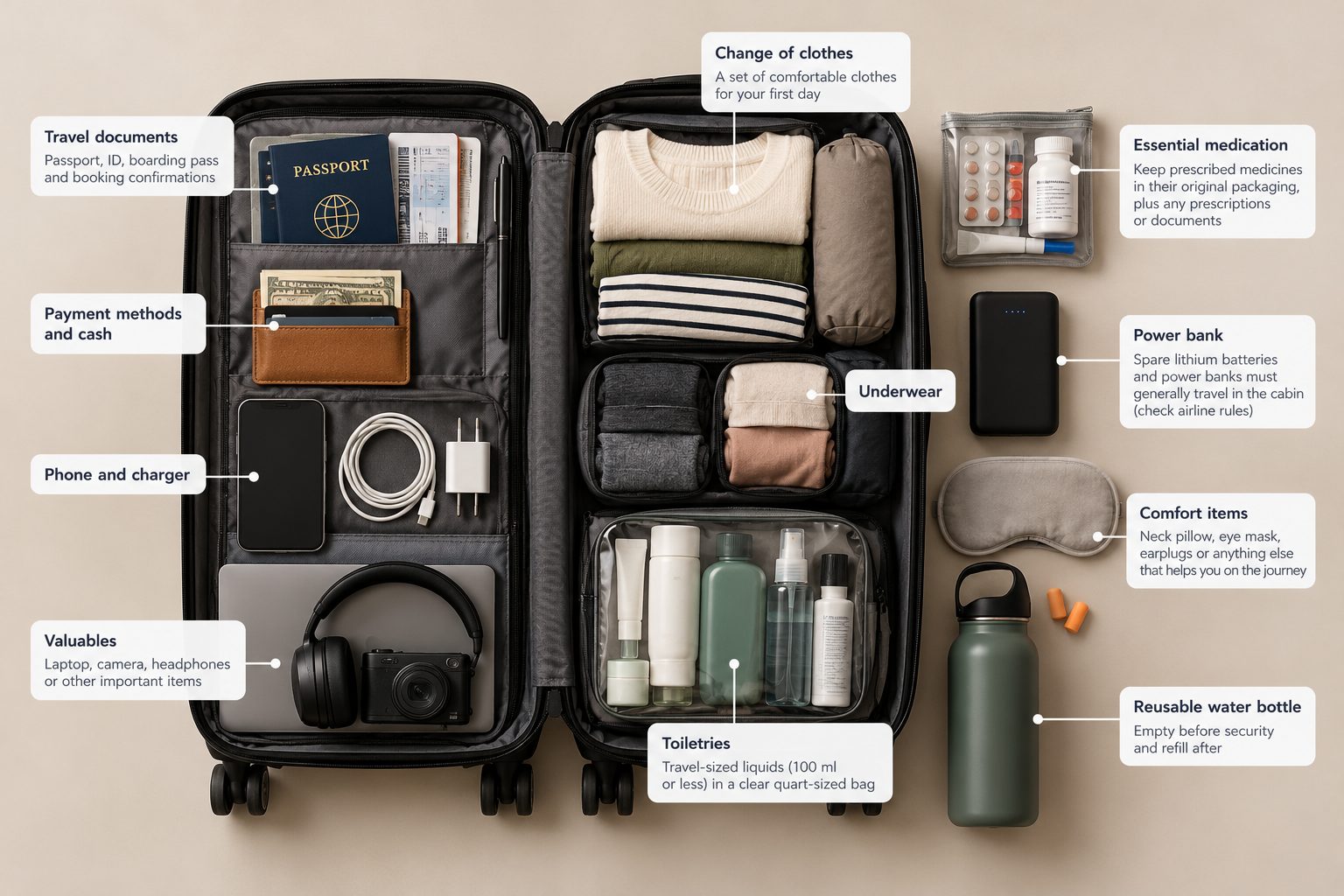
With your master packing list ready, focus on the items you may need during the journey or immediately after landing, especially if your checked luggage arrives late. Your carry-on should keep your first day manageable, with important documents, essential medication and everyday items within easy reach rather than buried in your suitcase.

Carry-on bag contents laid out and labelled.

Start with your passport or identification, booking confirmations, payment cards, some cash, your phone, charger and any valuables you would rather not check in. Add a change of clothes, underwear and basic toiletries so you can freshen up or get through the first day if your main luggage is delayed.

Keep medication close: Pack prescribed medicines in your carry-on, preferably in their original labelled packaging, along with any necessary prescriptions or supporting documents. Medically necessary liquids may qualify for exceptions to standard liquid limits, although screening requirements still apply.

Check liquids and batteries before departure: Under the US Transportation Security Administration’s standard rule, carry-on liquids, gels and aerosols must generally be in containers of 100 ml (3.4 oz) or less, fitting into one clear, quart-sized bag per passenger. Spare lithium batteries and power banks must generally travel in the cabin, with capacity and airline restrictions applying. Check the TSA's guide to what you can bring and your departure airport's rules, since requirements vary by country.

A well-packed carry-on keeps your first-day essentials accessible and helps you handle unexpected delays with less stress.

How to adjust your packing list by trip length

With your master checklist and carry-on essentials sorted, the next step is deciding how much to pack for the time you will spend away. A weekend getaway requires fewer outfits than a week-long holiday, while a longer stay calls for a balance between having enough clothing and leaving room for laundry. Adjusting quantities to match your plans helps you avoid overpacking without running short of essentials.

Weekend trip (2–3 nights): Pack 2–3 outfits, 3 sets of underwear, 1 set of sleepwear, 1–2 pairs of shoes and travel-sized toiletries. Add a light jacket if the weather calls for it.

One-week trip (5–7 nights): A Packing list for a week should include 5–7 outfits, 7 sets of underwear, 2 sets of sleepwear and 2 pairs of shoes. Pack enough toiletries for the stay or plan to replenish them, and include laundry supplies if you expect to wash clothes.

Long stay (two weeks or more): Start with 7–10 outfits, 10–14 sets of underwear, 2–3 pairs of shoes and full-sized toiletries where practical. Plan to do laundry rather than packing a fresh outfit for every day.

Use these counts as a starting point, then adjust for weather, activities and access to laundry facilities.

What to pack for international travel

International trips require a little more preparation than domestic journeys because entry requirements, health rules and everyday practicalities can differ from one country to another. Once your main packing list is ready, use an international travel checklist to confirm that your documents, health records and travel essentials are in order before departure.

Start with your passport and check its expiry date against your destination's entry rules, as some countries require several months of validity beyond your planned stay. Confirm whether you need a visa or electronic travel authorisation, and carry any required vaccination certificates or other health documents. The UK government's foreign travel checklist is a useful resource for checking documents, health precautions and other preparations.

Next, pack a plug adapter that matches your destination's sockets, along with your phone charger and power bank. Download offline maps and save your accommodation address, booking confirmations and emergency contacts so you can access them without an internet connection.

Finally, arrange mobile data before leaving by choosing to buy a travel eSIM if your phone supports it. Check destination coverage and activation instructions in advance so you can navigate, contact your travel companions and access important information after landing.

How to handle money while travelling

Managing money abroad starts with planning how you will pay for things before leaving home. Carry an internationally accepted card, keep some local currency for small purchases and understand how exchange rates affect your spending.

Before departure, check your card’s international fees and set aside enough for accommodation, transport and everyday expenses. Grey’s virtual card for international payments can help you pay eligible merchants online. If you earn in different currencies, Grey also shares tips on saving for a trip when you get paid in different currencies, helping you prepare your travel budget before departure.

Grey virtual card displayed on a phone while travelling.

When paying by card, watch out for dynamic currency conversion (DCC). If a shop or ATM offers to charge you in your home currency or the local currency, choosing the local currency often lets your card provider handle the conversion. Compare the fees and exchange rates before deciding.

Finally, arrange some local currency before landing or plan where to withdraw cash after arrival. Taxis, markets and smaller businesses may not accept cards, so having cash available can make everyday transactions easier.

Frequently asked questions about travel packing checklists

1. What should you never pack in checked baggage?

Avoid packing passports, cash, jewellery, essential medication, laptops, power banks and spare lithium batteries in checked baggage. Keep valuables and important documents in your hand luggage. Also, never pack explosives, flammable substances or other prohibited items. Check your airline’s baggage rules before travelling, as restrictions vary by destination and carrier.

2. How many outfits for a one-week trip?

Pack around seven everyday outfits for a one-week trip, adjusting for your activities and destination. Include two pairs of shoes, sleepwear, underwear for each day, and one extra outfit for emergencies. Choose clothes you can mix and match to save space. For longer trips, consider laundry instead of packing additional outfits.

3. What documents do you need for international travel?

You typically need a valid passport, the appropriate visa or travel authorisation, and your flight tickets or itinerary. Depending on your destination, you may also need proof of accommodation, return tickets, travel insurance, vaccination certificates or evidence of sufficient funds. Check official entry requirements before departure and keep digital and physical copies of important documents.

4. Can you pack a power bank in hand luggage?

Yes. Power banks must generally travel in hand luggage, not checked baggage, because they contain lithium batteries. Airlines commonly allow power banks up to 100 watt-hours (Wh), while larger capacities may require approval or be prohibited. Protect the terminals against short circuits and check your airline’s current battery restrictions before travelling.

5. How much cash should you carry abroad?

Carry enough local currency for your first day’s transport, meals and small purchases, plus a modest emergency reserve. The amount depends on your destination, arrival arrangements and access to ATMs. Avoid carrying your entire travel budget in cash. Use a suitable payment card for larger expenses and check local cash declaration rules before departure.

6. What is the 3-1-1 liquids rule?

The 3-1-1 rule is a US airport security guideline for liquids in carry-on luggage. Each container must hold no more than 3.4 ounces (100 millilitres), all containers must fit inside one clear, resealable quart-sized bag, and each passenger is generally allowed one bag. Rules and exemptions vary by country and airport, so check before flying.

11 best day trips from Prague

•

•

2 min read

Prague is a good base for exploring Central Europe. Many of the top day trips from Prague take about an hour by train, and even the longer ones, like Dresden, are manageable in a day. In this guide, I cover what to see, how to get there, how long it takes, and what it costs.

One thing to know first: Czechia uses the koruna (CZK), not the euro. In October 2026, one euro bought roughly 24 koruna, so CZK 100 is about €4. Fares below are approximate 2026 figures and change by operator and booking time.

Best day trips from Prague: Overview

Trains suit Kutná Hora, Plzeň, Karlštejn, and Dresden, while buses are the better choice for Karlovy Vary, Český Krumlov, and Terezín. Distance sets the effort: Karlštejn is about 40 minutes away, whereas Vienna and Brno are long days that suit an early start or an overnight stay.

Destination Travel time from Prague Approximate fare (one way) Best for
Kutná Hora 55 min by direct train CZK 100–160 (€4–7) Bone church, UNESCO town
Český Krumlov 3 hrs by direct bus CZK 130–300 (€5–12) Fairy-tale castle town
Karlovy Vary 2 hrs by bus CZK 100–180 (€4–7) Spa town
Terezín 1 hr by bus 413 Check operator fare WWII history
Dresden 2 hrs 10 min by direct train From CZK 200 (€8) Baroque Germany
Bohemian Switzerland 2 hrs by train and bus Check train and bus fares Sandstone cliffs
Plzeň 1 hr 20 min by direct train CZK 120–200 (€5–8) Pilsner Urquell
Karlštejn 40–45 min by direct train CZK 78 (€3) Gothic castle
Konopiště 40–60 min by train via Benešov Check Czech Railways fare Castle, rose garden
Brno 2 hrs 30 min by Pendolino CZK 250–450 (€10–19) Moravia’s capital
Vienna 4 hrs by direct train From CZK 400 (€16) Imperial capital

‍

Fares are one way, so as a rough guide a return trip costs about double. Check current times and prices on Czech Railways and the bus operators’ sites before you travel.

1. Kutná Hora: The bone church and a silver town

__wf_reserved_inherit

Kutná Hora is the easiest big payoff from Prague. The Sedlec Ossuary, decorated with the bones of tens of thousands of people, is the headline, and St Barbara’s Cathedral in the UNESCO-listed historic centre is the reason to stay for lunch. Direct trains from Praha hlavní nádraží take about 55 minutes and cost around CZK 100-160 one-way. The ossuary is close to Kutná Hora main station, while the historic centre is about 3 km further, so allow for a local train or bus.

Tip: Book an ossuary time slot online first, and arrive early, because tour buses start arriving after 11:00.

2. Český Krumlov: A fairy-tale castle town

__wf_reserved_inherit

Český Krumlov is a UNESCO town set inside a bend of the Vltava River, beneath a castle tower. A direct RegioJet bus from Na Knížecí takes roughly 2 hours 50 minutes to 3 hours 10 minutes and costs around CZK 130 to 300 one way. The train needs a change and takes about 3.5 hours. It’s a long but doable day.

Tip: Take the 07:00 bus, which arrives around 10:00, and catch a late return bus so you see the town after the crowds thin. It gets very busy in July and August.

3. Karlovy Vary: the spa town

__wf_reserved_inherit

Karlovy Vary is a river valley lined with pastel colonnades, where visitors sip warm mineral water from porcelain cups. It’s also known for Becherovka, Moser crystal, and the Grandhotel Pupp. There’s no direct train, so take the bus: about 2 hours from Praha Florenc, with FlixBus at CZK 158 when we checked and RegioJet from around CZK 100.

Tip: Loket, a small castle town, is about half an hour away by local train if you want a second stop.

4. Terezín: A memorial, not a sightseeing stop

Terezín was an 18th-century fortress town that became the Theresienstadt ghetto and transit camp during the Second World War, and around 150,000 Jews passed through it on the way to the extermination camps. Today the Small Fortress, the Ghetto Museum, and a columbarium are memorial sites. Direct bus 413 from Praha Letňany (metro C) takes about an hour and runs hourly. Get off at “Terezín, U památníku” for the Small Fortress, or at the town bus station for the ghetto sites.

Tip: Allow half a day and consider a guide, because the history is hard to follow without context.

5. Dresden: Baroque Germany in two hours

__wf_reserved_inherit

Dresden is in Germany, about 2 hours 10 minutes to 2 hours 20 minutes from Praha hlavní nádraží by direct train, and the line follows the Elbe through sandstone canyon country for around an hour. Fares typically run €8 to €18, and FlixBus takes about 2 hours. The city is known as the “Florence on the Elbe” for its baroque architecture and museums. Germany uses the euro, not the koruna.

Tip: Take an early train and return in the evening, or stay overnight for a slower visit.

6. Bohemian Switzerland: Sandstone cliffs

__wf_reserved_inherit

Bohemian Switzerland National Park is a landscape of sandstone towers, gorges, and pine forest on the German border. The headline is the Pravčická Gate, described as the largest natural sandstone arch in Europe, plus gorge boat rides on the Kamenice. By public transport, take a train from Praha hlavní nádraží to Děčín, then bus 434 or 438 to Hřensko (about 20 minutes), roughly two hours each way. By car it’s about 1 hour 45 minutes.

Tip: This is the trip where a tour or a car beats public transport.

7. Plzeň: The home of Pilsner Urquell

__wf_reserved_inherit

Plzeň is where Pilsner Urquell is brewed, and the brewery is a 15-minute walk from the station. Beneath the historic centre, tunnels run nearly 14 km in total, and the guided Plzeň Historical Underground tour covers 800 metres. The town also has the tallest church tower in Czechia. Direct trains run hourly and take about 1 hour 20 minutes, costing roughly CZK 120 to 200, while buses take about an hour and can be cheaper.

Tip: With children, add the Techmania science centre.

8. Karlštejn: The quickest castle

__wf_reserved_inherit

Karlštejn is Charles IV’s Gothic fortress above the Berounka valley, about 30 km from Prague. The direct S7 train from Praha hlavní nádraží takes 40 to 45 minutes and costs around CZK 78 one way. From Karlštejn station, it’s a 20 to 30 minute walk uphill to the castle. It suits a half day. Tip: the ride itself passes limestone cliffs and beech forest, so sit by a window.

9. Konopiště: A quieter castle

__wf_reserved_inherit

Konopiště is a castle with a rose garden about 40 km from Prague. Take a train from Praha hlavní nádraží to Benešov (40 to 60 minutes), then walk or take a local bus to the castle. Check Czech Railways for the current fare.

Tip: Choose Karlštejn if you want the famous castle, and Konopiště if you want the place to yourself.

10. Brno: Moravia’s capital

__wf_reserved_inherit

Brno is the capital of Moravia, about 2 hours 30 minutes from Prague by Pendolino, with trains every 30 minutes at peak times and fares of CZK 250 to 450 one way. Highlights include Špilberk Castle, the Capuchin Crypt, and the UNESCO-listed Villa Tugendhat. With around five hours of travel, it’s a long day, so many visitors stay overnight.

Tip: take the train rather than the bus, which is slower, and book Villa Tugendhat in advance.

11. Vienna: A long but possible day

__wf_reserved_inherit

Vienna is in Austria, about 4 hours from Prague by direct train, with several daily departures on ČD Railjet and RegioJet from around CZK 400 (€16). That’s roughly eight hours of travel, so it works better as an overnight stay than a day trip. The draw is the imperial palaces and the coffee culture. Austria uses the euro.

Tip: If you only have one day, spend it in Dresden and save Vienna for a longer visit.

Getting around and paying on your day trips

Czechia uses the koruna, so you’ll pay in CZK at stations, castles, and restaurants, and in euros in Dresden and Vienna. Some tourist businesses accept euros, but the rate they apply is usually worse than your card’s, so pay in koruna. If a card terminal offers to charge you in euros or dollars, decline, because that’s dynamic currency conversion and the rate is usually poor.

Grey lets you hold multiple currencies in one account, and you can spend on a virtual card added to Apple Pay or Google Pay. The card is a USD card, so purchases in koruna or euros are cross-border card transactions that incur a 2% fee plus $0.50. The fixed $0.50 matters more on small purchases, so fewer, larger payments such as train tickets keep the cost down. A travel eSIM for Czechia keeps maps, booking confirmations, and operator apps working without roaming charges, and you can move money before you travel if you need to top up.

Day-tripping from Prague? Spend koruna and euros on a Grey virtual card and grab a travel eSIM.

Frequently asked questions about day trips from Prague

What is the best day trip from Prague?

Kutná Hora is the best all-round choice. It takes about 55 minutes by direct train, costs around CZK 100 to 160 one way, and covers the Sedlec Ossuary and a UNESCO town in half a day. Český Krumlov is the standout if you don’t mind roughly three hours by bus each way.

Can you visit Dresden from Prague in a day?

Yes. Direct trains take about 2 hours 10 to 20 minutes, fares typically run €8 to €18, and FlixBus takes about 2 hours. Take an early train and return in the evening, or stay overnight if you want a slower visit.

What currency does Czechia use?

Czechia uses the Czech koruna (CZK), not the euro. In October 2026, €1 bought roughly 24 koruna, so CZK 100 is about €4. Some tourist businesses accept euros, usually at a poor rate, and Dresden and Vienna both use the euro.

Is it better to take the train or the bus?

Take the train for Kutná Hora, Plzeň, Karlštejn, Dresden, Brno, and Vienna. Take the bus for Karlovy Vary, Český Krumlov, and Terezín, where there’s no good direct train. For Plzeň, the bus can be cheaper and runs more often.

Is Český Krumlov worth a day trip from Prague?

Yes, if you’re comfortable with about three hours each way and catch an early bus. It’s a long day, and the town is very busy in July and August. Staying overnight lets you see it after the day-trippers leave.

How much do day trips from Prague cost?

Public transport trips typically cost about CZK 80 to 450 one way, or roughly €3 to €19, plus entry fees. Organised tours cost more: Kutná Hora tours are listed from about €46 per person and Český Krumlov from about €88 including admissions.

Whichever trip you choose, start early, and book timed entries in advance. For more ideas, see our guide to the best day trips from Amsterdam.

Get a Grey Card and spend on your day trips.

How much does a trip to the Bahamas cost?

•

•

2 min read

A trip to the Bahamas can cost a few hundred dollars or several thousand, depending on where you’re travelling from, how long you plan to stay, and the kind of holiday you want. Flights, accommodation, food, local transport, and activities all affect your budget. If you’re travelling during peak season, expect to pay more for flights and hotels.

Looking at trip packages to the Bahamas can help you plan your spending before you book. Some packages combine flights and accommodation, while others include meals, airport transfers, or excursions. These options can make budgeting easier, but check what’s included so you don’t end up paying extra for things you expected to be covered.

Your travel dates and choice of island also matter. Nassau and Paradise Island offer plenty of resorts and activities, while other islands may suit a quieter getaway. In this guide, you’ll learn what to budget for flights, hotels, food, and activities so you can plan a Bahamas trip that fits your wallet.

How much does a trip to the Bahamas cost?

A 7-day trip to the Bahamas can cost around $1,000 per person for a budget holiday, about $2,000 for a mid-range trip, or more than $4,300 for a luxury stay. Your final cost depends on where you stay, how you travel, and the activities you choose.

Sky view of the ocean in the Bahamas

Accommodation is one of the biggest expenses, with standard resorts averaging around $242 per night. Food can also take up a large part of your budget, especially if you eat at sit-down restaurants, where daily spending may reach 100–200 per person. Excursions add to the cost, too. Popular Exuma boat tours can range from $215 to over $570, depending on the experience.

Getting around also matters. Local jitney buses are generally cheaper than private taxis, helping you save money on transport. When comparing trip packages to the Bahamas, check whether flights, hotel stays, meals, transfers, and activities are included. This helps you compare the total cost and avoid unexpected expenses.

How much does a trip to the Bahamas cost from Europe?

A one-week trip to the Bahamas from Europe can cost around €2,000 to €5,000 per person, depending on your departure city, accommodation, and travel plans. Budget travellers may spend €2,000 to €2,800, while mid-range holidays can cost €3,000 to €5,000. Luxury trips can cost considerably more.

Flights: Return flights from Europe to the Bahamas typically cost around €500 to €900, although prices vary by season, airline, and booking date. You may also need connecting flights, which can affect your travel time and total fare.

Accommodation: Hotels and resorts are often a major expense. Budget hotels help keep costs down, while beachfront and all-inclusive resorts can cost much more per night.

Daily expenses: Food, transport, and excursions add to your budget. To save money, compare flight prices, travel outside peak periods, and check what your hotel package includes before booking.

Also read: How much does an all-inclusive Caribbean trip cost?

How much does a trip to the Bahamas cost from Africa?

A one-week trip to the Bahamas from Africa can cost around $2,200 to $4,500 per person, depending on your departure city, flights, accommodation, and activities. Travelling from cities like Lagos or Johannesburg can be expensive because flights usually involve connections through Europe or the United States.

Flights: Return flights from major African cities to Nassau may cost around $1,100 to $1,600, depending on the airline, season, and booking date. Check different routes and travel dates to find a suitable fare.

Accommodation: Budget travellers can save by staying in guesthouses or affordable hotels. Mid-range travellers may spend more on three-star resorts and comfortable accommodation close to popular attractions.

Daily expenses: Food, local transport, and excursions add to the total. Budget travellers can spend around $2,100 to $2,600 for the week, while mid-range trips may cost $3,100 to $4,500 per person.

Before booking, compare flight and hotel prices separately and allow extra money for travel insurance, visa requirements where applicable, and unexpected expenses.

How much does a trip to the Bahamas cost from South America?

A one-week trip to the Bahamas from South America can cost around $1,800 to $4,000 per person, depending on your departure city, accommodation, and activities. Your total budget will depend on flight prices and the type of holiday you want.

Flights: Return flights from South American cities to Nassau may cost around $600 to $1,200. Prices vary by country, airline, travel season, and whether you need connecting flights.

Accommodation: Budget hotels and guesthouses help keep costs lower, while beachfront resorts and all-inclusive hotels can increase your spending significantly.

Daily expenses: Food, transport, and excursions add to your total. You can save by eating at local restaurants, using affordable transport, and booking activities in advance.

Trip to the Bahamas cost breakdown

The table below compares the cost of a six-night stay in the Bahamas for one traveller departing from Africa. It covers two options: a mid-range resort and a budget-friendly Airbnb, with estimated costs for flights, accommodation, food, activities, and local transport.

Category Mid-range resort Budget Airbnb
Flights $1,400 $1,400
Accommodation 1,950(325/night) 720(120/night)
Food and drinks $1,050 $525
Excursions $500 $100
Local transport $150 $50
Total estimated cost $5,050 $2,795

‍

Key differences

  • Accommodation: A mid-range resort offers more amenities but can cost considerably more, especially when resort fees apply. An Airbnb may help you save on accommodation, particularly if you choose a less expensive island or neighbourhood.
  • Food and drinks: Restaurant meals can take up a large part of your budget. Eating at local spots such as Fish Fry stalls and preparing some meals with groceries can help reduce spending.
  • Transport and activities: Private airport taxis and organised excursions add to resort holiday costs. Budget travellers can save by using public jitney buses where available and enjoying free activities such as beach hopping.

How to budget and pay for your trip to the Bahamas

Planning your Bahamas trip starts with knowing how much you can afford to spend. Set a budget for flights, accommodation, meals, transport, and excursions, then set aside extra money for unexpected expenses. Book major travel costs early and compare prices before paying.

How you manage your money matters, too. With Grey, you can move money before you travel into your foreign currency account and spend with a virtual card for eligible online payments, including flight bookings, hotel reservations, and activities. Check the card’s availability, fees, and acceptance before your trip.

Staying connected is just as important. You can also buy a travel eSIM for the Bahamas, where available, to access mobile data without relying entirely on expensive roaming charges.

Track your spending throughout the trip, compare exchange rates before converting money, and keep a backup payment option handy. A little preparation can help you enjoy the Bahamas without stretching your budget.

Frequently asked questions about the cost of a trip to the Bahamas

How much does a trip to the Bahamas cost?

A mid-range seven-day trip to the Bahamas costs around $2,000 to $3,500 per person, depending on where you travel from. This estimate covers flights, accommodation, meals, local transport, and a few popular excursions.

Are travel packages cheaper?

Yes, travel packages can save you money by combining flights and accommodation into one booking. Compare package prices with separate bookings, check what is included, and look for deals on all-inclusive resorts in Nassau and Paradise Island.

What currency do they use?

The Bahamas uses the Bahamian dollar (BSD), which is pegged at one-to-one with the US dollar. Both currencies are widely accepted, so US dollars are convenient for visitors. However, you may receive Bahamian dollars as change.

When is the best time to save?

August to November can offer lower flight and hotel prices because it falls within the quieter travel season. However, this period overlaps with hurricane season, so check weather forecasts, cancellation policies, and travel insurance before booking.

Do African citizens need a visa?

Visa requirements depend on your nationality and travel circumstances. Many African passport holders need a Bahamian visa, while some may qualify for exemptions. Check the official Bahamas immigration requirements and any US or European transit visa rules before booking.

How can you save on food?

Save on meals by visiting local food spots instead of dining exclusively at resorts. Arawak Cay’s Fish Fry is popular for Bahamian dishes such as conch salad and fried seafood. Mixing local meals with groceries can help keep daily food costs manageable.

Bahamas bound? Move money before you travel, spend with a Grey virtual card with no markup, and buy a travel eSIM for the Bahamas to stay connected throughout your trip.

Arrow (up)

Back to top