<script type="application/ld+json" data-schema-version="grey-blog-v4"> [{"@context":"https://schema.org","@type":"BlogPosting","@id":"https://grey.co/blog/mastercard-exchange-rate#article","headline":"Mastercard exchange rate: How it works and what you actually pay","description":"Mastercard sets its own exchange rate daily, separate from your bank's rate. Learn how it works, what fees apply, and how to spend less abroad. Compare now.","inLanguage":"en","url":"https://grey.co/blog/mastercard-exchange-rate","mainEntityOfPage":{"@id":"https://grey.co/blog/mastercard-exchange-rate#webpage"},"datePublished":"2026-07-17T21:23:15.196Z","dateModified":"2026-08-14T14:30:50.246Z","author":{"@type":"Person","@id":"https://grey.co/authors/adeolu-titus-adekunle#person","name":"Adeolu Titus Adekunle","url":"https://grey.co/authors/adeolu-titus-adekunle","jobTitle":"Content Writer","sameAs":["https://www.linkedin.com/in/titusadeoluadekunle/"]},"publisher":{"@type":"Organization","@id":"https://grey.co/#organization","name":"Grey","url":"https://grey.co","logo":{"@type":"ImageObject","url":"https://cdn.prod.website-files.com/6360022338a81bd6fdbb1145/6564ae1077a67e39d3c491a6_Grey%20Logo%20Lockup%20Black.svg"}},"image":{"@type":"ImageObject","@id":"https://grey.co/blog/mastercard-exchange-rate#primaryimage","url":"https://cdn.prod.website-files.com/636a85d290ee58e70c17e1c0/6a5a9d271bb8205990fa106a_Mastercard%20Exchange%20Rate%20How%20It%20Works%20and%20What%20You%20Actually%20Pay-compressed.jpg","contentUrl":"https://cdn.prod.website-files.com/636a85d290ee58e70c17e1c0/6a5a9d271bb8205990fa106a_Mastercard%20Exchange%20Rate%20How%20It%20Works%20and%20What%20You%20Actually%20Pay-compressed.jpg","width":1200,"height":675}},{"@context":"https://schema.org","@type":"WebPage","@id":"https://grey.co/blog/mastercard-exchange-rate#webpage","url":"https://grey.co/blog/mastercard-exchange-rate","name":"Mastercard Exchange Rate: How It Works and What You Pay | Grey","description":"Mastercard sets its own exchange rate daily, separate from your bank's rate. Learn how it works, what fees apply, and how to spend less abroad. Compare now.","inLanguage":"en","primaryImageOfPage":{"@id":"https://grey.co/blog/mastercard-exchange-rate#primaryimage"},"breadcrumb":{"@id":"https://grey.co/blog/mastercard-exchange-rate#breadcrumb"}},{"@context":"https://schema.org","@type":"BreadcrumbList","@id":"https://grey.co/blog/mastercard-exchange-rate#breadcrumb","itemListElement":[{"@type":"ListItem","position":1,"name":"Home","item":"https://grey.co/"},{"@type":"ListItem","position":2,"name":"Blog","item":"https://grey.co/blog"},{"@type":"ListItem","position":3,"name":"Mastercard exchange rate: How it works and what you actually pay","item":"https://grey.co/blog/mastercard-exchange-rate"}]},{"@context":"https://schema.org","@type":"FAQPage","@id":"https://grey.co/blog/mastercard-exchange-rate#faq","mainEntity":[{"@type":"Question","name":"What rate does Mastercard use for currency conversion?","acceptedAnswer":{"@type":"Answer","text":"Mastercard uses a wholesale exchange rate based on rates in the global foreign exchange market. It's usually very close to the mid-market rate, often within 0.1% to 0.3%. This rate only covers the currency conversion and doesn't include any fees charged by your bank."}},{"@type":"Question","name":"When does Mastercard update its exchange rate?","acceptedAnswer":{"@type":"Answer","text":"Mastercard updates its exchange rates every business day. The rate used for your purchase is the one in effect when your transaction is processed, not necessarily when you make the purchase. Since processing can take one or two days, the final rate may differ slightly from the rate on the day you paid."}},{"@type":"Question","name":"Why is my exchange rate different from the Mastercard rate?","acceptedAnswer":{"@type":"Answer","text":"Mastercard's exchange rate is only part of the total cost. Your bank may also charge a foreign transaction fee, usually between 1% and 3%. If you accepted Dynamic Currency Conversion (DCC), the merchant's exchange rate may also have increased the amount you paid."}},{"@type":"Question","name":"What is dynamic currency conversion and should I avoid it?","acceptedAnswer":{"@type":"Answer","text":"Dynamic Currency Conversion lets you pay in your home currency instead of the local currency when shopping abroad or withdrawing cash. Although this may seem convenient, the merchant sets the exchange rate, which is usually much less favourable than Mastercard's. In most cases, it's better to decline DCC and pay in the local currency."}},{"@type":"Question","name":"Does Grey use the Mastercard exchange rate?","acceptedAnswer":{"@type":"Answer","text":"Grey issues virtual Visa cards rather than Mastercards, so the Mastercard exchange rate does not apply to Grey card transactions. When Grey converts between currencies, it uses its own market rate with a 0.5%-1% conversion fee, sometimes capped at $6, depending on the currency pair. For same-currency purchases where you hold a balance in the transaction currency, no conversion is applied, removing exchange rate costs entirely."}},{"@type":"Question","name":"How do I dispute a Mastercard exchange rate charge?","acceptedAnswer":{"@type":"Answer","text":"If you think you were charged the wrong exchange rate or an incorrect foreign transaction fee, contact your card issuer rather than Mastercard. Your bank is responsible for processing the transaction and applying any additional fees. If the issue involves Dynamic Currency Conversion that you didn't agree to, your bank can also help you dispute the charge with the merchant. Get the Grey virtual debit card and spend internationally directly from a foreign-currency balance, with fees and exchange rates disclosed before each transaction."}}]}] </script>

Mastercard exchange rate: How it works and what you actually pay

Adeolu Titus Adekunle

TABLE OF CONTENT

SHARE THIS POST

If you have ever shopped abroad with a Mastercard denominated in another currency, you might have wondered how the process works behind the scenes. Who does the conversion? Your bank, Mastercard, or the recipient? How is the payment settled?

Paying with a card abroad or online in a foreign currency involves at least two layers of currency exchanges. The amount you end up paying depends on Mastercard's exchange rate, any foreign transaction fee your bank charges, and whether you accept the merchant's currency conversion.

Mastercard sets its own exchange rate each day based on wholesale currency market rates. This rate is separate from the rate your bank applies. When you spend in a foreign currency, Mastercard converts the amount at its daily rate, then your bank may add a foreign transaction fee on top, typically 1% to 3% of the transaction.

This guide explains how the Mastercard exchange rate works, what fees you might pay, how it compares with Visa, and how to avoid paying more than you need to on international purchases.

How does the Mastercard exchange rate work?

Mastercard sets an exchange rate for each currency pair it supports every business day. This rate is determined by the interbank foreign exchange market, where large financial institutions trade currencies with each other. Mastercard rates are usually close to the mid-market rate you see on Google and Xe.

Whenever you use a Mastercard to pay in a foreign currency, Mastercard converts the purchase into your card's billing currency using its daily exchange rate. For example, if your card is billed in USD and you buy something in EUR, Mastercard converts the EUR amount to USD before the transaction reaches your bank.

In most cases, the difference is only 0.1% to 0.3%, making Mastercard's exchange rate one of the more competitive aspects of international card payments. If you want to know how Mastercard calculates exchange rates and estimate how much a purchase will cost, Mastercard offers an online currency converter where you can select the currencies and the transaction amount.

Keep in mind that the final amount may be slightly different because the exchange rate applied is the one in effect when the transaction is processed, not necessarily when you made the purchase.

Mastercard foreign transaction fees explained

The Mastercard exchange rate is not the only cost you incur when spending in a foreign currency. There are usually two costs involved.

1. Mastercard's exchange rate

Mastercard's rate is close to mid-market, so it doesn’t cost much.  Mastercard uses wholesale financial market data to set a single daily benchmark rate. Independent financial audits consistently show that Mastercard’s daily rate tracks extremely close to the true mid-market rate, making its Mastercard foreign transaction fee negligible.

2. Your bank's foreign transaction fee

This is where most of the additional transaction costs come from. Most banks and card issuers charge a foreign transaction fee, also called a cross-border or international transaction fee, when you use your card in another currency. This amount is usually between 1% and 3% of the converted transaction amount. This fee is charged by your bank, not by Mastercard, and is added after the currency conversion.

For example, imagine you spend €200 while travelling in France.

  • Mastercard converts the €200 into USD using its daily exchange rate.
  • Your bank then adds a 2% foreign transaction fee.
  • Your statement shows the converted USD amount plus the additional fee.

Some travel credit cards and premium bank accounts don't charge foreign transaction fees. So you should check your card's terms before travelling or shopping internationally.

If you regularly spend in foreign currencies, choosing a card with no foreign transaction fees can save you a significant amount over time.

Discover how virtual cards can simplify your life abroad

Mastercard vs Visa exchange rate: which is better?

Mastercard and Visa are two of the largest online payment processing networks in the world. They have more in common than differences. Neither payment network issues debit or credit cards directly; both issue them only through banks and other financial institutions.

Both Mastercard and Visa set daily wholesale exchange rates close to the mid-market rate. The difference between the two rates for any currency pair at any time is typically less than 0.5%, and often less than 0.1%. For most people, choosing between Mastercard and Visa won't noticeably affect how much they pay. Instead, pay attention to the card issuer.

Here is a table comparing Mastercard vs Visa exchange rates.

Factor Mastercard Visa
Rate basis Wholesale interbank market (close to mid-market) Wholesale interbank market (close to mid-market)
Typical rate margin vs mid-market 0.1% to 0.3% 0.1% to 0.3%
Foreign transaction fee
(issuer-dependent)
0% to 3% 0% to 3%
Dynamic currency conversion (DCC) Available at merchants Available at merchants
Rate checker tool Yes Yes
Best for Cashback rewards, everyday shopping, and event access Global travel perks, high spenders, and luxury benefits

How to check the Mastercard exchange rate before you spend

To estimate what you will pay in your billing currency before making a foreign purchase:

  1. Go to Mastercard's official currency conversion calculators.
  2. Enter the amount you intend to spend.
  3. Select the transaction currency (the currency used by the merchant).
  4. Select your billing currency (the currency your card is denominated in).
  5. Review the estimated converted amount and the indicated exchange rate.

Keep in mind that this is only an estimate. The final exchange rate is the one in effect when your bank processes the transaction, which is often one or two business days after the purchase. For major currencies like USD, EUR, and GBP, the difference is usually small. Less stable currencies may see larger fluctuations.

Also, remember that the Mastercard calculator does not include your bank's foreign transaction fee. If your card charges a 2% foreign transaction fee, you'll need to add it to your estimate of the total cost.

How to avoid paying too much on Mastercard exchange rates

Mastercard's exchange rate is really the problem. So there's usually little to gain from seeking a better rate with another payment processing network. Instead, focus on avoiding the extra fees that banks and merchants add, whether on a Visa or Mastercard. Here are some ways to avoid paying too much for international transactions.

1. Pay in the local currency, not your home currency

When paying abroad, merchants or ATMs may ask whether you'd like to pay in your home currency instead of the local currency. This is called Dynamic Currency Conversion (DCC). Although it sounds convenient, it's usually much more expensive. The merchant sets the exchange rate, which is often 3% to 8% worse than Mastercard's rate. Choosing the local currency lets Mastercard apply its own exchange rate, which is almost always the cheaper option.

2. Choose a card without a foreign transaction fee

A card that waives the international transaction fee eliminates the bank's additional charge on every foreign currency transaction. For frequent travellers or people who shop internationally regularly, this is the single most impactful cost reduction available.

3. Use a multi-currency card where the conversion happens at mid-market rates

Some fintech platforms, like Grey, offer cards linked with a multi-currency account. This setup allows you to hold balances in foreign currencies )EUR, USD, and GBP) before travel or convert at the mid-market rate at a time you choose, rather than at the moment of purchase. This means you can exchange your money when rates are favourable, rather than relying on the exchange rate at the time of purchase. It also helps you avoid many of the foreign transaction fees charged by traditional banks.

Convert currencies at mid-market rates with Grey and spend from your foreign currency balance without paying a foreign transaction markup on each purchase.

Learn more about avoiding ATM and conversion fees abroad

Using Grey for international spending

The Grey Plus Card is a virtual Visa card, not a Mastercard. This card is linked to your foreign currency accounts. Once you have enough money in that currency balance, there is no need to convert. For example, if you have a USD balance and pay a merchant in USD, the payment comes directly from your USD wallet. No exchange rate is applied, and there's no foreign transaction fee for the currency conversion because no conversion is needed.

A cross-border card fee is applied to non-USD payments. This cross-border card fee is 2% plus $0.50 per cross-border transaction. This is about what most bank-issued Mastercards charge for foreign transaction fees, even though many do not disclose them.

When you convert between currencies in your Grey account, Grey uses a disclosed exchange rate and a 0.5%-1% conversion fee, sometimes capped at $6, depending on the currency pair. This allows you to convert your money in advance, rather than paying exchange rate markups each time you make a purchase.

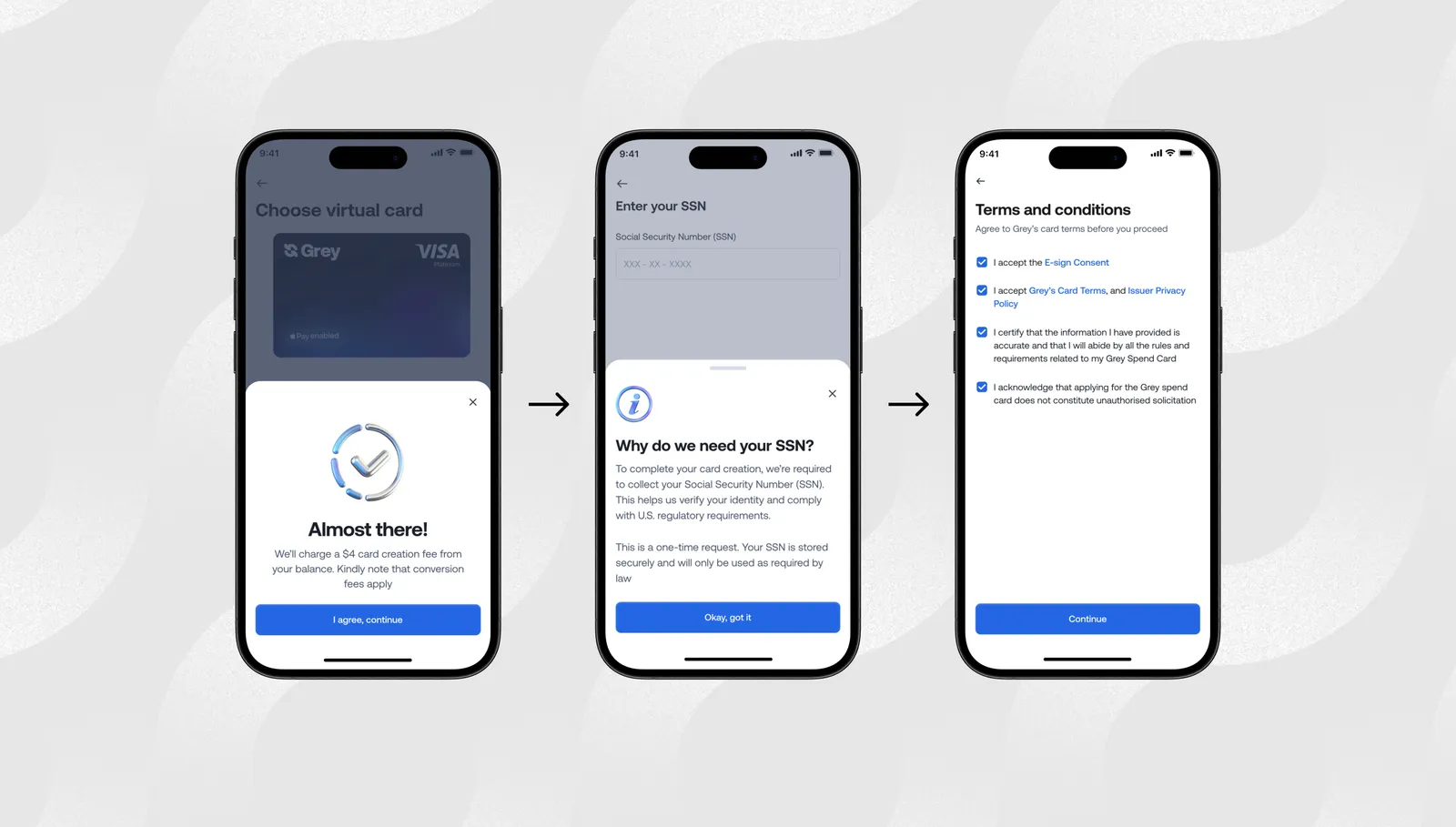
You can use the contactless feature when you link your Apple Pay and Google Pay. This lets you tap with your phone when shopping or using public transport. With the multiple card support, you can create a separate card for a specific reason with its own limit. Say a card for your online shopping, another for your international trip, while a card is connected to your Meta ads

Get the Grey virtual debit card and spend directly from your international balance in a foreign currency anywhere Visa is accepted.

Frequently asked questions

What rate does Mastercard use for currency conversion?

Mastercard uses a wholesale exchange rate based on rates in the global foreign exchange market. It's usually very close to the mid-market rate, often within 0.1% to 0.3%. This rate only covers the currency conversion and doesn't include any fees charged by your bank.

When does Mastercard update its exchange rate?

Mastercard updates its exchange rates every business day. The rate used for your purchase is the one in effect when your transaction is processed, not necessarily when you make the purchase. Since processing can take one or two days, the final rate may differ slightly from the rate on the day you paid.

Why is my exchange rate different from the Mastercard rate?

Mastercard's exchange rate is only part of the total cost. Your bank may also charge a foreign transaction fee, usually between 1% and 3%. If you accepted Dynamic Currency Conversion (DCC), the merchant's exchange rate may also have increased the amount you paid.

What is dynamic currency conversion and should I avoid it?

Dynamic Currency Conversion lets you pay in your home currency instead of the local currency when shopping abroad or withdrawing cash. Although this may seem convenient, the merchant sets the exchange rate, which is usually much less favourable than Mastercard's. In most cases, it's better to decline DCC and pay in the local currency.

Does Grey use the Mastercard exchange rate?

Grey issues virtual Visa cards rather than Mastercards, so the Mastercard exchange rate does not apply to Grey card transactions. When Grey converts between currencies, it uses its own market rate with a 0.5%-1% conversion fee, sometimes capped at $6, depending on the currency pair. For same-currency purchases where you hold a balance in the transaction currency, no conversion is applied, removing exchange rate costs entirely.

How do I dispute a Mastercard exchange rate charge?

If you think you were charged the wrong exchange rate or an incorrect foreign transaction fee, contact your card issuer rather than Mastercard. Your bank is responsible for processing the transaction and applying any additional fees. If the issue involves Dynamic Currency Conversion that you didn't agree to, your bank can also help you dispute the charge with the merchant.

Get the Grey virtual debit card and spend internationally directly from a foreign-currency balance, with fees and exchange rates disclosed before each transaction.

Last updated:

October 8, 2026

Open a free Grey account to get startedJoin 1 million digital nomads
IF YOU ENJOYED THIS, CHECK THESE OUT

Best platforms for Egyptian freelancers to earn in USD in 2026

•

•

2 min read

You are a software developer in Cairo. You have been building React apps for a local agency for three years, and you know your skills are worth more than what the domestic market pays. A colleague recently told you he is earning $40 an hour on Upwork, paid in USD, and withdrawing to his Egyptian bank account. That sounded great until you started researching. Upwork takes 10%. Payoneer takes another cut when you convert to EGP. PayPal only lets you withdraw to a Visa card and charges a total of around 8.5% in fees. Some platforms do not even verify properly from an Egyptian address. By the time you figured out what you would actually keep from a $1,000 project, you were back to browsing local job boards.

This guide is the calculation you were looking for. It compares the platforms where Egyptians are earning in USD right now, what you can realistically charge at each one, the fees each platform takes, and how to get the money into your bank account without losing a significant portion to conversion costs. The goal is to help you pick the right platform for your skill level and the right payout method for your situation, so you keep as much of your earnings as possible.

Why earning in USD matters more in Egypt than most places

This is not a theoretical preference. The Egyptian pound has lost significant value against the dollar over the past few years, and freelancers who kept their earnings in USD during that period saw their purchasing power hold steady while salaried workers in EGP saw theirs shrink. A freelancer earning $2,000 a month in 2022 could convert that to roughly 60,000 EGP at the time. The same $2,000 today converts to considerably more. The freelancer did not get a raise; the currency did the work.

Beyond the exchange rate, there is a practical reason to earn in USD: most of the tools you need to do your work are priced in dollars. Adobe Creative Cloud, Figma, GitHub Pro, AWS hosting, domain registrations, and even ChatGPT Plus. If you earn in EGP and pay for these tools in USD, you are converting twice and losing margin both times. Earning in the same currency as your expenses simplifies your finances and reduces unnecessary conversion costs.

Egypt’s government has recognised this shift. ITIDA launched freelancer, a platform that provides Egyptian freelancers with an official ID, training programmes, and access to banking and business support services. The freelance workforce is no longer informal; it is becoming a structured part of the economy. The question is not whether to freelance internationally from Egypt. It is where to start and how to get paid efficiently. For more on managing USD income as a remote worker in Egypt, we cover the financial side in detail.

‍Also read: Managing USD income as a remote worker in Egypt

The platforms: what they pay, what they cost, and who they suit

Not every platform works the same way, and the right one depends on your skill level, your specialisation, and how you want to work. Below is what each platform actually looks like for an Egyptian freelancer, including the numbers most guides leave out.

Upwork

Upwork is the largest global freelance marketplace, and the one most Egyptian freelancers start with. You create a profile, bid on projects posted by clients, and build a track record through reviews. The platform is strong for software development, writing, virtual assistance, marketing, and design.

Egyptian freelancers on Upwork typically charge between $15 and $75 per hour, depending on the skill and experience level. A junior content writer might start at $15 to $20 per hour, while an experienced full-stack developer or data scientist can command $50 to $75 or more. Long-term contracts with the same client are common, providing income stability and reducing proposal costs.

As of 2026, Upwork charges freelancers a variable service fee ranging from 0% to 15% per contract, with most freelancers reporting fees of around 10%. The fee is set at the start of the contract and does not change during it. This replaced the old tiered system, where the rate decreased with cumulative billings for the same client. For a freelancer earning $1,000 on a typical contract at 10%, Upwork takes $100. You also need Connects to submit proposals, which cost $0.15 each, and most job applications require 4 to 6.

Payouts from Upwork to Egypt are available through Payoneer, Wise, or wire transfer. Payoneer is the most commonly used option and charges a receiving fee plus a conversion spread when you withdraw to EGP. Wise is also available, but the Wise card does not work for Egyptian residents, which limits its usefulness for USD spending. You can also route payouts to a multi-currency USD account with a provider like Grey, which gives you more control over when and how you convert.

Best for: developers, writers, virtual assistants, and marketers at any experience level. The highest volume of international projects is available to Egyptians.

Honest limitation: competition is fierce in popular categories. Building a profile with strong reviews takes time, and the 10% fee plus Connects spending adds up if your proposal-to-win ratio is low.

Fiverr

Fiverr operates on a gig model: you list a service at a set price, and clients purchase it directly. This is a different dynamic from Upwork’s bidding system. You are not competing on proposals; you are competing on the quality of your listing, your reviews, and your portfolio samples. The platform is strong for graphic design, video editing, voiceover, logo design, social media management, and short-turnaround tasks.

Fiverr takes 20% of every order, regardless of the amount. There is no sliding scale. If a client pays $500 for your service, Fiverr keeps $100, and you receive $400. This is the highest commission rate among the major platforms, and it is the single biggest factor to weigh when deciding whether Fiverr suits your pricing model. For freelancers charging premium rates ($100+ per project), the 20% cut is substantial. For those using Fiverr to build a portfolio and attract repeat clients who eventually move off-platform, the cost may be worth it in the short term.

Egyptian freelancers on Fiverr typically start with gigs priced between $10 and $50, with experienced sellers scaling to $200 or more per project through tiered pricing and add-on services. Top-rated sellers in design and video editing report consistent order volumes, which compensate for the high commission through volume.

Payouts from Fiverr to Egypt are available through Payoneer, bank transfer, or PayPal. Given PayPal’s limitations in Egypt (withdrawals only to Visa cards, total fees around 8.5%), Payoneer or a direct bank transfer via a multi-currency account is the more practical route. All Fiverr bank transfers run through Payoneer, so the conversion cost to EGP is similar regardless of method. There is a 14-day clearing period before funds are available for withdrawal (7 days for Top Rated Sellers), and you can withdraw up to $5,000 once per 24 hours. For a detailed walkthrough of setting this up, see our guide on how Fiverr freelancers in Egypt can receive payments.

Best for: designers, video editors, voiceover artists, and anyone with a clearly packaged service. Works well for building a client base quickly without writing proposals.

Honest limitation: the 20% fee is double what most Upwork contracts cost. On a $500 project, that is $100 gone before you even think about conversion costs. The 14-day clearing period also means you wait two weeks before you can touch your money.

Also read: How Egypt is becoming a MENA hub for remote workers

Toptal

Toptal is not a marketplace in the traditional sense. It is a curated network that accepts roughly the top 3% of applicants through a multi-stage screening process that includes technical interviews, timed coding tests, and a trial project. If you pass, you get matched with high-value clients, including Fortune 500 companies and well-funded startups. If you do not pass, you cannot reapply for a set period.

The financial upside is significant. Egyptian freelancers accepted into Toptal report rates of $60-$250 per hour, depending on specialisation. Senior software engineers, data scientists, and finance professionals command the highest rates. The critical difference is that Toptal does not take a commission from the freelancer. The platform charges the client a markup above the freelancer’s rate, so you keep 100% of your agreed rate. Toptal handles all invoicing and payment collection, paying you in USD via bank transfer on a regular schedule.

For an Egyptian freelancer earning $5,000 a month through Toptal with zero platform commission, the only cost is the payout conversion, which makes the choice of payout method especially important. A 2% conversion cost on $5,000 is $100. An 8.5% cost through PayPal is $425.

Best for: senior software developers, data scientists, UX/UI designers, financial modelling experts, and project managers with 3+ years of experience and a strong English-language portfolio.

Honest limitation: not accessible to beginners or mid-level freelancers. The application process alone can take several weeks. If you do not pass the screening, you will not have partial access; you will simply not be on the platform.

PeoplePerHour

PeoplePerHour is a UK-based platform that is smaller than Upwork or Fiverr but has a solid presence in design, marketing, web development, and writing. Egyptian freelancers can create profiles, post fixed-price offers, or bid on client projects.

The commission structure is tiered: 20% on the first $700 earned with any single buyer, then it drops for subsequent earnings with that buyer. Average rates for Egyptian freelancers on the platform range from $15 to $100 per hour depending on the skill and client base. Payouts are available through Payoneer or bank transfer. The platform is particularly worth considering if your clients are primarily in the UK or Europe, as PeoplePerHour has stronger visibility in those markets.

Best for: marketing, design, and development freelancers targeting UK and European clients specifically.

Honest limitation: smaller project volume than Upwork. The 20% starting commission is steep, though it decreases with repeat business.

Mostaql

Mostaql is an Arabic-language freelance platform that is part of the Hsoub network (the same company behind Khamsat and Hsoub Academy). Projects are posted in Arabic, and the client base is predominantly MENA-region businesses. This makes it a strong option for Egyptian freelancers who are more comfortable working in Arabic, or who specialise in Arabic content writing, translation, or localisation.

Rates tend to be lower than on English-language platforms, but competition is also less intense, and the cultural alignment with regional clients can lead to smoother project execution. Payment is processed through bank transfer. Mostaql is a practical starting point for freelancers building a reputation before moving to higher-paying international platforms.

Best for: Arabic content writers, translators, and freelancers targeting MENA businesses. Good entry point for building reviews.

Honest limitation: rates are generally lower than English-language platforms. Limited visibility to US and European clients.

Also read: How to get paid in USD as a freelancer in Egypt

LinkedIn (direct client acquisition)

LinkedIn is not a freelance marketplace, but it is where many of the highest-paying contracts originate. Egyptian professionals who optimise their profiles for remote skills, publish consistently, and engage with industry-specific content attract recruiter and client attention directly. There is no commission; you negotiate rates and payment terms with the client.

The trade-off is that LinkedIn requires more effort up front. You are not bidding on posted projects; you are building visibility so that opportunities come to you. This works best for consultants, senior developers, marketing strategists, and other specialists whose expertise is best demonstrated through thought leadership rather than a marketplace profile. Payment terms are whatever you agree with the client, which means you also need to handle invoicing and contracts yourself.

Best for: experienced professionals (5+ years) with a visible specialisation who can attract inbound leads through profile optimisation and content.

Honest limitation: no payment protection, no dispute resolution, and no guaranteed pipeline. Building a client-generating LinkedIn presence takes months of consistent effort.

Etsy (digital products)

Etsy is a different model from the platforms above. Instead of trading time for money on client projects, you create digital products (templates, planners, design assets, fonts, printable art) and sell them to a global audience. Each product is created once and sold repeatedly, making Etsy a passive-income channel rather than a freelance marketplace.

Etsy charges a 6.5% transaction fee plus a 3% payment processing fee + $0.25 per sale. For a $20 digital product, that is approximately $2.15 in fees, leaving you roughly $17.85 per sale. Payouts can be deposited to an Egyptian bank account through Payoneer integration or directly, depending on your Etsy payment account setup. The income potential scales with the number of products you list and how well they are optimised for search on the platform.

Best for: graphic designers, illustrators, and creators who can build a catalogue of digital products. Particularly good for passive income alongside freelancing.

Honest limitation: building visibility on Etsy takes months of consistent listing and SEO optimisation within the platform. Income is unpredictable at first, and the market for digital templates is competitive.

Platform fees, rates, and payout options compared
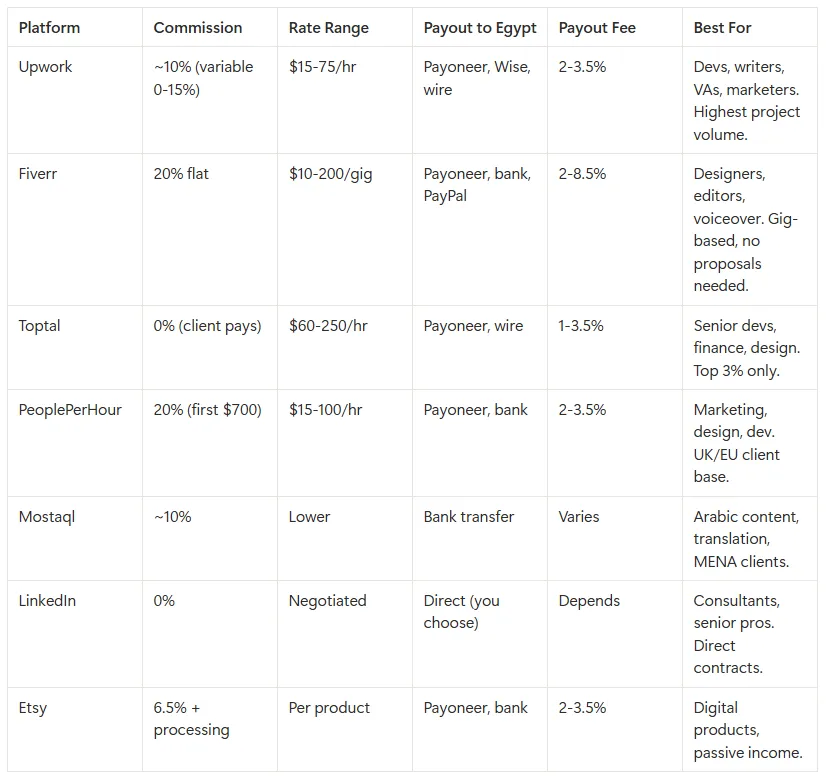
Table comparing platforms, rates and fees
Payout fee ranges depend on the withdrawal method. Payoneer’s conversion spread to EGP is typically 2% to 3.5%. PayPal’s total fees, including conversion, reach approximately 8.5%. Multi-currency account providers like Grey reflect conversion costs in the exchange rate, which is shown before you confirm. The cheapest path is usually: platform payout to a USD multi-currency account, then convert to EGP on your own schedule.

‍

What you actually keep: the real cost of earning $1,000

Platform commission is the cost most freelancers focus on, but it is only one part of the equation. The payout method you choose determines how much of your post-commission earnings you actually receive in Egyptian pounds. Here is what $1,000 in gross freelance earnings looks like through three different paths.

Path 1: Upwork to Payoneer to EGP. You earn $1,000 on Upwork. The platform takes approximately 10% ($100), leaving $900. You withdraw through Payoneer, which charges a receiving fee plus a conversion spread of roughly 2% to 3.5% when converting to EGP (approximately $18 to $32). Your take-home is approximately $868-$882 in EGP equivalent. Total cost: 11.8% to 13.2%.

Path 2: Fiverr to Grey USD account to EGP. You earn $1,000 on Fiverr. The platform takes 20% ($200), leaving $800. You withdraw to your Grey USD account (no Fiverr withdrawal fee for bank transfers). When you convert to EGP through Grey, the cost is built into the exchange rate margin, which is displayed before you confirm the conversion. Your take-home depends on the rate at the time of conversion, but the dominant expense is Fiverr’s 20% commission.

Path 3: Toptal to Grey USD account to EGP. You earn $1,000 through Toptal. Zero freelancer commission, so you keep $1,000. You receive this into your Grey USD account and convert to EGP at a rate that includes Grey’s exchange rate margin. Your take-home is the highest of any path because there is no platform commission. The only cost is conversion.

The difference between the cheapest and most expensive path can reach $100 to $150 on a single $1,000 payment. Over a year of earning $3,000 per month, that difference compounds to thousands of dollars in additional take-home income. The earning platform’s commission usually costs far more than the payout method’s fees, which means choosing the right platform for your skill level is the most impactful financial decision. But choosing an efficient payout method matters too, especially at higher volumes.

How to receive your USD earnings in Egypt

Once you have chosen a platform, you need a way to transfer the funds from that platform to your bank account in Egypt. The main options and their trade-offs:

Payoneer is the most widely integrated option. It works with Upwork, Fiverr, Toptal, Amazon, and most major platforms. The conversion spread to EGP is approximately 2% to 3.5%. Payoneer supports direct withdrawal to Egyptian bank accounts and also offers a prepaid Mastercard for online and in-store purchases. On a $1,000 withdrawal with conversion, expect total costs of approximately $20 to $35.

PayPal is available in Egypt, but it has significant limitations for regular freelance income. Withdrawals are only to Visa cards, not bank accounts. The total fees, including the 4.5% conversion markup, reach approximately 8.5%. PayPal also auto-transfers your entire balance to your Visa card on the 1st of every month; manual withdrawals before that date cost 79 EGP each. For a freelancer earning $2,000 a month, that is roughly $170 in fees per month, or over $2,000 annually. PayPal is best kept as a backup for clients who insist on it, not as a primary payment channel.

Wise is available in Egypt and offers transparent, low-cost conversion pricing (approximately 2.2% on USD to EGP). You can receive money and withdraw to an Egyptian bank account. However, the Wise card is not available to Egyptian residents, which limits your ability to spend USD directly without converting. You also cannot send from EGP, which makes it a one-way channel.

Multi-currency fintech accounts (Grey) give you USD, EUR, and GBP account details that you can add as payout destinations on most freelance platforms. Grey supports local fiat withdrawal to Egyptian banks, virtual cards on the Visa network for direct USD spending on subscriptions and tools, and stablecoin deposits for clients who pay in USDC. The conversion cost is reflected in the exchange rate margin, which Grey shows you before you confirm any conversion. For a broader comparison of payout options, see our guide on getting paid in USD as a freelancer in Egypt.

Payout provider comparison for Egyptian freelancers
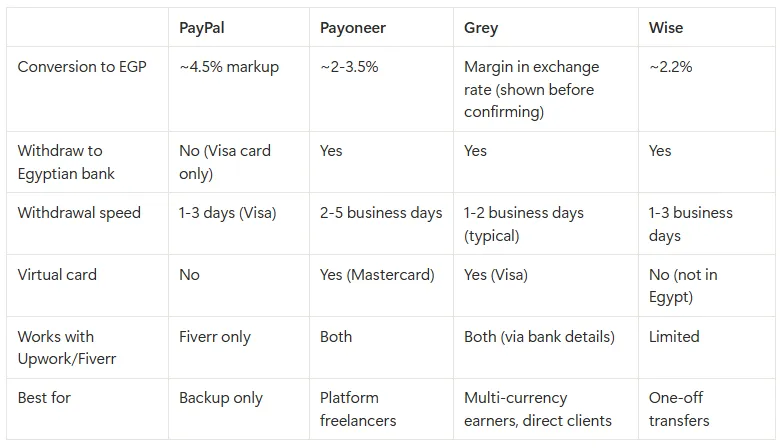
Payout provider comparison for Egyptian freelancers

Tax obligations for Egyptian freelancers earning in USD

This is where many guides for Egyptian freelancers stop, and it is exactly the section you need. Freelance income earned from international clients is taxable in Egypt. The specifics depend on how you structure your freelance activity.

If you operate as a sole proprietor (the most common structure for individual freelancers), your income is taxed under Egypt’s progressive personal income tax bands, which range from 0% on the first bracket up to 27.5% on the highest bracket. If you register a one-person company instead, you pay a flat corporate tax rate of 22.5% on business profits, regardless of income level. In both cases, you must register with the Egyptian Tax Authority (ETA) and obtain a Tax Card.

The annual tax return for sole proprietors is due by March 31. If your annual turnover exceeds EGP 500,000, you are also required to register for VAT at 14%. Egypt is increasingly requiring e-invoicing for professionals who invoice companies, so check the ETA portal to see whether your activity requires e-invoicing registration.

The good news is that business expenses are deductible. Software subscriptions, internet costs, equipment, coworking space, and other expenses directly related to your freelance work reduce your taxable income. Keep invoices and receipts for everything.

This is general guidance, not professional tax advice. Tax regulations change, and individual circumstances vary. Consult a certified tax professional in Egypt for advice specific to your situation.

Which platform is right for you

The best platform depends on where you are in your freelancing career and what type of work you do. Here is a practical framework:

If you are just starting out with no freelance portfolio or reviews, Fiverr or Mostaql are the lowest-barrier entry points. The competition is intense on low-price gigs, but completing 10 to 15 projects with strong reviews builds the credibility you need to move to higher-paying platforms. Mostaql is also a good starting point if you prefer working in Arabic and building a MENA client base first.

If you have a portfolio and 1 to 3 years of experience, Upwork or PeoplePerHour offer better rates and more substantial projects. Focus on building long-term client relationships, because repeat clients provide income stability and reduce the time and Connects spent on proposals. A single retained client at $3,000 per month is far more valuable than a dozen one-off projects.

If you are a senior specialist with 5+ years of experience in software engineering, finance, or product design, apply to Toptal. The screening process is demanding, but accepted freelancers earn $60 to $250 per hour with zero commission. Simultaneously, build your LinkedIn presence; many of the highest-value contracts come through direct outreach from hiring managers and founders.

If you want passive income, Etsy digital products let you create once and sell repeatedly. This works best as a complement to active freelancing, not a replacement, because it takes time to build a catalogue that generates consistent sales.

Regardless of which platform you choose, set up your payout method before your first project completes. Create a USD-denominated account, add those account details as your payout destination, and you will be ready to receive your first payment without delays. For options on spending your USD earnings directly, see our guide to virtual cards.

Receive your USD earnings with Grey

Grey gives Egyptian freelancers USD, EUR, and GBP account details that you can share with clients or add as payout destinations on freelance platforms. Here is how the setup works.

Download the Grey app (iOS or Android) or sign up at grey.co. Select Egypt as your country of residence and complete the KYC verification using your Egyptian national ID or passport. Verification typically takes a few minutes. Once approved, go to your account section to view your USD, EUR, and GBP account details, including routing numbers and account numbers for US bank transfers.

Add your Grey USD account details as the payout destination on Upwork, Fiverr, or whichever platform you use. Once the platform processes your withdrawal, the funds are credited to your Grey wallet. From there, you have several options: convert to EGP and withdraw directly to your Egyptian bank account (CIB, NBE, QNB, Banque Misr, and other major banks are supported) when the exchange rate suits you; keep a USD balance for paying international subscriptions and tools; or spend with your Grey virtual card on Visa-accepting merchants and services worldwide. If a client pays in USDC, you can also deposit stablecoins directly. For businesses invoicing international clients, Grey Business offers team accounts and international transfers.

Exchange rates on Grey are variable and include a margin over the mid-market rate. Grey does not charge transfer fees; the cost is reflected in the exchange rate. Always review the rate before confirming a conversion.

Frequently asked questions

Which freelance platform pays the most for Egyptian freelancers?

Toptal offers the highest rates: accepted Egyptian freelancers earn between $60 and $250 per hour, and the platform takes no commission on the freelancer side. However, Toptal’s acceptance rate is roughly 3%, so it is only accessible to senior specialists. For most Egyptian freelancers, Upwork offers the best combination of rate potential ($15 to $75 per hour) and project volume.

Can I use Upwork and Fiverr from Egypt without restrictions?

Yes. Both platforms are fully available to Egyptian residents. You can register, verify your identity, bid on or list projects, and receive payments. The main practical consideration is your payout method, as some withdrawal options (such as PayPal) are limited in Egypt. Setting up a Payoneer account or a multi-currency USD account before your first payout avoids delays.

How much tax do Egyptian freelancers pay on income from USD?

Freelance income is taxed under Egypt’s progressive personal income tax rates, ranging from 0% to 27.5%, depending on your annual income bracket if you operate as a sole proprietor. If you register a one-person company, the rate is a flat 22.5%. VAT registration is required if your annual turnover exceeds EGP 500,000, at a rate of 14%. Consult a certified tax professional for guidance on your specific situation, as tax regulations are updated periodically.

What is the cheapest way to convert USD to EGP as a freelancer?

Multi-currency fintech accounts typically offer lower conversion costs than PayPal or direct bank conversion. Payoneer’s conversion spread is approximately 2% to 3.5%, and PayPal’s total fees, including conversion, reach approximately 8.5%. Grey’s conversion cost is built into the exchange rate, which is shown before you confirm the conversion. Wise charges approximately 2.2%. The most expensive route is PayPal to a Visa card; the cheapest is generally a multi-currency USD account with direct withdrawal to your Egyptian bank.

Do I need a business registration to freelance from Egypt?

You are not legally required to register a company to freelance as an individual. However, you must register with the Egyptian Tax Authority (ETA) and obtain a Tax Card. If you plan to invoice companies regularly, registering a sole proprietorship helps with e-invoicing compliance and banking. Egypt’s ITIDA also offers a freelancer ID through freelancer. eg, which provides access to banking services and business support.

Can I earn on multiple freelance platforms simultaneously?

Yes. Many Egyptian freelancers maintain profiles on two or three platforms, for example, using Upwork for long-term contracts and Fiverr for short-turnaround gigs. The key is maintaining your reputation on each platform (response time, completion rate, reviews) rather than spreading yourself too thin. You can also combine platform work with direct client acquisition through LinkedIn.

‍

Ready to start receiving your USD freelance earnings? Sign up at grey.co or download the Grey app to get your multi-currency account details in minutes.
‍

‍

‍

How to budget in foreign currencies using the Grey card

•

•

2 min read

Budgeting used to be simple. You earned money, spent money, and tracked what was left. At that time, you had only one account with one currency, which required just one mental model.

Then remote work happened.

Now you might earn in EUR, pay for tools in USD, and travel in between. Discipline isn’t enough for budgeting anymore; you need structure. Without the right structure, even the most careful spender can lose track of where their money is going.

The Grey card comes in as a practical budgeting tool for people who live and spend across borders. I’ll explain.

Why budgeting in multiple currencies breaks down so easily

Most people don’t overspend because they’re irresponsible. Rather, they overspend because their money isn’t organised in a way that reflects how they live.

Here’s what usually goes wrong.

You’re spending across platforms, clients, and countries, but everything is tied to one card. Subscriptions, ads, one-off purchases, and travel expenses all blur together. When something goes wrong, such as a spike in ad spend or an unexpected renewal, it’s challenging to pinpoint the cause quickly.

Add foreign currencies to the mix, and it gets worse. The charges don’t always settle immediately, and these small amounts seem harmless until they quietly add up.

At that point, your budget is broken.

Also read: How to use your Grey card to manage all your subscriptions

What should budgeting look like when you earn and spend globally?

Clarity, separation, and control are the most crucial factors when budgeting across multiple currencies. You should be able to:

  • See exactly what each type of spending is costing you.
  • Stop or pause spending instantly when needed.
  • Protect one part of your budget from another.
  • Make changes without disrupting everything else.

The Grey card is designed around solving these exact needs.

How does the Grey card help with budgeting?

Use multiple cards to separate your spending

One of the most effective budgeting habits is separation. Instead of using a single card for everything, you can create multiple cards with clear purposes.

For example, you can create:

  • One card for subscriptions and recurring tools
  • One card for ads and growth experiments
  • One card for travel or everyday spending
  • One card per client or project

Each card acts like its own budget lane. You don’t need to guess where the money went; you already know.

This is especially useful if you freelance, manage ads, or run multiple income streams. When spending is separated, budgeting becomes more straightforward.

Also read: How to pay for ads easily with your Grey card

Freeze cards instantly when spending goes off-track

Budgets fail when you can’t act fast enough.

With the Grey card, you can instantly freeze or unfreeze any card in the app. If an ad campaign starts burning cash, freeze the card. If a subscription you forgot about renews unexpectedly, freeze the card. If you’re travelling and want to lock down non-essential spending, freeze the card.

Freezing a card doesn’t affect your other cards or balances. It simply stops that specific spending lane, which is precisely how budgeting should work.

Set limits that protect your budget

Budgets can fail when they’re too rigid. Grey’s spending limits work more like guardrails.

You can set daily or monthly limits per card, receive alerts when you’re approaching your limit, and still stay flexible. The goal isn’t to punish spending. I mean, who wants that? It’s to keep you aware before things drift too far.

For shared cards or subscriptions, limits are especially useful. You know exactly how much can be spent, and nothing sneaks past unnoticed.

Track spending clearly in one place

When you’re budgeting across currencies, visibility matters more than perfection. Every Grey card transaction appears clearly in your app, linked to the card you used. That means you’re not just seeing how much you spent, but why you spent it.

When budgeting time comes around, you’re no longer reconstructing your month from memory. The structure is already there.

Spend confidently across borders

Trust helps with budgeting too. When you’re shopping internationally, paying for ads, or travelling, declined payments and unexpected charges can throw everything off. The Grey Card works across global merchants and even supports Apple Pay and Google Pay, so everyday spending feels normal, even when you’re far from home.

LDMAG1

A quick note on protection when spending abroad

An often-overlooked aspect of budgeting is preparing for contingencies in case things go wrong.

When you pay with your Grey card, you have access to Visa benefits, including purchase protection, extended warranties, and price protection, depending on the transaction and your activation status. It’s not something you think about daily, but it adds a layer of reassurance when you’re buying electronics, booking travel, or shopping internationally.

It’s one less thing to worry about while managing money across borders.

Also read: How to claim your Visa card benefits

What budgeting in foreign currencies is like with the Grey card

When your card and your accounts are aligned, budgeting stops being guesswork. You know what you’re spending, which currency it’s coming from and more importantly, when something changes.

Instead of constantly reacting to your balance, you’re now making decisions with clarity. And that’s what good budgeting should be like, whether you’re at home, travelling, or working remotely.

If you’re ready to make your budget work wherever you are, create or update your Grey card and start spending and budgeting in the ways that matter to you.

‍

How Algerians receive international payments without Payoneer in 2026

•

•

2 min read

The day an Algerian freelancer mentioned that he lost nearly 18% to conversion fees during a payout was the day many realised how much money disappears. I remember the post quickly gaining attention, with others sharing similar stories. One business owner explained how a delayed transfer nearly cost him an important opportunity.

These stories reflect a wider challenge. For many freelancers and remote professionals in Algeria, receiving money from abroad can be frustrating. High conversion fees, long processing times, and strict banking procedures often reduce earnings before they are even accessed. Transfers may take days or weeks to clear, making it difficult to manage cash flow or plan business growth.

If you’re working with clients abroad and wondering how to receive payments efficiently while based in Algeria, this guide outlines practical, secure options to help you access your money faster and with fewer losses.

Also read: How to withdraw your freelancing money in Algeria

Why getting paid from abroad in Algeria isn’t always easy

Limited access to global platforms

Many Algerians struggle because major global platforms like Payoneer are not fully supported locally. This limits options for freelancers and remote workers, forcing you to search for alternatives that may be less convenient or more expensive.

High bank charges

If you’ve received money through a local bank, you’ve probably noticed the high fees. Between transfer charges and currency conversion costs, you can lose a significant portion of your earnings before it even reaches you.

Delays in international transfers

International transfers don’t always arrive quickly. Sometimes withdrawals take several days or longer to process in Algeria. These delays can be stressful, especially when you’re depending on that money for urgent expenses.

Currency withdrawal restrictions

In Algeria, foreign currency is tightly regulated by the Bank of Algeria. You cannot freely hold or withdraw large amounts of USD or EUR in cash. Most international payments must be converted into Algerian Dinar through official banking channels. There are also limits on foreign currency transfers and strict documentation requirements. This makes it harder for freelancers to access or move money freely.

Also read: The ultimate digital bank account for freelancers in Algeria

Best payment platforms to receive money from abroad in Algeria

There are smarter ways to get paid from abroad without losing money to fees or delays. Let’s look at the options that actually work.

Grey

Grey is a fast and reliable option for receiving money from abroad. It supports multiple currencies, making it easy to convert funds to Algerian Dinar securely. Payments arrive quickly, often faster than traditional banks, and its user-friendly platform lets you manage multiple streams of income in one place. For freelancers and remote workers, Grey reduces delays and ensures your money is safe while keeping conversion fees lower.

Wise

Wise is a popular platform for international payments because it’s transparent and straightforward. It allows Algerians to receive money in foreign currencies like USD, EUR, or GBP and convert to DZD at competitive rates. Fees are clear upfront, and transfers are generally faster than banks. Many freelancers prefer Wise because it reduces hidden costs, avoids unnecessary delays, and makes it simple to track payments from multiple clients.

Skrill

Skrill is a digital wallet that allows Algerians to receive international payments safely. It supports multiple currencies and enables fast, secure online transfers. Freelancers can withdraw funds to local bank accounts or spend them directly using a Skrill card. While fees are slightly higher than some other platforms, Skrill is reliable for regular payments, and it’s widely accepted by global companies and freelance marketplaces.

Bank Transfers

Direct bank transfers using SWIFT are one of the most secure ways to receive money from abroad. Payments usually take about three business days to reach Algerian accounts. You’ll need your IBAN and bank details, and funds are automatically converted to DZD. While reliable, bank transfers often come with higher fees and less flexibility compared to digital platforms, making them better for larger or less frequent payments.

MoneyGram

MoneyGram allows Algerians to receive cash quickly from international clients. The sender can transfer money online or from a branch, and you can pick up the funds at a local MoneyGram agent. It’s convenient for urgent payments, and no bank account is required. However, fees can be high depending on the amount, so it’s best for small or urgent transfers rather than regular freelance income.

Also read: How to open international bank accounts in Algeria

Ria Money

Ria Money Transfer is another option for receiving money from abroad in Algeria. Transfers are usually fast, often within a day, and funds can be collected at local agents. Ria supports multiple currencies, and it’s especially useful for freelancers without international bank accounts. While convenient, fees can vary, so it’s ideal for occasional payments or urgent transfers rather than large, recurring freelance payments.

Before you receive money from outside Algeria, read this

Because the money coming in is foreign, the Algerian government has rules in place before you can access it. These regulations affect timing, limits, and how payments are processed.

Documentation

To pick up cash in Algeria, you must show a government-issued ID. Without it, you might not be able to receive your payment, so always keep your ID ready.

Rate

Exchange rates vary between providers, which can affect how much you actually receive. Grey is ideal for Algerians because it offers competitive, transparent conversion rates, helping you retain more of your earnings.

Limits

Large payments, especially for business owners or highly paid remote workers, may undergo extra security checks. These can slow transfers and require additional verification before funds are released.

LDMAG1

Managing international payments with Grey

Receiving international payments should not be difficult for Algerians, especially as more people in the country are working remotely and earning from global clients. With the right solution like Grey, you can receive money quickly, securely, and at competitive exchange rates.  Download the mobile app today or sign up on the website, and start managing your international payments without unnecessary stress.

‍

How to use your Grey card to manage all your subscriptions

•

•

2 min read

I was so shocked when I saw the news. “Netflix to Acquire Warner Bros.” It’s the kind of industry shift that usually comes with new bundles, price changes, region-specific catalogues, and the inevitable “Your plan has been updated” email.

If you’re already juggling multiple subscriptions, such as streaming platforms, cloud storage, creative tools, productivity apps, and gaming services, any minor hiccup with your payment method can cause everything to collapse at once. A low balance here, a declined international charge there, and suddenly Netflix stops streaming, Spotify logs you out, and your work tools start sending warnings.

Now, where subscription prices keep changing, platforms keep merging, and foreign services dominate the apps we use daily, the real need isn’t more subscriptions; it’s a card that can keep up with them. The Grey card is perfect for this. It’s a flexible and reliable way to manage all your subscriptions, without worrying about currencies, top-ups, or unexpected declines.

Why do subscriptions fail in the first place?

Before discussing the solution, it helps to understand the problem. Most subscription failures come down to:

1. Cards that don’t support international merchants

Some platforms, especially those based in the US or EU, automatically reject certain cards.

2. Low or inconsistent balance

Most cards require you to have the exact amount ready before the subscription date. If you forget to top up, your subscription will pause.

3. Currency conversion issues

If your card is billed in one currency and the service charges are in a different currency, the payment may fail due to delays or conversion errors.

4. Tracking too many subscriptions at once

When everything runs on one card, it’s easy to lose control of what’s being billed and when.

Grey’s card helps smooth out each of these challenges.

Also read: How to use Google Pay worldwide with your Grey virtual card

LDMAG1

How does your Grey card make subscription management easier?

The card is designed to handle everyday payments, recurring charges, and international subscriptions without requiring you to jump through hoops. Here’s how it helps:

Spend from different currency wallets

This is one of the biggest advantages. Most cards are linked to a single currency, but your Grey card isn’t.

Although the card is primarily a USD card, the payment flow depends on the available balance: USD → USDC → the next-highest available balance (GBP or EUR).

Multiple cards for easy organisation

Instead of one card for everything, you can create two or three:

  • one for entertainment subscriptions
  • one for work tools
  • one for shared family plans

This makes it easy to track what’s coming out where, and freeze or cancel only the card linked to a specific group of subscriptions.

Accepted by most global platforms

The Grey card works across major international merchants, streaming services, cloud storage providers, gaming platforms, and productivity tools, so you don’t need multiple payment methods.

Add to Apple Pay or Google Pay

If you prefer not to type card details into every website, you can simply add the card to your mobile wallet and pay securely.

Instant freeze and unfreeze

If one subscription starts misbehaving or you just want to take a break, you can temporarily freeze the card.

Also read: How to pay for ads easily with your Grey card

How to set up your subscriptions with Grey

1. Create or activate your card

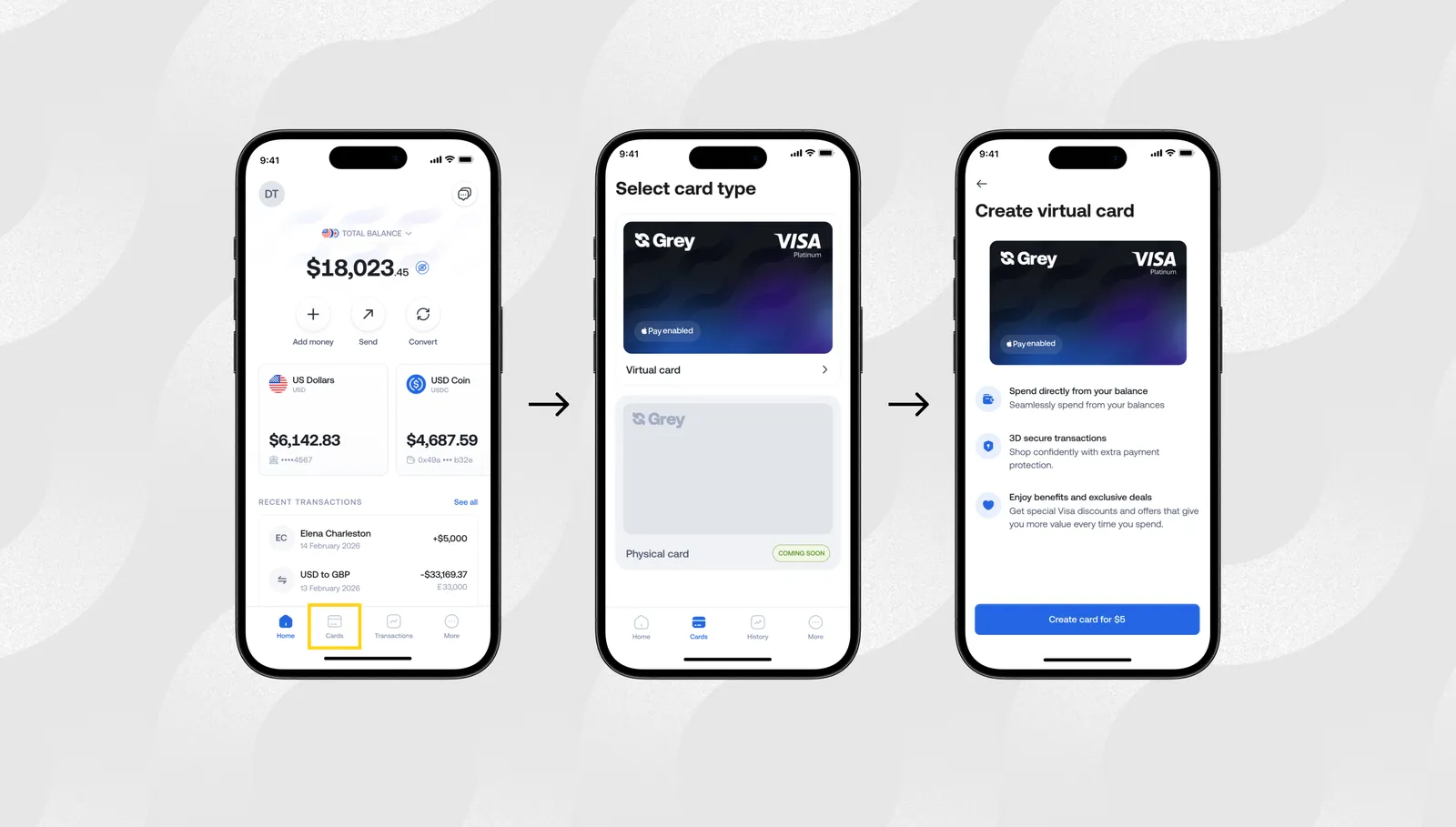
If you already have a Grey account, getting a card is simple. Simply go to the cards section to request a card for $5.

2. Add your card to your subscriptions

It could be Netflix, Figma, or iCloud. Simply enter your card details or pay via Apple Pay / Google Pay.

3. Set up spending limits

A small monthly limit can help you stay in control, especially for family or shared cards.

4. Create additional cards if needed

I like to think of them like folders. Each card can represent a spending category.

Enjoy stress-free subscription management

There’s something about managing subscriptions that makes them seem a lot like admin work. Your Grey card helps keep everything organised.

Whenever you’re ready to try it (which I hope will be soon), create your card, link your first subscription, and enjoy the peace of mind that comes with everything just working.

Create your Grey account today to get started.

‍

How to use Google Pay worldwide with your Grey virtual card

•

•

2 min read

I’ve always loved feeling independent, the kind of person who can move through the world without needing to stop and sort out a dozen little hassles. Maybe that’s why tapping my phone to pay has become one of my favourite tiny freedoms.

If you’re anything like me, you know those moments well. Rushing through an airport with no hands to spare. Grabbing breakfast from a food stall because you’re curious about how the locals eat. Signing up for an online tool at midnight because the timing just felt right.

That’s exactly why learning how to use Google Pay worldwide with your Grey virtual card makes such a difference. Once your card sits snugly inside Google Pay, every payment becomes smoother. No digging through bags, topping up a card before paying, and no declines. Just a quick tap and the quiet satisfaction of knowing you’ve sorted it.

And now that the Grey virtual card has officially landed, this is the perfect time to explore everything it can do to keep your days light, easy, and wonderfully yours.

Why the Grey virtual card works so effortlessly with Google Pay

If you’re looking for a simple, reliable way to use Google Pay worldwide, the Grey virtual card makes the process smoother than ever. With our upgraded virtual card experience now live, Google Pay becomes more than a convenient feature. It becomes the easiest way to spend your foreign currency and crypto balances across countries, platforms, and everyday transactions.

Here’s why using Google Pay with your Grey virtual card is such a seamless match:

One card, multiple balances

Your Grey virtual card connects directly to any balance you choose, including USD, GBP, EUR, or crypto like USDC, USDT, or BTC. No manual top-ups. No switching between wallets. Just direct, instant spending power everywhere Google Pay is accepted.

A smoother global experience

Many people switching to the Grey virtual card do so after dealing with cards that fail on international platforms. This upgraded virtual card was designed to remove that frustration. You get fewer random declines, clearer communication, and fast support whenever you need it, making global payments feel more predictable.

Contactless convenience, everywhere

When you combine Google Pay’s tap-to-pay simplicity with Grey’s global card functionality, you get fast, contactless payments across countries, currencies, and online merchants. Whether you’re shopping locally or paying for international services, everything works with a tap.

Stronger security

The Grey virtual card supports 3D Secure (3DS), giving you added protection during online and in-store transactions. It’s a safer way to shop, travel, and pay globally.

Who benefits most from using Google Pay with the Grey virtual card?

If you’ve been searching for a reliable virtual card that works with Google Pay worldwide, this duo is designed exactly for the way modern global citizens live, earn, and spend.

Digital nomads and travellers

Once your Grey virtual card is added to Google Pay, you can tap your way through airports, metros, cafés, supermarkets, and co-working spaces, anywhere contactless payments are accepted.

Crypto enthusiasts

If you hold or earn in crypto, Google Pay becomes your gateway to everyday fiat spending. Link your Grey virtual card to your crypto balances and pay like a local in any country.

Freelancers and remote workers

Whether you earn in USD, work with clients in Europe, or pay for tools hosted abroad, Google Pay + Grey card gives you a consistent and flexible way to manage global payments without failed transactions or confusing restrictions.

Small business owners

Running ads on Meta, TikTok, or X? Paying for global subscriptions and software? Your Grey virtual card helps every payment go through smoothly, without hidden fees or last-minute surprises.

How to create your Grey virtual card and add it to Google Pay

If you’re learning how to use Google Pay with your Grey virtual card, the setup takes just a few seconds:

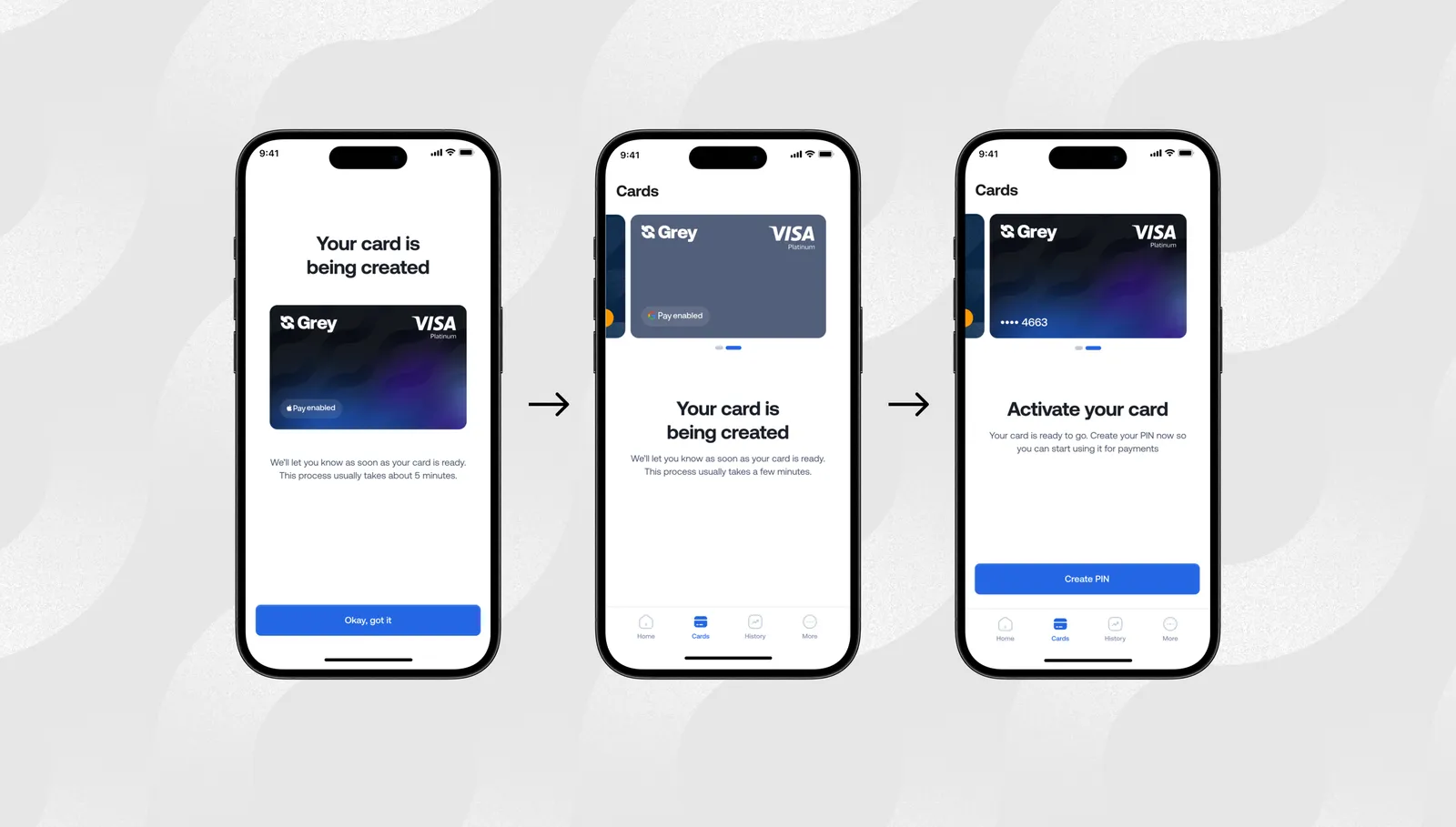
Tap to create your Grey card in the app.

__wf_reserved_inherit

Follow the verification steps.

__wf_reserved_inherit

It usually takes a few hours for the card to be created.

__wf_reserved_inherit

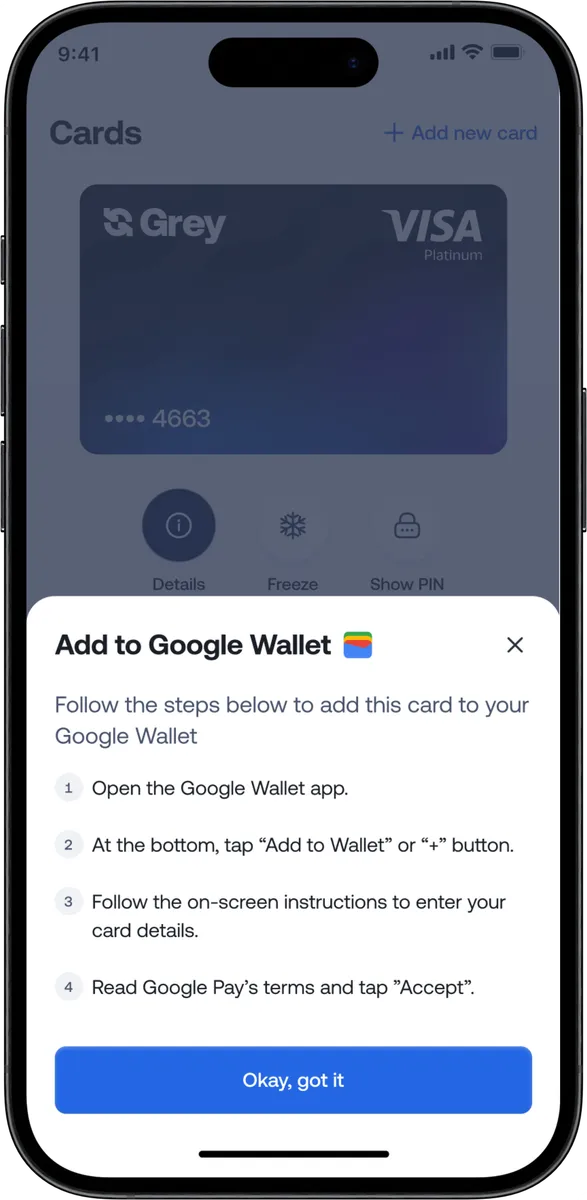
Once your Grey virtual card is ready, you can follow the steps to add it to Google Pay.

__wf_reserved_inherit

Once added, you can use Google Pay for contactless payments, online checkouts, in-app purchases, public transport, and global merchants that support Google Pay.

Where you can use Google Pay with your Grey virtual card worldwide

Google Pay works in dozens of countries and millions of merchant locations. With the Grey virtual card connected, you can:

  • Book international flights
  • Pay for Airbnb and travel bookings
  • Buy coffee and groceries in cities like Barcelona, Nairobi, Accra, Mexico City, or Bali
  • Subscribe to Amazon, Spotify, Canva, YouTube Premium, and more
  • Pay for ad platforms like Meta, TikTok, Google Ads, and X

Your Grey Visa card selects the right balance automatically, while Google Pay makes each payment instant and contactless.

Why this upgrade matters now

For years, users dealt with failed payments, poor international compatibility, and unclear card restrictions. The new Grey virtual card was built to fix these problems and make global payments through Google Pay easier than ever.

This upgrade helps you:

  • Spend globally with fewer limitations
  • Enjoy reliable virtual card functionality
  • Avoid unexpected card blocks or errors
  • Use foreign currency and crypto balances effortlessly
  • Make international purchases with more confidence

It’s all part of our goal to make international spending feel as easy as local shopping.

If you live or work globally, you deserve a payment setup that travels with you. Google Pay paired with the Grey virtual card removes friction from your everyday life so you can focus on what actually matters.

Ready to tap and go anywhere in the world?

Open your Grey app, get your Grey virtual card, and start using Google Pay wherever life takes you.

‍

How remote employees receive salaries from abroad

•

•

2 min read

Remote work has made it possible to earn a full salary from companies thousands of miles away. Whether you’re employed by an overseas startup or contracted by an international firm, your income now crosses borders before it reaches you. The opportunity is global, but receiving your salary isn’t always straightforward.

Most international employers pay in USD, EUR, or GBP. Yet many traditional banks weren’t built for seamless cross-border salary payments. Transfers can be delayed, automatically converted, or processed through third parties, limiting how you access and manage your earnings.

As more professionals work for foreign companies, the question is no longer can you earn globally, but how you receive and manage that salary efficiently. This article outlines reliable foreign account options designed for remote workers paid from abroad.

Also read: Best global banking setups for remote workers

Grey

Grey has grown into a strong cross-border payment platform built for remote workers earning in USD, EUR, and GBP. It provides multi-currency accounts that let you hold foreign earnings without forced conversion. You can send international payments or convert funds only when the rates suit you. Fees are clear and upfront, and it connects smoothly with platforms like Upwork and Fiverr, ensuring quick access to your salary or freelance income.

  • Sign up on the Grey website or app and complete identity verification.
  • Create your multi-currency account (USD, EUR, or GBP).
  • Access your foreign bank details provided inside your dashboard.
  • Share those details with your employer or client.
  • Receive your salary directly in foreign currency and convert or withdraw when preferred.

Wise

Wise is widely used by remote professionals receiving international salaries. It offers multi-currency accounts with local bank details in major currencies, making it easier for employers in the US or Europe to pay you directly. Known for mid-market exchange rates and transparent pricing, Wise allows users to hold, convert, and withdraw funds efficiently. It’s particularly useful for workers prioritising fair exchange rates and straightforward international transfers.

  • Open a Wise account and complete verification.
  • Activate the required currency account (USD, EUR, GBP, etc.).
  • Obtain local bank details for that currency.
  • Provide those bank details to your employer or payroll team.
  • Receive payment, hold funds, convert at mid-market rates, or withdraw to your local bank.‍

Payoneer

Payoneer remains popular among freelancers and contractors paid through global marketplaces. It integrates directly with platforms like Upwork and Fiverr, simplifying withdrawals. However, fees can be higher than newer fintech alternatives. Currency conversion charges may reach 2–3%, and inactive accounts can attract annual fees. While reliable and widely accepted, remote workers should review the cost structure carefully to ensure it aligns with their earning patterns.

  • Register for a Payoneer account and verify your identity.
  • Request receiving accounts in supported currencies.
  • Link your Payoneer account to freelancing platforms or share bank details with clients.
  • The employer or platform sends payment to your Payoneer account.
  • Withdraw funds to your local bank or use the Payoneer card.

Revolut

Revolut offers digital banking with multi-currency wallets, competitive exchange rates, and international transfer capabilities. Remote workers can hold and exchange several currencies within one app, making it convenient for managing overseas salaries. It also provides debit cards and budgeting tools. However, certain features depend on your country of residence, and some plans include monthly subscription fees. Revolut suits tech-savvy professionals seeking flexible, app-based global banking solutions.

  • Download the Revolut app and complete account verification.
  • Open the required currency wallet within the app.
  • Retrieve your account’s local or international bank details.
  • Share those details with your employer or client.
  • Receive your salary, hold multiple currencies, exchange within the app, or transfer to another bank.

Also read: Best multi-currency accounts for remote workers in Latin America

Myths about receiving salaries from abroad

Many remote workers hesitate to accept international jobs due to common misconceptions about delays, restrictions, and the ability to access foreign income.

1. My money will take too long to arrive

Many believe international salaries always take weeks to process. In reality, modern digital banking platforms and foreign accounts enable faster transfers, sometimes within hours or a few business days.

2. I can only receive payment through cash pickup

Some assume international earnings must be collected physically through money transfer agents. Today, foreign accounts and fintech platforms allow direct bank deposits without visiting any location.

3. Foreign accounts are only for large businesses

There’s a misconception that only corporations can open foreign or multi-currency accounts. Many fintech platforms now provide accessible options specifically designed for freelancers and remote employees.

4. Receiving foreign salaries is restricted

Some workers worry that earning from abroad violates regulations. In most countries, receiving foreign income is legal, provided proper identification and compliance requirements are met.

LDMAG1

Simplifying international payments for remote workers

Working remotely comes with many opportunities, but receiving your salary from an international employer shouldn’t be complicated. That’s why Grey makes it simple to receive payments smoothly and without stress. Remote workers can access their salaries quickly, manage multiple currencies, and convert at fair exchange rates, without worrying about excessive or hidden fees.

Sign up for Grey today or download the app to enjoy a faster, more reliable way to receive your salary, wherever you work from.

‍

Arrow (up)

Back to top