

An IFSC code (Indian Financial System Code) is an 11-character alphanumeric code that identifies a specific bank branch in India. The Reserve Bank of India assigns one to every branch in the country, and it is required for all electronic fund transfers through NEFT, RTGS, and IMPS. If you are sending money to someone's bank account in India, whether from within the country or from abroad, you need the IFSC code for their branch to complete the transfer.
The code is straightforward once you understand the format, but it causes confusion for two groups of people in particular: those sending money to India from the US, UK, or other countries who encounter IFSC alongside SWIFT and IBAN codes and are not sure which one they need, and Indian freelancers receiving international payments who need to provide their IFSC when withdrawing funds to their local bank account. This guide covers both situations.
What IFSC stands for and how the code is structured
IFSC stands for Indian Financial System Code. Every code is exactly 11 characters long and follows the same structure:
| Characters | Example | What they represent |
|---|---|---|
| First 4 (letters) | SBIN | The bank. SBIN = State Bank of India, HDFC = HDFC Bank, ICIC = ICICI Bank, UTIB = Axis Bank. |
| 5th (always zero) | 0 | Reserved by the RBI for future use. This character is always zero in every IFSC code. |
| Last 6 (alphanumeric) | 005943 | The specific branch. Each branch of a bank has a unique six-character identifier. |
So when you see SBIN0005943, you know it is a State Bank of India branch (SBIN), the zero is the standard separator, and 005943 identifies the exact branch. Two ICICI Bank branches in the same city will share the first five characters (ICIC0) but differ in the last six.
This structure means IFSC codes are branch-specific, not account-specific. If you change your branch but keep the same bank, your IFSC code changes. If you change nothing, it stays the same. Your account number and your IFSC code are independent.
Where to find an IFSC code
If you are looking for your own IFSC code (to share with someone sending you money), check any of the following: the top of a cheque leaf from your chequebook, the front page of your bank passbook, your net banking or mobile banking app (usually under account details), or the branch locator tool on your bank's website.
If you are looking for someone else's IFSC code (to send them money), the simplest route is to ask them directly. Sharing an IFSC code is safe. It identifies a bank branch, not an individual account. No one can withdraw money from your account using your IFSC code alone.
You can also look up any IFSC code on the RBI's website or on third-party tools like Razorpay's open-source IFSC toolkit, which covers every active branch in India.
When you need an IFSC code for international transfers to India
This is the part most guides skip. Receiving money from abroad can involve more than one banking code. The one you need depends on how the money is being sent and how it reaches your Indian bank account.
For a traditional international wire sent through the SWIFT network, the sender will typically need your bank's SWIFT/BIC code, along with your account details. A BIC is an international identifier used to identify financial institutions and route financial transactions.
An IFSC code becomes relevant when the payment is routed to your Indian bank account through a domestic payment system, such as NEFT or RTGS. This can happen with international payment services that receive the money abroad and then complete the final payout locally in INR.
Here's the practical difference:
| Transfer method | Code/details typically needed |
|---|---|
| International bank transfer via SWIFT | SWIFT/BIC + recipient account details |
| Local INR payout to an Indian bank account | Account number + IFSC |
| NEFT or RTGS transfer | Account number + IFSC |
| UPI payout | UPI details requested by the provider |
So, if a client is wiring money directly from an overseas bank to your Indian bank through SWIFT, they may ask for your bank's SWIFT/BIC rather than relying on the IFSC. If you're using an international payment provider that converts the funds and sends INR to your Indian account locally, you'll commonly be asked for your account number and IFSC for the final payout.
The important thing is to follow the payment instructions provided by your bank or transfer service. Some international transfers involve both an international leg and a domestic Indian payout, so seeing an IFSC requested for a payment that originated abroad is completely normal.
Sending to an Indian bank account (bank transfer)
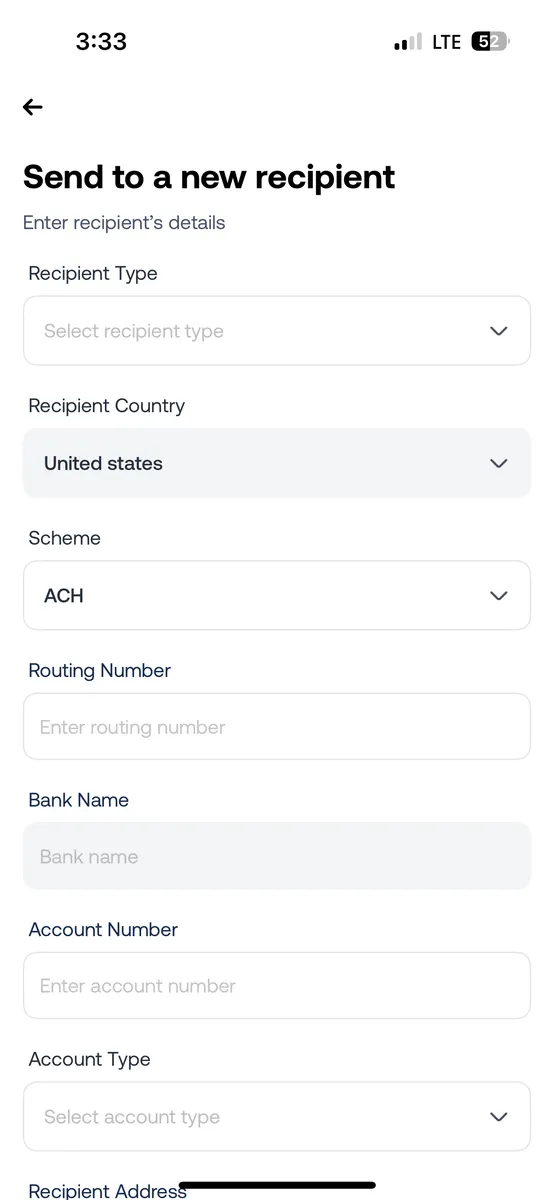
You need the recipient's IFSC code and their bank account number. The IFSC tells the payment system which branch to route the funds to. The account number identifies the specific account at that branch. This applies whether you are using a remittance app, a multi-currency account, or a traditional wire transfer.
Some platforms also ask for the recipient's bank name and branch name. These are for display and verification purposes. The IFSC code is what actually routes the payment.
Sending via UPI
UPI (Unified Payments Interface) does not require an IFSC code. You send to the recipient's UPI ID (like name@bankname) or their mobile number linked to UPI. The UPI system handles all the bank routing internally. This is one of the practical advantages of UPI for international transfers to India: fewer details to get wrong.
Grey supports both bank transfer and UPI for INR payouts to India. If your recipient has UPI set up, it is usually the simpler option. If they do not, a bank transfer with IFSC works for every Indian bank account.
Sending via SWIFT or wire transfer
If you are sending a traditional international wire transfer to India through your bank, you need the SWIFT/BIC code (which identifies the bank globally), not the IFSC code. However, your bank may also ask for the IFSC code as an additional routing detail to identify the specific branch. The two codes serve different purposes: SWIFT identifies the bank internationally, and IFSC identifies the branch domestically.
IFSC vs SWIFT vs IBAN: which code do you need?
This comparison causes the most confusion for people involved in cross-border payments to or from India.
| Code | What it identifies | Used for | Format |
|---|---|---|---|
| IFSC | A specific bank branch in India | Domestic transfers (NEFT, RTGS, IMPS) and as additional routing for international transfers to India | 11 characters (4 letters + 0 + 6 alphanumeric) |
| SWIFT/BIC |
A bank globally | International wire transfers | 8 or 11 characters |
| IBAN | A bank account internationally | International transfers in Europe, Middle East, and some other regions | Up to 34 characters (varies by country) |
India does not use IBAN. If a platform asks for an IBAN when you are sending money to India, it is asking for the wrong code. Indian bank accounts use an account number plus IFSC for domestic routing, and a SWIFT code for international identification. For a detailed explanation of SWIFT and IBAN codes and how they apply to Grey accounts, see IBAN vs SWIFT codes: how are they different?
IFSC for Indian freelancers receiving international payments
If you are an Indian freelancer or business owner who receives international payments through a multi-currency account or payment platform, you encounter IFSC at the withdrawal stage. Here is the typical workflow.
Your client pays you in USD, GBP, or EUR into your multi-currency account (like Grey). The funds sit in foreign currency until you are ready to convert. When you withdraw to your Indian bank account, you provide your Indian bank's account number and IFSC code. The platform uses these to route the INR payout to your branch.
If you withdraw via UPI instead, you provide your UPI ID or linked mobile number. No IFSC is needed.
With Grey, INR payouts to India settle instantly via UPI or next business day via bank transfer, both at a flat fee. Once the funds arrive in your Indian bank account, you can request a Foreign Inward Remittance Certificate (FIRC) as proof of the inward remittance, which may be useful for GST refund claims, export documentation, and financial record-keeping.
Common IFSC mistakes when sending money to India
Using an outdated IFSC code after a bank merger. When banks merge (as happened with several Indian public sector banks in recent years), branch IFSC codes change. The old code may stop working or route to a different branch. If your recipient's bank has merged with another bank since you last sent them money, ask for their updated IFSC.
Confusing IFSC with SWIFT. IFSC is 11 characters starting with four letters (the bank code), then a zero, then six characters. SWIFT/BIC codes are 8 or 11 characters with a different structure (bank code + country code + location code + optional branch code). If a transfer form asks for IFSC, do not enter the SWIFT code, and vice versa.
Entering the IFSC for the wrong branch. Two branches of the same bank in the same city have different IFSC codes. If your recipient recently changed their home branch or opened a new account at a different branch, their IFSC may have changed even though their bank name is the same. Always confirm the IFSC with the recipient before sending.
Assuming IFSC is needed for UPI transfers. If you are sending to a UPI ID or a mobile number linked to UPI, no IFSC is required. The UPI infrastructure handles routing internally. Only bank account transfers require IFSC.
Frequently asked questions
What is an IFSC code?
IFSC stands for Indian Financial System Code. It is an 11-character alphanumeric code assigned by the Reserve Bank of India to every bank branch in the country. It is used to identify the destination branch for electronic fund transfers through NEFT, RTGS, and IMPS.
How many digits are in an IFSC code?
An IFSC code has 11 characters: four letters identifying the bank, a zero as a separator, and six alphanumeric characters identifying the specific branch. For example, HDFC0000003 is an HDFC Bank branch where 000003 is the branch code.
Is it safe to share my IFSC code?
Yes. An IFSC code identifies a bank branch, not an individual account. No one can access your money using your IFSC code alone. You can safely share it with anyone who needs to send you a payment.
Do I need an IFSC code to send money to India from abroad?
It depends on the method. For bank transfers to an Indian bank account, yes, you need the recipient's IFSC code along with their account number. For UPI transfers, no IFSC is needed. For traditional SWIFT wire transfers, your bank will primarily use the SWIFT code, though some may also ask for the IFSC as additional routing information.
What is the difference between IFSC and SWIFT code?
IFSC identifies a specific bank branch within India and is used for domestic electronic transfers (NEFT, RTGS, IMPS). A SWIFT code identifies a bank globally and is used for international wire transfers. IFSC is 11 characters (4 letters + 0 + 6 alphanumeric). SWIFT is 8 or 11 characters with a different structure. India does not use IBAN.
Does India use IBAN codes?
No. India does not use IBAN for bank transfers. Indian bank accounts are identified by an account number plus an IFSC code for domestic transfers, and a SWIFT code for international identification. If a platform asks for an IBAN when you are sending money to India, it is requesting the wrong code.
Is the IFSC code the same for all branches of a bank?
No. Every branch has its own unique IFSC code. Two branches of the same bank in the same city will share the first five characters (bank code plus zero) but differ in the last six. If you change your branch, your IFSC changes, even if your account number stays the same.
Can I send money to India without an IFSC code?
Yes, if you use UPI. UPI transfers use the recipient's UPI ID or mobile number and do not require an IFSC code. For bank account transfers through NEFT, RTGS, or IMPS, the IFSC code is mandatory. Grey supports both bank transfer (requires IFSC) and UPI (no IFSC needed) for INR payouts to India.
Grey is a financial technology company, not a bank. Banking services are provided by licensed banking partners. This article is general information, not financial advice.