


<script type="application/ld+json" data-schema-version="grey-blog-v4"> [{"@context":"https://schema.org","@type":"BlogPosting","@id":"https://grey.co/blog/how-to-get-an-instant-usd-debit-card-in-france#article","headline":"How to get an instant USD debit card in France","description":"Discover how to get an instant USD debit card in France with Grey. Save on conversion fees, shop globally, and manage subscriptions effortlessly.","inLanguage":"en","url":"https://grey.co/blog/how-to-get-an-instant-usd-debit-card-in-france","mainEntityOfPage":{"@id":"https://grey.co/blog/how-to-get-an-instant-usd-debit-card-in-france#webpage"},"datePublished":"2024-12-25T01:44:58.524Z","dateModified":"2026-06-15T17:15:10.262Z","author":{"@type":"Person","@id":"https://grey.co/authors/adeolu-titus-adekunle#person","name":"Adeolu Titus Adekunle","url":"https://grey.co/authors/adeolu-titus-adekunle","jobTitle":"Content Writer","sameAs":["https://www.linkedin.com/in/titusadeoluadekunle/"]},"publisher":{"@type":"Organization","@id":"https://grey.co/#organization","name":"Grey","url":"https://grey.co","logo":{"@type":"ImageObject","url":"https://cdn.prod.website-files.com/6360022338a81bd6fdbb1145/6564ae1077a67e39d3c491a6_Grey%20Logo%20Lockup%20Black.svg"}},"image":{"@type":"ImageObject","@id":"https://grey.co/blog/how-to-get-an-instant-usd-debit-card-in-france#primaryimage","url":"https://cdn.prod.website-files.com/636a85d290ee58e70c17e1c0/6a3016b8a8cabb7c15b64a0c_6a3016b8b24e8fcf46a01311_how-to-get-an-instant-usd-debit-card-in-france__header-image.webp","contentUrl":"https://cdn.prod.website-files.com/636a85d290ee58e70c17e1c0/6a3016b8a8cabb7c15b64a0c_6a3016b8b24e8fcf46a01311_how-to-get-an-instant-usd-debit-card-in-france__header-image.webp","width":1200,"height":675}},{"@context":"https://schema.org","@type":"WebPage","@id":"https://grey.co/blog/how-to-get-an-instant-usd-debit-card-in-france#webpage","url":"https://grey.co/blog/how-to-get-an-instant-usd-debit-card-in-france","name":"How to get an instant USD debit card in France","description":"Discover how to get an instant USD debit card in France with Grey. Save on conversion fees, shop globally, and manage subscriptions effortlessly.","inLanguage":"en","primaryImageOfPage":{"@id":"https://grey.co/blog/how-to-get-an-instant-usd-debit-card-in-france#primaryimage"},"breadcrumb":{"@id":"https://grey.co/blog/how-to-get-an-instant-usd-debit-card-in-france#breadcrumb"}},{"@context":"https://schema.org","@type":"BreadcrumbList","@id":"https://grey.co/blog/how-to-get-an-instant-usd-debit-card-in-france#breadcrumb","itemListElement":[{"@type":"ListItem","position":1,"name":"Home","item":"https://grey.co/"},{"@type":"ListItem","position":2,"name":"Blog","item":"https://grey.co/blog"},{"@type":"ListItem","position":3,"name":"How to get an instant USD debit card in France","item":"https://grey.co/blog/how-to-get-an-instant-usd-debit-card-in-france"}]}] </script>

How to get an instant USD debit card in France

Adeolu Titus Adekunle

TABLE OF CONTENT

SHARE THIS POST

Over the years, France has been an attractive destination and home to freelancers, digital nomads, tourists and avid online shoppers, thanks to its rich culture, cuisine, iconic landmarks and entrepreneurial spirit.

But some people, find it challenging to manage international transactions. While having a USD debit card is an easy fix to this issue, getting one through traditional banks comes with long waiting times, exorbitant charges, and complex procedures.

Grey offers an efficient solution, providing an instant virtual USD debit card. Here's how you can get yours in France and why it's a must-have.

Why a USD debit card is a must-have in France

1. Effortless online shopping: Shop globally on international websites without worrying about declined payments or extra charges for currency conversions.‍

Read also: How to open US, UK and Euro bank accounts in France

2. Save on conversion fees: A USD debit card helps avoid frequent and costly conversions from euros to dollars.

3. Ideal for travellers: Simplify payments for flights, hotels, and other travel expenses while exploring destinations outside the eurozone.

4. Streamlined subscriptions: Easily pay for streaming services like Netflix, Spotify, and Adobe, which often bill in USD.

5. Perfect for freelancers: A USD debit card enables easier withdrawals and spending for freelancers in France working with international clients.

Getting a virtual USD debit card through Grey is quick, reliable, and hassle-free. Let's dive into the steps.

How to get a Grey USD debit card in France

Step 1: Create a Grey account and complete KYC

Start by signing up for a Grey account on their website or downloading the app.

Complete your KYC verification by uploading a valid government-issued ID, such as a French passport or national ID. This step ensures the security of your account and unlocks its full potential.

Encountering issues? Read Grey's guide on KYC verification problems.

Step 2: Request a foreign currency account

After completing your KYC, you can request a foreign currency account in USD, GBP, or EUR.

Your Grey foreign account enables you to receive payments from international clients or transfer funds easily. Once set up, fund your account through local or international bank transfers.

Step 3: Get your virtual USD debit card

__wf_reserved_inherit

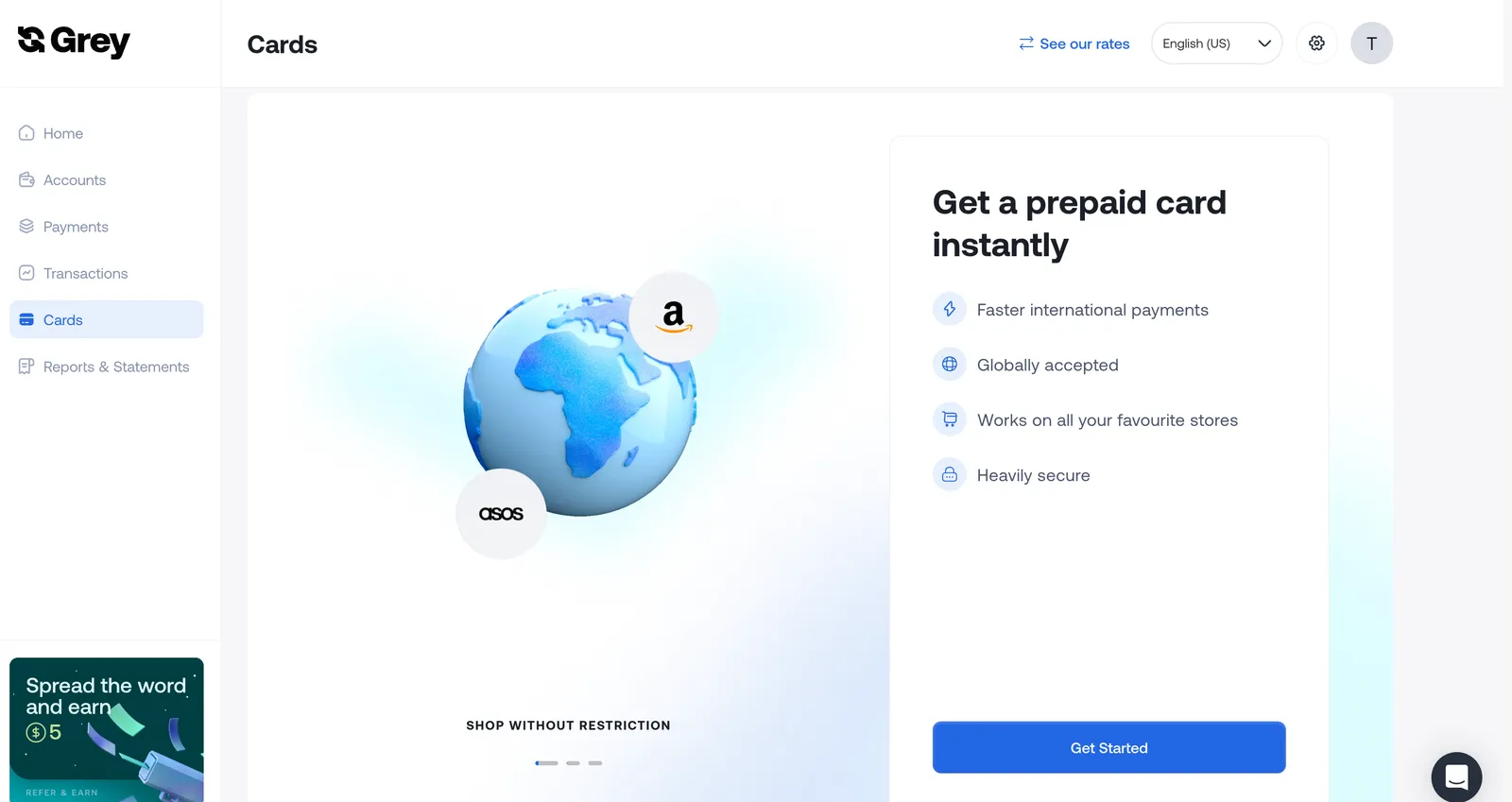
With funds in your account, go to the "Card" section in the Grey app or dashboard and click "Get started."

Pay the one-time card creation fee of $4, and fund your card with at least $1. Your virtual USD debit card will be available immediately and ready for use on global platforms.

Why choose Grey's USD debit card in France?

  1. Quick setup: Set up an account on Grey and get your virtual USD debit card in no time.
  2. Global usability: Use your card anywhere that accepts MasterCard for online payments and shopping.
  3. Easy funding: Transfer funds directly from your Grey account to your USD card.
  4. Transparent fees: Enjoy clear pricing with no hidden charges.
  5. Secure transactions: Grey's cutting-edge security measures ensure your payments are safe and protected.

Whether you are a remote worker with international clients, a traveller planning your next trip abroad or a frequent online shopper, a USD debit card allows you to transact globally without breaking a sweat. Grey makes it easy to stay financially connected with the global market. Sign up for Grey today and experience the freedom of seamless global payments with your instant USD debit card!

‍

Last updated:

October 2, 2026

Open a free Grey account to get startedJoin 1 million digital nomads
IF YOU ENJOYED THIS, CHECK THESE OUT

How to dissolve an LLC: Steps and costs

•

•

2 min read

A surprising number of business owners stop operating their LLC but never formally close it. The LLC stays registered, the state keeps expecting filings, and fees or penalties accumulate quietly in the background. In California, that can mean an $800 annual LLC tax for a business you thought you'd already shut down. In Delaware, LLCs generally owe a $300 annual tax until they properly cancel their registration. These obligations don't stop when you stop working.

Don't dissolve if you might restart the business within a year. It's easier and cheaper to keep the LLC dormant (file the required reports, pay any minimum fees) than to dissolve and re-form later. Reforming means new filing fees, a new EIN application, new bank accounts, and updated contracts with every vendor and client.

To dissolve an LLC, you vote to dissolve (if multi-member), settle debts, and distribute remaining assets. Then file Articles of Dissolution with your state, file final tax returns, cancel your EIN, and close all business accounts. The process takes 2 to 8 weeks depending on the state.

This guide covers every step, including the tax obligations most dissolution guides skip. For the formation side, see LLC costs.

Step 1: Vote to dissolve

The following steps outline the general process for dissolving an LLC in the US. However, requirements vary by state, including voting rules, tax obligations, filing documents, and processing times. Always check your state's specific requirements before proceeding.

If your LLC has more than one member, the members must formally vote to dissolve. Check your operating agreement for the voting threshold. Common options are unanimous consent, majority vote, or supermajority (two-thirds). If you don't have an operating agreement, your state's default LLC act applies, which typically requires the majority consent of all members.

For single-member LLCs, you make the decision yourself. Either way, document it in writing. Draft a written resolution that states the LLC name, the date of the vote, the result (unanimously approved, majority approved, etc.), and the signatures of all voting members. Keep this resolution with your LLC records permanently.

This documentation protects you if anyone later disputes whether the dissolution was authorised. It also protects you if creditors challenge the dissolution as fraudulent (attempting to avoid debts). A properly documented vote shows the dissolution was deliberate and orderly, not evasive.

If your operating agreement doesn't address dissolution, draft a simple dissolution resolution. One page is enough. Date it, state the decision, and have every member sign it. This becomes the legal record of consent.

Step 2: Wind up business affairs

Before you file anything with the state, resolve everything the LLC owes and is owed. This is the most time-consuming step and the one most people rush through, leading to problems months or years later.

Pay all debts and obligations. Outstanding invoices, business loans, credit card balances, vendor contracts, lease obligations, and any pending legal claims. If the LLC can't pay all debts from its assets, consult a business attorney before proceeding. Dissolving an LLC while debts are outstanding can expose members to personal liability in some situations, particularly if creditors can argue the dissolution was intended to evade payment.

Collect what's owed to you. Chase outstanding receivables aggressively. Send final invoices immediately. Once the LLC is dissolved, collecting becomes dramatically harder. You may lose standing to sue in the LLC's name. Some states allow a "winding up" period after dissolution during which you can still collect, but this varies. Don't rely on it.

Cancel contracts and subscriptions. Leases, software subscriptions, insurance policies, recurring services, domain registrations, hosting accounts, phone plans, and any other recurring commitments. Notify each provider in writing that the LLC is closing and request written confirmation of cancellation. Keep these confirmations. A verbal cancellation that isn't documented can lead to continued billing.

Notify your customers and clients. If you have ongoing client relationships, give them reasonable notice. Provide referrals to alternative providers if appropriate. This isn't legally required in most states, but it's professional and protects your personal reputation for future ventures.

Distribute remaining assets. After debts are paid and receivables collected, distribute the remaining cash and assets to members according to the operating agreement. If there's no agreement, follow your state's default rules, which typically allocate proportionally based on ownership percentage. Document every distribution with amounts, dates, and member signatures.

Step 3: File final tax returns

Your LLC must file a final tax return for the year it dissolves. Check the "final return" box on the applicable form. The specific form depends on how your LLC is taxed:

Single-member LLC (disregarded entity): Report the business's final income and expenses on Schedule C of your personal Form 1040, if applicable. Schedule C does not have a separate "final return" checkbox.

Multi-member LLC (partnership): File Form 1065, check the "final return" box, and issue final Schedules K-1 to each member. Each member reports their share of the LLC's income and other applicable tax items on their personal return.

LLC taxed as an S corporation: File Form 1120-S and mark it as the final return. If the LLC adopts a plan of corporate dissolution or liquidation, Form 966 is generally required within 30 days of adopting that plan.

LLC taxed as a C corporation: File Form 1120 and mark it as the final return. Form 966 is generally required within 30 days of adopting a plan of corporate dissolution or liquidation.

Don't forget state tax obligations. If your state has a franchise tax, income tax, or sales tax, file final returns with the state as well. In Texas, file a final franchise tax report with the Comptroller. In California, LLCs generally owe the $800 annual tax for their final taxable year, even if they stop operating partway through it. The tax is not normally prorated, although certain exceptions apply. In New York, the filing fee is $0, but you must file a final partnership return. For guidance, see how to file LLC taxes.

Sales tax: if your LLC collected sales tax, file a final sales tax return and remit any remaining tax. Notify your state's revenue department that the sales tax permit should be cancelled.

Payroll taxes: if you had employees, file final Forms 941 (quarterly) and W-2s (annual). Pay any remaining payroll tax deposits. File Form 940 (federal unemployment tax) marked "final."

Step 4: File Articles of Dissolution

File the required dissolution or cancellation documents with your state's Secretary of State or equivalent filing authority. The exact form, filing process, and requirements vary by state. Some states also require tax clearance or additional documentation before the LLC can be formally terminated.

Filing fees vary by state. Some states allow LLCs to dissolve at no charge, while others charge a filing fee. For example, California does not charge a fee for LLC termination filings, while Texas charges $40 for a Certificate of Termination. Check your state's current filing fees before submitting your dissolution documents.

The form is typically short: LLC name, date of formation, reason for dissolution (voluntary), effective date of dissolution, and confirmation that debts have been paid or provisions made for payment. Some states require a tax clearance certificate from the revenue department before accepting the dissolution filing. Ohio, for example, requires a tax clearance letter.

If your LLC operates in multiple states, you must also file for withdrawal (or termination of foreign qualification) in each state where you registered as a foreign LLC. Each state charges its own fee for this. Missing a foreign state registration means that the state keeps expecting filings and fees.

Processing time: 1 to 4 weeks for most states. Expedited processing is available in many states for an additional fee ($50 to $200). Once approved, the state issues a certificate of dissolution or cancellation. Keep this permanently with your LLC records.

Step 5: Cancel your EIN and close accounts

Close your IRS business account. An EIN cannot be permanently cancelled, but you can ask the IRS to close the business tax account associated with it. Send a letter containing the LLC's legal name, EIN, business address, and reason for closure to the Internal Revenue Service, Cincinnati, OH 45999. Include a copy of your EIN assignment notice if available. The IRS will close the account once all required tax returns have been filed and outstanding taxes paid.

Close all business accounts. Bank accounts, credit cards, payment processors (Stripe, PayPal, Square), and any merchant accounts. Transfer any remaining balances to members before closing. Request written confirmation from each institution that the account is closed. A "closed" bank account that still has a $2.50 monthly maintenance fee will eventually go to collections.

Cancel your registered agent service if you were using a professional agent. Cancel any business licences or permits with your city, county, and state. Cancel your DBA (doing business as) registration if you filed one. Update your website to indicate the business is no longer operating, or take it down entirely. Update social media profiles similarly.

Notify creditors formally. Many states require or recommend sending a written notice to known creditors that the LLC is dissolving. This starts a statutory claims period (typically 90 to 120 days) after which creditors who don't file claims lose their right to collect. This is your legal protection against surprise claims years later.

Common dissolution mistakes

1. Not filing Articles of Dissolution. This is the most common and most expensive mistake. The LLC continues to exist in the state's records, annual fees keep accumulating, franchise taxes keep accruing, and your registered agent keeps billing you. Five years of California's $800 annual LLC tax can mean $4,000 in unpaid taxes, plus applicable penalties and interest. The tax can apply even if the LLC earned no income, unless an exemption or exception applies.

2. Not filing final tax returns. The IRS expects a final return. Not filing triggers a substitute return (SFR), which estimates your tax liability, usually too high, and starts penalties and interest from the original due date. State revenue departments are equally aggressive. Don't assume that dissolving the LLC means the tax obligations disappear.

3. Distributing assets before paying debts. Members who receive distributions while debts are outstanding can be held personally liable for those debts, up to the amount they received. This is called a "fraudulent transfer" or "fraudulent conveyance" in legal terms. Pay every creditor first. Distribute to members last.

4. Forgetting state-specific requirements. Some states require additional steps before an LLC can be formally dissolved, including obtaining tax clearance or notifying creditors. These requirements vary, so check the rules in the state where your LLC was formed. Some states have mandatory waiting periods. Check your specific state's requirements before filing.

5. Not cancelling foreign state registrations. If your LLC is registered to do business in three states, you need to file for dissolution in your home state and withdrawal in the other two. Miss one and that state keeps expecting annual reports and fees.

Closing your LLC? Make sure all financial accounts are settled and final returns are filed before you dissolve.

Frequently asked questions about how to dissolve an LLC

How much does it cost to dissolve an LLC?

The cost of dissolving an LLC depends on the state and whether you need professional assistance. Some states charge no filing fee, while others charge $40, $100, or more. For example, California has no filing fee for LLC termination, while Texas charges $40. If you hire an attorney, dissolution service, or accountant, you'll also need to budget for their fees. Outstanding taxes, annual fees, and other obligations can increase the total cost.

How long does LLC dissolution take?

The state filing itself takes 1 to 4 weeks for processing, longer in busy states like California and New York. But the full wind-up process (paying debts, collecting receivables, distributing assets, filing final taxes, notifying creditors) can take 2 to 6 months. Start the wind-up well before you file with the state. The statutory creditor claims period adds 90 to 120 days after filing.

Can I dissolve an LLC with debt?

You can, but you must handle the debt first. The LLC's assets should be used to pay creditors before any distributions to members. If the LLC's assets aren't sufficient to cover all debts, consult a business attorney. Dissolving with unpaid debts can expose members to personal liability in some cases, particularly if creditors argue the dissolution was intended to avoid payment.

What happens to the LLC name after dissolution?

In most states, the name becomes available for others to use after dissolution. The timeline varies: some states release names immediately, others hold them for 1 to 3 years. If you want to protect the name for future use, consider registering it as a federal trademark before dissolving (costs $250 to $350). For starting a new LLC later, see start a Texas LLC or name an LLC.

Do I still need to file taxes after dissolving my LLC?

You must file a final tax return for the year of dissolution. After that, no. But if you didn't file returns for prior years, those obligations survive dissolution. The IRS can pursue unfiled returns against the LLC's former members. Clean up any back filings before or during dissolution.

Starting fresh? Open a Grey Business account for your next venture.

Disclaimer: This article is for informational purposes only. All costs and details are estimates based on mid-2026 data. Verify current information before making decisions. Grey isn't a bank. We're a licensed financial services provider offering multi-currency accounts.

Safe ways Filipinos keep their money when the Peso feels uncertain

•

•

2 min read

Periods of inflation or currency fluctuations often make Filipinos worried about the value of their savings. This has happened many times in recent years due to local and international economic factors. When the peso feels uncertain, many people look for safer ways to store their money using a means that protects the value of their savings. This guide explains the safest ways you can keep your money when the peso feels uncertain.

Also read: Wise vs PayPal vs Payoneer: which works best for freelancers in the Philippines?

Keep savings in stable foreign currencies

Saving in relatively stable currencies like USD, EUR, or GBP better protects you against local economic policies and events that might affect the peso’s value.

Using multi-currency accounts

The popularity of modern fintech platforms has made it easy for Filipinos to hold USD, EUR, and GBP. Platforms like Grey, Remitly, and Wise let you store, receive, and convert money at more competitive rates than traditional banks. This easy access to foreign currency usually comes with lower fees, lower transaction costs, and more favourable currency conversion rates. Holding stable foreign currencies in multi-currency accounts is ideal for freelancers, remote workers, and online shoppers who manage multiple currencies and are wary of losing money if the peso’s value is unstable.

LDMAG1

Opening a dollar account

Many Filipinos use USD savings accounts at local banks like BDO or Metrobank, which are legal and regulated by the Bangko Sentral ng Pilipinas (BSP). While the interest rate might be lower (around 1-2%) than saving in pesos, it appreciates if the peso weakens.

Also read: How to open US and UK bank accounts in the Philippines

Simple hedging

This can be a little complex, but we will try to help you understand. A simple hedging strategy uses an investment or technique to reduce the risk of potential losses from an existing position. It’s like an insurance policy for your investments. So, if you save some money in USD, for example, you can use forward contracts to lock in the rate at which you will convert foreign currency to pesos whenever you wish. This means you can convert at the same rate at any time, regardless of the exchange rate fluctuations.

Investing in precious metals

Precious metals also protect against exchange rate fluctuations. In fact, their value often rises during currency instability. ****Filipinos commonly invest in gold through pawnshops and banks. The BSP’s gold reserves strategy makes it a reliable alternative to stable foreign currencies. Other precious metals, like silver, are even more affordable and can be held physically or virtually as a store of wealth.

Considering government securities and bonds

The government’s securities and bonds are other options for protecting your money from currency fluctuations. They are considered low-risk investments supported by the country’s full taxing power. Bonds like Retail Treasury Bonds (RTBs) are even accessible to the general public. The minimum investment is also low. There are various options for government securities and bonds.

  • Treasury bills (T-bills): These are usually short-term obligations, and mature in one year or less.
  • Treasury bonds (T-bonds): These are medium- to long-term obligations with maturities ranging from 2 to 25 years. They pay regular interest called coupons, from time to time. Then, you’ll get the amount you put in when it matures.
  • Retail treasury bonds (RTBs): These are a popular and affordable option for smaller and individual investors. You can invest as low as PHP 5,000 and earn higher yields than typical savings accounts, with interest paid quarterly.
  • Retail dollar bonds (RDBs): The government also issues securities in dollars for investors who prefer dollars.

Diversifying your portfolio

Investing in the stock market is a popular way to diversify your portfolio. However, it isn’t necessarily safer, as it comes with significant risks. Although it can offer high returns in the long run and protect against inflation, it is volatile and prone to fluctuations. This means investors risk substantial losses.

With options like mutual funds or unit investment trust funds (UITFs), you can put your money into a diversified pool of assets (including stocks and bonds). This fund is managed by a professional and avoids the risks of investing in individual stocks. Information is available through various financial institutions such as Metrobank or COL Financial.

Investing in real estate

Real estate is widely considered by many Filipinos, including Overseas Filipinos (OFs) and Overseas Filipino Workers (OFWs), to be a safe and effective way to preserve wealth and hedge against the uncertainty of the peso. Unlike currency, which can be volatile, real estate is a physical asset and it generally appreciates over time, especially in good locations. Rentals provide a steady stream of passive income that can even be passed down to the next generation.

Also read: How to send US dollars to the Philippines from anywhere

Managing your money the safe way

When the peso feels uncertain, it is best to diversify your finances across investments and stable currencies. Keeping all your savings in one currency makes you vulnerable to fluctuations, but splitting them across stable currencies, low-risk investments, and secure accounts helps protect your money. Grey makes it easier and safer for Filipinos to hold multiple currencies without worrying about high fees or unfavourable exchange rates. The platform’s layers of security ensure users’ data and funds remain safe and accessible whenever needed.

Get started with Grey today and worry less about the peso’s uncertainty.

‍

Why US creators earn more from overseas in November and December

•

•

2 min read

If you’ve been creating content long enough, you’ve probably noticed a difference in your analytics towards the end of the year. More views. More clicks. More comments from usernames you sometimes can’t pronounce. And, of course, more money.

November and December are the Super Bowl of creator earnings, but what some US creators don’t realise is that the real boost isn’t just coming from home. It’s coming from overseas.

I learned this the hard way. One year, I woke up to see my channel suddenly blowing up in Germany, of all places. Same videos, same posting schedule, but my RPMs were doing gymnastics I’d never seen before. It didn’t seem logical until I started looking at what was happening globally.

And that’s what this article is about: the fascinating, slightly underrated reason why US creators earn more from international audiences at the end of the year.

The holiday season changes everything, especially abroad

November and December are universal spending months. Americans celebrate Thanksgiving and Christmas; the UK is scrambling for gift deliveries; the UAE is drowning in year-end retail campaigns, and Europe is switching into full hibernation-and-shop mode.

People are online more. They’re watching longer. They’re buying aggressively.

As audiences consume more content, advertisers increase their spending, and this surge isn’t limited to the US. It’s happening everywhere.

So, if you have even a tiny sliver of international viewers, this is the period when they become disproportionately valuable.

Also read: How Grey differs from a US bank

Higher CPMs outside the US?

There’s a popular myth that US audiences always deliver the highest CPMs (cost per mile). Not quite.

At the end of the year, countries like the UK, Canada, Australia, Germany, and the UAE often outbid US advertisers for the same ad slots. It’s simple economics: brands have budgets they must spend before 31 December, and they start bidding aggressively to hit their annual targets.

This means that a US creator with a strong international fan base may earn more per thousand views from the UK in December than from the US. A million views from Sydney or London can outperform a million from Chicago, even if the content is the same.

And because those countries have stronger currencies, the value stretches even further once everything’s converted back to USD.

Currency differences mean bonus income

This is the part nobody talks about.

If a German advertiser is paying €8 CPM and it gets converted to dollars, that difference adds a quiet little boost to your monthly payout.

Holiday seasons tend to strengthen some currencies, too. So if you’re earning from GBP, CAD, AUD or EUR traffic, November and December almost feel like they come with a built-in “seasonal bonus”.

You didn’t do anything different; you just happened to show up where the money was strongest.

Global audiences binge more content at the end of the year

One of my favourite analytics graphs every year is the late-December watch-time spike. The whole world slows down. Students go home. Offices close. People sleep, scroll, watch, repeat.

Outside the US, this downtime becomes even more pronounced.

In Northern Europe, everyone is indoors. In the Middle East, it’s tourism season. In Latin America, the lead-up to Christmas is a cultural event on its own. All of this means more hours to watch content, and every extra watch hour is more ad inventory.

Holiday behaviour = more impressions = more money.

Also read: How Nigerians can shop Black Friday deals from abroad

LDMAG1

International brands love US creators in Q4

Here’s the other secret: brands outside the US love American creators at the end of the year.

Why?

US creators have global influence, English reach, and a level of cultural export that travels well. A British or German brand that wants visibility during Black Friday will often prefer a US creator who can speak to both American and international audiences.

This demand drives up rates.

By the time December rolls around, creators are often negotiating higher sponsorship fees simply because brands abroad are scrambling to get visibility before budgets expire.

Platforms boost payouts globally

  • YouTube increases RPM across regions in Q4.
  • TikTok Shop runs aggressive UK and Southeast Asian campaigns.
  • Meta pushes more brand budgets through Reels.
  • Affiliate networks activate Black Friday and Singles’ Day commissions.

If you’re plugged into international markets at all, even slightly, you benefit from every single one of these regional campaigns without ever needing to travel or change where you live.

Real-world example

Take two creators:

Creator A: 90% US audience

Creator B: 55% US, 20% UK, 10% Canada, 10% Germany, 5% UAE

Creator A earns well in Q4, well, no surprise.

Creator B earns exceptionally well in Q4 because nearly every one of those regions hits seasonal peak CPMs at the same time.

It’s the same output, the same content, but different earning power.

Also read: Why many UK freelancers earn more from global clients in Q4

So how do you maximise overseas earnings?

The trick isn’t to chase views from every corner of the world. It’s to become discoverable globally.

Things that help include creating evergreen content, using clear and concise English that translates well, adding subtitles, tapping into international holidays, and covering universally relatable themes.

And of course, making sure you have a way to receive global income easily. Platforms like Grey exist for exactly this reason: to help creators collect payments from everywhere without friction.

The world pays better when the year ends

By the time December hits, the world is spending, scrolling, and watching more than at any other time of the year. And US creators sit at the perfect intersection of global relevance and strong ad markets.

So if you’ve ever wondered why your earnings jump in November and December, now you know. Your overseas audience is boosting your income in ways your home audience simply can’t match.

Lean into it, revel in it and open your Grey account today or download the app to get the financial freedom you need.

‍

How to start an LLC in Texas: Step-by-step guide

•

•

2 min read

Texas has no personal state income tax. That alone makes it one of the most popular states for LLC formation. But Texas does have a franchise tax, and ignoring it is the single most common mistake new LLC owners make. We'll cover that alongside every other step.

The full Texas LLC formation process takes about an hour of your time and $300 in state fees. You can do it entirely online through the Texas Secretary of State's SOSDirect system. No lawyer required for a straightforward single-member or two-member LLC, though complex ownership structures or real estate holdings benefit from legal guidance.

To form an LLC in Texas, choose a registered agent and file a Certificate of Formation with the Secretary of State ($300). Then get an EIN from the IRS, open a business bank account, and apply for any required permits. You can file online through SOSPortal, although processing times vary.

This guide walks through each step in the order you actually do them, with the costs and timelines you'll encounter. For choosing a name, see LLC naming guide.

Step 1: Choose your LLC name

Your Texas LLC name must include "LLC" or "Limited Liability Company" and be distinguishable from any existing entity registered in Texas. Search the Texas Secretary of State's SOSPortal database to check availability. The search is free and returns results instantly.

Texas is relatively lenient on name similarity. "Bright Studio LLC" and "Bright Studios LLC" would likely both be accepted as distinguishable. But being legally distinguishable doesn't mean your customers won't confuse the two. Search broadly and consider trademark implications before committing.

If your name is available but you're not ready to file immediately, Texas allows name reservations for 120 days at $40. This prevents someone else from registering it while you prepare your formation documents.

You can also file a DBA (Assumed Name Certificate) if you want to operate under a different name than your legal LLC name. The DBA filing costs $25 per county where you do business in Texas. This lets "Smith Holdings LLC" operate publicly as "Bright Studio" without changing the legal entity name.

Step 2: Choose a registered agent

Every Texas LLC must have a registered agent with a physical street address in Texas. No PO boxes. The agent receives legal documents (lawsuits, government notices, tax correspondence) on behalf of the LLC. This is a legal requirement, not optional.

Option 1: Be your own agent. Free, but your home address becomes public record on the Texas SOS website. Anyone can look up your LLC and find your personal address. You also must be available at that address during normal business hours to accept documents in person. If you're travelling or working remotely, you can miss a critical legal notice.

Option 2: Use a registered agent service. $50 to $199/year. The service provides a Texas address, forwards documents to you, and ensures nothing gets missed while you're unavailable. Northwest Registered Agent ($125/year) and ZenBusiness ($199/year after the first free year) are popular options. For service comparisons, see best LLC formation services.

Option 3: Use a friend or family member in Texas. Free, but they must be available at the registered address during business hours and they'll see every legal document your LLC receives, including lawsuits. Most people prefer the privacy of a paid service.

Step 3: File the Certificate of Formation

This is the actual formation step. You file the Certificate of Formation (Form 205) with the Texas Secretary of State.

Online filing (recommended): Visit the Texas Secretary of State's SOSPortal and create an account. Complete the Certificate of Formation (Form 205) with your LLC name, registered agent information, management structure, organiser details, and effective date. The filing fee is $300, payable by ACH or credit card, although credit card payments carry an additional convenience fee. Processing times vary, and expedited filing options are available for an additional charge.

Mail filing: Download Form 205, complete it, and mail it with the $300 filing fee to the Texas Secretary of State. Processing times vary, so check the state's current turnaround times before submitting.

The $300 fee is non-refundable. If your filing is rejected (usually because the name is too similar to an existing entity or required information is missing), you can correct and resubmit without paying again, but the original fee isn't returned if you abandon the filing.

Member-managed vs manager-managed: most single-member and small multi-member LLCs choose member-managed, meaning all owners participate in running the business. Manager-managed is for LLCs with passive investors who own a share but don't participate in daily operations. If you're not sure, choose member-managed. You can change this later by filing an amendment ($150).

Step 4: Create an Operating Agreement

Texas doesn't legally require an operating agreement, but you should have one anyway. Banks require it to open a business account. It also protects your personal liability shield: without an operating agreement, a court could argue the LLC isn't a separate entity from you personally (called "piercing the corporate veil"), exposing your personal assets to business debts.

Your operating agreement should cover: ownership percentages, profit and loss distribution, voting rights, member responsibilities, process for adding or removing members, what happens if a member dies or becomes incapacitated, and the process for dissolving the LLC.

For single-member LLCs, the operating agreement is simpler but still essential. It establishes the LLC as a separate entity and documents how the business operates. A basic single-member operating agreement is 3 to 5 pages. Most LLC formation services include a template. Free templates are available from the Texas Secretary of State website and SCORE (SBA's mentoring arm).

Step 5: Get an EIN (Employer Identification Number)

The EIN is free and takes 10 minutes. Apply online at irs.gov/ein. You'll need your LLC's legal name, Texas address, and the responsible party's SSN or ITIN. The EIN is issued immediately upon completion of the online application.

Every LLC needs an EIN, even single-member LLCs. Banks require it to open business accounts. The IRS uses it for tax filings. Vendors and clients use it on W-9 forms. Don't pay an LLC formation service $70 to $99 for this. It's free and faster to do yourself.

One EIN per LLC. If you dissolve and reform, the new LLC needs a new EIN. If you change your LLC's name or address, you keep the same EIN. If you change from single-member to multi-member entity, you keep the same EIN.

Step 6: Open a business bank account

Separate your personal and business finances immediately. Mixing them is the fastest way to lose your personal liability protection. Courts use "commingling of funds" as evidence that the LLC isn't a real separate entity.

What you need to open a business bank account: Certificate of Formation (the approved filing from the Texas SOS), EIN confirmation letter, operating agreement, government-issued ID, and a business address.

Traditional banks: Chase, Bank of America, Wells Fargo all offer business checking in Texas. Expect monthly fees of $10 to $30 (often waivable with minimum balances of $1,500 to $5,000). In-person branch visit required.

Online options: Grey Business lets you open a multi-currency business account in your LLC name with US routing and account details, no branch visit required. You get USD, GBP, and EUR accounts. If your Texas LLC works with international clients or vendors, the multi-currency capability eliminates the need for separate foreign currency accounts or expensive wire transfers for each currency. The Grey conversion fee is 1% capped at $6, compared to bank wire fees of $25 to $50 per international transfer.

Step 7: Texas franchise tax

This is the step most guides bury at the bottom. Don't skip it. Texas LLCs are generally subject to franchise tax rules, but that doesn't mean every LLC owes tax or must file a franchise tax report. Businesses with annualised total revenue at or below the state's no-tax-due threshold generally owe no franchise tax and don't need to file a franchise tax report. However, they must still submit an annual Public Information Report (PIR) or Ownership Information Report (OIR), unless an exception applies.

For 2026 and 2027, the no-tax-due threshold is $2.65 million in annualised total revenue. LLCs at or below this threshold generally owe $0 in franchise tax and no longer need to file a No Tax Due Report. They must still submit the applicable annual information report.

Missing required franchise tax filings or annual information reports can put your LLC's good standing at risk and may lead to forfeiture of its right to transact business in Texas. Even when no franchise tax is owed, it's important to submit the required PIR or OIR on time.

Filing deadlines: the initial franchise tax report is due May 15 of the year after formation. If you form your LLC in September 2026, your first report is due May 15, 2027. Annual reports are due May 15 every year after that. File electronically through the Texas Comptroller's Webfile system.

Tax rates (for LLCs above $2.65 million): 0.375% for retail and wholesale businesses, 0.75% for all other businesses, applied to the LLC's "taxable margin" (roughly, the lesser of total revenue minus cost of goods sold, total revenue minus compensation, 70% of total revenue, or total revenue minus $1 million).

After formation: What comes next

Business licences and permits. Texas doesn't have a general business licence, but specific industries require state or local permits. Food service needs a health department permit. Construction needs a contractor's licence. Check with your city and county clerk for local requirements.

Sales tax permit. If you sell taxable goods or services in Texas, apply for a sales tax permit through the Texas Comptroller. The permit is free. Texas sales tax is 6.25% state rate plus up to 2% local rate (total up to 8.25%). Don't collect sales tax without a permit, and don't sell taxable items without collecting it.

Business insurance. Not legally required for single-member LLCs in Texas (unless you have employees, in which case workers' compensation is recommended but not mandatory in Texas). General liability insurance ($30 to $100/month) protects against third-party claims. Professional liability (errors and omissions) is worth considering if you provide professional services.

Separate credit. Apply for a business credit card in your LLC name to start building business credit. Use it for business expenses and pay in full each month. Business credit is separate from personal credit and can help you secure financing later.

Ready to start your Texas LLC? Open a Grey Business account and get US banking details in your LLC name from day one.

Frequently asked questions about how to start an LLC in Texas

How much does it cost to start an LLC in Texas?

$300 state filing fee for the Certificate of Formation. Optional costs: registered agent service ($50 to $199/year), name reservation ($40), DBA filing ($25 per county), and EIN (free from IRS). Total out-of-pocket for a basic LLC: $300 to $500 in the first year. For cost breakdowns across states, see LLC cost guide.

How long does it take to form a Texas LLC?

Processing times for Texas LLC formation vary depending on the filing method and current workload. Online applications can be submitted through SOSPortal, and expedited same-day or next-day processing is available for an additional fee. Once your LLC is approved, you can apply for an EIN and open a business bank account. The overall timeline depends on how quickly your filing is approved and your bank account is set up.

Does a Texas LLC pay state income tax?

Texas has no personal state income tax, but LLCs are generally subject to the state's franchise tax rules. For 2026 and 2027, LLCs with annualised total revenue of $2.65 million or less generally owe no franchise tax and don't need to file a franchise tax report. However, they must still submit an annual Public Information Report or Ownership Information Report, unless exempt. LLCs above the threshold generally pay 0.375% (retail/wholesale) or 0.75% (other businesses) on their taxable margin, although an alternative EZ computation method is available for eligible businesses. For filing details, see LLC tax guide.

Do I need a lawyer to form an LLC in Texas?

Not for a straightforward single-member or small multi-member LLC. The SOSDirect online filing system is user-friendly and walks you through each section. A lawyer ($500 to $2,000) is worth the cost if your LLC involves complex ownership structures, significant assets, real estate holdings, or multiple members with different contribution levels. For dissolution guidance, see dissolve an LLC.

Can a non-US resident start an LLC in Texas?

Yes. Texas does not require LLC owners to be US citizens or residents. You'll need a registered agent with a Texas address, an EIN from the IRS (apply by mail using Form SS-4 if you don't have a US SSN), and a business bank account that accepts non-resident LLCs. Grey Business serves international founders without requiring a US branch visit.

Start your Texas LLC and open Grey Business for US banking details in your LLC name.

Disclaimer: This article is for informational purposes only. All costs and details are estimates based on mid-2026 data. Verify current information before making decisions. Grey isn't a bank. We're a licensed financial services provider offering multi-currency accounts.

How South African YouTubers receive YouTube payments in 2026

•

•

2 min read

YouTube is now considered one of the most popular search engines in the world, and South African creators are taking full advantage of it, with over 25 million South Africans actively using the platform. This shows that there’s a huge market for you as a creator. And you can, of course, make money from it.

How?

First, you create videos that people watch worldwide; next, your account gets monetised, and then the money accumulates in your AdSense account. After that, you can withdraw and then start spending.

Except... I’ve spoken to many creators who waited weeks for transfers, lost significant portions of their earnings due to unfavourable exchange rates, or had payments rejected because their bank didn’t accept international wire transfers. None of those stories need to be yours. Below, I’ll explain how YouTube pays, the pain points most South Africans face, and most importantly, practical, step-by-step options to receive your money quickly and with minimal fees.

Also read: Send US dollars to South Africa from anywhere

Why do USD earnings matter for South African creators?

As a South African creator, your payments from YouTube are made in US dollars. Earning in USD gives your income more global value. Great yeah? Well, most local bank accounts in South Africa can’t receive USD directly. For those that do, when your earnings are converted into South African Rand (ZAR), they often take a significant cut due to high transfer fees and unfavourable exchange rates.

Sometimes, currency fluctuations can make this worse. Your income’s real value may drop the moment it’s converted. By holding part of your earnings in USD, you can protect yourself from these swings and preserve the value of what you’ve earned.

Earning in a stable foreign currency helps you stay in control by keeping more of your money, allowing you to decide when to convert it, and ultimately, getting paid on your own terms.

How does YouTube pay?

Before you can cash out your earnings, it’s important to understand how YouTube’s payment system works.

1. Join the YouTube Partner Program (YPP)

You can only start earning from ads once you’re part of the YouTube Partner Program (YPP). To qualify, your channel needs to meet one of YouTube’s monetisation thresholds within the past 12 months:

  • Option 1: 1,000 subscribers and 4,000 valid public watch hours, or
  • Option 2: 1,000 subscribers and 10 million valid public Shorts views

Once your channel is approved, you’ll be able to monetise through ads, channel memberships, Super Chats, Super Stickers, and YouTube Premium revenue. Essentially, every view or engagement can start earning you money, as long as it happens on monetised content.

2. Set up a Google AdSense account

YouTube doesn’t send money directly to your bank. All payments are processed through Google AdSense, so setting it up is a crucial step.

Here’s what you’ll need to do:

  1. Create or link an AdSense account to your YouTube channel.
  2. Submit your tax information. This ensures compliance with YouTube’s global payment policies.
  3. Choose your preferred payout method, such as direct bank transfer or wire transfer.

Your AdSense dashboard is where you’ll monitor your estimated earnings, payment history, and any deductions for taxes or invalid activity.

3. Reach the payment threshold

YouTube doesn’t pay out every time you make a few dollars; it works on a minimum payment threshold system. You’ll need to earn at least $100 in your AdSense account before Google processes a payout.

If your earnings for the month fall short, the amount will simply roll over to the next month until you reach the threshold. Once you cross that mark and your account is verified, YouTube will automatically schedule your payment in the next payment cycle.

For most creators, payments will be sent around the 21st of each month, covering your total earnings up to the end of the previous month. So, if you hit $100 in March, you’ll typically get paid in April.

4. Understand the payment timeline

So, let's talk more about the payment cycle. The payment system runs on a monthly cycle, but payments aren’t instant. There’s a short delay while your earnings are verified and processed.

Here’s how it works:

  • Earnings are finalised between the 3rd and 10th of the following month. During this time, YouTube reviews your ad revenue to confirm everything’s valid.
  • Payments are processed between the 21st and 26th, once your balance reaches the $100 threshold.
  • You’ll only receive your payout if there are no payment holds, such as missing tax information or pending account verification.

So, for example, if you earned $200 in April, those funds will appear in your AdSense account in early May, but you’ll actually receive the money later in May. Once Google processes that month’s payouts.

It’s a simple system. Once you understand the rhythm, you just need a bit of patience between creating the content and seeing the cash hit your account.

Also read: How to pay for subscriptions in US dollars from South Africa

How to receive USD from YouTube in South Africa with Grey

Grey allows South African YouTubers to open a USD account effortlessly, all without leaving the country.

1. Create your Grey account

Visit the Grey website or download the app. Sign up and complete your KYC verification.

2. Access your USD account details

After approval, you’ll get your account information, including a US routing number, account number, and SWIFT code.

3. Connect your Grey USD account to AdSense

Log in to AdSense, select “Add payment method,” and enter your Grey account details.

4. Receive payments in USD

YouTube will deposit your earnings directly into your Grey account in USD, eliminating the need for automatic currency conversion.

5. Convert whenever you want

Use Grey’s in-app exchange to convert USD to ZAR at competitive rates or hold your USD in your account if you prefer.

Also read: How to send and receive British pounds in South Africa

What other ways can South African YouTubers boost earnings?

Once you’ve set up a reliable payment method, you can turn your channel into a sustainable income source. The most successful creators don’t rely on just one revenue stream; they layer multiple income sources to protect against dips in views or ad rates.

Here’s how you can do the same:

Channel memberships

Offer loyal fans exclusive perks like members-only videos, live Q&As, or custom emojis in exchange for a monthly subscription. This builds community and gives you a predictable monthly income.

Super chat & super stickers

These features allow viewers to pay to have their messages highlighted or to send animated stickers during live chats, providing a fun way for fans to support you in real-time.

Affiliate marketing

By adding affiliate links in your video descriptions, you can earn a commission every time someone buys a product you recommend. This works well if you review gear, software, or services your audience already needs.

Brand sponsorships

You can partner with companies to feature their products or services in your content. Sponsored deals often pay far more than ad revenue, especially if you have a niche audience that brands want to reach.

Also read: How to get paid as a creator on social media from anywhere in the world

At the end of the day, the more diverse your income streams, the more stable your creator career will be. If ad rates drop or one revenue source slows down, your other income channels keep you afloat.

Why Grey is the best option for South African creators

Now to the solution. Grey is built to accommodate how modern creators work, earn, and spend across borders. If you’re a South African YouTuber, influencer, or freelancer receiving international payments, Grey removes the friction that usually comes with getting paid from abroad.

Free USD account setup

Grey lets you open a USD account, providing you with the same payment details (routing and account numbers) that US-based creators typically use.

Low, transparent FX rates

Grey offers competitive exchange rates that are visible upfront, so you know exactly how much you’ll receive before confirming a transfer.

Multi-currency accounts to grow your income

With Grey, you can also hold EUR, GBP and USD, which is perfect if you land brand deals in Europe or work with clients in the UK.

Fast, reliable payouts

You no longer need to wait weeks for your money to clear. Grey processes transfers quickly, so you can move your earnings to your local bank account without delay, helping you maintain a steady cash flow.

Built with creators in mind

Every feature is designed to make life easier for people who get paid globally, so you can focus on making content instead of chasing payments. This makes it easier to keep more of your hard-earned YouTube income and avoid the usual international payment frustrations.

Being a YouTuber in South Africa is a great way to share your voice with the world and earn a living from it. By setting up a USD account with Grey, you can receive your YouTube earnings quickly, securely, and without incurring losses due to unfavourable exchange rates.

Create your free Grey account today or download the app to make your creator journey easier, smarter, and borderless.

‍

A simple guide to online shopping from abroad for Indonesians

•

•

2 min read

Global marketplaces like Shopee and Tokopedia have created a reliable platform for international shopping. While you might be unable to visit the US to buy that designer bag or the cute handcrafted gift from Kenya, you can still access international stores from the comfort of your home.

Shopping from digital stores has become increasingly popular among Indonesians looking for better prices, wider product choices and brands not available locally. Unfortunately, buying from overseas can be confusing without accurate information. This guide breaks down everything you need to know about online shopping from abroad, so you can shop safely, affordably and confidently.

Also read: Grey vs. local banks: The best currency exchange choice in Indonesia

Why Indonesians shop from abroad

Many Indonesians opt for online international stores for reasons such as:

  • Access to global brands and exclusive products: Many reputable brands and product collections are not readily available in local markets.
  • Better pricing than local mark-ups: Buying directly from international sellers can be cheaper than buying certain products locally. Many local sellers hike their selling prices unfairly to increase their profit margins.
  • Availability of electronics, fashion, and niche products: Many niche products, fashion items, and electronics are available on online stores and may not be sold locally. These stores also offer a wide variety of items to help you take control of your shopping.
  • Seasonal sales, discount codes and loyalty programmes: Black Friday, Cyber Monday, last-minute deals, holiday sales and other promotions provide an opportunity for you to buy items at cheaper rates. Some online stores also offer discount codes, coupons and loyalty programmes to help you save some money while you shop.
  • More reliable authenticity for certain products (e.g., tech, skincare): In a world where dupes look more original than the originals, shopping from reputable international online stores offers a better guarantee of authentic products.

Popular platforms Indonesians use for international purchases

Indonesians generally favour regionally popular shopping platforms

  • Shopee: This is perhaps the most popular online market in Indonesia for international purchases. It provides a marketplace for brands, sellers, and consumers to conduct transactions safely and easily online. The platform has an extensive catalogue, a user-friendly mobile experience, and a robust logistics network.
  • Lazada: Lazada is a major international e-commerce marketplace and one of the largest online shopping destinations in Southeast Asia, headquartered in Singapore and owned by the Alibaba Group. It operates a platform for various brands and sellers, offering a wide range of consumer goods.
  • TikTok Shop/ShopTokopedia: TikTok is evolving into a global marketplace for not just engaging content but also e-commerce. This platform has experienced rapid expansion and strong traction since its integration into Tokopedia to comply with local laws.
  • Etsy: Etsy is gaining some popularity in Indonesia. Buyers in Indonesia can purchase items from Etsy sellers worldwide. The platform automatically handles currency exchange, so transactions are seamless. Buyers can also easily find a wide range of products, especially handcrafted items, souvenirs, and gifts.

Also read: Using USDC for international transfers in Indonesia

Considerations before online shopping from abroad

Shopping on online international stores has many perks, but it isn't always straightforward. Before you dash into an online digital marketplace and start shopping, there are certain factors to consider to ensure a favourable experience.

1. Total cost estimation

Don’t assume the price you see on the product will be the total cost you’ll incur. Other factors might add to the cost at the payment gateway ro before receiving your order. These include:

  • Product price: The base cost of the item you are ordering
  • International shipping fees: the cost of transporting your order to Indonesia. It usually varies based on the item's value, weight, size, destination, and dispatch speed.
  • Customs duties and import taxes: charges levied by the government on goods entering its borders
  • Currency conversion costs: If you are paying in IDR, expect some cost on currency conversion.
  • Payment platform charges: The payment platform might also charge a fee for the transaction.
  • Service charge: Some online stores charge a token for purchasing items from their platform,

2. Customs and import rules

Your international purchases are subject to import duties, Value Added Tax (VAT), and potentially other sales taxes. Specific rules depend on the value of the goods (Cost, Insurance, and Freight, or CIF) and the type of product. If the total CIF value per shipment is less than 3 USD, they are exempt from import duties, but VAT (11%) will still apply. The US$3 threshold does not apply to certain products, especially fashion items, which have specific regulations. You should understand how these regulations apply to you before shopping online.

3. Shipping options and considerations

Sometimes, the shopping platform has an existing partnership with a shipping company for order delivery. You may opt for a shipping option based on speed, cost, and reliability.

  • Express services: DHL, FedEx, or UPS with 3-7 day delivery are ideal for valuables but pricier.
  • Economy options: USPS Priority Mail or China Post take 2-4 weeks, are cheaper but less trackable.

Shipping costs usually vary and depend on the parcel's volumetric weight and value.

4. Payment methods for Indonesians

A reliable, secure, and convenient payment option is key to a hitch-free experience when shopping online internationally. Here are some payment options:

  • Credit/debit cards: Visa and Mastercard cards are widely accepted, with local payment gateways like GPN integrating seamlessly. However, markup on exchange rates can be high.
  • Digital wallets: GoPay, OVO, DANA, or ShopeePay are available for quick transactions/
  • Bank transfers and fintechs: Both traditional bank transfers and emerging fintech payment options, such as Grey, are also used for online shopping in Indonesia.

LDMAG1

Tips to stay safe while shopping internationally

Not all sellers are legit. You should have a high index of suspicion when shopping online.

  • Only buy from verified sellers with strong ratings.
  • Avoid deals that seem too good to be true.
  • Use secure payment methods with buyer protection.
  • Keep all receipts for customs clearance.
  • Track your parcel and contact support immediately if delayed.

Also read: How freelancers in Indonesia can receive payments from the US, UK & EU clients

Managing online purchases with Grey

Online shopping from abroad provides access to global products, competitive prices and higher-quality goods. Despite its perks, Indonesians should consider customs rules, secure payment options, overall cost and reliable shipping methods before going ahead. With the right planning, you can shop internationally with confidence and ease. That plan starts with having a reliable payment solution for your online purchases. And this is where Grey comes in. Grey makes online shopping from abroad simpler for Indonesians:

  • Multi-currency accounts in USD, GBP and EUR
  • Virtual dollar cards that work on most global websites
  • Better exchange rates than traditional banks
  • Transparent, low fees
  • Withdrawal into a local bank account

Open a Grey account today for seamless international online purchases.

‍

Arrow (up)

Back to top

