
How Indian remote workers manage multi-currency income
Tunde Aladeloba
TABLE OF CONTENT
SHARE THIS POST
Have you ever waited days for an international payment to clear, only to realise you lost part of it during conversion into rupees? For many Indian remote workers, that frustration is all too familiar.
That’s exactly why multi-currency income is becoming so important. When you earn in USD, GBP or EUR, you protect the true value of your work, avoid repeated conversion costs, and gain the flexibility to decide when to exchange your money. It gives you stronger cash flow and more control over your earnings while working with global clients.
Today, multi-currency income is a big perk of working internationally from India. Yet managing fluctuating exchange rates and multiple income streams can still feel overwhelming.
Why Indian remote workers should earn in multiple currencies
Across India, more professionals are earning in dollars, pounds and euros through remote work. A multi-currency account is a smart, practical way to manage global income with confidence.
1. Significant cost savings
If you receive USD or GBP as part of your income and instantly convert it to rupees every time, you lose money through bank charges and poor exchange rates. Managing your earnings in multiple currencies helps you avoid repeated conversion fees. You can hold your income in foreign currency and convert only when rates are better. Over months, this can save you thousands of rupees without changing how hard you work.
2. Simplifies international payments
As a remote worker in India, you may need to pay for software subscriptions, online tools, or courses priced in dollars or euros. With multi-currency income, you can pay directly from your foreign earnings instead of converting from rupees each time. This makes international purchases smoother, faster, and cheaper. It also makes you feel like a true global professional, not limited by borders.
3. Faster payments
Many international clients prefer paying directly in USD or GBP. By managing your income in these currencies, you can share payment details that feel familiar to them. This reduces delays and confusion. Instead of waiting several days for complicated transfers to clear, payments can arrive more quickly and predictably. That means better cash flow and less stress at the end of the month.
4. Reduces FX risk
In India, exchange rates can move quickly. If the rupee weakens or strengthens suddenly, it affects how much you finally receive. Managing your income in multiple currencies allows you to hold your earnings and convert when the rate suits you. You are not forced to accept whatever rate the bank gives that day. This control helps protect your income from unnecessary losses.
Managing multiple currencies as a remote worker in India can feel confusing at first. But with the right approach, you can stay in control, protect your income, and make smarter financial decisions every month.
1. Choose the right payment partner
Managing multi-currency income starts with using a platform you can trust. When you’re working with international clients, the last thing you want is unclear fees or unpredictable processing times cutting into your earnings. Look for transparency, competitive exchange rates, and strong security. A reliable platform ensures your income reaches you fully and on time, giving you stability while working globally from India.
2. Track exchange rates strategically
Exchange rates fluctuate constantly, and those small shifts can significantly affect how much you receive in rupees. Instead of converting immediately, monitor trends and convert when rates are favourable. Being intentional about timing helps you maximise value and protect the real worth of your international income.
3. Separate earnings from spending
Once you convert at a strong rate, use INR for regular expenses like rent, groceries, transport, and utilities. Treat foreign currency earnings as strategic income rather than everyday spending money. This approach keeps budgeting simple while allowing you to manage conversions thoughtfully and avoid unnecessary losses.
4. Diversify your savings
If you earn in multiple currencies, consider saving across them. Holding part of your income in foreign currency can help you pay for global subscriptions, tools, or travel without repeated conversions. It also provides a buffer against currency volatility, giving you flexibility and stronger long-term financial control while living in India.
Choosing the best multi-currency platform for Indian remote workers
When picking a platform to manage your global income, consider the following
Fees: Choose one with low or no charges on transfers and conversions. Every rupee matters.
Currencies: Make sure it supports USD, GBP, EUR, or whatever you earn in.
Speed: Fast transfers mean no waiting around for clients to pay.
Ease of use: A simple app or website makes life easier.
Support: Good customer service is key if anything goes wrong.
Safety: Always pick a platform that’s licensed and regulated
LDMAG1
Managing multicurrency income in India
Managing multiple currencies as a remote worker in India should not feel like a second job. Grey makes it easier to receive, hold and send USD, GBP and EUR without unnecessary stress, delays or hidden charges.
Whether you are working remotely from Bengaluru, Jaipur or Kochi, Grey is designed to support your global career from India. Sign up or download the app today and simplify the way you handle international income.
As a migrant worker in the UK, you likely already have a local bank account. But if you work with international clients or send money abroad, you’ve probably had a few challenges — high fees, unfavourable exchange rates, and slow transaction times.
A US bank account can make things easier by allowing you to receive and hold USD without conversion losses. And if you want better financial flexibility, having an additional UK account with a digital bank can help you manage your money more efficiently.
With Grey, you can open US and UK bank accounts easily.
Why do migrant workers in the UK need a US or extra UK bank account?
Even with a UK bank account, opening a US account (or an extra UK account) can be a game-changer. Here’s why:
1. Receiving USD payments without extra fees
If you work for US-based companies or freelance for international clients, you probably receive payments in USD. UK banks often charge high fees for converting USD to GBP. With a US account, you can receive payments directly in dollars without losing money on exchange rates.
2. Holding USD as savings
Slight currency fluctuations can affect your earnings. Holding part of your money in USD instead of GBP gives you more financial stability, especially if you send money abroad regularly.
3. Avoiding expensive international transfers
Sending money across borders? UK banks often have high international transfer fees. With Grey, you can move money seamlessly between your US and UK accounts, saving time and money.
4. Managing finances with an extra UK account
Some workers prefer multiple accounts to separate savings, salary payments, or different income sources. A second UK account can help with budgeting or receiving payments from multiple employers.
Benefits of using Grey as a migrant worker in the UK
No hidden fees – Transparent pricing means you keep more of your money.
Fast transactions – Receive payments and transfer money without long delays.
Global access – Use the Grey app to manage your finances from anywhere, anytime.
Tips for managing finances as a migrant worker
Budget wisely: Allocate your income across savings, daily expenses, and remittances to your family.
Use secure banking options – Enable two-factor authentication (2FA) for extra security.
Simplify banking across borders with Grey
Managing international payments as a migrant worker in the UK doesn’t have to be complicated. With Grey, you can open a US or extra UK bank account, receive payments seamlessly, and move money across borders.Create your Grey account today or download the app to enjoy inclusive global banking, designed for you to carry your dreams across borders.
As a freelancer juggling multiple tasks and clients, you’ll quickly realise that managing your time effectively is crucial to a successful freelance career. Tracking the time spent on each task helps you plan your day more effectively and stay productive while meeting deadlines like a proper professional.
In this article, we’ll explore five of the best time-tracking tools to help you stay organised and have more control over your tasks and projects.
But first, let’s take a quick look at why time tracking is vital for freelancers:
Increased productivity: Time tracking helps you identify where your time goes, i.e., time spent on tasks, websites, and programs. These insights help you pin down and minimise distractions and time-wasting activities, helping you stay focused and work more efficiently.
Accurate billing: With time tracking tools, you can track billable hours invested in a task or project and charge clients accordingly**.**
Project management: Time tracking helps estimate how long specific tasks and projects will take, allowing you to set realistic deadlines, manage client expectations and avoid project scope creep.
Transparency and trust: Time tracking tools often have timesheets, which show clients a clear record of how much time was spent on their project. This builds confidence in your work and pricing.
Now that we’ve covered the importance of time tracking, here are some of the best tools to help you get started.
Top time tracking tools for freelancers
Toggl Track has a friendly user experience
Toggl Track is a popular time-tracking tool that individuals, teams, and businesses use to manage time and track productivity. It’s known for its user-friendly interface, detailed reports, and automatic time tracking across multiple devices and websites.
Toggl makes collaboration and project management easy with clients and team members, seamlessly integrating with tools like Asana, Trello, Slack, and Notion. It also allows you to track billable hours for transparency, generate performance insights, and manage your budget, helping you build trust and good relationships with your clients.
Toggl Track has a free plan designed for freelancers to support up to five users. Premium plans start at $10 billed monthly and offer saved and customisable reports, project templates, and more integrations.
Harvest has an inbuilt invoicing and payment feature
Harvest is an excellent tool for tracking time across multiple clients and projects. It allows you to create timesheets for different clients and projects and easily turn them into reports. However, Harvest's built-in invoicing and payment feature makes it stand out from other time management tools.
With Harvest, you can convert your timesheets into accurate invoices and request client payments. You can also create fast and easy invoices with Grey to get seamless and hassle-free payments from clients.
Harvest has a free plan that is perfect for freelancers but is limited to one seat and two projects. On the other hand, the premium plan costs $10.80 monthly (billed annually) and offers unlimited seats and projects, making it ideal for teams with larger workloads.
Hubstaff adds GPS time tracking for freelancers on the go
Hubstaff is another robust time-tracking tool that automatically generates invoices from timesheets, simplifying the payment process for freelancers.
In addition to tracking time and activity levels like mouse movements and keyboard usage, it offers GPS time tracking for freelancers working on location-based projects. GPS tracking lets you log hours while on site, ensuring accurate billing for work done.
Hubstaff integrates with various payments, communication and project management tools like Asana, Slack and QuickBooks. Its reporting tools provide deep insights into your project’s progress, with data visualisation, helping you optimise your workflows, stay productive, and meet deadlines.
Hubstaff has four premium plans starting at $4.99 per seat monthly, with a 14-day trial period for new users.
Memtime is a simple, desktop only time tracking tool
Memtime is a simple time-tracking tool that runs automatically in your background, capturing how much time you spend on different tasks and activities. While it only functions as a desktop app, its simplicity and features make it a top choice for freelancers.
Memtime’s automated time tracking displays your activities in programs and populates them in real time. There are also detailed custom timesheets and reports showing data like your programs’ use and top websites to help you identify distractions or areas for improvement. However, this tool is a freelancer favourite because of its privacy policy. Your captured activities are stored exclusively on your device and won’t be shared with your clients, colleagues, or bosses.
Memtime’s pricing starts at $12 per user monthly (billed bi-annually) and covers custom reporting, time tracking, project management integrations, and calendar sync.
RescueTime is a lower-cost option that offers focus modes and in-depth reports
Like other time-tracking tools, RescueTime also automatically tracks your time across different apps, websites and tasks, categorising your activities to give you a clear picture of how your time is spent throughout the day.
Beyond time tracking, RescueTime offers focus sessions called FocusTime that block distracting websites during set work hours, helping you stay focused. It also has in-depth reports and daily summaries to give insights into your productivity patterns.
While it doesn’t have the invoicing and billing features that some time trackers offer, RescueTime is a great choice for freelancers who want to optimise their productivity for their benefit. It has a free version and a premium plan starting at $6.50, which includes features like calendar integration and focus sessions.
Time is one of your most valuable assets as a freelancer, as it directly affects your productivity, health, and earnings. With time tracking, you can see where your time goes, identify areas for improvement, work smarter, not more complexly, and ultimately have a successful freelance career.
Being from Rio myself, I’ll be the first to tell you: it’s a city that refuses to make sense, but somehow, everything clicks. The views are stunning, yes, but what really defines Rio is the rhythm of daily life: becoming best friends with someone you just met at the bar, the energy of a roda de samba, people gathering to watch the sunset at Arpoador, the drums, whistles and colours of a street carnival….
Among cariocas (locals), we say Rio is the city of beauty and chaos. And once you find your way through the beautiful mess, it will be difficult to ever want to leave.
If you’re trying to figure out how to navigate all of it, stick with me. I’ll break down what you’ll spend to live in Rio like a true carioca, chaos and all.
Rent in Rio
Renting in Rio is full of contrasts. One street might have stunning ocean views, while the next winds up a steep cobblestone alley. Prices swing all over the place depending on the neighbourhood, the building, and how close you are to the beach.
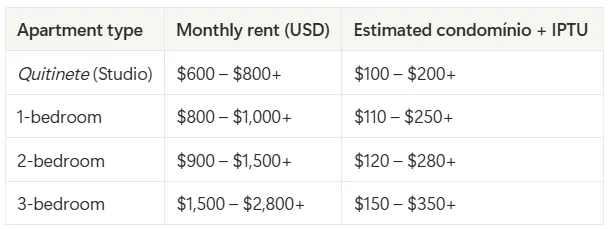
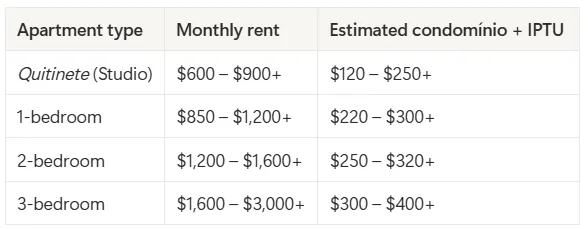
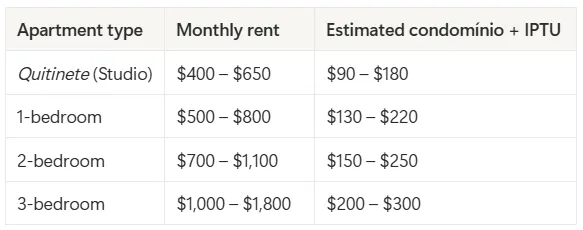
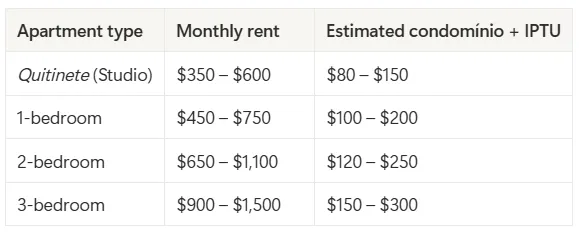
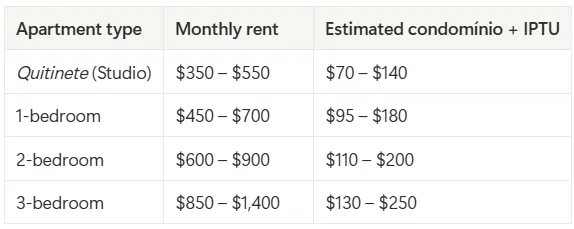
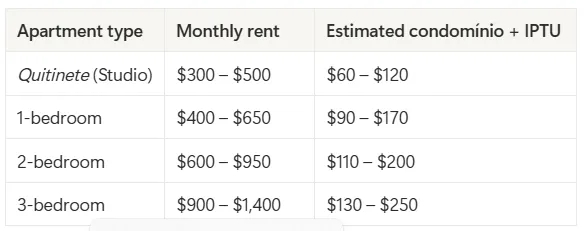
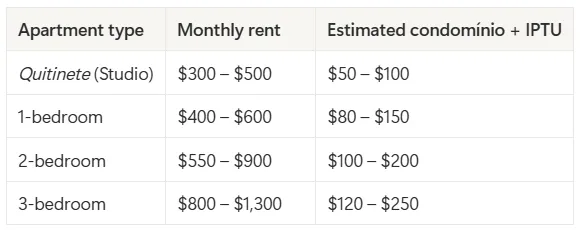
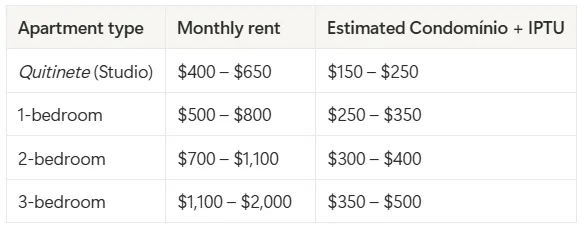
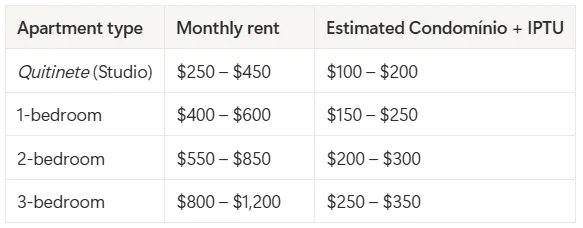
And here’s a little secret many newcomers miss: the rent you see isn’t the full story. You’ll also need to cover the condomínio (building maintenance fee) and IPTU (property tax), which can tack on $100 to $350 a month depending on the building’s age, location, and perks.
I’ll break down rent and living costs across the neighbourhoods I recommend most for expats, so you can find the perfect spot to call home in Rio.
Ipanema (South Zone)
This is beach life at its finest: steps from the sand, surrounded by trendy cafés, designer stores, and a crowd that loves to see and be seen. It’s safe, upscale, and perfectly blends surf and city energy.
Most rentals here are modern apartments with balconies and ocean views, often inside stylish buildings with doormen and amenities. If you want that postcard-perfect Rio life, this is it… but it doesn’t come cheap.
Leblon (South Zone)
If Ipanema is lively and social, I’d say Leblon is the elegant older sister. Calmer streets, fancy cafés, and a beach that feels a little more private.
Most rentals here are modern apartments with great amenities, like parking, pools, and even gyms. Leblon is the one if you want a quieter version of Rio’s beach life with a luxury touch. However, it is the most expensive neighbourhood in the city.
Copacabana (South Zone)
Copa is the most touristy and famous bairro (neighbourhood). It’s packed, loud, and a little messy, but it’s hard not to love it. You’ll find locals, tourists, and lifelong residents all sharing the same (huge) stretch of sand.
Most rentals in Copacabana are older apartments in classic buildings. You can find some with small balconies or sea views if you’re lucky. It’s not the calmest area, but you can live on or around the beach for a lot less than in Ipanema or Leblon.
Botafogo (South Zone)
Botafogo has that perfect in-between vibe, with city energy that's not too chaotic. You’ve got views of the Sugarloaf Mountain, great cafés, and quick access to both the beaches and the metro. It’s where many people settle when they want to be close to everything.
It features a mix of modern apartments and older ones, well-structured buildings, and everything you need within walking distance.
Flamengo (South Zone)
This is one of my favourites. I feel like Flamengo is cool without trying. It’s residential, calm, and full of leafy streets, but you’re still just a few metro stops away from downtown or the beach. The Flamengo Park (Aterro do Flamengo) is basically everyone’s backyard here. It’s perfect for morning runs, weekend picnics, or just people-watching by the bay.
You’ll find plenty of classic Rio apartments with high ceilings and vintage tiles, and the rent is usually friendlier than in the beach zones. It’s great if you want a quieter base with quick access to the city buzz.
Santa Teresa (Central)
Santa Teresa is Rio’s bohemian soul. It’s slower, artsier, and full of charm. You'll find colourful colonial houses turned into art studios, charming guesthouses, and vintage-style flats with city views. Most rentals here are older homes full of personality, high ceilings, tiled floors, and balconies.
It’s not the easiest place to move around, but if you love charm over convenience, this hilltop neighbourhood will win you over fast.
Glória/Catete (Central)
Glória and Catete sit right between the beach zones and downtown. They’re super central, full of life, and packed with history. You’ll find old apartments with tall windows, wooden floors, and those classic tiled hallways that feel very Rio Antigo (old Rio).
It’s perfect if you want easy access to everything without paying Zona Sul (South Zone) prices. Plus, you’re a short walk from Flamengo Park and the metro, which makes it easier to get anywhere in the city.
Barra da Tijuca (West Zone)
Barra feels like a whole different city, with wide streets, modern high-rises, shopping malls, and endless beaches. Most rentals here are inside condomínios (gated communities) with pools, gyms, and 24-hour security, so it’s great if you like comfort and space.
It’s a bit far from the city centre, but if you drive or don’t mind longer commutes, you’ll like the calm vibe, surf spots, and the feeling of living in a little urban resort.
Tijuca (North Zone)
Tijuca is one of Rio’s most traditional neighbourhoods. It’s right by the North Zone and well connected to the metro, making it easy to reach the city centre or the South Zone (beach areas). The neighbourhood has a strong local feel: you’ll find family-owned bakeries, lively markets, and streets full of life.
Housing here ranges from older apartments to more modern buildings with amenities. It’s a great option if you want an authentic Rio experience without the high prices of the beachside areas.
Grajaú (North Zone)
Grajaú is a hidden gem tucked away in the North Zone. It’s quiet, leafy, and one of those neighbourhoods where people still greet each other on the street and kids play outside. The pace is slower here, but you’re still close to Tijuca and the metro, so you can easily reach other parts of the city.
Rent is generally more affordable than in Tijuca or the South Zone, and you’ll find larger apartments or even small houses for the same price you’d pay for a one-bedroom elsewhere. It’s ideal if you’re after space, peace, and a bit of that small-town vibe within Rio, away from tourist traps.
Transport in Rio
Rio is a city of hills, beaches, and busy streets. Getting around is just part of the adventure, and expats have a few main options, each with its pros and cons.
Metro
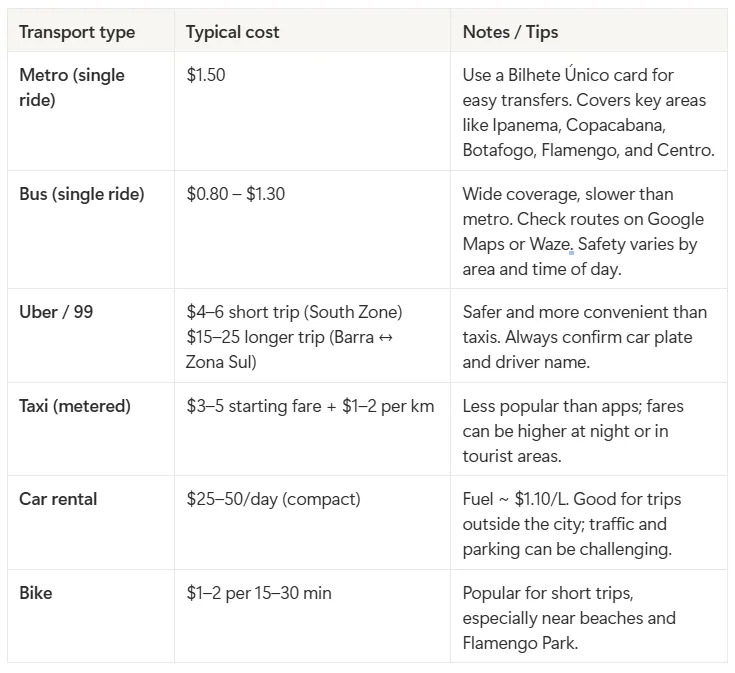
The metro is fast, safe, and reliable for connecting key areas like Centro, Botafogo, Flamengo, Copacabana, Ipanema, and Leblon. Trains run roughly every 4–6 minutes during peak hours.
Cost: R$ 7.90 per ride (~$1.50)
Tips: Buy a rechargeable Bilhete Único card to pay for multiple trips and transfers easily. Trains don’t go everywhere, so you’ll still need buses, Ubers, or walking for some neighbourhoods.
Buses
Buses cover almost every corner of the city, but they can be slow in traffic. Some routes are safe and comfortable; others, especially in tourist-heavy areas or at night, are less recommended.
Tip: Use Google Maps or apps like Waze to check routes and safety reviews.
Uber/99
Ride-hailing apps are the most used here. They’re often safer and more convenient than taxis.
Cost: Short trips in the South Zone (Copacabana ↔ Ipanema) ~$4–6; longer trips (Barra ↔ Zona Sul) ~$15–25.
Tip: Always confirm the license plate and driver name before entering, and avoid unregistered taxis.
Car rentals / driving
Driving in Rio is possible but challenging: traffic is heavy, parking is expensive, and streets can be steep and confusing. It’s great if you plan trips outside the city or want flexibility in Barra da Tijuca.
Cost: Car rental ~$25–50/day for a compact car; fuel ~$1.10/L.
Tip: Consider using condomínio parking if you rent an apartment with a garage.
Cycling
It’s also possible to rent bikes in Rio, which is a fun and healthy way to get around, especially along the beaches and in areas with bike lanes like Aterro do Flamengo or parts of Copacabana and Ipanema. Many apps let you locate and unlock bikes on the go.
Cost: Bike rental ~$1–2 for 15–30 minutes.
Here is a breakdown to make it easier:
Pro tip for expats: As locals, we combine transport modes: metro for fast, long trips, Uber for late-night rides, and walking for neighbourhood errands. If you live in Barra, you’ll likely rely more on Uber or a car; in Zona Sul, walking and public transit cover most daily needs.
Food prices in Rio
Food in Rio is a whole vibe. You can grab a quick snack by the beach, dig into a feijoada, or hunt for exotic ingredients for your own kitchen. There’s something for every taste and budget.
Restaurants
If you’re just starting out, there are plenty of casual spots where you can grab a salgadinho (savoury snack) or a sandwich for $3–8. Lunch at a local boteco (bar/restaurant) will run around $6–12, and it’s often the perfect excuse to sit, sip a juice or beer, and watch the city move.
For a sit-down meal with friends, expect to spend $15–25 per person. You'll get grilled meats, fresh seafood, or the classic PF (prato feito, a full lunch plate with rice, beans, salad, and meat).
If you’re feeling fancy or celebrating something, Rio’s fine dining scene is amazing. A meal for two can easily hit $80–150, with cocktails adding a few more dollars. But the food and vibe are totally worth it.
Supermarkets
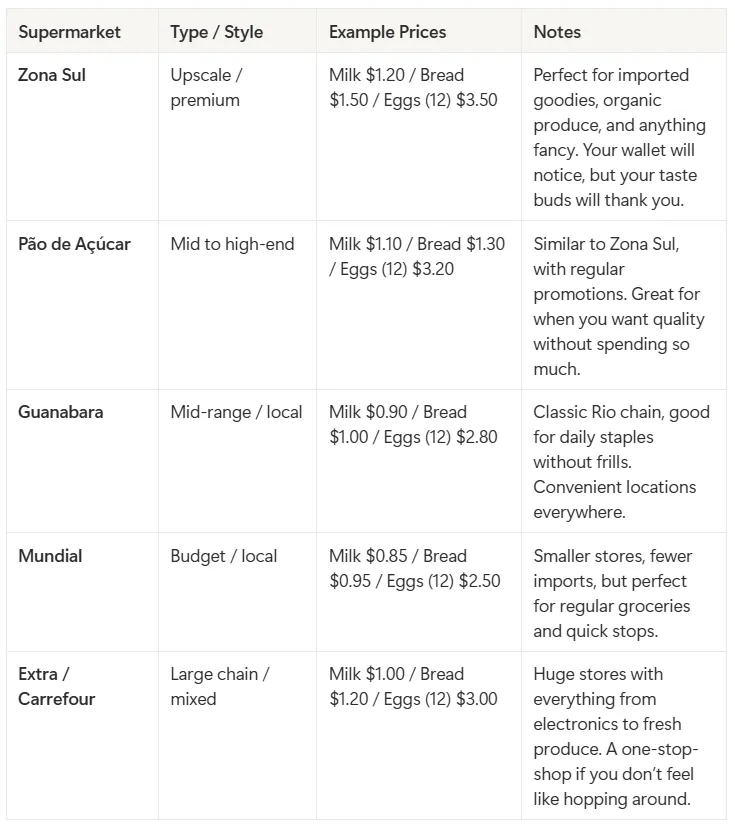
Now, grocery shopping in Rio is a story on its own. The city has everything from high-end boutique-style stores to budget-friendly local markets. Here’s the rundown:
Tip: I usually mix it up. Guanabara or Mundial for the basics, and Zona Sul or Pão de Açúcar when I want a treat or something special for dinner. Also, grocery prices can vary a bit depending on where you live. In Ipanema or Leblon, expect higher prices for the same items, especially at premium stores. Botafogo, Flamengo, and Glória/Catete have mid-range options like Guanabara, while Copacabana and Barra offer a mix. You can find bargains at Mundial or Extra if you know where to look.
Here’s a realistic monthly breakdown in USD:
For one person
Groceries (mix of Guanabara/Mundial + occasional Zona Sul treats): $80–120 per week (~$320–480 per month)
Eating out (casual lunches, occasional dinners or drinks): $50–80 per week (~$200–320 per month)
Total monthly food budget:$520–800
This gives you a mix of cooking at home, weekend brunches, and a few nights out without feeling restricted.
For a couple or small family
Groceries: $150–220 per week (~$600–880 per month)
Eating out: $100–150 per week (~$400–600 per month)
Total monthly food budget:$1,000–1,480
Enough for regular grocery shopping, occasional fine dining, and still exploring Rio’s countless food options.
Utilities costs in Rio
Living in Rio comes with the usual utility costs, but there are a few local quirks to keep in mind. Here’s what you can expect as an expat:
Electricity
Electricity can be surprisingly pricey, especially if you use air conditioning, which, honestly, is a must if you want to survive Rio’s summer.
Average monthly cost for a 1–2 bedroom apartment: $40–$70
Tips: Try using energy-efficient bulbs and turning off air conditioners and fans when you leave. Rio’s energy bills are calculated monthly and vary with usage.
Water and sewer
Water bills are usually affordable, but they’re often combined with sewer fees.
Average monthly cost: $15–30
Tip: Condomínios sometimes include water in your monthly fee, so check before signing a lease.
Gas
Most apartments use piped gas for cooking and water heating, which is included in your condo or building fees in many cases.
Cost: Often included in rent/condomínio; if separate, ~$10–15/month
Tip: Check with your landlord whether it’s included, especially in modern condomínios.
Internet and TV
High-speed internet is widely available, and we usually combine it with streaming services rather than traditional cable.
Average monthly cost: $25–45 for fibre internet (~500 Mbps)
TV/streaming: $5–15 per service (Netflix, Globoplay, Amazon Prime)
Mobile/Cell phone
Mobile plans in Rio are flexible, often prepaid (pré-pago) or postpaid (pós-pago).
Average monthly cost: $10–25 for 5–10 GB data plus calls/texts
Tip: Prepaid SIM cards are easy to get at shops or airports and work well for temporary stays.
Healthcare in Rio
Healthcare in Rio is a mix of public access, private comfort, and everything in between. You’ll find excellent doctors and modern hospitals, but the experience (and cost) depends a lot on whether you’re using the public system (SUS) or private care.
Public healthcare (SUS)
Brazil’s Sistema Único de Saúde (SUS) is free and available to everyone, from locals and expats to tourists in emergencies. The system covers general consultations, hospital stays, and medications for chronic conditions.
Cost: Free
Pros: Universal access, no need for insurance, available across the city.
Cons: Long waiting times, overcrowded hospitals, and limited English-speaking staff.
If you live in Rio long-term and speak some Portuguese, you can rely on SUS for routine care, but most expats prefer private hospitals for faster service and English-speaking doctors.
Private health insurance
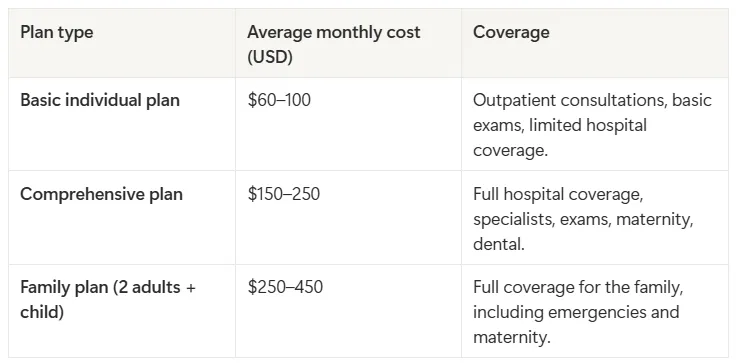
If you plan to stay for a while, private health insurance (plano de saúde) is worth considering. Plans vary from basic outpatient coverage to full hospital and dental care. The biggest providers are Bradesco Saúde, SulAmérica, Unimed, and Amil.
Tip: Expats often choose a mid-tier plan and pay out of pocket for minor visits. A basic consultation at a private clinic without insurance costs around $30–60, while a specialist (like a dermatologist or orthopaedist) can range from $60–120.
Average living costs in Rio
Rio is one of Brazil’s priciest cities. Between rent, transport, and the occasional caipirinha by the beach, costs add up quickly.
That said, it can still fit different lifestyles. Here’s what your monthly budget might look like:
In the end, you can live comfortably on around $1,500/month, but to fully enjoy the carioca lifestyle without cutting corners, $2,000–2,500/month is a realistic sweet spot for most expats.
Earning abroad, spending in Rio
I’ve lived in a few countries before, sending money back home and figuring out how to make different currencies work. Now I’m back in Rio, earning in dollars and spending in reais, so believe me: I know the pain. Watching exchange rates, paying fees, and waiting for transfers just turn a simple purchase into endless headaches.
Grey makes that part simple. You can send money abroad, receive your salary in USD, GBP, or EUR, and withdraw in reais when rates are good, all without the stress of conversions or hidden fees.
Open your Grey account today and manage your money the easy way, so you can focus on enjoying Rio's beauty, embracing the chaos, and making the city your own.
The world has gone borderless, but your money is still stuck in the past. Whether you're a freelancer invoicing clients across three continents, an expat building a life in Lagos, or a digital nomad island-hopping through Southeast Asia, currency conversion shouldn't be the bottleneck in your global lifestyle.
Traditional banks and legacy forex services treat every currency exchange like it's 1995—with hidden fees, stale rates, and service restrictions that lock out entire regions. Meanwhile, the borderless generation needs something different: transparent pricing, real-time rates, and tools that actually work globally.
Why traditional currency conversion fails the modern professional
Picture this: You're a UX designer in Cairo billing a Silicon Valley startup in USD. Your local bank quotes you a rate that's noticeably worse than market rates, adds processing fees, and tells you the money will arrive "in several business days." By the time you can actually spend that money, the exchange rate has shifted again.
This scenario plays out millions of times daily across Africa, Asia, MENA, and LATAM. Traditional financial institutions operate on outdated infrastructure that assumes everyone lives in the same time zone and uses the same currency. They don't understand that a marketing consultant in Manila might need to pay expenses in Philippine pesos while receiving payment in euros, or that a software engineer in Mexico City wants to save in USD but spend locally in pesos.
The problems run deeper than inconvenience. Hidden markups, often disguised as "competitive rates", can cost you substantial amounts annually. These aren't transparent fees you can budget around; they're embedded spreads that banks quietly pocket while advertising "fee-free" transfers.
Service restrictions create another barrier. Many global fintech solutions simply don't serve entire regions, leaving millions of professionals with limited options. If you're based in Nigeria, Pakistan, or Brazil, you've likely experienced the frustration of discovering that a promising financial service "isn't available in your country yet."
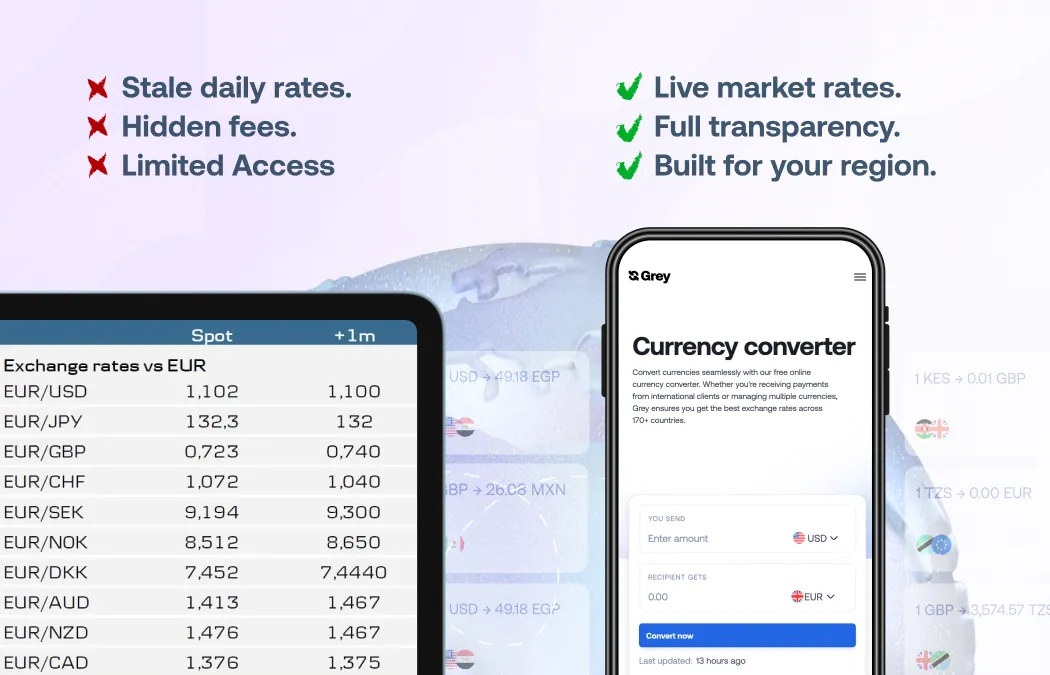
Grey currency converter benefits
Understanding real-time FX: The currency game-changer
Real-time foreign exchange rates change the entire equation. Instead of banks setting arbitrary rates that favor their profit margins, live FX tracking means you get pricing that reflects actual market conditions as they happen.
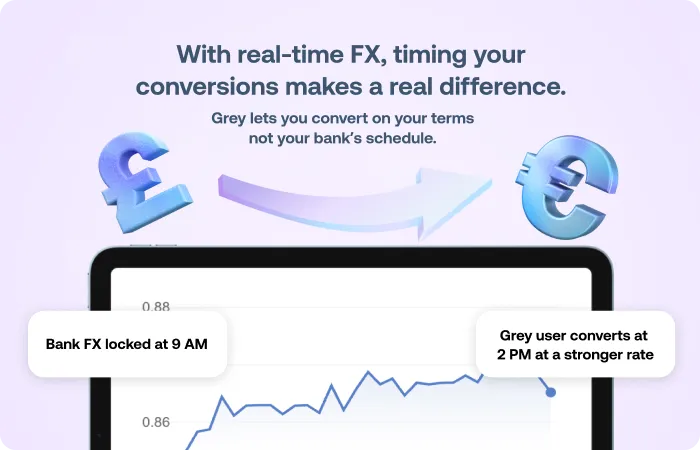
Here's how it works: The global forex market operates 24/7, with currency values fluctuating based on economic data, political events, and market sentiment. Traditional banks update their rates once or twice daily, sometimes less frequently, creating windows where you're essentially trading on yesterday's information.
Real-time FX platforms pull live data from multiple market sources, giving you rates that update every few seconds. This matters enormously when you're converting substantial amounts or when currency pairs are particularly volatile.
Consider major currency pairs during volatile periods. Professionals working with international clients often see significant rate movements within single trading days. With traditional banking, you might lock in a rate at an unfavorable time and watch the market move in your favor throughout the day, missing potential value. Real-time FX lets you time your conversions more strategically.
The transparency factor is equally crucial. When you can see live rates alongside clear fee structures, you make informed decisions rather than hoping your bank treated you fairly.
Real-world scenarios: When smart currency conversion matters most
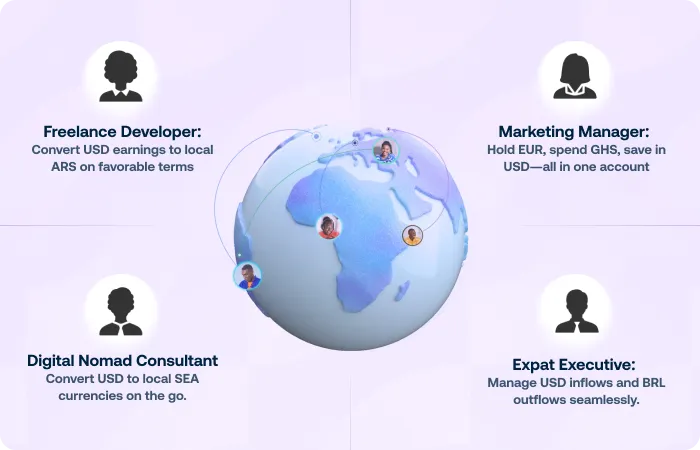
The freelance developer
A full-stack developer in Buenos Aires bills international clients in USD but covers all local expenses in pesos. Traditional banks offer rates that are notably worse than market rates, plus additional fees. With real-time FX and transparent pricing, she can convert exactly what she needs when rates are favorable, maximising the purchasing power of her dollar earnings.
The remote marketing manager
A marketing professional works for a European company while based in Accra, receiving salary in euros. Monthly expenses like rent and utilities require Ghanaian cedis, while long-term savings goals involve USD accumulation. Multi-currency capability allows holding euros, converting to cedis for immediate needs, and building USD savings—all with current market rates and clear fee structures.
The digital nomad consultant
A business consultant based in Indonesia while serving international clients. Getting paid in USD but needing local currencies for daily expenses creates constant conversion needs. Rather than losing value through frequent exchanges or managing multiple cash reserves, real-time FX enables strategic conversion timing with immediate local access.
The expat executive
A regional manager relocated from Dubai to São Paulo receives compensation in both USD and Brazilian reais. Supporting family in Lebanon requires USD transfers, while local Brazilian expenses need reais. Real-time conversion tools enable optimised timing for family support while efficiently managing day-to-day local currency needs.
These scenarios share common threads: professionals who earn, spend, and save across multiple currencies need tools that match their complexity. One-size-fits-all solutions don't work when your financial life spans continents.
Grey's approach: Built for the borderless generation
Grey designed its platform specifically for professionals who think beyond borders. Instead of retrofitting legacy banking infrastructure, Grey built modern currency conversion tools from scratch with the borderless generation in mind.
The real-time conversion calculator shows live rates for major currency pairs affecting Africa, Asia, MENA, and LATAM markets. You see exactly what you'll receive before confirming any transaction, no hidden surprises or markup mysteries. The platform updates rates continuously, so whether you're converting at 9 AM Lagos time or 11 PM Manila time, you're working with current market data.
Transparency extends beyond rates to fee structures. Grey displays all costs upfront: conversion spreads, transfer fees, and any applicable charges. This clarity lets you budget accurately and compare options intelligently. Many users find that even with clearly stated fees, they save money compared to traditional banks with hidden markups.
The multi-currency accounts functionality addresses a core need for borderless professionals: holding multiple currencies without constant conversion friction. You can receive USD payments, hold euros for upcoming expenses, and convert to local currency only when needed. This flexibility reduces unnecessary conversions and gives you more control over timing.
Instant local withdrawals matter enormously in regions where traditional international transfers can take days or weeks. Grey's partnerships with local financial institutions mean converted funds reach your local account quickly, whether you're in Mexico City, Johannesburg, or Jakarta.
Making the switch to Grey:
Practical steps for better currency conversion
Transitioning to smarter currency conversion doesn't require overhauling your entire financial setup. Start with one specific use case, perhaps monthly expense conversions or quarterly client payments, and compare your current costs against real-time FX alternatives.
Calculate your annual conversion costs under your current system. Include hidden markups, explicit fees, and opportunity costs from poor timing. Many professionals discover they're spending significant amounts annually on inefficient currency conversion.Feel free to use Grey's currency exchange platform to test real-world performance with smaller amounts initially. Pay attention to rate accuracy, conversion speed, and fund availability. The goal is building confidence in new tools before shifting major financial flows.
Consider your currency exposure and timing flexibility. If you receive large payments quarterly, real-time FX gives you more strategic options than daily expense conversions. Understanding your patterns helps optimise timing and minimise costs.
The future of currency conversion
Financial technology continues evolving rapidly, with artificial intelligence and machine learning creating new possibilities for currency conversion optimisation. Predictive analytics might soon help users time conversions more strategically, while automated conversion triggers could execute optimal rates without constant monitoring.
Regulatory changes across emerging markets are also improving access to international financial services. Countries that previously restricted forex access are opening up, creating opportunities for borderless professionals who were previously underserved.
The trend toward remote work and global business operations means demand for sophisticated currency tools will only grow. Companies hiring across continents need better ways to manage multi-currency payroll, while professionals building international careers require tools that match their complexity.
Central bank digital currencies (CBDCs) may eventually reshape currency conversion entirely, but current implementations suggest this transformation will take years to materialise meaningfully. In the meantime, private solutions like Grey are filling critical gaps for professionals who can't wait for traditional banking to catch up.
Your currency conversion strategy
The borderless generation deserves financial tools designed for their reality. Currency conversion should be transparent, efficient, and accessible regardless of your location or the currencies you need to manage. Your currency conversion strategy impacts your bottom line daily. Hidden fees, poor rates, and service restrictions constrain your global potential.
Grey's currency exchange platform provides the transparency, real-time data, and regional focus that borderless professionals need. The question isn't whether smarter currency conversion tools exist, it's whether you're ready to take advantage of them.
Your global career deserves financial services that think globally too. Make 2025 the year you stop overpaying for currency conversion and start optimising your international money management for the borderless future you're already living.
Have you ever waited days for an international payment to clear, only to realise you lost part of it during conversion into rupees? For many Indian remote workers, that frustration is all too familiar.
That’s exactly why multi-currency income is becoming so important. When you earn in USD, GBP or EUR, you protect the true value of your work, avoid repeated conversion costs, and gain the flexibility to decide when to exchange your money. It gives you stronger cash flow and more control over your earnings while working with global clients.
Today, multi-currency income is a big perk of working internationally from India. Yet managing fluctuating exchange rates and multiple income streams can still feel overwhelming.
Why Indian remote workers should earn in multiple currencies
Across India, more professionals are earning in dollars, pounds and euros through remote work. A multi-currency account is a smart, practical way to manage global income with confidence.
1. Significant cost savings
If you receive USD or GBP as part of your income and instantly convert it to rupees every time, you lose money through bank charges and poor exchange rates. Managing your earnings in multiple currencies helps you avoid repeated conversion fees. You can hold your income in foreign currency and convert only when rates are better. Over months, this can save you thousands of rupees without changing how hard you work.
2. Simplifies international payments
As a remote worker in India, you may need to pay for software subscriptions, online tools, or courses priced in dollars or euros. With multi-currency income, you can pay directly from your foreign earnings instead of converting from rupees each time. This makes international purchases smoother, faster, and cheaper. It also makes you feel like a true global professional, not limited by borders.
3. Faster payments
Many international clients prefer paying directly in USD or GBP. By managing your income in these currencies, you can share payment details that feel familiar to them. This reduces delays and confusion. Instead of waiting several days for complicated transfers to clear, payments can arrive more quickly and predictably. That means better cash flow and less stress at the end of the month.
4. Reduces FX risk
In India, exchange rates can move quickly. If the rupee weakens or strengthens suddenly, it affects how much you finally receive. Managing your income in multiple currencies allows you to hold your earnings and convert when the rate suits you. You are not forced to accept whatever rate the bank gives that day. This control helps protect your income from unnecessary losses.
Managing multiple currencies as a remote worker in India can feel confusing at first. But with the right approach, you can stay in control, protect your income, and make smarter financial decisions every month.
1. Choose the right payment partner
Managing multi-currency income starts with using a platform you can trust. When you’re working with international clients, the last thing you want is unclear fees or unpredictable processing times cutting into your earnings. Look for transparency, competitive exchange rates, and strong security. A reliable platform ensures your income reaches you fully and on time, giving you stability while working globally from India.
2. Track exchange rates strategically
Exchange rates fluctuate constantly, and those small shifts can significantly affect how much you receive in rupees. Instead of converting immediately, monitor trends and convert when rates are favourable. Being intentional about timing helps you maximise value and protect the real worth of your international income.
3. Separate earnings from spending
Once you convert at a strong rate, use INR for regular expenses like rent, groceries, transport, and utilities. Treat foreign currency earnings as strategic income rather than everyday spending money. This approach keeps budgeting simple while allowing you to manage conversions thoughtfully and avoid unnecessary losses.
4. Diversify your savings
If you earn in multiple currencies, consider saving across them. Holding part of your income in foreign currency can help you pay for global subscriptions, tools, or travel without repeated conversions. It also provides a buffer against currency volatility, giving you flexibility and stronger long-term financial control while living in India.
Choosing the best multi-currency platform for Indian remote workers
When picking a platform to manage your global income, consider the following
Fees: Choose one with low or no charges on transfers and conversions. Every rupee matters.
Currencies: Make sure it supports USD, GBP, EUR, or whatever you earn in.
Speed: Fast transfers mean no waiting around for clients to pay.
Ease of use: A simple app or website makes life easier.
Support: Good customer service is key if anything goes wrong.
Safety: Always pick a platform that’s licensed and regulated
LDMAG1
Managing multicurrency income in India
Managing multiple currencies as a remote worker in India should not feel like a second job. Grey makes it easier to receive, hold and send USD, GBP and EUR without unnecessary stress, delays or hidden charges.
Whether you are working remotely from Bengaluru, Jaipur or Kochi, Grey is designed to support your global career from India. Sign up or download the app today and simplify the way you handle international income.
The digital nomad scene has evolved over the years, and 2026 feels like the year of maturity. Today, entire countries are rolling out red carpets for remote workers, and honestly, some of these programmes are incredible.
What’s in it for these countries? A remote worker earning a London or San Francisco salary but spending it in Lisbon or Mexico City. That's pure economic gold, as that’s money that will be pumped directly into the economy through the said freelancers’ spending.
I’ve spent some time researching which countries are genuinely attracting remote workers in 2026, not just talking about it, but actually making it happen. Here’s what I’ve found.
Portugal
Let me start with the obvious one. Portugal has been the poster child for remote work migration since 2020, and in 2026, it remains at the forefront.
Entire neighbourhoods in Príncipe Real and Santos are now essentially expat hubs. You’ll hear more English than Portuguese in some co-working spaces, and the average rent has tripled in five years. Some locals aren’t always thrilled about that, but the government certainly is.
What makes Portugal attractive to remote workers?
The D7 visa (passive income visa) and the newer Digital Nomad Visa make it absurdly easy for remote workers to settle here legally. You need proof of income, which is around €3,040 per month for a single person, and you’re basically in. Processing times are reasonable, and you get access to Europe’s Schengen zone.
Portugal offers a lifestyle that’s hard to beat. It’s affordable, at least compared to London or Paris, has a stunning coastline, incredible food, and a time zone that works for both European and US East Coast clients.
Are there any drawbacks to working remotely in Portugal?
Rent in Lisbon and Porto has become genuinely expensive. A one-bedroom flat in a decent neighbourhood will set you back €1,200 - €1,800 per month now. And if you’re not earning in EUR or USD, the cost of living might surprise you.
Still, for most remote workers, especially those in tech, design, or marketing, Portugal remains one of the safest, easiest, and most attractive options in Europe.
Spain
Some say Spain spent years watching Portugal steal its thunder, but in 2023, it launched a proper Digital Nomad Visa, and by 2026, the results are showing.
I’ve got friends who moved to Valencia and Barcelona in the last year, and the quality of life they describe is impressive. Spain’s visa requires proof of a monthly income of at least € 2,000, a clean criminal record, and health insurance. The visa is valid for 12 months (renewable for up to five years) and you get to live and work remotely in one of Europe’s most liveable countries.
What makes Spain attractive to remote workers?
The weather, obviously. But also the infrastructure. Spain’s internet speeds are excellent, co-working spaces are everywhere, and cities like Madrid, Barcelona, and Valencia offer that perfect mix of metropolitan energy and Mediterranean ease.
Spain's tax regime for new residents can be favourable. The Beckham Law (yes, named after that Beckham) allows qualifying remote workers to pay a flat 24% tax on Spanish-sourced income for up to six years. If you structure things correctly and most of your income is foreign-sourced, Spain can be surprisingly tax-efficient.
Are there any drawbacks to working remotely in Spain?
A minor downside is that obtaining your TIE (residence card) can take several months, and navigating local government offices often requires considerable patience. But if you can navigate the admin, you’ll absolutely love your stay.
Mexico
I’ll be honest, I didn’t expect Mexico to dominate the remote work conversation the way it has, but here we are. In 2026, Mexico City, Playa del Carmen, and Tulum are absolutely crawling with remote workers, particularly from the U.S. and Canada.
Mexico’s Temporary Resident Visa is designed for remote workers who earn at least $3,500 per month or hold at least $60,000 in savings. Once approved, you can live in Mexico for up to four years.
What makes Mexico attractive to remote workers?
The timezone compatibility with the U.S. is a plus if you're working for American clients or companies. Mexico’s Central or Eastern time zones mean you're not taking calls at 2 a.m. The cost of living is significantly lower than in the U.S. You can live comfortably in Mexico City on $2,000–$3,000 per month, including rent, food, and entertainment.
The lifestyle is vibrant. Mexico City boasts world-class restaurants, an incredible cultural scene, and a creative energy that rivals any major global city. The variety is there, and it's affordable.
Are there any drawbacks to working remotely in Mexico?
It’s essential to acknowledge that safety concerns are real in certain areas. Mexico City is generally safe in expat-friendly neighbourhoods like Roma, Condesa, and Polanco, but it’s essential to stay vigilant. Internet reliability can vary significantly, being fine in major cities but patchy in beach towns. And whilst Mexico is affordable, the influx of high-earning remote workers has driven up rents in popular neighbourhoods. A flat in Roma Norte that cost $800 per month in 2021 now costs $ 1,500 or more.
Still, for North American remote workers, Mexico remains the most convenient, accessible, and practical option.
UAE
Dubai and Abu Dhabi have always attracted expats, but the UAE’s remote work visa (launched in 2020 and refined since) has turned it into a genuine hub for high-earning digital professionals.
The UAE’s remote work visa requires proof of a monthly income of $5,000 or more (or an annual income of $50,000 or more), valid employment, and health insurance. The visa grants you one year of residency (renewable), exempts you from income tax, offers world-class infrastructure, and provides a lifestyle that's... well, very Dubai.
What makes Mexico attractive to remote workers?
No income tax is the headline. If you’re earning six figures (a term that I’ve now come to dislike) and paying 40% tax in the UK or EU, moving to Dubai can mean keeping significantly more of your income. The infrastructure is phenomenal and everything runs on time. The UAE is one of the safest countries in the world, and for remote workers with families, that's a huge draw.
Are there any drawbacks to working remotely in Mexico?
It’s expensive. Rent in Dubai is high (think $2,000-$4,000 per month for a decent one-bedroom), and while there's no income tax, the cost of living offsets some of those savings. The culture also isn’t for everyone. There are many strict laws, conservative social norms, and a car-dependent lifestyle that can feel restrictive if you’re used to European walkability.
But for high earners prioritising tax efficiency and luxury, the UAE is hard to beat.
LDMAG1
Estonia
Estonia doesn't get enough credit, but that’s why I’m here. This tiny Baltic nation launched the world's first Digital Nomad Visa in 2020, and whilst it's not as sunny as Portugal or as buzzy as Mexico, it’s carved out its own loyal following.
Estonia's visa requires proof of a monthly income of € 4,500 or more and allows you to live and work remotely for up to 12 months. Extensions are possible, and the entire application process is digital.
What makes Estonia attractive to remote workers?
Everything happens online, from company registration to tax filing. For tech workers and entrepreneurs, Estonia feels like home.
Estonia also offers the e-Residency programme, which allows you to run a business remotely from an EU-based location without needing to reside there. Pair that with the Digital Nomad Visa, and you've got a powerful setup for location-independent entrepreneurs.
Are there any drawbacks to working remotely in Estonia?
It's cold. Proper cold. If you’re chasing sunshine, Estonia isn't it. The expat community is relatively small, which can make it feel isolating. And whilst Tallinn is lovely, the rest of Estonia is quite rural; if you need urban energy, options are limited.
But for a certain type of remote worker, tech-focused, digitally savvy, unbothered by winter, Estonia is brilliant.
Bali has perhaps been the most popular digital nomad hotspot in Indonesia. For over a decade, it's always existed in a legal grey area. Most people worked on tourist visas and did "visa runs" every few months. In 2024, Indonesia finally launched a proper remote work visa.
The visa costs around $130, requires proof of a monthly income of $2,000 or more, and grants you 12 months (renewable for up to five years) to live and work remotely.
What makes Indonesia attractive to remote workers?
It’s cheap. You can live well in Bali on $1,500 per month. The lifestyle is unbeatable: surf, yoga, co-working spaces overlooking rice paddies, and a massive community of like-minded remote workers. Canggu, Ubud, and Sanur are now essentially purpose-built for this crowd.
Are there any drawbacks to working remotely in Indonesia?
Infrastructure is hit-or-miss. The internet can be unreliable during the rainy season, power cuts happen, and healthcare isn’t comparable to that in developed countries. The visa process, whilst improved, still involves typical Indonesian bureaucracy.
But if you’re earning in USD or GBP and want a low-cost, high-lifestyle base in Southeast Asia, Bali remains hard to beat.
The countries attracting remote workers in 2026 aren’t just the ones with the nicest beaches or the coolest co-working spaces. They’re the ones that understand the economics, make visas accessible, and offer a genuine quality of life improvement over wherever you’re leaving.
Portugal, Spain, Mexico, the UAE, Estonia, and Indonesia are leading the pack, and they’re leading for different reasons. Portugal offers European ease and Schengen access. Spain brings scale and variety. Mexico offers affordability and time zone alignment for Americans. The UAE is the tax-free luxury option. Estonia is the digital pioneer. Bali is the lifestyle escape.
Your ideal destination depends on what you value most: tax efficiency, cost of living, weather, community, or infrastructure. However, wherever you land, ensure that you have the necessary financial infrastructure in place. Because the visa might get you in the door, but a proper payment setup is what lets you actually enjoy it.
Getting paid across borders
I’ve watched friends move to Portugal or Mexico, land great clients, then lose 3 - 5% of every payment to terrible exchange rates and international transfer fees. Over a year, that adds up to thousands of pounds, dollars, or euros just... gone.
If you’re working remotely and getting paid in USD, EUR, or GBP whilst living abroad, you need a proper payment setup. Many traditional banks are often problematic in this regard, as they have slow transfers, hidden foreign exchange markups, and fees that make little sense.
Personally, I’d recommend Grey come in. You receive virtual USD, EUR, and GBP accounts, allowing clients to pay you directly without the headaches of international transfers. You convert currency at real rates, and you can withdraw to your local account quickly. It’s the kind of setup that saves you actual money every month.