

<script type="application/ld+json" data-schema-version="grey-blog-v4"> [{"@context":"https://schema.org","@type":"BlogPosting","@id":"https://grey.co/blog/brazil-visa-us-citizens#article","headline":"Brazil visa requirements for US citizens: Full guide","description":"Do US citizens need a visa for Brazil? See the current e-visa requirements, cost, processing time, and how to apply before you travel. Apply today.","inLanguage":"en","url":"https://grey.co/blog/brazil-visa-us-citizens","mainEntityOfPage":{"@id":"https://grey.co/blog/brazil-visa-us-citizens#webpage"},"datePublished":"2026-08-07T21:02:24.529Z","dateModified":"2026-08-09T09:00:00+01:00","author":{"@type":"Person","@id":"https://grey.co/authors/priscila-marotti#person","name":"Priscila Marotti","url":"https://grey.co/authors/priscila-marotti","jobTitle":"Content Writer","sameAs":["https://www.linkedin.com/in/priscila-marotti/"]},"publisher":{"@type":"Organization","@id":"https://grey.co/#organization","name":"Grey","url":"https://grey.co","logo":{"@type":"ImageObject","url":"https://cdn.prod.website-files.com/6360022338a81bd6fdbb1145/6564ae1077a67e39d3c491a6_Grey%20Logo%20Lockup%20Black.svg"}},"image":{"@type":"ImageObject","@id":"https://grey.co/blog/brazil-visa-us-citizens#primaryimage","url":"https://cdn.prod.website-files.com/636a85d290ee58e70c17e1c0/6a764738f98ac0eb5ad464f1_Brazil%20visa%20requirements%20for%20US%20citizens.jpg","contentUrl":"https://cdn.prod.website-files.com/636a85d290ee58e70c17e1c0/6a764738f98ac0eb5ad464f1_Brazil%20visa%20requirements%20for%20US%20citizens.jpg","width":1200,"height":675}},{"@context":"https://schema.org","@type":"WebPage","@id":"https://grey.co/blog/brazil-visa-us-citizens#webpage","url":"https://grey.co/blog/brazil-visa-us-citizens","name":"Brazil Visa Requirements for US Citizens | Grey","description":"Do US citizens need a visa for Brazil? See the current e-visa requirements, cost, processing time, and how to apply before you travel. Apply today.","inLanguage":"en","primaryImageOfPage":{"@id":"https://grey.co/blog/brazil-visa-us-citizens#primaryimage"},"breadcrumb":{"@id":"https://grey.co/blog/brazil-visa-us-citizens#breadcrumb"}},{"@context":"https://schema.org","@type":"BreadcrumbList","@id":"https://grey.co/blog/brazil-visa-us-citizens#breadcrumb","itemListElement":[{"@type":"ListItem","position":1,"name":"Home","item":"https://grey.co/"},{"@type":"ListItem","position":2,"name":"Blog","item":"https://grey.co/blog"},{"@type":"ListItem","position":3,"name":"Brazil visa requirements for US citizens: Full guide","item":"https://grey.co/blog/brazil-visa-us-citizens"}]},{"@context":"https://schema.org","@type":"FAQPage","@id":"https://grey.co/blog/brazil-visa-us-citizens#faq","mainEntity":[{"@type":"Question","name":"Is the Brazil e-visa mandatory for US citizens?","acceptedAnswer":{"@type":"Answer","text":"Yes. US citizens travelling to Brazil for tourism, business, transit, sporting events, or cultural activities must obtain an approved e-visa before travelling. Airlines may ask to see your visa before boarding, and you may be refused entry if you arrive without one."}},{"@type":"Question","name":"Can US citizens get a visa on arrival in Brazil?","acceptedAnswer":{"@type":"Answer","text":"No. Brazil does not offer a visa on arrival for US citizens. You must apply for and receive your e-visa before you travel."}},{"@type":"Question","name":"How long should my passport be valid to enter Brazil?","acceptedAnswer":{"@type":"Answer","text":"Your passport must be valid for the duration of your stay in Brazil and have at least two blank visa pages. Before travelling, always check the latest passport requirements on the official Brazilian government website, as entry rules may change."}},{"@type":"Question","name":"Do children need a visa to travel to Brazil?","acceptedAnswer":{"@type":"Answer","text":"Yes. Every US passport holder, including children and infants, must have their own valid visa to enter Brazil. Parents or legal guardians are responsible for completing the application on behalf of minors."}},{"@type":"Question","name":"Can I extend my tourist stay in Brazil?","acceptedAnswer":{"@type":"Answer","text":"In some cases, yes. If you wish to stay longer than your authorised period, you can request an extension from the Brazilian Federal Police before your current stay expires. Approval is not automatic and depends on your individual circumstances."}},{"@type":"Question","name":"Can I work in Brazil with a tourist e-visa?","acceptedAnswer":{"@type":"Answer","text":"No. The Brazil e-visa is intended for short visits such as tourism, business meetings, sporting events, or transit. If you plan to work, study, or live in Brazil, you'll need to apply for the appropriate visa before travelling."}},{"@type":"Question","name":"How early should I apply for my Brazil e-visa?","acceptedAnswer":{"@type":"Answer","text":"Although many applications are processed within a few business days, it's best to apply at least two to four weeks before your departure. This allows extra time in case additional documents or information are requested."}}]}] </script>

Brazil visa requirements for US citizens: Full guide

Priscila Marotti

TABLE OF CONTENT

SHARE THIS POST

Planning a trip to Brazil? Before you start looking for flights or building your Rio de Janeiro itinerary, it's worth checking the latest visa rules.

Brazil recently reintroduced visa requirements for travellers from the United States, meaning you can no longer arrive without prior authorisation. Fortunately, most visitors can now apply online through Brazil's electronic visa (e-visa) system, making the process much simpler than visiting a consulate.

As of 2026, US citizens need a visa to enter Brazil for tourism. Brazil reintroduced an electronic visa (e-visa) that you apply for online before travelling. You'll need a valid passport, a passport photo, proof of financial means, and the visa fee. Always confirm the latest requirements through the official Brazilian government website before booking your trip.

Do US citizens need a visa for Brazil?

Yes. US citizens need a visa to visit Brazil for tourism, business, transit, sporting events, or artistic activities.

After several years of visa-free travel, Brazil reinstated the visitor visa requirement for US, Canadian, and Australian passport holders on 10 April 2025. Eligible travellers can apply online for a Brazil e-visa, removing the need to visit a Brazilian embassy or consulate in most cases.

The Brazil e-visa is intended for short visits and is designed to make the application process faster and more convenient. Once approved, you'll receive your visa electronically by email, which you should keep with your travel documents when flying to Brazil.

For most US tourists, the application requires:

  • A valid US passport with at least two blank visa pages
  • A completed online visa application
  • A recent passport-style photograph
  • Payment of the visa fee
  • Proof of onward or return travel
  • Proof of sufficient financial means, such as recent bank statements

Because visa policies can change, it's a good idea to check the official Brazilian government website before submitting your application or booking non-refundable travel.

Brazil entry requirements for US citizens

Getting an approved e-visa is only one part of entering Brazil. Immigration officers may also ask you to meet several standard entry requirements when you arrive.

Before travelling, make sure you have:

A valid passport

Your passport must be signed, remain valid for the duration of your stay, and have at least two blank visa pages available.

A valid Brazil e-visa

US citizens travelling for tourism or short business visits must obtain an approved electronic visitor visa before departure. Airlines may check your visa before allowing you to board your flight.

Proof of onward travel

Brazilian authorities may ask for confirmation that you intend to leave the country, such as a return ticket or an onward flight reservation. This is also part of the e-visa application process.

Proof of financial means

Applicants currently need to show evidence they can support themselves during their stay. The official e-visa requirements include a recent bank statement showing transactions over the previous 30 days and a balance of at least $2,000.

Health requirements

If you're travelling to areas where yellow fever is present, health authorities may recommend getting vaccinated before your trip. Depending on your travel history, additional health requirements may apply, so it's worth checking both the official Brazilian government guidance and the latest US travel advice before departure.

Meeting these requirements before you travel can help you avoid delays at the airport and make your arrival in Brazil much smoother.

How to apply for a Brazil e-visa from the USA

Applying for a Brazil e-visa is entirely online and usually takes just a few steps.

1. Visit the official e-visa website

Start your application through Brazil's official electronic visa portal. Avoid unofficial websites that charge additional service fees or claim to speed up the process.

2. Complete the online application

Fill in your personal information exactly as it appears in your passport. Double-check spellings, passport numbers, and travel dates before submitting the form.

3. Upload your documents

You'll typically need to provide:

  • Your passport information page
  • A passport-style photograph with a white background
  • Proof of your flight reservation
  • Recent bank statements showing sufficient funds

Additional documents may be requested depending on your circumstances.

4. Pay the application fee

Once you've uploaded your documents, you'll pay the visa fee online using one of the accepted payment methods.

5. Wait for approval

If your application is approved, your e-visa will be sent to your email. Print a copy or keep a digital version available when travelling, as airlines or border officials may ask to see it.

How much does a Brazil visa cost?

The cost of a Brazil visa for US citizens is US$80.90 for a standard electronic visitor visa (e-visa). This fee covers the application and processing of your visa and is paid online when you submit your application. The fee is generally non-refundable, even if your application is refused or you decide not to travel.

Before making your payment, double-check that:

  • Your passport details are correct.
  • All required documents have been uploaded.
  • Your passport photo meets the official specifications.
  • You're applying through the official e-visa portal.

If your application is incomplete or additional documents are requested, processing may be delayed, so it's worth taking a few extra minutes to review everything before submitting.

Keep in mind that visa fees can change. Always confirm the latest amount on the official Brazilian e-visa website before applying.

How long does a Brazil visa take to process?

Most e-visa applications are processed within up to five business days, although processing times can vary depending on application volumes and whether additional documentation is required.

Because unexpected delays can happen, it's recommended that you apply at least two to four weeks before your departure date. This gives you enough time to respond if the authorities ask for extra documents or clarification.

To help your application move as quickly as possible:

  • Complete every section accurately.
  • Upload clear, high-quality copies of your documents.
  • Ensure your passport photo meets the required standards.
  • Regularly check your email for updates or requests for additional information.

Avoid leaving your application until the last minute, especially if you're travelling during peak holiday periods.

How long can US citizens stay in Brazil?

With an approved visitor e-visa, US citizens can stay in Brazil for up to 90 days per visit.

The visa is generally valid for multiple entries over a period of up to 10 years, allowing you to visit Brazil more than once without applying for a new visa each time, provided each stay complies with the permitted duration.

If you wish to stay longer than your authorised period, you must apply for an extension through the Brazilian Federal Police before your current stay expires. Extensions are not guaranteed and are assessed on a case-by-case basis.

Overstaying your visa can lead to fines, administrative penalties, or difficulties entering Brazil in the future, so it's important to monitor your permitted length of stay carefully.

If you're planning to work, study, or live in Brazil, you'll usually need a different type of visa, as the visitor e-visa is intended for tourism, business meetings, transit, sporting events, and similar short-term activities.

Money tips for US travellers in Brazil

Once your visa is sorted, it's worth planning how you'll pay for everyday expenses while you're in Brazil.

Although major cities widely accept cards, you'll still come across smaller shops, cafés, local markets, and taxis that prefer cash or have minimum card spend requirements. Having a mix of payment options can make your trip much easier.

Avoid exchanging money at the airport

Airport exchange bureaux often offer some of the least competitive exchange rates. If possible, exchange only a small amount for immediate expenses and look for better rates elsewhere.

Know the local currency

Brazil uses the Brazilian real (BRL). While some tourist attractions may display prices in US dollars, almost all day-to-day purchases are made in reais.

Use a travel-friendly card

Using a card designed for international spending can help you avoid unnecessary foreign transaction costs and poor exchange rates.

If you're travelling with Grey, the Grey virtual debit card for travel lets you spend online and abroad while managing multiple currencies from one app.

You can also discover how Grey for travellers and tourists helps you manage money across borders, or learn how to get an instant USD debit card in Brazil before your trip.

Before you leave, it's also worth reading our guide on how to protect your funds while travelling abroad so you're prepared if your card is lost, stolen, or compromised.

Ready for your trip?

Getting your Brazil e-visa is one of the first steps towards an unforgettable trip. Once you've sorted your travel documents, make sure your money is just as prepared.

Open a Grey account, get a Grey card, and make the most of your money while spending in Brazil.

Frequently asked questions about Brazil visas for US citizens

Is the Brazil e-visa mandatory for US citizens?

Yes. US citizens travelling to Brazil for tourism, business, transit, sporting events, or cultural activities must obtain an approved e-visa before travelling. Airlines may ask to see your visa before boarding, and you may be refused entry if you arrive without one.

Can US citizens get a visa on arrival in Brazil?

No. Brazil does not offer a visa on arrival for US citizens. You must apply for and receive your e-visa before you travel.

How long should my passport be valid to enter Brazil?

Your passport must be valid for the duration of your stay in Brazil and have at least two blank visa pages. Before travelling, always check the latest passport requirements on the official Brazilian government website, as entry rules may change.

Do children need a visa to travel to Brazil?

Yes. Every US passport holder, including children and infants, must have their own valid visa to enter Brazil. Parents or legal guardians are responsible for completing the application on behalf of minors.

Can I extend my tourist stay in Brazil?

In some cases, yes. If you wish to stay longer than your authorised period, you can request an extension from the Brazilian Federal Police before your current stay expires. Approval is not automatic and depends on your individual circumstances.

Can I work in Brazil with a tourist e-visa?

No. The Brazil e-visa is intended for short visits such as tourism, business meetings, sporting events, or transit. If you plan to work, study, or live in Brazil, you'll need to apply for the appropriate visa before travelling.

How early should I apply for my Brazil e-visa?

Although many applications are processed within a few business days, it's best to apply at least two to four weeks before your departure. This allows extra time in case additional documents or information are requested.

Last updated:

October 2, 2026

Open a free Grey account to get startedJoin 1 million digital nomads
IF YOU ENJOYED THIS, CHECK THESE OUT

11 best day trips from Amsterdam

•

•

2 min read

Some of the best day trips from Amsterdam take under 30 minutes by train, and most of the rest are within a couple of hours, so you can see those famous windmills, tulip fields, and medieval towns without changing hotels.

This guide covers 11 trips: what to see, how to get there, how long they take, and what they cost. Fares and prices are approximate 2026 figures and vary by time of day and ticket type, so confirm the exact amount before you travel.

Best day trips from Amsterdam: Overview

Trains do most of the work. Haarlem, Zaanse Schans, Utrecht, Rotterdam, The Hague, and Delft are all served by NS trains from Amsterdam Centraal, and you rarely need to book ahead. The exceptions are Keukenhof, which uses timed tickets, and Giethoorn, which has no station. If you’ve already done the Amsterdam canal boat trips, Utrecht’s wharf canals and Giethoorn offer a quieter version of the same idea.

Destination Travel time from Amsterdam Approximate return fare Best for
Zaanse Schans 17–20 min by train, then 10 min walk €9–10 Windmills, half day
Keukenhof 35–45 min by bus (spring only) From about €35 including entry Tulips
Utrecht 25–30 min by train €16 Canals, full day
Rotterdam 40 min by train €15 Modern architecture
The Hague 50 min by train €14 Museums
Giethoorn 2 hrs by train and bus Tours from ~€64.50 Car-free canal village
Bruges 2 hrs 45 min by train €35–50 Medieval Belgium
Haarlem 15–20 min by train €10 Half day, museums
Delft 1 hr by train €15–25 Delft Blue pottery
Volendam and Marken 30–40 min by bus €5–6 one way by bus Fishing villages
Kinderdijk 1 hr 15 min by train and waterbus €15 by train, plus waterbus UNESCO windmills

‍

If you plan several stops in one region, the Amsterdam & Region Travel Ticket covers Volendam, Marken, Edam, Zaanse Schans, and Haarlem from about €23 for one day. Check live train fares on the NS website.

1. Zaanse Schans: Windmills in 20 minutes

Zaanse Schans is a preserved village of working windmills, green wooden houses, a clog workshop, and a cheese farm on the river Zaan, about 16 km from the city. The village is free to walk around, and individual windmills cost roughly €5-€7 each. A direct train from Amsterdam Centraal to Zaandijk Zaanse Schans takes about 17 minutes and costs around €9.40 return, with a 10-minute walk over the bridge afterwards. It suits a half day.

Tip: Arrive before 09:30 or after 15:30 in summer, when coach tours fill the village between 10:00 and 15:00.

2. Keukenhof: Tulips, in season only

Keukenhof is open for only about eight weeks each spring, with around seven million bulbs flowering across 32 hectares near Lisse. The 2026 season ran from 19 March to 10 May, and the dates for the next season will be published on keukenhof.nl. In 2026, adult entry cost about €21-€23 online, and a combi ticket with a return bus from Amsterdam started at roughly €35-€38.50. Bus 852 from Amsterdam RAI takes about 35 minutes. Entry is by timed slot, and peak weekends sell out.

Tip: Peak bloom usually falls between 10 and 25 April.

3. Utrecht: Canals without the crowds

Utrecht is the best city trip if you want canals at a calmer pace. Its two-level wharf canals have cafés in the old cellars at water level, and the Dom Tower and cathedral dominate the centre. Trains from Amsterdam Centraal take 25 to 30 minutes and cost around €16 return.

Tip: Give Utrecht a full day rather than pairing it with another stop, because the old centre rewards slow walking.

4. Rotterdam: The modern contrast

Rotterdam was rebuilt after the Second World War, which explains its bold architecture: the Cube Houses, the Markthal food hall, and the Erasmus Bridge over a lively waterfront. Fast direct intercity trains take about 40 minutes and cost around €15 return.

Tip: Delft is 15 minutes away by train, so the two combine well in one day.

5. The Hague: Museums and government

The Hague is the seat of the Dutch government and home to the Mauritshuis, known for its Vermeer paintings. Families may prefer Madurodam, a miniature Netherlands. A direct intercity train takes about 50 minutes and costs around €14 return.

Tip: Delft is only 10 minutes away by train, so pair The Hague with Delft instead of adding a third city.

6. Giethoorn: The car-free canal village

Giethoorn has about 6.5 km of canals, no cars, and thatched-roof cottages on small islands. It has no train station, so public transport means a train to Steenwijk (around 90 minutes) and bus 270 (15 minutes), roughly two hours each way. Check NS for the current fare. Guided boat tours in the village cost about €8-€10 per person, and organised day tours from Amsterdam start at around €64.50 and include transfers.

Tip: If you only have one spare day, Haarlem or Zaanse Schans give a better return on your time.

7. Bruges: A long day, but worth it
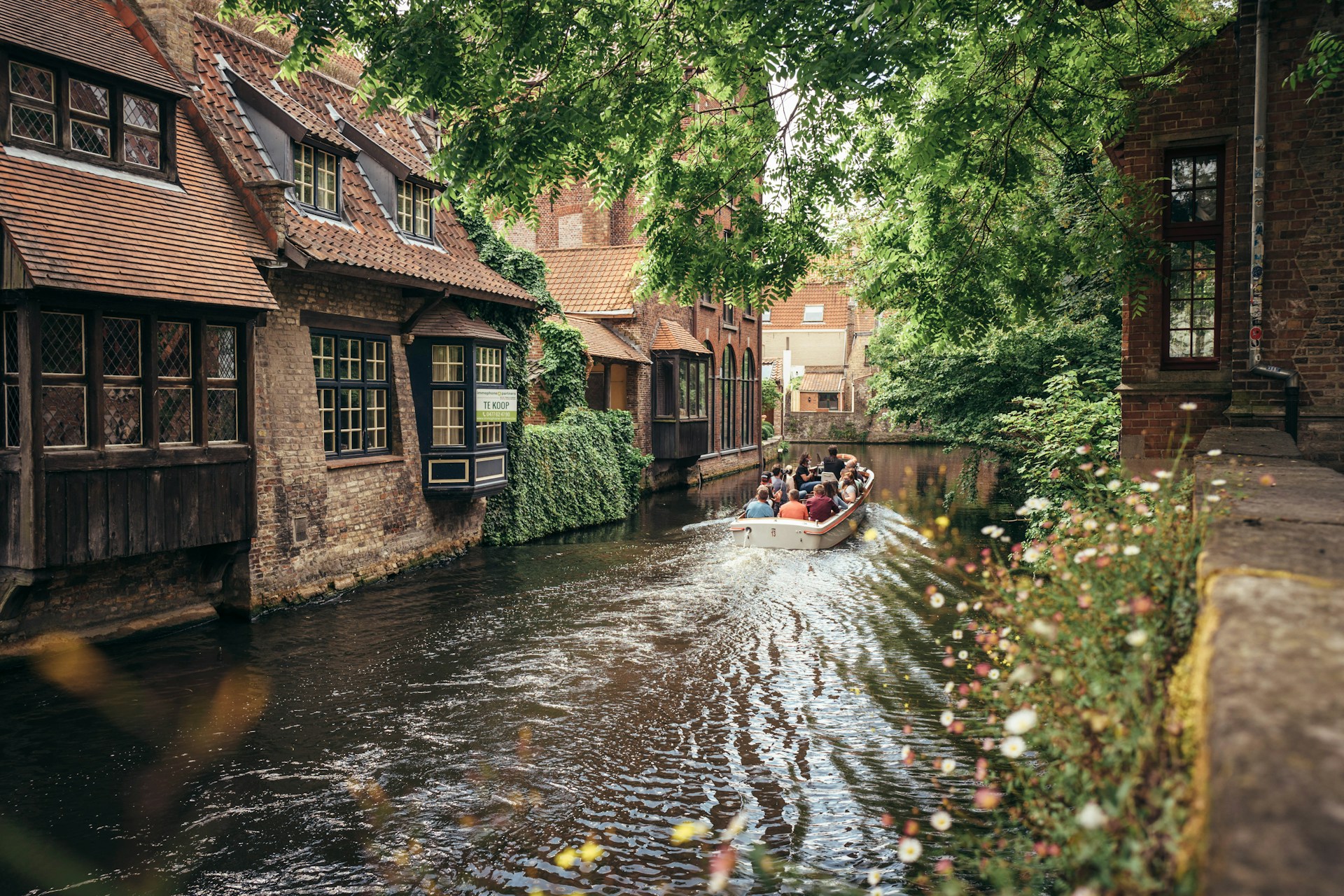
Bruges is in Belgium, so it takes the most planning. The train via Brussels takes about 2 hours 45 minutes each way and costs roughly €35 to €50 return. FlixBus runs direct coaches in 3 to 3.5 hours from about €15 one way. The medieval centre and canals are compact enough to cover in a day.

Tip: Start early and carry photo ID, since you’ll cross a national border even though checks are rare.

8. Haarlem: The easiest day trip

Haarlem is 15 to 20 minutes from Amsterdam Centraal by train, at around €10 return. It has a Gothic cathedral, the Grote Markt square, and the Frans Hals Museum, and feels distinctly Dutch without the crowds. It works as a half day.

Tip: Zandvoort beach is about 15 minutes farther by train, so Haarlem plus a beach walk makes for a full day in warm weather.

9. Delft: Blue pottery and Vermeer

Delft is a compact canal town famous for Delft Blue pottery and its Vermeer connections, including the Vermeer Centrum. The train takes about an hour, and return fares run roughly €15 to €25 depending on the ticket, so check NS. Half a day covers the highlights.

Tip: Delft is 10 minutes from The Hague and 15 minutes from Rotterdam, so it fits easily into a two-city day.

10. Volendam and Marken: fishing villages

Volendam is a fishing village on the IJsselmeer, about 20 km north of the city, with an old harbour and traditional costumes. Marken is a quieter former island with green wooden houses. Bus 316 from Amsterdam Centraal reaches Volendam in 30 to 35 minutes, and a seasonal ferry (April to October) crosses to Marken for roughly €8.50 one way.

Tip: Tours often combine these villages with Zaanse Schans, but they lie in different directions, so going independently means two separate bus routes.

11. Kinderdijk: UNESCO windmills

Kinderdijk’s 19 windmills date from the 1740s and were built to drain the polder. Take the train to Rotterdam (about 40 minutes, around €15 return), then the Waterbus to Kinderdijk, for a total of roughly 1 hour 15 minutes. Entry to the visitor area is around €16, with timed entry in peak season.

Tip: Guided tours linking Kinderdijk with Rotterdam or The Hague simplify transfers.

Getting around and paying on your day trips

Dutch trains, trams, and buses use OVpay, which lets you tap in and out with a contactless bank card or a phone, so you rarely need paper tickets. Confirm your card works with OVpay before you rely on it, and keep some cash for small kiosks and markets.

Grey lets you hold euros and other currencies in one account, and the Grey virtual Mastercard can be added to Apple Pay or Google Pay for contactless payments. Because it’s a USD card, purchases in euros count as cross-border card transactions and incur a 2% fee plus $0.50, so check the cost before you pay for small items. You can spend euros on a virtual Mastercard for larger purchases such as tickets and tours. A travel eSIM for the Netherlands keeps maps, the NS app, and booking confirmations working without roaming charges. If you’re topping up from home, see how to send money from the US to the Netherlands.

Day-tripping from Amsterdam? Hold euros with Grey, spend on a virtual card, and grab a travel eSIM.

Frequently asked questions about day trips from Amsterdam

What is the best day trip from Amsterdam?

Zaanse Schans is the best all-round choice for first-time visitors, because it’s about 17 minutes by train and covers windmills, cheese, and crafts in half a day. Haarlem and Utrecht are better if you prefer a real Dutch city. In spring, Keukenhof is the standout.

Is Bruges a day trip from Amsterdam?

Yes, but it’s a long one. Allow about 2 hours 45 minutes each way by train via Brussels, or 3 to 3.5 hours by FlixBus from around €15 one way. Start early, or stay overnight if you want a slower visit.

Is it better to take the train or a tour?

The train is better for Haarlem, Utrecht, Rotterdam, The Hague, Delft, and Zaanse Schans, since they’re direct and need no advance booking. A tour makes sense for Giethoorn and Keukenhof, where public transport involves transfers. Organised full-day tours typically cost €35 to €90.

Can I visit two cities in one day?

Yes. Delft, The Hague, and Rotterdam are on the same line, with Delft 10 minutes from The Hague and 15 minutes from Rotterdam. Haarlem and Zandvoort beach are about 15 minutes apart.

Do I need to book Keukenhof in advance?

Yes. Entry is by timed slot, and popular dates sell out before the season starts. The park opens for about eight weeks each spring, so check keukenhof.nl for the confirmed dates.

How much does a day trip from Amsterdam cost?

Most train-based trips cost about €9-€16 return to Zaanse Schans, Haarlem, Utrecht, The Hague, and Rotterdam, plus any attraction entry fees. Bruges and organised tours cost more. Prices change, so confirm fares on NS before you go.

Whichever trip you choose, start early and travel light. For more ideas, see our guide to the best day trips from London.

Get a Grey Card and spend euros on your day trips

How much does a Europe trip cost? A country-by-country budget

•

•

2 min read

Planning a Europe trip involves a lot of variables: which countries, which season, how you’ll move between cities, and where you’re flying from. Get those details right, and you can see a lot of Europe for a reasonable amount. Get them wrong, and costs escalate quickly without any obvious single cause.

This guide breaks down what a trip to Europe costs in 2026, starting with five major departure regions, then going country by country to provide daily spending figures that determine your on-the-ground budget.

How much does a Europe trip cost? Budget range overview

A two-week Europe trip in 2026 costs roughly $1,800 to $3,500 per person on a budget, $3,500 to $7,000 mid-range, and $8,000 plus for luxury travel. These figures include international return flights from the US, accommodation, food, local transport, and activities.

The single biggest variable after flights is your route. Daily costs range from $70 to $90 in Eastern Europe, $120 to $180 in Western Europe, and $180 to $280 in Switzerland and Iceland. A two-week itinerary through Portugal and the Czech Republic costs meaningfully less than the same length of time in France and Switzerland, even with identical spending habits.

Two other variables that matter: season and booking lead time. Summer (June to August) is the most expensive period for both flights and accommodation across Europe. Shoulder seasons (April to June and September to October) offer a strong balance of good weather and lower prices. Winter travel outside the Christmas period can reduce costs significantly.

The Europe trip budget framework that most experienced travellers use: calculate your flights as a fixed one-off cost, then multiply your daily spending estimate by the number of travel days, and add a 10 to 15% buffer for unexpected costs. The daily estimate depends almost entirely on which countries you visit, covered in the country-by-country section below.

How much does a Europe trip cost from the USA?

Flights from the US are the single largest fixed cost for most American travellers visiting Europe, and the range is wide depending on departure city, destination, airline, and timing.

From New York (JFK), round-trip fares to London or Paris typically run $600 to $900 on full-service airlines if you book two to three months ahead. In summer, prices can spike to $1,200 or more for direct flights. From Los Angeles (LAX), expect to pay $750 to $1,200 for a round trip in economy to major hubs like Amsterdam, Frankfurt, or Madrid. Chicago usually falls in the $650 to $950 range for nonstop routes.

Budget airlines including Norse Atlantic, PLAY, and French Bee offer transatlantic fares from $150 to $380 one-way. These carry-on-only fares require flexibility on dates and destination, but can substantially reduce the flight portion of your budget.

Two-week Europe trip total from the USA (per person):

  • Budget traveller: $1,800 to $2,800 (including $500 to $700 on flights)
  • Mid-range traveller: $3,000 to $4,500 (including $700 to $1,000 on flights)
  • Comfort traveller: $6,000 to $9,000 (including $1,000 to $1,500 on flights)

How much does a Europe trip cost from Canada?

Canadian travellers face similar transatlantic flight dynamics to US travellers, with some route-specific differences. Direct flights operate from Toronto (YYZ), Vancouver (YVR), and Montreal (YUL) to major European hubs.

Round-trip fares from the East Coast of North America to Europe average $700 to $1,000 for economy class, with West Coast departures running $900 to $1,300. Canadian departure cities generally sit within this range, with Montreal often competitive on Air France and Air Transat routes to Paris and beyond.

Two-week Europe trip total from Canada (per person):

  • Budget traveller: $1,900 to $2,900 (including $550 to $800 on flights)
  • Mid-range traveller: $3,100 to $4,700 (including $800 to $1,100 on flights)
  • Comfort traveller: $6,200 to $9,500

How much does a Europe trip cost from within Europe?

Travelling within Europe to other European destinations has a completely different cost structure. Budget airlines (Ryanair, easyJet, Wizz Air, Vueling) and an extensive rail network make intra-European travel significantly cheaper than transatlantic flights.

Budget airline fares between European cities often start at £20-£80 one-way when booked in advance, though baggage fees can add £30-£50. Intercity rail within a single country runs €20 to €80 for most journeys, with high-speed international routes (London to Paris, Paris to Amsterdam, Madrid to Barcelona) typically costing €50 to €150 when booked ahead.

A multi-country Eurail Pass offers unlimited travel in 33 European countries, with a 15-day continuous pass starting from approximately €441 for adults. This is cost-effective for intensive rail travel but not always necessary for planned itineraries where point-to-point tickets booked in advance are often cheaper.

Two-week Europe trip total from within Europe (per person):

  • Budget traveller: £800 to £1,400 / €900 to €1,600 (depending on route and countries visited)
  • Mid-range traveller: £1,500 to £2,800 / €1,700 to €3,200
  • Comfort traveller: £3,500 to £6,000 / €4,000 to €7,000

How much does a Europe trip cost from Africa?

African travellers to Europe typically fly through major connecting hubs including Istanbul (Turkish Airlines), Addis Ababa (Ethiopian Airlines), Doha (Qatar Airways), Dubai (Emirates), and Amsterdam (KLM). Direct flights exist from a small number of African cities to European destinations, but the majority involve at least one connection.

Roundtrip fares from major African cities, including Lagos, Nairobi, Accra, and Johannesburg, to European destinations typically range from $400 to $1,100, depending on origin, destination, and season. Ethiopian Airlines and Turkish Airlines consistently offer competitive fares on African-to-European routes.

Schengen visa requirements apply for most African passport holders, with consulate fees currently at €80 per application. Factor this into the total trip cost.

Two-week Europe trip total from Africa (per person):

  • Budget traveller: $1,500 to $2,400 (including $400 to $700 on flights)
  • Mid-range traveller: $2,800 to $4,200 (including $600 to $900 on flights)
  • Comfort traveller: $5,500 to $8,500

How much does a Europe trip cost from South America?

South American travellers face some of the longest transatlantic routes outside of Asia-Pacific. Direct flights operate from São Paulo (GRU), Buenos Aires (EZE), Bogotá (BOG), Lima (LIM), and a handful of other cities to European hubs, primarily Lisbon, Madrid, and Paris.

Lisbon and Madrid are typically the cheapest entry points for South American travellers due to direct routes from multiple South American cities. TAP Air Portugal and Iberia are the primary carriers on these corridors.

Roundtrip economy fares from South America to Europe generally run $700 to $1,400, with São Paulo to Lisbon or Madrid often the most competitively priced at $700 to $1,000 when booked two to three months ahead. Buenos Aires and Lima routes run slightly higher.

Two-week Europe trip total from South America (per person):

  • Budget traveller: $2,000 to $3,200 (including $700 to $1,000 on flights)
  • Mid-range traveller: $3,500 to $5,500 (including $900 to $1,300 on flights)
  • Comfort traveller: $7,000 to $11,000

Europe trip cost by country: daily budgets compared

Your route determines your daily spending more than almost any other factor. Here is a verified country-by-country comparison for the five most commonly visited European destinations, plus two value alternatives.

Country Budget
($/day)
Mid-range
($/day)
Comfort
($/day)
Notes
Czech Republic

$45–$65 $80–$120 $150–$230 Prague is pricier; Brno and smaller cities offer better value
Portugal

$55–$80 $95–$140 $160–$250 Lisbon and Porto have risen in cost; the Alentejo and Algarve remain cheaper
Italy $70–$100 $140–$175 $280–$380 Venice and Milan are the most expensive; Naples and Sicily offer considerably more for less
France $75–$110 $145–$215 $250–$400 Paris runs 30 to 40% above the national average; the south and rural France are far more affordable
Switzerland $150–$190 $260–$320 $450–$600+ The most expensive country in Europe for travellers; day trips from France or Italy can reduce costs significantly

‍

Switzerland can cost €230 to €280 per day, while Portugal is €85 to €115 per day, which is significantly cheaper than most of Western Europe.

For a detailed breakdown of one of the most popular European destinations, see our guide on how much a trip to Italy costs.

What your route means in practice: A 14-day trip splitting time between Czech Republic and Portugal, using the mid-range figures above, costs approximately $1,820 to $2,940 in on-the-ground spending, not including flights. The same two weeks split between France and Switzerland costs approximately $2,870 to $4,690 on the ground. That’s a difference of over $1,000 to $1,700 purely from country selection, before a single additional decision is made.

How to budget and pay for your Europe trip

Once you have a total figure, how you access and spend money in Europe makes a measurable difference to what you actually spend.

Hold euros before you go: Most of Western Europe uses the euro. Converting your spending money before departure, or holding euros in a multi-currency account, means you can see and confirm the rate you're getting, rather than accepting whatever the airport kiosk or hotel desk offers. Grey lets you hold euros and more in one account and spend directly from that balance.

Use one virtual Mastercard across borders: A Grey virtual card works at any merchant or ATM that accepts Visa across all 27 EU countries and beyond. There’s no need to carry multiple cards or exchange cash at each border. Cross-border card transactions on a USD card incur a 2% fee plus $0.50; spending from a euro balance avoids this for euro-zone countries.

Get a travel eSIM for Europe: Roaming charges on your home plan can add unexpected costs to a multi-country trip. A travel eSIM lets you add a European data plan before you leave, avoid roaming fees entirely, and switch between local networks across the continent. Buy a travel eSIM for Europe through the Grey app and cover your data needs without a separate SIM card or roaming charges.

For sending money from the US to cover European expenses, see our “send money from the US to Europe” page for current rates and fee information.

Frequently asked questions about the cost of a Europe trip

How much does a Europe trip cost for two weeks?

A two-week Europe trip in 2026 costs roughly $1,800 to $3,500 per person on a budget, $3,500 to $7,000 mid-range, and $8,000 plus luxury, including flights from the US. The range is wide because Eastern European countries cost roughly half as much per day as Western European ones. Your route shapes the total almost as much as your flights.

Which are the cheapest countries in Europe to visit?

Central and Eastern Europe offers the best budget value, with Czechia, Hungary, and Poland providing realistic daily costs from about $45 to $65. Portugal is the best value in Western-adjacent Europe, with prices ranging from $55 to $80 per day on a budget. Switzerland and Scandinavia are consistently the most expensive, with Switzerland running $150 or more even for budget travellers.

How much per day should I budget for Europe?

Plan $45 to $65 per day in Eastern Europe (Czech Republic, Hungary, Poland), $80 to $130 in Southern Europe (Portugal, Greece, Croatia), and $120 to $200 in Western Europe (France, Italy, Germany). Switzerland is a category of its own at $150 to $300 per day for most travellers. These figures cover accommodation, food, local transport, and entry fees, but not international flights.

Is rail or flying cheaper for getting around Europe?

It depends on the route and how far ahead you book. Budget airlines frequently offer fares between European cities for £20 to £80 one-way when booked weeks in advance, which beats most rail options on cost. However, rail is often faster city-centre to city-centre once airport travel time is included, and a Eurail Pass becomes cost-effective for intensive multi-country itineraries. For short, planned routes, point-to-point rail tickets booked two to three months ahead are often the best value; for spontaneous travel, budget airlines win on price.

What is the cheapest month to fly to Europe?

The cheapest months to fly to Europe from the US are typically January, February, and November, when round-trip fares from hubs like JFK can drop to $550-$700. The shoulder seasons of May and September offer a good balance of lower prices and favourable weather compared to the peak summer period in July and August.

Touring Europe? Hold euros with Grey, use one virtual card across borders, and grab a travel eSIM for your trip.

How much does a trip to Greece from the United States cost?

•

•

2 min read

Let’s say you found a return flight from Greece for $890 and started planning a week-long vacation around it. Then you check hotels on Santorini and one night costs more than you expected to spend for three nights. You quickly realise that the flight is usually the easiest part of trips to Greece to price; hotels, ferries, and how many islands you visit are where the budget moves.

A one-week trip to Greece from the United States costs roughly $1,200 to $1,900 per person on a budget, $2,000 to $3,000 mid-range, and $5,000 or more for luxury stays. Flights, island ferries, and July and August hotel rates drive most of the difference.

How much does a trip to Greece cost? Budget range overview

A week in Greece breaks into three cost layers: getting there, sleeping, and moving around once you arrive. Return flights from the United States typically cost $700 to $1,300. On the ground, a budget traveller spends about €450 to €800 for seven nights and a mid-range traveller spends €900 to €1,500, both assuming two people share a room. Dollar totals in this article use an assumed rate of $1.10 to the euro, so adjust them if the rate has moved by the time you book.

Three choices affect a trip to Greece more than any others.

The first is season, because July and August are when rooms cost the most, and Greece also charges a higher nightly climate fee from April to October than from November to March.

The second is which island you pick: a mid-range room that costs about €130 a night on Naxos can cost €250 to €350 on Santorini in August.

The third is how many ferry hops you add, since each leg costs €35 to €108 depending on the route and vessel.

How much does a trip to Greece cost from the USA?

__wf_reserved_inherit

Return flights from the United States cost about $700 to $1,300. Direct flights from several East Coast cities to Athens take roughly nine to ten hours, and fares sit at the top of that range in July and August. Once you land, a 3-star hotel room in Athens typically costs €70 to €140 a night, and meals run €20 to €35 a day for budget travellers or €45 to €70 for mid-range travellers who eat two sit-down meals daily. An Acropolis ticket is €30, and a flat-rate taxi from Athens airport to the city centre costs €43 during the day and €60 at night, so an Athens-only week stays near the bottom of each range.

That puts a budget trip from the USA at roughly $1,200 to $1,900 per person and a mid-range trip at $2,000 to $3,000 per person, including one island ferry trip. Because you pay for flights in dollars and for almost everything else in euros, the exchange rate and any card fees apply to nearly every purchase after you land, which is why the payment section below is worth reading before you travel.

How much does a trip to Greece cost from North America?

This section covers Canada, Mexico, and the rest of North America; US travellers should use the section above. Return flights from these origins cost about $800 to $1,400. The ground costs are the same as for any other origin: budget travellers spend €450 to €800 per week, and mid-range travellers spend €900 to €1,500 per week. That makes a budget trip about $1,300 to $2,000 per person and a mid-range trip about $2,000 to $3,100.

Currency adds a step for Canadian and Mexican travellers. Fares may be quoted in Canadian dollars or pesos, while hotels and ferries are priced in euros, and the totals here are in US dollars and euros. Check the day’s rate between your own currency and the euro before treating any total as final, because a three per cent swing on a $2,500 trip is $75.

How much does a trip to Greece cost from Europe?

Flights from elsewhere in Europe are the cheapest in this guide, at roughly €150 to €400 return, because most European capitals have direct routes to Athens and several islands. Ground costs stay the same: €450 to €800 for a budget week and €900 to €1,500 for a mid-range week. Totals come to about €600 to €1,200 for a budget trip and €1,050 to €1,900 for a mid-range trip, shown in euros because that is how most European travellers budget.

Travellers from the eurozone don’t convert any currency in Greece, so their only extra cost is card fees if the account isn’t in euros. Travellers from the UK, Switzerland, and Poland pay a conversion fee on every purchase, which makes the card or account you choose a bigger part of the total.

How much does a trip to Greece cost from Africa?

__wf_reserved_inherit

Return flights from Africa to Athens cost about $500 to $1,100, and most itineraries connect through a hub such as Istanbul, Cairo, or Addis Ababa, so fares vary with the route. Citizens of most African countries, including Nigeria, Ghana, Kenya, Egypt, and Morocco, need a Schengen visa for Greece. The application fee is €90 for adults, and applicants usually also pay a visa centre service charge and need travel insurance with at least €30,000 in medical cover. Add those costs to your total.

Excluding the visa, a budget trip from Africa comes to roughly $1,000 to $2,000 per person and a mid-range trip to $1,700 to $2,800. Many travellers from Africa pay for flights and hotels in dollars or euros, so how you hold foreign currency before you leave matters as much as the fare.

How much does a trip to Greece cost from South America?

Return flights from South America to Athens cost about $1,100 to $1,900 and usually include one connection in Europe, which makes this the most expensive origin in the guide. Citizens of Brazil, Argentina, Chile, Colombia, and Peru can enter Greece without a visa for up to 90 days in any 180-day period, while citizens of some other countries in the region need one, so check with the Greek embassy before you book.

A budget trip comes to roughly $1,600 to $2,400 per person, and a mid-range trip to $2,300 to $3,600 per person. With a long-haul fare as the largest line item, the biggest savings usually come from the flight date, so compare fares across several weeks before you fix your hotel dates.

Trip to Greece cost breakdown: flights, hotels, ferries, and food

This table lists the line items behind the totals above. Prices are per person unless a row says per room, and ferry prices vary with vessel type, season, and how far ahead you book.

Item Typical cost Notes
Return flight from the USA $700–$1,300 Top of the range in July and August
Hostel bed €20–€40 per night Around €20 in Athens, around €40 on Mykonos and Santorini
Budget guesthouse €25–€50 per room per night Outside peak season on most islands
3-star hotel €70–€140 per room per night Higher on the islands in July and August
4-star boutique hotel €140–€250 per room per night Family suites fall in this range
Caldera-view luxury villa €400–€900+ per night Santorini and Mykonos in peak season
Climate crisis resilience fee, April to October €2–€15 per room per night €2 for 1 to 2-star, €5 for 3-star, €10 for 4-star, €15 for 5-star; paid at the hotel
Climate crisis resilience fee, November to March €0.50–€4 per room per night Same star categories at lower rates
Meals €20–€35 per day (budget), €45–€70 (mid-range), €80–€120 (comfortable) Taverna dinners average €18–€35 per person
Ferry, Piraeus to Santorini (conventional) €40–€60 About eight hours
Ferry, Piraeus to Santorini (high-speed) €60–€90 About 4.5 hours
Ferry, Piraeus to Mykonos (conventional) €35–€45 About five hours
Acropolis ticket €30 Per person
Boat excursion About €100 Day trips from the islands
Taxi, Athens airport to centre €43 daytime, €60 at night Fixed rate

‍

Ferry times and prices change by season and operator, so check the official Greek tourism site for island information and confirm fares with the ferry operator before you book. If you already know your hotel and ferry costs, you can hold euros before you leave, which locks in the exchange rate for the part of your budget you can price today.

How to budget and pay for your trip to Greece

Once the budget is set, the next cost is paying for it. Three charges matter most: your bank's foreign transaction fee, the ATM operator’s withdrawal fee, and dynamic currency conversion, which happens when a Greek card terminal or ATM offers to charge you in dollars instead of euros. Decline that offer, because the conversion is usually done at a less favourable rate than your card network’s.

Grey is one way to handle this. You can hold euros in a Grey account, convert dollars to euros at a 1% cap of $6. You can also spend USD on a virtual card that costs $5 to create and has no monthly fee. As a worked example, converting $1,320 (about €1,200, a mid-range week on the ground) costs $6 in conversion fees instead of $13.20, because of the cap. The exchange rate itself includes a margin over the mid-market rate, and Grey shows it before you confirm. You can also buy a travel eSIM for Greece in the app so you have data when you land, and send money from the US to Greece if you need to pay a host or a booking deposit in advance. A fee-free travel card from your own bank may cost less on a given trip, so compare each option’s foreign transaction fee, conversion rate, and monthly fee before you choose.

Frequently asked questions

How much does a trip to Greece cost?

A one-week trip to Greece from the United States costs roughly $1,200 to $1,900 per person on a budget and $2,000 to $3,000 per person in the mid-range, including flights of $700 to $1,300. Ground costs alone run about €450 to €800 for a budget week and €900 to €1,500 for a mid-range week, with hotels and ferries causing most of the variation.

Is Greece expensive?

It depends on where you go. Daily costs run from about €55 to €210 per person on the mainland and €80 to €420 on the islands, depending on travel style. Santorini and Mykonos cost the most, and a traditional taverna dinner averages €18 to €35 per person, including house wine.

How much does island hopping cost?

Ferry fares run €35 to €50 per leg on conventional ferries and €70 to €108 on high-speed catamarans, so three to four legs cost roughly €100 to €430. Athens to Santorini costs €40 to €60 on a conventional ferry (about eight hours) and €60 to €90 on a high-speed ferry (about 4.5 hours). The best departure times can sell out on the busiest summer routes, so book early.

When is the cheapest time to visit Greece?

November to March is the cheapest period for the nightly climate fee, which falls to €0.50 to €4 per room, compared with €2 to €15 from April to October. Room rates are also lower outside July and August, when a mid-range room that costs about €130 on Naxos can reach €250 to €350 on Santorini. Some island ferry routes run less often in winter, so check timetables before you plan an island trip.

Do I need a visa or ETIAS for Greece?

US, Canadian, and many South American passport holders can visit Greece for up to 90 days in any 180-day period without a visa. Citizens of most African countries need a Schengen visa, with an application fee of €90 for adults. The EU’s ETIAS travel authorisation, a short online application for visa-exempt visitors, has been scheduled to start in the last quarter of 2026, so check the official ETIAS website for the start date and fee before you book.

Should I pay in euros or dollars in Greece?

Pay in euros. When a card terminal or ATM offers to charge you in dollars, known as dynamic currency conversion, decline it, because the conversion is usually done at a less favourable rate than your card network’s. Check your own card’s foreign transaction fee and ATM charges before you leave, since those are the two fees that apply to most purchases.

Heading to Greece? Hold euros with Grey, spend on a virtual card, and add a travel eSIM before you fly.

How much does a trip to Thailand cost?

•

•

2 min read

My friend who took a trip to Thailand last year says it cost her about $30 a day, so you multiply by seven, get $210, and start looking at flights. The first fare you find is $980 return. Her $ 30-a-day rate was accurate, but it left out the flight, the island ferry, and the fee her bank charged on every card payment. Planning a week in Thailand is mostly a matter of separating the low daily costs from the costs that arrive before you land, which are not.

This guide covers what a week in Thailand costs from five starting points, including the island transfers and payment fees that most budgets leave out.

How much does a trip to Thailand cost? Budget range overview

A week in Thailand costs about $1,000 to $2,800 per person once flights, accommodation, food, and local transport are included, and the cost of the trip depends more on your departure city than on anything you do after you arrive. Thailand is a value destination on the ground: a street meal costs roughly $2 to $4, and a shared guesthouse room costs about $20 to $35 per person per night. The return flight, at $600 to $1,400 from most regions, is what makes the total large.

The figures in this guide assume seven nights, two people sharing a room, and two spending levels. Budget means guesthouses or simple hotels at about $20 to $35 per person per night, plus $25 to $40 a day for food, local transport, and entry fees. Mid-range means three- and four-star hotels at about $50 to $90 per person per night, plus $50 to $80 a day. On the ground, that comes to roughly $315 to $525 for a budget week and $700 to $1,190 for a mid-range one, before flights and island transfers.

After the flight, three things move the total: the season, which islands you visit, and how you pay. Prices peak from November to February, when the weather is dry and cool, and fall in the rainy season from roughly May to October.

Starting point Return flight Estimated total, seven nights
United States $700 to $1,300 $1,015 to $2,490
Canada and Mexico $800 to $1,400 $1,115 to $2,590
Europe €500 to €900 €780 to €1,930
Africa $600 to $1,200 $915 to $2,390
South America $1,300 to $2,200 $1,615 to $3,390

‍

Each total ranges from the cheapest flight at a budget level to the most expensive at a mid-range level. Totals exclude island transfers and visa fees, which are covered below.

How much does a trip to Thailand cost from the USA?

Return flights from the United States to Bangkok typically cost $700 to $1,300. Most itineraries connect through East Asia, the Gulf, or Europe; journeys take 20 hours or more, and fares tend to be low in the rainy season, from May to October, and high around Christmas and New Year.

On the ground, a budget week costs about $140 to $245 for accommodation and $175 to $280 for daily spending, while a mid-range week costs $350 to $630 for accommodation and $350 to $560 for daily spending. That puts the total at roughly $1,015 to $2,490 per person before island transfers. The flight is the highest single cost for most travellers, which is why the trip to Thailand cost from the United States varies so much with the month you book.

Card fees add to the total. Many US bank cards charge a foreign transaction fee of around 3% on each baht purchase, which comes to about $30 on $1,000 of card spending, and Thai ATMs charge a separate flat fee on every foreign card withdrawal, covered in the payment section below.

How much does a trip to Thailand cost from North America?

This section covers Canada and Mexico, since the United States has its own section above. Return flights to Bangkok typically cost $800 to $1,400 in US dollars. Canadian travellers usually connect through East Asian hubs, with Vancouver offering the shortest routes, while travellers from Mexico typically connect through the United States, Europe, or East Asia.

Ground costs are the same as in the US section, which puts the total at roughly $1,115 to $2,590 per person before island transfers. Because these figures are in US dollars, the amount you pay in Canadian dollars or Mexican pesos depends on the exchange rate on the day you book and on the days you spend. Many Canadian credit cards also charge a foreign currency fee of around 2.5% on each baht purchase, so check yours before you fly.

How much does a trip to Thailand cost from Europe?

__wf_reserved_inherit

Return flights from Europe to Bangkok cost about €500 to €900. Nonstop flights run from several European capitals, and one-stop itineraries through Doha, Dubai, or Istanbul are often cheaper.

Ground costs in euros range from €280 to €460 for a budget week and €610 to €1,030 for a mid-range week, for a total of roughly €780 to €1,930 per person before island transfers. Travellers from the eurozone still convert euros to baht on every card payment and cash withdrawal, and the fee for doing so varies by bank, so check your card's foreign-currency charge before you travel.

How much does a trip to Thailand cost from Africa?

Return flights from Africa to Bangkok typically cost $600 to $1,200. Ethiopian Airlines flies from Addis Ababa to Bangkok, and other itineraries connect through Doha, Dubai, or Istanbul.

Entry rules depend on your passport. South African citizens have been able to enter visa-free for a short stay, while Nigerian citizens need a tourist visa, which costs about 2,000 baht (roughly $55) for a single entry at the time of writing and is applied for online or at a Thai embassy before travel. With the same ground costs as the other sections, the total comes to roughly $915 to $2,390 per person before island transfers and any visa fee.

How much does a trip to Thailand cost from South America?

Return flights from South America to Bangkok typically cost $1,300 to $2,200, which makes this the most expensive starting point. Nearly every itinerary connects in Europe, the Gulf, or the United States, and journeys often take 24 hours or more. Citizens of Brazil, Argentina, and Chile can enter Thailand visa-free for short stays, so there’s no visa fee to pay.

With ground costs of $315 to $525 for a budget week and $700 to $1,190 at mid-range, the total is roughly $1,615 to $3,390 per person before island transfers. Travellers paying in Brazilian reais, Argentine pesos, or Chilean pesos face a currency conversion on every purchase, so the exchange rate affects the total more here than for travellers who already hold dollars.

Trip to Thailand cost breakdown: flights, hotels, food, and islands

The table below shows what a week costs once the flight is set aside. Island transfers are the item most budgets leave out, and they depend on how far you travel and how quickly you want to get there.

Cost item (per person, seven nights) Budget Mid-range What moves the number
Accommodation $140 to $245 $350 to $630 Island and month; Phuket, Koh Samui, and Koh Phi Phi cost most from November to February
Food and drink $105 to $175 $210 to $350 Street stalls and food courts cost far less than beachfront restaurants
Local transport and entry fees $70 to $105 $140 to $210 Metro and shared taxis cost less than private cars and tours
Island and city transfers, about three journeys $30 to $90 $90 to $250 Buses, trains, and shared ferries versus domestic flights and speedboats
Total before flights $345 to $615 $790 to $1,440

‍

A ferry from Phuket to Koh Phi Phi, or the combined bus-and-ferry ticket from Surat Thani to Koh Samui, typically costs $9 to $25 per journey, and a domestic flight from Bangkok to Phuket or Chiang Mai typically costs $40 to $100 one way when booked early. The Tourism Authority of Thailand lists entry and transport information for each region.

Travellers who earn or save in more than one currency can hold multiple currencies before they leave, so the exchange rate is fixed when they convert instead of at each purchase.

How to budget and pay for your trip to Thailand

Thailand uses cash for small purchases such as street food, markets, and local transport, and cards for hotels, tours, and flights. That split shapes what paying costs. Thai ATMs charge a flat fee of about 220 baht (roughly $6 to $7) on every foreign card withdrawal at most banks, on top of whatever your own bank charges, so withdrawing $300 once costs far less in fees than withdrawing $100 three times. When an ATM or card terminal offers to convert the amount to dollars, decline and pay in baht, because the rate it applies is set by the operator and is usually worse than your card's. Most US bank cards also add a foreign transaction fee of around 3%, and carrier roaming passes typically cost about $10 per day, or $70 for a week.

Several options reduce these costs. Travel credit cards with no foreign transaction fee remove the 3% charge, and multi-currency accounts such as Wise and Revolut also support international spending. Their fees vary by plan and country, so compare them before you choose.

Grey is another option, with different trade-offs. You can spend on a virtual card created in the app for $5, with no monthly fee. A virtual card keeps your main bank card out of hotel and tour-booking systems, and you can freeze the virtual card if its details are ever exposed. The card is denominated in US dollars, so every baht purchase is a cross-border card transaction with a 2% fee plus $0.50. Against a 3% bank fee, that makes the card cheaper above $50 and more expensive below it: a $200 tour costs $4.50 in fees against $6, while a $5 street meal costs $0.60 against $0.15. Use the card for hotels, tours, and flights, and pay for street food in cash.

You fund the account by ACH deposit, which costs 0.8% (minimum $2, maximum $10), or by converting from another balance at 1% (capped at $6), and the exchange rate is shown before you confirm. If you also need to pay a tour operator or host by bank transfer, you can move money before you travel and settle the booking in advance. For data, you can buy a travel eSIM for Thailand in the app and install it before you fly. Travel eSIMs are typically data-only, so calls and texts to your US number still need your carrier's plan or Wi-Fi calling, and the price per gigabyte is worth comparing with your carrier's roaming pass.

Frequently asked questions about the cost of a trip to Thailand

How much does a trip to Thailand cost?

A week in Thailand costs about $1,000 to $2,800 per person for most travellers flying from North America, Europe, or Africa, covering flights, accommodation, food, and local transport. The return flight is usually the highest single cost, at roughly $600 to $1,400 depending on where you start, while a week on the ground costs about $315 to $525 at a budget level and $700 to $1,190 at mid-range. Island transfers, visa fees where they apply, and card or ATM fees add to the total.

Is Thailand cheap?

Thailand is inexpensive on the ground compared with the United States and Western Europe. A street meal costs roughly $2 to $4, a shared guesthouse room about $20 to $35 per person per night, and an island ferry about $9 to $25. Prices rise in Phuket, Koh Samui, and Koh Phi Phi during the November to February peak, and the long-haul flight remains the highest cost for most travellers.

How much spending money do you need per day in Thailand?

Plan for about $25 to $40 a day at a budget level or $50 to $80 a day at mid-range, plus accommodation. Those figures cover street food and local restaurants, metro and shared taxi rides, and temple or park entry fees. They don't cover island transfers, organised tours, or nights out, which you should budget separately.

When is the cheapest time to visit Thailand?

Prices are lowest in the rainy season, roughly May to October, when flights and hotels cost less and the Andaman coast around Phuket and Krabi sees rougher seas. Gulf islands such as Koh Samui are generally drier between January and August, which makes them a better choice in the middle of the year. Peak prices apply from November to February, with the steepest rates around Christmas and New Year.

Do I need a visa for a trip to Thailand?

Citizens of the United States, Canada, most European countries, Brazil, Argentina, and Chile can enter without a visa for a short stay, currently up to 60 days, though the allowed period has been under review. All arrivals complete the Thailand Digital Arrival Card online shortly before they travel, and a tourist entry fee has been proposed more than once, so check the current rules before you book. Other nationalities, including Nigerian citizens, need a tourist visa, which cost about 2,000 baht at the time of writing.

Should I bring cash to Thailand?

Yes, for small purchases. Street food stalls, markets, local buses, and many small shops take cash only, while hotels, malls, and larger restaurants accept cards. Withdraw cash in fewer, larger amounts, because Thai ATMs charge a flat fee of about 220 baht on each foreign card withdrawal regardless of the amount, and decline any offer to convert the withdrawal to your home currency.

Off to Thailand? Create a Grey virtual card and add a travel eSIM before you fly.

How much does a US passport cost? Fees and renewal prices

•

•

2 min read

How much you'll need to pay for a US passport depends on your age, the type of passport you need and how quickly you want it processed. Whether you are applying for your first passport, renewing an expired document or replacing a lost one, understanding the fees helps you prepare your budget and avoid unexpected expenses.

A US passport has two main charges: an application fee and an execution fee. A new adult passport book costs more than a renewal, and expedited service adds an extra fee. A passport card is cheaper than a book

Your total cost may also depend on whether you apply in person, request faster processing or need additional services, such as overnight delivery. Children have different application fees and requirements from adults, while passport cards and books serve different travel purposes.

This guide breaks down US passport fees, renewal costs, expedited processing charges and the differences between passport books and cards, helping you understand what you may need to pay before applying.

How much does a US passport cost?

The cost of a US passport depends on whether you are applying for the first time or renewing an existing passport. A first-time adult passport book costs $165, while an adult renewal costs $130. These fees cover the standard passport book application and do not include optional expedited processing or delivery services.

First-time adult applicants must pay two separate fees:

  • Application fee: $130, paid to the US Department of State for processing the passport application.
  • Execution fee: $35, paid separately to the authorised acceptance facility, such as a participating post office, for accepting and verifying your application.

Together, these fees bring the total cost of a first-time adult passport book to $165. Adult renewals generally cost less because eligible applicants can apply by mail or online without paying the separate execution fee. Before applying, confirm the current fees and payment methods on the official US Department of State website.

New US passport book and card fees

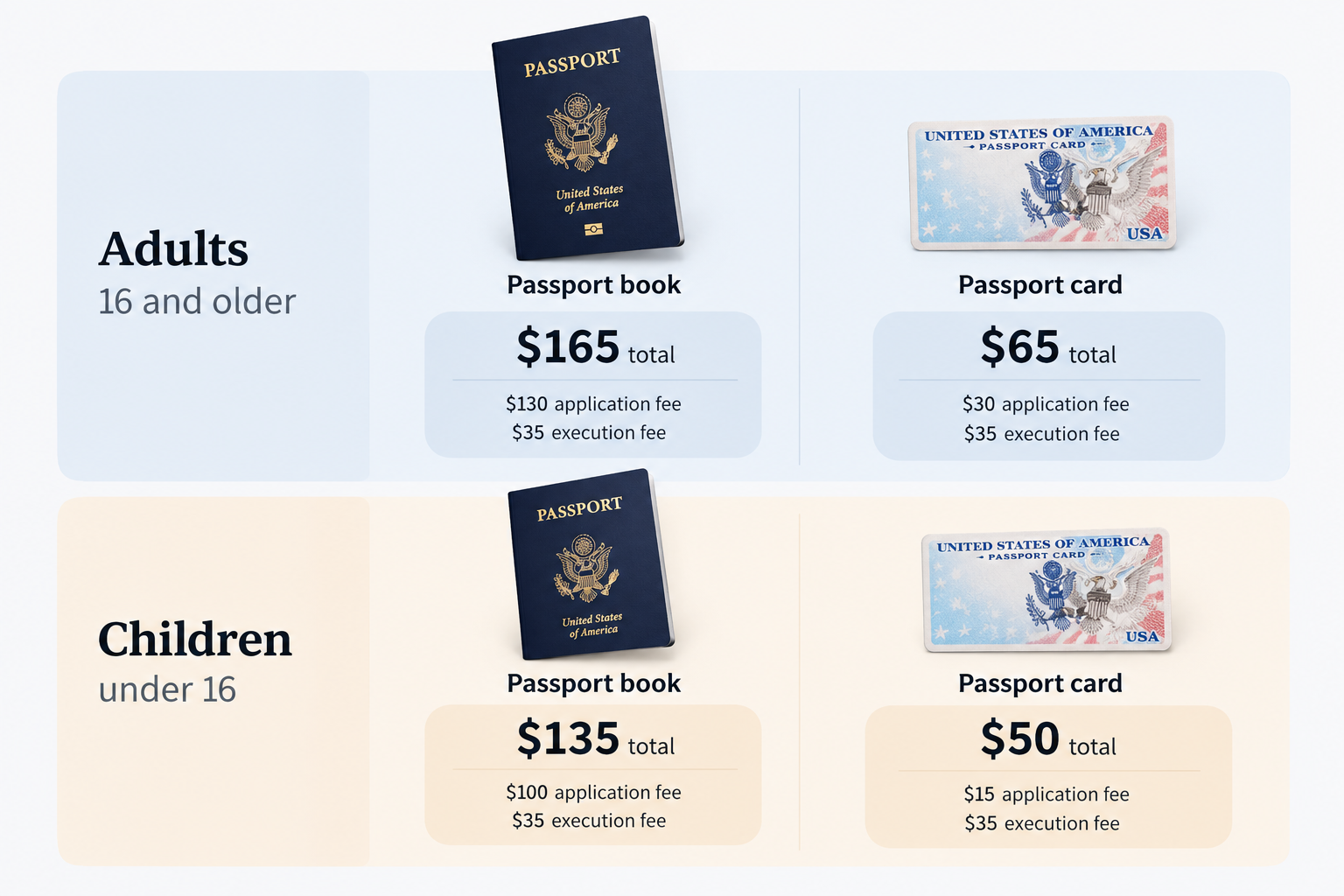
The cost of a first-time US passport depends on your age and whether you apply for a passport book, a passport card or both. Applicants must pay an application fee to the US Department of State and a separate $35 execution fee to an authorised acceptance facility.

Comparison of US passport book and passport card fees for adults and children.

Adults aged 16 and older:

  • Passport book: $165 total, comprising a $130 application fee and $35 execution fee.
  • Passport card: $65 total, comprising a $30 application fee and $35 execution fee.

Children under 16:

  • Passport book: $135 total, comprising a $100 application fee and $35 execution fee.
  • Passport card: $50 total, comprising a $15 application fee and $35 execution fee.

A passport book allows international travel by air, land and sea, while a passport card is limited to eligible land and sea crossings, primarily between the United States, Canada, Mexico, Bermuda and Caribbean countries. It cannot be used for international air travel. Check the official US Department of State website for current fees, eligibility requirements and application instructions.

US passport renewal fees

Renewing a US passport generally costs less than applying for a first passport because eligible adult applicants do not pay the separate execution fee. An adult passport renewal costs $130 for a passport book or $30 for a passport card. These fees cover standard processing, while expedited service and optional delivery services may cost extra.

You can renew your US passport by mail if your most recent passport is undamaged, was issued within the last 15 years, and you were at least 16 years old when it was issued. Your passport must also display your current legal name, or you must provide official documentation confirming your name change.

If you are a Canadian citizen, the renewal process and fees are different. Check the requirements for renewing a Canadian passport to understand eligibility, application methods and current charges before submitting your documents. Always verify the latest fees through the relevant government website.

Expedited US passport and additional fees

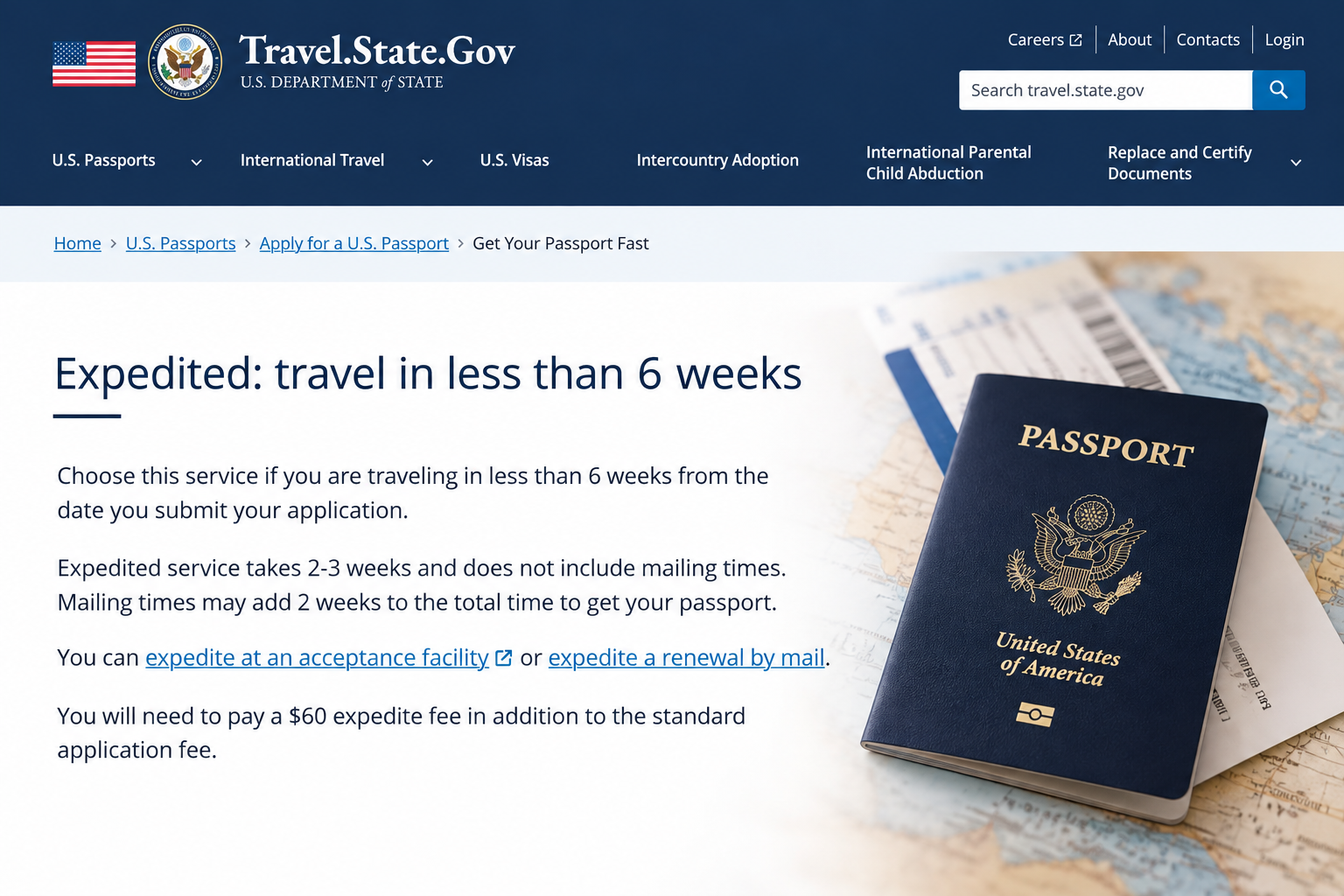
If you need your US passport sooner than the standard processing time allows, you can pay extra for expedited service. The additional fee is $60, which is added to your regular passport application cost. This option may be useful if you have an upcoming trip and cannot wait for routine processing, but you should still check the current processing estimates before applying.

Expedited US passport service and delivery fees listed on the State Department website.

You can also pay $21.36 for 1–2 day delivery of your completed passport book to your home address. This fee covers faster delivery after your passport has been issued; it does not guarantee that your application will be processed within one or two days.

Remember to budget for passport photographs if you do not take an acceptable photo yourself. A local retail store or post office may charge around $15 for passport photos, although prices vary by location. Before submitting your application, review the latest fees on the US Department of State website to confirm the amounts and available services.

Spending abroad on your trip

Spending abroad can cost more than expected when card charges and unfavourable exchange rates add up. Before travelling, check whether your credit card charges foreign transaction fees, which typically range from 1% to 3% per purchase. A card with 0% foreign transaction fees can help you keep more of your travel budget.

If you are travelling from the US to the UK, you may also need to move money across borders before your trip. Grey makes it easier to send money from the US to the United Kingdom, so you can organise your funds before departure. Check the applicable transfer fees and exchange rate to understand the total cost.

Once you arrive, Grey’s virtual card for spending abroad offers another payment option for eligible purchases. Check its fees and supported currencies before using it to understand how to avoid foreign transaction fees where applicable.

When paying at shops or restaurants, choose to pay in the local currency rather than your home currency. This helps you avoid dynamic currency conversion, which may come with an unfavourable exchange rate.

Frequently asked questions US passport costs

How much does a US passport cost?

A first-time adult US passport book costs $165, including the $130 application fee and $35 acceptance fee. If you apply for a passport card instead, the total is $65. Your final cost may increase if you choose expedited processing or faster delivery. Check official passport fees.

How much is a US passport renewal?

Renewing an eligible adult US passport costs $130 for a passport book or $30 for a passport card. You do not pay the separate $35 acceptance fee when renewing by mail or online. Expedited processing and optional delivery services cost extra. Check your eligibility before submitting your renewal application.

What is the US passport card fee?

A first-time adult US passport card costs $65, including the $30 application fee and $35 acceptance fee. Eligible adult renewals cost $30. The card supports qualifying land and sea travel to destinations such as Canada, Mexico, Bermuda and the Caribbean, but it cannot be used for international air travel.

How much is the expedited US passport service?

Expedited US passport processing costs an additional $60 per application. This fee is added to your standard passport charges for faster processing, currently estimated at two to three weeks. Optional one-to-three-day delivery of an issued passport book costs extra. Check current processing times before paying, as mailing time is separate.

Can I pay for a US passport online?

Yes, if you qualify for online renewal. Eligible applicants can pay using a credit or debit card through the official government renewal portal. First-time applicants generally need to apply in person and pay using the accepted methods. Avoid unofficial websites that charge additional fees or claim to process applications on the government’s behalf.

How do I avoid fees abroad?

To reduce travel costs, choose a payment card with 0% foreign transaction fees and check its terms before travelling. At payment terminals, select the local currency to avoid potentially unfavourable dynamic currency conversion rates. If you use Grey’s virtual card, review its applicable fees and supported currencies before making international purchases. Compare transfer charges and exchange rates before sending money abroad.

How to plan a road trip in the US (plus the best scenic routes)

•

•

2 min read

You've got two weeks off, a car, and roughly $2,000. That's enough for an incredible US road trip if you plan it right, and barely enough for a frustrating one if you don't. Most people start by picking a route. That's actually step two. Step one is deciding how many hours you're willing to drive each day, because that single number determines where you can go, how many stops you can make, and whether you'll enjoy the trip or just survive it.

To plan a road trip, pick your route and stops, set a daily driving limit, budget for fuel, food, and stays, book key accommodation early, and prepare your car. Build in buffer time for detours. Use a card with no foreign transaction fees if you're visiting from abroad.

We've planned this guide around the decisions in the order you actually need to make them, not the order most articles put them in. You'll also find the four best scenic road trips in the US with real distances, costs, and timing, so you can compare routes before committing.

How to plan a road trip: step by step

Planning a road trip comes down to six decisions, made in this order. Skip one and the rest get harder.

1. Choose your route. Start with a destination or a theme. Do you want coastline (Pacific Coast Highway), desert (Utah's Mighty Five parks), history (Route 66), or mountains (Blue Ridge Parkway)? Once you've picked the theme, map the route and identify overnight stops roughly every 3 to 5 hours of driving. Google Maps and Roadtrippers are the two best tools for this.

2. Set a daily driving limit. The number one mistake on road trips is overestimating how far you want to drive in a day. 4 to 5 hours of actual driving is sustainable. Six is fine occasionally. Eight is miserable and dangerous. Plan your stops around a 4-hour average, and you'll enjoy the drive instead of enduring it.

3. Book accommodation for your first and last nights, plus any national parks. Everything in between can stay flexible. But the first night sets the tone (don't arrive exhausted because you drove too far), and national park lodges and campsites book months in advance. If you're visiting in summer, book Yosemite, Zion, or Yellowstone accommodation 3 to 6 months ahead.

4. Budget the trip before you leave. Fuel, food, accommodation, tolls, park entrance fees, and one unexpected cost. We'll break this down below with a worked example.

5. Prepare the car. Tyres, oil, coolant, wipers, and a safety kit. A breakdown 100 miles from the nearest town is the kind of adventure nobody wants. If you're renting, inspect the car before you leave the lot and document any existing damage.

6. Download offline maps. Cell coverage is patchy in rural America, especially through the desert Southwest, mountain passes, and stretches of Montana and Wyoming. Download your entire route on Google Maps or Maps.me before you leave. If you're visiting from abroad and need data on the road, a travel eSIM is cheaper and more reliable than roaming on your home plan.

Best scenic road trips in the US

If you're looking for road trip ideas, these are the four routes that consistently rank as the best road trips in the USA. Here's a quick comparison:

Route Distance Days Est. fuel cost Best season
Pacific Coast Highway ~650 mi 5 to 7 $80 to $120 Apr to Oct
Route 66 ~2,400 mi 10 to 14 $250 to $400 May to Sep
Blue Ridge Parkway ~469 mi 3 to 5 $60 to $90 Sep to Nov
Utah Mighty Five ~900 mi 7 to 10 $120 to $180 Mar to May, Sep to Nov

‍

Pacific Coast Highway is probably the most photographed road trip in the country. San Francisco to Los Angeles (or the reverse), hugging the coast through Big Sur, Monterey, Santa Barbara, and Malibu. It's short enough for a long weekend if you push it, but 5 to 7 days lets you stop at every viewpoint without rushing.

Route 66 is the classic. 2,400 miles from Chicago to Santa Monica, crossing eight states and three time zones. It's a trip through small-town America, roadside diners, and neon signs. Budget at least 10 days. Some stretches of the original route have been replaced by interstate, but most of the iconic stops are still there.

Blue Ridge Parkway is the most underrated route on this list. 469 miles through the Appalachian Mountains from Virginia to North Carolina, with no commercial traffic (trucks are banned). In autumn, the foliage is extraordinary. It's also one of the cheapest road trips because there are no tolls and fuel distances are short.

Utah's Mighty Five hits all five of Utah's national parks in a single loop: Arches, Canyonlands, Capitol Reef, Bryce Canyon, and Zion. The landscape is unlike anything else in the US. Spring and autumn are the sweet spots; summer is brutally hot and parks are overcrowded. An America the Beautiful pass ($80 per vehicle per year), from the National Park Service, covers entrance fees for all five parks.

All fuel costs are estimates based on a vehicle averaging 25 to 30 mpg at mid-2026 US fuel prices. Your actual cost will vary by vehicle, driving style, and fuel price at the time of travel.

How to budget for a road trip

The number that catches most people off guard isn't fuel. It's food. A two-week road trip where you eat at restaurants for every meal can easily cost $1,500 to $2,000 per person. Pack a cooler, buy groceries, and save restaurants for the stops that deserve them.

Here's a worked budget for a 7-day Pacific Coast Highway trip for two people:

Expense Estimated cost (2 people, 7 days)
Fuel (650 mi, 25 mpg, ~$4/gal) $100 to $120
Accommodation (motels + Airbnb mix) $700 to $1,200
Food (groceries + 3 restaurant meals) $400 to $600
Tolls (Golden Gate Bridge + minor) $10 to $20
Park and attraction fees $30 to $80
Unexpected (flat tyre, parking, etc.) $100 to $200
TOTAL $1,340 to $2,220

‍

The range is wide because accommodation drives most of the variance. Camping ($20 to $40 per night) versus a beachfront motel in Big Sur ($250+ per night) changes the total dramatically. If you're saving up for the trip, save for your road trip in a Pouch so the money is set aside and visible, separate from your everyday spending.

All costs are estimates based on mid-2026 prices. Fuel, accommodation, and food costs vary seasonally and by region.

Road trip packing and car prep

Two lists: one for the car, one for you.

Car prep (do this at least a week before you leave): check tyre pressure and tread depth (including the spare), check oil level and coolant, test all lights (headlights, brake lights, indicators, fog lights), replace wiper blades if they streak, and make sure your breakdown cover is active and covers your route.

Safety kit: jump cables or a portable jump starter, a basic tool kit, a torch with fresh batteries, a first aid kit, a reflective warning triangle or flares, and a printed copy of your route (in case your phone dies and there's no signal).

Packing for you: pack light. Road trip luggage lives in the boot, not in overhead bins, so you have more space than flying, but overpacking means less room for souvenirs and groceries. Bring layers (mountain and coastal temperatures swing 15 to 20 degrees between morning and afternoon), comfortable driving shoes, sunscreen, a reusable water bottle, and a cooler if you're planning to buy groceries.

One thing most people forget: a phone mount for the dashboard. Using your phone as a GPS while it sits in your lap is unsafe and illegal in many states. A $15 mount solves this completely.

How to pay on a US road trip

If you live in the US, your regular debit or credit card handles everything. Fuel, tolls, accommodation, food. The only thing to watch is whether your card charges foreign transaction fees if you cross into Canada or Mexico during the trip.

If you're visiting the US from abroad, paying for a road trip gets more complicated. Your home bank card works at most fuel stations and restaurants, but foreign transaction fees of 1.5 to 3% add up fast over a two-week trip. On $3,000 in spending, that's $45 to $90 in fees you didn't need to pay.

A card with no foreign transaction fees is the simplest fix. Grey's virtual Mastercard works at US fuel stations, restaurants, and toll booths. You load USD before you leave and spend from your dollar balance, so there's no conversion markup on every transaction. Pay for fuel and tolls on a virtual card.

For data and navigation, a travel eSIM is cheaper than international roaming. You buy it before you leave, activate it when you land, and get US data for maps, music, and booking accommodation on the road. Buy a travel eSIM for the US. And if you need to move money before you travel, Grey handles that too.

Cash tip: carry $100 to $200 in small bills. Some rural fuel stations, farm stands, and small-town diners are cash-only.

Frequently asked questions about planning a road trip IN the US

How do I plan a road trip for the first time?

Start with a route (pick a destination or a scenic drive). Map your overnight stops every 3 to 5 hours of driving. Book your first night, last night, and any national park accommodation in advance. Budget for fuel, food, stays, and one unexpected cost. Prep the car (tyres, oil, lights). Download offline maps. Everything else can be flexible.

What is the best US road trip for beginners?

The Pacific Coast Highway from San Francisco to Los Angeles. It's short (650 miles, 5 to 7 days), the route is well-marked, accommodation is plentiful, and the scenery is spectacular from start to finish. Reliable cell coverage for most of the route makes navigation easy.

How much does a road trip across the US cost?

A coast-to-coast trip (roughly 2,800 miles, 10 to 14 days) typically costs $2,500 to $5,000 per person. Budget roughly: $300 to $500 for fuel, $1,000 to $2,500 for accommodation, $500 to $1,000 for food, and $200 to $500 for tolls, attractions, and unexpected costs. Camping and cooking drop the total significantly.

How far should I drive per day on a road trip?

4 to 5 hours of actual driving (200 to 300 miles on highways) is the sweet spot. You can push to 6 to 8 hours on long transfer days, but doing that daily will burn you out by day three. Plan around a 4-hour average and add a rest day every three or four driving days.

Do I need an America the Beautiful pass?

If you're visiting two or more national parks, yes. The pass costs $80 per vehicle per year and covers all 400+ National Park Service sites. A single park entry is typically $30 to $35, so the pass pays for itself after three parks. For the Utah Mighty Five loop, it saves roughly $95 in entrance fees.

Can I do a US road trip without a car?

You'll need a car. Public transport doesn't cover most scenic routes. If you don't own a car, rent one early for the best rates. Airport pickup is usually cheaper than city-centre. Under-25 drivers can expect a surcharge of $20 to $30 per day. International visitors need a valid driving licence from their home country.

Hitting the road? Save for your trip in a Grey Pouch and pay for fuel and tolls on a virtual card, wherever the highway takes you.

Disclaimer: This article is for informational purposes only. Fuel prices, accommodation rates, park fees, and toll charges change seasonally. All cost estimates are based on mid-2026 data. Verify current prices before you travel. Grey isn't a bank. We're a licensed financial services provider offering multi-currency accounts.

Arrow (up)

Back to top