
Cost of living in New Delhi

Priscila Marotti

TABLE OF CONTENT

SHARE THIS POST

New Delhi is a city of contrasts, with centuries-old temples beside glass towers, quiet colonial avenues next to buzzing markets, and flavours that shift from luxury dining to roadside chaat. Life here can be as affordable or as indulgent as you make it, and that’s what makes Delhi so dynamic for expats, freelancers, and remote workers.

Living in New Delhi means navigating both the modern and the traditional, from leafy neighbourhoods in South Delhi to the energy of Connaught Place. The cost of living varies widely depending on where you stay and how you spend.

Rent in Delhi

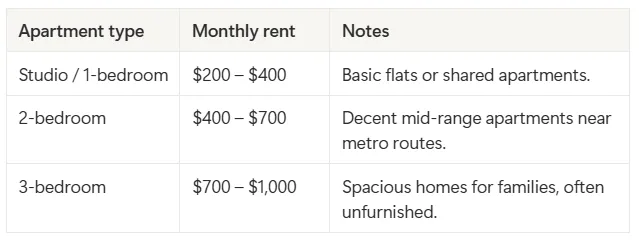
Finding a home in Delhi is all about choosing your pace and comfort level. Expats tend to favour the safer, greener areas in South and Central Delhi, while more affordable options are available in the city’s outer districts or Gurgaon (now Gurugram).

Here’s how rent typically looks across neighbourhoods:

South Delhi (Greater Kailash, Hauz Khas, Defence Colony)

The expat favourite. South Delhi combines convenience, cafés, and leafy residential streets. Areas like Greater Kailash and Defence Colony are upscale and well-connected, while Hauz Khas offers a younger, artsy feel with boutique apartments and nightlife.

__wf_reserved_inherit

Central Delhi (Connaught Place, Karol Bagh, Chanakyapuri)

Historic, convenient, and full of colonial charm. Central Delhi is ideal for those who want quick access to embassies, offices, and cultural attractions. It’s pricier, but living here means being in the thick of the action.

__wf_reserved_inherit

Gurgaon (Gurugram)

Modern and business-focused. Gurgaon is home to corporate offices, luxury malls, and newer high-rise complexes. It’s popular with professionals working remotely or in tech and finance. The infrastructure is modern, and many apartments come with gyms and pools.

__wf_reserved_inherit

East and North Delhi (Preet Vihar, Rohini, Mayur Vihar)

More affordable and family-friendly. These districts are great for long-term residents seeking lower rents without leaving the city. Infrastructure is improving, and access to metro lines makes commuting manageable.

__wf_reserved_inherit

Noida and Faridabad (suburban options)

For those who prefer space and calm. These satellite cities are connected by metro and offer newer developments with lower rents, ideal for remote workers or families.

__wf_reserved_inherit

Transport in New Delhi

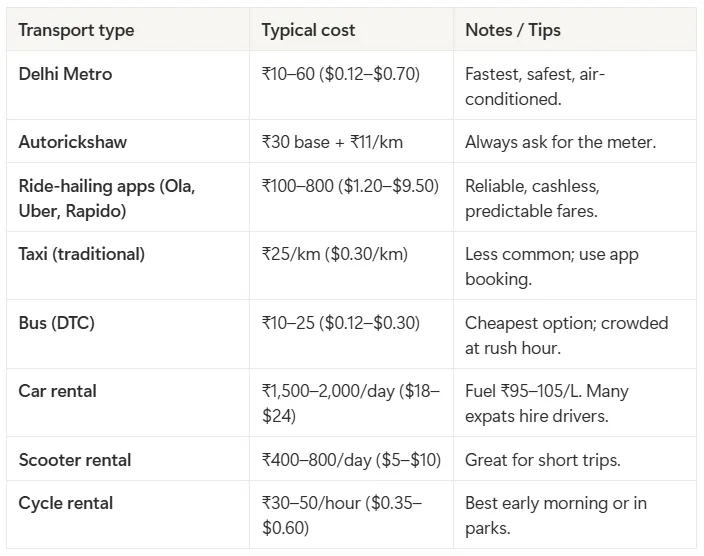
New Delhi is a city that moves fast (sometimes too fast). Between a buzzing metro, the endless flow of rickshaws, and the constant hum of traffic, getting around is an adventure in itself. For expats, navigating Delhi’s transport network can feel overwhelming at first, but it quickly becomes second nature.

Delhi Metro

Clean, efficient, and air-conditioned, the Delhi Metro is the backbone of the city’s public transport. It connects nearly every major area, from Connaught Place to Gurgaon and Noida. It’s the most reliable way to escape traffic and travel long distances quickly.

  • Cost: ₹10–60 ($0.12–$0.70) per ride, depending on distance. Monthly passes start around ₹1,000 ($12).
  • Tip: Avoid rush hours (8–10am and 6–8pm). The women-only coaches are great for comfort and safety.

Autorickshaws

The green-and-yellow autos are everywhere in Delhi. They’re perfect for short to medium trips and cost less than taxis.

  • Cost: Base fare is ₹30 ($0.35) for the first 2 km, then ₹11/km ($0.13/km).
  • Tip: Always insist on using the meter or agree on a price before getting in, especially near tourist spots or at night.

Ride-hailing apps (Ola, Uber, Rapido)

Most expats rely on ride-hailing apps for convenience and cashless payments. Both Ola and Uber are widely used, and Rapido offers affordable bike rides for solo travellers.

  • Cost: ₹100–300 ($1.20–$3.60) for short rides; ₹500–800 ($6–$9.50) for longer distances across the city.
  • Tip: Fares rise sharply during rain or peak hours. Opt for Ola Auto or Rapido to avoid surge pricing.

Taxis (traditional cabs)

Traditional black-and-yellow taxis still exist, but they’re far less common than before. Most travellers now prefer app-based rides for safety and reliability.

  • Cost: Around ₹25/km ($0.30/km) on average.
  • Tip: Book through an app or hotel to avoid inflated rates.

Buses

Delhi has an extensive bus system run by the Delhi Transport Corporation (DTC) and private operators. Buses are cheap, frequent, and cover nearly all parts of the city. Many are now air-conditioned.

  • Cost: ₹10–25 ($0.12–$0.30) per ride.
  • Tip: Buses can get crowded, especially during office hours. Use Google Maps to track routes and timings.

Driving and car rentals

Driving in Delhi is not for the faint-hearted. Traffic is heavy, rules are loosely followed, and parking can be a challenge. Still, many expats rent or hire drivers for convenience.

  • Cost: Car rental starts around ₹1,500–2,000/day ($18–$24) for a small car. Fuel costs about ₹95–105/litre ($1.10–$1.25).
  • Tip: Most long-term expats hire a local driver (₹15,000–25,000/month) rather than driving themselves.

Two-wheelers and scooters

Motorbikes and scooters are popular for short commutes, especially in areas with tight traffic. Apps like Rapido also rent bikes.

  • Cost: ₹400–800/day ($5–$10) for rental; ₹1,000–1,500/month for petrol costs.
  • Tip: Always wear a helmet. Traffic in Delhi can be unpredictable, especially during peak hours.

Walking and cycling

Delhi isn’t the most pedestrian-friendly city, but areas like Lutyens’ Delhi, Connaught Place, and Lodhi Garden are pleasant to explore on foot. Some new neighbourhoods also have dedicated cycling tracks.

  • Cost: Free; cycle rentals start at ₹30–50/hour ($0.35–$0.60).
  • Tip: Early mornings are best for walking or cycling before the heat and traffic build up.

Quick cost overview

__wf_reserved_inherit

Food prices in New Delhi

I love that food in New Delhi is a daily celebration of flavour, from sizzling street food at India Gate to elegant fine dining in Khan Market or Aerocity. You can live on spicy chaat and parathas or enjoy global cuisine in expat-favourite cafés.

Restaurants

Eating out in Delhi ranges from quick roadside snacks to multi-course gourmet meals. Street food is cheap, delicious, and everywhere, while cafés and restaurants in South Delhi or Gurugram offer trendy, international menus.

  • Street food / local dhabas: Expect to pay ₹100–250 ($1.20–$3) for filling meals like chole bhature, biryani, or thali. A cup of chai or fresh juice adds ₹20–50 ($0.25–$0.60).
  • Mid-range restaurants: A sit-down meal in areas like Hauz Khas, Connaught Place, or Greater Kailash costs ₹600–1,200 ($7–$14) per person, including mains, sides, and a drink.
  • Fine dining/rooftop spots: Dinner for two at high-end restaurants in Aerocity or luxury hotels can range ₹3,000–6,000 ($35–$70), not including alcohol.

Delhi also has a thriving café culture, with modern coffee houses and coworking cafés in places like Lodhi Colony or Saket. Coffee and pastries usually cost ₹200–400 ($2.50–$5).

Supermarkets and markets

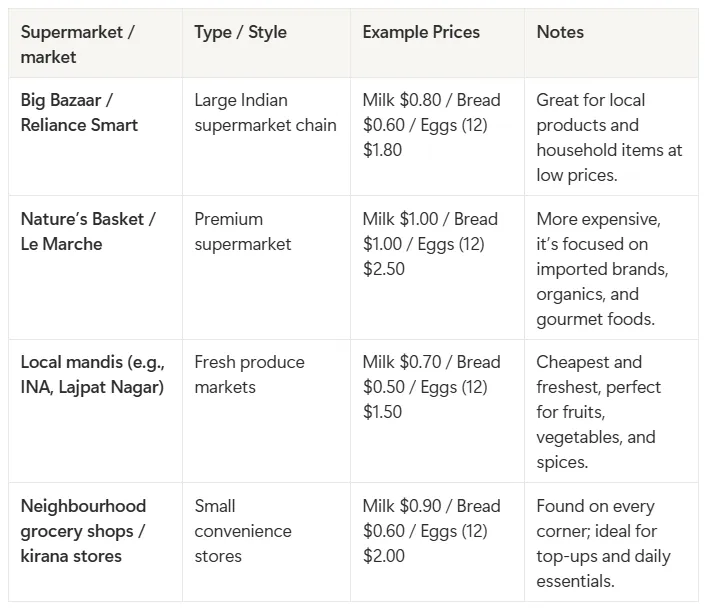
Grocery shopping in Delhi depends on how and where you shop. You can save a lot by buying from local mandis (fresh markets), or choose the convenience of large supermarkets that stock imported items for expats.

__wf_reserved_inherit

The tip is always to shop in a mix of both: mandis for fresh produce, and premium stores for imported cheese, wine, and cereals. Imported goods are significantly pricier due to taxes, so switching to local brands can save a lot.

Monthly cost overview

For one person

  • Groceries (mix of local and premium stores): $40–70 per week (~$160–280 per month)
  • Eating out (casual meals, cafés, and occasional dinners): $30–60 per week (~$120–240 per month)

Total monthly food budget: $280–520

Enough to cook regularly, enjoy street food, and still dine out a few times a week without stretching your wallet.

For a couple or small family

  • Groceries: $80–130 per week (~$320–520 per month)
  • Eating out: $60–100 per week (~$240–400 per month)

Total monthly food budget: $560–920

This covers a comfortable mix of home-cooked meals, family lunches, and the occasional treat at Delhi’s upscale restaurants.

Utilities costs in Delhi

New Delhi’s utility costs are generally reasonable, though electricity bills can fluctuate quite a bit between seasons, especially during the hot summer months when air conditioning runs constantly. Here’s what you can expect monthly:

Electricity

Electricity is the biggest variable in your utility budget. Summers (April–August) can drive bills up significantly due to air conditioning, while winter usage drops sharply.

  • Average monthly cost for a 1–2 bedroom apartment: $35–70
  • Tip: Using energy-efficient appliances and fans instead of AC when possible can help cut costs. Most bills are handled by BSES or NDMC and paid monthly online or via apps.

Water

Water is inexpensive but not always consistently supplied in every area — especially in older buildings. Many apartments in Delhi have water tanks or rely on tankers for refills.

  • Average monthly cost: $5–15
  • Tip: Check if water is included in your rent or building maintenance fee. Tanker delivery charges can add $5–10 extra when needed.

Gas

Most homes use piped natural gas (PNG) for cooking, but in some areas, LPG cylinders are still common. Both are affordable and widely available.

  • Cost: $8–15 per month
  • Tip: Piped gas (Indraprastha Gas Limited) is the most convenient option; if using cylinders, keep a backup since delivery can take a day or two.

Internet

Internet coverage in Delhi is excellent, especially in residential areas and coworking hubs. Fibre broadband is standard, with competitive speeds and reliable service.

  • Average monthly cost: $10–25 for high-speed fibre (100–300 Mbps)
  • Tip: Popular providers include Airtel Xstream, JioFiber, and ACT Fibernet. Installation is usually done within 1–2 days.

Mobile/Cell phone

Mobile data is very cheap in India — some of the lowest prices in the world. Both prepaid and postpaid plans include generous data allowances.

  • Average monthly cost: $3–8 for 10–20 GB data
  • Tip: Jio, Airtel, and Vi are the main carriers. SIM cards are easy to get with a passport and ID photo.
__wf_reserved_inherit

Healthcare in Delhi

Healthcare in New Delhi offers a wide range of options, from low-cost public hospitals to world-class private facilities that attract patients from across the globe. The city is a major hub for medical tourism, offering high-quality treatment at a fraction of Western prices.

Public healthcare

India’s public healthcare system, run under the National Health Mission, provides basic medical services at government hospitals and clinics. While affordable, these facilities are often overcrowded and may lack modern equipment or English-speaking staff.

  • Cost: Free or very low for residents; nominal fees for foreigners
  • Pros: Extremely low-cost and widely available
  • Cons: Long waiting times, inconsistent quality, and limited comfort

Public hospitals like AIIMS (All India Institute of Medical Sciences) are among the best in the country, but expats generally prefer private options for reliability and efficiency.

Private healthcare and insurance

Private healthcare in New Delhi is excellent and affordable by international standards. Leading hospitals such as Fortis, Apollo, and Max Healthcare provide English-speaking doctors, advanced treatments, and modern facilities.

  • Basic consultation (without insurance): $10–25
  • Specialist visit: $30–60
  • Hospital stay (per night, private room): $80–150

Private health insurance is highly recommended for expats and long-term residents. Most international providers, like Cigna, Allianz, and HDFC ERGO**,** offer flexible plans that include both local and global coverage.

__wf_reserved_inherit

Tip: Most doctors in private hospitals speak fluent English, and appointments can often be booked online or via apps. Pharmacies are plentiful, and generic medications are widely available, making day-to-day healthcare both convenient and inexpensive.

Average living costs in New Delhi

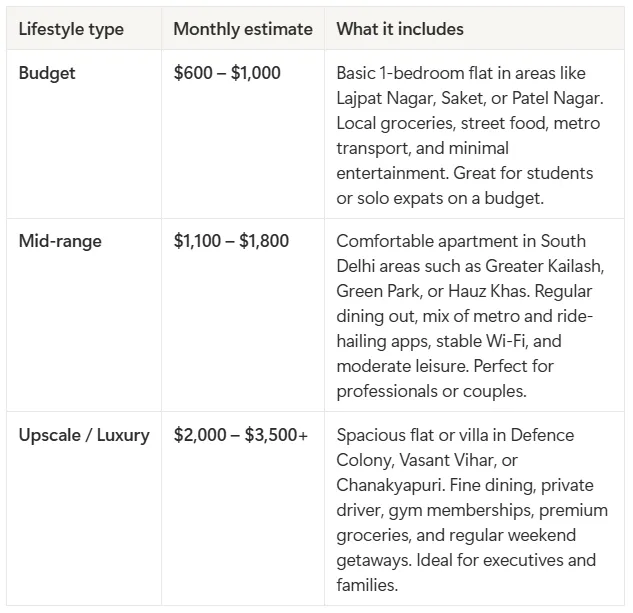
New Delhi is one of Asia’s most dynamic capitals, offering a blend of history, food, culture, and modern convenience. While the city can be as affordable or expensive as you make it, your monthly costs will largely depend on your neighbourhood and lifestyle choices, like in most cities.

__wf_reserved_inherit

You can live comfortably in New Delhi for around $1,200–1,600 per month, though costs rise sharply in high-end neighbourhoods or if you prefer imported goods and Western-style amenities.

Living globally, spending locally in New Delhi

From rooftop bars in Hauz Khas to the calm of Lodhi Gardens, New Delhi blends heritage and modern living in a way few cities can. For expats and freelancers earning abroad, the city offers an incredible quality of life at a fraction of Western costs.

With Grey, you can receive international payments in USD, GBP, or EUR, convert them at competitive rates, and withdraw INR ****directly to a local account.

Open your Grey account today and make living in New Delhi as rewarding financially as it is culturally.

‍

Last updated:

June 15, 2026

Open a free Grey account to get startedJoin 1 million digital nomads
IF YOU ENJOYED THIS, CHECK THESE OUT

How to get paid by Amazon in South Africa with Grey

•

•

2 min read

Selling products or earning through Amazon’s affiliate and freelance platforms is a great way to tap into global income streams. But for many South Africans, there’s one persistent challenge — how do you get paid?

That’s where Grey comes in. Grey gives South Africans access to virtual foreign accounts, so you can get paid in Amazon’s preferred currencies and easily convert or withdraw your money.

In this guide, I’ll show you exactly how to get paid by Amazon in South Africa with Grey.

How Amazon pays sellers, affiliates, and freelancers

Amazon uses a standardised system to distribute earnings. You will receive your payouts directly to the bank details you provide.

Here’s how it works:

  • Earnings calculation: Amazon deducts fees and refunds from your sales or commissions.
  • Payment cycles: Most payouts are made every 14 days (biweekly), but this may vary depending on account type and region.
  • Currency: Amazon disburses funds in the local currency of the marketplace (e.g., USD for Amazon.com, GBP for Amazon UK), so a multi-currency account is essential.
  • Bank account requirements: You must add a compatible bank account that matches the payout currency — this is where Grey becomes your best option.

Also read: How to get paid by Amazon in Nigeria, Kenya, and Tanzania with Grey

Why Grey is the best way to get paid by Amazon in South Africa

Grey is a cross-border financial platform that makes international payments easy for freelancers, digital entrepreneurs, and remote workers. With a Grey account, you can:

  • Create virtual USD, GBP, and EUR accounts — perfect for receiving Amazon payouts.
  • Receive payments directly into your foreign account without delays or rejections.
  • Convert funds to South African rand (ZAR) at competitive exchange rates.
  • Withdraw funds locally to your bank account or mobile wallet.

Also read: How freelancers in South Africa can receive payments from the US, UK & EU clients

Step-by-step: How to get paid by Amazon using Grey

Here’s how to set up and receive your Amazon payments through Grey:

1. Open a Grey account

Visit the Grey website or download the Grey app and sign up for free. Fill in your name, email, and phone number to get started.

2. Verify your identity

Upload a valid ID, proof of address, and a selfie. This is required to activate your virtual foreign bank accounts.

3. Generate your bank account details

Once verified, you can create foreign accounts (USD, GBP, or EUR) from your Grey dashboard. These include:

  • IBAN
  • SWIFT/BIC
  • Account number
  • Bank name and address

4. Add Grey account to Amazon Seller Central or Affiliate dashboard

  • Go to Amazon Seller Central or your Amazon Affiliate dashboard.
  • Navigate to Settings > Payment Information.
  • Select “Add new bank account”.
  • Enter your Grey-provided virtual bank account details in the correct currency (e.g., USD for Amazon.com).
  • Save changes.

5. Get paid and withdraw

Once Amazon releases your funds, they’ll arrive in your Grey account. You can:

  • Hold in foreign currency until the exchange rate favours you.
  • Convert to ZAR at competitive rates.
  • Withdraw directly to your local South African bank account.

Also read: How to open a US and UK bank account in South Africa

Tips to make the most of your Amazon payouts with Grey

Here are a few ways you can maximize your Amazon payouts with Grey.

  • Avoid instant conversions if the exchange rate is low — Grey lets you hold multiple currencies.
  • Track your payments in real time using the Grey app or website.
  • Split payouts if you have multiple Amazon accounts or freelance gigs.
  • Stay compliant by keeping a record of your foreign payments for tax purposes.

Get paid by Amazon in South Africa

With Grey, getting paid by Amazon in South Africa is fast, affordable, and stress-free. No more rejected payments, currency conversion issues, or high international transfer fees.

If you’re ready to simplify your finances and get paid like a pro, create your Grey account today or download the app to receive Amazon payouts in USD, GBP, or EUR and convert them to rand with ease.

‍

The best international bank accounts for freelancers and remote workers

•

•

2 min read

Getting paid shouldn’t feel like a puzzle. But for many freelancers and remote workers juggling clients across continents, managing income in multiple currencies can get messy pretty quickly.

I learned this the hard way after chasing down delayed transfers, losing money to currency conversion, and constantly explaining IBAN numbers. That’s when I realised I didn’t just need a better payment method, I needed the right international bank account for freelancers.

Luckily, there are smarter solutions out there. Let’s explore what actually works and why Grey is the top choice if you’re looking for freedom, flexibility, and control over your international income.

How global accounts simplify life for freelancers

When you’re working with clients in the US, UK, Germany, or beyond, your local bank probably isn’t cutting it. High fees, long waits, and limited currency support can affect your earnings and peace of mind.

That’s where international bank accounts for freelancers shine. They give you:

  • Multi-currency access (USD, GBP, EUR, and more)
  • Faster global payments
  • Better exchange rates
  • Access to local account details (so your clients can pay you easily)
  • Freedom to work and earn from anywhere

Why freelancers and remote workers love Grey

Unlike traditional banks or generic apps, Grey is built for people who work across borders. The interface is clean, the setup is easy, and everything — from invoicing to withdrawals — just works.

💡 Also read: How to open virtual bank accounts for freelancers outside the USA

Whether you’re working with clients in the U.S., Europe, the UK, or around the world, Grey makes it easy to:

  • Instantly open virtual USD, GBP, and EUR bank accounts
  • Receive international payments from platforms or clients abroad
  • Convert money at competitive exchange rates with no hidden fees
  • Withdraw funds to your local bank account in minutes
  • Connect with a growing freelancer community for tips, resources, and peer support

Grey simplifies international banking for freelancers in Africa and beyond. It’s secure, fast, and designed to make remote work more rewarding.

Other options worth considering

Not every freelancer has the same needs, so here are a couple of other platforms to explore if you’re shopping around.

Wise

Wise is known for transparency and low transfer fees. You can hold multiple currencies and get local bank details in key countries.

Pros: Great rates, user-friendly app

Cons: Not freelancer-focused, fewer local withdrawal options in some regions

Payoneer

Popular among freelancers using platforms like Fiverr or Upwork, Payoneer offers multi-currency accounts and global payments.

Pros: Good for platform-based freelancers

Cons: Complicated fee structure, longer payout times

Revolut

Revolut is a digital banking app that supports multi-currency accounts, global spending, and even cryptocurrency. It’s great for freelancers who travel or spend in different currencies.

Pros: Hold and exchange over 25 currencies

Cons: Some key features are only available in paid plans

N26

Based in Germany, N26 is a full-fledged digital bank with international capabilities. It’s ideal if you live in Europe or hold EU residency, offering IBAN accounts and seamless card usage abroad.

Pros: Smooth user experience and banking features

Cons: Not available globally; mostly for EU residents

What to look for in a freelancer-friendly international bank account?

Choosing the right platform can impact how quickly and easily you get paid. Here are the key features every freelancer should consider:

  • Can I receive payments in my client’s currency?
  • How fast can I access my money?
  • Are the exchange rates and fees transparent?
  • Can I withdraw to my local account easily?
  • Does it support my country or region?

If you’re a freelancer in Africa, Southeast Asia, or Latin America, Grey checks all the boxes — and adds powerful tools to help you work and earn globally.

You may also like: Earning in USD? Here’s how to receive your salary as a remote worker

Take the stress out of getting paid

Managing international income doesn’t have to be complicated. With the right tools, it can feel seamless — even empowering.

Grey gives you more than just an account. With Grey, you get a gateway to globally impactful work with local-level convenience. Whether you’re invoicing in euros, getting paid in dollars, or converting to naira, Grey ensures nothing gets lost in translation.

Open your international bank account today

If you’re ready to stop worrying about payments and focus on your work, it’s time to make the switch.

Join Grey today and get your own international bank account built for freelancers — no paperwork, no stress, just smarter banking.

‍

How to open an offshore private bank account as a US citizen

•

•

2 min read

There’s a US-based consultant somewhere who just signed a contract with a client in a European country. The client has insisted they’ll pay in EUR and wants to send via SEPA, as their finance team is avoiding international wire transfers. Unfortunately, this consultant’s US bank account isn’t set up to receive SEPA transfers, and every time he converts EUR to USD through his local bank, he loses 3-4% of the payment before it even hits his balance.

If that scenario sounds a bit too distant, you’ll perhaps be able to relate better with Sharon, who works in New York but plans to retire in Portugal in three years and wants to build a local financial presence before she gets there.

In each of these situations, the solution is the same. They both need a bank account outside the United States. And the first question most people ask when they start looking into it is whether it’s even legal.

Easy answer, it is. Millions of US citizens hold foreign bank accounts for ordinary reasons. The process is more straightforward than most people expect, and the complications that do exist are mostly on the reporting side, not the opening side. Here, I’ll be walking through both.

What is an offshore bank account?

The phrase “offshore bank account” carries a bit of baggage that it doesn’t deserve. Most people picture secretive numbered accounts in tax havens, shell companies, or the kind of thing that ends with a congressional hearing. No thanks to Hollywood.

The reality is a lot simpler. An offshore bank account is a bank account held in a country other than where you live or where you’re a tax resident.

For example, a US citizen living in Chicago who opens a current account at a bank in Germany has an offshore bank account. So does a freelancer in New York who opens a multi-currency account to receive GBP from a London client.

People generally open offshore accounts for three main legitimate reasons.

  1. To manage foreign income.
    If you earn in a foreign currency and convert everything back to USD through your US bank every time a payment arrives, you’ll be paying a conversion spread on every single transaction, typically 3 to 5% at traditional banks. Holding the money in the currency you earned it in and converting only what you need reduces that cost significantly.
  2. When preparing for relocation or extended travel
    Building a financial presence in another country before you move there is practical. It means you arrive with a functioning local account rather than spending your first weeks abroad trying to open one as a non-resident.
  3. Currency diversification
    Some US citizens want to hold a portion of their savings in a non-dollar currency, whether as a hedge, for travel convenience, or in anticipation of spending abroad. This is a straightforward financial decision with no legal complications, provided the reporting obligations are met.

An offshore account is not a way to hide money from the IRS. The US government has extensive mechanisms for tracking foreign accounts held by its citizens, and there are penalties for failing to report them. The reporting requirements deserve a lot of attention, so that’s where we’ll start.

The legal and reporting framework every US citizen must understand

There are two primary reporting obligations for US citizens with foreign accounts.

FBAR: FinCEN Form 114

The Foreign Bank Account Report, filed through FinCEN (the Financial Crimes Enforcement Network), is required if the combined balance of all your foreign financial accounts exceeds $10,000 at any point during the calendar year, not just at year-end.

The annual deadline is April 15th of the following year, with an automatic extension to October 15th. Filing is done electronically through the BSA E-Filing System. There is no filing fee.

The penalties for non-compliance are where this gets serious. For non-wilful failure to file, the penalty can reach $10,000 per violation per year. For wilful failure, the penalty can exceed $100,000 or 50% of the account balance per violation. Courts have interpreted “wilful” broadly, and “I didn’t know I had to file” has not consistently held up as a defence.

The FBAR is not filed with your tax return. It’s a separate filing with a separate agency.

FATCA: Form 8938

The Foreign Account Tax Compliance Act introduced a second reporting layer. Form 8938 is filed with your regular federal tax return and covers foreign financial assets above certain thresholds.

For single filers living in the US, the threshold is $50,000 at year-end or $75,000 at any point during the year. For married filers living in the US, it’s $100,000 at year-end or $150,000 at any point. The thresholds are higher for US citizens living abroad.

FATCA and FBAR cover overlapping but not identical territory, and you may be required to file both. Filing one does not satisfy the obligation to file the other.

Foreign income remains taxable

Holding money in a foreign bank account does not change your US tax liability on that money. Income earned abroad, whether from a foreign employer, a freelance client, or investments, is still subject to US income tax. The account is just where the money sits. The IRS taxes the income, not the location of the account.

The rules around FBAR, FATCA, and foreign income taxation are genuinely complex, and the consequences of getting them wrong are expensive. If your situation involves significant foreign balances or income, consult a certified tax professional before opening an account.

Do you actually need a traditional offshore account?

Before walking through the opening process, it’s worth being honest about whether you need this account or not.

A traditional offshore bank account, the kind at a private bank in Switzerland or a retail bank in Germany, involves real minimum balances, documentation requirements, and in many cases a physical visit or notarised paperwork. For some, that’s exactly the right solution. For others, it’s much more than they need.

You’ll need a traditional banking account if:

  • You’re relocating permanently or for an extended period and need genuine local banking infrastructure.
  • You’re holding significant assets (typically $50,000 or more) in a foreign currency for investment or diversification purposes.
  • You need access to banking services in another country, such as local loans, investment accounts, or trade finance.

You’ll need a multi-currency account, not a traditional offshore account, if:

  • You’re receiving foreign income from clients or employers and want to avoid conversion fees.
  • You want local banking details (a SEPA IBAN, a UK sort code, a US routing number) to give to international clients without routing everything through international wires.
  • You want to hold multiple currency balances and convert at your own timing rather than being forced to convert on receipt.

The distinction matters because the processes, costs, and realistic accessibility of these two options are very different. Most people asking “how do I open an offshore bank account” actually need the second option.

Traditional foreign banks have significantly reduced their US client onboarding since FATCA was introduced in 2010, because FATCA compliance costs are substantial for foreign financial institutions. Many simply don’t take new US clients anymore.

Multi-currency fintech accounts have filled a large part of that gap. They’re more accessible, open faster, and better suited to the foreign income management use case most US citizens actually have.

How to open an offshore bank account

Whether you’re opening a traditional account or a multi-currency account, the process follows a similar sequence.

Step one: Choose your jurisdiction

For traditional offshore accounts, the most accessible jurisdictions for US citizens in 2026 are Canada, the UK, Germany, the Netherlands, and some Caribbean banking centres. Historically popular jurisdictions, such as Switzerland and the Cayman Islands, have significantly reduced their intake of US clients due to FATCA compliance costs.

For multi-currency accounts, jurisdiction is less relevant because the account is digital-first and the provider usually holds licences across multiple regulatory environments.

Step two: Decide on the type of account

Current account or savings account at a traditional foreign bank, or a multi-currency account at a regulated fintech platform. The right answer depends on what you identified in the previous section.

Step three: Gather your documentation

For traditional foreign banks, you’ll typically need:

  • A valid US passport
  • Proof of US address (utility bill or bank statement dated within 90 days)
  • Your Social Security Number (SSN) or Individual Taxpayer Identification Number (ITIN)
  • A completed W-9 form (most foreign banks require this under FATCA to confirm your US taxpayer status)
  • Source of funds documentation for accounts above a certain balance threshold
  • Some banks require in-person verification or notarised copies of documents, which adds time and cost if you’re opening remotely

For multi-currency fintech accounts, the documentation requirements are lighter. A valid passport, proof of address, and identity verification through the platform’s KYC process are typically sufficient. You typically won’t need a W-9, notarisation, or a branch visit.

Step four: Apply and complete verification

Traditional foreign banks can take weeks to process applications, particularly for US citizens, where FATCA review adds a compliance layer. Some require an introduction from a relationship manager before an application is even accepted.

Most fintech platforms complete digital KYC verification within one to three business days in most cases.

Step five: Fund the account and understand the ongoing cost structure

The first funding transaction is where fees matter most. Understand the conversion spread on your initial deposit, the ongoing maintenance fee structure (if any), and what it costs to move money in and out. This is covered in the comparison section below.

Also read: Offshore bank accounts: What’s realistic in 2026

Grey: multi-currency banking for US citizens managing foreign income

If what you need is foreign banking details, multi-currency balance management, and a cost structure that doesn’t eat into your income, Grey will work perfectly.

With a Grey account, you get actual local banking details across multiple currencies. A US routing number and account number for USD. A SEPA IBAN for EUR. A UK sort code and account number for GBP. This way, your employers can pay you through their local payment network, the same way they pay any local vendor.

Setting up a Grey account is digital and takes only minutes to get started. KYC verification typically completes within a few business days. Once verified, your account details are available immediately. Fund it via ACH, SEPA, or Faster Payments, hold balances in the currencies you earn, and convert only when you need to, at a rate that’s shown to you before you confirm.

The fee structure is straightforward. Deposits via ACH, SEPA, or Faster Payments are charged at 0.8%, with a minimum of $2/€2/£2 and a maximum of $10/€10/£10. Currency conversion is charged at 1%, capped at $6.

You can also create a virtual USD card to pay for foreign subscriptions like AWS, Figma, or Google Ads. The card costs $5 to create with no monthly fee, but cross-border card transactions (non-USD purchases on a USD card) incur a 2% fee plus $0.50.

Grey is regulated by FINTRAC and FinCEN. Customer funds are held in segregated accounts at licensed partner banks, separate from Grey's operational capital.

Grey is not a replacement for the FBAR or FATCA reporting obligations described earlier in this article. Your Grey account, like any foreign financial account, counts toward your FBAR threshold calculation. The account provides infrastructure, not tax relief. If your combined foreign account balances exceed $10,000 at any point during the year, the filing obligation applies.

Also read: What “offshore account” really means for freelancers

LDMAG1

Making banking work for you

Opening an offshore bank account as a US citizen is legal, accessible, and practical for anyone earning in foreign currencies, planning to move abroad, or managing multi-currency expenses. The complications are mostly on the reporting side: FBAR and FATCA, which apply regardless of which type of account you open or which provider you use.

The type of account you need depends entirely on your situation. If you’re relocating permanently or holding significant assets abroad, a traditional foreign banking relationship may be the right fit. If you’re managing foreign income, paying international clients, or simply want local banking details in multiple currencies, a multi-currency account gives you what you need at a fraction of the cost and complexity.

Open your Grey account today and experience a smarter way to bank beyond borders.

Frequently asked questions

Is it legal for a US citizen to open an offshore bank account?
‍
Yes, it is, but you have to report correctly to the US government. If your combined foreign account balances exceed $10,000 at any point during the year, you must file an FBAR (FinCEN Form 114) by April 15th of the following year, with an automatic extension to October 15th.

Do I have to pay US taxes on money held in an offshore account?
‍
Yes. The location of your bank account does not affect your US tax liability. All income earned by US citizens, regardless of where it is held, is subject to US federal income tax.

What is the difference between FBAR and FATCA reporting?
‍
The FBAR (FinCEN Form 114) is filed with FinCEN if your combined foreign account balances exceed $10,000 at any point during the year. FATCA (Form 8938) is filed with the IRS as part of your regular tax return if your foreign financial assets exceed $50,000 for single filers at year-end ($75,000 at any point during the year). You may be required to file both. Filing one does not replace the other.

Can I open an offshore bank account without visiting the country in person?
‍
For multi-currency fintech accounts, yes. KYC verification is completed digitally, typically within one to three business days, with no physical visit required. For traditional foreign banks, the answer depends on the institution and jurisdiction. Many European retail banks require in-person verification or notarised copies of documents for non-resident applicants.

What documents do I need to open an offshore bank account as a US citizen?
‍
For digital multi-currency accounts, you typically need a valid US passport and proof of address. For traditional foreign banks, you’ll need a passport, proof of address, a Social Security Number, a completed W-9 form (required under FATCA), and source-of-funds documentation for accounts above certain balance thresholds. Some banks also require a reference from an existing client or relationship manager before accepting a US citizen application.

Grey charges fees on deposits, conversions, and withdrawals. Deposits via ACH, SEPA, or FPS incur a 0.8% fee (minimum $2/€2/£2, maximum $10/€10/£10). Currency conversions are charged at 1%, capped at $6. Withdrawal fees vary by currency: ₦35 for NGN, 0.5% for EUR/GBP (minimum €2/£2, maximum €10/£10), and $0.50 to $0.65 for KES/UGX/TZS. Cross-border card transactions (non-USD purchases on a USD card) incur a 2% fee plus $0.50. Exchange rates are variable and include a margin over the mid-market rate. Always review fees and the rate before confirming a transaction. Visit our pricing page for current rates.

‍

Best multi-currency accounts for freelancers and remote workers in Africa

•

•

2 min read

In a world where borders are digital and talent has no postcode, freelancers and remote workers in Africa are making their mark on the global stage. One thing remains non-negotiable: getting paid quickly and easily.

Multi-currency accounts allow you to hold, receive, and send money in different currencies, helping you avoid costly exchange fees and delays.

So, which multi-currency platforms are worth considering? Let’s explore the top contenders — and why Grey stands out as the best option.

Also read: Top international money transfer options for African remote workers

Grey: The ultimate solution for African freelancers

Grey is a digital banking platform designed specifically with global professionals in mind — and it’s changing the game for African freelancers and remote workers.

Here’s why Grey is leading the pack:

1. Instant access to global accounts

With just a few taps, Grey gives you virtual USD, GBP, and EUR accounts — complete with local bank details — making it easy to receive international payments as if you were based in the UK, Europe, or the US.

2. Competitive exchange rates

Tired of losing money to poor conversion rates? Grey offers the most competitive exchange rates in the market, helping you keep more of what you earn. Try out our free currency converter.

3. Fast and secure transfers

Grey enables you to send money globally with speed and transparency. Whether you're paying a supplier or moving funds to your local bank, transferring money with Grey is quick and secure.

4. Seamless user experience

The Grey app is clean, intuitive, and built for mobile — giving you control over your finances from anywhere in the world.

5. No hidden fees

Grey prides itself on transparency. You’ll always know exactly what you’re being charged, and there are no surprise deductions or hidden costs.

You may also like: Top PayPal and Payoneer alternatives for African freelancers

How freelancers and remote workers in Africa can receive payments with Grey

1. Create your Grey account

Register on the Grey website or download the mobile app to get started.

2. Complete identity verification

This involves submitting a valid ID, proof of address, and a selfie for security purposes. The process is quick and ensures smooth transactions.

3. Request your foreign bank accounts

Once verified, navigate to the ‘Accounts’ section to generate your UK, US, or EU bank account to receive global payments. Your account will be generated instantly, and you’ll receive your bank account details.

4. Link your account to freelancing platforms or share your details with clients

Once you’ve created your foreign account, you can easily share it with clients or add it to freelance platforms to receive payments directly.

Other alternatives to consider

While Grey is the standout option, here are a few other platforms freelancers may consider:

  • Payoneer: Popular among freelancers, but often comes with higher fees and slower transfers.
  • Wise: Known for low fees and real exchange rates, but doesn’t always offer local receiving accounts in key African countries.
  • Revolut: Offers multi-currency features but has limited availability and functionality in parts of Africa.

You may also like: 5 top sites to get remote foreign jobs for Africans

The verdict — Why choose Grey's multi-currency accounts?

If you’re a freelancer or remote worker in Africa, choosing the right multi-currency account is key to managing your global income effectively. While there are several platforms, Grey combines ease, affordability, and speed like no other.

Ready to simplify your global banking experience? Open your free Grey account now and take control of your international finances today.

‍

How to send and receive USDC payments in Nigeria

•

•

2 min read

As global digital payments continue to evolve, receiving USDC in Nigeria has become an essential option for freelancers, remote workers, and businesses dealing with international transactions. However, traditional banking systems often complicate the process with high fees, delays, and unnecessary restrictions. Fortunately, Grey provides a seamless solution, allowing users to send and receive USDC payments in Nigeria effortlessly.

Why send and receive USDC payments in Nigeria?

USDC is a stablecoin pegged 1:1 to the U.S. dollar, making it a reliable option for freelancers looking to avoid the volatility of other cryptocurrencies. Receiving and sending USDC provides several advantages:

Why use Grey for receiving USDC payments in Nigeria

Grey provides a hassle-free way to receive USDC payments in Nigeria, eliminating the common challenges associated with international transactions. With Grey, you get:

  • Instant USDC deposits – Receive USDC payments directly in your Grey account without delays.
  • Send USDC anywhere at competitive exchange rates.
  • Low fees – Save money with Grey’s cost-effective transaction fees.
  • Secure transactions – Grey ensures all transfers comply with financial regulations for secure payments.
  • User-friendly experience – A simple, intuitive platform for managing your funds efficiently.

Also read: Receive USDC instantly in your US account with Grey!

How to receive USDC in Nigeria with Grey

Getting started with receiving USDC payments in Nigeria using Grey is quick and straightforward. Follow these steps:

  1. Create a Grey account – Sign up on Grey’s website or mobile app and complete the verification process.
  2. Access your USDC wallet – Once verified, navigate to your Grey wallet and locate your unique USDC wallet address.
  3. Share your wallet details – Provide your USDC address to international clients, employers, or business partners.
  4. Receive your payment – Once the sender transfers USDC, the funds will instantly reflect in your Grey wallet.

You may also like: How to send and receive USDC directly in your USD account

Start sending and receiving USDC payments with Grey today

Managing international payments no longer has to be a challenge. With Grey, you can send and receive USDC payments in Nigeria without stress and convert them to Naira instantly at the best rates.

Sign up on Grey today and experience fast, secure, and cost-effective international transactions.

‍

Secure ways to receive international payments in Mexico

•

•

2 min read

With the rise of remote work, freelancing, and global trade, receiving international payments securely in Mexico is more important than ever. Many traditional payment methods have high fees, slow processing times, and security risks. Choosing the right international payment solution ensures you receive funds quickly, affordably, and without unnecessary complications.

In 2023, international remittances to Mexico reached $63 billion, reflecting the increasing reliance on cross-border transactions. As global transactions grow, so does the need for secure and efficient payment solutions.

In this article, I’ll explore why secure payment methods matter, the best options available in Mexico, and why Grey is the ideal choice for hassle-free international transactions.

Why you need a secure way to receive international payments

Avoid scams:  International transactions can be vulnerable to fraud. Using secure platforms ensures your payments are protected from unauthorized access and scams.

Fast and reliable transactions: Delayed payments can disrupt cash flow, especially for freelancers and businesses relying on timely income. A secure payment system ensures quick and consistent transactions.

Lower transaction costs:  Some payment methods have hidden fees and unfavourable exchange rates. Choosing a secure and cost-effective option helps maximize your earnings.

Regulatory compliance: Mexico has strict financial regulations. Secure international payment platforms comply with legal requirements, ensuring smooth transactions without legal issues.

Also read: How to get an instant USD debit card in Mexico

Ways to receive international payments in Mexico

Regular bank transfers: Major banks like BBVA, Santander, and Banorte allow international wire transfers, but they often come with high fees and slow processing times.

PayPal:  This is a popular option for freelancers and e-commerce businesses, but currency conversion rates can reduce your earnings.

Western Union & MoneyGram: These services are useful for receiving cash quickly, but fees and in-person pickups may not be ideal for regular transactions.

Grey: It provides multi-currency accounts in USD, GBP, and EUR, making it easy to receive international payments and convert funds at competitive exchange rates. With Grey, you can withdraw directly to your local bank account hassle-free.

Why Grey is the best way to receive international payments in Mexico

Multi-currency accounts: Receive payments in USD, GBP, and EUR without worrying about high conversion fees.

Fast processing: Payments are credited quickly, ensuring steady cash flow.

Competitive exchange rates: Convert and withdraw your funds without losing money on poor exchange rates.

User-friendly platform: The app and web platform make it easy to manage your transactions.

Also read: Best virtual Mastercards for online payments in Egypt

Steps to set up your Grey account

1. Sign up

Register on the Grey website or download the mobile app. Click “Sign Up” and enter your details to create an account.

2. Verify your identity

Upload the required documents, such as your passport, national ID, or driver’s license, for verification. Grey may also request proof of address to enhance security.

3. Create a foreign account

Once verified, you can request a USD, GBP, or EUR account, allowing you to receive international payments directly from clients and businesses. Grey provides official account details, including IBAN, SWIFT code, and account number.

4. Share your payment details

Provide your Grey account details to international clients, employers, or payment platforms like Upwork, Fiverr, Payoneer, or Stripe.

5. Withdraw your funds

Log in to your Grey dashboard to check your balance. Convert your USD, GBP, or EUR to Mexican Pesos (MXN) at competitive exchange rates. Once converted, withdraw your funds directly to your local bank account.

Also read: How to pay for online courses from Mexico with Grey

Secure international payments with Grey

As global transactions continue to grow, having a secure, fast, and cost-effective way to receive international payments in Mexico is essential. Grey offers a seamless solution with multi-currency accounts, competitive exchange rates, and instant withdrawals, ensuring you get paid without hassle.

Create your Grey account today or download the app to enjoy inclusive global banking, designed to carry your dreams across borders.

‍

Arrow (up)

Back to top