
<script type="application/ld+json" data-schema-version="grey-blog-v4"> [{"@context":"https://schema.org","@type":"BlogPosting","@id":"https://grey.co/blog/why-migrants-and-expatriates-in-asia-are-choosing-grey-for-international-money-transfers#article","headline":"Why migrants and expatriates in Asia are choosing Grey for international money transfers","description":"Discover why Grey is the top choice for migrants and expatriates in Asia for international money transfers. Learn about its multi-currency accounts, competitive exchange rates, low fees, and seamless transfers.","inLanguage":"en","url":"https://grey.co/blog/why-migrants-and-expatriates-in-asia-are-choosing-grey-for-international-money-transfers","mainEntityOfPage":{"@id":"https://grey.co/blog/why-migrants-and-expatriates-in-asia-are-choosing-grey-for-international-money-transfers#webpage"},"datePublished":"2025-01-29T07:27:20.065Z","dateModified":"2026-06-15T17:12:42.127Z","author":{"@type":"Person","@id":"https://grey.co/authors/adeolu-titus-adekunle#person","name":"Adeolu Titus Adekunle","url":"https://grey.co/authors/adeolu-titus-adekunle","jobTitle":"Content Writer","sameAs":["https://www.linkedin.com/in/titusadeoluadekunle/"]},"publisher":{"@type":"Organization","@id":"https://grey.co/#organization","name":"Grey","url":"https://grey.co","logo":{"@type":"ImageObject","url":"https://cdn.prod.website-files.com/6360022338a81bd6fdbb1145/6564ae1077a67e39d3c491a6_Grey%20Logo%20Lockup%20Black.svg"}},"image":{"@type":"ImageObject","@id":"https://grey.co/blog/why-migrants-and-expatriates-in-asia-are-choosing-grey-for-international-money-transfers#primaryimage","url":"https://cdn.prod.website-files.com/636a85d290ee58e70c17e1c0/6799d7bd2587b31240ce72b3_Why%20migrants%20and%20expatriates%20in%20Asia%20are%20choosing%20Grey%20for%20international%20money%20transfers.png","contentUrl":"https://cdn.prod.website-files.com/636a85d290ee58e70c17e1c0/6799d7bd2587b31240ce72b3_Why%20migrants%20and%20expatriates%20in%20Asia%20are%20choosing%20Grey%20for%20international%20money%20transfers.png","width":1200,"height":675}},{"@context":"https://schema.org","@type":"WebPage","@id":"https://grey.co/blog/why-migrants-and-expatriates-in-asia-are-choosing-grey-for-international-money-transfers#webpage","url":"https://grey.co/blog/why-migrants-and-expatriates-in-asia-are-choosing-grey-for-international-money-transfers","name":"Why migrants and expatriates in Asia are choosing Grey for international money transfers","description":"Discover why Grey is the top choice for migrants and expatriates in Asia for international money transfers. Learn about its multi-currency accounts, competitive exchange rates, low fees, and seamless transfers.","inLanguage":"en","primaryImageOfPage":{"@id":"https://grey.co/blog/why-migrants-and-expatriates-in-asia-are-choosing-grey-for-international-money-transfers#primaryimage"},"breadcrumb":{"@id":"https://grey.co/blog/why-migrants-and-expatriates-in-asia-are-choosing-grey-for-international-money-transfers#breadcrumb"}},{"@context":"https://schema.org","@type":"BreadcrumbList","@id":"https://grey.co/blog/why-migrants-and-expatriates-in-asia-are-choosing-grey-for-international-money-transfers#breadcrumb","itemListElement":[{"@type":"ListItem","position":1,"name":"Home","item":"https://grey.co/"},{"@type":"ListItem","position":2,"name":"Blog","item":"https://grey.co/blog"},{"@type":"ListItem","position":3,"name":"Why migrants and expatriates in Asia are choosing Grey for international money transfers","item":"https://grey.co/blog/why-migrants-and-expatriates-in-asia-are-choosing-grey-for-international-money-transfers"}]}] </script>

Why migrants and expatriates in Asia are choosing Grey for international money transfers

Adeolu Titus Adekunle

TABLE OF CONTENT

SHARE THIS POST

International money transfer is one of the bedrocks of the rapidly growing global market. It connects people across countries and continents and makes international trade easy. In today's world, managing cross-border payments with ease is essential for migrants and expatriates in Asia. Whether it's sending money to family back home or receiving payments from abroad, they need a fast, reliable, and cost-effective solution.

For many reasons, Grey is the preferred choice for international money transfers among migrants and expatriates in Asia.

In this article, we explore why migrants and expatriates in Asia are choosing Grey for international money transfers.

The challenges of international money transfers faced by migrants and expatriates in Asia

Migrants and expatriates often face significant challenges when transferring money internationally. Here are some of those challenges.

  • High transaction fees: Traditional banks and remittance platforms charge exorbitant fees, which can eat into the funds sent or received.
  • Unfavourable exchange rates: Many traditional international payment options offer lower value for your money with their unfavourable exchange rates.
  • Slow processing time: International money transfers in Asia require long bureaucratic processes and a ton of paperwork. Sometimes, it might require days to process. This can be inconvenient for urgent payment needs.

Read also: Why is international payment so complex for migrant workers?

Why migrants and expatriates in Asia prefer Grey

Grey's international payment solution addresses these challenges. It offers innovative features and user-friendly services. Here are some reasons migrants and expatriates in Asia are choosing Grey for international money transfers

1. Multi-currency accounts

Grey provides international accounts in USD, GBP, and EUR. A multi-currency account allows users to receive payments directly in foreign currencies. This avoids the hassle of opening local bank accounts in different countries. Migrants and expatriates can hold and manage multiple currencies in a single, convenient app.

2. Competitive exchange rates

Grey offers highly competitive real-time exchange rates. Users can monitor the exchange rates and convert at the best possible rates.

3. Fast and seamless transfers

Grey enables instant international money transfers. You can send funds to family and friends quickly. You can also receive payments from overseas clients without delays.

4. Transparent and low fees

Grey is committed to transparency. It offers low transaction fees for transfers and conversions and no hidden charges.

5. Convenience and accessibility

With Grey, you can manage your finances effortlessly from anywhere and anytime.

6. Register with ease

You can create an account on Grey in a few quick steps. Create an account using the Grey website or download the app. Proceed to complete your Know Your Customer (KYC) verification, and once verified, you can request your multi-currency account.

Read also: Getting your foreign currency account

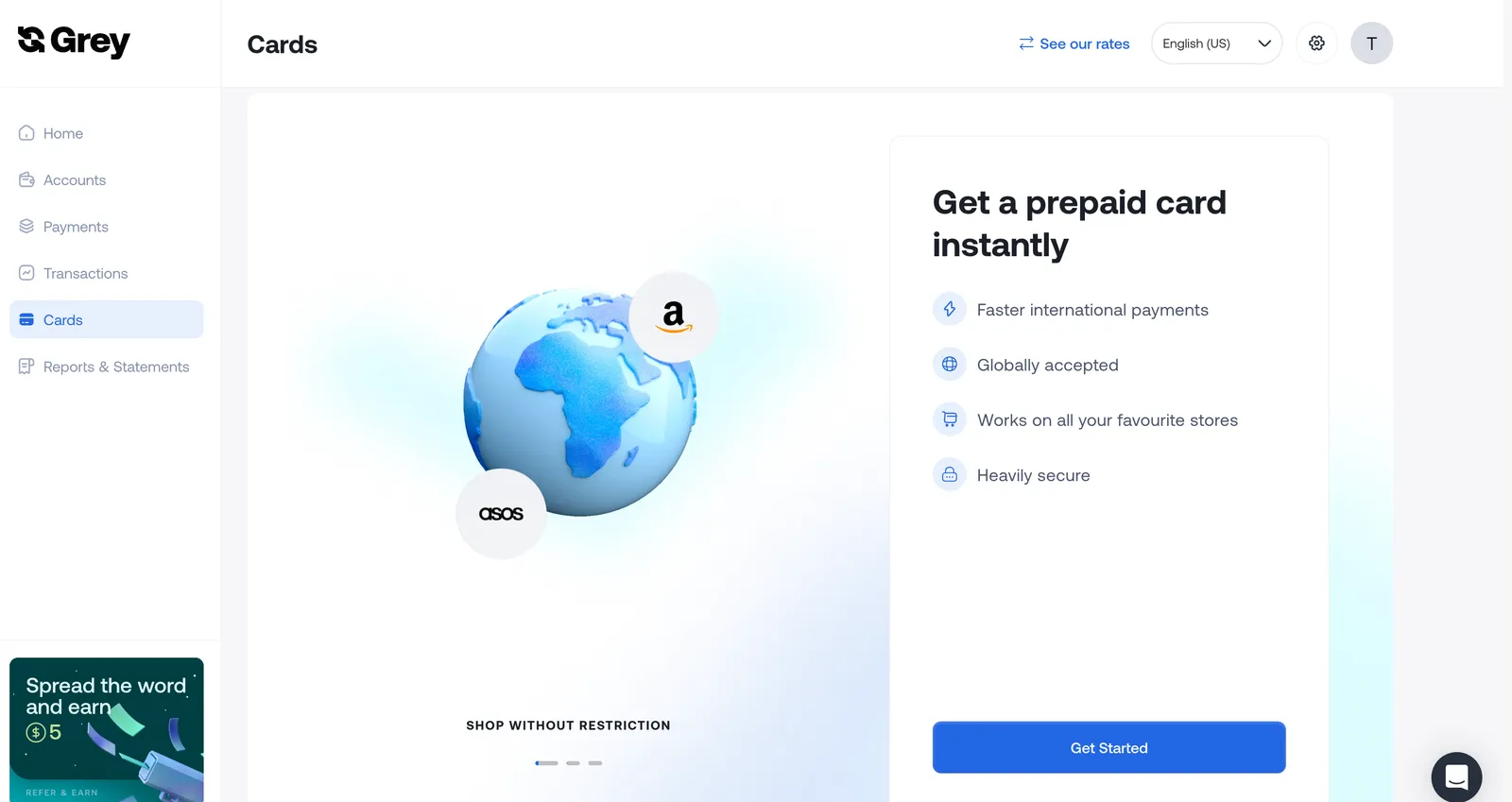
7. Instant USD card

The instant USD card is one reason why migrants and expatriates in Asia are choosing Grey for international money transfers

You can get a virtual USD card within minutes of creating an account. This USD card integrates seamlessly with any payment platform that allows MasterCard, providing financial flexibility.

Read also: How to get an instant USD debit card online in 2025

Conclusion

Migrants and expatriates in Asia deserve a smarter way to manage their finances. This is why migrants and expatriates in Asia are choosing Grey for international money transfers. Grey combines the power of multi-currency accounts, competitive rates, and fast transfers into one platform.

Create a Grey account today and experience hassle-free international money management.

‍

Last updated:

October 2, 2026

Open a free Grey account to get startedJoin 1 million digital nomads
IF YOU ENJOYED THIS, CHECK THESE OUT

Net 30 payment terms: What they mean and how to use them on invoices

•

•

2 min read

Invoicing is a crucial part of freelancing or managing a business. Disclosing payment terms clearly avoids payment delays, builds trust, and prevents disputes. Net 30 is one of the most common payment terms you will see on invoices as a freelancer and business owner.

Net 30 is a payment term that means the full invoice amount is due 30 days from the invoice date, not from when the work was completed. It is the most common B2B payment term in the US. A "2/10 net 30" variation offers a 2% early payment discount if paid within 10 days, with the full amount due in 30 days otherwise.

Whether you're a freelancer sending your first invoice, a small business setting payment terms, or a client trying to understand what "net 30" means, this guide explains how it works, how it compares with other payment terms like net 15 and net 60, and when you should use it. You'll also learn how to follow up on overdue invoices and get international clients to pay more efficiently.

What does net 30 mean on an invoice?

"Net 30" means the full amount on the invoice is due within 30 calendar days of the invoice date.

The word "net" refers to the total amount owed, with no deductions. So "net 30" simply means: pay the full amount within 30 days. But there are a few other things that confuse people, and we need to clarify them.

  • The countdown starts from the invoice date, not the delivery date. If you complete work on 1 June but send the invoice on 5 June, the 30 days run from 5 June, making the due date 5 July.
  • Net 30 counts calendar days, not business days. Weekends and public holidays count. A 30-day period always means 30 full days.
  • Until the client agrees to the payment terms (either in a contract or by accepting the invoice), net 30 is still a request. So, it is better to add the payment terms in the contract your client signs before commencing the work. This way, you are not just springing it on the client after the job is done.

Net 30 invoice example

Here is a Net 30 invoice example:

Field Example
Invoice number INV-047
Invoice date 1 July 2026
Payment due date 31 July 2026
Payment terms Net 30
Amount due USD 2,500

You can also offer early-payment incentives to clients who pay sooner.

For example, you can use the "2/10 Net 30" format, which means:

  • If the client pays within 10 days, they get a 2% discount (so they pay $2,450 instead of $2,500)
  • If the client pays between 11 and 30 days, they pay the full $2,500
  • If the client pays after 30 days, they will pay the full amount ($2,500) plus any late fee specified in the contract.

This format gives clients an incentive to pay early, helping your cash flow without shortening your standard terms beyond what the client expects.

Net 30 vs Net 60: which is better?

When you send an invoice, the payment terms you choose directly affect how quickly you get paid and how healthy your cash flow remains. Two of the most common options are net 30 and net 60. Understanding the difference between them helps you decide which one works better for your business.

  • Net 30 means the client has 30 days from the invoice date to pay the full amount.
  • Net 60 means the client has 60 days from the invoice date to pay the full amount

The right payment terms depend on who you are working with and what you can afford to wait for. Here is a quick comparison of net 30 vs net 60:

Feature Net 30 Net 60
Payment timeline 30 calendar days from invoice 60 calendar days from invoice
Common with Small to mid-size businesses, freelancers Large enterprises, government contracts
Benefit to seller Faster cash flow May be required to win large clients
Benefit to buyer More time to process payment Aligns with longer internal payment cycles
Risk to seller Client may still pay late Two months without payment can affect cash flow

Advantages of Net 30

  • Better cash flow: You receive money sooner, which makes it easier to pay your own bills, suppliers, or team.
  • Lower risk: The shorter the payment window, the lower the chance the client will delay or fail to pay.
  • Easier to manage: You can follow up quickly if payment is late, and you spend less time chasing invoices.
  • Stronger position: Offering Net 30 shows you value prompt payment and helps set professional expectations from the start.

Disadvantages of Net 30

  • Some larger companies may push back and ask for longer terms.
  • You might lose a deal if a client insists on Net 60 or longer.
  • It can feel stricter to new or long-term clients who are used to more generous terms.

Advantages of Net 60

  • Attracts bigger clients:  Many corporations and agencies prefer net 60 (or even net 90) because they have more complex payout systems and bureaucracy
  • Can help win contracts: Offering longer terms can make your proposal more competitive when bidding against other freelancers or agencies.
  • Builds goodwill: Some clients appreciate the flexibility and may be more likely to give you repeat work.

Disadvantages of Net 60

  • Your money is tied up for two months, which can create cash flow problems.
  • Higher risk of late or missed payments.
  • You may need to use personal savings, a line of credit, or invoice financing to cover expenses while waiting.
  • Following up on overdue invoices becomes more common and time-consuming.

Choosing between Net 30 and Net 60

Net 30 is usually better for most freelancers, independent contractors, and small businesses. It protects your cash flow and reduces the risk of waiting too long for payment.

Net 60 can be better in these situations:

  • You work mainly with large corporations that have strict payment policies.
  • The project value is high enough that you can afford to wait 60 days.
  • You have strong cash reserves or access to short-term financing.
  • The client is reliable and has a proven track record of paying on time.

Before you decide what’s right for you, ask yourself these questions:

  1. How important is quick cash flow to my business right now?
  2. Do most of my clients prefer longer payment terms?
  3. Can I comfortably wait 60 days without financial stress?
  4. Am I willing to risk delayed payments for the chance of winning bigger contracts?

How to set payment terms on a freelance invoice

For most freelancers, net 30 is the industry default. But that does not mean it has to be your default, too. See our freelance contract guide for how to build payment terms into a contract before starting work.

Here is a practical guide that can help you structure your payment terms:

  • New clients, small projects: Net 14. You do not yet know this client. Opting for a shorter payment term reduces the risk of the client defaulting on payment.
  • ‍Ongoing relationships, mid-size projects: Use Net 30 for mid-range projects or where you have built a strong relationship with the client. It is standard and widely accepted.
  • Large enterprise clients: Net 30 to 60, depending on the contract value and how important the relationship is.

Here are some of the best invoicing tools for freelancers.

Setting late payment fees

What happens when the client does not pay within the stipulated timeframe? In reality, most clients will honour payment terms. But there are times when the client fails to hold their side of the bargain. This is where late fees come in, and why you should have disclosed it from the beginning. It is not a mere threat. It is a guiding principle that ensures the client remains compliant.

Late payment fees are extra charges you add when a client pays after the due date. They encourage on-time payment and help cover the cost of chasing overdue invoices. This fee can be a percentage of the unpaid invoice (e.g., 1.5% or 2% per month), a flat fee (e.g., $25 or $50 per overdue invoice), or a combination (e.g., $20 + 1.5% per month).

Here is an example of how you can phrase the late payment fees on the contract and invoice:

“Payment is due within 30 days of the invoice date (net 30). A late fee of 1.5% per month (or the maximum allowed by law) will be applied to any overdue balance.”

Late fee rules differ by country and sometimes by state. In some places, there are legal limits on the percentage you can charge. Make sure your fee is reasonable and enforceable. You can also give a short grace period (e.g., 3–5 days) before applying the fee if you want to stay flexible. Send a polite reminder a few days before or right after the due date, before adding the fee.

Requesting a deposit on new projects

Asking for a deposit before starting work is one of the best ways to protect your time and cash flow. It confirms the client is serious and gives you money upfront to cover early costs. This amount typically depends on the project type and size. Here is a quick guide:

  • Small projects: 30–50%
  • Medium projects: 40–50%
  • Large or long-term projects: 30–50% (better divided into milestones)
  • New or untested clients: 50%
  • Trusted repeat clients: 20–30% or none

Don’t be sceptical about asking for a deposit from a new client. It is standard practice, and most professional clients would expect it. Include the deposit requirement in both your proposal and contract. Examples:

  • “A 50% deposit is required to begin the project. The remaining 50% is due upon completion.”
  • “Work will commence once the initial 40% deposit has been received.”
  • “Payment schedule: 50% upfront, 50% on final delivery.”

On the invoice, label it clearly as “Project Deposit – 50%” so there is no confusion.

What to do when a client misses a net 30 deadline

Missing a payment deadline does not always mean a client is acting in bad faith. There might be a lot more going on behind the scenes. Clients can misplace invoices or forget about them. Bigger corporations might require sign-offs from various approvals, which can cause delays. Some might even have specified periods for processing payments, which might fall outside your payment terms.

However, while you want to be understanding and preserve the relationship with the client, you must also ensure you protect your cash flow. So, here are some tips on what to do when a client misses a net 30 deadline or any other payment terms.

  • Day 31 (due date passed): Send a friendly reminder.

"Hi [Name], just following up on invoice INV-047 for USD 2,500, due on 31 July. Please let me know if you need anything from my side to process this. Happy to resend the invoice if helpful."

  • Day 33-Day35 (3-5 days overdue): Follow up again, slightly more direct.

"Hi [Name], I wanted to follow up again on invoice INV-047, now 5 days overdue. Is there anything holding up the payment on your end? I am happy to jump on a quick call if useful."

  • Day 37 ( 7 days overdue): Apply the late fee and state it clearly.

"Hi [Name], invoice INV-047 is now 15 days overdue. As per our agreed payment terms, a late payment fee of 1.5% is now being applied. The updated total is USD 2,537.50. Please arrange payment at your earliest convenience."

  • Day 60 and beyond

If payment has still not arrived, escalate. Options include: involving a collections agency, pursuing the matter through small claims court, or engaging a solicitor (UK) or lawyer (US) to send a formal demand letter. At this point, it is fine to sacrifice the relationship to get your money.

How to get paid faster than net 30

Net 30 is standard, but that does not mean you have to wait an entire month for every payment.

  • Require deposits: A 50% deposit means you have real money in before you invest significant time. The client who pays a deposit is also less likely to disappear before the final invoice.
  • Use milestones: For larger projects, break payments into stages: 40% deposit to start, 30% at the midpoint, and 30% on final delivery. This way, you receive money throughout the project instead of waiting until the very end.
  • Offer early payment discounts: A 2% discount for paying within 10 days (2/10 net 30) is a good incentive for most clients looking to save money.
  • Send invoices immediately after you finish the project. Don’t wait. Send the invoice the same day the work is finished or the milestone is reached. The payment clock starts only when the invoice is issued.
  • Use faster payment methods: Clients are more likely to pay quickly when they can use familiar local payment methods instead of expensive international wire transfers.

If you work with overseas clients, giving them local bank details can significantly reduce payment delays. Instead of sending an international wire, a US client can pay you via ACH, a UK client via Faster Payments, and a European client via SEPA. These domestic payment networks are typically faster, cheaper, and avoid the correspondent bank fees often associated with SWIFT transfers.

Open a multi-currency account with Grey and give international clients local payment details in USD, GBP, or EUR. This makes it easier for international clients to pay you using their local banking system. Payments arrive without correspondent bank deductions, and you can manage multiple currencies from one account before converting when needed. Grey’s invoicing to receive international payments from multiple clients and currencies in one place.

Open a multi-currency account with Grey and make it easier for international clients to pay you, whatever payment terms you agree on.

Frequently asked questions

When does the net 30 clock start?

The net 30 period starts on the invoice date, not the date the work was completed or delivered. If you issue an invoice on 1 July, the payment is due by 31 July. This is why it is important to send invoices promptly after completing work.

Is net 30 calendar days or business days?

Net 30 is calendar days unless you explicitly state otherwise on the invoice. Weekends and public holidays count. If the due date falls on a weekend or holiday, it is common practice to treat the next business day as the effective due date, though this is worth specifying if it matters to you.

What happens if I cannot pay a net 30 invoice on time?

Contact the supplier before the due date, not after. Most businesses are willing to arrange a short extension if you communicate proactively. Waiting until after the deadline without notice is more likely to trigger late fees and damage the relationship.

Can I charge a late fee on a net 30 invoice?

Yes, if late fees are included in your payment terms and either agreed in a signed contract or printed on the invoice, the client has accepted. The fee must be stated clearly before the work begins. Retroactively adding a late fee to terms that were not originally agreed upon is not enforceable.

What is the difference between net 30 and due on receipt?

"Due on receipt" means payment is expected immediately when the client receives the invoice, or within a very short window, such as 24 to 48 hours. Net 30 gives the client 30 days. Due on receipt is sometimes used for small one-off transactions or when working with new clients, where you want faster payment.

How can international clients pay me faster?

Provide international clients with local payment details in their own country. A US client with a US routing number and account number can pay via ACH, which settles in one to three business days with no fees on their side. A UK client with a sort code and account number pays via Faster Payments, which settles within hours. Grey provides both account types alongside EUR IBANs from a single multi-currency account.

How to grow your USD income as a creator or freelancer in 2025

•

•

2 min read

In Nigeria, it’s common knowledge now that everyone needs at least two income streams. The easiest way to get that is through freelancing. Many Nigerians are finding their way around their hurdles by taking their skills global.

Instead of waiting for the local market to catch up, they’re tapping into the foreign market to earn in dollars, pounds, and euros, all while living right here at home. This shift has reshaped how they see work, stability, and possibility.

For this article, I spoke to two freelancers who have multiple income streams. It ended up being an “aspire to perspire” session, but with genuine, relatable stories.

Also read: How to budget as a freelancer and manage irregular income

Anna’s* Story

I started as an editorial assistant for a publishing company. I even worked on one of the most popular Christian books in Nigeria. Then, during my NYSC year, I worked as a teacher, and the salary was ₦7,000, a whole graduate o. I also took a content writing job for a travel blog. The pay was ₦40,000 per month, decent pay for me at the time. My lead was really cool. I’ve always been lucky with bosses, to be honest. The website crashed, so all my work there is essentially gone.

After NYSC, I worked as an editorial assistant, then as a journalist. Now I work at a fintech and freelance at a publication as a writer that pays me in USD. Altogether, I now earn over a million naira monthly, with a good part of that coming from my freelance job.

At first, my dream was to pursue a PhD. I even tried twice. But my school, coughs UNILAG, didn’t send my transcript in time. Eventually, I decided to focus on earning money instead. I still love learning, but right now, I love being able to afford the lifestyle I want even more.

Earning globally has completely changed my day-to-day life. I no longer rely on public transport. I can outsource chores like laundry, order food when I don’t feel like cooking, and buy books, jewellery, and clothes whenever I feel like it. Ten years ago, I wouldn’t have thought I could afford this level of comfort. Now, I can.

I use Grey for salary. It’s reliable, the fees are transparent, and I don’t have to deal with delays. I don’t even like waiting for my money.

Remote work makes it a bit easier to have rest periods, even during the day, but I believe you shouldn’t be the reason your team or company falls short. To be honest I’m not exactly passionate about working, I just like the freedom and lifestyle it allows me to enjoy. So I always give my best effort.

My advice to anyone wanting to start earning globally while staying rooted locally is to take whatever you’re doing seriously. Opportunities often come through referrals and reputation. In fact, I got my current publication role because someone referred me after seeing the quality of my work. So yes, update your CV and LinkedIn, but most importantly, show up and do your job well.

Also read: How much should you charge as a freelancer?

Segun’s* story

I still laugh when I think about how it all started.

My first real taste of work came just before NYSC, where I worked at a recreational park. I was meant to manage plants, but somehow I found myself helping with their social media, pitching business ideas, and making content. That planted the seed (pun intended).

Since then, I’ve moved through some exciting media and tech spaces. First worked as a designer in a marketing agency. It was tough. You know all those job ads when they say they’re fast-paced, that’s exactly how agencies are. Soon, they drafted me to start doing a bit of content creation and digital marketing there. The pay was about ₦120,000. From there, I switched to core writing at a media company, then a PR company. That’s where my writing was fine-tuned properly.

I used to think I was great. I was humbled seeing multiple comments from my editor on every first draft. I soon got used to it. The standards were high, and I needed to adjust. My last two roles have been in tech companies. And I loved them.

For freelance work, I’ve mostly done design, but sometime last year, some guy reached out to me on LinkedIn and said he was hiring ghostwriters. It was a contract role where I’d be writing threads for his company’s clients on X. I still always call it Twitter, though. The pay was $25 per post. It wasn’t rigid. And I could just deliver the number of posts I was comfortable with. I’m not even sure how many I write per month. Depends on how I’m feeling. But it’s excellent as a passive income. Everything I earn just keeps stacking up in my Grey account. I only withdraw when there’s a proper emergency or a big purchase, like when I bought my phone.

I still get one or two design gigs that I take up when I’m feeling it. But life’s been good so far. I don’t spend a lot of money, except on food, as I love ordering food.

Earning a global income is great. I know there’s still a lot more for me to achieve. Honestly, the only way from here is up.

Also read: How to land your first client as a freelancer

Nigerians are proving that talent has no borders. With the right skills, determination, and tools, you can work with foreign clients. The only missing piece for many freelancers is a reliable way to get paid. Grey helps with that by giving you USD, GBP, and EUR accounts to receive payments directly from global clients and convert to naira when you feel like.

Open a Grey account today or download the app to join other ambitious freelancers.

*Some names have been changed for anonymity

‍

Why financial admin is the #1 killer of freelancer creativity

•

•

2 min read

Freelancers live for creativity. You sit down to create, ideas flowing, momentum building, then suddenly you remember that invoice you haven’t sent, or that overdue client payment. Just like that, the spark fizzles.

Bad financial admin essentially hijacks your creativity. That’s why you need to manage it well, to give you more time to focus on creativity.

Also read: How Grey helps you spend less time chasing payments

The hidden weight of financial admin

Before writing this article, I conducted a thorough study to determine what freelancers find most difficult. One of the most common answers was “sorting out finances.” Okay, looking back now, maybe asking a couple of my freelancer friends shouldn’t count as a “thorough study,” but you get the point.

You can also try it. Ask any freelancer what they dread most, and chances are “chasing payments” will rank near the top. Add in tracking expenses, converting currencies, and worrying about tax season, and you’ve got a recipe for constant distraction.

Switching between “creative brain” and “spreadsheet brain” is exhausting. Every time you break focus to send a reminder email or check an exchange rate, you lose momentum. That lost flow is harder to get back than the admin was worth.

Also read: Why freelancers lose productivity chasing late payments

Why do creativity and admin clash?

Creativity thrives on freedom, exploration, and uninterrupted focus. Admin is its opposite: rigid, repetitive, and structured. Trying to balance the two can be a problem.

The problem isn’t that admin exists, it’s that it constantly interrupts the creative process. And the more interruptions, the less space your brain has to experiment, imagine, and innovate.

The real cost for freelancers

When admin creeps into your creative hours, three things happen:

  • Lost time: Hours spent sending invoices or calculating fees are not spent creating or earning.
  • Lost money: Late payments, hidden transaction fees, or missed deductions quietly reduce your income.
  • Lost opportunities: Stress kills creativity. The more admin weighs you down, the harder it is to produce your best work, leading to burnout.

Also read: Payout delays: how they affect mental health and productivity

Smarter ways to handle financial admin

A few simple shifts can free up your time and protect your energy:

  • Automate where you can: Use invoicing tools, auto-reminders, and payment platforms that streamline the process.
  • Outsource what drains you: Bookkeeping or tax prep might be worth delegating.
  • Create admin zones: Block out specific hours for financial tasks instead of letting them spill into your creative time.

Also read: How Grey reduces stress for international students managing money

Reclaiming your creative freedom

Your creativity is your biggest asset as a freelancer. The goal isn’t to eliminate financial admin — that’s impossible — but to manage it in a way that lets your creativity thrive.

Because at the end of the day, clients don’t hire you for your invoicing skills. They hire you for the fresh ideas, the bold designs, and the creative spark that only you can bring. Don’t let financial admin snuff that out.

With Grey, you can open multi-currency accounts, have instant conversions, and enjoy stress-free payments. We take the admin off your plate so you can focus on what you do best, creating.

Open a Grey account today or download the app to make freelancing simpler, smarter, and more rewarding.

‍

How Nigeria is navigating digital currency regulations

•

•

2 min read

Nigeria isn’t new to innovation, especially with money.

It is one of the largest adopters of mobile money in Africa and has a huge crypto community. The enthusiasm has always been there, which has greatly aided the broad acceptance of innovation over the years. As crypto use surged, policymakers moved to keep pace, sometimes with strict regulations and other times stepping aside to allow the industry to grow.

Following the regulators’ changing rules,  where does that leave businesses, freelancers, and everyday users who actually need to move money? I say, somewhere in the middle of a live experiment. The country is trying to protect its financial system while allowing for new rails like stablecoins, tokenised assets, and CBDCs. The result is a system that changes fast, rewards people who stay informed, and increasingly favours solutions that combine innovation with compliance.

We’ll together, trace how Nigeria got here, how the rules are shifting, and what that means for safely getting paid, paying others, and cryptocurrency startups.

A quick look back: Nigeria’s digital currency story

By the late 2010s, crypto adoption was becoming hugely popular. Platforms like Binance, Paxful, and Luno held a huge part of the market share. For young Nigerians, especially freelancers tired of waiting days for foreign payments or watching the naira lose value overnight, digital assets became a faster, more reliable alternative.

By 2021, Nigeria ranked second in the world for crypto adoption. While this might have ordinarily been a good thing, the Central Bank of Nigeria (CBN) was worried about money laundering, tax evasion and threats to monetary stability, so it stepped in hard. It banned banks from facilitating crypto transactions, cutting off many startups and exchanges that relied on traditional financial rails.

Yet, even as the crackdown unfolded, Nigeria pushed forward with its own state-backed experiment. In October 2021, the country launched the eNaira. It was Africa’s first central bank digital currency (CBDC). The goal was to offer a safe, regulated digital alternative that could promote financial inclusion and modernise payments. While uptake has been very slow, it showed that Nigeria wasn’t against digital money. It seemed more like the government wanted to be in total control.

The tug-of-war: innovation vs. regulation

I like to describe Nigeria’s digital currency journey as a tussle between innovation and control. On one side, you have a young, tech-savvy population eager to embrace decentralised finance. On the other hand, cautious regulators are trying to manage risks in an already fragile economy. The result is a constant push and pull that has shaped how Nigerians use digital money today.

  • Crypto bans and restrictions: In 2021, the Central Bank’s ban on banks supporting crypto transactions significantly impacted exchanges and fintech startups. While peer-to-peer trading kept the crypto economy alive, businesses that relied on bank integrations struggled to stay afloat. For many of these businesses, innovation slowed down because of regulatory roadblocks, not a lack of demand.
  • The eNaira experiment: To counter the rise of unregulated digital assets, the government doubled down on its own central bank digital currency. The eNaira was marketed as a safer, government-approved alternative. But despite millions of downloads, adoption has been sluggish. By 2023, less than 1% of Nigerians were active users, a sign that trust and utility are what drive adoption, not availability.
  • Global pressure and local realities: Nigeria’s regulatory stance isn’t just shaped at home. International bodies like the IMF and World Bank have pushed for tighter oversight on digital assets to prevent risks such as capital flight and financial crime. Nigeria, already under economic strain, has had to walk a fine line between encouraging innovation and staying compliant with global standards.

This back-and-forth has created uncertainty for businesses and individuals. However, it has also forced Nigerians to turn to stablecoins, fintech workarounds, and alternative platforms to keep the digital economy alive despite regulatory hurdles.

Also read: Comparing USDC vs SWIFT transfers: What you need to know

Where do things stand today?

By late 2023, it became clear that Nigeria’s hardline stance on crypto wasn’t sustainable. Despite restrictions, trading volumes kept rising, peer-to-peer platforms flourished, and freelancers still turned to stablecoins to get paid. The government had to face reality as a complete clampdown wasn’t working.

The tone began to shift. The Securities and Exchange Commission (SEC) announced it was exploring licensing frameworks for exchanges and fintechs. This signalled a new willingness to move away from blanket bans toward structured regulation. Instead of shutting the door completely, regulators defined how players could legally operate in the space.

At the same time, the Central Bank of Nigeria (CBN) started refining its digital currency policies, aiming to build a more inclusive and controlled financial ecosystem. Some of the key areas of focus included:

  • Cross-border transactions: With remittances forming a significant part of Nigeria’s economy, the CBN began looking at ways digital currencies could make sending and receiving money cheaper and faster.
  • Inclusion of fintech startups: Rather than locking fintechs out, regulators started discussing how startups could plug into Nigeria’s payment infrastructure, bringing innovation back into the fold.
  • Stablecoins and tokenised assets: Recognising the popularity of dollar-backed stablecoins like USDT and USDC, the government has been considering frameworks to regulate their use, creating a safer environment for individuals and businesses.

This doesn’t mean Nigeria has fully embraced digital currencies. Instead, it shows a shift in mindset, from outright resistance to cautious acceptance. Regulators are no longer trying to fight innovation head-on but are instead putting guardrails around it. The aim is to ensure that growth happens within a controlled, secure framework.

For everyday Nigerians, this new phase could mean more reliable payment options, less reliance on risky peer-to-peer trading, and greater confidence that trading digital assets doesn’t leave them operating in a legal grey area.

Also read: How to accept payments in USDC as a digital nomad

Why does this matter for freelancers and businesses?

For many Nigerians, especially freelancers, digital currencies have been essential. When international clients struggled to pay via traditional banking routes, receiving USDT, Bitcoin, or other tokens often became the only practical option. Peer-to-peer (P2P) markets filled the gap, creating a parallel economy where freelancers could swap digital assets for naira. This method, however, left users vulnerable to price volatility, scams, and compliance risks.

Businesses haven’t had it any easier. Startups and SMEs wanting to tap into global markets found themselves in a no-man’s land. Holding or accepting crypto was risky, and many were forced to improvise. Some leaned on stablecoins to shield themselves from naira swings, while others turned to fintech platforms offering USD accounts as safer, more reliable workarounds.

This is why Nigeria’s stance matters. With more straightforward rules and proper standards, freelancers and businesses stand to gain a lot.

  • More reliable on- and off-ramps: Easier, safer movement between crypto and naira without depending solely on unregulated P2P trades.
  • Wider adoption of stable, regulated digital currencies: Giving businesses and individuals a secure way to transact without being exposed to wild market swings.
  • Reduced reliance on risky workarounds: With licensed exchanges and fintech integrations, the payment process could become smoother, faster, and more transparent.

In short, what’s at stake is financial confidence. For freelancers, that means getting paid without fear of losing value or falling victim to fraud. For businesses, it means expanding globally with fewer compliance headaches and more predictable cash flow.

What the future might look like

Nigeria is in an interesting place right now. The crypto community is creative, resilient, deeply embedded in the country’s digital economy and shows no signs of slowing down. At the same time, regulators are beginning to acknowledge that outright bans haven’t worked, and that structured, transparent systems are the only sustainable path forward. The result is a future that’s likely to blend innovation with oversight.

Here’s what to expect:

  • Stablecoins become more popular: USD-backed stablecoins like USDC could become the sweet spot, offering the stability of the dollar, the efficiency of blockchain, and enough regulatory flexibility to gain mainstream acceptance.
  • Clearer rules for fintechs: Licensing, compliance requirements, and regulatory sandboxes may allow startups and platforms to operate more confidently, sparking new payment solutions without fear of abrupt policy reversals.
  • Hybrid financial systems: Depending on the context, Nigerians may use a mix of eNaira, stablecoins, and cross-border accounts instead of one dominant solution.

This balancing act between innovation and regulation could position Nigeria as a regional leader in digital finance. This change won’t happen by rejecting crypto, but by integrating it into a safer, more inclusive financial ecosystem.

Also read: Bank transfers vs. crypto transfers: which is safer for international payments?

Where do you go from here?

The key takeaway for freelancers, entrepreneurs, and businesses is adaptability. Payment systems will keep evolving through CBDCs like the eNaira, globally trusted stablecoins, or flexible multi-currency accounts. Those who stay open, informed, and ready to pivot will be best placed to thrive in this shifting landscape.

At its core, the future of money in Nigeria is one where trust, accessibility, and opportunity are the major guiding principles.

These principles also guide us at Grey. That’s why we’re giving you access to borderless accounts and payment tools designed to help you confidently navigate your finances. Create your free Grey account today or download the app to experience a smarter way to move money.

‍

Cross-border transfers: USD, USDC and everything in between

•

•

2 min read

Moving money across borders has always been tricky. If you’ve ever tried sending dollars from one country to another, you’ll know the story too well. Delays, high fees, confusing exchange rates, and sometimes even failed transfers. But things are changing. With digital banking, fintech platforms, and the rise of crypto-based assets like USDC, cross-border transfers are becoming more accessible.

Today, freelancers, businesses, and everyday professionals are discovering new ways to move money faster, cheaper, and smarter.

In this article, I’ll explain how USD and USDC transfers work, what sets them apart, where they overlap, and how to choose the right option for your needs.

Also read: How to accept payments in USDC as a digital nomad

Why do cross-border transfers matter more than ever?

The internet, not borders, now defines opportunity. However, many payment systems still trail a bit in their development. Transfers can take days and often pass through outdated banking systems that weren’t built for the pace of the current digital economy.

This is why new forms of money movement have become more common. The US dollar remains the foundation of international trade. At the same time, USDC, a digital stablecoin pegged 1:1 to the dollar, is redefining what’s possible by offering near-instant, low-cost transfers without relying on traditional banking rails.

Together, USD and USDC are shaping a new era of cross-border payments that’s faster, more flexible, and better suited to how people and businesses work today.

USD transfers: The familiar option

The US dollar has long been the backbone of international trade. In fact, more than 80% of global forex transactions involve USD, making it the most trusted and widely accepted currency for cross-border payments. Whether you’re a freelancer invoicing a client abroad or a company paying international suppliers, USD will likely be the default choice.

When you send money in dollars, there are a few common routes. The most traditional is the SWIFT network, the global messaging system connecting banks. It’s reliable and secure, but transfers can take several days and incur hefty fees.

Then there are fintech platforms like Grey, Wise, or Payoneer, which use more innovative infrastructure to speed things up and reduce costs, making USD transfers more accessible for everyday professionals.

For bigger transactions, businesses often still rely on bank-to-bank wires, which get the job done but aren’t always friendly to smaller amounts thanks to steep charges and hidden exchange markups.

The strength of USD transfers lies in their universal acceptance. It’s a stable, recognised currency that works seamlessly for individuals and businesses. But that familiarity comes with trade-offs. Transfers via banks can be expensive, with fees that quietly reduce earnings, and delays that turn a simple payment into a waiting game. For anyone relying on regular cross-border income, these inefficiencies can be discouraging.

Also read: How USDC is revolutionising international money transfers

USDC transfers: The new way to send money

Unlike volatile cryptocurrencies such as Bitcoin or Ethereum, USDC is a stablecoin designed to mirror the value of the US dollar 1:1. Every USDC in circulation is backed by equivalent dollar reserves, which means its price doesn’t swing up and down. You get the speed of crypto without the drama of speculation.

The real magic of USDC lies in its movement. Instead of waiting days for a SWIFT transfer to crawl through banking rails, a USDC transaction can land in someone’s wallet within minutes, no matter where they are. Payments move across blockchain networks like Ethereum, Solana, or Binance Smart Chain. A client in London could send you USDC at midnight, and you’d see it in your wallet almost instantly.

From there, you have options. You could hold it as digital dollars, spend it with platforms that accept USDC directly, or automatically receieve it as USD with Grey. For freelancers and businesses, this means fewer middlemen, lower costs, and much faster access to funds compared to traditional banking.

That said, USDC isn’t without potential drawbacks. To use it confidently, you need at least a basic understanding of how crypto wallets and transfers work. And while sending and receiving is simple, converting it into spendable cash usually requires exchanges or fintech platforms, which adds an extra step. Grey lets you receive USDC as USD, allowing you to receive funds without needing a manual exchange or a third-party platform.

Finally, the regulation of stablecoins is still evolving worldwide. The status isn’t crystal clear in some countries.

Still, for anyone tired of waiting days and losing money to hidden fees, USDC offers a glimpse into the future of borderless money: fast, cheap, and globally accessible.

Also read: USDC vs. other stablecoins: what's best for global transactions?

USD vs. USDC: Which should you use?

It’s not really an either-or situation as they play different roles in the cross-border ecosystem, but the smartest creators and businesses are learning to use them side by side.

If you’re dealing with corporate clients or large organisations, they’ll likely stick to what they know: USD via bank transfer. It’s the default language of global commerce, universally recognised, and often required for official contracts and large invoices. The small trade-off is speed and cost.

On the flip side, if your income comes from digital-first platforms, startups, or international freelancers, you’ll start to see more USDC in the mix. These players care about speed and efficiency. With USDC, you could receive funds in minutes, often at a fraction of the cost. That means faster access to cash flow, essential for independent creators and small businesses that can’t afford delays.

The real edge comes when you’re able to manage both. Having accounts that can handle USD and USDC gives you maximum flexibility. You can accept traditional corporate client transfers while tapping into the new, faster rails of stablecoins without missing a beat.

What to watch out for in cross-border transfers

Here are significant things you shouldn’t overlook when making cross-border payments:

Conversion fees

This is the silent killer of international payments. Banks and some platforms often hide markups on the exchange rate, meaning you lose money every time you convert. Always compare the offered rate against the mid-market rate before hitting send. Grey shows transparent FX rates so you know exactly what you’re paying.

Transfer speed

‍This depends on your situation. A corporate payment in USD via SWIFT might take several business days, while a USDC transfer could land in your wallet in minutes. If cash flow is critical, say paying contractors or covering ad spend, opting for faster rails can make a big difference.

Security and compliance

‍Money moves fastest when it’s trusted. Using regulated platforms like Grey that follow AML (Anti-Money Laundering) and KYC (Know Your Customer) rules ensures your transfers aren’t flagged, delayed, or frozen.

Scalability

‍A one-off transfer is easy to manage, but what happens when you pay 20 freelancers monthly or receive recurring payments from multiple clients? Look for solutions that offer bulk payouts, automated reporting, and clean transaction histories. The focus is on making your business operations sustainable as you grow.

Also read: How to send and receive USDC directly in your USD account

Grey makes USD and USDC transfers seamless

Grey bridges the gap between traditional banking and modern money. With Grey, you can:

  • Open a real USD account to send and receive payments directly.
  • Send and receive USDC payments globally with no hidden fees or delays.
  • Convert to local currency at competitive rates.

Also read: How to send and receive USDC payments in Nigeria

The future of cross-border transfers

Cross-border payments are moving toward hybrid models. USD may remain the anchor for stability, while USDC and other stablecoins will bring speed and efficiency. According to a report by PwC, more than 60% of financial institutions are exploring blockchain solutions for payments.

For freelancers and businesses, the takeaway is simple: don’t box yourself into one method. The smartest professionals are already combining both currencies, holding USD for big client contracts while leveraging USDC for quick transfers or digital-first clients.

The global economy is moving fast; the winners will be those who can adapt, choose the right platforms, and keep more of what they earn. One of such platforms is Grey, which gives you the freedom to earn, hold, and transfer in the way that suits your global work life best.

Create your free Grey account today or download the app  to enjoy inclusive global banking designed to carry your dreams across borders.

‍

How remote workers are influencing local economies

•

•

2 min read

While remote work has been around for a very long time, its popularity has peaked since the COVID-19 pandemic. In the United States alone, approximately 42% of workers were operating from home full-time during the height of the crisis, accounting for more than two-thirds of the country's economic activity. By 2024, remote work had stabilised at levels three to four times higher than pre-pandemic figures.

Beyond the flexibility and convenience it offers, remote work is also reshaping local economies in various ways. It has opened up opportunities for people to perform their jobs from virtually anywhere. High-speed internet, online collaboration tools, and virtual communication platforms mean that physical proximity to an office is no longer essential.

This digital evolution has impacted the economies of small towns, transformed housing markets, and boosted local entrepreneurship. The influx of talent and growth of local talent have led to significant social and economic changes at the local level. However, these impacts are not always positive.

In this article, we will examine the local economic influence of remote workers, including the good, the bad, and the ugly.

The positive impacts of remote workers on local economies

Remote workers help local economies by spending their earnings in their communities, supporting local businesses, creating more job options, and sometimes slowing the movement of people to big cities. Here are some of the ways remote work benefits local economies:

  • Stimulation of local businesses: Most remote workers spend their income on local goods and services, like groceries and restaurants. This spending helps boost local sales and supports small businesses.
  • Diversification of local economies: In the past, people often had to move to bigger cities for work, which hurt small towns. Now, remote work lets people stay and contribute to their local communities, creating new opportunities and economic growth.
  • Reduced urban migration: Similarly, remote work allows professionals to live outside traditional economic centres, relieving the pressure on overloaded city infrastructure and providing economic opportunities in underserved rural or suburban areas.
  • Job creation and skill development: As remote work grows, it creates new jobs and increases demand for local services like co-working spaces and cafes. Employers can hire from a larger talent pool, and workers can connect with clients from different countries.
  • Increased inclusivity: Remote work provides a pathway for young professionals and other workers to participate in the global workforce without geographic limitations, leading to greater economic participation and skill development.
  • Expanding tax bases and government revenues: When remote workers relocate, they contribute to local tax revenues through consumption taxes, property rentals, or business registration. Countries offering digital nomad visas also generate income from application fees and related services. This new tax base can support infrastructure improvements, healthcare, and community development projects.

Also read: Best apps for remote workers and global freelancers

The negative impacts of remote workers on local economies

While the shift to digital jobs has helped local economies, there are also some downsides. Here are a few negative effects of remote work on local communities:

  • Competition for local talent: Companies may hire remote workers from other locations instead of local candidates, making it harder for local skilled workers to find employment. Job hunting, which was once a local competition, has now become a global rat race.
  • Affects office-dependent roles and businesses: Businesses like restaurants sometimes rely on commercial activities around them for sales. But when many of these potential customers now work from home, it might affect their businesses. In fact, consumer visits to establishments dropped by up to 80% in neighbourhoods with high remote work rates during the pandemic.  Many businesses no longer require physical office spaces or opt for smaller working spaces. While this might have reduced the business’ overhead cost, it has also potentially cost the cleaners, fixers, security personnel, janitors and other unskilled workers their jobs.
  • Driving up housing and rental markets: While the influx of remote workers stimulates local economies, it can also strain housing markets. Cities like Lisbon, Mexico City, and Bali have seen sharp increases in rents due to rising demand from international professionals. In some cases, locals are priced out of central neighbourhoods, sparking debates around gentrification and housing policy. This dual effect highlights the need for local governments to strike a balance between welcoming remote workers and protecting affordable housing for residents.

Challenges of remote work

Having explored the good and the bad of remote work for local economies, now let’s look at the tricky side. While significant progress has been made in improving the work experiences of remote workers, many personal and operational challenges still persist that indirectly influence local economies.

One challenge is measuring and keeping up productivity. Many people find it hard to focus or stay organised when working from home, which can slow down innovation in local tech companies or startups that need teamwork. Lower productivity can reduce overall economic growth.

While it sounds great that local talent can work with global clients and earn in foreign currencies, many remote workers still experience challenges managing international payments. Traditional banks are plagued with cumbersome paperwork, delayed payment processing, exorbitant charges, and unfavourable conversion rates. One way many remote workers mitigate this challenge is by opting for a reliable digital payment tool like Grey.

Also read: How to save in USD as a remote worker

Managing payments with ease with Grey

Remote workers now make up a large part of the workforce and are helping to change local economies everywhere. Their spending helps local businesses, their skills drive innovation, and their presence supports new infrastructure. Still, they also bring challenges like higher housing costs, social changes, and payment issues.

Grey offers multi-currency accounts, so users can manage money in USD, GBP, and EUR, and get good exchange rates to local currencies. Transactions are quick, affordable, and have no hidden fees.

Sign up on Grey today to make your international payments easier.

‍

Arrow (up)

Back to top