You receive a $2,000 payment from a client in New York. Before you withdraw it to your naira account, you want to know exactly what Grey charges you at each step: the deposit, the conversion, and the withdrawal. This is the page that answers that question.
Grey charges three types of fees: deposit fees when money comes in, conversion fees when you switch between currencies, and withdrawal fees when you send money out to a local bank account or mobile wallet. There are also charges for virtual cards if you use them for online spending. Every fee is shown before you confirm a transaction, so there are no surprises after the fact.
This guide breaks down each fee category with the exact amounts, caps, and examples so you can calculate your cost before you move any money.
How much does Grey charge for deposits?
When someone sends money to your Grey account, a deposit fee applies. The fee depends on the currency and payment method. For most deposits, the Grey deposit fee is 0.8% of the amount received, with a minimum charge and a maximum per-transaction cap.
USD deposits
| Method |
Fee |
Minimum |
Maximum |
Example |
| ACH |
0.8% |
$2 |
$10 |
$1,000 deposit = $8 fee |
| FedNow |
0.8% |
$2 |
$10 |
$1,000 deposit = $8 fee (typically settles within seconds) |
| Fedwire |
$20 flat |
N/A |
N/A |
Same day or next day delivery |
ACH is the standard method for receiving USD from US bank accounts. It is the most common deposit method for freelancers and remote workers receiving client payments.
ACH deposits are the better option for most transactions. Fedwire makes sense only when you need same-day settlement, and the $20 flat fee is worth the speed, typically for amounts above $2,500 where the percentage-based ACH fee would cap at $10 anyway.
FedNow is the Federal Reserve's instant payment system, launched in 2023. Like ACH, Grey charges a 0.8% deposit fee (minimum $2, maximum $10), but payments can settle within seconds when the sender's bank supports FedNow. You don't need to request FedNow specifically. If it's available through the sender's bank, the payment is processed automatically. Check your Grey account details or contact Grey Support to confirm which routing number to share for FedNow payments.
EUR deposits
| Method |
Fee |
Minimum |
Maximum |
Example |
| SEPA |
0.8% |
€2 |
€10 |
€500 deposit = €4 fee |
SEPA and SEPA INSTANT are the EUR deposit methods. The fee structure is identical to ACH: 0.8% with a floor and a cap. For deposits above €1,250, the fee caps at €10 regardless of the amount.
GBP deposits
| Method |
Fee |
Minimum |
Maximum |
Example |
| FPS (Faster Payments) |
0.8% |
£2 |
£10 |
£5,000 deposit = £10 (capped) |
| BACS |
£15 flat |
N/A |
N/A |
1 to 3 business days |
| CHAPS |
£25 flat |
N/A |
N/A |
Same day |
FPS is the default for most GBP deposits and the cheapest option for amounts under £1,875 (where the 0.8% fee stays below the £15 BACS flat rate). BACS and CHAPS are legacy bank transfer methods. CHAPS is typically only worth using for urgent, high-value transfers where same-day settlement is critical.
What happens with small deposits
If you receive a deposit that is less than the minimum fee, the full minimum fee still applies. For example, if someone sends you $2 via ACH, the $2 minimum fee is deducted, and $0.01 is credited to your balance. This matters if you receive many small payments. Where possible, combining smaller payments into fewer, larger ones avoids triggering the minimum fee multiple times.
Grey conversion fee: how the 1% charge works
Every time you convert one currency to another on Grey, the conversion fee depends on the currency pair. Some conversions are free, while others are charged at 0.5% or 1%. The fee has a cap for certain currency pairs.
| Fee group |
Rate |
What this means |
| Group A |
0% |
No conversion fee |
| Group B |
0.5% |
A 0.5% fee applies to the conversion amount |
| Group C |
1% |
A 1% fee applies to the conversion amount |
| Group D |
1% (cap $6) |
A 1% fee applies, but you'll never pay more than $6 per transaction |
The fee group can make a noticeable difference to what you pay. For example, if you convert $1,000 using a Group D currency pair, the standard 1% fee would be $10, but you'll only pay $6 because of the cap. On a $5,000 conversion, the fee would normally be $50, but it remains capped at $6. If you regularly convert larger amounts, it's worth checking which fee group your currency pair falls into.
On top of the conversion fee, the exchange rate on Grey includes a margin over the mid-market rate. This margin is part of how Grey prices its service. The rate and any applicable fees are always shown before you confirm your conversion, so you can see exactly what you'll receive before you proceed.
Learn more about Grey's conversion fees.
Grey withdrawal fees by country
Withdrawal fees are charged when you send money from your Grey account to a local bank account or mobile wallet. The fee depends on the destination country and payment method. Most withdrawals in Africa are processed instantly; withdrawals to Europe and North America take 1 to 3 business days.
Africa
| Country |
Currency |
Method |
Fee |
Speed |
| Nigeria |
NGN |
Bank transfer |
₦35 |
Instant |
| Kenya |
KES |
Mobile money (M-Pesa) |
$0.50 |
Instant |
| Kenya |
KES |
Bank transfer |
$0.65 |
Instant |
| Ghana |
GHS |
Mobile money (MTN, Vodafone, Airtel) |
$0.20 |
Instant |
| Ghana |
GHS |
Bank transfer |
$1.20 |
Instant |
| South Africa |
ZAR |
Bank transfer |
$1.50 |
Hours to 1 business day |
| Uganda |
UGX |
Mobile money (MTN, Airtel) |
$1.00 |
Instant |
| Tanzania |
TZS |
Mobile money |
$0.50 |
Instant |
| Tanzania |
TZS |
Bank transfer |
$1.00 |
Instant |
| Egypt |
EGP |
Bank transfer |
$2.00 |
1 to 2 business days |
| Egypt |
EGP |
Mobile money |
$2.50 |
1 to 2 business days |
| Morocco |
MAD |
Bank transfer |
$2.00 |
Next business day |
| Algeria |
DZD |
Bank transfer |
$2.50 |
Up to 5 business days |
| Rwanda |
RWF |
Bank transfer |
$1.30 |
1 business day |
| Cameroon |
XAF |
Mobile money |
$1.80 |
Instant |
| Senegal |
XOF |
Mobile money |
$3 |
Instant |
| Senegal |
XOF |
Bank transfer |
$2 |
1 business day |
| Côte d'Ivoire |
XOF |
Mobile money |
$1.80 |
Instant |
| Côte d'Ivoire |
XOF |
Bank transfer |
$2 |
1 business day |
| Ethiopia |
ETB |
Mobile money |
$2 |
Instant |
| Ethiopia |
ETB |
Bank transfer |
$2 |
1 business day |
For Nigeria specifically, the ₦35 flat withdrawal fee makes Grey one of the cheapest options for converting USD to naira and withdrawing to a local bank. Combined with the capped deposit and conversion fees, the total cost of receiving a $2,000 payment and withdrawing to your Nigerian bank account is approximately $16 (see the worked example below).
Asia
| Country |
Currency |
Method |
Fee |
Speed |
| India |
INR |
Bank transfer (IFSC required) |
1% conversion fee |
Varies |
| Philippines |
PHP |
Bank or mobile wallet |
$0.85 |
Instant |
| Thailand |
THB |
Bank transfer |
$1.80 |
1 business day |
| Indonesia |
IDR |
Bank transfer |
$0.45 |
Instant |
| Türkiye |
TRY |
Bank transfer |
$1.50 + 0.10% per transfer |
1 business day |
| Saudi Arabia |
SAR |
Bank transfer |
$3.50 |
1 business day |
| China |
CNY |
Bank transfer |
$2.80 |
1 business day |
Europe
| Region |
Currency |
Method |
Fee |
Speed |
| Eurozone |
EUR |
SEPA |
0.5% (min €2, max €10) |
1 to 2 working days |
| United Kingdom |
GBP |
FPS / BACS / CHAPS |
0.5% (min £2, max £10) |
1 to 3 working days |
North America
| Country |
Currency |
Method |
Fee |
Speed |
| Canada |
CAD |
Interac |
CA$3.00 |
Minutes |
| Canada |
CAD |
Bank transfer |
CA$2.50 |
1 business day |
| USA |
USD |
ACH |
0.5% (min $2, max $10) |
1 to 2 business days |
| USA |
USD |
SWIFT |
$25.00 |
1 to 4 business days |
Latin America
| Country |
Currency |
Method |
Fee |
Speed |
| Brazil |
BRL |
Pix |
$1.00 |
Instant |
| Brazil |
BRL |
Bank transfer |
$1.00 |
1 to 2 business days |
| Mexico |
MXN |
Bank transfer |
$0.60 |
Instant |
| Argentina |
ARS |
Bank transfer |
$2 + 0.20% per transaction |
Instant |
| Chile |
CLP |
Bank transfer |
$1 |
1 business day |
Grey virtual card charges
Grey offers virtual cards on the Visa network for online and in-store payments (via Apple Pay and Google Pay in supported regions). Virtual card charges are separate from deposit, conversion, and withdrawal fees.
| Fee type |
Amount |
When it applies |
| Card creation |
$5.00 |
One-time fee when you create a new virtual card |
| Card funding |
$1.00 |
Each time you load funds onto the card |
| Cross-border transaction |
2% + $0.50 |
When you use a USD card on a non-USD website (e.g., a EUR or GBP merchant) |
| Monthly maintenance |
$0.00 |
No recurring fee for keeping the card active |
The cross-border fee applies when the merchant charges in a currency different from your card currency. If you hold a USD card and pay on a European website that charges in euros, the 2% + $0.50 fee covers the currency handling across networks. This is a standard charge from the card networks that applies across providers, not a Grey-specific fee.
How to calculate your total Grey charges
The total cost of moving money through Grey depends on which steps your transaction involves. Not every transaction hits all three fee types. Here are the most common scenarios.
Scenario 1: Receive USD, withdraw to a Nigerian bank account. A client sends you $2,000 via ACH. Deposit fee: 0.8% = $16, but capped at $10. You convert USD to NGN: 1% = $20, but capped at $6 if the pair is in Group A. You withdraw ₦ 35 to your bank account. Total cost: $10 + $6 + ~$0.02 (₦35) = approximately $16.02 on a $2,000 transaction, or about 0.8%.
Scenario 2: Receive GBP via FPS, spend with a virtual card in USD. You receive £1,000. Deposit fee: 0.8% = £8. You convert GBP to USD: 1% conversion fee (check Group A/B for cap). You fund your card: $1. No cross-border fee because you are paying on a USD website with a USD card.
Scenario 3: Receive EUR, withdraw to a Moroccan bank. You receive €500. Deposit fee: 0.8% = €4. You convert EUR to MAD (conversion fee applies). You withdraw MAD: $2.00. Total depends on the conversion fee cap for your currency pair.
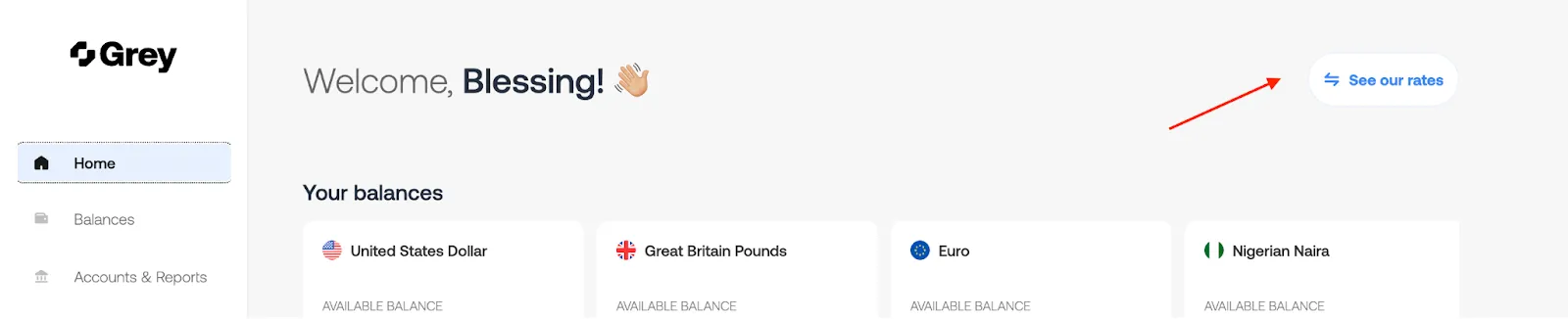
The pricing calculator on Grey’s pricing page lets you input your specific amounts and see the exact fees before you make a transaction. Use it to compare the cost of different deposit or withdrawal methods for your situation.
What Grey does not charge for
Some costs that are common on other platforms do not apply to Grey. There is no monthly account maintenance fee, no fee for holding balances in USD, EUR, or GBP, and no charge for receiving stablecoin deposits where supported. There is also no fee for creating your Grey account or completing KYC verification. Grey does not charge transfer fees on deposits or withdrawals beyond the fees listed above; the exchange rate margin is the remaining cost and is shown before you confirm any conversion.
Frequently asked questions
Does Grey charge hidden fees?
No. Every fee is displayed before you confirm a transaction. The deposit, conversion, and withdrawal fees are shown separately so you can see the breakdown. The exchange rate, including the margin over the mid-market rate, is also visible before you proceed. If you want to preview costs before initiating a transaction, use the pricing calculator on Grey’s pricing page.
What is the cheapest way to receive money on Grey?
For USD, both ACH and FedNow cost 0.8% of the deposit amount, with a minimum fee of $2 and a maximum of $10. If the sender's bank supports FedNow, the payment can arrive within seconds. Fedwire costs a flat $20 regardless of amount, making it better suited to urgent, high-value transfers where same-day settlement is required. For GBP, Faster Payments (FPS) is the cheapest at 0.8%, capped at £10. BACS (£15) and CHAPS (£25) are more expensive and typically unnecessary for standard deposits.
How much does Grey charge to withdraw to a Nigerian bank account?
The NGN withdrawal fee is a flat ₦35 per transaction, and the transfer is instant. If you are withdrawing from a USD balance, you will also pay the 1% conversion fee (capped at $6 for Group A pairs) when converting USD to NGN. The deposit fee would have already been charged when the USD was credited to your account.
Why does the India withdrawal show a 1% conversion fee instead of a flat fee?
INR withdrawals from Grey require a currency conversion step during the payout process. The 1% conversion fee applies to this step. This is different from most other withdrawal corridors, where the fee is a fixed amount. The effective cost depends on the amount you are withdrawing.
Do Grey charges change over time?
The 1% conversion fee is fixed. Grey may update deposit and withdrawal fees from time to time, but conversion fees remain at 1% with the existing cap structure. Any changes to fees are communicated before they take effect, and the current fee is always shown before you confirm a transaction.
Is there a fee for using Grey’s virtual card on international websites?
If the website charges in the same currency as your card (for example, a USD card on a USD website), there is no additional fee beyond whatever you paid to fund the card. If the website charges in a different currency (for example, a USD card on a EUR website), a cross-border fee of 2% plus $0.50 per transaction applies. This is a standard card network charge, not a Grey-specific fee. You can avoid it by using a card denominated in the same currency as the merchant.
Exchange rates on Grey are variable and include a margin over the mid-market rate. The rate is always shown before you confirm a conversion. Fees listed in this article are accurate as of March 2026. For the most current pricing, visit grey.co/fee-calculator. If you do not have a Grey account yet, you can sign up at grey.co and complete verification in a few minutes.



.png)
.png)
.svg)