
<script type="application/ld+json" data-schema-version="grey-blog-v4"> [{"@context":"https://schema.org","@type":"BlogPosting","@id":"https://grey.co/blog/cheapest-and-fastest-way-to-send-money-from-the-uk-to-kenya#article","headline":"Cheapest and fastest way to send money from the UK to Kenya","description":"Grey offers the best way to send money from the UK to Kenya, offering speed and affordability.","inLanguage":"en","url":"https://grey.co/blog/cheapest-and-fastest-way-to-send-money-from-the-uk-to-kenya","mainEntityOfPage":{"@id":"https://grey.co/blog/cheapest-and-fastest-way-to-send-money-from-the-uk-to-kenya#webpage"},"datePublished":"2025-04-23T18:56:17.710Z","dateModified":"2026-06-15T17:05:07.460Z","author":{"@type":"Person","@id":"https://grey.co/authors/adeolu-titus-adekunle#person","name":"Adeolu Titus Adekunle","url":"https://grey.co/authors/adeolu-titus-adekunle","jobTitle":"Content Writer","sameAs":["https://www.linkedin.com/in/titusadeoluadekunle/"]},"publisher":{"@type":"Organization","@id":"https://grey.co/#organization","name":"Grey","url":"https://grey.co","logo":{"@type":"ImageObject","url":"https://cdn.prod.website-files.com/6360022338a81bd6fdbb1145/6564ae1077a67e39d3c491a6_Grey%20Logo%20Lockup%20Black.svg"}},"image":{"@type":"ImageObject","@id":"https://grey.co/blog/cheapest-and-fastest-way-to-send-money-from-the-uk-to-kenya#primaryimage","url":"https://cdn.prod.website-files.com/636a85d290ee58e70c17e1c0/6a3013a0cba51a61391dde30_6a30139f409f3f2f72f61f13_cheapest-and-fastest-way-to-send-money-from-the-uk-to-kenya__header-image.webp","contentUrl":"https://cdn.prod.website-files.com/636a85d290ee58e70c17e1c0/6a3013a0cba51a61391dde30_6a30139f409f3f2f72f61f13_cheapest-and-fastest-way-to-send-money-from-the-uk-to-kenya__header-image.webp","width":1200,"height":675}},{"@context":"https://schema.org","@type":"WebPage","@id":"https://grey.co/blog/cheapest-and-fastest-way-to-send-money-from-the-uk-to-kenya#webpage","url":"https://grey.co/blog/cheapest-and-fastest-way-to-send-money-from-the-uk-to-kenya","name":"Cheapest and fastest way to send money from the UK to Kenya","description":"Grey offers the best way to send money from the UK to Kenya, offering speed and affordability.","inLanguage":"en","primaryImageOfPage":{"@id":"https://grey.co/blog/cheapest-and-fastest-way-to-send-money-from-the-uk-to-kenya#primaryimage"},"breadcrumb":{"@id":"https://grey.co/blog/cheapest-and-fastest-way-to-send-money-from-the-uk-to-kenya#breadcrumb"}},{"@context":"https://schema.org","@type":"BreadcrumbList","@id":"https://grey.co/blog/cheapest-and-fastest-way-to-send-money-from-the-uk-to-kenya#breadcrumb","itemListElement":[{"@type":"ListItem","position":1,"name":"Home","item":"https://grey.co/"},{"@type":"ListItem","position":2,"name":"Blog","item":"https://grey.co/blog"},{"@type":"ListItem","position":3,"name":"Cheapest and fastest way to send money from the UK to Kenya","item":"https://grey.co/blog/cheapest-and-fastest-way-to-send-money-from-the-uk-to-kenya"}]}] </script>

Cheapest and fastest way to send money from the UK to Kenya

Adeolu Titus Adekunle

TABLE OF CONTENT

SHARE THIS POST

With increasing trade and migration between the United Kingdom and Kenya, sending money across borders has become a common need — whether for family support, remote work payments, or personal expenses. Yet, traditional bank transfers often remain costly, slow, and subject to unfavourable exchange rates.

Thankfully, modern financial technology has made things easier. Today, UK residents can send money to Kenya quickly and affordably through digital platforms designed for speed and transparency. Among the many options available, Grey has emerged as the best way to send money from the UK to Kenya.

Read more: Grey vs. local banks: The best currency exchange method in Kenya

Trusted options to send money to Kenya from the UK

Here are some of the most popular and reputable services for sending money from the UK to Kenya:

  • Wise

Well-known for its transparent fees and real exchange rates, Wise allows users to send money directly to Kenyan bank accounts. Transfers usually take a few hours, and everything is clearly broken down before you send.

  • WorldRemit

Offers flexibility with delivery methods, including M-Pesa, bank deposits, and even airtime top-ups. Transfers to mobile money are usually instant, while bank transfers can take up to 24 hours.

  • Paysend

Paysend is ideal for smaller transfers, offering a flat £1 fee and delivery in minutes to cards or mobile wallets. However, exchange rate margins may apply.

  • TransferGo

This platform offers rapid transfers to Kenyan accounts, often under 30 minutes for a slightly higher fee, or lower-cost next-day options.

  • Western Union

A long-standing option with vast reach in Kenya, including M-Pesa and cash pickups. Fast, but often more expensive than digital-first solutions.

The cheapest and fastest way to send money from the UK to Kenya is with Grey

Grey is a cross-border financial platform built for the modern global citizen. It enables individuals in the UK to send money directly to Kenya with minimal fees, fast delivery, and real-time currency conversion. Whether you’re managing a freelance team, supporting family, or handling personal finances, Grey provides a seamless experience from start to finish.

Here’s why Grey is the best way to send money from the UK to Kenya.

  • Competitive exchange rates: Grey offers real-time, market-driven rates without the hidden markups often used by traditional banks and wire services.
  • Low fees: Grey charges minimal transaction costs, helping you save more with each transfer.
  • Fast transfers: Most transfers arrive within minutes to hours, whether it’s a bank account or a mobile wallet like M-Pesa.
  • Virtual foreign bank accounts: Grey gives users UK, US, and EU bank accounts. This makes it easy to receive payments and send funds abroad with ease.
  • M-Pesa and bank support: You can convert GBP into Kenyan shillings and withdraw directly to Kenyan mobile money wallets or bank accounts.

Learn more about withdrawing to Kenyan bank accounts with Grey

How to get started with Grey

Creating an account on Grey and sending money is fast and straightforward:

  1. Visit Grey’s website or download the Grey app from your app store
Sign up on Grey for the Cheapest and fastest way to send money from the UK to Kenya

2. Sign up with your email and create a secure password

create a password to enjoy the best way to send money from the UK to Kenya

3. Verify your identity by uploading a valid ID and selfie (for compliance and safety)

Verify your identity to use Cheapest and fastest way to send money from the UK to Kenya

4. Receive your virtual accounts in GBP, USD, and EUR.

‍

5. Send money by funding your GBP account, converting to Kenyan shillings, and withdrawing to a local account or M-Pesa wallet.

Read more: How to open US and UK bank accounts in East Africa

Sending money from the UK to Kenya using Grey

Once you’re set up on Grey, transferring funds takes just a few steps:

  • Step 1: Fund your Grey GBP account.
  • Step 2: Convert your GBP to Kenyan shillings at Grey’s current rate.
  • Step 3: Select “Withdraw” and enter the recipient’s M-Pesa number or bank details.
  • Step 4: Confirm the transaction—your funds usually arrive within minutes.

The best way to send money from the UK to Kenya

Grey is transforming how people handle international money transfers. Offering speed, affordability, and ease, it’s the ideal solution for anyone regularly sending money from the UK to Kenya. Whether you’re an expatriate, freelancer, or business owner, Grey offers the flexibility and trust needed for cross-border finance.

Sign up on Grey or download the app today to start sending money the smarter way.

‍

Last updated:

October 2, 2026

Open a free Grey account to get startedJoin 1 million digital nomads
IF YOU ENJOYED THIS, CHECK THESE OUT

Easiest way to send USD from the Philippines to the USA

•

•

2 min read

The easiest way to send USD from the Philippines to the US depends on one thing: whether your money is already in dollars. If it is, a transfer from a USD account to the recipient's US bank account is the simplest and usually the cheapest route. If you're starting with pesos, a digital money transfer service that converts PHP to USD and pays a US bank account directly will beat a traditional bank wire on fees in most cases.

That matters because the fees you can see are only half the cost. The exchange rate, a correspondent bank charge or a 4% conversion spread can quietly take more than the transfer fee itself. Below, we compare the realistic options with the fees each provider published when we checked on 26 November 2026, so you can see the total before you send.

The quick answer

  • You already hold US dollars (for example, freelance income paid into a USD account): send them by local US bank transfer (ACH). There's no currency conversion, so you only pay the transfer fee.
  • You're starting with pesos and want the lowest fee: use a digital transfer service that converts PHP to USD and pays out to a US bank account, such as Wise. Grey fits only once you hold dollars, because it doesn't accept peso deposits.
  • The recipient needs cash today: Western Union offers cash pick-up at agent locations in the US.
  • You're moving a large sum and want to stay with your bank: a telegraphic transfer (SWIFT wire) from your Philippine bank works, but fixed fees add up: Security Bank, for example, charges $20, plus $15 if you also cover the US bank's charges.

Your options compared

Here's what each option cost to send about PHP 50,000 (roughly $784 at the PHP 63.76 per dollar mid-market rate Wise's calculator showed) to a US bank account.

OptionPublished fees on about PHP 50,000 (USD)Exchange rateTypical speed
Grey, sending from a USD balanceAbout $3.92 (ACH fee of 0.5%, minimum $2, maximum $10)No conversion needed1 to 2 business days
WiseAbout $3.53 (PHP 225.18, paying by bank transfer)Mid-market rateConversion can take up to 2 working days
PayPal (personal payment)About $36.36 ($4.99 fee plus a 4% conversion spread)PayPal's rate plus the 4% spreadInstant to the recipient's PayPal account
Bank wire (Security Bank example)About $37.35 ($20 commission, $15 correspondent charge if you pay all fees, and PHP 150 documentary stamp tax)The bank's selling rateNot published
Western UnionShown in its estimator, varies by payment and payout methodWestern Union's rateCash pick-up can be ready in minutes

Fees and rates checked on 26 November 2026. Sources: Grey's published fees, Wise Philippines, PayPal Philippines fees, Security Bank telegraphic transfer charges and Western Union. Grey and Wise figures exclude any difference between their rate and the mid-market rate.

Two things stand out. If you already have dollars, nothing beats skipping the conversion. If you're starting in pesos, the gap between the cheapest and the most expensive option on the same PHP 50,000 is more than $30.

1. Grey: best if you already earn or hold US dollars

Grey lets people in the Philippines open a free USD account with US account details, which is how many Filipino freelancers get paid by foreign clients. Once dollars are in that account, you can send them straight to any US bank account by ACH, without converting to pesos and back again.

Grey's fee page lists outgoing USD ACH transfers at 0.5%, with a $2 minimum and a $10 maximum, and the app shows the exact fee before you confirm. On $784, that's about $3.92. The recipient doesn't need a Grey account, only a US bank account.

Grey doesn't accept peso deposits. In the Philippines, pesos are a payout currency on Grey: you can convert dollars to pesos and withdraw them, but you can't fund your account in pesos. Once your dollars are in Grey, sending them on to the US is covered on the Philippines to US page. If you're starting with pesos, use one of the options below.

How to send USD to the US with Grey

  1. Sign up on the Grey app or website and verify your identity with a valid Philippine government-issued ID or passport.
  2. Get dollars into your USD account, for example by giving a client your US account details.
  3. Tap Send, choose USD and Send via bank transfer, then pick ACH as the payment scheme.
  4. Enter the recipient's details, review the fee and confirm with your PIN or 2FA code.
Sending USD from the Philippines to a US bank account in the Grey app

Transfers usually arrive in 1 to 2 business days.

2. Wise: lowest published fee when you start in pesos

Wise converts at the mid-market rate and shows its fee upfront. On PHP 50,000 paid by bank transfer, its calculator showed PHP 225.18 in fees, about 0.45%.

The trade-off is timing: Wise says conversion can take up to 2 working days. Wise is a strong choice for one-off peso transfers, but you still need a separate account if you also want to receive dollars from clients.

3. PayPal: convenient, but the most expensive app here

PayPal is instant if your recipient already uses it. For a Philippine account sending a personal payment to the US, PayPal charges $4.99 when funded from your balance or bank, and $4.99 plus 3.4% plus $0.30 when funded by card.

The bigger cost is the 4% conversion spread PayPal adds when it converts your pesos to dollars. On PHP 50,000, that alone is about $31. Use PayPal when speed or convenience matters more than cost, or when you already hold a USD balance in PayPal.

4. Bank wire (SWIFT telegraphic transfer)

Philippine banks such as BDO, BPI, Metrobank and Security Bank send USD abroad by telegraphic transfer. Security Bank, for example, charges a USD 20 commission, a USD 15 correspondent charge if you choose to pay all fees ("OUR"), and documentary stamp tax of PHP 0.60 per PHP 200 when the transfer is funded in pesos.

That's about $37 on PHP 50,000, before the bank's exchange rate. Because most of it is fixed, a wire makes more sense for large amounts, and less sense for regular small transfers. If you already hold dollars in a Philippine USD savings account, sending from that account avoids Security Bank's peso-funding tax.

5. Western Union: when the recipient needs cash

Western Union is the option to pick when your recipient in the US needs cash in hand, since it can pay out at agent locations. You can also send to a US bank account, but you'll need the recipient's SWIFT/BIC code.

Western Union lets you send up to $15,000 equivalent in PHP per transfer, or $7,500 to US Southwest Border states. It earns money on the exchange rate as well as fees, so check the total in its estimator.

A common mistake: picking an app that only sends into the Philippines

Some remittance apps that send money into the Philippines don't support sending money out of it. WorldRemit, for example, says it only offers airtime top-up when you send from the Philippines. Before you sign up anywhere, check that the Philippines is listed as a sending country and the US as a destination.

What you need before you send

For a US bank transfer by ACH, you'll need the recipient's:

  • Full name and street address, city, state and ZIP code
  • Bank name
  • Account number and account type (checking or savings)
  • Routing number (nine digits)

A wire usually needs the bank's SWIFT code as well. If you're not sure which to use, here's how ACH and wire differ on speed and fees.

Paying a US business instead of a person?

If you're paying a US school, landlord or online service, you may not need a transfer at all. Many US businesses accept card payments, and a USD card lets you pay in dollars directly.

Frequently asked questions

Does the recipient need a Grey account?

No. Grey pays out to the recipient's US bank account in USD, so they only need a US bank account. You need a verified Grey account to send.

What is the cheapest way to send money from the Philippines to the US?

If you already hold US dollars, sending them by ACH from a USD account is cheapest because there's no conversion. If you're starting with pesos, Wise had the lowest published fee in our 26 November 2026 check, so compare the final amount on the day you send. Grey doesn't accept peso deposits, so it only helps once you hold dollars.

How long does a transfer from the Philippines to the US take?

With Grey, it typically takes 1 to 2 business days from a funded USD balance. Wise says conversion can take up to 2 working days, and Western Union cash pick-up can be ready within minutes.

Is there a limit on how much I can send?

Yes, and it depends on the provider. Western Union allows up to $15,000 equivalent per transfer, and Grey's limit depends on your verification level and is shown in the app.

The cheapest transfer is often the one that skips a conversion you didn't need. If you're paid in dollars, keep them in dollars until they reach the US. Open a free Grey account and check today's USD to PHP rate before you send.
Grey virtual card vs Chipper, Geegpay and others: fees compared

•

•

2 min read

If you live in Nigeria and want a virtual dollar card for regular online spending, the fee that matters most is the one you pay every time you use the card, not the one you pay to open it. Grey charges a one-time $5 to create its Visa card and nothing per payment. Raenest (formerly Geegpay) charges $3 to create plus $0.70 on every successful payment, and Chipper's Nigerian USD card charges $5, then $0.90 per payment and $1 a month.

That sounds like small change, until you add up a year of subscriptions. Every figure below comes from each provider's own pricing or help pages, checked on 26 November 2026, so you can see the source and check it yourself.

A lot has changed since this comparison was first published. Grey's card for Nigeria, Ghana and Kenya is now Visa, Raenest has moved to a new Visa card that spends straight from your balances, and Chipper now offers two different USD cards in Nigeria.

Grey vs Raenest vs Chipper: card fees side by side

Here are the published fees for the three virtual dollar cards most people in Nigeria compare. Where a provider's own pages don't state a fee, the table says so rather than guessing.

Fee or featureGrey Visa cardRaenest Visa cardChipper NG-USD cardChipper US-USD card
Creation fee (USD)$5 one-time$3 one-time$5$5
Fee per successful payment (USD)None$0.70$0.90Not stated
Monthly fee (USD)NoneNone$1$1
Non-US merchant feeUp to 2% + $0.502% + $0.40Not statedNot stated
Decline for insufficient fundsNot listed$0.40₦250Not stated
FundingSpends from your Grey balances, no top-upSpends from USD, GBP, EUR or NGN balancesAdd funds from Chipper, no funding feeNot stated
Spending limits (USD)$10,000 a day, $50,000 a monthUp to $20,000 a day, $60,000 a month (by KYC level)Not stated$2,000 per transaction

Fees and rates checked on 26 November 2026. Sources: Grey card fees and limits from Grey's support centre, Raenest virtual card charges, Chipper NG-USD card and Chipper US-USD card.

What a year of subscriptions costs on each card

Creation fees get the attention, but per-payment fees decide the real cost. Take a common pattern: 10 card payments a month on US websites, such as streaming, cloud storage, design tools and ad top-ups, all paid from a USD balance.

CardFirst month (USD)First year (USD)Each year after (USD)
Grey Visa card$5$5$0
Raenest Visa card$10$87$84
Chipper NG-USD card$15$125$120

Fees and rates checked on 26 November 2026. The example assumes US merchants and a USD balance, so no cross-border or conversion fees apply.

Raenest's lower creation fee only wins if you make two payments or fewer in total. By the third payment, $3 plus three $0.70 charges ($5.10) already costs more than Grey's one-off $5.

When the merchant is outside the US

Grey and Raenest both pass on a cross-border fee when you pay a merchant outside the US or in a currency other than USD. On a $20 payment to a non-US website, Grey's fee is up to 2% plus $0.50, so up to $0.90. Raenest charges 2% plus $0.40 ($0.80) on top of its $0.70 transaction fee, so $1.50 in total.

Chipper's Nigerian help pages don't publish a cross-border fee, so check the in-app fee screen before you rely on it for non-US merchants. If you shop on UK or European sites often, our guide to shopping abroad covers how to keep those charges down.

Paying from a naira, pound or euro balance

If your card payment comes from a balance that isn't USD, there's a conversion step. Grey charges 1% for currency conversion, capped at $6, at the rate shown in the Grey app at the time of the payment. Raenest says its conversion fee applies only when a purchase is funded from a non-USD wallet and links to a separate conversion fee page that doesn't publish a fixed percentage.

LDMAG1

Grey virtual card: what you pay and what you get

Grey's card is a debit card, so there's no credit check and nothing to repay. It spends straight from your available Grey balance, so you never top up the card itself.

  • Network: Visa. Grey's support centre lists Nigeria, Ghana and Kenya among the countries that can create the Visa card. Grey Mastercard creation is now limited to specific regions such as India, Turkey and Vietnam.
  • Cost: a one-time $5 creation fee, and you need at least $5 in your USD balance to create it. Grey charges no card maintenance, transaction or funding fees.
  • Balances: pay from USD, EUR, GBP or your local currency. Non-USD balances are converted at 1%, capped at $6.
  • Cross-border fee: up to 2% plus $0.50 on non-USD card payments. It also applies to refunds from non-USD merchants, and conversion fees aren't refunded.
  • Limits: up to $10,000 a day and $50,000 a month.
  • Multiple cards: create as many as you need, each with its own limits, and pause any card from the app.
  • Where it works: online, in apps and in stores wherever Visa is accepted, plus Apple Pay and Google Pay in supported regions. It can't be used for cash withdrawals.

Separate cards make it easier to see where your money goes, for example one for subscriptions and one for ads. Our Grey card budgeting guide shows how people set that up.

One rule worth knowing: if a card's balance goes negative and the shortfall reaches $50, Grey automatically terminates that card. Keep your balance above your recurring charges.

Raenest (formerly Geegpay) virtual card

Raenest's help centre introduced its new Visa card in August 2026. The card now spends directly from your USD, GBP, EUR or NGN balance, so there's no separate card funding step.

  • Cost: $3 to create, free funding and no monthly fee, then $0.70 on every successful transaction.
  • Non-US merchants: 2% plus $0.40 for purchases or refunds on non-US websites.
  • Declines and disputes: $0.40 when a payment is declined for insufficient balance, and $50 to process a chargeback or dispute.
  • Limits: up to $20,000 a day and $60,000 a month, depending on your verification level.
  • Physical card: Raenest's cards page says a physical card is available on request.

Raenest is the stronger pick if you need a physical card or daily limits above $10,000. For frequent small payments, the $0.70 charge on each one makes it more expensive than Grey within a few transactions.

Chipper Cash USD cards

Chipper now offers two USD cards in Nigeria, and they work differently. Its help pages don't name the card network for either.

Chipper NG-USD card

  • Cost: $5 to create, $0.90 on every successful transaction, and a $1 monthly maintenance fee charged on the 28th.
  • Declines: a non-refundable ₦250 fee for each transaction that fails for insufficient funds. Chipper cut this from ₦500.
  • Funding: no fee to add or withdraw funds, and naira to dollar conversions use Chipper's real-time rate. Money sent to the card from external sources, such as Visa Direct, carries a 1% fee.

Chipper US-USD card

  • Cost: $5 to create and $1 a month, charged on the 28th.
  • Limit: $2,000 maximum per transaction.
  • Use: issued through a US partner, with wider acceptance on international platforms, and it can be used for some financial service transactions where the merchant supports them. Issuance can take up to 48 hours.

If you already keep money in Chipper and only pay for something occasionally, the NG-USD card is convenient. For regular spending, the per-payment fee, the monthly charge and the ₦250 decline fee add up quickly.

Can you get a Wise or Payoneer card in Nigeria?

Wise's card is not currently available to residents of Nigeria, Ghana or Kenya. Wise's own card availability list doesn't include them and offers a waitlist instead.

Payoneer says card availability depends on each customer's eligibility and jurisdiction. Where it is offered, its fees page lists a $29.95 annual card fee and up to 3.5% on card transactions with currency conversion, which makes it a costly card for everyday spending.

If you mainly want a card for receiving and converting freelance income, the cards matter less than the account behind them. Our receiving fees comparison covers that side.

Which virtual card should you choose?

  • Lots of small USD payments every month (subscriptions, software, ads): Grey, because there's no per-payment or monthly fee.
  • You need a physical card or limits above $10,000 a day: Raenest.
  • You already use Chipper and pay for something now and then: Chipper's NG-USD card, as long as you budget for the $1 monthly fee and avoid declines.
  • You want to compare more options: see our wider list of virtual dollar cards available in Nigeria.

Whichever you pick, keep enough in your balance to cover recurring charges. Declines cost money on Raenest and Chipper, and a declined subscription can lock you out of a service you rely on.

Frequently asked questions

Is the Grey virtual card free?

No. Grey charges a one-time $5 fee to create the card and no monthly, funding or per-transaction fees after that. You may pay a cross-border fee of up to 2% plus $0.50 on non-USD payments, and 1% (capped at $6) if the payment is converted from a non-USD balance.

Is the Grey card Visa or Mastercard in Nigeria?

Visa. Grey's support centre lists Nigeria, Ghana and Kenya among the countries that can create the Visa card, while Grey Mastercard creation is now limited to specific regions such as India, Turkey and Vietnam.

Which virtual dollar card has the lowest fees in Nigeria?

Of the three cards compared here, Grey costs the least for regular spending because it has no per-transaction or monthly fee. Raenest has the lowest creation fee at $3, but its $0.70 per-transaction fee overtakes Grey's $5 by the third payment.

Is Geegpay the same as Raenest?

Yes. Geegpay renamed itself Raenest, and its help centre still describes the product as Raenest (formerly Geegpay).

Can I get a Wise card in Nigeria?

Not at the moment. Wise's list of countries where personal customers can get its card doesn't include Nigeria, Ghana or Kenya, and Wise offers a waitlist for unlisted countries.

The price on the box is the creation fee, but the price you actually pay is what the card charges every time you use it. If most of your spending is regular USD payments, create a Grey card in the app and see the fee before you confirm.

How to open a foreign bank account for PayPal payments

•

•

2 min read

For PayPal, a foreign bank account almost always means a US one. PayPal lets you link a bank account from the country where your PayPal account is registered, or a US bank account in some countries, according to its help centre. So the steps are: check that your PayPal country accepts US banks, open a USD account you can hold from abroad, and link it with your name matching exactly.

Most people do it the other way round. They open an account first, then find PayPal will not take it. This guide shows how to check before you start, which accounts work for which PayPal countries, how to set up and link a Grey account, what it costs, and what to do if PayPal says no.

Which foreign bank accounts PayPal accepts

PayPal decides by the country your PayPal account is registered in, not by where your bank is. Its rule is a bank in that same country and in the local currency, with US banks allowed as an extra option in some countries. The name on the bank account must also match the name on the PayPal account.

Your PayPal account is registered inWhat PayPal lets you linkCan a Grey account receive your withdrawals?
A country where PayPal offers US bank linkingA local bank, or a US bank accountYes, a Grey USD account, if you live in a country where Grey offers one
The United KingdomA UK bank account in GBPYes, a Grey GBP account
A eurozone countryA local bank account in EURNo. Grey declines EUR deposits from PayPal, so withdraw to a local bank
A country where PayPal offers only local banks or cardsA local bank account or an eligible cardNo. Withdraw locally, or get clients to pay you outside PayPal

Sources: PayPal help centre and Grey's help centre, checked on 26 November 2026.

Your PayPal country is the one you registered with, and you cannot switch it. PayPal says that if you move abroad, you need to close your account and open a new one, so registering PayPal in a country you do not live in is not a shortcut to better withdrawal options.

How to check what your PayPal account accepts

Do this before you open anything. It takes two minutes.

  1. Log in to PayPal and open your Wallet.
  2. Start adding a bank account and look at what PayPal asks for.
  3. If PayPal offers a US bank or asks for a US routing number and account number, a US account can work for you.
  4. If it only asks for a local bank, or only offers to add a card, PayPal does not accept US banks for your country.

Morocco is a good example of the last case: Moroccan users in PayPal's community forum report seeing only the option to add a card. If that is you, our guide for Moroccan PayPal accounts covers the routes that do work.

How to open a Grey USD or GBP account

Grey gives you US, UK and EU account details in your own name. Grey is a financial technology company, not a bank.

Check two things first. Grey's US accounts are offered to residents of a list of eligible countries, including Nigeria, Ghana, Egypt, India, Indonesia, the Philippines and South Africa, and only to full-time employees and freelancers, according to Grey's help centre. If your country is not on that list, a Grey USD account is not an option for PayPal yet.

  1. Sign up. Create an account on the Grey web app or mobile app, choose your country of residence and verify your email.
  2. Verify your identity. Upload a valid government ID. Grey says verification usually takes a few minutes and can take up to 24 hours.
  3. Request your account. In the app, request a USD account, or a GBP account if your PayPal is registered in the UK. Your account number and routing details then appear in the app.

If you are wondering how a US account can exist without you living in the US, our explainer on virtual US accounts covers how they work and who they suit.

How to link your Grey account to PayPal

  1. In your PayPal Wallet, choose to link a bank account.
  2. Enter the routing number and account number from your Grey USD account, or the sort code and account number from your GBP account.
  3. Confirm the account. PayPal sends up to two small deposits of between $0.01 and $0.99 and says to look for them after three business days. Find them in Grey and enter the exact amounts in PayPal, carefully, because three wrong attempts disable the bank.
  4. Once PayPal shows the account as confirmed, withdraw your balance to it.

Three rules from Grey's PayPal guide keep withdrawals from bouncing:

  • The name on your Grey account must match your PayPal account.
  • Grey accepts USD and GBP from PayPal but declines EUR for compliance reasons.
  • Withdrawals take one to two working days, not counting weekends or public holidays.

What PayPal withdrawals to Grey cost

The biggest cost is usually the currency conversion. PayPal adds a conversion fee on top of its base rate whenever it converts your balance, and its Morocco fee page, for example, lists 3%.

Keep your PayPal balance in USD and withdraw it as USD, and that fee does not apply on the way out. PayPal may still charge for USD withdrawals in some countries, so check your country's PayPal fee page.

On the Grey side, here is what $1,500 withdrawn from PayPal and moved to your local bank costs.

StepGrey fee ruleFee on $1,500 (USD)
PayPal to your Grey USD account (ACH)0.8%, minimum $2, maximum $10$10 (0.8% would be $12, so the cap applies)
Converting to your local currency1%, capped at $6$6 (1% would be $14.90)
Withdrawing to your local bankDepends on your countryVaries; Grey lists ₦35 for Nigeria and $1.50 for South Africa
Total before the local withdrawal fee$16

Fees and rates checked on 26 November 2026, from Grey's help centre and Grey's fees page. GBP received by Faster Payments costs 0.8%, capped at £10.

For comparison, if PayPal converted the same $1,500 at a 3% fee, that fee alone would be $45. You do not have to convert at all: you can hold the dollars and convert when the rate suits you.

If PayPal will not link your account

PayPal's help centre lists the usual reasons. Work down this list before contacting support.

  • Country or currency. Your PayPal country does not accept US banks, or the account is not in your local currency.
  • Name mismatch. The bank account name does not match your PayPal name exactly.
  • Bank type. PayPal says it may not support some banks, including most online-only or prepaid accounts.
  • Link history. A bank account can only ever be linked to three PayPal accounts.
  • Limitations. The bank is already active on a PayPal account that is limited or has a negative balance.
  • Failed confirmation. Three wrong attempts at the confirmation amounts disable the bank until PayPal reactivates it.

If none of these can be fixed, the cleaner route is to take PayPal out of the chain. A US client can pay your Grey USD account directly by ACH, which our guide to getting paid without PayPal walks through.

Frequently asked questions

Can a non-US resident link a US bank account to PayPal?

Sometimes. PayPal allows US bank accounts in some countries in addition to local banks. Start adding a bank in your PayPal Wallet: if PayPal offers a US bank or asks for a US routing number, it works for your country.

Can I link a Grey EUR account to PayPal?

You should not. Grey declines EUR deposits from PayPal for compliance reasons, so use a Grey USD or GBP account where PayPal allows it, or a local bank for euros.

How long does a PayPal withdrawal to Grey take?

One to two working days, not counting weekends or public holidays, according to Grey's help centre.

The account you open matters less than the country your PayPal is registered in, so check your Wallet first and open the account PayPal will actually take. When you are ready, create a free Grey account or download the app.

EOR vs PEO: What is the difference?

•

•

2 min read

Hiring someone in another country sounds exciting until you start looking into employment laws, payroll taxes, contracts and local regulations. Suddenly, bringing one new person onto your team involves a lot more than sending an offer letter.

If you're expanding internationally, you've probably come across two options: an employer of record (EOR) and a professional employer organisation (PEO). Both help businesses manage employees, but they work in very different ways.

So, when comparing an employer of record vs PEO, which one makes more sense for your business?

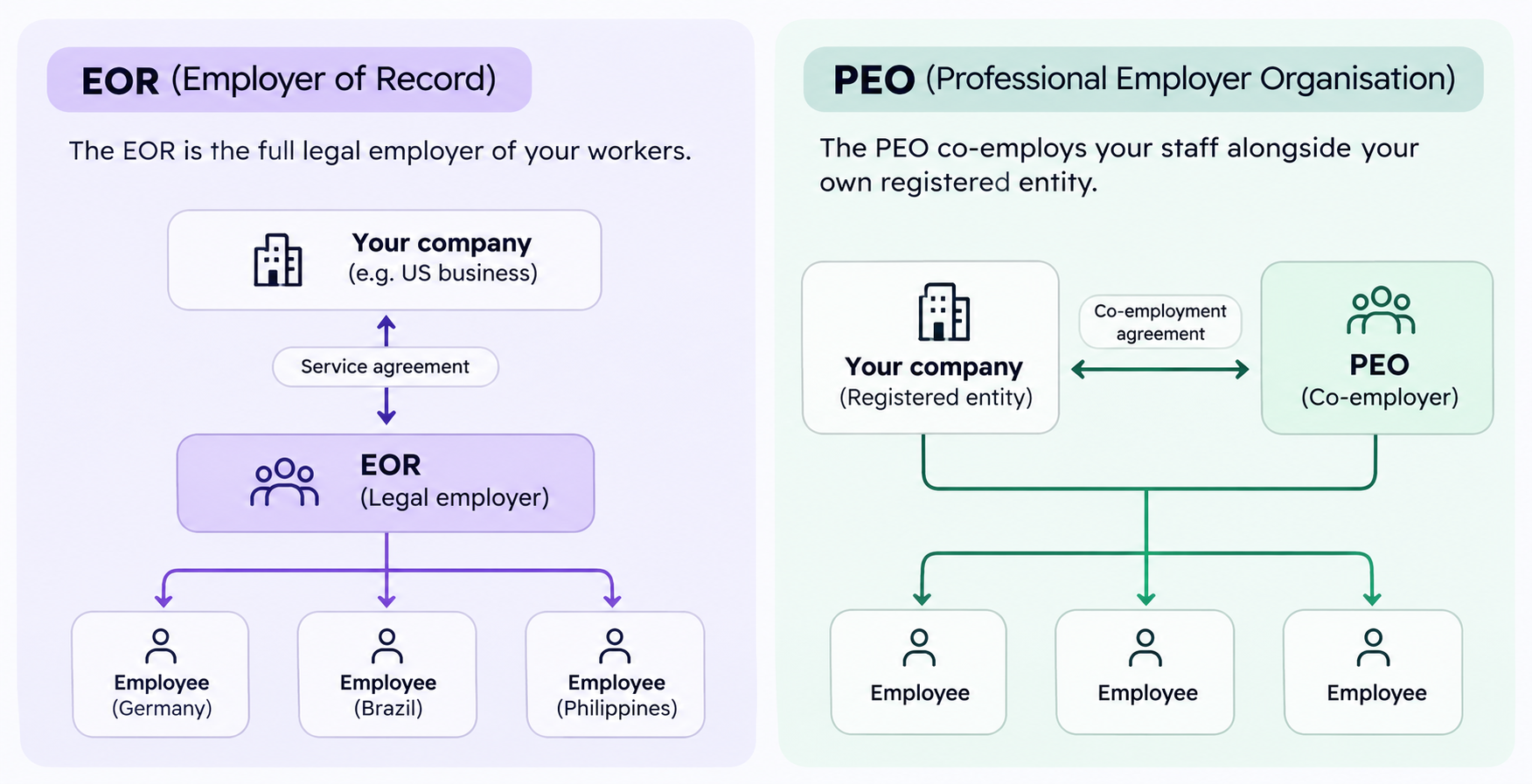
An employer of record (EOR) legally employs staff on your behalf, allowing you to hire in another country without setting up a local company. A professional employer organisation (PEO) shares certain employment responsibilities with your existing business through co-employment. The biggest difference is who legally employs your workers and whether you need a registered local entity.

Let's look at how both models work, what they cost and how to choose the right one for your growing team.

EOR vs PEO: How do they compare?

The easiest way to understand the difference between an EOR and a PEO is to look at who takes responsibility for employment.

An EOR becomes the legal employer of your workers in the relevant country, while a PEO works alongside your existing business to manage employment-related tasks.

Here's how the two compare:

Feature Employer of record (EOR) Professional employer organisation (PEO)
Legal employer EOR is the formal legal employer Your company remains an employer under a co-employment arrangement
Local entity required
No, typically not Yes, generally
Employment model
Third-party legal employment Co-employment
Geographic reach
Particularly useful for international hiring Commonly used for domestic HR management
Payroll
EOR administers local payroll PEO administers payroll on behalf of the client
Compliance EOR handles many formal employer obligations Responsibilities are shared according to the agreement and applicable law
Employee benefits EOR arranges locally compliant benefits PEO helps administer benefits and may provide access to group plans
Liability EOR assumes specified legal employer responsibilities, but the client retains some risks Responsibilities and liabilities are divided between the PEO and client
Best for Hiring in countries where you don't have a registered business Managing HR and payroll where your business already operates
Typical pricing
Often a monthly fee per employee Often a fee per employee or a percentage of payroll

‍

You may also see the term PEO employer of record used when researching international hiring. This can be confusing because a PEO may handle payroll administration and certain employer-related filings without becoming the sole legal employer of your staff.

The important thing is to check the actual employment arrangement, not just the terminology a provider uses.

What is an EOR?

An employer of record (EOR) is a third-party organisation that legally employs workers on behalf of another company, allowing businesses to hire internationally without setting up a local entity.

Imagine you run a US-based technology company and find an excellent developer in the Philippines. You want to hire them full-time, but you don't have a registered company there or the infrastructure to manage local payroll and employment regulations.

An EOR becomes the developer's legal employer, taking care of these responsibilities while you manage their everyday work.

How does an EOR work?

An EOR typically handles the legal and administrative aspects of employment, including:

  • Preparing locally compliant employment contracts
  • Processing salaries, taxes and statutory deductions
  • Managing employee benefits, leave and contributions
  • Handling onboarding, offboarding and employment compliance

Your company remains in charge of daily operations, including assigning tasks, managing performance and setting team goals.

This arrangement is particularly useful for businesses looking to explore new markets, build international teams or expand without investing in local subsidiaries.

However, working with an EOR doesn't remove all your legal responsibilities. Your company may still be accountable for workplace practices, intellectual property and data protection, depending on local laws and contractual arrangements.

For a closer look at the model, read our guide explaining what an employer of record is.

What is a PEO?

A professional employer organisation (PEO) shares certain employment responsibilities with your business through a co-employment arrangement. Unlike an EOR, a traditional PEO generally requires your company to have an existing legal entity in the country where your employees work.

Imagine you run a growing marketing agency in California with 30 employees, but managing payroll, benefits and HR paperwork is becoming increasingly time-consuming.

A PEO helps you manage these responsibilities while your company remains an employer.

How does a PEO work?

A PEO typically helps businesses manage employment-related tasks, including:

  • Processing payroll and managing tax filings
  • Administering employee benefits
  • Providing HR support and employment documentation
  • Assisting with employment compliance

Your company continues to manage employees' daily work, performance and business decisions.

Working with a PEO may also give smaller businesses access to employee benefits that would otherwise be expensive or difficult to manage independently.

However, employment responsibilities are shared. Your company remains accountable for workplace practices, employee supervision and its obligations under applicable laws.

If you're exploring this option, our guide to what a PEO is explains the model in more detail.

Key differences between an EOR and a PEO

The main differences between an EOR and a PEO come down to four things: local entity requirements, geographic coverage, compliance responsibilities and costs.

Diagram comparing the EOR and PEO employment models.

1. Local entity requirements

An EOR allows you to hire employees in another country without establishing your own local entity, while a traditional PEO generally requires an existing registered business.

For example, if you're a US company hiring your first employee in Germany, an EOR may be the more practical option. If you already have a German subsidiary, a PEO or local HR outsourcing provider may be a better fit.

2. Geographic coverage

EOR services are designed for international hiring, allowing businesses to build teams across multiple countries without establishing a separate company in each location.

Traditional PEOs are more commonly used for domestic employment, particularly in the US.

Some providers offer international PEO services, but these may operate through an EOR or another employment structure. Always check which model applies in your target country.

3. Compliance and legal responsibility

An EOR becomes the formal legal employer, handling responsibilities such as employment contracts, payroll taxes and statutory contributions.

With a PEO, these responsibilities are shared between your company and the provider through a co-employment agreement.

Neither model removes all your legal obligations. Your business may still be responsible for workplace safety, employee classification and other employment matters.

The US Department of Labor's guidance on joint employment explains how employment responsibilities can extend to more than one organisation under certain US labour laws.

4. Costs and pricing

EOR providers typically charge a fixed monthly fee per employee, while PEOs often charge a fee per employee or a percentage of payroll.

For example, an EOR charging $500 per employee would cost $2,500 per month for five employees. A PEO charging $150 per employee would cost $750 for the same number of workers, assuming your business already has a local entity.

These figures are illustrative and exclude salaries, taxes, benefits and additional charges.

When comparing costs, look beyond the monthly fee. An EOR may be more expensive per employee but save you the cost of establishing and maintaining a foreign entity. A PEO may offer better value if your business is already established and you're looking to scale your HR operations.

When should you choose an EOR or a PEO?

Choose an EOR if you want to hire employees in a country where you don't have a legal entity. A PEO is a better fit if your business is already established and needs support managing HR, payroll and employee benefits.

Choose an EOR when you're expanding internationally

An EOR is particularly useful when hiring your first overseas employees, exploring new markets or building a global team.

Imagine your US-based software company wants to hire a designer in Brazil, a developer in India and a customer support specialist in the Philippines. Instead of establishing three separate legal entities, an EOR can manage local employment arrangements while you focus on running your team.

However, as your workforce grows in a particular country, establishing your own entity may become more cost-effective.

Choose a PEO when you're scaling an existing business

A PEO makes sense when your business is growing and managing HR internally is becoming increasingly demanding.

For example, if your consulting firm has grown from 10 to 80 employees, a PEO can help manage payroll, benefits, onboarding and HR administration without the need to build a large internal HR department.

You get professional HR support while maintaining your existing employment structure.

What if you're hiring contractors instead?

If you're working with independent contractors, you may not need an EOR or PEO. You can generally engage them directly through a service agreement and pay them for their work.

However, the working relationship must meet local classification rules. If someone follows a fixed schedule, works under direct supervision and operates like a regular employee, they may need to be classified as one.

Understanding the difference between a contractor and an employee can help you avoid legal and tax complications.

Paying a global team: How does it work with an EOR or PEO?

With an EOR, you fund the provider, which handles local payroll. With a PEO, payroll is managed through your existing business and its agreed payroll arrangements.

When managing an international team, you'll also need to consider exchange rates, transfer fees and payment delivery times.

Cross-border salary payments from the US to a global team.

Paying employees through an EOR

The payroll process with an EOR typically involves four steps:

  1. Your company submits salary details and payroll adjustments.
  2. The EOR calculates taxes, contributions and benefits.
  3. Your company funds the EOR according to its invoice.
  4. The EOR pays employees through the local payroll system.

For example, if your US company employs someone in Brazil, you might receive an invoice in USD while the employee gets paid in Brazilian reais.

Make sure you understand how your EOR handles currency conversion, funding deadlines and additional payroll fees.

Paying employees through a PEO

A PEO manages payroll, tax deductions and employee benefits through your existing business's employment structure.

If you operate in multiple countries, you may need separate payroll arrangements for each location. A traditional US PEO, for example, won't necessarily handle payroll for employees in the Philippines or Kenya.

Check which countries your provider supports and what payment options are available.

Managing international payments with Grey

Beyond payroll, running a global team involves moving money across borders. You might need to fund an overseas payroll provider, transfer money between business accounts or pay international contractors.

Grey helps businesses manage eligible international payments and hold and send multiple currencies, giving them more flexibility over when they convert their money.

You can explore different payment routes to pay your team from the US. For example, if you're working with a freelance developer in Manila, you can send money from the US to the Philippines through supported payment methods.

Grey complements your employment arrangements by helping you manage international payments rather than replacing your EOR, PEO or payroll provider.

What should you check before paying an international team?

Before choosing a payment method, consider:

  • Who is responsible for processing payroll and statutory deductions
  • Which currencies and payment methods your team can receive
  • Exchange rates, transfer fees and delivery times
  • Local employment and payroll requirements

Remember that paying a contractor's invoice is different from processing an employee's salary. Choosing the right employment model and payment method can help you manage costs and keep your international team paid on time.

Frequently asked questions about EOR vs PEO

What is the difference between an EOR and a PEO?

The main difference is who legally employs your staff. An EOR becomes the formal legal employer of workers on your behalf, while a PEO shares certain employment responsibilities with your existing company through co-employment.

An EOR is particularly useful for hiring internationally without establishing a local entity. A PEO generally supports businesses that already have a registered presence where their employees work.

Which do I need to hire abroad?

An EOR is usually the better option if you want to hire employees in another country without establishing your own local company.

If your business already has a legal entity in that country, a PEO or local payroll and HR provider may be suitable.

The best choice depends on your existing business structure, workforce size, budget and long-term hiring plans.

Does a PEO require a local entity?

Yes, a traditional PEO generally requires your business to have a registered legal entity in the jurisdiction where employees work.

This is because a PEO operates through a co-employment arrangement rather than replacing your company as the employer.

Some providers offer international PEO services without requiring a local entity, but these may actually use an EOR structure. Always confirm the legal employment model before signing an agreement.

Who is the legal employer under an EOR or PEO?

Under an EOR arrangement, the EOR is the formal legal employer, although your company still directs the employee's daily work and may retain certain legal responsibilities.

Under a traditional PEO arrangement, your company remains an employer, while the PEO assumes specified employment-related responsibilities through co-employment.

The exact allocation of responsibilities depends on local laws and the provider agreement.

Which is cheaper, an EOR or a PEO?

A PEO may be cheaper per employee for an established business with a larger workforce, but an EOR can be more economical when you're hiring a small number of employees in countries where you don't have a legal entity.

EOR fees often reflect the additional responsibilities and infrastructure involved in international employment.

To compare costs accurately, include service fees, employer taxes, benefits, local entity expenses, payroll charges and any currency conversion costs.

How do I pay an international team?

You can pay an international team through an EOR, a local payroll arrangement supported by a PEO or direct contractor payments, depending on the worker's legal classification.

For employees hired through an EOR, you'll generally fund the provider, which processes salaries and statutory deductions locally.

For independent contractors, you may be able to use an international payment platform such as Grey to send money to supported countries, subject to account eligibility and payment requirements.

Pay your global team with Grey

Hiring internationally gives your business access to people and skills beyond your home market. But managing the money behind a global team deserves just as much attention as finding the right people.

Once you've chosen the appropriate employment model, Grey can help you explore cross-border payment options, manage supported currencies and send money internationally.

Explore how to pay your global team with Grey.

Can a foreigner open a bank account in Egypt as a visitor?

•

•

2 min read

Yes, a foreigner can open a bank account in Egypt as a visitor. In August 2024 the Central Bank of Egypt told banks to open accounts for non-resident foreigners, so a residence permit is no longer a formal requirement. In practice, though, the branch still decides how smooth that is, and the paperwork it asks for (an Egyptian address in your name, a local phone number, proof of where your money comes from) is what trips most visitors up.

That gap between the rule and the counter is what this guide is about. I'll walk you through what the central bank actually said, the documents banks ask for, the steps, the costs, and when a visitor is better off not opening an Egyptian account at all.

Can a foreigner open a bank account in Egypt without residency?

On paper, yes. Ahram Online reported on 11 August 2024 that the Central Bank of Egypt (CBE) had directed banks to open accounts for foreign clients who don't live in Egypt. The letter keeps the existing account-opening rules and normal due diligence in place, so banks can still say no if your documents don't satisfy their checks.

This wasn't the first time. The same report notes that the CBE had already written to banks in April 2016 about refusals to open accounts for non-resident foreigners. A second letter eight years later tells you the refusals didn't stop.

That matches what people report on the ground. A 2026 guide from The Rio Times describes a residence permit as the single document that makes the process easiest, and says acceptance for non-residents still varies from bank to bank and even branch to branch.

Do you actually need an Egyptian bank account as a visitor?

Often you don't. The right answer depends on how long you're staying and what you need to pay for. Here's how I'd decide.

Your situationEgyptian account needed?What usually works
Holiday of a few weeksNoYour home card, plus some cash in Egyptian pounds from an ATM or a licensed exchange
Working remotely for one to six monthsUsually notAn account you can manage from anywhere for receiving pay, plus a card for spending
Renting long term and paying local billsHelpfulAn Egyptian pound account, which also lets you use InstaPay, Egypt's instant transfer app
Moving to Egypt on a residence permitYesOpen the account once your permit is issued; it is the document banks trust most

If you're on a short trip, the bigger risk is losing money on exchange, not lacking an account. Our guide to currency exchange traps covers that, and this one explains buying Egyptian pounds as a non-citizen.

Types of bank accounts available to visitors

Banks that accept non-residents generally offer two kinds of account. Many visitors end up with both, because each solves a different problem.

Foreign currency accounts

These hold US dollars, euros or pounds sterling. They suit you if money arrives from abroad and you only want to convert to Egyptian pounds (EGP) when you need to.

Receiving an international transfer straight into a foreign currency account is the cleanest route. Keep the sending bank's confirmation, because Egyptian banks can ask where funds came from, especially when you later move money out. Egypt's currency controls are the reason for that extra scrutiny.

Egyptian pound accounts

A current or savings account in EGP is for life in Egypt: rent, utilities, local transfers and cash withdrawals. Some banks pay interest on savings accounts, depending on the product.

Documents you need to open a bank account in Egypt as a foreigner

Each bank sets its own list, so call ahead. These are the documents that come up most often.

DocumentWhat banks usually acceptWatch out for
PassportOriginal and a copy, showing your valid visa or residence permitAn expired or soon-to-expire visa makes refusal likely
Proof of Egyptian addressA registered or notarised lease, or a recent utility bill in your nameThe document branches question most; ask before relying on a hotel booking
Local mobile numberAn Egyptian SIM registered to your passportNeeded for alerts and online banking
Proof of income or source of fundsAn employer letter, contract, payslips or bank statementsOften asked of non-residents as part of due diligence
Minimum deposit (EGP)Roughly EGP 1,000 to 5,000, more for some accountsVaries by bank and account type

Checked 25 November 2026. Sources: The Rio Times (2026) for documents; Andersen Egypt (page updated December 2025) for the deposit range.

Some banks also ask for a tax registration number or a reference letter from your current bank. Use the USD to EGP converter to see what the deposit means in dollars today.

How to open the account, step by step

  1. Get a local SIM first. Banks want an Egyptian number on the form, and you'll need it for the card and app.
  2. Sort your address proof. If you're renting, ask your landlord for a registered or notarised lease, or put a utility bill in your name.
  3. Pick a large branch. Main branches in Cairo or Alexandria tend to be more used to foreign customers. Big banks include National Bank of Egypt, Banque Misr, CIB, QNB Alahli and Emirates NBD Egypt.
  4. Call ahead. Ask for a "non-resident foreigner account", the exact document list and the minimum deposit.
  5. Visit with originals and copies. If a clerk says non-residents can't open accounts, politely mention the central bank's August 2024 instruction and ask for a manager.
  6. Ask for the tariff in writing. Card issuance, low-balance charges, international transfers and currency spreads all follow the bank's own fee list.

Once your documents are complete, opening usually takes a few days, and some banks open accounts the same day, according to Andersen Egypt. The debit card can take longer, and each bank sets its own timing.

Common mistakes that get visitors turned away

  • Arriving with only a hotel booking. Address proof is the weakest link for most visitors, so confirm what the branch accepts before you go.
  • Trying a small branch first. Staff there may never have opened a non-resident account and default to "no".
  • No paper trail for your money. If you can't show where your funds come from, due diligence can stall the application.
  • Expecting to open it online from abroad. Andersen Egypt notes you may need at least one branch visit to verify your identity, even where banks take online applications.

The alternative: an account you open from home

If what you really need is somewhere to receive pay and spend while you travel, a foreign currency account you control from your phone can do the job without a branch visit. That's where Grey fits.

Grey is a financial technology company, not a bank, and it is registered with FinCEN in the United States and FINTRAC in Canada. It works for people who live in its supported countries, which include Egypt, Nigeria, Kenya, Ghana, Algeria, Morocco, India and Indonesia. The full list appears during sign-up, so check it before you plan around Grey.

If your home country is supported, you can open foreign currency accounts in USD, GBP and EUR before you fly. You verify with a government ID and a short video selfie, which usually takes a few minutes and can take up to 24 hours. There are no account opening or maintenance fees, and you get a virtual USD card that you can add to Apple Pay or Google Pay.

How you're paidGrey receiving feeTypical arrival time
USD by ACH0.8% (min $2, max $10)1 to 2 business days
USD by FedNow0.8% (min $2, max $10)Seconds
USD by Fedwire$20 flatAbout 1 business day
GBP by Faster Payments0.8% (min £2, max £10)Not stated
EUR by SEPA or SEPA Instant0.8% (min €2, max €10)Not stated

Checked 25 November 2026. Source: Grey Help Centre, US account guidelines and "Everything you need to know about your Grey account".

Two limits to know. Payments from individual third parties into your USD account must be under $4,000 each, and Grey doesn't accept payments for crypto, P2P, betting or forex trading. Withdrawal options depend on your country of residence, so Grey sits alongside an Egyptian account rather than replacing one if you need to pay local bills in pounds.

Frequently asked questions

Can I open a bank account in Egypt on a tourist visa?

The central bank's August 2024 instruction allows banks to open accounts for non-resident foreigners, so a tourist visa doesn't rule you out. Acceptance still varies by bank and branch, and a residence permit makes approval much easier.

Can I open an Egyptian bank account online from abroad?

Not usually as a foreigner. Even banks that take online applications may want a branch visit to check your original documents, and Banque Misr's account-opening initiative for people abroad is written for Egyptian citizens, who apply through an Egyptian embassy.

Can a US citizen open a bank account in Egypt?

Yes, under the same rules as other foreigners: a passport with a valid visa, proof of an Egyptian address and the bank's due diligence checks. If you're still planning the trip, start with the US visa rules.

How much money do I need to open an account?

Andersen Egypt puts typical minimum deposits at roughly EGP 1,000 to 5,000, with more for some account types. Ask your branch for its exact figure.

The short version

Egypt's rulebook says yes to visitors, but the branch decides how easy that yes is. If you're staying long enough to need one, bring a lease, a local number and proof of your income, and go to a main branch. If you're only passing through, sort your visit visa, set up an account you can manage from home, and keep the bank queue for when you move.

Can you open an offshore bank account online for free?

•

•

2 min read

Yes, you can open an account outside your home country online without paying an opening fee, but probably not at a traditional offshore bank. Banks in offshore centres usually want proof of where your money comes from, and many charge monthly or transaction fees. What most freelancers and remote workers really need is foreign account details to get paid in US dollars, pounds or euros, and that part you can get free from your phone.

Getting this wrong costs money either way. You either pay for a private banking product you don't need, or you sign up for something that can't receive the payments you're expecting. Here, I'll show you what an offshore account really is, whether it's legal, what you have to report, and how to open a free USD, GBP or EUR account with Grey, including what it costs once money starts arriving.

What is an offshore bank account?

An offshore bank account is an account held with a bank outside the country where you live. "Offshore" sounds shady, but it only describes location. A Ghanaian designer with a UK account and a British retiree with an account in the Isle of Man are both, technically, banking offshore.

People open them for different reasons:

  • Getting paid by foreign clients in the currency they pay in
  • Holding savings outside a local currency that keeps losing value
  • Managing money while travelling, studying or relocating
  • For wealthier clients, investing, estate planning and spreading risk across countries

The first three are about moving money. The last one is about storing it, and that's where traditional offshore banks earn their fees. If you want the longer comparison, read our guide to global accounts versus offshore ones.

Is it legal to have an offshore bank account?

Yes, in most countries holding an account abroad is legal. What's illegal is hiding the account, or the income in it, from your tax authority. And banking secrecy is mostly gone.

Under the OECD's Common Reporting Standard, banks in participating countries collect information on customers who live elsewhere and pass it to their tax authority, which shares it with the customer's home country. Under FATCA, foreign financial institutions report accounts held by US persons to the IRS. Assume your government can find out about an account abroad.

Some countries also limit how much money residents can move out. South Africa, for example, sets annual allowances for money sent offshore, so check your central bank's rules before you move savings.

What you may have to report

  • US persons: if your foreign accounts together were worth more than $10,000 at any time in the year, you must file an FBAR (FinCEN Form 114) through FinCEN's BSA E-Filing System. It's due 15 April, with an automatic extension to 15 October, according to the IRS. Our FBAR guide walks through it.
  • Everyone else: income paid into a foreign account is usually still taxable where you're tax resident, and many tax returns ask about foreign income or accounts. If you move between countries, our guide to digital nomad tax covers where you might owe.

This isn't tax advice. Your tax authority or a qualified adviser can confirm what applies to you.

Can you open an offshore bank account online for free?

At a traditional offshore bank, rarely. Checking a non-resident's identity and source of funds is expensive, so these banks either ask for a meaningful balance or charge fees to cover it. GlobalBanks, an offshore account-opening adviser, says no-deposit offshore accounts do exist, but the bank usually earns the money back through monthly or transaction fees.

What you can get free is foreign currency account details from a financial technology company. Here's how the two compare.

FeatureTraditional offshore bankGrey foreign currency account
Who provides itA licensed bank in another countryGrey, a financial technology company, through licensed banking partners
Opening feeVaries by bank; some charge oneNone
Minimum depositOften required; varies by bankNone
Monthly feeCommon, unless you keep a set balanceNone
DocumentsID, proof of address, often source of funds and bank referencesGovernment ID, short video of your face, recent bank statement as proof of address
Best forHolding and investing larger savings abroadGetting paid in USD, GBP and EUR, then converting or withdrawing locally

Checked 25 November 2026. Sources: grey.co/foreign-accounts; support.grey.co KYC verification article; GlobalBanks on no-deposit offshore accounts.

How to open a free USD, GBP or EUR account with Grey

Grey is a financial technology company, not a bank, and it's registered with FinCEN. Banking services come from licensed banking partners, which is how you get account details in the US, UK and Europe without living there.

Strictly speaking, that makes a Grey account a foreign currency account rather than an offshore bank account. It gives you local account details inside another country's payment system, which is what most people searching for an offshore account want. Here's how to open one:

  1. Sign up. Create an account on grey.co or in the Grey app. Opening is free and there's no minimum deposit.
  2. Verify your identity. Upload a photo of your original government ID (driving licence, national ID card or passport), record a short video of your face and add a bank statement from the last three months as proof of address. Turn off any VPN first. Reviews usually take a few minutes and can take up to 24 hours.
  3. Create your accounts. Which currencies you can open depends on your country of residence. A USD account gives you an account number plus separate ACH and wire routing numbers; a GBP account gives you an account number, sort code and IBAN; a EUR account gives you an IBAN and SWIFT/BIC code.
  4. Share your details. Give them to clients, your employer or platforms such as Upwork, Deel, Fiverr and Amazon.
  5. Convert and withdraw. Convert at a real-time rate with a small built-in spread, shown before you confirm, then send money to a local bank account or mobile wallet, depending on your country.

What it costs once money arrives

Free to open doesn't mean free to use. Grey charges a fee when money lands in your account, and the fee depends on how the sender pays.

How the sender paysReceiving feeArrival time
USD by ACH0.8% (min $2, max $10)1 to 2 business days
USD by FedNow0.8% (min $2, max $10)Seconds
USD by Fedwire$20 flatAbout 1 business day
GBP by Faster Payments0.8% (min £2, max £10)Up to 2 business days after the transaction date
GBP by Bacs£15 flatUp to 2 business days after the transaction date
GBP by CHAPS£25 flatUp to 2 business days after the transaction date
EUR by SEPA or SEPA Instant0.8% (min €2, max €10)Up to 2 business days after the transaction date

Checked 25 November 2026. Source: support.grey.co guidelines for receiving payments to your US, UK and European accounts. There is no account opening fee, maintenance fee or minimum deposit (grey.co/foreign-accounts).

Here's a worked example. A client pays you $1,000 by ACH: the 0.8% fee is $8, so you receive $992. If they pay $3,000, 0.8% would be $24, but the fee is capped at $10, so you receive $2,990.

The same $3,000 sent by Fedwire costs $20. Because ACH and FedNow never cost more than $10, ask US clients to use them unless they can only send a wire. Conversion fees vary by currency, so check the fee calculator before you convert.

Limits to know before you share your details

Each account works on its own country's payment system, so check these rules before you send your details to a client:

  • USD: the account can only be reached by ACH, FedNow or Fedwire. A client outside the US will need to pay from a US account or through a platform that pays out by ACH.
  • GBP: you can only receive pounds, sent from the UK or the EEA, by Faster Payments, Bacs or CHAPS. International SWIFT and wire transfers aren't supported.
  • EUR: you can only receive euros by SEPA from the EEA. International SWIFT and wire transfers aren't supported.
  • Third parties: each payment from another individual into your USD account must be under $4,000. Payments from business accounts have no such limit.
  • Payment purposes: Grey doesn't accept payments for crypto, P2P, betting or forex trading.

Who should open a Grey account, and who needs an offshore bank

A Grey account suits you if you freelance for foreign clients, work remotely for a company abroad, sell through online platforms or want to hold USD, GBP or EUR instead of a currency that keeps sliding. It's built for receiving, converting and withdrawing money.

A traditional offshore bank, or a tax adviser, makes more sense if you want to invest large savings abroad, set up a trust or receive SWIFT transfers from anywhere in the world. If you specifically need a full account at a US bank, see how non-residents can open a US bank account online.

Whichever route you take, check who holds your money and what protects it. Our guide to global virtual accounts covers the questions to ask.

Common mistakes to avoid

  • Assuming offshore means tax free. Where the account sits doesn't change where you owe tax.
  • Giving a foreign client your EUR or GBP details for a SWIFT payment. The money can't arrive that way, so agree the payment method first.
  • Paying $20 for a wire when ACH would cost $10 at most. On a $5,000 invoice, ACH saves you $10.
  • Picking a bank for its location instead of your needs. If you mainly need to get paid, a free foreign currency account does the job.

Frequently asked questions

Are offshore bank accounts legal?

Yes, in most countries. Holding money abroad is legal as long as you declare the account and the income in it where your country's rules require it.

Are offshore bank accounts tax free?

No. You usually owe tax where you're tax resident, wherever the account is. Interest or income earned offshore is normally still reportable at home.

Can my government see my offshore account?

Usually, yes. Under the OECD's Common Reporting Standard and the US FATCA rules, banks share information about foreign customers' accounts with tax authorities.

Is Grey an offshore bank?

No. Grey is a financial technology company, not a bank, and it's registered with FinCEN. It provides USD, GBP and EUR account details through licensed banking partners.

Can I open a foreign account online with no deposit?

With Grey, yes. There's no opening fee, no maintenance fee and no minimum deposit, though fees apply when you receive and convert money.

Get paid globally without the offshore price tag

For most people searching for an offshore bank account, the part that matters is foreign account details to get paid in the currency their clients use, and those cost nothing to open.

Open a free foreign currency account with Grey, check which payment method each client will use, and keep a note of the account for your next tax return.

Arrow (up)

Back to top