How to accept ACH payments for free
Learn how to accept ACH payments for free, what "free" really covers, the setup steps, and the costs to watch before you choose. Start now.
Tunde Aladeloba
•
November 27, 2026
•
2 min read



Losing a job, sending to the wrong account, running out abroad: the money fears we rarely admit, and the tools that shrink them with Grey. Open.

Olayoyin Olorunmota
•
10 min read
It’s 3 am, and the phone is lighting up the ceiling. What if my main client does not renew next month? What if that transfer went to the wrong account number and it has already left? What if the card declines in a city where I know nobody? What if someone at home calls tonight and needs money by morning?
We rarely say these out loud, yet most of us carry some version of them. At that hour, they feel shapeless. In daylight, most turn out to be a few specific risks and a few specific steps.
Five money fears tend to keep people awake: losing income, a payment that never arrives, a transfer sent to the wrong person, running out of money abroad, and an emergency at home. Each is partly rational and partly reducible.
This is how we can get ahead of these worries and how to make each situation easier to handle.
Of the five, this is the one with the most reason behind it. Clients leave, contracts end, companies restructure, and a salary that felt permanent can stop with a month’s notice. We are not being dramatic when we worry about it.
What we can usually reduce is how fast the fear turns into a crisis. Two numbers do most of the work. The first is the cost of one month: rent, food, transport, data, and any fixed obligations such as school fees or loan repayments. The second is how much of your income comes from one source. If a single client or employer pays most of it, losing them hurts differently from losing one of five.
Always have a buffer of one month’s costs, kept somewhere separate from the account you spend from, like in a Pouch. One month is not a deep cushion but it’s enough to turn a sudden stop into a few weeks of choices instead of a few days of panic. From there, three months is a common target if you can reach it.
This is not to forsee stalled income but to be prepared if it does.
Late payment is perhaps the least troubling of the five, because it does not feel like a disaster. It feels like waiting, refreshing the account, and drafting a polite email for the third time. Invoices do get paid late, and some clients, rather annoyingly, treat the due date, as a suggestion.
Part of the fear can be shrunk before you send an invoice. Here's what you can do:
- State the due date and the payment method in writing, and agree what happens if the date passes, such as a late fee or a pause on work. Ask for a deposit on larger jobs so you are never fully exposed.
- Check that the name on your invoice matches the name on the account that will receive the money. Many banks and payment providers hold a payment for review when the sender's details and the receiving account name do not match, and you may be asked for documents before it is released. A payment can be on its way and still not be spendable.
- A follow-up routine helps too: a reminder two days before the due date, one on the day, and one a week later. A scheduled message is easier to send than an anxious one.
This is the fear with the sharpest edge, because many transfers cannot simply be taken back. Once a bank transfer has left, getting it returned usually depends on the receiving bank, and on the person who received it, more than on how quickly we notice.
What we can reduce is the chance of it happening, and how fast we act if it does:
Be honest about the odds. Recalls depend on the receiving bank, can carry a fee, and do not always succeed. Speed improves the chances. It does not guarantee a return.
We cannot remove this fear completely, and we should not pretend to. We can make the mistake less likely and the response faster, which is most of what is in our control.
Being abroad changes the shape of this worry. At home, a failed card is an annoyance at best. Somewhere else, it can mean a missed ride, a stalled hotel check-in, or a long call to a bank that is closed. Some of the fear is justified: cards do get declined abroad, banks do flag unfamiliar transactions, and the exchange rate at a till can be worse than the one on your phone.
These steps can help:
The part of this fear that is not rational is the idea that one failed payment means everything has failed. Usually, it means we need the second option, and the point of having one is that the first failure becomes a small event.
Holding USD, GBP or EUR while abroad keeps travel spending flexible and Grey's virtual cards give you a second option.
This is the fear that does not stay in our own heads, because it arrives as a phone call and a familiar voice. Money for a hospital deposit or a parent's rent is needed quickly, and to a specific place. An emergency usually comes with a deadline, and the person usually asking cannot wait for an exchange rate to improve.
In these instances, what you can decide in advance is the route and the amount. Know how money reaches that person: which bank, which account name, which details, and whether it can arrive at all on a weekend or a public holiday. You can confirm the details and when you are a little calmer, in a calm moment, send what you can without without putting your housing or tuition and other commitments at risk.
Transfer times vary by route and by day, so learn how long your usual route takes before you need it, not on the day. Treat any delivery estimate as an estimate, and leave room around bank cut-off times.
We carry this fear because we care about the people on the other end of it. That is not something to fix. What we can do is make the next call a little less frightening by doing the dull preparation before it comes.
Sometimes, but not always. It depends on the receiving bank, the type of transfer, and whether the money has already been spent. Contact your bank or provider immediately, because speed improves the chances, and expect that a fee may apply.
Contact your bank or provider straight away. Have the date, amount, transaction reference, and the recipient's details ready, and say what went wrong in plain terms. Do not wait to see whether the recipient notices.
Start with one month of essential costs, then build towards three to six months. People with irregular income often aim for the higher end, because a gap can last longer. These are general guidelines, not financial advice.
Providers often hold a payment for verification when the sender's details and the receiving account name do not match, or when more information is needed about the source of the funds. You may be asked for documents before the money is released.
Carry two ways to pay from different providers, keep a little cash in the local currency, keep a buffer in the currency you will spend, and check each card's fees for payments abroad before you leave.
Yes. Money worries are common, and some of them are rational. A useful way to handle them is to separate the part that is a real risk from the part that is not, and then act on the part you can change.
Open a Grey account to receive, hold, and send money in one place.
Fees and rates: deposits by ACH, SEPA, or Faster Payments cost 0.8%, with a minimum of $2, €2, or £2 and a maximum of $10, €10, or £10. Currency conversion costs 1%, capped at $6. Withdrawals to a Nigerian bank account cost ₦35. A virtual card costs $5 to create, once, with no monthly fee, and payments on non-US websites can carry a cross-border fee of 2% plus $0.50. A recall of a USD, EUR, or GBP payment carries a fixed fee of $50, €25, or £25, even if it fails. Exchange rates vary with a margin over the mid-market rate.

Learn how to accept ACH payments for free, what "free" really covers, the setup steps, and the costs to watch before you choose. Start now.
Tunde Aladeloba
•
November 27, 2026
•
2 min read
Accepting ACH payments for free is possible through payment providers that offer zero-fee bank transfers or allow businesses to receive payments directly into their bank accounts. The best option depends on whether you are collecting money from customers, receiving freelance payments or accepting recurring business payments.
Start by checking whether your bank offers free ACH collections. Some banks provide this service through business accounts, while platforms such as payment processors may charge transaction or monthly fees. Compare their pricing, settlement times, transaction limits and return fees before choosing.
If you need a free instant ACH transfer online, check whether the provider supports same-day processing. Standard ACH transfers usually take one to three business days, so instant settlement is not guaranteed. Also, confirm that free transfers apply to receiving payments, not just sending money.
ACH (Automated Clearing House) payments are electronic bank-to-bank money transfers processed through a centralised US financial network. They allow individuals and businesses to send and receive money directly between US bank accounts without using paper cheques or physical cash. Common examples include direct deposits, bill payments, payroll and recurring subscriptions.
When you initiate an ACH payment, your bank collects the transaction details and groups them with other payments into a batch. It then sends the batch to an ACH operator, either the Federal Reserve or The Clearing House, which sorts the transactions and routes them to the recipient's bank. The recipient's account is credited using their bank routing and account numbers.
Standard ACH transfers typically take one to three business days to settle, although eligible Same-Day ACH transactions can arrive sooner. If you are comparing payment options, understanding how long a wire transfer takes can help you choose the right method.
Unlike ACH, wire transfers are processed individually rather than in batches. They can arrive within hours, are generally harder to reverse, and often cost $15–50 per transaction. ACH payments are usually cheaper, but settlement is not always immediate.
Accepting ACH payments involves choosing a payment provider, verifying your account, collecting the necessary bank details and obtaining authorisation before initiating a transfer. Whether you run a US-based business or work as an international freelancer, follow these five steps to start receiving ACH payments.
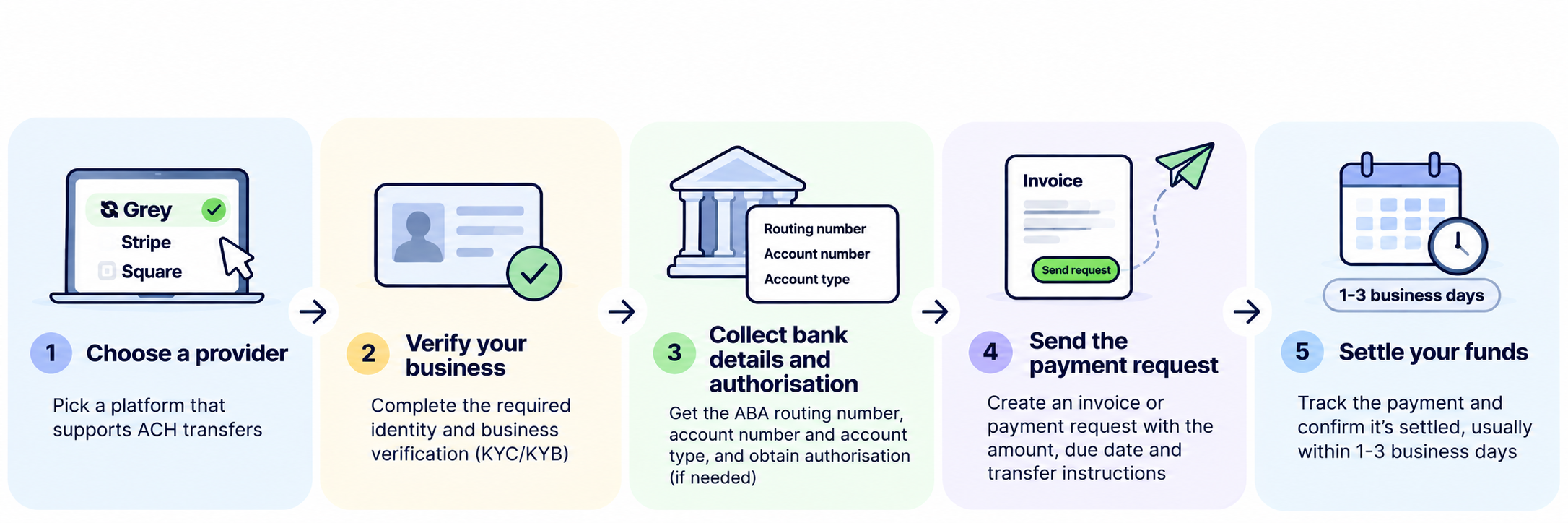
Freelancers looking for apps for freelancers to get paid often need more than a way to receive money; they also want to avoid unnecessary transaction fees. ACH payments offer one option, with several ways to receive funds without paying a receiving fee. These include direct bank-to-bank transfers, Zelle and contractor payment platforms such as Deel, although each comes with different requirements and limitations.
Here are three options worth considering:
While many platforms advertise free ACH payments, the actual costs can appear elsewhere. Monthly subscriptions, failed-payment fees, withdrawal charges and transaction limits can make a supposedly free service expensive. Settlement delays can also affect cash flow, particularly for freelancers who depend on timely payments.
Even when a provider charges no fee to receive funds, transferring funds from a US account to Nigeria may involve additional fees or unfavourable exchange rates.
Before choosing a provider, check its current fee schedule, especially if you receive frequent payments or withdraw funds in Naira. A zero receiving fee does not necessarily mean zero overall cost.
Receiving payments from US clients while living abroad can be challenging if your local bank account does not support ACH transfers. The ACH network only processes payments between eligible US bank accounts, meaning international freelancers often need a US-based receiving account to collect payments from American businesses.
One option is to open a USD account that provides US bank details, including a routing number and account number. This allows clients to send money through ACH without relying on international wire transfers, which can attract higher fees and longer processing times.
Platforms such as Grey provide virtual USD accounts that allow eligible users outside the US to receive payments from American clients. Once your account is set up and verified, you can share your receiving details with clients who want to get paid from the US through a domestic bank transfer.
After receiving your funds, you can move your money abroad by withdrawing or converting your USD balance into your local currency, subject to Grey's supported countries, withdrawal options and applicable fees. This gives international freelancers another way to manage cross-border payments without needing to maintain a traditional US bank account.
Yes. You can accept ACH payments without receiving fees through direct bank-to-bank ACH credits or eligible contractor payout services. However, a free transfer does not always mean a free account. Monthly subscriptions, withdrawal charges, return fees and currency conversion costs may still apply. Check the provider’s fee schedule and eligibility requirements before choosing an option for receiving payments.
Standard ACH transfers typically settle within one to three business days. Eligible transactions may qualify for Same-Day ACH, while some payment processors take five to seven business days, particularly for first-time payments. The actual arrival time depends on the provider’s processing schedule, bank cut-off times, weekends and public holidays. Check the estimated settlement date before relying on funds.
Yes. ACH payments are generally cheaper than card transactions because processing fees are usually lower. Depending on the provider, receiving an ACH payment may be free or cost less than 1%. Card payments often carry higher processing charges, especially for international transactions. Compare the full fees, including currency conversion, before choosing how to collect payments in most cases.
Yes. International freelancers may be able to receive ACH payments through eligible virtual USD accounts from providers such as Grey or Geegpay. These services can provide US routing and account numbers for clients making domestic bank transfers. Availability depends on your country, account verification and provider terms, so confirm that your account supports incoming ACH payments before sharing its details.
An ACH return fee is a charge applied when a bank transfer is rejected or returned. Common reasons include insufficient funds, incorrect account details, a closed account or a payment dispute. The amount varies by bank and payment provider, and some providers may pass the fee to the business receiving the payment. Review the return policy before accepting payments for each transaction.
Yes. International freelancers can receive ACH payments in US dollars through eligible virtual USD accounts that provide US routing and account numbers. After the funds arrive, they may be able to hold the balance, withdraw it or convert it into local currency. Available options, processing times and fees depend on the provider, your country and account verification before making withdrawals.

Fifteen apps freelancers use to get paid internationally, compared on fees, currencies, payout speed and country coverage. See the list. Open an account.
Tunde Aladeloba
•
November 27, 2026
•
2 min read
A freelance developer in Lagos may finish a project for a client in London, while a virtual assistant (VA) in Nairobi could be waiting for payment from a company in New York. Both have completed their work, but getting the money into their local accounts can be a different challenge altogether. Between currency conversion, international transfer fees, delayed payments and limited withdrawal options, receiving money across borders is not always straightforward.
That is why choosing the right apps for freelancers to get paid internationally matters just as much as finding clients. Some platforms let you hold multiple currencies, send professional invoices and receive payments directly from overseas clients, while others offer convenient local withdrawals. However, not every app supports every country or currency, and the cheapest option is not always the most convenient.
To help you make the right choice, we have rounded up 15 apps for freelancers to get paid internationally, comparing their payment options, fees, currency support and accessibility. Whether you work with clients across continents or manage projects for a few overseas businesses, this guide will help you find an option that makes getting paid easier.
Freelancers generally receive international payments through three main routes: freelance marketplaces, virtual foreign bank accounts, and direct bank transfers or payment links. Each route offers a different level of convenience, payment protection and control over how money moves from the client to the freelancer.
Freelance marketplaces provide an all-in-one environment where freelancers find clients, agree on project terms, submit completed work and receive payments. Platforms such as Upwork and Fiverr collect payments from clients and release the funds according to their payment policies. Some also offer escrow protection, which helps reduce the risk of working with clients who refuse to pay after receiving completed work.
The main advantage is that freelancers do not have to negotiate international payment arrangements with every new client. However, marketplace service fees and withdrawal charges can reduce earnings, and freelancers have less control over the payment process.
Virtual foreign bank accounts allow freelancers to receive money in currencies such as US dollars, euros and British pounds without necessarily having a physical bank account in those countries. Providers such as Payoneer, Wise, Grey and Geegpay offer different types of foreign currency receiving details that clients can use to send payments through supported banking networks.
This route is particularly useful for freelancers who work with multiple international clients outside freelancing marketplaces. Instead of asking every client to arrange an international wire transfer, they can provide suitable receiving account details. However, currency conversion, account eligibility and withdrawal options vary by provider and country.
Freelancers who find clients independently can collect payments through traditional international bank transfers or online payment links. With a bank transfer, the client sends money directly to the freelancer's designated account, sometimes through the SWIFT network. Payment links offer another option, allowing clients to pay invoices using supported debit or credit cards.
Services such as Stripe, Paystack and Flutterwave make it easier to collect digital payments, depending on the freelancer's country and account eligibility. This approach gives freelancers greater control over their client relationships and payment terms, although transfer charges, card processing fees and currency conversion costs can affect the final amount received.
A multi-currency account allows freelancers to receive, hold and manage money in different currencies, particularly USD, GBP and EUR. Instead of having every international payment converted automatically into naira or another local currency, you receive the money in the currency your client sends.
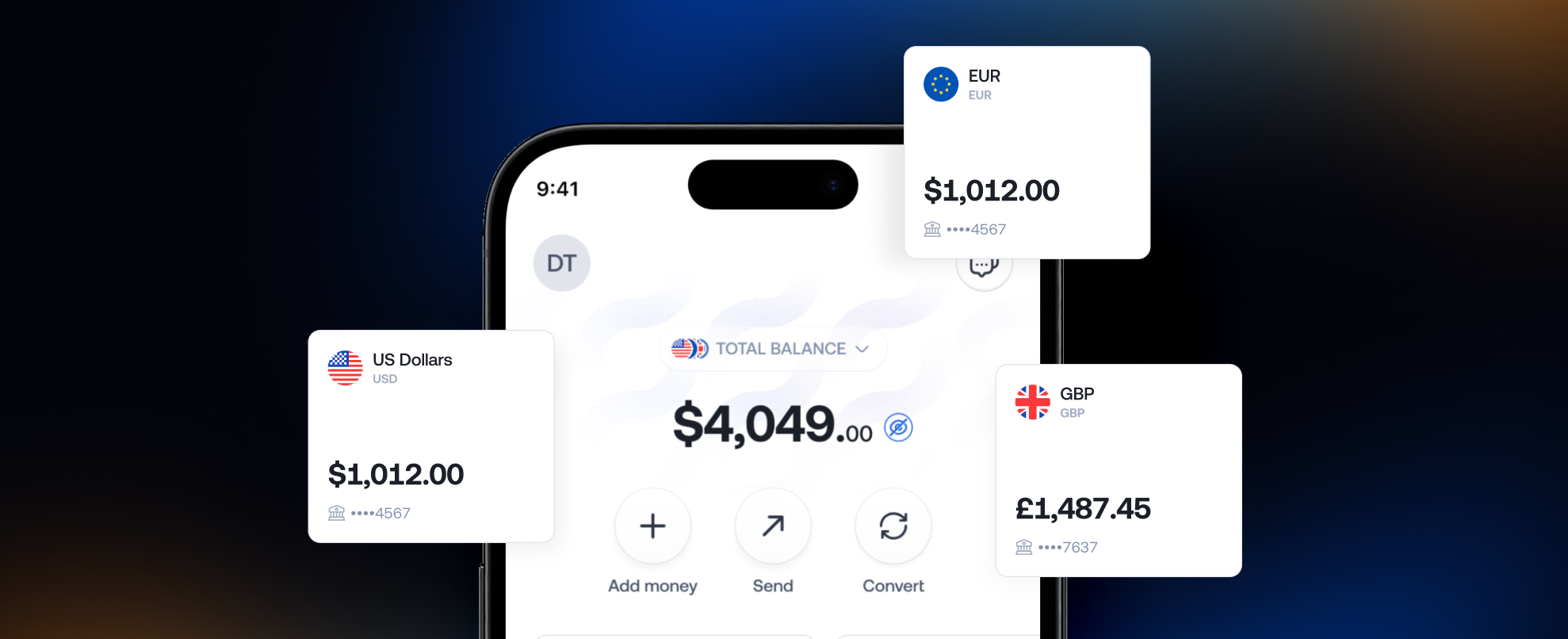
For example, a client in the US can pay you in dollars using your USD receiving details, while a UK client can send pounds to your GBP account. The same applies to euros from eligible European clients.
This is different from receiving international payments directly into a regular local bank account, where:
With a multi-currency account, you can keep your money in its original currency and convert it when needed. This gives you more control over exchange rates and helps avoid unnecessary conversion losses.
Grey makes this easier by offering a multi-currency account where freelancers can manage USD, GBP and EUR balances from one place. You can find out what to look for in a multi-currency account and see how features such as transparent fees, currency support and conversion flexibility can help you manage international earnings more effectively.
These apps help freelancers create professional invoices, send payment requests and collect money from international clients without handling every transaction manually.
1. Payoneer: Sends professional payment requests and allows freelancers to receive international payments through virtual bank details and multiple supported currencies.
2. Paystack: Lets Nigerian freelancers create branded payment links and collect international card payments directly from clients through a simple checkout process.
3. Flutterwave: Supports multi-currency payment links and invoicing, allowing freelancers to bill overseas clients and collect payments through supported international payment methods.
4. Grey: Allows freelancers to create foreign currency invoices and receive payments through USD, GBP and EUR virtual accounts with local banking details.
5. Geegpay: Helps African freelancers create professional invoices, share payment requests and receive international payments through supported foreign currency virtual accounts.
6. Wise: Enables freelancers to request payments, share account details and receive money in multiple currencies through supported international and local banking networks.
7. Stripe: Offers hosted invoices and payment links that allow freelancers to collect international payments through cards and supported bank payment methods.
8. PayPal: Allows freelancers to create and send customised invoices that international clients can pay using their PayPal balances or eligible cards.
9. Deel: Provides contractor invoicing and payment management, helping freelancers submit invoices and receive earnings from international companies through supported withdrawal methods.
10. Wave: Offers free invoicing software that helps freelancers create estimates, send professional invoices, track payments and accept online payments.
11. FreshBooks: Combines invoicing, expense tracking and accounting tools, allowing freelancers to send payment requests and manage client transactions in one place.
12. Zoho Invoice: Provides free invoicing tools for creating customised invoices, automating payment reminders and collecting payments through supported third-party payment gateways.
13. Bonsai: Combines invoicing, contracts, proposals and client management tools, helping freelancers organise projects and collect payments through integrated payment processors.
14. HoneyBook: Helps freelancers manage client bookings, send invoices, automate payment reminders and collect payments through an integrated client management platform.
15. Square Invoices: Allows freelancers to create digital invoices, send payment reminders and collect payments online through supported card and payment methods.
Read also: Best free invoicing tools
The amount an international client sends is not always the amount that reaches your local bank account. Payment apps charge different fees for receiving money, processing card payments and converting foreign currencies. Some advertise low receiving fees but make their money through exchange-rate markups, while others charge a higher upfront fee with more competitive conversion rates.
The table below compares the estimated costs of popular payment apps, including the additional charges freelancers should consider before choosing one.
The easiest way to choose a payment app is to consider where your client is based and how they prefer to send money. Not every client wants to make an international bank transfer, especially when they can pay through a familiar local banking method. Choosing an app that supports your client's local payment network can help reduce transfer fees, delays and payment difficulties.
Also read: ACH, SWIFT, Wire and FedNow: What they are and when to use each
If most of your clients are in the US, consider Grey, Geegpay or Payoneer. These services offer eligible freelancers USD receiving details that allow US clients to pay through domestic ACH transfers rather than expensive international wires. This makes payment more familiar and convenient for American businesses.
For clients in the UK or Europe, Wise, Grey and Geegpay are worth considering. They provide eligible freelancers with GBP or EUR receiving details, allowing clients to pay through UK Faster Payments or SEPA bank transfers. These local payment methods are generally cheaper and simpler than sending money internationally.
Some clients would rather pay an invoice using a debit or credit card than arrange a bank transfer. In this case, Paystack and Flutterwave offer payment links that let clients pay online without setting up a bank transfer. This is particularly useful when working with multiple clients who have different banking preferences.
Virtual multi-currency accounts are often among the cheapest options, especially when clients can pay through local bank transfers. Services such as Grey, Wise and Geegpay offer foreign currency receiving options. Compare receiving, conversion and withdrawal fees before choosing.
Yes. You can use virtual USD receiving accounts from providers such as Grey, Payoneer and Geegpay, subject to eligibility. These accounts provide US banking details that eligible international clients can use to send payments without you owning a physical US bank account.
Payment times depend on the app and transfer method. Local bank transfers can arrive within hours or 1–3 business days, while international SWIFT transfers may take 2–5 business days. Card payments and marketplace withdrawals also have different processing and settlement periods.
Yes, foreign freelance income may be taxable in your country of residence, even when clients pay you in another currency. Your tax obligations depend on local regulations, income thresholds and applicable exemptions. Keep invoices and payment records to support accurate tax reporting.
Grey, Payoneer and Geegpay are worth considering because they offer foreign currency receiving options for eligible African freelancers. The best choice depends on your country, supported currencies, withdrawal methods and transaction fees. Check local availability before opening an account.
Yes. Some invoicing and payment platforms allow you to bill clients in USD, GBP or EUR and receive the converted amount in your local currency. The conversion may happen automatically or when you withdraw, depending on the provider and account settings.

Prohibited items on flights in Nigeria cover weapons, flammables, batteries and restricted exports. See the full list before you fly. Compare the rules.
Tunde Aladeloba
•
November 27, 2026
•
2 min read
A flight can be booked, your bags packed, and your travel documents ready, only for an item in your luggage to cause an unexpected problem at the airport. Sometimes, it is something passengers consider harmless, such as a particular tool, liquid, battery or household product, that attracts attention during security screening. What you can carry also depends on whether the item is going in your hand luggage or checked baggage.
Understanding the prohibited items on flights in Nigeria before leaving home can save you from unnecessary delays, having your belongings confiscated or missing your flight. Some items are banned because they pose fire, explosion or injury risks, while others are restricted under aviation security, customs or airline regulations.
In this guide, we break down the items you cannot take on domestic and international flights departing from Nigeria, including weapons, explosives, flammable products, dangerous chemicals and restricted goods. We also explain the difference between items that are completely prohibited and those you may carry under specific conditions. That way, you can check your luggage properly, avoid airport surprises and know what to leave behind before heading to the airport.
The Nigeria Civil Aviation Authority (NCAA) restricts items that could threaten passenger safety, cause fires or interfere with aircraft security. Some are prohibited in both cabin and checked baggage, while others cannot be carried in hand luggage but may travel in checked baggage under specific conditions. The main categories include:
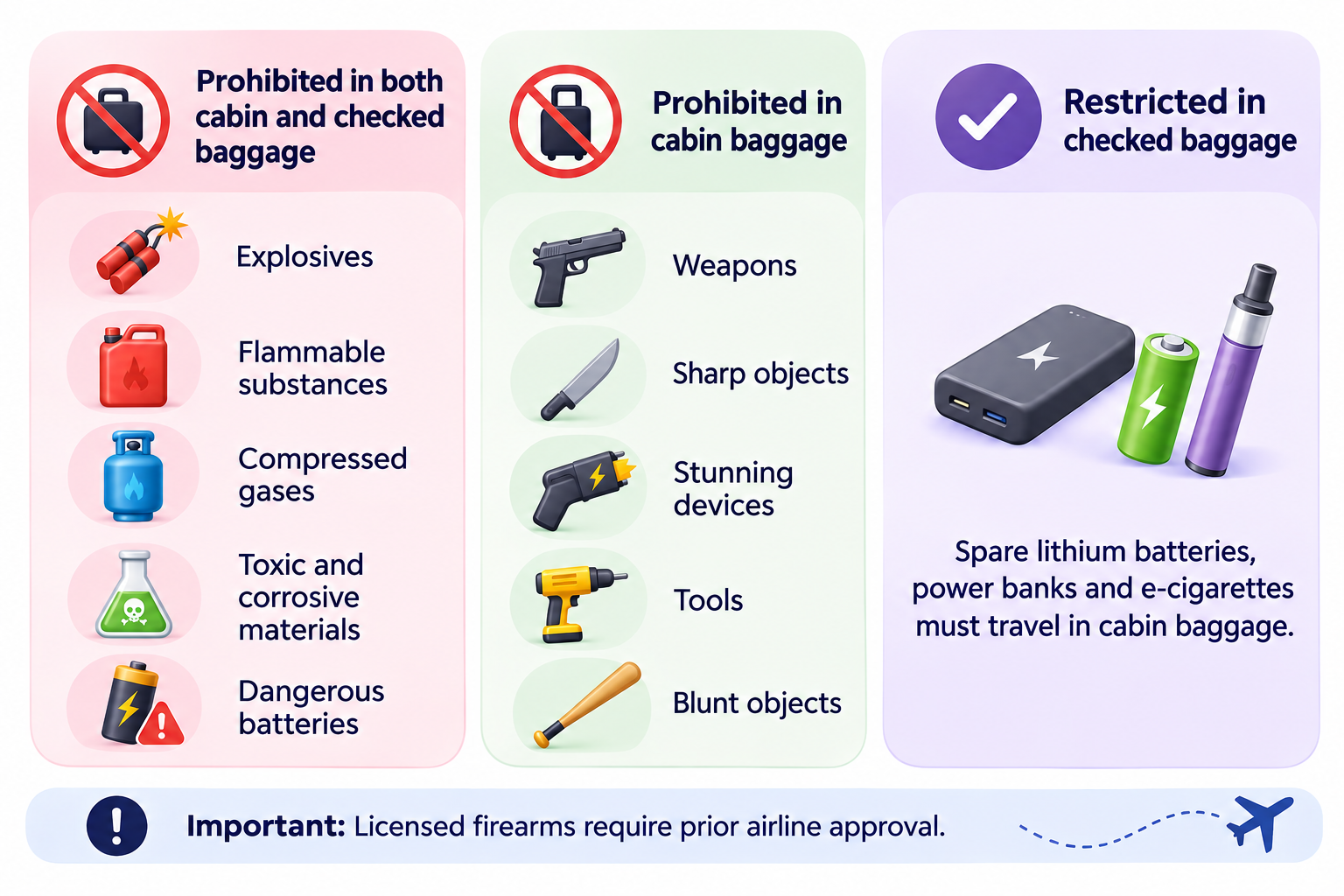
Spare lithium batteries, power banks and e-cigarettes must generally travel in cabin baggage, with terminals protected against short circuits.
Important: Licensed firearms require prior airline approval and special handling. Liquid restrictions also vary by route and airport. Check the NCAA's 2023 Civil Aviation Regulations, particularly Parts 15 and 17, and confirm your airline's requirements before travelling.
Hand luggage is for items you may need during your journey, such as your phone, laptop, medication, and travel documents. However, not everything can go into the cabin. Nigerian aviation security rules place restrictions on liquids, batteries, sharp objects and other potentially dangerous items. Knowing what is allowed helps you pack correctly and avoid having belongings confiscated at security.
You can carry toiletries, creams, perfumes, toothpaste and other liquids in your hand luggage, subject to airport security limits.
These restrictions are particularly important for international flights. For more examples of liquids and other restricted items, see Grey's guide to items banned on a plane.
Laptops, mobile phones, tablets, digital cameras and other personal electronic devices can generally travel in your cabin bag. Spare lithium batteries and power banks must also go in hand luggage rather than checked baggage.
Protect spare battery terminals against short circuits. Damaged or swollen batteries should not be carried.
Some items are permitted on board but cannot be placed in checked baggage due to fire risks or safety concerns. These include:
The Nigeria Customs Service (NCS) maintains an export prohibition list covering certain agricultural products, raw materials and cultural items. These restrictions are designed to protect local industries, preserve natural resources, support food security and prevent the illegal removal of Nigeria's cultural heritage.
The main restricted export categories include:
Unprocessed maize grains are restricted from export to help maintain domestic food supply and prevent shortages.
Rough and sawn wood are prohibited under the export restrictions, helping to discourage deforestation and encourage local processing.
Unprocessed animal hides and skins, including wet blue leather and other unfinished forms, fall under export restrictions.
Ferrous and non-ferrous metal scraps cannot be freely exported, as the restriction supports local recycling and manufacturing industries.
Raw rubber latex and rubber lumps are restricted to encourage domestic processing and value addition.
Cultural objects and historical artefacts cannot be exported without the necessary government authorisation and clearance.
You can carry foreign currency worth US$10,000 or more (or its equivalent in other currencies) out of Nigeria, but you must declare it to the Nigeria Customs Service (NCS). The declaration threshold applies to cash and relevant negotiable instruments. Declaring your money does not automatically mean you cannot travel with it. However, additional information and supporting documents may be required, particularly for larger amounts.

Nigeria Customs now provides an Electronic Currency Declaration Form (e-CDF) for travellers carrying amounts at or above the reporting threshold.
You can also avoid the inconvenience of travelling with large amounts of physical dollars by using a virtual USD account with Grey. This offers a more convenient way to access your foreign earnings without needing to withdraw and travel with physical currency.
Carrying large amounts of cash across borders is not the only way to access your money abroad. Bank transfers and digital payment services allow you to move funds internationally without physically transporting banknotes. They also provide transaction records that help establish the source of your money when required.
Traditional SWIFT transfers typically take 1–5 business days, while digital transfers can arrive within minutes or a few business days, depending on the destination and payment method.
Instead of travelling with physical dollars or pounds, you can keep your money in a foreign currency account and transfer it when needed. A traditional domiciliary account lets you receive, hold and send foreign currencies such as USD, GBP and EUR through a Nigerian bank. This means you can keep your earnings in their original currency rather than converting everything to naira immediately.
Grey offers another way to manage foreign currency without the usual bank visits and account-opening processes associated with traditional domiciliary accounts. You can open virtual USD, GBP and EUR accounts online, receive international payments, hold multiple currencies and convert your money when you need it. You can also send money directly from Nigeria to the UK, making it easier to manage international payments without carrying physical cash.
Firearms, sharp objects, explosives, flammable substances, certain tools, blunt weapons and dangerous chemicals are prohibited in cabin baggage. Liquids, aerosols and gels in containers exceeding 100 ml are generally restricted on international flights. Always check your airline's specific baggage rules before packing, as some items may be allowed in checked baggage instead.
You can carry foreign currency worth US$10,000 or more, or its equivalent, but you must declare it to Nigeria Customs. The declaration threshold does not mean larger amounts are automatically prohibited. You may need supporting documents showing the source of your money, particularly when carrying substantial sums. Confirm the latest requirements before travelling.
Yes, you can carry certain foods, particularly commercially packaged and properly labelled products, subject to airline and destination-country rules. However, fresh fruits, vegetables, meat, seeds and other agricultural products may face restrictions. Some Nigerian agricultural commodities are also subject to export prohibitions. Check the destination country's customs requirements before packing food.
Yes. Power banks are generally allowed in hand luggage but must not be placed in checked baggage. Those rated up to 100Wh are generally permitted, while batteries between 100Wh and 160Wh usually require airline approval. Protect their terminals against short circuits and check your airline's capacity limits before departure.
Airport security may remove and confiscate prohibited items during baggage screening. Depending on the item and circumstances, you could face additional questioning, missed flights, fines or legal action. Carrying undeclared currency, illegal weapons or dangerous substances can have more serious consequences. Always check your luggage before leaving for the airport.
Both follow core aviation safety restrictions covering weapons, explosives, flammable materials and dangerous goods. However, international flights may have additional requirements involving liquid limits, customs declarations, agricultural exports and destination-country restrictions. Domestic routes may also have airline-specific baggage policies. Check both your airline's rules and applicable customs requirements before travelling.

See which countries charge no personal income tax, what residency really requires, and the costs behind the headline. Explore the list.
Odunmorayo Oke
•
November 26, 2026
•
2 min read
Nothing can beat that feeling of waiting for a text/email alert telling you that your salary has landed, only to finally receive it and see that part of your income is missing because you've had ‘income tax’ taken out.
Income tax is a tax charged by governments on the income earned by individuals. This could be money earned from a salary, wages, business profits, or other personal income. In many countries, income tax will automatically be deducted from your salary as an employee. Self-employed individuals may be required to calculate and pay personal income tax themselves.
Governments use this to fund public services and infrastructure such as healthcare, education, transport, and security.
However, how much is paid, who pays, and how income is taxed will depend on the country. A handful of countries charge no personal income tax, mostly Gulf states, Caribbean islands, and small European territories. They usually raise money through VAT, customs duties, or residency fees instead. Becoming a tax resident takes time and money, and US citizens still file on worldwide income.
There are 12 countries globally where you can legally live and work in 2026 with 100% of your personal income and investment earnings.
While you won’t pay any income tax, you will still have to pay tax in some form. All governments need to pay for their roads, hospitals, and public services. So, instead of charging you tax on your payslip, you will pay tax on your groceries, importing a car, renting a flat, or running a business.
If you are working abroad, working remotely, or considering moving abroad, understanding the differences can help you make smarter financial decisions. Here are 12 countries where you can earn income without paying personal income tax.
When searching for countries with no tax, people often imagine they can earn 100% of their income with no further interaction with a revenue body. However, zero-tax countries rely heavily on indirect and corporate taxes such as
VAT and sales duties: Value Added Tax is a consumption tax charged on everyday items and services. Instead of charging tax on the income you earn, you’ll pay tax on the money you spend. Many Gulf states have introduced VAT in the last decade. While you may not pay any tax on your salary in Riyadh or Manama, you’ll pay 15% VAT in Saudi Arabia and 10% VAT in Bahrain.
Import and customs duties: Taxes charged on goods imported into a country. It is usually paid by the importer at the border and will therefore increase the price you pay in shops. Many Caribbean and Pacific island economies depend heavily on imported goods, so customs duties, shipping costs and insurance can make everyday items such as food, electronics and vehicles more expensive.
Corporate and freelance tax: This is a tax paid on the net profit of a registered business or self-employed individual. Just because a country has no general personal income tax does not mean businesses operating there are excluded from taxation.
As of 2026, the United Arab Emirates charges 9% corporate tax on profits from businesses and freelance work over AED 375,000. Bermuda charges 15% corporate income tax on large multinational groups and progressive payroll tax on local earnings.
Property and stamp duty: Stamp duty and property tax are taxes charged by the government, either one-off or annually, on the purchase, sale, or registration of property. If you’re buying or renting property, you’ll pay a high transfer tax, stamp duty, or fees.
Understanding where tax will be charged can help you understand how much it will really cost to live there.
There are more than 20 countries and states globally that charge no personal income tax. However, some are difficult to relocate to due to strict visa requirements. Using data from PwC Worldwide Tax Summaries and OECD Automatic Exchange of Information Portal, here are 12 countries with no income tax in 2026. They have been split by region.
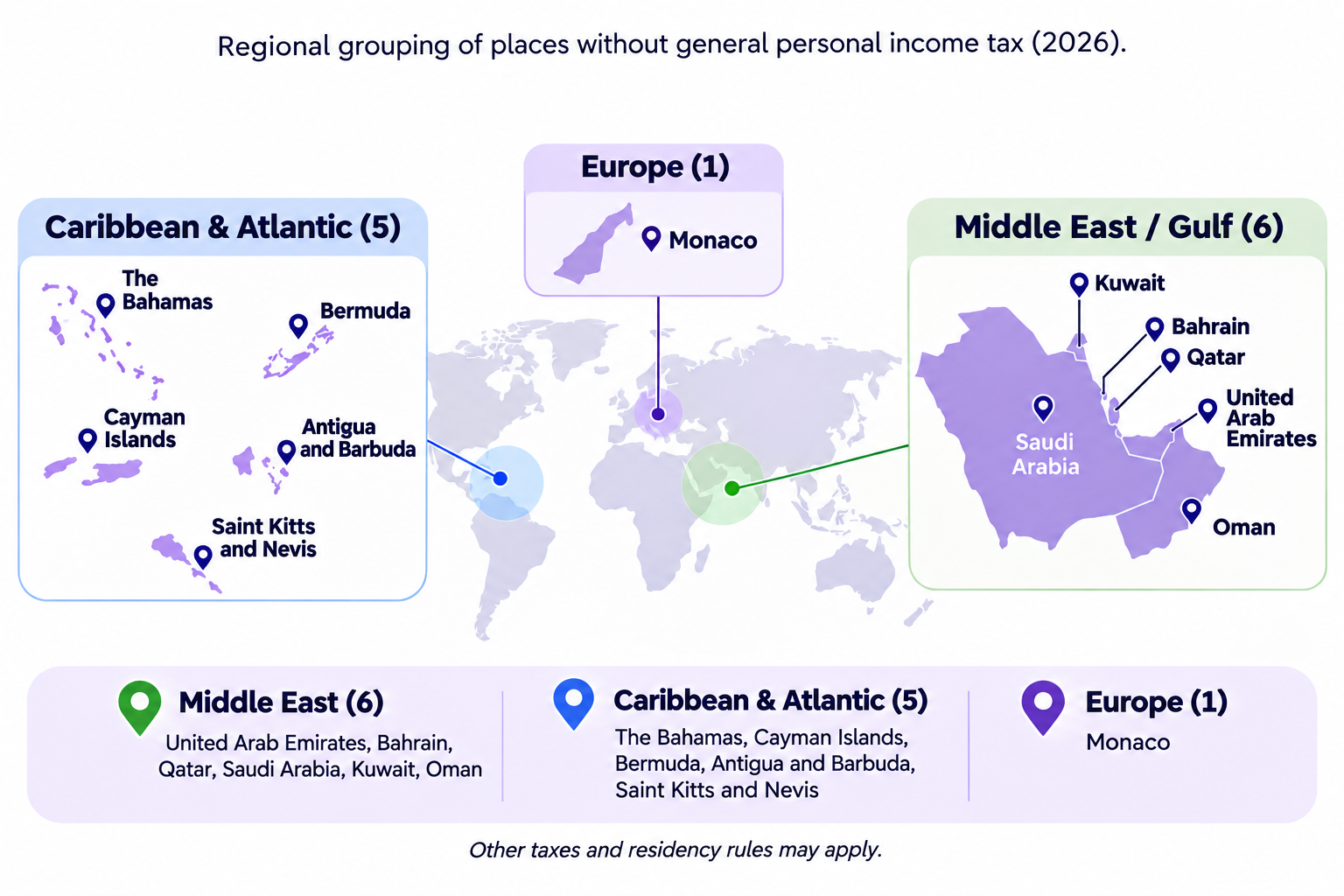
These countries earn enough from oil and gas to fund their roads, schools, and public services without taxing your salary.
Dubai and Abu Dhabi are popular destinations for remote workers, business founders, and expats. In 2026, you pay 0% tax on your salary and share dividends and profits from selling personal assets.
You can get a residency visa through a local job, a remote work visa, a freelance permit, or a 10-year Golden Visa by buying property worth at least AED 2 million. On the flip side, you will pay 5% VAT on shopping, a 4% fee when buying property in Dubai and a 9% corporate tax on business profits over AED 375,000.
Bahrain charges 0% tax on your wages and investment profits. You can move there with a job offer or get a 10-year Golden Residency by buying property worth at least BHD 130,000 or earning BHD 2,000 a month after living there for five years. Everyday costs include a 10% VAT and a 2% property registration fee.
Your salary and personal investment profits are completely tax-free in Qatar.
Property investments of at least QAR 730,000 can qualify eligible foreign buyers for a residence permit without a local sponsor. A higher investment of at least QAR 3.65 million can provide additional permanent-residency-related benefits.
Qatar has no general VAT in force as of November 2026. However, qualifying Qatar-source business income is subject to a 10% income tax. This can include income earned by self-employed individuals carrying out taxable business activities in the country.
Saudi Arabia charges 0% personal income tax on salaries. Expats usually move there on a work visa or through the Premium Residency programme.
The Premium Residency programme offers different products. These include a renewable one-year residency option costing SAR 100,000 annually and a permanent residency option with a one-time fee of SAR 800,000. Foreign property owners may also qualify for the Real Estate Owner Residency product by owning or holding qualifying rights to residential property worth at least SAR 4 million, subject to the programme’s conditions.
Foreign-owned businesses and qualifying non-Saudi ownership interests in companies may be subject to a 20% corporate income tax on their taxable share of profits. Shoppers pay 15% VAT on most taxable goods and services.
This corporate tax should not be confused with personal income tax on an employee’s salary.
Kuwait has no personal income tax and no VAT. However, moving there is difficult unless you have a local job offer, family sponsorship, or a licensed local business.
Foreign-owned companies also pay a 15% corporate income tax on profits made in Kuwait.
Residents in Oman currently pay 0% general personal income tax. You can move there through an employment arrangement or qualifying property investment and residency programmes.
Oman has introduced legislation on personal income tax from 1 January 2028. Under Royal Decree No. 56/2025, a 5% tax will apply to taxable income above OMR 42,000 annually.
These island nations pay for public services using tourism, financial services, import taxes, and visa investment fees instead of taxing your salary.
The Bahamas charges 0% tax on your salary, investment profits, and inheritance. You can move there on an annual residence permit or get permanent residency by buying property worth at least BSD 750,000.
Since 1 January 2025, the minimum investment for economic permanent residency has been BSD 1 million, maintained for at least 10 years.
Everyday shopping comes with VAT and import duties on many shipped goods. The standard VAT rate is 10%.
However, from 1 April 2026, unprepared food has been made zero-rated for VAT, so the standard rate does not apply to every grocery purchase.
The Cayman Islands charges zero personal income tax, zero tax on investment gains, and zero corporate tax.
It also has no general inheritance or gift tax. However, residents and businesses still face other government charges, including import duties, work permit fees and property stamp duty.
Foreign workers can move there through a local employment arrangement or qualify for certain investment-based residency programmes.
One option is a Certificate of Permanent Residence for Persons of Independent Means, which requires an investment of at least US$2 million in developed real estate in the Cayman Islands. Another route, the Certificate of Direct Investment, requires an investment of at least US$1 million in an employment-generating business. Both routes have additional eligibility requirements.
The Global Citizen Concierge Programme is no longer available. It ended in 2022 and should not be considered a current remote-work visa option.
Instead of income tax, the government relies on import duties, financial services licence fees, work permit fees and stamp duties.
Bermuda does not charge personal income tax or general tax on personal capital gains. However, it does charge payroll tax on employment income.
Employers pay this tax, but they can deduct the employee’s share from their salaries. For the 2026/27 tax year (1 April 2026 to 31 March 2027), employees pay between 0.25% and 12.50%, depending on how much they earn each year. The first BMD 48,000 is taxed at 0.25%, while the highest rate of 12.50% applies to annual earnings between BMD 500,001 and BMD 1 million.
If you want to move to Bermuda, you will need a work permit or another qualifying residency option.
Investors may also qualify through Bermuda’s Economic Investment Residential Certificate (EIRC) programme. The programme requires a minimum investment of BMD 2.5 million in approved areas, such as local property, businesses or certain charitable contributions. Applicants must also meet the programme’s investment, holding and residency requirements.
Bermuda also charges a 15% corporate income tax, but only on qualifying multinational groups with annual global revenues of at least €750 million. This tax does not apply to every business in Bermuda.
Residents of Antigua and Barbuda pay 0% general personal income tax on salaries and personal investment income.
You can explore relocation through the country’s ordinary immigration routes or its Citizenship by Investment Programme, which gives qualifying applicants options such as approved real estate investments and contributions to the National Development Fund. Citizenship is not automatic and is subject to due diligence and other eligibility requirements.
The country’s Nomad Digital Residence programme, which previously allowed remote workers to live there for up to two years, ended on 15 November 2025 and is no longer available to new applicants.
Local companies pay a 25% corporate income tax, while shoppers pay a standard 17% Antigua and Barbuda Sales Tax (ABST) on taxable goods and services.
Saint Kitts and Nevis does not charge general personal income tax on employment earnings. Individuals also generally do not pay personal income tax on dividends, interest and capital gains.
Although business income and other specific transactions may be subject to separate tax rules, the absence of personal income tax should not be interpreted as an exemption from every tax obligation.
People from other countries can explore residency or citizenship through qualifying investment routes, including approved real estate purchases or contributions to the Sustainable Island State Contribution.
Applicants must satisfy the programme’s due diligence, financial and other eligibility requirements before citizenship can be granted.
The government generates revenue through a 17% standard VAT, import duties and corporate income tax, which is generally 33% on taxable company profits.
Monaco charges 0% personal income tax on most residents, except for French nationals who are subject to French income tax under the 1963 agreement between France and Monaco.
To obtain a residence card (carte de séjour), you must demonstrate that you have suitable accommodation in Monaco, provide the required criminal record documentation and show that you have enough financial resources to support yourself.
If you are relying on independent financial means, you can provide a certified statement from a Monaco-based bank with sufficient funds.
You may also qualify through employment, business activity or financial support from another person.
Companies that earn at least 25% of their turnover outside Monaco are subject to corporate profits tax, currently at 25%.
Monaco also applies a standard 20% VAT rate, in line with the French VAT system.
Getting a visa to live in a country doesn’t mean you’ll be a legal tax resident. Most countries have 3 main rules to determine if you’re a tax resident:
The 183-day rule: Many countries use the 183-day rule as one of the criteria for determining tax residency, but it is not a universal requirement.
For example, the UAE recognises several routes to tax residency. An individual may qualify after spending at least 183 days in the country within a consecutive 12-month period. There is also a route for individuals who spend between 90 and 182 days in the UAE, provided they meet conditions such as having UAE employment, conducting business there or maintaining a permanent place of residence. A separate route considers whether the UAE is the individual’s primary residence and the centre of their financial and personal interests.
Meeting the requirements for a tax residency certificate is not necessarily the same as meeting the immigration requirements for a residence visa. Always check the rules that apply to your destination and circumstances.

Money and investment requirements: If you are not moving for a local job, you may need to show that you can support yourself financially.
Depending on the country and immigration programme, you may have to show proof of remote employment, a minimum monthly income, sufficient savings or qualifying investments.
For example, the Cayman Islands requires at least US$2 million in developed real estate for its Certificate of Permanent Residence for Persons of Independent Means. Monaco requires evidence of sufficient financial resources, which can be proven through a certified statement from a local bank. Bermuda’s 2026 Economic Investment Residential Certificate programme requires an investment of at least BMD 2.5 million.
These are separate immigration requirements, not universal tax-residency thresholds. A person can qualify for a residence permit without automatically becoming a tax resident.
Cutting ties with your home country:
Moving abroad is only half the job. Your previous country may still consider you a tax resident.
Tax authorities in countries such as the UK, Canada and Australia look at factors including where you maintain your permanent home, where your family lives, your employment arrangements and the location of your economic interests.
Having a bank account, owning property or running a company in your former country does not automatically make you a tax resident there.
Reading up on how dual citizenship works or tools like Estonia e-Residency can help you understand international legal status, though neither replaces actually moving away to end your home tax obligations.
Visa approvals usually take anywhere from four weeks for a Gulf work permit to six months or more for Caribbean and European investor visas. Make sure to budget for legal fees, health insurance, document checks, and property deposits before you apply.
Looking for zero-tax countries for expats works very differently if you hold a US passport because the United States taxes its citizens no matter where they live in the world.
According to the IRS guide for U.S. citizens and residents abroad, American citizens and green card holders must file a US tax return and report their worldwide income every year, even if they live full-time in Dubai, Monaco, or the Cayman Islands.
US citizens living abroad may reduce their US tax bill through the Foreign Earned Income Exclusion (Form 2555).
For the 2026 tax year, eligible Americans can exclude up to $132,900 of foreign-earned income from US federal income tax. To qualify, they must have a tax home abroad and meet either the physical presence test (spending at least 330 full days outside the US within a 12-month period) or the bona fide residence test (living in another country for an uninterrupted period that includes a full tax year).
The exclusion covers eligible employment and self-employment income, but not dividends, interest or capital gains. Income above the exclusion limit may still be taxable, and rental income follows separate rules.
US citizens abroad may also need to file an FBAR (Foreign Bank Account Report) **if the combined value of their foreign bank and financial accounts exceeds $10,000 at any point during the year.
If you want to reduce your US tax bill without dealing with overseas tax rules, consider moving to a US state with no personal income tax.
Other countries have their own rules for people who stop being tax residents. Canada and South Africa, for example, may tax certain assets as though they were sold when someone leaves. France has an exit tax for some shareholders, while Australia has capital gains tax rules for certain assets. These taxes do not apply to everyone and depend on individual circumstances.
Note: Breaking international tax rules can lead to heavy fines. This article is not tax advice, so always speak with a qualified cross-border tax advisor about your personal situation.
Moving to a zero-income-tax country almost always means dealing with more than one currency. You might earn freelance income in US dollars from clients in New York, collect dividends in British pounds, and pay your rent in Emirati dirhams or euros.
Using traditional banks to switch between currencies can eat into the tax savings you want to enjoy. They often add 3% to 5% in hidden exchange rate fees, plus high international transfer fees every time you move money across borders.
Grey is built to make international living and handling your money much simpler. With Grey, you can open a multi-currency account in minutes, hold multiple currencies like USD, GBP, and EUR, and convert your money at clear, minimal rates.
When you need to pay rent, cover bills, or send money home, you can move money between countries straight from your phone without waiting days for bank transfers to clear.
Living across borders? Hold and move multiple currencies with Grey.
12 major countries and territories with zero personal income tax for residents include the United Arab Emirates, Bahrain, Qatar, Saudi Arabia, Kuwait, Oman, the Bahamas, the Cayman Islands, Bermuda, Antigua and Barbuda, Saint Kitts and Nevis, and Monaco. Oman has passed legislation to introduce a 5% personal income tax on high earners starting in January 2028.
No. Under IRS rules, US citizens and green card holders are taxed on their worldwide income no matter where they live. While qualifying expats can exclude up to $132,900 of foreign-earned salary in 2026 under the Foreign Earned Income Exclusion, earnings above that threshold and passive investment income remain taxable by the US government.
Dubai charges 0% personal income tax on salaries, dividends, and personal capital gains. However, residents still pay indirect and business levies, including a 5% Value-Added Tax (VAT) on most goods and services, a 4% property transfer fee, municipal housing fees, and a 9% corporate tax on business or freelance profits above AED 375,000.
Most zero-tax jurisdictions require you to spend at least 183 days per year inside the country to qualify as a tax resident and obtain a Tax Residency Certificate. Some destinations, such as the UAE, offer a 90-day residency route if you maintain a permanent residence and strong economic ties locally, while US citizens claiming the Foreign Earned Income Exclusion must spend at least 330 full days abroad.
Yes. Countries without personal income tax fund public services through higher everyday costs. Expect steeper prices driven by customs duties on imported goods, VAT rates between 5% and 20%, mandatory private health insurance, expensive property minimums, and annual visa or residency renewal fees.
Disclaimer: This article contains general information only and should not be considered tax advice. Tax laws and residency requirements can change frequently, so always consult a qualified cross-border tax professional.

What does PMB mean in an address? Learn how a private mailbox works, how it differs from a PO box, and when to get one. Read on.
Odunmorayo Oke
•
November 26, 2026
•
2 min read
You are filling out a shipping form for an important client, or perhaps checking the return address on a package from a US supplier, when three mysterious letters catch your eye: PMB. It is not a street name, nor is it a suite number, and it certainly does not look like a standard post office box. If you have ever paused mid-checkout wondering if that address is legitimate or if your courier will get lost trying to find it, you are not alone.
PMB stands for private mailbox. It is a mailbox rented from a private company rather than the postal service, and it appears on the address line as "PMB" followed by your box number. In comparison to a PO Box, which uses a numbered box address within a post office, a PMB uses a street address, so it can receive regular mail and packages from private couriers.
When you encounter the abbreviation PMB in letters or emails, it indicates that the recipient uses a private mailbox service rather than a standard residential or commercial street address. For anyone researching “what does 'PMB' mean in an address”, understanding how it works is important. A PMB address is typically hosted by commercial mail receiving agencies, UPS stores, or independent shipping outlets.
Compared to government-issued postal boxes, a PMB gives you a real, physical street address rather than just a post office box number. This changes how mail and packages can be delivered to your location. To format a US PMB address correctly, include the recipient’s name, the PMB designation and box number, the facility’s street address, and the city, state and ZIP code. For example:
JOHN DOE
PMB 456
123 BUSINESS AVENUE
CITY, STATE 12345
You can also place the PMB designation and number on the same line as the facility’s street address, provided the address follows USPS formatting guidelines. Correct formatting helps postal services and delivery companies identify the intended recipient and mailbox.
Renting a private mailbox provides a secure and flexible alternative to using your home address for public-facing correspondence. When you sign up for a PMB, the provider performs strict identity checks in compliance with postal regulations, often requiring government-issued photo identification and proof of address.
In the United States, customers renting a PMB through a commercial mail receiving agency must complete USPS Form 1583, which authorises the agency to receive mail on their behalf. Applicants must provide two acceptable forms of identification. One must be a government-issued photo ID, while the other must establish a permanent address.
Once your account is active, the facility accepts all incoming mail and packages on your behalf. Depending on the provider and your mailbox agreement, this can include deliveries from USPS and private carriers such as FedEx, UPS and DHL.
Some providers also have features such as mail scanning, forwarding and package notifications. If you travel frequently or manage your operations remotely, staff can photograph your mail envelopes as they arrive or forward your packages to another address, sometimes internationally. You may need to pay additional fees for opening and scanning mail, package handling or forwarding. This setup keeps your personal location private while ensuring you can manage your deliveries remotely.
Trying to decide which postal option to use can be confusing when abbreviations start to get mixed up. To clarify the differences between a private mailbox, a traditional post office box, and a virtual address, consider the comparison below.
According to official guidelines on postal and private mailbox address conventions, understanding these operational boundaries helps you select the right service for your needs (learn more via USPS).
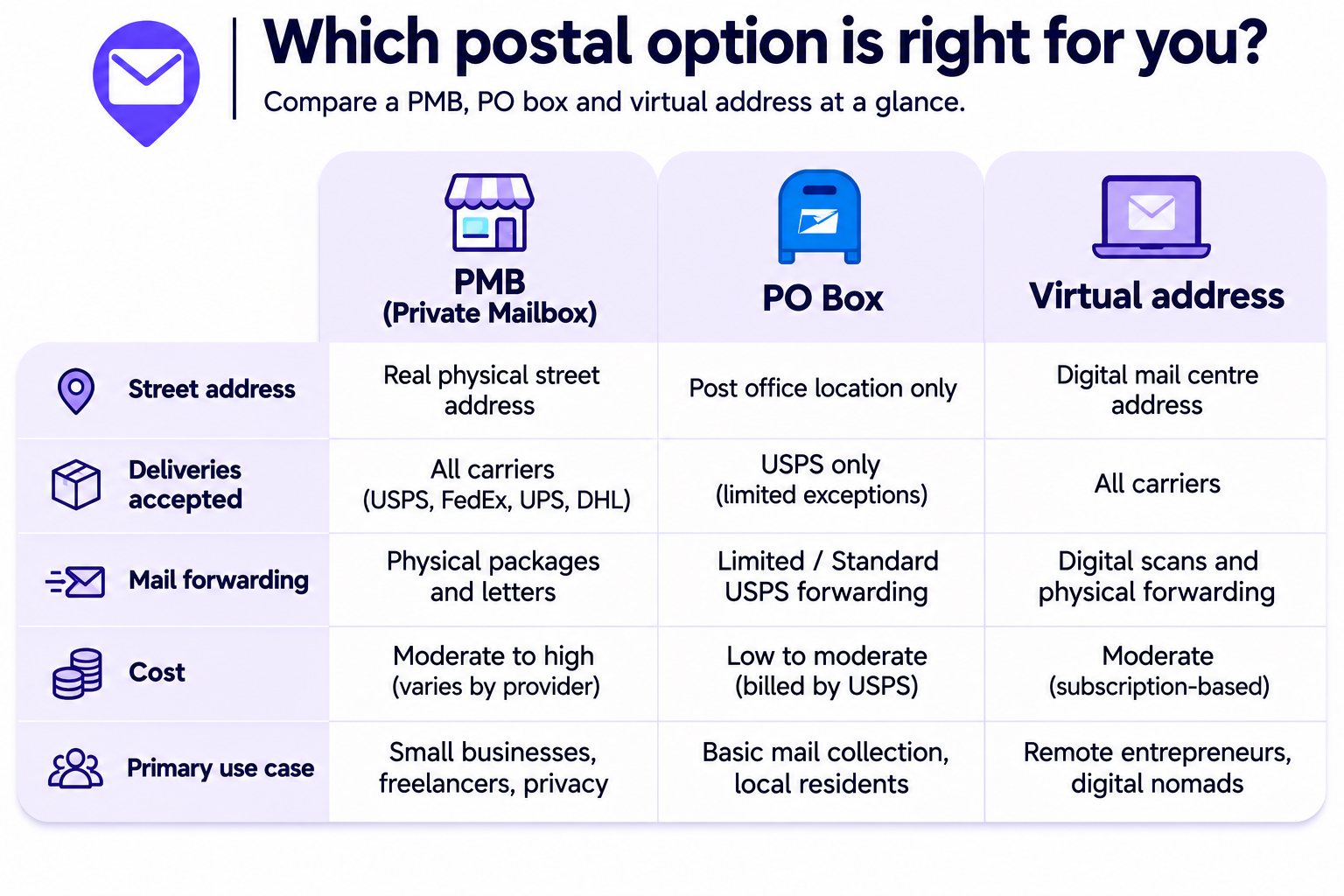
A PO Box usually accepts deliveries from USPS only. However, some locations have street addresses, which allow customers to receive packages from private couriers. PMBs and virtual mailboxes can also accept deliveries from different carriers, depending on the provider.
Securing a private mailbox is a straightforward process, though it requires specific documentation to prevent fraud. If you are establishing a professional presence or exploring how to get a PMB address, the steps remain consistent across most commercial providers.
First, locate a commercial mail receiving agency or shipping store near your target location, or choose an online provider if you prefer digital management. Next, complete the required verification paperwork.
Typical costs range from $10 to $30 per month depending on the box size, location, and additional services like mail scanning. Many freelancers and independent professionals find that securing a mailing address goes hand in hand with structuring their business, especially when evaluating whether they need an LLC to freelance and protect their personal assets.
For international founders, digital creators, and remote professionals operating outside the United States, having a reputable US mailing address is a smart operational move.
It gives you a US address for business mail and packages while keeping your home address private. However, having a PMB does not make you a US resident, register your business or establish a physical business location.
A mailing address only solves the logistics side of running a cross-border business, and it comes with some limitations. A PMB may not meet the address requirements for opening a bank account. US banks generally require individuals to provide a residential or business address, while businesses must provide their principal place of business or another physical location. Requirements may vary between banks, so a PMB alone may not be enough.
Once your mail handling is sorted, the bigger task is moving your money without losing a chunk of your money to high wire fees or sluggish transfer times. This is where Grey steps in to make things easy for you.
Built for global freelancers, remote workers, and international businesses, Grey bridges the financial gap when you are working with US clients from abroad. Eligible users can open a USD account in their name to receive local ACH and wire payouts.
From there, you can effortlessly send and receive money from the US at competitive exchange rates and spend on a virtual card for software subscriptions, ad spend, and international suppliers. If you are still mapping out your broader US entity structure, it also helps to review what you need to open a business bank account and weigh what an LLC costs to set up before making your next move.
Running a US-facing business from abroad? Open a Grey account to hold and move USD.
PMB stands for Private Mailbox. It refers to a mailbox rented from a private company, usually a Commercial Mail Receiving Agency (CMRA), which receives and holds mail on behalf of individuals and businesses.
No. A PO Box is issued by the postal service and uses a post office box number, whereas a PMB is rented from a private mailbox provider and generally uses the provider’s street address alongside your individual mailbox number.
Yes. Many freelancers and small business owners use a PMB to maintain privacy and receive professional mail and packages. Note that a PMB may not meet the address requirements for business registration, licensing or certain financial services. Check the relevant institution’s requirements before using one for official purposes.
Not necessarily. US banks generally require a residential or business street address for identity verification, although their requirements vary. A PMB may be accepted as a separate mailing address, but you should not assume it will satisfy the physical address requirement.
Yes, many private mailbox providers accept packages from couriers such as FedEx, UPS and DHL. However, delivery acceptance depends on the provider, location and mailbox agreement. Check these conditions before renting a mailbox.

Items banned on a plane range from lithium batteries to certain liquids and sharp objects. See the full 2026 list by category. Compare before you pack.
Tunde Aladeloba
•
November 26, 2026
•
2 min read
Some everyday items you wouldn't think twice about packing can become a problem at airport security. That perfume you use every day, the power bank you carry everywhere, your favourite pocket knife or even a bottle of water could cause problems at airport security if you don't know the rules. What seems harmless in your handbag or suitcase may be restricted or completely prohibited on an aircraft.
Items banned on a plane generally fall into six groups: explosives and flammables, compressed gases, corrosives, toxic substances, lithium batteries above permitted limits, and sharp or blunt weapons. Some items are prohibited in carry-on luggage but allowed in checked baggage, while others cannot be carried on an aircraft at all. Restrictions vary depending on your airline, destination and aviation authority.
This is why checking your luggage before heading to the airport matters. You don't want to arrive at security only to have an expensive item confiscated, face unnecessary delays or risk missing your flight.
In this article, we'll cover more than 200 restricted and prohibited items, explain where they belong and help you understand what you can safely pack before your next trip.
Six main hazard categories are prohibited from aircraft entirely: explosives, flammable materials, toxic substances, corrosives, radioactive materials and disabling devices. These items pose risks to passengers, crew and aircraft safety, so they cannot be packed in either carry-on or checked luggage.

Some items are too sharp, heavy or potentially dangerous to be carried inside the aircraft cabin but can travel safely in checked baggage. These include certain sharp objects, work tools, sporting equipment and liquids that exceed airport security limits. If you're unsure whether something belongs in your hand luggage, check the rules before packing to avoid having it confiscated at security.
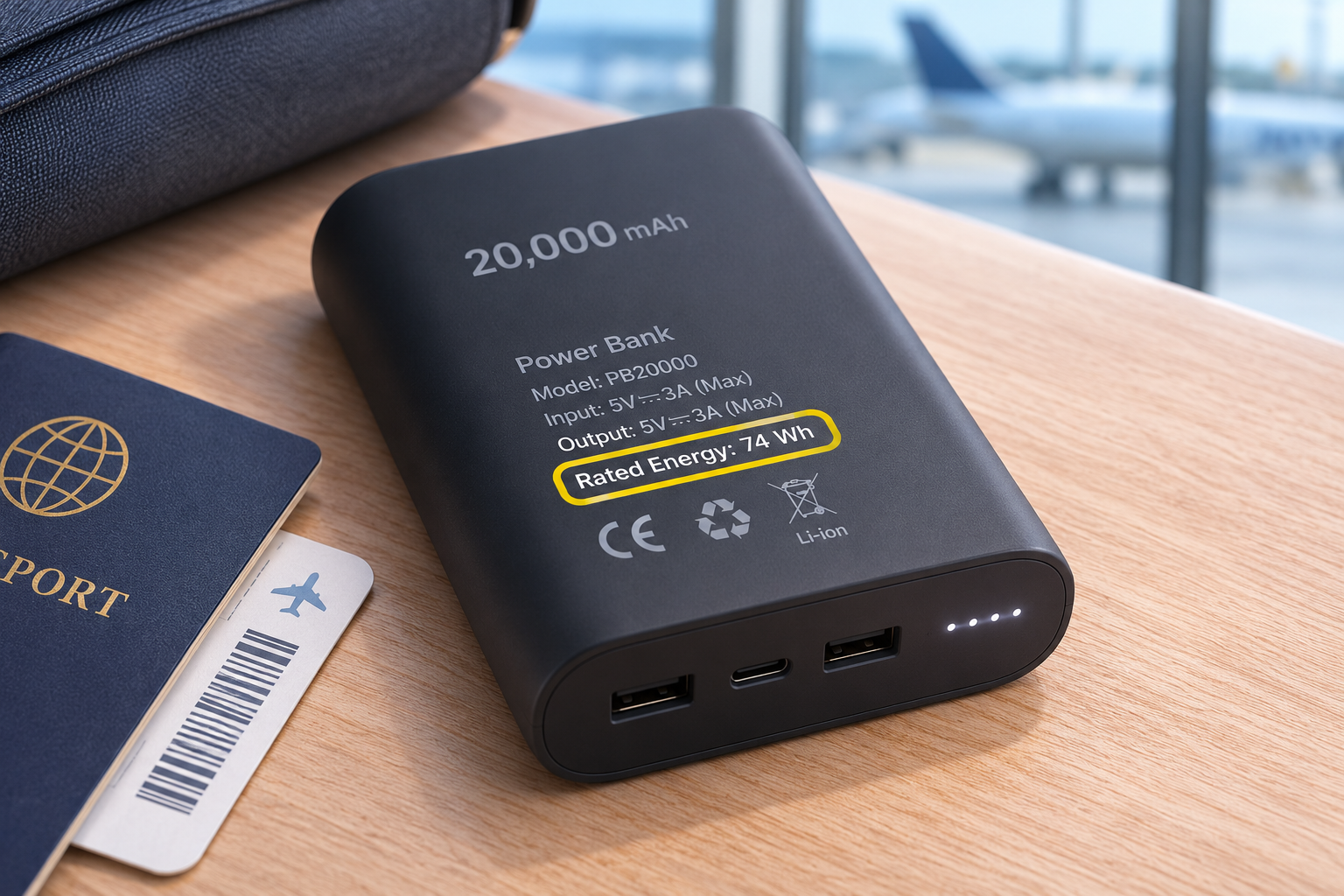
Certain battery-powered devices and spare lithium batteries must travel in the cabin rather than checked baggage because of the fire risk they pose. According to the FAA's PackSafe guidance, power banks and spare batteries must remain with passengers, subject to capacity limits.
Packing your suitcase according to your airline's baggage policy is a good start, but it doesn't mean every item will automatically be allowed throughout your journey. Air travel restrictions operate at different levels: national aviation regulations, airport security requirements, transit-country rules and individual airline policies. An item permitted on your departure flight could still cause problems when you land or pass through another airport.
Here are three important differences to consider before travelling.
Airlines have specific rules for suitcases containing built-in lithium batteries. If the battery is removable, you may be allowed to check in the suitcase after removing it and carrying the battery in the cabin. However, smart luggage with non-removable batteries exceeding permitted limits may be refused altogether. Always check your airline's battery policy before purchasing or packing one. While preparing for your trip, a Grey travel eSIM can also help you stay connected when you land, without having to search for a local SIM card at the airport.
Connecting flights can introduce additional restrictions because you may have to pass through security screening again. For example, liquids purchased at an airport duty-free shop may be confiscated during transit if they are not properly sealed in an approved tamper-evident bag with proof of purchase. Check the transit airport's requirements before buying perfumes, alcohol or other liquids.
Some countries prohibit items that airlines might otherwise allow onboard. Australia, for example, has strict biosecurity requirements covering fresh food, plants and animal products. Thailand also prohibits the importation of e-cigarettes and vaping products. Travellers should check destination-country customs rules rather than assuming cabin or checked baggage approval means an item can enter the country. For international purchases and travel expenses, a Grey virtual card gives you another way to manage eligible online payments while abroad.
Finding a prohibited item in your luggage doesn't always mean you'll be denied boarding or face legal trouble. What happens next depends on the item, where it is discovered and whether it poses a safety risk. Airport security officers and airline staff follow specific procedures to deal with prohibited items, ranging from confiscation to reporting dangerous goods to the relevant authorities.
Here are three possible outcomes:
If security finds an item that is prohibited in hand luggage but permitted in checked baggage, you may be given the opportunity to return to the check-in counter and repack it, provided time and airport procedures allow. Otherwise, the item may be surrendered or confiscated. Oversized liquids, pocket knives and prohibited tools are common examples. Some airports also provide facilities for mailing certain items home, although this isn't guaranteed.
Carrying dangerous goods, undeclared explosives, or prohibited weapons can have more serious consequences. Depending on the country's laws and the circumstances, you could face financial penalties, questioning by airport police, prosecution or refusal of carriage. In the United States, for example, the FAA can impose substantial civil penalties for dangerous goods violations. The severity depends on the nature of the violation and applicable regulations.
When airport staff discover hazardous materials, they may isolate the affected baggage, prevent it from being loaded and notify the airline's dangerous goods personnel. Suspected serious incidents can also be reported to airport authorities and national aviation regulators. These reports help investigators identify safety risks and prevent similar incidents on future flights.
Yes, you can bring a power bank on a plane, but it must travel in your hand luggage rather than checked baggage. Most airlines allow power banks up to 100 watt-hours (Wh) without special approval. Those between 100 and 160 Wh generally require airline approval, while anything above 160 Wh is prohibited on passenger aircraft. Always protect the terminals against short circuits.
Yes, small nail scissors are generally permitted in hand luggage, provided they meet the airport's blade-length restrictions. Rules vary by country: some authorities use a 6 cm limit, while US rules generally allow scissors with blades shorter than 4 inches. Larger scissors may need to go in checked baggage.
Yes, personal-care aerosols such as deodorant and hairspray are generally allowed, subject to airline and aviation authority restrictions. In hand luggage, they must normally be in containers of 100 ml or less. Checked baggage may allow larger toiletry aerosols, commonly up to 500 ml per item, subject to quantity and packaging limits.
Flammable fuels, certain chemicals, corrosive liquids and other dangerous substances are prohibited from passenger aircraft. Ordinary liquids such as shampoo, perfume and drinks are generally allowed in checked baggage. However, hand luggage usually has a 100 ml container limit under standard airport security rules, although some airports operate approved alternative screening systems.
Yes, most solid foods, including sandwiches, biscuits, bread, fruit and packaged snacks, can pass through airport security. However, foods with liquid, gel or spreadable consistency, such as yoghurt, jam, sauces and peanut butter, generally fall under cabin liquid restrictions. International travellers should also check destination customs rules because some countries restrict fresh produce, meat and dairy products.
The outcome depends on the item and the applicable aviation rules. Harmless restricted items, such as oversized liquids or prohibited cabin tools, may be confiscated or returned to you for repacking in checked baggage if permitted. Dangerous goods, explosives and prohibited weapons can result in seizure, questioning, financial penalties or prosecution. Serious incidents may also be reported to aviation authorities.

Employer of record vs PEO: see which model legally employs your staff and when each one fits. Written for cross-border hiring teams. Compare both now.
Priscila Marotti
•
November 26, 2026
•
2 min read
Hiring someone in another country sounds exciting until you start looking into employment laws, payroll taxes, contracts and local regulations. Suddenly, bringing one new person onto your team involves a lot more than sending an offer letter.
If you're expanding internationally, you've probably come across two options: an employer of record (EOR) and a professional employer organisation (PEO). Both help businesses manage employees, but they work in very different ways.
So, when comparing an employer of record vs PEO, which one makes more sense for your business?
An employer of record (EOR) legally employs staff on your behalf, allowing you to hire in another country without setting up a local company. A professional employer organisation (PEO) shares certain employment responsibilities with your existing business through co-employment. The biggest difference is who legally employs your workers and whether you need a registered local entity.
Let's look at how both models work, what they cost and how to choose the right one for your growing team.
The easiest way to understand the difference between an EOR and a PEO is to look at who takes responsibility for employment.
An EOR becomes the legal employer of your workers in the relevant country, while a PEO works alongside your existing business to manage employment-related tasks.
Here's how the two compare:
You may also see the term PEO employer of record used when researching international hiring. This can be confusing because a PEO may handle payroll administration and certain employer-related filings without becoming the sole legal employer of your staff.
The important thing is to check the actual employment arrangement, not just the terminology a provider uses.
An employer of record (EOR) is a third-party organisation that legally employs workers on behalf of another company, allowing businesses to hire internationally without setting up a local entity.
Imagine you run a US-based technology company and find an excellent developer in the Philippines. You want to hire them full-time, but you don't have a registered company there or the infrastructure to manage local payroll and employment regulations.
An EOR becomes the developer's legal employer, taking care of these responsibilities while you manage their everyday work.
An EOR typically handles the legal and administrative aspects of employment, including:
Your company remains in charge of daily operations, including assigning tasks, managing performance and setting team goals.
This arrangement is particularly useful for businesses looking to explore new markets, build international teams or expand without investing in local subsidiaries.
However, working with an EOR doesn't remove all your legal responsibilities. Your company may still be accountable for workplace practices, intellectual property and data protection, depending on local laws and contractual arrangements.
For a closer look at the model, read our guide explaining what an employer of record is.
A professional employer organisation (PEO) shares certain employment responsibilities with your business through a co-employment arrangement. Unlike an EOR, a traditional PEO generally requires your company to have an existing legal entity in the country where your employees work.
Imagine you run a growing marketing agency in California with 30 employees, but managing payroll, benefits and HR paperwork is becoming increasingly time-consuming.
A PEO helps you manage these responsibilities while your company remains an employer.
A PEO typically helps businesses manage employment-related tasks, including:
Your company continues to manage employees' daily work, performance and business decisions.
Working with a PEO may also give smaller businesses access to employee benefits that would otherwise be expensive or difficult to manage independently.
However, employment responsibilities are shared. Your company remains accountable for workplace practices, employee supervision and its obligations under applicable laws.
If you're exploring this option, our guide to what a PEO is explains the model in more detail.
The main differences between an EOR and a PEO come down to four things: local entity requirements, geographic coverage, compliance responsibilities and costs.
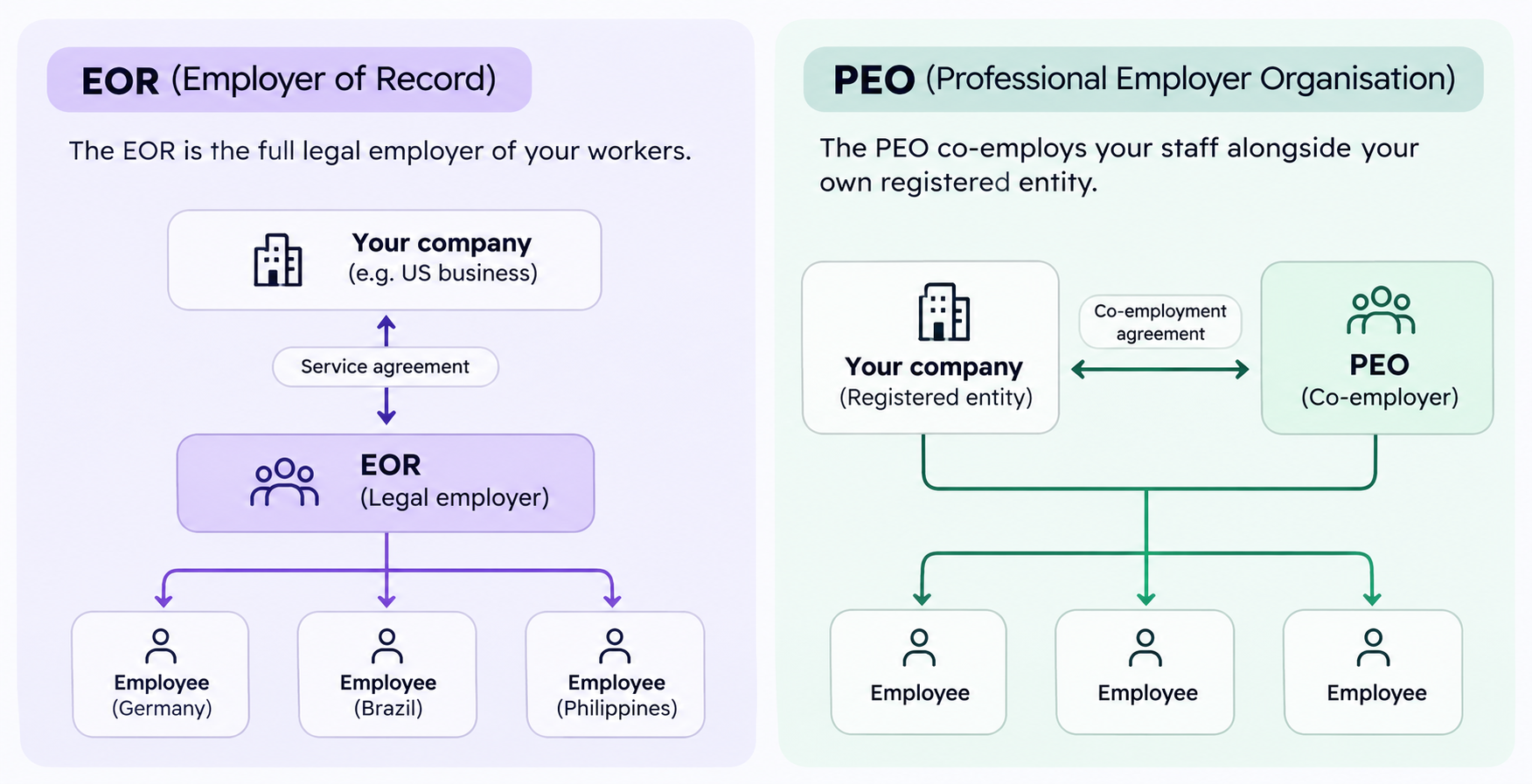
1. Local entity requirements
An EOR allows you to hire employees in another country without establishing your own local entity, while a traditional PEO generally requires an existing registered business.
For example, if you're a US company hiring your first employee in Germany, an EOR may be the more practical option. If you already have a German subsidiary, a PEO or local HR outsourcing provider may be a better fit.
2. Geographic coverage
EOR services are designed for international hiring, allowing businesses to build teams across multiple countries without establishing a separate company in each location.
Traditional PEOs are more commonly used for domestic employment, particularly in the US.
Some providers offer international PEO services, but these may operate through an EOR or another employment structure. Always check which model applies in your target country.
3. Compliance and legal responsibility
An EOR becomes the formal legal employer, handling responsibilities such as employment contracts, payroll taxes and statutory contributions.
With a PEO, these responsibilities are shared between your company and the provider through a co-employment agreement.
Neither model removes all your legal obligations. Your business may still be responsible for workplace safety, employee classification and other employment matters.
The US Department of Labor's guidance on joint employment explains how employment responsibilities can extend to more than one organisation under certain US labour laws.
4. Costs and pricing
EOR providers typically charge a fixed monthly fee per employee, while PEOs often charge a fee per employee or a percentage of payroll.
For example, an EOR charging $500 per employee would cost $2,500 per month for five employees. A PEO charging $150 per employee would cost $750 for the same number of workers, assuming your business already has a local entity.
These figures are illustrative and exclude salaries, taxes, benefits and additional charges.
When comparing costs, look beyond the monthly fee. An EOR may be more expensive per employee but save you the cost of establishing and maintaining a foreign entity. A PEO may offer better value if your business is already established and you're looking to scale your HR operations.
Choose an EOR if you want to hire employees in a country where you don't have a legal entity. A PEO is a better fit if your business is already established and needs support managing HR, payroll and employee benefits.
An EOR is particularly useful when hiring your first overseas employees, exploring new markets or building a global team.
Imagine your US-based software company wants to hire a designer in Brazil, a developer in India and a customer support specialist in the Philippines. Instead of establishing three separate legal entities, an EOR can manage local employment arrangements while you focus on running your team.
However, as your workforce grows in a particular country, establishing your own entity may become more cost-effective.
A PEO makes sense when your business is growing and managing HR internally is becoming increasingly demanding.
For example, if your consulting firm has grown from 10 to 80 employees, a PEO can help manage payroll, benefits, onboarding and HR administration without the need to build a large internal HR department.
You get professional HR support while maintaining your existing employment structure.
If you're working with independent contractors, you may not need an EOR or PEO. You can generally engage them directly through a service agreement and pay them for their work.
However, the working relationship must meet local classification rules. If someone follows a fixed schedule, works under direct supervision and operates like a regular employee, they may need to be classified as one.
Understanding the difference between a contractor and an employee can help you avoid legal and tax complications.
With an EOR, you fund the provider, which handles local payroll. With a PEO, payroll is managed through your existing business and its agreed payroll arrangements.
When managing an international team, you'll also need to consider exchange rates, transfer fees and payment delivery times.

The payroll process with an EOR typically involves four steps:
For example, if your US company employs someone in Brazil, you might receive an invoice in USD while the employee gets paid in Brazilian reais.
Make sure you understand how your EOR handles currency conversion, funding deadlines and additional payroll fees.
A PEO manages payroll, tax deductions and employee benefits through your existing business's employment structure.
If you operate in multiple countries, you may need separate payroll arrangements for each location. A traditional US PEO, for example, won't necessarily handle payroll for employees in the Philippines or Kenya.
Check which countries your provider supports and what payment options are available.
Beyond payroll, running a global team involves moving money across borders. You might need to fund an overseas payroll provider, transfer money between business accounts or pay international contractors.
Grey helps businesses manage eligible international payments and hold and send multiple currencies, giving them more flexibility over when they convert their money.
You can explore different payment routes to pay your team from the US. For example, if you're working with a freelance developer in Manila, you can send money from the US to the Philippines through supported payment methods.
Grey complements your employment arrangements by helping you manage international payments rather than replacing your EOR, PEO or payroll provider.
Before choosing a payment method, consider:
Remember that paying a contractor's invoice is different from processing an employee's salary. Choosing the right employment model and payment method can help you manage costs and keep your international team paid on time.
The main difference is who legally employs your staff. An EOR becomes the formal legal employer of workers on your behalf, while a PEO shares certain employment responsibilities with your existing company through co-employment.
An EOR is particularly useful for hiring internationally without establishing a local entity. A PEO generally supports businesses that already have a registered presence where their employees work.
An EOR is usually the better option if you want to hire employees in another country without establishing your own local company.
If your business already has a legal entity in that country, a PEO or local payroll and HR provider may be suitable.
The best choice depends on your existing business structure, workforce size, budget and long-term hiring plans.
Yes, a traditional PEO generally requires your business to have a registered legal entity in the jurisdiction where employees work.
This is because a PEO operates through a co-employment arrangement rather than replacing your company as the employer.
Some providers offer international PEO services without requiring a local entity, but these may actually use an EOR structure. Always confirm the legal employment model before signing an agreement.
Under an EOR arrangement, the EOR is the formal legal employer, although your company still directs the employee's daily work and may retain certain legal responsibilities.
Under a traditional PEO arrangement, your company remains an employer, while the PEO assumes specified employment-related responsibilities through co-employment.
The exact allocation of responsibilities depends on local laws and the provider agreement.
A PEO may be cheaper per employee for an established business with a larger workforce, but an EOR can be more economical when you're hiring a small number of employees in countries where you don't have a legal entity.
EOR fees often reflect the additional responsibilities and infrastructure involved in international employment.
To compare costs accurately, include service fees, employer taxes, benefits, local entity expenses, payroll charges and any currency conversion costs.
You can pay an international team through an EOR, a local payroll arrangement supported by a PEO or direct contractor payments, depending on the worker's legal classification.
For employees hired through an EOR, you'll generally fund the provider, which processes salaries and statutory deductions locally.
For independent contractors, you may be able to use an international payment platform such as Grey to send money to supported countries, subject to account eligibility and payment requirements.
Hiring internationally gives your business access to people and skills beyond your home market. But managing the money behind a global team deserves just as much attention as finding the right people.
Once you've chosen the appropriate employment model, Grey can help you explore cross-border payment options, manage supported currencies and send money internationally.
Explore how to pay your global team with Grey.

Freelance and contract work differ on clients, control, tax forms and how you get paid. See which suits your setup. Compare both before you decide.
Tunde Aladeloba
•
November 25, 2026
•
2 min read
The way people work has changed, and so has the language we use to describe independent work. Today, someone can earn a living designing websites for clients in three different countries, while another person works with a single company on a six-month project without becoming a permanent employee. Both may work remotely, set their own rates and enjoy a level of independence that traditional employment rarely offers. Yet, one is often described as a freelancer and the other as a contractor.
A freelancer works with multiple clients on short-term projects, usually setting their own rates and working hours. A contractor typically works with one client for an agreed period, often under a fixed contract. Both work independently, but contract work generally offers more predictable income.
The difference matters more than you might think, especially if you're trying to build a sustainable career outside the traditional 9-to-5. Your working arrangement can influence how you find clients, negotiate payments, manage your workload and plan your finances. It can also determine the kind of agreements you sign and the responsibilities you take on.
Understanding freelance vs contract work is important before accepting your next remote opportunity or deciding how to offer your services. Although both arrangements have plenty in common, they are not interchangeable. Here's what separates them and how to decide which arrangement works best for you.
The main difference between a freelancer and a contractor is how they work with clients, how long their engagements last and how much control they have over their daily responsibilities. While both are self-employed and offer services to businesses, their working arrangements are not quite the same. A freelancer typically works with several clients on short-term projects, while a contractor is usually hired by one company for a fixed period or specific assignment.
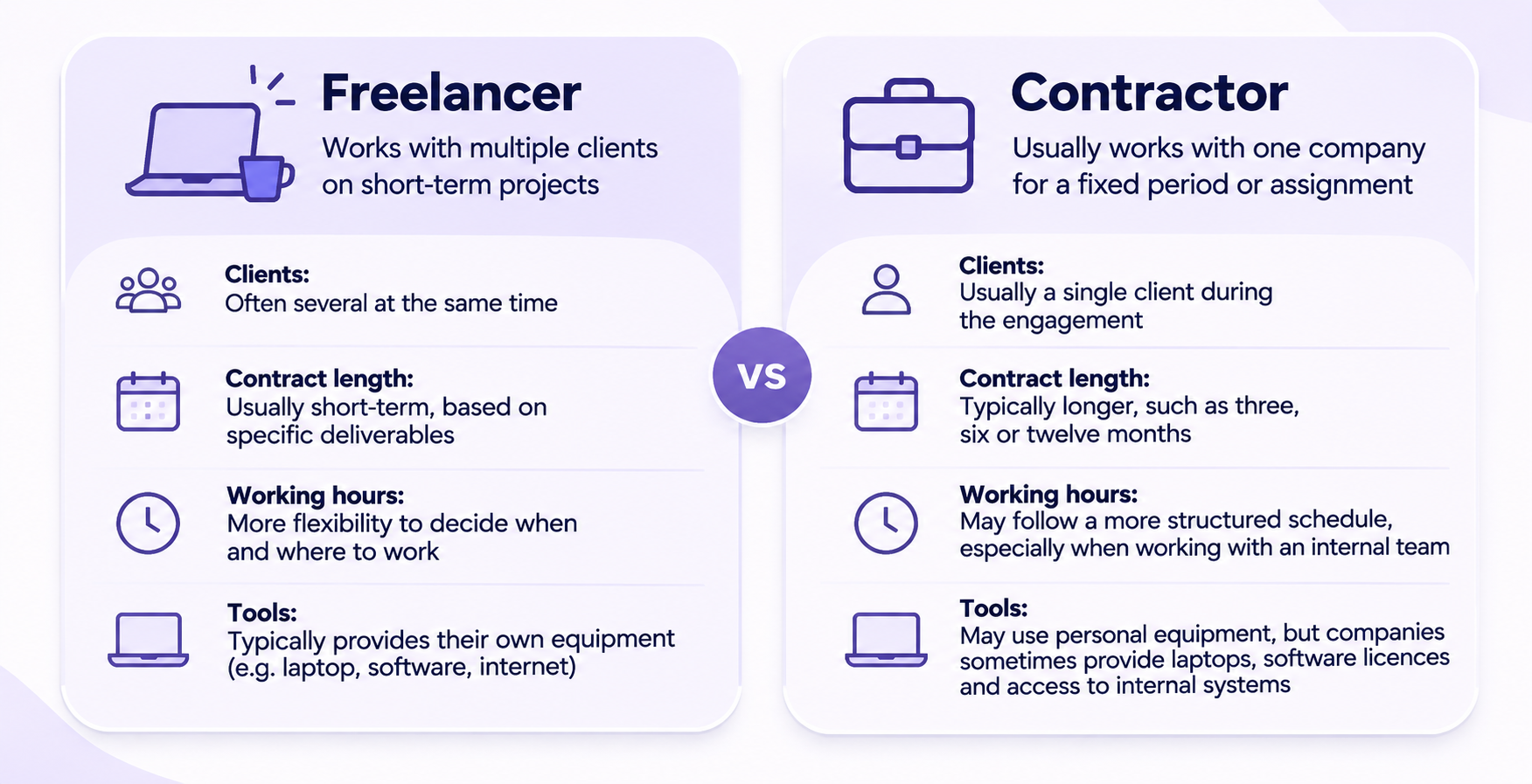
Here are four important differences to understand:
Freelancers often work with several clients at the same time. For example, a freelance graphic designer might create social media designs for three businesses while managing other projects. Contractors, on the other hand, usually dedicate their time to a single client during an agreed-upon engagement, although they can take on additional clients if their contracts permit.
Freelance projects are often shorter and based on specific deliverables. A client might hire a freelance writer to produce five articles or a designer to create a brand identity. Contractors typically sign agreements covering longer periods, such as three, six or twelve months. Some freelancers also work on ongoing arrangements, including freelance retainer agreements , where clients pay regularly for an agreed amount of work.
Freelancers generally decide when and where they work, provided they meet deadlines. Contractors may have more structured schedules, particularly when working closely with a company's internal team or following its operational hours.
Freelancers typically provide their own laptops, software, internet connection and other equipment. Contractors may also use personal equipment, but companies sometimes provide work laptops, software licences and access to internal systems, depending on the agreement.
One thing freelancers and contractors quickly discover is that earning money independently also means taking responsibility for their taxes. Unlike traditional employees, whose employers deduct income tax from their salaries through payroll systems such as PAYE, independent workers generally receive their payments without tax deductions. This means you must calculate what you owe and make the necessary payments yourself.
In the United States, freelancers and contractors are generally treated similarly for federal tax purposes when they operate as self-employed individuals. According to the IRS rules on independent contractors, their tax responsibilities typically involve four important areas:
Clients generally pay your agreed fees without deducting income tax or Social Security and Medicare contributions. You are responsible for reporting your earnings and settling your tax obligations. Unlike salaried employees, you must set aside money from each payment to cover your tax bill and avoid unexpected financial pressure when filing your annual returns.
Businesses may issue Form 1099-NEC to report payments made to independent contractors for services. This document helps the IRS track nonemployee compensation, although you must report all taxable income even if you don't receive one. Generally, businesses use it when they pay an independent worker $600 or more during the tax year for qualifying services.
Self-employed individuals generally pay both the employer and employee portions of Social Security and Medicare taxes. This is known as self-employment tax and is calculated based on qualifying net earnings, separately from federal income tax.
Because taxes aren't automatically deducted from your earnings, you may need to make estimated tax payments four times a year. This helps you avoid accumulating a large tax bill and potential underpayment penalties when filing your annual return.
Ultimately, whether you freelance or work on contract, understanding your tax obligations helps you price your services properly, manage your earnings and avoid unpleasant surprises during tax season
The way freelancers and contractors earn money often comes down to how they price their services and structure agreements with clients. While freelancers have more freedom to choose how much they charge and how they get paid, contractors typically negotiate an hourly or daily rate for an agreed period. Neither arrangement guarantees a higher income; it depends on the work, experience, client budget and ability to negotiate.
Here are four ways their payment structures differ:
Freelancers often charge a fixed amount for completing a specific task or deliverable. For example, a freelance writer might charge $300 for five articles, while a graphic designer could charge $500 for a complete brand identity. This arrangement allows experienced freelancers to earn more when they complete projects efficiently without compromising quality.
Both freelancers and contractors can charge by the hour. This model works particularly well when the workload is unpredictable, or the client needs ongoing support. The client pays for the actual hours worked, making it easier to account for additional tasks, revisions and meetings.
Contractors frequently negotiate daily rates, particularly when working with companies on longer engagements. Instead of charging for individual deliverables, they receive an agreed amount for each working day. This arrangement can provide more predictable earnings throughout the contract period.
Freelancers must account for periods when they have no paying projects. Time spent pitching clients, marketing their services, handling administration and waiting for new assignments can affect their income. This is why experienced freelancers build these unpaid periods into their rates rather than charging only for hours spent working.
Whether you're freelancing or contracting, having clear payment terms matters. A well-written freelance contract helps establish agreed rates, payment schedules, deliverables and expectations before work begins.
Working with clients overseas means thinking beyond simply agreeing on a price. You also need a reliable way to invoice clients, receive payments and avoid losing too much money to conversion fees. Start by agreeing on your payment currency, whether USD, GBP or EUR, and include your rates, payment deadlines and preferred payment method on every invoice.
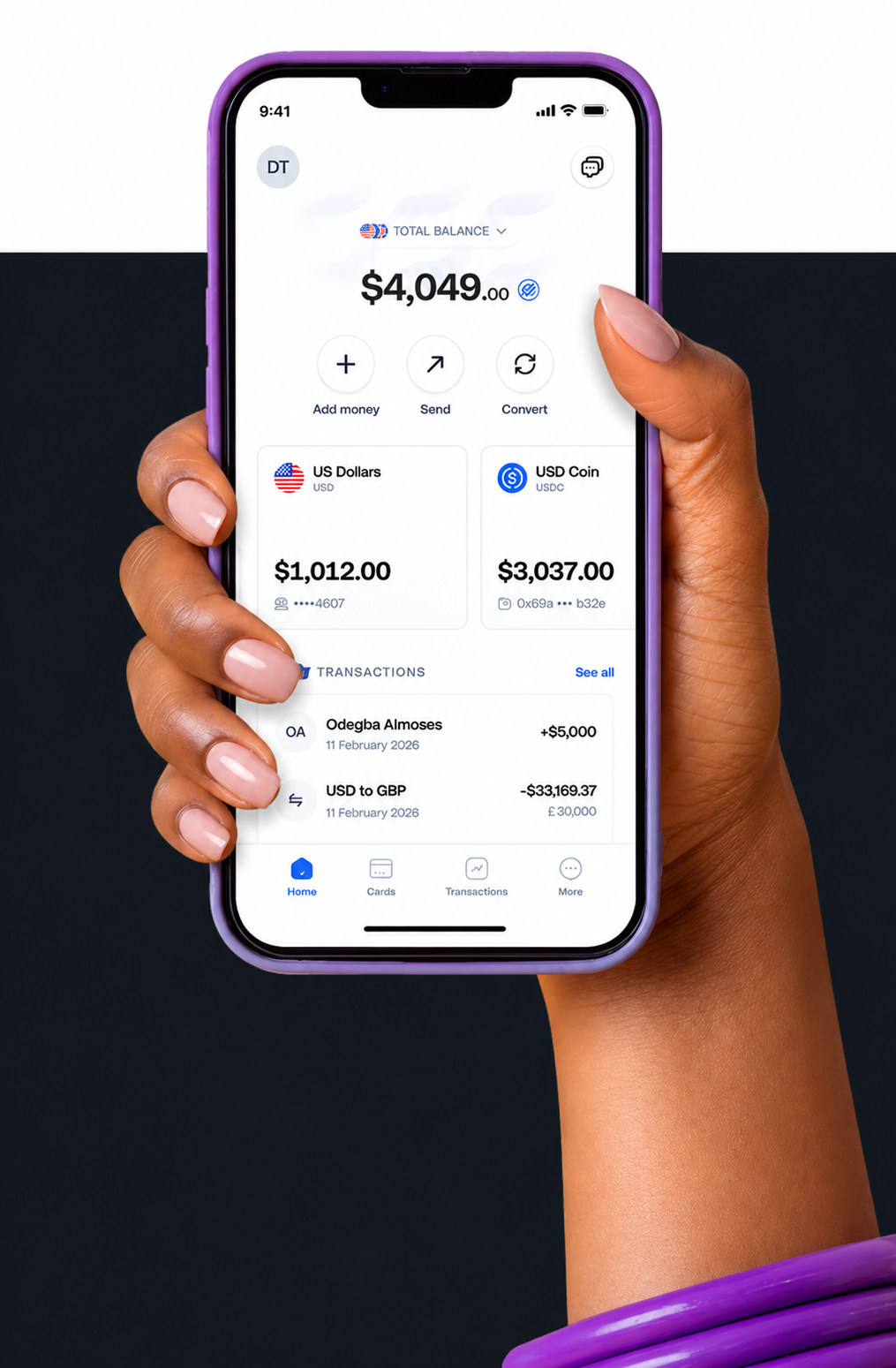
Grey makes receiving international payments easier. You can open a multi-currency account to receive and hold supported currencies without needing a traditional local bank account in your client's country. You can also send an invoice to an overseas client to request payment professionally.
Before converting your earnings, compare exchange rates and fees, as currency spreads can reduce the amount you receive. Also, check transfer processing times so you can plan around payment deadlines and cash flow.
Choosing between freelancing and contracting depends on what you want from your career, how comfortable you are with income fluctuations and how much independence you need. Neither option is automatically better; the right choice comes down to your financial priorities, preferred working style and long-term goals.
The table below compares both arrangements across four important factors to help you decide.
The bottom line: Choose freelancing if independence, flexible schedules and working with multiple clients matter most to you. Contracting may suit you better if you prefer longer engagements, structured assignments and more predictable earnings.
Not exactly. Both are generally classified as self-employed workers rather than traditional employees. However, freelancers typically work with multiple clients on shorter projects, while independent contractors often take on longer assignments with one company. The distinction is mainly about working arrangements rather than a separate legal employment status.
In the United States, both generally follow self-employment tax rules when operating as independent workers. They may receive Form 1099-NEC from clients reporting their nonemployee compensation and typically report business income and expenses on Schedule C. However, receiving a 1099-NEC is not compulsory for reporting taxable earnings.
Yes. You can work as a contractor for one company while taking on freelance projects for other clients. For example, a software developer might have a six-month contract with a technology company while building websites for smaller businesses. Just check your main contract for exclusivity, confidentiality and conflict-of-interest clauses.
Neither automatically earns more. Contractors may enjoy more predictable earnings through longer engagements and negotiated hourly or daily rates. Freelancers, however, can increase their income by working with multiple clients, specialising in high-demand skills and charging premium project rates. Ultimately, experience, industry, pricing and client demand determine earning potential.
Independent contractors generally don't receive the same employer-sponsored benefits as permanent employees. This means you're usually responsible for arranging your own health insurance, retirement savings, paid holidays and sick leave. Some clients offer additional benefits through specific agreements, but these aren't guaranteed. Always review your contract before accepting an assignment.
Freelancers can receive international payments through platforms like Grey, which makes working with overseas clients easier. With Grey, you can open multi-currency accounts, receive payments in USD, GBP and EUR, and hold funds without needing a traditional bank account in your client's country.

What is a 1099-K form? Learn how payment apps report your income, the current thresholds, and what sellers and freelancers must do. Read on.
Tunde Aladeloba
•
November 25, 2026
•
2 min read
When you receive money through PayPal, Venmo, or other payment apps, those platforms may report certain transactions to the IRS. They do this using a tax document called Form 1099-K. This form helps the IRS keep track of payments made through digital platforms, particularly when people use them to sell products or provide services.
A Form 1099-K, also known as a Payment Card and Third Party Network Transactions form, reports payments you receive through payment apps, online marketplaces, and other third-party payment processors. If your transactions meet the applicable reporting requirements, the platform may send a copy of the form to you and the IRS. The amount shown on the form generally represents the total payments processed, not necessarily your profit or taxable income.
Receiving this form does not automatically mean you owe taxes on all the money reported. The tax treatment depends on why you received the money. For example, payments for products you sell or services you provide may be taxable, while personal gifts and reimbursements generally are not. Understanding how Form 1099-K works, including the reporting requirements, can help you identify taxable payments, avoid reporting errors, and prepare your tax return correctly.
A 1099-K form is an IRS tax document that reports the gross payments you receive for goods or services through payment cards and third-party payment networks. It helps the IRS track digital transactions and gives you a record of payments processed through online platforms.
For example, imagine you run an online store, offer freelance services, or sell handmade products through a marketplace. Customers pay you using PayPal, Venmo, Cash App, eBay, or Etsy. These platforms record your transactions and may issue you a 1099-K when your payments meet the applicable reporting requirements.
Payment settlement entities (PSEs) are responsible for issuing Form 1099-K to eligible recipients and submitting a copy to the IRS. These include payment card processors and third-party settlement organisations (TPSOs) that facilitate transactions between buyers and sellers. If you're unfamiliar with how these tax documents work, understanding what a Form 1099 is can help you see where Form 1099-K fits into the wider tax reporting process.
The main purpose of Form 1099-K is to improve tax reporting accuracy and help the IRS track payments made through digital platforms. It allows the agency to compare payment records with the income you report on your tax return.
However, receiving a 1099-K does not automatically mean the entire amount shown is taxable income. Personal gifts, reimbursements, and other non-income transactions may receive different tax treatment
The 1099-K reporting threshold is the minimum payment amount and transaction count that trigger a payment platform's federal reporting requirement. These limits have changed over the years, so the tax year matters when determining whether you should receive the form.
As of November 17, 2026, the federal reporting rules for third-party payment apps and online marketplaces are:
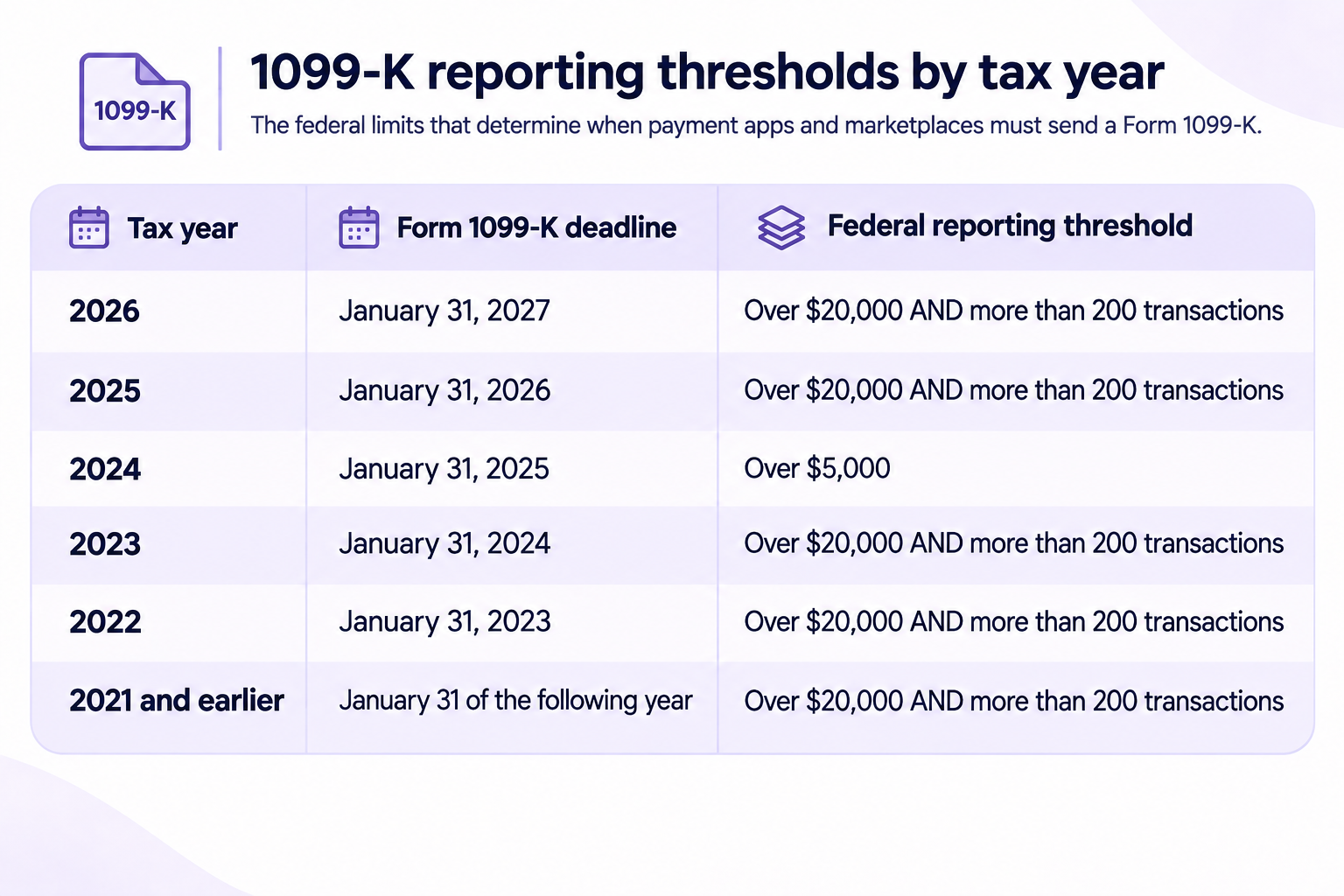
Note: These are federal reporting thresholds for third-party payment network transactions, not thresholds for whether income is taxable.
No. If you accept direct credit or debit card payments for goods or services, your payment processor must report those transactions regardless of the amount or number of payments. The $20,000 and 200-transaction requirements apply to third-party payment networks, such as PayPal and online marketplaces.
Form 1099-K is issued by payment settlement entities that process payments you receive for selling goods or providing services. These include payment apps, online marketplaces, gig-economy platforms, and payment card processors. If you use digital payment services, understanding how virtual wallets work can help you understand how money moves between customers, platforms, and sellers.
Payment apps and virtual wallets allow you to send, receive, and store money electronically. Examples include services that facilitate peer-to-peer transfers and commercial payments. If you accept customer payments through these platforms, you may receive a 1099-K when the applicable reporting requirements are met. However, personal transfers between friends and family are generally treated differently from business payments.
Online marketplaces connect buyers and sellers through e-commerce stores, auction websites, and craft platforms. When these marketplaces collect and process payments for your products, they may issue a 1099-K to report qualifying transactions. Whether you sell clothing, electronics, handmade products, or other items, the platform's payment processing arrangement matters.
Rideshare, food delivery, freelance, and ticket-resale platforms may process payments on behalf of independent workers and service providers. If you earn money through these services, a 1099-K may be issued for payments processed through the platform.
Payment card processors handle credit, debit, and gift card transactions for businesses. Unlike third-party payment networks, card transactions have no federal minimum reporting threshold.
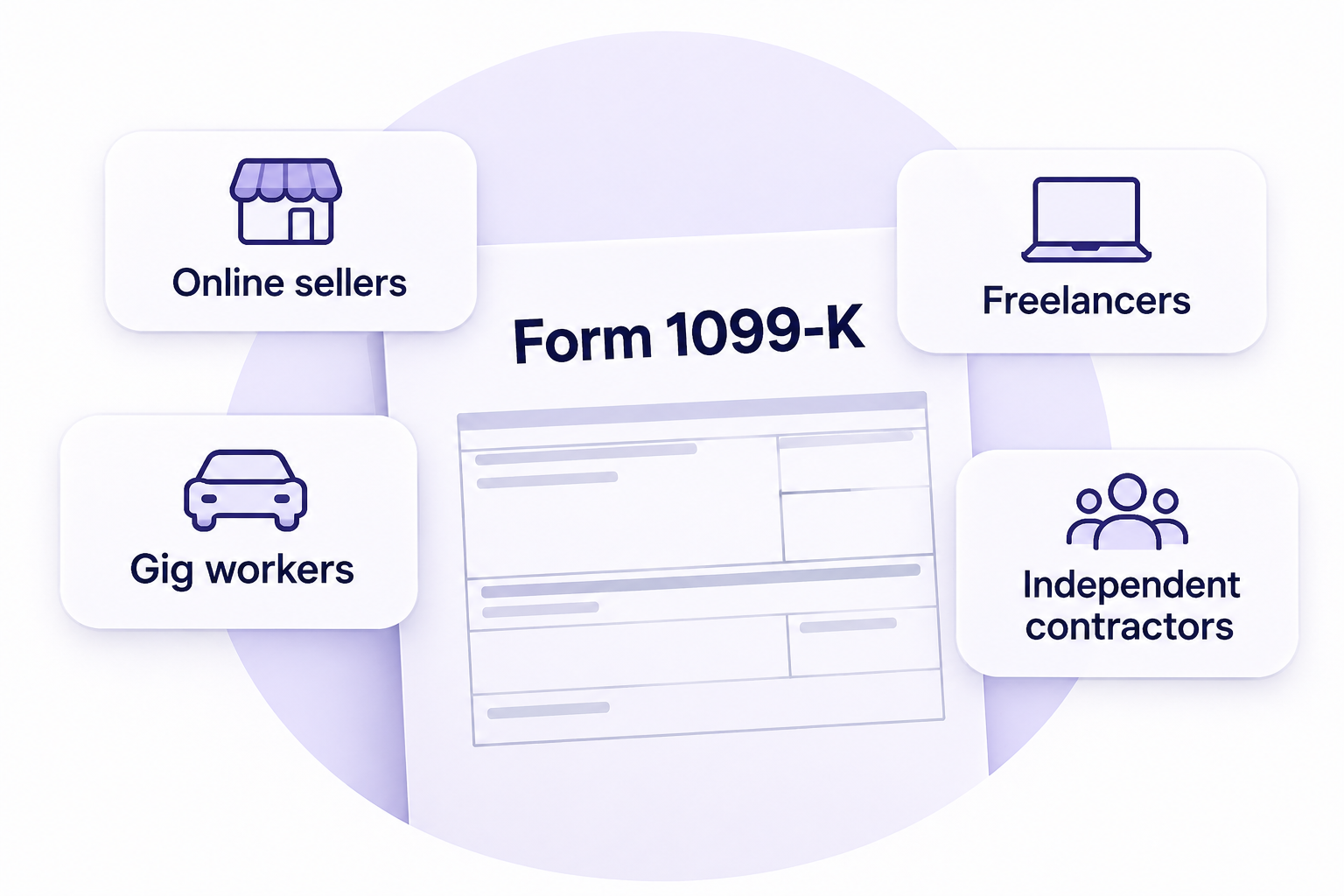
A 1099-K form is generally issued to people and businesses receiving payments for goods or services through payment cards, apps, or online marketplaces. Recipients may include online sellers, gig workers, freelancers, and independent contractors. Whether you receive one depends on how you are paid and the reporting rules. Even without the form, taxable income must be reported.
If you sell products online, drive for a rideshare service, deliver food, or provide freelance work, you may receive a 1099-K when a platform processes customer payments and reporting requirements are met. Direct card payments can be reported regardless of the amount or transaction count.
Not every transfer through a payment app is business income. Payments for goods or services may be reportable, while personal gifts and reimbursements between friends or family are not. Money a friend sends to split dinner differs from a customer paying you for work. Keep personal and business transactions separate, and save records showing what each payment was for
Form 1099-NEC reports payments made to independent contractors for services, while Form 1099-K covers payments processed through payment cards and third-party networks. Understanding what Form 1099-NEC reports and who receives it helps you distinguish between the two documents and identify potential overlaps. If a payment appears on both forms, compare the amounts with your invoices, payment platform statements, and other business records. This helps you avoid reporting the same income twice when preparing your tax return.
If you earn money through international marketplaces, freelance platforms, or overseas clients, how you receive and manage your earnings matters. Grey makes this easier by providing USD account options that allow eligible users to receive and manage international payments. Instead of converting every dollar immediately, you can hold your funds in USD and decide when to exchange them based on your needs and available exchange rates.
With Grey, you can open a USD account to receive eligible payments from international clients and platforms. This gives you more flexibility when managing your earnings, particularly if you regularly work with customers or businesses abroad. And when you need to send your money elsewhere, you can move money across borders using Grey's available international transfer services.
Whether you're a freelancer, online seller, or independent professional, having access to a USD account can simplify how you receive, hold, and manage your income. Rather than worrying about immediate currency conversion, you have more control over when and how you access your earnings.
Form 1099-K is an information return showing gross payments you received for goods or services through payment cards, payment apps, or online marketplaces. The payment processor sends a copy to you and the IRS. Use it alongside your own records to work out what income, gains, fees, refunds, and expenses belong on your tax return.
For the 2026 tax year, federal rules generally require third-party settlement organisations to report when your gross payments for goods or services exceed $20,000, and you have more than 200 transactions. Both conditions must be met for each calendar year. Payment-card transactions have no minimum federal threshold, and some states require reporting at lower amounts.
PayPal may send you Form 1099-K if your 2026 payments for goods and services exceed $20,000 and involve more than 200 transactions during that year. Both federal conditions apply, although state rules may require reporting at a lower threshold. PayPal may also issue a form below the federal threshold. Personal transfers generally are not reportable.
No. Form 1099-K reports gross payments, not your taxable profit. For business income, you generally calculate taxable profit after allowable business expenses. If you sell a personal item, a gain may be taxable, while a loss is generally not deductible. Gifts and reimbursements for shared personal costs are not taxable income under federal tax rules.
First, contact the payment platform or form issuer and request a corrected 1099-K. If it cannot provide one, the IRS says you can still file and zero out the error on Schedule 1 of Form 1040: report it on line 8z and offset it on line 24z. Keep supporting records and correspondence for your files.
Yes. The 1099-K threshold determines when a platform must send an information form; it does not determine whether income is taxable. You must report taxable income even if you receive no 1099-K. Keep records of cash, card, app, and marketplace payments, along with fees, refunds, expenses, and purchase costs, for accurate tax reporting each year.

What is a 1099-INT form? Learn how interest income is reported, who gets one, the threshold, and what to do at tax time. Read on.
Tunde Aladeloba
•
November 25, 2026
•
2 min read
A little extra money in a savings account can feel like a welcome reward, especially when it has been earning interest throughout the year while you're saving for a house, building an emergency fund, or simply setting some money aside for unexpected expenses. When January arrives, however, the bank may send a tax document showing exactly how much interest that money generated, leaving you wondering whether those earnings are taxable, whether they need to appear on your tax return, and what happens if the amount is relatively small.
This is where Form 1099-INT comes in. So, what is a 1099-INT form, and why does a bank send one? It is an IRS tax document used to report interest income paid to you by banks, credit unions, brokerage firms, and other financial institutions during the tax year. Generally, the payer must issue it when reportable interest reaches $10, although certain exceptions apply.
The form provides a record of your interest earnings and helps the IRS verify the income reported on your tax return, but receiving one does not mean the entire amount is an additional tax bill. Even when the interest seems insignificant, or no form arrives, taxable interest may still need to be reported. Understanding what a 1099-INT form is can help you know when to expect one, what the reporting threshold means, and how to include your interest income when filing your taxes.
Form 1099-INT is an IRS information return that reports interest income paid to you during the calendar year. If money in a bank account, certificate of deposit, or investments earns interest, the institution or organisation that pays it may send you this form. It gives you and the IRS a record of the interest to include on your federal tax return, even without a withdrawal.
Banks, credit unions, brokerage firms, and other organisations that pay interest issue Form 1099-INT when IRS reporting rules apply. A payer must send it if it paid you at least $10 in reportable interest during the year. A form may also be required for amounts below $10, such as when federal income tax was withheld. The payer sends a copy to you and the IRS.
The form can report interest from savings and checking accounts, savings accounts, certificates of deposit (CDs), and money market deposit accounts. It can also include interest from bonds and U.S. Treasury securities, along with other debt investments. The source and amount are generally shown in separate boxes.
Receiving Form 1099-INT does not mean you owe tax on every dollar shown. Most bank interest is taxable, while qualifying tax-exempt interest is treated differently but may still need to be reported. You generally must report taxable interest even if you did not withdraw it or receive a form.
Anyone who earns $10 or more in reportable interest during a calendar year will generally receive Form 1099-INT from the bank or financial institution that paid them. This $10 threshold remains unchanged for the 2026 tax year. It applies to people earning interest from savings accounts, fixed-term deposits, and certain investments.
You may receive a 1099-INT if you have a savings account, certificate of deposit (CD), money market account, or bonds that pay interest. Your bank or financial institution sends you a copy and reports the same earnings to the IRS. If you're unfamiliar with the wider 1099 series, understanding what a 1099 form is also helps explain why different types of income have separate reporting forms.
If your interest is below $10, you may not receive a 1099-INT. However, the bank must still send one if it took federal tax from your interest or paid foreign tax on your behalf, even when the amount is lower.
Remember, the $10 limit only determines when the bank must send the form. It does not mean smaller interest payments are tax-free. You must still report taxable interest on your tax return, even if you never receive a 1099-INT. The IRS explains the reporting rules for Form 1099-INT, including when banks must send it.
All taxable interest must be reported on your federal tax return, even if you did not receive Form 1099-INT. This means that if your bank paid you interest during the year, you still need to include it when filing your taxes, whether the amount was $5 or $500. Leaving the money in your account instead of withdrawing it does not make the interest tax-free.
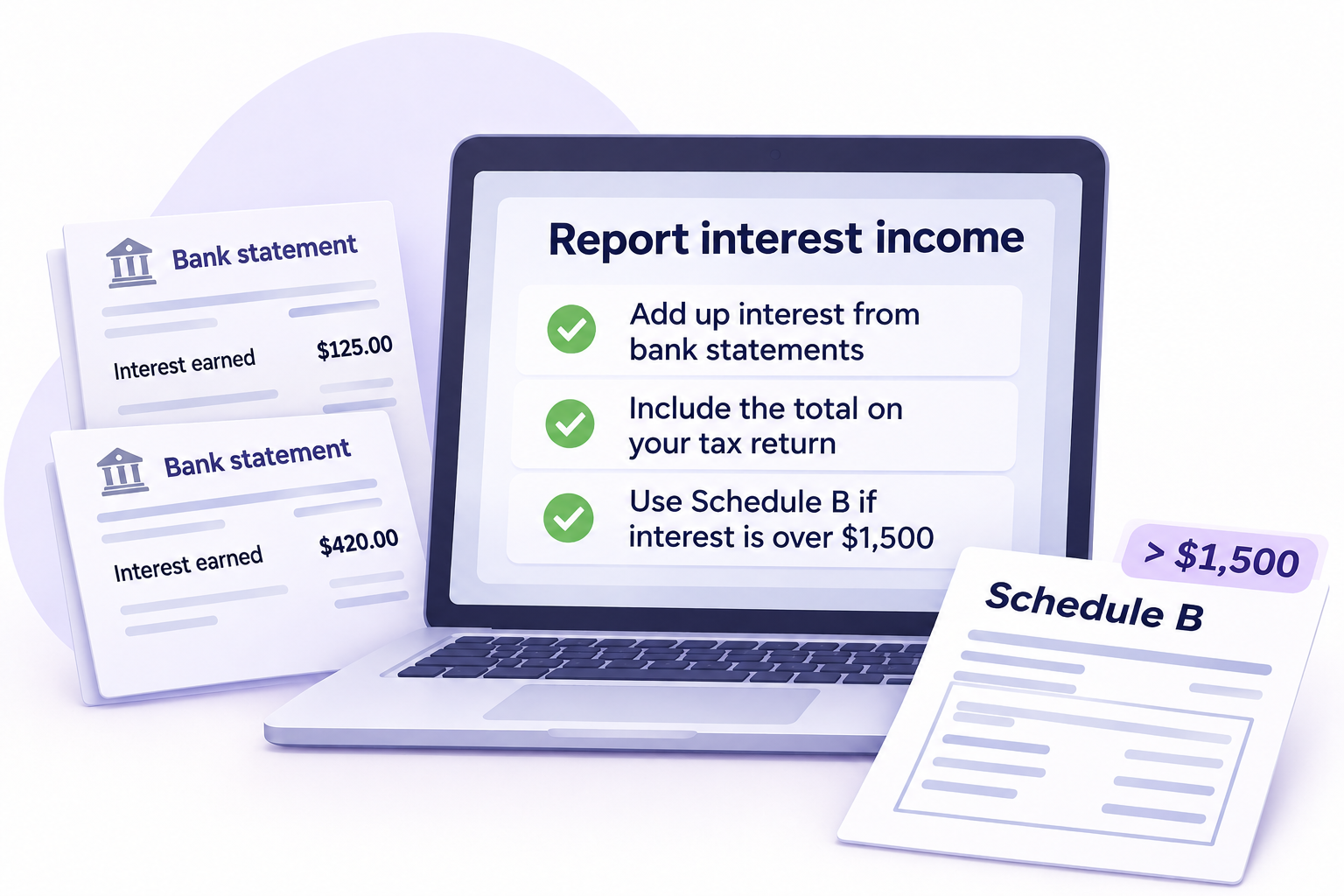
Start by checking your year-end bank statements to see how much interest you earned across your accounts. Add the amounts together and include the total taxable interest when preparing your federal tax return. Keep your statements as proof of the payments in case the IRS asks for more information.
If your total taxable interest is more than $1,500, you generally need to complete an additional tax form called Schedule B and submit it with your federal tax return. This form lists the banks and other organisations that paid you interest. Other situations, including certain foreign account interests, may also require it.
Tax-exempt interest, such as interest from qualifying municipal bonds, is reported separately from ordinary taxable interest. Some investment funds also pay tax-exempt dividends, which are reported differently from bank interest. You can learn more about what a 1099-DIV reports to understand how investment income is recorded.
This information is for general educational purposes and is not professional tax advice. Check the relevant IRS instructions or speak with a tax professional about your circumstances.
Earning interest from a bank outside the US does not mean it is automatically exempt from US taxes. If you are a US citizen or resident alien, you generally need to report taxable interest from foreign accounts, just as you would interest earned from a US bank. This applies even if the foreign bank does not send you Form 1099-INT. Keep your bank statements so you can work out how much interest you earned and report the amount in US dollars.
If you regularly receive or save money in different currencies, having a place to hold those funds can also make managing your finances easier. Grey offers a USD account, allowing eligible customers to receive and hold USD without converting them immediately. You can also hold multiple currencies and explore how to save in foreign currency when managing money across borders.
Remember that reporting foreign interest income is different from reporting foreign bank accounts. If the total value of your foreign financial accounts exceeds $10,000 at any point during the year, you may also need to file an FBAR. Other reporting requirements may apply depending on your circumstances.
Form 1099-INT reports interest income paid to you during the tax year by banks, credit unions, brokerage firms, and other financial institutions. The payer sends a copy to you and the IRS, showing how much interest you earned. You use this information when preparing your federal income tax return.
Banks and other financial institutions generally issue Form 1099-INT when they pay you $10 or more in interest during the calendar year. The form may also be required below this amount if federal income tax or foreign tax was withheld. Remember, the $10 threshold does not make smaller interest payments tax-free.
Yes. You must report taxable interest on your federal tax return even if you earned less than $10 and never received Form 1099-INT. Check your year-end bank statements and add up the interest earned across your accounts. The responsibility to report taxable interest remains yours, whether or not the bank sends a form.
Most interest income is taxable at your ordinary federal income tax rate, including earnings from savings accounts, certificates of deposit, and money market accounts. However, some interest, such as qualifying interest from municipal bonds, is federally tax-exempt. You may still need to report tax-exempt interest separately when filing your federal tax return.
US citizens and resident aliens generally must report taxable interest earned from foreign bank accounts, even if they do not receive Form 1099-INT. Depending on the total value of their foreign accounts and other circumstances, they may also need to file an FBAR or Form 8938. These are separate reporting requirements.
Banks and other financial institutions generally send Form 1099-INT by January 31 following the tax year in which you earned the interest. If the deadline falls on a weekend or public holiday, it moves to the next business day. Check your email, online banking account, or post for the document.
Contact the bank or financial institution that issued the form and ask for a corrected copy. Compare the reported amount with your bank statements to identify any differences. If the institution confirms the error, request that it send the corrected form to both you and the IRS before you file your tax return.

Eight countries with real remote-work visas, ranked on income bar, living costs, internet speed and time zone, all checked on official pages. Compare them.
Tunde Aladeloba
•
November 25, 2026
•
2 min read
The best countries to work remotely from right now are Portugal, Malaysia, Thailand, Spain, Colombia, Costa Rica, Croatia and the United Arab Emirates. Each one has a visa built for people who earn from abroad, broadband that handles video calls, and a clear income bar you can plan around.
That last point is why this list looks different from the famous rankings. The best-known remote-work index put Germany, Denmark and the US at the top in 2022, yet Germany, the leader, has no visa made for someone paid by a foreign employer. We checked every visa rule, cost figure and internet speed below against government pages and named data sources on 25 November 2026.
The order weighs four things: how clear the legal route is, how much you must earn, what daily life costs and how fast the internet is. Use the first table to see whether you qualify and the second to compare daily life.
Checked 25 November 2026. Sources: each country's government or consular page, linked in its section below.
Checked 25 November 2026. Sources: Numbeo Cost of Living Index by Country, 2026 mid-year (higher is pricier; the US scores 69.7 and the UK 68.2) and the Ookla Speedtest Global Index, March 2026 (US median 309.80 Mbps, UK 172.24 Mbps).
The big indices score how pleasant a country is for remote work, not whether a foreigner can legally do it there. NordLayer's Global Remote Work Index ranked Germany, Denmark and the US as its top three in 2022, judging 66 countries on cybersecurity, economic and social conditions, infrastructure and COVID-19 response.
Germany shows the problem. It has no dedicated digital nomad visa, and its freelance visa usually needs letters of intent from potential German clients, according to The Local Germany (November 2024). If your salary comes from London or Lagos, a great score for e-government does not help you get in.
So this list starts with the question the indices skip: is there a visa for you? Only then does it compare rent, broadband and time zones.
Portugal gives you a residence route, not just a long holiday. Its D8 visa for remote work asks for an average monthly income over the last three months of at least four times the Portuguese minimum wage, per Portugal's visa application centre. With the minimum wage at €920 in 2026, that is €3,680 a month.

Before you apply, read our D8 application guide.
Malaysia has the lowest living costs and rent on this list, and a modest income bar if your job qualifies. The DE Rantau Nomad Pass needs US$24,000 a year (about US$2,000 a month) for tech and digital roles, or US$60,000 for senior non-tech roles such as CEO or legal counsel, according to the official DE Rantau FAQ (version 10, August 2026).

Our DE Rantau guide covers the documents.
Thailand's Destination Thailand Visa lasts five years, the longest on this list. It allows 180 days per entry, extendable once by another 180 days, and asks for at least 500,000 baht in funds and a 10,000 baht fee, per the Thai foreign ministry.

See our DTV walkthrough for the application steps.
Spain asks for less income than Portugal or Croatia. The bar is 200% of the minimum wage each month, per the Spanish consulate in New York, and with the 2026 minimum wage at €1,221 over 14 payments, The Local Spain puts the bar at about €2,849 a month.
Here is Spain's application process, step by step.
Colombia pairs New York's winter clock with some of the lowest costs here (index 35.6). Its digital nomad visa needs income of at least three times the monthly minimum wage and lasts up to two years, per Colombia's Ministry of Justice.
Costa Rica's official tourism board says digital nomads are exempt from income tax. The stay needs US$3,000 a month earned outside Costa Rica (US$4,000 with dependants) and a US$100 fee, per the official requirements.

Our Costa Rica guide covers eligibility and costs.
Croatia offers non-EU citizens up to 18 months in the EU. It asks for at least €3,622.50 a month, or €43,470 in savings for a 12-month stay, per Croatia's interior ministry, and the accounting firm Crowe Croatia says digital nomads do not pay Croatian income tax.
The UAE has the fastest broadband here (384.51 Mbps) and no income tax on individuals. Its one-year virtual work residence visa needs proof that you work for an organisation outside the UAE and earn US$3,500 a month, per the UAE government portal.
Your clients' clock matters more than the beach, because it sets when you sleep. If a New York client books a 9am call, that is 9am in Bogotá, 2pm in Lisbon and 10pm in Kuala Lumpur during New York's winter.
Europe moves its clocks forward in summer, while Colombia, Costa Rica, Malaysia, Thailand and the UAE do not. Check the gap in both seasons before you sign a lease.
Most of these visas ask for bank statements, so the way you get paid shapes your application. Croatia accepts a bank statement showing regular income, Portugal looks at your three-month average, and Costa Rica asks for a year of statements.
Grey gives you USD, GBP and EUR account details, so clients can pay you as if you were local: ACH or wire for dollars, sort code and IBAN for pounds, IBAN and SWIFT for euros. Receiving by ACH, Faster Payments or SEPA costs 0.8% (minimum $2, £2 or €2, maximum $10, £10 or €10), according to Grey's help centre, and you can download a statement for any currency and date range.
Whether a consulate accepts a statement from a financial technology company is the consulate's call, so ask before you apply. Grey is a financial technology company, not a bank, and is registered with FinCEN.
Once you land, a virtual card spends from your USD, EUR or GBP balance for a one-time $5 fee and no monthly charges, with conversion fees on non-USD payments. Check today's USD to EUR rate if you earn in dollars and plan to live in Portugal, Spain or Croatia.
Portugal is the best all-round choice for most remote workers, because its D8 visa is a residence route and its broadband and time zone suit UK and US clients. If your budget is tight and you work in tech, Malaysia is the cheapest place to live on this list and asks for US$24,000 a year.
It depends on the country, and many tourist rules say nothing clear about remote work. A visa built for remote workers removes that doubt, which is why every country on this list has one. Our guide to working on a tourist visa explains the risks.
Not on most remote-work visas alone, because they have end dates: 18 months in Croatia, 24 months in Malaysia and two years in Colombia. Portugal and Spain issue residence permits rather than temporary stays, so they suit people who plan to stay for years.
Malaysia is the cheapest country on this list, with a Numbeo cost of living index of 34.0 and a rent index of 8.5 (2026 mid-year). Colombia (35.6) and Thailand (36.8) come next.
Portugal, Malaysia and Thailand top this list, but the right pick depends on your income, your passport and your clients' time zone. Start with the table, check the official page for your shortlisted country, and see our 50-plus country list if none of these fits, or the nomad tax guide before you move.
The best country to work remotely from is the one that will let you stay.

Create a Wells Fargo virtual card in minutes and find your card number safely. See how a Grey virtual card compares for spending abroad. Get started.
Tunde Aladeloba
•
November 24, 2026
•
2 min read
Personally, virtual cards win over physical cards for me because I keep losing the card, and sometimes it’s a chore bringing the card out each time I want to shop online or pay for a subscription. Virtual cards offer another way to pay without repeatedly entering your physical card information. If you already bank with Wells Fargo, here's how you can create one and how to get started.
To create a Wells Fargo virtual card, sign in to the Wells Fargo Mobile app or online banking and check the digital payment options available for your eligible card. If virtual card details are supported, follow the prompts to generate or access them. You may also be able to add your eligible card to a digital wallet for contactless payments.
However, availability depends on your card type and the features supported by Wells Fargo. Not every customer can generate a separate virtual card number on demand, so check your account's available options before proceeding.
A Wells Fargo virtual card is a temporary, digitally generated 16-digit number linked to an existing account. It allows users to make online payments without directly exposing their actual card details, adding another layer of protection against fraud and unauthorised charges.
For businesses, Wells Fargo provides virtual card solutions through its WellsOne commercial card programme. Companies can generate single-use card numbers with custom spending limits, expiration dates, and merchant category restrictions. This makes paying approved suppliers more secure while giving businesses better control over their spending.
For everyday consumers, however, Wells Fargo does not offer standalone virtual card numbers for individual accounts. Instead, personal debit and credit cardholders can use digital payment services such as Apple Pay, Google Pay, Samsung Pay, PayPal, and Paze. These services use encrypted digital tokens to help protect actual card information during transactions.
Of course, Wells Fargo isn't the only option for managing online payments. Services offering online debit cards provide another way to pay online without relying on your everyday banking card. Similarly, prepaid Visa cards can help users set aside money for specific purchases and keep their spending under control.
If you're a Wells Fargo personal account holder, you can connect an eligible debit or credit card to a digital wallet through the Wells Fargo Mobile app.
Getting started is fairly simple. Here's how to do it.
Once verification is complete, your card should be ready to use with the selected digital wallet.
The best part? You can make contactless and online payments without repeatedly entering your physical card details. The digital wallet uses a secure token to help protect your actual card information.
Wells Fargo doesn't display a complete, standalone virtual card number in its mobile banking app. Instead, when you add an eligible card to a digital wallet, the wallet generates a hidden digital token linked to your actual card.
Step 1: Sign in
Open the Wells Fargo Mobile app and sign in using your username and password (or biometric sign-in).
Step 2: Tap menu
Once signed in to your account dashboard, tap Menu in the bottom navigation bar.
Step 3: Select card settings
From the main menu list, scroll down and select Card Settings.
Step 4: Choose digital wallet
In the Card Settings menu, choose digital wallet.
Step 5: Add your card
Select Apple Pay or Google Pay, then tap Add beside your eligible Wells Fargo card and follow the on-screen prompts to complete the setup.
Step 6: Open your mobile wallet
Once your card is linked, open Apple Wallet or Google Wallet on your phone and select your newly added Wells Fargo card.
Step 7: View virtual account number
Tap card details (or the info icon) to view the last four digits of your virtual account number.
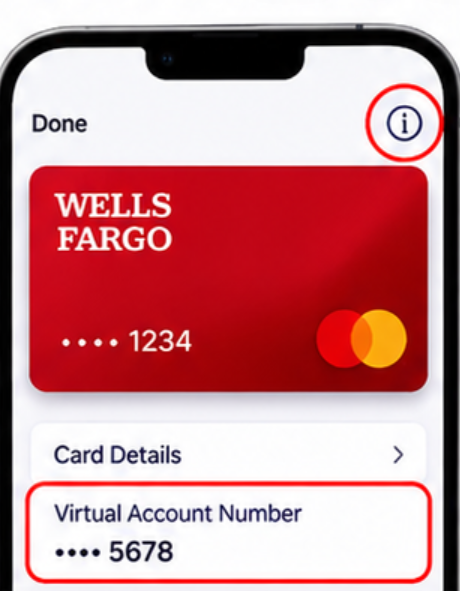
Remember, these four digits identify the digital wallet's virtual account number, not your complete physical card number. The full tokenised card details are generally not displayed for security reasons.
If you're living outside the United States and wondering whether you can access Wells Fargo banking services, this guide to opening a Wells Fargo account outside the US provides additional information.
To get the most out of your Wells Fargo virtual card, it's important to know how to use it safely. A few simple precautions can help protect your money and personal information when shopping online.
These precautions are particularly useful if you regularly make international online purchases. If you're a non-resident looking into US banking options, understanding whether non-residents can open a US bank account online in 2026 can also help you make informed decisions about managing your money.
If you're using Wells Fargo but need more flexibility for international payments, Grey is worth considering. Perhaps you want to pay for a subscription in dollars, shop on a US website, or send money to someone back home. You don't necessarily want to depend on your regular bank card for everything.
With the Grey virtual card, you can make online payments, including international purchases and subscriptions. And if you need to send money from the US to family, friends, or business partners abroad, Grey also offers international money transfers.
What if you regularly receive money in different currencies? Grey's multi-currency accounts allow you to hold and manage multiple currencies, making it easier to keep your international finances organised and one less app on your phone.
So, whether you're paying online, receiving money from abroad, or sending dollars to another country, Grey gives you more ways to manage your money beyond everyday banking.
Yes, Wells Fargo supports digital card numbers through digital wallets such as Apple Pay, Google Pay and Samsung Pay. However, personal customers cannot generate standalone virtual card numbers like those offered by some other providers. Businesses may also have access to commercial virtual card payment solutions.
Open the Wells Fargo Mobile app and sign in. Go to Menu, select Card Settings, then Digital Wallet. Choose an available wallet, such as Apple Pay or Google Pay, and add your eligible debit or credit card. Follow the verification instructions to complete the setup.
Once your card is added to a digital wallet, it receives a unique digital card number that replaces your actual card number during supported transactions. You may find its last four digits in your wallet's card details. The complete token number may not be displayed.
Yes. Eligible Wells Fargo debit cards can be used internationally through supported digital wallets at participating merchants. However, international usage settings, merchant acceptance and transaction fees may affect your experience. Check your card settings and account terms before travelling.
Yes. Digital wallets replace your actual card number with a unique digital card number, helping prevent merchants from accessing your full card details. Wells Fargo also provides fraud monitoring and Zero Liability protection for qualifying transactions reported promptly, subject to applicable conditions.
6. What is a good alternative to Wells Fargo virtual cards?
If you need more flexibility for international payments, Grey is worth considering. Its virtual card supports online spending, while its multicurrency accounts help you hold and manage different currencies. You can also use Grey to send money across borders, including transfers from the US.