

Running a remote team has its perks. From access to a global talent pool to reduced overhead cost, it looks straightforward on paper. It is looks interesting when the developers in Lagos, designers in Cape Town, content marketers in Nairobi, and operations in Accra now work for clients in the US, Europe, and the Middle East. But it is not as easy as it seems, particularly for African teams. The team is distributed across the continent, your clients are international, and communication gaps can occur. On the money side, there can be problems too. You are:
- Paying team members in multiple local currencies.
- Receiving client payments in USD, GBP, or EUR.
- Managing payments for software subscriptions, ads, and vendors in different currencies.
All the while, you also have to struggle with a traditional banking infrastructure that might not be optimised for managing international payments.
With all of these in play, the success of many African remote teams depends on having the right business account to support cross-border payments. It improves your cash flow processes, your team’s experience, and reduces the fees and conversion markups you lose on every transaction.
This article highlights the best business accounts for remote teams in Africa and how to set up a business account that works.
Also read: Best Payoneer and PayPal alternatives for freelancers in Africa
Why do remote African teams need business accounts?
A global business account helps remote African teams manage their finances better. They can better:
- Receive client payments in USD, GBP, or EUR without significant deductions.
- Pay team members and contractors in their local currencies across multiple African countries.
- Manage team expenses across Africa with foreign currency cards
- Convert currencies at transparent, competitive rates
- Integrate with accounting software for reporting and reconciliation.
- Operate without requiring a physical bank visit, excessive documentation, or a minimum balance that ties up working capital.
No single platform does all of this perfectly. Most remote teams end up with two or three tools that together cover the full scope. Understanding what each platform does well makes those combination decisions easier.
Best business accounts for remote teams in Africa
Managing international payments is not one-size-fits-all. Each payment option has its pros and cons, and understanding how each works will help you choose the option that is most suitable for your financial operation and team structure. In no particular order, these are some of the best business accounts for remote teams in Africa.
Wise Business
Wise Business offers multi-currency accounts, batch payment capability, and international cards that can be issued to individual team members with spending controls. The platform uses the mid-market exchange rate and charges a transparent, upfront fee on every conversion.
Key features of Wise Business for African teams include:
- Local bank details: Receive funds in major currencies (USD, GBP, & EUR) without high intermediary bank fees.
- Regional support: Direct transfers to M-PESA wallets in Kenya and competitive rates for South African Rand (ZAR).
- Multi-currency wallet: Hold balances in ZAR, MAD, and other currencies alongside major international currencies.
- Business tools: Issue employee expense cards, sync with accounting software (Xero, QuickBooks), and manage bulk payments.
- Team cards: Issue physical and digital expense cards for team members, with customisable access controls.
- Batch payments: Allow business users to send up to 1,000 payments simultaneously by uploading a single spreadsheet file. This feature is designed for businesses that manage international payroll, pay multiple suppliers, or handle recurring invoices across different currencies.
Wise Business doesn’t charge a monthly fee, but it does have a one-time setup fee that varies by region. A conversion fee of approximately 0.4% to 1.5% on most currency pairs, applied at the mid-market rate. There is a volume discount for monthly transfers over $25,000.
Here is how to open a Wise Business account:
- Register for a Wise account and select “Business”.
- Get verified by providing identification and business registration documents.
- Pay a one-time activation fee, which varies by region.
- Activate the specific currency accounts you will be managing.
Wise Business is great for teams with high-volume international transfers across multiple currencies who want transparent, mid-market rate conversions and batch payment capabilities. However, it has limited functionality in certain African countries. It is a good idea to check whether it works in your country and supports payouts in your desired currency before proceeding.
Payoneer Business
Payoneer’s business account is one way to manage multiple currencies and integrations with global marketplaces and freelancing platforms. This makes it particularly suited to teams whose revenue comes from platforms such as Amazon, Upwork, or Fiverr. It supports payments to contractors in over 200 countries and allows batch payouts to multiple recipients.
Here are the key features:
- Local receiving accounts: Get dedicated account details for major markets (including the US, UK, EU, Japan, Canada, and Australia) to receive payments from clients as if you had a local bank account.
- Marketplace integrations: Connect directly to over 2,000 marketplaces and platforms, including Amazon, eBay, Upwork, Fiverr, and Airbnb.
- Payoneer checkout: Accept credit card payments directly on your own website (supporting Shopify and WooCommerce) with 0% currency conversion fees for USD and EUR.
- Billing and invoicing: Use an integrated free invoice builder to request payments from clients via credit card, ACH bank debit, or local bank transfer.
- Payoneer commercial card: Access funds via physical or virtual Mastercards to pay for business expenses, such as digital advertising, or to withdraw cash at ATMs.
- Working Capital: Eligible businesses can apply for a Capital Advance of up to 140% of their monthly revenue, based on their payment history.
If a significant portion of your team’s revenue comes from platforms that support Payoneer as a payout method, it should be a strong consideration for managing your finances as a remote African team. However, conversion margins of 2% to 3% on the exchange rate might obscure the true transaction cost.
Raenest
Raenest provides multi-currency accounts in USD, GBP, and EUR to users across Africa. The payment platform offers a transparent fee structure. ACH deposits incur a 0.35% fee capped at $30. Raenest charges conversion fees of 0.4% to 1% for business transactions. The cost is usually capped and depends on the currency corridor. The platform supports transaction limits of up to $60,000 per month for fully verified accounts, making it more practical for agencies and teams operating at scale than platforms with lower caps.
Raenest offers:
- Multi-currency accounts: Open business checking accounts in USD, GBP, and EUR to receive payments from international clients
- Local currency support: Supports transfers in Nigerian Naira (NGN), Kenyan Shillings (KES), Egyptian Pound (EGP), Rwandan Franc (RWF), Central African CFA franc (XAF), and Ugandan Shilling (UGX)
- Corporate cards: Create virtual and physical USD cards to pay for business tools, subscriptions, and global advertising (e.g., Google or Facebook Ads).
- Stablecoin support: You can receive payments in USDT and USDC, which are automatically converted to USD at a 1:1 value to avoid traditional banking delays.
- Smart invoicing: Generate professional invoices with automated VAT calculations and payment reconciliation.
Grey Business
Grey Business accounts are specifically designed to help African companies, startups, and agencies manage remote teams by streamlining international payroll and expense management across 170+ countries. Grey makes the list as one of the best business accounts for African remote teams for many reasons, including:
- Bulk payments: Pay your entire team at once by uploading a CSV file to the Grey Business dashboard. You can pay into bank accounts or mobile money wallets globally.
- International corporate accounts: African teams can open dedicated business accounts in USD, GBP, and EUR to receive client payments, pay salaries and vendors.
- Manage team expenses: Users can issue multiple virtual debit cards to team members, whether a programmer is paying for software subscriptions or the digital marketing team is paying for an ad. With "Smart Approvals," you can manage and control expenses to avoid overspending.
- Stablecoin support: Send and receive payments via USDC, providing an alternative for teams in regions with volatile local currencies.
- Branded invoicing: Grey allows you to generate professional invoices and track them to ensure your business gets paid on time.
- Local withdrawals: Convert foreign earnings to local currencies (e.g., NGN, KES, TZS, GHS, ZAR) and withdraw to local banks or mobile money in minutes.
- Cost efficiency: Grey is considerably cheaper than traditional banks. Currency conversion fee is 1% and capped at $6.
Grey is well-regulated by global authorities such as FinCEN (United States) and FINTRAC (Canada), and well-secured to protect your business data and finances.
Also read: Grey Business vs Grey Personal Banking
Airwallex
This payment solution is designed for global businesses managing cross-border payments. Airwallex:
- Supports multi-currency accounts in over 23 currencies
- Issues virtual and physical team cards
- Integrates directly with accounting software, including Xero and QuickBooks.
- Handles expense management, reporting, and accounting reconciliation.
- Supports batch payments and API integrations
Airwallex’s FX rates are competitive, usually within 0.5% to 1% of the mid-market rate for major currency pairs.
Airwallex may have limitations in certain African countries and requires businesses to be registered before creating an account.
Deel
Deel is not a traditional business bank account, strictly speaking, but it works well for African remote teams. It is a contractor management and international payroll platform that handles the international payments chain from an employer to a team distributed across different countries and currencies. The platform also handles local compliance, documentation, conversions, agreements, and local currency payouts. It streamlines global payments and team management by offering:
- Diverse withdrawal options: Workers can receive funds via local bank transfers, mobile wallets, or international platforms such as PayPal, Wise, and Payoneer.
- Local currency support: Deel enables payments in over 200 currencies, helping teams reduce high currency conversion fees.
- Compliance and legal support: Helps companies operate in other countries without local offices by acting as an Employer of Record (EOR), handling local taxes, social security, and labour law requirements.
- Integrated HR tools: Offer HR tools to simplify administrative tasks for both the employer and the remote worker.
If you are managing finances across a diverse team across Africa, all you have to do is to pay Deel in USD or your base currency. Deel converts and distributes to each team member through local payout methods in their country.
Deel includes a conversion spread that may not be transparent enough to show the conversion loss. This might be up to 2%, and can add up over months.
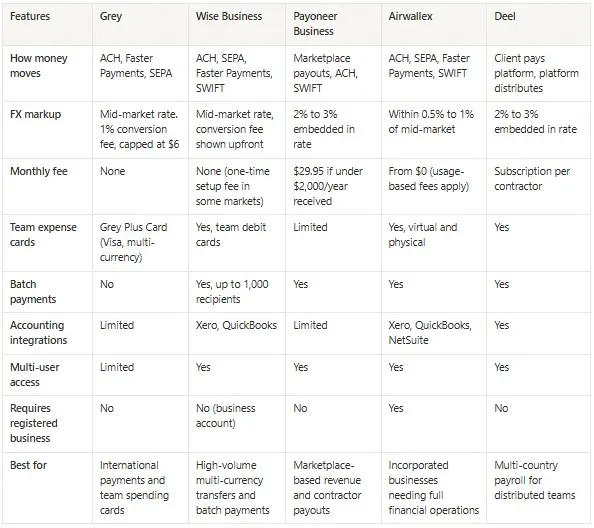
How the platforms compare
Choosing the right payment solution for your team
Most remote teams operating from Africa do not run their entire financial operation through a single platform. The more practical approach is to identify the two or three tools that together cover your specific combination of needs.
A common setup for a small African agency billing international clients looks like this:
- A multi-currency receiving account (Grey or Geegpay) for inbound client payments in USD, GBP, and EUR, with the team’s expense card for international software and ad spend.
- Wise Business or Airwallex for batch payments to contractors across multiple countries, taking advantage of the batch payment functionality and accounting integrations.
- Deel for any contractor relationships that require formal compliance documentation, particularly in markets where local labour regulations make a Deel contract more appropriate than a direct bank transfer.
Your choice should consider where your clients and team members are, how formally incorporated your business is, your payment needs, and how much volume you are processing. Understanding these factors provides a clearer picture and helps you make an informed decision.
Manage your team’s international finances with Grey
Grey gives remote teams across Africa virtual USD, GBP, and EUR accounts with real foreign banking details, a multi-currency Visa card that draws directly from available balances across currencies, and a straightforward withdrawal to local bank accounts across the continent.
The Grey Virtual Card, a virtual Visa card, connects directly to available Grey balances across USD, EUR, GBP, and NGN. When a team member pays for AWS cloud hosting, renews a Figma subscription, or settles a Facebook Ads invoice, the card automatically draws from the relevant currency balance, without a manual top-up. Multiple cards can be created for different spending categories, each with its own limit. Built-in 3D Secure authentication requires cardholder verification for each transaction, reducing the risk of unauthorised charges going undetected on a shared team account. The card supports Apple Pay and Google Pay in eligible regions.
Managing an African remote team is better when you can receive international payments in various currencies and pay your team members across Africa. Sign up on Grey and download the app today to manage cross-border payments for your remote team with freedom.
.svg)