
<script type="application/ld+json">[{"@context":"https://schema.org","@type":"BlogPosting","@id":"https://grey.co/blog/how-to-get-an-instant-usd-debit-card-in-india#article","headline":"How to get an instant USD debit card in India","description":"Learn how to get an instant USD debit card in India with Grey. Simplify international payments, manage subscriptions, and save on conversion fees.","inLanguage":"en","url":"https://grey.co/blog/how-to-get-an-instant-usd-debit-card-in-india","datePublished":"2024-12-27T07:24:20.789Z","dateModified":"2026-06-15T17:14:09.693Z","author":{"@type":"Person","name":"Adeolu Titus Adekunle"},"publisher":{"@type":"Organization","@id":"https://grey.co/#organization","name":"Grey","url":"https://grey.co"},"mainEntityOfPage":{"@id":"https://grey.co/blog/how-to-get-an-instant-usd-debit-card-in-india#webpage"},"image":"https://cdn.prod.website-files.com/636a85d290ee58e70c17e1c0/6a30167b230d71e013ec70c2_6a30167aeb742ba6b5ec000d_how-to-get-an-instant-usd-debit-card-in-india__header-image.webp"},{"@context":"https://schema.org","@type":"BreadcrumbList","@id":"https://grey.co/blog/how-to-get-an-instant-usd-debit-card-in-india#breadcrumb","itemListElement":[{"@type":"ListItem","position":1,"name":"Home","item":"https://grey.co/"},{"@type":"ListItem","position":2,"name":"Blog","item":"https://grey.co/blog"},{"@type":"ListItem","position":3,"name":"How to get an instant USD debit card in India","item":"https://grey.co/blog/how-to-get-an-instant-usd-debit-card-in-india"}]}]</script>

How to get an instant USD debit card in India

Adeolu Titus Adekunle

TABLE OF CONTENT

SHARE THIS POST

The world's most populous nation, India, is increasingly becoming a hub for freelancers, remote workers, and global shoppers. A USD debit card is essential for stress-free international transactions, whether you're paying for services, managing travel expenses, or receiving payments from overseas clients.

Like in most other countries outside the US, acquiring a USD debit card at traditional banks is challenging due to the long waits, hidden fees, and complex processes. With Grey, you can skip the stress and get an instant USD debit card in just a few steps. This guide will walk you through the process and explain why it's a must-have for managing international transactions.

Why you need a USD debit card in India

  1. Simplified online shopping: Shop on international websites without declined payments or high conversion fees.
  2. Save on conversion costs: Avoid the recurring expense of converting INR to USD for every transaction.
  3. Travel convenience: Make payments for flights, accommodations, and transport effortlessly while travelling abroad.
  4. Manage subscriptions with ease: Pay for global services like Netflix, Adobe, and Spotify without worrying about currency conversions.
  5. Freelance payment solution: Receive international payments smoothly and avoid the complexities of local bank transfers.

Also read: How to receive payments from Upwork in India in 2025

How to get a Grey USD debit card in India

Step 1: Create and verify your Grey account

Start by signing up on the Grey website or app.

Complete the KYC (Know Your Customer) verification process to activate your account. This entails uploading a valid government-issued ID, such as an Indian passport, proof of residence and your photograph. This ensures secure and compliant usage.

Tip: Grey provides a detailed guide to resolve common KYC verification issues if needed.

Step 2: Set up and fund a foreign currency account

Once your KYC is approved, request a foreign currency account in USD, GBP, or EUR.

__wf_reserved_inherit

You can fund this account via local or international bank transfers, making it easy to store foreign currencies for future transactions.

Step 3: Apply for your virtual USD debit card

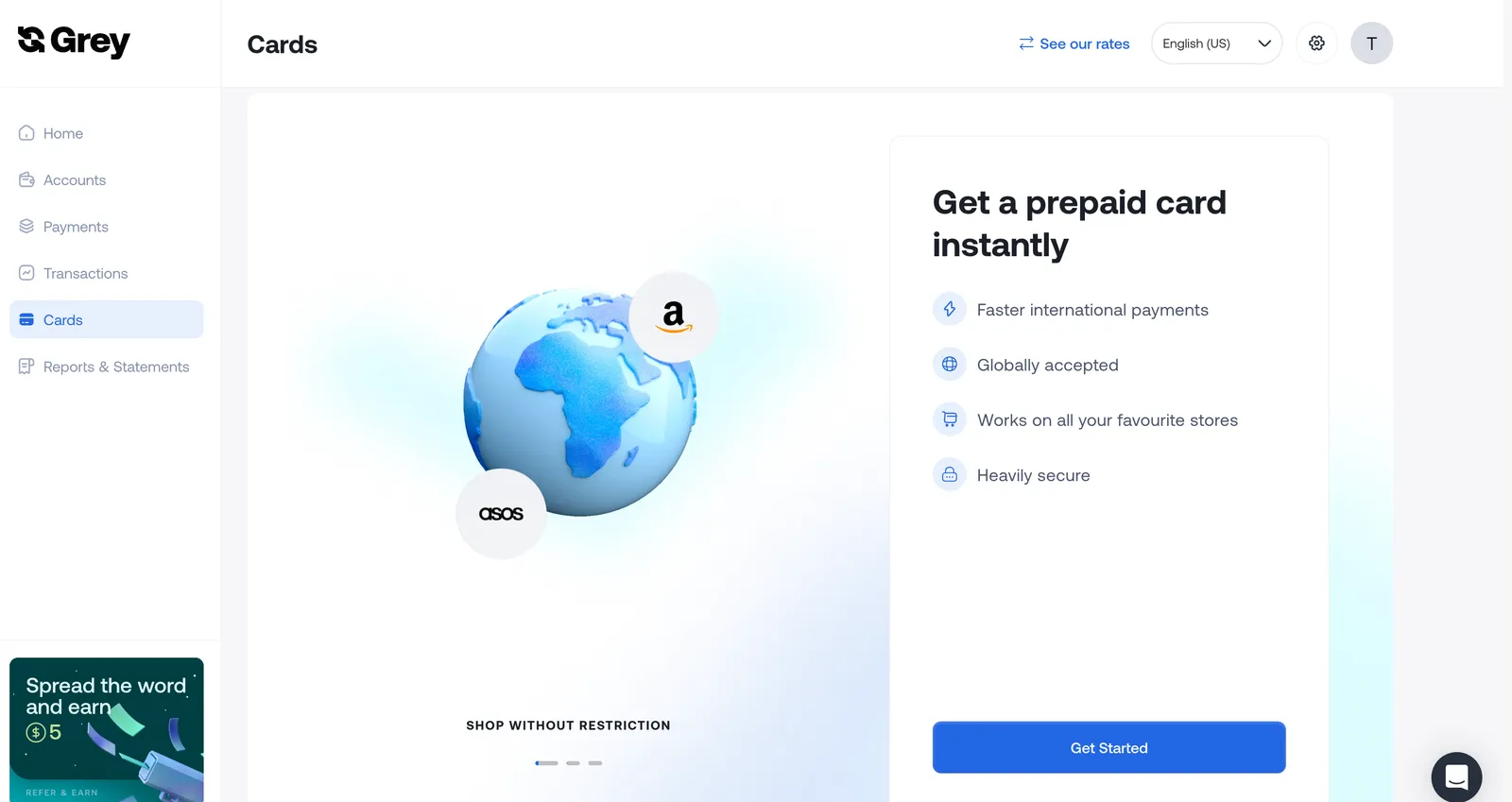
Go to the "Card" section in the Grey app or dashboard and click "Get started."

Pay the one-time card creation fee of $4 and fund the card with at least $1 to complete the application process for your virtual card. Your debit card will be ready for use in no time at all.

Read also: Best mountain vacation spots for a summer escape

Why choose Grey's USD debit card in India?

  1. Instant card issuance: Skip the long waits and get your virtual card instantly.
  2. Global usability: Make payments on any platform or store that accepts MasterCard.
  3. Simple funding: Load your card directly from your Grey foreign currency account.
  4. Transparent fees: Enjoy low, clear charges with no hidden costs.
  5. Secure transactions: Grey offers top-notch security measures to protect your payments and personal data.

Conclusion

Getting a USD debit card in India has never been easier. With Grey, you can skip the traditional banking hurdles and enjoy a quick, secure, and cost-effective solution for all your global financial needs.

Sign up with Grey today and take control of your international payments effortlessly!

‍

Last updated:

September 22, 2026

Open a free Grey account to get startedJoin 1 million digital nomads
IF YOU ENJOYED THIS, CHECK THESE OUT

Top offshore bank accounts US citizens should consider this year

•

•

2 min read

Opening an offshore bank account is becoming increasingly common and practical for US citizens. An offshore bank account can unlock access to flexible, multi-currency financial tools that traditional US banks don’t always offer.

Despite the “offshore” label, opening an account abroad is completely legal when done properly. With tax compliance in place and the right financial partner, you can manage money internationally with ease. Here, we’ll look at the top countries for offshore banking in 2025 and introduce Grey, a modern digital alternative that gives you many of the same global banking benefits without the red tape.

Why US citizens consider offshore bank accounts

US citizens are increasingly exploring offshore banking for practical and completely legal reasons. Here are some of the top motivations:

Multi-currency access: Many offshore banks allow you to hold accounts in USD, EUR, GBP and other currencies, which is helpful for remote workers or investors with global exposure.

Geographical diversification: Offshore accounts provide an extra layer of protection if there’s financial or political instability in your home country.

Global lifestyle: Digital nomads, expats, and retirees benefit from banks that support international transfers, low FX fees, and seamless ATM access abroad.

Asset protection: In certain jurisdictions, offshore accounts can protect your funds from local lawsuits or creditor claims.

Investment access: Offshore banks can unlock new investment opportunities, including global mutual funds, stocks, or foreign real estate.

Keep in mind that as a US citizen, you’re still obligated to report foreign accounts through FATCA (Foreign Account Tax Compliance Act) and FBAR (Foreign Bank Account Report). The IRS requires transparency — but it doesn't prohibit banking abroad.

Also read: The easiest way to open an offshore bank account online for free

Best countries to open an offshore bank account in 2025

Let’s explore some of the most popular and accessible countries for US citizens to open offshore accounts — with each offering unique perks for international finance.

1. Switzerland

A classic name in offshore banking, Switzerland remains a top destination for those seeking banking stability and privacy.

Switzerland is best for high-net-worth individuals seeking wealth management, asset protection, and secure multi-currency accounts.

2. Singapore

Singapore’s strong economy, tight financial regulation, and low tax environment make it ideal for business owners and investors. While minimum deposits vary, many expats find Singapore’s digital-first banking experience incredibly convenient.

3. Georgia

The Eastern European nation of Georgia is a rising star in offshore finance. With low taxes and a simple application process, it’s a great choice for digital nomads or freelancers. Some banks even allow you to open an account remotely or within a day of arriving.

4. Belize

Belize is well-known for its asset protection laws. It’s an excellent option for personal savings or setting up an offshore business account. Banks here generally make account opening relatively straightforward.

5. Cayman Islands

Although often associated with large corporations, the Cayman Islands also welcomes individuals. With no income tax and strong confidentiality protections, it’s an attractive option for wealth preservation. Be prepared for high minimum deposits, but the long-term benefits are significant.

6. Mauritius

For US citizens with ties to Africa or Asia, Mauritius offers an interesting mix. Its stable financial system and proximity to emerging markets make it ideal for entrepreneurs and remote workers. Offshore accounts can often be opened with just a few thousand dollars, and the country’s banking system is English-friendly.

Also read: Best countries to open an offshore bank account (with low tax benefits!)

How to choose the right offshore account

Choosing the right country (and bank) depends on your specific goals. Ask yourself:

  • Are you managing client payments or investments abroad?
  • Do you need multi-currency access or a simple USD account?
  • Can you meet the minimum deposit requirements?
  • Do you want full digital banking, or are you okay with in-person onboarding?
  • Is the bank FATCA-compliant and transparent with US reporting laws?

It’s also wise to consult a financial advisor or accountant familiar with US offshore banking regulations to avoid legal or tax surprises.

How Grey simplifies global banking for US citizens

Opening a traditional offshore account can take a while and many banks have high minimum deposit requirements or tedious paperwork. That’s where Grey comes in.

Grey is a global banking platform that offers multi-currency accounts in USD, EUR and GBP without the need to travel or deal with offshore bureaucracy. Grey gives you the core benefits of offshore banking:

  • Free virtual accounts: Instantly receive USD, EUR, and GBP from clients or platforms.
  • Multi-currency wallets: Hold your earnings in foreign currencies.
  • Fast currency conversion: Convert money at competitive, transparent exchange rates.
  • Local withdrawals: Send your funds to domestic accounts or mobile wallets across multiple countries.
  • Secure platform: Grey is fully regulated, with encryption and fraud protection built-in.

How to open a Grey account (from anywhere)

Getting started with Grey is simple — and fully remote:

  1. Sign up on grey.co or download the Grey app
  2. Verify your identity by uploading a valid passport or government ID
  3. Create your virtual bank accounts in USD, EUR, or GBP
  4. Start receiving payments from clients, marketplaces, or employers
  5. Convert and withdraw to your local bank or spend using Grey’s virtual dollar card

With Grey, you don’t need to jump through hoops to access the benefits of global banking.

Also read: The easiest way to get a virtual dollar account for AdSense earnings

Offshore banking is no longer reserved for the elite. If you want a faster, easier way to create international bank accounts without the paperwork and five-figure minimums, Grey is your best bet. Create your Grey account today or download the app to enjoy inclusive global banking, designed for you to carry your dreams across borders.

‍

How to convert Euros to Naira at black market rates

•

•

2 min read

In Nigeria, access to foreign currency, especially Euros, is in high demand. Getting the best exchange rate during such transactions can have a big impact on your finances.

Because traditional banks often have rigid systems and unfavourable rates, many people turn to the black market to convert their Euros to Naira. It’s quick, it’s accessible, and often, it seems like the only way to get a better value.

However, the black market isn’t always the safest or most sustainable option. Here, I’ll be exploring what black market rates really mean, the downsides, and how to get the same competitive rates with Grey.

What is the black market euro to naira rate?

The black market, also called the parallel market, is an unofficial foreign exchange system where people exchange currencies outside of government-regulated banks. In Nigeria, black market rates are widely used because they typically have a better deal than the rates published by the Central Bank of Nigeria (CBN).

For example, while a bank might offer to buy your euro at ₦1,100, the black market might offer ₦1,300 or more. These rates fluctuate daily and are often based on real-time demand and supply. You can track them through street vendors, social media platforms, or dedicated websites.

But while the rates are attractive, there’s very little oversight.

Also read: The best virtual dollar cards for freelancers and frequent travellers

Why do people prefer black market rates?

The appeal is simple: Better value. Many people who earn in foreign currencies especially want to maximise their naira earnings. With bank limits and long processing times, traditional routes feel restrictive.

Some of the common reasons include:

  • Favourable rates: You get more naira for each euro when compared to official rates.
  • Fewer restrictions: No paperwork, no waiting in line at the bank, and no foreign exchange limits.
  • Speed: Transactions are instant, especially for cash exchanges.

For someone earning in euros, it can feel like the smartest way to go. But that leads us to the other side of the coin.

The risks of converting EUR to NGN on the black market

Black market transactions are, by nature, unregulated. That means you're stepping into a system with zero accountability. Here’s what you’re risking:

  • Scams and counterfeit money: There are countless stories of people being duped with fake naira or invalid euros.
  • Security concerns: Meeting with strangers to exchange large amounts of cash isn’t just unsafe — it’s dangerous.
  • No recourse: If something goes wrong, there’s no refund policy or customer support.
  • Unpredictable fluctuations: Rates are inconsistent and can vary drastically within hours or between sellers.
  • No regulation or protection: If your exchanger disappears with your money, there’s no legal support. Transactions are based entirely on trust.‍
  • Counterparty risk: Scammers often impersonate legitimate exchangers. Even referrals can go wrong.‍
  • Legal grey area: While using black market rates isn’t criminalised for individuals, regulators frown on it, and anti-money laundering laws could apply in certain situations.‍
  • Lack of transparency: You never really know where your money is going, or whether the exchanger is operating cleanly.

This is why many freelancers and global professionals are now searching for legal, digital ways to get black market-level rates, without the risk.

A smarter alternative: convert euros to naira with Grey

Grey offers a secure, digital way to convert EUR to NGN at rates that often rival the black market —  minus the risk.

With Grey, you can open a free virtual EUR account from Nigeria. That means you can receive payments from clients in Europe, get your funds instantly, and convert them to naira.

Here’s what makes it so convenient:

  • Multi-currency accounts: Receive and hold EUR, USD, or GBP in your name.
  • Competitive exchange rates: Convert your Euros to Naira at some of the best rates available.
  • Instant processing: Say goodbye to days of waiting for payment clearance.
  • Full transparency: No hidden fees, no funny business.
  • Withdraw to your Nigerian bank: Seamlessly move your naira to any local account when you're ready.

You’re not only saving time and money, you’re protecting yourself from fraud.

Also read: Convert pounds to naira at the best rates online

How to convert EUR to NGN with Grey

Setting up your account and getting started is incredibly simple. Here’s how:

Create a Grey account

Visit grey.co or download the app. Sign up with your email and create a secure profile.

Verify your identity

Upload a valid ID (like your national ID or passport), a selfie, and proof of address to complete KYC.

Receive Euros

Once verified, you can request a free EU bank account. Share your IBAN with clients or platforms that pay in Euros.

Convert to Naira

Log in to your Grey dashboard, tap your Euro balance, and hit “Convert.” Your naira equivalent will be shown instantly.

Withdraw to your local bank

Send your converted naira to any Nigerian bank account of your choice.

It’s fast, safe, and built specifically for people like you — freelancers, remote workers, and global professionals.

Also read: Freelancer's guide to handling currency fluctuations

If you regularly receive payments in Euros, don’t settle for high-risk meetups or shady agents. Instead, take control of your money with Grey and experience smarter banking built for modern work. Create a free Grey account or download the app and convert Euros to Naira the smart way.

‍

Top USD savings accounts for freelancers working remotely

•

•

2 min read

As a remote freelancer, earning in US dollars helps with global accessibility and improves spending power. Once you start earning, the next step is finding the perfect place to save. The right USD savings account helps you save smarter, avoid unnecessary fees, and even grow your earnings.

In this article, we’ll be going through the best savings accounts for remote freelancers. The major criteria will be convenience, security, and flexibility.

Also read: Where to find high-paying remote customer service jobs worldwide

Grey – Best all-round USD account for freelancers

Grey is designed for modern freelancers and digital professionals working with international clients. With Grey, you can open a virtual USD account online. It’s perfect for receiving payments from platforms like Upwork, Fiverr, and clients abroad.

But Grey offers more than just a place to store your earnings. It’s a fully digital experience tailored for remote work:

  • Multi-currency accounts: Hold and manage USD, GBP, EUR, and more.
  • Competitive exchange rates: Convert USD to your local currency at real-time market rates.
  • Low transaction fees: Send and receive money globally without heavy charges.
  • Integrated invoicing tools: Generate and send professional invoices directly from your Grey account.
  • Safe and secure – Grey uses bank-level encryption and complies with global financial regulations.

Also read: High-paying remote jobs you can land without experience

Wise – Great for holding and converting USD

Wise is another excellent choice for international freelancers. With its multi-currency account, you can hold, receive, and convert USD alongside other currencies.

Wise is known for transparency and its mid-market exchange rates. You can also get local bank details in the US, which makes receiving USD payments easier. It’s useful if you freelance for clients in the US and Europe.

While Wise has no monthly maintenance fees, you may encounter small charges for currency conversion and withdrawals.

Payoneer – Popular among freelancers on marketplaces

Payoneer is a well-known payment solution, especially for freelancers on platforms like Upwork, Fiverr, and Toptal. With Payoneer, you can create a USD receiving account, which can be used to get paid by US-based companies or marketplaces.

Funds received can be held in your Payoneer account or withdrawn to your local bank. However, freelancers often report higher withdrawal fees and currency conversion charges compared to newer alternatives like Grey and Wise.

Still, Payoneer’s global reach and integration with major platforms make it a solid option for many remote workers.

Revolut – Digital banking with USD capabilities

Revolut offers digital banking solutions for freelancers and remote workers in supported countries. While it’s not a dedicated USD savings platform, Revolut’s multi-currency wallet allows you to hold, receive, and exchange USD easily.

Its sleek app interface, analytics, and budgeting tools make it popular among younger freelancers. You can also invest or save in vaults — a feature that helps you automate your savings.

Also read:  The easiest way to open an offshore bank account online for free

Grey leads the pack for its freelancer-first approach, multi-currency flexibility, and seamless global transfers. I once heard a saying that what you choose to do is often bound within the confines of what you can do. Well, opening a Grey account is something that you can do and given the points we’ve raised, is probably something you want to do too.

Create your Grey account today or download the app to enjoy inclusive global banking, designed for you to carry your dreams across borders.

‍

How to convert Cedis to USD at the best rates

•

•

2 min read

Somewhere in Ghana, someone is facing the not-so-fun task of converting money from Ghanaian Cedis to US Dollars. He starts scrolling through his bank app and then realises the exchange rate is painfully low. He checks with a local forex bureau but is unsure of how safe or consistent the process is. It’s a fairly common situation. The struggle to get fair conversion rates is real.

Thankfully, with the right tools, converting GHS to USD doesn’t have to feel like a rip-off. We’ll break down the smartest, safest, and most affordable ways to convert your Cedis to US Dollars, and show you why Grey is your best bet for getting more out of every transaction.

Why you might need to convert Cedis to dollars

Ghanaians need to convert to USD for a variety of reasons, including:

  • Travel: Whether for business, study, or leisure, having USD on hand is essential for many destinations.
  • Paying for digital tools and subscriptions: From Adobe to Netflix, many global platforms bill in dollars.
  • Sending money to loved ones abroad: USD is often the preferred or required currency for cross-border family support.

Also read: Convert pounds to naira at the best rates online

Traditional ways of converting GHS to USD (and their pitfalls)

Banks

Many banks in Ghana allow you to exchange GHS for USD, but the process can be time-consuming and expensive. You may be required to fill out long forms, provide proof of need, or wait days to access foreign currency. Banks also set poor exchange rates often and charge high transfer or withdrawal fees.

Bureau de Change (Forex traders)

Forex traders in Ghana’s major cities often offer better rates than banks, but they aren’t always regulated or transparent. Rates can fluctuate wildly, and there's always the risk of scams or counterfeit notes.

Online communities or P2P exchange

Some people turn to peer-to-peer networks or online forums to exchange currency. While this might get you close to black-market rates, it can also be incredibly risky. There’s no guarantee you’ll get paid, or that the notes you receive are real.

Mobile money apps

Mobile apps offer some convenience, but their rates can be unpredictable, and not all of them support direct GHS-to-USD exchange. Limits and network restrictions are also common.

Also read: How to convert Euros to Naira at black market rates

The smarter way: Convert GHS to USD using Grey

Grey is an international digital banking platform that lets users in Ghana create virtual USD accounts and convert currencies at competitive rates. Unlike banks and unregulated traders, Grey is transparent, flexible, and fast.

With Grey, you can receive USD payments, convert at real-time rates, and withdraw your money when you need it.

How to convert GHS to USD with Grey

Here’s a step-by-step process to convert your Ghanaian Cedis to USD using Grey:

Create an account

Visit Grey or download the Grey mobile app. Sign up with your email address and complete the onboarding process.

Verify your identity

Upload a valid ID and proof of address to complete KYC verification. This step is quick and keeps your account secure.

Fund your Grey account

Deposit GHS into your Grey account using a local bank transfer or mobile money.

Convert your Cedis to USD

Inside your Grey dashboard, go to the “Convert” section. Enter the amount of GHS you want to exchange and view the current rate. Tap “Convert” to finalise the transaction.

Hold, spend, or transfer

‍You can choose to:

  1. Hold your USD in your Grey account.
  2. Withdraw it to a foreign bank account.
  3. Or use it to pay for subscriptions or services online.

Tips to get the best exchange rates

  • Monitor rates regularly: Rates fluctuate, so keeping an eye on market trends helps you convert when it's most favourable.
  • Convert larger amounts at once: This reduces the percentage you lose to fees.
  • Use platforms like Grey that reflect market rates: This ensures you’re not losing value through hidden markups.

Why Grey is the best platform for currency conversion in Ghana

Grey is built for the modern African professional navigating a global economy. Here’s why it stands out:

  • Multi-currency accounts: Hold and manage balances in USD, GBP, EUR, and more.
  • Great exchange rates: Get the best rates on the market.
  • Fast transfers: Convert and move money in minutes.
  • Safe and secure: Fully compliant with financial regulations and protected by advanced encryption.
  • Built for freelancers and remote workers: Get paid by international clients, hold your funds in USD, and withdraw to your local account in GHS.

Also read: Freelancer’s guide to handling currency fluctuations

If you’re tired of bad rates, long wait times, and sketchy forex exchanges, it’s time to switch to something better. With Grey, you can convert your Ghanaian Cedis to US Dollars at highly competitive rates.

Create your Grey account today or download the app to enjoy inclusive global banking, designed for you to carry your dreams across borders.

‍

How to withdraw from PayPal to Nigeria (5 ways compared)

•

•

2 min read

This article was what I needed when I was trying to land a freelance writing role a few years ago. I was a greenhorn in freelancing at the time, and it was one of those jobs where you have to complete a paid sample article before getting hired. The ridiculous pay is a separate conversation, but after I turned in the sample, they asked for my PayPal details, and I was at a loss. Then I discovered the challenges PayPal users in Nigeria face when setting up their accounts. I eventually used my friend’s account to receive the payment, only to discover another layer of challenges. Withdrawing to my local account would be really difficult and expensive, so the amount I’d end up with wouldn’t make it worth it.

Despite the challenges with PayPal use in Nigeria, it remains a widely used payment platform for international transactions. With over 429 million users globally, it is one of the most trusted payment solutions by international clients and businesses. PayPal does not support direct withdrawal to Nigerian bank accounts. There is no provision to directly withdraw from your PayPal balance to your First Bank, GTB, or Access Bank account. This long-standing limitation affects a significant number of Nigerian digital workers, but there are ways around this, varying cost, reliability, and setup ease.

This article covers the main options, their real costs, and how to choose the right approach based on how often you receive PayPal payments and how much control you want over the conversion.

Read also: The best digital nomad jobs to earn from anywhere in Nigeria

Why is PayPal withdrawal restricted in Nigeria?

PayPal’s restriction in Nigeria stems from Nigeria's regulatory framework. Nigerian PayPal accounts can receive payments from international senders, but the platform does not support direct bank withdrawal to Nigerian bank accounts through its interface. This is a compliance and partnership decision, not a technical limitation. PayPal has not established the required local banking infrastructure to support naira withdrawals in Nigeria as it has in other countries.

The consequence is that anyone receiving PayPal income in Nigeria needs a third-party step to access the funds. That third-party step adds another layer of cost, delays, and inconvenience.

Options for withdrawing PayPal funds in Nigeria

You can access your PayPal funds using any of these methods.

Virtual USD account linked to PayPal

This is perhaps the most structured and cost-effective approach for anyone who regularly receives PayPal income in Nigeria. While PayPal does support withdrawals, you can add a US bank account as a withdrawal method. Typically, you need a Social Security Number and US residency to create a USD account. However, fintech platforms let you create a virtual USD account entirely online, and you receive USD account details as if you had an account with Wells Fargo or Bank of America.

You can then link this account to your PayPal account and withdraw via ACH. ACH is the local payment route for local USD transactions and is typically completed within one to three business days.

When the money lands in your virtual USD account, you are not required to convert at the rate that applies on the day PayPal processes the withdrawal. You hold USD and convert when the rate is favourable.

Here is how to withdraw from PayPal in Nigeria using a virtual USD account:

  1. Open an account with a platform that provides a USD account compatible with PayPal, such as Grey, Raenest, or Cleva.
  2. Copy the USD account details provided by your chosen platform (usually a USD routing number and account number).
  3. Link bank account to PayPal:
    • Log in to your Nigerian PayPal account.
    • Go to "Wallet", then "Link a bank account".
    • Select "Link a US bank account" and enter the virtual USD details.
    • Confirm the account if PayPal sends verification transactions.
  4. Initiate transfer
    • Click on "Transfer Money" in your PayPal Wallet.
    • Choose the linked virtual USD account as the destination.
    • Enter the amount to transfer and confirm.
  5. Once the money enters your virtual USD account (e.g., Grey), use the app to convert it to naira and transfer it to your local Nigerian bank account.

Note that the name on your virtual USD account must match the name on your PayPal account.

Here are some of the platforms offering virtual USD accounts in Nigeria that support PayPal withdrawals:

  • Grey: a digital payment platform offering virtual USD, GBP, and EUR accounts in Nigeria. It allows users to receive international payments from PayPal and withdraw to Nigerian bank accounts at favourable rates. Grey’s deposit fee is 0.8% of the amount, kept within $2 to $10, regardless of the amount. Converting to naira is at mid-market exchange rates with a 1% conversion fee (capped at $6) applied.
  • Cleva: Offers virtual USD accounts that support PayPal withdrawals with a $1 charge for deposits under $300 and $3 for deposits over $300. Conversions to naira are usually free, but an undisclosed margin is included in the exchange rate.
  • Raenest: Offers four free deposits per month for ACH transfers. Raenest charges a flat $1 fee per ACH deposit, regardless of the amount. Raenest charges a fee of 0.5% to 0.7% for converting USD to Naira. This conversion fee is capped at $2.70, meaning you will never pay more than $2.70 to convert any amount of dollars. Withdrawing NGN from your Raenest wallet to a local Nigerian bank account is completely free,

Flutterwave for Business transactions

This option is relevant for merchants selling products on Flutterwave. Although Flutterwave does not allow Nigerian merchants to receive payments directly from PayPal, they can accept payments from PayPal users via Flutterwave’s “Pay with PayPal” feature. This feature allows Flutterwave merchants in select African countries to accept payments from PayPal users worldwide. ****

Once you register your business on Flutterwave, you can enable PayPal as a payment option on your Flutterwave checkout. Customers can pay via PayPal. Funds will be available in your Flutterwave dashboard. Then, you can transfer the funds from Flutterwave to your Nigerian bank account.

  1. Create a merchant account (business or individual) and complete the verification process.
  2. Go to your Flutterwave Dashboard and and from your settings, enable PayPal as a payment option.
  3. You can now create payment links or integrate the Flutterwave checkout on your website.
  4. Customers select "Pay with PayPal" at checkout.
  5. Your payments are processed and settled into your linked local bank account within 1-5 working days.

It is important to review the conversion rates and withdrawal fees on Flutterwave before setting up this route.

This option does not help a freelancer receiving a direct PayPal payment from a single client. It is only relevant for business owners that can adopt Flutterwave as the payment processor.

Engage with trusted local exchangers

Several platforms offer to buy PayPal funds and pay in naira. These are often informal or semi-formal exchange services. So, it’s crucial to choose reputable exchangers to avoid scams. Some options include fnfSwap, Zutaa and Afrilatest.

Here is how these platforms work:

  • They provide a PayPal or USD account for you to initiate a transfer.
  • Send the money from your PayPal
  • They verify receipt and transfer naira to your bank account at an agreed rate.

Rates are negotiated and vary by platform, time of day, and transaction size.

Again, always verify the credibility of exchangers and be cautious of potential fraud. Some operators accept your PayPal transfer and do not complete the naira payment. They can also pay you at significantly worse rates than quoted. Before using any P2P service:

  • Check recent reviews
  • Verify the platform's regulatory status
  • Use a small test transaction first

For one-off or small-amount withdrawals, this route can be faster than setting up a virtual USD account. For regular income, the cost variability and fraud risk make it a less reliable primary method.

Try the UBA dollar prepaid card (AfriCard)

The UBA AfriCard is a prepaid USD Visa card that supports PayPal withdrawals in Nigeria. Once obtained, it can be linked to a verified PayPal account as a debit card rather than a bank account. PayPal supports withdrawal to linked debit cards in some circumstances, and the AfriCard provides a USD-denominated option that works within that framework.

The process requires a physical visit to a UBA branch with valid ID and a utility bill to obtain the card. Once you have the card and link it to PayPal, you can transfer your PayPal balance to the card and spend in USD directly or use the card for ATM withdrawals.

One drawback is that you don’t have direct access to USD. You are spending from a USD prepaid card rather than converting and withdrawing to a naira account. For certain use cases, particularly for expats or frequent travellers who want to spend in USD, this is functional. For someone trying to get naira into their Nigerian bank account, the process requires an additional step.

Read also: Top PayPal and Payoneer alternatives for African freelancers

How the options compare

Feature Grey Traditional Nigerian banks
How money is received Via foreign account details (USD, GBP, EUR) using local rails (ACH, SEPA, Faster Payments) Via SWIFT wire into domiciliary or naira account
Intermediary bank fees None (when using local rails) $15–$60 deducted by correspondent banks
Deposit / receiving fee ~0.8% (min $2, capped at $10) Usually hidden in transfer chain or charged as processing fees
FX rate used Mid-market rate Bank’s internal rate (typically 2%–4% worse than mid-market)
Conversion fee ~1% (capped at $6 per transaction) Embedded spread (2%–4%) with no clear breakdown
Control over conversion timing Yes, you choose when to convert No, conversion often happens automatically on receipt
Transparency Upfront breakdown before conversion Opaque — final amount only known after settlement
Processing time Within hours (depending on rail) 2–5 business days
Ability to hold USD Yes Limited (domiciliary accounts only, with restrictions)
Typical total cost on $1,000 ~$10–$20 equivalent ~$40–$100+ (fees + FX loss combined)
Best use case Freelancers, remote workers, recurring payments Large, infrequent transfers, corporate payments

What Grey provides for PayPal withdrawals in Nigeria

Grey issues virtual USD accounts to Nigerian users with real US account details that PayPal accepts as a linked account. Once the link is verified, withdrawals from PayPal land in the Grey USD balance within one to three business days.

The USD sits in the account until the user initiates a conversion. The conversion rate and the 1% fee, capped at $6 regardless of the amount, are displayed before confirmation. A $2,000 PayPal withdrawal converted to naira on Grey costs $6 in conversion fees. The naira transfers to a Nigerian bank account for ₦35 per withdrawal.

Beyond PayPal, the same account receives ACH transfers from US clients and employers directly, which means it functions as a general USD receiving account rather than a PayPal-specific workaround.

Withdraw PayPal funds in Nigeria at the best rates with Grey in these quick steps.

  1. Create an account on Grey or sign up via the mobile app. Select Nigeria as your country and provide your personal information.
  2. Upload your picture and other documents to complete your Know Your Customer (KYC) verification.
  3. Get your virtual USD account details. You’ll receive a US account under your name. The name on your PayPal account must match your Grey account to avoid failed or missing transfers.
  4. Link your Grey USD account to PayPal. Go to the wallet section of your PayPal.
  5. Select “Link a Bank Account” and input your Grey account details.
  6. A deposit will be sent from your PayPal to your Grey account for verification.
  7. After verification, you can now transfer funds from PayPal to Grey. This may take 1–3 business days.

Read more: How to open a foreign bank account for PayPal payments

Frequently asked questions

Why can't I withdraw PayPal funds directly to my Nigerian bank account?

PayPal does not have a direct bank withdrawal partnership with Nigerian commercial banks. This is a regulatory and operational decision rather than a technical barrier. To access PayPal funds in naira in Nigeria, you need a third-party route: either a virtual USD account that PayPal accepts as a linked bank account, a merchant platform like Flutterwave, or a local exchange service. The virtual USD account route is the most structured and cost-effective for regular income.

How long does it take for a PayPal withdrawal to reflect in a virtual USD account?

PayPal standard transfers to linked bank accounts typically take one to three business days. Instant transfer is available in the US for eligible accounts but does not apply to virtual USD accounts linked by Nigerian users. Once the funds land in the virtual USD account, conversion to naira and withdrawal to a Nigerian bank account is typically processed within a few minutes to a few hours.

What happens if my PayPal name does not match my virtual USD account name?

PayPal matches the account holder name on the destination bank account against the name on the PayPal account. A mismatch causes the transfer to fail or be returned. Before linking a virtual USD account to PayPal, confirm that the name on the virtual account matches your PayPal display name exactly, including middle names or initials if they appear on either account. If there is a discrepancy, update the name on one account before proceeding.

Are P2P exchange platforms safe for withdrawing PayPal funds in Nigeria?

Some are legitimate and have built reputations over years of operation. Others are fraudulent. The risk is real enough that starting with a small test transaction before sending significant funds is standard practice for anyone using this route for the first time. Checking recent user reviews on independent platforms, verifying whether the operator has any regulatory registration, and avoiding operators who ask for payment before they have confirmed receipt of your PayPal transfer are the basic due diligence steps.

—

Ready to withdraw your PayPal funds?

Sign up at grey.co or download the Grey app. Link your USD account to PayPal in minutes, and convert to naira at a 1% fee capped at $6

‍

Best invoicing tools for freelancers working with international clients

•

•

2 min read

The invoicing tool you choose as a freelancer working with international clients affects more than just how your invoice looks. It determines how much of each payment you keep, how quickly you receive it, and whether the process creates friction for your client's finance team.

A client in New York paying via ACH expects to enter a routing number and click "send." A client in London expects a SEPA-compatible IBAN. A client in Dubai may want to pay by card. If your invoicing tool does not support the payment method your client prefers, the invoice sits unpaid while both sides figure out an alternative. And if the tool charges 3% to 5% per transaction in processing and conversion fees, you are losing $150 to $250 on every $5,000 invoice before the money reaches your bank.

This article compares six invoicing tools on the things that actually matter for international freelancers: pricing, transaction fees, multi-currency support, automation, and whether the tool integrates invoicing and payment collection into a single workflow.

Invoicing mistakes that delay international payments

Missing or incorrect payment details. A wrong IBAN digit, an outdated SWIFT code, or a mismatched account name causes rejected transfers. Always copy and paste account details rather than typing them, and verify with your payment provider before sharing.

Vague service descriptions. "Consulting services" tells a finance team nothing. "UX audit of checkout flow, 40 hours at $75/hour" tells them exactly what was delivered and how the amount was calculated. Vague descriptions delay approvals because someone has to ask what the charge is for.

No currency specified. If your invoice says "500" with no currency, the client may process it in their local currency, convert incorrectly, or send it back for clarification. State the three-letter currency code (USD, EUR, GBP) next to every amount.

Also read: Simple tools freelancers use to work with clients worldwide

What a professional freelance invoice must include for international clients

Before choosing a tool, it helps to know what the tool needs to produce. An international freelance invoice should include: a unique invoice number, issue date and payment due date, your legal name or business name and address, the client's name and billing address, itemised services with descriptions, quantities, rates, and line totals, the total amount due in a clearly specified currency (USD, EUR, GBP), your preferred payment method with specific details (routing number and account number for ACH, IBAN and SWIFT/BIC for wire, or a payment link), and payment terms (Net 14, Net 30, or milestone-based).

Two elements are particularly important for cross-border invoices. First, the currency must be stated explicitly. An invoice that says "$500" without specifying USD, CAD, or AUD creates ambiguity. Second, the payment instructions must match the client's preferred payment method. If your client's finance team processes ACH payments and your invoice only includes a SWIFT code, the invoice goes to the back of the queue.

Six invoicing tools for freelancers with international clients

1. Grey Invoicing

Pricing: Free. No subscription, no monthly fees.

Transaction fees: 1% conversion fee, capped at $6 per conversion. No per-invoice processing fee.

Multi-currency: USD, GBP, EUR.

Best for: Cross-border freelancers who want invoicing and payment collection in one platform.

Grey's invoicing tool is free and integrated with Grey's multi-currency accounts. This is the key differentiator: you create the invoice within Grey, the client receives a payment link, they pay via ACH (USD), SEPA (EUR), or Faster Payments (GBP), and the money lands directly in your Grey balance. There is no separate payment gateway, no third-party processor, and no additional processing fee per invoice.

The workflow: create an invoice in the Grey app or web dashboard, add your client's details and the line items, set the currency and due date, and send. The client clicks the payment link, pays via their local bank transfer method, and the funds are deposited into your Grey account. You convert to your local currency when you choose (a 1% fee, capped at $6) and withdraw to your local bank account.

Grey does not currently offer time tracking, project management, or recurring invoice automation. It is a focused tool: create, send, get paid. If you need those features, pair Grey with a time-tracking tool (Toggl, Clockify) or a project management tool (Notion, Asana).

2. FreshBooks

Pricing: $19/month (Lite, 5 clients) to $33/month (Plus, 50 clients). Discounts of 50% to 70% often available for the first 3 to 6 months.

Transaction fees: Depends on the payment gateway. ACH: 1% ($1 min). Credit card: 2.9% + $0.30.

Multi-currency: Yes, supports multiple currencies.

Best for: Freelancers who bill hourly and need time tracking linked to invoicing.

G2 rating: 4.5/5.

FreshBooks is the strongest option for freelancers who bill by the hour. Built-in time tracking lets you log hours against a project, and those hours auto-populate into an invoice. The platform also supports automated payment reminders (FreshBooks reports that freelancers who use them get paid up to 11 days faster), recurring invoices for retainer clients, and expense tracking. The main drawback for international freelancers is the monthly subscription cost and the reliance on a separate payment gateway for processing, which adds per-transaction fees on top.

3. Wave

Pricing: Free (Starter). Pro plan: $16-$19/month.

Transaction fees: Credit card: 2.9% + $0.60. ACH: 1%.

Multi-currency: Limited.

Best for: Freelancers starting out who want free invoicing with basic accounting.

G2 rating: 4.3/5.

Wave offers free invoicing and basic accounting (income/expense tracking, simple financial reports) in one dashboard. It is the most accessible starting point for a freelancer who has never used invoicing software. The limitation for international freelancers is that multi-currency support is limited, and the 2.9% + $0.60 per credit card transaction adds up quickly on larger invoices. On a $500 invoice paid by card, you lose $15.10 to processing fees.

4. PayPal Invoicing

Pricing: Free. No subscription.

Transaction fees: 2.99% + $0.49 per transaction. FX conversion adds approximately 3% to 4%.

Multi-currency: Yes, 24+ currencies.

Best for: Freelancers whose clients already use PayPal.

G2 rating: 4.4/5.

PayPal's advantage is familiarity. Over 430 million accounts globally mean most clients already have one and can pay an invoice in seconds. The disadvantage is cost: the combination of the 2.99% transaction fee and the 3% to 4% FX conversion fee makes PayPal one of the most expensive options for international invoicing. On a $500 invoice, total fees can reach $30 to $35, or 6% to 7%. For occasional small invoices where client convenience is paramount, PayPal works. For regular large invoices, the fees are disproportionate.

5. Bonsai

Pricing: $9 to $15/month (Basic) to $19 to $25/month (Essentials).

Transaction fees: Credit card: 2.9% + $0.30. ACH: ~1%.

Multi-currency: Yes.

Best for: Freelancers who want contracts, proposals, and invoicing in one platform.

G2 rating: 4.7/5 (HoneyBook, similar category).

Bonsai combines proposals, contracts, project management, time tracking, and invoicing into a single workflow. You send a proposal, the client signs the contract, you track the work, and Bonsai generates the invoice from the agreed terms. For freelancers managing multiple international clients with ongoing relationships, this end-to-end workflow significantly reduces admin. The trade-off is the monthly subscription and per-transaction fees.

6. Zoho Invoice

Pricing: Free.

Transaction fees: Depends on connected payment gateway (Stripe, PayPal, etc.).

Multi-currency: Yes, extensive.

Best for: Freelancers who want advanced automation without a subscription fee.

G2 rating: 4.6/5.

Zoho Invoice offers free invoicing with features that most competitors charge for: automated payment reminders, recurring invoices, client portals, multi-currency billing, and integration with the broader Zoho ecosystem (Zoho Books, Zoho CRM). The limitation is that payment collection requires connecting a third-party gateway (Stripe, PayPal), which adds its own transaction fees. Zoho is a strong choice if you want more automation than Wave but do not want to pay for FreshBooks.

What a $500 invoice actually costs through each platform

__wf_reserved_inherit

This is the comparison that matters. Below is the total cost, including subscription (amortized monthly if applicable), transaction processing, and FX conversion, when a US client pays a $500 invoice.

Grey's cost advantage comes from the absence of a per-invoice processing fee. Most invoicing tools charge 2.5% to 3% every time a client pays by card, which is $12.50 to $15 on a $500 invoice. Grey charges nothing at the invoice payment stage because the payment flows directly into your Grey account via ACH, SEPA, or FPS. The only fee is the 1% conversion fee when you move funds to your local currency, capped at $6, regardless of the amount.

The trade-off is that Grey does not offer time tracking, project management, or recurring invoicing. If those features are essential, FreshBooks or Bonsai is worth the subscription cost. If your primary need is to invoice international clients and get paid without losing 3% to 7% per transaction, Grey is the lowest-cost option.

Also read: Avoid these costly mistakes while applying for remote jobs worldwide

The invoicing workflow freelancers should automate

The value of invoicing software is not just in creating the invoice. It automates the steps around it, so you spend less time on admin and more time on billable work.

1. Contract or scope agreement. Before the first invoice, agree in writing on the scope, rate, currency, and payment terms. This prevents disputes later. Tools like Bonsai handle contracts and invoicing together.

2. Invoice creation. Use saved templates with your client's details, your payment information, and standard terms pre-filled. Creating each invoice should take under two minutes.

3. Automatic payment reminders. Set reminders for 3 days before the due date, the due date itself, and 7 days overdue. Most invoicing tools (FreshBooks, Zoho, Wave) automate this. If your tool does not, calendar reminders work as a manual fallback.

4. Online payment via the invoice. The invoice should include a payment link or button that lets the client pay immediately. Every extra step between "I approve this invoice" and "I've paid it" adds days to your payment timeline.

5. Payment tracking and reconciliation. Your invoicing tool should show you at a glance: total invoiced this month, total paid, total overdue, and total outstanding. This is your cash flow dashboard.

How to choose an invoicing tool that fits your country and client base

Choosing an invoicing tool depends on your location, client geography, payment needs, and how you want to manage billing, currency, and compliance across borders.

Payout options

Choose a tool that supports how your clients prefer to pay and how you want to receive funds locally. Some platforms are better suited for US clients using ACH, while others support cards or global transfers. Also consider payout options such as mobile money, local bank accounts, or holding foreign currency. The right fit reduces friction, speeds up payments, and ensures you can access funds easily without relying on complex or costly workarounds.

Currency handling and exchange rates

A strong invoicing tool should allow you to invoice in your client’s currency while giving you control over when and how you convert funds. Look for platforms with multi-currency support and transparent exchange rates. Poor FX rates can quietly reduce your earnings over time. The ability to hold USD, EUR, or GBP and convert strategically helps protect your margins and gives you better financial control across international transactions.

Fees

Understand how the platform charges for its services beyond just monthly subscriptions. Some tools offer free invoicing but charge higher transaction or FX fees, while others have subscription plans with lower processing costs. Look at card fees, transfer charges, and withdrawal costs. A platform that appears cheap upfront may cost more in the long run, depending on your transaction volume and client payment behaviour across different markets.

Also read: High-paying remote jobs you can land without experience

Compliance and ease of use

The tool should meet regulatory requirements relevant to your country while remaining simple to use daily. Consider onboarding requirements, document verification, and how easily you can create and manage invoices. A complex system can slow you down, while a compliant and intuitive platform helps you operate smoothly. This balance is important for freelancers working with international clients who need both reliability and speed in their invoicing process.

Frequently asked questions

1. What is the best way to invoice international clients as a freelancer?

The best approach is to use a digital invoicing tool that supports multi-currency billing and global payment methods. This allows you to invoice in your client’s preferred currency while receiving funds conveniently. It also improves professionalism, reduces errors, and speeds up approval and payment timelines.

2. Should I invoice in my local currency or the client’s currency?

It is generally better to invoice in the client’s currency to reduce friction and make payments easier for them. However, using tools that allow you to hold foreign currency helps you avoid poor exchange rates and decide when to convert funds based on favourable market conditions.

3. How can I reduce fees when receiving international payments?

You can reduce fees by using fintech platforms with low FX margins, consolidating transactions, and avoiding unnecessary conversions. Choosing ACH over SWIFT where possible and comparing platform charges regularly helps you keep more of your earnings from international clients over time.

4. Do I need a business account to invoice international clients?

Not always, but having a business account improves credibility, separates personal and business finances, and simplifies tax reporting. Many invoicing platforms also work better with business profiles, giving you access to more features and smoother payment processing for global freelance work

Managing international invoicing becomes easier when you use tools built for cross-border work. Grey stands out by combining multi-currency accounts with a free invoicing tool that lets you create, customise, and send professional invoices without added costs.

With competitive exchange rates, fast access to funds, and simple payment tracking, Grey helps you stay in control of your earnings. Sign up or download the Grey app today to manage payments globally.

Grey charges fees on deposits, conversions, and withdrawals. Deposits via ACH, SEPA, or FPS incur a 0.8% fee (minimum $2/€2/£2, maximum $10/€10/£10). Currency conversions are charged at 1%, capped at $6. Withdrawal fees vary by currency: ₦35 for NGN, 0.5% for EUR/GBP (minimum €2/£2, maximum €10/£10), and $0.50-$0.65 for KES/UGX/TZS. Cross-border card transactions (non-USD purchases on a USD card) incur a 2% fee plus $0.50. Exchange rates are variable and include a margin over the mid-market rate. Always review fees and the rate before confirming a transaction. Visit grey.co/pricing for current rates.

Arrow (up)

Back to top