
<script type="application/ld+json" data-schema-version="grey-blog-v4"> [{"@context":"https://schema.org","@type":"BlogPosting","@id":"https://grey.co/blog/getting-paid-in-gbp-from-tiktok-uk-as-a-creator-in-egypt#article","headline":"Getting paid in GBP from TikTok UK as a creator in Egypt","description":"Get paid from TikTok UK in Egypt without losing money to high fees. Compare Grey, Wise, Payoneer, and bank transfer fees and rates.","inLanguage":"en","url":"https://grey.co/blog/getting-paid-in-gbp-from-tiktok-uk-as-a-creator-in-egypt","mainEntityOfPage":{"@id":"https://grey.co/blog/getting-paid-in-gbp-from-tiktok-uk-as-a-creator-in-egypt#webpage"},"datePublished":"2025-08-06T11:01:29.438Z","dateModified":"2026-06-15T14:48:32.703Z","author":{"@type":"Person","@id":"https://grey.co/authors/adeolu-titus-adekunle#person","name":"Adeolu Titus Adekunle","url":"https://grey.co/authors/adeolu-titus-adekunle","jobTitle":"Content Writer","sameAs":["https://www.linkedin.com/in/titusadeoluadekunle/"]},"publisher":{"@type":"Organization","@id":"https://grey.co/#organization","name":"Grey","url":"https://grey.co","logo":{"@type":"ImageObject","url":"https://cdn.prod.website-files.com/6360022338a81bd6fdbb1145/6564ae1077a67e39d3c491a6_Grey%20Logo%20Lockup%20Black.svg"}},"image":{"@type":"ImageObject","@id":"https://grey.co/blog/getting-paid-in-gbp-from-tiktok-uk-as-a-creator-in-egypt#primaryimage","url":"https://cdn.prod.website-files.com/636a85d290ee58e70c17e1c0/6a3010c09bede433da21f147_6a3010bf7f1e2b07bb189070_getting-paid-in-gbp-from-tiktok-uk-as-a-creator-in-egypt__header-image.webp","contentUrl":"https://cdn.prod.website-files.com/636a85d290ee58e70c17e1c0/6a3010c09bede433da21f147_6a3010bf7f1e2b07bb189070_getting-paid-in-gbp-from-tiktok-uk-as-a-creator-in-egypt__header-image.webp","width":1200,"height":675}},{"@context":"https://schema.org","@type":"WebPage","@id":"https://grey.co/blog/getting-paid-in-gbp-from-tiktok-uk-as-a-creator-in-egypt#webpage","url":"https://grey.co/blog/getting-paid-in-gbp-from-tiktok-uk-as-a-creator-in-egypt","name":"Getting paid in GBP from TikTok UK as a creator in Egypt","description":"Get paid from TikTok UK in Egypt without losing money to high fees. Compare Grey, Wise, Payoneer, and bank transfer fees and rates.","inLanguage":"en","primaryImageOfPage":{"@id":"https://grey.co/blog/getting-paid-in-gbp-from-tiktok-uk-as-a-creator-in-egypt#primaryimage"},"breadcrumb":{"@id":"https://grey.co/blog/getting-paid-in-gbp-from-tiktok-uk-as-a-creator-in-egypt#breadcrumb"}},{"@context":"https://schema.org","@type":"BreadcrumbList","@id":"https://grey.co/blog/getting-paid-in-gbp-from-tiktok-uk-as-a-creator-in-egypt#breadcrumb","itemListElement":[{"@type":"ListItem","position":1,"name":"Home","item":"https://grey.co/"},{"@type":"ListItem","position":2,"name":"Blog","item":"https://grey.co/blog"},{"@type":"ListItem","position":3,"name":"Getting paid in GBP from TikTok UK as a creator in Egypt","item":"https://grey.co/blog/getting-paid-in-gbp-from-tiktok-uk-as-a-creator-in-egypt"}]},{"@context":"https://schema.org","@type":"FAQPage","@id":"https://grey.co/blog/getting-paid-in-gbp-from-tiktok-uk-as-a-creator-in-egypt#faq","mainEntity":[{"@type":"Question","name":"What is the cheapest way to receive GBP from TikTok UK in Egypt?","acceptedAnswer":{"@type":"Answer","text":"For regular creator income, Grey and Wise are often the most cost-effective options because they reduce exchange rate losses and make conversion more transparent."}},{"@type":"Question","name":"Can I receive TikTok creator payments directly in GBP?","acceptedAnswer":{"@type":"Answer","text":"Yes. Platforms like Grey and Wise let you receive and hold GBP before converting to EGP. This gives you more control over timing and exchange rates."}},{"@type":"Question","name":"How long do TikTok UK payments take to reach Egypt?","acceptedAnswer":{"@type":"Answer","text":"Traditional bank wires usually take 3 to 7 business days. Grey and Wise transfers are often faster depending on the payment route."}},{"@type":"Question","name":"Do Egyptian creators pay tax on income from TikTok UK?","acceptedAnswer":{"@type":"Answer","text":"Yes. Egyptian tax residents are generally required to declare worldwide income, including creator earnings from foreign clients and platforms. Speak to a certified tax professional for advice specific to your case."}},{"@type":"Question","name":"What details should I share to receive GBP payments?","acceptedAnswer":{"@type":"Answer","text":"For local UK transfers through Grey, share your GBP account details. For direct international bank transfers, share your SWIFT/BIC code and Egyptian bank details."}}]}] </script>

Getting paid in GBP from TikTok UK as a creator in Egypt

Adeolu Titus Adekunle

TABLE OF CONTENT

SHARE THIS POST

Your content might go viral overnight, but getting paid for it is rarely that fast.

A £2,000 creator payout from TikTok UK to an Egyptian bank account can lose £60 to £150 before it reaches you, depending on how the payment is received.

The problem is usually the costs in the background of visible fees: intermediary bank deductions, transfer charges, and exchange rate markups when your bank converts GBP to EGP. Many Egyptian banks convert at rates 3% to 5% below the mid-market rate, which means part of your income disappears before you even touch it.

For creators earning from TikTok UK through brand deals, creator marketplace campaigns, affiliate partnerships, or platform payouts, the payment method matters as much as the payment itself. A few percentage points lost every month can easily turn into hundreds or thousands of dollars per year.

This article compares the most common ways Egyptian creators receive GBP payments from TikTok UK and helps you choose the best option based on how often you get paid and how much you typically receive.

Also read: Best way for TikTok creators in Egypt to get paid from abroad

How Egyptian creators get paid from TikTok UK

Getting paid from TikTok UK isn’t just about posting content and waiting for money to show up in your account. How you get paid depends on where your income is coming from and who is paying you.

If you’re an Egyptian creator working with TikTok UK, your income usually doesn’t come from just one place. You might be getting paid directly by TikTok, working with UK brands, or earning through affiliate links and partnerships.

In most cases, your payments will come from one of these main sources:

Creator Rewards Program

If you are eligible for TikTok’s Creator Rewards Program (previously known as the Creator Fund), TikTok pays creators directly for qualifying video performance. Payments are based on factors like video views, engagement, watch time, and audience location.

These payouts are usually sent monthly once you reach the minimum withdrawal threshold set by TikTok. The amount can vary significantly from month to month, which is why many creators treat it as supplementary income rather than their main revenue stream.

TikTok Creator Marketplace brand deals

Many creators earn more from brand collaborations than from platform payouts.

Through TikTok Creator Marketplace, UK brands can work directly with creators for sponsored content, product promotions, and campaign partnerships. Payment terms here depend on the brand or agency, not TikTok itself.

Some brands pay by direct bank transfer, others use platforms like Payoneer, Wise, or contractor payment systems. This is where payment setup becomes especially important, because fees and exchange rates can change dramatically depending on how the brand sends the money.

Affiliate partnerships

Creators also earn through affiliate links, especially in beauty, fashion, tech, and lifestyle niches.

In this case, payment usually comes from the affiliate network or brand partner rather than TikTok directly. Some affiliate platforms pay in GBP, others in USD or EUR, depending on the company.

This means your payment method should not only work for TikTok payouts, but also for multiple income sources at the same time.

LIVE gifts and creator monetisation features

If you use TikTok LIVE, gifts, subscriptions, or other monetisation features, TikTok may process payouts differently depending on your region and account setup.

These earnings are usually smaller but more frequent, and they often benefit from faster, lower-cost payout methods instead of traditional bank wires.

Why your payout method matters

Two creators can earn the same £2,000 from TikTok UK and still receive very different amounts in Egypt.

One gets paid through a traditional bank wire and loses money to transfer fees and poor exchange rates. The other receives GBP into a foreign account first, converts later, and keeps significantly more.

That is why the payment method matters just as much as the income source. The goal is not only to get paid, but to keep more of what you earn.

Also read: The best way to send money to Egypt from the UK‍

Payment methods for receiving GBP creator income in Egypt

Direct bank transfer (SWIFT)

A direct international bank transfer from TikTok UK, an agency, or a UK brand to your Egyptian bank account is the most traditional option.

Most companies are familiar with bank transfers, and all you usually need is your bank account details and SWIFT/BIC code. But this pathway is expensive/

The sender may pay transfer fees, intermediary banks can deduct additional charges during the SWIFT process, and your Egyptian bank often converts the money to EGP using its own exchange rate, usually 3% to 5% below the mid-market rate.

On a £2,000 payout, the total loss from transfer fees and poor conversion can be significant. Processing also takes 3 to 7 business days.

SWIFT transfers make sense for occasional large payments when the sender insists on a traditional bank route. For regular creator income, they are usually the most expensive option.

Wise

Wise is a common option for creators receiving international payments because it offers transparent fees and the mid-market exchange rate.

For GBP to EGP transfers, Wise shows the full fee upfront and avoids hidden exchange rate markups. This makes it easier to predict exactly how much you will receive.

Another advantage is flexibility. You can hold GBP in your account and convert when the exchange rate works better for you instead of converting immediately.

The limitation is that EGP withdrawals and local support for Egyptian users can change depending on availability, so it is important to confirm current functionality before using Wise as your main payout route.

When available, Wise is one of the lowest-cost ways to receive GBP from TikTok UK.

Payoneer

Payoneer is widely used by freelancers and creators in Egypt, especially for platform payouts and international brand deals.

It provides receiving accounts and supports payments from businesses already using Payoneer for contractor or creator payments.

Receiving fees may apply depending on how the payment is sent, and withdrawing to your Egyptian bank account usually includes 2% to 3% in currency conversion charges, plus a withdrawal fee.

For creators managing income from multiple platforms and clients, Payoneer can be convenient because everything stays in one dashboard. However, it is rarely the cheapest option for regular GBP payouts.

Grey

Grey provides GBP accounts with real UK banking details, which makes receiving payments from TikTok UK much simpler.

Instead of asking a UK client or agency to send an international transfer to Egypt, they can pay directly into your Grey GBP account as a local UK bank transfer. To them, it works like a normal domestic transfer.

A deposit fee of 0.8% applies, with a minimum of £2 and a maximum of £10. You can hold the balance in GBP and convert to EGP when you choose. The exchange rate is shown before you confirm.

This is especially useful for creators with recurring monthly payouts, brand retainers, or multiple UK clients. The fee cap means larger payments become proportionally cheaper over time.

Grey also gives you a virtual card linked to your balance, so you can pay for subscriptions, ads, editing tools, or creator software directly in GBP without converting first.

For creators who work with UK brands regularly, this can save a meaningful amount every year.

Revolut

Revolut is another option for receiving international creator payments.

It offers exchange rates close to the mid-market rate and quick access to funds, which can be useful for creators who need speed.

However, Egyptian withdrawal support and EGP functionality may vary depending on account type and regional availability.

Before relying on Revolut for regular TikTok income, confirm that withdrawals to Egypt are fully supported.

You may also like: How to get paid as a creator on social media from anywhere in the world

Payment method comparison for Egyptian TikTok creators

Method Receiving Fee Conversion Cost Typical Cost on £2,000 Speed Best For
SWIFT Wire Sender + intermediary fees 3–5% bank markup High (£60–£150+) 3–7 business days Large one-off payments
Wise Transparent fee Mid-market rate Low, depends on route 1–2 business days Low-cost direct payouts
Payoneer Receiving fee applies 2–3% conversion Medium to high 2–5 business days Multiple platforms
Grey 0.8% (max £10) Transparent conversion shown upfront Competitive for regular payouts 1–3 business days Monthly creator income
Revolut Low transfer fee Near mid-market Low if available Near-instant Fast access

Which payment method fits your situation

If TikTok UK or your agency pays you monthly

Grey works well because your payer can send directly to your UK account details as a local transfer instead of an international wire.

You avoid unnecessary transfer friction and keep more control over when to convert to EGP.

If you work with multiple platforms and brands

Payoneer can be useful if you receive payments from TikTok, affiliate platforms, and direct sponsorships in one place. The convenience is valuable, even if the fees are slightly higher.

If your priority is the lowest exchange cost

Wise is often one of the best options because of the mid-market exchange rate and transparent fees, but always confirm Egyptian withdrawal support first.

If a brand insists on a traditional international transfer

Ask if they can pay your Grey GBP account instead of wiring directly to your Egyptian bank. This helps reduce exchange rate losses and gives you more flexibility.

What to consider before choosing a payout method

Total cost matters more than the headline fee

A platform with a small receiving fee can still be expensive if the exchange rate is poor.

Always compare the full cost from payout to final EGP in your bank account.

Holding GBP can save money

If you pay for tools like editing software, subscriptions, or ads in foreign currency, holding GBP first can help you avoid unnecessary double conversion.

Platform reliability in Egypt

Some services work perfectly globally but have inconsistent withdrawal support for Egyptian users.

Always test with a small amount first before making it your main payout method.

Make it easy for the payer

The easier the payment process is for TikTok UK, your agency, or your brand client, the faster you usually get paid.

A local UK account often removes unnecessary hesitation.

Frequently asked questions

What is the cheapest way to receive GBP from TikTok UK in Egypt?

For regular creator income, Grey and Wise are often the most cost-effective options because they reduce exchange rate losses and make conversion more transparent.

Can I receive TikTok creator payments directly in GBP?

Yes. Platforms like Grey and Wise let you receive and hold GBP before converting to EGP.

This gives you more control over timing and exchange rates.

How long do TikTok UK payments take to reach Egypt?

Traditional bank wires usually take 3 to 7 business days. Grey and Wise transfers are often faster depending on the payment route.

Do Egyptian creators pay tax on income from TikTok UK?

Yes. Egyptian tax residents are generally required to declare worldwide income, including creator earnings from foreign clients and platforms. Speak to a certified tax professional for advice specific to your case.

What details should I share to receive GBP payments?

For local UK transfers through Grey, share your GBP account details. For direct international bank transfers, share your SWIFT/BIC code and Egyptian bank details.

Ready to receive TikTok UK payments with fewer fees?

Sign up at grey.co or download the Grey app, get your UK GBP account details, and start receiving creator payments with clearer fees and better control over your money.

Last updated:

October 13, 2026

Open a free Grey account to get startedJoin 1 million digital nomads
IF YOU ENJOYED THIS, CHECK THESE OUT

Egypt visa requirements for US citizens

•

•

2 min read

From the Great Pyramid of Giza and the Nile River to the temples of Luxor and the beaches of Sharm El Sheikh, Egypt remains one of the world’s most visited destinations. Every year, thousands of US citizens, all drawn by the country’s rich history and growing hospitality sector, travel to Egypt for tourism, business, study, and cultural experiences.

However, before booking your flight, it is important to understand Egypt’s visa requirements for US citizens. Entry rules vary depending on the purpose and duration of your stay, and travellers may need an e-visa, visa on arrival, or other supporting travel documents before entering the country.

Understanding the process early helps you avoid airport delays, rejected applications, or unexpected immigration issues. This guide explains Egypt visa requirements for US citizens, including documents, visa options, processing times, fees, and other important travel considerations before your trip.

Also read: How to get an instant USD debit card in Egypt

Why do US citizens need visas for Egypt?

Egypt requires visas from US citizens as part of its national security and immigration control policies. Like many countries, Egypt monitors who enters and exits its borders to reduce security risks, track foreign visitors, and ensure travellers meet legal entry requirements before arrival.

Visa systems also help Egyptian authorities manage immigration records, prevent overstays, and verify the purpose of travel, whether for tourism, business, study, or work. During the application process, travellers may be required to provide passport details, travel plans, accommodation information, or supporting documents to confirm their identity and intended stay.

For US citizens, the visa process is generally straightforward, with options including e-visas, visas on arrival, and embassy applications depending on travel circumstances. Applying correctly before departure helps avoid delays, denied boarding, or entry complications at Egyptian airports and border checkpoints

Also read: Egypt visa requirements for EU citizens

Egypt visa types for US citizens

US citizens travelling to Egypt can choose between short-term tourist visas and long-term visas, depending on the purpose of their stay. While Egypt offers relatively accessible visa options for Americans, understanding the right category before travelling helps avoid delays, overstays, or immigration issues after arrival.

1. Tourist visas

A. Visa on arrival

US citizens can obtain a visa on arrival at major Egyptian international airports, including Cairo International Airport. This remains one of the most convenient options for tourists visiting Egypt for short stays, vacations, or family visits.

Validity: 30 days (single-entry)

Cost: $30, paid in cash at the bank counters before passport control. At Cairo International Airport the visa on arrival is now a QR code costing $36 ($30 plus a $6 processing fee), bought by card at self-service machines in the arrivals hall.

Best for: Short tourism trips and flexible travel plans

Requirements

  • A US passport valid for at least six months from the arrival date
  • At least one blank passport page
  • Proof of onward or return flight ticket
  • Hotel booking or accommodation details may sometimes be requested

Outside Cairo, carry US dollars in cash for the bank counters. At Cairo, bring a card for the QR code machines instead. While the process is generally straightforward, queues can become long during peak tourism seasons.

Also read: Legal alternatives to black market exchange rates in Egypt

B. Egypt e-Visa

The Egypt e-Visa allows US citizens to complete the visa application process online before departure, reducing airport processing time after arrival. Many travellers prefer this option because approval arrives digitally through email before travelling.

Validity:

  • 30-day single-entry visa
  • Multiple-entry options also available

Cost:

  • $30 (single-entry)
  • $65 (multiple-entry)

Fees are listed on the official portal, visa2egypt.gov.eg, and were checked on 27 November 2026. Egypt has also announced a visa fee rise from 1 January 2027, and travel agents expect the single-entry visa to reach $33.

Requirements

  • Passport valid for at least six months
  • Scanned passport bio page
  • Digital passport photograph
  • Valid email address
  • A Visa, Mastercard or other debit card for payment

Processing time

Most e-Visas are approved within 3 to 5 business days, and the portal asks you to apply at least seven days before departure in case additional verification is required.

The e-Visa is often the smoother option for families, business travellers, and first-time visitors who want fewer airport formalities.

Also read: Egypt visa requirements for UK citizens

2. Long-term visas

US citizens planning to stay in Egypt beyond tourism must apply for a long-term visa in a work, study, or residency category.

A. Work visa

Foreign nationals cannot legally work in Egypt using a tourist visa. US citizens intending to work must secure sponsorship from an Egyptian employer before applying.

Requirements

  • Valid employment contract
  • Employer sponsorship
  • Ministry of Labour approval
  • Educational and professional certificates
  • Medical examination
  • Police clearance certificate

Work visa approval may take several weeks because Egyptian authorities carefully review foreign employment applications.

B. Student visa

US citizens studying Arabic, Islamic studies, archaeology, medicine, or other academic programmes in Egypt must apply for a student visa through an accredited institution.

Requirements

  • Official admission letter
  • Proof of tuition payment or financial support
  • Medical examination report
  • Police clearance certificate
  • Valid passport

Many universities assist international students during the visa process after admission is confirmed.

C. Residence visa

Residence visas apply to retirees, dependents, investors, or foreigners joining family members already living in Egypt.

Requirements

  • Proof of financial stability
  • Health insurance coverage
  • Accommodation details
  • Police clearance certificate
  • Valid passport

Approval length varies depending on the residency category and supporting documentation submitted during application.

Also read: Planning a summer trip to Egypt? Avoid currency exchange traps

D. Sinai resort permission

US citizens visiting only the Sinai resort areas of Sharm El Sheikh, Dahab, Nuweiba, or Taba for short stays do not need a full Egyptian tourist visa. Instead, travellers receive a free Sinai entry permission stamp upon arrival.

Validity: Up to 15 days

Cost: Free

Best for: Beach vacations and short resort stays in Sinai

Requirements

  • US passport valid for at least six months
  • Confirmed accommodation within Sinai resort areas
  • Return or onward travel ticket

This permission is valid only within the Sinai Peninsula resort zone. Travellers who plan to visit Cairo, Luxor, Alexandria, or other Egyptian cities outside Sinai must obtain a regular tourist visa or e-Visa before travelling beyond the permitted region

Frequently asked questions

Can US citizens enter Egypt without a visa?

Yes, but only under specific conditions. US citizens visiting Sinai resort areas like Sharm El Sheikh, Dahab, Taba, or Nuweiba for less than 15 days can receive a free Sinai entry stamp. Travelling outside these areas, including Cairo or Luxor, requires a standard Egyptian tourist visa or e-Visa.

Is the Egypt e-Visa better than a visa on arrival?

For many travellers, yes. The e-Visa reduces airport waiting time and provides approval before departure, which lowers the risk of entry issues after landing. Visa on arrival remains convenient, but long queues, payment rules that differ by airport, or documentation checks can slow the process at busy airports.

How long does Egypt visa processing take for US citizens?

Tourist e-Visas are usually processed within 3 to 5 business days, although delays can happen during peak travel periods or additional verification checks. Long-term visas such as work or residence permits may take several weeks because they involve background reviews, sponsorship approvals, and immigration documentation requirements.

Can US citizens extend their stay after arriving in Egypt?

Yes, extensions are possible. Travellers usually need a valid passport, visa copies, passport photos, and proof of accommodation. Approval is not automatic, and overstaying without extension approval may result in fines, departure delays, or future travel restrictions into Egypt.

What happens if my passport expires soon before travelling to Egypt?

Egypt requires US passports to remain valid for at least six months from the arrival date. Airlines may refuse boarding if the passport validity is shorter. Even with an approved visa, immigration officers can deny entry if passport validity requirements are not fully satisfied upon arrival.

Managing travelling funds with Grey

Travelling to Egypt becomes easier when you understand visa rules, entry options, and the documents required before arrival. From e-Visas and visa on arrival to Sinai entry permissions, choosing the right option helps you avoid delays and entry issues at the border. Once in Egypt, managing your money efficiently is just as important as planning your trip.

Grey helps you hold USD and convert to Egyptian pounds when needed, giving you more control over your spending and reducing unnecessary currency loss. Sign up or download the app to get started and manage your money more smoothly while in Egypt.

Grey charges fees on deposits, conversions, and withdrawals. Deposits via ACH, SEPA, or FPS incur a 0.8% fee (minimum $2/€2/£2, maximum $10/€10/£10). Currency conversions are charged at 1%, capped at $6. Withdrawal fees vary by currency: ₦35 for NGN, 0.5% for EUR/GBP (minimum €2/£2, maximum €10/£10), and $2 for Egypt. Cross-border card transactions (non-USD purchases on a USD card) incur a 2% fee plus $0.50. Exchange rates are variable and include a margin over the mid-market rate. Always review fees and the rate before confirming a transaction. Visit our guide to fees and charges on Grey for current rates.
‍

Egypt visa requirements for UK citizens: The complete 2026 guide

•

•

2 min read

Egypt remains one of the most visited destinations for UK travellers, from the Red Sea resorts to Cairo and the Nile. The entry rules are more nuanced than most guides suggest: there is a visa-free route that only applies to part of the country, a visa on arrival that must be paid in cash, an e-Visa, and a consulate route with a little-known free visa for travellers of Egyptian origin.

This guide covers every route for UK citizens in 2026: who genuinely does not need a visa, what each option costs, how to avoid being overcharged at the airport, the border crossing rules from Israel and Jordan, and the money rules that determine how you should carry and spend funds in Egypt.

And because Egypt is a largely cash-based economy with strict limits on its own currency, we also cover the practical side: how a multi-currency account handles GBP to EGP without airport exchange desks.

Do UK citizens need a visa for Egypt?

Yes, in most cases. UK passport holders normally need a visa to enter Egypt. There is one genuine exception: if you arrive by air at Sharm El-Sheikh and stay for less than 15 days within the Sinai resorts of Sharm El Sheikh, Dahab, Nuweiba, or Taba, you receive a free entry permission stamp on arrival and do not need a visa.

The exemption is strictly limited. If you plan to travel outside those resorts, take a Nile cruise, visit Cairo or Luxor, or stay longer than the permitted period, you must get a visa. You can buy one at Sharm El-Sheikh Airport or apply online before travelling.

Your four visa options compared

Route Cost Validity Best for
Sinai free entry stamp Free Up to 15 days, Sinai resorts only Resort-only holidays via Sharm El-Sheikh
e-Visa (online) $30 single / $65 multiple Tourist e-visas valid up to 3 months Most travellers; avoids airport queues
Visa on arrival $30 cash at bank kiosks; $36 QR code by card at Cairo airport Up to 30 days, single entry Last-minute trips; bring exact USD cash
Consulate (London) £32 single / £53 multiple tourist 6 months validity; 30 days stay (single) or 90 days collective (multiple) Long stays, work, study, non-tourist purposes

Two warnings for the airport route. First, outside Cairo the visa on arrival is paid in cash at the bank kiosks before the immigration counters, so bring the exact amount in US dollars. At Cairo International it is now a QR code costing $36 ($30 plus a $6 processing fee), bought by card at self-service machines in arrivals. Second, you do not need to buy your visa from an agent. Agents in arrival halls often charge well above the $30 official price. If an agent harasses you, report it to the tourist police in the terminal.

The e-Visa is paid online in US dollars, which means a UK debit card adds a foreign transaction fee on top of the visa cost. Paying with a Grey virtual card from a USD balance avoids that markup.

Fees are due to rise on 1 January 2027. Egypt has raised a fixed fee built into tourist visas from that date, and travel agents expect the single-entry visa to reach $33 and Cairo's QR code visa $39. Fees in the table were checked on 27 November 2026 on the official e-Visa portal.

Free multiple-entry visa for travellers of Egyptian origin

Applicants of Egyptian origin, or applicants married to an Egyptian national, can obtain a multiple-entry visa free of charge through the consulate by providing official proof: an Egyptian ID if you are of Egyptian origin, or your spouse's Egyptian ID plus your marriage certificate if your spouse is Egyptian.

For the large UK-Egyptian community visiting family, this changes the calculation entirely. A free multiple-entry visa, valid 6 months with up to 90 days of collective stay, makes frequent trips realistic, and it shifts the real planning question from paperwork to money, which we cover below.

Also read: Step-by-step guide to applying for an Egypt visit visa

Applying through the Egyptian Consulate in London

  • A passport valid for at least 6 months on the date the visa is issued
  • Two recent coloured passport photographs (45mm x 35mm) on a white background, with your name written on the back
  • A completed application form per applicant
  • Card payment when applying in person; postal order with a pre-paid return envelope when applying by post
  • Business visa applications: a company letter stating the purpose of the visit and the name and address of the organisation being visited in Egypt

Collection takes 5 to 7 business days once all documents are provided, and passports must be collected in person if you applied in person. One passport covers children under 16 added to it; children with their own passports, including babies, need their own visa.

Visa extensions and overstays

You can apply for an extension at the Egyptian Passport and Immigration Offices in-country. Do not leave it late: if you try to leave Egypt on a visa that has expired by more than 14 days, you will get a fine and face difficulties at departure. If you are hospitalised or delayed, start the extension process before your visa lapses.

Long-term visas: work, study, and residency

Work visa

Working in Egypt requires a job offer from an Egyptian employer, who sponsors the work permit application through the Egyptian Ministry of Labour. Expect background checks and medical tests, and note one requirement that surprises people: you must show HIV test results to apply for a work permit. Work permits can only be obtained from the local authorities in Egypt, not from the consulate in London.

Student visa

Students need an official letter of acceptance from a recognised Egyptian institution, proof of funds for tuition and living costs, and medical clearance. Visas generally run for the duration of the course.

Residency

Retirees, entrepreneurs, and long-stay residents apply for a residence permit, which can only be applied for and obtained within Egypt. Requirements include proof of sufficient income, a rental contract or property ownership, and a UK police clearance certificate.

Also read: Egypt visa requirements for US citizens

Crossing into Egypt by land or sea

If you are combining Egypt with Israel or Jordan, the border arithmetic matters, because everything is paid in US dollars cash.

From Israel at Taba

  • Staying in Taba only: $20 border tax for a 15-day entry stamp
  • Travelling within Sinai (including Sharm El-Sheikh): $120 border tax for a 15-day stamp
  • Travelling beyond Sinai (including flying from Cairo or Hurghada): $120 border tax plus a $30 entry visa plus a letter of guarantee from a travel agent, around $20
  • Crossing by car: an additional charge of around $100, plus parking fees

The FCDO recommends bringing at least 170 US dollars in cash per person, with extra to cover changes, because charges at Taba have been increasing at short notice since March 2026. The ATMs at the crossing are unreliable and frequently empty, so obtain your dollars before travelling. Border officials may also ask travellers to remove hats, coats, or other items of clothing, including religious clothing, as they pass through the terminal.

From Jordan by ferry

Ferries run from Aqaba to Taba Heights and Nuweiba. If you will stay beyond 15 days or travel past Sinai, an entry visa costs $35 at Taba Heights or $30 at Nuweiba, purchased at the port terminal, again usually in cash.

Health and entry conditions

You must show a yellow fever vaccination certificate if arriving from a country listed as a transmission risk; direct arrivals from the UK are not normally affected, but transit routes can trigger it. Check TravelHealthPro's Egypt guide for recommended vaccinations before you travel.

Two further conditions worth knowing. Egypt may deny entry if your gender expression or appearance does not match the sex marker or photograph in your passport. And high-value electronics and recording equipment should be declared on arrival; satellite phones and radio communications equipment are likely to be confiscated without prior clearance from the Ministry of Telecommunications.

Taking money into Egypt: the rules

Egypt's currency rules shape how you should carry funds. You can bring no more than 5,000 Egyptian pounds into or out of the country, which makes it pointless to buy EGP in the UK in any quantity. There is no limit on foreign currency, but you must declare anything worth more than 10,000 US dollars on arrival.

The practical setup for a UK traveller is foreign currency in and digital money throughout. A Grey multi-currency account lets you hold GBP, USD, and EUR and convert as you spend, at rates that beat airport exchange desks, with a virtual card for hotel and flight bookings. Keep some US dollars in cash for visa fees and border charges, and handle the rest digitally.

Sending money from the UK to Egypt before you travel

For the UK-Egyptian community, trips home usually come with money to move: support for parents, contributions to family costs, payments ahead of arrival. Rather than carrying declared cash, you can send money to Egypt before you travel. Grey pays out to banks operating in Egypt and to mobile money, with mobile money arriving same-day.

Combined with the free multiple-entry visa for travellers of Egyptian origin, a standing GBP to EGP setup means each trip starts with the paperwork and the money already handled. Opening an account takes minutes and you can do it before you fly.

Frequently asked questions

Do UK citizens need a visa for Egypt?

Yes, normally. The exception is arriving by air at Sharm El-Sheikh and staying under 15 days within the Sinai resorts of Sharm El Sheikh, Dahab, Nuweiba, or Taba, where you receive a free entry stamp.

Is Sharm El Sheikh visa-free for UK citizens?

Yes, for stays under 15 days within the Sinai resorts, arriving by air at Sharm El-Sheikh. Travelling beyond the resorts, including Cairo, Luxor, or a Nile cruise, requires a visa.

How much is the Egypt visa on arrival for UK citizens?

30 US dollars in cash at the official bank kiosks before immigration, or $36 by card as a QR code at Cairo International. Do not buy from agents in the arrival hall, who often charge more than the official price.

How much does the Egypt e-Visa cost for UK citizens?

$30 for single entry and $65 for multiple entry, paid online by card. Tourist e-visas are valid for up to 3 months. Verify current fees on the official portal before applying.

How long does the Egypt e-Visa take?

Typically 3 to 5 business days. Apply at least a week before travel to allow for delays or additional checks.

Can people of Egyptian origin get a free visa?

Yes. Applicants of Egyptian origin, or those married to an Egyptian national, can obtain a free multiple-entry visa through the consulate with official proof such as an Egyptian ID or a spouse's ID plus marriage certificate.

What happens if I overstay my Egypt visa?

You can apply for an extension at the Egyptian Passport and Immigration Offices. Leaving on a visa expired by more than 14 days risks a fine and difficulties at departure.

How much cash can I take into Egypt?

You can bring a maximum of 5,000 Egyptian pounds in or out. Foreign currency is unlimited but amounts worth over 10,000 US dollars must be declared on arrival.

What is the best way to manage money in Egypt as a UK visitor?

Carry some US dollars in cash for visa fees and border charges, and use a Grey multi-currency account for the rest: hold GBP, convert at competitive rates, and pay with a virtual card.

Understanding Egypt's visa requirements before you travel can help you avoid unnecessary delays and ensure a smoother journey from the UK. Once your travel plans are in place, open a Grey account to pay for visa fees, manage travel expenses in multiple currencies and spend abroad with greater convenience and competitive exchange rates.

‍

This article is for general information purposes only and does not constitute legal or immigration advice. Visa requirements and entry rules change frequently. Always verify current information with the Egyptian Consulate General in the UK or GOV.UK before travelling. Note that the FCDO advises against all travel to some parts of Egypt and against all but essential travel to others; check current travel advisories before booking.

Prohibited items on flights in Nigeria: Full list

•

•

2 min read

A flight can be booked, your bags packed, and your travel documents ready, only for an item in your luggage to cause an unexpected problem at the airport. Sometimes, it is something passengers consider harmless, such as a particular tool, liquid, battery or household product, that attracts attention during security screening. What you can carry also depends on whether the item is going in your hand luggage or checked baggage.

Understanding the prohibited items on flights in Nigeria before leaving home can save you from unnecessary delays, having your belongings confiscated or missing your flight. Some items are banned because they pose fire, explosion or injury risks, while others are restricted under aviation security, customs or airline regulations.

In this guide, we break down the items you cannot take on domestic and international flights departing from Nigeria, including weapons, explosives, flammable products, dangerous chemicals and restricted goods. We also explain the difference between items that are completely prohibited and those you may carry under specific conditions. That way, you can check your luggage properly, avoid airport surprises and know what to leave behind before heading to the airport.

What items are prohibited on flights in Nigeria?

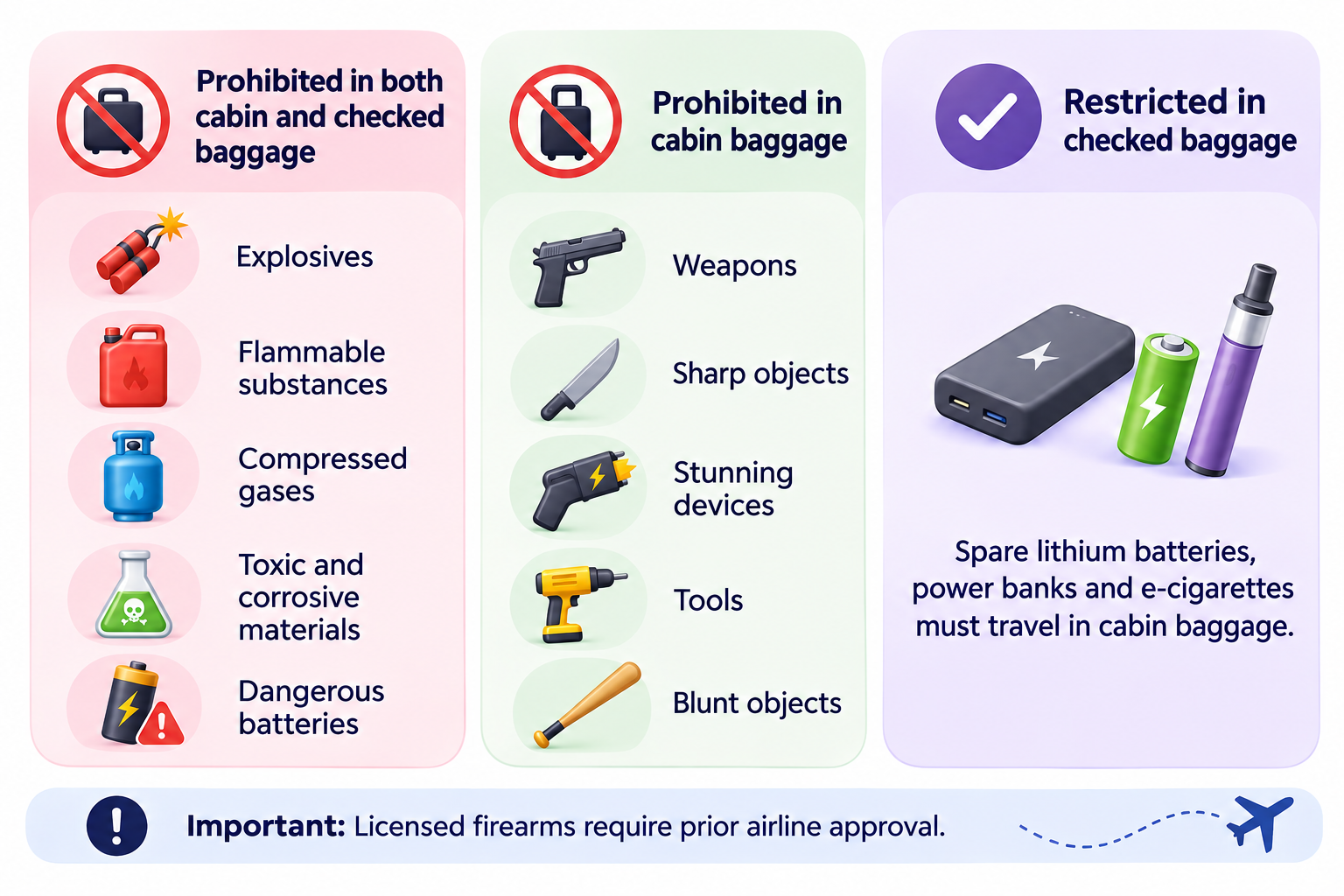
The Nigeria Civil Aviation Authority (NCAA) restricts items that could threaten passenger safety, cause fires or interfere with aircraft security. Some are prohibited in both cabin and checked baggage, while others cannot be carried in hand luggage but may travel in checked baggage under specific conditions. The main categories include:

Graphic of item categories restricted on Nigerian flights.

1. Prohibited in both cabin and checked baggage

  • Explosives: Fireworks, firecrackers, grenades, gunpowder, detonators and flares.
  • Flammable substances: Petrol, diesel, kerosene, lighter fluid, paint thinners and other highly flammable liquids.
  • Compressed gases: Butane, propane, camping gas and certain dangerous aerosols.
  • Toxic and corrosive materials: Acids, poisons, pesticides, bleach, chlorine and radioactive substances.
  • Dangerous batteries: Damaged or recalled lithium batteries and certain high-risk electronic devices.

2. Prohibited in cabin (carry-on) baggage

  • Weapons: Firearms, ammunition, replica guns, bows, arrows and slingshots.
  • Sharp objects: Knives, scissors with blades over permitted limits, razor blades, axes and box cutters.
  • Stunning devices: Tasers, stun guns and incapacitating sprays.
  • Tools: Drills, saws, hammers, crowbars and long-shaft screwdrivers.
  • Blunt objects: Baseball bats, clubs and martial arts equipment.

3. Restricted in checked baggage

Spare lithium batteries, power banks and e-cigarettes must generally travel in cabin baggage, with terminals protected against short circuits.

Important: Licensed firearms require prior airline approval and special handling. Liquid restrictions also vary by route and airport. Check the NCAA's 2023 Civil Aviation Regulations, particularly Parts 15 and 17, and confirm your airline's requirements before travelling.

What can go in hand luggage on Nigerian flights?

Hand luggage is for items you may need during your journey, such as your phone, laptop, medication, and travel documents. However, not everything can go into the cabin. Nigerian aviation security rules place restrictions on liquids, batteries, sharp objects and other potentially dangerous items. Knowing what is allowed helps you pack correctly and avoid having belongings confiscated at security.

1. Liquids, aerosols and gels

You can carry toiletries, creams, perfumes, toothpaste and other liquids in your hand luggage, subject to airport security limits.

  • Each container should hold no more than 100 ml.
  • All containers should fit inside one transparent, resealable plastic bag with a capacity of up to one litre.
  • Prescription medicines and essential baby food may receive special allowances, subject to screening.

These restrictions are particularly important for international flights. For more examples of liquids and other restricted items, see Grey's guide to items banned on a plane.

2. Batteries and electronic devices

Laptops, mobile phones, tablets, digital cameras and other personal electronic devices can generally travel in your cabin bag. Spare lithium batteries and power banks must also go in hand luggage rather than checked baggage.

  • Batteries up to 100Wh are generally permitted.
  • Batteries between 100Wh and 160Wh require airline approval.
  • Batteries above 160Wh are generally prohibited.

Protect spare battery terminals against short circuits. Damaged or swollen batteries should not be carried.

3. Items that must stay in your hand luggage

Some items are permitted on board but cannot be placed in checked baggage due to fire risks or safety concerns. These include:

  • Power banks: Keep them in your cabin bag, with their terminals protected against accidental contact.
  • Spare lithium batteries: Carry them in hand luggage and protect exposed terminals.
  • E-cigarettes and vapes: Keep these in the cabin and never use or charge them during the flight.

What does Nigerian customs restrict on export?

The Nigeria Customs Service (NCS) maintains an export prohibition list covering certain agricultural products, raw materials and cultural items. These restrictions are designed to protect local industries, preserve natural resources, support food security and prevent the illegal removal of Nigeria's cultural heritage.

The main restricted export categories include:

1. Maize

Unprocessed maize grains are restricted from export to help maintain domestic food supply and prevent shortages.

2. Timber

Rough and sawn wood are prohibited under the export restrictions, helping to discourage deforestation and encourage local processing.

3. Raw hides and skins

Unprocessed animal hides and skins, including wet blue leather and other unfinished forms, fall under export restrictions.

4. Scrap metals

Ferrous and non-ferrous metal scraps cannot be freely exported, as the restriction supports local recycling and manufacturing industries.

5. Unprocessed rubber

Raw rubber latex and rubber lumps are restricted to encourage domestic processing and value addition.

6. Artefacts and antiquities

Cultural objects and historical artefacts cannot be exported without the necessary government authorisation and clearance.

How much currency can you carry out of Nigeria?

You can carry foreign currency worth US$10,000 or more (or its equivalent in other currencies) out of Nigeria, but you must declare it to the Nigeria Customs Service (NCS). The declaration threshold applies to cash and relevant negotiable instruments. Declaring your money does not automatically mean you cannot travel with it. However, additional information and supporting documents may be required, particularly for larger amounts.

How to declare foreign currency at the airport

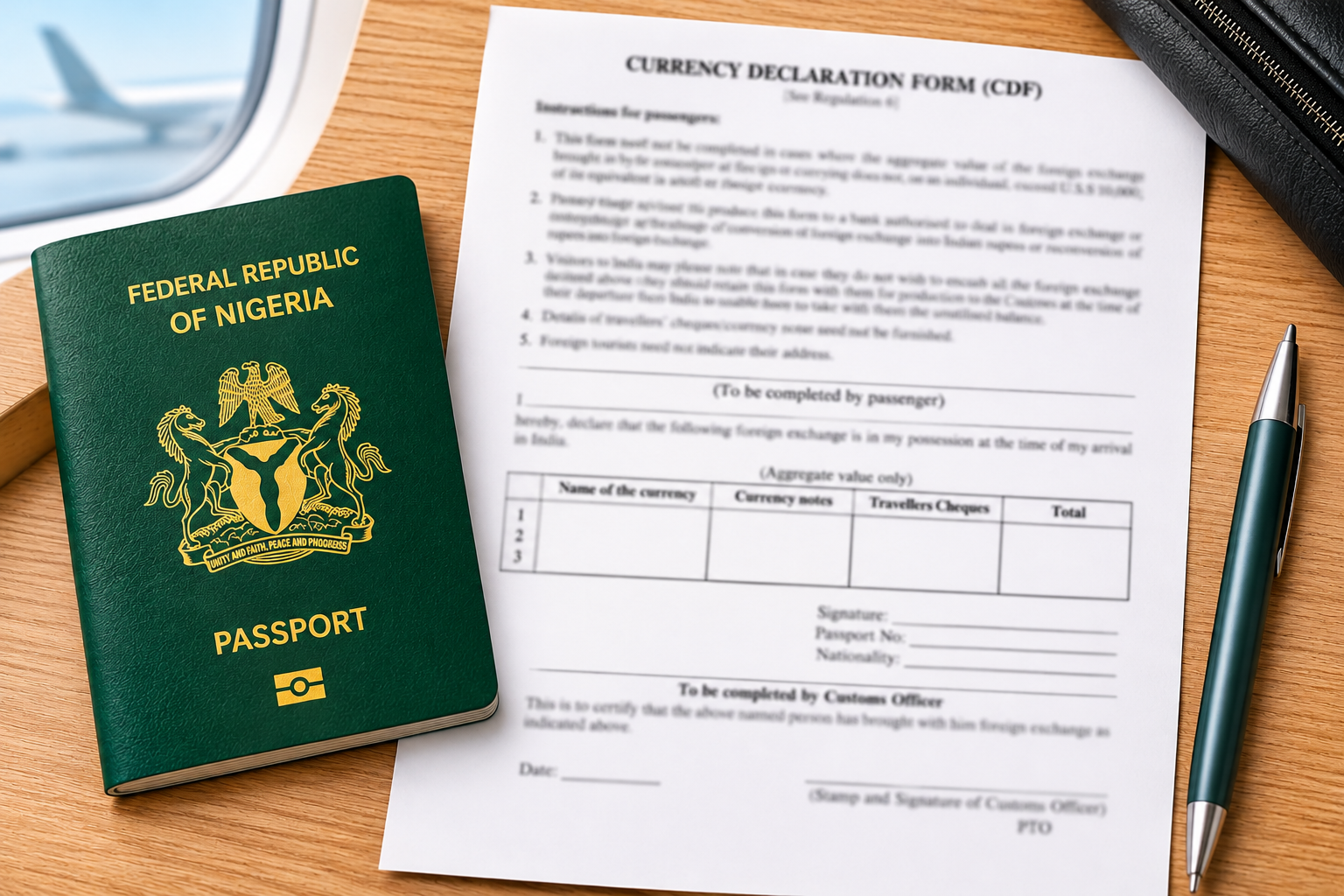
Currency declaration form next to a Nigerian passport.

Nigeria Customs now provides an Electronic Currency Declaration Form (e-CDF) for travellers carrying amounts at or above the reporting threshold.

  1. Complete the online form: Visit the NCS Electronic Currency Declaration portal and enter your travel details, passport information and the amount of each currency you are carrying.
  2. Submit your declaration: Review your information, confirm that it is accurate and submit the form.
  3. Save your acknowledgement: Keep your declaration reference number or acknowledgement slip.
  4. Visit Customs at the airport: Present yourself and your declaration reference to a Customs officer for physical verification. Your declaration remains pending until validated.
  5. Provide supporting documents: Bring relevant bank withdrawal slips, transaction records or other evidence showing the source of the funds, where requested

You can also avoid the inconvenience of travelling with large amounts of physical dollars by using a virtual USD account with Grey. This offers a more convenient way to access your foreign earnings without needing to withdraw and travel with physical currency.

Moving money instead of carrying cash

Carrying large amounts of cash across borders is not the only way to access your money abroad. Bank transfers and digital payment services allow you to move funds internationally without physically transporting banknotes. They also provide transaction records that help establish the source of your money when required.

Traditional SWIFT transfers typically take 1–5 business days, while digital transfers can arrive within minutes or a few business days, depending on the destination and payment method.

Instead of travelling with physical dollars or pounds, you can keep your money in a foreign currency account and transfer it when needed. A traditional domiciliary account lets you receive, hold and send foreign currencies such as USD, GBP and EUR through a Nigerian bank. This means you can keep your earnings in their original currency rather than converting everything to naira immediately.

Grey offers another way to manage foreign currency without the usual bank visits and account-opening processes associated with traditional domiciliary accounts. You can open virtual USD, GBP and EUR accounts online, receive international payments, hold multiple currencies and convert your money when you need it. You can also send money directly from Nigeria to the UK, making it easier to manage international payments without carrying physical cash.

Frequently asked questions about prohibited items on flights in Nigeria

1. What is banned in hand luggage on Nigerian flights?

Firearms, sharp objects, explosives, flammable substances, certain tools, blunt weapons and dangerous chemicals are prohibited in cabin baggage. Liquids, aerosols and gels in containers exceeding 100 ml are generally restricted on international flights. Always check your airline's specific baggage rules before packing, as some items may be allowed in checked baggage instead.

2. How much cash can you take out of Nigeria?

You can carry foreign currency worth US$10,000 or more, or its equivalent, but you must declare it to Nigeria Customs. The declaration threshold does not mean larger amounts are automatically prohibited. You may need supporting documents showing the source of your money, particularly when carrying substantial sums. Confirm the latest requirements before travelling.

3. Can you carry food out of Nigeria on a flight?

Yes, you can carry certain foods, particularly commercially packaged and properly labelled products, subject to airline and destination-country rules. However, fresh fruits, vegetables, meat, seeds and other agricultural products may face restrictions. Some Nigerian agricultural commodities are also subject to export prohibitions. Check the destination country's customs requirements before packing food.

4. Are power banks allowed on Nigerian flights?

Yes. Power banks are generally allowed in hand luggage but must not be placed in checked baggage. Those rated up to 100Wh are generally permitted, while batteries between 100Wh and 160Wh usually require airline approval. Protect their terminals against short circuits and check your airline's capacity limits before departure.

5. What happens if you carry a prohibited item?

Airport security may remove and confiscate prohibited items during baggage screening. Depending on the item and circumstances, you could face additional questioning, missed flights, fines or legal action. Carrying undeclared currency, illegal weapons or dangerous substances can have more serious consequences. Always check your luggage before leaving for the airport.

6. Do domestic and international flights have the same rules?

Both follow core aviation safety restrictions covering weapons, explosives, flammable materials and dangerous goods. However, international flights may have additional requirements involving liquid limits, customs declarations, agricultural exports and destination-country restrictions. Domestic routes may also have airline-specific baggage policies. Check both your airline's rules and applicable customs requirements before travelling.

Cost of living in London vs New York: a sourced comparison

•

•

2 min read

New York is more expensive than London for most people, but the gap is smaller than the headlines suggest and it sits in different places. A newly listed flat costs about 11% more in New York ($4,100 median asking rent in October 2026, against about $3,700 for London's £2,825 average), yet New York's subway is cheaper and London wins clearly on healthcare and childcare. The bigger surprise is how much you need to earn just to be allowed to sign a New York lease.

Plenty of comparison sites give you dozens of prices at once, many of them crowd-sourced and months old. This guide does the opposite: fewer numbers, each one tied to an official or named source and a date, so you can trust what you are planning with. Where we couldn't verify a like-for-like figure, we left it out.

All conversions use about $1.31 to the pound, the rate GBP/USD was trading at on 19 November 2026 (FXStreet). Grab your calculator.

London vs New York at a glance

CostLondon (GBP, approx. USD)New York (USD)Source and period
Asking rent, new let (per month)£2,825 average (about $3,700)$4,100 median citywide; $4,995 ManhattanRightmove, Q3 2026; StreetEasy, October 2026
Income landlords usually ask for (per year)30 x rent: £84,750 (about $111,000)40 x rent: $164,000Kinleigh Folkard & Hayward; StreetEasy
Deposit cap5 weeks' rent (annual rent under £50,000)1 month's rentGOV.UK Tenant Fees Act guidance; New York Attorney General
Public transport, weekly cap£44.70, zones 1 to 2 (about $59)$35, subway and local busMayor of London decision MD3464, from 1 March 2026; MTA, from January 2026
Local tax a renter paysCouncil tax: £2,068 a year average Band DCity income tax: 3.078% to 3.876%GOV.UK, 2026 to 2027; NYS Tax Department, 2026
Sales tax20% VAT, included in shelf prices8.875%, added at the tillGOV.UK; NYC Department of Finance

Rates and prices checked on 26 November 2026.

Rent: New York costs more, but not twice as much

Rent is the line that decides your budget in both cities. According to Rightmove's Q3 2026 rental price tracker, London's average advertised rent hit a record £2,825 a month, about $3,700. StreetEasy's October 2026 report puts New York's median asking rent at $4,100, up 3.8% on a year earlier.

That makes a newly listed New York home roughly 11% dearer. The gap widens in the most popular areas: Manhattan's median asking rent was $4,995 in October, Brooklyn's $3,866 and Queens' $3,350. Rightmove reports an average and StreetEasy a median, so treat the gap as a guide rather than an exact figure.

Asking rents are what newcomers pay. People who have been in their London flat for a while pay less: the ONS puts the average rent across all London tenancies at £2,338 in September 2026 (about $3,060), up 3.5% in a year. For the capital on its own, our London cost guide goes into more detail.

Verdict: New York is more expensive for a new renter, by about a tenth citywide and more in Manhattan. It is not the "twice as much" that some older comparisons claim.

The hidden gap: what you need to earn to sign a lease

This is where the two cities really part ways. New York landlords typically want your gross annual income to equal 40 times the monthly rent, according to StreetEasy, and some buildings ask for 50 times. On a $4,100 flat, that means earning $164,000 a year, or finding a guarantor who meets the test instead.

London letting agents usually work to 30 times the monthly rent; the London estate agency Kinleigh Folkard & Hayward describes the same rule. On £2,825 that is £84,750, about $111,000. So the income bar for an average new let is roughly 48% higher in New York, even though the rent itself is only about 11% higher.

Neither rule is law, and both cities offer guarantor services and shares for people who fall short. But if you are weighing a job offer, this test tells you more than any rent average: a New York salary has to clear the landlord's bar before it can pay the rent.

How much cash you need to move in

In England, the deposit is capped at five weeks' rent when annual rent is under £50,000, and a landlord can take at most one month's rent in advance, per GOV.UK's Tenant Fees Act guidance. On the £2,825 average that is about £3,260 of deposit plus the first month, roughly £6,085 (about $7,970).

New York caps the security deposit at one month's rent and the credit and background check fee at $20, according to the New York Attorney General. On a $4,100 flat that is about $8,200 with the first month. Under the city's FARE Act, you can't be charged a broker fee unless you hired the broker yourself.

Verdict: Move-in cash is similar. The real barrier in New York is the income test, not the deposit.

LDMAG1

Transport: New York is cheaper and simpler

New York charges one flat fare whatever the distance. Since January 2026 a subway or local bus ride costs $3, and OMNY caps what you pay at $35 for any seven days; the 30-day MetroCard has been retired in favour of that cap, says the MTA.

London charges by zone and time. From 1 March 2026 a peak Tube journey in zone 1 costs £3.10 on pay as you go, a bus ride is £1.75, and the zones 1 to 2 caps are £8.90 a day and £44.70 a week, under the Mayor of London's 2026 fares decision. Live further out and the caps rise.

Verdict: A New Yorker who rides every day pays about $35 a week; a zones 1 to 2 Londoner pays about $59.

Taxes: council tax vs city income tax

Both cities charge renters a local tax, just in different ways. In London you pay council tax on your home: the average Band D bill across London is £2,068 for 2026 to 2027, about £172 a month or $226, per GOV.UK. Your actual bill depends on your property's band and borough.

New York renters pay no property tax bill, but city residents pay New York City income tax on top of state and federal tax. The 2026 rate schedule starts at 3.078% and reaches 3.876% for single filers above $50,000 of taxable income. On $100,000 of taxable income the city takes about $3,751 a year, roughly $313 a month.

Shopping works differently too. UK shelf and menu prices already include 20% VAT, while New York adds 8.875% sales tax at the till, according to the NYC Department of Finance (clothing and footwear under $110 are exempt). Add a tip in a New York restaurant and a $25 menu price ends up well above $25.

Verdict: For a middle earner, New York's city income tax costs a little more each month than an average London council tax bill. Compare prices only after tax and tips.

Healthcare and childcare: London's biggest advantage

London residents use the NHS without a bill at the point of care. If you move to the UK on a visa, you pay the immigration health surcharge instead: £1,035 a year for most applicants, or £776 for students and under-18s, per GOV.UK.

In New York, most people rely on employer health insurance. KFF's 2026 Employer Health Benefits Survey found US workers pay an average of $7,471 a year towards family cover, and those with a single-cover deductible face an average of $1,955 before most benefits start. These are national figures, but they show the scale of a cost London residents mostly don't carry.

For parents, working families in England can get 30 hours a week of funded childcare for 38 weeks a year, from nine months old until school, if each parent earns at least £203.36 a week and neither has adjusted net income over £100,000 (GOV.UK). New York offers free, full-day 3-K for three-year-olds through NYC Public Schools, but care for babies and toddlers is mostly paid for privately.

Verdict: If you have young children or would buy your own insurance, London is cheaper by thousands a year.

What this comparison leaves out

We left out grocery baskets, restaurant meals, gym fees and utility bills on purpose. The figures you see for these on comparison sites are mostly crowd-sourced, change monthly and rarely compare like with like; one 2025 snapshot can be badly out of date by now. If they matter to your decision, check a live index on the day and compare after-tax prices, as above.

Which city costs more for you?

  • Single renter, commuting daily: New York costs more mainly through rent and the 40x income test; transport claws a little back.
  • Family with a toddler: London is usually cheaper, thanks to funded childcare hours and the NHS.
  • Moving on a visa: add the UK health surcharge to London's side, and US health insurance premiums and deductibles to New York's.
  • Earning in one currency, living in the other: the exchange rate becomes a cost line of its own.

For a wider checklist before you go, see our money checklist for anyone relocating overseas.

Earning in dollars, paying in pounds (or the other way round)

Plenty of people in this comparison are paid in one currency and spend in the other: a New York salary while relocating, US clients while living in London, or UK savings funding a Manhattan deposit. Every time you convert, the rate and the fee come out of your budget, which is why it pays to know the common conversion traps before you move.

Grey accepts sign-ups from both the UK and the US, and lets you receive and hold USD, GBP and EUR in one app. Receiving GBP by Faster Payments or USD by ACH costs 0.8%, capped at £10 or $10, and converting between currencies costs 1%, capped at $6. On the New York move-in example above, converting about £6,260 of pounds to dollars would cost $6 in Grey's fee rather than $82, plus whatever rate you see before you confirm.

The same works in reverse if you earn in the US and pay a London landlord: hold the dollars, then change dollars into pounds when the rent is due. If you only need a UK home for your US income, our guide to the best dollar accounts in the UK compares your options. Grey is a financial technology company, not a bank.

Frequently asked questions

Is London cheaper than New York?

For most people, yes. A new rental costs about 11% more in New York (StreetEasy, October 2026, against Rightmove, Q3 2026), healthcare costs far more, and New York landlords want a higher income. Transport is the main area where New York is cheaper.

What salary do you need to rent in New York compared with London?

New York landlords usually ask for 40 times the monthly rent in annual income, so $164,000 for the $4,100 median. London agents usually ask for 30 times, so £84,750 (about $111,000) for the £2,825 average.

Do you pay council tax in New York?

No. New York has no council tax for renters, but residents pay New York City income tax of 3.078% to 3.876% on top of state and federal income tax.

Is the Tube or the subway cheaper?

The subway. New York charges $3 a ride and caps spending at $35 a week. In London, zones 1 to 2 are capped at £8.90 a day and £44.70 a week, and fares rise with each extra zone.

The bottom line

New York costs more, but the real difference is how much you need to earn and what happens when you need a doctor or a nursery, not what you pay for a cappuccino. Price your own move with the rent, transport, tax and healthcare lines above, then decide which currency you want to earn and hold. If you'll be moving money between pounds and dollars, open a free Grey account or download the app before you go.

Figures were checked on 26 November 2026 from the sources linked above. Rents, fares and tax rates change, so check them again before you commit to a move.

Egypt visa requirements for EU citizens

•

•

2 min read

Yes, EU citizens need a visa to visit Egypt, unless they are only staying in the Sinai resorts for up to 15 days. You have three options: an e-Visa bought online before you fly ($30 single entry, $65 multiple entry), a visa on arrival ($30, or $36 as a QR code at Cairo airport), or a free Sinai entry stamp. Your passport must be valid for at least six months from the day you arrive.

The rules changed several times in 2026. Fees went up by $5 in March and April, Cairo airport swapped its paper visa sticker for a QR code over the summer, and another rise is due on 1 January 2027. Many guides still quote $25, so this one is dated and sourced: every rule below was checked on 26 November 2026 against Egypt's official e-Visa portal and EU foreign ministry travel advice.

Your Egypt visa options at a glance

OptionFee (USD)Stay allowedHow you get and pay for it
e-Visa, single entry$30Up to 30 daysOnline at visa2egypt.gov.eg, at least 7 days before you fly; pay by card
e-Visa, multiple entry$65Up to 30 days per visitOnline at visa2egypt.gov.eg; pay by card
Visa on arrival (paper sticker)$30Up to 30 daysBank counter before passport control; USD or the equivalent in EUR
Visa on arrival, Cairo airport (QR code)$36 ($30 plus $6 processing)Up to 30 daysSelf-service machine (card only), bank counter, app or visaonarrival.gov.eg
Sinai entry stampFreeUp to 15 days, Sinai resorts onlyStamped on arrival at Sharm El Sheikh airport or the Taba crossing

Fees checked on 26 November 2026. Sources: Egypt e-Visa portal, German Federal Foreign Office, Khaleej Times.

Do EU citizens need a visa for Egypt?

Yes. Ireland's Department of Foreign Affairs says plainly that its citizens "will normally need a visa to enter Egypt", and Germany's Federal Foreign Office says the same for Germans. The good news is that tourist visas for ordinary EU passports are easy to get, either online or on arrival.

All 27 EU member states are on the list of nationalities eligible for an e-Visa, according to the official e-Visa portal's FAQ, which we checked country by country. Business travellers and anyone who plans to work should apply for the right visa in advance through an Egyptian embassy instead.

Option 1: the Egypt e-Visa

The e-Visa is the safest choice if you want to land and walk straight to passport control. The official portal is visa2egypt.gov.eg; the portal asks you to apply at least seven days before departure.

  • Fee: $30 for single entry, $65 for multiple entry, as listed on the portal's FAQ. VisasNews reported the rise from $25 and $60 in April 2026.
  • Stay: up to 30 days per visit. VisasNews, reading the portal in April 2026, reported a single-entry e-Visa is valid for three months from issue and a multiple-entry one for six months.
  • What you need: a passport valid for at least six months from arrival, an email address to register, and a Visa, Mastercard or other debit card to pay online.
  • After you pay: the portal emails you the decision. Print it or keep it on your phone for the border.

The portal also notes that border officers can still refuse entry to an e-Visa holder, as with any visa. For a screen-by-screen walkthrough, see our step-by-step guide to the application.

Watch out for look-alike sites. Third-party agencies that sell Egypt e-Visas usually charge a service fee on top of the $30, so check the address bar says visa2egypt.gov.eg before you enter card details.

Option 2: visa on arrival

Most EU travellers can still buy a single-entry tourist visa when they land. The German Federal Foreign Office's travel advice (status 26 November 2026) puts the fee at $30, or the equivalent in euros, paid at the official bank counters before passport control. It also notes that Sharm El Sheikh airport sells a $30 visa valid for the whole of Egypt, alongside the free Sinai stamp.

Cairo airport now uses QR codes

Cairo International launched a digital visa on arrival as a pilot on 1 August 2026, Khaleej Times reported, and the German Federal Foreign Office says it replaced the paper sticker there from 1 September. You get a QR code from a self-service machine in the arrivals hall, a bank counter, the "Visa On Arrival" app or visaonarrival.gov.eg, then show it at immigration.

It costs $36 in total: the $30 visa plus a $6 processing fee. The machines take cards only, according to both the German Federal Foreign Office and the American University in Cairo's travel office, so don't rely on cash. A code bought in advance is valid for seven days from issue.

Which is cheaper? If you're flying into Cairo, the $30 e-Visa bought a week ahead beats the $36 QR code. If you're flying into another airport, the e-Visa and the paper visa on arrival cost the same, so the choice comes down to whether you'd rather queue at a bank counter or sort it from your sofa.

Option 3: the free Sinai entry stamp

If your whole trip is a beach holiday in South Sinai, you may not need a visa at all. Ireland's travel advice says citizens going only to Sharm El Sheikh, Dahab, Nuweiba and Taba can get a free entry permission stamp on arrival for up to 15 days. The German Federal Foreign Office says the stamp is issued at Sharm El Sheikh airport and the Taba land crossing.

The catch: the stamp doesn't cover the rest of Egypt. A day trip to Cairo, Luxor or the pyramids needs a full visa, and so does staying longer than 15 days. If there's any chance you'll leave the resorts, pay the $30.

Passport or ID card?

Bring a passport valid for at least six months from the date you arrive; airlines may refuse to board you otherwise.

National ID cards are a grey area. Germany's Federal Foreign Office says Germans can enter with a Personalausweis plus two biometric photos, but warns it isn't accepted by every Egyptian authority and recommends a passport. Ireland's advice says Irish passport cards can't be used.

If you hold another EU nationality, check your own foreign ministry's Egypt page before relying on an ID card. A passport removes the doubt.

Egypt visa fees are rising on 1 January 2027

Prime Ministerial Decree No. 2553 of 2026 raises a fixed fee built into entry and transit visas from $12 to $15 from 1 January 2027. Egypt Independent reported that the decree appeared in the Official Gazette on 30 August 2026. The government hasn't published new traveller prices yet.

A circular from the Egyptian Travel Agents Association expects the single-entry visa to rise from $30 to $33 and Cairo's QR code visa from $36 to $39, according to a September 2026 summary of the decree and circular by Wego. The American University in Cairo also lists $39 for the Cairo QR visa from 1 January 2027. If you're travelling in early 2027, buying your e-Visa in December won't help much: a single-entry e-Visa is only valid for three months.

Visiting for business, work or longer stays

A tourist visa is for tourism. If you're coming for meetings, Ireland's advice is to get a visa in advance from an Egyptian embassy; our guide to the Egypt business visa covers that process. Paid work, study and residence all need a visa or permit arranged through your employer, university or an Egyptian mission before you start.

Germans can also apply for a simple tourist visa at an Egyptian mission for €35 plus a €3 processing fee, the German Federal Foreign Office says. Fees at other EU missions vary, so check with the embassy in your country.

Paying in Egypt: euros, dollars and cash rules

Visa fees are priced in US dollars, but most EU travellers spend in euros. On arrival, the bank counters accept dollars or the euro equivalent, while Cairo's QR code machines take cards only. After that, day-to-day spending is in Egyptian pounds, so check the latest euros to Egyptian pounds rate before you budget, and use official exchange rather than black market rates.

Know the cash rules too. You must declare foreign currency worth more than $10,000 when you enter, and only declared amounts above that can leave with you, according to the German Federal Foreign Office. Egyptian pounds can only be carried in and out in limited amounts, published by the Egyptian Tourism Authority, and breaking these rules can lead to prosecution and seizure of the cash.

If you'd rather pay the e-Visa in dollars than let your bank convert euros at its own rate, a Grey virtual card works for EU residents and runs on a USD balance. Converting euros to dollars in Grey costs 1%, capped at $6. Because the portal isn't a US merchant, expect Grey's cross-border card fee of 2% plus $0.50 as well, so a $30 e-Visa comes to about $31.10, plus $1 each time you fund the card.

For more on card charges abroad, see how to avoid foreign transaction fees.

Frequently asked questions

Can EU citizens get a visa on arrival in Egypt?

Yes. Single-entry tourist visas cost $30 at the bank counters before passport control, payable in dollars or the euro equivalent. At Cairo International the visa on arrival is now a QR code costing $36, paid by card.

How much is the Egypt e-Visa for EU citizens?

$30 for single entry and $65 for multiple entry on the official portal, visa2egypt.gov.eg, as of November 2026. Each visit can last up to 30 days. A rise is expected from 1 January 2027.

Can EU citizens enter Egypt without a visa?

Only for a stay of up to 15 days in the South Sinai resorts of Sharm El Sheikh, Dahab, Nuweiba and Taba, using the free Sinai entry stamp. Leaving those areas or staying longer needs a full visa.

How long does the Egypt e-Visa take?

The portal asks you to apply at least seven days before you travel and emails you once your application has been processed. Don't leave it to the night before.

Can I enter Egypt with my EU national ID card?

It depends on your nationality. Germany says its ID card works with two biometric photos but isn't accepted by every authority, and Ireland says passport cards can't be used. Travel with a passport valid for six months to be safe.

Before you book

For most EU travellers, the cheapest and calmest route into Egypt is a $30 e-Visa bought at least a week ahead on the official portal, with a passport that has six months left on it. Buy it before 1 January 2027 only if you'll arrive within three months. Then plan how you'll pay once you're there; if you're heading to the capital, our guide to Cairo prices is a good place to start.

Visa rules and fees were checked on 26 November 2026 against the sources linked above. They change often, so confirm them on visa2egypt.gov.eg and your own foreign ministry's travel advice before you fly.

How to pay on Amazon, ASOS and Shein from Nigeria, Ghana and Kenya

•

•

2 min read

You can pay on Amazon and ASOS from Nigeria, Ghana and Kenya with a Visa or Mastercard that is enabled for international online payments, and Shein shows the methods available for your country at checkout. The catch is delivery, not payment: Amazon ships to all three countries, ASOS listed delivery to Nigeria and Ghana but not Kenya when we checked, and Shein only confirms delivery at checkout.

If your local bank card keeps getting declined, a USD virtual card is the usual fix. Below, we cover what each store accepts, where it delivers, the fees that surprise people on foreign sites, and how to set up a card that works, with everything checked on 26 November 2026.

Store by store: delivery and payment at a glance

StoreNigeriaGhanaKenyaPayment methods
Amazon.comShips (AmazonGlobal)Ships (AmazonGlobal)Ships (AmazonGlobal)Visa, Mastercard and American Express cards; Amazon gift card balance
ASOSStandard delivery £17.50, free over £100Standard delivery £10, free over £100No delivery options shownVisa, Mastercard, American Express, PayPal, Apple Pay, Google Pay; Klarna and Clearpay where offered
SheinConfirm at checkoutConfirm at checkoutConfirm at checkoutShown at checkout for your delivery country

Checked on 26 November 2026. Sources: AmazonGlobal export countries, Amazon card requirements, ASOS delivery pages for each country and ASOS payment methods. Delivery options change, so confirm with your address entered before you fill your basket.

Why your card gets declined on foreign stores

Most declines on Amazon, ASOS or Shein come down to the card, not the store. The usual reasons are a local card that isn't enabled for international online payments, a bank limit on foreign spending, or the store's fraud checks flagging a mismatch between your card details and your billing address.

Start by asking your bank whether your card works for foreign online payments and what the limit is. If it doesn't, or the limit is too low for your order, a USD virtual card funded from your own balance gets around both problems.

How to pay on Amazon from Nigeria, Ghana or Kenya

Amazon lists Nigeria, Ghana and Kenya as eligible countries for AmazonGlobal, its international shipping service. Not every item ships, though: some marketplace sellers don't ship internationally, so check the delivery message on the product page with your address selected.

  1. Sign in, go to Your Account and add your delivery address in Nigeria, Ghana or Kenya.
  2. Under Your Payments, add your card number, name, expiry date and security code.
  3. At checkout, choose that card and check the order total, including any import fees deposit.
  4. If your card is in US dollars, leave the card currency as it is. Amazon's Change card currency option is for cards in other currencies.

Amazon says customs fees and import duties are the recipient's responsibility. Look at the import charges line before you pay, so the total doesn't surprise you.

You can also pay with an Amazon gift card balance. Redeem the code under Your Account and Amazon applies it to eligible orders, with a card covering any difference.

How to pay on ASOS from Nigeria, Ghana or Kenya

ASOS accepts Visa, Mastercard and American Express cards, plus PayPal, Apple Pay and Google Pay. It also lists Klarna and Clearpay, but ASOS notes that some payment services may not always be offered, so expect fewer options at checkout outside the UK.

When we checked, ASOS's delivery page showed standard delivery to Nigeria for £17.50 and to Ghana for £10, both free on orders over £100. For Kenya, it showed no delivery options at all. If you're shopping for Christmas, the page quoted delivery on or before 15 December 2026 for Nigeria and 17 December 2026 for Ghana on orders placed that day.

ASOS is a UK retailer, which matters for your card. Payments on non-US websites can attract a cross-border fee, so a £40 order won't cost you exactly £40 on a USD card.

LDMAG1

How to pay on Shein from Nigeria, Ghana or Kenya

Shein doesn't publish a single list of the countries it delivers to, and shopping guides disagree. The reliable test is the checkout itself: enter your address in Nigeria, Ghana or Kenya and see whether Shein offers delivery and which payment methods appear.

If Shein accepts your address, pay by card in the checkout's payment step, or use a Shein gift card balance if you have one. If it doesn't, shoppers use a parcel forwarding service, which gives you an overseas address and then sends the parcel on to you for an extra fee.

Paying with a Grey virtual card

A Grey virtual card is a USD Visa card that people in Nigeria, Ghana and Kenya can create in the Grey app. It works for online payments wherever Visa is accepted, which includes Amazon and ASOS, and in supported regions you can add it to Apple Pay or Google Pay.

What it costs

  • Card creation: a one-time $5 fee, with no monthly maintenance fee.
  • Currency conversion: the card spends from your Grey balance. Paying from your USD balance avoids conversion; converting naira, cedis or shillings to USD costs 1%, capped at $6.
  • Cross-border fee: up to 2% plus $0.50 on payments to non-US websites, charged by the merchant or card processor, not Grey.

Grey's help centre gives an example of how the cross-border fee works: a £50 purchase debits £51 plus $0.50. Amazon.com is a US store, so paying there in dollars from your USD balance avoids both the conversion and the cross-border fee.

How to set it up

  1. Sign up on the Grey app and verify your identity.
  2. Add money in your local currency. In Nigeria, transfer naira from a bank account in your own name. In Ghana, fund from a bank account or mobile money such as MTN MoMo. In Kenya, use M-Pesa or a bank transfer.
  3. Convert what you need to USD. Check today's rate for USD to NGN, USD to GHS or USD to KES first.
  4. Go to Cards, select Virtual card, then Create card, accept the terms and set a 4-digit PIN.
  5. Add the card details to your Amazon, ASOS or Shein account at checkout.

Keep enough in your balance before you shop. If a card balance goes negative and reaches $50, Grey automatically terminates the card. Country-specific guides for Nigeria, Ghana and Kenya go into more detail.

Frequently asked questions

Is the Grey card Visa or Mastercard in Nigeria, Ghana and Kenya?

Visa. Grey's supported country list for its Visa card includes Nigeria, Ghana and Kenya, and Grey has discontinued Mastercard except in specific regions.

Can I use my naira, cedi or shilling bank card on Amazon?

Sometimes. It works if your bank has enabled it for international online payments and your order is within your foreign spending limit, so ask your bank first.

Why was I charged more than the price on ASOS?

Payments to non-US websites can carry a cross-border fee of up to 2% plus $0.50, charged by the merchant or card processor. If the store bills in pounds, the amount is also converted to dollars.

Does Shein deliver to Kenya?

Shein doesn't publish a list we could verify. Enter your Kenyan address at checkout: if delivery and payment options appear, you can order directly; if not, use a parcel forwarder.

Getting the card right is only half of a successful foreign order; the other half is knowing the store will actually deliver before you pay. Check delivery with your address, keep your card funded in dollars, and sign up on Grey to create your virtual card.

Arrow (up)

Back to top