For Nigerians earning across borders, however, the payment method you choose can make a noticeable difference. Fees, exchange rates, payout times and access to foreign currencies all affect how much of your money eventually reaches you.
The best ways to receive international payments in Nigeria include using a USD virtual account with US account details, platforms such as Payoneer and Wise, PayPal where available, and remittance services for personal transfers. For freelancers and remote workers regularly receiving USD, a virtual account can be particularly useful because it allows clients and platforms to pay through US payment networks such as ACH.
This guide compares the main options, their costs and where each one makes the most sense.
Why receiving foreign payments in Nigeria can be complicated
There are more ways to receive money from abroad in Nigeria than there were a few years ago, but international payments still work differently from ordinary local transfers.
Nigeria's foreign exchange and international remittance market is regulated by the Central Bank of Nigeria (CBN), and the rules governing how international money transfer operators process payments have continued to evolve.
For example, in March 2026, the CBN introduced additional requirements for International Money Transfer Operators (IMTOs), including the use of designated naira settlement accounts with authorised dealer banks for remittance-related transactions.
For the person receiving the money, the bigger practical question is usually what happens between the sender clicking "pay" and the money becoming available to spend.
A traditional international wire may involve transfer and intermediary fees. Receiving foreign currency through a Nigerian domiciliary account can also involve additional banking requirements. Some global payment platforms have country-specific restrictions, while converting foreign currency immediately means you have less control over when you exchange your earnings.
If you regularly earn in dollars, another option is opening a Nigerian dollar account. You can also use a virtual foreign account that gives you payment details in the country where your client or employer is based.
The right option ultimately depends on who is paying you, where they are located and how you want to use the money afterwards.
What are the best ways to receive international payments in Nigeria?
Here is a quick comparison of some of the main options available.
| Method |
Best for |
Typical fees |
Typical speed |
| USD virtual account |
Freelancers, remote workers and platform payouts |
Varies by provider and payment rail |
Instant to a few business days |
| Payoneer |
Freelance platforms, marketplaces and business payments |
Varies by payment type and withdrawal method |
Usually within a few business days |
| Wise |
International transfers where features are available |
Varies by currency and payment method |
Often minutes to a few business days |
| PayPal |
Online payments and clients already using PayPal |
Transaction and currency conversion fees may apply |
Often fast once payment is sent |
Remittance apps
|
Personal transfers and family remittances |
Varies by provider |
Minutes to a few business days |
Gift cards
|
Occasional non-cash compensation |
Resale/conversion costs vary |
Depends on how the card is used |
| Stablecoins |
Users comfortable managing digital assets |
Network, platform and conversion fees may apply |
Often minutes |
Fees and availability can change, so check the provider's current pricing and Nigerian account eligibility before choosing a service.
USD virtual accounts
A USD virtual account is one of the most practical options for Nigerians who regularly get paid by US clients, employers or online platforms.
Instead of asking a US client to make an international payment directly to Nigeria, you receive US account details such as an account number and routing number.
From the payer's perspective, the transaction can then be processed as a US payment rather than a traditional international transfer.
This is particularly useful for ACH payments. ACH is one of the main electronic payment networks used for domestic transfers in the US and is commonly used for salaries, business payments and platform payouts.
Platforms including Upwork, Fiverr, Deel and Amazon can use ACH for eligible payouts. That means a Nigerian freelancer with compatible US account details can potentially add those details as their payout method rather than relying on an international wire or another intermediary.
For example, Grey provides a USD virtual account with the account details needed to receive supported USD transfers.
With Grey, ACH payments generally take one to two business days, while eligible FedNow payments can arrive in seconds. Fedwire is available for same-business-day wire payments.
If USD makes up most of your international income, this setup can also give you more control over your earnings because you can receive the payment in dollars and decide when you want to convert it.
You can read more about how to receive US dollars in Nigeria.
PayPal, Payoneer and Wise
USD virtual accounts are not the only way to get paid internationally. PayPal, Payoneer and Wise can also be useful, particularly when your client or the platform you work with already uses one of them.
PayPal
PayPal is widely used for online payments around the world, and its functionality in Nigeria has historically been more limited than in some other markets.
However, PayPal's current guidance states that new customers in Nigeria can receive payments after linking their account to its licensed local partner.
Once the appropriate setup is complete, someone can send money to the email address or mobile number associated with your PayPal account. Depending on the services available to your account, the money can then be transferred or used through PayPal.
This can make PayPal useful when an international client already relies on the platform and does not want to arrange a separate bank transfer.
The trade-off is cost. Transaction and currency conversion fees can apply, so it is worth checking how much you will actually receive before choosing PayPal for regular client payments.
Payoneer
Payoneer is another established option for freelancers, online sellers and businesses receiving international payments.
Eligible users can access receiving account details for supported currencies and use them to collect payments from clients, marketplaces and other businesses. Payoneer is also integrated with a range of freelance and e-commerce platforms.
This can make it convenient if the marketplace where you earn already supports Payoneer directly.
Fees depend on how the money reaches your Payoneer account, the currency involved and how you eventually withdraw or use it. Check the applicable fees for your account before deciding how to receive a large payment.
Wise
Wise is known primarily for international transfers and multi-currency services.
Availability is more important here than the headline exchange rate. Wise features differ depending on where your account is registered, and access to local account details for receiving particular currencies is not universal.
For that reason, Nigerian users should check which receiving features are currently available to their account rather than assuming they will have access to the same USD, GBP or EUR account details offered in other countries.
Wise can still be useful when your particular account and transfer route are supported, especially when a sender already uses the service.
Remittance apps, gift cards and stablecoins
Not every international payment is a salary or freelance invoice. Sometimes you are receiving money from family, selling digital services or getting paid by someone who cannot use a traditional bank transfer.
That is where alternative methods can make sense.
Remittance apps
International remittance services are designed primarily for person-to-person transfers.
Services such as Western Union, MoneyGram, Remitly and other licensed international money transfer operators can allow someone abroad to send money to a recipient in Nigeria using the payout options available through that provider.
They can be useful for family support or occasional personal transfers because the sender does not necessarily need your foreign bank details.
They are less suited to some forms of professional income. If you receive a salary or client payments every month, having account details that can be saved by an employer or connected directly to a freelance platform may be more convenient.
Gift cards
Some freelancers and online sellers receive gift cards as payment, but they are generally better treated as a niche option than a substitute for an international payment account.
A gift card is usually restricted to a particular retailer or ecosystem. Turning it into cash may require selling it through another service, which can introduce additional fees, exchange-rate differences and fraud risks.
For professional work, an invoice paid into an account in your name usually gives you a clearer payment record.
Stablecoins
Stablecoins such as USDC are digital assets designed to track the value of another asset, commonly the US dollar.
They can provide fast cross-border transfers and may be useful for people who already work with digital assets. However, receiving a stablecoin is not the same as receiving USD into a bank account.
You need to consider the platform you use, network compatibility, conversion fees and how you will eventually turn the asset into money you can use locally. Crypto-related rules and provider policies can also change.
For most freelancers who simply need a client to pay an invoice, a USD account with familiar banking details may be easier for both sides.
How to receive international payments with Grey
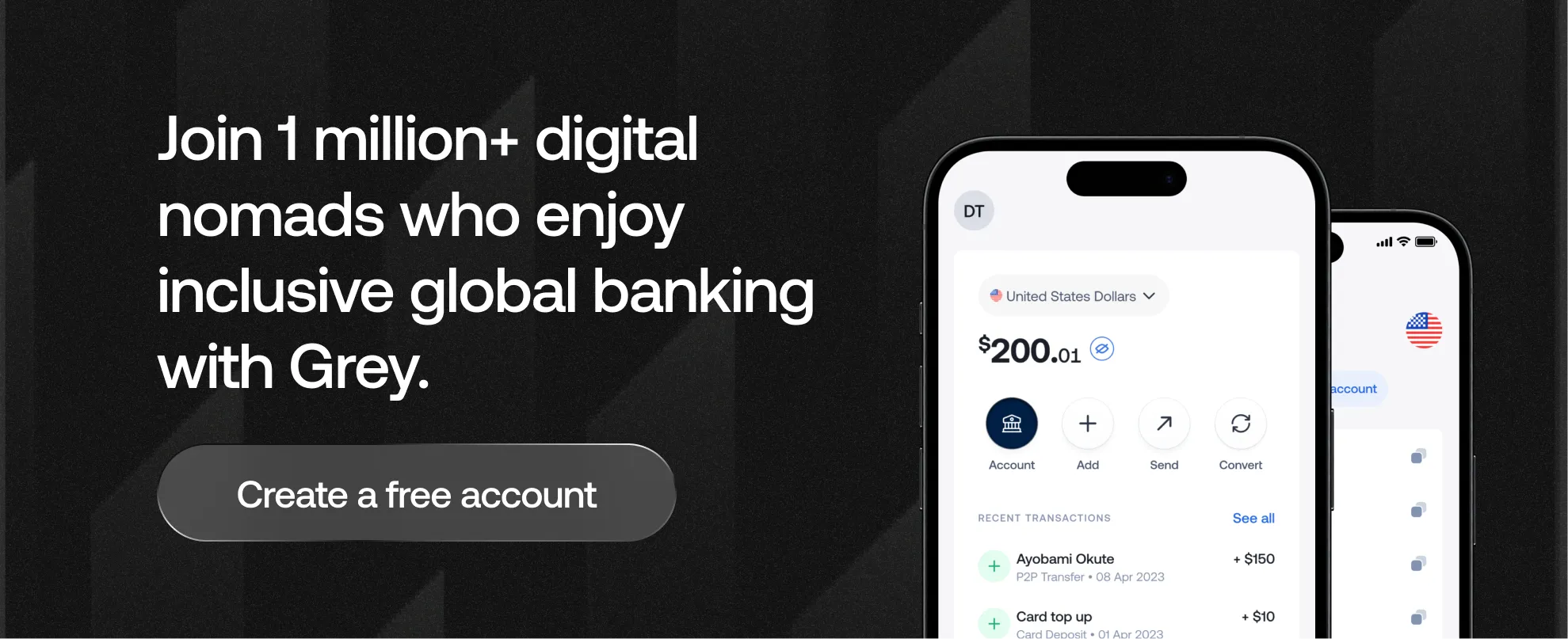
If you regularly receive USD from clients, employers or international platforms, Grey gives you US account details that can be used for supported domestic US payments.
Your Grey USD account supports ACH, FedNow and Fedwire transfers.
ACH is particularly useful for recurring payments. It is widely used in the US for payroll and platform payouts, including payments from services such as Upwork, Fiverr, Amazon and Deel.
For individual Grey accounts, receiving USD through ACH costs 0.8%, with a minimum fee of $2 and a maximum of $10. FedNow uses the same fee structure and can deliver eligible payments in seconds, including outside traditional banking hours. Fedwire deposits have a flat $20 fee.
Once the payment arrives, you can keep your funds in USD or convert them when you need another supported currency.
You can then receive money from abroad and manage your international earnings from the same account. If you want to use your USD for online purchases, you can also spend with a virtual dollar card.
How to receive USD with Grey
First, create your Grey account and complete the required identity verification.
Once your account has been verified, request your USD account and open its account details. You will see the information required for supported US transfers, including your account and routing details.
You can then give those details to your employer or client, or add them as a payout method on a supported platform.
Make sure you use the correct routing details for the payment method. ACH transfers require the ACH routing number, while Fedwire payments require the wire routing number.
Once the transfer is processed, the money appears in your Grey USD balance.
Which international payment method should you choose?
There is no single payment method that works best in every situation.
If you receive a one-off transfer from a relative abroad, a remittance service may be enough. If a marketplace already pays you through Payoneer, using its built-in payout option may save you an extra step. PayPal can be useful when a client already works within its ecosystem.
But if you regularly invoice US clients or earn through platforms that support ACH payouts, having US account details can make the payment process much closer to receiving a domestic US transfer.
Before choosing, compare the complete cost rather than focusing on one fee. Look at what the sender pays, what you pay to receive the money, any currency conversion costs and what it costs to withdraw or spend your balance.
A slightly cheaper receiving fee does not necessarily mean a cheaper payment if you lose more during conversion.
The best setup may also involve more than one method. A freelancer could use a USD virtual account for US clients, Payoneer for a marketplace that prefers it and a remittance service for personal transfers.
What matters is having the right option for the type of payment you receive.
Frequently asked questions
What is the best way to receive money from abroad in Nigeria?
The best method depends on who is sending the money and why. A USD virtual account can be useful for freelancers, remote workers and businesses receiving payments from US clients or platforms. Remittance services may be more convenient for personal transfers, while PayPal, Payoneer and Wise can be useful when supported by the sender or platform.
Can I receive USD without a domiciliary account in Nigeria?
Yes. A domiciliary account is not your only option for receiving USD. Eligible Nigerians can use financial platforms that provide US account details for receiving supported USD payments. Grey, for example, provides USD account details that support ACH, FedNow and Fedwire payments.
Does PayPal work in Nigeria?
Yes, but the services available in Nigeria differ from those offered in some other countries. PayPal currently states that new Nigerian customers should link their account to its licensed local partner to start receiving payments. Check PayPal's current Nigerian account requirements before relying on it for client payments.
How do freelancers get paid in Nigeria?
Nigerian freelancers can receive international payments through USD virtual accounts, freelance platform payout methods, Payoneer, PayPal, Wise where the required features are available, or other supported payment services. Freelancers working with US clients may find an account that accepts ACH useful because many US companies and freelance platforms already use ACH for payouts.
Get paid internationally without the extra detours
Receiving international payments in Nigeria has become much more flexible. Instead of relying on a single route, you can choose a payment method based on where your money is coming from, how often you get paid and what you want to do with your earnings afterwards.
For regular USD payments, having US account details can be especially useful. It gives clients and supported platforms a familiar way to pay you while giving you control over when you hold, convert or use your earnings.
Open a USD account with Grey and start receiving international payments in USD.



.svg)