







<script type="application/ld+json" data-schema-version="grey-blog-v4"> [{"@context":"https://schema.org","@type":"BlogPosting","@id":"https://grey.co/blog/best-countries-to-work-in-asia#article","headline":"Best countries to work in Asia","description":"Explore the best countries to work in Asia with salary, visa, and cost of living details.","inLanguage":"en","url":"https://grey.co/blog/best-countries-to-work-in-asia","mainEntityOfPage":{"@id":"https://grey.co/blog/best-countries-to-work-in-asia#webpage"},"datePublished":"2025-05-26T16:01:21.173Z","dateModified":"2026-06-15T17:03:59.909Z","author":{"@type":"Person","@id":"https://grey.co/authors/priscila-marotti#person","name":"Priscila Marotti","url":"https://grey.co/authors/priscila-marotti","jobTitle":"Content Writer","sameAs":["https://www.linkedin.com/in/priscila-marotti/"]},"publisher":{"@type":"Organization","@id":"https://grey.co/#organization","name":"Grey","url":"https://grey.co","logo":{"@type":"ImageObject","url":"https://cdn.prod.website-files.com/6360022338a81bd6fdbb1145/6564ae1077a67e39d3c491a6_Grey%20Logo%20Lockup%20Black.svg"}},"image":{"@type":"ImageObject","@id":"https://grey.co/blog/best-countries-to-work-in-asia#primaryimage","url":"https://cdn.prod.website-files.com/636a85d290ee58e70c17e1c0/6a3012b55ed0b9ead3f0137c_6a3012b45ed0b9ead3f012f4_best-countries-to-work-in-asia__header-image.webp","contentUrl":"https://cdn.prod.website-files.com/636a85d290ee58e70c17e1c0/6a3012b55ed0b9ead3f0137c_6a3012b45ed0b9ead3f012f4_best-countries-to-work-in-asia__header-image.webp","width":1200,"height":675}},{"@context":"https://schema.org","@type":"WebPage","@id":"https://grey.co/blog/best-countries-to-work-in-asia#webpage","url":"https://grey.co/blog/best-countries-to-work-in-asia","name":"Best countries to work in Asia","description":"Explore the best countries to work in Asia with salary, visa, and cost of living details.","inLanguage":"en","primaryImageOfPage":{"@id":"https://grey.co/blog/best-countries-to-work-in-asia#primaryimage"},"breadcrumb":{"@id":"https://grey.co/blog/best-countries-to-work-in-asia#breadcrumb"}},{"@context":"https://schema.org","@type":"BreadcrumbList","@id":"https://grey.co/blog/best-countries-to-work-in-asia#breadcrumb","itemListElement":[{"@type":"ListItem","position":1,"name":"Home","item":"https://grey.co/"},{"@type":"ListItem","position":2,"name":"Blog","item":"https://grey.co/blog"},{"@type":"ListItem","position":3,"name":"Best countries to work in Asia","item":"https://grey.co/blog/best-countries-to-work-in-asia"}]},{"@context":"https://schema.org","@type":"ItemList","@id":"https://grey.co/blog/best-countries-to-work-in-asia#list","name":"Best countries to work in Asia","numberOfItems":8,"itemListElement":[{"@type":"ListItem","position":1,"name":"Singapore"},{"@type":"ListItem","position":2,"name":"South Korea"},{"@type":"ListItem","position":3,"name":"Thailand"},{"@type":"ListItem","position":4,"name":"India","url":"https://indianvisaonline.gov.in/"},{"@type":"ListItem","position":5,"name":"Vietnam"},{"@type":"ListItem","position":6,"name":"Malaysia"},{"@type":"ListItem","position":7,"name":"Indonesia"},{"@type":"ListItem","position":8,"name":"Philippines"}]}] </script>

Best countries to work in Asia

Priscila Marotti

TABLE OF CONTENT

SHARE THIS POST

Asia is more than a destination. It's a gateway to bold career moves, vibrant cultures, and exciting new lifestyles. From fast-growing tech hubs to peaceful coastal towns perfect for remote work, the region has something for every kind of professional. Whether you’re aiming for a higher salary, better work-life balance, or a fresh challenge in a dynamic market, there’s an Asian country that fits your career goals.

This guide explores the best countries to work in Asia, with practical details on income, cost of living, work culture, and visa options.

Things to consider before working in Asia

Language considerations

English is widely used in countries like Singapore, Malaysia, and the Philippines, but in other places like Thailand, Vietnam, South Korea, and Indonesia, learning the local language can significantly improve your job prospects and integration.

Healthcare systems

Most countries in Asia offer a mix of public and private healthcare. While public healthcare can be affordable, many expats opt for private health insurance for faster and higher-quality care. Providers like Insured Nomads offer international health plans suitable for expats in Asia.

Minimum wage and salaries

Minimum wages vary widely across Asia, but salaries for skilled professionals are generally competitive, especially in industries like tech, finance, and manufacturing.

Cost of living

Cost of living can differ greatly between countries — and even between cities. Singapore and Seoul are among the most expensive, while Vietnam and the Philippines offer more affordable lifestyles.

Safety and stability

Most Asian countries in this guide are politically stable with low crime rates. However, it’s essential to stay informed about local regulations and customs.

Accommodation options

Housing varies from luxury apartments in city centres to affordable suburban homes. Research rental options, average prices, and expat-friendly neighbourhoods before relocating.

‍

1. Singapore: A hub for high earners and career growth

This sleek island nation is one of Southeast Asia’s powerhouses, where efficiency meets opportunity. With world-class infrastructure, top-tier healthcare, and sharp governance, Singapore offers not just a high standard of living but a high standard of working too.

__wf_reserved_inherit

If your life is colour-coded and your Google Calendar feels like a personal assistant, Singapore is your natural habitat. The city-state thrives on precision, professionalism, and innovation. Salaries in finance, tech, and logistics are among the highest in Asia.

It’s also a strategic hub, home to regional HQs of many global companies, giving you more room to grow.

Living costs:

Rent and dining out are expensive. A one-bedroom in the city can cost around $2,500/month. Public transport is affordable and reliable.

Average monthly salary:

$3,500–$7,000 (mid-level roles in tech, finance, marketing).

Visa info: Apply for the Employment Pass (EP) if you're a professional with a job offer. Learn more via Ministry of Manpower.

2. South Korea: A playground for creatives and tech experts

If you're fuelled by art, aesthetics, and ambition, South Korea is your creative playground. It’s where centuries-old palaces share skylines with neon-lit cafés, and where tradition blends with modern trends.

__wf_reserved_inherit

From indie design studios in Seoul to film sets in Busan, Korea is rising as a hotspot for creatives in gaming, fashion, media, and entertainment. It’s also growing in software development and business strategy.

With a strong pop culture industry and thriving tech scene, South Korea is inspiring and full of opportunity.

Living costs:

Seoul is expensive, but other cities are more affordable. Expect $1,200–$2,500/month depending on location.

Average monthly salary:

$2,500–$5,000 (design, media, IT, digital roles).

Visa info: The E-7 visa covers foreign professionals in specialised fields. Check eligibility on Hi Korea.

3. Thailand: Balancing work and lifestyle for freelancers and remote workers

You crave balance: a productive Zoom call in the morning, a mango smoothie by the beach in the afternoon. Thailand delivers both.

__wf_reserved_inherit

With a welcoming culture, low cost of living, and reliable internet, Thailand has become a top choice for freelancers, remote workers, and creative entrepreneurs.

Chiang Mai and Bangkok lead the way, with coworking spaces, expat communities, and lots of opportunities in tourism, e-commerce, education, and digital services.

Thailand has also launched new visa options for remote workers, making it easier to work legally while enjoying the lifestyle.

Living costs:

$800–$1,800/month, including rent, food, and transport.

Average monthly salary:

$1,500–$3,500 (remote roles or expat positions in tech, content, and similar roles).

4. India: A fast-paced environment for tech professionals and startup builders

If you thrive in organised chaos and want your work to mean something, India is where innovation meets impact.

__wf_reserved_inherit

India is cementing its position as a global tech and startup hub. Cities like Bengaluru, Hyderabad, and Pune are full of opportunities in software, fintech, product management, and engineering.

Whether you're building the next big thing or solving major problems, working in India means being part of a fast-moving, purpose-driven ecosystem.

Living costs:

Even in major cities, costs are relatively on the lower side. $500–$1,200/month can easily cover most essentials.

Average monthly salary:

$1,000–$3,000 (tech, remote marketing, startup roles).

Visa info: The Employment Visa is available for skilled professionals with a job offer. Start at Indian Visa Online.

You may also like: Top 8 digital nomad cities for remote workers in Southeast Asia

5. Vietnam: Growing opportunities for early-career talent and entrepreneurs

Vietnam is the rising star many overlook, but it is quickly proving itself impossible to ignore. With a booming tech scene and a surge of new startups, the country offers exciting opportunities for developers, marketers, and early-career professionals eager to grow fast.

__wf_reserved_inherit

Ho Chi Minh City and Hanoi are at the heart of this momentum, with vibrant communities of entrepreneurs, freelancers, and remote workers building something fresh. Add in a low cost of living, rich culture, and incredible street food, and you get a dynamic environment where creativity and ambition thrive.

If you are ready to build your future in a place that is going places, Vietnam is calling.

Living costs:

Very affordable: $600–$1,200/month including rent, food, and entertainment.

Average monthly salary:

$1,200–$2,800 (digital, creative, or tech roles).

Visa info: You’ll need a Work Permit and a Temporary Residence Card (TRC). More information on Vietnam Visa.

6. Malaysia: Affordable comfort with strong infrastructure

Kuala Lumpur offers the best of both worlds — skyscrapers, street food, and a relaxed pace of life. It’s an ideal base for professionals who want low-key luxury and steady career growth.

__wf_reserved_inherit

Malaysia is developing fast in digital services, engineering, and e-commerce. There’s also a visa programme for digital nomads, making it easy to settle in as a remote worker.

With English widely spoken and a diverse society, Malaysia is both welcoming and practical.

Living costs:

$800–$1,600/month for most lifestyles.

Average monthly salary:

$1,800–$3,500 (remote roles or local jobs in tech/business).

7. Indonesia: Creative lifestyle and flexible remote work options

Beyond Bali’s postcard-perfect beaches is a growing community of coworking spaces, startups, and remote professionals.

__wf_reserved_inherit

Key industries like tech, tourism, and sustainability are attracting professionals looking for flexibility and purpose. Bali and Jakarta are popular hubs with good infrastructure and strong expat networks.

Indonesia offers a balance of work and lifestyle that’s hard to beat, but be sure to research the infrastructure in your chosen location.

Living costs:

$600–$1,400/month, depending on the city and your lifestyle.

Average monthly salary:

$1,200–$2,500 (remote work or local startup jobs).

Reality check: Infrastructure varies by island — do your homework.

Learn more about Indonesia’s digital nomad visa.

8. Philippines: A hotspot for remote work and outsourcing professionals

The Philippines has become one of Asia’s most popular destinations for remote workers, digital professionals, and outsourcing experts. Known for its strong English proficiency, friendly communities, and growing digital economy, the country offers an ideal blend of work and lifestyle.

__wf_reserved_inherit

Metro Manila, Cebu, and Davao are the key hubs for freelancers, startups, and remote teams. The Philippines is particularly attractive to professionals in customer support, virtual assistance, marketing, content creation, and IT services, thanks to its robust outsourcing industry.

Beyond work, the country offers stunning beaches, vibrant cities, and a lower cost of living compared to many other Asian countries.

Living costs:

Affordable. You can live comfortably on $700–$1,500 per month, depending on the city or island.

Average monthly salary:

$1,200–$2,500 (remote roles, digital services, creative work, and outsourcing-related jobs).

Visa info:

For remote workers, the Philippines currently operates on long-stay tourist visas that can be extended for several months. Learn more about how to apply for a digital nomad visa in the the Philippines.

Bonus: Ready to go global? Make sure your money can, too.

No matter which country fits your vibe, getting paid from international clients, employers, or freelance platforms shouldn’t be complicated. With Grey, you can open free USD, EUR, and GBP accounts to receive money like a local.

Grey was built for professionals like you — global in ambition, local in lifestyle.

Why choose Grey?

Open your free international account with Grey today and work anywhere, on your terms.

‍

Last updated:

October 13, 2026

Open a free Grey account to get startedJoin 1 million digital nomads
IF YOU ENJOYED THIS, CHECK THESE OUT

How to find accommodation as a digital nomad: Short-term and long-term

•

•

2 min read

Finding accommodation as a digital nomad is a skill in itself. Unlike a holiday, where you book something nice for a week and call it done, nomadic living involves a constant cycle of research, short-term stays, longer-term negotiations, and the occasional bad Wi-Fi situation you didn't see coming.

The good news is that the infrastructure for nomadic accommodation has improved significantly in recent years. More landlords understand what nomads need. More co-living spaces have opened in major nomad cities. And the playbook for finding good, affordable housing on the road is well established, even if it's not always well documented.

This guide covers the full range of accommodation options available to digital nomads, from short-term platforms to local rental markets, along with practical tips for finding housing quickly in a new city and managing cross-border payments when you do. For a broader introduction to the lifestyle itself, see our digital nomad lifestyle guide.

Short-term accommodation options for digital nomads

Short-term stays, typically under one month, are where most nomads start when arriving in a new location. They're more expensive per night than long-term rentals but are usually more flexible, have no lease requirements, and are often furnished and include utilities.

Airbnb and Vrbo

Airbnb and Vrbo are the most familiar options. Both offer furnished apartments, private rooms, and entire properties for nightly, weekly, or monthly bookings. Airbnb has a monthly discount feature built into the pricing: hosts can set a percentage off for bookings of 28 days or more, and many do. Make sure to contact the host directly to negotiate a monthly rate, even if the discount isn’t advertised.

Pros: wide selection, clear guest reviews, flexible booking terms, and host communication before arrival.

Cons: higher cost than local rentals, Wi-Fi quality varies significantly, and some hosts are optimised for tourists rather than working professionals.

Booking.com monthly stays

Booking.com has expanded significantly into the long-stay market and often surfaces options that don’t appear on Airbnb, particularly serviced apartments and aparthotels. Filter for “apartments” and select monthly stays for better pricing.

Pros: broad inventory, often includes properties not listed elsewhere, good cancellation policy options.

Cons: varies by property; some listings have minimum requirements for monthly pricing.

Hostels with private rooms

In budget destinations across Southeast Asia, Latin America, and Eastern Europe, hostels with private rooms offer a surprisingly good option for short stays. Private rooms in hostels are often significantly cheaper than equivalent Airbnb listings, include shared common areas and sometimes coworking spaces, and come with a built-in social environment.

Pros: cost-effective, social, often include breakfast and utilities.

Cons: thin walls, shared bathrooms in some cases, variable Wi-Fi, and not suitable for long client calls in shared spaces.

Hotel long-stay deals

Many hotels, particularly business hotels and aparthotels, offer significantly reduced monthly rates for extended stays that are never listed on their standard booking pages. These are negotiated directly by calling the hotel and asking for long-stay or corporate rates.

Pros: Hotel amenities, cleaning service, reliable infrastructure.

Cons: Typically more expensive than private rentals, even with long-stay discounts, and less "home-like.”

Cost comparison by accommodation type and region

Accommodation type Southeast Asia (monthly est.) Southern Europe (monthly est.) Latin America (monthly est.)
Airbnb (entire apartment) $400–$900 $900–$2,000 $500–$1,200
Co-living space (private room) $500–$1,200 $1,000–$2,200 $600–$1,500
Hostel private room $200–$500 $500–$1,000 $300–$700
Local rental (unfurnished) $250–$600 $600–$1,400 $350–$900
Serviced apartment / aparthotel $600–$1,400 $1,200–$2,500 $700–$1,600

‍

Figures are estimates based on Nomad List city data and market research. Costs vary significantly by city, neighbourhood, and season.

Long-term accommodation options for digital nomads

Once you’ve settled on staying somewhere for two months or more, the economics shift. The short-stay premium no longer makes sense, and the right approach is to find accommodation the way a local would.

Local rental market

In most cities, the cheapest furnished apartments are found through local channels rather than international platforms. This typically means Facebook groups (search for "[city name] expats", "[city name] apartments for rent", or "[city name] digital nomads"), local property listing sites, and WhatsApp groups that circulate among the expat and nomad community in that city.

The trade-off: finding a place this way takes more time and requires being either in the city already or trusting photos and video tours remotely. The upside is that a furnished apartment found through local channels can cost 30 to 50% less than the equivalent on Airbnb for the same city and quality level.

Furnished apartment agencies

Many cities have local agencies that specifically handle furnished apartments for short- to medium-term rentals. These agencies often cater to business travellers and relocating professionals, which means their inventory is typically furnished to a reasonable standard and includes utilities. A quick search for “furnished apartments [city name]” plus the local language equivalent often surfaces these.

House-sitting through TrustedHousesitters

TrustedHousesitters matches homeowners who need their home and pets looked after with nomads and travellers willing to house-sit for free accommodation. If you're comfortable with pets and flexible on location, this is a legitimate way to live rent-free in exchange for daily pet care and property oversight.

It requires advance planning: good house-sitting opportunities in desirable locations fill quickly, and building a strong TrustedHousesitters profile with reviews takes time. But for nomads who want to significantly reduce accommodation costs in high-cost countries, it’s a genuine option.

Sublets

Locals who are travelling temporarily often sublet their furnished apartments at rates closer to local market prices than tourist prices. These can be found through the same Facebook groups and WhatsApp networks as local rentals. Sublets are typically informal arrangements, so due diligence on the space and the landlord’s willingness to let is important.

How do digital nomads find housing abroad?

The most common mistake first-time nomads make is trying to solve the accommodation problem entirely from home, before arriving. Booking three months of Airbnb before you’ve spent a single week in a place is expensive and inflexible. The approach experienced nomads use is different.

Book one to two weeks of short-term accommodation first
Arrive at your destination with a comfortable, central place already sorted for the first week or two. This gives you time to explore neighbourhoods, join local nomad and expat groups, and get a feel for where you actually want to be before committing to something longer.

Join the Facebook and WhatsApp groups for that city
Search for “[city] expats”, “[city] digital nomads", and “[city] apartments for rent” on Facebook. Request access. Post asking what you’re looking for. Many of the best long-term finds come through these groups within 48 hours of posting.

Ask on Nomad List
Nomad List’s community forum and chat are organised by city and are among the most useful real-time sources for what's available, which areas are best for working, and what pitfalls to avoid in any given place.

Talk to other nomads already there
The nomad community is generally generous with practical information. If you’re staying in a hostel or co-living space during your first week, ask other residents where they found their accommodation. Recommendations from people currently living in the city are more reliable than anything you’ll find through a search engine.

Be ready to move quickly on local listings
Good furnished apartments at local prices go fast, particularly in popular nomad cities like Chiang Mai, Medellín, Lisbon, and Tbilisi. If you find something good, don’t spend days deliberating.

Co-living spaces for digital nomads: are they worth it?

Co-living spaces are purpose-built or adapted residential properties that offer private or semi-private rooms with shared common areas, Wi-Fi, and often a built-in community of other remote workers and nomads. They sit somewhere between a high-end hostel and a furnished apartment in terms of experience and price.

What co-living typically includes:

  • Private furnished room with reliable, fast internet
  • Shared kitchen, living areas, and sometimes coworking desks
  • Utilities and cleaning are included in the price
  • Community events, networking opportunities, and social programming
  • Often: rooftop access, gym, pool, or other amenities, depending on the property

Is it worth it?
Co-living is worth it in two situations. First, when you’re new to a city, you want a built-in social environment to meet people quickly without putting in weeks of social effort. Second, when the all-inclusive price is genuinely competitive with furnished apartments, once you factor in utilities, internet, and cleaning. In some cities, it is, in others, it’s significantly more expensive per month than an equivalent local rental.

The experience varies considerably between properties. Read reviews specifically about the internet speed, noise levels, and the current community atmosphere (which changes as residents cycle in and out). A co-living space with a dead atmosphere or patchy Wi-Fi solves neither the social nor the work problem.

Tips for finding and securing nomad housing

  • Test the Wi-Fi before committing: Ask the host or property for the broadband speed, or run a speed test during a video call or in-person visit before signing anything. Minimum functional speed for most remote work is 25 Mbps download and 10 Mbps upload; 50 Mbps or more is comfortable for video calls.
  • Use a VPN to search local listing sites: Some regional property platforms show different results or prices based on your detected location. Searching with a local VPN node can surface listings that don’t appear when searching from abroad.
  • Always have a backup option: Before checking out of your current place, have your next accommodation confirmed and paid. Moving cities without a fallback creates unnecessary stress.
  • Read reviews for noise level, not just overall score: A 4.8-rated apartment can still be on a main road above a bar. Look specifically for reviews mentioning noise, street sounds, and sleep quality.
  • Ask for a monthly discount, even if one isn’t listed: Hosts and landlords generally prefer a reliable occupant for a month to the uncertainty of nightly bookings. A direct message asking for a monthly rate almost always gets a response, even if the answer is no.
  • Confirm check-in flexibility before booking: Many nomads arrive on late flights or unconventional schedules. Clarify check-in times before booking, particularly for entire-apartment listings where a lockbox or key exchange must be arranged.
  • Arrive with one month’s rent in local cash if possible: Many local landlords in emerging market countries prefer or require cash deposits. Having local currency ready, rather than relying on finding an ATM on arrival, simplifies the move-in process.

How to manage payments and deposits as a digital nomad

The financial side of finding accommodation abroad creates its own set of complications. Deposits are often due in advance, in local currency. Monthly rent may need to be transferred internationally. And paying through your home bank can mean losing 3 to 5% on every conversion.

For deposits sent ahead of arrival, the cleaner approach is a multi-currency account that lets you convert at a fair rate and send internationally at low cost. Grey lets you send money abroad with Grey at a conversion fee of 1%, capped at $6, with the rate shown before you confirm. For nomads regularly moving money between countries, this is significantly cheaper than bank wire transfers that typically carry a $25 to $50 sending fee plus a 2 to 4% conversion spread.

For ongoing rent payments in foreign currencies, opening a multi-currency account for nomads lets you hold USD, EUR, and GBP balances, pay from whichever currency is most cost-effective for the transaction, and avoid converting back and forth on every monthly payment.

The practical workflow: hold income in the currency you earn it in, convert only what you need for the current month’s expenses, and use a Grey virtual card for USD-denominated online subscriptions and tools you’re paying for, regardless of where you’re living.

Open a multi-currency account with Grey today to begin.

Frequently asked questions about finding accommodation as a digital nomad

How much should a digital nomad budget for accommodation?

It depends significantly on the destination. In Southeast Asia (Chiang Mai, Bali, Ho Chi Minh City), comfortable furnished apartments run $400 to $800 per month. In Southern Europe (Lisbon, Barcelona, Athens), expect $900 to $1,800 for a similar standard. In Latin America (Medellín, Mexico City, Buenos Aires), the range is $500 to $1,200. Co-living and Airbnb add a premium of 20 to 50% above the local rental market rate for equivalent quality. A general planning range for most nomad-friendly destinations is $600 to $1,500 per month for accommodation, with high-cost-of-living cities (Western Europe, Japan, US) falling above that range.

Is it safe to rent from local landlords as a digital nomad?

Generally, yes, with reasonable precautions. Request a video call to see the apartment in real time before paying any deposit. Pay the deposit using a method that leaves a record (bank transfer or a traceable payment method), rather than in cash, if possible. Confirm the landlord’s identity and verify the address on maps before arrival. In cities with established nomad communities, Facebook groups and WhatsApp recommendations for specific landlords are useful vetting tools: others have rented from the same person and can confirm their experience.

Can I get a lease as a digital nomad without a fixed address?

Formal leases typically require proof of income and sometimes a local guarantor, which many nomads can’t provide. In practice, most nomad accommodation is arranged informally: a written agreement, a WhatsApp exchange, or a platform booking confirmation rather than a legally binding lease. This is the norm in the nomad market, and most landlords catering to nomads expect it. For any significant deposit, having a written agreement (even via email or WhatsApp) that specifies the amount, the return conditions, and the rental period is worth the effort.

What is the best app for finding digital nomad accommodation?

No single app covers everything. For short stays, Airbnb and Booking.com are the most practical starting points. For co-living, Selina and Outsite have their own booking platforms. For local rentals, the most effective tool is Facebook Groups combined with Nomad List’s city-specific community chats. Many experienced nomads use Airbnb for the first week in a new city and then transition to a local rental found through Facebook or community recommendations.

How do digital nomads handle deposits in a foreign country?

Most deposits for nomad accommodation are paid by bank transfer, local cash, or through a platform (for Airbnb bookings, Airbnb holds the payment). For local rentals requiring a direct bank transfer in foreign currency, a multi-currency account with a competitive conversion rate is the most cost-effective method: converting at a bank’s standard rate typically costs 3 to 5% of the deposit amount, whereas a platform like Grey charges 1%, capped at $6, on conversion. Keep a record of every deposit paid, the agreed return conditions, and the landlord’s contact details.

Do I need travel insurance if I am renting accommodation long-term?

Travel insurance needs change when you’re a long-term renter rather than a short-stay tourist. Standard travel insurance often excludes stays beyond 30 to 90 days or has reduced coverage for long-term accommodation. Nomad-specific insurance products (such as SafetyWing or World Nomads) are designed for extended travel and cover medical emergencies, trip interruption, and sometimes personal belongings. For long-term rentals, contents insurance for your possessions in the rental property is worth investigating separately, as landlord insurance typically doesn’t cover tenants’ belongings.
11 best coworking spaces in Bali

•

•

2 min read

Working from Bali sounds great until you actually need somewhere reliable to take a video call, finish a deadline, or spend a full day getting work done. A beach café might be great for an hour, but it is not always practical when you need fast Wi-Fi, a comfortable desk, and a quiet place to focus.

With more than 50 coworking spaces across Bali, you have plenty of options. Canggu, Ubud, Seminyak, and Sanur all have spaces designed for remote workers, freelancers, entrepreneurs, and digital nomads. Prices can range from around IDR 50,000 per day for a basic hot desk to IDR 2,500,000 per month for a dedicated desk at a premium space.

For most digital nomads, Canggu and Ubud are the first places to look because they have some of the island’s largest remote-working communities. But the right coworking space in Bali depends on where you are staying, how long you plan to work, and whether you need meeting rooms, community events, or simply a quiet desk and reliable internet.

This guide covers 11 coworking spaces worth considering, so you can find one that fits your workday and your Bali plans. For visa options, see our list of visa-free countries for digital nomads.

What should you check before choosing a coworking space in Bali?

The first coworking space you find may look great in photos, but your priorities become clearer once you are sitting there trying to finish a deadline. A beautiful view means little when the Wi-Fi drops during a client call or your desk is too noisy to concentrate.

Check the internet

For regular video calls, aim for at least 50 Mbps and ask whether the space has a backup connection in case the main network goes down. Anything below 30 Mbps will frustrate you if you have to screen-share and upload large files. Test at the time of day you'll actually be working, not at 6 am when the space is empty and the bandwidth is uncontested.

Air conditioning

Open-air spaces look beautiful on Instagram, but working in 32 °C heat with 80% humidity can be miserable for laptop-intensive work. If you run hot, choose an air-conditioned space. Your laptop’s fan will thank you, too. Overheating laptops throttle their processors, which makes everything slower.

Time zone compatibility

Bali is GMT+8. If your clients are in New York (GMT-5), your overlap is 7 am to 11 am Bali time. If they're in London (GMT+0/+1), the overlap is 3 pm to 8pm Bali time. Check that the coworking space opens early enough (or stays open late enough) for your schedule. Some spaces don’t open until 8 am or 9 am, which cuts into your US overlap window.

Think about where you are staying

A 30-minute commute can become frustrating when you are working every day. Canggu works well if you want a social beach scene, while Ubud suits a quieter, nature-based environment.

Compare the actual price

Check whether you are paying daily or monthly and what comes with the membership. Some spaces include coffee, meeting rooms, or events, while others charge separately.

Look beyond the desk

Meeting rooms, phone booths, printers, comfortable seating, and reliable power can make a big difference. Community events matter too if you want to meet other founders, freelancers, and remote workers.

These factors also matter when exploring the best cities in Indonesia for digital nomads, because where you stay can shape both your workday and your experience outside work.

The 11 best coworking spaces in Bali

Whether you’re spending a few weeks in Bali or making the island your new base, you’ll find coworking spaces to suit different ways of working. From quiet spaces where you can focus to lively hubs where you can meet other remote workers, here are 11 places to consider for your next workday.

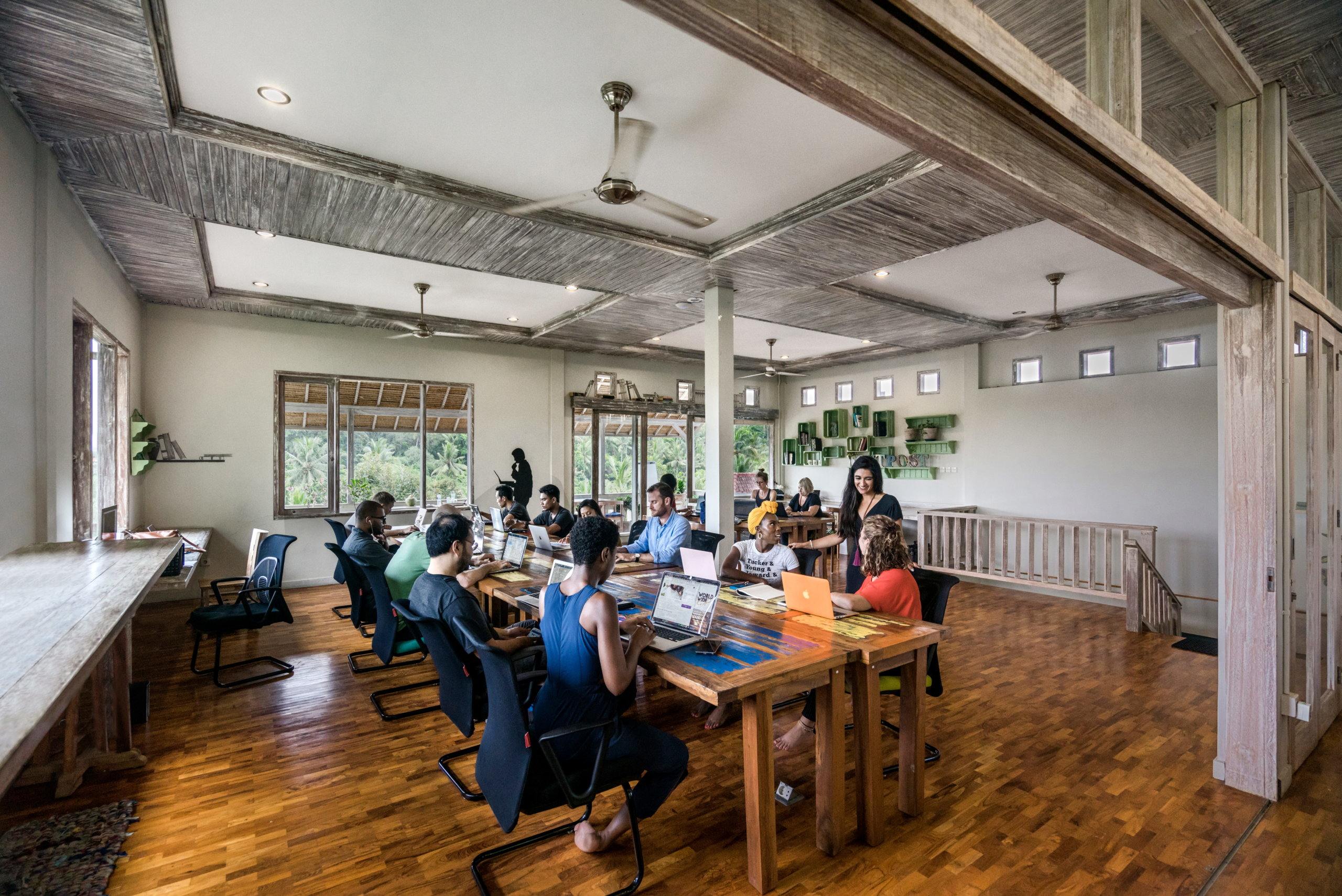
Outpost

__wf_reserved_inherit

Location: Ubud and Canggu

Daily rate: Around IDR 225,000 USD(15–16)

Monthly rate: Around IDR 2,935,000 USD(195–210)

Internet: Up to 200 Mbps with load-balanced connections

Best for: Remote professionals who need reliable Wi-Fi, quiet spaces and access to more than one location. The phone booths are the key differentiator. If you're on Zoom 3 hours a day, Outpost handles that better than any open-air space in Bali. The downside? It feels like a nice office, not like Bali. That's either a feature or a bug, depending on what you're here for.

Bali

Location: Legian/Kuta, Dewi Sri

Daily rate: Around IDR 150,000 ($10)

Monthly rate: Around IDR 2,000,000 ($133) for a hot desk pass

Internet: Around 30–60 Mbps

Best for: Expats and digital nomads who want a convenient live-and-work setup.

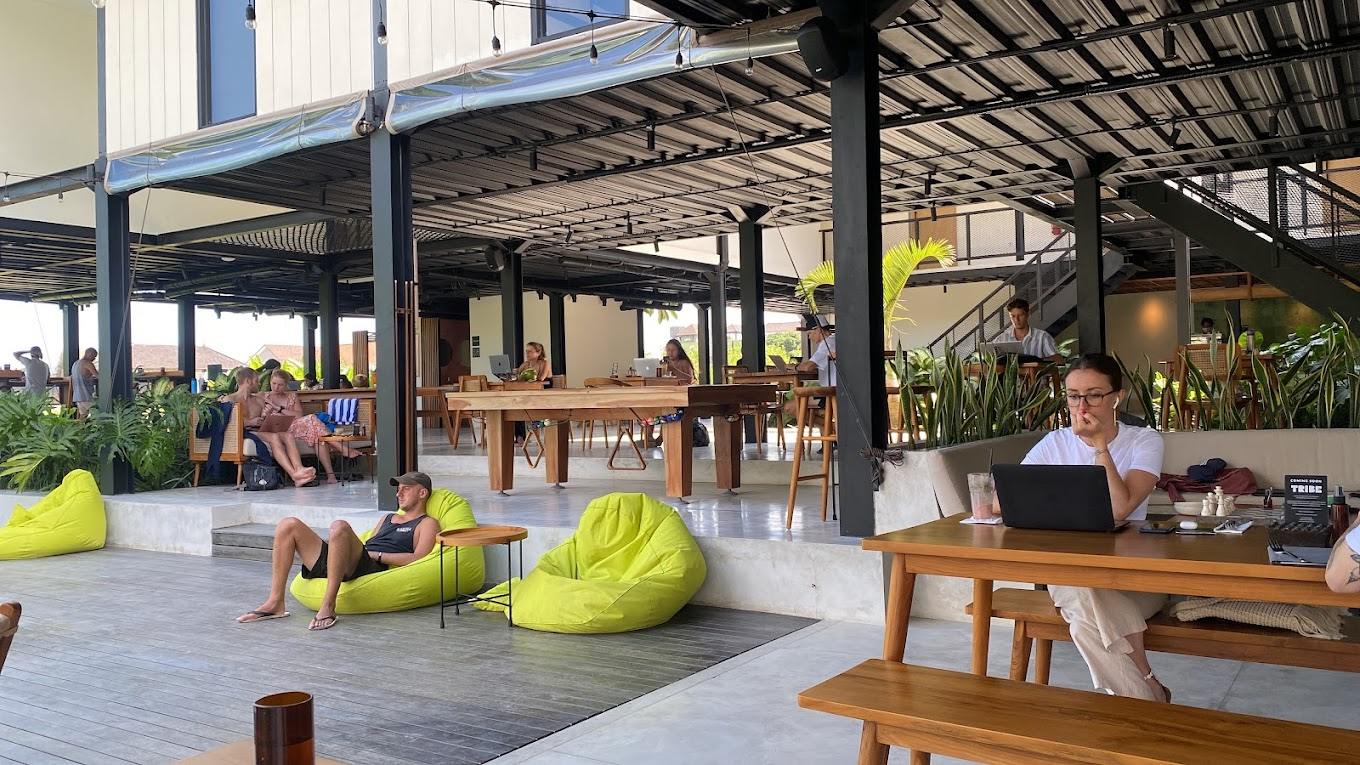
Tribal Bali

__wf_reserved_inherit

Location: Canggu, Pererenan

Daily rate: Free entry, with an expected café spend of around IDR 100,000

Monthly rate: No monthly membership

Internet: Around 100 Mbps fibre

Best for: Social digital nomads, creatives and people who enjoy meeting others while they work.

Livit Hub

__wf_reserved_inherit

Location: Sanur

Daily rate: Around IDR 275,000 ($18)

Monthly rate: Around IDR 4,875,000 ($325) for unlimited access

Internet: Up to 150 Mbps backup fibre

Best for: Startup teams, developers and remote professionals who want a professional workspace.

Workmates Canggu

Location: Canggu

Daily rate: No fixed coworking fee; café spending applies

Monthly rate: Not available

Internet: Around 50–70 Mbps

Best for: Digital nomads who prefer a relaxed café atmosphere over a conventional coworking office.

Kumpul

Location: Multiple locations, including Denpasar and Kuta

Daily rate: Around IDR 200,000 ($13)

Monthly rate: Around IDR 2,500,000 ($165)

Internet: Around 50 Mbps

Best for: Entrepreneurs who want to build connections with local businesses and founders.

The Office Bali

Location: Seminyak

Daily rate: Available on request

Monthly rate: From around IDR 3,500,000 ($230), depending on the desk

Internet: Around 100 Mbps dedicated fibre

Best for: Corporate professionals, consultants and independent professionals who prefer a structured office.

BWork Bali

__wf_reserved_inherit

Location: Canggu, Berawa

Daily rate: Around IDR 150,000–200,000 (10–13)

Monthly rate: Around IDR 2,300,000 ($150)

Internet: Around 150 Mbps dual fibre

Best for: Developers, content creators and remote professionals who need a quieter place to focus.

Dojo Bali

__wf_reserved_inherit

Location: Canggu, Echo Beach

Daily rate: N/A — permanently closed

Monthly rate: N/A — permanently closed

Best for: Understanding the history of Bali's digital nomad community.

Hubud

Location: Ubud, Monkey Forest

Daily rate: N/A — permanently closed

Monthly rate: N/A — permanently closed

Best for: Exploring the history and evolution of coworking in Bali.

Komunitas Co

Location: Ubud

Daily rate: Not available as a standard coworking rate

Monthly rate: Not available

Best for: Travellers interested in local creative communities and cultural experiences.

Best coworking spaces in Ubud for focused work

If you need a quiet place to work in Ubud, these three coworking spaces offer a mix of peaceful surroundings, reliable workspaces and meeting facilities.

Outpost Ubud (Penestanan & Nyuh Kunin)

Atmosphere: A tropical workspace with open-air areas, greenery, ravine views and a jungle pool.

Typical clientele: Remote executives, tech founders and long-term expats.

Distance: Around 7 minutes by scooter from central Ubud.

Meeting rooms: Yes, with private booths, conference rooms and whiteboards**.**

Ubud Co-Working

Atmosphere: A peaceful workspace overlooking green rice fields, designed for focused work.

Typical clientele: Writers, software engineers and digital nomads.

Distance: Around 6 minutes northeast of central Ubud.

Meeting rooms: Yes, including private rooms and dedicated meeting spaces.

The Hidden Space Ubud Cafe

Atmosphere: A quiet, plant-filled café with a garden setting away from the busy centre.

Typical clientele: Creative freelancers, slow-travelling nomads, and professionals.

Distance: Around 13 minutes by scooter from central Ubud.

Meeting rooms: Yes, with space for small workshops and private events.

How much does Coworking in Bali cost?

Your coworking budget depends largely on how long you plan to work from Bali. If you’re only staying for a few days, a day pass usually costs IDR 50,000–200,000.

A weekly pass can give you better value. For a longer stay, expect to pay around IDR 1,000,000–3,000,000 (56–167) a month for a hot desk. Dedicated desks cost more and often include extras such as storage and meeting-room access.

Before choosing a space, check the payment options. Some places offer better rates when you pay in cash, so keeping some IDR with you can help. You can keep your larger travel budget in your Grey account and use your multi-currency card when you need to pay by card.

If you’re planning a longer stay, our budgeting tips for nomads in Bali can help you plan your daily spending too.

For data on the go, grab a travel eSIM instead of buying a local SIM at the airport (where you'll overpay by 30-50% compared to ordering one online before you arrive). And if you're earning in USD while living in Bali, hold your dollars in a Grey account and convert to rupiah only when you need local currency. The rupiah fluctuates against the dollar, so converting in smaller amounts as needed often gets you a better average rate than converting a lump sum on arrival.

ATM fees can add up quickly, especially when you’re withdrawing regularly. A Grey card can help you manage your spending abroad by letting you pay by card without foreign transaction fees and withdraw cash at a fair exchange rate, depending on the ATM and applicable charges.

If you’re planning to work and spend more time in Indonesia, having a simple way to manage your money can make everyday payments easier. You can open a Grey account for Indonesia and manage your international spending from one place.

Frequently asked questions

What is the best area in Bali for digital nomads?

Canggu is popular with digital nomads because you’ll find plenty of coworking spaces, cafés, accommodation and a large remote-work community. Ubud is a better fit if you prefer a quieter environment surrounded by nature. Your choice ultimately depends on whether you prioritise social connections, convenience or a slower pace.

How fast is the internet at Bali coworking spaces?

Internet speeds vary between spaces, but many established coworking spaces offer reliable fibre connections suitable for video calls, cloud-based work and large file transfers. Some advertise speeds of 100 Mbps or more. Before choosing a space, check whether it has backup internet if reliable connectivity is essential to your work.

How much does a day pass cost at a Bali coworking space?

A day pass typically costs between IDR 50,000 and IDR 200,000, depending on the location and facilities. Some cafés and coworking spaces offer free entry with a minimum spend, while premium spaces charge more for access to meeting rooms, private areas, pools and other facilities.

Can I legally work remotely in Bali?

You need to check Indonesia’s current visa and immigration rules before working remotely from Bali. The rules depend on your nationality, visa type and the nature of your work. If you’re earning from overseas clients or an employer, confirm that your planned activities are permitted under the visa you intend to use.

Which is better for digital nomads: Canggu or Ubud?

Canggu may suit you if you want a lively digital nomad community, more coworking options and easy access to cafés and social activities. Ubud offers a quieter setting with more greenery and a slower pace. Neither is universally better; the right choice depends on how you prefer to work and live.

Do Bali coworking spaces offer accommodation?

Some coworking spaces in Bali are connected to coliving properties, so you can combine your accommodation and workspace in one place. Others only provide workspace access. If you want both, look specifically for coworking and coliving packages, and check whether accommodation, workspace access and other amenities are included.

Top remote jobs for Nigerians in 2026: Roles, pay and how to get paid

•

•

2 min read

Remote jobs for Nigerians in 2026 are no longer a niche or a fallback. Software developers, data analysts, designers, and marketers from Nigeria are working full-time for companies in the US, UK, and Europe, earning in dollars, and doing it all from home. The roles are real, the salaries are competitive, and the infrastructure to support it has never been more accessible.

One thing most guides skip: when you apply to platforms like Upwork or Turing, they ask for your banking details before you land your first job. Having a Grey account ready means you can provide a US ACH routing number and account number on the spot and receive USD payments from day one without scrambling for a solution after you have already been hired.

This guide covers the highest-paying remote roles for Nigerians, realistic salary ranges, where to find legitimate international opportunities, and how to set up the payment side before you start applying.

Software developer and engineer

Software development remains the highest-paying remote role accessible to Nigerian professionals. International companies hire Nigerian developers for frontend, backend, mobile, and full-stack roles across fintech, SaaS, AI, and healthtech.

Employment Freelance rates
USD 30,000 to 90,000 per year USD 25 to 80 per hour

Also read: Remote work in Lagos: how Nigerians earn and manage global dollar income

Skills in demand: React, Node.js, Python, TypeScript, Go, cloud infrastructure. Employers prioritise portfolios and real-world experience over credentials.

Data analyst and data scientist

Remote data analyst roles are growing as global businesses rely on data-driven decisions. Nigerians with SQL, Python, and business intelligence skills are finding long-term contracts with international teams, often with flexible schedules.

Employment Freelance rates
USD 25,000 to 70,000 per year USD 20 to 60 per hour

Skills in demand: SQL, Python, Tableau, Power BI, dbt, statistical modelling.

Digital marketer and growth specialist

Digital marketing is one of the most accessible remote roles for Nigerians. Results matter more than location, and Nigerian marketers are securing international roles in SEO, paid advertising, content, and email marketing with global startups and brands.

Employment Freelance rates
USD 20,000 to 75,000 per year USD 15 to 50 per hour

Skills in demand: performance marketing, SEO, HubSpot, Google Analytics, Klaviyo, growth experimentation.

You may also like: How to receive USD freelance payments in Nigeria

Product designer — UI/UX

Remote design roles continue to grow as companies invest in digital products. Nigerian designers with strong portfolios work remotely with global teams on apps, websites, and SaaS platforms, competing on craft rather than location.

Employment Freelance rates
USD 30,000 to 75,000 per year USD 25 to 70 per hour

Tools in demand: Figma, Framer, user research, prototyping, design systems.

Technical writer and content specialist

Remote writing has expanded beyond blogging. Nigerian professionals are working as technical writers, documentation specialists, and content strategists for international companies in SaaS, fintech, and developer tools.

Employment Freelance rates
USD 20,000 to 55,000 per year USD 20 to 60 per hour

Virtual assistant and operations support

VA roles have evolved into full remote operations positions. Nigerian VAs now support founders and remote teams with scheduling, CRM management, customer support, and internal coordination, often on long-term retainers.

Employment Monthly retainer
USD 12,000 to 35,000 per year USD 800 to 2,500

Customer success and support

International companies value Nigerian professionals in customer success roles for communication skills and time zone alignment with Europe. These roles offer stable monthly income and career progression.

Employment Contract rates
USD 18,000 to 45,000 per year USD 10 to 25 per hour

Set up your payment account before you apply

Most international platforms and employers ask for your banking details during onboarding, not after your first payment. Upwork, Turing, Deel, and most payroll systems ask you to add a withdrawal method before you can accept work or receive a salary. If you do not have a USD account ready, you are either blocked at that step or forced to use a less efficient workaround.

Here is what the onboarding forms typically ask for:

  • Account type: Checking
  • ACH routing number
  • Account number
  • Bank name

A Grey account gives you a US ACH routing number and account number that works with all of the above. You fill in those four fields, and your dollar earnings arrive in your Grey USD account within 1 to 2 business days of each payment. Open your multi-currency account before you start applying so the payment side is ready the moment you land a role.

Once the money is in your account, you hold it in USD, convert to naira when the rate works for you, and spend internationally with a virtual card. There is no pressure to convert immediately and no automatic conversion that locks you into a bad rate.

Also read: Best digital platforms for freelancers to receive money in Nigeria

Where to find legitimate remote jobs as a Nigerian

These platforms consistently list international remote opportunities suitable for Nigerians:

  • LinkedIn — remote-first roles and direct hiring from international companies
  • We Work Remotely — curated global remote jobs across tech, design, and marketing
  • Remote OK — tech, data, and marketing roles
  • Wellfound — startups hiring internationally, often with equity
  • Upwork — freelance and long-term remote contracts across all categories
  • Turing — remote engineering roles with US companies, vetted entry process

Building a remote career from Nigeria that pays well

The professionals earning consistently in remote roles do three things: they build skills with long-term demand, they use the right platforms to find legitimate opportunities, and they set up reliable systems for getting paid before they need them. The payment side is the easiest part to solve in advance. Manage your earnings in USD, convert when the rate suits you, and focus your energy on the work itself.

Frequently asked questions

What are the highest-paying remote jobs for Nigerians in 2026?

Software development, data science, and UI/UX design offer the highest earning potential, with annual salaries ranging from USD 30,000 to USD 90,000 depending on experience and role level.

How do Nigerians get paid for remote jobs?

Most international employers and platforms pay via ACH direct deposit into a US bank account or via payroll platforms like Deel or Remote. Having a USD account with an ACH routing number, such as a Grey account, lets you receive these payments directly.

What banking details do I need for Upwork or Turing?

Both platforms ask for a checking account type, an ACH routing number, an account number, and a bank name. A Grey USD account provides all four.

Do I need to be in the US to receive dollar payments from remote work?

No. You receive the money into your USD account regardless of where you are. Grey accounts are available in Nigeria and 80+ other countries, and you access your USD balance from the Grey app.

Is it legal to earn in dollars from remote work in Nigeria?

Yes. Nigerians can legally earn in foreign currency from international employers and clients. You are responsible for declaring income to FIRS as required under Nigerian tax law. Consult a tax professional for advice on your specific situation.

Which remote jobs can Nigerians do with no experience?

Virtual assistant, data entry, customer support, and entry-level content writing roles are the most accessible for those starting out. These typically pay USD 10,000 to USD 25,000 per year and provide a foundation for moving into higher-paying categories.

Salary ranges are indicative and based on industry data available at the time of publication. Actual compensation varies by employer, experience level, and role scope. Tax obligations for remote workers in Nigeria are subject to Nigerian law; consult a qualified tax adviser for guidance specific to your situation.

‍

If you’re working online for international clients or employers, create a free account on Grey to receive USD, EUR, or GBP, manage your income efficiently, and focus on growing your remote career in 2026 and beyond.

Best countries Nigerians travel to while working remotely

•

•

2 min read

In Nigeria, many remote workers reach a point where work starts to feel the same every day. The job is still going well, clients are still online, and deadlines are still met, but the environment never changes. Same room, same chair, same routine. Then a simple question comes in: if work can be done from anywhere, why stay in one place?

For some Nigerians, that question remains in their minds. For others, it becomes a decision. Not to quit work, but to change where life happens around the work. Since the job is already remote, they begin to test new environments while still keeping their roles and clients. Many start with nearby countries like Accra or Nairobi, while others go further to places like Dubai or European cities. The work does not change, but the setting does.

This article looks at the countries Nigerians are choosing and what makes them practical for remote work without affecting income, routine, or daily productivity.

Also read: Top sites to get international remote jobs in Nigeria

Why Nigerians are choosing to work remotely abroad

More Nigerian remote workers are choosing to live abroad while working online, combining global income with better living conditions, mobility, and lifestyle opportunities.

Stronger economies and financial clarity

Earnings in dollars or pounds become even more valuable when combined with predictable living costs, stable exchange rates, and structured financial systems. A freelancer who moves to Portugal or the UAE can plan their expenses more easily than in Nigeria's fluctuating naira environment. This shift is not just about income but about financial clarity: knowing what your earnings are worth month to month without sudden currency drops affecting your lifestyle.

Better infrastructure

Stable electricity, faster internet, efficient public transport, and safer urban systems all contribute to a smoother daily life. A Nigerian remote worker in Dubai or Lisbon can focus fully on work without worrying about power cuts or connectivity issues. Over time, the difference shows not just in comfort but in how consistently and efficiently work can be delivered to international clients.

Global communities and career growth

Living abroad places Nigerian remote workers closer to international networks. Co-working spaces, tech hubs, and creative communities offer opportunities to meet other professionals, collaborate, and grow. A developer working remotely from Berlin or a designer in Barcelona can attend events, meet clients, and build relationships that would be harder to access from Nigeria.

Efficient payment systems

Abroad, remote workers can receive payments faster and avoid some of the restrictions faced in Nigeria. Multi-currency accounts like Grey work the same from any country: you receive USD, GBP, or EUR from clients via ACH, SEPA, or Faster Payments, hold the balance, and convert when the rate suits you. Your payment setup does not need to change when your location does.

Key factors Nigerians consider before choosing a remote work destination

Before relocating, Nigerian remote workers assess practical conditions that affect daily work, safety, income stability, and how smoothly they can operate abroad.

Cost of living

One of the first considerations is how living costs compare to income. Nigerian remote workers earning in foreign currency still assess rent, food, transport, and healthcare expenses in their destination. Cities like London or New York may offer access, but high living costs can reduce savings. In contrast, places like Lisbon or Dubai offer a more balanced cost-to-income ratio. The goal is not just to earn abroad but to maintain a lifestyle in which expenses remain manageable while still allowing room for savings and financial stability.

Also read: The best digital nomad jobs to earn from anywhere in Nigeria

Time zone alignment with clients

Time zone is a critical but often underestimated factor. Nigerian remote workers consider how closely their destination aligns with client working hours, especially for UK or US-based roles. A poor time overlap can mean late-night meetings or early morning deadlines, which becomes difficult to sustain long-term. For example, moving to Asia while working with US clients can stretch working hours significantly. On the other hand, locations within Europe or parts of the Middle East offer better alignment. Choosing the right time zone helps maintain productivity, communication flow, and a healthier daily work rhythm.

Personal safety and security

Safety is a major consideration when choosing where to live and work abroad. Nigerian remote workers often prioritise countries with low crime rates, stable political environments, and reliable public systems. Feeling safe affects everything from where you live to how freely you can move, work late hours, or explore your environment. For someone working remotely, especially from home or shared spaces, a secure environment allows full focus without constant concern. Over time, safety becomes less of a luxury and more of a necessity for maintaining both productivity and peace of mind.

Also read: The best digital nomad jobs to earn from anywhere in Nigeria

Visa policies and legal stay options

Visa access plays a major role in destination choice. Nigerians often consider countries with flexible visa policies, digital nomad visas, or easier residency pathways. The ability to stay legally without frequent renewals reduces uncertainty. Some destinations allow remote workers to live longer while working for foreign companies. Without clear legal options, even attractive locations become impractical. This makes visa requirements, processing timelines, and renewal conditions essential factors when deciding where to relocate and work remotely.

Internet reliability and infrastructure

Stable internet and infrastructure are essential for remote work. Nigerians moving abroad prioritise countries with consistent broadband, minimal downtime, and reliable electricity. This ensures uninterrupted communication with clients and teams. Access to co-working spaces and strong mobile networks also matters. Without reliable infrastructure, remote work becomes stressful and unpredictable. As a result, destinations are often chosen based on how well they support consistent productivity and seamless collaboration across different time zones.

Six countries where Nigerian remote workers are choosing

Nigerian remote workers are choosing different countries that combine better living conditions, stable infrastructure, and smoother work environments while continuing to earn from global clients online.

Ghana

Ghana is a top choice because of ECOWAS's ease of travel, shared culture, and proximity to Nigeria. Accra has a growing tech and creative ecosystem where freelancers and remote workers can easily plug in. The environment feels familiar, from language flow to everyday lifestyle. Even food culture adds a light rivalry, especially the famous jollof rice debate between Nigerians and Ghanaians, which makes settling in more fun than stressful. Many Nigerians use Ghana as a first step into living abroad while still working remotely for international clients.

Payment note: Grey supports withdrawals to Ghanaian banks ($1.20) and mobile money ($0.20), so your payment setup works the same as it did in Nigeria.

Dubai (UAE)

Dubai is popular among Nigerian remote workers because of its one-year virtual working program, which allows professionals to live in the UAE while working for foreign clients. The city offers world-class infrastructure, fast internet, and a highly international environment. Many Nigerians also move with family, attracted by safety and modern living standards. Dubai's connectivity makes global collaboration straightforward, especially for those working with US or UK clients.

Payment note: The UAE has no personal income tax, which means your gross USD earnings are your net earnings. Grey's USD account details work the same from Dubai as from Lagos.

Also read: How to apply for a digital nomad visa in Portugal

Portugal

Portugal has become a favorite due to its Digital Nomad Visa and balanced cost of living compared to other Western European countries. Cities like Lisbon and Porto offer warm climates, relaxed lifestyles, and robust digital infrastructure. Nigerian remote workers are drawn to the slower pace of life combined with access to European markets. It is also easier to build community through co-working spaces and international networks.

Payment note: You will need a Portuguese NIF (tax number) for residency. You can continue receiving client payments into your Grey EUR account via SEPA while building local financial presence.

Morocco

Morocco appeals to Nigerian remote workers because of its proximity to Europe, growing digital economy, and relatively affordable lifestyle. Cities like Casablanca and Marrakech offer a mix of modern infrastructure and rich cultural experiences. The time zone alignment with Europe also makes it easier to manage international client work.

Payment note: Grey supports withdrawals to Moroccan banks at $2.00 per transaction (next business day), so you can access your earnings locally.

Also read: Digital nomad setup in Morocco: what to expect and requirements

Canada

Canada is chosen by Nigerian remote workers looking for long-term stability and potential residency pathways. The country offers strong infrastructure, high living standards, and a diverse multicultural environment. While the cost of living can be high in major cities, the quality of life and safety often offset this. Many Nigerians view Canada not just as a remote work destination but as a long-term relocation option with career and immigration opportunities.

Payment note: Grey supports Canadian withdrawals via Interac (CA$3) and bank transfer (CA$2.50), making it practical alongside any local Canadian account you open.

United Kingdom

The UK remains attractive due to cultural familiarity, strong earning potential, and access to a large global job market. Nigerian remote workers often find it easier to integrate into professional environments because of shared language and historical ties. Cities like London offer strong connectivity, networking opportunities, and proximity to major industries. While living costs are high, the income potential often offsets this for remote professionals.

Payment note: Grey provides GBP account details with a UK sort code and account number. If you are already receiving GBP from UK clients, your setup does not change when you move to the UK.

Managing global income with Grey

Working remotely abroad gives Nigerian professionals access to better lifestyles and global opportunities, but managing international income efficiently is just as important. Grey makes it easy to receive, hold, and convert foreign payments with competitive rates and a secure, regulated system built for cross-border workers. It helps you stay in control of your earnings no matter where you live. Sign up or download the app to start managing your global income with ease and confidence.

Grey charges fees on deposits, conversions, and withdrawals. Deposits via ACH, SEPA, or FPS incur a 0.8% fee (minimum $2/€2/£2, maximum $10/€10/£10). Currency conversions are charged at 1%, capped at $6. Withdrawal fees vary by currency: ₦35 for NGN, 0.5% for EUR/GBP (minimum €2/£2, maximum €10/£10), and $0.50-$0.65 for KES/UGX/TZS. Cross-border card transactions (non-USD purchases on a USD card) incur a 2% fee plus $0.50. Exchange rates are variable and include a margin over the mid-market rate. Always review fees and the rate before confirming a transaction. Visit grey.co/pricing for current rates.

Planning a global career from India in 2026

•

•

2 min read

Working abroad has moved from being a distant dream to a realistic career goal for many Indian professionals in 2026. Global hiring is accelerating as employers increasingly look beyond borders to build strong, diverse teams. With digital recruitment and faster application processes, opportunities that once felt out of reach are now more accessible than ever.

For Indians considering this path, securing a job abroad is no longer a matter of luck or personal connections. It requires clarity, preparation, and the right information. In this guide, you’ll discover what it truly takes to secure a job abroad in 2026, understand the process from start to finish, and position yourself confidently for international opportunities.

Also read: Digital nomad guide to working remotely from India

Which countries can Indian professionals get jobs in 2026?

Several countries are actively recruiting Indian professionals to fill skill gaps and strengthen their workforces. With strong education, global exposure, and adaptability, Indian talent fits naturally into many high-demand international roles.

Canada

Canada continues to attract Indian professionals due to persistent shortages in IT, healthcare, engineering, and skilled trades. Many Indian workers are highly valued for their qualifications and proficiency in English. Clear immigration pathways like Express Entry and Provincial Nominee Programs make it easier to transition from work permits to permanent residency, offering long-term career and settlement opportunities.

Germany

Germany, Europe’s largest economy, faces major skill gaps in software development, healthcare, engineering, and technical roles. Indian professionals are well-suited due to their strong STEM education and work ethic. New initiatives like the Opportunity Card (Chancenkarte) simplify entry, making Germany more accessible for Indians seeking structured careers, global exposure, and stable employment in Europe.

Australia

Australia is actively welcoming Indian professionals to meet workforce needs in engineering, technology, healthcare, and emerging fields like AI. Indians benefit from the cultural familiarity, English language advantage, and their recognised qualifications. Programs such as the Mobility Arrangement for Talented Early-professionals Scheme (MATES) reflect Australia’s growing focus on long-term talent exchange with India.

United Kingdom

The UK is experiencing shortages across healthcare, education, and technology sectors. Indian professionals are a strong fit due to recognised qualifications and experience working in global environments. The Skilled Worker Visa route provides a clear legal pathway, allowing Indians to work with reputable employers while gaining international exposure and long-term career growth.

UAE & Singapore

The UAE and Singapore remain top destinations for Indian professionals in IT, finance, banking, logistics, and management. Indian talent is widely trusted and already integrated into these economies. High salaries, strong infrastructure, and international work environments make both countries attractive, with the UAE offering the added benefit of tax-free income.

Also read: How to build a global personal brand from India as a remote worker

Career paths for Indian professionals to work globally in 2026

Planning to work abroad starts with choosing the right career path. Some professions offer clearer international opportunities because their skills, certifications, and qualifications are globally recognised.

Technology

You can boost your chances of working abroad by earning globally recognised tech certifications like AWS, Microsoft Azure, or Cisco CCNA. Pair these credentials with hands-on experience, and international employers will see you as a skilled professional ready to contribute to cloud, networking, or IT infrastructure projects.

Healthcare

To work abroad in healthcare, you must register with the medical or nursing council of the country you’re targeting. Completing these requirements makes your Indian medical training recognised, allowing you to practice professionally. Many countries actively seek skilled healthcare workers, making your experience and qualifications highly valuable.

Engineering

Proficiency in tools like AutoCAD and SolidWorks makes you a strong candidate for international engineering roles. These globally recognised programs demonstrate that your technical skills meet industry standards, enabling you to work on construction, manufacturing, or industrial projects that require precision, safety, and technical expertise.

Finance

Obtaining CPA certification or specialising in IFRS can significantly enhance your international finance career. These globally recognised credentials align your knowledge with international standards, helping you secure roles in auditing, compliance, accounting, or financial management with multinational companies.

Hospitality

Completing HACCP training or recognised culinary diplomas prepares you for international hospitality opportunities. Employers value your understanding of global food safety, service, and culinary standards, opening doors to hotels, resorts, and restaurants where professionalism, adaptability, and expertise are in high demand.

Also read: How Indian freelancers are adapting to global payment trends

Best ways for Indians to secure jobs abroad successfully

If you’re an Indian professional aiming to work abroad, success depends on presenting yourself effectively and connecting with the right opportunities.

Globally formatted CV

A well-structured, internationally formatted CV is essential to get noticed by recruiters abroad. Focus on clarity, achievements, and quantifiable results rather than just duties. Highlight skills, certifications, and projects relevant to global employers. Tailoring your CV for each job increases your chances of interviews and helps recruiters quickly see why you’re the right candidate.

International LinkedIn profile

Your LinkedIn profile is often the first impression for global employers. Use a professional photo, write a compelling summary, and highlight international experience or skills. Add recommendations and showcase projects. Engage with relevant industry content and connect strategically. A strong LinkedIn profile increases visibility, credibility, and your chances of attracting recruiters from abroad.

Target the right platforms

Applying to the right platforms improves your chances of landing international roles. Focus on verified job boards, global talent marketplaces, and country-specific portals. Avoid generic applications on low-reputation sites. Research each platform, understand its requirements, and tailor your profile accordingly. This targeted approach increases visibility and ensures your applications reach serious recruiters abroad.

Gain global certifications

Global certifications make your skills stand out internationally. Whether in IT, finance, healthcare, or engineering, credentials recognised worldwide show you meet international standards. For example, AWS, CPA, or IFRS certifications enhance credibility and demonstrate expertise. Earning these certifications increases your employability and signals to recruiters that you’re prepared for global roles.

Consult recruitment partners

Working with international recruitment agencies or consultants can accelerate your job search abroad. They connect you to verified employers, provide guidance on visa processes, and help prepare you for interviews. Indian professionals benefit from their networks and insights, avoiding scams and focusing on legitimate opportunities. Consulting with these partners ensures a smoother and faster path to securing global roles.

LDMAG1

Receive global payments with Grey

As an Indian professional planning a global career in 2026, there’s no better time to start than now. Opportunities are growing, and acting early gives you an edge. While planning your international journey, make sure you have a reliable way to receive payments. Grey is secure, fast, and offers excellent conversion rates. Sign up or download the app to receive your global earnings effortlessly.

‍

Getting paid from Europe and the US while living in India

•

•

2 min read

Earning in euros or dollars while living in India is a common goal for many remote workers, digital nomads, and expats. This often translates to higher earning potential, especially when converted to rupees. Unfortunately, high fees, payment delays, complex paperwork and forced currency conversions often make getting paid from Europe and the US while living in India very challenging.

However, there are various ways to manage international payments seamlessly while working in India. Here is how professionals in India efficiently receive payments from Europe and the US, and keep more of their earnings.

Why getting paid from Europe and the US can be tricky

Most traditional Indian banks are designed for just domestic transactions rather than foreign payments. When payments arrive via international wire, they may pass through multiple intermediary banks and incur extra charges. On top of that, you are forced to convert from EUR or USD to INR immediately the money lands in your accounts, and the rates are often not that great.

Due to processing and the transaction network, it may take a few days for the payment to reach your account. Lack of control over fees, transaction speed, and conversion can be frustrating for many professionals. The uncertainties make financial planning somewhat difficult.

Also read: Why Bengaluru is India’s unofficial capital for remote work and startups

How to get paid from Europe and the US while living in India

Here are the popular options for managing international payments from Europe and the US while living in India

Bank transfers and SWIFT payments

Many European and US companies opt for international bank transfers via SWIFT because it is reliable. This method is widely trusted and works well for both large payments and regular salaries. However, it has drawbacks. Transfers may take several business days, and fees are deducted before the money even gets to your account. You may also need to provide additional documentation to access your earnings, which can be cumbersome.

While SWIFT transfers are acceptable for occasional payments, they are rarely the most cost-effective option for frequent international income.

Using digital payment platforms

Platforms such as PayPal, Payoneer and Skrill are popular because they are easy for foreign clients to use. Payments arrive quickly, and you can withdraw funds to your Indian bank account.

However, convenience comes at a cost. You need to be mindful of platform fees, withdrawal charges, and currency conversion mark-ups that can significantly reduce your earnings. Some users also experience account limitations or compliance reviews that temporarily restrict access to funds. This is why it is best to compare options before choosing a digital payment solution.

  • Payoneer: Ideal if you work through international freelance marketplaces like Upwork or Fiverr. It provides multi-currency accounts and integrates seamlessly with these platforms, making withdrawals straightforward.
  • Razorpay: An India-based payment gateway that allows businesses and some freelancers to accept international card payments in over 130 currencies directly into their Indian bank account.
  • PayPal: Widely used and trusted by global clients. However, while PayPal supports swift transfers, it comes at a higher cost.

Also read: Payment methods Indians often miss: alternatives beyond PayPal and bank transfers

Multi-currency accounts

For many Indians earning from Europe and the US, multi-currency accounts have become the most efficient payment solution. These payment platforms help you open accounts in various currencies such as USD, EUR, and GBP. This way, clients can pay you as if they were making a local transfer within their country.

LDMAG1

You also don’t have to convert your earnings to INR immediately, as a multi-currency account allows you to hold foreign currency and convert when exchange rates are favourable. You can also spend foreign currencies directly to pay for your subscriptions, trips, and online purchases. This level of control protects your income because fees are typically low, transactions are swift, and there are no hidden fees.

  • Grey: Tailored to remote workers in India with international clients. Users can access USD, EUR, and GBP account details for international payments within minutes. Transaction fees are generally low with mid-market exchange rates, and transactions are nearly instant. You can also get a USD debit card for your online payments and automated invoicing to streamline your finances. Grey also integrates seamlessly with global freelancing platforms (like Fiverr and Upwork) and online marketplaces (like Etsy and Amazon), allowing you to access your earnings without delay.
  • Wise: Offers local account details (USD, EUR, GBP) so clients can pay you via a local transfer, avoiding SWIFT fees. Funds are converted at the mid-market exchange rate with low, transparent fees, ensuring you keep more of your earnings.
  • Winvesta: A fintech company providing cross-border payments and multi-currency accounts for Indians. Users can manage payments in USD, EUR, GBP and other foreign currencies.

Also read: How remote workers in India can switch from traditional banks to Grey.

Managing your global income with Grey

Getting paid from Europe and the US while living in India does not have to be stressful. With the right tools, you can maximise your earnings and streamline your finances. Grey provides multi-currency accounts supporting USD, EUR, and GBP. This allows professionals in India to receive payments from Europe and the US easily. You can hold foreign currency, convert at competitive rates, and withdraw to your Indian bank account when it suits you.

Sign up on Grey today or download the app to get started.

‍

Arrow (up)

Back to top