


The digital nomad scene has evolved over the years, and 2026 feels like the year of maturity. Today, entire countries are rolling out red carpets for remote workers, and honestly, some of these programmes are incredible.
What’s in it for these countries? A remote worker earning a London or San Francisco salary but spending it in Lisbon or Mexico City. That's pure economic gold, as that’s money that will be pumped directly into the economy through the said freelancers’ spending.
I’ve spent some time researching which countries are genuinely attracting remote workers in 2026, not just talking about it, but actually making it happen. Here’s what I’ve found.
Let me start with the obvious one. Portugal has been the poster child for remote work migration since 2020, and in 2026, it remains at the forefront.
Entire neighbourhoods in Príncipe Real and Santos are now essentially expat hubs. You’ll hear more English than Portuguese in some co-working spaces, and the average rent has tripled in five years. Some locals aren’t always thrilled about that, but the government certainly is.
The D7 visa (passive income visa) and the newer Digital Nomad Visa make it absurdly easy for remote workers to settle here legally. You need proof of income, which is around €3,040 per month for a single person, and you’re basically in. Processing times are reasonable, and you get access to Europe’s Schengen zone.
Portugal offers a lifestyle that’s hard to beat. It’s affordable, at least compared to London or Paris, has a stunning coastline, incredible food, and a time zone that works for both European and US East Coast clients.
Rent in Lisbon and Porto has become genuinely expensive. A one-bedroom flat in a decent neighbourhood will set you back €1,200 - €1,800 per month now. And if you’re not earning in EUR or USD, the cost of living might surprise you.
Still, for most remote workers, especially those in tech, design, or marketing, Portugal remains one of the safest, easiest, and most attractive options in Europe.
Some say Spain spent years watching Portugal steal its thunder, but in 2023, it launched a proper Digital Nomad Visa, and by 2026, the results are showing.
I’ve got friends who moved to Valencia and Barcelona in the last year, and the quality of life they describe is impressive. Spain’s visa requires proof of a monthly income of at least € 2,000, a clean criminal record, and health insurance. The visa is valid for 12 months (renewable for up to five years) and you get to live and work remotely in one of Europe’s most liveable countries.
The weather, obviously. But also the infrastructure. Spain’s internet speeds are excellent, co-working spaces are everywhere, and cities like Madrid, Barcelona, and Valencia offer that perfect mix of metropolitan energy and Mediterranean ease.
Spain's tax regime for new residents can be favourable. The Beckham Law (yes, named after that Beckham) allows qualifying remote workers to pay a flat 24% tax on Spanish-sourced income for up to six years. If you structure things correctly and most of your income is foreign-sourced, Spain can be surprisingly tax-efficient.
A minor downside is that obtaining your TIE (residence card) can take several months, and navigating local government offices often requires considerable patience. But if you can navigate the admin, you’ll absolutely love your stay.
I’ll be honest, I didn’t expect Mexico to dominate the remote work conversation the way it has, but here we are. In 2026, Mexico City, Playa del Carmen, and Tulum are absolutely crawling with remote workers, particularly from the U.S. and Canada.
Mexico’s Temporary Resident Visa is designed for remote workers who earn at least $3,500 per month or hold at least $60,000 in savings. Once approved, you can live in Mexico for up to four years.
The timezone compatibility with the U.S. is a plus if you're working for American clients or companies. Mexico’s Central or Eastern time zones mean you're not taking calls at 2 a.m. The cost of living is significantly lower than in the U.S. You can live comfortably in Mexico City on $2,000–$3,000 per month, including rent, food, and entertainment.
The lifestyle is vibrant. Mexico City boasts world-class restaurants, an incredible cultural scene, and a creative energy that rivals any major global city. The variety is there, and it's affordable.
It’s essential to acknowledge that safety concerns are real in certain areas. Mexico City is generally safe in expat-friendly neighbourhoods like Roma, Condesa, and Polanco, but it’s essential to stay vigilant. Internet reliability can vary significantly, being fine in major cities but patchy in beach towns. And whilst Mexico is affordable, the influx of high-earning remote workers has driven up rents in popular neighbourhoods. A flat in Roma Norte that cost $800 per month in 2021 now costs $ 1,500 or more.
Still, for North American remote workers, Mexico remains the most convenient, accessible, and practical option.
Dubai and Abu Dhabi have always attracted expats, but the UAE’s remote work visa (launched in 2020 and refined since) has turned it into a genuine hub for high-earning digital professionals.
The UAE’s remote work visa requires proof of a monthly income of $5,000 or more (or an annual income of $50,000 or more), valid employment, and health insurance. The visa grants you one year of residency (renewable), exempts you from income tax, offers world-class infrastructure, and provides a lifestyle that's... well, very Dubai.
No income tax is the headline. If you’re earning six figures (a term that I’ve now come to dislike) and paying 40% tax in the UK or EU, moving to Dubai can mean keeping significantly more of your income. The infrastructure is phenomenal and everything runs on time. The UAE is one of the safest countries in the world, and for remote workers with families, that's a huge draw.
It’s expensive. Rent in Dubai is high (think $2,000-$4,000 per month for a decent one-bedroom), and while there's no income tax, the cost of living offsets some of those savings. The culture also isn’t for everyone. There are many strict laws, conservative social norms, and a car-dependent lifestyle that can feel restrictive if you’re used to European walkability.
But for high earners prioritising tax efficiency and luxury, the UAE is hard to beat.
LDMAG1
Estonia doesn't get enough credit, but that’s why I’m here. This tiny Baltic nation launched the world's first Digital Nomad Visa in 2020, and whilst it's not as sunny as Portugal or as buzzy as Mexico, it’s carved out its own loyal following.
Estonia's visa requires proof of a monthly income of € 4,500 or more and allows you to live and work remotely for up to 12 months. Extensions are possible, and the entire application process is digital.
Everything happens online, from company registration to tax filing. For tech workers and entrepreneurs, Estonia feels like home.
Estonia also offers the e-Residency programme, which allows you to run a business remotely from an EU-based location without needing to reside there. Pair that with the Digital Nomad Visa, and you've got a powerful setup for location-independent entrepreneurs.
It's cold. Proper cold. If you’re chasing sunshine, Estonia isn't it. The expat community is relatively small, which can make it feel isolating. And whilst Tallinn is lovely, the rest of Estonia is quite rural; if you need urban energy, options are limited.
But for a certain type of remote worker, tech-focused, digitally savvy, unbothered by winter, Estonia is brilliant.
Also read: The best countries in Europe to land a remote job
Bali has perhaps been the most popular digital nomad hotspot in Indonesia. For over a decade, it's always existed in a legal grey area. Most people worked on tourist visas and did "visa runs" every few months. In 2024, Indonesia finally launched a proper remote work visa.
The visa costs around $130, requires proof of a monthly income of $2,000 or more, and grants you 12 months (renewable for up to five years) to live and work remotely.
Also read: Real budgeting tips for nomads living in Bali
It’s cheap. You can live well in Bali on $1,500 per month. The lifestyle is unbeatable: surf, yoga, co-working spaces overlooking rice paddies, and a massive community of like-minded remote workers. Canggu, Ubud, and Sanur are now essentially purpose-built for this crowd.
Infrastructure is hit-or-miss. The internet can be unreliable during the rainy season, power cuts happen, and healthcare isn’t comparable to that in developed countries. The visa process, whilst improved, still involves typical Indonesian bureaucracy.
But if you’re earning in USD or GBP and want a low-cost, high-lifestyle base in Southeast Asia, Bali remains hard to beat.
Also read: Everything you need to know about the Indonesian digital nomad visa
The countries attracting remote workers in 2026 aren’t just the ones with the nicest beaches or the coolest co-working spaces. They’re the ones that understand the economics, make visas accessible, and offer a genuine quality of life improvement over wherever you’re leaving.
Portugal, Spain, Mexico, the UAE, Estonia, and Indonesia are leading the pack, and they’re leading for different reasons. Portugal offers European ease and Schengen access. Spain brings scale and variety. Mexico offers affordability and time zone alignment for Americans. The UAE is the tax-free luxury option. Estonia is the digital pioneer. Bali is the lifestyle escape.
Your ideal destination depends on what you value most: tax efficiency, cost of living, weather, community, or infrastructure. However, wherever you land, ensure that you have the necessary financial infrastructure in place. Because the visa might get you in the door, but a proper payment setup is what lets you actually enjoy it.
I’ve watched friends move to Portugal or Mexico, land great clients, then lose 3 - 5% of every payment to terrible exchange rates and international transfer fees. Over a year, that adds up to thousands of pounds, dollars, or euros just... gone.
If you’re working remotely and getting paid in USD, EUR, or GBP whilst living abroad, you need a proper payment setup. Many traditional banks are often problematic in this regard, as they have slow transfers, hidden foreign exchange markups, and fees that make little sense.
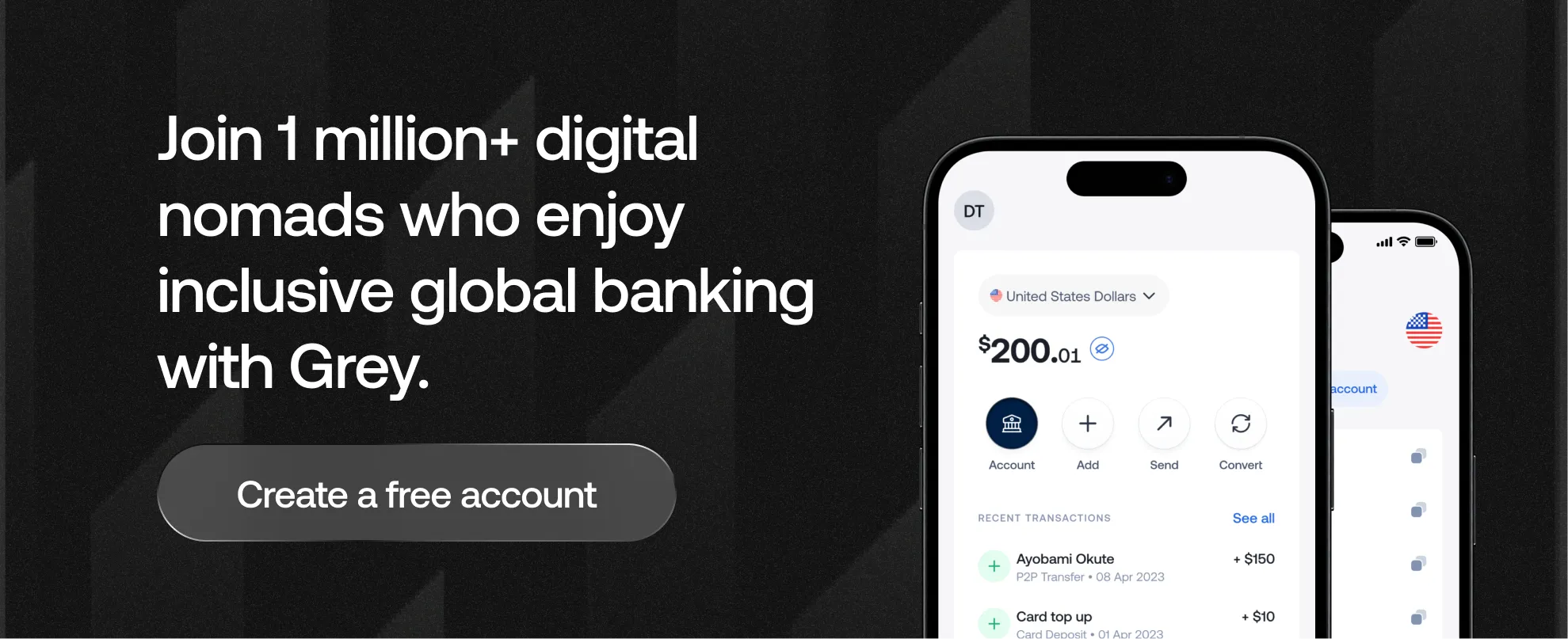
Personally, I’d recommend Grey come in. You receive virtual USD, EUR, and GBP accounts, allowing clients to pay you directly without the headaches of international transfers. You convert currency at real rates, and you can withdraw to your local account quickly. It’s the kind of setup that saves you actual money every month.
Create your free Grey account today or download the app and start receiving international payments with better rates, faster transfers, and zero hassle.



.svg)
Back to top
