<script type="application/ld+json" data-schema-version="grey-blog-v4">
[{"@context":"https://schema.org","@type":"BlogPosting","@id":"https://grey.co/blog/where-filipinos-working-remotely-should-store-savings-usd-or-php#article","headline":"Where Filipinos working remotely should store savings: USD or PHP?","description":"Here is all you have to consider when deciding whether to save in USD or PHP as a Filipino remote worker.","inLanguage":"en","url":"https://grey.co/blog/where-filipinos-working-remotely-should-store-savings-usd-or-php","mainEntityOfPage":{"@id":"https://grey.co/blog/where-filipinos-working-remotely-should-store-savings-usd-or-php#webpage"},"datePublished":"2025-12-30T08:42:52.718Z","dateModified":"2026-06-15T14:30:36.572Z","author":{"@type":"Person","@id":"https://grey.co/authors/adeolu-titus-adekunle#person","name":"Adeolu Titus Adekunle","url":"https://grey.co/authors/adeolu-titus-adekunle","jobTitle":"Content Writer","sameAs":["https://www.linkedin.com/in/titusadeoluadekunle/"]},"publisher":{"@type":"Organization","@id":"https://grey.co/#organization","name":"Grey","url":"https://grey.co","logo":{"@type":"ImageObject","url":"https://cdn.prod.website-files.com/6360022338a81bd6fdbb1145/6564ae1077a67e39d3c491a6_Grey%20Logo%20Lockup%20Black.svg"}},"image":{"@type":"ImageObject","@id":"https://grey.co/blog/where-filipinos-working-remotely-should-store-savings-usd-or-php#primaryimage","url":"https://cdn.prod.website-files.com/636a85d290ee58e70c17e1c0/6a300c8c6386987090c74012_6a300c8b375175d0e8af24c5_where-filipinos-working-remotely-should-store-savings-usd-or-php__header-image.webp","contentUrl":"https://cdn.prod.website-files.com/636a85d290ee58e70c17e1c0/6a300c8c6386987090c74012_6a300c8b375175d0e8af24c5_where-filipinos-working-remotely-should-store-savings-usd-or-php__header-image.webp","width":1200,"height":675}},{"@context":"https://schema.org","@type":"WebPage","@id":"https://grey.co/blog/where-filipinos-working-remotely-should-store-savings-usd-or-php#webpage","url":"https://grey.co/blog/where-filipinos-working-remotely-should-store-savings-usd-or-php","name":"Where Filipinos working remotely should store savings: USD or PHP?","description":"Here is all you have to consider when deciding whether to save in USD or PHP as a Filipino remote worker.","inLanguage":"en","primaryImageOfPage":{"@id":"https://grey.co/blog/where-filipinos-working-remotely-should-store-savings-usd-or-php#primaryimage"},"breadcrumb":{"@id":"https://grey.co/blog/where-filipinos-working-remotely-should-store-savings-usd-or-php#breadcrumb"}},{"@context":"https://schema.org","@type":"BreadcrumbList","@id":"https://grey.co/blog/where-filipinos-working-remotely-should-store-savings-usd-or-php#breadcrumb","itemListElement":[{"@type":"ListItem","position":1,"name":"Home","item":"https://grey.co/"},{"@type":"ListItem","position":2,"name":"Blog","item":"https://grey.co/blog"},{"@type":"ListItem","position":3,"name":"Where Filipinos working remotely should store savings: USD or PHP?","item":"https://grey.co/blog/where-filipinos-working-remotely-should-store-savings-usd-or-php"}]}]
</script>
Freelancer
•
December 30, 2025
•
8 min read
Where Filipinos working remotely should store savings: USD or PHP?
Adeolu Titus Adekunle
TABLE OF CONTENT
SHARE THIS POST
There is usually a dilemma among Filipino remote workers: whether to save in USD or PHP and where to save. This concern is understandable, as many of them earn in USD but spend every day in PHP. Converting every now and then can erode your earnings, and it just makes sense to convert all your earnings into PHP. Before you jump into a decision, let’s explore the pros and cons of saving in either USD or PHP, and how you can make an informed choice about where to store your savings.
The US dollar is a stable currency widely used in global transactions. For Filipinos earning in dollars, saving in USD reduces the risk of losing money to PHP’s volatility and avoids repeated conversion costs. You are at peace during periods of local economic uncertainty because the USD's purchasing power tends to hold up better over time during financial crises.
Saving in USD is also a great idea if you travel abroad frequently, pay for international education, make international payments, or invest in global assets. Keeping your earnings in USD gives you control over when to convert, instead of being forced to convert at potentially unfavourable rates. You can wait until rates are favourable before converting to PHP.
However, saving in USD isn’t all about the positives either. If most of your expenses are in PHP and you hold all savings in USD, you may be exposed to short-term exchange rate swings when you need PHP. If the peso improves, converting USD could result in a loss.
There is also a gap it creates in your local cash flow. You think you have enough pesos to last a period, only to find yourself needing urgent access to more money. You can only hope to convert your USD savings just in time to meet that need.
Saving in USD also yields very little interest. USD accounts in Philippine banks offer much lower rates: 0.1-1.1% for savings, and 1-3% for time deposits on longer terms.
In summary, the USD is best used as a store of value rather than for daily spending.
Saving in PHP is well-suited to everyday life for most Filipinos because they pay for local expenses such as groceries, rent, and utilities in pesos. This removes the need for frequent conversions and reduces conversion fees that can gradually add up and eat into your earnings. With the PHP's current stability and low inflation (1.5% in November 2025), your savings maintain purchasing power for domestic needs without the hassle of monitoring exchange rates.
A major advantage of saving PHP is the higher interest rates, especially through digital banks. Some offer 3-6% on savings or time deposits, which is more than what you’ll get with USD. Saving in PHP provides better real returns, even after adjusting for the Philippines' current inflation rate.
On the downside, the PHP is more volatile than the USD. Its value is influenced by domestic economic factors such as trade deficits, natural disasters, or policy changes. If the peso weakens as projected, your savings could lose international purchasing power, impacting overseas travel or imports.
In essence, PHP is ideal for short-term liquidity and local focus but exposes you to currency risks in a globalised economy.
LDMAG1
Where should Filipinos working remotely store their savings: USD or PHP?
If we are to piece all of these together, here is a direct comparison of the pros and cons of saving in either USD or PHP
Stability: Storing funds in USD offers high stability and shields savings from local currency depreciation, whereas the PHP is more vulnerable to exchange rate fluctuations and local economic factors.
Accessibility: Savings in USD are easily accessible for international travel or online purchases in foreign currencies. Conversely, using a PHP account for international expenses requires currency conversion, which may involve additional fees and less favourable rates.
Transaction fees: Using multi-currency accounts or virtual wallets to receive foreign payments often results in lower conversion fees when holding funds in USD. On the other hand, receiving foreign currency into a traditional PHP account results in higher conversion fees and unfair exchange rates.
Interest rates: While PHP savings accounts may offer higher interest rates, these potential gains could be offset by inflation or depreciation. Interest rates on USD accounts at local banks are typically lower.
Inflation hedge: The USD generally provides a better hedge against local inflation compared to the PHP. Inflation in the Philippines can erode the purchasing power of the pesos you saved faster than the dollars.
For most Filipino remote workers, the real answer is not choosing one over the other, but using both intentionally. Using a balanced approach, you can hold part of your savings in USD and part in PHP to minimise risk, regardless of how the exchange rate moves.
Even with the right currency mix, where you store your money can determine whether you truly protect your income or slowly lose money to fees, forced conversions and poor exchange rates.
This is where modern payment solutions like Grey come in. Grey allows you to open a multi-currency account to receive USD, hold it, and convert to PHP whenever you need to. This gives you total control over timing your conversion and the transparency to monitor the exchange rates in real time. Instead of choosing between USD and PHP, you can manage both in one place, on your own terms.
If you’re a Nigerian YouTuber close to monetisation, first congratulations. You’ve earned it, or at least you’re about to. Now it’s important to understand how YouTube will pay you and how to properly set up your payment details, so you don’t lose out on your funds.
In this article, I will share exactly how YouTube pays creators, and what Nigerian creators need to do to maximise earnings.
How YouTube actually pays creators
YouTube doesn’t pay you directly. Instead, they pay through Google AdSense, which is Google’s advertising platform. When you’re accepted into the YouTube Partner Programme, you link your YouTube channel to an AdSense account, and that’s where your earnings accumulate.
AdSense pays in US dollars (USD). There’s a minimum payout threshold of $100, meaning you won’t receive anything until your earnings reach at least $100. Once you cross that threshold, AdSense processes payments monthly, typically between the 21st and 26th, for the previous month’s earnings.
So if you earn $150 in January, AdSense will pay you sometime between 21st and 26th February. Simple enough in theory, but where does that money actually go, and how do you access it in Nigeria?
To receive YouTube earnings in Nigeria, you need a few things in place:
A monetised YouTube channel: This means you’ve been accepted into the YouTube Partner Programme (1,000 subscribers, 4,000 watch hours in the past 12 months, and adherence to YouTube’s policies).
A Google AdSense account: You’ll create this when applying for monetisation. Make sure your AdSense account has your correct legal name and address.
A valid payment method: This is where it gets tricky for Nigerian creators. AdSense needs a way to send you money, and not every method works smoothly in Nigeria. I’ll discuss this in-depth later.
Tax information: AdSense requires you to submit tax details, even if you’re not in the US. Nigerian creators typically complete a W-8BEN form, which confirms that you’re a foreign person not subject to US tax withholding on most AdSense earnings.
The problems Nigerian creators run into with receiving YouTube earnings
The first time I set up an AdSense payout, I added a Nigerian bank account and assumed everything would work smoothly. It didn’t.
First problem, delays. My first payment took nearly two weeks to arrive after AdSense marked it as sent. I had no visibility into where the money was or why it was taking so long.
The second problem was the fees and exchange rates. When the money finally arrived, I lost around 5 - 6% due to a combination of receiving fees and a terrible exchange rate set by my bank. On a $200 payout, that’s $10 - $12 gone, money I’d worked hard to earn.
I realised quickly that relying solely on wire transfers to a Nigerian bank wasn’t sustainable. I needed a better system.
After some research and talking to other Nigerian creators, I eventually figured out what actually works. The key is using a service that provides a US bank account or a more efficient way to receive USD payments than traditional Nigerian banks.
Here’s what I did:
Step 1: I opened an account on a platform that provides virtual USD accounts. Most people recommended Grey, and I obliged. Platforms like this give you US banking details (account number and routing number) that you can add to AdSense as your payout method. When AdSense sends payments, they go to this account instead of directly to a Nigerian bank.
Step 2: I updated my AdSense payment settings. In AdSense, under Payments > Payment methods, I added my new US bank details. AdSense verified the account by making small test deposits, which I confirmed.
Step 3: I waited for my next payout cycle. Once my earnings crossed $100 again, AdSense sent the payment to my US account. It arrived within 3 - 5 days, much faster than wire transfers to Nigerian banks.
Step 4: Instead of being forced to convert USD to naira immediately at whatever rate my bank decided, I held the money in USD and converted it when rates were favourable. I also had the option to spend directly from a USD card or withdraw to my Nigerian bank account.
This setup solved every problem I’d been facing: faster payments, better control over exchange rates, and no rejected transfers.
Set up your payment method before you hit $100: Don’t wait until you’ve earned your first payout to sort this out. Get your USD account ready early so there are no delays when you finally qualify for payment.
Don’t rely on traditional wire transfers unless you have no other option: The fees and delays aren’t worth it. Get a free USD account with Grey, Wise to gain better control and faster access to your money.
Keep your AdSense details accurate: Make sure your name, address, and tax information match your official documents. Mismatches can delay payments or cause verification issues.
Track your earnings and fees: Know how much you’re actually receiving after conversion and fees. This helps you plan better and understand the real value of your content.
Focus on creating consistent content: The payment setup is important, but your primary job is still making videos people want to watch. Sort out the money side once, then get back to creating.
Create more, stress less
Once you’ve sorted out a reliable payment method, you can focus on making great videos and growing your audience.
Set up your USD receiving account now, link it to AdSense, and get back to creating. Your content deserves to be rewarded properly, and you deserve to receive that money without unnecessary stress.
Open your free Grey account today, or download the app, and start receiving your YouTube earnings faster, at better rates, and with full control over your money. Because you’ve earned it, you should actually get to keep it.
Fiverr freelancers are growing rapidly around the world, from Africa to Asia and Europe. They connect with clients who value their skills, whether it’s design, writing, or communications. For example, I get clients from Europe and the U.S. for writing and communications projects, even though I’m based in Nigeria. Platforms like Fiverr make it possible to work remotely, reach global clients, and get paid in major currencies like dollars, euros, and pounds.
However, earning in multiple currencies can sometimes be tricky, because many freelancers aren’t sure how to receive payments smoothly. In this blog, I’ll show you the best ways to get paid in dollars, euros, and pounds without losing money along the way.
What freelancers need to know to get started on Fiverr
Fiverr helps you showcase your skills, whether it’s writing, design, software development, or digital marketing, and connect with clients from all over the world. The platform has so many benefits. I remember one time I used the promotional tools, and I got three times more clients over just four months. The resources are amazing; you really can’t get enough of them. And the rating system? It clearly shows your potential and the quality of your work.
Here’s how you can set up your Fiverr account in easy steps:
Create an account: Sign up using your email, Google, or Facebook.
Complete your profile: Add a professional photo, describe your skills, and include your relevant experiences.
Create gigs: Detail the services you offer, set your pricing, and define delivery times.
Verify your identity: Complete Fiverr’s verification process to build trust with clients.
Publish your gigs: Make your services live so clients can find you, message you, and hire you.
Once your account is live, you can start attracting clients, growing your reputation, and earning internationally, all from the comfort of your home.
How freelancers can get paid in USD, euros, and pounds on Fiverr
Fiverr operates majorly in USD, but you can link multicurrency platforms to receive USD payments and convert them into euros, pounds, or other currencies.
Grey
If I had to recommend one platform for receiving Fiverr earnings in multiple currencies, it would be Grey. You get your USD directly from Fiverr and can convert to euros or pounds easily. It’s fast, secure, and the exchange rates are competitive. Using Grey makes managing international payments smooth and stress-free, especially if you rely on Fiverr clients for consistent work.
Payoneer
Payoneer is another solid option for Fiverr freelancers. It lets you receive USD from Fiverr and withdraw or convert to euros, pounds, or local currency. I’ve seen many freelancers grow with it because it’s reliable and widely accepted. While not as fast as Grey, it’s convenient for those who want flexibility in accessing and managing their earnings globally.
PayPal
PayPal lets freelancers receive Fiverr payments in USD and convert them to other currencies like euros or pounds. It’s simple, widely recognised, and works across many countries. The platform is especially useful for those who need a straightforward, easy-to-use solution for managing international payments.
Wise
Wise allows Fiverr freelancers to receive USD and convert to euros, pounds, or other currencies at near-market rates. It’s known for transparency, low fees, and fast transfers, making it a solid choice for anyone looking to manage international earnings efficiently.
Steps to setting up a Grey account for Fiverr earnings
Sign up on Grey: Go to the Grey website and create an account to get virtual foreign bank account details in USD, GBP, or EUR.
Link to Fiverr: Log in to your Fiverr account, navigate to the Earnings section, and choose Bank Transfer. Enter your unique Grey account details.
Withdraw funds: Once your Grey account is verified, you can transfer your available Fiverr earnings directly to it.
Convert & transfer: After the funds arrive in your Grey USD account, you can convert them to EUR, GBP, or other local currencies and use them as needed.
LDMAG1
When it comes to receiving Fiverr payments in USD, euros, or pounds, Grey stands out as the top choice because it’s fast, secure, and links effortlessly to your Fiverr account. Unlike other platforms, it ensures you don’t lose money to hidden charges when converting currencies, giving you full control over your earnings. That’s why it’s highly recommended for freelancers. Sign up or download the app today and start getting paid the way you deserve.
Indians are increasingly in demand as remote talent, with US and UK companies hiring extensively, especially in tech. I remember a former colleague who constantly received messages from American and British hiring managers looking for his skills as a developer. Many Indian tech students even secure international job offers before graduation, highlighting the growing global recognition of India’s tech talent.
Once the job is landed, whether working from Goa or Bangalore, it’s essential to have a fast, reliable way to receive your salary in India. Getting paid smoothly not only ensures financial stability but also lets you focus on delivering your best work. This blog highlights the best methods to get paid from the US and UK quickly and without stress.
Why US and UK companies are hiring Indian professionals
You’ve probably noticed it too. US and UK companies are hunting for Indian talent like never before. But why is India suddenly the go-to place for global remote work? Let’s break it down.
Cost efficiency
Think about it, companies can hire top talent in India for 60-70% less than in the US or UK. And no, they’re not compromising on quality. For them, it’s smart business. For you? It means more opportunities to work with international companies while staying home.
Talent pool
India produces a huge pool of talented engineers every year. Imagine that talent! For global companies, it’s like having a buffet of skilled developers, designers, and IT specialists to choose from. No more waiting months to fill a critical role, they can find the right person quickly. And for Indian professionals, it means opportunities open up even before graduation.
English proficiency
Language is rarely a barrier for Indian professionals. Most speak English fluently, which makes collaborating with US or UK teams much smoother. From Slack messages to Zoom calls, communication flows naturally. Companies value this ability, Indian talent can join global teams without miscommunication or endless back-and-forth slowing progress.
High quality
Indian workers are known for going the extra mile. They adapt quickly, pick up new tools, and integrate easily into Western work culture. Companies aren’t just looking for hands, they want problem-solvers, innovators, and reliable people who can get things done. That combination of skill and mindset is why Indian talent keeps standing out globally.
How Indians can easily receive payments from the US and UK
Now that Indian talent is in high demand by US and UK companies, there’s one thing you can’t ignore, getting paid. A great gig is useless if your money gets stuck. Here’s how to receive payments quickly and without stress.
Wise
When clients pay in USD or GBP, Wise converts it to INR with mid-market exchange rates. That means no hidden charges or surprises, and the money reaches your Indian bank account faster. For freelancers, it’s like having an international payment system that just works, making sure every rupee lands safely and transparently.
Skydo
Skydo is getting popular among freelancers because it gives you virtual bank accounts in USD, GBP, or EUR. Basically, it’s like having a “local” account abroad. Your client pays like they’re sending to a local bank, and you get it in India without sweating the conversion or delays. Perfect for side hustlers or full-time remote work.
Payoneer is still a favourite among freelancers and platforms. It’s reliable, widely accepted, and you can withdraw directly to your Indian bank. The interface is simple, and the setup is straightforward. For anyone juggling multiple clients from different countries, it’s almost like a global wallet in your pocket.
PayPal
PayPal is convenient and fast, which is why clients like it. But its fees are higher, and the exchange rates can be unfriendly, so your earnings take a small hit. For quick, one-off payments, it works well, but regular use can slowly reduce your take-home income.
Direct bank transfer / SWIFT
Large, infrequent payments are safest via SWIFT. The money comes straight into your account, which feels secure, but the fees can be high and the exchange rates are not favourable. It’s perfect for occasional big transfers, but if you’re working remote gigs regularly, the slow process and cost can eat into your income.
Grey
With Grey, you can forget about stressing over payments. It’s designed to make sure your money arrives safely and on time, handling conversions reliably. No confusing fees, no delays. For Indian freelancers working with US and UK companies, Grey takes the uncertainty out of international payments, leaving you to focus on your work.
LDMAG1
Manage your foreign income easily with Grey
Getting hired by US and UK companies is a major milestone for Indian professionals, and the opportunities keep growing. What makes it even better is using Grey to receive payments. With Grey's multi-currency features, freelancers and remote workers can get paid in USD or GBP without any hassle. When converting to INR, Grey offers competitive exchange rates so you don’t lose any of your hard-earned money to hidden fees. Simply sign up or download the Grey app to receive international payments effortlessly.
Three freelancers walk into a Slack channel. One is a React developer in Lagos charging $45 an hour. Another is an ML engineer in Cairo, billing $120. The third is a product designer in Nairobi at $70. All three earn in USD. All three work remotely for international clients. But the ML engineer takes home nearly three times what the developer does, and the gap has nothing to do with how hard either works.
The difference comes down to which skill they chose to develop, which platform they use, and how they position themselves. In 2026, AI and machine learning freelancers are commanding rates that would have seemed absurd five years ago, while some roles that used to pay well have compressed as automation increased supply and lowered the barrier to entry. Knowing which skills are on which side of that divide is worth more than any productivity hack.
This guide breaks down the freelance skills that are paying the highest USD rates right now, what drives the rate ranges within each skill, and where to find the work. If you are deciding which skill to invest in, or trying to figure out why your current skill is not earning what you expected, the answers are here.
What actually determines how much you earn
Even within the same field, two freelancers can charge vastly different rates. The gap usually comes down to a few factors that are worth understanding before you look at specific skills.
Specialisation beats generality. A "full-stack developer" on Upwork competes with hundreds of thousands of profiles. A "full-stack developer who builds fintech dashboards with React and Node.js" competes with a fraction of that. Specialists command higher rates because clients pay a premium for someone who has solved their specific problem before. This is true across every skill category below.
Platform choice affects your ceiling. The same ML engineer might charge $50 to $80 per hour on Upwork, $100 to $200 on Toptal, and $150 to $250 through direct clients found via LinkedIn. The platform determines the client pool, the fee structure, and the rate expectations. Upwork’s 10% service fee and high competition push rates down. Toptal’s 3% acceptance rate and enterprise client base push them up. Direct clients through LinkedIn or referrals means zero platform commission but requires you to handle sales, contracts, and invoicing yourself.
Geography still matters, but less than it used to. Freelancers in Africa and South Asia typically charge 30% to 60% less than those in the US or Western Europe for equivalent work, according to industry surveys. But that gap narrows significantly for senior specialists with strong portfolios and English proficiency. A senior Toptal-vetted developer in Cairo or Lagos can charge rates comparable to mid-level developers in the US.
Best freelance skills that pay in US dollars in 2026
Rates below are based on data from Upwork, Toptal, and industry salary surveys. Ranges reflect the spread from entry-level marketplace freelancers to senior specialists with direct clients. Your actual rate depends on experience, platform, specialisation, and client geography.
AI and machine learning engineering
AI and machine learning engineering is the highest-paying freelance skill category in 2026, and it is not close. Enterprise AI adoption has created demand far outpacing supply, and freelancers who can build, fine-tune, and deploy AI models are in a position to set their rates.
Machine learning engineer: ML engineers develop predictive models and AI systems using Python, TensorFlow, PyTorch, and cloud platforms like AWS and GCP. On Upwork, entry-level ML engineers charge $50-$80 per hour. Mid-level engineers with 2 to 5 years of experience command $80 to $120 per hour. Senior specialists on Toptal or through direct clients earn $120-$250+. The highest premiums go to freelancers specialising in LLM development, retrieval-augmented generation (RAG) systems, or computer vision, where rates run 30% to 50% above general ML work.
AI workflow architect: This role involves designing and managing automation systems using tools like Zapier, Make, or custom API integrations to reduce manual effort across business processes. Rates range from $80 to $250 per hour, with the highest rates going to architects who can integrate AI models into existing enterprise workflows rather than just connecting off-the-shelf tools.
Prompt engineer: Prompt engineers design and optimise inputs for generative AI models to produce better outputs. This role barely existed three years ago, but it now averages around $70 per hour according to ZipRecruiter data, with specialists on Upwork and Toptal commanding $100 to $200+ for complex enterprise projects. The work determines how tools like ChatGPT or Claude respond to specific business needs.
Where the work is: Toptal for senior ML engineers (highest rates, enterprise clients). Upwork for mid-level engineers (highest volume). LinkedIn and direct outreach for AI consultants, selling strategy, plus implementation. Kaggle competitions can also serve as a portfolio builder that leads to consulting work.
Software development and engineering
Software development remains one of the most reliable ways for freelancers to earn US dollars. The demand is broad and consistent because every company needs software built, maintained, or scaled.
Full-stack developer: Full-stack developers work on both frontend and backend, handling everything from user interfaces to databases and APIs. Common stacks include React with Node.js, Python with Django, and Vue with Laravel. On Upwork, rates range from $40 to $100 per hour. Toptal-vetted full-stack developers earn $80 to $150. The key differentiator is stack specialisation and industry experience: a full-stack developer who builds SaaS dashboards commands more than a generalist who builds "websites."
Backend developer: Backend developers focus on server-side logic, databases, authentication, and performance optimisation. This role is especially well paid in fintech, healthtech, and enterprise SaaS, where data integrity and security are critical. Rates run $50 to $180 per hour, with the top end reserved for specialists working on high-throughput systems or complex API architectures.
Mobile app developer: Mobile developers build applications for iOS and Android using Swift, Kotlin, Flutter, or React Native. Demand remains strong for both consumer apps and internal business tools. Rates range from $45 to $160 per hour, with cross-platform specialists (Flutter, React Native) increasingly preferred by startups that want to ship on both platforms without maintaining two codebases.
Freelance developers who invoice clients directly often use multi-currency accounts to receive payments in USD without intermediary platform fees, keeping more of each payment.
Where the work is: Upwork has the highest volume. Toptal and Gun.io for premium enterprise contracts. GitHub, Stack Overflow, and dev community contributions also generate inbound client interest for senior developers.
As digital products become increasingly competitive, companies are investing heavily in design to improve user experience, retention, and conversion. Freelance designers who understand both aesthetics and user behaviour earn consistently in USD.
UI/UX designer: UI/UX designers research user needs, create wireframes, and design intuitive interfaces using tools like Figma and Adobe XD. Rates range from $35 to $120 per hour, with higher rates going to designers who can demonstrate measurable impact on conversion rates or user retention from previous projects. A portfolio showing before-and-after metrics is worth more than a portfolio of pretty screens.
Product designer: Product designers take a broader role, combining UX, UI, user research, and product strategy. They often work closely with developers and founders to shape the product direction, not just the interface. Rates range from $45 to $150 per hour. This role is particularly well paid in the SaaS and fintech spaces where design decisions directly affect revenue.
Where the work is: Dribbble and Behance for portfolio visibility. Toptal for premium product design contracts. Upwork for volume. LinkedIn for direct client acquisition, especially from startup founders building their first product.
Data analytics and data science
Every company knows data is important. Fewer know how to use it. That gap is what makes data roles consistently well paid, because the freelancer is not just processing numbers; they are translating data into decisions that affect revenue, costs, and strategy.
Data analyst: Data analysts clean and analyse datasets, build dashboards, and generate insights using SQL, Excel, Python, Tableau, or Power BI. Rates range from $35 to $120 per hour. The highest-paid data analysts are those who specialise in a vertical (fintech analytics, healthcare analytics, e-commerce analytics) and can explain findings to non-technical stakeholders. Building dashboards is a commodity skill; interpreting what the dashboard means for the business is what commands premium rates.
Data scientist: Data scientists go deeper into modelling, forecasting, and statistical analysis, often using Python, R, and machine learning techniques. Rates range from $50 to $200 per hour, with the top end reserved for scientists working on predictive models that directly influence business outcomes, such as pricing, risk scoring, or demand forecasting.
Where the work is: Upwork for analytics projects. Toptal for enterprise data science contracts. Kaggle for building credibility. LinkedIn for consulting engagements with companies that need ongoing analytical support rather than one-off projects.
Cybersecurity and cloud security
Cybersecurity is increasingly critical as companies move infrastructure to the cloud. The global cybersecurity skills shortage exceeds 4 million professionals, which means freelancers with the right certifications and experience can command some of the highest rates outside of AI.
Cybersecurity analyst: This role involves identifying vulnerabilities, monitoring threats, and implementing security best practices. Certifications like CISSP, CEH, or CompTIA Security+ significantly affect earning potential. Rates range from $50 to $170 per hour, with certified analysts at the higher end.
Penetration tester: Pen testers simulate cyberattacks to uncover security flaws before malicious actors exploit them. This is one of the highest-paid freelance roles because it requires deep technical expertise, and the stakes are high. Rates range from $80 to $250 per hour, with the premium going to testers who hold OSCP or OSCE certifications and can demonstrate complex past engagements.
Cloud security engineer: These specialists secure cloud environments on platforms like AWS, Azure, and GCP, focusing on identity management, access controls, and compliance frameworks. Rates range from $70 to $220 per hour. Cloud security is especially well paid because it combines two high-demand skill sets (cloud infrastructure and security) into one role.
Freelancers in cybersecurity often need to pay for certifications, lab environments, and specialised tools, all priced in USD. A virtual dollar card simplifies paying for these without converting back and forth between local currencies.
Where the work is: Upwork and Toptal for contract engagements. HackerOne and Bugcrowd for bug bounty programmes. LinkedIn and industry conferences for direct consulting relationships with CISOs and CTOs.
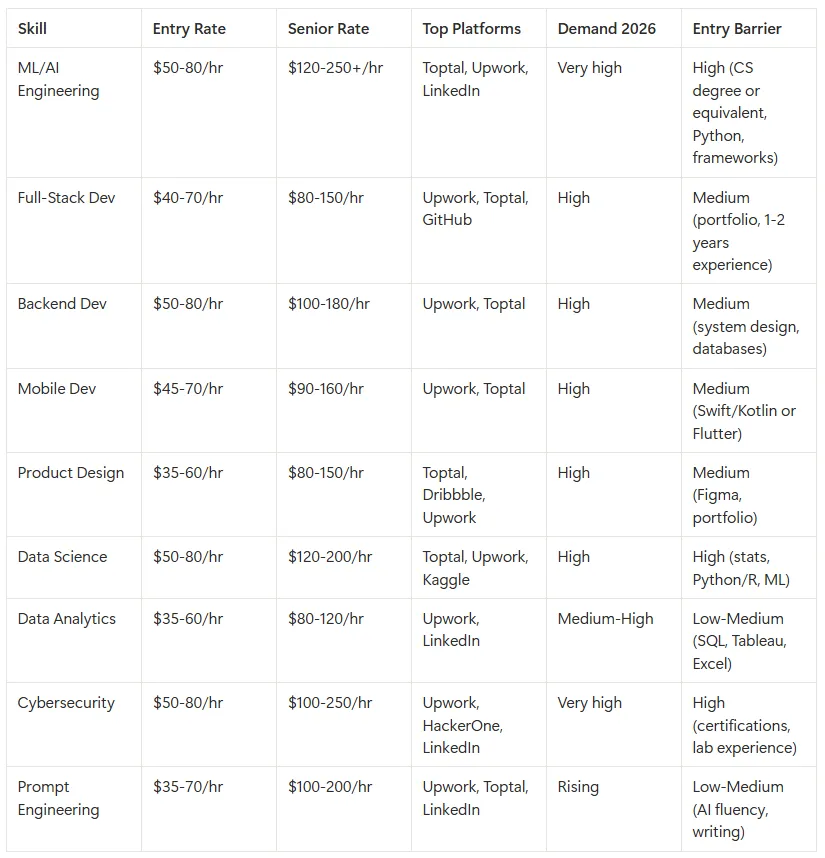
Freelance skills compared: rates, platforms, and demand
Rates based on 2025-2026 data from Upwork, Toptal, ZipRecruiter, and industry surveys. Actual rates vary by experience, portfolio, geography, and client type.
Which skill path makes sense for you
The best skill to invest in depends on where you are starting from and how quickly you need to earn.
If you are a beginner looking for your first USD-paying gig, data analytics and prompt engineering have the lowest entry barriers. You can learn SQL, Tableau, and basic Python in 3 to 6 months and start taking projects on Upwork. Prompt engineering requires AI fluency and strong writing rather than a computer science degree, and the field is new enough that competition is still manageable.
If you are a mid-level developer (1 to 3 years), specialise your stack and your industry. "React developer" earns less than "React developer for fintech dashboards." Build 3 to 5 strong portfolio projects in your chosen niche, get reviews on Upwork, then apply to Toptal or pitch direct clients through LinkedIn. The rate jumps from generalist to specialist is typically 30% to 50%.
If you want the highest ceiling, AI/ML engineering and cybersecurity offer the best long-term earning potential. Both have high entry barriers (you need real technical depth, not just a course completion certificate), but the demand-supply gap means qualified freelancers can charge premium rates. A senior ML engineer on Toptal can earn more per hour than a managing director at many companies.
If you want to diversify into passive income, combine freelance work with digital products. A designer freelancing on Upwork at $60 per hour can also sell Figma templates on Gumroad or Etsy. A developer can build and sell starter kits, boilerplate templates, or SaaS tools. The freelancing income covers your living costs while the products build long-term value.
Managing your USD freelance payments
The skill you choose and the rate you negotiate are only part of the equation. How you receive and access your USD earnings determines how much of that rate you actually keep. Platform fees take a cut, and then the withdrawal method takes another. The gap between what your client pays and what lands in your bank account can range from 5% to over 25%, depending on the path the money takes.
Grey gives you USD, EUR, and GBP account details that you can share with clients or add as your payout destination on freelance platforms like Upwork, Fiverr, or Toptal. Your client pays via a local bank transfer in their country, and the funds are deposited into your Grey wallet. From there, you can convert to your local currency when the exchange rate suits you and withdraw to your local bank. Or you can spend directly in USD using a Grey virtual card on the Visa network, which is useful for paying for tools like Figma, AWS, Adobe, or certification exam fees without converting to local currency and back.
For freelancers invoicing clients directly (common for consultants and senior developers landing contracts through LinkedIn), Grey also supports international transfers. And for agencies or consultancies managing contractor payments, Grey Business offers team accounts and multi-currency expense management.
Here is how the setup works. Download the Grey app or sign up at grey.co. Complete KYC verification, which takes a few minutes. Once approved, go to your account section to view your USD, EUR, and GBP account details, including routing numbers and account numbers for ACH transfers. Add those details as your payout destination on whichever platform you use, or share them directly with clients who pay by wire or bank transfer.
Exchange rates on Grey are variable and include a margin over the mid-market rate. Grey does not charge transfer fees; the cost is reflected in the exchange rate. Always review the rate before confirming a conversion.
As a freelancer, understanding which platforms are growing fastest tells you where opportunity is concentrating. It reveals which business models are working, which professional categories are in demand, and where geographic expansion is creating new markets for remote workers. Growth doesn’t automatically mean “best,” but it absolutely signals where attention, investment, and users are flowing.
In this article, I identify the platforms experiencing significant growth in 2026, explain why they’re expanding, and explore what it means for freelancers and remote workers navigating an increasingly fragmented marketplace.
First, what do I mean by growth?
Growth isn’t one-dimensional. A platform can be growing rapidly in user acquisition but struggling with revenue. Another might have modest user growth but explosive increases in transaction volume. When evaluating platform growth, several metrics matter.
User acquisition rates indicate that platforms are adding workers and clients quickly, particularly in previously underserved markets. Revenue growth indicates transaction volume and platform fees are increasing significantly. Geographic expansion reveals platforms successfully entering new countries and regions where they previously had minimal presence. Feature adoption demonstrates that new tools or services are scaling quickly within existing user bases. Market share shifts show platforms taking users from established competitors.
These dimensions don’t always move together. A platform might be growing users rapidly in Southeast Asia, whilst mature markets stagnate. Another might have steady user counts but rapidly increasing revenue per user as they roll out premium features. Understanding these nuances matters when deciding where to invest your time building profiles and reputations.
Why platform growth patterns matter for workers
Growing platforms create opportunity, but they also introduce complexity. When a platform is scaling quickly, job opportunities typically expand as the client base grows. Platform revenue funds feature development, improving tools and user experience. Payment infrastructure often improves to support scaling across geographies. Competition between platforms benefits users by lowering fees and improving terms.
But rapid growth isn’t universally positive. Quality control sometimes suffers when platforms prioritise expansion over moderation. Policies change frequently as companies figure out what works at scale. Early adopter advantages diminish as competition increases. Payment and support systems occasionally struggle to keep pace with user growth.
Understanding growth helps you identify emerging opportunities before markets saturate, diversify strategically across platforms, anticipate which skills will be in demand, and position yourself where opportunity is expanding rather than contracting.
Commission-free and alternative model platforms
Contra has positioned itself as the anti-Upwork, and it's working. The platform doesn't charge freelancers commissions, instead monetising through premium features. This model has resonated particularly with mid-career to senior freelancers tired of paying 10–20% platform fees on every project.
Contra's growth is concentrated among designers, developers, marketers, and other creative professionals who want portfolio-focused presentation rather than bid-based competition. The platform emphasises direct client relationships without heavy platform intermediation. User acquisition has expanded from primarily US-based freelancers to a genuinely global base, and transaction volume is rising despite the commission-free structure.
What's driving this growth is straightforward: experienced freelancers do the maths and realise they're losing thousands annually to platform fees. Contra's sleek portfolio system appeals to creatives who want their work showcased well. The younger demographic comfortable with newer platforms is willing to experiment beyond established marketplaces.
One implication: commission-free platforms mean freelancers handle their own payment infrastructure. You're not routing money through the platform's payment system, but invoicing clients directly and managing how you receive funds. This creates both flexibility and responsibility around choosing payment methods that work internationally.
Braintrust takes a different approach: user ownership via a token-based governance model. Originally focused on blockchain and crypto projects, it's expanded into mainstream enterprise clients seeking vetted developers. The platform's growth is driven by its ownership structure — users who contribute (by working, referring clients, or participating in governance) earn tokens that give them stake in the platform's success.
For senior developers and tech professionals interested in Web3 models, Braintrust offers both competitive rates (by eliminating traditional platform overhead) and philosophical alignment with decentralised ownership. Growth has been strong in developer communities, particularly those already familiar with crypto ecosystems.
Vertical-specific platforms dominating niches
Toptal isn't new, but it continues growing by slowly expanding which specialisations it accepts. Started exclusively for developers, it now includes designers, finance experts, product managers, and recently added interim executives. This controlled expansion lets Toptal maintain its exclusivity whilst accessing new markets.
Growth indicators include geographic reach into emerging tech hubs and enterprise client acquisition. Companies willing to pay premium rates for vetted talent have proven to be a sustainable market, and remote work normalisation has made global hiring standard practice rather than experimental.
For workers, Toptal's continued growth signals that the premium talent segment remains strong. If you're senior in your field and can pass their vetting (which remains genuinely difficult as acceptance rates stay around 3%), the platform offers high-quality, well-paying projects.
Maven has grown rapidly in the cohort-based course and expert knowledge space. Post-pandemic, there's been an explosion in practitioners monetising their expertise through teaching. Maven makes it technically simple to run cohort-based courses — live sessions, community interaction, structured curriculums — without building your own platform infrastructure.
Course creator numbers are rising fast, particularly among industry practitioners rather than traditional educators. A senior product manager at a tech company can run a cohort on product strategy. An experienced designer can teach a workshop on design systems. Growth is driven by low barriers to entry, high profit margins on courses, and enough success stories to prove the model works.
For workers with specialised knowledge, Maven and similar platforms represent income diversification beyond client services.
LDMAG1
Geographic expansion into emerging markets
Upwork and Fiverr aren't growing fastest in the US or Western Europe but they're growing in Africa, Southeast Asia, and Latin America. As internet penetration improves and digital payment infrastructure develops in these regions, platforms are expanding their user bases significantly.
This creates more competition for existing workers in these regions but also expands opportunities for clients seeking talent in these markets. Importantly, platform features are increasingly adapted for emerging market needs: local payment methods, better currency support, mobile-first interfaces.
Andela started focused on African tech talent but has expanded into Latin America. It connects developers with global companies whilst providing training and community support. Growth has accelerated as companies seek talent beyond traditional tech hubs and as developers in emerging markets gain access to tools and training that improve their competitiveness.
Turing uses AI-powered matching to connect developers — initially focused on India, now global — with long-term remote roles at companies primarily in the US. It's grown by handling employment logistics, compliance, and payments, making it easier for companies to hire internationally and for developers to access stable income.
The challenge with rapid geographic expansion: payment infrastructure often lags. A platform might operate in 50 countries but only offer reliable, affordable payouts in 15. Workers in newly served markets frequently face limited withdrawal options, forced currency conversions at poor rates, or long delays in accessing earnings.
This is where external payment solutions become essential. If you're working on a platform that's expanding into your region but hasn't yet optimised payment infrastructure, you need your own system for receiving and managing international income efficiently.
Creator economy and content platforms
Substack continues expanding as writers monetise directly without traditional publishing infrastructure. Many top writers continue to earn through paid subscriptions. The platform has moved beyond newsletters into podcasts and video, and its international writer base is growing steadily.
Growth is driven by writers leaving traditional media, audiences willing to pay for quality content directly, and a subscription model that’s proven sustainable. Substack takes 10% of subscription revenue, which writers find reasonable compared to traditional publishing economics.
Patreon has matured into a reliable income source across creative categories — visual artists, musicians, podcasters, video creators, and even writers. The recurring revenue model works, and the platform keeps improving tools for community management and tiered memberships.
Growth indicators include the creator count increasing in non-US markets and the average revenue per creator rising, suggesting creators are getting better at converting audiences to paying members. International payment infrastructure improvements have made it easier for creators globally to receive funds and for supporters worldwide to subscribe.
Kajabi, Teachable, and Thinkific are course platforms where anyone with expertise can create and sell courses. These three are growing as more practitioners realise they can monetise knowledge. Course creator counts are rising, particularly among people who aren’t professional educators but have industry experience worth teaching.
Their growth is fuelled by low barriers to entry (you don’t need technical skills to set up a course), high profit margins on digital products, and enough success stories to make it feel achievable. For workers, this represents another income diversification option: package your expertise into courses that generate revenue whilst you’re doing other work.
The payment infrastructure challenge
A pattern emerges across fast-growing platforms: they expand geographically and add users faster than they can optimally support payment infrastructure. A platform might accept workers from 60 countries but only offer reliable, affordable payouts in 20 of them.
This creates friction. You’re earning in USD from US clients via one platform, EUR from European clients via another, and GBP from UK clients directly. One platform pays via PayPal, another via bank transfer, and a third via Payoneer. Each method has different fees, timelines, and exchange rate markups.
Workers on growing platforms often face forced conversion to local currency at unfavourable rates, inconsistent payout methods across platforms they use, payment delays as platforms scale transaction processing, and geographic limitations where the platform accepts your work but doesn’t support payouts in your country yet.
How do workers adapt?
By building a personal payment infrastructure that works across multiple platforms.
Using services like Grey, Wise, or Payoneer to receive payments in multiple currencies.
Maintaining accounts that give control over when and how currency conversion happens.
Platforms that solve payment infrastructure well grow faster because they retain workers better, while those that neglect it face churn as workers get frustrated trying to access their earnings efficiently.
This is where Grey fits naturally into remote workers’ infrastructure. Grey provides multicurrency accounts, transparent conversion rates, and control over when you move money, regardless of which platforms you’re working on.
What platform growth means for workers
The platforms growing fastest in 2026 aren’t necessarily the biggest, they're the ones solving problems traditional platforms haven’t addressed. User ownership structures, vertical specialisation, and successful emerging market expansion define where growth is happening.
For workers, several implications stand out. Specialisation is winning: vertical-specific platforms are growing faster than generalist ones in many cases. Geographic barriers are dissolving: platforms succeeding in emerging markets create opportunities for workers in those regions and for clients seeking global talent. Direct relationships are valued: experienced professionals are moving toward platforms that enable less intermediation and more control.
Being early to growing platforms often provides advantages, better visibility, less competition, and sometimes preferential treatment. But don’t abandon established platforms entirely. Growth doesn’t mean existing platforms are dying. Diversification across mature and growing platforms balances stability with opportunity.
Most importantly, invest in your payment infrastructure. As you work across more platforms and geographies, having solid payment systems becomes essential, not optional. The fragmented nature of online work in 2026, which involves multiple platforms, multiple currencies,and multiple client locations, demands infrastructure that works across all of it.
Grey answers all of that. You can receive international payments in USD, EUR, and GBP, hold multiple currencies, and convert at transparent rates, regardless of which platforms you use. Open your free account today and build payment systems that keep pace with how you actually work.
Is it possible to receive foreign income in Morocco without a domiciliary account? The simple answer is yes. However, it is not always straightforward, especially with the wrong payment services.
Domiciliary (foreign currency) accounts were once the standard for Moroccans earning in USD, EUR, or GBP, but they are becoming less popular. Opening one often involves extensive paperwork, multiple bank visits, minimum balance requirements, and strict compliance with local regulations. Beyond these, SWIFT fees, intermediary charges, and poor conversion rates when converting to MAD make them too expensive for the average person.
The good thing is that you don’t need a traditional domiciliary account at banks such as Attijariwafa Bank or Banque Centrale Populaire to manage international payments efficiently. Freelancers, remote workers, and expats earning from abroad can not find alternatives that suit their needs.
This article explains how Moroccans can receive foreign income without a domiciliary account and describes the pros and cons of each option.
Why do many Moroccans avoid domiciliary accounts?
A domiciliary account allows you to receive foreign currencies without immediate conversion to MAD. On paper, this sounds ideal. In practice, these accounts come with significant problems. A domiciliary (or foreign currency) account allows you to receive USD, EUR, or GBP without automatically converting to MAD. However, these accounts have considerable limitations, including:
You have to visit the banking hall.
It might require cumbersome paperwork.
It takes a while to open an account.
SWIFT fees and other bank charges can eat into earnings.
There is limited flexibility when trying to make online payments and subscriptions.
Transactions may take a few days to complete.
How Moroccans receive foreign income without a domiciliary account
There are three main alternatives: online payment platforms, fintech multi-currency accounts, and cash pickup services. Each serves a different purpose, depending on how often you get paid and how much control you want over your money.
LDMAG1
PayPal
PayPal is one of the most widely recognised international payment platforms. Many foreign clients already trust and use PayPal, which makes it easy to request payments without lengthy explanations or setup.
PayPal allows Moroccans to receive payments in foreign currency and withdraw funds to a local bank account or card. Transactions are usually instant, and the platform is easy to use. However, PayPal is designed more for convenience than cost efficiency. Withdrawal requires automatic conversion to MAD, often at exchange rates that include hidden mark-ups. Fees can be substantial, especially for regular income, and users have little control over when or how conversion happens. There are also frequent reports of account restrictions and suspensions that can interrupt your cash flow or lead to losses.
PayPal works best for occasional payments or short-term use, but it becomes expensive and restrictive for consistent freelance or remote income.
Fintech platforms and multi-currency accounts
This is easily a top recommendation for managing international payments in Morocco. Most of these platforms are designed to address the challenges posed by the rigid traditional domiciliary account payment system. They let you complete cross-border transactions like it is local payments and convert to MAD whenever you like.
Grey offers Moroccans USD, EUR, and GBP account details that you can share directly with international clients or employers. You can hold your income in foreign currency, convert it to MAD when exchange rates are favourable, and withdraw it to your Moroccan bank account.
Grey also supports automated invoicing, integrates with freelance platforms, and provides virtual cards for paying subscriptions, tools, and services directly in foreign currency. This setup gives freelancers and remote workers far more control over exchange timing, fees, and spending, making it well-suited for regular international income.
Payoneer is widely used by freelancers working with global marketplaces and companies. It offers foreign accounts and allows withdrawals to Moroccan bank accounts. Payoneer is reliable and well-integrated with major freelance platforms, but its fee structure can be cumbersome. Currency conversion and withdrawal fees can be relatively high, and customer support is often slow. It remains a practical option for platform-based freelancers, though it offers less flexibility than newer fintech solutions.
Wise
Wise is known for transparent pricing and mid-market exchange rates. While it offers strong multi-currency functionality globally, features for Moroccan residents are limited, especially regarding local withdrawals and employer payments. Wise is effective for individuals with international banking needs, but may not be the most seamless solution for Moroccan-based freelancers who rely on frequent payouts.
Cash pickup services are another way to receive foreign income without a domiciliary account, but you should treat them more like a fallback than as your main payment solution.
MoneyGram and Western Union allow senders abroad to transfer money for cash pickup in Morocco without a bank account. These services provide fast access to cash and nationwide availability. However, they come with high fees, unfavourable exchange rates, and low transaction limits. They are also not recommended for freelancers and remote workers with regular foreign income, invoicing, and financial planning.
Managing international payments with Grey
You don’t need a domiciliary account to receive foreign income in Morocco. Freelancers, remote workers, and expats who regularly earn in USD, EUR, or GBP need an alternative that suits their needs. Grey offers you control over exchange rates, lower fees, faster payment processing, and the flexibility required to manage a global income. With the newly improved Grey cards, you now manage your payments globally by creating multiple cards, spend directly from your balance without top ups, and link with Apple Pay and Google Pay. Grey bypasses the paperwork and restrictions of domiciliary accounts, allowing you maximise you income without hassles.



.svg)