


<script type="application/ld+json" data-schema-version="grey-blog-v4"> [{"@context":"https://schema.org","@type":"BlogPosting","@id":"https://grey.co/blog/visa-free-countries-for-nigerians#article","headline":"A list of visa-free countries for Nigerian passport holders","description":"Discover a list of visa-free countries for Nigerian passport holders and plan your next trip with ease.","inLanguage":"en","url":"https://grey.co/blog/visa-free-countries-for-nigerians","mainEntityOfPage":{"@id":"https://grey.co/blog/visa-free-countries-for-nigerians#webpage"},"datePublished":"2023-08-09T05:56:50.695Z","dateModified":"2026-06-15T19:34:56.209Z","author":{"@type":"Person","@id":"https://grey.co/authors/ngozi#person","name":"Ngozi Enelamah","url":"https://grey.co/authors/ngozi"},"publisher":{"@type":"Organization","@id":"https://grey.co/#organization","name":"Grey","url":"https://grey.co","logo":{"@type":"ImageObject","url":"https://cdn.prod.website-files.com/6360022338a81bd6fdbb1145/6564ae1077a67e39d3c491a6_Grey%20Logo%20Lockup%20Black.svg"}},"image":{"@type":"ImageObject","@id":"https://grey.co/blog/visa-free-countries-for-nigerians#primaryimage","url":"https://cdn.prod.website-files.com/636a85d290ee58e70c17e1c0/64d32a99c0c163473232bc47_Visa%20Free%20Countries%20copy.webp","contentUrl":"https://cdn.prod.website-files.com/636a85d290ee58e70c17e1c0/64d32a99c0c163473232bc47_Visa%20Free%20Countries%20copy.webp","width":1200,"height":675}},{"@context":"https://schema.org","@type":"WebPage","@id":"https://grey.co/blog/visa-free-countries-for-nigerians#webpage","url":"https://grey.co/blog/visa-free-countries-for-nigerians","name":"A list of visa-free countries for Nigerian passport holders","description":"Discover a list of visa-free countries for Nigerian passport holders and plan your next trip with ease.","inLanguage":"en","primaryImageOfPage":{"@id":"https://grey.co/blog/visa-free-countries-for-nigerians#primaryimage"},"breadcrumb":{"@id":"https://grey.co/blog/visa-free-countries-for-nigerians#breadcrumb"}},{"@context":"https://schema.org","@type":"BreadcrumbList","@id":"https://grey.co/blog/visa-free-countries-for-nigerians#breadcrumb","itemListElement":[{"@type":"ListItem","position":1,"name":"Home","item":"https://grey.co/"},{"@type":"ListItem","position":2,"name":"Blog","item":"https://grey.co/blog"},{"@type":"ListItem","position":3,"name":"A list of visa-free countries for Nigerian passport holders","item":"https://grey.co/blog/visa-free-countries-for-nigerians"}]},{"@context":"https://schema.org","@type":"ItemList","@id":"https://grey.co/blog/visa-free-countries-for-nigerians#list","name":"A list of visa-free countries for Nigerian passport holders","numberOfItems":17,"itemListElement":[{"@type":"ListItem","position":1,"name":"Benin"},{"@type":"ListItem","position":2,"name":"Barbados"},{"@type":"ListItem","position":3,"name":"Cape Verde"},{"@type":"ListItem","position":4,"name":"Fiji"},{"@type":"ListItem","position":5,"name":"Cooks Island"},{"@type":"ListItem","position":6,"name":"Maldives"},{"@type":"ListItem","position":7,"name":"Burkina Faso"},{"@type":"ListItem","position":8,"name":"Togo"},{"@type":"ListItem","position":9,"name":"Gambia"},{"@type":"ListItem","position":10,"name":"Saint Kitts and Nevis"},{"@type":"ListItem","position":11,"name":"Ivory Coast"},{"@type":"ListItem","position":12,"name":"Cameroon"},{"@type":"ListItem","position":13,"name":"Dominica"},{"@type":"ListItem","position":14,"name":"Montserrat"},{"@type":"ListItem","position":15,"name":"Senegal"},{"@type":"ListItem","position":16,"name":"Vanuatu"},{"@type":"ListItem","position":17,"name":"Ghana"}]}] </script>

A list of visa-free countries for Nigerian passport holders

Ngozi Enelamah

TABLE OF CONTENT

SHARE THIS POST

For many Nigerians, travelling the world is a dream, but understanding visa procedures may frequently be challenging. However, you can travel to many nations as a Nigerian without requesting a visa. All you have to do is literally show up at their border.

In this post, we’ll look at the countries where Nigerian nationals can travel without a visa to learn about other cultures, experience stunning landscapes, and have lifelong experiences.

The Importance of visa-free travel for Nigerian passport holders

Before looking into some of these countries, here are a few reasons why countries work on a visa-free partnership and why it’s important;

1. Improvements to tourism and cultural exchange

Visa-free travel opens doors to new places and cultures, encouraging more tourism and cross-cultural interaction. Nigerian visitors are encouraged to discover various landscapes and historic places and immerse themselves in local traditions because they can travel to other countries without worrying about getting a visa.

The visitors and the host communities benefit from this cultural interaction, which fosters respect and understanding.

2. Increase in global business opportunities

Business opportunities for holders with Nigerian passports are facilitated by visa-free travel. It makes conferences, trade shows, and meetings accessible to businesspeople, investors, and professionals without the inconvenience of time-consuming visa applications.

This expedited procedure promotes international relationships, investments, and collaborations, which supports economic expansion and development.

3. Strengthened diplomatic relations

Visa-free travel is essential for developing diplomatic ties between nations. A symbol of collaboration and trust is when a nation grants visa-free travel to nationals of Nigeria. It promotes cordial relations and diplomatic communication and prepares the ground for upcoming trade, education, and cultural exchange partnerships.

Challenges faced by Nigerian passport holders

Nigerian passport holders frequently need help with visa applications. Numerous factors can deter people from travelling the world, including strict visa requirements, protracted processing delays, and expensive visa fees.

There is a bright spot, though: an increasing number of nations have adopted visa-free travel regulations to encourage tourism and strengthen international ties after realizing the potential of Nigerian visitors.

Visa-free countries for Nigerian passport holders

So if you’re planning a budget trip and you’d like to save on visa fees, here are the nations that let citizens of Nigeria enter without a visa:

1. Benin

Situated on the Gulf of Guinea, Benin is a hidden treasure waiting to be explored. At the Royal Palaces of Abomey, immerse yourself in the rich history of the ancient kingdom of Dahomey and its legacy.

Witness the awe-inspiring Voodoo culture, visit the enchanting Ganvie, the Venice of Africa, or embark on a wildlife safari in Pendjari National Park. Benin’s warm and vibrant atmosphere will captivate you with its cultural tapestry.

2. Barbados

Bliss and tropical delights in the eastern Caribbean give visitors from Nigeria a taste of paradise. This island getaway is a beach lover’s paradise with pure white-sand beaches, blue waterways, and year-round sunshine.

Enjoy mouthwatering Bajan food, snorkelling, or scuba diving to see the beautiful marine life and get lost in Bridgetown’s rich culture and history. The Caribbean treasure of Barbados will leave you wanting more.

3. Cape Verde

Love spending time on the beach? Well, Cabo Verde is an island country where many people love to have their getaway. It is formed of ten islands, and the people primarily speak Portuguese. Cape Verde is visa-free for Nigerians, so all you have to do is show up at the border with your passport.

4. Fiji

The South Pacific country of Fiji offers Nigerians a visa-free stay of up to four months and does so with open arms. Beautiful coral reefs, lush jungles, and hospitable inhabitants make Fiji a unique tropical destination.

5. Cooks Island

Travel to the isolated Cook Islands in the Pacific Ocean’s centre for the perfect tropical retreat visa-free for the first 31 days of your stay. Enjoy the relaxed island way of life, take in the splendour of palm-lined beaches, and go snorkelling in pristine lagoons filled with marine life.

Cooks Island visa-free for Nigerians

For Nigerian tourists looking for paradise, Rarotonga and Aitutaki provide the ideal balance of leisure and exploration.

6. Maldives

Famous for its luxury resorts, overwater bungalows, and turquoise lagoons, the Maldives offers Nigerian passport holders a visa-free stay of up to 30 days, allowing them to indulge in the ultimate tropical escape.

7. Burkina Faso

Travellers from Nigeria can experience a distinctive fusion of customs and breathtaking scenery in this landlocked nation in West Africa: Discover Sindou’s remarkable rock formations and Banfora’s waterfalls’ mesmerizing splendour.

Burkina Faso visa free Nigerians

8. Togo

This list will only be complete with including Togo. Bright Markets and Cultural Delights, Togo, a country on the Gulf of Guinea, draws tourists from Nigeria with its vibrant marketplaces, age-old celebrations, and extensive cultural history. Take part in the Togolese culture’s traditional dances and music, or take a beautiful stroll through the Kpalimé highlands.

9. Gambia

Nigerian tourists can get a sense of the rich culture and breathtaking natural beauty of the region in The Gambia, all visa-free. Situated on the coast of West Africa, explore the historic stone circles of Wassu, go on a river safari along the Gambia River, or peruse the crowded marketplaces of Banjul.

Visit the National Museum to immerse yourself in the nation’s history or unwind on Sanyang’s gorgeous beaches. The Gambia is intriguing, thanks to its warm temperature, welcoming population, and varied fauna.

10. Saint Kitts and Nevis

Sounds new to you too? Saint Kitts and Nevis, an island nation in the Caribbean Sea, draws tourists from Nigeria with its breathtaking scenery, spotless beaches, and welcoming people. Relax on the golden sands, swim in the azure water, or partake in aquatic activities like diving and snorkelling. Experience the thrill of a daring zip line trip while exploring the UNESCO-designated Brimstone Hill Fortress National Park and the lively local culture.

11. Ivory Coast

A perfect blend of tradition and Modernity. Ivory Coast, a country in West Africa, draws tourists from Nigeria with its thriving marketplaces, breathtaking scenery, and rich cultural history. Experience the colonial beauty of Grand-Bassam, a historic city that is a UNESCO World Heritage site.

__wf_reserved_inherit
Grand-Bassam

12. Cameroon

Where Nature and Culture Meet. Immerse yourself in Douala’s vibrant markets, sample delectable Cameroonian cuisine, and watch the traditional dances and ceremonies of numerous ethnic groups. Cameroon's natural wonders and cultural variety will leave an indelible impact.

13. Dominica

For Nigerian citizens, Dominica is visa-free for up to six months. It's a location that will always surprise you, from its magnificent cities to its harsh interior.

14. Montserrat

With a few exceptions, this is also visa-free for Nigerians. On the day of travel, the passport must have six months of validity remaining. Two visa pages in the passport must be free of any markings.

15. Senegal

Nigerians do not require a tourist visa to visit Senegal. Nigerian citizens do not need a visa to enter Senegal. The visit visa stay is usually limited to 90 days. The applicant does not need to be present when applying for a free Senegal visa, and we recommend learning a little French before booking your trip. When you’re there, visit the House of Slaves and the Bandia Reserve.

16. Vanuatu:

Vanuatu is a Y-shaped archipelago comprising 83 relatively small, geologically younger volcanic islands. Nigerian passport holders can stay in Vanuatu for a maximum of 30 days.

17. Ghana

The list would not be complete without Ghana. Ghana is popular for its rich culture and traditions. Being quite similar to Nigeria, you can expect to enjoy the warmth of its citizens, tons of beaches, and forestry. Nigerians do not need a tourist visa to visit Ghana. In fact, you can stay up to 90 days in Ghana without requiring a visit visa too.

Wrapping up

Remember, you're not limited to these countries; you can also consider visa-on-arrival destinations like Rwanda, Madagascar, Seychelles, and Cambodia. Regardless of where you choose to visit next, rest assured that you have the perfect travel buddy with Grey. Grey makes it easy for you to manage your finances wherever you are. Create your Grey account to get started today.

Last updated:

October 2, 2026

Open a free Grey account to get startedJoin 1 million digital nomads
IF YOU ENJOYED THIS, CHECK THESE OUT

How to avoid foreign transaction fees when travelling abroad

•

•

2 min read

Foreign transaction fees: how to avoid paying extra

Let’s say you land in Tokyo, check into your hotel, decide to grab dinner, and then pay with your card. Nothing feels unusual. Well, until your bank statement arrives, and every single transaction has a small percentage added on. That’s a foreign transaction fee, and over a two-week trip with daily card spending, it quietly adds up to a meaningful sum.

The good news is that foreign transaction fees are avoidable. They’re not a fixed cost of travelling, rather a result of using the wrong card or making the wrong choice at the payment terminal. This guide explains what foreign transaction fees are, how to avoid them, and what to look for in a card that won’t charge you for spending in another country.

What is a foreign transaction fee?

A foreign transaction fee is a charge your bank or card issuer applies when you complete a transaction in a foreign currency, or when a transaction is processed through a foreign bank, even if you’re physically in your home country. According to the Consumer Financial Protection Bureau, foreign transaction fees typically range from 1% to 3% of the purchase amount.

The fee is not charged by the card networks but by the bank or financial institution that issued your card. Two people with Visa cards from different banks can make the same purchase abroad: one pays a foreign transaction fee, and the other doesn’t, depending purely on what their card issuer charges.

Foreign transaction fees apply in several situations:

  • Purchasing something in a foreign currency while travelling abroad
  • Shopping on an international website that processes payments in a foreign currency
  • Making a purchase at a foreign merchant, even if the amount is displayed in your home currency

The fee is typically a percentage of the total transaction value, deducted automatically, so it usually won’t appear as a separate line item at the payment terminal. It shows up later, on your statement, alongside dozens of other charges. Most people don’t notice it until they add everything up.

How to avoid foreign transaction fees

Avoiding foreign transaction fees doesn’t require complicated financial planning. You just need to know which tools to use before you travel.

Use a card with no foreign transaction fee: This is the most straightforward solution. Many travel-oriented cards, premium cards, and digital banking accounts charge zero foreign transaction fees as standard. If your current card charges a foreign transaction fee, switching to one that doesn’t is the single most effective change you can make.

Always pay in the local currency: When you use your card abroad, the payment terminal may offer to charge you in your home currency instead of the local one. Always decline this. It’s called dynamic currency conversion, and it typically adds a significant surcharge on top of whatever fees your card already charges. Paying in local currency means your bank or card issuer handles the conversion, which is almost always cheaper than the merchant doing it.

Withdraw cash strategically at ATMs: If you need cash in local currency, withdraw larger amounts less frequently rather than making multiple small withdrawals. Many cards charge a flat fee per ATM withdrawal abroad, so fewer withdrawals at larger amounts reduce the fixed cost per transaction. Check whether your card has ATM withdrawal fees and whether there’s a network of fee-free ATMs available in your destination.

Use a multi-currency account for extended travel: If you’re travelling for weeks or months, or visiting multiple countries, a multi-currency account lets you hold balances in several currencies and spend from the relevant one without triggering conversion fees. You convert when the rate suits you, not at the moment of every transaction.

Tell your bank you’re travelling: This doesn’t avoid foreign transaction fees, but it prevents your card from being blocked for suspected fraud when you use it abroad, which is a separate problem that costs time rather than money.

Cards with no foreign transaction fee

Not every card charges foreign transaction fees. Knowing which categories typically waive them helps you choose the right one before your next trip.

Travel rewards cards: These are specifically designed for frequent travellers and almost universally offer no foreign transaction fees as a baseline feature. They often include additional travel benefits, such as airport lounge access, travel insurance, and points on international spending.

Premium cards: You’ll usually find these at the higher tier of a bank’s product range, typically waive foreign transaction fees alongside other premium features. The trade-off is usually a higher annual fee.

Digital banking accounts and fintech platforms: Many of these have made no foreign transaction fees a standard feature rather than a premium one. Many digital-first accounts charge zero foreign transaction fees on all purchases, offer competitive exchange rates, and provide virtual cards for secure online spending. This combination makes them meaningfully cheaper than traditional cards, even when the traditional card also claims no foreign transaction fee but still applies an exchange rate markup.

What to look for when comparing cards:

  • Zero foreign transaction fee explicitly stated in the terms, not just a low fee
  • Exchange rate used for currency conversion: mid-market is better than a proprietary rate with a margin built in
  • ATM withdrawal fees abroad, and whether there’s a monthly free allowance
  • Whether the card is virtual, physical, or both
  • Fraud protection and the ability to freeze the card instantly if needed

Read the terms carefully. A card that advertises no foreign transaction fee can still apply an exchange rate margin that costs you 1 to 2% on every conversion. The total cost of spending abroad is the fee plus the rate margin, not just one or the other.

Best travel cards with no foreign fees

The best travel card for spending abroad has several features working together, not just one. Here’s what to look for.

Zero foreign transaction fee: This is the baseline. Any card you use regularly abroad should have this as a confirmed feature, not something to check each time.

Mid-market or near-mid-market exchange rate: The exchange rate is where many cards recoup costs even when they advertise no foreign transaction fee. A card that charges 0% in fees but applies a 2.5% margin to the exchange rate costs you 2.5% on every transaction. The closest rate to the interbank mid-market rate is always better.

No or low ATM withdrawal fees: If you’ll need cash, check the ATM fee structure. Some cards charge a flat fee per withdrawal, others charge a percentage, and some offer a monthly allowance of free withdrawals before fees kick in.

Instant freeze and fraud protection: If your card is lost or compromised while you’re abroad, the ability to freeze it instantly from an app is a practical necessity. Physical cards take days to replace. A virtual card can be frozen in seconds, and a replacement can be issued without waiting for the post.

Multiple currencies in one account: For travellers visiting more than one country, a card linked to a multi-currency account means you’re spending from the right currency balance in each country, avoiding conversion entirely where you’ve pre-loaded the local currency.

The Grey virtual debit card covers all of these. Grey charges no foreign transaction fee on purchases made in the card’s base currency, applies a conversion fee of 1% capped at $6 for currency conversions, and gives you a virtual USD card you can get the Grey virtual debit card and add to Apple Pay or Google Pay in minutes. Grey accounts hold USD, GBP, EUR, and other currencies, allowing you to convert and spend from whichever balance you need.

The cross-border card fee on the Grey virtual card (non-USD purchases on a USD card) is 2% plus $0.50. For travellers who pre-convert to the local currency within Grey before spending, this fee is avoidable entirely.

Dynamic currency conversion: the hidden fee

Dynamic currency conversion (DCC) is the practice where a foreign merchant or ATM offers to convert your transaction into your home currency at the point of sale, rather than charging you in the local currency. It sounds convenient, but it’s more expensive.

Here’s how it works in practice. You’re in Paris, paying €80 for a meal. The card reader asks whether you’d like to pay in euros or in US dollars. If you choose dollars, the merchant’s payment provider handles the conversion, typically at a rate that includes a 5% to 10% margin above the mid-market rate. If you choose euros, your card issuer handles the conversion, almost always at a better rate.

A concrete example: €80 at the mid-market rate on a given day might be $87.20. The same transaction processed via DCC might show as $91.50 or higher, with the merchant’s payment provider keeping the difference. On a single transaction, this is a few dollars. Across ten days of dining, hotels, and activities, it adds up to a meaningful amount paid for no service.

The way to avoid DCC is to always choose to pay in the local currency when given the option. If a card reader asks whether you want to pay in your home currency, decline. If an ATM offers to convert your withdrawal to your home currency, decline. For more details on how card network exchange rates work, see our guide on how Mastercard exchange rates work.

Some merchants apply DCC automatically without asking. In that case, ask to redo the transaction in local currency or dispute the DCC charge with your bank after the fact if the margin applied was excessive.

How to use a multi-currency account when travelling

A multi-currency account improves the travel payment experience in practical ways. Instead of converting every transaction at the point of sale, you convert in advance at a rate you can see and confirm, then spend from the converted balance without any further conversion cost.

For example, before travelling to Japan, you convert $500 to JPY in your multi-currency account at the current mid-market rate, with a transparent conversion fee. For the rest of your trip, every yen you spend comes from that balance.

If you’re travelling to multiple countries, you hold balances in each currency and spend from whichever one applies. Euros in France, pounds in the UK, dirhams in Morocco. Each balance is pre-converted at a rate you confirmed before travel.

Grey lets you hold and convert multiple currencies from one account. You can convert currencies at mid-market rates with Grey and load the converted balance to your Grey virtual card before you travel.

For travellers who earn in one currency and spend in another, such as a remote worker earning USD who spends in EUR, GBP, or NGN while travelling, Grey removes the double conversion problem: converting from USD to local currency at your bank’s rate every time you make a purchase, twice each time, once in and once out.

Frequently asked questions

What is the average foreign transaction fee?

The typical foreign transaction fee charged by traditional banks and card issuers ranges from 1% to 3% of the transaction value. According to the Consumer Financial Protection Bureau, 3% is the most common fee rate among US-issued cards that charge it. On $3,000 in travel spending, a 3% foreign transaction fee costs $90 before any exchange rate margin is applied.

Do all cards charge foreign transaction fees?

No. Many travel-oriented cards, premium cards, and digital banking accounts charge zero foreign transaction fees. The fee is set by the card issuer, not by Visa or Mastercard. Whether your card charges a foreign transaction fee is stated in your card’s terms and conditions, usually in the fees section. If it’s not clearly stated as zero, check before travelling.

Does using a debit card abroad avoid foreign transaction fees?

Not automatically. Whether a debit card charges foreign transaction fees depends on the issuing bank, not the card type. A debit card from a traditional bank can charge the same 1% to 3% as a traditional card. A debit card from a digital banking platform like Grey may charge zero. The card type (debit versus card) matters less than the issuer’s fee policy.

What is dynamic currency conversion, and how do I avoid it?

Dynamic currency conversion (DCC) is when a foreign merchant or ATM offers to charge you in your home currency rather than the local currency. It typically adds 5% to 10% to the effective cost of the transaction because the merchant’s payment provider sets the conversion rate, almost always worse than your card issuer’s rate. Avoid it by always choosing to pay in the local currency when given the option. If a payment terminal asks whether you want to pay in your home currency, decline.

Is it cheaper to pay in cash or by card abroad?

It depends on how you obtain the cash and which card you’re comparing. Withdrawing cash from an ATM abroad with a card that charges withdrawal fees and a poor exchange rate can be more expensive than paying by card with no foreign transaction fee. Conversely, a card with a high foreign transaction fee can make cash, obtained at a fair exchange rate, cheaper. The answer depends on your specific card’s fee structure. A card with no foreign transaction fee, a mid-market exchange rate, and no ATM withdrawal fees is typically the cheapest way to access money abroad, whether for card or cash spending.

Does Grey charge foreign transaction fees?

Grey does not charge a foreign transaction fee on purchases made in the card’s base currency (USD for the Grey virtual USD card). A cross-border card fee of 2% plus $0.50 applies to non-USD purchases made on the USD card. To avoid this fee when spending in non-USD currencies abroad, convert the amount you need to the local currency within your Grey account before travelling and spend from that converted balance.
Cost of living in Rio

•

•

2 min read

Being from Rio myself, I’ll be the first to tell you: it’s a city that refuses to make sense, but somehow, everything clicks. The views are stunning, yes, but what really defines Rio is the rhythm of daily life: becoming best friends with someone you just met at the bar, the energy of a roda de samba, people gathering to watch the sunset at Arpoador, the drums, whistles and colours of a street carnival….

Among cariocas (locals), we say Rio is the city of beauty and chaos. And once you find your way through the beautiful mess, it will be difficult to ever want to leave.

If you’re trying to figure out how to navigate all of it, stick with me. I’ll break down what you’ll spend to live in Rio like a true carioca, chaos and all.

Rent in Rio

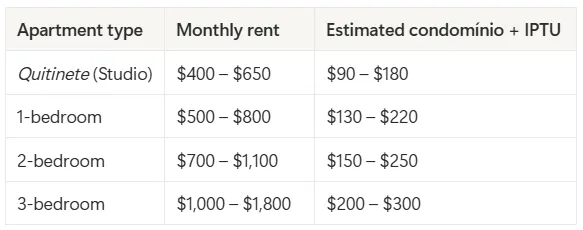
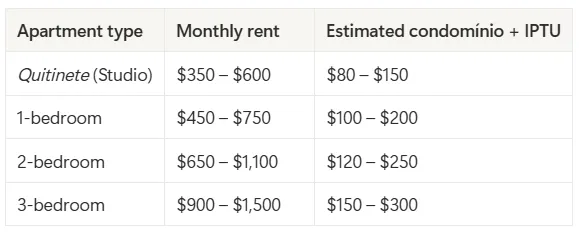
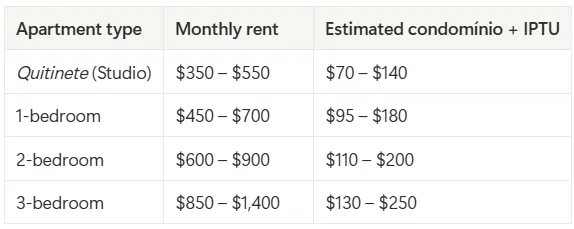
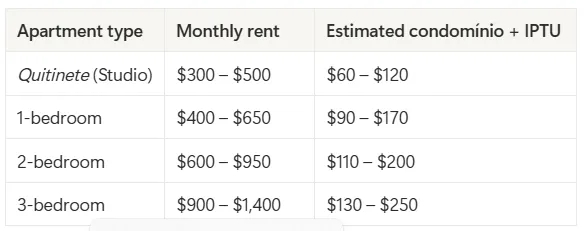
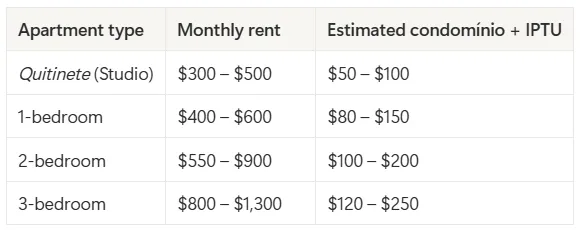
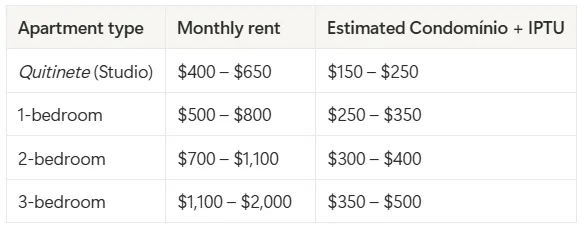
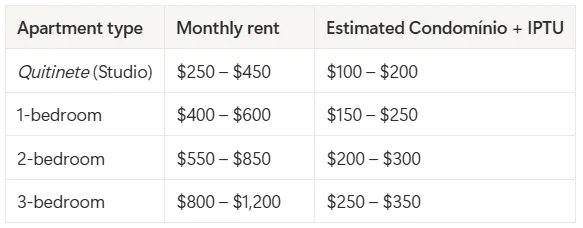
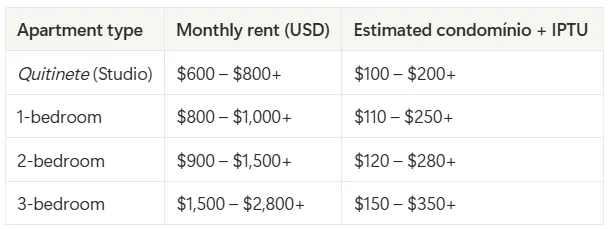
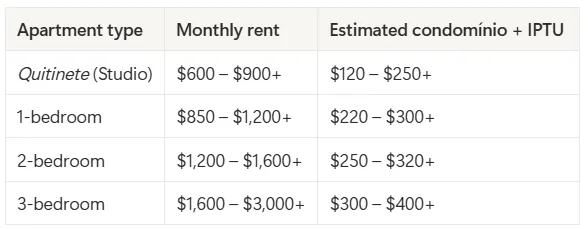
Renting in Rio is full of contrasts. One street might have stunning ocean views, while the next winds up a steep cobblestone alley. Prices swing all over the place depending on the neighbourhood, the building, and how close you are to the beach.

And here’s a little secret many newcomers miss: the rent you see isn’t the full story. You’ll also need to cover the condomínio (building maintenance fee) and IPTU (property tax), which can tack on $100 to $350 a month depending on the building’s age, location, and perks.

I’ll break down rent and living costs across the neighbourhoods I recommend most for expats, so you can find the perfect spot to call home in Rio.

Ipanema (South Zone)

This is beach life at its finest: steps from the sand, surrounded by trendy cafés, designer stores, and a crowd that loves to see and be seen. It’s safe, upscale, and perfectly blends surf and city energy.

Most rentals here are modern apartments with balconies and ocean views, often inside stylish buildings with doormen and amenities. If you want that postcard-perfect Rio life, this is it… but it doesn’t come cheap.

__wf_reserved_inherit

Leblon (South Zone)

If Ipanema is lively and social, I’d say Leblon is the elegant older sister. Calmer streets, fancy cafés, and a beach that feels a little more private.

Most rentals here are modern apartments with great amenities, like parking, pools, and even gyms. Leblon is the one if you want a quieter version of Rio’s beach life with a luxury touch. However, it is the most expensive neighbourhood in the city.

__wf_reserved_inherit

Copacabana (South Zone)

Copa is the most touristy and famous bairro (neighbourhood). It’s packed, loud, and a little messy, but it’s hard not to love it. You’ll find locals, tourists, and lifelong residents all sharing the same (huge) stretch of sand.

Most rentals in Copacabana are older apartments in classic buildings. You can find some with small balconies or sea views if you’re lucky. It’s not the calmest area, but you can live on or around the beach for a lot less than in Ipanema or Leblon.

__wf_reserved_inherit

Botafogo (South Zone)

Botafogo has that perfect in-between vibe, with city energy that's not too chaotic. You’ve got views of the Sugarloaf Mountain, great cafés, and quick access to both the beaches and the metro. It’s where many people settle when they want to be close to everything.

It features a mix of modern apartments and older ones, well-structured buildings, and everything you need within walking distance.

__wf_reserved_inherit

Flamengo (South Zone)

This is one of my favourites. I feel like Flamengo is cool without trying. It’s residential, calm, and full of leafy streets, but you’re still just a few metro stops away from downtown or the beach. The Flamengo Park (Aterro do Flamengo) is basically everyone’s backyard here. It’s perfect for morning runs, weekend picnics, or just people-watching by the bay.

You’ll find plenty of classic Rio apartments with high ceilings and vintage tiles, and the rent is usually friendlier than in the beach zones. It’s great if you want a quieter base with quick access to the city buzz.

__wf_reserved_inherit

Santa Teresa (Central)

Santa Teresa is Rio’s bohemian soul. It’s slower, artsier, and full of charm. You'll find colourful colonial houses turned into art studios, charming guesthouses, and vintage-style flats with city views. Most rentals here are older homes full of personality, high ceilings, tiled floors, and balconies.

It’s not the easiest place to move around, but if you love charm over convenience, this hilltop neighbourhood will win you over fast.

__wf_reserved_inherit

Glória/Catete (Central)

Glória and Catete sit right between the beach zones and downtown. They’re super central, full of life, and packed with history. You’ll find old apartments with tall windows, wooden floors, and those classic tiled hallways that feel very Rio Antigo (old Rio).

It’s perfect if you want easy access to everything without paying Zona Sul (South Zone) prices. Plus, you’re a short walk from Flamengo Park and the metro, which makes it easier to get anywhere in the city.

__wf_reserved_inherit

Barra da Tijuca (West Zone)

Barra feels like a whole different city, with wide streets, modern high-rises, shopping malls, and endless beaches. Most rentals here are inside condomínios (gated communities) with pools, gyms, and 24-hour security, so it’s great if you like comfort and space.

It’s a bit far from the city centre, but if you drive or don’t mind longer commutes, you’ll like the calm vibe, surf spots, and the feeling of living in a little urban resort.

__wf_reserved_inherit

Tijuca (North Zone)

Tijuca is one of Rio’s most traditional neighbourhoods. It’s right by the North Zone and well connected to the metro, making it easy to reach the city centre or the South Zone (beach areas). The neighbourhood has a strong local feel: you’ll find family-owned bakeries, lively markets, and streets full of life.

Housing here ranges from older apartments to more modern buildings with amenities. It’s a great option if you want an authentic Rio experience without the high prices of the beachside areas.

__wf_reserved_inherit

Grajaú (North Zone)

Grajaú is a hidden gem tucked away in the North Zone. It’s quiet, leafy, and one of those neighbourhoods where people still greet each other on the street and kids play outside. The pace is slower here, but you’re still close to Tijuca and the metro, so you can easily reach other parts of the city.

Rent is generally more affordable than in Tijuca or the South Zone, and you’ll find larger apartments or even small houses for the same price you’d pay for a one-bedroom elsewhere. It’s ideal if you’re after space, peace, and a bit of that small-town vibe within Rio, away from tourist traps.

__wf_reserved_inherit

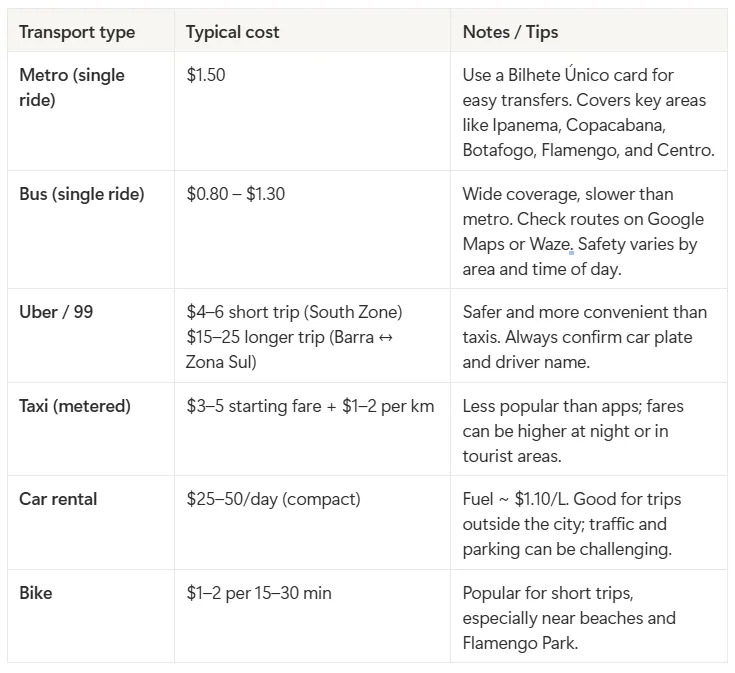
Transport in Rio

Rio is a city of hills, beaches, and busy streets. Getting around is just part of the adventure, and expats have a few main options, each with its pros and cons.

Metro

The metro is fast, safe, and reliable for connecting key areas like Centro, Botafogo, Flamengo, Copacabana, Ipanema, and Leblon. Trains run roughly every 4–6 minutes during peak hours.

  • Cost: R$ 7.90 per ride (~$1.50)
  • Tips: Buy a rechargeable Bilhete Único card to pay for multiple trips and transfers easily. Trains don’t go everywhere, so you’ll still need buses, Ubers, or walking for some neighbourhoods.

Buses

Buses cover almost every corner of the city, but they can be slow in traffic. Some routes are safe and comfortable; others, especially in tourist-heavy areas or at night, are less recommended.

  • Cost: ~R$ 4.70 – R$ 6.50 per ride (~US $0.80 – $1.30)
  • Tip: Use Google Maps or apps like Waze to check routes and safety reviews.

Uber/99

Ride-hailing apps are the most used here. They’re often safer and more convenient than taxis.

  • Cost: Short trips in the South Zone (Copacabana ↔ Ipanema) ~$4–6; longer trips (Barra ↔ Zona Sul) ~$15–25.
  • Tip: Always confirm the license plate and driver name before entering, and avoid unregistered taxis.

Car rentals / driving

Driving in Rio is possible but challenging: traffic is heavy, parking is expensive, and streets can be steep and confusing. It’s great if you plan trips outside the city or want flexibility in Barra da Tijuca.

  • Cost: Car rental ~$25–50/day for a compact car; fuel ~$1.10/L.
  • Tip: Consider using condomínio parking if you rent an apartment with a garage.

Cycling

It’s also possible to rent bikes in Rio, which is a fun and healthy way to get around, especially along the beaches and in areas with bike lanes like Aterro do Flamengo or parts of Copacabana and Ipanema. Many apps let you locate and unlock bikes on the go.

  • Cost: Bike rental ~$1–2 for 15–30 minutes.

Here is a breakdown to make it easier:

__wf_reserved_inherit

Pro tip for expats: As locals, we combine transport modes: metro for fast, long trips, Uber for late-night rides, and walking for neighbourhood errands. If you live in Barra, you’ll likely rely more on Uber or a car; in Zona Sul, walking and public transit cover most daily needs.

Food prices in Rio

Food in Rio is a whole vibe. You can grab a quick snack by the beach, dig into a feijoada, or hunt for exotic ingredients for your own kitchen. There’s something for every taste and budget.

Restaurants

If you’re just starting out, there are plenty of casual spots where you can grab a salgadinho (savoury snack) or a sandwich for $3–8. Lunch at a local boteco (bar/restaurant) will run around $6–12, and it’s often the perfect excuse to sit, sip a juice or beer, and watch the city move.

For a sit-down meal with friends, expect to spend $15–25 per person. You'll get grilled meats, fresh seafood, or the classic PF (prato feito, a full lunch plate with rice, beans, salad, and meat).

If you’re feeling fancy or celebrating something, Rio’s fine dining scene is amazing. A meal for two can easily hit $80–150, with cocktails adding a few more dollars. But the food and vibe are totally worth it.

Supermarkets

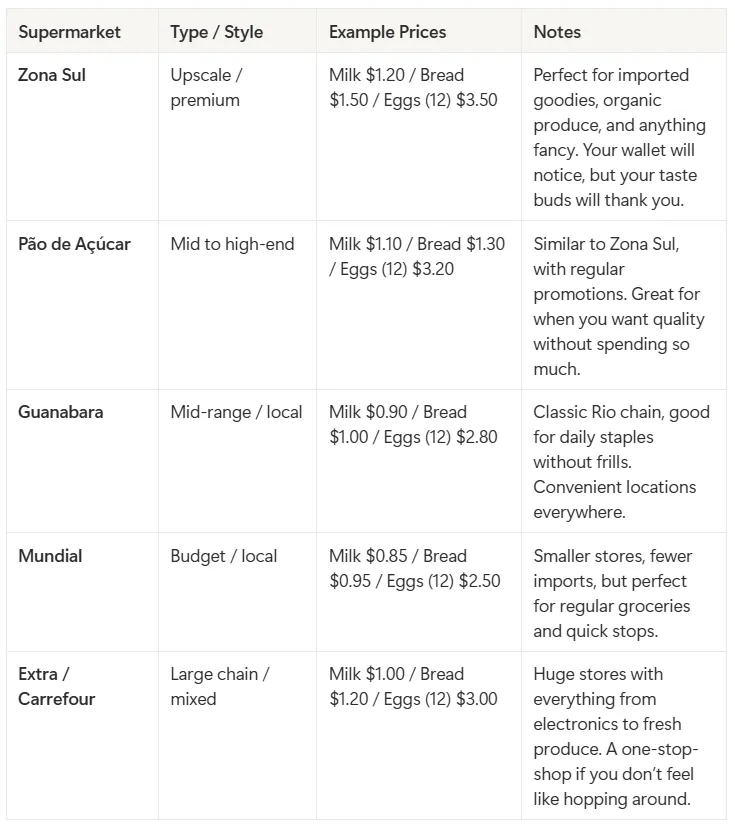
Now, grocery shopping in Rio is a story on its own. The city has everything from high-end boutique-style stores to budget-friendly local markets. Here’s the rundown:

__wf_reserved_inherit

Tip: I usually mix it up. Guanabara or Mundial for the basics, and Zona Sul or Pão de Açúcar when I want a treat or something special for dinner. Also, grocery prices can vary a bit depending on where you live. In Ipanema or Leblon, expect higher prices for the same items, especially at premium stores. Botafogo, Flamengo, and Glória/Catete have mid-range options like Guanabara, while Copacabana and Barra offer a mix. You can find bargains at Mundial or Extra if you know where to look.

Here’s a realistic monthly breakdown in USD:

For one person

  • Groceries (mix of Guanabara/Mundial + occasional Zona Sul treats): $80–120 per week (~$320–480 per month)
  • Eating out (casual lunches, occasional dinners or drinks): $50–80 per week (~$200–320 per month)

Total monthly food budget: $520–800

This gives you a mix of cooking at home, weekend brunches, and a few nights out without feeling restricted.

For a couple or small family

  • Groceries: $150–220 per week (~$600–880 per month)
  • Eating out: $100–150 per week (~$400–600 per month)

Total monthly food budget: $1,000–1,480

Enough for regular grocery shopping, occasional fine dining, and still exploring Rio’s countless food options.

Utilities costs in Rio

Living in Rio comes with the usual utility costs, but there are a few local quirks to keep in mind. Here’s what you can expect as an expat:

Electricity

Electricity can be surprisingly pricey, especially if you use air conditioning, which, honestly, is a must if you want to survive Rio’s summer.

  • Average monthly cost for a 1–2 bedroom apartment: $40–$70
  • Tips: Try using energy-efficient bulbs and turning off air conditioners and fans when you leave. Rio’s energy bills are calculated monthly and vary with usage.

Water and sewer

Water bills are usually affordable, but they’re often combined with sewer fees.

  • Average monthly cost: $15–30
  • Tip: Condomínios sometimes include water in your monthly fee, so check before signing a lease.

Gas

Most apartments use piped gas for cooking and water heating, which is included in your condo or building fees in many cases.

  • Cost: Often included in rent/condomínio; if separate, ~$10–15/month
  • Tip: Check with your landlord whether it’s included, especially in modern condomínios.

Internet and TV

High-speed internet is widely available, and we usually combine it with streaming services rather than traditional cable.

  • Average monthly cost: $25–45 for fibre internet (~500 Mbps)
  • TV/streaming: $5–15 per service (Netflix, Globoplay, Amazon Prime)

Mobile/Cell phone

Mobile plans in Rio are flexible, often prepaid (pré-pago) or postpaid (pós-pago).

  • Average monthly cost: $10–25 for 5–10 GB data plus calls/texts
  • Tip: Prepaid SIM cards are easy to get at shops or airports and work well for temporary stays.
__wf_reserved_inherit

Healthcare in Rio

Healthcare in Rio is a mix of public access, private comfort, and everything in between. You’ll find excellent doctors and modern hospitals, but the experience (and cost) depends a lot on whether you’re using the public system (SUS) or private care.

Public healthcare (SUS)

Brazil’s Sistema Único de Saúde (SUS) is free and available to everyone, from locals and expats to tourists in emergencies. The system covers general consultations, hospital stays, and medications for chronic conditions.

  • Cost: Free
  • Pros: Universal access, no need for insurance, available across the city.
  • Cons: Long waiting times, overcrowded hospitals, and limited English-speaking staff.

If you live in Rio long-term and speak some Portuguese, you can rely on SUS for routine care, but most expats prefer private hospitals for faster service and English-speaking doctors.

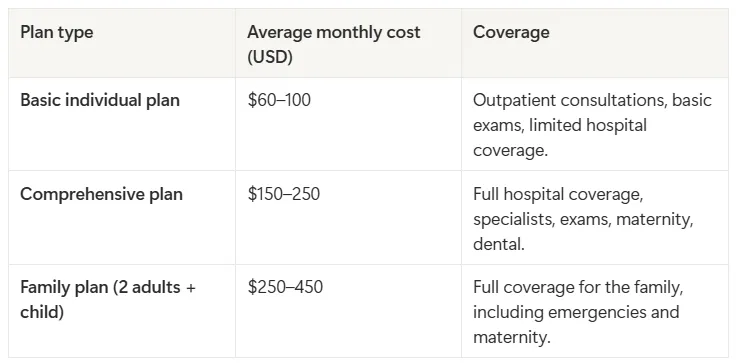
Private health insurance

If you plan to stay for a while, private health insurance (plano de saúde) is worth considering. Plans vary from basic outpatient coverage to full hospital and dental care. The biggest providers are Bradesco Saúde, SulAmérica, Unimed, and Amil.

__wf_reserved_inherit

Tip: Expats often choose a mid-tier plan and pay out of pocket for minor visits. A basic consultation at a private clinic without insurance costs around $30–60, while a specialist (like a dermatologist or orthopaedist) can range from $60–120.

Average living costs in Rio

Rio is one of Brazil’s priciest cities. Between rent, transport, and the occasional caipirinha by the beach, costs add up quickly.

That said, it can still fit different lifestyles. Here’s what your monthly budget might look like:

__wf_reserved_inherit

In the end, you can live comfortably on around $1,500/month, but to fully enjoy the carioca lifestyle without cutting corners, $2,000–2,500/month is a realistic sweet spot for most expats.

Earning abroad, spending in Rio

I’ve lived in a few countries before, sending money back home and figuring out how to make different currencies work. Now I’m back in Rio, earning in dollars and spending in reais, so believe me: I know the pain. Watching exchange rates, paying fees, and waiting for transfers just turn a simple purchase into endless headaches.

Grey makes that part simple. You can send money abroad, receive your salary in USD, GBP, or EUR, and withdraw in reais when rates are good, all without the stress of conversions or hidden fees.

Open your Grey account today and manage your money the easy way, so you can focus on enjoying Rio's beauty, embracing the chaos, and making the city your own.

‍

Cost of living in London vs New York: A full comparison

•

•

2 min read

London and New York. Two cities that define ambition, opportunity, and the art of expensive living. They’re often compared for their energy, culture, and global influence, but there’s one comparison that never gets old: which city is more expensive to live in?

Both have that irresistible, big-city energy: the feeling that something exciting is always happening just one train stop away. Not so exciting, however, are the expenses that would make even a well-paid professional wince at their bank statement. Still, they’re magnets for dreamers, freelancers, and global workers who want to live at the centre of everything.

So, you want the old-world charm of London, with its cobblestones, museums, and rainy-day cafés? Or the nonstop buzz of New York, where everyone always seems to be on the move?

This is a detailed breakdown of the actual living costs in each city. I have everything covered: rent, food, transport, utilities, and even childcare. I even touched on how Grey can help you manage your money.

Grab your calculator, let’s find out which city really costs more to call home.

How much is the typical rent?

Rent is where both cities truly test your patience and financial endurance. No matter how you slice it, housing eats up the biggest portion of anyone’s monthly budget, and both London and New York are notorious for it.

In London, a one-bedroom flat in the city centre, areas like Shoreditch, Southbank, or Notting Hill, costs around $3,100 per month. If you cross the Thames or move a few Tube stops outward to areas like Stratford or Greenwich, and rent dips to around $2,300. While that’s still steep, it’s relatively manageable compared to New York’s rental market.

In New York, a one-bedroom apartment in Manhattan or prime Brooklyn averages around $4,100 monthly, with similar spaces in Queens or the Bronx costing closer to $2,500. That’s a nearly 30% higher average rent than in London for central locations, though the gap narrows in outer boroughs.

Larger homes follow the same trend. A three-bedroom apartment in central London costs roughly $5,100, compared to a staggering $7,800 in Manhattan. It’s this kind of price tag that makes flat sharing so common. Even outside the city centres, the difference remains: an average of $3,700 in London versus $5,100 in New York.

To put it simply, you’ll need to earn about $100,000 a year to rent comfortably in central London, but closer to $130,000 - $150,000 to manage the same standard of living in New York. In both cases, rent alone can take up 40 - 50% of your monthly income if you’re not careful.

__wf_reserved_inherit

Verdict: London is expensive, but New York is on a whole other level. The average renter in NYC spends roughly 20 - 25% more than their London counterpart for the same space.

Also read: Cost of living in London

What if you prefer to buy a condo or apartment?

When it comes to buying a home, both cities make you pay dearly for the privilege of saying “I live here.”

In London, buying property is often less about owning a space and more about investing in history. Yeah, it’s that expensive.

A square metre of city-centre real estate costs around $21,250, making it one of the most expensive property markets in the world. That means a modest 70 m² flat in Central London (think Shoreditch, South Kensington, or Westminster) could cost upwards of $1.48 million before taxes or fees. Step just outside the heart of the city, say, to areas like Stratford, Walthamstow, or Greenwich and the average drops to $11,000 per square metre, bringing that same flat down to about $770,000.

New York, surprisingly, comes in slightly cheaper per square metre, around $15,500 in the city centre. A 70 m² apartment in Manhattan would cost approximately $1.08 million. However, buyers there face higher ongoing costs, including property taxes averaging 1.7% per year, as well as maintenance fees that can add several thousand dollars per month in co-op or condo buildings. Outside central boroughs like Brooklyn, Queens, or the Bronx, property prices average $11,100 per square metre, roughly $777,000 for the same 70 m² flat, which is nearly identical to London’s suburban equivalents.

But price per square metre doesn’t tell the whole story. In London, you’ll often find smaller, older properties that come with preservation restrictions, while New York’s market leans toward high-rise living with modern amenities but sky-high building costs.

If you’re buying as an investor, rental yields are another factor: London averages 3 - 4% annually, compared to 4 - 5% in New York.

__wf_reserved_inherit

Verdict: London wins for long-term prestige and property value stability, but New York offers more substantial returns and newer builds for your money. Either way, in both cities, you’ll need to plan well for a purchase.

Also read: Cost of living in Paris

Restaurants

If rent is where London and New York empty your wallet, food is where they tempt you to open it again. Both cities are global dining capitals, home to celebrity chefs, street food icons, and everything in between. Regardless of your preference, whether grabbing a quick bite or splurging on fine dining, the numbers tell a fascinating story about how much it really costs to eat well in each city.

In London, an inexpensive meal at a local café or casual restaurant costs around $27, while in New York, that same plate would be roughly $25. It’s a negligible difference, well, until you start dining out regularly. A three-course dinner for two in a mid-range restaurant costs approximately $106 in London, compared to $150 in New York. That’s almost a 40% jump, showing how New York’s dining scene rewards indulgence but punishes your credit card.

For the average person eating out three to four times a week, that difference soon becomes a problem. You could spend $450 - $600 monthly on casual meals in London or nearly $700 - $900 in New York, and that’s before drinks or tips.

Fast food and casual chains paint a slightly different picture. A McDonald’s combo meal costs $11 in London and $14 in New York, making the UK marginally friendlier to quick, low-cost dining. Drinks, however, are where the playing field levels out. A domestic beer costs around $9 in London and $8 in New York, while an imported beer might flip the comparison, $8 in London versus $10 in New York.

And if you’re one of those people who can’t start the day without caffeine (no judgement here), you’ll pay $5.50 for a cappuccino in London and around $6 in New York. Over a month of daily café runs, that’s about $165 vs. $180, proof that even your coffee habit costs more in Manhattan.

__wf_reserved_inherit

Verdict: London wins if you’re eating on a budget, or prefer home-cooked meals and pub lunches over fine dining. But New York outshines for culinary variety: you’ll find everything from $3 pizza slices to $300 tasting menus, often on the same block.

Markets

When it comes to everyday shopping, you’ll find plenty of options in either city, and how far your grocery budget stretches depends on what you buy and where you buy it.

In London, chain supermarkets like Tesco, Sainsbury’s, and Aldi offer solid value, while Waitrose or Marks & Spencer cater to those who don’t mind paying a premium for imported or organic goods. A typical grocery basket, which will include milk, bread, rice, eggs, and fresh fruit, comes to around $40 - $50 weekly for one person, or roughly $200 a month if you mostly cook at home. Prices stay fairly stable, though imported foods (like cheese or wine) push the total higher.

A litre of milk costs $1.70, and a loaf of bread averages $2, which is affordable by big-city standards. But a dozen eggs go for about $4.70, and chicken fillets hover around $9 per kilo. Meat and dairy tend to be where your grocery bill spikes. On the brighter side, locally grown produce like apples ($3.50/kg) or bananas ($1.70/kg) remains budget-friendly, especially at weekend markets or local greengrocers.

New York, however, turns grocery shopping into an Olympic event, one that your wallet rarely wins. Supermarkets like Whole Foods, Trader Joe’s, and Key Food charge noticeably more, with prices varying wildly by borough. Expect to spend around $350 - $450 per month if you cook regularly, and easily more if you shop organic or prefer imported brands.

Basic items tell the story well: a loaf of bread is $4.90 (more than double London’s), and eggs cost $7.20 per dozen. Even staples like rice ($8.20/kg) and milk ($1.60/L) come with a New York markup. Meat and produce are consistently higher too, as chicken fillets average $16/kg, and apples hit $7.50/kg, nearly twice London’s cost.

The gap widens further when you factor in alcohol and tobacco. A bottle of wine costs $11.50 in London but $18 in New York. Cigarettes? $4.50 in London versus a staggering $19 in NYC, making it one of the most expensive places in the world for smokers.

__wf_reserved_inherit

Verdict: London gives you more value for money, especially if you cook often.

Transportation

Let’s be honest, both cities have world-famous public transport systems. London’s red double-decker buses and the New York subway come to mind almost immediately.

In London, getting around isn’t cheap, but it’s incredibly well-connected. A one-way Tube or bus ticket costs around $4.20, and a monthly travel pass averages $240, still one of the most expensive in the world. Daily commuters can save money using Oyster cards or contactless payments, which cap your daily fare at around $10 - $15, depending on the zones.

Taxi rides are another story. A standard black cab starts at $5.50, but the fare rises quickly during rush hour or late at night. Ride-hailing services like Uber tend to be slightly cheaper, though not by much. Fuel costs around $1.80 per litre, making car ownership in London more of a luxury than a necessity. Due to the congestion charges, parking fees, and insurance, most people stick to public transport or cycling.

Over in New York, transportation is slightly more affordable, at least on paper. A single subway or bus fare costs $3, and a monthly MetroCard is $133, nearly half of London’s cost. For daily riders, that’s a massive saving. Taxis start around $5, and while surge pricing can spike fares in Manhattan traffic, ride-sharing apps like Lyft and Uber are everywhere. Fuel is far cheaper, averaging $0.90 per litre, making car ownership less punishing for those outside the boroughs.

__wf_reserved_inherit

Verdict: New York wins for affordability, hands down. But London’s system is better integrated. If you value comfort and connectivity, you’ll tolerate London’s higher costs. But if saving money matters more, New York’s MetroCard is still the golden ticket, even if it sometimes comes with the scent of pizza and street jazz.

Also read: Cost of living in Mumbai

Utilities

Utilities might not be the most exciting topic, but they’re what truly determine whether your apartment feels like home or just an expensive box with windows.

In London, basic utilities for an 85 m² apartment — electricity, heating, cooling, water, and garbage — come to around $330 per month. Prices fluctuate depending on the season; winter heating bills can push the cost closer to $400, while the summer months offer some relief. What’s great, though, is that energy-efficient buildings are becoming more common, especially in newer developments outside central London.

The internet is reasonably priced by global standards. A high-speed plan (60 Mbps or more) averages $42, and most providers offer reliable service. Mobile plans are also competitive, with rates starting at around $19 per month for calls, texts, and 10 GB or more of data. That’s significantly cheaper than in the U.S., and it’s one of the few areas where London actually saves you money.

Meanwhile, in New York, utilities can be a mixed bag. The average cost for the same 85 m² apartment is around $200 per month, but don’t let that fool you; many older buildings in New York have outdated systems, meaning you’ll likely need to budget extra for heating or air conditioning, especially during extreme weather. Some apartments include water and heat in the rent, but electricity can still add up fast.

Where New York really pulls ahead (or falls behind, depending on how you see it) is in connectivity. Internet costs about $66.60 per month, and while speeds are great, it’s nearly 60% more expensive than in London. Mobile plans are also higher, averaging $62 monthly, roughly three times London’s rate.

__wf_reserved_inherit

Verdict:. In London, you’ll pay less for mobile and internet services and enjoy reliable utilities across the board. New York’s older infrastructure and higher data costs make it the slightly more expensive option, especially for remote workers or freelancers who depend on stable, high-speed connections.

LDMAG1

Sports and leisure

The one thing Londoners and New Yorkers take seriously, besides their morning coffee, is staying active and entertained. However, depending on where you live, the cost of staying fit (or just having fun) can vary significantly.

In London, Gym memberships average $64 a month, and you’ll find everything from sleek chains like PureGym and Virgin Active to boutique studios with yoga, spin, or boxing. Public sports centres are affordable too; some charge as little as $8 per session for swimming or fitness classes. If you’re into tennis, court rentals on weekends cost around $25 an hour, and for the less sporty, catching a movie at your local cinema is about $20.

What’s great about London is that so many of the fun activities are free; long runs through Hyde Park, weekend cycling along the Thames, or joining a neighbourhood football group — everyone loves Sunday League. Outdoor activities thrive in London, especially in the summer when the weather finally cooperates.

New York, on the other hand, turns fitness into a high-end affair. A basic gym pass can cost $130 per month, with premium clubs like Equinox charging up to $250 for memberships that include saunas, classes, and towel service (because, of course, it’s New York). Tennis court rentals are pricier too, averaging $59 per hour, and even outdoor recreation in Central Park isn’t entirely free if you want to join an organised sport or use maintained courts.

Entertainment prices are roughly comparable to those in London. A cinema ticket is $20, but New York’s nightlife, concerts, and Broadway shows can make that number skyrocket quickly. A night out with drinks, dinner, and a show can easily top $250, especially in Manhattan.

__wf_reserved_inherit

Verdict: London offers better value and more free fitness options, while New York delivers more variety and experience, if you’re willing to pay the price.

Childcare

If you plan on raising kids in either London or New York, brace yourself, childcare is one of the biggest expenses you’ll face, no matter which side of the Atlantic you’re on.

In London, a full-day private preschool costs around $2,550 per month, depending on the borough and curriculum. Central neighbourhoods, such as Kensington or Islington, tend to be pricier, while outer zones, like Croydon or Walthamstow, have slightly lower fees. London offers a diverse range of childcare options, including local nurseries, Montessori schools, and nanny shares. The UK government also provides subsidies for working parents, with 15 to 30 hours of free childcare available for eligible children aged three to four.

Although primary education is free for state-funded schools, tuition in private schools averages $27,400 per year. However, top-tier institutions such as the American School in London or Southbank International can exceed $35,000 annually. Still, the structure and global curriculum often justify the price.

New York, however, raises the stakes and the fees. Preschool in the city costs approximately $2,230 per month, which may sound slightly lower than in London, but the difference quickly fades once you factor in registration fees, supplies, and additional care hours. For many working parents, hiring a nanny becomes the norm, with costs ranging from $3,000 to $4,500 per month, depending on the hours and experience required.

Private education is where the gap truly widens. An international or private primary school in New York costs a staggering $58,300 per year on average, making it one of the most expensive cities in the world for schooling. Even mid-tier private schools range between $35,000 and $45,000 annually — roughly equivalent to a small mortgage.

__wf_reserved_inherit

Conclusion

Choosing between London and New York is a personal decision. You’ll need to consider the trade-offs you’re willing to live with: rent versus salary, dining versus groceries, public transport versus car costs, and the necessary but often overlooked realities of paying for childcare and schooling.

If you earn abroad or have income in foreign currencies, those trade-offs start to look a little different. Suddenly, a higher salary in New York might cover steeper rents and school fees; a London paycheck might stretch further on everyday items or childcare. The smart move is to think of your finances as a system: how you get paid, how you hold money, and how you convert it all matter as much as the numbers on a job offer.

The right platforms make a real difference. Holding the right currency, timing conversions, and avoiding hidden fees can save you hundreds, even thousands, of dollars a year. For remote workers, freelancers, and families juggling international income and local costs, a multi-currency account with transparent rates and fast payouts is no longer a nice-to-have but a necessity.

That problem exactly is what Grey solves. It doesn’t matter if you’re paid in dollars, pounds or euros, you can receive funds on Grey, hold them in the currency that works best for you, and convert or withdraw at competitive rates, quickly and transparently. That means less guesswork when you’re planning rent, school fees or monthly bills in either city, and more control over how much of your hard-earned money actually reaches you.

Open a free Grey account or download the app to keep more of your income and, by extension, spend it on the things that truly matter.

Disclaimer: This article is based on researched data and is intended to give you a general overview of the cost of living in London and New York. The figures provided are estimates gathered at the time of writing and may vary depending on location, lifestyle, and market changes.

‍

Cost of living in London for international students

•

•

2 min read

There are only a handful of moments quite as exciting as a confirmation mail from the university you applied to.

It’s that single moment when months of applications, essays, and anxious email refreshing finally pay off. It’s even more surreal when the university is in London, one of the world’s most popular and cosmopolitan cities.

However, once the excitement subsides, the important question of how much it will cost to live in London inevitably arises.

That’s why I’ve put together this guide. It’s a complete breakdown of what it really costs to live as an international student in London. We’ll cover everything from accommodation to entertainment, and I’ll show you how Grey helps you to make your pounds stretch further (especially if you’re receiving money from home).

So, let’s unpack the numbers, shall we?

Accommodation

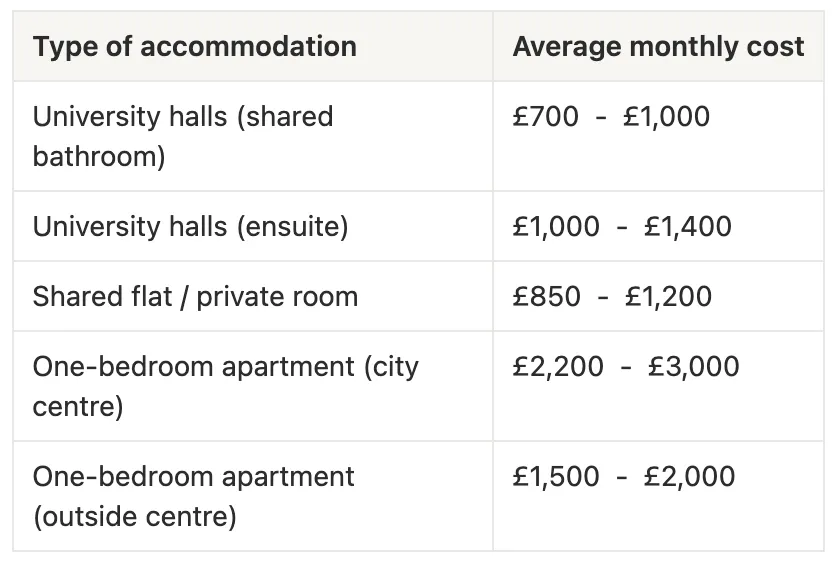
Rent is almost always the biggest part of a student’s budget. It varies depending on where you live. Central areas like Bloomsbury, Shoreditch, and South Kensington are pricier because they’re near top universities (UCL, LSE, Imperial). If you’re okay with a longer commute, you’ll find cheaper options in areas like Stratford, Lewisham, or Wembley.

Cost of living in London for international students

Many students save by sharing flats. Websites like SpareRoom or UniAcco help you find affordable, student-friendly housing. Remember that bills (electricity, Wi-Fi, water) often aren’t included in private rentals, so you’ll need to add another £150 - £250 monthly.

LDMAG1

Food and groceries

How much you spend on groceries depends entirely on your lifestyle. Cooking at home can save a lot, especially if you shop smart. Supermarkets like Aldi, Lidl, Tesco, and Asda are student favourites, while M&S and Waitrose are pricier but great for the occasional treat.

Cost of living in London for international students

If you cook most of your meals, you’ll likely spend around £150 - £250 per month on groceries. Eating out regularly or relying on takeaways can double that. You can also get student discounts in nearby restaurants and cafes. Also, meal prepping on weekends helps cut weekday costs and saves you from impulsive buying.

Also read: Cost of living in Alexandria

Transportation

Public transport in London is excellent but pricey, so plan ahead as much as you can. Most students rely on the Tube, buses, and trains, with discounted Oyster cards or Student Travelcards to keep costs down. I recommend using Trainpal or Trainline to book trains ahead, especially when you’ll be travelling outside London.

Cost of living in London for international students

If your classes are close to home, cycling can save a ton. Santander Cycles (Boris Bikes) cost just £20/month for unlimited 60-minute rides. Walking is also underrated in central London; you’ll be surprised how much you can explore on foot. It’s important to note that mobile maps, such as Google or Apple Maps, are helpful. The London commute can be very confusing, so it’s a great way to stay informed about your location. Ensure your device is charged, type in the address, and you’re all set.

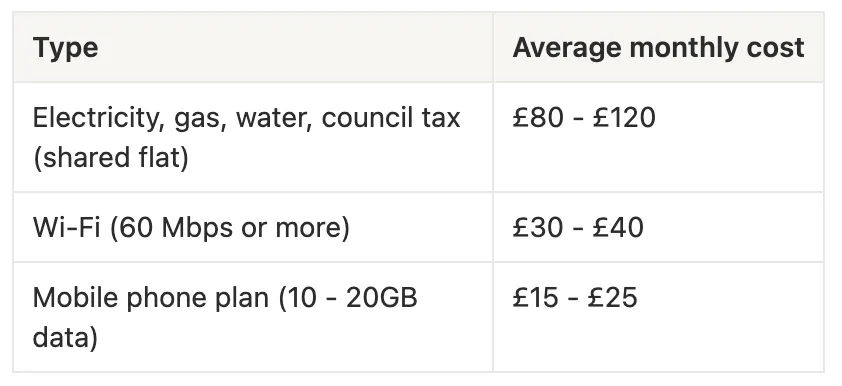
Utilities and internet

If you live in university housing, utilities are usually included. However, if you’re renting privately, you may need to pay separately for essentials such as electricity, gas, and Wi-Fi. You can also find private accommodation with all bills included, but these are usually in the form of flatshares.

Cost of living in London for international students

Students are exempt from paying Council Tax if they’re enrolled full-time, so make sure to get a letter from your university confirming your status.

Study materials and personal expenses

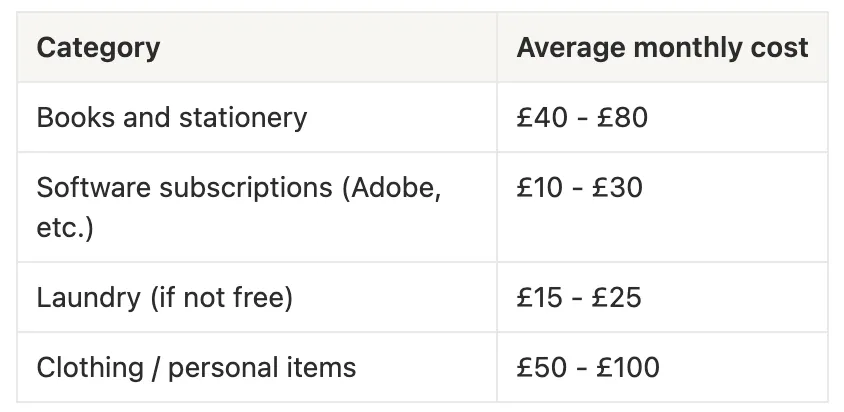
Books, printing, and supplies might not seem like much, but the costs can quickly add up. Most universities have libraries stocked with required textbooks; however, some courses may require specific editions or software (you can use the Grey virtual card for this).

Cost of living in London for international students

Most students also budget for occasional entertainment, streaming services, and social activities. It’s London. You’ll want to see a play, visit museums, or just enjoy a pint with friends now and then.

Also read: Cost of living in London vs New York: A full comparison

Entertainment and leisure

London is full of free and low-cost experiences. Museums like the Tate Modern, British Museum, and V&A are all free, and many theatres have discounted student tickets. Still, it’s nice to have a small leisure budget. A modest £150 - £250 per month for entertainment covers the occasional night out, gym membership, or city exploration.

Cost of living in London for international students

Total estimated monthly cost of living for international students

‍

Cost of living in London for international students

Total estimated monthly cost: £1,500 - £2,500

Your exact budget depends on where you live and how you spend, but a realistic figure for most international students in London falls between £18,000 and £25,000 per year.

Also read: Cost of living in London

Managing money in London with Grey

While studying your course in school, you’ll also need to learn how to manage your money outside of it. Many international students face the challenge of finding a reliable way to receive funds from outside the country or send some money back home occasionally.

Grey completely solves that. With a multicurrency account, you can receive money from home in USD, GBP, or EUR, convert at competitive rates, and spend directly in pounds, all without worrying about hidden fees or bad exchange rates.

So, if your parents send you funds monthly or even if you freelance part-time, Grey helps you manage your finances like a local.

Open a Grey account today or download the app and take one more thing off your student to-do list.

‍

Disclaimer: This article is based on researched data and is intended to give you a general overview of the cost of living in London. The figures provided are estimates gathered at the time of writing and may vary depending on location, lifestyle, and market changes.

‍

Exploring Cairo as a city for digital nomads: amenities and culture

•

•

2 min read

Cairo is home to ancient wonders like the Pyramids of Giza and the Sphinx, and also a growing number of digital nomads from across the world seeking diverse work experience and cultural adventures. Cairo has increasingly attracted digital nomads drawn to its low cost of living, rich cultural immersion, and improving digital infrastructure. This article examines the amenities supporting remote work in Cairo, alongside its vibrant culture, to give you a taste of what to expect if you visit.

Also read: Side hustle in Egypt? Here’s how to receive international payments

Amenities for digital nomads in Egypt

Cairo offers a mix of budget-friendly essentials and emerging facilities for remote workers, though it demands adaptability to its chaotic energy. As of 2025, the city ranks among Africa's top destinations for nomads, thanks to its affordability.

  • Internet and connectivity

Internet reliability varies, with average speeds around 20-50 Mbps in central areas. This is good enough for most tasks, but outages can still occur. However, digital nomads have a better experience in co-working spaces or cafes. Portable Wi-Fi devices or SIM cards from providers like Vodafone offer backups, with data plans costing $7-15 monthly.

  • Co-working spaces and workspaces

The co-working scene is growing, with options like Regus offering high-speed internet, meeting rooms, and a professional workspace. Urban Station in central Cairo provides cosy, quiet environments with modern amenities. Other spots include cafes in Zamalek or Maadi with free Wi-Fi. Membership subscriptions range from around $5 per day to $100 per month. These spaces also foster networking among digital nomads, expats and local remote workers.

  • Cost of living

Cairo's affordability is a major plus. You can live comfortably on a monthly budget under $1,000. One-bedroom apartments cost around $350-$500 in areas like Maadi or Heliopolis. Meals are often under $5. If you add around $150 for groceries, you're living way below what you’ll spend monthly in Western cities. Healthcare is cheap, even with out-of-pocket payments. You can also get an affordable health insurance package covering your stay.

  • Accommodation options

Cairo offers a wide range of affordable housing. Digital nomads can find short- and long-term rentals through Airbnb, Booking.com, or local agents. Neighbourhoods like Zamalek, Maadi, and Heliopolis are favourites for their safety, greenery, and proximity to coworking hubs

  • Transport and mobility

Cairo’s public transport system includes buses, taxis, and the metro. Ride-hailing apps like Careem and Uber are widely used and inexpensive. For daily commuting, many nomads prefer Uber due to its safety and comfort. The Cairo International Airport is also well-connected, offering direct flights to major cities in Europe, Africa, and Asia.

  • Financial accessibility

International payments can sometimes be a challenge in Egypt due to local banking restrictions. Traditional banks often limit foreign currency transactions or impose high transfer fees. That’s where platforms like Grey come in, offering multi-currency accounts that let you receive and send money internationally with ease. For remote workers paid in USD, GBP, or EUR, this ensures smooth financial management without the hassle of traditional exchange controls.

Cultural experiences for digital nomads in Cairo

Cairo is culturally vibrant, offering many exciting experiences to explore.

  • Historical and architectural edifices

Egypt is home to many architectural wonders, from mosques like Al-Azhar to ancient churches. The Giza pyramids and the Sphinx are iconic destinations for exploring ancient Egypt.

  • Food and culinary scene

You should whet your taste buds with some Egyptian cuisine, which is usually affordable. The kushari, falafel, and grilled meats are generally under $7.

  • Lifestyle and community

The growing digital nomad and expat communities make it easy to connect with like-minded individuals through meetups and events, often found at the various coworking and co-living spaces. Cairo can be fast-paced with festivals and lively souks.

Also read: How to get an instant USD debit card in Egypt

Managing international payments with Grey

Cairo is an interesting hub for digital nomads with affordability, modern amenities, and cultural diversity. It’s a place where you can immerse yourself in millennia of history while working from a modern coworking hub or a cosy café.  For remote workers, Cairo delivers an unforgettable balance of old and new.  If you’re planning to work from Egypt**,** a Grey multi-currency account simplifies your international payments. You can manage multiple currencies seamlessly while you explore the wonders of Cairo.

Get started on Grey today for seamless international payments in Egypt.

‍

Cost of living in Mumbai

•

•

2 min read

The more you know, the more you realise that you don’t know. This saying is attributed to the great Aristotle. He may not have been talking about Mumbai, but he just as easily could have been.

The city has that effect on people. Just when you think you’ve figured it out, you learn something new. Mumbai is a city that overwhelms your senses but finds a way to make you fall in love with it anyway. It’s India’s financial capital, a melting pot of dreams, and of course, the home of Bollywood.

If you’re considering moving there, understanding the cost of living is the first step to finding your place in the city that never really slows down.

Let’s break it all down. We’ll do housing, groceries, transport, utilities and every essential thing you need to know about how much it costs to live in the city of flamingoes.

Rent

Rent in prices in Mumbai aren’t exactly straightforward. There’s a lot of contrast depending on what part of the city you stay. So it’s heavily dependent on the lifestyle, neighbourhood, and how much of Mumbai you want to properly immerse yourself in.

If you plan on staying in the south, you’ll most likely be close to the sea, which can push up the rent. If you move further out to places like Thane, Navi Mumbai, or even Andheri, things start to look friendlier on the wallet. The commute might stretch a little, but with Mumbai’s expanding metro network, that trade-off’s becoming easier every year.

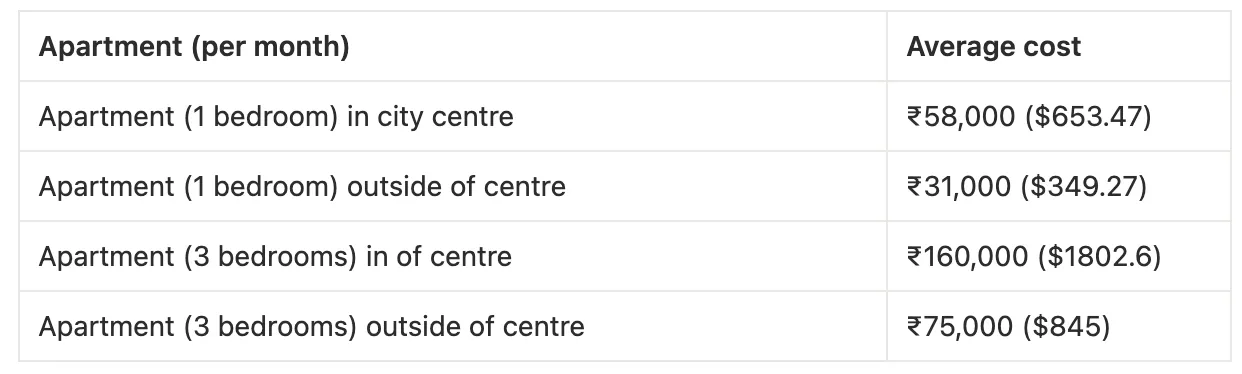
Here’s a quick look at what renting in Mumbai actually costs on average:

__wf_reserved_inherit

What if you prefer to buy an apartment in Mumbai?

If you’re thinking long-term and planning to buy rather than rent, brace yourself. Mumbai’s property market is as intense as the city itself. So think long and hard and decide if it’s a commitment you want to make.

The city’s real estate scene is famously competitive. In South Mumbai, there are neighbourhoods where proximity to the sea and skyline views can easily double the cost per square metre. Folks who buy property here usually do it for comfort and prestige.

If you have a tighter budget, areas like Navi Mumbai, Thane, and Chembur are redefining urban living have significantly lower property prices. These neighbourhoods attract young professionals and families looking for value without losing touch with the city’s pulse.

Still, property ownership in Mumbai is no small feat, regardless of where you chose. Mumbai remains one of India’s most expensive and fast-moving real estate markets.

Here’s a breakdown of the average cost of buying an apartment in Mumbai:

__wf_reserved_inherit

Also read: Cost of living in New Delhi

Restaurants

I know you’re probably trying to save money, but you can’t move to a new country without properly immersing yourself in it. And what better way is there to immerse yourself in the culture of a people than through their food?

Mumbai has options for every kind of budget and craving.

A full meal at a small local eatery can cost as little as ₹150 - ₹500, making it easy to eat well without overspending. Mid-range restaurants, the kind you’ll find in Bandra, Powai, or Lower Parel, usually charge around ₹1,500 - ₹2,500 for two people, while fine dining establishments in South Mumbai can easily cross ₹5,000 - ₹8,000 for a three-course meal.

Fast food and café culture are also big parts of daily life Mumbai. A McDonald’s combo meal costs around ₹400, a cappuccino averages ₹230, and a bottle of water costs roughly ₹17, give or take. Meanwhile, imported drinks or craft cocktails at upscale bars can range from ₹350 - ₹900 depending on the location and brand.

What’s especially interesting about Mumbai’s dining scene is how it blends affordability and aspiration. On one street, you can find a family-run thali joint serving unlimited curries for the price of a metro ticket, and right next door, a sleek restaurant serving modern Indian tasting menus that could rival Paris or New York. Just pick what works for you and have a good time.

Here’s a breakdown of the average cost of eating out in Mumbai:

__wf_reserved_inherit

Also read: Cost of living in Bengaluru (Bangalore)

Markets

The smell of spices spilling from open sacks, and the sight of produce piled high in street markets, are things that are synonymous with Mumbai. The city’s markets mirror its people. They’re diverse, adaptable, and endlessly resourceful.

For most residents, groceries make up about 10% - 15% of their monthly expenses, depending on lifestyle and household size. I know for sure that mine would be less than 10%. I eat out a lot as I rather unfortunately, can’t cook.Local staples such as rice, lentils, vegetables, and bread remain relatively affordable, with prices that fluctuate slightly based on season and supply. Buying directly from open-air markets or smaller vendors often stretches your rupee further than shopping exclusively at premium stores. Imported goods can cost two to three times their local equivalents, which is why many Mumbaikars (a person residing or born in the Indian city of Mumbai), ****mix local essentials with the occasional indulgence.

One important thing to note: beef is largely unavailable in Mumbai due to local religious and legal restrictions. Cows are considered sacred in Hinduism. Most households substitute with chicken, fish, or mutton, and the city’s coastal location ensures seafood remains a staple in many diets, especially along the western suburbs.

For the average single professional, monthly grocery bills typically range between ₹5,000 - ₹10,000, while families might spend upwards of ₹20,000 - ₹30,000 depending on preferences and eating habits. Despite global inflation and rising urban costs, Mumbai’s mix of traditional markets and modern retail options keeps grocery shopping flexible.

Here’s what everyday market prices in Mumbai look like on average:

__wf_reserved_inherit

Also read: Cost of living in Bali: what remote workers and expats should expect

Transportation

Getting around Mumbai is both a logistical exercise and a lesson in patience. But it’s also part of what gives the city its pulse. The local train network is often called the city’s lifeline, and for good reason too. It moves over 7.5 million passengers daily across its Western, Central, and Harbour lines. It’s the fastest and most affordable way to get around, with tickets costing as little as ₹20 for short distances. You don’t want to be on the train during rush hours though. They are usually packed.

For shorter journeys, auto-rickshaws, locally called “tuk-tuk”, and black-and-yellow taxis are everywhere. A quick rickshaw ride across the suburbs might cost between ₹30 and ₹150, depending on distance and traffic, while taxis are a slightly pricier but more comfortable alternative. The city’s Uber and Ola network is extensive too, though surge pricing during heavy rains or traffic jams can double the fare.

Public transport users typically spend around ₹2,000 - ₹3,000 per month, depending on routes and frequency. Those relying on taxis or private cars could easily see transport costs rise to ₹8,000 - ₹15,000 monthly, especially with petrol prices hovering around ₹106 per litre and parking charges creeping upward in business districts like Lower Parel or Bandra.

You could also get your own car. Between fuel, maintenance, and parking, monthly costs can exceed ₹12,000 - ₹20,000, depending on usage. So most residents prefer a hybrid approach, combining public transport with occasional cabs or two-wheelers to strike a balance.

__wf_reserved_inherit

Utilities

Once you’ve found your place in Mumbai, your next concern will likely be managing monthly utilities. This will vary widely based on your lifestyle.

For most residents, electricity is the biggest recurring expense. Mumbai is generally hot and humid, so air conditioning is almost non-negotiable during the summer months. A small apartment using fans and minimal AC might see monthly electricity bills between ₹2,000 - ₹3,500, while larger households running multiple air conditioners could pay anywhere from ₹5,000 - ₹10,000 or more. The average unit rate for electricity in the city ranges from ₹7 - ₹12 per kWh, depending on consumption slabs and provider (BEST, Adani, or Tata Power).

Water and waste management are generally more affordable but vary depending on your housing society. Monthly water charges typically range between ₹300 and ₹800, and some buildings include it in maintenance fees. Waste disposal and building maintenance can add another ₹1,000 - ₹3,000, particularly in gated communities or high-rise apartments.

Internet connectivity in Mumbai is among the most reliable in India. With high-speed fibre connections from providers like JioFiber, Airtel Xstream, and ACT you can get speeds between 100 Mbps to 1 Gbps. Most monthly plans start at about ₹700 - ₹1,500. Freelancers and remote workers often opt for mid-range packages that balance speed and stability, typically around ₹1,000 per month.

For mobile data, plans from Airtel, Jio, and VI start at around ₹300 - ₹500 per month for unlimited calls and up to 2GB of daily data, making it easy to stay connected without breaking the bank.

Altogether, a single professional living in a one-bedroom apartment might spend roughly ₹4,500-₹7,000 per month on utilities, while families in larger apartments can expect anywhere between ₹8,000 - ₹15,000, depending on usage and comfort level.

__wf_reserved_inherit

Sports and leisure

If staying active is a priority, you’ll find a wide range of fitness options across the city. Basic gym memberships in local neighbourhoods start around ₹1,200 - ₹2,500 per month, while premium chains like Gold’s Gym, Cult.Fit or Fitness First charge between ₹3,000 - ₹6,000 monthly.

Outdoor enthusiasts often take advantage of Mumbai’s coastline and public spaces. Early morning jogs along places like Marine Drive or Carter Road are pretty common. Cycling is also very popular. These activities are mostly free, apart from park entry fees (around ₹50 - ₹100).

For those with a competitive streak, sports club memberships can range dramatically from ₹10,000 annually for smaller community clubs to over ₹1 - 2 lakh per year for prestigious venues like the Bombay Gymkhana or CCI (Cricket Club of India). Renting a tennis or badminton court for an hour typically costs ₹600 - ₹1,200, depending on the location and time.

A standard cinema ticket for an international release ranges from ₹250 - ₹600, although luxury theatres like PVR ICON or INOX Insignia charge up to ₹900 for recliner seats.

In short, there’s something for every kind of lifestyle. You can live simply and spend next to nothing, or indulge and experience the best of urban leisure. The choice, as always in Mumbai, depends on how much you want to spend.

__wf_reserved_inherit

Also read: Cost of living in Jakarta: a complete guide for travellers and digital nomads

Childcare

For families, education is one of Mumbai’s biggest expenses. While local preschools are relatively affordable, international schools are significantly more expensive due to global curricula and facilities. Still, many expat and professional families consider the investment worthwhile for quality and continuity.

__wf_reserved_inherit

Clothing and shoes

If you’re shopping on the high street, international brands like Zara, H&M, Levi’s, and Uniqlo have a strong presence in malls like Phoenix Palladium and Oberoi Mall. A pair of jeans typically costs around ₹2,500 - ₹4,000, casual shirts or blouses range from ₹1,200 - ₹2,500, and summer dresses or chinos fall within the ₹2,000 - ₹3,500 bracket.

For mid-range or local brands, men’s t-shirts and women’s kurtas often cost ₹800 - ₹1,500, while workwear or ethnic outfits average ₹2,000 - ₹3,000. Many locals also shop at Linking Road (Bandra) or Hill Road, where you can bargain for trendy pieces, sandals, and accessories, usually for under ₹1,000.

When it comes to footwear, expect to spend around ₹2,000 - ₹3,500 for a good pair of sneakers, while local brands or markets sell stylish alternatives for ₹800 - ₹1,200. During the monsoon months, rubber sandals or waterproof shoes are a must-have and usually cost between ₹500 - ₹1,000.

The city’s fashion culture encourages you to stay cool, stylish, and comfortable.

__wf_reserved_inherit

LDMAG1

Living smart in Mumbai with Grey

To live a proper life in Mumbai, you need to plan, budget and work towards it. It’s a city that rewards ambition. It encourages you to push yourself, to work, to thrive. But there’s only so much you can do without the right tools. Managing your money, especially as someone who gets paid in foreign currency is important. And in Grey, you have the perfect solution.

With Grey, you can create a multicurrency account to receive, convert, and spend money across borders seamlessly. Grey helps you manage it all from one platform with real exchange rates and no hidden fees. So you don’t need to worry about payments. You can pay for everything you need in this new city, right from your app.

Sign up or download the Grey app today and make managing money in Mumbai easier.

Disclaimer: This article is based on researched data and is intended to give readers a general overview of the cost of living in Mumbai. The figures provided are estimates gathered at the time of writing and may vary depending on location, lifestyle, and market changes.

‍

Arrow (up)

Back to top