
<script type="application/ld+json" data-schema-version="grey-blog-v4"> [{"@context":"https://schema.org","@type":"BlogPosting","@id":"https://grey.co/blog/best-travel-destinations-in-brazil-for-summer-vacation#article","headline":"Best travel destinations in Brazil for summer vacation","description":"Explore Brazil’s top travel destinations, from Rio’s beaches to the Amazon, with seamless payments via Grey.","inLanguage":"en","url":"https://grey.co/blog/best-travel-destinations-in-brazil-for-summer-vacation","mainEntityOfPage":{"@id":"https://grey.co/blog/best-travel-destinations-in-brazil-for-summer-vacation#webpage"},"datePublished":"2025-03-25T19:21:00.635Z","dateModified":"2026-06-15T17:07:01.175Z","author":{"@type":"Person","@id":"https://grey.co/authors/priscila-marotti#person","name":"Priscila Marotti","url":"https://grey.co/authors/priscila-marotti","jobTitle":"Content Writer","sameAs":["https://www.linkedin.com/in/priscila-marotti/"]},"publisher":{"@type":"Organization","@id":"https://grey.co/#organization","name":"Grey","url":"https://grey.co","logo":{"@type":"ImageObject","url":"https://cdn.prod.website-files.com/6360022338a81bd6fdbb1145/6564ae1077a67e39d3c491a6_Grey%20Logo%20Lockup%20Black.svg"}},"image":{"@type":"ImageObject","@id":"https://grey.co/blog/best-travel-destinations-in-brazil-for-summer-vacation#primaryimage","url":"https://cdn.prod.website-files.com/636a85d290ee58e70c17e1c0/6a30147dd1740a1721bb999a_6a30147ceb742ba6b5ea8f9c_best-travel-destinations-in-brazil-for-summer-vacation__header-image.webp","contentUrl":"https://cdn.prod.website-files.com/636a85d290ee58e70c17e1c0/6a30147dd1740a1721bb999a_6a30147ceb742ba6b5ea8f9c_best-travel-destinations-in-brazil-for-summer-vacation__header-image.webp","width":1200,"height":675}},{"@context":"https://schema.org","@type":"WebPage","@id":"https://grey.co/blog/best-travel-destinations-in-brazil-for-summer-vacation#webpage","url":"https://grey.co/blog/best-travel-destinations-in-brazil-for-summer-vacation","name":"Best travel destinations in Brazil for summer vacation","description":"Explore Brazil’s top travel destinations, from Rio’s beaches to the Amazon, with seamless payments via Grey.","inLanguage":"en","primaryImageOfPage":{"@id":"https://grey.co/blog/best-travel-destinations-in-brazil-for-summer-vacation#primaryimage"},"breadcrumb":{"@id":"https://grey.co/blog/best-travel-destinations-in-brazil-for-summer-vacation#breadcrumb"}},{"@context":"https://schema.org","@type":"BreadcrumbList","@id":"https://grey.co/blog/best-travel-destinations-in-brazil-for-summer-vacation#breadcrumb","itemListElement":[{"@type":"ListItem","position":1,"name":"Home","item":"https://grey.co/"},{"@type":"ListItem","position":2,"name":"Blog","item":"https://grey.co/blog"},{"@type":"ListItem","position":3,"name":"Best travel destinations in Brazil for summer vacation","item":"https://grey.co/blog/best-travel-destinations-in-brazil-for-summer-vacation"}]},{"@context":"https://schema.org","@type":"ItemList","@id":"https://grey.co/blog/best-travel-destinations-in-brazil-for-summer-vacation#list","name":"Best travel destinations in Brazil for summer vacation","numberOfItems":5,"itemListElement":[{"@type":"ListItem","position":1,"name":"Rio de Janeiro"},{"@type":"ListItem","position":2,"name":"The Amazon Rainforest"},{"@type":"ListItem","position":3,"name":"Salvador"},{"@type":"ListItem","position":4,"name":"Florianópolis"},{"@type":"ListItem","position":5,"name":"Pantanal"}]}] </script>

Best travel destinations in Brazil for summer vacation

Priscila Marotti

TABLE OF CONTENT

SHARE THIS POST

Brazil is a country of vibrant culture, stunning landscapes, and diverse ecosystems. Imagine a place where the Amazon Rainforest breathes life into the planet, producing 20% of the world’s oxygen, while samba rhythms pulse through the streets of Rio. From golden beaches and lush rainforests to lively cities and historic towns, the nation offers something for every traveller. Brazil is the perfect summer getaway if you’re looking for adventure, relaxation, or cultural experiences.

Must-visit destinations in Brazil for summer vacation

With so much to explore, narrowing down my must-visit destinations in Brazil was no easy task. But if you’re planning a trip, these are the places that left me in awe.

1. Rio de Janeiro – A city of breathtaking views and beaches

__wf_reserved_inherit

Rio de Janeiro is pure magic. It’s one of those places that just takes your breath away, whether you’re gazing up at Christ the Redeemer or sinking your toes into the golden sands of Copacabana. The city is vibrant, energetic, and full of contrasts—one moment, you’re hiking through a rainforest, and the next, you’re sipping a caipirinha by the beach.

Must-do experiences in Rio:

  • Take the cable car up to Sugarloaf Mountain for panoramic coastline views.
  • Stroll along Ipanema Beach, where the scenery is as beautiful as the people.
  • Explore the historic streets of Santa Teresa, filled with colourful street art and lively samba bars.
  • Hike through Tijuca National Park, the largest urban rainforest in the world.
  • Experience the electric energy of Lapa, where music and dancing never stop.

Also read: How to open US and UK bank accounts in Brazil

2. The Amazon Rainforest – A journey into the wild

__wf_reserved_inherit

Stepping into the Amazon felt like entering another world. The sheer scale of it is overwhelming—lush greenery stretching endlessly, rivers teeming with life, and the sounds of nature creating an orchestra all around you. It’s a place where adventure is guaranteed.

Unmissable experiences in the Amazon:

  • Visit Manaus, the gateway to the rainforest, and explore its bustling markets.
  • Witness the “Meeting of the Waters”, where two rivers flow side by side without mixing.
  • Go on a wildlife-spotting tour to see pink river dolphins, macaws, and even jaguars.
  • Stay in a jungle lodge and wake up to the calls of exotic birds.
  • Learn about indigenous cultures and their deep connection to the forest.

3. Salvador – The heart of Afro-Brazilian culture

__wf_reserved_inherit

Salvador is a city that dances to its own rhythm. Every street bursts with history, from the colonial architecture of Pelourinho to the powerful beats of drum circles in the squares. The mix of African, Portuguese, and indigenous influences creates a culture unlike any other.

Why I love Salvador:

  • Wandering through Pelourinho, a UNESCO-listed district with colourful buildings and cobbled streets.
  • Watching the sunset from Elevador Lacerda, overlooking the stunning bay.
  • Tasting Bahian delicacies like acarajé and moqueca — absolute flavour explosions.
  • Relaxing at Praia do Forte, a gorgeous beach town with sea turtle conservation projects.
  • Experiencing Carnival in Salvador, where the energy is unmatched.

4. Florianópolis – Island paradise for beach lovers

__wf_reserved_inherit

Florianópolis, or “Floripa” as the locals call it, is a slice of heaven. It’s a place where you can find a beach for every mood—whether you want to surf, relax, or go on an adventure. The island has a laid-back charm that makes it easy to lose track of time.

Floripa highlights:

  • Surfing at Joaquina Beach, one of Brazil’s top surf spots.
  • Kayaking and dining by the water at Lagoa da Conceição.
  • Taking a boat trip to Campeche Island, home to crystal-clear waters and ancient rock carvings.
  • Hiking to hidden beaches with breathtaking views.
  • Indulging in the freshest oysters and seafood—you won’t find better.

You may also like: Best multi-currency accounts for remote workers in Latin America

5. Pantanal – The world’s largest tropical wetland

__wf_reserved_inherit

For wildlife lovers, the Pantanal is paradise. It’s one of the best places on Earth to see animals in their natural habitat, from jaguars prowling the banks to flocks of vibrant birds soaring overhead. Unlike the dense Amazon, the open landscapes here make spotting wildlife an unforgettable experience.

Why I would highly recommend you to visit the Pantanal:

  • Going on a jaguar safari, where you have a high chance of spotting these elusive big cats.
  • Birdwatching and spotting the iconic hyacinth macaw.
  • Exploring the wetlands on horseback, just like the pantaneiros (local cowboys).
  • Embarking on a night safari to see nocturnal creatures like anteaters and tapirs.
  • Trying your hand at piranha fishing — yes, really!

Managing your money while travelling in Brazil

If there’s one travel lesson I’ve learned, it’s that managing money abroad can be trickier than expected — especially when juggling different currencies. With Grey, you can easily send, receive, and exchange money internationally without the high fees of traditional banks. Whether you’re booking a tour, paying for a beachside meal, or splitting costs with friends, Grey keeps it simple.

Also read: Top countries for Latin America digital nomad visas

Plan your Brazilian adventure with Grey

Brazil is a country that stays with you long after you’ve left. The landscapes, the people, the culture — everything about it makes you want to return. If you’re dreaming of an unforgettable summer trip, start planning now.  Make the most of your trip by planning ahead and managing your finances efficiently with Grey.

Sign up for a Grey account today, or download the app to enjoy hassle-free international payments while exploring Brazil.

‍

Last updated:

October 13, 2026

Open a free Grey account to get startedJoin 1 million digital nomads
IF YOU ENJOYED THIS, CHECK THESE OUT

Can a non-US resident open a Bank of America account?

•

•

2 min read

Yes, but only if you live in the US. Bank of America's international banking page says "You must be living in the U.S. to open your account", and non-resident aliens must apply in person at a branch. If you live abroad, there is no online or remote route to a personal account.

That rule surprises people, because many guides, including an earlier version of this one, treat the Social Security number as the big hurdle. It isn't. Bank of America accepts a tax number from your home country, so the real gate is a US address you can prove.

Below I cover who qualifies, the documents Bank of America asks for, how the branch visit works, what the basic account costs and what to do if you live outside the US. Every rule here was checked on Bank of America's own pages on 25 November 2026.

Can a non-US resident open a Bank of America account?

A non-US citizen can, but someone who lives outside the US generally cannot. What decides it is your address, not your passport.

Your situationCan you open a personal account?How
Living in the US on a work or student visaYesIn person at a branch, with two IDs, proof of your US address and a tax number
Living in the US with an SSN and a US residential addressYesOnline or in a branch
Visiting the US on a tourist or business visaNot under the bank's stated rulesYou must be living in the US and prove a US physical address; a hotel booking is not on the list of accepted proofs
Living outside the USNoThere is no online or remote route for non-residents

Checked 25 November 2026. Source: Bank of America international banking page and applying for accounts FAQs.

Can you open a Bank of America account online as a non-resident?

No. Bank of America's FAQs say US visa holders currently living in the US "may open an account in person at one of our financial centers", and its international page says non-resident aliens "must apply in person".

The online application is built for people who already have a Social Security number and a US residential address. If that is you, the bank says it processes applications in 1 to 2 business days and posts your account documents within 7 to 10 business days.

Bank of America non-resident account requirements

Bring one item from each row. These are the options Bank of America lists for international customers opening a personal account.

RequirementWhat Bank of America accepts
Primary ID (one)Foreign passport, with or without a visa; US non-immigrant visa with Border Crossing Card (DSP-150); Mexican, Guatemalan, Dominican or Colombian consular ID; Canadian citizenship certificate card
Secondary ID (one)Foreign driver's licence with photo or a US driver's licence; US-issued work ID card or badge; a debit or other bank card with a Visa or Mastercard logo; a major retail store card from a nationally known company; US Department of State diplomat ID; Mexican voter registration card with photo
Proof of US physical addressGovernment-issued photo ID, work ID with address and photo, a current utility bill or a rental agreement in your name. PO boxes and mail drops are refused
Permanent foreign addressYour home address abroad: building number and street, city or town, state or province, and country
Tax identification numberA foreign tax identification number (FTIN) from your home country, or your US SSN or ITIN if you have been issued one
Opening deposit (USD)$25 or more for an Advantage SafeBalance account

Checked 25 November 2026. Source: Bank of America international banking page, applying for accounts FAQs and the Advantage SafeBalance Clarity Statement.

International students can use a US student ID validated for the current term as their second ID, according to Bank of America's student banking page.

Do you need an SSN or ITIN for Bank of America?

Not necessarily. Bank of America's international page says a US taxpayer number is not required unless you have been issued one, and it accepts a foreign tax identification number instead.

There is one wrinkle. The bank's general application FAQ mentions an ITIN for visa holders, so if you have an ITIN, bring it, and if you don't, bring your home-country tax number and confirm it when you book.

What you cannot swap out is the US address. A post office box or mail drop will not do, and neither will an address you cannot prove with a document in your name. For the wider picture, see our guide to opening a US account without an SSN.

How to open a Bank of America account as a non-resident

  1. Confirm you qualify: you live in the US and can prove a US physical address.
  2. Gather one primary ID, one secondary ID, proof of address, your full foreign address and a tax number.
  3. Book a time at a branch. Bank of America asks you to have everything ready before you choose a time and location.
  4. Bring your opening deposit. The Advantage SafeBalance account needs $25 or more.
  5. Once the account is open, set up the mobile app, your debit card and digital wallets.

If you are in the US on a short trip and none of this fits, our guide to banking on a visit visa covers what is realistic.

What a Bank of America account costs

The basic Advantage SafeBalance account costs $4.95 a month, according to its Clarity Statement (information current as of November 2025). The fee is waived if you keep a minimum daily balance of $500, if an account owner is under 25, or if you are a Preferred Rewards member.

Bank of America also notes that fees apply to wires and certain transfers, which matters if clients will pay you from abroad. Check the fees for your ZIP code before you rely on the account for income.

Why non-resident applications stall

These are the gaps that stop an application at the desk, based on Bank of America's own rules.

  • No US residence: the bank requires you to be living in the US.
  • The wrong address: a PO box, mail drop or hotel booking is not proof of a US physical address.
  • One ID instead of two: you need a primary ID and a secondary ID.
  • Applying online without an SSN: the online form asks for one, so non-residents go to a branch.
  • A thin foreign address: give the building, street, city, state or province and country.

What to do if you can't open a Bank of America account

If you live outside the US, Bank of America is not your route, and walking into a branch on holiday will not change that. Start by asking what you actually need: a US bank, or a way to get paid in US dollars.

If you need a full US bank because you are moving, open it after you arrive and have a US address you can prove. Other big US banks set their own conditions, which our guide to other major banks compares.

If you need to get paid in dollars from abroad, a USD account built for non-residents does that job without a branch visit.

Grey USD account compared with Bank of America

Bank of America personal accountGrey USD account
Where you must liveIn the USOne of Grey's eligible countries, such as Nigeria, Ghana, India, Egypt or the Philippines
Who it is forAnyone who meets the ID and address rulesFull-time employees and freelancers
How you applyIn person at a branch (online only with an SSN and US address)Online, in the app or on the website
DocumentsTwo IDs, proof of US address, foreign address, tax numberGovernment ID, a short selfie video and a bank statement from the last three months
US tax numberNot required unless you have been issued oneSSN asked for only if you live in the US
Monthly fee (USD)$4.95 for SafeBalance, waivableNone
Receiving US payments (USD)Fees apply to wires and certain transfersACH or FedNow 0.8% (min $2, max $10); Fedwire $20

Checked 25 November 2026. Source: Bank of America international banking page and SafeBalance Clarity Statement; Grey Help Centre articles on US account eligibility, KYC verification and USD deposit fees.

With a Grey USD account you get an account number plus ACH and wire routing numbers to give to US clients and platforms. ACH payments arrive in 1 to 2 business days and Fedwire in about one business day, and you can hold the dollars or convert them after checking the currency converter.

Read Grey's receiving guidelines before you share your details: individual third-party deposits must be under $4,000, and payments for crypto, peer-to-peer, betting or forex trading are not accepted. Grey is a financial technology company, not a bank, and is registered with FinCEN.

Frequently asked questions

Can a tourist open a Bank of America account?

Not under Bank of America's published rules. Its international page says you must be living in the US to open an account, and you need a document in your name proving a US physical address, such as a utility bill or rental agreement.

Can I open a Bank of America account with just a passport?

No. A foreign passport counts as your primary ID, but Bank of America also asks for a secondary ID, proof of your US address, your permanent foreign address and a tax identification number.

Can I open a Bank of America account without an SSN?

Yes, in a branch. Bank of America's international page says a US taxpayer number is not required unless you have been issued one, and it accepts a foreign tax identification number. The online application, however, asks for an SSN.

Is Bank of America right for you?

If you live in the US, opening a Bank of America account as a non-citizen takes two IDs, a provable address, a tax number from home and one branch visit. If you live abroad and mainly need to get paid in dollars, open a free Grey account and send your USD details with your next invoice.

At Bank of America, where you live matters more than which tax number you hold.
South Africa visa requirements for US citizens: what to check before you fly

•

•

2 min read

No, US citizens do not need a visa for South Africa if they stay 90 days or less for tourism or business. The rule most likely to get you turned away at OR Tambo or Cape Town is about your passport, not a visa: you need two consecutive, completely blank visa pages and at least 30 days of validity left after the day you leave. Every rule below was checked against South African and US government sources on 25 November 2026, with links so you can confirm them yourself.

This guide covers the border checklist, the yellow fever rule that catches travellers who connect through Africa, what to carry for children, the new Electronic Travel Authorisation (ETA), how to stay longer than 90 days, and how to handle rand without overpaying. If you are still choosing where to go in the rainbow nation, our list of hidden travel gems is a good place to start.

Do US citizens need a visa for South Africa?

US passport holders can enter South Africa without a visa for up to 90 days. The US State Department says a visa is not required for stays under 90 days, and the South African Embassy in Washington confirms the exemption covers tourism and business visits.

That covers holidays, visiting friends and family, safaris, meetings and conferences. It does not cover a job with a South African employer or a course of study. For those, or for any stay longer than 90 days, the embassy says you need a temporary residence visa, applied for before you travel.

Entry requirements for US citizens at the border

Visa-free does not mean paperwork-free. Have these ready when you land:

RequirementWhat South Africa asks forOfficial source
Passport validityValid for at least 30 days after you leave South AfricaUS State Department; South African Embassy
Blank pagesTwo consecutive, completely blank visa pages on arrivalUS State Department
Ticket outA return or onward air ticketWestern Cape Government
MoneyEnough to cover your daily expenses during the stayWestern Cape Government
Yellow fever certificateOnly if you arrive from, or spend more than 12 hours in transit at an airport in, a yellow fever risk countrySouth African government (DIRCO); CDC
Children's documentsBirth certificate strongly advised; parental consent where one parent travelsDepartment of Home Affairs

Checked 25 November 2026. Sources: US State Department, Western Cape Government, DIRCO yellow fever guidance.

The blank-page rule is the one that sends people home

The State Department is blunt: you will be denied entry if you do not have two consecutive blank visa pages. The pages must sit side by side and carry no stamps at all. Endorsement pages at the back of a US passport do not count.

So open your passport before you book anything non-refundable. If your visa pages are filling up from past trips, renew first, because a passport with plenty of validity but scattered free pages can still fail the test.

Do you need a yellow fever vaccine flying from the US?

Not if you fly direct or connect through Europe or the Gulf. South Africa only asks for a yellow fever certificate from travellers over one year old who arrive from a risk country, or who spent more than 12 hours in transit at an airport in one.

The risk list includes Kenya and Nigeria, so a long layover in Nairobi or Lagos changes the rules. According to the CDC, the vaccine must be given at least ten days before arrival. Without a valid certificate you can be refused entry or placed under quarantine surveillance for up to six days, but the certificate itself is now valid for life.

Travelling to South Africa with children

South Africa's child-travel rules still apply to American families, in a lighter form. In its December 2018 guidance, Home Affairs says children from visa-exempt countries are strongly advised to carry the documents, because officials may ask for them at the port of entry.

  • Both parents travelling: each child's passport and a birth certificate (or equivalent document) showing the parents' details.
  • One parent travelling: the same, plus a consent letter from the parent who is not travelling.
  • Child travelling alone or with another adult: a birth certificate, consent letters from the parents, copies of the parents' passports and a letter from the person receiving the child in South Africa.

A consent letter is quick to prepare at home and can save a long conversation at the immigration counter. Pack copies even if you never get asked.

Do Americans need South Africa's new ETA?

No. South Africa launched its Electronic Travel Authorisation on 12 August 2026, and it will become compulsory step by step for nationalities that need a port-of-entry visa. US citizens do not fall into that group.

In his launch speech, the Home Affairs minister said visa-exempt travellers will be able to use the ETA voluntarily, either for a faster arrival queue or to apply to extend their stay by up to a further 90 days. Registration needs a passport scan and a selfie, and it started at OR Tambo, Cape Town, King Shaka and Lanseria airports.

How to stay longer than 90 days

You have three routes, depending on why you want to stay.

Extend a visitor stay

Tourists who want more time can apply for a renewal in person at a Visa and Permit Facilitation Centre run by VFS Global for Home Affairs. You need your passport (valid at least 30 days beyond your new departure date), your entry stamp, a return ticket or reservation, your address in South Africa and an affidavit confirming you kept to your current visa conditions.

VFS lists a general rule of applying no less than 60 days before your current visa expires. On a 90-day entry, that means starting in your first month, not your last week.

Work remotely: South Africa's remote work visa

South Africa's digital nomad option is the remote work visitor visa, for people employed by a company outside South Africa. The official checklist published by South Africa's High Commission in Ottawa (February 2025) covers stays of more than three months and up to three years.

You must show a gross salary of at least R650,796 a year, roughly $37,400 at the rate on 25 November 2026, plus an employment contract signed by you and your foreign employer. You cannot take a job with a South African employer on this visa, and you may need to register with the South African Revenue Service depending on how long you stay.

Home Affairs first announced a R1 million threshold in 2024, so older articles you find may quote the higher figure. If you are comparing destinations, see our digital nomad visas list.

Work, study or business visas

A job offer, a university place or a longer business assignment needs a temporary residence visa, applied for through the South African Embassy or a consulate in the US before you fly. If your trip is short but business-heavy, our guide to the South Africa business visa explains when a visa-free visit stops being enough.

Money tips for US travellers in South Africa

South Africa uses the rand (ZAR). On 25 November 2026, Grey's USD to ZAR converter showed a mid-market rate of about R17.39 per dollar, so $100 is roughly R1,739 before fees.

The State Department says you can carry up to R25,000 in rand cash, and foreign currency is unlimited if you declare it on arrival. Carrying less cash also means less to lose.

Use a card that won't punish you on every swipe

Some US cards add a foreign transaction fee to every purchase abroad, which adds up over a two-week trip. Our guide on how to avoid foreign transaction fees compares your options.

Grey's virtual card is useful for the online side of the trip: flights, lodges, tours and in-app bookings. It costs a one-time $5 to create with no monthly fee, and non-US merchants may add a cross-border fee of up to 2% plus $0.50. It cannot withdraw cash, so pack a separate card for ATMs.

Pay South African businesses in rand

Some guesthouses, tour guides and safari operators ask for a deposit by bank transfer in rand. With Grey you can send money to South Africa straight to major South African bank accounts, and the recipient does not need a Grey account.

Grey US to South Africa transferFee or limit (USD)
ACH deposit into your Grey balance0.8% of the deposit, minimum $2
USD to ZAR conversion1% of the amount converted
Withdrawal to a South African bank$1.80 flat
Limits$10,000 a day, $30,000 a month

Checked 25 November 2026. Source: Grey's US to South Africa transfer page.

On a $500 lodge deposit funded by ACH, that comes to about $4 for the deposit, $5 for conversion and $1.80 to pay out, so roughly $11 in total. From a funded balance, transfers typically arrive within minutes. Grey is a financial technology company, not a bank.

Frequently asked questions

How long can a US citizen stay in South Africa without a visa?

Up to 90 days for tourism or business. Longer stays need an extension, a remote work visa or a temporary residence visa.

Can I enter South Africa if my passport expires soon?

Yes, as long as it is valid for at least 30 days after you leave South Africa and has two consecutive blank visa pages.

Is South Africa safe for US travellers?

The State Department rates South Africa Level 2, "Exercise increased caution", due to crime, terrorism, unrest and kidnapping (advisory issued 27 May 2025). Read the full advisory before you go and plan how you will get around after dark.

Before you book

Open your passport to the visa pages, check the expiry date against your return flight, and look at where your layovers are. If children are coming, put birth certificates and any consent letter in your hand luggage. When you are ready to sort out spending money, you can open a Grey account in the app before you fly.

For Americans, the South African visa question is easy; two blank pages side by side decide whether you get in.

How much does a trip to Egypt cost? A full budget breakdown

•

•

2 min read

Egypt has a reputation as a fairly cheap destination for travellers, and in some ways it earns that reputation. A plate of koshari costs a few dollars, and a metro ride costs well under one. The surprises come from everything else: site tickets, internal travel, guides, and a Nile cruise. When you add it all up, a week-long trip to Egypt can cost from a few hundred dollars to several thousand per person, depending on how you travel.

This guide breaks it down line by line, using prices checked at the time of publishing so you can build a budget that fits you. Figures are in US dollars per person and exclude international flights unless stated otherwise.

A one-week trip to Egypt typically costs between $360 per person on a tight budget and $2,200 or more for a comfortable one, excluding flights. The main costs are accommodation, internal travel or a Nile cruise, site entry tickets, guides and food. Entry tickets can take a bigger share of the budget than many travellers expect.

How much does a trip to Egypt cost in total?

A week in Egypt costs roughly $360 to $800 per person on a budget, $870 to $1,580 at mid-range, and $2,230 to $4,280 for a comfortable trip, excluding international flights. Those are estimates for November 2026, and your own total will land wherever your choices put it.

Here’s the Egypt travel budget by travel style, for seven days:

Cost line (per person, 7 days) Budget Mid-range Comfortable
Accommodation $100–$250 $350–$600 $1,050–$2,100
Food and drink $70–$140 $140–$280 $350–$600
Internal travel $50–$150 $150–$250 $250–$500
Site entry tickets $80–$150 $120–$220 $200–$350
Guides, drivers and tips $30–$80 $80–$200 $350–$700
Visa $30 $30 $30
Total $360–$800 $870–$1,580 $2,230–$4,280

‍

A few notes on reading it:

  • Budget means hostels or guesthouses, street food, public transport, and a self-guided approach with a few paid extras.
  • Mid-range means three- or four-star hotels, casual restaurants, a domestic flight or sleeper train, and a guide on some days.
  • Comfortable means four- or five-star hotels, nicer restaurants, flights between cities, and private guides or drivers.
  • A Nile cruise isn’t in these totals. It replaces some hotel nights and meals, so it gets its own section below.

The ranges come from tour operator and travel guide estimates checked in November 2026, so treat them as a planning guide, not a quote.

Flights, transfers and internal travel

For most travellers from the US, the flight to Cairo is the single biggest cost, and round-trip fares typically range from $620 to $1,100 per person. Where you land in that range depends on your departure city, the airline, and how many stops you’re willing to make.

Timing matters too. One fare tracker’s November 2026 data showed January and February as the cheapest months to fly from the US, but hotel rates tend to climb around Christmas and New Year. Compare a few date combinations before you book.

Once you’re in Egypt, most itineraries follow the Nile: Cairo, then Luxor, then Aswan. Here’s what these usually cost:

  • Domestic flights, Cairo to Luxor or Aswan: Roughly $50 to $150 one way. Fares swing a lot by date and how early you book.
  • Overnight sleeper train, Cairo to Luxor or Aswan: Roughly $90 to $130 per person. It also saves you a night at a hotel.
  • Private driver for a day: Often quoted at $50 to $100 in tour operator guides, usually for a day of sightseeing in one city.

Airport transfers and local rides are small next to these, but they add up over a week, so keep a little aside for them.

How much does a Nile cruise cost?

A three- to four-night Nile cruise between Luxor and Aswan typically costs about €400 to €850 per person on a budget or standard five-star ship, and roughly €850 to €3,250 on deluxe and luxury ones. Those figures are quoted in euros and are based on double occupancy, meaning you share a cabin.

The fare usually covers your cabin and all meals, and on many ships, a shared guide and sightseeing transport. Some costs are often extra, so check the inclusions before you compare prices:

  • Temple entry fees, quoted at about €65 per person
  • Crew tips, quoted at about €20 per night
  • Drinks and Wi-Fi
  • Add-ons such as an Abu Simbel trip, quoted at about €100

A cruise replaces some of your hotel nights and meals, so don’t add the full fare on top of the budget table above without taking those out.

Accommodation and food

Accommodation is usually your highest day-to-day cost, and nightly rates in Egypt range from about $15 at the budget end to $600 or more at the top end. Tour operator guides checked in November 2026 put typical rates like this:

  • Budget: About $15 to $35 a night for hostels, guesthouses and simple hotels
  • Mid-range: About $50 to $120 a night for three- and four-star hotels
  • Comfortable and luxury: About $150 to $600 a night for four- and five-star hotels and resorts

The budget table earlier assumes the lower to middle part of each range, which is where many travellers end up when they also spend a night on a train or a Nile ship. Rates rise in peak season, roughly late November to February, so the same room can cost noticeably more around Christmas and New Year. If you want a sense of what everyday prices look like for people who live there, the cost of living in Cairo is a useful reference.

Food is where Egypt is genuinely cheap, if you eat the way locals do. Typical prices from the same guides:

  • Street food and local eateries: About $2 to $8 a meal, and as little as $3 to $7 in budget guides
  • Casual sit-down restaurants: About $10 to $20 a meal in some guides, and $15 to $35 for mains in others
  • Upmarket restaurants: About $25 to $50 a meal

In the table, food works out to around $10 to $20 a day on a budget, $20 to $40 at mid-range, and $50 to $85 for a comfortable trip. That assumes a mix of cheap meals and a few proper sit-down ones. Eating every meal at hotel restaurants or tourist-facing places near the major sites will push you well above these figures.

Site entry tickets and guides

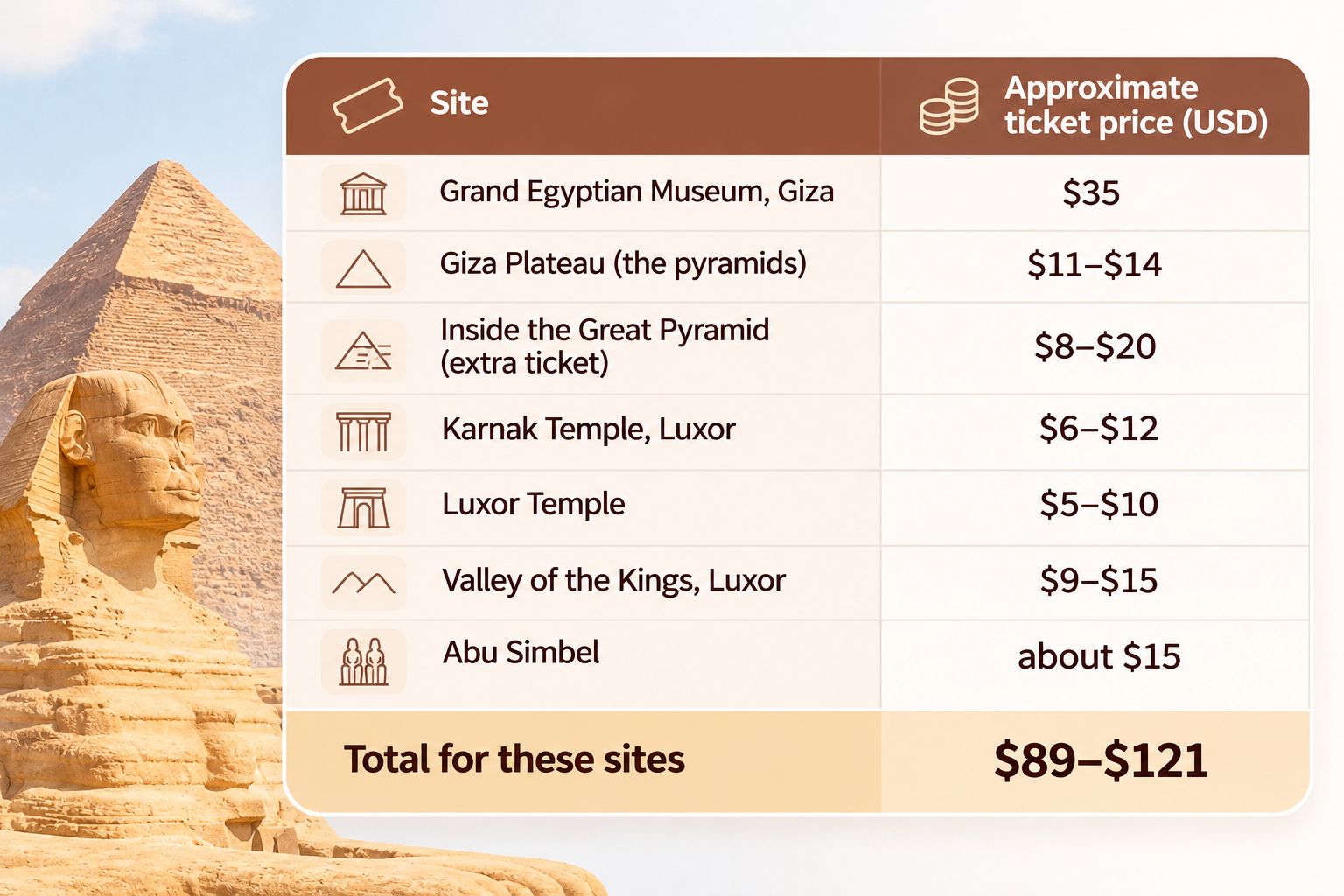
Egypt entry fees for the main sites add up to roughly $90 to $120 per person, and most visitors spend more once they add extra tombs and temples. The biggest single-ticket attraction is the Grand Egyptian Museum, which will cost $35 for foreign adult visitors from 1 November 2026.

Here are the major sites in US dollars. Sources disagree on several of these, so they’re shown as ranges:

Table showing prices of Egypt main sites

Two cautions apply. First, ticket prices are revised regularly, so check the current price on the official ticketing channel before you travel. Second, tickets are priced in Egyptian pounds, so the dollar figure moves with the exchange rate. The table uses a rate of about 53-54 pounds per dollar as of mid-November 2026.

The table doesn’t include everything. Extra tombs in the Valley of the Kings are ticketed separately, and sites such as Philae and Hatshepsut’s temple cost more again. That’s why the site entry line in the budget table runs higher than the total here.

On guides: you can visit most sites on your own, and many travellers do. A private driver is often quoted at $50 to $100 per day, and a licensed guide is usually arranged as well. Guide fees vary, so ask what’s included before you agree. Tips are separate: tour operator guides suggest budgeting about $5 to $10 a day.

One more fixed cost is your visa. A single-entry e-visa costs $30, rising to $33 from 1 January 2027, and a visa on arrival is currently $30. Check Egypt’s official visa portal to confirm what applies to your passport before you book.

Money, cards and currency in Egypt

The simplest way to handle money in Egypt is a mix: Egyptian pounds (EGP) in cash for markets, tips, taxis and small cafés, and a card for hotels, larger restaurants, malls and many ticket offices.

Start with the exchange rate, because it affects every other number in this guide. In mid-November 2026, it was about 53-54 to the US dollar, and it has been moving. Before you go, convert your budget into Egyptian pounds at the current rate, then check again a few days before you fly.

A few practical points on Egypt currency exchange:

  • Cash limits: Egypt limits how much local currency you can carry in or out of the country, currently EGP 5,000 per person, and you must declare foreign currency worth more than $10,000. Check the latest customs rules before you travel.
  • ATMs: Cash machines in cities and tourist areas are the usual way to top up on pounds. The local bank and your own bank may each charge a withdrawal fee, and some machines cap how much you can take out at once, so ask your bank before you go and withdraw larger amounts less often.
  • Dynamic currency conversion: If a card terminal or ATM offers to charge you in US dollars instead of Egyptian pounds, decline and pay in pounds. That offer is called dynamic currency conversion, and the rate it applies is usually less favourable than the one you get by paying in local currency.
  • Cash for small spending: Markets, street food, tips and many taxis are cash-based, so don't count on cards for everything.

If you’d like a separate card for the trip, a Grey virtual card for spending abroad can sit alongside your regular bank card for payments that merchants accept by card, such as online hotel and tour bookings. It’s a virtual card, so you can’t use it to withdraw cash from an ATM. There’s a one-time card creation fee, and FX fees apply to payments made in currencies other than USD, so check the current fees on the Grey cards page before you travel.

If you need to pay a local host, driver or relative in Egypt before you arrive, you can also send money from the US to Egypt with Grey.

Grey's products and features are available to eligible users only, and availability depends on your location and account. Fees, limits and terms apply. Check grey.co for current details.

Frequently asked questions

How much does a week in Egypt cost?

A week in Egypt costs about $360 to $800 per person on a budget, $870 to $1,580 at mid-range, and $2,230 to $4,280 for a comfortable trip, excluding international flights. Add roughly $620 to $1,100 for a round-trip flight from the US, and remember that a Nile cruise replaces some hotel and food costs rather than adding to them.

Is Egypt cheap for tourists?

Egypt is cheap for food, local transport and basic accommodation, but not for everything. Site entry tickets, internal flights, guides, and cruises cost real money, and for many visitors, they make up a larger share of the budget than the daily basics do.

How much cash should you take to Egypt?

Carry enough for tips, markets, taxis and small cafés, and top up from ATMs as you go. One tour operator’s budget guide suggests $50 to $70 a day if you rely on cash for most spending, and you’ll need far less if you pay by card at hotels and larger restaurants. Remember the limit of EGP 5,000 in local currency that you can carry in or out of the country.

Do you need a guide for the pyramids?

No. You can buy a ticket for the Giza Plateau and explore on your own, and many visitors do. A guide mostly adds history and context, so if you hire one, agree on the price and what it includes before you start.

What is the cheapest month to visit Egypt?

For flights from the US, one fare tracker’s November 2026 data showed January and February as the cheapest months. Hotel prices are usually lowest in the hot summer months, roughly June to August, though temperatures in Luxor and Aswan are very high then. Many travellers consider the cooler months from around October to April the best time to visit Egypt for sightseeing, but that’s also when prices peak, especially around Christmas and New Year.

Are cards widely accepted in Egypt?

Cards are accepted at hotels, upmarket restaurants, malls and many ticket offices, but markets, street food stalls, small cafés and many taxis are mostly cash. Carry some Egyptian pounds, and if a terminal offers to charge you in dollars, choose pounds instead.

Get a Grey card and spend in different currencies.

Receiving foreign income in Morocco without a domiciliary account

•

•

2 min read

Is it possible to receive foreign income in Morocco without a domiciliary account? The simple answer is yes. However, it is not always straightforward, especially with the wrong payment services.

Domiciliary (foreign currency) accounts were once the standard for Moroccans earning in USD, EUR, or GBP, but they are becoming less popular. Opening one often involves extensive paperwork, multiple bank visits, minimum balance requirements, and strict compliance with local regulations. Beyond these,  SWIFT fees, intermediary charges, and poor conversion rates when converting to MAD make them too expensive for the average person.

The good thing is that you don’t need a traditional domiciliary account at banks such as Attijariwafa Bank or Banque Centrale Populaire to manage international payments efficiently. Freelancers, remote workers, and expats earning from abroad can not find alternatives that suit their needs.

This article explains how Moroccans can receive foreign income without a domiciliary account and describes the pros and cons of each option.

Why do many Moroccans avoid domiciliary accounts?

A domiciliary account allows you to receive foreign currencies without immediate conversion to MAD. On paper, this sounds ideal. In practice, these accounts come with significant problems. A domiciliary (or foreign currency) account allows you to receive USD, EUR, or GBP without automatically converting to MAD. However, these accounts have considerable limitations, including:

  • You have to visit the banking hall.
  • It might require cumbersome paperwork.
  • It takes a while to open an account.
  • SWIFT fees and other bank charges can eat into earnings.
  • There is limited flexibility when trying to make online payments and subscriptions.
  • Transactions may take a few days to complete.

How Moroccans receive foreign income without a domiciliary account

There are three main alternatives: online payment platforms, fintech multi-currency accounts, and cash pickup services. Each serves a different purpose, depending on how often you get paid and how much control you want over your money.

LDMAG1

PayPal

PayPal is one of the most widely recognised international payment platforms. Many foreign clients already trust and use PayPal, which makes it easy to request payments without lengthy explanations or setup.

PayPal allows Moroccans to receive payments in foreign currency and withdraw funds to a local bank account or card. Transactions are usually instant, and the platform is easy to use. However, PayPal is designed more for convenience than cost efficiency. Withdrawal requires automatic conversion to MAD, often at exchange rates that include hidden mark-ups. Fees can be substantial, especially for regular income, and users have little control over when or how conversion happens. There are also frequent reports of account restrictions and suspensions that can interrupt your cash flow or lead to losses.

PayPal works best for occasional payments or short-term use, but it becomes expensive and restrictive for consistent freelance or remote income.

Fintech platforms and multi-currency accounts

This is easily a top recommendation for managing international payments in Morocco. Most of these platforms are designed to address the challenges posed by the rigid traditional domiciliary account payment system. They let you complete cross-border transactions like it is local payments and convert to MAD whenever you like.

Also read: Top digital nomad hotspots in Morocco for remote workers

Grey

Grey offers Moroccans USD, EUR, and GBP account details that you can share directly with international clients or employers.  You can hold your income in foreign currency, convert it to MAD when exchange rates are favourable, and withdraw it to your Moroccan bank account.

Grey also supports automated invoicing, integrates with freelance platforms, and provides virtual cards for paying subscriptions, tools, and services directly in foreign currency. This setup gives freelancers and remote workers far more control over exchange timing, fees, and spending, making it well-suited for regular international income.

Also read: How freelancers in Morocco can switch from traditional banks to Grey

Payoneer

Payoneer is widely used by freelancers working with global marketplaces and companies. It offers foreign accounts and allows withdrawals to Moroccan bank accounts. Payoneer is reliable and well-integrated with major freelance platforms, but its fee structure can be cumbersome. Currency conversion and withdrawal fees can be relatively high, and customer support is often slow. It remains a practical option for platform-based freelancers, though it offers less flexibility than newer fintech solutions.

Wise

Wise is known for transparent pricing and mid-market exchange rates. While it offers strong multi-currency functionality globally, features for Moroccan residents are limited, especially regarding local withdrawals and employer payments. Wise is effective for individuals with international banking needs, but may not be the most seamless solution for Moroccan-based freelancers who rely on frequent payouts.

Also read: Freelancing legally in Morocco: licences, taxes and foreign income rules

Cash pickup services

Cash pickup services are another way to receive foreign income without a domiciliary account, but you should treat them more like a fallback than as your main payment solution.

MoneyGram and Western Union allow senders abroad to transfer money for cash pickup in Morocco without a bank account. These services provide fast access to cash and nationwide availability. However, they come with high fees, unfavourable exchange rates, and low transaction limits. They are also not recommended for freelancers and remote workers with regular foreign income, invoicing, and financial  planning.

Managing international payments with Grey

You don’t need a domiciliary account to receive foreign income in Morocco. Freelancers, remote workers, and expats who regularly earn in USD, EUR, or GBP need an alternative that suits their needs. Grey offers you control over exchange rates, lower fees, faster payment processing, and the flexibility required to manage a global income. With the newly improved Grey cards, you now manage your payments globally by creating multiple cards, spend directly from your balance without top ups, and link with Apple Pay and Google Pay. Grey bypasses the paperwork and restrictions of domiciliary accounts, allowing you maximise you income without hassles.

Sign up for a Grey account by downloading the app to manage your foreign income with ease.

‍

The best long-stay destinations for remote workers

•

•

2 min read

Choosing a long-stay destination is really different from short visits. If you just need to go out and touch grass or escape from work briefly, you might not have to plan too much. But if you are going to be staying for months, you need to think beyond waking up on a beach or watching the sunset hitting the horizon. A lot more factors come into play with long-stay destinations, and if you don’t carefully pick your destination, you might get frustrated and have to leave sooner than planned

This guide covers some of the best places for remote workers to stay long-term. Before we get into the list, let’s look at what you should think about when picking your next spot.

Also read: Best countries to move to on a digital nomad visa in 2026

What should you consider before choosing a long-stay destination?

Travelling as a remote worker is different from a regular vacation. You need to balance work and fun, so it’s important to think about what will help you stay productive and comfortable during your stay.

  • Internet: Fast, reliable internet is a must for remote workers. It helps you stay connected with your team, work smoothly, and join meetings without issues.
  • Legal requirements: Make sure to check visa rules, taxes, and travel insurance before you go.
  • Cost of living: Look up the average prices for housing, food, and transport to be sure you can afford to live there on your budget.
  • Infrastructure: Check if there are coworking spaces, cafes, good public transport, and other things that will help you work comfortably.
  • Safety: Choose safe neighbourhoods that are close to good medical care. It’s also smart to check your country’s travel advice before you go**.**
  • Lifestyle: Think about the weather, time zone differences with your job, fun things to do, and whether there’s a community for networking.
  • Accommodation: Try to find places with a kitchen to save money on food and enough space for a good work setup.

Also read: How global workers plan income, location, and lifestyle together

The best long-stay destinations for remote workers

With all these factors in mind, here are some of the top long-stay destinations for remote workers.

Lisbon, Portugal

Lisbon has long been a favorite in Europe for long-term stays. The D8 visa lets you stay for up to two years, and the city offers rich culture and a lower cost of living than many other European cities. You’ll find fast fiber internet (100+ Mbps) and coworking spaces like Second Home and Lisbon WorkHub. With a Schengen visa, it’s easy to visit other European countries too. Lisbon is a great choice if you want a European base that’s affordable.

Here’s what the average budget of a digital nomad living in Lisbon looks like.

Valencia, Spain

If you want a city with a Mediterranean vibe and strong digital infrastructure, Valencia is a great pick. Earning about $3,500 per month lets you apply for Spain’s Digital Nomad Visa. You can live well for under $1,500 a month, or up to $2,000 if you want more comfort. Valencia has fast fiber internet (often 100+ Mbps) and plenty of coworking spaces like Vortex Centro and ExpressHub. There’s lots to do, from exploring modern architecture to enjoying the historic sites and relaxing by the coast.

Marrakech, Morocco

Morocco is a crossroads between the Arab world, Africa, and Europe, making Marrakech a unique place for remote workers. The city’s cultural mix is welcoming, and it’s easy to meet people from different backgrounds. While Morocco doesn’t have a specific digital nomad visa, visitors are generally welcomed. The city has strong digital infrastructure and coworking spaces like L’BLASSA, Targa, and Goworking. You can live comfortably in Marrakech on $1,200 to $2,000 per month, and find accommodation in the medina for as little as $400 a month.

Also read: Remote-work friendly cities in Morocco: Rabat, Casablanca or Marrakech?

Chiang Mai, Thailand

Many Southeast Asian cities stand out to remote workers for their affordable living costs, warm residents, and peaceful natural environments. Chiang Mai's the OG nomad hub in Southeast Asia, and with Thailand's DTV visa now valid for 5 years for remote workers, it's even better for long stays. The Internet's solid at 200+ Mbps in coworking cafes like Punspace, and you can live well on $1,000-1,500 monthly. Temples, night markets, and mountain hikes keep things exciting, plus a huge expat scene for meetups. It's great for budget-conscious folks who want culture without chaos.

LDMAG1

Mexico City, Mexico

If you want a lively city, Mexico City is a great choice. The temporary resident visa lets many people stay for up to four years if they can show an income of about $2,600 per month. The city has reliable internet and growing coworking spaces. You can get by on $1,000 to $1,600 a month. Enjoy the tacos, museums, and nice weather. It can get busy at times, but there’s always something to do.

Managing your finances on the go

If you want an easy way to manage your money while traveling, try using multicurrency accounts. Grey lets you hold USD, GBP, or EUR, switch between them easily, and make low-fee transfers. You can also withdraw in local currencies at fair rates and use a USD debit card for online payments wherever you are.

Get started on Grey today and download the app to seamlessly manage your finances on the go.

‍

How much does a trip to Greece from the United States cost?

•

•

2 min read

Let’s say you found a return flight from Greece for $890 and started planning a week-long vacation around it. Then you check hotels on Santorini and one night costs more than you expected to spend for three nights. You quickly realise that the flight is usually the easiest part of trips to Greece to price; hotels, ferries, and how many islands you visit are where the budget moves.

A one-week trip to Greece from the United States costs roughly $1,200 to $1,900 per person on a budget, $2,000 to $3,000 mid-range, and $5,000 or more for luxury stays. Flights, island ferries, and July and August hotel rates drive most of the difference.

How much does a trip to Greece cost? Budget range overview

A week in Greece breaks into three cost layers: getting there, sleeping, and moving around once you arrive. Return flights from the United States typically cost $700 to $1,300. On the ground, a budget traveller spends about €450 to €800 for seven nights and a mid-range traveller spends €900 to €1,500, both assuming two people share a room. Dollar totals in this article use an assumed rate of $1.10 to the euro, so adjust them if the rate has moved by the time you book.

Three choices affect a trip to Greece more than any others.

The first is season, because July and August are when rooms cost the most, and Greece also charges a higher nightly climate fee from April to October than from November to March.

The second is which island you pick: a mid-range room that costs about €130 a night on Naxos can cost €250 to €350 on Santorini in August.

The third is how many ferry hops you add, since each leg costs €35 to €108 depending on the route and vessel.

How much does a trip to Greece cost from the USA?

__wf_reserved_inherit

Return flights from the United States cost about $700 to $1,300. Direct flights from several East Coast cities to Athens take roughly nine to ten hours, and fares sit at the top of that range in July and August. Once you land, a 3-star hotel room in Athens typically costs €70 to €140 a night, and meals run €20 to €35 a day for budget travellers or €45 to €70 for mid-range travellers who eat two sit-down meals daily. An Acropolis ticket is €30, and a flat-rate taxi from Athens airport to the city centre costs €43 during the day and €60 at night, so an Athens-only week stays near the bottom of each range.

That puts a budget trip from the USA at roughly $1,200 to $1,900 per person and a mid-range trip at $2,000 to $3,000 per person, including one island ferry trip. Because you pay for flights in dollars and for almost everything else in euros, the exchange rate and any card fees apply to nearly every purchase after you land, which is why the payment section below is worth reading before you travel.

How much does a trip to Greece cost from North America?

This section covers Canada, Mexico, and the rest of North America; US travellers should use the section above. Return flights from these origins cost about $800 to $1,400. The ground costs are the same as for any other origin: budget travellers spend €450 to €800 per week, and mid-range travellers spend €900 to €1,500 per week. That makes a budget trip about $1,300 to $2,000 per person and a mid-range trip about $2,000 to $3,100.

Currency adds a step for Canadian and Mexican travellers. Fares may be quoted in Canadian dollars or pesos, while hotels and ferries are priced in euros, and the totals here are in US dollars and euros. Check the day’s rate between your own currency and the euro before treating any total as final, because a three per cent swing on a $2,500 trip is $75.

How much does a trip to Greece cost from Europe?

Flights from elsewhere in Europe are the cheapest in this guide, at roughly €150 to €400 return, because most European capitals have direct routes to Athens and several islands. Ground costs stay the same: €450 to €800 for a budget week and €900 to €1,500 for a mid-range week. Totals come to about €600 to €1,200 for a budget trip and €1,050 to €1,900 for a mid-range trip, shown in euros because that is how most European travellers budget. Compare with the Europe trip cost by country.

Travellers from the eurozone don’t convert any currency in Greece, so their only extra cost is card fees if the account isn’t in euros. Travellers from the UK, Switzerland, and Poland pay a conversion fee on every purchase, which makes the card or account you choose a bigger part of the total.

How much does a trip to Greece cost from Africa?

__wf_reserved_inherit

Return flights from Africa to Athens cost about $500 to $1,100, and most itineraries connect through a hub such as Istanbul, Cairo, or Addis Ababa, so fares vary with the route. Citizens of most African countries, including Nigeria, Ghana, Kenya, Egypt, and Morocco, need a Schengen visa for Greece. The application fee is €90 for adults, and applicants usually also pay a visa centre service charge and need travel insurance with at least €30,000 in medical cover. Add those costs to your total.

Excluding the visa, a budget trip from Africa comes to roughly $1,000 to $2,000 per person and a mid-range trip to $1,700 to $2,800. Many travellers from Africa pay for flights and hotels in dollars or euros, so how you hold foreign currency before you leave matters as much as the fare.

How much does a trip to Greece cost from South America?

Return flights from South America to Athens cost about $1,100 to $1,900 and usually include one connection in Europe, which makes this the most expensive origin in the guide. Citizens of Brazil, Argentina, Chile, Colombia, and Peru can enter Greece without a visa for up to 90 days in any 180-day period, while citizens of some other countries in the region need one, so check with the Greek embassy before you book.

A budget trip comes to roughly $1,600 to $2,400 per person, and a mid-range trip to $2,300 to $3,600 per person. With a long-haul fare as the largest line item, the biggest savings usually come from the flight date, so compare fares across several weeks before you fix your hotel dates.

Trip to Greece cost breakdown: flights, hotels, ferries, and food

This table lists the line items behind the totals above. Prices are per person unless a row says per room, and ferry prices vary with vessel type, season, and how far ahead you book.

Item Typical cost Notes
Return flight from the USA $700–$1,300 Top of the range in July and August
Hostel bed €20–€40 per night Around €20 in Athens, around €40 on Mykonos and Santorini
Budget guesthouse €25–€50 per room per night Outside peak season on most islands
3-star hotel €70–€140 per room per night Higher on the islands in July and August
4-star boutique hotel €140–€250 per room per night Family suites fall in this range
Caldera-view luxury villa €400–€900+ per night Santorini and Mykonos in peak season
Climate crisis resilience fee, April to October €2–€15 per room per night €2 for 1 to 2-star, €5 for 3-star, €10 for 4-star, €15 for 5-star; paid at the hotel
Climate crisis resilience fee, November to March €0.50–€4 per room per night Same star categories at lower rates
Meals €20–€35 per day (budget), €45–€70 (mid-range), €80–€120 (comfortable) Taverna dinners average €18–€35 per person
Ferry, Piraeus to Santorini (conventional) €40–€60 About eight hours
Ferry, Piraeus to Santorini (high-speed) €60–€90 About 4.5 hours
Ferry, Piraeus to Mykonos (conventional) €35–€45 About five hours
Acropolis ticket €30 Per person
Boat excursion About €100 Day trips from the islands
Taxi, Athens airport to centre €43 daytime, €60 at night Fixed rate

‍

Ferry times and prices change by season and operator, so check the official Greek tourism site for island information and confirm fares with the ferry operator before you book. If you already know your hotel and ferry costs, you can hold euros before you leave, which locks in the exchange rate for the part of your budget you can price today.

How to budget and pay for your trip to Greece

Once the budget is set, the next cost is paying for it. Three charges matter most: your bank's foreign transaction fee, the ATM operator’s withdrawal fee, and dynamic currency conversion, which happens when a Greek card terminal or ATM offers to charge you in dollars instead of euros. Decline that offer, because the conversion is usually done at a less favourable rate than your card network’s.

Grey is one way to handle this. You can hold euros in a Grey account, convert dollars to euros at a 1% cap of $6. You can also spend USD on a virtual card that costs $5 to create and has no monthly fee. As a worked example, converting $1,320 (about €1,200, a mid-range week on the ground) costs $6 in conversion fees instead of $13.20, because of the cap. The exchange rate itself includes a margin over the mid-market rate, and Grey shows it before you confirm. You can also buy a travel eSIM for Greece in the app so you have data when you land, and send money from the US to Greece if you need to pay a host or a booking deposit in advance. A fee-free travel card from your own bank may cost less on a given trip, so compare each option’s foreign transaction fee, conversion rate, and monthly fee before you choose.

Frequently asked questions

How much does a trip to Greece cost?

A one-week trip to Greece from the United States costs roughly $1,200 to $1,900 per person on a budget and $2,000 to $3,000 per person in the mid-range, including flights of $700 to $1,300. Ground costs alone run about €450 to €800 for a budget week and €900 to €1,500 for a mid-range week, with hotels and ferries causing most of the variation.

Is Greece expensive?

It depends on where you go. Daily costs run from about €55 to €210 per person on the mainland and €80 to €420 on the islands, depending on travel style. Santorini and Mykonos cost the most, and a traditional taverna dinner averages €18 to €35 per person, including house wine.

How much does island hopping cost?

Ferry fares run €35 to €50 per leg on conventional ferries and €70 to €108 on high-speed catamarans, so three to four legs cost roughly €100 to €430. Athens to Santorini costs €40 to €60 on a conventional ferry (about eight hours) and €60 to €90 on a high-speed ferry (about 4.5 hours). The best departure times can sell out on the busiest summer routes, so book early.

When is the cheapest time to visit Greece?

November to March is the cheapest period for the nightly climate fee, which falls to €0.50 to €4 per room, compared with €2 to €15 from April to October. Room rates are also lower outside July and August, when a mid-range room that costs about €130 on Naxos can reach €250 to €350 on Santorini. Some island ferry routes run less often in winter, so check timetables before you plan an island trip.

Do I need a visa or ETIAS for Greece?

US, Canadian, and many South American passport holders can visit Greece for up to 90 days in any 180-day period without a visa. Citizens of most African countries need a Schengen visa, with an application fee of €90 for adults. The EU’s ETIAS travel authorisation, a short online application for visa-exempt visitors, has been scheduled to start in the last quarter of 2026, so check the official ETIAS website for the start date and fee before you book.

Should I pay in euros or dollars in Greece?

Pay in euros. When a card terminal or ATM offers to charge you in dollars, known as dynamic currency conversion, decline it, because the conversion is usually done at a less favourable rate than your card network’s. Check your own card’s foreign transaction fee and ATM charges before you leave, since those are the two fees that apply to most purchases.

Heading to Greece? Hold euros with Grey, spend on a virtual card, and add a travel eSIM before you fly.

Arrow (up)

Back to top